Peng Yue∗
University of Electronic Science and technology of China, Chengdu, China
In the past hundred years, chaos has always been a mystery to human beings, including the butterfly effect discovered in 1963 and the dissipative structure theory which won the chemistry Nobel Prize in 1977. So far, there is no quantitative mathematical-physical method to solve and analyze these problems. In this paper, the idea of using field theory to study nonlinear systems is put forward, and the concept of generalized potential is established mathematically. The physical essence of generalized potential promoting the development of nonlinear field is extended and the spatiotemporal evolution law of generalized potential is clarified. Then the spatiotemporal evolution law of conservative system and pure dissipative system is clarified. Acceleration field, conservative vector field and dissipation vector field are established to evaluate the degree of conservation and dissipation of physical field. Finally, the development route of new field research and the precondition of promoting engineering application in the future are discussed.
For a long time, the researches on nonlinear problems have attracted much attention. The reason for this en-thusiasm for research is that, on the one hand, due to the continuous in-depth study of turbulence, buckling and other mechanical theories, the problems found have obvious nonlinear characteristics [1], which greatly re-stricts related theoretical breakthroughs and engineering innovation. On the other hand, the well-known butter-fly effect, dissipation mechanism and other factors also show the influence of nonlinear factors in the researches of medical statistics [2], economics [3], sociology [4] and other disciplines, which also makes the research on non-linear problems attract the attention of researchers in other subjects. Therefore, it is necessary to develop in-novative mathematical analysis methods to describe non-linear phenomena.
At present, in addition to relying on phenomenological statistics to obtain the basic laws of nonlinear dynam-ics [1][2][3][4], international researches on nonlinear prob-lems are mainly based on two major ideas. One is to rely on the continuous development of mathematical theory, through geometric methods or the solution of nonlinear partial differential equations [5] to obtain the basic laws of system nonlinearity. The other is to add the necessary physical conditions to linearize the nonlinear problem, and develop and improve the approximate characteristics of nonlinearity through the study of linear problems [6]. However, one obstacle is that the development of mathe-matical theory depends on sufficient inspiration and con-tinuous updating of philosophical methodology. Another obstacle is that the physical simplification method of lin-earization will lead to the loss of key information of non-linear problems. For example, the current common initial value sensitive problems cannot be reflected by linearized models. Based on the above two problems, the nonlinear theory of classical mechanics is already in a bottleneck period, and it is urgent to develop new analysis methods to deal with the current problems.
∗Emial: [email protected]
Usually, any nonlinear system can be expressed by the following general expressions:
˙
xi=fi(xj), fi∈C2(Rn) (1) For example, Lorentz system can be expressed as:
˙ x1=σ(x2−x1) ˙ x2=rx1−x2−x1x3 ˙ x3=x1x2−bx3 (2)
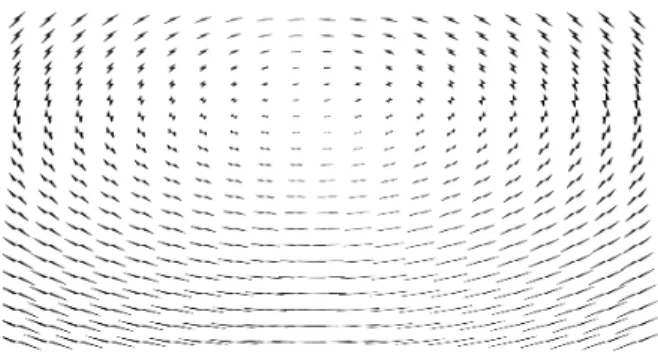
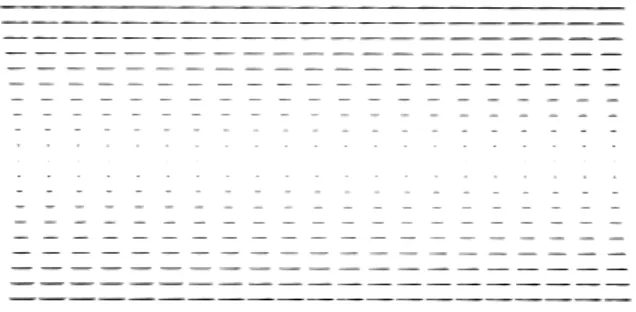
At present, the common method for studying above the system is Lagrange method. The above-mentioned system is taken as the motion equation of the particle system, and the stability of the system can be judged by studying the singularity of the system [7]. This method is widely used in related projects. However, this method has great limitations in revealing the nonlinear dissipa-tion characteristics of the system at the system level, for example, it is very difficult to judge the occurrence of butterfly effect and reveal the characteristics of dissipa-tive structure in chaos systems. In the field of mechanics, the common analysis methods include Lagrange method and Euler method. In this paper, Euler method is used to describe the nonlinear system. For example, for Lorentz system (2), “phase flow” can be expressed as FIG. 1 to FIG. 3.
FIG. 1. Phase flow diagram on XOY plane for Lorentz system In addition, it can be seen that the streamline diagram of phase flow fits well with the traditional phase diagram of nonlinear system.
FIG. 2. Phase flow diagram on XOZ plane for Lorentz system
FIG. 3. Comparison between streamline diagram (blue) of phase flow and traditional phase diagram (red) for Lorentz system
Streamline, as one of the physical quantities of fluid mechanics, refers to the curve which is tangent to the velocity vector at every point in the flowfield. It is a curve composed of different fluid particles at the same time and reveals the spatial distribution law of velocity, which coincides with the relationship between momentum and position in phase diagram. It inspires a new method to solve PDEs and will be discussed in the future because it is not related to the content discussed in this paper.
From FIG. 1 to FIG. 3 provide a good foundation for the introduction of nonlinear analysis into field theory. In the history of conservative field research, firstly, La-grange [8] described the gravitational field with gravita-tional potential. The gravity at any point is equal to the negative gradient of the gravitational potential at that point. Then, Laplace [9] gives the gravitational potential equation in rectangular coordinates. Laplace [9] assumes that the Laplace equation holds when the attractive par-ticle is in the body. Finally, Poisson [10] fixed the error. Poisson [10] pointed out that if the point is in the interior of the attractor, the Laplace equation should be changed to Poisson equation in practical physics research. There-fore, we can understand that potential is the reason to promote the development of conservative field [11]. As we all know, nonlinear field includes conservative field and dissipative field. According to the expansion of the con-servative field researches, we believe that the nonlinear field also has a “push potential” to promote its
develop-ment. In order to study this “push potential”, here is the concept of generalized potential.
Definition 1. For Ω ⊂ Rn, M = (Ω,S), existence tensor field σij ∈ TM. if conjugate gradient of vector
ϕi ∈ TM satisfy condition σij = ϕi∂j, the vector ϕi is
generalized potential of tensor fieldσij.
In order to explain why conjugate gradient is used in the definition, lemma 1 need to be studied.
Lemma 1. The curl of vector’s gradient is zero, and the curl of vector’s conjugate gradient is not zero.
Proof. Due to arbitrary vector ϕi ∈ TM, M = (Ω,S),
the curl of vector s’ gradient is ek∂k×eiej∂iϕj = ek×ei
ejϕj,ki=ki••memejϕj,ki
For partial derivatives, the order of derivation is trans-formed, and its value does not change.
ki••memejϕj,ki =ki••me mejϕ
j,ik
By converting the index again, we can obtain
ki••memejϕj,ik=ik••me mejϕ
j,ik=−ki••me mejϕ
j,ki= 0
It is proved that the curl of vector’s gradient is zero. Then, assuming that the curl of the conjugate gradient of the vector is zero and always holds
ek∂k×eiejϕi∂j ≡ −ek∂k×eiejϕi∂j
We can get the following formula ek∂k×eiejϕi∂j= ek×ei
ejϕi,kj=ki•••me mejϕ
i,kj
According to the rule of index conversion, we can ob-tain
−ki•••memejϕi,kj =•mik••emejϕi,kj=k•im••ekejϕi,mj
Combine the above two formulas, we can get a funny conclusion
k≡m
According to the definition of tensor index, it is obvious that the curl of vector’s conjugate gradient is not zero.
Thus it can be seen that the conjugate gradient is dif-ferent from the gradient. The gradient of the vector has the expression problem of rotating field. However, the conjugate gradient represents the second-order tensor, which can be homeomorphic mapping with the original tensor. Therefore, any tensor can be expressed as conju-gate gradient form of vector.
In order to establish the relationship between conju-gate gradient and gradient, lemma 2 should be studied.
Lemma 2. The divergence of the conjugate gradient of an arbitrary vector is equal to the gradient of the diver-gence of this vector.
Proof. Due to arbitrary vector ϕi ∈ TM, M = (Ω,S),
the divergence of the conjugate gradient of the vector is ek∂k·eiejϕi∂j=ejδkiϕi,jk=ejϕi,ji
and the gradient of the divergence of vectorϕi is
ej∂j ek∂k·eiϕi
=ejδkiϕi,kj =ejϕi,ij
Because the order of derivation of partial derivatives can be interchanged arbitrarily, it can be obtained that
ejϕi,ji=ejϕi,ij
It can be concluded that the divergence of the conju-gate gradient of an arbitrary vector is equal to the gra-dient of the divergence of this vector.
In the field of classical mechanics, Newton’s second law is usually considered when describing the relationship between the change of motion state and the force acting on it. So we can get the most important theorem of this paper.
Theorem 1. For stress tensor field σij ∈ TM, M =
(Ω,S). The generalized potential of the stress field is
ϕi∈TM, then the evolution law of the stress field
satis-fies
ϕ•i,,i••j =ρduj
dt (3)
whereρis the density of nonlinear system,tis developing time of the nonlinear system anduj is the velocity vector
of nonlinear system.
Proof. Generally, an object is subjected to two kinds of force, surface force Fjplane and mass force Fmass
j .
Hy-pothetically, if the force caused by mass is equivalently distributed to the surface, then it can be mathematically equivalent to sum surface forceFj.
Fj=F plane j +F
mass j
According to Gauss theorem, above force can be de-scribed by stress state,ni is the surface normal vector.
Fj= Z ∂τ niσijd(∂τ) = Z τ σij,••,i•dτ
so the force per unit volume can be expressed as
fj=
dFj
dτ =σ
••,i ij,•
Assuming that the generalized potential of the stress field isϕi∈TM, according to lemmas 1 and 2, it is easy
to obtain the following expression
σij,••,i• =ϕ•i,j,••i=ϕ•i,,i••j
Newton’s second law with the force per unit volume in Mechanics can be expressed as:
fj=ρ
duj
dt
Combining all of the above formulas, we can obtain the final result
ϕ•i,,i••j =ρduj dt
In this way, the theory has been proved.
This theorem reveals the spatiotemporal evolution law of nonlinear systems in classical mechanics. According to the famous formula in field theory. It can be simply un-derstood that the sum of Laplacian operator and double curl operator is the operator on the left of formula (3) as shown in following
ϕi,•,i••j =ϕj,i•,••i+•j••nm•
ki m••ϕi,nk
In the previous introduction, it has been explained that the physical field represented by the Laplacian operator is a conservative field. Therefore, theorem 2 can be ob-tained and the proof is omitted.
Theorem 2. In the framework of classical mechanics, nature exists a generalized potential ϕi in the
nonlin-ear system. The generalized potential is the fundamental reason that drives the development of nonlinear systems. The spatial evolution law of the generalized potential is
ϕ•j,i,••i+j•••nm•mki••ϕi,nk=ρ
duj
dt (4)
whereρis the density of nonlinear system,tis developing time of the nonlinear system anduj is the velocity vector
of nonlinear system.
In addition, we can get two important corollaries, which reveal conditions for the occurrence of conserva-tive system and pure dissipaconserva-tive system.
Inference 1. The conservative field satisfies the follow-ing relations, the Laplacian operator of the generalized potential is a constant value, and the acceleration drives the generalized potential to be spatially distributed in the form of double curl operator.
Lj =ϕ•j,i,••i, Lj∈TM (5)
At this time, the space-time evolution law can be trans-formed into
•j••nm•mki••ϕi,nk=ρ
duj
dt −Lj (6)
whereρis the density of nonlinear system,tis developing time of the nonlinear system anduj is the velocity vector
Inference 2. The pure-dissipation field satisfies the fol-lowing relations, the double curl operator of the gener-alized potential is a constant value, and the acceleration drives the generalized potential to be spatially distributed in the form of Laplacian.
Dj =•j••nmm•ki••ϕi,nk, Dj∈TM (7)
At this time, the space-time evolution law can be trans-formed into
ϕ•j,i,••i=ρduj
dt −Dj (8)
whereρis the density of nonlinear system,tis developing time of the nonlinear system anduj is the velocity vector
of nonlinear system.
Formula (5) reveals the basic evolution law of general chaotic system, and formula (6) and formula (7) are two limits of chaotic motion. Therefore, the following phys-ical quantities can be defined to evaluate the degree of conservation and dissipation in any chaotic system.
Definition 2. ForΩ⊂Rn,M = (Ω,S), existence
ten-sor field σij ∈ TM. L is the Laplace operator and D is
the double curl operator. Lj ∈ TM is the conservative
vector field and Dj ∈ TM is the dissipation vector field
for the original tensor field σij. The development speed
of complex system isuj∈TM and the generalized
poten-tial isϕj∈TM, then these nonlinear development law of
complex system is as follows:
ρduj
dt =Lj+Dj, Lj=L(ϕj), Dj=D(ϕj) (9)
whereρis the density of complex system,t is developing time of the complex system
Finally, an example is given to illustrate the influence of generalized potential on nonlinear system. If the dis-tribution of generalized potential in three-dimensional space is in the following form
ϕ1=σ(x2−x1)
ϕ2=rx1−x2−x1x3
ϕ3=x1x2−bx3
(10)
It is noticed that above equations look like Lorentz sys-tem, but they are the spatial distribution of the general-ized potential, not the spatial distribution of the original field, so it is not Lorentz system. Let’s name it the new-1 nonlinear system. Its generalized potential space distri-bution is shown in FIG. 1 to FIG. 3. The distridistri-bution of dissipation vector is shown in FIG. 4 to FIG. 7.
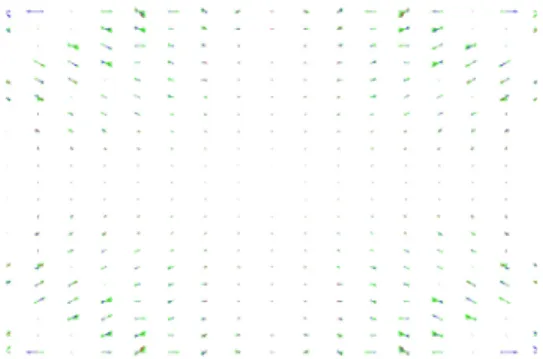
It can be seen from FIG. 4, FIG. 5 and FIG. 6 that the small disturbance at the center point will bring vi-bration of the distant space acceleration, which reveals the famous ”Butterfly Effect” [12]. For the new-1 non-linear system, the maximal amplifying coefficient is be-tween 115 and 155. In fact, due to the superposition of
FIG. 4. Dissipation (green) and conservative (red) vector field distribution and acceleration field (blue) on XOY plane for nonlinear system New-1
FIG. 5. Dissipation (green) and conservative (red) vector field distribution and acceleration field (blue) on XOZ plane for nonlinear system New-1
vectors, the small disturbances in different places will be integrated to balance. Therefore, if we want to calculate the disturbance amplifying coefficient in space, we need to consider all the small disturbance values and stack them. The cancellation of the nonlinear interaction can be demonstrated in the experiment of turbulent inter-action changing into laminar flow published in 2019 [1]. In addition, it can be seen from the streamline diagram FIG. 7 that the dissipative structure of nonlinear dis-turbance is reciprocating, and it can be seen that system will develop from one equilibrium state to another. Here, the dissipative structure theory [13] proposed by Ilya Pri-gogine is verified mathematically and physically. So we can get the following general law in physics.
Theorem 3. All nonlinear processes spontaneously un-dergo a conservative and dissipative reciprocating process. The generalized potential is distributed in the space in the form of divergence gradient operator, where the spatial distribution of the generalized potential on Laplace oper-ator represents the conservative behavior of the nonlinear system, and the spatial distribution on the double curl operator of the generalized potential represents the dissi-pative behavior of the nonlinear system, until the kinetic energy of the nonlinear system become zero and chaos stops.
FIG. 6. Dissipation (green) and conservative (red) vector field distribution and acceleration field (blue) on YOZ plane for nonlinear system New-1
FIG. 7. Streamlines of dissipation (green) and conservative (red) vector field distribution and acceleration field (blue) for nonlinear system New-1
Nonlinearity is the essential law of nature, so it is not only a physical law, but also a new natural philosophcal methodology. Due to the regular generalized potential distribution (Fig.1 and Fig.2) will lead to random and irregular distribution of kinematic physical quantities in space (Fig.4, Fig.5 and Fig.6) , the double curl opera-tor of complex system will lead to the failure of Lapla-cian determinism, Therefore, generalized potential and its principle can not only be applied to fluid mechanics, solid mechanics, electrodynamics, even economics, polit-ical science, history and other disciplines, but also con-tribute to development of natural philosophy principle.
In summary, mathematically speaking, the fundamen-tal cause of nonlinear phenomena is the double curl op-erator of the generalized potential. Due to the influence of different initial value and different boundary condi-tions, the spatial distribution of generalized potential is different, and the development law of nonlinear system has also undergone great changes. Its application scenar-ios could be different physical scenarscenar-ios of analytical me-chanics, fluid meme-chanics, solid mechanics and electrody-namics research. Therefore, the generalized potential can effectively unify classical mechanics. In addition, gener-alized potential can be used as an effective method to solve nonlinear problems in engineering. This is an open and challenging new field. Determining generalized po-tentials with different boundary conditions and different initial value will be the focus of future research in this field.
[1] J. Kuchnen, B. Song, D. Scarselli, and et.al. Destabiliz-ing turbulence in pipe flow. Nature physics, 14:386–390, 2019.
[2] J. Shen. A recursive bifurcation model for early forecast-ing of covid-19 virus spread in south korea and germany.
Science Report, 10(20776), 2020. DOI:10.1038/s41598-020-77457-5.
[3] J. L. Manda, M. Dino, K. Joseph, and et.al. Urbanization and market integration have strong, nonlinear effects on cardiometabolic health in the turkana. Science Advance, 6(43), 2020. DOI:10.1126/sciadv.abb1430.
[4] L. R. Barnett, J. D. Charman, and et. al. Nonlinear landscape and cultural response to sea-level rise. Science Advance, 6(43), 2020. DOI:10.1126/sciadv.abb6376. [5] T. Buckmaster and V. Vicol. Non-uniqueness of weak
solutions to the navier-stokes equation.Annals of mathe-matics, 189(1), 2019. DOI:10.4007/ annals. 2019. 189.1.3. [6] B. Hamzi and E. H. Abed. Local modal participa-tion analysis of nonlinear systems using poincar´e lin-earization. Nonlinear Dynamics, 99:803–811, 2019. DOI:10.1007/s11071-019-05363-1.
[7] N. V. Kuznetsov, T. N. Mokaev, O. A. Kuznetsova, and E. V. Kudryashova. The lorenz system: hidden boundary
of practical stability and the lyapunov dimension. Non-linear Dynamics, 2020. DOI:10.1007/s11071-020-05856-4.
[8] T. Fukushima. Lagrange’s analytical mechanics (la-grange 1788) in original french text. 05 2017. DOI:10.13140/RG.2.2.19275.59684.
[9] M. R. Ebert and M. Reissig. Laplace equation - prop-erties of solutions - starting point of elliptic theory.
Springer, 2018.
[10] L. Abadias, E. G. Jos´ea, and C. Lizama. Poisson equa-tion and discrete one-sided hilbert transform for (c, α) bounded operators. arXiv, 2020. arXiv:2002.10122. [11] L. Greengard and S. Jiang. A new mixed potential
rep-resentation for the equations of unsteady, incompressible flow. arXiv, 2018. arxiv:1809.08442.
[12] W. Cai, B. Ng, T. Geng, L. Wu, and A. Santoso. Pub-lisher correction: Butterfly effect and a self-modulating el ni˜no response to global warming. Nature, 2020. DOI:10.1038/s41586-020-2958-5.
[13] I. Prigogine. Herausgeber: Advances in chemical physics.
Interscience Publishers, John Wiley and Sons, London-New York, (416), 1965.