1
Bachelor of Applied Science - Supervision and Management - Appendices
PROPOSAL
BACHELOR OF APPLIED SCIENCE
with a major in
Electronics Engineering Technology
Submitted to:
The Florida Department of Education
by
MIAMI DADE COLLEGE
School of Computer & Engineering
Technologies
3 Contents
A. EXECUTIVE SUMMARY ... 5
PLANNING PROCESS ... 6
WORKFORCE NEEDS/DEMANDS ... 6
ACADEMIC CONTENT AND CURRICULUM ... 7
ASSESSMENT OF CURRENT AND ANTICIPATED RESOURCES AND BUDGET TO DELIVER THE PROGRAM ... 7
B. DESCRIPTION OF PLANNING PROCESS AND TIME LINE FOR IMPLEMENTATION ... 8
C. ANALYSIS OF WORKFORCE NEEDS/DEMANDS FOR THE BACCALAUREATE PROGRAM ... 11
LABOR MARKET DEMAND ... 11
NATIONAL TRENDS ... 11
EMPLOYER DEMAND ... 12
DIVERSIFIED WORKFORCE ... 14
STUDENT SUPPORT ... 14
POTENTIAL ENROLLMENTS ... 17
MDCCONTACT WITH SOUTH FLORIDA STATE AND PRIVATE UNIVERSITIES ... 18
D. ALIGNMENT WITH K-20 GOALS AND STRATEGIC IMPERATIVES ... 19
K-20GOALS ... 19
STRATEGIC IMPERATIVES... 21
E. ACADEMIC CONTENT AND CURRICULUM ... 22
CURRICULUM DESIGN ... 25
General Education and Common Prerequisite Courses ... 25
Senior Level Institution Core Courses ... 26
Standards of the field ... 26
Justification for 134 credit hours ... 27
Flexibility ... 27
Admission Requirements ... 28
Graduation Requirements ... 28
Terminal Program Outcomes ... 28
F. ASSESSMENT OF CURRENT AND ANTICIPATED RESOURCES TO DELIVER THE PROGRAM . 29 Library Volumes ... 29
G. PROPOSED ENROLLMENT, PERFORMANCE, AND BUDGET PLANS ... 32
H. ACCREDITATION PLAN ... 35
I. PLAN OF ACTION IN CASE OF PROGRAM TERMINATION ... 36
Proposal Implementation ... 36
Terms and Conditions of Program Continuation ... 36
REFERENCE LIST ... 37
APPENDICES ... 39
APPENDIX 1SURVEY OF MDCASSOCIATE IN SCIENCE EETSTUDENTS ... 40
4
APPENDIX 2AEMPLOYER SURVEY COMMENTS ... 46
APPENDIX 3 MDCALUMNI SURVEY ... 47
APPENDIX 3 MDCALUMNI SURVEY ... 47
APPENDIX 4 MDCSURVEY OF EETSTUDENTS –COMBINED AS AND AA DEGREE-SEEKING ... 51
APPENDIX 5:LETTERS OF SUPPORT ... 55
APPENDIX 6INDUSTRY FOCUS GROUP –JOB SKILLS ANALYSIS MATRIX ... 69
APPENDIX 7STATEWIDE ARTICULATION MANUAL CAREER LADDER AGREEMENT (EXCERPT) ... 70
APPENDIX 8LEARNING OUTCOMES COURSE MAPPING ... 72
APPENDIX 9COURSE DESCRIPTIONS FOR SENIOR INSTITUTION LEVEL TECHNOLOGY CORE COURSES ... 74
APPENDIX 10 4-YEAR ADVISING PLANNING SHEET ... 77
Sample Course Sequence ... 78
APPENDIX 11LABORATORY EQUIPMENT SUMMARY ... 80
APPENDIX 12 MIAMI DADE COLLEGE PROGRAM REVIEW PROCESS ... 81
APPENDIX 13 MIAMI DADE COLLEGE ENGINEERING DEPARTMENT CORE FACULTY ... 84
APPENDIX 14ENROLLMENT,PERFORMANCE, AND BUDGET PLAN ... 85
APPENDIX 15MINUTES OF PLANNING MEETINGS ... 86
APPENDIX 16MDCSCETENGINEERING ADVISORY COMMITTEE ... 94
5
A. Executive Summary
Miami Dade College (MDC) offers an Associate in Science (AS) degree in Electronics Engineering Technology (EET) and is proposing to offer a Bachelor of Applied Science with a major in Electronics Engineering Technology (BAS EET) degree in accordance with Florida Statute Section 1007.33. The objective is to address the local workforce need for baccalaureate-level engineers and to provide a smooth articulation for MDC’s AS graduates to attain a degree at a local institution that will support higher paying careers. On the statewide level, the Department of Labor occupation profile for Electronics Engineers in Florida projects annual growth to be 21% over the 10-year period 2004 to 20141. The Florida Agency for Workforce Innovation, Labor Market Statistics Center projects the annual growth rate for all engineering occupations at 17.04% from 2007 – 2015.
Miami Dade College’s Office of Institutional Research conducted surveys between June 2007 and September 2007 among employers, current students, and alumni to gauge the need for and level of interest in a baccalaureate degree in electronics engineering technology within Miami-Dade County. An initial student survey returned a statistical sampling of 153 respondents, comprised of both Associate in Science and Associate in Arts engineering majors. A second survey, conducted to identify the level of interest among Associate in Science engineering majors, yielded a sample of an additional 37 responses for a total survey sample of 190 subjects. The Employer survey was conducted among six companies who jointly employ over 12,000 workers in Region 23.
In a sampling of current Associate in Science Electronics Engineering Technology majors (AS EET), 87% (32) who responded said they intend to pursue a baccalaureate degree aftercompleting their associate’s degree (Appendix 1). Note: MDC enrolls an average of 300 AS EET majors per year.
Over 78% (25) of the AS EET student sample said they would enroll at Miami Dade College if it offered a bachelor’s degree (Appendix 1).
Employers who responded to the MDC Employer Survey projected as many as 200 incumbent workers would be interested in enrolling in a BAS EET if offered at Miami Dade College and local employers project a need to hire over 500 engineers with baccalaureate degrees over the next three to five years (Appendix 2).
In responding to MDC’s employer survey (Appendix 2), Florida Power and Light (FPL) indicated that potentially 200 employees would be interested in participating in a BAS EET program if offered at Miami Dade College, noting that it has not been successful in hiring local BS Engineering graduates who are able to pass FPL’s qualification examinations. Miami Dade College, however, has a close partnership with FPL, having recently developed an AS degree in Electrical Power Technology pipeline partnership tailored specifically to FPL’s needs and qualification exams. The proposed MDC BAS EET curriculum was developed with direct industry input from FPL and other local employers, and will provide students with the opportunity to acquire the skills and knowledge required by industry for entry-level electronics engineering positions.
In a survey of combined Associate in Science and Associate in Arts engineering majors conducted in September 2007 (Appendix ), 58.2% (92) of AA/AS engineering majors answered yes when asked if they would enroll in the BAS in Electronics Engineering Technology if offered at MDC.
Cost and location were cited as the primary ways in which respondents perceive that MDC excels over other institutions offering similar degrees, with 87.3% (138) of respondents citing cost and 70.9% (112) citing location (Appendix ).The proposed MDC BAS EET degree will be unique within Miami-Dade County. Only two upper division institutions in the state have programs that articulate to the Associate in Science in Electronics
1
Career Onestop. Occupation Profile, Electronics Engineers except Computer, Florida. sponsored by the US Department of Labor Retrieved January 11, 2008 from http://www.careerinfonet.org/occ_rep.asp?next=occ_rep&Level= optstatus111111111&jobfam= 17&id=1&nodeid=2&soccode=172072&stfips=12&x=52&y=10
6
Engineering Technology: University of Central Florida and Florida A&M. Florida International University (FIU) and University of Miami (UM) do not offer a Bachelor of Applied Science with a major in Electronics Engineering Technology. These institutions offer the Bachelor of Science in Electrical Engineering (BSEE). These degree programs have different C.I.P. codes -- BSEE is 14.1001; BAS EET is (CIP 15.0303) -- and different prerequisites. The Associate in Science in Electronics Engineering Technology does not directly articulate to the Bachelor of Science in Electrical Engineering. Tuition differentials also make the BSEE programs less accessible to the MDC student population. The cost for the proposed BAS EET program at MDC will be approximately $11,264.502, compared to the BSEE at FIU at a cost of $16,973.733 and UM at a cost of $139,335.514 for Electrical Engineering degrees.
Planning Process
Planning meetings were conducted in May 2007 to discuss the feasibility of offering a BAS EET at Miami Dade College (Appendix 15). The steering committee was comprised of the MDC Campus President (Wolfson Campus), Dean of Academic Affairs (Wolfson Campus), Engineering Department faculty members, Director of the School of Computer and Engineering Technologies (SCET), Director of Curriculum Development for SCET, Chair of the Engineering Department, District Director of Academic Programs, and Associate Provost of Institutional Effectiveness.
To gauge the interest for the proposed baccalaureate degree, MDC faculty, administrators, and staff representatives developed and conducted industry, student, and alumni surveys between July 2007 and September 2007, evaluated state and national higher education initiatives, and reviewed local and national labor trends and statistics. MDC conducted an industry and faculty-led curriculum development process to address the continuing need for advanced electronics engineering technology education and training. A focus group of industry representatives was convened to identify workforce requirements and define skill sets and to develop an industry-, workforce-driven curriculum. Participants included
representatives from Florida Power and Light, AT&T, Federal Aviation Administration (FAA), Florida Department of Transportation Miami Toll System, Carnival Cruise Lines, and an independent engineering consultant representing small business interests (Appendix 6).
Workforce Needs/Demands
• In a survey of Miami-Dade County small and large companies, conducted by MDC’s Institutional Research Department in July 2007, respondents indicated the need to hire between 8 (small companies) and up to 500 (large companies) individuals with baccalaureate degrees for a variety of positions including electronics engineering (mean of 91 positions) over the next 3 – 5 years, which indicates the importance of the baccalaureate education to these employers (Appendix 2). • Locally, Florida Power and Light projects an interest in enrolling up to 200 employees in a local
BAS EET program and a need to hire up to 500 bachelor level engineers over the next three to five years. A sampling of other local employers indicated hiring needs for at least 80 bachelor level engineering positions over the next three years (Appendix 2).
• In surveys of current engineering students conducted between July and September 2007, 58.2% (92) of respondents indicated that they would enroll in the BAS in Electronics Engineering Technology if offered at MDC (Appendix 4).
• In a survey of MDC alumni conducted in July 2007, 35.5% (65) of respondents indicated interest in enrolling in the BAS in Electronics Engineering Technology if offered at MDC (Appendix 3). 62% (39) of the alumni respondents indicated that they are currently employed. Of those who identified their job function, 23% (n=8) specified an electrical or electronic-related job category. Of
2
$86.75 per credit for tuition and fees for 134 credits based on 2008-2009 tuition rates. Source http://www.mdc.edu/tuition/ accessed July 28, 2008
3 Tuition and fees for 128 credits. Source http://admissions.fiu.edu/costs.htm and http://www.fiu.edu/orgs/controller/ UG%20Calculator.htm accessed July 28, 2008
4
Estimated cost per credit based on $34,834 per year quoted for tuition and fees for a 4-year, 127 credit program. Source http://www6.miami.edu/ UMH/CDA/UMH_Main/0,1770,29532-1;44908-2;39181-2;61099-3,00.html accessed July 28, 2008
7
the respondents who selected “other” 24 out of 27 respondents identified an engineering related job responsibility closely aligned with the objectives of the proposed BAS degree.
Academic Content and Curriculum
The Bachelor of Applied Science with a major in Electronics Engineering Technology (CIP 15.0303) is designed to provide seamless articulation for AS EET graduates. It will also accommodate AS engineering technology majors in computer engineering technology, telecommunications, and biomedical engineering technology, and students entering with an Associate in Arts. As noted in Table 13, it incorporates the lower division technical core and general education courses from the AS EET and provides the upper division level advanced electronics engineering technology skills, with emphasis on the applied, practical application of engineering principles. Industry practitioners defined the job functions, job duties required for positions, and the knowledge, skills, tools, and equipment required to accomplish the goals. MDC Engineering faculty members further developed and refined the course competencies, learning outcomes, and learning resources.
MDC’s BAS EET program will adhere to the requirements stipulated in the Statewide Articulation Manual, which stipulates 134 semester hours for the baccalaureate in electronics engineering technology (Appendix 7); consequently, the BAS EET will exceed the State of Florida’s 120 credit hour limit. Students entering with an AS EET will be credited with 68 credits and complete 66 credit hours at the junior/senior level including 48 hours of engineering technology core courses at the senior level institution as mandated by the state for this degree program5. MDC plans to seek industry accreditation for the BAS EET program from ABET, Inc., the accreditation board for engineering and technology. Accordingly, it has incorporated ABET requirements into the curriculum to support this objective. It should be noted that ABET requires a minimum of 124 credit hours for engineering technology programs [ABET, 2008-2009].
Assessment of Current and Anticipated Resources and Budget to Deliver the Program
A preliminary assessment of required resources has been projected with estimated costs (Appendix 14) for the academic years 2008 through 2012 to include: facilities renovations for three classroom/laboratories ($90,000); specialized equipment and tools for the new laboratories, including, electronics, testing equipment, and computers for each classroom/lab ($278,641); additional library resources including subscriptions to IEEE journals, 1800 total new book titles, 200 new non-print books (e-books, CDs, etc.), 50 total new print serials, and one new database ($168,250), plus library support salaries ($23,000). Instructional support requires one additional full-time faculty, two additional part-time faculty, and a laboratory instructional support assistant ($340,255 for instructional support). Other staffing needs include one full-time program manager, a part-time academic advisor/recruiter, and a part-time clerical/administrative assistant ($323,458 other program personnel expenses).
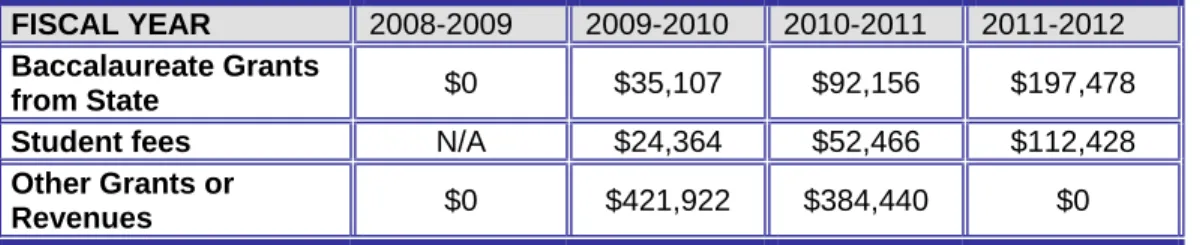
The projected expenditure for academic years 2008 through 2012 is $1,320,362 (average of $330,091 per year). Enrollment projections are based on 24 students (10 FTEs) beginning in January 2010 and increasing to 80 students (54 FTEs) by 2011-12, assuming an annual attrition rate of 25%. Revenue from student fees is projected to be $189,259 for the 4-year start-up period, based on the 2008-2009 state tuition rate of $86.75 per credit hour and assuming 5% annual increases in tuition rates. The estimated FTE funding from the State is projected to be $324,742 based on the State’s 2008-2009 funding formula of $3657 per FTE, leaving $806,362 to be funded from other sources. It is estimated that beginning in 2011-12, 12 students will graduate from the program with 100% placement due to the demand, and at projected starting salaries of $58,000 or higher.
5
Florida Department of Education (FLDOE) Office of K-20 Articulation, Division of Strategic Initiatives, Statewide Post-Secondary Articulation Manual, Career Ladder Agreement, (2005). Retrieved October 1, 2007 from http://www.fldoe.org/articulation/pdf/ AStoBaccalaureate_ Agreemnts.pdf.
8
B. Description of Planning Process and Time Line for Implementation
Planning meetings were conducted beginning in May 2007 to discuss the feasibility of offering a BAS EET at Miami Dade College (
Appendix 6). A task force comprised of faculty and administrators was organized. Members of the task force included the MDC Wolfson Campus President, Academic Dean, Associate Provost for Institutional Effectiveness, District Academic Affairs Director, Director of the School of Computer and Engineering Technologies (SCET), Engineering Department faculty members, the Director of Curriculum Development for SCET, the chair of the Engineering Department, and the SCET Industry Director. To determine the interest for the proposed baccalaureate degree, MDC’s Institutional Research department, in collaboration with Engineering Department faculty and administrators, developed and disseminated surveys to current students, AS EET program alumni, and local employers (Appendices 1 – 4). The task force also evaluated state and national higher education initiatives and conducted research into the local, state and national labor markets. As part of its research process, MDC convened a focus group of industry representatives to identify workforce requirements and define skill sets (Appendix 6) leading to the development of an industry, workforce-driven curriculum. Participants included representatives from Florida Power and Light, AT&T, Federal Aviation Administration (FAA), Florida Department of Transportation Miami Toll System, Carnival Cruise Lines, and an independent engineering consultant representing small business interests.
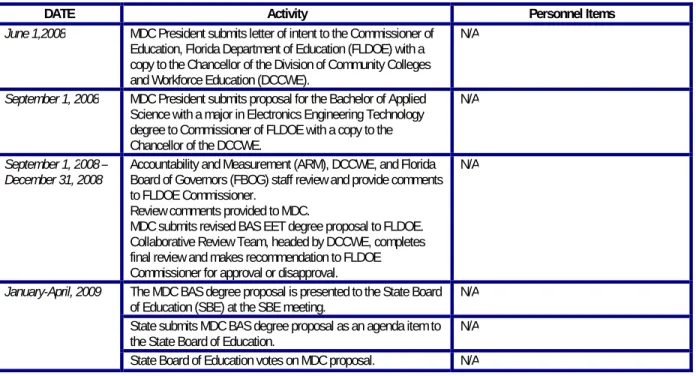
The proposed Bachelor of Applied Science with a major in Electronics Engineering Technology is progressing according to the State Board of Education Baccalaureate Proposal Approval Process. A Letter of Intent to the Commissioner of Education was submitted in June 2008. Per State Board of Education guidelines, the attached proposal was submitted to the MDC Academic Leadership Council, Campus and College Academic and Student Support Councils (CASSC), the Executive Council, the College President, Dr. Eduardo Padrón, the Miami Dade College Board of Trustees and others as appropriate. Table 1 is an estimation of timeline dates, representing the projected timeline for the BAS approval and implementation process.
Table 1: Miami Dade College Estimated Implementation Timeline for Bachelor of Applied Science with a major in Electronics Engineering Technology Degree
DATE Activity Personnel Items
June 1,2008 MDC President submits letter of intent to the Commissioner of Education, Florida Department of Education (FLDOE) with a copy to the Chancellor of the Division of Community Colleges and Workforce Education (DCCWE).
N/A
September 1, 2008 MDC President submits proposal for the Bachelor of Applied Science with a major in Electronics Engineering Technology degree to Commissioner of FLDOE with a copy to the Chancellor of the DCCWE.
N/A
September 1, 2008 –
December 31, 2008 Accountability and Measurement (ARM), DCCWE, and Florida Board of Governors (FBOG) staff review and provide comments to FLDOE Commissioner.
Review comments provided to MDC.
MDC submits revised BAS EET degree proposal to FLDOE. Collaborative Review Team, headed by DCCWE, completes final review and makes recommendation to FLDOE Commissioner for approval or disapproval.
N/A
January-April, 2009 The MDC BAS degree proposal is presented to the State Board of Education (SBE) at the SBE meeting.
N/A State submits MDC BAS degree proposal as an agenda item to
the State Board of Education. N/A
9
April-May, 2009 Upon SBE approval, MDC begins the BAS EET implementation process including preliminary Capital Outlay for equipment, facility renovation, communication technology, other equipment, including purchase of information technology/teleconferencing equipment, and posting of faculty positions.
MDC posts:
• 1 Full Time Program Manager • 2 Part Time doctoral-prepared
faculty
• 1 PT Instructional Lab Assistant • I PT MLS Faculty Librarian • 1 PT Program Support Staff • 1 PT Program Academic Advisor
June 2009 MDC advises potential BAS EET students to complete general education, common prerequisites, and/or elective courses in Fall 2009.
MDC commences marketing campaign in the MDC service area and conducts Town Hall student and community meetings with industry leaders. Marketing media includes billboards, newsprint, and radio. MDC begins accepting applications for January 2010.
July, 2009 MDC finalizes hiring of positions for July 2009 • 1 Full Time Academic Administrator (Program Manager)
• 2 Part Time doctoral-prepared faculty
• 1 PT Instructional Lab Assistant • I PT MLS Faculty Librarian • 1 PT Program Support Staff • 1 PT Program Academic Advisor
August, 2009 MDC library submits library resource recommendations. MDC begins ordering program equipment, technology, and furniture, office, and classroom supplies.
N/A
September-December, 2009
Engineering faculty refine core engineering courses by developing syllabi, instructional materials, including on-line course materials, and finalizing faculty course assignments. MDC finalizes textbook selection.
MDC recruits, admits and advises new BAS EET students. MDC conducts orientation and advisement for new students for January 2010.
N/A
January, 2010 MDC offers the first BAS EET core courses. MDC posts:
1 Doctoral-prepared FT faculty
March 2010 MDC conducts Student Services recruitment/retention activities
for Summer/Fall 2010. N/A
April 2010 MDC conducts advisement workshops for Summer/Fall 2010. N/A
May/June 2010 MDC admits BAS EET students for Fall 2010 and conducts
orientation/advisement activities. N/A
July, 2010 MDC accepts applications for BAS EET students for Spring term 2011.
MDC conduct assessment of BAS EET program and submits annual status report to the State.
MDC completes hiring of:
• 1 Doctoral-prepared FT faculty
July 2009-2010 MDC Facilities/Renovation N/A
August, 2010 MDC enrolls second cohort of students in engineering core courses.
N/A
September-December, 2010 MDC admits BAS EET students for Spring 2009 and conducts orientation/advisement activities. N/A
January, 2011 MDC enrolls third cohort of students in engineering core courses.
MDC requests accreditation (ABET) evaluation for program(s). Deadline to submit request for evaluation visit to take place in Fall 2011 is January 31, 2011.
MDC posts:
• 2 PT faculty positions • 1 FT Instructional Lab Assistant
February, 2011 MDC prepares self-study for ABET accreditation. Self-study
10
by ABET headquarters no later than July 1.
May/June, 2011 MDC admits BAS EET students for Fall 2011 and conducts
orientation/advisement activities. N/A
June, 2011 MDC completes the self-study and submits it to ABET for evaluation.
N/A
July 1, 2011 MDC conducts assessment of BAS EET program and submits
annual status report to the State. MDC completes hiring of: • 2 PT faculty
• 1 FT Instructional Lab Assistant
August, 2011 MDC Graduates first BAS EET candidates. N/A
August 2011 MDC convenes planning committee for ABET accreditation process.
N/A
September –
December 2011 ABET Evaluation visit(s) takes place on MDC's campus. ABET team presents factual findings orally on campus. Then, following a 7-day response period for the institution to report errors of fact or observation, the team finalizes and submits its preliminary findings and recommendations (called a "draft statement") to the leadership of the appropriate commission for editing.
N/A
February - April 2012 MDC receives draft statement from ABET. MDC must respond to draft statement(s) within 30 days.
N/A
August 2012 ABET notifies MDC of its final accreditation actions. MDC
obtains ABET accreditation results. N/A
July 1, 2013 MDC conducts assessment of BAS EET program and submits annual status report to the State. N/A
March-April 2013 MDC submits the self-study to ABET. N/A
May 2011-2013 MDC annually admits BAS EET students for Fall semester and conducts orientation/advisement activities. N/A
July 1, 2013-2015 MDC conducts assessment of BAS EET program and submits annual status report to the State. N/A
August-September, 2011
ABET conducts the accreditation visit for the BAS EET program.
MDC hosts ABET accreditation site visit.
N/A
11
C. Analysis of Workforce Needs/Demands for the Baccalaureate Program As stipulated by the Baccalaureate Proposal Approval guidelines, Miami Dade College collaborated with its local workforce development board, economic development councils, business and industry partners, as well as its current students and graduates, to determine workforce baccalaureate degree needs and demands. The proposed Bachelor of Applied Science with a major in Electronics Engineering Technology degree is uniquely tailored to meet the specific job requirements identified by industry representatives for electronic engineering technologists. Industry representatives defined an individual with a baccalaureate in Electronics Engineering Technology as someone who “works with engineers and other technical personnel on the design, development, testing, and troubleshooting of circuits and systems [FRC, 2007].” This individual is involved with the implementation of systems and projects, the testing of installed systems, and the project management of system installations. The work of electronics engineers is of a practical and applied nature. An electrical engineer performs the conceptual, theoretical, and design work relating to electrical systems and components with emphasis on electrical power systems; an electronics engineer manages the implementation process as it relates to assembling, installing, and testing various types of electronic systems [Career Onestop, 2008].
Labor Market Demand
Miami Dade College works closely with local employers to provide programs that meet local workforce needs. Its primary objective is to produce a trained workforce to meet the critical demands in the high technology marketplace of Florida’s Internet Coast. Graduates of Miami Dade College’s engineering technology programs are recruited and employed by local, state, and federal organizations for electronics-related positions. Research conducted by Miami Dade College’s Office of Institutional Research (Appendix 2) indicates that there is a strong need for baccalaureate-educated engineers. An analysis of job postings for entry-level and replacement candidates conducted in September, 2007 reflects that 48% of the jobs in engineering-related fields require a bachelor’s degree, while 4% that accept an associate’s degree require at least seven years of related work experience [Job Postings, 2007]. Additional research findings are summarized in the following sections.
National Trends
As shown in Table 2 below, the Department of Labor Bureau of Labor Statistics has projected that the demand for electronics engineers nationally will increase 10% over the ten year period 2004-2014.
State of Florida Trends
The Department of Labor occupation profile for Electronics Engineers in Florida projects annual growth to be 21%, with 200 new annual job openings over the 10-year period from 2004 – 2014 due to growth and replacement [Career OneStop, 2008].
Table 2: Average Annual Job Openings for Electronics Engineers - National and State Trends
United States
Employment Percent
Change
1
2004 2014
Electronics engineers, except computer 142,900 156,700 + 10 % 4,190
Florida Employment Percent
Change
1
2004 2014
Electronics engineers, except computer 4,920 5,950 + 21 % 200 1
Job Openings refers to the average annual job openings due to growth and net replacement. Source: Career OneStop, Department of Labor Bureau of Labor Statistics
12 Employer Demand
In May 2007, MDC convened a focus group of industry representatives to discuss educational needs as they relate to gaps in local electronics engineering positions (Appendix 2). Participants included
representatives from Florida Power and Light (FPL), AT&T, Federal Aviation Administration (FAA), Florida Department of Transportation Miami Toll System, Carnival Cruise Lines, and an independent engineering consultant representing small business interests. To reinforce these employers’ inputs, MDC’s
Engineering Department also conducted a telephone survey among these six employers in July 2007. The survey responses were tabulated by MDC’s Office of Institutional Research and are presented in Appendix 2. Collectively these organizations employ over 12,000 employees in Region 23. 83% (n=5) of respondents indicated that they would give hiring preference to candidates possessing a bachelor’s degree in Electronics Engineering Technology.
¾ 100% of respondents indicated that a bachelor’s degree was an extremely important criterion for career advancement within their organizations.
¾ In this same survey, employers who responded projected 0 - 200 employees (mean=57) would potentially enroll in the BAS Electronics program if offered at MDC (Appendix 2).
¾ They also projected hiring needs over the next 3 - 5 years ranging from 8 to 500 (mean = 91) engineers with baccalaureate degrees (Appendix 2).
¾ Florida Power and Light indicated that potentially 200 employees would be interested in participating in a BAS EET program if offered at Miami Dade College (Appendix 2A), observing that it has not been successful in hiring local BS Engineering graduates who are able to pass FPL’s qualification examinations. “If MDC offers a Bachelor of Applied Science in Electronics it would be a great source for FPL hiring. Currently FPL hires Bachelor engineering candidates primarily from UF. FIU candidates do not pass the FPL nuclear entry test. FPL would be interested in enrolling employees in the BAS at MDC since it would be more economical for FPL.” Miami Dade College has a close partnership with FPL, having recently developed an AS degree in Electrical Power Technology pipeline partnership tailored specifically to FPL’s needs and qualification exams. The proposed MDC BAS EET curriculum was developed with direct industry input from FPL and other local employers, and will provide students with the opportunity to acquire the skills and knowledge required by industry for entry-level electronics engineering positions.
¾ In addition to interest in enrolling incumbent workers in a local baccalaureate engineering program, FPL indicated in the phone survey (Appendix 2A) that it projects a need to hire 500 engineers at the baccalaureate level over the next three to five years due to attrition and expansion of its operations.
¾ Other local employers who participated in the MDC Employer Survey (Appendix 2) included ATT, FAA, and Carnival Cruise Lines. Survey respondents projected openings for bachelor’s level positions ranging from 8 (small companies) up to 500 (large companies), with a mean of 91 positions over the next 3 – 5 years.
Miami Dade College’s School of Computer and Engineering Technologies’ Engineering Advisory Board, consisting of representatives from industry associations, governmental agencies, and local companies that hire engineers, also recognizes the importance of higher education and has expressed its support for Miami Dade College offering a baccalaureate in electronics engineering technology.
¾ “On behalf of [MDC’s] Engineering Advisory Committee, I want to express full support for the proposed Baccalaureate degree in Electronics Engineering Technology….We represent organizations involved in the development of MDC’s proposed degree and are very familiar with the benefits this program will bring to our professional community and the organizations which employ us. We want to commend you on pursuing this initiative.”
Joseph M. Yesbeck, P.E., Managing Principal Jacobs, Carter Burgess and Chair, engineering Advisory Committee of Miami Dade College
13
Miami Dade College has received of letters of support and endorsement from agencies including the Department of Transportation and Federal Aviation Administration, industry professional associations including South Florida Manufacturers Association, Enterprise Development Corporation, and iCoast, and private corporations including Florida Power and Light, Carnival Cruise Lines, and Motorola, among others. All indicated support and recommended that Miami Dade College design and implement a four-year degree in Electronics Engineering Technology, recognizing the need for such a degree and stating how it would benefit their organizations and the community. Sample comments appear below and Appendix 5 contains full text copies of these letters.
¾ FAA cited its ongoing partnership with Miami Dade College “to cultivate our future leaders. We have successfully hired many MDC graduates and are looking forward to an expanded workforce pool of engineers” as a result of this program.
Darrell D. Roberts, Manager, Technical Operations Services Federal Aviation Administration
¾ “Please accept our gratitude and appreciation for implementing a much needed offering in the field of electronics engineering in South Florida.”
Jaime A. Borras, Motorola Senior Fellow, Corporate Vice President Motorola, Inc.
¾ “Your program will aid us greatly by providing a well-prepared pipeline of entry level engineering professionals.”
Rodney M. Miller, Dean, FPL Group University, Director of Learning and Development, Workforce Planning
FPL Group
¾ Carnival Cruise Lines requires a continuous pipeline of qualified professionally trained engineering technologists. This degree will improve the availability of local candidates for these positions and decrease our costs by eliminating relocation expenses…. [therefore,] I support MDC’s efforts to establish a Baccalaureate of Applied Science in Electronics Engineering Technology.”
John P. Masseria
Manager, I/T Engineering, Information Systems Carnival Cruise Lines
¾ “Ensuring that we recruit effective Electronics Engineers who are well trained, knowledgeable about effective Electronics Engineering processes and methods, and…committed to our community is absolutely essential and vital….we are delighted to support this new effort….”
Anobb Hyacinthe, CPM, Miami Toll System Support Manager Florida’s Turnpike Enterprise
¾ “…we are aware of the shortage of bachelors prepared workers in Workforce Region 23 and believe this degree to be a positive, proactive step in meeting the needs of local employers.”
Rick Beasley, Executive Director South Florida Workforce
¾ “…we appreciate your diligent efforts in addressing this critical shortage area in the manufacturing profession.”
June Wolfe, President
South Florida Manufacturers Association
¾ “Miami Dade College has been an essential partner … and has been instrumental in satisfying this community’s workforce training needs. Electronics Engineering Technology personnel are vital to the growth of the technology industry in Miami-Dade County and neighboring communities….please accept our full support.”
Jane Teague, Executive Director Enterprise Development Corporation
14
¾ “…additional degree offerings can only serve to advance the business community as a whole.” Michael Corbit, Executive Director
iCoast
¾ “Our educational systems seek to provide quality education and training to all students and prepare them to effectively enter the engineering profession….I am certain that our students will benefit for years to come from the much-needed, highly specialized degree for Electronics Engineers.”
Alina Puentes, Academic Engineering Director Miami-Dade County Public Schools
¾ “We welcome this latest initiative as another demonstration of the College’s mission to provide much needed educational opportunities to the Miami Dade County community. The availability of an affordable 4-year engineering degree should attract more women to participate and enable them to improve their long term career prospects.”
Victoria Usherenko, President
Sherry Thompson Giordano, Executive Director ITWomen
Diversified Workforce
Miami Dade College can significantly contribute to meeting the diversified workforce needs of the community and companies in the service region by recruiting from its diversified student body. Table 3 compares information regarding Miami Dade College’s minority enrollment [Miami Dade College, 2007c] and demographics for Miami Dade County [U.S. Census Bureau, 2007]. Miami Dade College graduates more minority students than any other institution of higher education in the nation, including the largest number of Hispanic and African-American students. Consequently, in addition to meeting the needs of the community as a whole, the MDC proposed program will provide employers with a large pool of diverse baccalaureate degree candidates who have traditionally been under-represented in the engineering profession.
Table 3: MDC and Miami-Dade County and EET Demographics
Gender/Ethnicity Associate in Science
Electronics Engineering
Technology Enrollment Fall 2006
Miami Dade County Demographics, 2005
African-American 28.1% 20.5%
Hispanic 59.6% 60.6%
Source: (MDC Office of Institutional Research; U.S. Census Bureau, 2007)
Student Support
Both current students and graduates indicate support for and significant interest in the creation of the baccalaureate degree in Electronics Engineering Technology at Miami Dade College. In surveys conducted in July and September 2007 by MDC’s Office of Institutional Research (Appendix ), 83% (n=131) of current MDC associate-level engineering students who responded, indicated that they prefer to remain within Miami-Dade County to study. When asked if they would enroll in the BAS with a major in Electronics Engineering Technology if offered at MDC, 58.2% (n=92) of AA/AS engineering majors answered yes. To determine the interest among Associate in Science electronics engineering majors specifically, a second survey was administered in September 2007 (Appendix 1) and as highlighted in
15
Table 4, when asked if they would be interested in enrolling in a BAS-EET if offered at MDC, 78.1% (n=25) of the AS EET degree students and 58.2% (n=92) of the combined AA/AS engineering majors responded “yes” (Appendix 4). This result indicates that AS degree students, for whom this proposed degree is targeted, have a high level of interest in pursuing a baccalaureate at Miami Dade College. Table 4: Baccalaureate Degree Interest
Questions Yes
AS Only AA/AS
Are you planning to pursue a Baccalaureate degree after completing an Associate degree program
87%
(n=32)
83.2% (n=158)
If Miami Dade College were to offer a Baccalaureate degree in Electronics Engineering Technology, would you be interested?
78.1%
(n=25)
58.2% (n=92)
Source: Miami Dade College Office of Institutional Research Student Surveys (June2007; September 2007)
Student Survey Comments
The following are comments that students made in response to the survey that was administered by MDC’s Office of Institutional Research:
• “It is an excellent idea. Most of the students will embrace that idea for the fact that they come from low income parents. As a matter of fact not all of them receive scholarships when attending universities. And it is not because they are not smart enough to keep a high GPA, but because they still have to work for extra income while attending college. So they do not spend
considerable time studying. When they transfer they are obliged to take loan. I believe that the BAS in E.E.T. will help the majority of them. To tell the truth, if MDC … had the BAS I would not transfer to FAU after receiving my A.A. degree.”
• “I believe it is a wonderful idea, this is an extraordinary institution. By offering more opportunities more people will be given the chance to have the great experience current students are having.” • “I think it will be a great idea for MDC to offer a BS in EET. It will certainly be a lot cheaper than in
any other University.”
• “…I have received an AA from MDC and had a great time in MDC. I would like for MDC to have this Bachelor’s program in engineering.”
• “A BAS will be very helpful for a lot of students doing engineering due to the quality of the professors at MDC.”
• “I am pursuing a B.S. Computer Sciences. If this MDC BAS degree is offered, it would be great. I might consider changing my degree.”
• “DO IT!!!!!!!!!!!!!!!!!!!!!!!!!!!!!!!!!!!!!!!!” • “Would enroll immediately.”
16 Alumni Survey Comments
These comments were received from alumni who were surveyed:
• “I think that it will help a lot of students especially the international students because Miami Dade offers a very good quality of education at an affordable price.”
• “This would be an excellent program for me.”
• “It actually would be great to have a BAS available @ MDC! Go for it!”
• “Education is all about having the right opportunities available. A new opportunity like a BAS degree will open the door to many students in the ongoing search of quality and affordable education at MDC.”
• “I would be thrilled if you offered this program. I loved attending MDC and would gladly enroll in this program if offered. Please notify me immediately if this program becomes available.” • “Great Idea...It was about time!!!!!!!!”
• “Make sure it includes hands on training and real life application.”
• “… as a student that completed an AA in MDC, I would definitely return to MDC to complete a BA degree, not only cause I know more of MDC but because I trust you that the plan that was set forth for my education in the AA degree was not just slap on to make me graduate.”
• “I think that Miami Dade provides an excellent education. It would be an excellent idea to offer an education to obtain a bachelor degree for civil engineering, mechanical engineering and many other fields of engineering. At the time that I finished my Art Degree in Miami Dade there were only technical careers for engineering but not to obtain a bachelors. If Miami Dade offers that I am sure that many students would take that chance because Miami Dade offers a good education, offers tutoring, have a flexible schedule and the cost is more reasonable to pay. Please I think if you open a bachelors program for civil, mechanical, electrical engineering you are also providing alternatives to students that were planning to take technical careers to take instead a bachelors degree.”
• “I am graduating this semester from a university with a 3.9 GPA. If at the time I was at Miami Dade I would have the opportunity to finish my bachelors at Miami Dade I would have finished it there.”
Affordability
As noted in Appendices 1 and 4 and summarized in Table 5, cost and location were cited as the primary ways in which student respondents perceive that MDC excels over other institutions offering engineering degrees. These factors were slightly more important to AS degree seeking students who responded than to the combined AA/AS sampling.
Table 5: Benefits of Miami Dade College (Student Survey Responses)
Question: In what ways does MDC excel over other colleges with similar programs?
AS Only AA/AS
Cost 96.9% (n=31) 87.6% (n=138)
Location 78.1% (n=25) 70.9% (n=112)
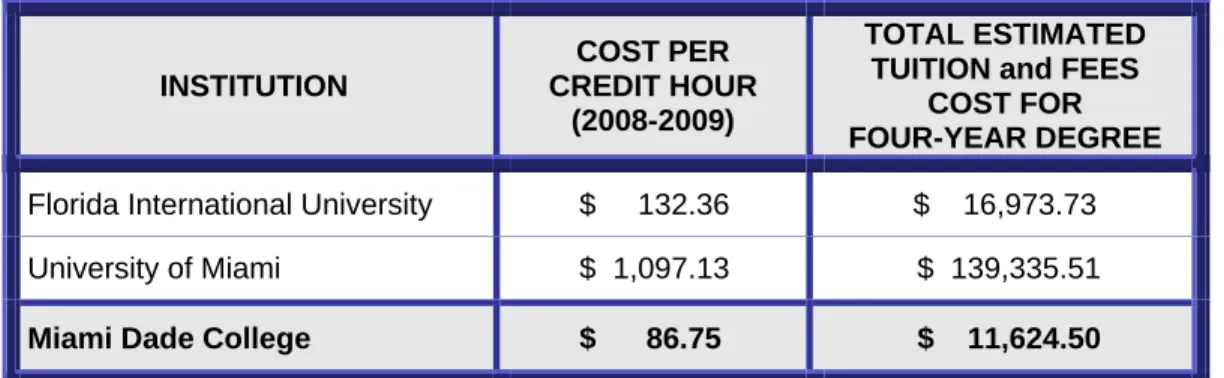
Tuition differentials make the BSEE programs less accessible to the MDC student population. Table 6 compares the costs for engineering degrees at MDC, FIU, and UM. The cost for the proposed BAS EET program at MDC will be approximately $11,624.506, compared with the BSEE at FIU at a cost of
6
$86.75 per credit for tuition and fees for 134 credits based on 2008- 2009 tuition rates. Source http://www.mdc.edu/tuition/ accessed July 28, 2008
17
$16,973.737 and UM at a cost of $139,335.518. This program will be more affordable to MDC’s lower socioeconomic student population (see Tables 10 and 11) than university programs.
Table 6: Comparison of Tuition Costs
INSTITUTION
COST PER CREDIT HOUR
(2008-2009)
TOTAL ESTIMATED TUITION and FEES
COST FOR FOUR-YEAR DEGREE
Florida International University $ 132.36 $ 16,973.73 University of Miami $ 1,097.13 $ 139,335.51
Miami Dade College $ 86.75 $ 11,624.50
Source: Institution websites
Several students who responded to the survey commented on the cost factor:
• “Adding this program to MDC would benefit a lot of students tremendously, not only because of the access but the cost.”
• “Although E.E. is not my intended major, I would take advantage of MDC BAS in E.E. because of the very low price on tuition.”
• “I think that it will help a lot of students … because Miami Dade offers a very good quality of education at an affordable price.”
Potential Enrollments
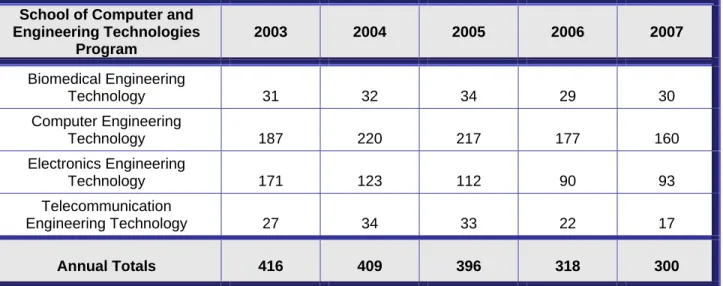
The proposed BAS EET degree is designed to allow graduates from Associate in Science in Electronics Engineering Technology degrees to pursue a baccalaureate degree; however, it will also accommodate graduates from other AS and AA engineering programs, including computer engineering technology, biomedical engineering technology, and telecommunications technology. Students and graduates of these disciplines are potential candidates for a BAS EET program as well. Table 7 provides the 5-year enrollment history in Miami Dade College’s School of Computer and Engineering Technologies.
As noted, the MDC Department of Engineering AS enrollment has averaged between 300 and 400 students annually for the past five years9 and represent a population of potential candidates for Miami Dade College’s proposed BAS degree program in Electronics Engineering Technology.
7 Tuition and fees for 128 credits. Source http://admissions.fiu.edu/costs.htm and http://www.fiu.edu/orgs/controller/ UG%20Calculator.htm accessed July 28, 2008
8
Estimated cost per credit based on $34,834 per year quoted for tuition and fees for a 4-year, 127 credit program. Source http://www6.miami.edu/ UMH/CDA/UMH_Main/0,1770,29532-1;44908-2;39181-2;61099-3,00.html accessed July 28, 2008
9
18
Table 7: MDC School of Computer and Engineering Technologies Associate in Science Programs 5-Year Fall Enrollment - Potential Candidates for the BAS degree
School of Computer and Engineering Technologies Program 2003 2004 2005 2006 2007 Biomedical Engineering Technology 31 32 34 29 30 Computer Engineering Technology 187 220 217 177 160 Electronics Engineering Technology 171 123 112 90 93 Telecommunication Engineering Technology 27 34 33 22 17 Annual Totals 416 409 396 318 300
Source: Miami Dade College Office of Institutional Research (2007)
Table 8 represents a conservative estimate of the projected 3-year enrollment in the proposed BAS-EET program based upon current student surveys and employers’ interest levels as indicated in the letters of support (Appendices 1 - 5). After the initial three year establishment phase, based upon the number of students currently served by MDC’s School of Computer and Engineering Technologies (300+ per year) and the Department of Labor annual growth projections (21%), the enrollment is projected to grow significantly during the next 5 to 10 year period.
Table 8: Projected 3-year student enrollment in MDC’s BAS - Electronics Engineering Technology 2009 - 2010 24 (10 FTE) 2010 - 2011-2012 42 (25 FTE) 2011-2012 80 (54 FTE)
MDC Contact with South Florida State and Private Universities
In compliance with the State Board of Education Baccalaureate Program Proposal for Community
Colleges guidelines, Dr. Norma Martin Goonen, Provost, Academic and Student Affairs, Miami Dade
College, notified local higher education institutions of Miami Dade College's intent to submit baccalaureate program proposals to the State Board in September 2008 (Appendix 17). Florida International University, University of Miami, Barry University and St. Thomas University were provided with a copy of the curriculum guide and a summary of the proposed Bachelor of Applied Science with a major in Electronics Engineering Technology. As of the submission date of this proposal, there has been no response to the correspondence.
19
D. Alignment with K-20 Goals and Strategic Imperatives K-20 Goals
The Miami Dade College BAS EET degree proposal aligns with the appropriate Florida Department of Education Goals established by the Legislature in SB 1162 as follows:
1. Highest Student Achievement
The proposed program encourages high student achievement and performance at all levels and consistently applies academic and training standards as required by the Southern Association of Colleges and Schools Commission on Colleges and ABET. MDC will not terminate any existing Associate in Arts or Associate in Science degree as a result of the BAS EET proposal and the proposed BAS EET degree aligns with the MDC and the AA in pre-engineering and AS in electronics engineering technology degrees.
2. Seamless Articulation and Maximum Access
In 1986, MDC and Florida A&M University (FAMU) created a 2+2 articulation arrangement which followed the Career Ladder Articulation agreement established by the State of Florida Department of Education, which provides for block acceptance of the 68 associate-level credit hours from the AS EET. The original agreement provided for all courses, including upper division FAMU courses, to be offered onsite at MDC. The number of courses that were offered locally decreased and eventually ceased completely. Students were then required to relocate to Tallahassee to take and/or complete their coursework. As a result, MDC students have been unable to complete their baccalaureate coursework locally. The MDC/FAMU arrangement was dissolved in May 2007.
MDC’s proposed BAS EET aligns with FLDOE Goal 2 as follows:
(a) The proposed BAS EET effectively utilizes the education resources of the K-20 system. The educational and training opportunities may begin immediately after high school with a student enrolling in the Associate in Science degree in Electronics Engineering Technology, Biomedical Technology, Computer Engineering Technology or Telecommunication Technology, or an Associate in Arts pre-engineering program, and matriculating to the proposed BAS EET program. Students will receive the full range of articulation and transfer rights guaranteed by the Florida Statewide Course Numbering System (SCNS) and Statewide Articulation agreements. By utilizing flexibility of course offerings and scheduling options, the proposed BAS EET degree streamlines the educational process for non-traditional engineering students by allowing them to continue working full or part-time.
(b) As reflected in the student and alumni survey responses (Appendices 1, 3, and 4), the affordability of higher education is an issue for Miami Dade College students. The US Census Bureau (2007), noted that Miami is the third poorest city in America. As noted in the MDC Student Surveys conducted by Institutional Research, 97% of AS EET degree respondents cite cost as the way in which MDC excels over other institutions (Appendix 1) and 81% of all student respondents (AA/AS) indicated that MDC excelled over other colleges regarding costs (Appendix 4). Table 9, compiled by MDC’s Office of Institutional Research, reports that 35% of MDC students are below the poverty level, 57% are low income, and 49% are currently recipients of some type of financial assistance. Eighty-eight (88%) of MDC’s students are classified as academically under-prepared and MDC accommodates these students by providing college preparatory courses to prepare them for college-level credit course work and programs. MDC enrolls and graduates large numbers of students (MDC Graduate Profile 2006-07) and, consequently, is in a position to meet the challenges of increasing rates of learning and completion at all levels by utilizing proven multiple and varied academic student support services.
20
Table 9: Percentage of MDC Students below the Poverty Threshold
(c) The proposed BAS EET program combines the theoretical with practical, hands-on, and applied learning designed to provide students with additional job-readiness skills. MDC is in compliance with the State Common Course Prerequisites and the Statewide AS to BS Career Ladder Articulation Agreements and degree transferability.
(d) The cost of tuition at other Region 23 institutions may contribute to low student enrollment and/or graduation from BS EE programs. The majority of MDC students are geographically bound due to transportation and financial issues preventing them from transferring to other regional institutions. As noted in Table 6, the MDC BAS EET proposal provides an affordable option for Florida residents seeking BAS EET preparation.
3. Skilled Workforce and Economic Development
Miami Dade College can meet the diversified workforce needs of the community and agencies in its service region by providing higher education opportunities for many South Florida students. MDC graduates more minority students than any other institution of higher education in the nation [Miami Dade College Student Profile Data, 2007d] and has the potential to provide Region 23 employers with a large pool of diverse BAS EET engineers.
The proposed Miami Dade College BAS EET degree will provide the South Florida community with an affordable, efficient, career-ladder approach to baccalaureate education and will enable currently employed individuals to pursue a BAS EET.
4. Quality Efficient Services
The proposed BAS EET degree program will provide high quality and efficient services by utilizing existing Miami Dade College resources and services. Applications for admission and registration services will be processed utilizing Miami Dade College’s existing systems within the Offices of the Registrar and Admissions. A dedicated part-time student services/academic advisor will provide specialized advisement and counseling required for engineering majors. Admission requirements will conform to established MDC policy and Florida statutes and rules.
21 Strategic Imperatives
In addition to aligning with the Florida Department of Education K-20 Mission and Goal statements, the MDC Bachelor of Applied Science with a major in Electronics Engineering Technology degree proposal is designed to align with the Strategic Plan Imperatives as follows:
1. Set, Align, and Apply Academic Curricular and Testing Standards
Students will be required to meet all baccalaureate admission standards, including foreign language, College-Level Academic Skills Test (CLAST) requirements, and minimum grade point averages. In addition, MDC’s BAS EET proposed degree program will meet all standards to attain accreditation from ABET.
The program will meet all requirements as stipulated by the Statewide Articulation and Common Pre-Requisite Manuals and will align course requirements with professional needs and standards. MDC will conduct program reviews as stipulated by MDC Policies and accreditation requirements.
2. Improve Student Rates of Learning
The proposed BAS EET degree will address this imperative by developing and implementing plans to annually increase:
• The percentage of associate degree graduates who enroll in the BAS EET program. • The retention rates of BAS EET students.
• The completion rates of the BAS EET students.
3. Improve the Quality of Instructional Leadership
The intent of the proposed BAS EET degree proposal is to provide students with an affordable, efficient, seamless, workforce-driven baccalaureate engineering degree. The proposed BAS EET degree will include the opportunity for students to obtain knowledge and skills not only in electronics technology but also to obtain management skills through project management training and assignments, enabling graduates to take leadership positions in industry. The proposed BAS EET degree program is designed to provide graduates with a combination of classroom knowledge and practical applied strategies that may consequently impact the quality of leadership within local businesses and industry.
4. Increase the Quantity and Improve the Quality of Education Options
The proposed BAS EET degree increases the educational options and workforce opportunities for prospective students within Region 23 by providing the opportunity for a high quality, seamless, workforce-driven degree that adds to the current engineering career ladder options at MDC. It is designed to provide the graduate with the skills and abilities to handle the increasingly complex skills, abilities, responsibilities, and critical thinking required of professionals in a global community.
5. Align Workforce Education Programs with Skill Requirements of the New Economy
The proposed BAS EET curriculum incorporates and aligns with the training and skill requirements requested by employers such as FPL, FAA, and ATT (Appendix 6), who participated in the industry focus group conducted in May 2007. To ensure that educational needs are met, the MDC School of Computer and Engineering Technology administrators meet periodically with advisory committees and faculty to review the current programs, local workforce needs, and to evaluate and revise curriculum.
6. Align Financial Resources with Performance
MDC will provide advisory committees with information regarding accountability measures and processes. Recruitment and retention of students will be monitored to ensure that student learning and educational needs are met. The annual budget process and the five-year program review process as well as SACS and ABET accreditation reviews, and the Florida State Board of Education annual report will ensure that resources address program performance.
22 7. Coordinate Efforts to Improve Higher Student Learning
MDC will continue to utilize its existing articulation and access plans and will facilitate new agreements as appropriate. Academic student advising will be coordinated to ensure that students progress toward baccalaureate degree completion in a timely manner.
E. Academic Content and Curriculum
Program Title Bachelor of Applied Science with a major in Electronics Engineering
Technology
C.I.P. Code 15.0303
Department School of Computer and Engineering Technologies Department of
Engineering
General Education Requirements
36 credit hours
Total Credits 134
Common Course Pre-requisites
MACX253 Or MACX311
AND MACX254 Or MACX312 AND PHYX053 Or PHYX048/X048L
State-wide Articulation: Associate in Science in Electrical Engineering Technology to a Baccalaureate in Electronic Engineering Technology
In compliance
Program Description:
The Bachelor of Applied Science with a major in Electronics Engineering Technology (BAS-EET) is designed to provide students who have completed an Associate in Science degree in Electronics Engineering Technology, Computer Engineering Technology, Telecommunications Engineering Technology, or Biomedical Engineering Technology, an opportunity to seamlessly attain a bachelor’s degree without losing transfer credits. It also allows Associate in Arts engineering graduates, who favor applied concepts in engineering, to pursue an alternative baccalaureate to the Bachelor of Science, which places more focus on theory. Students enrolled in the BAS will acquire hands-on experiences that reflect industry practice, and develop much needed industry skills such as project management, teamwork, and technical writing. The Bachelor of Applied Science with a major in Electronics Engineering Technology prepares students for employment in such occupations as Electronics Engineer, Test Engineer, Project Engineer, Electronics Manufacturing Engineer, Electronics Systems Engineer, Electronics Hardware Engineer, Technical Support Engineer, Quality Control Engineer, Reliability Engineer, Field Engineer, Processing Engineer, or Sales Engineer.
The proposed Bachelor of Applied Science with a major in Electronics Engineering Technology degree will be housed within the School of Computer and Engineering Technologies at Miami Dade College. The proposed six-digit Classification of Instructional Programs (CIP) code is 15.0303. Accordingly, the program was designed to incorporate the Career Ladder Articulation [FLDOE, 2005] and Common Prerequisites for this CIP code as designated by the State of Florida Department of Education [FLDOE, 2007]. It is a 134 credit hour program incorporating lower and upper division coursework which includes the required 36 credits of general education, foundation courses and technical core courses as shown in the Curriculum Guide (Table 10).
23 Table 10: Curriculum Guide
Bachelor of Applied Science with a major in Electronics Engineering Technology
C.I.P. 15.0303
Total credits required for the degree is 134
This program is designed to prepare students for entry level engineering positions such as Electronics Engineers, Test Engineers, Project Engineers, Electronics Manufacturing Engineers, Electronics Systems Engineers, Electronics Hardware Engineers, Technical Support Engineers, Quality Control Engineers, Reliability Engineers, Field Engineers, Processing Engineers, and Sales Engineers.
Course Course Title Credits Pre-/Co-Requisites GENERAL EDUCATION: 36 CREDITS REQUIRED
Communications – 6 Credits Required
ENC 1101 English Composition 1 3
ENC 1102 English Composition 2 3 Pre-Req ENC 1101
Oral Communication – 3 Credits Required
SPC 1026 Fundamentals of Speech
Communications (recommended) 3
Humanities – 6 Credits Required
PHI 2010 Introduction to Philosophy (recommended) 3
PHI 2604 Critical Thinking/Ethics (recommended) 3 Pre-Req ENC 1102
Behavioral and Social Science – 6 Credits Required
CLP 1006 Psychology of Personal Effectiveness 3 (recommended)
ECO 2013 Principles of Economics (Macro) 3 (recommended)
Science – 6 Credits Required
* Courses exclude labs
PHY 2053 Physics without Calculus 3 Prereq MAC 1114 or MAC 1147; Co-req PHY2053L
PHY 2054 Physics w/o Calculus 2 3 PHY2053; Co-req PHY2054L
Mathematics – 6 Credits Required
* Courses exclude labs
MAC 1105 College Algebra 3 Pre-req MAT1033
MAC 2311 Calculus and Analytical Geometry 1 5 Pre-req MAC1147 and Trigonometry
Note: extra 2 credits assigned to General Education Elective block General Education Elective – 3 Credits Required
See Advisor for Approved Selections
PHY2053L Physics w Calculus Lab 1 Co-req PHY2053
COMMON COURSE PREREQUISITES
MAC2311 Calculus and Analytical Geometry 2 GE Pre-req MAC 1114 and MAC 1140
or MAC1147
MAC2312 Calculus and Analytical Geometry 2 4 Pre-req MAC2311
PHY2053/2053L Physics w/o Calculus 2 GE Pre-req MAC1114 or MAC1140;
24 LOWER DIVISION Technology Core– 38 Credits Required
Digital Computer Circuit Analysis 1 4 Pre/Co-req MAC1105
4 Pre-Req CET2114C, MAC1147
Current Circuits 4 Pre/Co-req MAC1105
Alternating Current Circuits 4 Pre-req EET1015C; co-req
MAC1147
Electronics 4 Pre-Req EET1025C
Electronics 4 Pre-Req EET1141C
Electronic Communications 1 - Analog 4 Co-req EET2101C
CGS2423 C for Engineers 4 Pre-Req CGS1060
OR
COP1220 Introduction to C++ Programming 4 Pre-Req CGS1060
MAC1140 Pre-Calculus Algebra 3 Pre-Req MAC 1105
MAC1114 Trigonometry 3 Pre-Req MAC1105 or MAC1140
LOWER DIVISION TECHNICAL ELECTIVES – 8 CREDITS REQUIRED
CET 2142C Advanced Digital Circuits (recommended) 4 CET2114C EET 2351C Electronic Communications 2 - Digital
(recommended) 4 Pre-req EET2305C
MAJOR CORE REQUIREMENTS – 48 Credits Required
CET 3126C Advanced Microprocessors 4 Pre-req CET2123C
CET 4190C Applied Digital Signal Processing 4 Pre-req CET3126C, EET4136 EET 3158C Linear Integrated Circuits and Devices 4 Pre-req EET2101
EET 3XXX Power Systems 3 Pre-req EET1025C
EET 3716C Advanced System Analysis 4 Pre-req EET2101C, Co-req MAC2312
EET 4XXXC Signals and Systems 4 Pre-req MAC2311
EET 4732C Feedback Control Systems 4 Pre-req EET3158C
EET 4165C Senior Design 1 3 Department approval required
EET 4166C Senior Design 2 3 Department approval required
EST 3543C Programmable Logic Controllers 4 CET2123C
ETI 3671 Technical Economic Analysis 3 MAC1105
ETI 3704 Safety Issues in Electronics Engineering 3 Technology
ETI 4480C Applied Robotics 4 Pre-req CET3126C
PHY2054L Physics w/o Calculus Lab 1 Co-req PHY2054
Admission Requirements
Students must have an earned AA or AS degree from a regionally accredited institution or completed a minimum of 60 credit hours with a cumulative grade point average of 2.0 and a minimum 2.5 grade point average in all lower division engineering technology core courses.
Students must have a minimum of 28 lower division technology courses and must satisfy all course prerequisite requirements before being admitted into upper division level engineering technology core courses.
Students must complete MAC1105 and ENC1101 prior to being admitted into the senior level institution. Students must submit a completed Miami Dade College Admissions Application.
Additional Information:
Students entering with an AS or AAS degree may need additional General Education credits to meet the 36 General Education credits required for the baccalaureate degree. Students entering with an AA degree may need additional electives to provide appropriate background for the baccalaureate program.
25 Graduation Requirements
- a minimum of 134 semester hours in specified coursework - a minimum cumulative grade point average of 2.0
- a minimum 2.5 grade point average in the engineering major
- a minimum of 30 semester hours of 3000-4000 level course work at the senior level institution
- successful completion of a minimum of 48 semester hours of engineering technology core coursework at the senior institution level
- satisfactory completion the general education 36 credit hour requirements - satisfactory completion of the Gordon Rule requirements
- satisfactory completion of the CLAST or waiver
- Computer Competency: By the 16th earned college level credit (excluding EAP and college preparatory courses), a student must take the Computer Competency Test and pass
- By the 31st earned college level credit (excluding EAP and college preparatory courses), a student must pass CGS 1060, an equivalent continuing education or vocational credit course or retest with a passing score on the Computer Competency Test.
- Foreign Language: Students admitted to the baccalaureate degree program without meeting the foreign language admission requirement of at least 2 courses (6 - 8 credit hours) of sequential foreign language at the secondary level or the equivalent of such instruction at the postsecondary level must earn such credits prior to graduation.
Students should check their individualized Degree Audit Report to determine the specific graduation policies in effect for their program of study for the year and term they entered Miami Dade. This outline includes current graduation requirements.
The final responsibility for meeting graduation requirements rests with the student.
Curriculum Design
The proposed curriculum is designed to create highly trained, well educated, and employable electronics engineering technology professionals. The curriculum was developed utilizing extensive input from workforce experts, electronics engineering faculty, and college administrators to ensure that students acquire the latest skills and content. An industry focus group was conducted in May 2007 during which a job task analysis was performed and key skill sets, knowledge, and equipment were identified (Appendix 6). Consideration has been given to ensure that the proposed program incorporates a clear scope and sequence of core coursework thereby allowing for a seamless transition. Descriptions for senior level institution technology core courses are available in Appendix 9. The Bachelor of Applied Science with a major in Electronics Engineering Technology degree has been designed with a high degree of flexibility allowing students to enter at various points, including transfer entry or upon completion of an AS, AAS, or AA degree from a regionally accredited institution. A four-year advising plan was developed to provide students an example of the proposed plan of study (Appendix 10).
General Education and Common Prerequisite Courses
The proposed Miami Dade College BAS with a major in Electronics Engineering Technology degree program conforms to all state statutes and rules, including the completion of 36 credits of general education and CLAST, addresses the SACS Accreditation Criteria (3.3.1 and 3.4.1) for student learning assessments, the Florida general education standards (Florida Rule 6A.10.030), and Common Course Prerequisite requirements. The proposed degree incorporates the AS and AA lower division coursework as the foundation of the baccalaureate program and MDC is in compliance with State of Florida Articulation Agreements and Common Course Pre-Requisite standards regarding transferability. Transcripts from students transferring from out-of-state institutions will be evaluated on an individual basis per established MDC policy. All State of Florida Articulation Agreements will be preserved and State certification guidelines met.