Chapter 7:
Replication Management
using the
State Machine Approach
Fred B. Schneider* Department of Computer Science
Cornell University Ithaca, New York 14853 U.S.A.
This chapter reprints my paper "Implementing Fault-tolerant Services using the State Machine Approach: A Tutorial" which orginally appeared in ACM Computing Surveys 22 (Dec. 1990). The paper has been reformatted, but otherwise remains unchanged.
Most distributed systems employ replicated services in one form or another. By replicating a service, we can support fault-tolerance as well as improving overall throughput by placing server replicas at sites where the service is needed. Pro-tocols for replication management can be divided into two general classes. Thefirst, called "the state machine approach" or "active replication", has no centralized control. This class is the subject of this chapter. The second class of protocols is called the "primary-backup approach", and it is discussed in Chapter 8 (???FS et al-primary-backup).
The state machine approach ties together a number of the fundamental problems that have been discussed in previous chapters. Chapter 2 (??FS-models) should be consulted to put in perspective the distributed systems models of this chapter. Chapter 4 (???Ozalp+Keith) discusses the logical clocks used here to order client requests. And, Chapter 5 (???Toueg+Hadzlacos) discusses semantics for various communications primitives that support the state machine approach.
*This material is based on work supported in part by the Office of Naval Research under contract N00014-91-J-1219, the National Science Foundation under Grant No. CCR-8701103, and DARPA/NSF Grant No. CCR-9014363. Any opin-ions,findings, and conclusions or recommendations expressed in this publication are those of the author and do not reflect the views of these agencies.
1. Introduction
Distributed software is often structured in terms ofclientsandservices. Each service comprises one or more servers and exports operations which clients invoke by making requests. Although using a single, centralized, server is the simplest way to implement a service, the resulting service can only be as fault-tolerant as the processor executing that server. If this level of fault tolerance is unac-ceptable, then multiple servers that fail independently must be employed. Usually, replicas of a sin-gle server are executed on separate processors of a distributed system, and protocols are employed to coordinate client interactions with these replicas. The physical and electrical isolation of processors in a distributed system ensures that server failures are independent, as required.
Thestate machine approach is a general method for implementing a fault-tolerant service by replicating servers and coordinating client interactions with server replicas.1 The approach also pro-vides a framework for understanding and designing replication management protocols. Many proto-cols that involve replication of data or software—be it for masking failures or simply to facilitate cooperation without centralized control—can be derived using the state machine approach. Although few of these protocols actually were obtained in this manner, viewing them in terms of state machines helps in understanding how and why they work.
This paper is a tutorial on the state machine approach. It describes the approach and its imple-mentation for two representative environments. Small examples suffice to illustrate the points. How-ever, the approach has been successfully applied to larger examples; some of these are mentioned in §9. Section 2 describes how a system can be viewed in terms of a state machine, clients, and output devices. Coping with failures is the subject of §3 through §6. An important class of optimizations— based on the use of time—is discussed in §7. Section 8 describes dynamic reconfiguration. The his-tory of the approach and related work is discussed in §9.
2. State Machines
Services, servers, and most programming language structures for supporting modularity define state machines. Astate machineconsists of state variables, which encode its state, and commands, which transform its state. Each command is implemented by a deterministic program; execution of the command is atomic with respect to other commands and modifies the state variables and/or pro-duces some output. A client of the state machine makes a request to execute a command. The request names a state machine, names the command to be performed, and contains any information needed by the command. Output from request processing can be to an actuator (e.g. in a process-control system), to some other peripheral device (e.g. a disk or terminal), or to clients awaiting responses from prior requests.
In this tutorial, we will describe a state machine simply by listing its state variables and com-mands. As an example, state machine memory of Figure 2.1 implements a time-varying mapping from locations to values. A readcommand permits a client to determine the value currently associ-ated with a location, and awritecommand associates a new value with a location.
For generality, our descriptions of state machines deliberately do not specify how command invocation is implemented. Commands might be implemented
using a collection of procedures that share data and are invoked by acall, as in a monitor, using a single process that awaits messages containing requests and performs the actions they specify, as in a server, or
using a collection of interrupt handlers, in which case a request is made by causing an interrupt, as in an operating system kernel. (Disabling interrupts permits each command to be executed to completion before the next is started.)
For example, the state machine of Figure 2.2 implements commands to ensure that at all times at most one client has been granted access to some resource. In it,x ydenotes the result of appendingy to the end of listx,head(x) denotes thefirst element of listx, andtail(x) denotes the list obtained by deleting thefirst element of listx. This state machine would probably be implemented as part of the supervisor-call handler of an operating system kernel.
Requests are processed by a state machine one at a time, in an order that is consistent with potential causality. Therefore, clients of a state machine can make the following assumptions about
memory: state_machine
varstore :array[0..n]of word read: command(loc: 0..n)
sendstore[loc]toclient endread;
write: command(loc: 0..n, value:word) store[loc] :!value
endwrite
endmemory
mutex: state_machine
varuser :client_id init!;
waiting :list of client_id init!
acquire: command
ifuser!! "sendOKtoclient; user :!client
[]user#! "waiting:!waiting client
fi
endacquire
release: command
ifwaiting!! "user:!!
[]waiting#! "sendOKtohead(waiting); user:!head(waiting); waiting:!tail(waiting)
fi
endrelease
endmutex
Figure 2.2. A resource allocator
the order in which requests are processed:
O1: Requests issued by a single client to a given state machinesmare processed bysm in the order they were issued.
O2: If the fact that request r was made to a state machine sm by client c could have caused a requestr$to be made by a clientc$tosm, thensmprocessesrbeforer$. Note that due to communications network delays, O1 and O2 do not imply that a state machine will process requests in the order made or in the order received.
To keep our presentation independent of the interprocess communication mechanism used to transmit requests to state machines, we will program client requests as tuples of the form
%state_machine.command,arguments&
and postulate that any results from processing a request are returned using messages. For example, a client might execute
%memory.write, 100, 16.2&;
%memory.read, 100&; receivevfrommemory
to set the value of location 100 to 16.2, request the value of location 100, and await that value, setting vto it upon receipt.
The defining characteristic of a state machine is not its syntax, but that it specifies a determinis-tic computation that reads a stream of requests and processes each, occasionally producing output:
Semantic Characterization of a State Machine. Outputs of a state machine are completely determined by the sequence of requests it processes, independent of time and any other activity in a system.
Not all collections of commands necessarily satisfy this characterization. Consider the following pro-gram to solve a simple process-control problem in which an actuator is adjusted repeatedly based on the value of a sensor. Periodically, a client reads a sensor, communicates the value read to state machinepc, and delays approximatelyDseconds:
monitor: process
dotrue"val :!sensor;
%pc.adjust,val&; delayD
od
endmonitor
State machinepcadjusts an actuator based on past adjustments saved in state variableq, the sensor reading, and a control functionF.
pc: state_machine varq:real;
adjust: command(sensor_val :real) q :!F(q,sensor_val); sendq toactuator endadjust
endpc
Although it is tempting to structure pc as a single command that loops—reading from the sensor, evaluating F, and writing to actuator—if the value of the sensor is time-varying, then the result would not satisfy the semantic characterization given above and therefore would not be a state machine. This is because values sent toactuator(the output of the state machine) would not depend solely on the requests made to the state machine but would, in addition, depend on the execution speed of the loop. In the structure used above, this problem has been avoided by moving the loop intomonitor.
In practice, having to structure a system in terms of state machines and clients does not consti-tute a real restriction. Anything that can be structured in terms of procedures and procedure calls can also be structured using state machines and clients—a state machine implements the procedure, and
requests implement the procedure calls. In fact, state machines permit more flexibility in system structure than is usually available with procedure calls. With state machines, a client making a request is not delayed until that request is processed, and the output of a request can be sent some-place other than to the client making the request. We have not yet encountered an application that could not be programmed cleanly in terms of state machines and clients.
3. Fault Tolerance
Before turning to the implementation of fault-tolerant state machines, we must introduce some terminology concerning failures. A component is considered faulty once its behavior is no longer consistent with its specification. In this paper, we consider two representative classes of faulty behavior:
Byzantine Failures. The component can exhibit arbitrary and malicious behavior, perhaps involving collusion with other faulty components [Lamport et al 82].
Fail-stop Failures. In response to a failure, the component changes to a state that permits other components to detect that a failure has occurred and then stops [Schneider 84].
Byzantine failures can be the most disruptive, and there is anecdotal evidence that such failures do occur in practice. Allowing Byzantine failures is the weakest possible assumption that could be made about the effects of a failure. Since a design based on assumptions about the behavior of faulty com-ponents runs the risk of failing if these assumptions are not satisfied, it is prudent that life-critical sys-tems tolerate Byzantine failures. However, for most applications, it suffices to assume fail-stop failures.
A system consisting of a set of distinct components is t fault-tolerant if it satisfies its specification provided that no more thantof those components become faulty during some interval of interest.2 Fault-tolerance traditionally has been specified in terms of MTBF (mean-time-between-failures), probability of failure over a given interval, and other statistical measures [Siewiorek & Swarz 82]. While it is clear that such characterizations are important to the users of a system, there are advantages in describing fault tolerance of a system in terms of the maximum number of com-ponent failures that can be tolerated over some interval of interest. Asserting that a system ist fault-tolerant makes explicit the assumptions required for correct operation; MTBF and other statistical measures do not. Moreover, t fault-tolerance is unrelated to the reliability of the components that make up the system and therefore is a measure of the fault tolerance supported by the system archi-tecture, in contrast to fault tolerance achieved simply by using reliable components. MTBF and other statistical reliability measures of a t fault-tolerant system can be derived from statistical reliability
2Atfault-tolerant system might continue to operate correctly if more thantfailures occur, but correct operation cannot
measures for the components used in constructing that system—in particular, the probability that there will bet or more failures during the operating interval of interest. Thus,tis typically chosen based on statistical measures of component reliability.
4. Fault-tolerant State Machines
A t fault-tolerant version of a state machine can be implemented by replicating that state machine and running a replica on each of the processors in a distributed system. Provided each replica being run by a non-faulty processor starts in the same initial state and executes the same requests in the same order, then each will do the same thing and produce the same output. Thus, if we assume that each failure can affect at most one processor, hence one state machine replica, then by combining the output of the state machine replicas of thisensemble, we can obtain the output for thet fault-tolerant state machine.
When processors can experience Byzantine failures, an ensemble implementing a t fault-tolerant state machine must have at least 2t"1 replicas, and the output of the ensemble is the output produced by the majority of the replicas. This is because with 2t"1 replicas, the majority of the out-puts remain correct even after as many astfailures. If processors experience only fail-stop failures, then an ensemble containing t"1 replicas suffices, and the output of the ensemble can be the output produced by any of its members. This is because only correct outputs are produced by fail-stop pro-cessors, and aftertfailures one non-faulty replica will remain among thet"1 replicas.
The key, then, for implementing antfault-tolerant state machine is to ensure
Replica Coordination. All replicas receive and process the same sequence of requests.
This can be decomposed into two requirements concerning dissemination of requests to replicas in an ensemble.
Agreement. Every non-faulty state machine replica receives every request.
Order. Every non-faulty state machine replica processes the requests it receives in the same relative order.
Notice that Agreement governs the behavior of a client in interacting with state machine replicas and that Order governs the behavior of a state machine replica with respect to requests from various clients. Thus, while Replica Coordination could be partitioned in other ways, the Agreement-Order partitioning is a natural choice because it corresponds to the existing separation of the client from the state machine replicas.
Implementations of Agreement and Order are discussed in §4.1 and §4.2. These implementa-tions make no assumpimplementa-tions about clients or commands. While this generality is useful, knowledge of commands allows Replica Coordination, hence Agreement and Order, to be weakened, and thus allows cheaper protocols to be employed for managing the replicas in an ensemble. Examples of two common weakenings follow.
First, Agreement can be relaxed for read-only requests when fail-stop processors are being assumed. When processors are fail-stop, a requestrwhose processing does not modify state variables need only be sent to a single non-faulty state machine replica. This is because the response from this replica is—by definition—guaranteed to be correct and, becauserchanges no state variables, the state of the replica that processesrwill remain identical to the states of replicas that do not.
Second, Order can be relaxed for requests that commute. Two requests r andr$commutein a state machine smif the sequence of outputs andfinal state ofsmthat would result from processingr followed byr$is the same as would result from processing r$followed by r. An example of a state machine where Order can be relaxed appears in Figure 4.1. State machinetally determines thefirst from among a set of alternatives to receive at leastMAJ votes and sends this choice toSYSTEM. If clients cannot vote more than once and the number of clients Cnosatisfies 2MAJ >Cno, then every request commutes with every other. Thus, implementing Order would be unnecessary—different replicas of the state machine will produce the same outputs even if they process requests in different orders. On the other hand, if clients can vote more than once or 2MAJ'Cno, then reordering requests might change the outcome of the election.
Theories for constructing state machine ensembles that do not satisfy Replica Coordination are proposed in [Aizikowitz 89] and [Mancini & Pappalardo 88]. Both theories are based on proving that an ensemble of state machines implements the same specification as a single replica does. The approach taken in [Aizikowitz 89] uses temporal logic descriptions of state sequences, while the approach in [Mancini & Pappalardo 88] uses an algebra of actions sequences. A detailed description of this work is beyond the scope of this tutorial.
tally: state_machine
varvotes :array[candidate]of integer init0 cast_vote: command(choice:candidate)
votes[choice] :!votes[choice]"1;
ifvotes[choice](MAJ"sendchoice toSYSTEM; halt
[]votes[choice]<MAJ"skip
fi
endcast_vote endtally
4.1. Agreement
The Agreement requirement can be satisfied by using any protocol that allows a designated pro-cessor, called thetransmitter, to disseminate a value to some other processors in such a way that:
IC1: All non-faulty processors agree on the same value.
IC2: If the transmitter is non-faulty, then all non-faulty processors use its value as the one on which they agree.
Protocols to establish IC1 and IC2 have received considerable attention in the literature and are some-times calledByzantine Agreementprotocols,reliable broadcast protocols, or simplyagreement pro-tocols. The hard part in designing such protocols is coping with a transmitter that fails part way through an execution. See [Strong & Dolev 83] for protocols that can tolerate Byzantine processor failures and [Schneider et al 84] for a (significantly cheaper) protocol that can tolerate (only) fail-stop processor failures.
If requests are distributed to all state machine replicas by using a protocol that satisfies IC1 and IC2, then the Agreement requirement is satisfied. Either the client can serve as the transmitter or the client can send its request to a single state machine replica and let that replica serve as the transmitter. When the client does not itself serve as the transmitter, however, the client must ensure that its request is not lost or corrupted by the transmitter before the request is disseminated to the state machine replicas. One way to monitor for such corruption is by having the client be among the pro-cessors that receive the request from the transmitter.
4.2. Order and Stability
The Order requirement can be satisfied by assigning unique identifiers to requests and having state machine replicas process requests according to a total ordering relation on these unique identifiers. This is equivalent to requiring the following, where a request is defined to bestableatsmi once no request from a correct client and bearing a lower unique identifier can be subsequently delivered to state machine replicasmi:
Order Implementation. A replica next processes the stable request with smallest unique identifier.
Further refinement of Order Implementation requires selecting a method for assigning unique identifiers to requests and devising a stability test for that assignment method. Note that any method for assigning unique identifiers is constrained by O1 and O2 of §2, which imply that if request ri could have caused request rj to be made then uid(ri)<uid(rj) holds, where uid(r) is the unique identifier assigned to a requestr.
In the subsections that follow, we give three refinements of the Order Implementation. Two are based on the the use of clocks; a third uses an ordering defined by the replicas of the ensemble.
Using Logical Clocks
A logical clock [Lamport 78a] is a mapping T
ˆ
from events to the integers. Tˆ
(e), the "time" assigned to an eventeby logical clockTˆ
, is an integer such that for any two distinct eventseande$, eitherTˆ
(e)<Tˆ
(e$) orTˆ
(e$)<Tˆ
(e), and ifemight be responsible for causinge$thenTˆ
(e)<Tˆ
(e$). It is a simple matter to implement logical clocks in a distributed system. Associated with each processp is a counterTˆ
p. In addition, atimestampis included in each message sent byp. This timestamp is the value ofTˆ
pwhen that message is sent. Tˆ
pis updated according to:LC1: T
ˆ
pis incremented after each event atp.LC2: Upon receipt of a message with timestamp), processpresetsT
ˆ
p: Tˆ
p:!max(Tˆ
p,))"1.The value ofT
ˆ
(e) for an eventethat occurs at processorpis constructed by appending afixed-length bit string that uniquely identifiespto the value ofTˆ
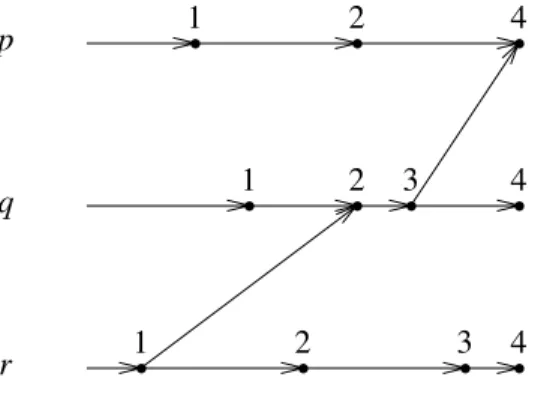
p wheneoccurs.Figure 4.2 illustrates the use of this scheme for implementing logical clocks in a system of three processors,p,qandr. Events are depicted by dots and an arrow is drawn between eventseande$ife might be responsible for causing event e$. For example, an arrow between events in different processes starts from the event corresponding to the sending of a message and ends at the event corresponding to the receipt of that message. The value of T
ˆ
p(e) for each event e is written above that event.IfT
ˆ
(e) is used as the unique identifier associated with a request whose issuance corresponds to evente, the result is a total ordering on the unique identifiers that satisfies O1 and O2. Thus, a logicalp q r 1 2 4 1 2 3 4 1 2 3 4
clock can be used as the basis of an Order Implementation if we can formulate a way to determine when a request is stable at a state machine replica.
It is pointless to implement a stability test in a system where Byzantine failures are possible and a process or message can be delayed for an arbitrary length of time without being considered faulty. This is because no deterministic protocol can implement agreement under these conditions [Fischer et al 85].3Since it is impossible to satisfy the Agreement requirement, there is no point in satisfying the Order requirement. The case where relative speeds of non-faulty processors and messages is bounded is equivalent to assuming that they have synchronized real-time clocks, and will be considered shortly. This leaves the case where fail-stop failures are possible and a process or message can be delayed for an arbitrary length of time without being considered faulty. Thus, we now turn to devis-ing a stability test for that environment.
By attaching sequence numbers to the messages between every pair of processors, it is trivial to ensure that the following property holds of communications channels.
FIFO Channels. Messages between a pair of processors are delivered in the order sent. For fail-stop processors, we can also assume:
Failure Detection Assumption. A processorpdetects that a fail-stop processorqhas failed only afterphas received the last message sent topbyq.
The Failure Detection Assumption is consistent with FIFO Channels, since the failure event for a fail-stop processor necessarily happens after the last message sent by that processor and, therefore, should be received after all other messages.
Under these two assumptions, the following stability test can be used.
Logical Clock Stability Test Tolerating Fail-stop Failures. Every client periodically makes some—possibly null—request to the state machine. A request is stable at replicasmi if a request with larger timestamp has been received bysmi from every client running on a non-faulty processor.
To see why this stability test works, we show that once a requestr is stable at smi, no request with smaller unique identifier (timestamp) will be received. First, consider clients thatsmi does not detect as being faulty. Because logical clocks are used to generate unique identifiers, any request made by a client c must have a larger unique identifier than was assigned to any previous request made by c. Therefore, from the FIFO Channels assumption, we conclude that once a request from a non-faulty client c is received by smi, no request from c with smaller unique identifier than uid(r) can be
3The result of [Fischer et al 85] is actually stronger than this. It states that IC1 and IC2 cannot be achieved by a
deter-ministic protocol in an asynchronous system with a single processor that fails in an even less restrictive manner—by simply halting.
received bysmi. This means that once requests with larger unique identifiers thanuid(r) have been received from every non-faulty client, it is not possible to receive a request with a smaller unique identifier than uid(r) from these clients. Next, for a client c that smi detects as faulty, the Failure Detection Assumption implies that no request fromcwill be received bysmi. Thus, once a requestr is stable at smi, no request with smaller timestamp can be received from a client—faulty or non-faulty.
Synchronized Real-Time Clocks
A second way to produce unique request identifiers satisfying O1 and O2 is by using approxi-mately synchronized real-time clocks.4DefineTp(e) to be the value of the real-time clock at proces-sor p when event e occurs. We can use Tp(e) followed by a fixed-length bit string that uniquely identifiespas the unique identifier associated with a request made as eventeby a client running on a processorp. To ensure that O1 and O2 (of §2) hold for unique identifiers generated in this manner, two restrictions are required. O1 follows provided no client makes two or more requests between successive clock ticks. Thus, if processor clocks have a resolution ofRseconds, then each client can make at most one request everyRseconds. O2 follows provided the degree of clock synchronization is better than the minimum message delivery time. In particular, if clocks on different processors are synchronized to within * seconds, then it must take more than * seconds for a message from one client to reach another; otherwise, O2 would be violated because a requestrmade by one client could have a unique identifier that was smaller than a requestr$made by another, even thoughrwas caused by a message sent afterr$was made.
When unique request identifiers are obtained from synchronized real-time clocks, a stability test can be implemented by exploiting these clocks and the bounds on message delivery delays. Define+
to be constant such that a requestrwith unique identifieruid(r) will be received by every correct pro-cessor no later than timeuid(r)"+ according to the local clock at the receiving processor. Such a+
must exist if requests are disseminated using a protocol that employs afixed number of rounds, like the ones cited above for establishing IC1 and IC2.5 By definition, once the clock on a processor p reaches time),pcannot subsequently receive a requestrsuch thatuid(r)<) , +. Therefore, we have the following stability test.
4A number of protocols to achieve clock synchronization while tolerating Byzantine failures have been proposed
[Lamport & Milliar-Smith 84] [Halpern et al 84]. See [Schneider 86] for a survey. The protocols all require that known bounds exist for the execution speed and clock rates of faulty processors and for message delivery delays along non-faulty communications links. In practice, these requirements do not constitute a restriction. Clock synchronization achieved by the protocols is proportional to the variance in message delivery delay, making it possible to satisfy the restriction— necessary to ensure O2—that message delivery delay exceeds clock synchronization.
5In general,+will be a function of the variance in message delivery delay, the maximum message delivery delay, and
Real-time Clock Stability Test Tolerating Byzantine Failures I. A requestris stable at a state machine replicasmi being executed by processorp if the local clock at preads) and uid(r)<),+.
One disadvantage of this stability test is that it forces the state machine to lag behind its clients by+, where + is proportional to the worst-case message delivery delay. This disadvantage can be avoided. Due to property O1 of the total ordering on request identifiers, if communications channels satisfy FIFO Channels, then a state machine replica that has received a requestrfrom a client ccan subsequently receive fromconly requests with unique identifiers greater thanuid(r). Thus, a request r is also stable at a state machine replica provided a request with larger unique identifier has been received from every client.
Real-time Clock Stability Test Tolerating Byzantine Failures II. A requestris stable at a state machine replicasmi if a request with larger unique identifier has been received from every client.
This second stability test is never passed if a (faulty) processor refuses to make requests. However, by combining the first and second test, so that a request is considered stable when it satisfies either test, a stability test results that lags clients by+only when faulty processors or network delays force it.
Using Replica-Generated Identi
fi
ers
In the previous two refinements of the Order Implementation, clients determine the order in which requests are processed—the unique identifier uid(r) for a requestr is assigned by the client making that request. In the following refinement of the Order Implementation, the state machine replicas determine this order. Unique identifiers are computed in two phases. In the first phase, which can be part of the agreement protocol used to satisfy the Agreement requirement, state machine replicas propose candidate unique identifiers for a request. Then, in the second phase, one of these candidates is selected and it becomes the unique identifier for that request.
The advantage of this approach to computing unique identifiers is that communications between all processors in the system is not necessary. When logical clocks or synchronized real-time clocks are used in computing unique request identifiers, all processors hosting clients or state machine repli-cas must communicate. In the repli-case of logical clocks, this communication is needed in order for requests to become stable; in the case of synchronized real-time clocks, this communication is needed in order to keep the clocks synchronized.6In the replica-generated identifier approach of this subsec-tion, the only communication required is among processors running the client and state machine
6This illustrates an advantage of having a client forward its request to a single state machine replica that then serves as
the transmitter for disseminating the request. In effect, that state machine replica becomes the client of the state machine, and so communication need only involve those processors running state machine replicas.
replicas.
By constraining the possible candidates proposed in phase 1 for a request’s unique identifier, it is possible to obtain a simple stability test. To describe this stability test, some terminology isfirst required. We say that a state machine replica smi has seen a requestr once smi has received r and proposed a candidate unique identifier for r; and we say that smi has accepted r once that replica knows the ultimate choice of unique identifier forr. Definecuid(smi,r) to be the candidate unique identifier proposed by replicasmi for request r. Two constraints that lead to a simple stability test are:
UID1: cuid(smi,r)'uid(r)
UID2: If a request r$ is seen by replica smi after r has been accepted by smi then uid(r)<cuid(smi,r$).
If these constraints hold throughout execution, then the following test can be used to determine whether a request is stable at a state machine replica.
Replica-Generated Identifiers Stability Test. A requestrthat has been accepted bysmi is stable provided there is no requestr$that has (i) been seen bysmi, (ii) not been accepted by smi, and (iii) for whichcuid(smi,r$)'uid(r) holds.
To prove that this stability test works, we must show that once an accepted requestris deemed stable
at smi, no request with smaller unique identifier will be subsequently accepted at smi. Let r be a
request that, according to the Replica-Generated Identifiers Stability Test, is stable at replica smi. Due to UID2, for any requestr$that has not been seen bysmi,uid(r)<cuid(smi,r$) holds. Thus, by transitivity using UID1,uid(r)<uid(r$) holds, and we conclude thatr$cannot have a smaller unique identifier than r. Now consider the case where request r$ has been seen but not accepted by smi and—because the stability test forr is satisfied—uid(r)<cuid(smi,r$) holds. Due to UID1, we con-clude that uid(r)<uid(r$) holds and, therefore, r$ does not have a smaller unique identifier than r. Thus, we have shown that once a requestrsatisfies the Replica-Generated Identifiers Stability Test at smi, any requestr$that is accepted bysmi will satisfyuid(r)<uid(r$), as desired.
Unlike clock-generated unique identifiers for requests, replica-generated ones do not necessarily satisfy O1 and O2 of §2. Without further restrictions, it is possible for a client to make a requestr, send a message to another client causing requestr$to be issued, yet haveuid(r$)<uid(r). However, O1 and O2 will hold provided that once a client starts disseminating a request to the state machine replicas, the client performs no other communication until every state machine replica has accepted that request. To see why this works, consider a request r being made by some client and suppose some requestr$ was influenced by r. The delay ensures that r is accepted by every state machine replicasmj beforer$is seen. Thus, from UID2 we concludeuid(r)<cuid(smi,r$) and, by transitivity
To complete this Order Implementation, we have only to devise protocols for computing unique identifiers and candidate unique identifiers such that:
(4.1) UID1 and UID2 are satisfied.
(4.2) r#r$ -uid(r)#uid(r$)
(4.3) Every request that is seen eventually becomes accepted.
One simple solution for a system of fail-stop processors is the following.
Replica-generated Unique Identifiers. Each state machine replica smi maintains two vari-ables:
SEENiis the largestcuid(smi,r) assigned to any requestrso far seen bysmi, and ACCEPTi is the largestuid(r) assigned to any requestrso far accepted bysmi. Upon receipt of a requestr, each replicasmi computes
(4.4) cuid(smi,r) :!max(SEENi , ACCEPTi )"1".i
(Notice, this means that all candidate unique identifiers are themselves unique.) The replica then disseminates (using an agreement protocol)cuid(smi,r) to all other replicas and awaits receipt of a candidate unique identifier for r from every non-faulty replica, participating in the agreement protocol for that value as well. LetNFbe the set of replicas from which can-didate unique identifiers were received. Finally, the replica computes
(4.5) uid(r) :!
smj.NF
max (cuid(smj,r)) and acceptsr.
We prove that this protocol satisfies (4.1),(4.3) as follows. UID1 follows from using assign-ment (4.5) to computeuid(r), and UID2 follows from assignment (4.4) to computecuid(smi,r). To conclude that (4.2) holds, we argue as follows. Because an agreement protocol is used to disseminate candidate unique identifiers, all replicas receive the same values from the same replicas. Thus, all replicas will execute the same assignment statement (4.5) and all will compute the same value for uid(r). To establish that the these uid(r) values are unique for each request, it suffices to observe that maximums of disjoint subsets of a collection of unique values—the candidate unique identifiers—are also unique. Finally, in order to establish (4.3), that every request that is seen is eventually accepted, we must prove that for each replica smj, a replica smi eventually learns cuid(smj,r) or learns that smj has failed. This follows trivially from the use of an agreement proto-col to distribute thecuid(smj,r) and the definition of a fail-stop processor.
An optimization of our Replica-generated Unique Identifiers protocol is the basis for the ABCAST protocol in the ISIS Toolkit [Birman & Joseph 87] developed at Cornell. In this optimiza-tion, candidate unique identifiers are returned to the client instead of being disseminated to the other state machine replicas. The client then executes assignment (4.5) to compute uid(r). Finally, an
agreement protocol is used by the client in disseminatinguid(r) to the state machine replicas. Some unique replica takes over for the client if the client fails.
It is possible to modify our Replica-generated Unique Identifiers protocol for use in systems where processors can exhibit Byzantine failures, have synchronized real-time clocks, and communi-cations channels have bounded message-delivery delays—the same environment as was assumed for using synchronized real-time clocks to generate unique identifiers. The following changes are required. First, each replica smi uses timeouts so that smi cannot be forever delayed waiting to receive and participate in the agreement protocol for disseminating a candidate unique identifier from a faulty replica smj. Second, if smi does determine that smj has timed-out, smi disseminates "smj timeout" to all replicas (by using an agreement protocol). Finally, NF is the set of replicas in the ensemble less anysmj for which "smj timeout" has been received fromt"1 or more replicas. Notice, Byzantine failures that cause faulty replicas to propose candidate unique identifiers not produced by (4.4) do not cause difficulty. This is because candidate unique identifiers that are too small have no effect on the outcome of (4.5) at non faulty replicas and those that are too large will satisfy UID1 and UID2.
5. Tolerating Faulty Output Devices
It is not possible to implement atfault-tolerant system by using a single voter to combine the outputs of an ensemble of state machine replicas into one output. This is because a single failure—of the voter—can prevent the system from producing the correct output. Solutions to this problem depend on whether the output of the state machine implemented by the ensemble is to be used within the system or outside the system.
Outputs Used Outside the System
If the output of the state machine is sent to an output device, then that device is already a single component whose failure cannot be tolerated. Thus, being able to tolerate a faulty voter is not sufficient—the system must also be able to tolerate a faulty output device. The usual solution to this problem is to replicate the output device and voter. Each voter combines the output of each state machine replica, producing a signal that drives one output device. Whatever reads the outputs of the system is assumed to combine the outputs of the replicated devices. This reader, which is not con-sidered part of the computing system, implements the critical voter.
If output devices can exhibit Byzantine failures, then by taking the output produced by the majority of the devices, 2t"1-fold replication permits up to t faulty output devices to be tolerated. For example, aflap on an airplane wing might be designed so that when the 2t"1 actuators that con-trol it do not agree, the flap always moves in the direction of the majority (rather than twisting). If output devices exhibit only fail-stop failures, then onlyt"1-fold replication is necessary to toleratet
treated as fail-stop—failure detection is implemented by the viewer. With such an output device, a human user can look at a one of t"1 devices, decide whether the output is faulty, and only if it is faulty, look at another, and so on.
Outputs Used Inside the System
If the output of the state machine is to a client, then the client itself can combine the outputs of state machine replicas in the ensemble. Here, the voter—a part of the client—is faulty exactly when the client is, so the fact that an incorrect output is read by the client due to a faulty voter is irrelevant. When Byzantine failures are possible, the client waits until it has receivedt"1 identical responses, each from a different member of the ensemble, and takes that as the response from thetfault-tolerant state machine. When only fail-stop failures are possible, the client can proceed as soon as it has received a response from any member of the ensemble, since any output produced by a replica must be correct.
When the client is executed on the same processor as one of the state machine replicas, optimi-zation of client-implemented voting is possible.7This is because correctness of the processor implies that both the state machine replica and client will be correct. Therefore, the response produced by the state machine replica running locally can be used as that client’s response from the t fault-tolerant state machine. And, if the processor is faulty, then we are entitled to view the client as being faulty, so it does not matter what state machine responses the client receives. Summarizing, we have:
Dependent-Failures Output Optimization. If a client and a state machine replica run on the same processor, then even when Byzantine failures are possible, the client need not gather a majority of responses to its requests to the state machine. It can use the single response produced locally.
6. Tolerating Faulty Clients
Implementing atfault-tolerant state machine is not sufficient for implementing atfault-tolerant system. Faults might result in clients making requests that cause the state machine to produce errone-ous output or that corrupt the state machine so that subsequent requests from non-faulty clients are incorrectly processed. Therefore, in this section, we discuss various methods for insulating the state machine from faults that affect clients.
7Care must be exercised when analyzing the fault-tolerance of such a system because a single processor failure can
now cause two system components to fail. Implicit in most of our discussions is that system components fail independently. It is not always possible to transform atfault-tolerant system in which clients and state machine replicas have independent failures to one in which they share processors.
6.1. Replicating the Client
One way to avoid having faults affect a client is by replicating the client and running each replica on hardware that fails independently. However, this replication also requires changes to state machines that handle requests from that client. This is because after a client has been replicated N -fold, any state machine it interacts with will receiveNrequests—one from each client replica—when it formerly received a single request. Moreover, corresponding requests from different client replicas will not necessarily be identical. First, they will differ in their unique identifiers. Second, unless the original client is itself a state machine and the methods of §4 are used to coordinate the replicas, corresponding requests from different replicas can also differ in their content. For example, if a client makes requests based on the value of some time-varying sensor, then its replicas will each read their sensors at a slightly different times and, therefore, make different requests.
Wefirst consider modifications to a state machinesmfor the case where requests from different client replicas are known to differ only in their unique identifiers. For this case, modifications are needed for coping with receiving N requests instead of a single one. These modifications involve changing each command so that instead of processing every request received, requests are buffered until enough8have been received; only then is the corresponding command performed (a single time). In effect, a voter is being added tosmto control invocation of its commands. Client replication can be made invisible to the designer of a state machine by including such a voter in the support software that receives requests, tests for stability, and orders stable requests by unique identifier.
Modifying the state machine for the case where requests from different client replicas can also differ in their content typically requires exploiting knowledge of the application. As before, the idea is to transform multiple requests into a single one. For example, in atfault-tolerant system, if 2t"1 different requests are received, each containing the value of a sensor, then a single request containing the median of those values might be constructed and processed by the state machine. (Given at most tByzantine faults, the median of 2t"1 values is a reasonable one to use because it is bounded from above and below by a non-faulty value.) A general method for transforming multiple requests con-taining sensor values into a single request is discussed in [Marzullo 89]. That method is based on viewing a sensor value as an interval that includes the actual value being measured; a single interval (sensor) is computed from a set of intervals by using a fault-tolerant intersection algorithm.
6.2. Defensive Programming
Sometimes a client cannot be made fault-tolerant by using replication. In some circumstances, due to the unavailability of sensors or processors, it simply might not be possible to replicate the
8If Byzantine failures are possible then atfault-tolerant client requires 2t"1-fold replication and a command is
per-formed aftert"1 requests have been received; if failures are restricted to fail-stop, thent"1-fold replication will suffice and a command can be performed after a single request has been received.
client. In other circumstances, the application semantics might not afford a reasonable way to transform multiple requests from client replicas into the single request needed by the state machine. In all of these circumstances, careful design of state machines can limit the effects of requests from faulty clients. For example, memory(Figure 2.1) permits any client to write to any location. There-fore, a faulty client can overwrite all locations, destroying information. This problem could be prevented by restricting write requests from each client to only certain memory locations—the state machine can enforce this.
Including tests in commands is another way to design a state machine that cannot be corrupted by requests from faulty clients. For example,mutexas specified in Figure 2.2, will execute arelease command made by any client—even one that does not have access to the resource. Consequently, a faulty client could issue such a request and causemutexto grant a second client access to the resource before the first has relinquished access. A better formulation of mutex ignores release commands from all but the client to which exclusive access has been granted. This is implemented by changing thereleaseinmutexto:
release: command
ifuser#client"skip
[]waiting!! /user!client"user:!!
[]waiting#! /user!client"sendOKtohead(waiting); user:!head(waiting); waiting:!tail(waiting)
fi
endrelease
Sometimes, a faulty client not making a request can be just as catastrophic as one making an erroneous request. For example, if a client ofmutexfailed and stopped while it had exclusive access to the resource, then no client could be granted access to the resource. Of course, unless we are prepared to bound the length of time that a correctly functioning process can retain exclusive access to the resource, there is little we can do about this problem. This is because there is no way for a state machine to distinguish between a client that has stopped executing because it has failed and one that is executing very slowly. However, given an upper boundB on the interval between anacquireand the followingrelease, theacquirecommand ofmutexcan automatically schedulereleaseon behalf of a client.
We use the notation
schedule%REQUEST&for ")
to specify scheduling%REQUEST& with a unique identifier at least) greater than the identifier on the request being processed. Such a request is called atimeout requestand becomes stable at some time in the future, according to the stability test being used for client-generated requests. Unlike requests from clients, requests that result from executingscheduleneed not be distributed to all state machine replicas of the ensemble. This is because each state machine replica will independently scheduleits
own (identical) copy of the request.
We can now modifyacquireso that areleaseoperation is automatically scheduled. In the code that follows, TIME is assumed to be a function that evaluates to the current time. Note that mutex might now process two release commands on behalf of a client that has acquired access to the resource: one command from the client itself and one generated by itsacquirerequest. However, the new state variabletime_grantedensures that superfluousreleasecommands are ignored.
acquire: command
ifuser!! "sendOKtoclient; user:!client;
time_granted:!TIME;
schedule
%
mutex.timeout,time_granted&
for "B []user#! "waiting:!waiting clientfi
endacquire
timeout: command(when_granted:integer) ifwhen_granted#time_granted "skip
[]waiting!! /when_granted!time_granted "user :!!
[]waiting#! /when_granted!time_granted "
sendOK tohead(waiting); user :!head(waiting); time_granted :!TIME; waiting :!tail(waiting)
fi
endtimeout
7. Using Time to Make Requests
A client need not explicitly send a message to make a request. Not receiving a request can trigger execution of a command—in effect, allowing the passage of time to transmit a request from client to state machine [Lamport 84]. Transmitting a request using time instead of messages can be advantageous because protocols that implement IC1 and IC2 can be costly both in total number of messages exchanged and in delay. Unfortunately, using time to transmit requests has only limited applicability, since the client cannot specify parameter values.
The use of time to transmit a request was employed in §6 when we revised the acquire com-mand ofmutexto foil clients that failed to release the resource. There, areleaserequest was automat-ically scheduled by acquire on behalf of a client being granted the resource. A client transmits a releaserequest tomutexsimply by permitting B(logical clock or real-time clock) time units to pass. It is only to increase utilization of the shared resource that a client might use messages to transmit a releaserequest tomutexbeforeBtime units have passed.
all clients and state machine replicas have (logical or real time) clocks synchronized to within0
and
the election starts at timeStrtand this is known to all clients and state machine replicas.
Using time, a client can cast a vote for adefaultby doing nothing; only when a client casts a vote dif-ferent from its default do we require that it actually transmit a request message. Thus, we have:
Transmitting a Default Vote. If client has not made a request by time Strt"0, then a request with that client’s default vote has been made.
Notice that the default need not befixed nor even known at the time a vote is cast. For example, the default vote could be "vote for the first client that any client casts a non-default vote for". In that case, the entire election can be conducted as long as one client casts a vote by using actual messages.9
8. Recon
fi
guration
An ensemble of state machine replicas can tolerate more thantfaults if it is possible to remove state machine replicas running on faulty processors from the ensemble and add replicas running on repaired processors. (A similar argument can be made for being able to add and remove copies of clients and output devices.) Let P()) be the total number of processors at time ) that are executing replicas of some state machine of interest, and letF()) be the number of them that are faulty. In order for the ensemble to produce the correct output, we must have
Combining Condition: P()),F())>Enuf for all 0').
whereEnuf 1 0 if only fail-stop failures are possible.P())/2 if Byzantine failures are possible.
A processor failure may cause the Combining Condition to be violated by increasing F()), thereby decreasing P()),F()). When Byzantine failures are possible, if a faulty processor can be identified, then removing it from the ensemble decreasesEnufwithout further decreasingP()),F()); this can keep the Combining Condition from being violated. When only fail-stop failures are possi-ble, increasing the number of non-faulty processors—by adding one that has been repaired—is the only way to keep the Combining Condition from being violated because increasingP()) is the only way to ensure thatP()),F())>0 holds. Therefore, provided the following conditions hold, it may be possible to maintain the Combining Condition forever and thus tolerate an unbounded total number of faults over the life of the system.
9Observe that if Byzantine failures are possible, then a faulty client can be elected. Such problems are always possible
F1: If Byzantine failures are possible, then state machine replicas being executed by faulty processors are identified and removed from the ensemble before the Combin-ing Condition is violated by subsequent processor failures.
F2: State machine replicas running on repaired processors are added to the ensemble before the Combining Condition is violated by subsequent processor failures. F1 and F2 constrain the rates at which failures and repairs occur.
Removing faulty processors from an ensemble of state machines can also improve system per-formance. This is because the number of messages that must be sent to achieve agreement is usually proportional to the number of state machine replicas that must agree on the contents of a request. In addition, some protocols to implement agreement execute in time proportional to the number of pro-cessors that are faulty. Removing faulty propro-cessors clearly reduces both the message complexity and time complexity of such protocols.
Adding or removing a client from the system is simply a matter of changing the state machine so that henceforth it responds to or ignores requests from that client. Adding an output device is also straightforward—the state machine starts sending output to that device. Removing an output device from a system is achieved bydisabling the device. This is done by putting the device in a state that prevents it from affecting the environment. For example, a CRT terminal can be disabled by turning off the brightness so that the screen can no longer be read; a hydraulic actuator controlling theflap on an airplane wing can be disabled by opening a cutoff valve so that the actuator exerts no presure on that control surface. However, as suggested by these examples, it is not always possible to disable a faulty output device: turning off the brightness might have no effect on the screen and the cutoff valve might not work. Thus, there are systems in which no more than a total oftactuator faults can be tolerated because faulty actuators cannot be disabled.
The configuration of a system structured in terms of a state machine and clients can be described using three sets: the clients
C
, the state machine replicasS
, and the output devicesO
.S
is used by the agreement protocol and therefore must be known to clients and state machine replicas. It can also be used by an output device to determine which send operations made by state machine replicas should be ignored.C
andO
are used by state machine replicas to determine from which clients requests should be processed and to which devices output should be sent. Therefore,C
andO
must be available to all state machine replicas.Two problems must be solved to support changing the system configuration. First, the values of
C
,S
, andO
must be available when required. Second, whenever a client, state machine replica, or output device is added to the configuration, the state of thatelement must be updated to reflect the current state of the system. These problems are considered in the following two subsections.8.1. Managing the Con
fi
guration
The configuration of a system can be managed using the state machine in that system. Sets
C
,S
, andO
are stored in state variables and changed by commands. Each configuration isvalidfor a col-lection of requests—those requests r such that uid(r) is in the range defined by two successive configuration-change requests. Thus, whenever a client, state machine replica, or output device per-forms an action connected with processingr, it uses the configuration that is valid forr. This means that a configuration-change request must schedule the new configuration for some point far enough in the future so that clients, state machine replicas, and output devices all find out about the new configuration before it actually comes into effect.There are various ways to make configuration information available to the clients and output devices of a system. (The information is already available to the state machine.) One is for clients and output devices to query the state machine periodically for information about relevant pending configuration changes. Obviously, communication costs for this scheme are reduced if clients and output devices share processors with state machine replicas. Another way to make configuration information available is for the state machine to include information about configuration changes in messages it sends to clients and output devices in the course of normal processing. Doing this requires periodic communication between the state machine and clients and between the state machine and output devices.
Requests to change the configuration of the system are made by a failure/recovery detection mechanism. It is convenient to think of this mechanism as a collection of clients, one for each ele-ment of
C
,S
, orO
. Each of theseconfiguratorsis responsible for detecting the failure or repair of the single object it manages and, when such an event is detected, for making a request to alter the configuration. A configurator is likely to be part of an existing client or state machine replica and might be implemented in a variety of ways.When elements are fail-stop, a configurator need only check the failure-detection mechanism of that element. When elements can exhibit Byzantine failures, detecting failures is not always possible. When it is possible, a higher degree of fault tolerance can be achieved by reconfiguration. A non-faulty configurator satisfies two safety properties.
C1: Only a faulty element is removed from the configuration. C2: Only a non-faulty element is added to the configuration.
However, a configurator that does nothing satisfies C1 and C2. Changing the configuration enhances fault-tolerance only if F1 and F2 also hold. For F1 and F2 to hold, a configurator must also (1) detect faults and cause elements to be removed and (2) detect repairs and cause elements to be added. Thus, the degree to which a configurator enhances fault tolerance is directly related to the degree to which (1) and (2) are achieved. Here, the semantics of the application can be helpful. For example, to infer that a client is faulty, a state machine can compare requests made by different clients or by the same
client over a period of time. To determine that a processor executing a state machine replica is faulty, the state machine can monitor messages sent by other state machine replicas during execution of an agreement protocol. And, by monitoring aspects of the environment being controlled by actuators, a state machine replica might be able to determine that an output device is faulty. Some elements, such as processors, have internal failure-detection circuitry that can be read to determine whether that ele-ment is faulty or has been repaired and restarted. A configurator for such an element can be imple-mented by having the state machine periodically poll this circuitry.
In order to analyze the fault-tolerance of a system that uses configurators, failure of a configurator can be considered equivalent to the failure of the element that the configurator manages. This is because with respect to the Combining Condition, removal of a non-faulty element from the system or addition of a faulty one is the same as that element failing. Thus, in atfault-tolerant sys-tem, the sum of the number of faulty configurators that manage non-faulty elements and the number of faulty components with non-faulty configurators must be bounded byt.
8.2. Integrating a Repaired Object
Not only must an element being added to a configuration be non-faulty, it also must have the correct state so that its actions will be consistent with those of rest of the system. Definee[ri] to be the state that a non-faulty system elementeshould be in after processing requestsr0 through ri. An element e joining the configuration immediately after request rjoin must be in statee[rjoin] before it can participate in the running system.
An element isself-stabilizing[Dijkstra 74] if its current state is completely defined by the previ-ousk inputs it has processed, for somefixedk. Obviously, running such an element long enough to ensure that it has processedkinputs is all that is required to put it in statee[rjoin]. Unfortunately, the design of self-stabilizing state machines is not always possible.
When elements are not self-stabilizing, processors are fail-stop, and logical clocks are imple-mented, cooperation of a single state machine replicasmi is sufficient to integrate a new element e into the system. This is because state information obtained from any state machine replicasmi must be correct. In order to integrateeat requestrjoin, replicasmi must have access to enough state infor-mation so thate[rjoin] can be assembled and forwarded toe.
When e is an output device, e[rjoin] is likely to be only a small amount of device-specific set-up information—information that changes infrequently and can be stored in state variables ofsmi.
When e is a client, the information needed for e[rjoin] is frequently based on recent sensor values read and can therefore be determined by using information provided to smi by other clients.
And, wheneis a state machine replica, the information needed fore[rjoin] is stored in the state variables and pending requests atsmi.
The protocol for integrating a client or output deviceeis simple—e[rjoin] is sent toebefore the output produced by processing any request with a unique identifier larger thanuid(rjoin). The proto-col for integrating a state machine replicasmnew is a bit more complex. It is not sufficient for replica smi simply to send the values of all its state variables and copies of any pending requests tosmnew. This is because some client request might be received bysmi after sending e[rjoin] but delivered to smnew before its repair. Such a request would neither be reflected in the state information forwarded bysmi tosmnew nor received by smnew directly. Thus,smi must, for a time, relay tosmnew requests received from clients.10Since requests from a given client are received bysmnewin the order sent and in ascending order by request identifier, oncesmnew has received a request directly (i.e. not relayed) from a clientc, there is no need for requests fromc with larger identifiers to be relayed tosmnew. If smnew informs smi of the identifier on a request received directly from each clientc, thensmi can know when to stop relaying tosmnewrequests fromc.
The complete integration protocol is summarized in the following.
Integration with Fail-stop Processors and Logical Clocks. A state machine replica smi can integrate an elementeat requestrjoininto a running system as follows.
Ifeis a client or output device,smi sends the relevant portions of its state variables to eand does so before sending any output produced by requests with unique identifiers larger than the one onrjoin.
Ifeis a state machine replicasmnew, thensmi
(1) sends the values of its state variables and copies of any pending requests tosmnew, (2) sends to smnew every subsequent request r received from each client c such that
uid(r)<uid(rc), where rc is the first request smnew received directly from c after being restarted.
The existence of synchronized real-time clocks permits this protocol to be simplified because smi can determine when to stop relaying messages based on the passage of time. Suppose, as in §4, there exists a constant+such that a requestr with unique identifieruid(r) will be received by every (correct) state machine replica no later than timeuid(r)"+according to the local clock at the receiv-ing processor. Let smnew join the configuration at time )join. By definition, smnew is guaranteed to receive every request that was made after time )join on the requesting client’s clock. Since unique