2
MANAGEMENT
FOR THE
BACHELOR DEGREE
Textbook
Under the editorship of O.F. Balatskyi and O.M. Telizhenko
Approved by the Ministry of Education and Science of Ukraine as textbook for the students of Higher Educational Institutions
Sumy
Universytetska knyga 2015
3 УДК 65.012.32(075.8)
ББК 65.290-2я73 М50
Recommended to be published by the Scientific Council of Sumy State University. Record No. 2 of September 20, 2007
Reviewers: S.M. Kozmenko, Dr.Sci. (Econ.), Prof., Vice-rector for Scientific work of Ukrainian Academy of Banking of the National Bank of Ukraine;
S.M. Illyashenko, Dr.Sci. (Econ.), Prof., Head of the Department of Marketing of Sumy State University;
A.I. Yakovlev, Dr.Sci. (Econ.), Prof., Head of the Department of Economics and Marketing of National Technical University “Kharkiv Polytechnic Institute”
The approved by was given by the Ministry of Education and Science of Ukraine. Letter No. 14.4/18- Г-2035 of 22.11.07
Management for Bachelors: textbook: under the general editorship of O. F. Balatskyi, M50 O.M.Telizhenko - Sumy: Universytetska knyga, 2015 - 610 p.
ISBN 978-966-680-448-1
The textbook contains educational module, which embraces the content of main regulatory disciplines on specialists training by the direction 6.030601 “Management” in the knowledge branch 03.06 “Management and administration” of the educational and qualification level “Bachelor”. According to the content the disciplines completely conform to curricula approved by scientific and methodological commission on management and agreed with logical and structural scheme of educational process.
The textbook embraces almost all aspects of bachelor training. The chapters contain questions for self-control and list of recommended literature. While creating the chapters the results of fundamental and applied scientific researches of the evaluation branch, the forecasting and management of economic potential of complicated industrial system were used.
ББК 65.290-2я73
ISBN 978-966-680-448-1
4 CONTENT
CHAPTER 1 THE HISTORY OF MANAGEMENT………...……14
1.1 The main stages of the management development………...…..14
1.2 The development of the antique management……….….16
1.3 The concept of Machiavelli’s leadership………..…17
1.4 The foundation of “scientific management” in England……….….19
1.5 The school of “scientific management”. Taylorism……...…..21
1.6 The school of “administrative management”………...……..24
1.7 “Synthetic” concept of management………...……...25
1.8 The bureaucratic school of management……….….27
1.9 School of psychology and human relations. Behaviourism………..28
1.10 Features of the Japanese and American management models…...……30
1.11 Management development in Ukraine………....32
CHAPTER 2. PRINCIPLES OF MANAGEMENT……….….35
2.1 Basic management concepts and categories……….35
2.2 Planning as a management function……….37
2.3 Organization: concept, purpose, properties……….38
2.4 Motivation: the meaning of the function and purpose………..44
2.5 Control function………....47
2.6 Communications and management decisions………...48
2.7 Authority essence and forms. The law of power………..50
2.8 Conflict management………51
2.9 Organizational changes……….52
2.10 Management ethics and corporate social responsibility……….53
CHAPTER 3. PERSONAL MANAGEMENT………..…….56
3.1 Personnel Management as a social system………...56
3.2 The notion and essence of personnel………58
3.3 Personnel policy of organization………..61
3.4 Service of personnel, its structure and functions………..64
3.5 Planning and optimization of the personnel number………67
3.6 Recruitment and selection of the staff………..70
3.7 Career guidance and adaptation of the staff……….74
3.8 Training……….75
3.9 Evaluation and appraisal of staff………..77
3.10 Career management, training of managers……….79
CHAPTER 4 CONTROLLING………..84
5
4.2 Types of controlling………..87
4.3 Cost management in controlling………...88
4.4 Management accounting in the controlling system………..94
4.5 The concept of operational and strategic controlling………...96
4.6 Deviations in the system of controlling………99
4.7 Budgeting in the system controlling………...103
CHAPTER 5 OPERATING MANAGEMENT………...112
5.1 Basics of operating management………112
5.2 The strategic planning is in the operating system………...114
5.3 Aggregate planning……...117
5.4 Management of the supplies of dependent and independent demand…...119
5.5 Operating planning and production control of production…...124
5.6 Human resources management in the operating system……...127
CHAPTER 6. MANAGEMENT INFORMATION SYSTEMS………...130
6.1 Informatization management processes……...130
6.2 Automated systems of company management (Standards for MRP, MRPII, ERP, ERPII)………...132
6.3 The organization of information technologies and management activities……...136
6.4 Network technologies and systems of distributed processing………...138
6.5 Hypertext technologies and their application on the Internet………...140
6.6 Peculiarities of advertising on the Internet…………...142
6.7 Payment systems and virtual employment………...145
CHAPTER 7. ORGANIZATION OF THE MANAGER'S WORK………...149
7.1 The basic principles of the manager's work organization……...149
7.2 Management and leadership……...151
7.3 Management of the formal and informal communication……...155
7.4 Forms of business communication……...157
7.5 Scheduling of manager’s work…...160
7.6 The realization of manager’s work activity……...164
7.7 Economic efficiency of the manager's work……...167
CHAPTER 8 THE BASIC PRINCIPLES OF THE FOREIGN ECONOMIC ACTIVITY………...169
8.1 The foreign-economic activity of the subjects to a market society. Regulation of the foreign economic activity in Ukraine……...169
8.2 The forms of enterprises on the foreign markets. The market research of the foreign market on the foreign export-import transactions……...172
6 8.3 Organization and preparation technique, execution and implementation
of the foreign economic agreements. The structure and content of the
international sales-purchase agreements………...180
8.4 Prices, fiscal and financial terms of contracts, payment terms, payment methods…....187
8.5 Transportation provision of foreign trade contracts (agreements)…...192
8.6 Economic efficiency of foreign trade enterprise……...194
CHAPTER 9. MANAGEMENT AND CERTIFICATION OF PRODUCTS QUALITY...198
9.1 The notions, figures, methods of determining product quality…...198
9.2 The interrelationship between effectiveness and products quality……...204
9.3 Standardization in quality control system……...207
9.4 System UkrSEPRO certificate……...210
9.5 The main ways of the activity improvement…...215
9.6 The collective worker participation in the quality improving of the organization functioning……...218
9.7 Involvement of suppliers in the process of improving the products quality…...223
CHAPTER 10. INVESTMENT………...227
10.1 Economic essence of investments and their importance in the development of actual economy………...227
10.2 Structure of investment market and subjects of investment activity………...228
10.3 Basic funding sources of investment activity……...231
10.4 The use of discounting activity rate of investment efficiency……...234
10.5 Models of determination of the borrower insolvency……...238
10.6 Economic content of the foreign investment. Forms and methods of its involvement………...239
10.7 Formation of the public policy in stimulation of investment activity and involvement in of foreign investments………...243
CHAPTER 11. REGIONAL MANAGEMENT………...246
11.1 Theoretical bases of regional management………...246
11.2 Organizational forms of territorial government………...250
11.3 Foreign economy activity in the region………...252
11.4 Analysis of regional development………...255
11.5 The regional management of labor potential………...257
11.6 Management of natural resource potential of the region………...261
11.7 The mechanism of the regional management………...262
11.8 The formation and use of the regional financial resources………...267
7
CHAPTER 12. CORPORATE MANAGEMENT………...277
12.1 History of origin and development of corporate form of management……...277
12.2 Notion and economic nature of corporation………...279
12.3 Types of corporations………...280
12.4 Modern approaches to the determination of corporate management………...280
12.5 Subjects and objects of corporate management………...281
12.6 Standards of corporate management………...283
12.7 Models of corporate management………...286
12.8 The status, rights and responsibilities of shareholders………...293
12.9 Shareholders’ impact on corporation activity………...293
12.10 Managers against the owners, or agency conflicts………...296
12.11 Types of corporate securities………...298
12.12 Operations with corporate securities………...300
CHAPTER 13. PROJECT MANAGEMENT………..302
13.1 The essence and importance of project management………...302
13.2 The organizational structures of project management………...306
13.3 Investment project management………...310
13.4 Project management processes………...312
13.5 Planning in control system of project………...317
13.6 Financing of investment projects………...323
13.7 Communications management and monitoring of projects…………...326
CHAPTER 14. LOGISTICS………...330
14.1 Essence, aims and functions of logistics…………...330
14.2 System approach to the material flow management………...332
14.3 Organizational and economic mechanisms of material and commodity flow management………...335
14.4 Organization of logistic planning………...339
14.5 Functional logistic management………...341
14.6 Purchase logistics………...341
14.7 Production logistics………...343
14.8 Distribution and physical distribution of goods………...344
14.9 Logistics service………...347
14.10 Inventory management………...348
14.11 Transport logistics and transportation at the enterprises………...356
14.12 Warehouse logistics………...360
8
CHAPTER 15. MANAGERIAL DECISIONS MAKING METHODS APPROVAL…...367
15.1 General notions of the decision making theory………...367
15.2 Approval and managerial decisions classification process………...374
15.3 Modeling of developing and making decisions………...375
15.4 System analysis in the decision making theory…………...376
15.5 Heuristic methods of managerial decisions making………...378
15.6 Features of development and decision making in a group…………...380
15.7 The quantitative methods for management decisions………...385
CHAPTER 16. ADMINISTRATIVE MANAGEMENT………...391
16.1 The concept of administrative management……...391
16.2 Conditions of effective management decisions………...392
16.3 The stages of management process………...393
16.4 Management of information resources of the organization…………...394
16.5 Group behavior in the organization………...395
16.6 Communicative process and communication in the organization…………...398
16.7 Conflict management in organizations………...400
16.8 Management of negotiations…………...403
16.9 Career in the organization………...405
CHAPTER 17. PLANNING OF ENTERPRISE ACTIVITY.………...409
17.1 Structure and system of enterprise activity planning…………...409
17.2 Sales planning…...413
17.3 Planning of production programme………...418
17.4 Planning of production capacity………...421
17.5 Planning of work and wages………...425
17.6 Planning of self cost and industrial products……...429
17.7 Planning of the production logistics support…………...432
17.8 Financial planning at the enterprise……...435
CHAPTER 18. BUSINESS ORGANIZATION………..…...439
18.1 General characteristics of business activity…………...439
18.2 Small business in market economy………...441
18.3 Ways of business organization………...443
18.4 Choice of business activity type…………...445
18.5 Legal basics of organization, registration, and termination of business entities...446
18.6 Licensing of certain types of business activity………...447
18.7 Business planning of modern entrepreneurship………...449
18.8 Ways to increase business effectiveness………...451
9
18.10 Ethics and etiquette in business………...460
CHAPTER 19. MARKETING………...468
19.1 The nature of marketing and the development of its concepts………...468
19.2 Marketing as an open mobile system…………...470
19.3 Formation of the marketing information system on the basis of marketing research………...471
19.4 Studying of the consumers’ demands and behavior and target segments selection….473 19.5 Commodity in the marketing complex…………...475
19.6 Price in complex marketing………...479
19.7 Distribution in the marketing sphere…………...480
19.8 Communication in a marketing complex…………...487
19.9 Management of marketing activities…………...490
CHAPTER 20. ENVIRONMENTAL MANAGEMENT………..………...494
20.1 The concept of the ecologically sustainable development………...494
20.2 State environmental policy………...496
20.3 Environmental policy at the global level………...498
20.4 Preconditions for implementation of environmental management in modern enterprises………...500
20.5 Socio-psychological aspects of eco-management…………...502
20.6 Methods and instruments of ecological management…………...507
20.7 Essence of strategic ecological management…………...511
20.8 International standards of ecological management………...514
20.9 Personnel as strategic resource of environmental management…………...516
CHAPTER 21. VALUATION OF CORPORATE ASSETS………..520
21.1 Organization of valuation………...520
21.2 Objects of valuation………...523
21.3 Basic principles of the valuation theory………...527
21.4 Market value and non-market value categories…………...530
21.5 Methods of valuation: an expenditure approach…………...534
21.6 Methods of valuation: a comparative approach……...538
21.7 Methods of valuation: income approach………...540
CHAPTER 22. EXECUTION OF DOCUMENTS………..551
22.1 Execution of official documents………...551
22.2 Management of documents circulation…………...556
22.3 Organizational documents………...564
22.4 Administrative documents………...565
10
termination of the agreement………...572
CHAPTER 23. BUSINESS ECONOMY………...577
23.1 General characteristic of business activity………...577
23.2 Firm as the main subject of business activity………...579
23.3 Enterprise ideas, its sources and search methods………...581
23.4 State registration of subjects of an entrepreneurial activity………..582
23.5 State regulation of an entrepreneurial activity………..584
23.6 Licensing of certain types of business operations………585
23.7 Patenting of some types of the business activity………..587
23.8 Contractual relationships in the company (enterprise)……….588
23.9 Manufacturing planning………590
23.10 Economic essence of the certain funds of the firm……….592
23.11 Intangible assets………..596
23.12 The concept of firm circulating assets. Methods of regulation and efficiency of firm circulating assets usage………...…...597
23.13 Concept and personnel classification………..599
23.14 Concept of salary and its functions………...601
23.15 The costs of the firm………...604
23.16 The financial results of the company operation. Profit. Break even point. Profitability…………...605
23.17 Tax administration………...607
23.18 The concept of state control of business, its form and order of appeal of the results of inspections………...609 22.6 Documents concerning the conclusion, change and
11
INTRODUCTION
In the centre of all the modern conceptions there is a person whose behavior influences the success of the whole company. We live in the epoch of change of social type of person: an economic type of person changes to corporate one. The last one opposed to economic person that was oriented only on own success, creates a space to live and develop in (first of all for itself).
Management relations are social by their nature as they appear between people in the process of production activity. That is why management as a science belongs to the class of economic and organizational sciences.
Subject of the management science is the social relations that appear between people in the process of production activity, exchange and consumption of material goods (services) regarding the agreement and coordination of common actions for achieving the defined aims, i.e. the management relations. The management relations originate from the industrial economic relations; they are a superstructure on economic basis. The management relations nature, their formation and development processes are determined by the nature of the industrial relations and forms of ownership of the means of production.
A general method of management as a science is dialectical that enables to solve the problems of improvement of forms and methods of production management under conditions of unstable economic situations, requires studying separate aspects, elements and connections of management system. It is realized by means of the methods of observation, modeling, analysis, synthesis, generalization, induction, deduction etc.
Special methods of cognition are divided into two groups: 1) methods of collection and primary data (information) processing;
2) methods of study, evaluation and summation of the received information from the point of view of the management relations (decision making, characteristics of personnel management, summation of background experience, labor motivation etc).
The most widely used methods of scientific researches in management include: shift from studying the concrete facts and figures to generalization and revealing the most essential cause-and-effect relations within the very system of management, as well as between this system and social and economic processes under its influence; evaluation of these relations form; classification of factors that stimulate or, vice versa, slow down the influence on their development that correspondently influence final results.
Recently mathematical methods of balance, optimization and other calculations, as well as economic and mathematical modeling have become rather widespread. They enable to reflect the key qualitative and quantitative characteristics of behavior (development) of management subject and object properly in comparatively simple and suitable for analysis form. The use of mathematical methods and models greatly influences the effectiveness and efficiency of manager’s work, increases the accuracy and safety of management decisions making. Widely used economic experiments give the opportunity to check in practice and improve the theoretical developments and hypotheses on new methods and forms of management before providing the whole economic system with them.
While arrangement of textbook the modern concepts of management, changes in social and economic relations, which took place in the result of world division of labour, technological modernization of production, formation of financial and production groups were taken into consideration. Including such disciplines as “Human Resources Management”, “Controlling”,
12 “Operations management”, “Information Systems in Management”, “Organization of Manager’s Work” to the textbook was aimed on concretization of appropriate management functions, which are studied systematically within the discipline “Basics of Management”. However the main attention while arrangement was aimed on the summing up of world experience of implementation the appropriate program providing and systematization of information into the educational process. All this gives students the opportunity to receive appropriate knowledge and skills of management decisions making with taking into account the cause-and-effect relations in the system of management.
The disciplines “Regional Management”, “Basics of Foreign Economic Activity” and “Corporate Management” give students the opportunity to formulate general ideas on foreign economic environment of production system functioning. The discipline “Investment” is considered as providing one, the study of which allows students to define not only economic efficiency of investment projects, but also to make appropriate management decisions concerning optimization of their financing sources.
13 Authors:
O. F. Balatskyi, Dr.Sci. (Econ.) – introduction, 1.1, 11.1, 13.4, 16.1
O. M. Telizhenko, Dr.Sci. (Econ.) – introduction, 10.1, 10.4, 13.3, 13.5, 13.7
Ye. O. Balatskyi, Dr.Sci. (Econ.) – 1.6, 1.10, 1.11, 2.10, 13.2, 13.6
V. V. Bozhkova, Dr.Sci. (Econ.) – 19.1, 19.2, 19.3, 19.4,19.8
Ye. V. Khlobystov, Dr.Sci. (Econ.) – 16.2, 16.3
Ye. V. Lapin, Dr.Sci. (Econ.) – 6.1, 6.2
M. M. Petrushenko, Dr.Sci. (Econ.) – 3.4, 3.6, 3.7, 20.6, 20.9
M. O. Sokolov, Dr.Sci. (Econ.) – 15.1, 15.3, 15.4
O. A. Bilovodska, Cand.Sci. (Econ.) – 19.5, 19.6, 19.7, 19.9
O. G. Degtyarenko, Cand.Sci. (Econ.) – 9.1, 9.2, 9.3, 9.4, 9.5, 9.6, 9.7
O. Yu. Dreval, Cand.Sci. (Econ.) – 17.1, 17.2, 17.3, 17.4, 17.5, 17.6, 17.7, 17.8
Yu. V. Galynska, Cand.Sci. (Econ.) – 10.5, 10.6, 10.7, 12.1, 12.2, 12.3, 12.4, 12.5, 12.6, 12.7
S. V. Glivenko, Cand.Sci. (Econ.) – 6.3, 6.4, 6.5, 6.6, 6.7, 16.4, 16.5, 16.6, 16.7, 16.8, 16.9
I. V. Gryshchenko, Cand.Sci. (Econ.) – 8.1, 8.3, 8.6, 23.4, 23.5, 23.6, 23.7, 23.9, 23.12, 23.14, 23.15, 23.18
V. F. Gryshchenko, Cand.Sci. (Econ.) – 8.2, 8.4, 8.5, 23.1, 23.2, 23.3, 23.8, 23.10, 23.11,23.13, 23.16, 23.17
Ye. V. Karpenko, Cand.Sci. (Econ.) – 1.2, 1.3, 1.4, 1.5, 1.7, 1.8, 1.9, 4.2, 4.4, 4.6, 4.7
O. I. Karpishchenko, Cand.Sci. (Econ.) – 13.1
V. M. Kyslyi, Cand.Sci. (Econ.) – 14.1, 14.2, 14.3, 14.4, 14.9, 14.10, 14.11
V. O. Lukyanykhin, Cand.Sci. (Econ.) – 3.1, 3.2, 3.3, 3.5, 3.8, 3.9, 3.10, 20.1, 20.2, 20.3, 20.4, 20.7
O. A. Lukyanykhina, Cand.Sci. (Econ.) – 4.1, 4.3, 4.5
Yu. A. Opanasyuk, Cand.Sci. (Econ.) – 11.2, 11.3, 11.5, 11.6
Yu. V. Panasovskyi, Cand.Sci. (Econ.) – 21.1, 21.2, 21.3, 21.4, 21.5, 21.6, 21.7
O. O. Pavlenko, Cand.Sci. (Econ.) – 5.1, 5.3, 5.4, 5.5
S. M. Rybalchenko, Cand.Sci. (Econ.) – 5.2, 5.6, 18.1, 18.3, 18.4, 18.5, 18.6, 18.9, 18.10 G. M. Shevchenko, Cand.Sci. (Econ.) – 20.5, 20.8
G. O. Shvindina, Cand.Sci. (Econ.) – 2.1, 2.2, 2.3, 2.4, 2.5, 2.6, 2.7, 2.8, 2.9, 7.1, 7.2, 7.3, 7.4, 7.5, 7.6, 7.7, 7.8
O. M. Solyanyk, Cand.Sci. (Econ.) – 12.8, 12,9, 12,10, 12.11, 12.12, 14.5, 14.6, 14.7, 14.8, 14.12
A. Yu. Zhulavskyi, Cand.Sci. (Econ.) – 11.4, 11.7, 11.8, 11.9
A. M. Kotenko, Assistant – 18.2, 18.7, 18.8 V. Ya. Lynnyk D. O. Smolennikov, Assistant – 15.2, 15.5, 15.6, 15.7 0.2, 10.3 – 22.1, 22.2, 22.3, 22.4 I. O. Tymchenko, Assistant –
14 CHAPTER 1. HISTORY OF MANAGEMENT
Objective: the formation of system knowledge concerning the conceptual bases of the modern
enterprise managing by way of the understanding the historical changes of the management as a science.
Subject: historical development of the main notions, regularities and categories of management. Content modules: The short history of the economic studies. Problems of the antique management.
The period of the market relations. Evolution of the notions “management” and “administration”. Management revolutions. The historical personalities who formulated the management conceptual apparatus and developed the conceptions. The Machiavelli’s concept of leadership. The schools of management: classical, school of “people’s interrelations”, E. Mayo’s motivation and managing theory. Experiments in Khotorn. The researches of F.Herzberg and D. McGregor.
The contemporary problems of the business owners’ motivation. The formation of the strategic management. Conceptions of modern management: the managing of quality, integral systems of managing.
1.1. The main stages of the management development
The term “management” is widely used in the international publications of managing theory. This notion became well-known as a result of the American culture expansion. The science literature at management of our country has used “management” as the synonym to the capitalistic running (administration) over 30 years. However “administration” doesn’t substitute “management”, because the last provides only one form of the administration, namely the managing of the social and economic processes by way of and within enterprising corporation or incorporated (stock) company.
In Ancient Rome the notion mancipium meant the right of possession and the property that was in the possession. There was Latin word mancepts - contractor, entrepreneur (a person, who created his capital by his own work, not only by an ardour, but by cunning and smartness).
The English word to manage meant the skill to use something. In this context a gentleman had to ride a horse skillfully and wield a spear, sword and shield. Thus, the notion “manager” initially was used in the context of ability to ride a horse. The skill to ride a horse is to make it do some movements which it does being free. That’s why the specific of management is to have enough skills to control people’s actions by such a way, that they don’t notice it. The main thing in the art of managing is to motivate people and to arouse their interest of their own free will.
Among numerous events and phenomena that occurred during the whole history of management one can single out the main ones, which are 5 basic periods of management development. Each period characterizes the transfer (change) of one qualitative state of management into another.
The first stage belongs to 5000-4000 B.C., when the slaveholding states were formulated in the Ancient East. Historians pointed out that the first transformation – transformation of priest caste into the religious functionaries had taken place in Sumer and Egypt. It became possible due to the fact that they had reformulated religious principles. If earlier Gods demanded humans’ sacrifices, henceforth there was no need to do it. Gods received not the human but symbolic sacrifice. That is, believers could sacrifice by way of money, cattle, oil, handicraft things and so on. The tribute in the form of sacrifice was collected, exchanged and put into circulation. Soon crafty Sumer priests were the richest and the most influential class. Besides the realization of ritual honors, the priest headed tax collection, property business, managed the treasury, planned the state budget. They diligently conducted business documentation and accounts, fulfilled the function of supplier, as well as controlling and planning function, which formed the management process.
Thus, the first stage, described as religious and commercial shows, that management was formulated as the religious and commercial activity instrument and turned into the social institute and professional work (business).
15 The second stage in establishing of the management took place approximately in thousand years after the first one and is connected with the name of the Babylonian ruler Hammurabi (1792-1750 B.C.). He was the prominent politician, military leader; he conquered the neighbor Mesopotamia and Assyria. To manage the big property one needed an effective administrative system, which would allow running the country successfully in the strength not of his will or tribal law, but on the basis of the same written laws. The superlative Hammurabi Code, which consists of 285 laws concerning the managing of different spheres, is the prominent sight of the ancient law and another period in management history. The value of Hammurabi’s Code, which regulated all relations in the society, is that it was the first formal management system.
Thus, the second stage is the period when the society manner of management, the formal system of people’s relations regulating system appeared, when the leader style as well as the methods of behavior motivation came into existence. This stage was called society-administrative.
The third stage took place in thousand years after Hammurabi’s death and was connected with the name of the ruler Nebuchadnezzar II (605-562 B.C.), who was not only the project author of the Babylonian Tower and Hanging Gardens, but also the author of the production control system on the textile factories, where he set up to use colored labels. Those labels marked the thread, which came to the factory every week. Such a controlling method helped to determine how long the feedstock lot was staying at the factory.
Thus, Nebuchadnezzar’s II achievements are building activity and the development of the technically difficult projects, the effective controlling methods of the products quality – characterize the third stage, which is called the stage of production and building.
The fourth stage practically coincides with the great industrial revolution XVIII-XIX, which stimulated the development of the European communism, and was connected with the names R.Owen, F. Tailor, G. Emerson, A. Fayol, M.P. Follitt, E. Mayo, M. Weber and others. It has made more essential impact on the theory and practice of management, than other previous stages.
As the industry grew firstly into manufactory (manual factory) and then into the old factory system, and the modern system of the share capital was ripening, a new diversity form of property was approved. Instead of one owner, there were many shareholders. Instead of one head-owner – some hired (employed) managers-non-owners.
The new property system caused the management to be separated from the production and capital, and soon the transformation of the administration and management into an independent economic power. At that time 2 notions were distinguished: administration that formulated general aims and company policy; management that controlled their realization.
Management is divided into numeral functions. At this time one can observe the creation of the new enterprise budget system. These numerous functions lead to the problem – how to coordinate and connect them on the new basis – to assign the specialists’ staff (section, subsection) to each function, and the manager will be given the general coordinate functions.
However management has not become a profession, its role in the production was not a leading one. Only during the monopolist capitalism period when there was a class of the professional managers which soon was separated from capitalists, one could talk about the new radical revolution in society. It was the fifth stage of the management development.
The industrial revolution has proved that administrative functions were important as well as technical and financial ones. Till XIX century the main character was manufacturer (capitalist). Soon one begins to realize that the capitalist is not so important in the manufacture administration. Obviously he should waive his leading role. But to whom? Marx thought that he had to waive it to the proletariat. And he hasn’t mistaken. Just the proletariat gained the leading positions in the socialist countries, including Soviet Union. Max Weber supposed bureaucracy its successor. And he was also right, because just bureaucracy is the powerful factor in all countries.
The new sixth stage of the management development is connected with the development of the “third sector” in the USA during 90s XX. The question is about the voluntary public organizations, situated all over the country. Management didn’t avoid that sector. During 80s the voluntaries were housewives, pensioners and in general incidental (odd) people. Now they are
16 taught, instructed and chosen by the special tests. The voluntaries are treated not as the incidental amateurs but as the unpaid workers.
Having analyzed the given material, one can make a conclusion that the history of management is inseparably linked with the development of manufacture. If we reproduce logically the development of the world manufacture, we’ll get such a chain:
1. The antique egasteries, the handicraft workshops, which used the slaveries’ work, are supposed to be the earliest manufacture.
2. The medieval handicraft shops headed by the master-owner and with a lot of apprentices, whom one can’t call the wage-earners, replaced manufactures.
3. The handicraft shops and urban corporations of the craftsmen were replaced by the manufactures with the wage-earners from the countryside.
4. The manufactures which used only manual labour and were also particularly specialized, were replaced by the early machine manufactory (textile factories). It is also called the old factory system.
5. The mass stream manufacture (conveyor) took the place of the machine manufacture during XIX-XX.
6. In the second half of the XX century the conveyor was substituted by the autonomous brigades and the mechanical labour is changed by the autonomic one.
7. Finally at the end of the XX century the autonomic manufacture is excluded by the robotized one that works due to the waste-free principles.
The theory and practice of management were impetuously developing at the beginning of XIX century. It is connected with the industrial revolution in European countries and in the USA. We’ll review this period further.
1.2. The development of the antique management
In spite of the fact that the first management revolutions took place in the Ancient East, just in Greece 2500 years ago there was the turn to the new system of values that stipulated the further development of management. Just Greeks created a new type of civilization – market economy that was based on the honest diligent labour, on the high culture of the democratic governance, and the free development of a personality.
The art of mastering the Greek language was called “cybernetics”, the driving a ship, and the main person at sea – guide (leader) - “cybernetes”. That name was given to the ruler or leader. An order on the Greek sheep was really the example of the organized management system: the precise distribution of duties among many executors, good coordination of activity. The management on the antique sheep was the first model of the efficient mobile trade enterprise organization, the example of a small-scale business.
The Greek management was described by other terms: it is called “coyraneo” in the military sphere (to run the fight), and “oikonomic” (housekeeping) in the everyday’s life. Hence the notion “economics” takes its origin.
Athenians were building their civilization systematically combining public and private property. The private sector was based on the family (domestic) farm (property), which used the peasant’s and his family labour (oikos). The small handicraft shops (ergasteriya) were more popular in the archaic polis (city-state). There were a few big shops (100-120 slaves).
Any brunch of manufacture (trade, building, handicraft, agriculture) in Ancient Greece was transforming into the brunch of applied economics. The Greek took into account meticulously everything: for example in the viticulture (wine-growing) how to plant efficiently great amount of the vine on the small area; how to dig trenches with necessary depth and combine them into an irrigation system in such a way that they will not destroy the mountain slopes and soil structure. The Greek were attentive to any kind of improvements that could raise the efficiency and quality of the production.
17 While forming their civilization, the Greek learnt to live and work tastefully, without excessiveness and east luxury, modestly and fine. The refinement in simplicity, art of especially gifted nations, consisted in that fact that:
- the Greek’s moderate and clever needs were brought up from the childhood by their way of life and environment: simple clothes, not strong wine, light but nourishing food.
- Greek culture praised spiritual values and public valour more highly than the money and things possession.
Greek management is the science that tells us how to make a lot of thing by nothing at all, how to build the trifle culture and score great success, forming it by means of the everyday little affairs and achievements. Just this way was used by the Japanese and Americans.
The culture of spirit and labour are tightly connected with the culture of business in Antique Greece. Wonderful temples and immortal masterpieces appeared only when the civilized market and the rational management system have been formulated. A barbarian will not admire the refined buildings, he doesn’t understand their beauty. They are necessary only for the civilized and competent trader, sailor, craftsman and landowner.
The civilized political system that takes into account each citizen’s vote and can appreciate the freedom of speech, focuses on such people. An ill-bred commoner is not able to take part in the democratic administration. Greece brought up a few generations of the competent, initiative and highly motivated citizens who took part in the polis administration with pleasure.
Thus, the initial point of civilization is the ancient Greek community, and its highest stage is West-European public society. The civilization could be possible only after appearing of the commodity-money relations, special business people, new labour ethics, and the rational management.
1.3. The concept of Machiavelli’s leadership
1,5 thousand years later the Greek management was changed by West-European one. It was founded by Niccolo Machiavelli (1469-1527). Over a long period of time he aroused interest rather as a political thinker, historian and writer, than as a creator of the management theory. His works – political tractates, historical essays and novels – represented ideas, which together formed the original system of practical management. The specialists point out 4 Machiavelli’s principles influenced the management development:
- an authority or leader’s power is based on the supporters;
- subordinated people must know, what they can expect from their leader and realize what he expects from them.
- a leader must have will to survival.
- a leader is always an example of wisdom and fair for his supporters. The basic points of Machiavelli’s leadership concept include:
1. Weakness for buying and fear of losses. Machiavelli taught the ruler to coordinate his actions, firstly, with the law of necessity and secondly with the inferiors’ behavior. The power is on the leader’s side when he takes into account psychology of people, knows the peculiarities of their thinking, moral habits, positive streaks and drawbacks of their character. One needs to find out who is the most dangerous for the leader: one, who wishes to save what they have (possess), or those, who try to have something that they don’t have. Rich people are afraid to lose what they have saved up. The fear of loss arouses the same weakness by which people trying to buy smth are seized (consumed). Both power reasons (motives) equally fallacious (vicious).
2. The winners can’t be judged. When a lot of people make mistakes (errs), nobody is punished. One can’t punish everyone, because there are many guilty people. As a rule a person can be punished for little faults and for big he can be awarded. When everybody is suffering, there are
18 few people who want to revenge, because it’s more easily to endure mutual offence than a personal one.
3. Will to power. The focus on the power and on the desire to achieve it conceals some potential danger for the social order, guarantor of which may be only the person who has this power. A ruler, as the personal embodiment of privilege and strength, turns into the aim of the ambitious subjects. A lot of people try to have power in their hands and when they finally get it they try to get the most out of it. “The will to power” is higher than people’s feelings. It rules (manages) us against us.
4. Will is only the wish not to be oppressed. Will is sure a value together with power. If one always tries to seize power, then one can’t lose his will. Machiavelli considers that the will of the republic is better to entrust not to the noble, but to the ordinary (common) people. The first are possessed by wish of power, and the last want just not to be oppressed. Thus they like a free life and have little means to steal the will, than noble people.
5. The crowd follows the visible success. What rules man’s behavior – motives or consequences, honest or erroneous results? One can often see the meaningless motives and results, and more often – great thoughts with little results. To perceive the illusions instead of reality, to think that the achieved success justifies any means, if they are in possession of the ruler, are characteristics of the laymen. They make crowd. It doesn’t know anything about politics; it is interested only in the visible case.
6. Fear and love. Two main motives – fear and love control the human’s behavior. The person, who people are afraid of, can easily rule, as that whom people love. Love is a delicate thing, fear is stronger than love. For the ruler’s sake, it’s better to keep the inferiors in fear. However he should do it so, that fear will not grow into hatred, and otherwise nothing will save the ruler from the storming horror. It’s not so difficult to achieve the necessary balance; the main thing is not to infringe upon the inferiors’ property and personal rights.
7. The honest man errs more often. People usually try to show themselves more honest and better, than they really are. But if the ruler indulges in wishful thinking, he deceives himself of his own free will. The honest ruler is more often defeated, because he measures people as he wishes i.e. he considers them better than they are. As opposed to him, the wise ruler studies the realities of life and relies on them.
8. The ruler must not be generous. The ruler must not be so generous as it would cause him losses. The provident ruler must not keep all the promises. He must keep them only in that case when non-fulfillment of them will cause damages. While soliciting the power, he promises a lot of things, and by this way he tries to get love and devotion of the inferiors. But to be kind means to be dependent from the inferiors. And where the dependence prevails, there are indecision, coward and light-mindedness, i.e. qualities which are inadmissible for the ruler. 9. Reward gradually, punish at once. When one rules people, he should pet or oppress them,
and at the same time he should be very attentive. As a rule people revenge only for little offences. The strong pressure deprives them of the revenge. If the leader chose that way, the pressure had to be very strong in order to deprive any resistance. It is correct to do good and beneficial deeds gradually, that the inferiors have enough time to thank. The positive stimuli should be valued, only then they fulfill their purposes. It’s better to punish people at once and in great amounts. One-time cruelty causes less irritation, than long one.
10. Envy causes enemies, persistence – supporters. Dissatisfaction is a stimulus to motion; it leads to some changes in our fates. We want more than have, but we are afraid to lose what already have purchased. When we envy someone, who lives better, we hate them and make
19 them our enemies. A desire to obtain is a natural feature. Someone aspires to it as far as possible. Others will not envy, but take, will not condemn, but approve. It’s very bad, when they can’t, but they solicit, when they don’t win, but get.
11.Principle of relativity. All people aspire to one purpose - to glory and riches. Although everybody chooses his own way to it: someone goes prudently, others win it by means of courage; someone uses cunning, others - violence; someone is patient, others - decisive; each of them is able to score a success, in spite of the fact that their actions are contradictory. Why is it possible? Reason is that, that despite the contrast both methods of action correspond to the concrete circumstances. What is well at one can be bad at the other. Some situations demand cruelty, others – indulgence.
Thus, Machiavelli’s principle of relativity says: the choice of means depends on the situation, the appraisal of the result – on means, finally all together (aim, means, and situation) should be correlated with each other.
1.4. The foundation of “scientific management” in England
The period during XVII-XIX centuries is the largest mark in the development of the pre-scientific management both from the point of theory and practice. One can see names of those people who have made a great contribution to the formation of the theory: T. Hobbes (1588-1679), A. Smith (1723-1790), R. Owen (1771-1858), D. Ricardo (1772-1823) and others. They are all English philosophers and economists, who have influenced the development of management idea by the social philosophy and political science. Together with theorists one should point out a strong pleaid of rulers-practitioners, who entered the history under the name of the creators of the “scientific management”. Such entrepreneurs, engineers and scientists as J. Watt (1736-1819), M. Bolton (1728-1809), Ch. Babbage (1792-1817) and others paid attention to either engineering - technical or social-psychological manufacture aspects.
The reasons of “scientific management” origin in England are:
- worsening of the labour conditions, caused by the intensive growth of industry and big cities. - sharpening of economic fight between bourgeoisie and proletariat;
- development of empiric researches (social statistics), enlightenment theories of progress, development of methodological problems of political economy, great outflow of scientific interests to social science from natural history.
Bolton’s and Watt experiment. One of the first examples of scientific approach in a management was given in 1800 by Bolton and Watt (England), which was created for the production of steam-engines. Having built a new house for a casting workshop, the founders of firm fully changed the traditional methods of work, adjusting operations to logic of technological process. The new planning of work was built on preliminary made project. The speeds of all machines were studied then for this purpose, in order to know, what product output is possible to expect from them. After that the operations were divided into much smaller elements, which were analyzed, cast aside superfluously and combined into the new operations. Strictly speaking, the question is about the rudiments of modern method to study time and motions (time-study), which was finished by Taylor.
The production tasks in Bolton’s and Watt’s company were clear standardized and divided into groups, due to what it was succeeded to classify labour payment depending on its meaning, having imposed tariff rates to every type of work. There was a clear system of economic account in a company and calculation of unit and wholesale prices cost.
Robert Owen and his approaches to management. One should single out Robert Owen among scientists. He is well-known as the representative of the utopian socialism. But the history of management shows him as an outstanding figure. By the way, his practical experiments are more meaningful than his theoretical views.
In 1800 30-yearsold Owen became the owner of a big textile factory in New Lanark (Scotland). Owing to his more modern and effective management principles, he made that company
20 one of the great leaders. Until his coming there were utterly unsatisfactory conditions of labour at the factory which could not help affecting the productivity. Owen has made list of reforms:
1. Production: he shortened a workday from 13 to 12 hours and put things in order at the factory buildings.
2. Social:
- improved the conditions of labour for his workers; - organized the building of the new houses;
- organized the system of paving the driveways and introduced the system of street cleaning; - opened a shop with low prices;
- forbade children to work till they will be 10 years old;
- built the Institute of Character Forming, which was used as a school for children and for the evening lectures for workers; it was the first attempt to impose the education for adults among the workers;
- opened a school for less than 6 years old children, which looked like preschool kinder garden;
3. Moral: he formed a local government and a special file to keep record of the hard drinking. The workers’ behavior was controlled at the factory by the inspectors, who used “mute monitors”. There were coloured marks (labels) at each worker’s place: a black mark was for bad behavior, blue – for indifference, orange – for good behavior and white foe an excellent behavior. This system was very effective; the orange and white marks were gradually increasing.
Owen scored a success, not only due to an exceptional attention to the human factor. Quite a lot of time he paid attention to the economic and technical problems, and cared for the income increase, adjusting of the equipment. He tried to get such co-ordinated actions from his workers, which would remind by its exactness of clock-work.
But, despite the successful entrepreneurial and manager's activity, Owen became a social thinker and enlightener in the twilight of life. In 1817 he offers the program of the radical re-erecting of society by creation of self-governing «settlements of community and collaboration", where there are not any private property, class antagonism, exploitation, contradiction, absents between mental and physical work.
In 1824 Robert Owen purchased an estate Harmony in Indiana (THE USA). There were agricultural lands, small manufactures and houses, for people - everything that is necessary to create an experimental co-operative community. He created here society «New Harmony» and invited people to live there. Settlers gathered in crowds in New Harmony, but mostly they did not fit for life in the community and far not all had necessary skills, to cultivate soil or work at the manufactures. The organized society gradually begins to exfoliate, and then tumbled down. People more frequently went for the mass meetings, than worked; they talked a lot about that, how to improve matter-position, but they didn’t try to do anything.
Thus, when Owen dare make the theoretical projects real, for the first time he failed. Experimental communist colonies, founded by him, failed. Why Owen - capitalist accompanied by success, and Owen - socialist failed? One can see the following principal reasons:
1. Psychological - Owen adopted an order in communist society, which was well-tested, by it at the capitalist factory: hard regulation and control, clearness of operations, motions, conduct. Even the size of apartments, clothes and property were under strict control. People entered commune voluntarily, in the hope to have free life, but finally they got the cruelest regulation. 2. The second reason of dissatisfaction growth is labour. People came to Owen from businessmen
and from surplus labour, because they thought that it was easy to work in a collective. They worked so. As a result the productivity fallen down, and after it the profitability. Interpersonal conflicts and searches of guilty were started.
21 Comparing Owen’s economic and social experiments, one can make a conclusion that in the first case his reforms went “from below”, and in the second - «from above». Owen’s conduct and tactician was doubtful. Being capitalist, he supported and kindled labour movement, meeting democracy in every way. Having transformed in the socialist, he forbade it at once.
It was Owen, who began practically to decide and scientifically to analyze the problems of motivation and productivity and their interconnection. Without lessening the economic factors value as financial precondition of production, at the same time he proceeded from social relations as that base on which a manager must build the program of the innovations. Therefore Owen spared a lot of time to study the relation of workers to labour, to the management, mutual relations between an employer and workers.
Unfortunately, the «scientific management» founders’ activity in England hasn’t made noticeable influence neither on a theory nor on practice of labour organization. Progressive innovations took place individually and separately, their results were effective only within the separate enterprises. However, their efforts were the necessary stage in the development of the management science.
1.5. The school of “scientific management”. Taylorism.
At the end of XIX - to beginning of XX age centuries the development center of management theory and practices moves from England to America. It was caused by the following reasons:
1. Creation of enormous national and multinational corporations on transport and in industry in the USA which absorbed everything new and up-to-date.
2. Change of the labour organization in the workshop and on the enterprise was going off very slowly. It led to the contradiction between the level of the technique and technology development and the formed system of production relations.
3. The influence of the European capitals, technical experience, and ideas which were searching the high incomes on the one hand, substantially stimulated the development of capitalism in the country, and on the other hand - hindered it. The development of the American production restrained the overload of the superfluous equipments, systematic fanning of the staffs and wasting of the materials at the factories.
4. The American managers practiced frequently the authoritarian methods of management and physical forcing to the labour. The bad conditions of labour, unwarranted earnings, abuses and physical offense of inferiors, sharpened the social tension in industry.
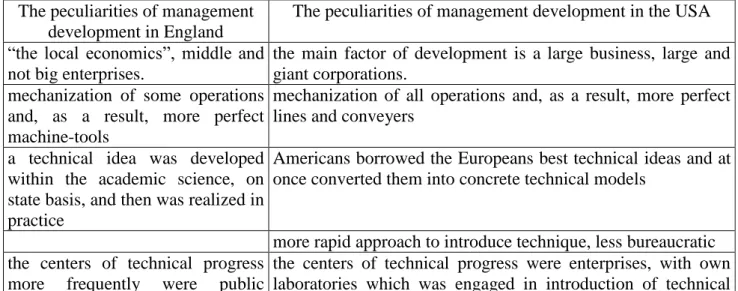
The distinguishing features of the management development in England and America are presented in a Tab. 1.1.
Table 1.1 The peculiarities and differences of the management development in England and in the USA The peculiarities of management
development in England
The peculiarities of management development in the USA “the local economics”, middle and
not big enterprises.
the main factor of development is a large business, large and giant corporations.
mechanization of some operations and, as a result, more perfect machine-tools
mechanization of all operations and, as a result, more perfect lines and conveyers
a technical idea was developed within the academic science, on state basis, and then was realized in practice
Americans borrowed the Europeans best technical ideas and at once converted them into concrete technical models
more rapid approach to introduce technique, less bureaucratic the centers of technical progress
more frequently were public
the centers of technical progress were enterprises, with own laboratories which was engaged in introduction of technical
22 institutions and universities achievements
F. U. Taylor (1856- 1915) is the founder of «scientific management» in America. Taylor was the first, who gave definition to the concept “management”, naming him «organization of production». Let examine the main points of «scientific management» of F.U. Taylor:
I. Laws and principles of scientific labour organization (SLO). One of the F. Taylor’s achievements in management was the clear scientific system of knowledge about the laws of rational labour organization. Its elements are:
- mathematical method of prime cost calculation; - differential payment system of work;
- method of time and motions study (time-study); - way of labour recepts division rationalizations; - instruction cards and others.
Four scientific principles were the motive force of the new system. Taylor called them the laws of management:
1. Creation of scientific foundation, scientific research of every separate type of labour.
2. A selection of workers and managers, their training and studies on the basis of scientific criteria (professional selection, professional consulting and professional studying).
3. Collaboration between administration and workers concerning the practical introduction of SLO.
4. The even and fair distribution of duties (responsibility) between workers and managers. Basic essence of scientific labour organization is in the following positions:
1. Development of the objective laws (standards and norms of labour), which both the administration and workers must submit.
2. Principle of forces economy means to remove all the erroneous, slow and vain motions, which require the superfluous expense of energy and brings no efficiency.
3. Exact selection and maximally concerted co-operation of all elements of the production system, which remind a clock-work.
II. Timing and distribution of works:
Taylor followed the principle: to control not the worker’s productivity, but his working methods. He paid attention to such control works, as the normalization of tools and equipment, preparation of work and its distribution, instruction cards and checking quality of work.
Conducting empirical researches by means of timing Taylor reached the following conclusions:
1. Unsatisfactory vehicle park requires to complete the work more of the time norm, as determined by timing;
2. It is necessary to systemize every detail in the workshop, based on the principle of uniformity; 3. The need for distribution of work between workers and machines, the procedure for passing the
products carried in order to minimize time spent on tasks, orders, materials, etc.
III. Differential system of labour payment and motivation of workers. Analyzing the old payment system, Taylor selected basic problems which arose up at its use:
1) The workers were paid for official position, but not for individual capabilities (the presence of man at work was paid);
2) Payment of labour depended not on a worker, but on the desire of administration;
3) Lazy and diligent workers were identically paid, by that way the leveling principle was legalized;
4) Administration reduced rates without any control, and workers answered with the lessening of the productivity;
23 5) The most important thing for workers was the guarantee of the payment, but not the quantity of
the work;
6) Workers were not interested in the losses of enterprise, and the administration was not interested in the studying of the labour actual time;
7) There was no interested collaboration of businessmen and workers.
These problems led to the development of the differential system of labour payment. Its main points are:
- higher payment is for the greater volume of work.
- punishment for a shortage and intentional errors, for work with a chill;
- wage increase more quickly, than increase of an output (when the output is increasing on 100%, the wage - on 50-60%);
- two maxima: the especially high pay for the heaviest work and lowest pay for an easy one (it caused the development of the scale concerning the change of work);
- guarantee from cutting of rates at the increase of output and keeping high pay;
- the necessary terms were created for front-rank workers: timely providing with raw material, instrument and technical documentation, details; teaching professional skills.
Basic principle of the differential system said: the backward are fined, front-rank workers
are rewarded, and middle workers get a norm.
IV. Managing of a staff is in Taylor’s system. At the end of XIX century a manpower policy had certain features on the American enterprises:
- an additional staff was gained by pirating of the best workers by means of money raises and various privileges;
- there was an opinion among businessmen that teaching of workers caused «unproductive charges»;
- former approach assumed that «if there is a suitable man, management methods can be fully given on his discretion».
In the field of the staff management Taylor developed a program «progressing worker». The purpose of such program is to favour the increase of professional level of every worker, inducing him to use his best capabilities, waking up in him proudness and energy and giving a pay for beautiful life.
The program «progressing worker» contains such principles:
1) one should give to the worker the task of such complication, that accessible to his abilities and physical force;
2) one should encourage him to do work which the first-class specialist of his digit is able to do; 3) every worker which works in the greatest rate of the first-class specialist must get premium
depending on character of work. It should be from 30% to 100% in comparison to the worker of middle level.
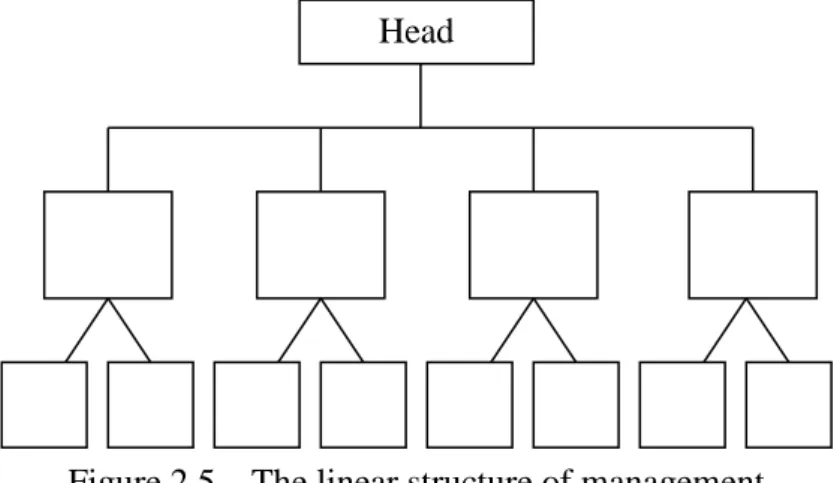
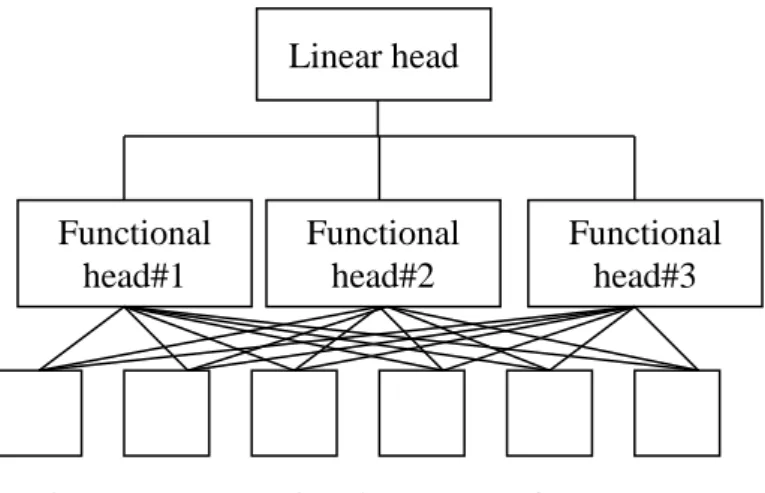
The preparation of leading staff was also Taylor’s innovative approach. The old system of linear management required from a leader implementation of the most various functions, which resulted in the overloading of performers. Taylor considered that it would be more easily to pick up and teach a few people (each of which would do one - two functions), than to find and teach one person, who has all qualities and executes the various duties. The functional administration was entered (eight masters-inspectors are in place of one) for that purpose.
Although F. Taylor was a bright figure and undoubted leader of «scientific management» school, he was not its unique representative. Among students and supporters of Taylor one can single out such managers and businessmen as G. Town, G. Warton, G. Emerson, F. Gilbrett, L. Brandi and others.
24 Conception of scientific management, suggested by Taylor, was the serious critical stage due to which a management began to be acknowledged as independent industry of the scientific researches.
1.6. The school of “administrative management”
The development of the problems concerning scientific management at the beginning of XX, faced with the necessity to analyze the principles of organization functioning. The works of Henri Fayol were the answer for this necessity.
H. Fayol (1841 - 1925) is the founder of an administrative management, the purpose of which was to create the universal principles of management. Fayol connected Taylor’s ideas of functional administration and old principle of one-man management. As a result he got a new scheme of management, which became the basis of the modern organization theory.
Fayol intentionally used a term «administration» instead of «management» because of the following reasons:
- «management» is the American term, and the word «administration» is more usually used by French;
- management, caused by the developed market economy, appeared in the private enterprise. A term «administration» vice versa means activity of the state in management; it touches the greatest part of administrative hierarchy, leading staff.
Administrative activity was only part of management by Fayol. The management itself was considerably wider sphere. A notion «management», according to Fayol, combines six basic groups of operations:
- technical and technological activity (production, processing, usage); - commercial activity (purchase, sale, exchange);
- financial activity (searches and optimum use of capital); - providing of safety (defence of property and people);
- registration activity (taking of inventory, balance sheet, charges, statistics); - administrative activity.
At the same time the administration influences only the staff of the enterprise, without any influence on the financial and economic factors of production.
The administrative activity in its turn needs implementation of 5 functions:
1. Planning (prediction) is a constituent of management process, during which the aims, standards and models are formulated, and they are the basis of the administrative organization.
2. Organization is creation of administrative structure, i.e. the providing of necessary level of formalization, involving resources in organization, forming of terms, necessary for normal work;
3. Giving orders foresees requirements of the leader to the inferiors in relation to implementation by them the role expectations, distributing of responsibility, permanent influence on the inferiors’ conduct;
4. Coordination is achievement of correspondence and coordination between different parts of enterprise by way of the rational ties in the production;
5. Control is the verification of implementation in accordance with the accepted program.
Thus, Fayol laid down the foundations of the structural and functional approach in management. It should be considered as functional, because the basic functions of management were certain, and as structural, because functions determined the organization structure.
The theory of administration has two parts. First part is connected with understanding management functions; second one - with understanding its principles. A function determines the sphere of activity, responsibility and jurisdiction of leader. It answers questions, what the leader does. On the contrary, principle answers a question, how the leader does it.
25 There are substantial differences between functions and management principles: functions are obligatory elements of the administrative process. If one of them loses, the whole management will break. They are expressly adjusted, structured and are a part of « administration science ». Principles embody subjective experience of leader, his philosophy; they are not strictly bound between each other and can be replaced or complemented depending on a concrete situation. Principles show by itself the «art of administration».
Fayol' pointed out the following principles of management: I. Structural principles
1. Division of labour is diminishing of objects, to which every participant of administrative process pays attention.
2. Authority and responsibility. Authority is a right to command and possibility to force other to submit. Responsibility – is a duty to do tasks and provide their satisfactory completion. The leader’s authority should correspond to the responsibility for the most effective work of organization.
3. Unity of orders (undivided authority) - at any activity a worker must be ordered only by one higher person.
4. Unity of administration - types of activity, which are directed on achievement of one purpose, should have one leader and submit to the unique plan.
5. Centralization.
6. Scalar chain (hierarchy). II. Principles of the process
7. Discipline.
8. Subordination of the personal interests to the general ones. 9. Reward of personnel.
10.Justice.
11.Corporate spirit. III. Principles of end-point
12.Order.
13.Stability of the personnel in position 14.Initiative.
G. Ford, Ch. Bernard, P. Salfrank studied the development of A. Fayol’s ideas and of the administrative school of management.
Obviously, that for the effective work many previous successful companies and individual businessmen use principles developed more than one hundred years ago by the representatives of administrative management school of management.
1.7. “Synthetic” concept of management
Two schools developed approximately during one time but in different countries were higher considered. Obviously, that one needs to combine some basic points of the studies. It was the reason that in 30s of the XX in the USA there was a synthetic conception of management. Its founders were directors of large firms, as, for example G. Mooney is a president of «General motors».
Basic idea of G. Mooney and A. Reilly consists in the fact that effective organization is the system, built on strictly formal principles. They aimed to construct the model of organization as one constructs a machine that is on the basis of logically connected and non-conflicting principles.
They took advantage of logical laws, opened by Levis F. Anderson to formulate the organizational principles. In accordance with Anderson’s theory, every principle is described through a process and result. Every process and result in their turn also have their own principles, process and result (Tab. 1.2).