David Stutz1 Nandhini Chandramoorthy2 Matthias Hein3 Bernt Schiele1
A
BSTRACTDeep neural network (DNN) accelerators received considerable attention in past years due to saved energy compared to mainstream hardware. Low-voltage operation of DNN accelerators allows to further reduce energy consumption significantly, however, causes bit-level failures in the memory storing the quantized DNN weights. In this paper, we show that a combination ofrobust fixed-point quantization,weight clipping, andrandom bit error training (RANDBET) improves robustness against random bit errors in (quantized) DNN weights significantly. This leads to high energy savings fromboth low-voltage operation as well as low-precision quantization. Our approach generalizes across operating voltages and accelerators, as demonstrated on bit errors from profiled SRAM arrays. We also discuss why weight clipping alone is already a quite effective way to achieve robustness against bit errors. Moreover, we specifically discuss the involved trade-offs regarding accuracy, robustness and precision: Without losing more than1%in accuracy compared to a normally trained8-bit DNN, we can reduce energy consumption on CIFAR10 by20%. Higher energy savings of, e.g.,30%, are possible at the cost of2.5%accuracy, even for4-bit DNNs.
1
I
NTRODUCTIONEnergy-efficiency is an important goal to lower carbon-dioxide emissions of deep neural network (DNN) driven applications and is a critical prerequisite to enable applica-tions in edge computing. DNN accelerators, i.e., special-ized hardware for inference, are used to reduce and limit energy consumption alongside cost and space compared to mainstream hardware, e.g., GPUs. These accelerators generally feature on-chip SRAM used as scratchpads, e.g., to store DNN weights. Data access/movement constitutes a dominant component of accelerator energy consumption (Sze et al.,2017). Reduced precision (Lin et al.,2016) is a widely used measure to reduce energy consumption at the cost ofapproximate computing(Sampson et al.,2011). Recently, DNN accelerators (Reagen et al.,2016;Kim et al., 2018;Chandramoorthy et al.,2019) further lower memory supply voltage to increase energy efficiency since dynamic power varies quadratically with voltage. However, aggres-sive SRAM supply voltage scaling, causes bit-level failures in SRAM on account of process variation (Ganapathy et al., 2017;Guo et al.,2009) with direct impact on the stored DNN weights. The ratepof these errors increases exponen-tially with lowered voltage and causes devastating drops in DNN accuracy such that memory reliability becomes the bottleneck in realizing low power DNN accelerators. In this 1Max Planck Institute for Informatics2IBM T. J. Watson
Re-search Center3University of T¨ubingen. Correspondence to: David
Stutz<[email protected]>.
paper, we aim to enable very low-voltage operation of DNN accelerators by developing DNNs robust to such bit errors in their weights, allowing DNN inference on“approximate hardware”(Koppula et al.,2019; Sampson et al.,2011). This is also desirable to improve security against adversar-ial manipulation of voltage settings (Tang et al.,2017). In general, robustness to bit errors in DNNs is a desirable goal in order to maintain safe operation and should become a standard performance metric in low power DNN design. Fig.1shows the average bit error rates of SRAM arrays as supply voltage is scaled belowVmin, i.e., the measured lowest voltage at which there are no bit errors. Voltage (x-axis) and energy (red, right y-axis) are normalized wrt. Vminand the energy per access atVmin, respectively. DNNs robust to a bit error rate (blue, left y-axis) of, e.g.,p= 1%
allow to reduce SRAM energy by roughly30%. To improve DNN robustness to bit errors, we first consider the impact of fixed-point quantization on robustness. While prior work (Murthy et al.,2019;Merolla et al.,2016;Sung et al.,2015) studies robustnesstoquantization, the impact of random bit errorsinquantized weights has not been considered so far. We find that the choice of quantization scheme has tremendous impact on robustness, even though accuracy is not affected. In particular, we identify a particularlyrobust quantization scheme, RQUANTin Fig.2(red). Addition-ally, independent of the quantization scheme, we propose aggressiveweight clippingduring training. This acts as an explicit regularizer leading to spread out weight distri-butions, improving robustness significantly, CLIPPINGin Fig.2(blue). This is in contrast to, e.g., (Zhuang et al.,
0.75 0.8 0.85 0.9 0.95 1 10−4 10−3 10−2 10−1 1 2.510 20
Supply Voltage, Normalized by Vmin
Bit Error Rate p in %
Bit Error Rate/Normalized Energyvs. Voltage
0.6 0.8 1 Normalized Energy p er SRAM Acc ess
Bit Error Ratep
Normalized Energy
=Vmin Figure 1: Energy and Low-Voltage Operation. Average bit error rate p(blue, left y-axis) from32 14nm SRAM arrays of size512×64from (Chandramoorthy et al.,2019) and energy (red, right y-axis) vs. voltage (x-axis). Voltage is normalized byVmin, the minimal measured voltage for error-free operation, as well as the energy per SRAM access at Vmin. SRAM accesses have significant impact on the DNN accelerator’s energy (Chen et al.,2016). Reducing voltage leads to exponentially increasing bit error rates.
2018;Sung et al.,2015) ignoring weight outliers to reduce quantization range, with sole focus of improving accuracy. Common error correcting codes (ECCs such as SECDED), cannot correctmultiplebit errors per word (containing multi-ple DNN weights). However, forp= 1%, the probability of two or more bit errors in a64-bit word is13.5%. Error detec-tion via redundancy (Reagen et al.,2016) or supply voltage boosting (Chandramoorthy et al.,2019) allow error-free low-voltage operation at the cost of additional energy or space. Therefore, (Kim et al.,2018) proposes a co-design approach of training DNNs onprofiledSRAM bit errors. Similarly, for approximate DRAMs, (Koppula et al.,2019) combines profiled bit error training with a clever weight to DRAM mapping. These approaches work as the spatial bit error patterns can be assumed fixed for afixedacceleratorand
voltage. The bit error pattern is obtained by post-silicon pro-filing and characterization of memories. The random nature of variation-induced bit errors requires profiling to be car-ried out for each voltage, memory array and individual chip in order to obtain the corresponding bit error patterns. This makes training DNNs on profiled bit error patterns an ex-pensive process. More importantly, we demonstrate that the obtained DNNs donotgeneralize across voltages or to un-seen bit error patterns, e.g., from other memory arrays. We proposerandom bit error training (RANDBET)which, in combination with weight clipping and robust quantiza-tion, obtains robustness against completelyrandombit error patterns, see Fig.2(violet). Thereby, it generalizes across chipsandvoltages, without any profiling, hardware-specific data mapping or other circuit-level mitigation strategies.
0 0.01 0.05 0.1 0.5 1 2.5 4.3 5 6 7 8
Bit Error Rate
p
in %
Robust
T
est
Error
RErr
in
%
CIFAR-10: Bit Error Robustness
8 bits: Normal RQuant +Clipping +RandBET Best, 8 bits Best, 4 bits
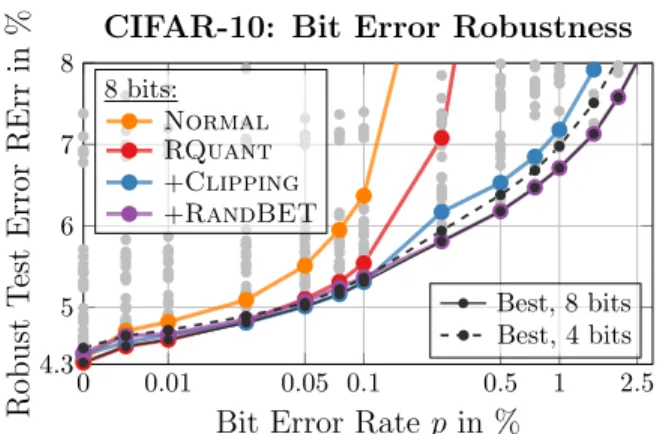
Figure 2:Robustness to Random Bit Errors.Robust test error (test error afterinjecting bit errors, RErr, lower is better ↓, y-axis) plotted against bit error rate p (x-axis). Robustness to higher bit error rates allows more energy efficient operation, cf. Fig. 1. For8 bit, through robust quantization (RQUANT,red), additionally weight clipping
(CLIPPING,blue) and finally adding random bit error
train-ing (RANDBET,violet) robustness improves significantly. The Pareto optimal frontier is shown for8bit (black solid) and4bit (dashed) quantization.
Contributions:We combine ourrobust fixed-point quan-tization RQUANT, i.e., reduced quantization range and ro-bust implementation, withweight clipping and random bit error training (RANDBET) in order to obtain high robustness against low-voltage induced, random bit errors. We consider fixed-point quantization schemes in terms of robustnessandaccuracy, instead ofsolelyfocusing on accu-racy as related work. Furthermore, we show that aggressive weight clipping, as regularization during training, is an ef-fective strategy to improve robustness through redundancy. In contrast to (Kim et al.,2018;Koppula et al.,2019), the robustness obtained through RANDBET generalizes across chipsandvoltages, as evaluated on profiled SRAM bit er-ror patterns from (Chandramoorthy et al.,2019). Finally, we discuss the involved trade-offs regarding robustness and accuracy and make our code publicly available to facilitate research in this highly applicable area of DNN robustness. Fig.2highlights key results on CIFAR10: with8bit and an increase in test error of less than1%, roughly20%energy savings are possible. Combined with low-precision, e.g., for4bit quantization,30%energy savings are possible at p= 1%with an increase in error rate of less than2.5%. Outline: We review related work in Sec.2and provide a detailed description and discussion of the considered low-voltage bit error model in Sec.3. In Sec.4, we discuss fixed-point quantization and its influence on bit error robustness and present weight clipping and RANDBET as effective strategies to improve robustness. Finally, Sec.5includes our experimental results. We conclude in Sec.6.
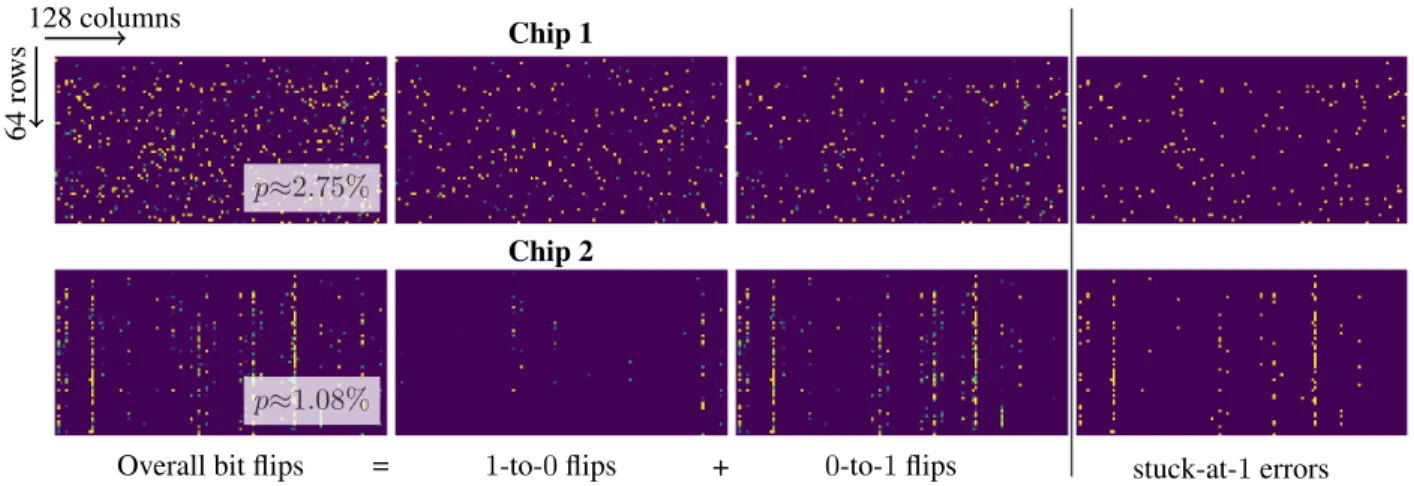
p≈0.86% p≈2.75% p≈0.14% p≈1.08% 128 columns 64 ro ws Chip 1 Chip 2
bit error ratepincreases
voltage decreases bit errors subset of
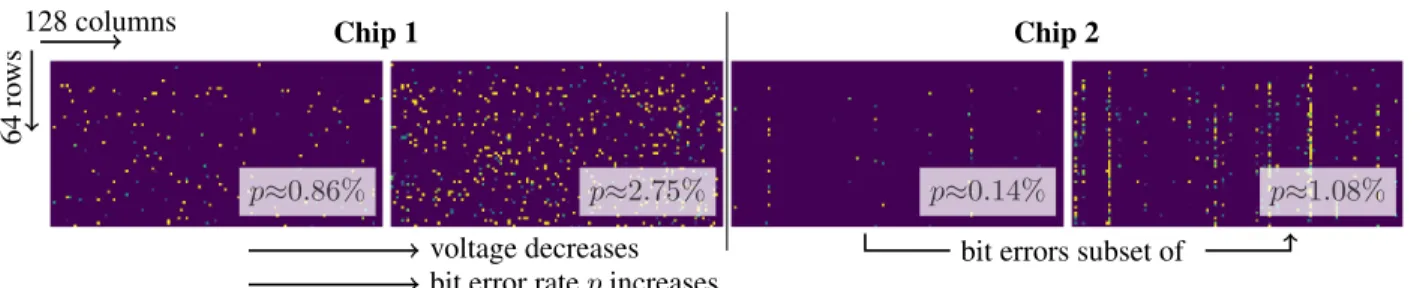
Figure 3:Exemplary SRAM Bit Error Patterns.Measured bit errors from two chips with on-chip SRAM (left and right), showing bit flip probability for a segment of size64×128bits:yellowindicates a bit flip probability of one,violetindicates zero probability. We show measurements corresponding to two supply voltages. With lower voltage, bit error rate increases. Also, the bit errors for higher voltage (= lower bit error rate) are a subset of those for lower voltage (= higher rate), cf. Sec.3. Our error model randomly distributes bit errors across space. However, as example, we also show SRAM chip 2 which has a different spatial distribution with bit errors distributed along columns. We aim to obtain robustness across different memory arrays, voltagesandallowing arbitrary DNN weight to memory mappings.
2
R
ELATEDW
ORKWe review relevant prior work on quantization, low-voltage induced random bit errors and weight robustness, in general. Quantization:DNN Quantization (Guo,2018) is usually motivated by faster DNN inference, e.g., through fixed-point quantization and arithmetic (Shin et al.,2017;Lin et al., 2016;Li et al.,2017), and energy savings. To avoid reduced accuracy, quantization is considered during training (Jacob et al.,2018;Krishnamoorthi,2018) instead of post-training or with fine-tuning (Goncharenko et al.,2018;Banner et al., 2019;nvt;ner), enabling low-bit quantization such as binary DNNs (Rastegari et al.,2016; Courbariaux et al.,2015). Some works also consider quantizing activations (Rastegari et al.,2016;Choi et al.,2018;Hubara et al.,2017) or gra-dients (Seide et al.,2014;Alistarh et al.,2016;Zhou et al., 2016). While works such as (Murthy et al.,2019;Merolla et al.,2016;Sung et al.,2015;Alizadeh et al.,2020) study the robustness of DNNstoquantization, the robustness of various quantization schemesagainstrandom bit errors has not been studied. This is in stark contrast to our findings that quantization impacts robustness significantly. Further-more, works such as (Zhuang et al.,2018;Sung et al.,2015; Park et al.,2018) clip weight outliers to reduce approxima-tion error of inliers, improving accuracy. In contrast, we considerweight clippingindependent of quantizationas reg-ularization during trainingwhich spreads out the weight distribution and improves robustness to bit errors.
Bit Errors in DNN Accelerators: Recent work (Ganapa-thy et al.,2017;2019) demonstrates that bit flips in SRAMs increase exponentially when reducing voltage belowVmin. The authors of (Chandramoorthy et al.,2019) study the im-pact of bit flips in different layers of DNNs, showing severe accuracy degradation. Similar observations hold for DRAM (Chang et al.,2017). To prevent accuracy drops at low volt-ages, (Reagen et al.,2016) combines SRAM fault detection
with logic to set faulty data reads to zero. (Chandramoorthy et al.,2019) uses supply voltage boosting for SRAMs to ensure error-free, low-voltage operation, while (Srinivasan et al.,2016) proposes storing critical bits in specifically ro-bust SRAM cells. However, such methods incur power and area overhead. Thus, (Kim et al.,2018) and (Koppula et al., 2019) propose co-design approaches combining training on profiled SRAM/DRAM bit errors with hardware mitigation strategies and clever weight to memory mapping. Besides low-voltage operation for energy efficiency, recent work (Tang et al.,2017) shows that an attacker can reduce voltage maliciously. Similarly, works such as (Kim et al.,2014; Mur-dock et al.,2020) demonstrate software-based approaches to induce few, but targeted, bit flips in DRAM. In contrast to (Kim et al.,2018;Koppula et al.,2019), ourrandom bit error trainingobtains robustness that generalizes across chips and voltages without expensive chip-specific profiling or hardware mitigation strategies. Furthermore, (Kim et al., 2018;Koppula et al.,2019) do not address the role of quanti-zation and we demonstrate that these approaches can benefit from our weight clipping, as well. We show that energy savings from low-voltage operation and low-precision (Park et al.,2018) can be combined.
Weight Robustness: Only few works consider weight ro-bustness: (Weng et al., 2020) certify the robustness of weights with respect toL∞perturbations and (Cheney et al.,
2017) study Gaussian noise on weights. (Rakin et al.,2019; He et al., 2020) consider identifying and (adversarially) flipping few vulnerable bits in quantized weights. Fault tolerance, in contrast, describes structural changes such as removed units, and is rooted in early work such as (Neti et al., 1992; Chiu et al.,1994). Finally, (Ji et al.,2018; Dumford & Scheirer,2018) explicitly manipulate weights in order to integrate backdoors. We study robustness against
random bit errors, which exhibit a quite special noise pattern compared toL∞or Gaussian noise, cf. Fig.4.
Global,qmax= 1,m= 8 Per-Layer(=NORMAL) +Asymmetric +CLIPPING0.1,m= 4
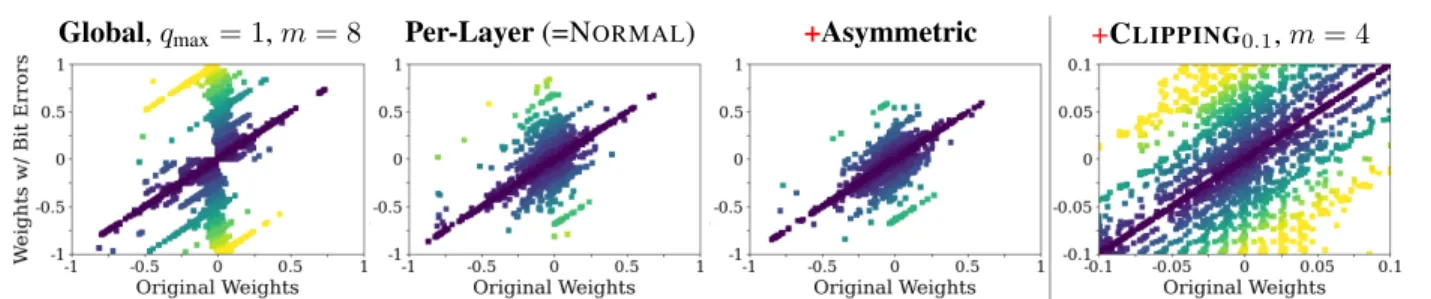
Figure 4: Quantization and Random Bit Errors. Original weights (x-axis) plotted against perturbed weights with bit errors (y-axis), for different fixed-point quantization schemes withm= 8bit (left) andp= 2.5%. We also show them= 4
bit case with CLIPPINGatwmax= 0.1, cf. Sec.4.2. Color indicates absolute error: from zerovioletto the maximal possible erroryellowof1(left) and0.1(right). Asymmetric per-layer quantization reduces the impact of bit errors compared to a the symmetric per-layer/global quantization. Clipping reduces absolute error, but the errorsrelativetowmaxincrease.
3
L
OW-V
OLTAGEI
NDUCEDR
ANDOMB
ITE
RRORS INQ
UANTIZEDDNN W
EIGHTS We assume the quantized DNN weights to be stored on multiple memory banks, e.g., SRAM in the case of on-chip scratchpads or DRAM for off-chip memory. As shown in (Ganapathy et al.,2017;Kim et al.,2018;Chandramoorthy et al.,2019), the probability of memory bit cell failures in-creases exponentially as operating voltage is scaled below Vmin, i.e., the minimal voltage required for reliable opera-tion, see Fig.1. This is done intentionally to reduce energy consumption, e.g., (Chandramoorthy et al.,2019;Kim et al., 2018;Koppula et al.,2019), or adversarially by an attacker, e.g., (Tang et al.,2017). Process variation during fabrication causes a variation in the vulnerability of individual bit cells. As shown in Fig.3(left), for a specific memory array, bit cell failures are typically approximately random and inde-pendent of each other (Ganapathy et al.,2017) even so chips showing patterns with stronger dependencies are possible Fig.3(right). Nevertheless, there is generally an “inherited” distribution of bit cell failures across voltages: as described in (Ganapathy et al.,2019), if a bit error occurred at a given voltage, it is likely to occur at lower voltages, as made ex-plicit in Fig.3. However, across different SRAM arrays in a chip or different chips, the patterns or spatial distribution of bit errors is usually different and can be assumed random (Chandramoorthy et al.,2019). Throughout the paper, we use the following bit error model:Random Bit Error Model:The probability of a bit error is
p(in %) for all weight values and bits. For a fixed memory array, bit errors are persistent across supply voltages, i.e., bit errors at probabilityp0≤palso occur at probabilityp. A bit error flips the currently stored bit. We denote random bit error injection by BErrp.
This error model realistically captures the nature of low-voltage induced bit errors, from both SRAM and DRAM as confirmed in (Chandramoorthy et al.,2019;Kim et al.,2018; Koppula et al.,2019). However, our approach in Sec.4is
model-agnostic: the error model can be refined if extensive memory characterization results are available for individual chips. For example, faulty bit cells with1-to-0or0-to-1flips might not be equally likely. Similarly, as in (Koppula et al., 2019), bit errors might be biased towards alignment along rows or columns of the memory array. The latter case is illus-trated in Fig.3(right). However, estimating these specifics requires testing infrastructure and detailed characterization of individual chips. More importantly, it introduces the risk of overfitting to few specific memories/chips. Furthermore, we demonstrate that the robustness obtained using our uni-form error model generalizes to bit error distributions with strong spatial biases as in Fig.3(right).
We assume the quantized weights to be mapped linearly to the memory. This is the most direct approach and, in contrast to (Koppula et al.,2019), does not require knowl-edge of the exact spatial distribution of bit errors. This also means that we do not map particularly vulnerable weights to more reliable memory cells, and therefore no changes to the hardware or the application are required. Thus, in practice, forW weights andmbits per weight value, we sample uniformlyu∼U(0,1)W×m. Then, thej-th bit in
the quantized weightvi = Q(wi)is flipped iffuij ≤ p.
Our model assumes that the flipped bits at lower probability p0
≤pare a subset of the flipped bits at probabilitypand that bit flips to1and0are equally likely. The noise pattern of random bit errors is illustrated in Fig.4: for example a single bit flip in the most-significant bit (MSB) of the signed integervican result in a change of roughly half of
the quantized range (also cf. Sec.4.1).
4
T
OWARDSR
OBUSTNESSA
GAINSTR
ANDOMB
ITE
RRORSWe address robustness against random bit errors in three steps: First, we analyze the impact of fixed-point quan-tization schemes on bit error robustness. This has been neglected both in prior work on low-voltage DNN
acceler- 𝑣(𝑡)= 𝐵𝐸𝑟𝑟 𝑝(𝑣𝑡) 𝑤𝑞 (𝑡) = 𝑄−1(𝑣(𝑡)) 𝑣(𝑡)= 𝑄𝑤(𝑡) Inject errors Quantize Dequantize Δ(𝑡)= ∇ 𝑤 𝑏 𝐿 𝑓 𝑥𝑏,𝑤𝑞 (𝑡) , 𝑦𝑏
Forward and backward pass for unperturbed & perturbed models
weight update with average of gradients 𝑤(𝑡+1)= 𝑤(𝑡)− 𝛾(Δ(𝑡)+ ෩Δ(𝑡)) ෩ Δ(𝑡)= ∇ 𝑤 𝑏 𝐿 𝑓 𝑥𝑏,𝑤𝑞𝑡 , 𝑦𝑏 𝑤𝑞𝑡 = 𝑄−1(𝑣(𝑡)) 𝑤(𝑡)
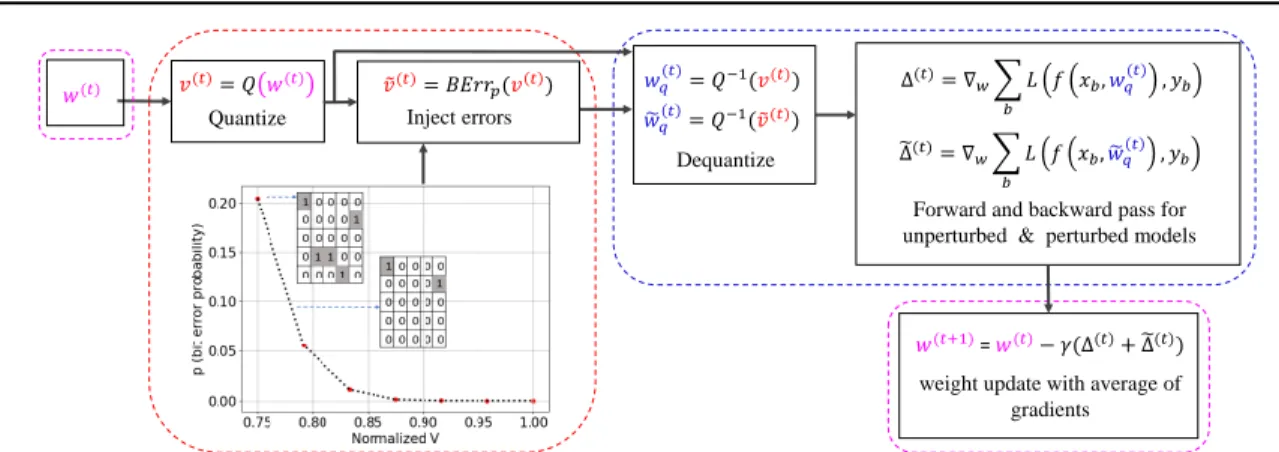
Figure 5:Random Bit Error Training (RANDBET).We illustrate the data-flow for RANDBET as in Alg.1. Here, BErrp
injects random bit errors in thequantized weightsv(t)=Q(w(t)), resulting inv˜(t), while the forward pass is performed on
thede-quantized perturbed weightsw˜(qt)=Q−1(v˜(t)), i.e., fixed-point arithmetic is not emulated. The weight update during training is not affected by bit errors and computed infloating point.
ators (Kim et al.,2018;Koppula et al.,2019) and in work on quantization robustness (Murthy et al.,2019;Merolla et al.,2016; Sung et al., 2015). This yields ourrobust quantization(Sec.4.1). On top, we propose aggressive weight clippingas regularization during training (Sec.4.2). Weight clipping enforces a more uniformly distributed, i.e., redundant, weight distribution, improving robustness. We show that this is due to minimizing the cross-entropy loss, enforcing large logit differences. Finally, in addition to ro-bust quantization and weight clipping, we performrandom bit error training (RANDBET)(Sec.4.3): in contrast to the fixed bit error patterns in (Kim et al.,2018;Koppula et al.,2019), we train on completelyrandombit errors and, thus, generalize across chips and voltages. Generalization is measured usingaverage robust test error (RErr), the test error after injecting bit errors, wrt. to our error model from Sec.3as well as real, profiled bit error patterns. Robustness against bit error ratephas to induce robustness forp0
≤p
(i.e., higher voltage), as well.
4.1 Robust Fixed-Point Quantization
We consider quantization-aware training (Jacob et al.,2018; Krishnamoorthi,2018) using a generic, deterministic fixed-point quantization scheme commonly used in DNN acceler-ators (Chandramoorthy et al.,2019). However, we focus on the impact of quantization schemes on robustness against random bit errors, mostly neglected so far (Murthy et al., 2019;Merolla et al.,2016; Sung et al., 2015). We find that quantization affects robustness significantly, even if accuracy is largely unaffected.
Fixed-Point Quantization:Letf(x;w)be a DNN taking an examplex∈[0,1]D, e.g., an image, and weightsw
∈
RW as input. Quantization determines how weights are
rep-resented in memory, e.g., on SRAM. In afixed-point quanti-zationscheme,mbits allow to represent2mdistinct values.
A weightwi ∈ [−qmax, qmax] is represented by a signed
m-bit integervi=Q(wi)corresponding to the underlying
bits. Here,[−qmax, qmax]is thesymmetricquantization range and signed integers use two’s complement representation. Then,Q: [−qmax, qmax]7→ {−2m−1
−1, . . . ,2m−1 −1}is defined as Q(wi) = jwi ∆ k , Q−1(v i) = ∆vi, ∆ = qmax 2m−1−1 (1)
Flipping the most significant bit (MSB, i.e., sign bit) leads to an absolute error of half the quantization range, i.e.,qmax (yellowin Fig.4). Flipping the least significant bit (LSB) incurs an error of∆, cf. Eq. (1). Thus, the impact of bit errors “scales with”qmax.
Global and Per-Layer Quantization:qmaxcan be chosen to accommodate all weights, i.e.,qmax= maxi|wi|. This is
calledglobalquantization. However, it has become standard to apply quantizationper-layerallowing to adaptqmaxto each layer. As in PyTorch (Paszke et al.,2017), we consider weights and biases of each layer separately. By reducing the quantization range for each layer individually, the er-rors incurred by bit flips are automatically minimized, cf. Fig.4. Theper-layer, symmetric quantization is our de-fault reference, referred to as NORMAL. However, it turns out that it is further beneficial to consider arbitrary quanti-zation ranges[qmin, qmax](allowingqmin >0). In practice, we first map[qmin, qmax]to[−1,1]and then quantize[−1,1]
using Eq. (1). Overall, per-layer asymmetric quantization has the finest granularity, i.e., lowest∆and approximation error. Nevertheless it is not the most robust quantization. Robust Quantization:Quantization as in Eq. (1) doesnot
provide optimal robustness against bit errors. First, the floor operationbwi/∆cis commonly implemented as float-to-integer conversion. Using proper roundingdwi/∆c in-stead has negligible impact on accuracy, even though ap-proximation error improves slightly. In stark contrast, bit
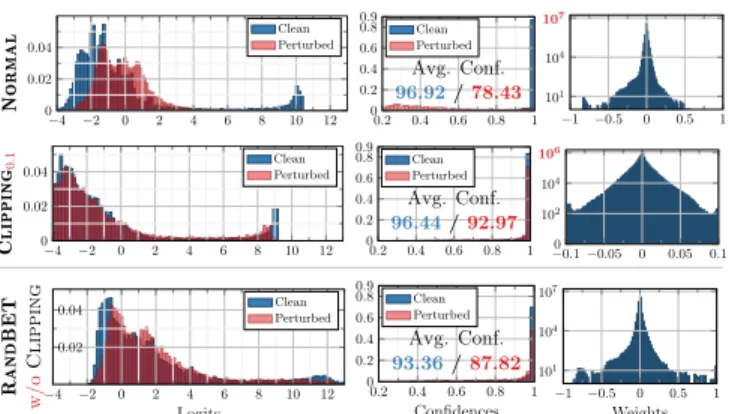
−4 −2 0 2 4 6 8 10 12 0 0.02 0.04 Normal Clean Perturbed 0.2 0.4 0.6 0.8 1 0 0.2 0.4 0.6 0.8 0.9 Clean Perturbed Avg. Conf. 96.92/78.43 −1 −0.5 0 0.5 1 101 104 107 −4 −2 0 2 4 6 8 10 12 0 0.02 0.04 Clipping 0 . 1 Clean Perturbed 0.2 0.4 0.6 0.8 1 0 0.2 0.4 0.6 0.8 0.9 Clean Perturbed Avg. Conf. 96.44/92.97 −00.1−0.05 0 0.05 0.1 102 104 106 −4 −2 0 2 4 6 8 10 12 0.02 0.04 Logits RandBET w/o Clipping Clean Perturbed 0.2 0.4 0.6 0.8 1 0 0.2 0.4 0.6 0.8 0.9 Confidences Clean Perturbed Avg. Conf. 93.36/87.82 −1 −0.5 0 0.5 1 101 104 107 Weights Figure 6:Effect of Weight Clipping.On CIFAR10, weight clipping constraints the weights (right), thereby implicitly limiting the possible range for logits (left,blue). However, even for wmax = 0.1 the DNN is able to produce high confidences (middle,blue), suggesting that more weights are used to obtain these logits. Furthermore, the impact of random bit errors,p= 1%, on the logits/confidences (red) is reduced significantly. RANDBET (trained withp= 1%, w/o weight clipping), increases the range of weights and is less effective at preserving logit/confidence distribution.
error robustness is improved considerably. During train-ing, DNNs can compensate the differences in approxima-tion errors, even for small precision m < 8. However, at test time, rounding decreases the impact of bit errors considerably. Second, Eq. (1) uses signed integers for sym-metric quantization. For asymsym-metric quantization, with arbitrary[qmin, qmax], we found quantization intounsigned
integers to improve robustness, i.e., Q : [qmin, qmax] 7→
{0, . . . ,2m
−1}. This is implemented using an additive term of2m−1−1in Eq. (1). While accuracy is not affected,
the effect of bit errors in the sign bit changes: in symmet-ric quantization, the sign bit mirrors the sign of the weight value. For asymmetric quantization, an unsigned integer representation is more meaningful. Overall, our robust fixed-point quantization (RQUANT)uses per-layer, asym-metric quantization into unsigned integers with rounding. These seeminglysmall differenceshave little to no impact on accuracy, while having tremendous impact on robustness against bit errors, see Sec.5.1and App.D.
4.2 Training with Weight Clipping as Regularization Weight clipping refers to constraining the weights to
[−wmax, wmax] during training, where wmax is a hyper-parameter. Generally,wmax is independent of the quanti-zation range(s) which always adapt(s) to the weight range(s) at hand. However, weight clipping limits the maximum possible quantization range (cf. Sec.4.1), i.e.,qmax≤wmax. It might seem that weight clipping with smallwmax automat-ically improves robustness against bit errors as the absolute errors are reduced. However, therelative errors are not
Algorithm 1 Random Bit Error Training (RANDBET). The forward passes are performed using de-quantized weights (blue). Perturbed weights are obtained by injecting bit errors in thequantized weights (in red). The update, averaging gradients from both forward passes, is performed
infloating-point (magenta). Also see Fig.5.
1: procedureRANDBET(p) 2: initializew(0) 3: fort= 0, . . . , T−1do 4: sample batch{(xb, yb)}Bb=1 5: {element-wise clipping:} 6: w(t)= min(w
max,max(−wmax,w(t)))
7: {quantization:}
8: v(t)=Q(w(t))
9: w(t)q =Q−1(v(t))
10: {clean forward and backward pass:}
11: ∆(t)=∇wPBb=1L(f(xb;w(t)q ), yb)
12: {perturbedforward and backward pass:}
13: w˜(t)q =Q−1(BErrp(v(t))){inject random bit errors}
14: ∆˜(t)=∇
wPBb=1L(f(xb;w˜(t)q ), yb)
15: {average gradients and weight update:}
16: w(t+1)=w(t)−γ(∆(t)+ ˜∆(t))
17: returnw(T)q =Q−1(Q(w(T)))
influenced by rescaling. As the DNN’s decision is usually invariant to rescaling, reducing the scale of the weights does not impact robustness. In fact, the mean relative er-ror of the weights in Fig.4(right) increased with clipping atwmax = 0.1. Thus, weight clipping doesnot“trivially” improve robustness by reducing the scale of weights. Nev-ertheless, we found that weight clipping actually improves robustness considerably on top of our robust quantization. The interplay of weight clipping and minimizing the the cross-entropy loss during training is the key. High con-fidences can only be achieved by large differences in the logits. Because the weights are limited to[−wmax, wmax], large logits can only be achieved using more weights in each layer to produce larger outputs. This is illustrated in Fig.6 (right): usingwmax = 0.1, the weights are (depending on the layer) up to5times smaller. Considering deep NNs, the “effective” scale factor for the logits is significantly larger, scaling exponentially with the number of layers. Thus, using wmax= 0.1is a significant constraint on the DNNs ability to produce large logits. As result, weight clipping produces a much more uniform weight distribution. Fig.6(left and middle) shows that a DNN constrained atwmax= 0.1can produce similar logit and confidence distributions (inblue) as the unclipped DNN. At the same time, random bit er-rors, have a significantly smaller impact on the logits and confidences (inred). Fig.6(right column) also shows the induced redundancy in the weight distribution. Weight clip-ping leads to more weights being utilized, i.e., less weights are zero (note log-scale, marked inred, on the y-axis). Also,
more weights reach large values, relative to the maximum absolute weight. Overall, we found weight clipping to be an easy-to-use but effective measure to improve weight ro-bustness. We use CLIPPINGwmax=0.1to refer to, e.g., weight clipping withwmax = 0.1. For more evidence supporting our argumentation, see Tab.2. For example, we show that DNNs loose robustness when using label smoothing, i.e., not enforcing high confidences/logits during training.
4.3 Random Bit Error Training (RANDBET)
Inaddition toweight clipping and robust quantization, we inject random bit errors with probabilitypduring training to further improve robustness. This results in the following learning problem, which we optimize as illustrated in Fig.5:
minwE[L(f(x; ˜w), y) +L(f(x;w), y)]
s.t. v=Q(w),v˜=BErrp(v),w˜ =Q−1(˜v).
(2)
where(x, y)are labeled examples,Lis the cross-entropy loss andv =Q(w)denotes the (element-wise) quantized weightswwhich are to be learned. BErrp(v)injects random
bit errors with ratepinv. Note that we consider both the loss on clean weights and weights with bit errors. This is desirable to avoid an increase in (clean) test error and sta-bilizes training compared to training only on bit errors in the weights. Note that bit error ratepimplies, in expecta-tion,pmW bit errors. Following Alg.1, we use stochastic gradient descent to optimize Eq. (2), by performing the gra-dient computation using the perturbed weightsw˜=Q−1(˜v)
withv˜ = BErrp(v), while applying the gradient update
on the (floating-point) clean weightsw. In spirit, this is similar to data augmentation, however, the perturbation is applied on the weights instead of the inputs. As we found that introducing bit errors right from the start may prevent the DNN from converging, we apply bit errors as soon as the (clean) cross-entropy loss is below1.75. Interestingly, weight clipping and RANDBET have somewhat orthogonal effects, which allows to combine them easily in practice: While weight clipping encourages redundancy in weights by constraining them to[−wmax, wmax], RANDBET (w/o weight clipping) causes the DNN to have larger tails in the weight distribution, as shown in Fig.6(bottom). However, considering logits and confidences, especially with random bit errors (inred), RANDBET alone performs slightly worse than CLIPPING0.1. Thus, RANDBET becomes particularly effective when combined with weight clipping, as we make explicit using the notation RANDBETwmaxand in Alg.1.
5
E
XPERIMENTSWe present experiments on MNIST (LeCun et al.,1998) and CIFAR (Krizhevsky,2009). We first analyze the im-pact of fixed-point quantization schemes on robustness (Sec. 5.1). Subsequently, we discuss weight clipping
Table 1: Quantization Robustness. RErr for random bit errors atp= 0.05%andp= 0.5%for normal training with different quantization schemes discussed in Sec.4.1. Minor differences can have large impact on RErr while clean test error is largely unaffected. For8bit the second row shows
NORMALquantization (symmetric/per-layer) whereas the
last row is our RQUANT. For4bits we show CLIPPING0.1
+RQUANTwith and without rounding. Quantization Schemes Err
in % RErr in % (CIFAR10) p=0.05 p=0.5 8 bit Eq. (1), global 4.63 86.01±3.65 90.71±0.49 Eq. (1), per-layer 4.36 5.51±0.19 24.76±4.71 +asymmetric 4.36 6.47±0.22 40.78±7.56 +unsigned 4.42 6.97±0.28 17.00±2.77 +rounding (=RQUANT) 4.32 5.10±0.13 11.28±1.47 4
bit w/o rounding* 5.81 90.40±0.21 90.36±0.2
w/ rounding* 5.29 5.75±0.06 7.71±0.36
(CLIPPING, Sec.5.2), showing that improved robustness
originates from increased redundancy in the weight dis-tribution. Then, we focus on random bit error training (RANDBET, Sec.5.3). We show that related work (Kim et al.,2018;Koppula et al.,2019) does not generalize, while RANDBET generalizes across chips and voltages, as demon-strated on profiled bit error patterns from different chips. Sec.5.4summarizes our results for various precisionsm. Metrics: We report (clean) test error Err (lower is better,
↓), corresponding tocleanweights, androbust test error RErr(↓) which is thetest error after injecting bit errors into the weights. As the bit errors are random we report theaverageRErr and its standard deviation for50samples of random bit errors with ratepas detailed in Sec.3. Architecture:We use SimpleNet (HasanPour et al.,2016), providing comparable performance to ResNets (He et al., 2016) with onlyW=5.5Mio weights on CIFAR10. On MNIST, we halve all channel widths, resulting in roughly
1Mio weights. On CIFAR100, we use a Wide ResNet (WRN) (Zagoruyko & Komodakis,2016) with group nor-malization (GN) (Wu & He,2018). Batch normalization (BN) (Ioffe & Szegedy,2015) works as well but models using BN yield consistently worse robustness against bit errors, see App.G.1for a discussion.
Training: We use stochastic gradient descent with an ini-tial learning rate of0.05, multiplied by0.1 after2/5, 3/5
and4/5of100/250epochs on MNIST/CIFAR. On CIFAR,
we whiten the input images and use AutoAugment (Cubuk et al.,2018) with Cutout (Devries & Taylor,2017). For RANDBET, random bit error injection starts when the loss is below 1.75 on MNIST/CIFAR10 or 3.5 on CIFAR100. Normal training with the standard and our robust quanti-zation are denoted NORMALand RQUANT, respectively. Weight clipping withwmaxis referred to as CLIPPINGwmaxor together with RANDBET as RANDBETwmax. For RQUANT,
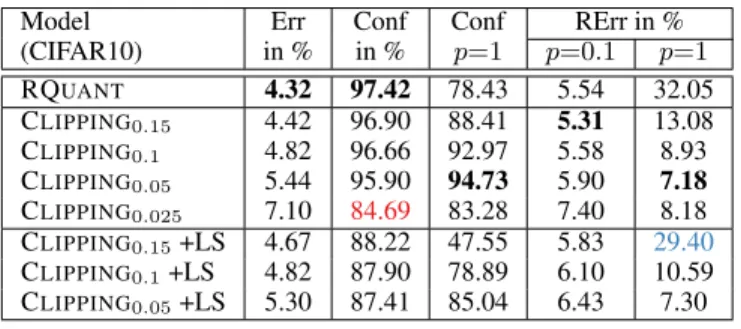
Table 2:Weight Clipping Robustness.Clean Err and RErr as well as clean confidence and confidence atp=1%bit er-rors (in %, higher is better,↑) for CLIPPINGand CLIPPING
with label smoothing (+LS). Err increases forwmax= 0.025
where the DNN is not able to produce large (clean) con-fidences. LS consistently reduces robustness, indicating that robustness is due to enforcing high confidence during trainingandweight clipping.
Model Err in % Conf in % Conf p=1 RErr in % (CIFAR10) p=0.1 p=1 RQUANT 4.32 97.42 78.43 5.54 32.05 CLIPPING0.15 4.42 96.90 88.41 5.31 13.08 CLIPPING0.1 4.82 96.66 92.97 5.58 8.93 CLIPPING0.05 5.44 95.90 94.73 5.90 7.18 CLIPPING0.025 7.10 84.69 83.28 7.40 8.18 CLIPPING0.15+LS 4.67 88.22 47.55 5.83 29.40 CLIPPING0.1+LS 4.82 87.90 78.89 6.10 10.59 CLIPPING0.05+LS 5.30 87.41 85.04 6.43 7.30
m= 8, we obtain4.3%on CIFAR10 and18.5%Err on CI-FAR100. On MNIST,0.47%are possible even form= 2. Ourappendixincludes implementation details (App.D), more information on our experimental setup (App.F), and complementary experiments (App.G). Among others, we discuss the robustness of BN (App.G.1), other architectures such as ResNet-50 (App.G.1), qualitative results for CLIP
-PING(App.G.3) and complete results form= 4,3,2bits precision (App.G.8). Also, we discuss a simple guarantee how the average RErr relates to the true expected robust error (App.C.2). Ourcodewill be made publicly available.
5.1 Quantization Choice Impacts Robustness
Quantization schemes affect robustness significantly, even when not affecting accuracy. For example, Tab.1shows that per-layer quantization reduces RErr significantly for small bit error rates, e.g.,p= 0.05%. While asymmetric quantization further reduces the quantization range, RErr increases, especially for large bit error rates, e.g.,p= 0.5%
(marked inred). This is despite Fig.4showing a slightly smaller impact of bit errors. This is caused by an asymmet-ric quantization intosignedintegers: Bit flips in the most significant bit (MSB, i.e., sign bit) are not meaningful if the quantized range is not symmetric as the sign bit does not re-flect the sign of the represented weight value, see App.G.2. Similarly, replacing integer conversion ofwi/∆by proper rounding,dwi/∆c, reduces RErr significantly (resulting in our RQUANT). This becomes particularly important for m= 4. Here, rounding also improves clean Err slightly, but the effect is significantly less pronounced. Proper rounding generally reduces the approximation error of the quantiza-tion scheme. These errors are magnified when considering bit errors at test time, even though DNNs can compensate such differences during training to achieve good accuracy,
Table 3: Fixed Pattern Bit Error Training. RErr for training on an entirely fixed bit error pattern (PATTBET).
Top: Evaluation on the same pattern; PATTBET trained onp= 2.5%does not generalize top= 1%even though the bit errors forp= 1%are a subset of those seen during training forp = 2.5%(inred). Bottom: PATTBET also fails to generalize to completely random bit errors. This can be confirmed on real, profiled bit errors in App.G.5.
Model (CIFAR10) RErr in %,pin %
Evaluation on Fixed Pattern p=1 p=2.5
PATTBETp=2.5 14.14 7.87
PATTBET0.15p=2.5 8.50 7.41
Evaluation onRandomPatterns p=1 p=2.5
PATTBET0.15p=2.5 12.09 61.59
i.e., low Err. Form= 4or lower, we also found weight clip-ping to help training, obtaining lower Err. Overall, we show that random bit errors induce unique error distributions, cf. Fig.4in DNN weights, heavily dependent on details of the employed fixed-point quantization scheme. We think that robustness against bit errors should become an important criterion for the design of DNN quantization. While our RQUANTperforms fairly well, finding an “optimal” robust quantization scheme is an interesting open problem.
5.2 Weight Clipping Improves Robustness
While the quantization range adapts to the weight range after every update during training, weight clipping explicitly con-straints the weights to[−wmax, wmax]. Tab.2shows the ef-fect of differentwmaxfor CIFAR10 with 8 bit precision. The clean test error is not affected for CLIPPINGwmax=0.15but
one has already strong robustness improvements forp= 1%
compared to RQUANT(RErr of 13.18% vs 32.05%). Fur-ther reducingwmaxleads to a slow increase in clean Err and decrease in average clean confidence, while significantly improving RErr to 7.18% forp = 1% at wmax = 0.05. Forwmax = 0.025the DNN is no longer able to achieve high confidence (marked inred) which leads to stronger loss of clean Err. Interestingly, the gap between clean and perturbed confidences under bit errors forp = 1%is (al-most) monotonically decreasing. These findings generalize to other datasets and precisions, see App.G.8. However, for low precisionm≤4the effects are stronger as RQUANT
alone does not yield any robust models and weight clipping is essential for achieving robustness.
As discussed in Sec.4.2the robustness of the DNN origi-nates in the cross-entropy loss enforcing high confidences on the training set and, thus, large logits while weight clipping works against having large logits. Therefore, the network has to utilize more weights with larger absolute values (com-pared towmax). In order to test this hypothesis, we limit the confidences that need to be achieved via label smoothing (Szegedy et al.,2016), targeting0.9for the true class and
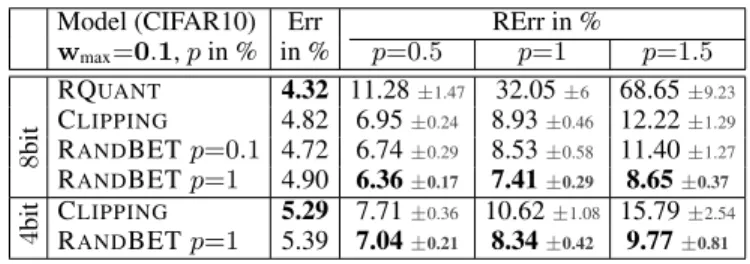
Table 4:Random Bit Error Training (RANDBET). Aver-age RErr (and standard deviation) of RANDBET evaluated at various bit error ratespand usingm= 8or4bit precision. For lowp, weight clipping provides sufficient robustness. However for p ≥ 0.5, RANDBET increases robustness significantly. This is pronounced for lower precisions.
Model (CIFAR10) Err in % RErr in % wmax=0.1,pin % p=0.5 p=1 p=1.5 8 bit RQUANT 4.32 11.28±1.47 32.05±6 68.65±9.23 CLIPPING 4.82 6.95±0.24 8.93±0.46 12.22±1.29 RANDBETp=0.1 4.72 6.74±0.29 8.53±0.58 11.40±1.27 RANDBETp=1 4.90 6.36±0.17 7.41±0.29 8.65±0.37 4 bit CLIPPING 5.29 7.71±0.36 10.62±1.08 15.79±2.54 RANDBETp=1 5.39 7.04±0.21 8.34±0.42 9.77±0.81
0.1/9for the other classes. According to Sec.4.2, this should
lead to less robustness, as the DNN has to use “less” weights. Indeed, in Tab.2, RErr atp= 1%increases from13.08%
for CLIPPING0.15 to29.4%when using label smoothing
(marked inblue). Moreover, the difference between average clean and perturbed confidence is significantly larger for DNNs trained with label smoothing.
In App.G.3we show that robustness against bit errors also leads to robustness againstL∞perturbations which
gener-ally affect all weights in contrast to random bit errors, and provide more qualitative results about the change of the weight distribution induced by clipping in Fig.10.
5.3 RANDBET Yields Generalizable Robustness Training on Profiled Errors Does Not Generalize: Co-design approaches such as (Kim et al.,2018;Koppula et al., 2019) combine training DNNs on profiled SRAM or DRAM bit errors with hardware-approaches to limit the errors’ im-pact. However, profiling SRAM or DRAM requires ex-pensive infrastructure, expert knowledge and time. More importantly, training on profiled bit errors does not general-ize to previously unseen bit error distributions (e.g., other chips or voltages): Tab.3(top) shows RErr of PATTBET, i.e., pattern-specific bit error training. The main problem is that PATTBET doesnoteven generalize to lower bit error rates (i.e., higher voltages) of the same pattern as trained on (marked inred). This is striking as, following Fig.3, the bit errors form a subset of the bit errors seen during training: training withp= 2.5%bit errors does not provide robustness forp= 1%, RErr increases7.9%to14.1%. It is not surprising, that Tab.3(bottom) also demonstrates that PATTBET does not generalize to random bit error pat-terns: RErr increases from7.4%to61.6%atp = 2.5%. The same observations can be made when training on real, profiled bit errors corresponding to the chips in Fig.3, see App.G.5. Overall, obtaining robustness that generalizes across voltagesandchips is crucial for low-voltage opera-tion to become practical.
Table 5: Generalization to Profiled Bit Errors.RErr for RANDBET on two different profiled chips. The bit error rates differ across chips due to measurements at different voltages, also see Fig.3. Chip 2 exhibits a bit error distribu-tion significantly different from uniform random bit errors: bit errors are strongly aligned along columns and biased towards0-to-1flips, cf. Fig.3. Nevertheless, RANDBET generalizes surprisingly well.
Chip (Fig.3) Model (CIFAR10) RErr in %
Chip 1 p≈0.86 p≈2.75
RANDBET0.05p=1.5 7.04 9.37
Chip 2 p≈0.14 p≈1.08
RANDBET0.05p=1.5 6.00 9.00
RANDBET Improves RobustnessOur RANDBET, com-bined with weight clipping, further improves robustness and additionally generalizes across chips and voltages. Tab.4 shows results for weight clipping and RANDBET with wmax = 0.1 and m = 8,4 bits precision. RANDBET is particularly effective against large bit error rates, e.g., p= 1.5%, reducing RErr from12.22%to8.65%(m= 8
bits). The effect is pronounced for4bits or even lower pre-cision, where models are generally less robust. The optimal combination of weight clipping and RANDBET depends on the bit error rate. For example, in Tab.2, loweringwmax to0.05reduces RErr below RANDBET0.1withp=1%for
some bit error rates. We also emphasize that RANDBET generalizes to lower bit errors than trained on, in stark con-trast to the fixed-pattern training PATTBET. In App.G.7, we also show that RANDBET works on other architectures such as ResNet-50. On other datasets, e.g.,MNIST, RAND -BET allows to operate atp = 12.5%bit error rate with
0.9%RErr and onlym = 2 bits. At this point, weight clipping alone yields90%RErr.
RANDBET Generalizes to Profiled Bit Errors: RAND -BET also generalizes to bit errors profiled from real chips, corresponding to Fig.3. Tab.5shows results on the two profiled chips of Fig.3. Profiling was done at various volt-age levels, resulting in different bit error rates for each chip. To simulate various weights to memory mappings, we apply various offsets before linearly mapping weights to the pro-filed SRAM arrays. Tab.5reports average RErr, showing that RANDBET generalizes quite well to these profiled bit errors. Regarding chip 1, RANDBET performs very well, even for largep≈2.75, as the bit error distribution of chip 1 largely matches our error model in Sec.3, cf. Fig.3(left). In contrast, with chip 2 we picked a more difficult bit error distribution which is strongly aligned along columns, po-tentially hitting many MSBs simultaneously. Thus, RErr increases for chip 2 even for a lower bit error ratep≈1.08
(marked inred) but energy savings are still possible without degrading prediction performance.
0 0.01 0.05 0.1 0.5 1 2.5 4 5 6 7 8 9 10
Bit Error Ratepin %
Robust T est Error RErr in % CIFAR-10 0 0.001 0.005 0.01 0.05 0.1 0.5 1.0 20 22 24 26 28 30
Bit Error Ratepin %
Robust T est Error RErr in % CIFAR-100 0 1 5 10 15 20 0.3 0.5 1
Bit Error Ratepin %
Robust T est Error RErr in % MNIST
Best for: m=8, 4, 3, 2 bits Normal RQuant +Clipping +RandBET ( All Models)
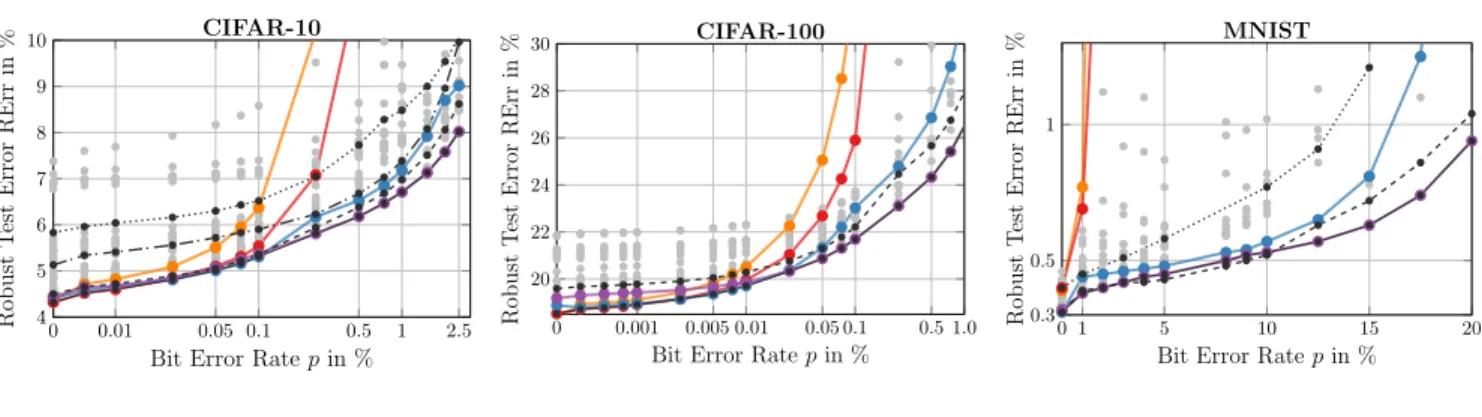
Figure 7:Bit Error Robustness on CIFAR10, CIFAR100 and MNIST.Average RErr plotted against bit error ratep, both in %. We considered various models (in•gray), corresponding to differentwmaxandpduring training. We explicitly plot the best model for each bit error rate: for NORMAL(orange), RQUANT(red), CLIPPING(blue) and RANDBET (violet). Note that these might correspond to differentwmaxandp(also across datasets). Across all approaches, we plot the per-error-rate best model in black: form= 8,4,3,2bits, depending on dataset. For8bit and low bit error rates, CLIPPINGis often sufficient. However, for4bit or higher bit error rates, RANDBET is crucial to keep RErr low.
5.4 Summary and Discussion
Our experiments are summarized in Fig. 7. We con-sider NORMAL quantization vs. our robust quantization RQUANT, various CLIPPINGand RANDBET models with differentwmaxandpduring training (indicated in•gray) and plot RErr against bit error ratepat test time. On all datasets RQUANToutperforms NORMAL. On CIFAR10 (left), RErr increases significantly for RQUANT(red) start-ing atp ≈ 0.25%bit error rate. While CLIPPING (blue) generally reduces RErr, only RANDBET (violet) can keep RErr around6%or lower for a bit error rate ofp≈0.5%. The best model for each bit error ratep(black and solid form= 8) might vary. CIFAR100 is generally more diffi-cult, while significantly higher bit error rates are possible on MNIST. On CIFAR10, RErr increases slightly form= 4. However, form= 3,2RErr increases more significantly as clean Err increases by1−2%. Nevertheless, RErr only increases slightly for larger bit error ratesp. It remains fu-ture work whether RANDBET with a more sophisticated (but robust) quantization scheme can enable low-voltage operation even form= 2bits. In all cases, RErr increases monotonically, ensuring safe operation at higher voltages. The best trade-off between robustness and accuracy depends on the application: higher energy savings require a larger “sacrifice” in terms of RErr. Finally, App.C.2provides a confidence-interval based guarantee on how strongly RErr is expected to deviate from the empirical results in Fig.7. Overall, the results in Fig.7enable robust low-voltage op-erationwithoutrequiring expensive error correcting codes (ECCs) or other circuit techniques (Reagen et al., 2016; Chandramoorthy et al.,2019). Furthermore, our analysis applies both to DRAM, commonly off-chip, and SRAM, usually used as scratchpads on-chip of DNN accelerators. Compared to co-design (Kim et al.,2018;Koppula et al.,
2019), we do not require expensive expert knowledge or pro-filing infrastructure. Moreover, RANDBET improves over
these approaches by generalizing across chips and voltages. Besides RANDBET, we show that robust fixed-point quan-tizationonly withweight clipping can provide reasonable robustness, e.g., forp= 0.1%on CIFAR10. This is without sophisticated quantization scheme, e.g., with special treat-ment for outliers (Zhuang et al.,2018;Sung et al.,2015; Park et al.,2018), and complementary to (Murthy et al., 2019;Merolla et al.,2016;Sung et al.,2015;Alizadeh et al., 2020), focusing merely on robustnesstoquantization.
6
C
ONCLUSIONWe propose a combination ofrobust quantization,weight clippingandrandom bit error training (RANDBET)to get DNNs robustness against random bit errors in their (quantized) weights, enabling low-voltage operation of DNN accelerators to save energy. Here, the accelerator memory is operated far below its rated voltage (Chan-dramoorthy et al.,2019;Koppula et al.,2019;Kim et al., 2018), inducing exponentially increasing rates of bit errors, directly affecting stored DNN weights. Weight clipping regularizes the weights to a small [−wmax, wmax] during training, encouraging redundancy and increasing robustness. RANDBET further generalizes across chips, with different bit error patterns, and voltages without requiring expensive memory profiling or hardware mitigation strategies. These are important criteria for low-voltage operation in practice. Besides, we also discuss the impact of fixed-point quanti-zation schemes on robustness, which has been neglected in prior work. We are able to train low-precision DNNs robust to significant rates of random bit errors which allow a reduction in energy consumption of roughly20%or more on MNIST and CIFAR.
R
EFERENCESC foreign function interface for python. https://cffi. readthedocs.io/en/latest/index.html. Cupy: A numpy-compatible array library accelerated by
cuda.https://cupy.dev/.
Nervana neural network distiller. https://github. com/nervanasystems/distiller.
NVIDIA Deep Learning Accelerator. http://nvdla. org/.
Nvidia tensorrt. https://developer.nvidia. com/tensorrt.
Alistarh, D., Li, J., Tomioka, R., and Vojnovic, M. QSGD: randomized quantization for communication-optimal stochastic gradient descent. arXiv.org, abs/1610.02132, 2016.
Alizadeh, M., Behboodi, A., van Baalen, M., Louizos, C., Blankevoort, T., and Welling, M. Gradient`1
regulariza-tion for quantizaregulariza-tion robustness. InICLR, 2020.
Andriushchenko, M., Croce, F., Flammarion, N., and Hein, M. Square attack: a query-efficient black-box adversarial attack via random search. InECCV, 2020.
Banner, R., Nahshan, Y., and Soudry, D. Post training 4-bit quantization of convolutional networks for rapid-deployment. InNeurIPS, 2019.
Biggio, B. and Roli, F. Wild patterns: Ten years af-ter the rise of adversarial machine learning. arXiv.org, abs/1712.03141, 2018.
Carlini, N. and Wagner, D. Towards evaluating the robust-ness of neural networks. InSP, 2017.
Carmon, Y., Raghunathan, A., Schmidt, L., Liang, P., and Duchi, J. C. Unlabeled data improves adversarial robust-ness. arXiv.org, abs/1905.13736, 2019.
Chandramoorthy, N., Swaminathan, K., Cochet, M., Paidi-marri, A., Eldridge, S., Joshi, R. V., Ziegler, M. M., Buyuktosunoglu, A., and Bose, P. Resilient low volt-age accelerators for high energy efficiency. InHPCA, 2019.
Chang, K. K., Yaalikc¸i, A. G., Ghose, S., Agrawal, A., Chatterjee, N., Kashyap, A., Lee, D., O’Connor, M., Has-san, H., and Mutlu, O. Understanding reduced-voltage operation in modern DRAM devices: Experimental char-acterization, analysis, and mechanisms. 1(1), 2017.
Chen, P.-Y., Zhang, H., Sharma, Y., Yi, J., and Hsieh, C.-J. ZOO: Zeroth order optimization based black-box attacks to deep neural networks without training substitute mod-els. InAISec, 2017.
Chen, T., Du, Z., Sun, N., Wang, J., Wu, C., Chen, Y., and Temam, O. Diannao: a small-footprint high-throughput accelerator for ubiquitous machine-learning. 2014.
Chen, Y., Emer, J. S., and Sze, V. Eyeriss: A spatial ar-chitecture for energy-efficient dataflow for convolutional neural networks. InISCA, 2016.
Cheney, N., Schrimpf, M., and Kreiman, G. On the robust-ness of convolutional neural networks to internal architec-ture and weight perturbations.arXiv.org, abs/1703.08245, 2017.
Chiang, P., Geiping, J., Goldblum, M., Goldstein, T., Ni, R., Reich, S., and Shafahi, A. Witchcraft: Efficient PGD attacks with random step size.arXiv.org, abs/1911.07989, 2019.
Chiu, C., Mehrotra, K., Mohan, C. K., and Ranka, S. Train-ing techniques to obtain fault-tolerant neural networks. InAnnual International Symposium on Fault-Tolerant Computing, 1994.
Choi, J., Wang, Z., Venkataramani, S., Chuang, P. I., Srini-vasan, V., and Gopalakrishnan, K. PACT: parameter-ized clipping activation for quantparameter-ized neural networks.
arXiv.org, abs/1805.06085, 2018.
Courbariaux, M., Bengio, Y., and David, J. Binaryconnect: Training deep neural networks with binary weights during propagations. InNeurIPS, 2015.
Croce, F. and Hein, M. Sparse and imperceivable adversarial attacks. InICCV, 2019.
Croce, F. and Hein, M. Reliable evaluation of adversarial robustness with an ensemble of diverse parameter-free attacks. InICML, 2020.
Cubuk, E. D., Zoph, B., Man´e, D., Vasudevan, V., and Le, Q. V. Autoaugment: Learning augmentation policies from data. arXiv.org, abs/1805.09501, 2018.
Deodhare, D., Vidyasagar, M., and Keerthi, S. S. Synthe-sis of fault-tolerant feedforward neural networks using minimax optimization. TNN, 9(5):891–900, 1998.
Devries, T. and Taylor, G. W. Improved regularization of convolutional neural networks with cutout. arXiv.org, abs/1708.04552, 2017.
Dong, Y., Liao, F., Pang, T., Hu, X., and Zhu, J. Boost-ing adversarial attacks with momentum. arXiv.org, abs/1710.06081, 2017.
Du, Z., Fasthuber, R., Chen, T., Ienne, P., Li, L., Luo, T., Feng, X., Chen, Y., and Temam, O. Shidiannao: shifting vision processing closer to the sensor. InISCA, 2015.
Duddu, V., Pillai, N. R., Rao, D. V., and Balas, V. E. Fault tolerance of neural networks in adversarial settings.
arXiv.org, abs/1910.13875, 2019a.
Duddu, V., Rao, D. V., and Balas, V. E. Adversarial fault tolerant training for deep neural networks. arXiv.org, abs/1907.03103, 2019b.
Dumford, J. and Scheirer, W. J. Backdooring convolu-tional neural networks via targeted weight perturbations.
arXiv.org, abs/1812.03128, 2018.
Galloway, A., Golubeva, A., Tanay, T., Moussa, M., and Tay-lor, G. W. Batch normalization is a cause of adversarial vulnerability.arXiv.org, abs/1905.02161, 2019.
Ganapathy, S., Kalamatianos, J., Kasprak, K., and Raasch, S. On characterizing near-threshold SRAM failures in FinFET technology. 2017.
Ganapathy, S., Kalamatianos, J., Beckmann, B. M., Raasch, S., and Szafaryn, L. G. Killi: Runtime fault classification to deploy low voltage caches without MBIST. InHPCA, 2019.
Goncharenko, A., Denisov, A., Alyamkin, S., and Terentev, E. Fast adjustable threshold for uniform neural network quantization.arXiv.org, abs/1812.07872, 2018.
Gowal, S., Dvijotham, K., Stanforth, R., Bunel, R., Qin, C., Uesato, J., Arandjelovic, R., Mann, T. A., and Kohli, P. On the effectiveness of interval bound prop-agation for training verifiably robust models.arXiv.org, abs/1810.12715, 2018.
Guo, Y. A survey on methods and theories of quantized neural networks. arXiv.org, abs/1808.04752, 2018.
Guo, Z., Carlson, A., Pang, L., Duong, K., Liu, T. K., and Nikolic, B. Large-scale SRAM variability characteriza-tion in 45 nm CMOS.JSSC, 44(11), 2009.
HasanPour, S. H., Rouhani, M., Fayyaz, M., and Sabokrou, M. Lets keep it simple, using simple architectures to outperform deeper and more complex architectures.
arXiv.org, abs/1608.06037, 2016.
He, K., Zhang, X., Ren, S., and Sun, J. Delving deep into rectifiers: Surpassing human-level performance on imagenet classification. InICCV, 2015.
He, K., Zhang, X., Ren, S., and Sun, J. Deep residual learning for image recognition. InCVPR, 2016.
He, Z., Rakin, A. S., Li, J., Chakrabarti, C., and Fan, D. Defending and harnessing the bit-flip based adversarial weight attack. InCVPR, 2020.
Hendrycks, D. and Dietterich, T. G. Benchmarking neural network robustness to common corruptions and perturba-tions.arXiv.org, abs/1903.12261, 2019.
Huang, R., Xu, B., Schuurmans, D., and Szepesv´ari, C. Learning with a strong adversary. arXiv.org, abs/1511.03034, 2015.
Hubara, I., Courbariaux, M., Soudry, D., El-Yaniv, R., and Bengio, Y. Quantized neural networks: Training neu-ral networks with low precision weights and activations.
JMLR, 18, 2017.
Ilyas, A., Engstrom, L., Athalye, A., and Lin, J. Black-box adversarial attacks with limited queries and information. InICML, 2018.
Ioffe, S. and Szegedy, C. Batch normalization: Accelerating deep network training by reducing internal covariate shift. InICML, 2015.
Jacob, B., Kligys, S., Chen, B., Zhu, M., Tang, M., Howard, A. G., Adam, H., and Kalenichenko, D. Quantization and training of neural networks for efficient integer-arithmetic-only inference. InCVPR, 2018.
Ji, Y., Zhang, X., Ji, S., Luo, X., and Wang, T. Model reuse attacks on deep learning systems. InCCS, 2018.
Kang, D., Sun, Y., Hendrycks, D., Brown, T., and Stein-hardt, J. Testing robustness against unforeseen adver-saries.arXiv.org, abs/1908.08016, 2019.
Khalil, E. B., Gupta, A., and Dilkina, B. Combinatorial attacks on binarized neural networks. InICLR, 2019.
Kim, S., Howe, P., Moreau, T., Alaghi, A., Ceze, L., and Sathe, V. MATIC: learning around errors for efficient low-voltage neural network accelerators. InDATE, 2018.
Kim, Y., Daly, R., Kim, J., Fallin, C., Lee, J., Lee, D., Wilkerson, C., Lai, K., and Mutlu, O. Flipping bits in memory without accessing them: An experimental study of DRAM disturbance errors. InISCA, 2014.
Koppula, S., Orosa, L., Yaglikc¸i, A. G., Azizi, R., Shahroodi, T., Kanellopoulos, K., and Mutlu, O. EDEN: enabling energy-efficient, high-performance deep neural network inference using approximate DRAM. In MICRO, pp. 166–181, 2019.
Krishnamoorthi, R. Quantizing deep convolutional net-works for efficient inference: A whitepaper. arXiv.org, abs/1806.08342, 2018.
Krizhevsky, A. Learning multiple layers of features from tiny images. Technical report, 2009.
Kurakin, A., Goodfellow, I., and Bengio, S. Adversarial ex-amples in the physical world.arXiv.org, abs/1607.02533, 2016.
LeCun, Y., Bottou, L., Bengio, Y., and Haffner, P. Gradient-based learning applied to document recognition.Proc. of the IEEE, 86(11):2278–2324, 1998.
Li, H., De, S., Xu, Z., Studer, C., Samet, H., and Goldstein, T. Training quantized nets: A deeper understanding. In Guyon, I., von Luxburg, U., Bengio, S., Wallach, H. M., Fergus, R., Vishwanathan, S. V. N., and Garnett, R. (eds.),
NeurIPS, 2017.
Liao, C., Zhong, H., Squicciarini, A. C., Zhu, S., and Miller, D. J. Backdoor embedding in convolutional neu-ral network models via invisible perturbation.arXiv.org, abs/1808.10307, 2018.
Lin, D. D., Talathi, S. S., and Annapureddy, V. S. Fixed point quantization of deep convolutional networks. In
ICML, 2016.
Liu, Y., Chen, X., Liu, C., and Song, D. Delving into transferable adversarial examples and black-box attacks.
arXiv.org, abs/1611.02770, 2016.
Liu, Y., Ma, S., Aafer, Y., Lee, W., Zhai, J., Wang, W., and Zhang, X. Trojaning attack on neural networks. InNDSS, 2018.
Lopes, R. G., Yin, D., Poole, B., Gilmer, J., and Cubuk, E. D. Improving robustness without sacrificing accuracy with patch gaussian augmentation. InICML Workshops, 2019.
Lu, J., Sibai, H., Fabry, E., and Forsyth, D. No need to worry about adversarial examples in object detection in autonomous vehicles. arXiv.org, abs/1707.03501, 2017.
Madry, A., Makelov, A., Schmidt, L., Tsipras, D., and Vladu, A. Towards deep learning models resistant to adversarial attacks. ICLR, 2018.
Maini, P., Wong, E., and Kolter, J. Z. Adversarial robust-ness against the union of multiple perturbation models.
arXiv.org, abs/1909.04068, 2019.
Merolla, P., Appuswamy, R., Arthur, J. V., Esser, S. K., and Modha, D. S. Deep neural networks are robust to weight binarization and other non-linear distortions.arXiv.org, abs/1606.01981, 2016.
Miyato, T., Maeda, S.-i., Koyama, M., Nakae, K., and Ishii, S. Distributional smoothing with virtual adversarial train-ing.arXiv.org, abs/1507.00677, 2015.
Mu, N. and Gilmer, J. Mnist-c: A robustness benchmark for computer vision. ICML Workshops, 2019.
Murdock, K., Oswald, D., Garcia, F. D., Van Bulck, J., Gruss, D., and Piessens, F. Plundervolt: Software-based fault injection attacks against intel sgx. InSP, 2020.
Murthy, A., Das, H., and Islam, M. A. Robustness of neural networks to parameter quantization. arXiv.org, abs/1903.10672, 2019.
Neti, C., Schneider, M. H., and Young, E. D. Maximally fault tolerant neural networks.TNN, 3(1):14–23, 1992.
Park, E., Kim, D., and Yoo, S. Energy-efficient neural network accelerator based on outlier-aware low-precision computation. InISCA, 2018.
Paszke, A., Gross, S., Chintala, S., Chanan, G., Yang, E., DeVito, Z., Lin, Z., Desmaison, A., Antiga, L., and Lerer, A. Automatic differentiation in pytorch. InNeurIPS Workshops, 2017.
Peck, J., Roels, J., Goossens, B., and Saeys, Y. Lower bounds on the robustness to adversarial perturbations. In
NeurIPS, 2017.
Rahman, F. U., Vasu, B., and Savakis, A. E. Resilience and self-healing of deep convolutional object detectors. In
ICIP, 2018.
Rakin, A. S., He, Z., and Fan, D. Bit-flip attack: Crushing neural network with progressive bit search. InICCV, 2019.
Rastegari, M., Ordonez, V., Redmon, J., and Farhadi, A. Xnor-net: Imagenet classification using binary convolu-tional neural networks. InECCV, 2016.
Reagen, B., Whatmough, P. N., Adolf, R., Rama, S., Lee, H., Lee, S. K., Hern´andez-Lobato, J. M., Wei, G., and Brooks, D. M. Minerva: Enabling low-power, highly-accurate deep neural network accelerators. InISCA, 2016.
Sampson, A., Dietl, W., Fortuna, E., Gnanapragasam, D., Ceze, L., and Grossman, D. Enerj: Approximate data types for safe and general low-power computation. SIG-PLAN Not., 46(6), 2011.
Seide, F., Fu, H., Droppo, J., Li, G., and Yu, D. 1-bit stochas-tic gradient descent and its application to data-parallel distributed training of speech dnns. InINTERSPEECH, 2014.
Sharma, H., Park, J., Suda, N., Lai, L., Chau, B., Kim, J. K., Chandra, V., and Esmaeilzadeh, H. Bit fusion: Bit-level dynamically composable architecture for accel-erating deep neural networks. InISCA, 2018.
Shin, S., Boo, Y., and Sung, W. Fixed-point optimization of deep neural networks with adaptive step size retraining. InICASSP, 2017.
Simonyan, K. and Zisserman, A. Very deep convolutional networks for large-scale image recognition. InICLR, 2015.
Srinivasan, G., Wijesinghe, P., Sarwar, S. S., Jaiswal, A., and Roy, K. Significance driven hybrid 8t-6t SRAM for energy-efficient synaptic storage in artificial neural networks. InDATE, 2016.
Stutz, D., Hein, M., and Schiele, B. Disentangling adversar-ial robustness and generalization.CVPR, 2019.
Stutz, D., Hein, M., and Schiele, B. Confidence-calibrated adversarial training: Generalizing to unseen attacks. In
ICML, 2020.
Sung, W., Shin, S., and Hwang, K. Resiliency of deep neural networks under quantization.arXiv.org, abs/1511.06488, 2015.
Sze, V., Chen, Y., Yang, T., and Emer, J. S. Efficient pro-cessing of deep neural networks: A tutorial and survey.
IEEE, 105(12), 2017.
Szegedy, C., Zaremba, W., Sutskever, I., Bruna, J., Erhan, D., Goodfellow, I., and Fergus, R. Intriguing properties of neural networks.arXiv.org, abs/1312.6199, 2013.
Szegedy, C., Vanhoucke, V., Ioffe, S., Shlens, J., and Wojna, Z. Rethinking the inception architecture for computer vision. InCVPR, 2016.
Tang, A., Sethumadhavan, S., and Stolfo, S. J. CLKSCREW: exposing the perils of security-oblivious energy manage-ment. InUSENIX, 2017.
Torres-Huitzil, C. and Girau, B. Fault and error tolerance in neural networks: A review.IEEE Access, 5, 2017.
Tram`er, F. and Boneh, D. Adversarial training and robustness for multiple perturbations. arXiv.org, abs/1904.13000, 2019.
Tsipras, D., Santurkar, S., Engstrom, L., Turner, A., and Madry, A. Robustness may be at odds with accuracy.
arXiv.org, abs/1805.12152, 2018.
Uesato, J., Alayrac, J., Huang, P., Stanforth, R., Fawzi, A., and Kohli, P. Are labels required for improving adversar-ial robustness? arXiv.org, abs/1905.13725, 2019.
Weng, T.-W., Zhao, P., Liu, S., Chen, P.-Y., Lin, X., and Daniel, L. Towards certificated model robustness against weight perturbations. InAAAI, 2020.
Wong, E. and Kolter, J. Z. Provable defenses against adver-sarial examples via the convex outer adveradver-sarial polytope. InICML, 2018.
Wu, Y. and He, K. Group normalization. InECCV, pp. 3–19, 2018.
Xu, H., Ma, Y., Liu, H., Deb, D., Liu, H., Tang, J., and Jain, A. K. Adversarial attacks and defenses in images, graphs and text: A review. arXiv.org, abs/1909.08072, 2019.
Zagoruyko, S. and Komodakis, N. Wide residual networks. InBMVC, 2016.
Zhang, H., Weng, T., Chen, P., Hsieh, C., and Daniel, L. Efficient neural network robustness certification with gen-eral activation functions. InNeurIPS, pp. 4944–4953, 2018a.
Zhang, J., Gu, Z., Jang, J., Wu, H., Stoecklin, M. P., Huang, H., and Molloy, I. Protecting intellectual property of deep neural networks with watermarking. InAsiaCCS, 2018b.
Zhou, S., Ni, Z., Zhou, X., Wen, H., Wu, Y., and Zou, Y. Dorefa-net: Training low bitwidth convolutional neu-ral networks with low bitwidth gradients. arXiv.org, abs/1606.06160, 2016.
Zhuang, B., Shen, C., Tan, M., Liu, L., and Reid, I. D. Towards effective low-bitwidth convolutional neural net-works. InCVPR, 2018.
p≈2.75% p≈1.08% 128 columns 64 ro ws Chip 1 Chip 2
Overall bit flips = 1-to-0flips + 0-to-1flips stuck-at-1errors
Figure 8: Low-Voltage Induced Bit Errors on Profiled Chips. Complementary to Fig.3, we break the the bit error distribution of chips 1 and 2 down into1-to-0and0-to-1bit flips. Additionally, we show that most of the bit errors are actually stuck-at-errors and, thus, not subject to randomness. As before, we show a sub-array of size64×128from all profiled bit cells (i.e., across all SRAM arrays). Sec.Aincludes details on profiling.
A
E
NERGYS
AVINGS INF
IG.
1
Fig.1shows bit error rate characterization results of SRAMs in the DNN accelerator chip described in (Chandramoorthy et al., 2019), fabricated using 14nm FinFET technology. The average bit error rate is measured from 32 SRAMs, each SRAM array of size 4KB (512×64 bit), as supply voltage is scaled down. Bit error ratep(in %) at a given supply voltage is measured as the count of read or write bit cell failures averaged over the total number of bit cells in the SRAM. A bit cell failure refers to reading 1 on writing 0 or reading 0 on writing 1. For a more comprehensive characterization of SRAMs in 14nm technology, the reader is referred to (Ganapathy et al.,2017). Fig.1also shows the energy per write and read access of a 4KB (512×64 bit) SRAM, obtained from Cadence Spectre simulations. Energy is obtained at the same constant clock frequency at all supply voltages. The voltage (x-axis) shown is normalized over Vminwhich is the lowest measured voltage at which there are no bit cell failures. Energy shown in the graph (secondary axis on the right) is also normalized over the energy per access atVmin.
Accelerators such as (Chen et al.,2016;2014; Chandramoor-thy et al.,2019;Reagen et al.,2016;nvd;Du et al.,2015; Sharma et al.,2018) have a large amount of on-chip SRAM to store weights and intermediate computations. Total dy-namic energy of accelerator SRAMs can be obtained as the total number of SRAM accesses times the energy of a single SRAM access. Optimized dataflow in accelerators leads to better re-use of weights read from memories in computa-tion, reducing the number of such memory accesses (Chen et al.,2016;2014;nvd). Low voltage operation focuses on reducing the memory access energy, leading to significant energy savings as shown.
B
R
ELATEDW
ORKIn the following, we briefly review work on adversarial robustness, fault tolerance, backdooring and quantization. These areas are broadly related to the topic of the main paper.
Adversarial and Corruption Robustness:Robustness of DNNs against adversarially perturbed or randomly cor-rupted inputs received considerable attention in recent years, see, e.g., relevant surveys (Biggio & Roli,2018;Xu et al., 2019). Adversarial examples (Szegedy et al.,2013), i.e., nearly imperceptibly perturbed inputs causing misclassifica-tion, consider an adversarial environment where potential at-tackers can actively manipulate inputs. This has been shown to be possible in the white-box setting, with full access to the DNN, e.g., (Madry et al.,2018;Carlini & Wagner,2017; Dong et al.,2017;Chiang et al.,2019;Croce & Hein,2020), as well as in the black-box setting, without access to DNN weights and gradients, e.g., (Chen et al.,2017;Ilyas et al., 2018;Croce & Hein,2019;Andriushchenko et al.,2020). Such attacks are also transferable between models (Liu et al., 2016) and can be applied in the physical world (Lu et al., 2017;Kurakin et al.,2016). Obtaining robustness against adversarial inputs is challenging, recent work focuses on achieving certified/provable robustness (Peck et al.,2017; Zhang et al.,2018a;Wong & Kolter,2018;Gowal et al., 2018) and variants of adversarial training (Miyato et al., 2015;Huang et al.,2015;Madry et al.,2018), i.e., train-ing on adversarial inputs generated on-the-fly. Adversarial training has been shown to work well empirically, and flaws such as reduced accuracy (Stutz et al.,2019;Tsipras et al., 2018) or generalization to attacks not seen during training has been addressed repeatedly (Carmon et al.,2019;Uesato et al.,2019;Stutz et al.,2020;Tram`er & Boneh,2019;Maini
Table 6:Architectures, Number of WeightsW, Expected Number of Bit Errors.Left and Middle:SimpleNet architec-tures used for MNIST and CIFAR10 with the corresponding output sizes, channelsNC, heightNHand widthNW, and
the total number of weightsW. We use group normalizationwithlearnable scale/bias, but reparameterized as outlined in App.E.Right:The number of expected bit errors for random bit errors, i.e.,pmW.
SimpleNetonMNIST
Layer Output Size
NC, NH, NW Conv+GN+ReLU 32,28,28 Conv+GN+ReLU 64,28,28 Conv+GN+ReLU 64,28,28 Conv+GN+ReLU 64,28,28 Pool 64,14,14 Conv+GN+ReLU 64,14,14 Conv+GN+ReLU 64,14,14 Conv+GN+ReLU 128,14,14 Pool 128,7,7 Conv+GN+ReLU 256,7,7 Conv+GN+ReLU 1024,7,7 Conv+GN+ReLU 128,7,7 Pool 128,3,3 Conv+GN+ReLU 128,3,3 Avg Pool 128,1,1 FC 10 W 1,082,826 SimpleNetonCIFAR10
Layer Output Size
NC, NH, NW Conv+GN+ReLU 64,32,32 Conv+GN+ReLU 128,32,32 Conv+GN+ReLU 128,32,32 Conv+GN+ReLU 128,32,32 Pool 128,16,16 Conv+GN+ReLU 128,16,16 Conv+GN+ReLU 128,16,16 Conv+GN+ReLU 256,16,16 Pool 256,8,8 Conv+GN+ReLU 256,8,8 Conv+GN+ReLU 256,8,8 Pool 256,4,4 Conv+GN+ReLU 512,4,4 Pool 512,2,2 Conv+GN+ReLU 2048,2,2 Conv+GN+ReLU 256,2,2 Pool 256,1,1 Conv+GN+ReLU 256,1,1 Avg Pool 256,1,1 FC 10 W 5,498,378 ponMNIST pin % pmW,m= 8
RandomBit Errors
10 866260 5 433130 1.5 129939 1 86626 0.5 43313 ponCIFAR pin % pmW,m= 8
RandomBit Errors
1 439870
0.5 219935
0.01 43987
et al.,2019). Adversarial inputs have also been considered for quantized DNNs (Khalil et al.,2019). Corrupted inputs, in contrast, consider “naturally” occurring corruptions to which robustness/invariance is desirable for practical ap-plications. Popular benchmarks such as MNIST-C (Mu & Gilmer,2019), Cifar10-C or ImageNet-C (Hendrycks & Di-etterich,2019) promote research on corruption robustness by extending standard datasets with common corruptions, e.g., blur, noise, saturation changes etc. It is argued that adversarial robustness, and robustness to random corrup-tions is related. Approaches are often similar, e.g., based on adversarial training (Stutz et al.,2020;Lopes et al.,2019; Kang et al.,2019). In contrast, we consider random bit errors in the weights, not the inputs.
Fault Tolerance: Fault tolerance, describes structural changes such as removed units, and has been studied in early works such as (Neti et al.,1992;Chiu et al.,1994). These approaches obtain fault tolerant NNs using approaches sim-ilar to adversarial training (Chiu et al.,1994; Neti et al., 1992;Deodhare et al.,1998). Recently, weight dropping regularization (Rahman et al.,2018) or GAN-based training (Duddu et al.,2019b) has been explored. Additionally, fault tolerance of adversarially robust models has been consid-ered in (Duddu et al.,2019a). We refer to (Torres-Huitzil & Girau,2017) for a comprehensive survey. In contrast, we do
notconsider structural changes/errors in DNNs.
Backdooring: The goal of backdooring is to introduce a
backdoor into a DNN, allowing to control the classification result by fixed input perturbations at test time. This is usu-ally achieved through data poisoning (Liu et al.,2018;Liao et al.,2018;Zhang et al.,2018b). However, some works also consider directly manipulating the weights (Ji et al., 2018;Dumford & Scheirer,2018). However, such weight perturbations are explicitly constructed not to affect accu-racy on test examples without backdoor. In contrast, we consider random bit errors (i.e., weight perturbations) that degrade accuracy significantly.
C
L
OW-V
OLTAGEI
NDUCEDR
ANDOMB
ITE
RRORS INQ
UANTIZEDDNN W
EIGHTS We provide a more detailed discussion of the considered error model: random bit errors, induced through low-voltage operation of SRAM or DRAM commonly used on DNN accelerators (Kim et al.,2018;Ko