c
MULTI-THEME SENTIMENT ANALYSIS WITH SENTIMENT SHIFTING
BY HONGKUN YU
THESIS
Submitted in partial fulfillment of the requirements for the degree of Master of Science in Computer Science
in the Graduate College of the
University of Illinois at Urbana-Champaign, 2016
Urbana, Illinois Adviser:
ABSTRACT
Business reviews contain rich sentiment on multiple themes, disclosing more interesting information than the overall polarities of documents. When it comes to fine-grained sentiment analysis, given any segment of text, we are not only interested in overall polarity of such segment, but also the sentiment words play major effects. However, sentiment analysis at the word level poses significant challenges due to the complexity of reviews, the inconsistency of sentiment in different themes, and the sentiment shifting resulting from linguistic patterns—contextual valence shifters.
To simultaneously resolve the multi-theme and sentiment shifting dilemma, a unified explainable sentiment analysis model, MTSA, is proposed in this paper, which enables both classification of sentiment polarity and discovery of quantified sentiment-shifting patterns. MTSA formulates multi-theme sentiment by learning embeddings (i.e., vector representations) for both themes and words, and derives the shifter effect learning algorithm by modeling the shifted sentiment in a logistic regression model.
Extensive experiments have been conducted on Yelp business reviews and IMDB movie reviews. The improvement of sentiment polarity classification demonstrates the effectiveness of MTSA at rectifying word feature representa-tions of reviews, and the human evaluation shows its successful discovery of multi-theme sentiment words and automatic effect quantification of contextual valence shifters.
ACKNOWLEDGMENTS
I would first like to thank my advisor Professor Jiawei Han of the Department of Computer Science at University of Illinois at Urbana-Champaign. He constantly encouraged me to explore new problems and gave me valuable suggestions on how to solve them, which steered me in the right direction when I worked on this thesis and other projects. He also provided me with a research assistant position in past two years, so that I could be fully dedicated into my research. I would also like to thank Jingbo Shang, who collaborated with me in my project. I sincerely appreciate Hewlett-Packard, who supports my research study, Meichun Hsu and Malu Castellanos, who joined our discussion and offered precious suggestions. I sincerely appreciate the help from my colleagues in Data Mining Group of UIUC, especially Xiang Ren, who collaborated with me in my previous studies.
Research was sponsored in part by Hewlett-Packard Lab and Vertica West R&D, the U.S. Army Research Lab under Cooperative Agreement No. W911NF-09-2-0053 (NSCTA), National Science Foundation IIS-1017362, IIS-1320617, and IIS-1354329, HDTRA1-10-1-0120, and grant 1U54GM114838 awarded by NIGMS through funds provided by the trans-NIH Big Data to Knowledge (BD2K) initiative (www.bd2k.nih.gov). The views and conclusions contained in this document are those of the author(s) and should not be interpreted as representing the official policies of the U.S. Army Research Laboratory or the U.S. Government. The U.S. Government is authorized to reproduce and distribute reprints for Government purposes notwithstanding any copyright notation hereon.
TABLE OF CONTENTS
LIST OF TABLES . . . vii
LIST OF FIGURES . . . viii
CHAPTER 1 INTRODUCTION . . . 1
CHAPTER 2 RELATED WORK . . . 4
2.1 Aspect/Theme-based Review Analysis . . . 4
2.1.1 Aspects/Themes-dependent Lexicon . . . 5
2.1.2 Document-level Aspects/Themes . . . 5
2.1.3 Sentence-level Aspects/Themes . . . 5
2.2 Contextual Valance Shifters for Sentiment Analysis . . . 6
2.3 Document-level Sentiment Analysis . . . 6
CHAPTER 3 PROBLEM DEFINITION . . . 8
CHAPTER 4 THEME DETECTION AND EXTRACTION IN REVIEWS . . . 11
4.1 Introduction of Topic Modeling Approach . . . 11
CHAPTER 5 METHODOLOGY . . . 13
5.1 Descriptors . . . 13
5.2 Multi-Theme Review Sentiment Modeling . . . 13
5.3 Sentiment Shifter Modeling . . . 15
5.3.1 Shifter Candidates Generation . . . 16
5.3.2 Shifter Effect Learning . . . 17
5.4 Rectification and Iterative Refinement . . . 20
5.5 Computational Complexity Analysis . . . 21
CHAPTER 6 EXPERIMENTS . . . 22
6.1 Datasets . . . 22
6.2 Experiment Settings . . . 22
6.3 Review Sentiment Classification . . . 24
6.4 Shifters Discovery . . . 26
6.4.2 Shifter Quality Analysis . . . 28
6.5 Model Selection . . . 28
6.6 Case Study and Discussion . . . 29
6.6.1 Multi-Theme Assumption Justification . . . 29
6.6.2 Mutually Enhance Justification . . . 30
6.6.3 Explainable Sentiment Analysis . . . 31
6.6.4 Shifters Benefit Discussion . . . 32
CHAPTER 7 CONCLUSIONS . . . 33
LIST OF TABLES
6.1 Comparison of classification accuracy. . . 24 6.2 Comparison with deep neural models. . . 26 6.3 Precision of feature rectification. avg: average precision of
judges; voted: the precision on majority voted labels. . . 26 6.4 Learned Shifters. Ranked by effect values, where intensifiers
are bounded by 2.0. . . 27 6.5 The changes of common sentiment words through iterations
LIST OF FIGURES
1.1 Examples of multi-theme and sentiment shifting challenges. . . 2 4.1 Graphical model representation of the generative model for
group detection. . . 12 5.1 Sentiment shifter learning process . . . 17 6.1 Accuracies on subsets of test data. The subsets are
deter-mined by different cut-off ratio . . . 25 6.2 Parameter Study for MTSA . . . 28 6.3 Sentiment polarities in different themes . . . 29 6.4 Accuracy improves through iterative refinement of MTSA . . . 31 6.5 Case Study: Explainable Sentiment Analysis . . . 31
CHAPTER 1
INTRODUCTION
With the proliferation of social media and interactions between businesses and customers, the daily growth of online reviews has become explosive. Due to the infeasibility of timely human analysis, automatic polarity classification for reviews, including product/movie reviews, comments and microblogs, has become an important research topic attracting much attention. The polarity classification problem [1] has been well studied by various machine learning techniques and recently some state-of-the-art and complex models achieved superior accuracy over review datasets [2, 3]. However, in many real world scenarios, businesses are interested in not only the polarity of a review, but also how sentiment words in context contribute to the overall polarity, which cannot be provided by those complex and less interpretable neural network-based models.
As a result, the bag-of-words model still offers the best accessible feature space for resolving detailed analysis beyond document-level classification. There are two major challenges when delving into the fine-grained sentiment analysis: multi-theme and sentiment shifting.
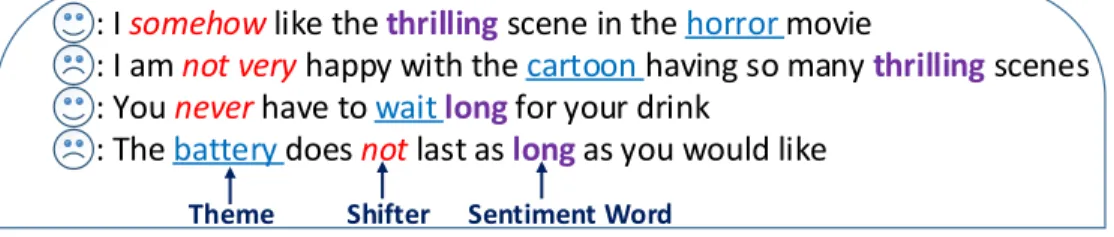
The review documents often consist of multiple themes (multi-theme), where a theme is an abstract concept, such as an aspect (e.g., the service or food quality of a restaurant) or a category (e.g., thriller movies vs. cartoon movies), as described in [4]. A word may convey different (degrees of) polarity when being used in different themes. For example, as shown in Figure 1.1, “long” is a positive word when describing the life of a battery, but becomes
negative if talking about a waiting queue in a restaurant. Similarly, “thrilling” should be a positive word in the reviews of thriller movies, but it usually reveals a negative sentiment in the reviews of other categories of movies.
Contextual valence shifters [5] with sentiment shifting effects such as negation, intensification, and diminishment, are the common factors that affect other words inside a context to express sentiment. The presences of
: I somehow like the thrilling scene in the horror movie
: I am not very happy with the cartoon having so many thrilling scenes : You never have to wait long for your drink
: The battery does not last as long as you would like
Theme Shifter Sentiment Word
Figure 1.1: Examples of multi-theme and sentiment shifting challenges. the sentiment shifting may interfere the learning of word polarity scores. For example, as shown in Figure 1.1, if using the bag-of-words model, without noticing the effects of negation words, e.g., “not” in sentences like “I am not very happy”, the polarity score of “happy” will be skewed and even reversed if multiple occurrences of “happy” are modified by negation words.
In this thesis, we study the problem of sentiment analysis for review text without external knowledge or lexicon that the algorithm should identify how words impose interpretable effects if different reviews have various theme and sentiment shifting may twist individual phrases. The target is classification of sentiment polarity and discovery of quantified sentiment-shifting patterns. When existing approaches are directly applied to this problem setting, they encounter several limitations.
Several proposed algorithms such as [6, 7] are able to identify overall sentiment polarity or ratings on specific topical themes, leading to useful detailed opinion summaries. However, these existing methods lacks direct analysis on multi-theme challenge for individual words or phrases. [8, 9] perform theme contextual sentiment analysis but focus on inferring latent weights of aspects for review data. Moreover, none of them address both
multi-theme and sentiment shifting challenges simultaneously.
Plain discriminative machine learning models using the vector space model, especially the bag-of-words model, learn the sentiment of terms, but each term has a fixed sentiment polarity even in different themes [1]; lexicon-based approach relies on external knowledge and the lexicon quality may vary depending on the reviews in different domains [10, 11]; and rule-based model has limited ability to discover new sentiment shifting phenomena.
In this thesis, we propose a general iterative multi-theme sentiment analysis framework, MTSA, to address both challenges at the same time. To be more specific, MTSA formulates multi-theme sentiment by factorizing the
review sentiments and learning embeddings (i.e., vector representations) for both themes and words. Leveraging theme embedding and word embedding which enable MTSA to examine whether a word has consistent sentiment over different themes, MTSA construct confident training contexts for shifter candidates and derives the shifter effect learning algorithm by modeling the shifted sentiment in a logistic regression model. Through bridging two components, iteratively, the embeddings will be further improved by the rectified document feature representations.
The main contributions of this thesis are as follows.
• We propose a unified and explainable sentiment analysis model to si-multaneously resolve the multi-theme andsentiment shifting challenges. • We learn theme embedding and word embedding to capture different
sentiment polarities of the same word in different themes.
• We automatically discover contextual valence shifters and quantify their effects.
CHAPTER 2
RELATED WORK
To the best of our knowledge, this is the first work addressing the task of fine-grained sentiment analysis for multiple themes and automatic sentiment shifter discovery with quantification. Yet our work is related to aspect-based review analysis, contextual valence shifters and document classification.
In this chapter, we make an overview of relevant methods and concepts for review sentiment analysis. First in Section 2.1, we introduce studies for aspect-based sentiment analysis for review data and discuss their advantages as well as disadvantages. In Section 2.2, literature about contextual valance shifters is introduced to understand the sentiment shifting effect. Then in Section 2.3, we present existing document-level polarity classification models, which are concise but fail to offer explainable analysis.
2.1
Aspect/Theme-based Review Analysis
Regarding aspect sentiment analysis or aspect-based opinion mining, there exist three streams of methods to handle the problem. The first treatment regards themes as an additional dimension to determine word-level polarity and targets to learn theme-dependent lexicon. While, the second treatment of themes emphasizes that the main task is, given a set of reviews, to extract major aspects of review targets and to infer the latent aspect ratings from each review [12]. The third works on sentence-level analysis and tries to detect categories first for each sentence and classify the polarity of sentence. Such aspects or themes can be pre-defined or automatically detected for the first stream but often are defined for the second one.
2.1.1
Aspects/Themes-dependent Lexicon
Different from general sentiment lexicon learning, in [11], the aspects or themes are prepared by external efforts and the aspect-specific sentiment is modeled as the sentiment of (aspect, term) pairs. However, through introducing aspects, the lexicon will suffer from sparsity and insufficient data.
2.1.2
Document-level Aspects/Themes
Latent Aspect Rating Analysis, being originally introduced in [8, 9], is resolved with relatively complicated models, focusing on rating regression and aspect rating regression on bag-of-words model but fail to show the power in classifi-cation tasks. In [8], typical theme words for each theme is pre-defined, and for each review, a bootstrapping algorithm is applied to form hard association between tokens and different themes, and composes a bag-of-words model for each theme. While in [9], through a unified model with a conjunction of Latent Dirichlet Allocation (LDA) [13], the hard association is determined by the probabilistic theme assignments, where themes are assumed to be latent rather than given. In such models, each term in the vocabulary has a fixed sentiment value for a particular theme and such value is completely independent among themes.
The methods treat themes and tokens as the treatment in topic modeling. The studies of topic modeling such as [13] models the text data as a bag of tokens generated from a designed admixture of language models (multinomial distributions over words) and offers a perspective to resolve the multi-theme dilemma. Furthermore, specialized topic models for sentiment analysis like [4, 14, 15], model that sentiment words are generated from either separated sentiment language models or theme-oriented ones. Instead of modeling
P(s|w) of a word wand sentiment s, they model distributions describing the probability P(w|s) that a word happened to be generated from sentiment topic s.
2.1.3
Sentence-level Aspects/Themes
Usually, due to limited content, each sentence covers one or two themes. In SemEval-14 task 4 [16], participants are required to design a pipeline to
detect theme words, determine the theme of sentences and classify sentiment polarity. At each step in the pipe, mostly supervised or semi-supervised classification approaches are adopted. Both concise hand-crafted features and neural embedding features trained through external data are applied by teams. In this way, sentiment polarity classification is less dependent on theme analysis than studies introduced in other two streams above.
2.2
Contextual Valance Shifters for Sentiment Analysis
The contextual valance shifters, illustrated in [5], are actively studied by the NLP community. This study [17] uses the shifters for sentiment classification and shows moderate improvement. [18] describes both the function of shifters and their scope of affection. Many of similar studies using NLP rules add shifter-related features into the feature representations of data but do not either interactively learn the effects of shifters or rectify the incorrect feature weights. [19] emphasizes that the shifting effect is not restricted to shifters but is dependent on the entire sentence, and it adopts SVM classifiers to judge whether a term is shifted in the sentence, whereas [20] proposes an algorithm to automatically generate shifting data. However, the former relies on domain knowledge of sentiment dictionary and the latter turns out to ensemble heterogeneous classifiers. Most studies relies on syntactic structures of sentences to extract shifters. In [21], a mutual information based scoring function is used to achieve polarity reversing construction, similar to negation shifters. A rule-based automatic approach for shifter extraction proposed by [22] can only identify the shifters with fixed categories via heuristic rules and is not designed for robust classification.
2.3
Document-level Sentiment Analysis
In recent years’ studies, distributed representations of words [23, 24] and deep learning promote a new angle of vector representations for text. However, both averaging word embeddings in a document and learning the paragraph embedding offer an overall view of documents. The studies of recurrent neural network with tree structure [2, 25] and convolution neural network [3] for text
classification offer an effective direction to model the compositionality for short sequential text data. Since tree-based RNN or LSTM requires parsing for sentences, they are not designed for document-level polarity classification. Although they have shown their superior accuracies for sentiment classification task, in general, they require much more time and resources to train the model and perform inference for prediction. Furthermore, none of them has the bridge towards multi-theme modeling and explicit shifter explanations.
CHAPTER 3
PROBLEM DEFINITION
This work deals with multi-theme sentiment analysis and sentiment shifting in a large collection of reviews. Besides textual word sequences in reviews, the only extra information for each review in this problem is its sentiment label.
Going deeper into textual reviews, we are interested in contextual valence shifters (“shifters” for short, in this thesis) in linguistics. Shifters are very popular—more than 90% review documents contain at least one shifter in the review corpora we examined. As described in the linguistic study [17], shifters usually have three different types: negations that reverse the semantic polarity of a particular term, intensifiers that increase the degree to which a term is positive or negative, and diminishers that decrease the degree.
Definition 1 A shifter is a word/phrase wthat has effect (negation, intensifi-cation, diminishment) on the sentiment polarities of its context words/phrases
Cw.
In this thesis, we primarily define the context of a shifterw by the sliding window. That is, for the i-th word wi in a sentence, its context Cwi is the
word sequence from (i−∆l)-th position to (i+ ∆r)-th position, where ∆l and ∆r are the parameters of the sliding window. Our framework is flexible with different sentiment context identification methods. Although semantic parser may identify useful long-range dependencies, applying various hand-crafted rules makes it not data-driven. With data-driven fashion, We choose sliding window due to its simplicity and robustness for model performance, which is testified in experiments.
The bag-of-words model is one of the most friendly models to incorporate shifters, because once we figure out their effects in the contexts they belong to, we can rectify the document feature representations W and refine the
Therefore, we formulate the unified multi-theme sentiment analysis problem as follows.
Definition 2 (Problem Definition). Given a review corpus D, as well as the sentiment label (polarity or score) yr and the theme descriptor θr for each
review r ∈ D, the task is to: (1) model different sentiment polarities of the same word in different themes; (2) discover the shifters and quantify their effects in D and rectify the document feature representations W; and (3) derive a unified classifier for sentiment classification, taking advantage of multi-theme modeling and shifters.
The themes in each review r are described as a vector representation θr, where θri is the weight of theme i in the review r. The representation is capable to describe not only different aspects (e.g., service and environment for restaurants) but also different categories of review target (e.g., horror movie and romantic movie).
We can define particular themes as:
Definition 3 For any review collection, themes are a fixed number of latent conceptual categories where word sentiment may vary across themes.
In this work, the themes are assumed to be either extracted beforehand via any rule-based or learning-based theme discovery method or given through extra meta knowledge. Θ∈RK×|D|
denotes the column-wise concatenated matrix of the theme descriptors of all reviews, where K is the number of themes.
MTSA can be divided into iterative two phases: (i) the theme and word embedding learning phase, which discovers the multi-theme phenomena for sentiment words and extract common sentiment words being invariant across themes, given theme descriptorsΘ and word-level descriptorsW and (ii) the shifter effects learning phase, which learns the valid quantified shifters from candidates and apply theme to correct word-level descriptors W, as outlined below:
• Theme and Word Embedding Learning:
1. Learn latent vector representations for themes and word as their embed-dings by optimizing an objective function with respect to the training instances with sentiment polarity labels, given observed review content in the training corpus and extracted theme descriptors.
2. Through ranking sentiment words by estimated sentiment polarities under each theme, extract the theme-invariant common sentiment words which are ranked as top positive or negative in most themes.
• Shifter Effects Learning:
1. Learn shifter effects for the shifter candidates, including phrase candi-dates generated from training corpus, by identifying common sentiment words inside shifters’ contexts and forming a logistic regression problem with respect to the unknown shifter effects.
2. Apply learned shifter effects to the contexts they have affected and update word-level featureW accordingly.
CHAPTER 4
THEME DETECTION AND EXTRACTION
IN REVIEWS
To discover the underlying themes inside review collection, we usually assume that we are given k themes, which are the topical theme clusters that users may care when they write the reviews. For example, for restaurant reviews, possible aspects may include “environment” and “food”.
4.1
Introduction of Topic Modeling Approach
As in many cases, we assume in each review, some latent themes/aspects/topics exist and a review document represented by bag-of-words model can be treated as a mixture of themes. It is natural to design a generative process of the patterns incorporating theme s as latent variables. Instead of enumerating numerous complicated topic models for theme discovery, we take the most popular treatment that using multinomial distribution to model latent topics and the representative basic model is the LDA [13].
LDA first assumes the terms in a particular theme,g, follow a multinomial distribution, φg, which is a random variable draws from a prior Dirichlet distribution.
More specifically, the words in a review or document are generated as: (1) A review document i hasN terms describing opinions and a probability distribution describing to what extend the review focuses on a certain theme, which is a multinomial distribution θi, with the conjugated Dirichlet prior, over latent diagnosis groups; (2) At each time, drawing a latent theme, a term is drawn from the theme following the word distribution in this theme. To design in this fashion, we expect through fitting the generative model with data, the true opinionated themes/topics of each review can be discovered. Finally, although the generative model assumes the number of terms for each review is from a Poisson distribution, as the number of terms for each patient
Algorithm 1: Generative process of reviews.
1. For each reviewi, its theme distributionθi∼Dir(α)
2. For each theme g, its topic term distributionφg ∼Dir(β)
3. For each review, the number of terms N ∼P oisson(ξ) 4. For each term j of the N terms for reviewi.
(a) draw topic assignment zij ∼Multinomial(θi)
(b) draw a termwij ∼Multinomial(φzij)
n 𝑁𝑖 𝜙𝑔 G 𝜃𝑖 𝑧𝑖,𝑗 𝑝𝑖,𝑗 𝛼 𝛽 s Figure 4.1: Graphical model representation of the generative model for group detection.
is assumed to be known and independent to the generation of patterns, it is not critical and the real counts are used. The generative process can be shown in Algorithm 1, and its graphical model representation can be found in Figure 4.1.
Since topic modeling especially LDA is popular and robust theme extraction technique, in the following chapters, we majorly utilize the output of topic model for MTSA. More specifically, the θ are the topic distributions of documents and they serve as theme descriptors in our work.
CHAPTER 5
METHODOLOGY
5.1
Descriptors
Theme Descriptors.
We adopt the probability distribution as a theme descriptor of each review and assume that the content of a review is generated from a multinomial distribution and θri =P r(t=i|r) describes how much different themes are emphasized in the review r.
Word-Level Descriptors.
Similarly, word-level representation (e.g., bag-of-words) Wr is adopted as the vector representation of each review r, whereWrj indicates the weight of wordj in review r. Note that the review feature representations W are not restricted to bag-of-words features and can be replaced by other descriptors or combined with others.
In our iterative framework, in order to be consistent with shifter effect learning step as Section 5.3.2, we adopt a general tf-idf weighting scheme for
W. For a single token of word j in review r, δ(r, j) = ∆tf(r)×idf(j) and ∆tf(r) denotes the normalized increment of term frequency in review r and
idf(j) denotes inverse document frequency of word j. The reason we do not directly use term frequency functions for word j but each token of j is to guarantee Wrj to be a linear combination of contributions of tokens which may be negated, diminished or intensified by shifters.
5.2
Multi-Theme Review Sentiment Modeling
According to the observation of multi-theme, the MTSA model follows the assumption below.
Assumption 1 (Multi-theme Assumption). The sentiment polarity of a word in different themes may be different.
Inspired by the Multi-theme Assumption, we desire to learn expressive sentiment embeddings for each review theme i and word j, by introducing vector representations pi,qj ∈ Rd and defining the sentiment polarity for wordj in theme i as:
sij =piTqj (5.1)
For a review r, we model its sentiment polarity, sr, by combining the affects of different words in different themes as:
sr= K X i=1 |Σ| X j=1 θriWrjsij = K X i=1 |Σ| X j=1 (θripi)T(Wrjqj) (5.2)
LetP ∈Rd×Kdenote the matrix of theme embeddings for allK themes, and
Q∈Rd×|Σ| denote the matrix of word embeddings for the whole vocabulary Σ. By using matrix operations, the prediction is equivalent to the following equation.
sr = (PΘr)T(QWr) (5.3) Since most polarity labels are binary, by taking the sigmoid function σ(x) =
1
1+e−x for sentiment sr, we have the prediction ˆyr =σ(sr) for review r with probability interpretation. Thereby, the log likelihood of the whole review corpus D formulates the objective of the optimization as:
L= |D|
X
r=1
yrln ˆyr+ (1−yr) ln(1−yˆr). (5.4) Besides probabilistic interpretation, other loss functions such as square loss and hinge loss are also adaptable in our model.
To avoid overfitting on observed data, we adopt the elastic net [26] as the regularization to guarantee sparsity on sentiment embeddings. Therefore, we can formulate our objective as a combination of sentiment objective as Eq. (5.4) and regularization on embeddings:
ling the weights of regularization terms.
Due to the limit of space, we do not derive the optimization algorithm that learns P and Q through minimizing the objective O. Any mature optimization technique, such as coordinate descent or stochastic gradient descent, can be adopted.
5.3
Sentiment Shifter Modeling
In most vector space models, each review document is represented as a bag-of-words feature vector describing the (tf-idf weighted) counts of words. However, in almost all human languages, a simple n-gram model cannot correctly represent the underlying meaning or sentiment of the document. As an example, to capture the sentiment of “The beef does not look as spicy as ...”, we need to be aware that “not” serves as a negation shifter.
Assumption 2 (Theme-invariant Assumption). The effect of a shifter is consistent in different themes.
With the Theme-invariant Assumption, to discover theme-invariant shifters, we can leverage the common theme-invariant sentiment words, a subset of sentiment words, which are consistently shared by almost all themes in our model.
In this work, learning effects of shifters is to assign the most appropri-ate quantified effects that achieve an accurappropri-ate polarity classification in a particular corpus, instead of only categorizing the shifters into nega-tion/intensifier/diminisher. In this study, We formally define the effect of a shifter as the following definition and and propose the Independent-effect Assumption.
Definition 4 For a shifter w, its effect is modeled as a real value fw ∈R.
Assumption 3 (Independent-effect Assumption). If the word at i-th position in the review r is within the contexts of m shifters w1, . . . , wm, its shifted
polarity, s0i =si·
Qm
k=1fwk where its original polarity is si = PK
j=1θrjsij. The rationales behind Independent-effect Assumption are: (1) we need to quantitatively define the shifter effects; (2) many such cases exist in real
data; (3) the problem is simplified and thus solvable. Admittedly, studying complicated composition of shifters is interesting future work. We are aware of possible complicated composition and thus propose to mine phrase shifters in Section 5.3.1 to alleviate the issue and the strategy works decently in practice.
5.3.1
Shifter Candidates Generation
As we assumed there exist a set of shifters Σsfor every language, an automatic method generating the potential candidates is a necessity rather than merely using human efforts. A set of negation keywords in English are defined in [27]. However, beyond such a thorough linguistic study of negation keywords, there might be more phrases that can express the shifting effect to different extents. Besides prepositions, in real cases, verbs, adverbs, and other types of words may also serve as shifters. Due to the difficulty of directly discovering such candidate sets from data, we propose a compromised bootstrapping solution by leveraging the contextual similarity between words defined by word embedding [23].
Our proposed method starts from a very small and confident set of shifter candidates as seeds, like negation words “never” and “not”, as well as intensi-fier/diminisher words “very” and “extremely”, and then enlarges the candidate set by retrieving the nearest words in terms of contextual similarity (e.g., cosine similarity between word embeddings) to the current candidates. Empir-ically, we find it is much better to discover negation and intensifier/diminisher as two separate sets with some overlapping.
More specifically, we directly leverage an open-source reliable model, word2vec trained from Google News dataset to calculate contextual similarity, since such unigram shifters objectively exist inside language. Alternatively, the word embeddings may also be trained on the review corpus but data could be insufficient. The contextual similarity is usually defined as cosine similarity: for wordsiandj in vocabulary, we have their vector representations asvi and
vj in word2vec model, and the contextual similarity, Sim(i, j) =
vi·vj
kvik2kvik2.
After running bootstrapping process several times, we finally obtain two candidate sets Σn (123 potential negations) and Σr (153 potential intensi-fiers/diminishers) with manual cleaning for obvious wrong candidates. As our
algorithm will finally learn the effects of shifters based on training data, we are able to resolve the noise and uncertainty in the initial sets by removing and adjusting these shifters based on their learned effects.
Furthermore, the unigram shifters cannot perfectly represent the nature of the language like English, where many multi-word phrases have the effect of negation, intensification or diminishment. To address this problem, i.e., multi-word phrases such as “not very” and “too ... to ...”, we propose to utilize frequent pattern mining to discover phrase shifters Σp. Because allowing non-consecutive phrases will exponentially increase the complexity of the problem, our method only considers the phrases composed by consecutive unigram shifters as potential phrase shifters. Σp accepts the frequent phrases whose frequency meet a threshold proportional to the corpus size and that satisfy simple rules.
Combining candidate bootstrapping and phrase shifters mining together, three sets of shifter candidates are generated as Σn,Σr,Σp and Σs = Σn∪ Σr∪Σp.
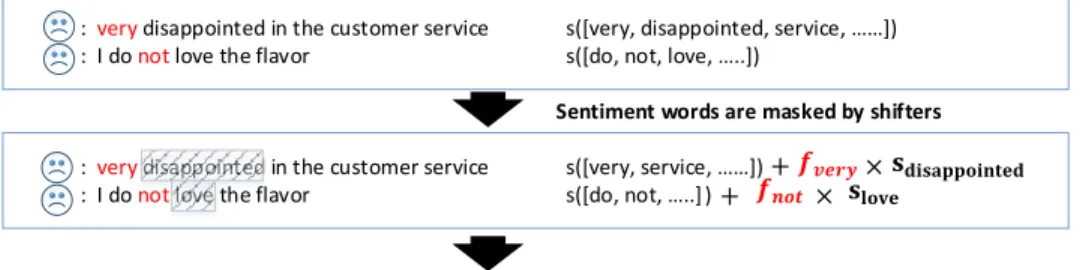
: very disappointed in the customer service s([very, disappointed, service, ……]) : I do not love the flavor s([do, not, love, …..])
: very disappointed in the customer service s([very, service, ……]) : I do not love the flavor s([do, not, …..] )
Sentiment words are masked by shifters
Learn shifters’ quantified effects: very – intensifier, not – negation
𝐬𝐝𝐢𝐬𝐚𝐩𝐩𝐨𝐢𝐧𝐭𝐞𝐝 𝐬𝐥𝐨𝐯𝐞
𝒇𝒗𝒆𝒓𝒚 𝒇𝒏𝒐𝒕+
+ × ×
Figure 5.1: Sentiment shifter learning process
5.3.2
Shifter Effect Learning
In order to obtain precise shifters, we learn the effects of shifters only based on (1) common sentiment words, and (2) single-modification contexts.
According to the Theme-invariant Assumption, considering only common theme-invariant sentiment words, when constructing shifter context, enables the algorithm to learn reliable effects of shifters. Thanks to multi-theme sentiment modeling, the ubiquitous sentiment words, such as “amazing” and “awful”, are able to be automatically extracted and such set of common sentiment words is denoted as Σc. More specifically, given theme embeddings
Algorithm 2: Shifter Effect Learning
Input: review documents D, a vector of quantified effects ft−1, review
feature matrix W, parameters matrices Θ,P,Q, common sentiment words Σc
for each review r in D do for each shifter w in Σs do
Identify sentiment contexts Cw of w inr
Identify the single modified words in Cw and the words must be in Σc
Construct shifter features in xr by Eq.( 5.7) Solve Eq. (5.8) forf∗
Return: a vector of quantified effects f∗, which serves asft for next iteration
P and word embeddings Q, the common sentiment words in Σc should be ranked in the top-N positives or top-N negatives based on theme polarities defined in Eq. (5.1) in at least M over K themes. The intuition of the first treatment is that the highly confident sentiment words shared by almost all themes are the safe choices to learn the effect of shifters, especially when the multi-theme sentiment polarity scores are not stable in the very beginning of our method.
Caused by the Independent-effect Assumption, when a sentiment word i
lies in the context of m (m ≥ 2) shifters w1, w2, . . . , wm, e.g., “not really
good”, the shifted polarity s0i of this sentiment word relies on the product of unknown effects Qm
k=1fwk. Such complex dependency makes the learning of
these quantified effects of shifters unstable and intractable, thus substantially increasing the difficulty of the learning process. Therefore, despite the sacrifice of some training data, we simplify the learning process by only considering single-modification contexts where every sentiment word is just modified by a single shifter.
As an iterative framework, MTSA updates shifter effects after each iteration of multi-theme modeling, and vice versa. Next, assuming at thet-th iteration, taking the previous estimated effect of a shifter w as fwt−1 and the true effect of a shifterwas an unknown variablefw∗, we will derive the rectified sentiment. For a particular occurrence of sentiment word j in review r, assume word
j is modified by a shifter w. In general, the contribution of this affected occurrence of word j to word-level feature Wrj should be δ(r, j)×fw∗, where
δ(r, j) = ∆tf(r)×idf(j), but currently the value is δ(r, j)×ft−1
tf-idf weighting scheme, ∆tf(r) denotes the normalized increment of term frequency in reviewrandidf(j) denotes inverse document frequency of wordj. Therefore, considering a single affected occurrence of wordj, whose sentiment is (θrP)Tqj, the rectified sentiment of reviewr should be :
s0r =sr+ (fw∗ −f t−1
w )×δ(r, j)(θrP)Tqj (5.6) Then, we take the rectified sentiments0r instead ofsr to predict review level sentiment. After rewriting Eq. (5.6) for all affected words in reviews, it naturally formulates a logistic regression problem. The feature vector of review r asxr ∈R|Σs| is:
xrw =
X
j∈Crw
δ(r, j)(θrP)Tqj (5.7)
whereCrw is the context of shift w in reviewr.
The logistic regression problem is formulated as follows. ˆ yr =σ(f∗·xr+ ¯sr) (5.8) ¯ sr =sr− X w∈Σs fwt−1 X j∈Cw δ(r, j)(θrP)Tqj Thel2regularization Ω(f) =αPw∈Σs(fw−1)
2is added to avoid fitting skewed
data and obtain reasonable quantified effects around 1.0 which indicates that this shifter has no effect on sentiment words. Thereby, we have the objective function to minimize with respect to f:
Of =α X w∈Σs (fw−1)2+ |D| X r=1 yrln ˆyr+ (1−yr) ln(1−yˆr) (5.9)
Mature solutions for the above logistic regression problem can find an optimal solution for f∗ that serves as ft for further iteration.
Thus, the work flow of one iteration for shifter effect learning in the whole MTSA framework is described in Algorithm 2. This model can be viewed as: figuring out how to put the correct sentiment effects of the words inside contexts of shifters back by learning appropriate shifter effects. Through the steps described above, the effects of shifters are learned as real-value vectors: fnfor negation Σn,fr for intensifier/diminisher Σr, andfp for shifter
phrases Σp, as long as they are learned to be valid shifters from the data. In practice, because the learning process is based on single-modification contexts, three sets of shifters can be quantified separately, in order to impose different constraints and resolve overlapping after effects are estimated.
5.4
Rectification and Iterative Refinement
After learning the quantified effects of shifters by Algorithm 2, we obtain three sets of useful shifters and their effects. The word-level feature representations
W are ready to be rectified by plugging the effects of these learned shifters. More specifically, instead of summing over the word occurrences (equivalent to f =1) for the computation of W, we now identify the context for each shifter wand apply its effect fw on the words within the context.
In this step, we are not restricted to common sentiment words and single-modification contexts, since (1) the word-level feature representations W
contains all words instead of common sentiment words only; and (2) the overall effect of multiple shifters modifying the same sentiment word can be accumulated as the product of shifter effects based on Independent-effect Assumption.
As tf-idf weighting scheme introduced in Section 5.1, initially with all shifter effects being set to one, for reviewrand wordj, we haveWrj =
PNrj
k=1δ(r, j) = Nrj ×∆tf(r)×idf(j). However, when considering shifter effects, we need roll back to single tokens and let’s denote the token-level vector for review r
as ¯Wr. For a token of word j at position l in r, initially, without considering shifters, ¯Wrl = ∆tf(r)×idf(j). Then, after updating shifter effects, we can calculate new ¯Wr through Algorithm 3. Then, to obtain word-level features for review r,Wr, aggregate the weights of tokens of the same word in ¯Wr.
Benefiting from the learning of the multi-theme sentiment model and quantified shifter effects, our sentiment polarity classification can be iteratively refined. In our framework, the learned theme and word embeddings,P andQ, together define the multi-theme sentiment polarity classifiers. Although the theme descriptors Θare pre-computed for reviews, the bag-of-words features
W are adjusted once the effects of shifters are updated. In the procedure of rectifying Wand training more accurate embeddings P andQ, classification performance is improved via mutual enhancements. However, there is no
Algorithm 3: Shifter Effect Inference
Input: review documentDr, quantified effects of three sets shifters: phrasesfp, negationsfn, intensifiers/diminishers fr.
Initialize: ¯Wr
for sentence in review r do for shifter w in sentence do
Identify the sentiment context Crw of w
for sentiment word l in Crw do
if w is a phrase then
¯
Wrl = ¯Wrl×fpw
else if w is a negation then
¯
Wrl = ¯Wrl×fnw
else
¯
Wrl = ¯Wrl×frw
Return: Adjusted token-level weights ¯Wr
guarantee on the convergence due to the possible noises in the data.
5.5
Computational Complexity Analysis
Suppose the number of words (i.e., tokens) in the review corpus D is ND, the size of the vocabulary is |Σ|, and the number of reviews is |D|. The time complexity for feature extraction of all review documents isO(ND) forW and at worst O(K|D| · |Σ|) for theme descriptors generation (i.e., topic modeling in this thesis), where K is the number of themes. The feature extraction in shifter effect learning in Algorithm 2 is O(ND) as the size of the shifter set |Σs|can be viewed as a small constant. The model learning for multi-theme sentiment model takes O(d(K +|Σ|+|D|)), where d is the dimensionality of embeddings, for each coordinate descent iteration, if we employ the speedup trick in [28]. The step of shifter effect learning as a logistic regression in Algorithm 2 is fairly efficient comparing to multi-theme sentiment learning step.
CHAPTER 6
EXPERIMENTS
6.1
Datasets
Our experiments use two real-world datasets: (1) Yelp dataset1 contains 30,471 5-scale rated reviews with timestamps selecting from the Yelp Challenge dataset. The business categories of reviews include restaurants, shopping centers, automotive, gym and drinks & bars. The average length of each review is 137 words. A negative review has a score no more than 2, while a positive review has a score at least 4. The dataset is partitioned into training and testing by a split point of time: 2014-08-01. The test set contains 3,779 positive examples and 4,562 negative examples. (2)IMDB dataset2 is introduced in [29] as a benchmark for sentiment analysis. There are 25,000 movie reviews for training and 25,000 movie reviews for testing, where average length of each review is 241 words . The unlabeled set of 50,000 additional reviews are not used in our experiment. The constructed dataset contains an even number of positive and negative reviews, so randomly guessing yields 50% accuracy.
6.2
Experiment Settings
In our model MTSA, the LDA implementation in MALLET [30] is adopted to obtain theme descriptors with a fixed number of themes K = 20 for both training and testing sets. Infrequent words and stopwords are removed before feature extraction. The non-literal characters are removed in Yelp dataset and the vocabulary used in the IMDB dataset is synchronized with the suggestions in [29], where characters composing emoji like “smile” face are preserved.
The parameter tuning schema for all compared baseline methods and for our model is as follows. A validation set is held-out in the training data and the final classification accuracy is evaluated on the test data. For our approach, the multi-theme model is tuned at the first step. After fixing the parameters in multi-theme model, we further tune the parameters related to shifter learning. The dimensionality of embeddings is set as d = 64 for both Yelp and IMDB. Based on our experiments and for reducing the risk of overfitting, we choose to first perform four rounds of cold-start learning, which optimizes the model starting from random initialization, and then apply one more round of warm-start learning, which takes the previous model as initialization. This setting usually yields a reasonably good accuracy. Our implementation utilizes the feature-based matrix factorization toolkit PL2M [28] for the multi-theme model and the L-BFGS [31] for optimization in the shifter learning process.
The word-level feature representations in unigram models are weighted by tf-idf, while those in bigram models are binary indicators of the presences. There are various ways to achieve tf-idf weighting in literature. As we proposed a general framework, different idf scores can be applied. Besides the log-scaled inverse fraction, navie bayes feature was proposed in [32], which performs very well for sentiment classification tasks. We will show that the NB feature is actually an idf weight function considering training labels. Define the count vectors as p= α+P
i:yr=1Wr and q = α+
P
r:yr=0Wr where α serves as smoothing. Wang in [32] defines the log ratio r for words as:
r = log(p/kpk1
q/kqk1
), Wˆr =rWr (6.1)
whereindicates element-wise product. Because the log ratior is applied on all features, if we take absolute value of each element in r to obtain abs(r), it serves as a non-negative idf function which measures how discriminative a feature is. Since r is global multiplied to all instances, taking absolute value will not change predictions.
As defined in Definition 1, there are various ways in practice to extract contexts of a shifter. Although some semantic parsing might be more precise to determine semantic scope, the context is extracted in our experiment by checking a fixed sized sliding window (e.g., size 3, [0,3]). In practice, simple sliding window may bring much noise when applying the learned shifters to
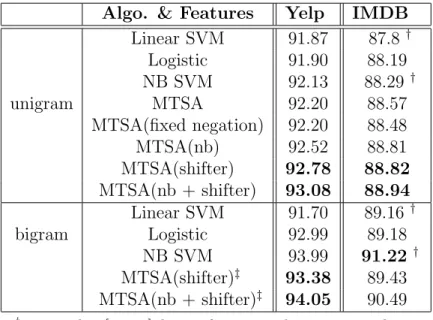
Table 6.1: Comparison of classification accuracy.
Algo. & Features Yelp IMDB
unigram Linear SVM 91.87 87.8 † Logistic 91.90 88.19 NB SVM 92.13 88.29 † MTSA 92.20 88.57 MTSA(fixed negation) 92.20 88.48 MTSA(nb) 92.52 88.81 MTSA(shifter) 92.78 88.82 MTSA(nb + shifter) 93.08 88.94 bigram Linear SVM 91.70 89.16 † Logistic 92.99 89.18 NB SVM 93.99 91.22 † MTSA(shifter)‡ 93.38 89.43 MTSA(nb + shifter)‡ 94.05 90.49
† reported in [29, 32]; binary features with cosine normalization (bnc); NB SVM is reported as an ensemble method of SVM with Navie Bayes features and Multinomial Navie Bayes classifier. ‡ The top bigram features from logistic bigram are appended to
feature vectors.
contexts. To alleviate the incorrect attachment, the only heuristic rule we adopt in the experiment is that we place adjectives with higher priority, and only if no adjective exists in the window, we take the immediate successive term as the back-off choice.
6.3
Review Sentiment Classification
MTSA can be used for sentiment polarity classification of reviews. We compare our algorithms with other baselines on the binary (positive/negative) classification task. It is worth mentioning that our model is very flexible to be adapted for review score regression tasks.
Table 6.1 presents the results of our experiment and the reported bench-marks using bag-of-words representations in literature. MTSA has better accuracy on both datasets than the plain discriminative classification models (i.e., SVM, logistic regression) and non-ensemble benchmarks. To have fair comparison, the naive bayes features, denoted as ‘nb’, are also compared in various models. When adding iterations of shifter learning, the rectified features take advantage of quantified shifters and help MTSA achieve further
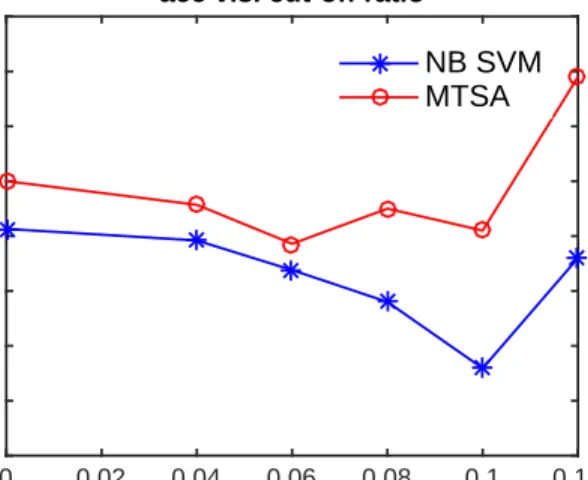
num shifter/ num token 0 0.02 0.04 0.06 0.08 0.1 0.12 accuracy 88 89 90 91 92 93 94 95
96 acc v.s. cut-off ratio
NB SVM MTSA
Figure 6.1: Accuracies on subsets of test data. The subsets are determined by different cut-off ratio
effects (i.e. −1) in MTSA may not improve accuracy.
In Figure 6.1, NB SVM model and MTSA model are evaluated on various subsets of test data. We select the reviews that each review has the ratio of the number of shifters and the number of tokens greater than the cut-off threshold. We can see that when the ratio getting bigger, shifters exist in the review with a larger portion and the gain of modeling shifter effect is bigger as the gap between MTSAand NB SVM gets bigger.
Discussed in several literature, n-gram features may have better classifica-tion performance depending on tasks [32]. Although our MTSA is derived from unigram bag-of-words, we experiment appending top 2% discriminative bigrams into our learning framework. The performance is boosted by the ad-hoc treatment and the benefit of shifters is more significant on the Yelp collection with shorter reviews.
Recent years, deep neural models achieve successful results for various classification task and the family of neural network methods for NLP should employ word embeddings as the input and train extensive deep model for the data. However, we did not compete with this family of models for classification performance, because they require extensive training even on a small amount of data and lack ability to explain at the word-level while we are studying using quantified shifters to make explainable sentiment analysis. According to the literature [24], the studies of neural networks achieved error rates around 7.5% for IMDB dataset as the comparison in Table 6.2. All these models [24, 33]
Table 6.2: Comparison with deep neural models.
Algorithm & Features IMDB
Paragraph Vec [24] 92.58
SA-LSTM [33] 92.76
MTSA 90.49
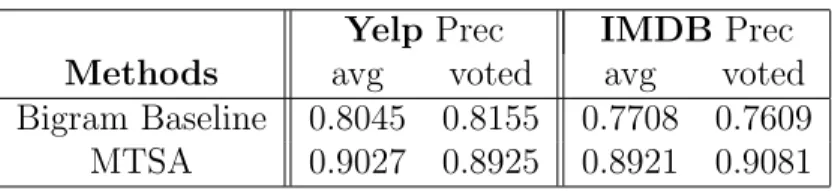
Table 6.3: Precision of feature rectification. avg: average precision of judges;
voted: the precision on majority voted labels.
YelpPrec IMDB Prec
Methods avg voted avg voted
Bigram Baseline 0.8045 0.8155 0.7708 0.7609 MTSA 0.9027 0.8925 0.8921 0.9081
are reported to use unlabeled data to improve performance with unsupervised component. For the long review documents and large training corpus, deep neural models may be able to learn good representations with very careful tuning on hyper-parameters and massive parameters to learn, e.g. each training review has a embedding vector to learn [24]. Besides, the feature representations learned by deep neural nets will become vector representations for reviews before feeding into a softmax unit and our multi-theme sentiment model can definitely take such vectorial features as W.
6.4
Shifters Discovery
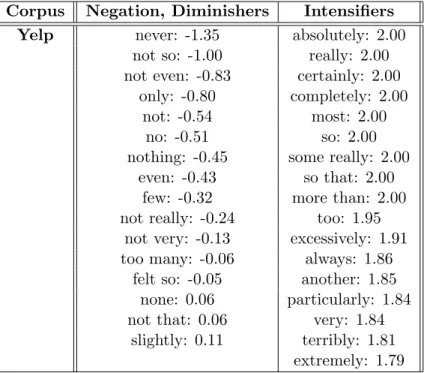
With default settings, MTSA extracts and quantifies around 70 unigram shifters and 80 phrase shifters for Yelp, 70 unigram shifters and 100 phrase shifters for IMDB, where the exact numbers varies under different parameter settings. As an example, the top ranked shifters including both unigram and bigram learned from Yelp reviews are presented in Table 6.4.
6.4.1
Human Judge Evaluation
To show the efficacy of our shifter discovery, we design an evaluation task to examine whether the shifters are correctly discovered and whether their effects on features are consistent with our motivation and human intuition. For each dataset, 200 reviews containing identified shifters are uniformly sampled as
Table 6.4: Learned Shifters. Ranked by effect values, where intensifiers are bounded by 2.0.
Corpus Negation, Diminishers Intensifiers
Yelp never: -1.35 absolutely: 2.00
not so: -1.00 really: 2.00
not even: -0.83 certainly: 2.00
only: -0.80 completely: 2.00
not: -0.54 most: 2.00
no: -0.51 so: 2.00
nothing: -0.45 some really: 2.00
even: -0.43 so that: 2.00
few: -0.32 more than: 2.00
not really: -0.24 too: 1.95
not very: -0.13 excessively: 1.91
too many: -0.06 always: 1.86
felt so: -0.05 another: 1.85
none: 0.06 particularly: 1.84
not that: 0.06 very: 1.84
slightly: 0.11 terribly: 1.81
extremely: 1.79
an evaluation set. In each review, we rank the sentiment words modified by discovered shifters by their polarity magnitudes. The top-5 sentiment words are marked together with their shifters as a phrase, and are presented with their corresponding polarity scores after rectification, e.g., (“not happy”, −1). Human judges are responsible to evaluate the correctness of polarity scores within review contexts. The baseline for comparison gets the polarity scores from the weights in the bigram logistic regression model if the phrase is there; otherwise, we do not present it. Human judges label the phrases using “correct”, “incorrect” and “irrelevant to sentiment”.
We report intraclass correlation coefficient (ICC) of 4 human judges, the two-way absolute agreement for IMDB and Yelp respectively: Average k = 0.905, 0.915; Individual = 0.702, 0.73. We use majority voting for evaluation, so average measurement is more important. (>0.8 indicates almost perfect agreement [34]), the ICC shows the judges have achieved agreements in most cases. Since we only inspect the top-5 set and have no idea about the full set, we evaluate the results by the precision, which is calculated by excluding the irrelevant cases (i.e., P rec= Ncorrect
6.4.2
Shifter Quality Analysis
Regarding the feature space of bigram model is much larger than our sentiment shifter model, we analyze the types of errors that each model made. First, the typical error of the bigram baseline is resulted from overfitting, e.g., “so great” has unexpected negative sentiment score due to limitation of training data. Nevertheless, our model learned “so” as an intensifier with an effect 2.0, thus making the polarity of “so great” even more positive. Second, the typical error our sentiment shifter model made is that the shifter and the sentiment word compose an “unusual” meaning, where the effect deviates from its usual value. Taking “less comfortable” as an example, in our model, “comfortable” holds a positive polarity as an individual word and “less” plays a role of diminisher; although the shifted polarity of the phrase “less comfortable” is less positive than before (i.e., score is lower, but still positive), it should have a negative polarity in the comparison context. Although the deviation results from simplified model, most minor deviations still guarantee the polarity shifting to correct direction. Such contradictions to the general functions of shifters lead to the major errors in our sentiment shifter model and a reasonable treatment to alleviate the issue is to append frequent abnormal phrases into review features.
6.5
Model Selection
dimensionality K 20 40 60 80 accuracy 92 93 94 95 96 97 98 acc v.s. K Yelp-train Yelp-testsliding window size
0 2 4 6 accuracy 92 93 94 95 96 97
98 acc v.s. window size Yelp-train Yelp-test
Figure 6.2: Parameter Study for MTSA
empirically, they are not sensitive. Besides regularization parameters, the dimensionality of embeddings K for model complexity and sliding window size for robustness are two parameters to study.
Apart from model parameters, MTSA is more sensitive to theme/review descriptors, the features. For example, for Yelp dataset, the categories of selected business are known and if we utilize the meta information as binary theme descriptors, the accuracy usually drop more than 0.3%.
6.6
Case Study and Discussion
6.6.1
Multi-Theme Assumption Justification
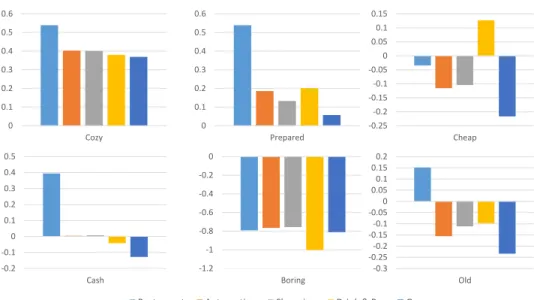
0 0.1 0.2 0.3 0.4 0.5 0.6 Cozy 0 0.1 0.2 0.3 0.4 0.5 0.6 Prepared -0.2 -0.1 0 0.1 0.2 0.3 0.4 0.5 Cash -1.2 -1 -0.8 -0.6 -0.4 -0.2 0 Boring -0.25 -0.2 -0.15 -0.1 -0.05 0 0.05 0.1 0.15 Cheap -0.3 -0.25 -0.2 -0.15 -0.1 -0.05 0 0.05 0.1 0.15 0.2 Old -1.2 -1 -0.8 -0.6 -0.4 -0.2 0 0.2 0.4 0.6
Cash Boring Old Cheap
Restaurant Automotive Shopping Drink & Bar Gym
Figure 6.3: Sentiment polarities in different themes
To justify our assumption that the same word may have different (degrees of) polarities across different themes, we present the sentiment polarities of “cozy”, “cash”, “prepared”, “boring”, “cheap” and “old” learned from Yelp dataset variant, where the theme-descriptors are constructed by categories of business in metadata. The word “cozy” ranks very high in the restaurant category because people usually express positive opinion when a restaurant offers pleasant environment, whereas “boring” appears more negative in the bars category because people enjoy the intriguing environment. The term “cash” has a positive polarity in the restaurant category because many
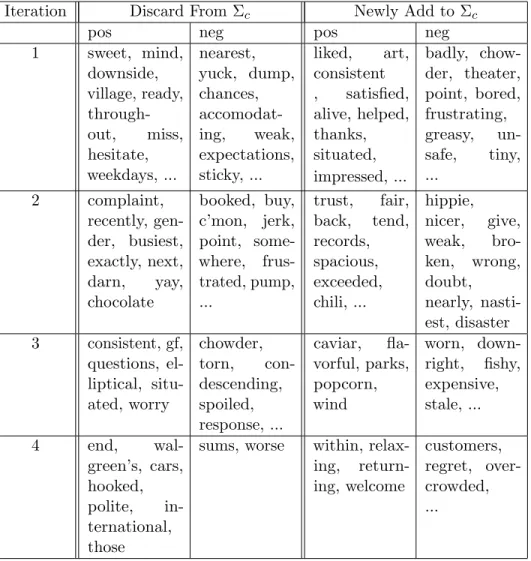
Table 6.5: The changes of common sentiment words through iterations for Yelp dataset
Iteration Discard From Σc Newly Add to Σc
pos neg pos neg
1 sweet, mind, downside, village, ready, through-out, miss, hesitate, weekdays, ... nearest, yuck, dump, chances, accomodat-ing, weak, expectations, sticky, ... liked, art, consistent , satisfied, alive, helped, thanks, situated, impressed, ... badly, chow-der, theater, point, bored, frustrating, greasy, un-safe, tiny, ... 2 complaint, recently, gen-der, busiest, exactly, next, darn, yay, chocolate booked, buy, c’mon, jerk, point, some-where, frus-trated, pump, ... trust, fair, back, tend, records, spacious, exceeded, chili, ... hippie, nicer, give, weak, bro-ken, wrong, doubt, nearly, nasti-est, disaster 3 consistent, gf, questions, el-liptical, situ-ated, worry chowder, torn, con-descending, spoiled, response, ... caviar, fla-vorful, parks, popcorn, wind worn, down-right, fishy, expensive, stale, ... 4 end, wal-green’s, cars, hooked, polite, in-ternational, those
sums, worse within,
relax-ing, return-ing, welcome customers, regret, over-crowded, ...
small restaurants prefer cash to credit cards and paying with cash usually has discounts, whereas in other categories, “cash” turns out to be slightly negative.
6.6.2
Mutually Enhance Justification
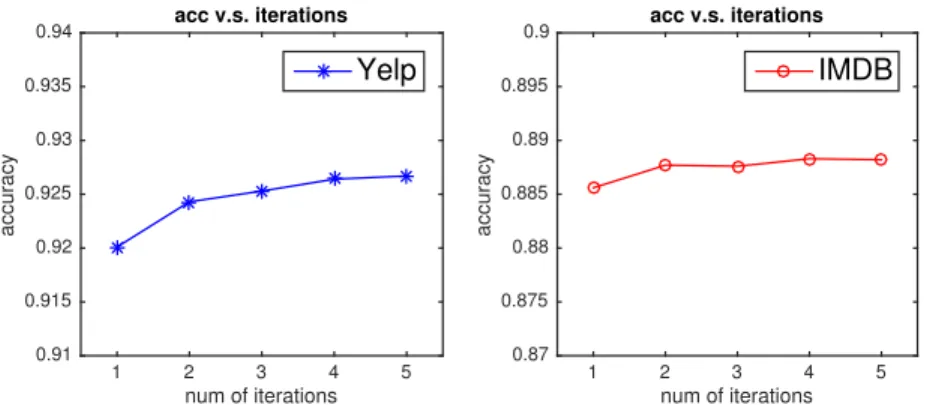
Aside from observing that classification accuracy improves through iterative refinement shown in Figure 6.4, we also find that extracted common sentiment words have reasonable dynamic changes. Initially, ignoring any effects of sentiment shifting, some noisy and incorrect words exist in the ranking lists. For example, “worry” was originally ranked in positive list, but after
num of iterations 1 2 3 4 5 accuracy 0.91 0.915 0.92 0.925 0.93 0.935 0.94 acc v.s. iterations Yelp num of iterations 1 2 3 4 5 accuracy 0.87 0.875 0.88 0.885 0.89 0.895 0.9 acc v.s. iterations IMDB
Figure 6.4: Accuracy improves through iterative refinement of MTSA three iterations, “worry” was eliminated from the positive list. Admittedly, although the ranking lists tend to converge after three iterations, some noisy words are added as new common sentiment words because possible over-fitting issue occurs for shifter effect learning. As a case study, the detailed changes of common sentiment words are illustrated in Table 6.5.
6.6.3
Explainable Sentiment Analysis
The beef does not really look as spicy as you might like (not, really spicy = -0.61436)
Preditction: negative
(beef | 0.012); (look | 0.028); (not,really | spicy | -0.614); (might | -0.08); (like | 0.002)
0 0.2 0.4 0.6
Spicy
Figure 6.5: Case Study: Explainable Sentiment Analysis
In an ideal scenario, the usage of MTSA should be: 1) train the model on the reviews with consistent sentiment and relative confident theme descriptors; 2) apply the model on the sentences or snippets with detected themes. In this way, the model will be able to present: the wordl-level sentiment polarities and how each word contributes to the overall sentiment by detecting sentiment shifting. We develop an online inference module to both analyze input sentence and offer reasons. As the case in Figure 6.5, applying the model we trained from Yelp collection, “spicy” is an adjective, which is learned to be positive, following a learned shifter phrase “not really” with negation effect −0.24 and the overall sentiment is reversed to negative.
6.6.4
Shifters Benefit Discussion
According to our experiments, although we effectively identified the shifters, the sentiment classification accuracy is not substantially improved. The limited coverage of shifters is the major reason for the insignificant rectification of shifters for long reviews. From statistical perspective, despite over 93% coverage of rectified reviews, the portion of active features (i.e., sentiment words) adjusted in each review are 7.2/87 in Yelp dataset and 10.5/122.8 in IMDB dataset. From semantic perspective, especially for long reviews, people may express the same opinion more than once in the same review using both acronyms and shifters. For example, when both “not good” and “bad” appear in the same negative review, the classifier may work properly judging mainly based on “bad” without noticing the shifter “not”. Therefore, shifters may not play important roles for long document level classification, but for shorter text or sentence level, they will be more effective.
CHAPTER 7
CONCLUSIONS
In this thesis, we address the problem of fine-grained review sentiment analysis to offer explanation to two major concerns:“multi-theme” and “sentiment shifting”. Different from lexicon-based approach and feature engineering for supervised learning, this work, to the best of our knowledge, is the first to propose automatic discovery and quantification of sentiment shifters in a polarity-labeled corpus. A framework is developed to incorporate such sentiment shifter learning together with multi-theme sentiment classification and let them mutually enhance each other. We experiment our method on read-world review collections, Yelp and IMDB, to evaluate the effectiveness for sentiment analysis and conduct case studies.
In the future, we will extend the learning framework to go beyond bag-of-words feature representations and take advantage of neural network-based models to further improve multi-theme sentiment classification and shifter learning. Another possible future extension might be taking advantage of linguistic grammar to distinguish shifters in different linguistic structures.
REFERENCES
[1] B. Pang, L. Lee, and S. Vaithyanathan, “Thumbs up?: Sentiment classi-fication using machine learning techniques,” in Proceedings of the con-ference on empirical methods in natural language processing (EMNLP). Association for Computational Linguistics, 2002, pp. 79–86.
[2] R. Socher, A. Perelygin, J. Wu, J. Chuang, C. D. Manning, A. Y. Ng, and C. Potts, “Recursive deep models for semantic compositionality over a sentiment treebank,” in Proceedings of the conference on empirical methods in natural language processing (EMNLP). Association for Computational Linguistics, October 2013, pp. 1631–1642.
[3] N. Kalchbrenner, E. Grefenstette, and P. Blunsom, “A convolutional neural network for modelling sentences,” in Proceedings of the 52nd Annual Meeting of the Association for Computational Linguistics (ACL). Association for Computational Linguistics, June 2014, pp. 655–665. [4] Q. Mei, X. Ling, M. Wondra, H. Su, and C. Zhai, “Topic sentiment
mixture: Modeling facets and opinions in weblogs,” in Proceedings of the 16th international conference on World Wide Web (WWW). ACM, 2007, pp. 171–180.
[5] J. Shanahan, Y. Qu, and J. Wiebe, “Contextual valence shifters,” in
Computing Attitude and Affect in Text: Theory and Applications, ser. The Information Retrieval Series. Springer Netherlands, 2006, vol. 20, pp. 1–10.
[6] L. Zhuang, F. Jing, and X.-Y. Zhu, “Movie review mining and summa-rization,” in Proceedings of the 18th ACM conference on Information and knowledge management (CIKM). ACM, 2006, pp. 43–50.
[7] I. Titov and R. T. McDonald, “A joint model of text and aspect ratings for sentiment summarization,” inProceedings of the 46th. Annual Meeting of the Association for Computational Linguistics (ACL). Association for Computational Linguistics, 2008, pp. 308–316.
[8] H. Wang, Y. Lu, and C. Zhai, “Latent aspect rating analysis on review text data: A rating regression approach,” in Proceedings of the 16th ACM SIGKDD international conference on Knowledge discovery and data mining (SIGKDD). ACM, 2010, pp. 783–792.
[9] H. Wang, Y. Lu, and C. Zhai, “Latent aspect rating analysis with-out aspect keyword supervision,” in Proceedings of the 17th ACM SIGKDD international conference on Knowledge discovery and data mining (SIGKDD). ACM, 2011, pp. 618–626.
[10] J. Wiebe, T. Wilson, and C. Cardie, “Annotating expressions of opinions and emotions in language,” Language resources and evaluation, vol. 39, no. 2-3, pp. 165–210, 2005.
[11] Y. Lu, M. Castellanos, U. Dayal, and C. Zhai, “Automatic construction of a context-aware sentiment lexicon: An optimization approach,” in
Proceedings of the 20th international conference on World wide web (WWW). ACM, 2011, pp. 347–356.
[12] Y. Wu and M. Ester, “Flame: A probabilistic model combining aspect based opinion mining and collaborative filtering,” in Proceedings of the Eighth ACM International Conference on Web Search and Data Mining (WSDM). New York, NY, USA: ACM, 2015, pp. 199–208.
[13] D. M. Blei, A. Y. Ng, and M. I. Jordan, “Latent dirichlet allocation,” J. Mach. Learn. Res., vol. 3, pp. 993–1022, Mar. 2003.
[14] C. Lin and Y. He, “Joint sentiment/topic model for sentiment analysis,” inProceedings of the 18th ACM conference on Information and knowledge management (CIKM). ACM, 2009, pp. 375–384.
[15] Y. Jo and A. H. Oh, “Aspect and sentiment unification model for online review analysis,” in Proceedings of the fourth ACM international conference on Web search and data mining (WSDM). ACM, 2011, pp. 815–824.
[16] M. Pontiki, D. Galanis, J. Pavlopoulos, H. Papageorgiou, I. Androut-sopoulos, and S. Manandhar, “Semeval-2014 task 4: Aspect based sen-timent analysis,” in Proceedings of the 8th International Workshop on Semantic Evaluation (SemEval 2014). Dublin, Ireland: Association for Computational Linguistics and Dublin City University, August 2014, pp. 27–35.
[17] A. Kennedy and D. Inkpen, “Sentiment classification of movie reviews using contextual valence shifters,” Computational intelligence, vol. 22, no. 2, pp. 110–125, 2006.
[18] M. Wiegand, A. Balahur, B. Roth, D. Klakow, and A. Montoyo, “A survey on the role of negation in sentiment analysis,” inProceedings of the Workshop on Negation and Speculation in Natural Language Processing,
ser. NeSp-NLP ’10. Association for Computational Linguistics, 2010, pp. 60–68.
[19] D. Ikeda, H. Takamura, L.-A. Ratinov, and M. Okumura, “Learning to shift the polarity of words for sentiment classification.” in In Proceed-ings of the Third International Joint Conference on Natural Language (IJCNLP), 2008, pp. 296–303.
[20] S. Li, S. Y. M. Lee, Y. Chen, C.-R. Huang, and G. Zhou, “Sentiment clas-sification and polarity shifting,” in Proceedings of the 23rd International Conference on Computational Linguistics (COLING). Association for
Computational Linguistics, 2010, pp. 635–643.
[21] W. Kessler and H. Sch¨utze, “Classification of inconsistent sentiment words using syntactic constructions,” in24th International Conference on Computational Linguistics (COLING). Association for Computational
Linguistics, 2012, pp. 569–578.
[22] N. Boubel, T. Fran¸cois, and H. Naets, “Automatic extraction of contex-tual valence shifters.” inRANLP. INCOMA Ltd. Shoumen, BULGARIA, September 2013, pp. 98–104.
[23] T. Mikolov, I. Sutskever, K. Chen, G. S. Corrado, and J. Dean, “Dis-tributed representations of words and phrases and their compositionality,” in Advances in neural information processing systems (NIPS). Curran Associates, Inc., 2013, pp. 3111–3119.
[24] Q. V. Le and T. Mikolov, “Distributed representations of sentences and documents,” in Proceedings of The 31st International Conference on Machine Learning (ICML). ACM, 2014, pp. 1188–1196.
[25] K. S. Tai, R. Socher, and C. D. Manning, “Improved semantic repre-sentations from tree-structured long short-term memory networks,” in
Proceedings of the 53rd Annual Meeting of the Association for Computa-tional Linguistics (ACL). Beijing, China: Association for Computational Linguistics, July 2015, pp. 1556–1566.
[26] H. Zou and T. Hastie, “Regularization and variable selection via the elastic net,” Journal of the Royal Statistical Society: Series B (Statistical Methodology), vol. 67, no. 2, pp. 301–320, 2005.
[27] L. Jia, C. Yu, and W. Meng, “The effect of negation on sentiment analysis and retrieval effectiveness,” in Proceedings of the 18th ACM conference on Information and knowledge management (CIKM). ACM, 2009, pp.
[28] J. Shang, T. Chen, H. Li, Z. Lu, and Y. Yu, “A parallel and efficient algorithm for learning to match,” in2014 IEEE International Conference on Data Mining (ICDM). IEEE, 2014, pp. 971–976.
[29] A. L. Maas, R. E. Daly, P. T. Pham, D. Huang, A. Y. Ng, and C. Potts, “Learning word vectors for sentiment analysis,” in Proceedings of the 49th Annual Meeting of the Association for Computational Linguistics: Human Language Technologies - Volume 1, ser. HLT ’11. Association for Computational Linguistics, 2011, pp. 142–150.
[30] A. K. McCallum, “Mallet: A machine learning for language toolkit,” 2002, http://mallet.cs.umass.edu.
[31] J. Nocedal, “Updating quasi-newton matrices with limited storage,”
Mathematics of computation, vol. 35, no. 151, pp. 773–782, 1980. [32] S. Wang and C. D. Manning, “Baselines and bigrams: Simple, good
sentiment and topic classification,” in Proceedings of the 50th Annual Meeting of the Association for Computational Linguistics: Short Papers-Volume 2 (ACL). Association for Computational Linguistics, 2012, pp.
90–94.
[33] A. M. Dai and Q. V. Le, “Semi-supervised sequence learning,” in Ad-vances in neural information processing systems (NIPS). Curran Asso-ciates, Inc., 2015, pp. 3079–3087.
[34] B. Sharrack, R. A. Hughes, S. Soudain, and G. Dunn, “The psychometric properties of clinical rating scales used in multiple sclerosis,” Brain, vol. 122, no. 1, pp. 141–159, 1999.