Does lowering dividend tax rates increase
dividends repatriated? Evidence of intra-firm
cross-border dividend repatriation policies
by German multinational enterprises
Christian Bellak
(Vienna University of Economics and Business Administration)
Markus Leibrecht
(Vienna University of Economics and Business Administration)
Michael Wild
(Vienna University of Economics and Business Administration)
Editorial Board:
Heinz
Herrmann
Thilo
Liebig
Karl-Heinz
Tödter
Deutsche Bundesbank, Wilhelm-Epstein-Strasse 14, 60431 Frankfurt am Main,
Postfach 10 06 02, 60006 Frankfurt am Main
Tel +49 69 9566-
0
Telex within Germany 41227, telex from abroad 414431
Please address all orders in writing to: Deutsche Bundesbank,
Press and Public Relations Division, at the above address or via fax +49 69 9566-3077
Internet http://www.bundesbank.de
Reproduction permitted only if source is stated.
ISBN
978-
3–86558–
536
–
3
(Printversion)
Does lowering dividend tax rates increase dividends
repatriated? Evidence of intra-firm cross-border
dividend repatriation policies by German
Multinational Enterprises
∗Markus Leibrecht† Christian Bellak‡ Michael Wild§
∗
This research was supported by a grant from the Austrian Science Fund. Comments by Rosanne Altshuler, Dhammika Dharmapala, Mike Devereux, Heinz Herrmann, Alexander Lipponer, Beatrix Stejskal-Passler, Alfons Weichenrieder and of seminar participants in Nottingham, Perugia, Reading, Vienna and the NTA Annual Conference (Boston) are highly appreciated. The hospitality of the research center of the Deutsche Bundesbank is gratefully acknowledged.
†
Vienna University of Economics and Business, Department of Economics and Research Institute for International Taxation, Augasse 2 - 6, A-1090 Vienna, Austria, Phone (+43-1) 313 36-5833, e-mail: [email protected].
‡
Corresponding author; Vienna University of Economics and Business, Department of Economics, Augasse 2 - 6, A-1090 Vienna, Austria, Phone (+43-1) 313 36-4505, e-mail:
Abstract
This paper explores the impact dividend taxes exert on the divi-dends repatriated from foreign affiliates to their German parent com-pany. Based on an augmented Lintner model of firms’ dividend payout decisions, the paper focusses on cross-border intra-firm dividend pay-ments of wholly-owned foreign affiliates in the manufacturing sector. Firm-level data from the Microdatabase Direct Investment (MiDi) of the Deutsche Bundesbank is used. Results firstly signal the validity of the original Lintner model for cross-border intra-firm dividend pay-ments of German affiliates abroad, although the target payout ratio and the degree of dividend smoothing drops substantially once time-invariant unobserved heterogeneity is controlled for. Secondly, results from an augmented Lintner model imply that increases in dividend taxes indeed have a statistically significant negative impact on the ex-pected value of dividends repatriated: Evaluated at the overall mean dividend payment a one percentage point increase in the dividend tax rate would decrease dividends repatriated by about 3.5 percent. Eval-uated at the mean of positive dividend payments a semi-elasticity of -1.6 is derived.
Keywords: Dividend Policy, Taxes, Lintner Model, Multinational Enterprise
Non technical summary
The aim of this study is to analyse whether dividend taxes exert a statis-tically and economically relevant impact on the expected value of dividends repatriated from foreign affiliates to their German parent company over the 1999-2005 period. The paper contributes to the literature as evidence on the impact dividend taxes have on cross-border intra-firm dividend payments is rather scarce. This is especially the case for countries applying the exemp-tion system in internaexemp-tional taxaexemp-tion, like Germany.
The analysis is based on data provided by the Deutsche Bundesbank’s Micro-database Direct Investment (MiDi) Micro-database. Specifically, data on German foreign affiliates in the manufacturing sector which are directly and wholly-owned by a German parent company is used for the analysis. Host countries included are the EU member countries (as of 2007) and the most advanced Non-EU OECD countries. In total, information contained in yearly data on 587 German affiliates abroad over 7 years is explored.
The analysis is based on the widely known Lintner model of dividend smooth-ing, which is frequently seen as a relevant description of firms’ dividend payout behavior. The Lintner model is a partial adjustment model sug-gesting that firms have a target dividend payment, which is a fraction of its current earnings. The model leads to an empirical specification relating dividends paid to lagged dividends and current earnings of the firm. How-ever, the basic Lintner model has been established for dividend payments to public shareholders, but not the intra-firm case and moreover it does not include taxes as determinants of dividend payments. Thus, two issues prior to exploring the tax effect within the Lintner framework arise: (i) it has to be established that the basic Lintner model also is suitable to analyze cross-border intra-firm payout behavior; and (ii) the Lintner model has to be augmented to include taxes as determinants of dividend payments. Empirical analysis of the basic Lintner model implies that this model seems to be valid for analysing cross-border intra-firm dividend payments, even if emphasis is put on the isolation of ”true state dependence” in payout be-havior. The existence of ”true state dependence” implies that payment of dividends in earlier years has a genuine behavioural effect on future divi-dend policy, as suggested by the Lintner model. Yet, compared to studies analysing the public shareholder sphere, the target-payout ratio is lower and the speed of adjustment is higher in the intra-firm context. From a more substantive perspective these differences are in line with the theoretical view suggesting that dividend payments are less relevant for signalling and con-trolling (agency) aims in the parent-subsidiary sphere.
Concerning the second issue raised, the basic Lintner model is augmented in a way that the target dividend payment is not merely a fraction of the firm’s current earnings but also depends on other factors like the taxation of dividends paid, the firm size or the debt level of the affiliate. Estimating empirically the augmented Lintner model reveals that taxes do play a
signif-icant role for the repatriation behavior. In particular, the results imply that a one percentage point decrease in the dividend tax rate would result in a 3.5 (1.6) percent increase in dividends repatriated if the coefficients derived are evaluated at the overall mean value of dividend payments (mean value of positive dividend payments).
Nicht technische Zusammenfassung
Diese Studie untersucht, ob Dividendensteuern sowohl aus statistischis-cher als auch aus ¨okonomischer Sicht eine relevante Wirkung auf das Vol-umen von nach Deutschland repatriierten Dividenden haben. Bisher liegt kaum empirische Evidenz ¨uber den Einfluss von Dividendensteuern auf intra-Firmen Dividendenzahlungen ¨uber die Grenze vor. Dies ist insbesondere f¨ur L¨ander wie Deutschland der Fall, welche das Freistellungsverfahren in der Internationalen Besteuerung anwenden. Die Analyse st¨utzt sich auf Daten aus der ”Microdatabase Direct Investment” (MiDi) der Deutschen Bundes-bank. Es werden in der Analyse Daten ¨uber direkte Deutsche Tochterge-sellschaften des verarbeitenden Sektors im Ausland verwendet, welche zu hundert Prozent im Eigentum einer Deutschen Muttergesellschaft stehen. Als Gastl¨ander werden alle EU Mitgliedstaaten mit Stand 2007, sowie die h¨ochstentwickelten nicht-EU OECD L¨ander inkludiert. Insgesamt wird In-formation aus j¨ahrlichen Daten ¨uber 587 Deutsche Tochterunternehmen im Ausland ¨uber sieben Jahre (1999 - 2005) verwendet.
Die Analyse st¨utzt sich auf das Lintner Modell der Dividendenpolitik, welches die Dividendenzahlungen eines Unternehmens in Abh¨angigkeit der laufenden Gewinne und fr¨uherer Dividendenzahlungen analysiert. Das Lintner Modell ist ein partielles Anpassungsmodell, welches impliziert, dass Unternehmen einen bestimmten Anteil des Gewinnes als Dividendenzahlung anstreben. Dieses Modell resultiert in einer empirischen Spezifikation, welche die gezahlte Dividende zu den im Vorjahr gezahlten Dividenden und den laufenden Gewin-nen und Verlusten in Beziehung setzt. Nachdem das Lintner Modell f¨ur die Erkl¨arung von Dividendenzahlungen an individuelle Anteilseigner en-twickelt wurde, nicht aber f¨ur intra-Firmen Dividendenzahlungen und es zudem Steuern als Determinanten von Dividendenzahlungen nicht enth¨alt, m¨ussen bevor der Effekt von Steuern mithilfe des Lintner Modells analysiert werden kann zwei Punkte gekl¨art werden: Erstens muss festgestellt wer-den, ob das urspr¨ungliche Lintner Modell auch f¨ur die Analyse des Divi-dendenzahlungsverhaltens im grenz¨uberschreitenden intra-Firmen Kontext geeignet ist. Zweitens muss das Lintner Modell um Steuern als Determinan-ten von Dividendenzahlungen erweitert werden.
Die empirische Analyse zeigt, dass das Lintner Modell geeignet ist, um das Dividendenzahlungsverhalten im grenzß”uberschreitenden intra-Firmen Kontext zu analysieren, sogar wenn Pfadabh¨angigkeit in der Dividendenpoli-tik explizit ber¨ucksichtigt wird. Pfadabh¨angigkeit impliziert, dass Dividen-denzahlungen in fr¨uheren Jahren eine direkte Auswirkung auf zuk¨unftige Dividendenzahlungen haben, wie es das Lintner Modell vorhersagt. Je-doch zeigt sich, dass im Vergleich mit den Ergebnissen von Studien in Bezug auf individuelle Anteilseigner die Anpassungsgeschwindigkeit h¨oher ist. Dieser Unterschied ist konsistent mit theoretischen Modellen, welche eine geringe Relevanz von Dividendenzahlungen zum Zweck des Signal-isierens (signalling) und der Kontrolle (agency) im Mutter-Tochter
Zusam-menhang aufzeigen.
Um dem zweiten Punkt Rechnung zu tragen, wird das Lintner Modell er-weitert, so dass die angestrebte Dividendenzahlung nicht nur eine Funk-tion des Gewinnes (Verlustes) ist, sondern auch von anderen Faktoren, wie zum Beispiel der Besteuerung der ausgesch¨utteten Dividende, der Un-ternehmensgr¨oße oder dem Verschuldungsgrad der Auslandstochter abh¨angt. Die empirische Sch¨atzung des erweiterten Lintner Modells ergibt, dass Steuern eine signifikante Rolle f¨ur das Repatriierungsverhalten spielen.
Die Ergebnisse der empirischjen Analyse implizieren, dass eine Senkung des Dividendensteuersatzes um einen Prozentpunkt zu einer Steigerung der repatriierten Dividende um 3.5 (1.6) Prozent f¨uhren w¨urde, wenn die Regres-sionskoeffizienten am Mittelwert der gezahlten Dividende (am Mittelwert der Dividenden mit positiven Euro-Wert) evaluiert werden.
Contents
1 Introduction 1
2 The basic Lintner model 2
2.1 The model framework . . . 2
2.2 Survey of existing studies applying the basic Lintner model . 3 2.2.1 Public shareholder sphere . . . 4
2.2.2 Cross-border intra-firm sphere . . . 5
2.3 Relevance of the basic Lintner model for cross-border intra-firm dividend payments of German intra-firms . . . 6
2.3.1 Methodological considerations . . . 6
2.3.2 Dividend data . . . 9
2.3.3 Descriptive evidence on firm-level data . . . 13
2.3.4 Econometric results for the basic Lintner model . . . . 13
3 Do taxes have an impact on the amount of dividends repa-triated? 14 3.1 Dividend taxes and intra-firm dividend payments - Survey of the empirical literature . . . 14
3.2 An augmented Lintner model . . . 17
3.3 Taxes and additional determinants of dividends . . . 17
3.3.1 Taxes . . . 17
3.3.2 Other determinants of dividends . . . 19
3.4 Econometric results for the augmented Lintner model . . . . 21
3.5 Robustness checks . . . 22
1
Introduction
Dividend repatriations of foreign affiliates to domestic parent companies and their determinants, respectively, are an important topic, both from micro- and macroeconomic viewpoints (e.g. Altshuler and Grubert, 2002). From the micro-perspective the choice of whether to repatriate earnings from a foreign subsidiary is a relevant decision in multinational financial management. From the macroeconomic viewpoint, the timing and extent of dividend repatriation may have direct consequences for the level of tax revenues, employment and investment in the home and the host country of Foreign Direct Investment (FDI). Thus, if dividend taxes significantly determine firms’ repatriation policies, they may also be directly connected with micro- and macroeconomic consequences.
It is a stylized fact that high dividend taxes reduce dividends paid (see Gordon and Dietz, 2006). This tax effect is predominantly established in studies dealing with dividend payments to public shareholders. In contrast, evidence on the impact dividend taxes have on cross-border intra-firm divi-dend payments is rather scarce, even though some evidence is available for credit system countries, the US in particular. Evidence for exemption sys-tem countries, like Germany1, is even scarcer. However, even in the latter case dividend taxes may impact on the volume of dividends repatriated as, for instance, host countries of FDI might levy withholding taxes on repatri-ated profits.
This paper analyzes the impact dividend taxes exert on the dividends repatriated from foreign affiliates to their German parent company. The effect dividend taxes have on intra-firm cross-border dividend repatriation policies can be analyzed by a new and powerful dataset, namely the Micro-database Direct Investment (MiDi) provided by the Deutsche Bundesbank. This database includes firm-level data of German parent companies and their affiliates abroad. Specifically, based on the Lintner model of firms’ dividend payout decisions (see Lintner, 1956) the paper focusses on the cross-border dividend payments of wholly-owned foreign affiliates (direct participating interests, Lipponer, 2008) in the manufacturing sector to their parent com-pany in Germany.
The analysis is based on the Lintner model, as this model is consistent with a second empirical stylized fact about firms’ dividend decisions, namely the dividend smoothing behavior of firms (see e.g. Gordon and Dietz, 2006). Moreover this model is frequently seen as “the best description of the divi-dend setting process available.” (Benartzi et al., 1997, p. 1032) It has to be noted, however, that the original intention of the Lintner model was not to explain cross-border intra-firm dividend payments. Rather, the focus was
1
Germany effectively applies the exemption system also prior to 2001 by exempting dividends via double tax treaties and having an extensive treaty network (see Grubert, 2001).
to describe dividend payments of firms to public shareholders. Additionally, the “basic” Lintner model does not directly contain taxes as a possible de-terminant of dividend policy. Thus, two issues arise: Firstly, the empirical relevance of the Lintner model for the specific dividend payment decision considered in this paper has to be explored. Secondly, the basic Lintner model has to be augmented to capture the impact of dividend taxes on the expected value of dividend payments.
With respect to the first issue raised, we find that the Lintner model is indeed suitable for analyzing cross-border intra-firm dividend payments, although the target payout ratio and the degree of dividend smoothing are relatively low and the adjustment to the target payout ratio occurs rather quickly. Yet, one has to bear in mind that our analysis also shows that the expected value of dividends remitted is higher for firms that initially pay a higher dividend. Based on an ”augmented” Lintner model we find that, besides the variables stressed by Lintner and the initial dividend payment, taxes as well as an affiliate’s indebtedness and size significantly determine dividend repatriation decisions. Specifically, the results imply that a one percentage point decrease in the dividend tax rate would increase dividends repatriated by 3.5 percent if evaluated at the overall mean dividend payment (semi-elasticity of about -3.5). Evaluated at the mean of positive dividend payments a semi-elasticity of -1.6 is derived. These results are broadly com-parable to the values derived by prior studies focusing on Multinational Enterprises (MNEs) from the US.
The paper is structured as follows: Section two outlines the basic Lintner model and provides an overview of studies analyzing its empirical relevance. Further, section two includes some methodological considerations for ana-lyzing dividend decisions and it elaborates on the usefulness of the basic Lintner model for analyzing the cross-border intra-firm dividend decisions of German companies. Section three presents results from the estimation of an augmented Lintner model which also captures various additional deter-minants of firms’ dividend policies, notably dividend taxes. The augmented Lintner model is thereby introduced, and the results of related literature as well as the regression results are presented. Section four summarizes.
2
The basic Lintner model
2.1 The model framework
The basic Lintner model is essentially a “partial adjustment model”. Thus, the model begins with the following equation describing dividend payments (based on Lintner, 1956, p. 107):
with: i = firm i, t = year, d = speed of adjustment coefficient, DIVit =
dividend payment of firm i in year t, DIVit∗ = desired (long-run) dividend payment,it = error term.
In a panel context, the error-term is written asit=ci+ρt+ϑitwithρt
being time-specific effects usually modeled as time dummies,ciare (random
or fixed) firm-specific time invariant effects and ϑit is the remainder error
term. Substituting DIVit∗ by rP rof itit with P rof itit being the current
year’s earnings after taxes of the firm and 1 ≥ r > 0 being the desired long-run target payout ratio and rearranging gives
DIVit=drP rof itit+ (1−d)DIVit−1+it (2)
The most important implications of the Lintner model given in Equation (1) and Equation (2) can be summarized as follows (based on Marsh and Merton, 1987; Bessler and Ellermann, 2004):
1. After tax earnings are the most important determinant of dividends. Recursively solving Equation (2) shows that current and past values ofP rof itit are the main determinants of dividends.
2. Firms’ managers focus on dividend changes.
This is directly derivable from Equation (1). Lintner (1956) formulates his model in this way. Yet he conducts his empirical analysis based on Equation (2).
3. Firms have a desired, long-run payout ratio (r).
This implies thatrderivable from Equation (2) is significantly different from zero.
4. Firms smooth dividend payments.
Dividend changes follow shifts in earnings, yet due to technological, institutional and psychological inertia, firms will smooth dividends. In other words, the level of dividends paid int−1 has an impact on dividends paid in t.2
2.2 Survey of existing studies applying the basic Lintner model
We have separated the empirical studies using the basic Lintner model into two categories: the first deals with the dividend payout in general, mainly involving dividends paid to public shareholders, and the second specifically
2A number of theoretical models explain why firms smooth dividends. Among them are signalling and agency models. The first sees dividends as a means for managers to signal “true profitability” to shareholders and the latter argues that the board of directors requires dividend payments as a device to control selfish managers (see Gordon and Dietz, 2006).
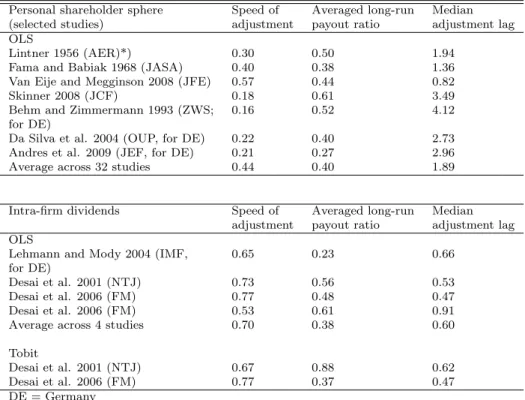
concerns cross-border intra-firm dividend payments. The former papers are further detailed into early studies, including the seminal work of Lintner, recent studies and studies dealing with German firms. We provide three measures to characterize the studies: the estimated long-run payout ratio (r), the speed of adjustment coefficient (d) and the median adjustment lag (δ). The latter shows the time period necessary to close the gap between the actual and the target dividend payment by 50 percent after a disequilibrating shock has occurred.3 Table (1) in the appendix shows the results derived.4
2.2.1 Public shareholder sphere
Lintner (1956) uses aggregate data from national accounts. He reports a speed of adjustment coefficient of 30 percent and a target payout ratio of 50 percent. The median adjustment lag is about two years. These results are only slightly altered in the study of Fama and Babiak (1968, p. 1134 Panel A), using firm-level data in order to better reflect the individual firm decision. Brittain (1964) provides another set of results by generalizing Lintner’s model via introducing depreciation allowances, personal income tax rates on dividends and other explanatory variables, based on aggregated data (38 annual observations 1920-1960, excluding 1936-38). The results of Brittain differ markedly from the average reported in Table (1), as the speed of adjustment is rather low (0.15) and the averaged long-run payout ratio is the highest of all studies surveyed (0.90).
Recent studies are those of Van Eije and Megginson (2008), who use Data-Stream and Worldscope firm-level data with a focus on European coun-tries and Skinner (2008), who uses data on US firms from Compustat. Van Eije and Megginson (2008) report a higher speed of adjustment coefficient and a target payout ratio comparable to that of the Lintner benchmark. Skinner (2008) reports a markedly lower speed of adjustment coefficient and thus a higher median adjustment lag (see Table (1)).
Studies based on German firm-level data are Behm and Zimmermann (1993), Da Silva et al. (2004) and Andres et al. (2009). Behm and Zimmer-mann (1993) use data on 32 major German firms between 1962 and 1988. While the speed of adjustment is much lower than Lintner’s, the averaged long-run payout ratio is almost equal. Da Silva et al. (2004) use data on 221 listed firms in Germany for the period 1984-93, for which at least five years of accounting data exist. They find a slightly lower speed of adjust-ment than Lintner (1956), but a similar payout ratio. Andres et al. (2009)
3
The median adjustment lag (δ) is calculated as (ln(0.5)/ln(1−d)) (see Pindyck and Rubinfeld, 1998).
4Most studies focus on the US and other highly developed OECD countries. With respect to other countries, for example Glen et al. (1995) found that the speed of adjust-ment lies between 40 percent in Zimbabwe and 90 percent in Turkey and the target payout ratios are between 30 and 40 percent. Adaoglu (2000) points out a speed of adjustment of 100 percent in Turkey with a payout ratio of 50 percent.
use data on 220 industrial and commercial firms in Germany. In particular, their finding points to a more flexible dividend policy as firms are willing to cut the dividend when profitability is only temporarily down. The re-sults of Andres et al. (2009) are consistent with a lower degree of dividend smoothing of German firms compared to firms from the US or the UK.
2.2.2 Cross-border intra-firm sphere
The Lintner model is also used to model cross-border intra-firm dividends. Two studies (Desai et al., 2001, 2006) are based on firm-level data (data on dividends repatriated from US affiliates abroad). A third study (Lehmann and Mody, 2004) uses data from current accounts and analyzes inter alia aggregate dividend payments from abroad to Germany. Compared to the results for dividends paid to public shareholders, the speed of adjustment coefficients of these studies are much higher, and therefore the median ad-justment lags are lower. Thus, these results imply that dividend smoothing is not as relevant in the cross-border intra-firm case as it is for the public shareholder sphere.5
Whereas Desai et al. (2001, 2006) report target payout ratios which are comparable to those reported for dividend payments to public shareholders, the target payout ratio derived by Lehmann and Mody (2004) is virtually zero. Hence, only the results derived by Desai et al. (2001, 2006) favor the validity of the Lintner model for the cross-border intra-firm dividend case.
Overall, the empirical studies reported in Table (1) are in favor of the Lintner model. However, smoothing seems to be much more important for the public shareholder sphere than for cross-border intra-firm dividend payments. Nevertheless, our summary of results also implies considerable heterogeneity between studies, especially concerning the speed of adjustment and hence the median adjustment lags.
It must be noted that the studies included in Table (1) are based on the linear OLS estimator. Yet, as dividend payments of an individual firm can-not be negative, the dependent variable is left censored. Using the OLS esti-mator forfirm-level data therefore probably leads to inconsistent estimates, as the conditional expectation of the model is non-linear in the parameters and the regressors (see Wooldridge, 2002, p. 525). Hence, an estimator for censored and corner-solution data, the Tobit estimator, is better suited for testing the Lintner hypothesis of dividend smoothing in these cases. Indeed, the study of Desai et al. (2001) also applies this estimator and finds a speed of adjustment coefficient of 0.67 / 0.77 and a target payout ratio of 0.88 / 0.37.
5Among the early papers applying the Lintner model in the cross-border intra-firm context is Scaperlanda and Mauer (1972). According to Hines and Hubbard (1990), Sca-perlanda and Mauer also find much higher speeds of adjustment than found in studies for payouts to public shareholders.
2.3 Relevance of the basic Lintner model for cross-border intra-firm dividend payments of German firms
2.3.1 Methodological considerations
As previously outlined, persistence in dividend payments is a crucial feature of the Lintner model. More specifically, the Lintner model postulates what can be called “true state dependence” in terms of Heckman (1981a, p. 91ff). Thus, the payment of dividends in year t0 has a genuine behavioral effect
on future dividend policy in the sense that an otherwise equal firm which does not pay a dividend in yeart0 will behave differently in the future. The
coefficient on the lagged dividend variable in the Lintner model is intended to isolate true state dependence and to signal the extent of dividend smoothing behavior of firms.
Yet, firms’ dividend policies also differ due to firm-specific, unobserved heterogeneity. In particular, for firm-specific reasons not related to the be-havioral smoothing effect postulated by Lintner, firms pay (or do not pay) dividends. In this case, past dividend payments have no effect on the prob-ability of paying dividends in the future (Baltagi, 2008, p. 217) and thus they are not part of an equation modelling dividend payments. Rather, the effect is captured by firm-specific time invariant effects.
Panel data allow us to include both a lagged dependent variable cap-turing the behavioral effect, as well as unobserved heterogeneity (i.e. firm-specific time invariant effects) in the same empirical model. Loudermilk (2007) stresses that unobserved affiliate-level heterogeneity is potentially important in explaining repatriated dividends. If one does not control for this unobserved heterogeneity - that is, by using a pooled estimator instead of a panel data estimator, the lagged dividend variable in the Lintner model acts as a proxy for such unobserved effects. An upward bias in the effect of the lagged dependent variable arises (see Hsiao, 2003, p. 218ff for examples). Improper treatment of unobserved heterogeneity gives rise to a relationship between past and future dividend payments which is “spurious” (“spurious state dependence”) in terms of Heckman (1981a). In this case a significant (and positive) effect of the lagged endogenous variable in the Lintner model may not be related to behavioral dividend smoothing as postulated by Lint-ner (1956). Thus, neglecting unobserved affiliate-level heterogeneity results in a biased estimate of the degree of dividend smoothing.6
6
So far, only a few empirical studies have attempted to examine the influence of mod-elling firm-specific, unobserved heterogeneity on the degree of smoothing behavior in the Lintner model. A notable exception is Loudermilk (2007). She examines the determi-nation of the share of payouts to firms’ shareholders made as share repurchases versus traditional cash dividends within the Lintner framework. In doing so, she explicitly mod-els the impact of unobserved heterogeneity on the coefficient of the lagged dependent variable. Moreover, dealing with firms’ dividend policies, Benito and Young (2003) also stress the importance of modelling unobserved heterogeneity. They analyze the incidence of dividend omissions and cuts as functions of financial characteristics including cash flow,
Several approaches are proposed in the literature to estimate dynamic non-linear panel data models with firm-specific unobserved heterogeneity. One crucial point therein is to cope with the “initial conditions problem”, which occurs when the first period for which we observe an outcome is not the beginning of the underlying stochastic process (Benito and Young, 2003, p. 542). However, presample information might determine the ob-served in-sample values of the endogenous variable. This issue is aggravated if the initial condition is correlated with the time invariant firm-specific ef-fects. Then, it is important to model the relationship of the initial condition (DIVit0) with the firm-specific time invariant effects (ci). A first approach
is to consider theDIVit0 as uncorrelated withci. Yet, this assumption
basi-cally implies thatDIVit0 is exogenously given and fixed, which might not be
the case. A second approach, which modelsDIVit0 as correlated with ci, is
to approximate, for example via a Probit model, the conditional distribution of DIVit0 given ci and the exogenous variables (Heckman, 1981b). A third
approach is to model ci as a function of DIVit0 and the exogenous
vari-ables (Wooldridge, 2005). The latter approach has the advantage of being applicable to corner-solution problems. Thus, in this study we apply this es-timator.7 Specifically, we estimate the following corner-solution model (see Wooldridge, 2002, p. 542f):8
DIVit=max(0, drP rof itit+ (1−d)DIVit−1+it) (3)
with: it =ci+ρt+ϑitandϑit≈N ormal(0, σϑ2), t = 1,. . . ,T. As mentioned,
the initial conditions problem is handled by specifying a distribution for ci
givenDIVit0and the exogenous variables. Thereby either the
“Chamberlain-approach” (Equation (4)) or the “Mundlak-“Chamberlain-approach” (Equation (5)) may be applied. The first approach models ci as a function of DIVit0 and of
all exogenous explanatory variables across all time periods. The second approach includes the time average of all exogenous explanatory variables together with DIVit0 (see Wooldridge, 2005; Wooldridge, 2002, p. 487).
c
DIVit0, P rof it;θ
=a+bDIVit0 +mP rof iti+αi (4)
withαi ≈N ormal(0, σα2).
c
DIVit0, P rof it;θ
=a+bDIVit0 +mpi.+αi (5)
withpi.= 1/TPTt=1P rof itit.
leverage, investment opportunities, investment and company size. 7
The approach of Heckman (1981b) is for binary endogenous variables.
8The definitions of variables included in Equation (3) are the same as those in section (2.1).
In both cases, coefficients of time-constant exogenous variables, like country dummies, are not identified if included in Equation (4) or Equa-tion (5) as well as in EquaEqua-tion (3) (Wooldridge, 2005, p. 44). SubstituEqua-tion ofci in Equation (3) by the right side of Equation (4) or Equation (5) gives
the corner-solution model which can be estimated by a standard random effects Tobit estimator. These estimates thus control for firm-specific un-observed effects and measure inter alia how within-firm changes in current earnings impact on dividends paid, given the level of lagged dividends paid (also see Chauvin and Kraay, 2007).
The Wooldridge (2005) estimator has the advantage of allowing the calculation of Average Partial Effects (APEs) from the estimated Tobit-coefficients. As argued by Wooldridge (2002) or Loudermilk (2007) in the case of corner-solution applications - such as, for example, the repatriation decision of foreign affiliates, the Tobit coefficient is not the parameter of in-terest.9 Rather, for an economic interpretation of the estimates one should derive APEs which are better suited for evaluating the economic importance of variables. In particular, APEs can be derived from the Tobit coefficients following the procedure given in Wooldridge (2005, p. 49f). For continuous variables, this results in summing the partial effect variable xl has on the
dependent variable over all cross-sections (see also Wooldridge, 2002, p. 523 and 541ff): AP El= N X i=1 φ(x 0β σ )βl (6)
with: φ being the cumulative normal distribution function, x0 being the matrix of regressors evaluated at the mean values,βbeing the vector of Tobit estimates and βl being the Tobit estimate for regressor l;σ= (σϑ2+σα2)1/2.
Note, that for the pooled Tobit estimator, which neglects the presence of ci, the APE is equal to the partial effect, i.e it is equal to ∆E(y)/∆xl
evaluated at a suitable (mean) value of xl (see Wooldridge, 2002, p. 24
and p. 530). Standard errors of the APEs can be derived using the “delta method” or a “bootstrapping approach” (Wooldridge, 2002, p. 495).
It should be noted that the Wooldridge estimator requires a balanced panel (Wooldridge, 2005, p. 42f; Poggi, 2007). Yet, as in the case of us-ing an unbalanced panel, applyus-ing a balanced sub-panel might lead to a selection bias of the estimates. A simple procedure to give an indication of the likelihood of a selection bias is to compare estimates derived from the balanced panel with those derived from the unbalanced panel. If different results are derived, this is an indication of the presence of selection bias
9
Corner solution problems where the mass point is due to maximization behavior have to be separated from censored data problems where the mass point is due to sampling. These two problems have different conditional expectations of interest (see Wooldridge, 2002, chapter 16).
(Verbeek, 2008, p. 178f).
To analyze the relevance of the Lintner model for dividend payments to German parent companies from their wholly-owned foreign affiliates we apply both the pooled Tobit estimator and the Wooldridge (2005) estimator for dynamic Tobit models. With respect to the latter estimator we generate a balanced panel of dividend payments in the years 1999 to 2005. Differences in the results concerning the effect of the lagged dependent variable using the pooled estimator and the Wooldridge estimator on the balanced estima-tor are an indication of the upward bias of the degree of dividend smoothing due to neglected, unobserved firm-specific heterogeneity. As already men-tioned, markedly different results between the pooled Tobit estimates for the balanced and the unbalanced panel would point towards the presence of sample selection problems.10
2.3.2 Dividend data
This study is based on the MiDi database made available by the Deutsche Bundesbank (e.g. Lipponer, 2008). Although the MiDi database does not di-rectly provide figures for dividends paid by affiliates abroad to their German parents, it provides sufficient information to allow the calculation of divi-dend payments according to the rules of the “Deutsches Handelsgesetzbuch” (HGB; German Code of Commercial Law). German parent companies have to deliver inter alia balance sheet data to the MiDi database according to HGB standards.11 The method of dividend calculation applied here there-fore follows HGB standards. Dividends repatriated in year t are proxied as follows12:
profit or loss for the financial year (after taxes and prior to profit distribution and offsetting of losses carried forward)13 in t [p32] + profit or loss carried forward from t-1 to t [p31]
10
All estimators are implemented using Stata version 10.0 (tobit and xttobit commands). Partial effects for the pooled Tobit estimator are derived using Stata 8.0 and the dtobit command.
11The form which is sent to the German parent firms includes the following state-ment: “The reported figures must be based on the balance sheet according to the rules of the country of residence of the affiliate, prior to the allocation of the net income. . . . Concerning the allocation of the balance sheet items in the form, the definitions and the classifications for the balance sheet of a German joint stock company have to be applied in an analogous way.” (Source: Anlage K3 zur AWV, Blatt 2; Vermoegen Gebi-etsansaessiger in fremden Wirtschaftsgebieten, Deutsche Bundesbank. Translated by the authors.)
12
The MiDi code is given in squared brackets.
13This variable represents the level of current year’s earnings after corporate income taxes and any tax-motivated profit shifting activities of MNEs.
+ withdrawal of capital reserves from t to t+1 [p29]
+ withdrawal of revenue reserves from t to t+1 [p30]
– addition to revenue reserves from t to t+1 [p30]
= profit / loss according to the balance sheet
– profits carried forward into t+1 [forward lag of p31]
= dividend payment in t
Due to the approximation of the repatriated dividends, several aspects have to be noted:
i) In the calculation of the dividend variable it is checked whether profits carried forward and profits according to balance sheet are larger than zero in order to avoid adding losses carried forward.
ii) Dividends are set to zero in three cases: (a) if profits according to balance sheet are zero or if balance sheet losses are given; (b) if losses are carried forward and (c) if the derived dividend is negative since the balance sheet profit is smaller than the profits carried forward but both values are positive.
iii) Outliers, defined as dividend payments larger or smaller than three standard deviations from the mean value, are dropped. The same outlier analysis is conducted for variable p32.
iv) The MiDi database provides balance sheet data converted into Euros. As we use data from balance sheets of different years (e.g. t and t+1) the issue of exchange rate stability arises. Balance sheet data in local currencies are not given in the MiDi database. Moreover, the application of the bilateral Euro exchange rate to convert the data into local currencies is complicated for several reasons: (a) different affiliates have different accounting dates so that the Euro exchange rate to be applied varies over affiliates within a particular host country and a given year; (b) as the balance sheet items are expressed in 1,000 Euros, they might be rounded values. Hence, a perfect replication of the balance sheet data in local currency would not be possible even if the “correct” Euro exchange rate were known; (c) a substantial share of affiliates report their balance sheet data to the Deutsche Bundesbank in different currencies in different years.14 Given these problems, a perfect transformation of the Euro data into local currencies is not
14
For example, the database contains affiliates which report their balance sheet state-ment denominated in the local currency of the host country in year t, in Deutschmarks in
possible. To cope with the exchange rate stability problem we calculate an average Euro exchange rate using the exchange rate data provided by the MiDi. The exchange rate used (F orexjt) is based on the average
over the exchange rates used by all affiliates which have their balance sheet statements denominated in the local currency of the host country in a given year. Thus, affiliates which use other currencies (usually the Deutschmark and the Euro) are not included in this average. We primarily use this variable to construct an additional control variable in the regressions. Yet, as a robustness check we also transform the data using this exchange rate before (to end up with data in local currencies) and after (to end up with data denominated in Euros again) the calculation of the dividend variable and estimate the model with these “converted” data.
v) To check the plausibility of the derived dividend data it is compared with the dividend data provided in the Deutsche Bundesbank’s DiKap database. The latter provides effective (positive) dividends received by a German parent aggregated over all its foreign affiliates in a partic-ular host country and a particpartic-ular year. The figures derived from the MiDi database for 2003, 2004 and 2005 are consistent with those given in the DiKap database. In particular, the reported average (positive) dividend payment the German parent companies included in our sam-ple receive from all of their foreign affiliates according to the DiKap database is (in Euro 1000) 4904.95 (2003), 4934.69 (2004) and 4283.21 (2005). The corresponding values derived from the Midi database are 3879.07 (2003), 3476.69 (2004) and 4399.65 (2005).15
We analyze repatriated profits from German affiliates abroad in the man-ufacturing sector. The reason for the exclusion of service sector industries is that the balance sheet data of these industries (e.g. holding companies, financial intermediaries) would inflate the balance sheet items. Yet, their parent companies may be active in any industry, whether it be manufactur-ing or services, i.e. they also comprise German holdmanufactur-ing companies. The host countries of German FDI considered are the EU-15 (without Germany), the new EU member states (NMS-12) and all non-EU OECD-countries exclud-ing Mexico, South Korea and, in the analysis in section 3, due to missexclud-ing tax data, Iceland and Turkey.
t+1 and in Euros in t+2. Transforming the Euro data using the exchange rate data given by the Midi database would result in using balance sheet items (e.g. p32) denominated in local currency of the host country and in Deutschmarks (e.g. forward lag of p31) in the calculation of the repatriated dividend in year t.
15
For the “converted” dividend data the DiKap values are (in Euro 1000) 4511.35, 4635.55 and 2923.92. The corresponding Midi values are 4121.09, 3467.66 and 3795.66.
Only those affiliates abroad which are wholly and directly owned by an incorporated German parent company (direct participation16) are included in the sample. This is for two reasons: First, to cope with agency prob-lems which might be reduced by using wholly owned affiliates (e.g. Da Silva et al., 2004) and, second, to have to model only one bilateral relationship (Germany and the respective host country of FDI). Thus, we neither model relationships between an affiliate and other affiliates of a common parent, nor between an affiliate and its several parent companies.17
The sample spans the time period from 1999 to 2005. These years have been chosen because data on capital reserves contained in the MiDi database are plausibility checked with the beginning of 1999 by the Deutsche Bundes-bank. 2005 is the most recent year in the MiDi database when the analysis has been undertaken. In the unbalanced panel, only those firms showing positive or zero dividend payments in at least three consecutive years have been included. This is done to avoid affiliates re-entering the sample after having disappeared from it. The balanced panel covers firms showing posi-tive or zero dividends in the seven consecuposi-tive years from 1999 to 2005.18
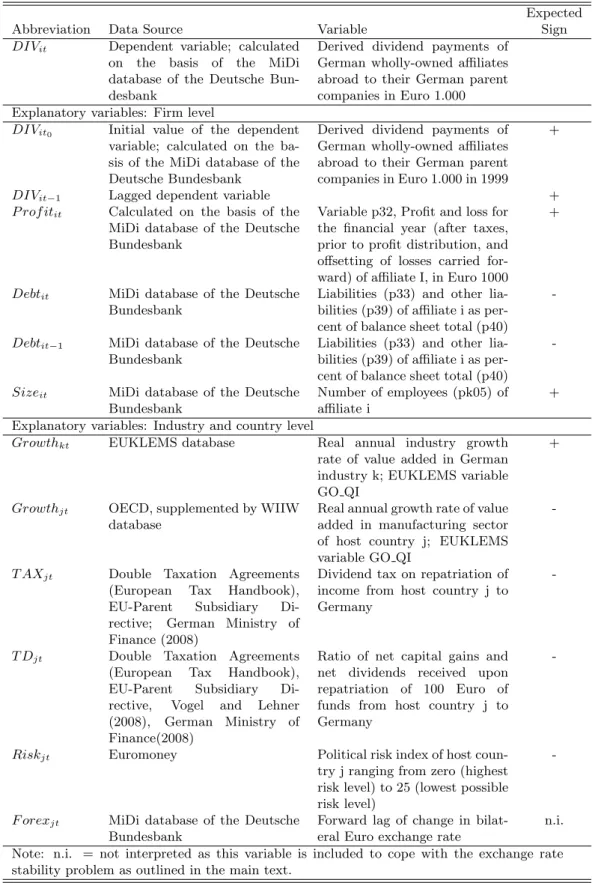
All affiliates included are legal entities. Yet, whether an affiliate is in-corporated cannot be ascertained from the MiDi database. It thus cannot be ruled out that the affiliates abroad may also include partnerships and private companies, but according to information provided by the Deutsche Bundesbank these are only exceptional cases. Hence, the vast majority of affiliates is incorporated. Moreover, only affiliates with a balance sheet total of at least 3 mn Euro are included to cope with changes in the balance sheet threshold over time. To sum up, definitions and sources of our variables used in the empirical analysis are given in Table (2) in the appendix.
16
Lipponer (2008, FN 5 and 6): “In the case of German foreign direct investment, it is the resident investors which are subject to reporting requirements (. . . ). Affiliated investors are those which have come together specifically to establish the investment en-terprise, which pursue economic interests jointly by holding participating interests in one or more enterprises or who are closely related to each other (direct related by blood or marriage) or are connected with each other as defined in section 15 of the Companies Act (Aktiengesetz).” A direct investment enterprise is classed as “dependent if the Investor holds more than 50% of the shares or voting rights. If a “dependent” enterprise holds a 100% participating interest in another enterprise than this enterprise and any additional enterprise fulfilling the condition of a 100% participating interest are also regarded as “dependent”.”
17
The effects dividend taxes have on indirect participating interests are analyzed by Weichenrieder and Mintz (2008).
18
In the sample used in the present study, 85 percent of affiliates have been included in the MiDi database since 1996 and thus the dividend generation process started well before 1999, the first year of observation.
2.3.3 Descriptive evidence on firm-level data
Table (3) in the appendix shows descriptive evidence on the firm-level data taken from the MiDi database. The distinction between dividend payers and non-payers (about 47 percent of our sample) clearly reveals similarities with regard to the size of affiliates and FDI stock, but also marked differences with regard to indebtedness, current earnings and profits according to the balance sheet. In particular, profits according to the balance sheet are negative for non-payers. The mean dividend paid is 1.2 mn (overall) and 2.7 mn (payers) Euro. For the “converted” dividend variable the means are 1.1 mn and 2.3 mn, respectively.
2.3.4 Econometric results for the basic Lintner model
The results for the basic Lintner model are presented in Table (4) of the appendix. These results intend to show whether the Lintner model can be applied to the research problem at hand. Part one of Table (4) shows the results for the pooled Tobit estimator (balanced panel). Short-run Tobit coefficients as well as short-run APEs are given. This estimator does not model the panel structure and thus might lead to an upward bias in the degree of state dependence (dividend smoothing) as outlined in (2.3.1). The statistically highly significant coefficient of the lagged dependent variable, the corresponding speed of adjustment coefficient and the target payout ratio are 0.50 (APE of 0.20), 0.50 (0.80) and 0.52 (0.13), respectively. These results imply that the gap between actual and target payout ratio is reduced by 50 percent after 1 (0.43) year(s).
Part two of Table (4) shows the results derived applying the Wooldridge-estimator (Chamberlain-approach). Modelling unobserved firm heterogene-ity in dividend payments indeed leads to a drop in the coefficient on the lagged dependent variable and of the APE to 0.11 and 0.04, respectively. Accordingly, the speed of adjustment coefficient increases to 0.89 (APE of 0.96) and the median lag decreases to 0.31 (0.22) years. The target payout ratio falls and is about 0.31 (0.12).
Part three of the Table shows the results using the Mundlak-approach. Applying this approach does not alter the results. Finally, the impact of using a balanced panel is analyzed in the model shown in the final column, which is based on the pooled Tobit estimator and the unbalanced panel in which affiliates that are in the sample for at least three consecutive years from 1999 to 2005 are included. The coefficients are similar to those shown in part one (balanced panel). This suggests that sample selection problems are of minor importance here.
Hence, these results imply that once we have controlled for unobserved time-invariant firm-specific time invariant effects dividend smoothing is less an issue for German multinational firms’ dividend policy. The effects of
disequilibrating shocks are absorbed rather quickly. However, one has to bear in mind that the coefficient on the initial condition (DIVit0) is positive
and highly statistically significant. Thus, firms paying higher dividends at the beginning of the sample period also have higher expected dividend pay-ments. This represents an additional channel of inertia in dividends paid. Most importantly however, the results imply that the Lintner model seems to be valid for analyzing cross-border intra-firm dividend payments. Yet, com-pared to studies analyzing the public shareholder sphere, the target-payout ratio is lower and the speed of adjustment is higher. From a more sub-stantive perspective these differences are in line with the view that, for the parent-subsidiary sphere, dividend payments are less relevant for signalling and controlling (agency) aims. Other instruments like detailed informa-tion on balance sheet posiinforma-tions or internal reporting systems and incentive schemes (e.g. internal job promotion) are available to parent companies to monitor and influence the performance and the behavior of their affiliates’ managers. Dividend smoothing and target payout ratios should be lower for cross-border intra-firm dividend decisions.
3
Do taxes have an impact on the amount of
div-idends repatriated?
After having established that the Lintner model is applicable for the cross-border intra-firm case, the model has to be augmented to capture the effect additional variables exert upon dividend payments. However, before the augmented Lintner model is presented and the various variables used in the estimation are introduced, a brief summary of related literature on the impact dividend taxes exert on dividend payments is given.
3.1 Dividend taxes and intra-firm dividend payments - Sur-vey of the empirical literature
Literature on the impact of dividend taxes on dividend remittances with a focus on German MNEs is scarce. The use of holding companies and owner-ship chains of German companies’ outward FDI, i.e. indirect participating interests (Lipponer, 2008) including partial ownership, has recently been ex-plored by Weichenrieder and Mintz (2008). Ownership chains areinter alia
used for the “routing” of dividends across third countries in order to lower the tax burden. The findings of Weichenrieder and Mintz (2008) show the importance of withholding taxes as a determinant for the design of own-ership chains of German MNEs. Weichenrieder and Mintz (2008) further argue that the gains from using holdings and ownership chains may be ex-pected to be larger for profitable firms that pay large dividends. Thus, one may expect holding companies to be usually used by firms with large profits,
as gains in the form of avoided dividend taxes are high. Thus, establishing a tax effect on dividend payments, even in the case of holding companies excluded from the analysis, as we have done in this study, would emphasize the importance of withholding taxes for repatriation decisions. Hence, this study presents evidence complementary to that given in Weichenrieder and Mintz (2008). Note that Weichenrieder and Mintz also base their analysis on the MiDi database. However, they do not directly model dividends as a function of dividend taxes.
Although not explicitly referring to the Lintner model, some empirical literature which aims to determine the sensitivity of dividend repatriations to tax costs emerged in the US. This literature increasingly focusses on alternatives to dividend repatriations19, which “is a costly alternative from a tax perspective” (Altshuler and Grubert, 2002, p. 74). The standard model employed by these studies can be summarized as20:
DIVi =γ0+γ1T axi+γ2Yi+γ3Zi+γ4Xi+ξi (7)
with: DIVi = dividend payment of foreign affiliate i to its US parent,T axi
= tax on dividend payments, Yi = affiliate’s after tax income; Zi = vector
of other affiliate characteristics,Xi = vector of the characteristics of the US
parent, ξi = error term.
Hines and Hubbard (1990) use US aggregate time series data on repatria-tions from 1962 to 1982 as well as micro-data from 1984, the former allowing a differentiation between various repatriation channels (interest paid to the parent to service debt capital contributions and royalty payments). For div-idend payers who are in a deficit credit position, the tax on divdiv-idends has a negative effect on distribution. The payout ratio increases by 0.16 percent-age points upon a one percentpercent-age point decrease of the tax variable. Using a Tobit specification, Altshuler and Newlon (1993) again find a negative and significant impact of the dividend tax on affiliates’ dividend remittances. Also, higher affiliate net profits increase dividend payments. Evaluated at the mean, the coefficient on the tax variable indicates that an increase in the tax rate by one percentage point decreases the dividend payout ratio by 0.054 percentage points, which translates into approximately a 1.5 percent decrease in dividend payments. (ibidem, p. 108)
From the mid-1990s onwards, a series of closely linked papers emerged. Altshuler et al. (1995a,b) show that the permanent components of tax costs do not affect dividend payments, while transitory components do. This result is in line with the “new view of dividend taxation”. They also estimate a Lintner-like model. Based on this model they find that a reduction in the tax rate implies an increase in the overall payout ratio (Altshuler et al.,
19E.g., royalties and share repurchases (see Grubert, 1998; Skinner, 2008). 20
Note, as most of these studies use cross-sectional data we use the subscript i (affiliate i) instead of it.
1995b, p. 265).
Grubert (1998) challenges these findings and argues that the results are due to the omission of alternatives to profit repatriation. Distinguishing various alternatives to dividends, his findings suggest that dividends and other repatriation taxes significantly alter the composition of payments of an affiliate to its US parent. In particular, the “tax price of dividend repa-triation discourages dividends, but they do not increase retained earnings.” (ibidem, p. 284) Moreover, including all dividend payments by foreign af-filiates, i.e. not only those paid to their US parents, suggests that even in countries applying an exemption system (e.g. Germany), the withholding tax rate enters statistically significant in his model.
Altshuler and Grubert (2002) add yet other alternatives to dividend repatriation. Including certain types of triangular relationships, which are important in the US case, they find that “the coefficient for the local with-holding tax on dividends is negative, as expected, and highly significant.” (p. 103)
Following the large and temporary tax cut on dividend income by the US Jobs and Growth Tax Relief Reconciliation Act of 200321, Chetty and Saez (2005) examine the effects of dividend taxation on payout policies. They conclude that the rise in regular dividend payments . . . offers perhaps the clearest evidence thus far in the literature that tax policy does matter for dividend payout policies.” (p. 828)
In a further study on the effects of the temporary dividend tax cut of the US Jobs Growth Act of 2003, Brown et al. (2007), conclude that firms respond to the tax cut, as the likelihood of a dividend increase following the tax cut is much higher than prior to 2003.22
An analysis of the effect of repatriation taxes on dividend payments of US affiliates abroad to their US parents based on the Lintner model is conducted by Desai et al. (2001). They find that a one percent change in the dividend tax rate also changes the volume of dividends repatriated by about one percent. Desai et al. (2001, p. 849) conclude that repatriation taxes “reduce the volume and efficiency of financial flows between affiliates and their American parents.” These results are confirmed in Desai et al. (2006).
To summarize, the available empirical evidence implies that dividend taxes do matter for cross-border intra-firm dividend payments. Yet, this result is predominantly established for countries applying the credit system in international taxation.
21
The US Jobs Growth Act creates a temporary tax holiday that reduces the US tax rate on repatriations from foreign subsidiaries from 35 percent to 5.25 percent (see Blouin and Krull, 2008).
22
See Blouin and Krull (2008) for details on the characteristics of firms which repatriate under the US Jobs Growth Act.
3.2 An augmented Lintner model
To analyze the impact taxes and other variables exert on dividend payments the Lintner model is augmented as follows (see, e.g. Khan, 2006, for a similar approach):
∆DIVit=d(DIVit∗−DIVit−1) +it1 (8)
with:
DIVit∗=rP rof itit+zT axjt+wMit+sNjt+hFkt (9)
Substituting and rearranging gives
DIVit=drP rof itit+dzT axjt+d(wMit+sNjt+hFkt) + (1−d)DIVit−1+it
(10) with: it=ci+ρt+ϑit. Thereby,Mit,Njt andFktare matrices of variables
capturing additionally relevant determinants of dividends varying over affili-ates (i), host countries (j) or German industries (k). The long- and short-run impacts of taxes on dividends are given in Equation (9) and Equation (10), respectively (z and dz).
3.3 Taxes and additional determinants of dividends
3.3.1 Taxes
In the case of cross-border dividend payments, the relevant dividend tax rate is not only determined by any withholding tax rates levied by host coun-tries of FDI on dividends. In addition, one must consider rules contained in double taxation agreements (DTAs) as well as any unilaterally binding tax laws. Germany has signed DTAs with all host countries included in our analysis. Thus, the withholding tax rates on dividends as given in the DTAs are relevant. Germany applies the exemption method in international taxa-tion, implying that dividends repatriated are not further taxed in Germany. Yet, due to stipulations concerning the deductibility of operating costs this exemption is provided only for 95 percent of the dividends repatriated since 1999.23 Five percent of repatriated dividends are taxed by the German
cor-porate income tax rate (including local business tax rates and the solidarity
23Art. 8b/7 of the German Koerperschaftssteuergesetz (German corporate income tax law) is introduced via the “Steuerentlastungsgesetz 1999/2000/2002” (March 1999). Orig-inally Art. 8b/7 stipulates that 15 percent of a foreign dividend are effectively taxed due to stipulations concerning deductibility of operating costs. As these 15 percent were against the EU Parent Subsidiary Directive this rate was reduced later in 1999 via the “Steuerbereinigungsgesetz” (Dezember 1999) to 5 percent. In the current German Koer-perschaftssteuergesetz the stipulations contained in Art. 8b/7 reappeared in Art. 8/5 and also had a broader focus (from 2002 onwards). Thus, the 95 percent exemption has been applied in Germany since 1999 (see e.g. German Ministry of Finance, 2008; Leis, 2004; KPMG, 2007).
surcharge). Moreover, for EU host countries of German FDI, the Parent-Subsidiary-Directive (PSD) applies. The latterinter aliastipulates that the withholding tax rates on dividends be set to zero. Yet, only 14 countries applied the PSD throughout the whole sample period (the old EU-member countries), ten countries have applied it from 2004 onwards (the NMS which joined the EU in 2004) and two EU-member states (Bulgaria and Romania) have applied the PSD from 2007 onwards. Thus, the applied dividend tax rate and its variability over time and host countries, respectively, depend on (i) the host country (EU member country or third country), (ii) the with-holding tax rate according to the DTA and (iii) the German overall tax rate on corporate income. The dividend tax rate (T axjt, in percent) which is
used in the empirical analysis is calculated as:
T axjt =τjt∗100 + (100−τjt∗100)∗0.05∗τDE,t (11)
with: τj = withholding tax rate on dividends of host country j according to
DTA (proportion);τj is zero if PSD applies;τDE = overall corporate income
tax rate of Germany (proportion); 0.05 is due to 95 percent exemption, 100 = assumed gross return of Euro 100 distributed as dividend.24
Dividends are only one means of transferring funds from the subsidiary to the parent. Another means is share repurchases by the affiliate which are subject to capital gains taxes. Thus, dividend repatriation policy might also depend on the taxation of share repurchases made by the affiliate. It is likely that dividend payments decrease if the taxation of capital gains is reduced. To capture the influence of share repurchases on dividend policy, we follow Poterba (2004) and apply a “tax discrimination factor” (T Djt) in
our analysis. T Djt measures the net or post-capital gains tax return from
share repurchases in percent of the net or after dividend tax rate dividend payment (having an equal gross return of Euro 100). With respect to capital gains taxes, one has to bear in mind that most of the DTAs signed by Germany preclude a withholding tax on capital gains at source (according to the Art 13/5 of the OECD-DTA convention; Vogel and Lehner, 1996, 2003, 2008). Moreover, those host countries which have not included Art. 13/5 in their DTA with Germany (i.e. Australia, Czech Republic, Bulgaria, Cyprus, Slovak Republic, New Zealand and Norway) also do not levy capital gains taxes on shares repurchased. Thus, capital gains realized through share repurchases are not taxed at source. Furthermore, Germany applies the exemption method in case of capital gains. Yet, as in the case for dividends, only 95 percent of capital gains received have effectively been exempted since 2004 due to stipulations concerning the deductibility of operating costs (see German Ministry of Finance, 2008). Thus, for the period until 2004 T Djt
is calculated as:
24For example,T ax
jt for j being an old EU member country and t being 2005 is 0 + (100 - 0)*0.05*0.386 = 1.93 percent.
T Djt = (
1
(1−τjt)∗(1−0.05∗τDE,t)
)∗100 (12)
For the years 2004 and 2005 T Djt is calculated as:
T Djt = (
(1−0.05∗τDE,t)
((1−τjt)∗(1−0.05∗τDE,t))
)∗100 (13)
with: τj = withholding tax rate on dividends of host country j according to
DTA (proportion);τj is zero if PSD applies;τDE = overall corporate income
tax rate of Germany (proportion); 0.05 is due to 95 percent exemption25.
We expect that a higher T axjt reduces the expected value of dividends
repatriated, as the Euro value of one unit dividend repatriated is reduced. Thus, a negative sign of the short- and long-run tax coefficient is expected. Furthermore, as an increase inT Djt implies that transferring funds by share
repurchases is relatively cheaper (in terms of tax burden borne), a negatively signed coefficient ofT Djt is expected, too.
3.3.2 Other determinants of dividends
Besides the Lintner-type variables, (DIVi,t−1,P rof itit) and the initial
divi-dend payment (DIVit0) we include several variables that have been shown as
important determinants of repatriation policies in theoretical and empirical papers.
A first group of determinants of dividends contained in theMit,Njt and
Fkt matrices in Equation (10) relates to liquidity of the affiliate. Internal
and external debt plays a role here: Firms with greater debt ratios and likely higher claims from interest expense on their earnings are less likely to pay dividends (Brown et al., 2007, p. 19). Higher debt constrains liquidity and the tight liquidity position of affiliates should then have a negative impact on the ability and willingness to pay out dividends. Therefore, we use a firm-specific debt indicator (debtit) of long- and short-run company debt in
the empirical analysis. Note, as an affiliate’s debt might be simultaneously determined with dividends paid, the one-year lagged debt variable is used. A negatively signed coefficient is expected.
Note, that debt financing of affiliates might also be used as a device to control the affiliates. Higher debt may reduce agency problems between the parent company and the affiliate in a similar way to dividend payouts (e.g. Brown et al., 2007, footnote 14). This agency argument is also related to a country’s risk level, as it is usually maintained that an affiliate in a culturally or institutionally distant and/or politically risky country would present a
25
For example,T axjt for j being an old EU member country and t being 2005 is 100∗ (1−0.05∗0.386)/(100∗(1−0)∗(1−0.05∗0.386))∗100 = 100 asτj is zero due to the PSD and the 95 percent exemption applies to foreign dividends and foreign capital gains in 2005.
greater agency risk to the parent. Therefore the parent would desire a higher degree of control of the affiliate’s investment behavior. “Under such conditions, the parent might require higher intra-firm dividend payments [...] than it requires from its other affiliates in less risky or more familiar markets.” (Lundan, 2006, p. 57) This argument is confirmed, for example, by evidence presented in Lehmann and Mody (2004), who find on the basis of aggregate data that the payout ratio appears to be lower for less risky countries. Moreover, Altshuler and Newlon (1993, p. 107) mention that country risk factors may explain the positive country effects on dividend remittances for certain countries. Thus, we include a proxy for the level of a host country’s political risk (Riskjt) in the augmented Lintner model.
As the level of risk decreases with an increase in the value of Riskjt, a
negatively signed coefficient is expected.26 Note that it is conceivable that affiliates which are partially owned pay higher dividends than wholly-owned firms, as local influence is possibly higher in the former (e.g. Desai et al., 2006). To cope with this channel of agency problems, only wholly-owned affiliates are used in the empirical analysis.
Another group of determinants focusses on investment and growth op-portunities either in the host or the home country, and is also related to the liquidity issues discussed above. On the one hand foreign affiliates with attractive investment opportunities may finance their new capital expendi-turesinter aliaby reducing or omitting dividends to their parent companies. The host country real growth rate (Growthjt) is used to proxy for growth
opportunities of the affiliate. Since we include only manufacturing affili-ates in our analysis, we use the aggregate growth rate of the manufacturing sector of each host country of German affiliates. We expect a negative relationship with dividends. On the other hand repatriated dividends may increase if growth opportunities in the home country (Germany) are soaring. Industry-level real growth rates (Growthkt) are used to capture investment
opportunities in Germany.
The size of the affiliate (Sizeit) is considered as another firm-specific
factor determining the expected dividend repatriated. In their empirical study on UK repatriation, Bond et al. (2005) find that “larger firms tend to have higher dividend payout ratios” (p. 60; also see Benito and Young, 2003). This might be due to the higher market power of larger firms which could ceteris paribus translate into higher dividend payouts. Furthermore, the size variable may capture the age of the firm, as older firms are larger and are expected to pay higher dividends due to lower growth opportunities and larger retained earnings. In a similar vein, Brown et al. (2007) include firm size among the set of covariates in their study of the effect of executive
26
Desai et al. (2004, p. 2467) maintain that affiliates located in a high risk country should be financed more by local indebtedness and thus lower dividends should follow. Yet, given the level of debt - as implied by theceteris paribuscondition in an econometric analysis - a higher country risk should lead to higher dividends.
stock ownership on dividend payouts, yet no results are displayed on this variable.27
Table (2) in the appendix also includes the details of the variables used in the subsequent empirical estimation and Table (5) also displayed in the appendix shows the descriptive evidence for the additional control variables used.
3.4 Econometric results for the augmented Lintner model
Applying the Tobit estimator proposed by Wooldridge (2005) leads to the results displayed in Table (6) given in the appendix to the paper. In the second (based on the Chamberlain-approach; model 1) and the third (based on the Mundlak-approach; model 2) column results for the full model, in-cluding all variables discussed above, are given. As the results are robust with respect to the approach used to model affiliate-specific effects, the re-maining models contained in Table (6) are based on the computationally simpler Mundlak-approach. Models 3 to 5 differ from model 2 by excluding insignificant control variables one at a time. Model 6 is our “preferred” model in the sense that it contains only statistically significant variables. Finally, in model 7 the dividend tax rate (T axjt) is substituted by the tax
discrimination factor,T Djt, which incorporates the taxation of capital gains.
Models 2 to 6 of Table (6) reveal that dividend taxes indeed impact neg-atively on the expected value of the repatriated dividends from wholly and directly owned foreign affiliates. This is also the case ifT axjt is substituted
by the tax discrimination factor (model 7). An increase in T Djt, which
might arise either if the capital gains tax rate decreases or the dividend tax rate increases (ceteris paribus), leads to a fall in expected dividends repa-triated. Thus, using T Djt reinforces the results derived by applying the
dividend tax rate.
Concerning the control variables included, the Lintner-type variables (lagged dividend and current year’s earnings) and the initial dividend pay-ment as well as an affiliate’s size and indebtedness enter statistically sig-nificant. The proxies capturing the growth opportunities as well as a host country’s political risk level fall short of statistical significance. Due to the relatively high level of political stability in the host countries included, the insignificance of Riskjt is not unexpected. Moreover, the insignificance of
Growthktmight be an indication for the rather poor growth performance of
Germany over the majority of years considered in the analysis. The insignif-icance of Growthjt is somewhat unexpected. It might be an indication of
the location of many German affiliates in countries where growth is rather sluggish during the sample period. Moreover, the inclusion of a full set of
27Note that most of the models estimated also includeF orex
jt as defined above as an additional variable in theNjt matrix.
time dummies might partly capture the effect of both variables, Growthjt
and Growthkt.
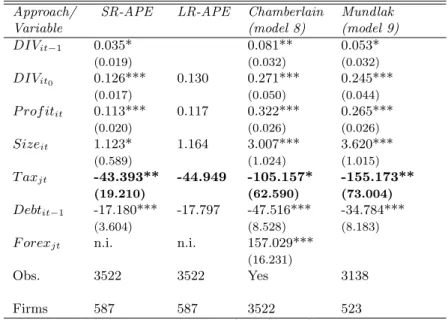
Table (6) gives an impression which variables impact significantly (pos-itively or negatively) on repatriated dividends. Yet, in order to derive the economic effects of these variables, APEs are more useful than Tobit co-efficients. The second and third column of Table (7) show the short- und long-run APEs derived based on model 6 of Table (6).
Using the short-run APEs shown in column two of Table 7 implies that a one percentage point decrease in the dividend tax rate increases the con-ditional expectation of dividend payments by about 43 thsd. Euro. This result implies that, if Germany would abandon the taxation of 5 percent of dividends repatriated which leads to a decrease of the dividend tax rate from about 2 percent to zero for EU member host countries, dividends repa-triated by foreign affiliates in these countries would increase by about 86 thsd. Euro.
Evaluating the effect of a one percentage point decrease in the dividend tax rate at the overall mean value of dividends repatriated by affiliates (1.2 mn Euro) implies a semi-elasticity of dividends with respect to the dividend tax rate of about -3.5 (calculated as -43/1215*100). In the long-run the effect increases slightly to about 45 thsd. Euro (cf. column three of Table 7) or a semi-elasticity of about -3.7. If the mean of positive dividend payments (2.7 mn Euro) is used the semi-elasticities derived are -1.6 and -1.7, respectively.
3.5 Robustness checks
The remaining columns of Table (7) (models 8 and 9) include further robust-ness checks. Model 8 gives estimates for the preferred model 6 being esti-mated using the Chamberlain-approach rather than the Mundlak-approach. Again, the results are robust with respect to the way affiliate-specific effects are modelled. Model 9 shows that the substantive results already contained in model 6 of Table (6) do not change if we use “converted” balance sheet data to derive the dividend variable instead of usingF orexjtas an additional
control variable. The estimated tax effect remains statistically significant and it increases (in absolute value) from -117 (model 6) to -155 (model 9). Finally, note that the coefficients of the Lintner-type variables as well as the coefficient of the initial dividend payment are also in this case in line with the results displayed in Table (4).
4
Summary
The aim of this study is to explore whether dividend tax rates have a statis-tically and economically relevant impact on the expected value of dividend repatriated from foreign wholly-owned manufacturing affiliates to their Ger-man parent company over the 1999-2005 period. The study is based on