P R E S E N T A T I O N
International Conference On
Software Testing, Analysis & Review
DEC 4-8, 2000 • COPENHAGEN, DENMARK
Presentation
Bio
Return to Main Menu
T3
Thursday, Dec 7, 2000
Software Testing Standards:
Stuart Reid
Paper
Do They Know What
They’re Talking About?
Software Testing
Standards
- do they know what they’re talking
about?
Overview
• Putting software testing in context
• A generic software test model
• Integrity levels and risk-based testing
• Application-specific standards
• A framework for software testing standards
• Conclusion and personal comments
What use are standards?
• Consumers
– Confidence in compliant products
– Authors provide expertise in standards
• Best practice vs. Good practice
• Manufacturers
– Compliance and Marketing
– Safety from liability
Process Context
Systems Engineering – ISO 15288
Software Engineering
Software Verification and
Validation
Software Testing
– ISO 12207
– IEEE 1012
BS 7925-2
IEEE 1008
ISO 12207 Processes
DEVELOPMENT
MAINTENANCE
OPERATION
SUPPLY
ACQUISITION
CONFIGURATION
MANAGEMENT
QUALITY
ASSURANCE
DOCUMENTATION
VERIFICATION
VALIDATION
JOINT REVIEW
AUDIT
PROBLEM
RESOLUTION
INFRASTRUCTURE
MANAGEMENT
IMPROVEMENT
TRAINING
DEVELOPMENT
VALIDATION
VERIFICATION
Systems Eng. Process Improvement
Process Improvement Context
Software Eng. Process Improvement
Software Testing
Process Improvement
– SE CMM
ISO 15504 / SW CMM
Quality Management and Assurance – ISO 9000
Quality Context
Software Quality Assurance – IEEE 730
Software Verification and
Validation – IEEE 1012
English, Swedish, etc. – Oxford English Dictionary
Terminology Context
Computing – IEEE 610
Software Engineering
IEEE 610.12
Software Testing
BS 7925-1
Software Test Model
ORGANISATION
TEST PROCESS IMPROVEMENT
TES
T
TERM
INOLOG
Y
TEST POLICY
TEST STRATEGY
TES
T
DO
CUMENTATION
INCIDENT MANAGEMENT
PROJECT TEST PLAN
PROJECT
PHASE
TEST PROCESS
PHASE TEST PLAN
ISO 12207/ISO 9001/IEEE 730
IEEE 1012/ISO 9000-3
ISO 15026
IEEE 1012
ISO 9000-3
ISO 15026
IEEE 829
TMM/TPI
IEEE 1044
BS 7925-2
IEEE 1008
ISO 15026
BS 7925-2
ISO 15026
BS 7925-1
IEEE 610.12
BS 7925-2
BS 7925-2
IEEE 1044
IEEE 1028
ISO 15026
(IEC 300-3-9)
Software Test Process
CHECK
COMPLETION
CHECK
AND
REPORT
TEST
EXECUTION
TEST
PLAN
TEST
SPECIFICATION
INCIDENT
MANAGEMENT
TEST COVERAGE
MEASURES
TEST CASE
DESIGN
INTEGRITY
LEVELS
(RISK ANALYSIS)
REVIEWS
REVIEWS
Integrity Levels
• Initially restricted to safety-related, application-specific
standards, e.g. avionics, automotive, defence
• The Software Integrity Level (SIL) is based on a risk
analysis
• Allows a single standard to define a hierarchy of levels
of testing (and development)
• Systems are normally partitioned into subsystems for
determining software integrity levels
Assignment of Integrity Levels
SIL 1
SIL 3
SIL 4
SIL 2
SIL 3
system data
Assign Integrity
integrity
levels
system
risks
Risk Analysis
IEC 60300-3-9
Example of the application
of Integrity Levels
technique 1
measure a
technique 2
measure b
techniques 1+2
measures a+b
techniques 2+3
measures b+c
SIL 1
SIL 2
SIL 3
SIL 4
Really
Interesting
Software
Testing
Standard
(requires
software
integrity level)
Pervasive Integrity Levels
• SILs need not be based on safety – may be economic
• An economic risk to a financial system may be
considered just as
important
as a safety risk to a vehicle
system
• Now there are ‘generic’ standards based on integrity
levels
– V&V - IEEE 1012-1998
– S/W Dev’t - IEC 61508-1998 (but still safety-related)
• Work required on matching test techniques and
completion criteria with integrity levels
• Ideally generic test standards, based on integrity levels,
will be applicable to the testing of ALL types of software
Application-Specific Standards
• Nearly all are safety-related
• Many, more recent standards use integrity levels
• BUT - why
application
-specific?
– there is no evidence that test techniques are application-specific
– danger of:
• duplicated effort
• ‘amateur’ testing standards
• Some application-specific standards have become
generic e.g. ESA Software Development Standards
• Restrict application-specific standards work to identifying
special risks/integrity levels
Current Framework Problems
• Too much duplication in application-specific
standards
• Poor coverage of test phases – only the unit or
component test phase is covered
• Techniques and measures are only defined in
terms of component testing
• The testing vocabulary standard is biased
toward component testing
A New Framework
risk criteria
Application-Specific
Standards
Application-Specific
Standards
Application-Specific
Standards
test criteria
Testing Phase
Standards
phases
re
fe
renc
e
re
fe
renc
e
integrity levels
integrity levels
Testing Terms Vocabulary
Testing
Techniques
& Measures
Standard
Application-Specific
Standards
Integrity Levels
Standard
test techniques
re
fe
renc
e
V & V
Standard
Testing Phase
Standards
Testing Phase
Standards
Testing Phase
Standards
Conclusions
• There are now several useful standards, e.g. IEEE 1012,
BS 7925-2 – so try them
• Any new framework must encompass all application
areas – not just safety-related
• Test standards effort needs to be increased and targeted
– create test phase standards (except unit/component)
– create a single test techniques standard for all phases
– match appropriate testing with integrity levels
– stop application-specific test standards work
• Any questions?
1
SOFTWARE TESTING STANDARDS
- do they know what they’re talking about?
STUART C. REID
Cranfield University
Royal Military College of Science,
Swindon, Wilts SN6 8LA, UK
Email: [email protected]
Abstract
This paper considers how standards can be used in software testing. Two views are used to identify relevant standards. First, those higher level standards that require software testing to be performed as part of a larger process are considered, and then a generic software testing model is presented and standards identified that support the activities within it. The concept of integrity levels and their use in testing standards is introduced and the usefulness of application-specific standards is considered and rejected. Finally a new framework of standards to support software testing is proposed.
1 INTRODUCTION
What use are standards to you? First, we must qualify the question as there is a consumer viewpoint and a producer viewpoint. As a consumer, standards affect our everyday lives and are generally considered a good thing. For instance, a standard that governs the quality of pushchairs generally meets with public approval as it is presumably safeguarding our children. As such, the standard acts as a form of guarantee to the consumer that the product is of a certain quality. The vast majority of consumers have no idea what a pushchair standard might contain, but trust the authors to know what they are writing about. Initially we might expect the standard to contain requirements that make a pushchair as safe as possible (so using best practice), but after a moment’s reflection we will probably modify our view to expect a reasonable balance between safety and cost (good practice). After all, we don’t want to make the price prohibitive. So, to the consumer, standards are generally useful, their authors providing the expertise to a transaction that would otherwise be lacking.
Now, what about the producer of pushchairs? They have a different perspective. Manufacturers benefit from complying with the standard as they are then presumably making ‘good enough’ pushchairs. They thereby avoid the dual pitfalls of bad publicity and legal liability from selling ‘unsafe’ pushchairs. Following the marketing theme, then if the pushchair standard was not mandatory, then those manufacturers complying with it would be able to use their compliance to market their products favourably compared with non-compliant competitors. Consider, finally, the manufacturer new to pushchairs. The existence of a standard detailing good practice in pushchair manufacture means that they do not have to start from scratch, but can build on the experience of the standard's authors.
Unhappily, there is no single software testing standard in the way that a single pushchair standard has been assumed here. Consumers of software testing services cannot simply look for the ‘kite-mark’ and testers have no single source of good practice. As will be shown, there are many standards that touch upon software testing, but
2
many of these standards overlap and contain what appear to be contradictory requirements. Perhaps worse, there are large gaps in the coverage of software testing by standards, such as integration testing, where no useful standard exists at all. Where standards related to software testing do exist this paper attempts to show which ones are best, for both building up confidence between supplier and consumer, and providing information on good practice to the new or inexperienced tester.
2
STANDARDS AND ACRONYMS
A large number of standards are mentioned in this paper, normally by reference to the originating standards body and standard number only, such as “BS 7925-1”. This list gives the name for each of them, along with any acronyms used.
BS British Standard
BS 7925-1 Software Testing Vocabulary
BS 7925-2 Software Component Testing
Def Stan 00-55 Requirements for Safety-Related Software in Defence Equipment
DO-178B Software Considerations in Airborne Systems and Equipment Certification
ESA European Space Agency
IEC The International Electrotechnical Commission
IEC 60300-3-9 Risk analysis of technological systems
IEC 61508 Functional Safety of electrical/electronic/programmable Safety-Related Systems
IEC 880 Software for computers in the safety systems of nuclear power stations
IEEE The Institute of Electrical and Electronics Engineers
IEEE 610 Standard Computer Dictionary
IEEE 610.12 Software Engineering Terminology
IEEE 730 Standard for Software Quality Assurance Plans
IEEE 829 Standard for Software Test Documentation
IEEE 1008 Standard for Software Unit Testing
IEEE 1012 Standard for Software Verification and Validation
IEEE 1028 Standard for Software Reviews
IEEE 1044 Standard Classification for Software Anomalies
IEEE 1044.1 Guide to Classification for Software Anomalies
ISO The International Organization for Standardization
ISO 9000 Quality management and quality assurance standards
ISO 9001 Model for quality assurance in design, development, production, installation and servicing.
ISO 9000-3 Guidelines for the application of ISO 9001 to the development, supply, installation and
maintenance of computer software
ISO 12207 Software life cycle processes
ISO 15026 System and software integrity levels
ISO 15288 System Life Cycle Processes
ISO 15504 Software process assessment
MISRA Development Guidelines for Vehicle Based Software (from the Motor Industry Software
Reliability Association)
NIST The National Institute of Standards and Technology
NIST 500-234 Reference Information for the Software Verification and Validation Process
PSS Procedures, Specifications and Standards
3
SEI The Software Engineering Institute
SE CMM Systems Engineering Capability Maturity Model
SW CMM Capability Maturity Model for Software
TMM Testing Maturity Model
3
PUTTING SOFTWARE TESTING IN CONTEXT
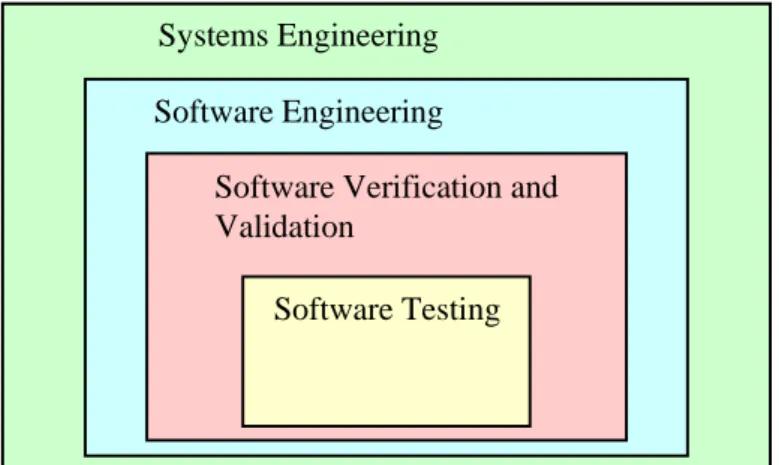
There are various definitions of software testing, but BS 7925-1 provides a mainstream definition, which is the “process of exercising software to verify that it satisfies specified requirements and to detect errors”. As such, software testing is one way of performing both software verification and software validation - static techniques, such as reviews, being another. Obviously, verification and validation are not performed as stand-alone processes - there has to be something to verify and validate. The verification and validation processes form part of the larger process of software engineering.
Similarly, very rarely does software run as a stand-alone process - software is generally produced to run as part of a larger system. This situation has long been accepted by those producing embedded software, where systems engineering is already considered an acceptable and necessary encompassing discipline. Thus, from a process viewpoint, software testing, as part of verification and validation, can be viewed as being included within software engineering, which, in turn, is part of systems engineering. This relationship is shown in figure 1.
Systems Engineering
Software Engineering
Software Verification and
Validation
Software Testing
Systems Engineering
Software Engineering
Software Verification and
Validation
Software Testing
Figure 1. The Process Context of Software Testing
Using the model in figure 1, process-oriented standards can be identified for each of the different levels identified. In fact, the systems engineering, software engineering and verification and validation processes are all covered by corresponding standards (e.g. ISO 15288, ISO 12207, and IEEE 1012 respectively). Each of these standards contains requirements relevant to the software tester. Both ISO 15288 (full publication due Dec. 2000) and ISO 12207 include processes for verification and validation, and although many software developers and testers ignore the systems aspect of their work, it is impossible to deny the relevance of ISO 12207, the software life cycle processes standard. ISO 12207 is a standard that defines a framework for software throughout its life cycle and, unlike ISO 9000, has been quickly accepted in the US - it has now been accepted as the ‘umbrella’, or integrating standard by the IEEE for their complete set of software engineering standards. IEEE 1012, one of this set, defines in detail the specific verification and validation processes, activities and tasks to be performed, based on integrity levels (see section 5).
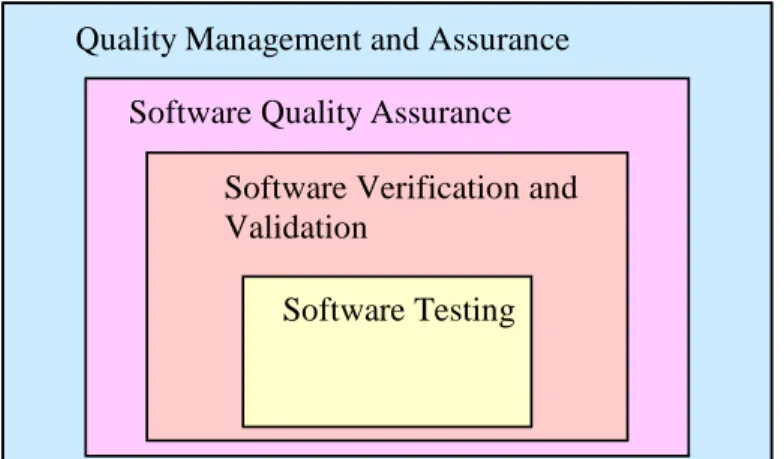
Quality provides a different perspective from which to view software testing and figure 2 shows how software testing fits into a quality model. From a quality perspective, testing, as part of verification and validation, can be seen as an integral part of software quality assurance. If software is part of a larger system, then software testing can also be considered as part of overall quality management and assurance. As with the process model, the
4
higher levels are covered well by corresponding standards (e.g. ISO 9000, IEEE 730 and IEEE 1012, respectively). Not many software developers will be ignorant of ISO 9000, but it considers testing at such a high level that non-compliance would basically mean performing no documented testing at all. IEEE 730 is similarly high level (and rather confusing as it separates testing into two parts; that performed as a part of ‘verification and validation’ and ‘other testing’).
Quality Management and Assurance
– ISO 9000
Software Quality Assurance
– IEEE 730
Software Verification and
Validation
– IEEE 1012
Software Testing
Quality Management and Assurance
Software Quality Assurance
Software Verification and
Validation
Software Testing
Figure 2. The Quality Context of Software Testing
A third model can be used where, unusually, software testing does have a corresponding standard. This represents the terminology perspective as shown in figure 3. Natural language, as spoken in our daily lives, is at the highest level, while computing terms and software engineering terms lead eventually to software testing terms. Standards are available for each level of this model, for example starting with the Oxford English Dictionary, leading onto IEEE 610, IEEE 610.12 and finally onto BS 7925-1, the software testing vocabulary.
Natural Language - English, Swedish, etc.
Computing Terms
Software Engineering
Terms
Software Testing
Terms
Natural Language - English, Swedish, etc.
Computing Terms
Software Engineering
Terms
Software Testing
Terms
Figure 3. The Terminology Context of Software Testing
From the above three models a number of standards relevant to testing have been identified, albeit that many of them only consider software testing from a very high level. Some, such as ISO 9000, offer little of use to the software test practitioner apart from in terms of compliance and marketing. Of the others, ISO 12207 is expected to have a large impact, and compliance with this standard is expected to become the usual state of affairs for software developers and testers. IEEE 1012, the software verification and validation standard, is highly-relevant to software testing and is covered in detail in section 5.
So far, by only considering the context of software testing, it has been viewed as a black box, and few relevant standards have been identified concerned with the detail of the software testing activity. To overcome this
5
shortfall, in section 4 a white box approach has been used where a generic software testing model has been developed and then standards have then been identified to support the different parts of the model.
4
A SOFTWARE TESTING MODEL
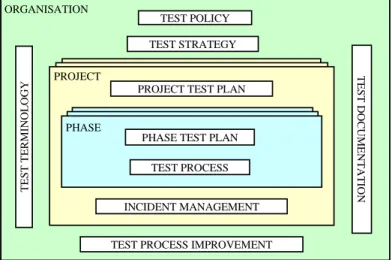
This software test model considers software testing from the level of the organisation down to the level of a single phase of a project. The model covers the test process, process improvement, terminology, documentation, and incident management, as shown in figure 4. Each element of the model is considered in terms of its support by standards. ORGANISATION TES T TE R M IN OL OGY TEST POLICY TEST STRATEGY TES T D O C U M E NT AT ION
TEST PROCESS IMPROVEMENT PROJECT
PROJECT TEST PLAN
INCIDENT MANAGEMENT PHASE
TEST PROCESS PHASE TEST PLAN ORGANISATION TES T TE R M IN OL OGY TEST POLICY TEST STRATEGY TES T D O C U M E NT AT ION
TEST PROCESS IMPROVEMENT PROJECT
PROJECT TEST PLAN
INCIDENT MANAGEMENT PHASE
TEST PROCESS PHASE TEST PLAN
Figure 4. A Generic Software Testing Model
4.1 Test
Terminology
A common set of terminology ensures efficient communication between all parties concerned with software testing. BS 7925-1 aims to provide a specialist vocabulary for software testing, while IEEE 610.12 provides a good overall glossary of software engineering terminology. The current shortcoming of BS 7925-1 is that it is somewhat biased towards component testing. It originated as the definitions section of BS 7925-2 and so was initially purely devoted to component testing, but has since been expanded to cover software testing in general. Further work needs to be done.
4.2 Test
Policy
The test policy characterises the organisation’s philosophy towards software testing. This would incorporate statements to ensure compliance with standards such as ISO 9001, ISO 12207 and IEEE 730. ISO 9001 provides only a very high level requirement that suppliers perform testing as part of verification and document it. At this level ISO 12207 defines the requirement for specific verification and validation processes to support the primary processes of development, maintenance, etc. IEEE 730 requires the production of both a Software Verification
and Validation Plan (and corresponding Report) and the documentation of any other tests (presumably those
performed by the developers), but appears to be superfluous, from a testing point of view, if ISO 9001 and ISO 12207 are used.
4.3 Test
Strategy
This is a high level document defining the test phases to be performed for a programme (one or more projects). ISO 9000-3, which provides guidance on the application of ISO 9001, suggests that unit, integration, system and acceptance testing be considered, basing the extent of testing on the complexity of the product and the risks. IEEE 1012 defines the verification and validation processes, activities and tasks to be performed based on
6
software integrity levels, so will determine which test phases are applied. ISO 15026 defines the process for determining integrity levels based on risk analysis, which is defined in IEC 60300-3-9.
4.4
Project Test Plan
This document defines the test phases to be performed and the testing within those phases for a particular project. Its content will be aligned with the test strategy (4.3), but any differences will be highlighted and explained in this document. ISO 9000-3 suggests a brief list of contents for test plans, while IEEE 829 provides a comprehensive set of requirements for test planning documentation.
4.5
Phase Test Plan
The phase test plan provides the detailed requirements for performing testing within a phase e.g. component test plan, integration test plan. IEEE 829 provides a comprehensive set of requirements for test planning. Perhaps more relevant for the unit/component testing phase, BS 7925-2 defines the detailed content of a software component test plan and provides an example set of documentation. Unhappily, there are no standards that cover other test phases specifically.
4.6 Test
Process
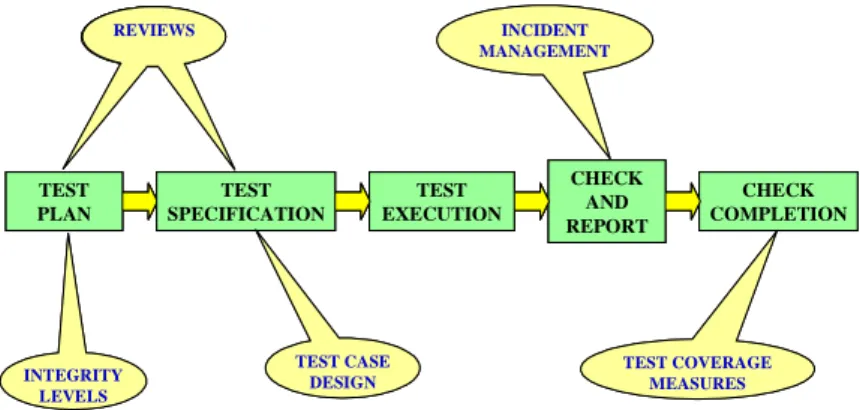
BS 7925-2 defines a generic component test process, which is shown in figure 5 along with associated activities. IEEE 1008 provides similar details on the test process as BS 7925-2, but labelled as unit testing. There are no standards that cover other test phases specifically.
CHECK COMPLETION CHECK AND REPORT TEST EXECUTION TEST PLAN TEST SPECIFICATION INCIDENT MANAGEMENT TEST COVERAGE MEASURES REVIEWS REVIEWS TEST CASE DESIGN INTEGRITY LEVELS CHECK COMPLETION CHECK AND REPORT TEST EXECUTION TEST PLAN TEST SPECIFICATION CHECK COMPLETION CHECK AND REPORT TEST EXECUTION TEST PLAN TEST SPECIFICATION INCIDENT MANAGEMENT TEST COVERAGE MEASURES REVIEWS REVIEWS TEST CASE DESIGN INTEGRITY LEVELS
Figure 5. Generic Software Testing Process
Phase test planning was considered earlier in 4.5, but the decisions made during this activity, such as which test case design techniques to use and which test completion criteria to apply, should be dependent on the integrity levels for the software, which in turn are based on some form of risk analysis. The process for determining integrity levels is defined in ISO 15026 and the risk analysis process is defined in IEC 60300-3-9. Both test plans and test specifications should be reviewed; software review techniques are defined in IEEE 1028. The techniques used to design test cases in the ‘test specification’ activity and the test coverage measures used in the ‘check completion’ activity are both defined, along with examples of their use, in BS 7925-2. Incident management, which forms a major part of the ‘check and report’ activity, is covered in the next section.
7
4.7 Incident
Management
Incident management is an essential adjunct to the testing process and is also known as problem reporting or anomaly classification. ISO 12207 includes problem resolution as a support process and IEEE 829 briefly covers incident reporting documentation. More detailed coverage is provided by IEEE 1044, which defines an anomaly classification process and classification scheme. IEEE 1044 is supported by comprehensive guidelines in IEEE 1044.1.
4.8 Test
Documentation
IEEE 829 provides a comprehensive set of requirements for test planning, test specification and test reporting documentation.
4.9
Test Process Improvement
Test process improvement should, presumably, be part of an organisation’s test policy. If complying with ISO 12207 then an improvement process is explicitly identified, while process improvement is pervasive in ISO 9000. At the systems engineering and software engineering levels then SEI have produced capability maturity models (the SE CMM and SW CMM frameworks, respectively) that include some testing. ISO 15504 is an international software process improvement standard that also includes some software testing. No process improvement standards are aimed specifically at the software testing process, although proprietary schemes, such as the Testing Maturity Model (TMM), are available for software testing process improvement.
5
INTEGRITY LEVELS AND RISK-BASED TESTING
In the field of safety-related applications, integrity levels have been around for some time. The concept of integrity levels allows a single standard to define different requirements dependent on the integrity level of the product to which the standard is being applied. The product may be a complete system, but is more often a part of a system, which means that the standard requires different parts of a system to meet different requirements (assuming that not all parts have the same integrity level). Partitioning of the system is sensible as otherwise the complete system will need to meet the (more rigorous) requirements of the highest integrity level part of the system, which may only be a small part of the whole. Integrity levels are normally determined on the basis of some form of risk assessment, and when used for safety-related applications the risk assessment is obviously based on safety issues. Once the integrity level is determined then the corresponding requirements (methods, techniques, coverage level, etc.) are selected based on the integrity level required.
The use of integrity levels was initially confined to application-specific standards, such as DO-178B (avionics), Def Stan 00-55 (defence) and MISRA (automotive), but this is gradually changing. The recently published IEC 61508, according to its title, is applicable to “electrical/electronic/programmable safety-related systems”, and so could presumably be used instead of the previously-mentioned standards, and this has been a well-debated point. The take-up of IEC 61508 has been relatively slow in the US as it is perceived as a European standard (despite its international title), in a similar way to ISO 9000. IEC 61508 has four integrity levels, as do most standards using this concept, and is very comprehensive, covering both hardware and software (part three of this standard covers software requirements). It does include some rather strange software testing requirements (the relationship between the requirements for boundary value analysis and equivalence partitioning needs some work), but part 7, which is not yet available, will provide an overview of techniques and measures, and may clarify such problems.
One thing that IEC 61508 has in common with the application-specific standards is that it is aimed at related applications. IEEE 1012, published in 1998, also uses the integrity level concept, but is neither a
safety-8
related standard, nor application-specific. This standard defines the verification and validation to be performed based (again) on four software integrity levels, but these integrity levels are not necessarily safety-related, but can be based on other forms of risk, such as economic, security, etc. Also published in 1998, is ISO 15026, which defines a process for determining integrity levels based on risk analysis. This standard defines an integrity level as a range of values of a software property necessary to maintain risks within tolerable limits, where the risk can be defined under different perspectives (e.g. safety, financial, political, security). The availability of these standards (and IEC 60300-3-9 on risk analysis) supports the recent emergence and popularity of risk-based testing and provides the beginning of a framework of standards to support it.
6 APPLICATION-SPECIFIC
STANDARDS
There are many application-specific standards for software development and testing, nearly all of which are in the safety-related application domain. Examples of this type are DO-178B (avionics), MISRA (automotive), Def Stan 00-55 (defence), and IEC 880 (nuclear). The first three of these standards/guidelines use the concept of levels of integrity, while the last, IEC 880, does not, but this may be due to its age – it was published in 1986. A relevant question to be asked of application-specific standards is why they were linked to a particular application area and not simply published as generic software development and testing standards. There are no ‘special’ testing techniques that are particularly appropriate for avionics systems that are not just as useful when testing automotive, or pharmaceutical, or medical, or financial software (as far as is known). As long as the perceived risks from the software failing are of a similar level, then similar amounts of effort will be appropriate for the development and testing. For instance, a safety-critical software component in a car and a financial software component upon which an organisation’s economic future is dependent will both be rigorously tested, but no-one knows of any testing technique that will work better for the automotive component than the financial component, or vice versa. If both are perceived as being similarly risky by the customer then they both deserve similar budgets for their testing and, all other things being equal, this will mean similar approaches to their testing.
Given that there appears to be no good reason for application-specific standards for software development and testing then why do they exist? Imagine that a particular industry body decides that their industry needs a software development standard and commissions a new standard from experts in software development who also work in their industrial area. On completing the work (which is a generic software development standard), the authors, who have little or no experience in other application areas, do not feel qualified to label it as a generic standard or may not want to disappoint the commissioning body by not delivering the application-specific standard they were expecting – and so another application-specific software standard is created. The developers of PSS-05-0 (the European Space Agency (ESA) software development standards) appear to have learnt this lesson. They have published the software development standards used by ESA as generic standards which “provide a concise definition of how to develop quality software”. PSS-05-0 is thus one step forward from application-specific standards. For testing it references IEEE 1028 for software reviews, IEEE 1012 for verification and validation, and IEEE 829 for test documentation. Its failing is that it does not use the integrity level concept. IEC 61508 is near to fulfilling the requirement for a generic standard using integrity levels, but it states that it is specifically applicable to safety-related applications. Why IEC 61508 could not be used for non safety-related applications, such as financially-related applications, if suitable integrity levels could be determined, is not clear.
There are few application-specific standards/guidelines that solely consider software testing, although NIST 500-234 is an example of one that provides ‘reference information’ on software verification and validation for the US
9
health care industry. These guidelines give good general (i.e. not especially relevant to healthcare) advice on verification and validation and also provide special sections on testing reused software and knowledge-based systems. This text of 75 pages is a fine, generic introduction to software verification and validation, freely available on the Web.
In general, application-specific standards for software development and testing do not appear to be worth the effort unless some positive data confirming that application-specific requirements are valid becomes available. With no basis for making this type of standard application-specific, then the effort would be better spent on generic standards, so reducing duplicated effort on very similar standards. The ideal use of application area experts is in providing standards for determining integrity levels for their particular field, which can then be applied to a generic software testing standard using integrity levels, written by experts in software testing, as suggested in the next section.
7
SOFTWARE TESTING FRAMEWORK
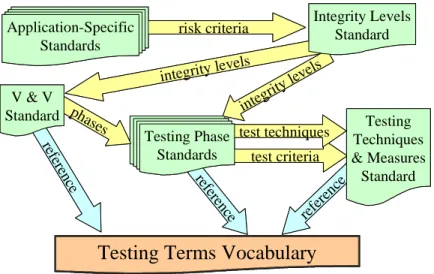
From the previous two sections, it would appear that integrity levels are the most appropriate means of defining different levels of rigour for the software testing of different software, based on some form of risk assessment. There will always remain some application-specific knowledge that is worthy of formalisation, and so application-specific standards will remain appropriate for defining how those risks that are special to that application area are to be determined. Once integrity levels for software have been determined (ISO 15026 is available for this) then they can be applied to the verification and validation standard, which will be used to decide which testing phases and activities to apply. IEEE 1012 is suitable for this task. The integrity levels could then be used by individual test phase standards to determine which techniques and completion criteria to apply in that phase. All testing standards would use a common terminology defined in a single vocabulary, an expanded version of BS 7925-1. This proposed framework is shown in figure 6.
risk criteria Application-Specific Standards Application-Specific Standards Application-Specific Standards test criteria Testing Phase Standards phases re fe re nce refere nce integrity leve ls integri ty leve ls
Testing Terms Vocabulary
Testing Techniques & Measures Standard Application-Specific Standards Integrity Levels Standard test techniques re fe re nce V & V Standard Testing Phase Standards Testing Phase Standards Testing Phase Standards risk criteria Application-Specific Standards Application-Specific Standards Application-Specific Standards test criteria Testing Phase Standards phases re fe re nce refere nce integrity leve ls integri ty leve ls
Testing Terms Vocabulary
Testing Techniques & Measures Standard Application-Specific Standards Integrity Levels Standard test techniques re fe re nce V & V Standard Testing Phase Standards Testing Phase Standards Testing Phase Standards
Figure 6. A Framework of Software Testing Standard
Of the testing phases, currently only the component (or unit) testing phase of the life cycle is supported by standards (BS 7925-2 and IEEE 1008 both cover this phase). This leaves integration, system (both functional and non-functional) and acceptance testing in need of coverage by standards. A working party in the UK is currently developing a standard of techniques for non-functional testing, which should partially fill this gap, but more testing standards are still required.
BS 7925-2 contains both a process and definitions of techniques and measures. The techniques and measures, however, are not only appropriate for component testing, but can also be used in other test phases. For instance,
10
boundary value analysis can be performed in all phases. But, because BS 7925-2 is primarily concerned with component testing, the techniques and measures are defined from only that perspective and the associated guidelines, which give examples of their use, also only cover their application to component testing. This introduces a problem when standards for the other test phases are written. It is not appropriate for the definitions in BS 7925-2 to be referenced by such standards, but re-defining them in each standard is also problematic, as there will be problems of consistency, but, more importantly, there will be duplication of effort. The solution is to create a single separate standard that covers the techniques and measures, which should be defined in such a way as to be applicable to whatever software testing phase is being performed. The guidelines to this standard
would then need to show how the techniques can be applied at each of the test phases. A frustrating aspect of
this solution is that the new techniques and measures standard will require major changes to BS 7925-2 to remove the definitions of techniques and measures and simply leave the component test process. However, the definitions of techniques and measures from BS 7925-2 would be an ideal starting place for this new standard.
8 CONCLUSIONS
This paper has identified a number of high level standards that include requirements for software testing, the two most important being ISO 9000 for compliance and marketing and ISO 12207 to define the framework of life cycle processes within which testing is performed. A generic testing model was then presented and used to identify those standards that support the more detailed aspects of testing. The model was found to be poorly supported in one main area - that of the individual test phases. Only the unit or component test phase is adequately supported, and there are two standards available, the best of which is BS 7925-2. A second shortcoming is that although information on test process improvement is available, it is proprietary, so there is a requirement for standardisation. The other parts of the generic model were generally well-supported, with the areas of incident management and integrity level classification unexpectedly being supported by useful standards. The use of the integrity levels in standards is now widespread in the safety-related applications areas. This concept is gradually gaining more widespread use and IEEE 1012, a particularly good verification and validation standard published in 1998, includes integrity levels. IEEE 1012 is also generic in that it applies to all software testing, so that economic or other risk factors may be considered rather than safety. Application-specific standards were also considered, and found to be obsolete for all but those activities based on risk analysis where special application-specific knowledge is necessary. Overall, the availability of generic testing standards, using the integrity level concept, that apply to all application areas is felt to be the way forward.
Brief subjective comments by the author on each of the standards mentioned in this paper are included in the Annex (section 10), where each standard is also given a rating on its usefulness to a software tester.
Finally, for those who do pick up a standard, please note that standards are generally in two parts; first a normative part, which defines what the user must comply with, and then an informative part, which includes guidance on the normative part. The nature of standards is that the normative part is difficult to read – do not be surprised at this. Before throwing it away, try the informative part, which is generally the most useful!
9
REFERENCES AND BIBLIOGRAPHY
BS 7925-1-1998, Software Testing –Vocabulary.
BS 7925-2-1998, Software Component Testing.
11
IEC 880, Software for computers in the safety systems of nuclear power stations, 1986.
IEC 60300-3-9, Dependability management - Part 3: Application guide - Section 9: Risk analysis of
technological systems, 1995.
IEC 61508:1998, Functional safety of electrical/electronic/programmable electronic safety-related systems.
IEEE 610, Standard Computer Dictionary, 1990.
IEEE 610.12, Software Engineering Terminology, 1990.
IEEE Std 730-1998, Standard for Software Quality Assurance Plans.
IEEE Std 829 -1998, Standard for Software Test Documentation.
IEEE Std 1008-1987, Standard for Software Unit Testing.
IEEE Std 1012-1998, Standard for Software Verification and Validation, 1998.
IEEE Std 1028-1997, Standard for Software Reviews.
IEEE Std 1044-1993, Standard Classification for Software Anomalies.
IEEE Std 1044.1-1995, Guide to Classification for Software Anomalies.
ISO 9000, Series of quality management and quality assurance standards.
ISO 9000-3 : 1997, Guidelines for the application of ISO 9001 to the development, supply, installation
and maintenance of computer software.
ISO 9001, Quality systems – Model for quality assurance in design, development, production, installation
and servicing, 1994.
ISO 15288, Life-Cycle Management—System Life Cycle Processes, Draft, 1997.
ISO/IEC 12207, Information Technology - Software life cycle processes, 1995.
ISO/IEC 15026:1998, Information Technology – System and software integrity levels.
ISO/IEC 15504:1998, Information technology -- Software process assessment.
Motor Industry Software Reliability Association (MISRA) Development Guidelines for Vehicle Based
Software, 1994.
NIST 500-234, Reference Information for the Software Verification and Validation Process (Health
Care), 1996.
PSS-05-0, ESA Software Engineering Standards, Issue 2, 1991.
RTCA DO-178B, Software Considerations in Airborne Systems and Equipment Certification, RTCA,
1992.
SW-CMM, Paulk, M. et al, Capability Maturity Model for Software, Version 1.1, Technical Report
CMU/SEI-91-TR-24, SEI, 1991.
SE-CMM, Bate, R. et al, Systems Engineering Capability Maturity Model, Version 1.1, SEI, 1995.
TMM, Burnstein, I., et al, Developing a Testing Maturity Model: Part 1 and 2, Illinois Inst. Of Tech.,
12
10 APPENDIX – SUBJECTIVE ASSSESMENTS
Standards
Comments
*Rating
Terminology Good coverage of this area. Little scope for misunderstandings.
IEEE 610 Useful reference text, but not necessary for a typical tester (over 200
pages of definitions!). U
IEEE 610.12 The software engineering definitions. Necessary as only terms not
defined here are included in BS 7925-1. HR
BS 7925-1 Excellent component testing terminology source. Some general software
testing terms, but needs expanding to become a true general software testing vocabulary. A draft copy of this document is freely available from: [email protected].
M
Specific
Software Testing
These standards are specifically written to support software testing and verification and validation (V&V).
BS 7925-2 Excellent coverage of the component (unit) test process and testing
techniques and measures. The techniques and measures are also applicable to other test phases. A draft copy of this document is freely available from: [email protected].
M
IEEE 829 Good test documentation standard, but the standards supporting the
processes should include guidelines on the necessary documentation. For instance BS 7925-2 for component test documentation, and IEEE 1044 for incident (anomaly) reporting.
HR
IEEE 1008 Good coverage of unit testing process, but now superseded by BS 7925-2. U
IEEE 1012 Excellent V&V standard, using integrity levels. A must when writing a
test strategy. M
IEEE 1028 Excellent introduction to software reviews. M
Supporting Standards covering those processes that support he test process.
IEEE 1044 Includes an anomaly (incident) classification process and standard lists of
anomaly classification schemes. If you’re setting up the incident reporting activity then there’s no need to look any further, apart from…..
HR
IEEE 1044.1 Guidance on the above, if you feel you need it. U
IEC 60300-3-9 A harmonising generic standard on risk analysis. Ideal if your industry
does not have an application-specific version – and may be better anyway. HR
ISO 15026 An excellent generic (non-safety-specific) process for determining
integrity levels. The only minor problem is that it attempts to specify means of achieving levels of integrity – this is best left to the development and test process standards.
13
Standards
Comments
*Rating
High-level Process and QA standards that contain requirements related to software testing
ISO 9000 ISO 9000-3 ISO 9001
What can you say about the ISO 9000 series? More than a quarter of a million certified organisations can’t be wrong. Testers need to be aware, but coverage of software testing is minimal.
U
IEEE 730 Very high level – states a requirement for the inclusion of V&V and
testing in QA plans, but not much else of use to the tester. O
ISO 15288 Will contain (due for release in late 2000) systems level requirements and
simply require compliance with ISO 12207, below for software components of systems.
O
ISO 12207 The integrating software life cycle processes standard. Those in software
not using this standard in five years time will be negligible (and negligent?).
M
Application-specific This is only a small sample of the available application-specific standards. As is typical
of this genre, nearly all are safety-related and consider both software development and testing.
IEC 880 An old (1986) standard that has a guidelines annex on software testing.
Aimed at very high integrity systems, its surprising its not been superseded.
O
DO-178B The best application-specific standard. Uses integrity levels. Its only
failings are the expectation of 100% coverage and the inclusion of modified condition decision coverage.
HR
Def Stan 00-55 Appears biased towards the use of mathematical proof for verification.
Defines required coverage in terms of code constructs rather than requiring techniques to be used.
U
MISRA A reasonable set of guidelines, freely-available on the Web at:
http://www.misra.org.uk/license.htm. No special automotive features discernible in the software testing.
U
NIST 500-234 Guidelines that specialise in V&V. Ostensibly for healthcare, but actually
generic. Unusually contains special topics on testing reused software and knowledge-based systems. Freely-available on the Web at: http://hissa.ncsl.nist.gov/HHRFdata/Artifacts/ITLdoc/234/val-proc.html.
U
Generic Development These consider both software development and testing.
PSS-05-0 No integrity levels. Testing requirements are largely based on references
to IEEE testing standards. U
IEC 61508 Not completely generic (for safety-related software). Uses integrity
levels, but allocation of software testing requirements to levels looks flawed.
14
Standards
Comments
*Rating
Process Improvement Apart from TMM, these process improvement standards cover both development and
testing, but concentrate on development.
ISO 15504 Allows existing process improvement models (e.g. CMM, Bootstrap, etc.)
to be cross-referenced to a common base for measurement and comparison.
U
SE CMM A systems version of the original capability maturity model, below. O
SW CMM Used largely to measure the software development process, it also gives
guidance on what to add to increase the level of maturity of the process. U
TMM A tester’s version of the above (so based on maturity levels), which
focuses primarily on testing. HR
*Ratings
M Mandatory – all testers should have this
HR Highly Recommended
U Useful, but not necessary
Thursday 7 December 2000
T3
Software Testing Standards:
Do They Know What They’re Talking
About?
Stuart Reid
Stuart Reid has a BSc in Aeronautics, a MSc in Computing and a PhD in Software Testing.
He is a senior lecturer in Software Engineering for Cranfield University at the Royal Military
College of Science. He has previously worked on the development of safety-critical systems
for a variety o application areas including command and control, radar and avionics.