Bringing the customer experience
full circle: The CRM value cycle
Why has customer relationship management (CRM) become a dirty word
in so many boardrooms? Its stated goals of serving customers better and
grow-ing relationships are noble, but many initiatives have been predestined for
failure by lack of focus and lofty expectations. Some retailers have tried for
quick-hit successes aimed only at increasing sales and reducing the cost to
serve customers. Unfortunately, ill-conceived and fragmented initiatives have
diluted consumer trust and worn a path to retailer and consumer
disappoint-ment alike. What approach should retailers take to truly improve customer
relationships in a holistic way?
Contents
1 One-sided relationship management: An approach in need of change
2 Aligning customer strategy with customer imperatives
4 The CRM value cycle: A framework for continuous improvement 9 Putting it all together: The CRM
value cycle in practice 10 The road ahead 12 Conclusion 13 About the author 13 Contributor 14 References
One-sided relationship management: An approach in need of change
In their rush to increase sales, most retailers have overlooked the fundamental basis of CRM: the customer. Traditional CRM, while touting the incontestable ambition of becoming cus-tomer-centric, has focused on short-term economic outcomes. Retailers have focused on improving tools — technological capabilities to deliver contact-center automation, campaign management and data analytics — as the endgame for CRM initiatives. The unspoken goal: try to extract the maximum value from customers, while reducing the cost to serve them. Clearly, becoming customer-centric requires improved capabilities, both business and technical. However, ensuring an explicit link between strategic goals and tactical initiatives has proven to be a major problem. Most companies operate under the assumption that the only benefits of CRM are transaction-related; accelerating the frequency and value of transactions are the keys to success. Similarly, reducing the cost to serve often means reducing the amount of time spent with customers, whether in person or on the phone. How many successful, long-term relationships are based on persuasive manipulation and reducing two-way communication? This approach makes an oxymoron out of the term “customer relationship management.” Retailers pursuing CRM initiatives have consistently run into four fundamental challenges: • Complex integration issues
• Difficult data collection
• Unclear return on investment (ROI) • Inconsistent priorities.
To begin with, the majority of retailers have found that they do not have the technological foundation or processes in place to deliver the seamless data flow and sophisticated analysis that many initiatives require. Even for retailers that have worked through integration issues and have determined how to identify consumers consistently, the short-term nature of the retail environment has forced business priorities that are inconsistent with the consumer’s interests. Developing initiatives that deliver rapid shareholder returns is often at odds with creating consumer trust and building relationships.
Aligning customer strategy with customer imperatives
In recent consumer research conducted by the IBM Institute for Business Value, we found that factors relating to the customer experience have much greater impact on satisfaction than typical promotion-focused CRM initiatives. Overall, our study provided three central insights: Satisfaction is a key performance indicator
Our research identified a clear linkage between overall satisfaction and retailer financial per-formance. On average, retailers that performed well financially deliver significantly higher overall satisfaction than lesser financial performers (see Figure 1). However, few retailers use customer satisfaction as an input to key business decisions or as a preeminent performance indicator. In 2001, a Jupiter Research study found that 63 percent of companies identify loyal customers by spending habits and order values, while only 13 percent incorporate customer satisfaction scores into decision making.1
Figure 1. (A) indicates stores that have delivered strong same-store sales and net income growth over the past three years, and (B) indicates stores with flat to declining same-store sales and net income growth.
Source: “Making CRM Work for Retailers 2002 Survey.” IBM Institute for Business Value.
The customer experience is king
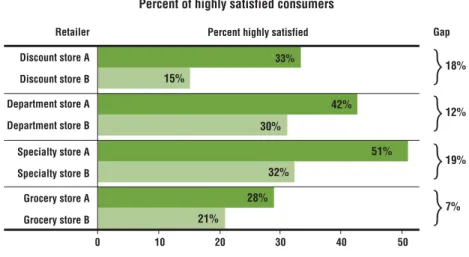
Most retail CRM programs today focus on tactical marketing and database-driven initiatives, but our consumer research clearly indicates that it is the customer experience that drives sat-isfaction. In fact, according to our research, interpersonal interaction between store associates and customers and the customer’s overall store experience were by far the most significant drivers of satisfaction (see Figure 2). Though certainly key operational priorities, marketing and pricing initiatives proved to have little direct correlation with consumer satisfaction.2
Percent of highly satisfied consumers
15% 30% 32% Discount store A Discount store B Department store A Department store B Specialty store A Specialty store B Grocery store A Grocery store B 21% 10 20 0 30 40 50 18% 33% 42% 51% 28% 12% 19% 7%
Figure 2. Person-to-person and store-experience-related items have significantly greater impact on satisfaction than pricing and marketing-related items.
Source: “Making CRM Work for Retailers 2002 Survey.” IBM Institute for Business Value.
Yet, when Jupiter Research surveyed 1,300 members of the National Retail Federation regard-ing their “top planned CRM investments,” the list included direct mail, e-mail, loyalty, online promotions and in-store promotions. There was no mention of initiatives that would directly improve the customer experience.3
Improve the store experience first
Our study found that the top-performing retailers distinguish themselves from their competi-tors by providing favorable store experiences. Winners like Williams-Sonoma had superior scores on key satisfaction drivers including: the look and feel of stores, compelling merchan-dise offerings, and a fun and entertaining shopping experience. Stores with flat to declining same-store sales and net income growth performed substantially lower on these factors, on average.4
A recent study conducted by Shop.org, the J.C. Williams Group and BizRate.com corroborates our study findings: their research suggests that consumers’ decisions about whether or not to return to a particular retailer is overwhelmingly based on experience-related factors, regardless of shopping channel.5
Person-to-person experience
Store experience
Price and value
Marketing and communications
Data integration and analytics
250 272
0 50 100 150 200
Relative strength index 122
47
38
Key drivers of customer satisfaction
21
300
Consumers of top financial performers were 38 percent more likely to be highly satisfied with their store experiences than those of the
The CRM value cycle: A framework for continuous improvement
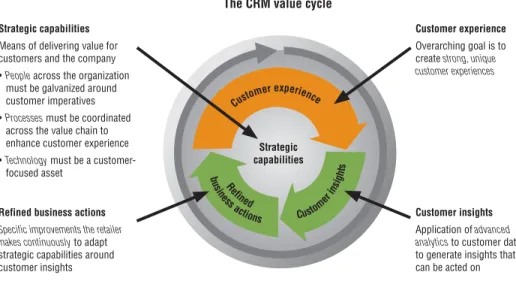
The findings from our consumer survey and third-party research efforts demonstrate that retailers need to make a substantial change in the way they approach CRM. To help retailers focus on the most important aspects of customer relationships, we have developed the CRM value cycle (see Figure 3). The CRM value cycle provides an overall framework and approach for understanding how a company needs to transform the retail experience from the custom-er’s point of view.
When applied by retailers, regardless of their current level of CRM sophistication, the frame-work can help avoid common CRM pitfalls, including:
• Poor planning and design of CRM initiatives
• CRM implementations that substitute technology solutions for customer-centric initiatives • Ineffective change management that fails to create sufficient organizational understanding
and support of implemented CRM initiatives
• Incomplete measurements for CRM initiative success.
The value cycle is based on four key components: customer experience, customer insights, refined business actions and strategic capabilities. The primary goal of the value cycle is to create strong, unique and continuously improved customer experiences. The improvement pro-cess is based on developing customer insights across segments and individual customers, and translating those insights into actions that provide new and improved experiences.
Figure 3. The CRM value cycle is a framework for systematically improving customer relationships. Source: IBM Institute for Business Value.
Strategic capabilities Strategic capabilities
Means of delivering value for customers and the company
• People across the organization
must be galvanized around customer imperatives
• Processes must be coordinated
across the value chain to enhance customer experience
• Technology must be a
customer-focused asset
Refined business actions Specific improvements the retailer makes continuously to adapt strategic capabilities around customer insights
Customer experience Overarching goal is to create strong, unique customer experiences
Customer insights Application of advanced analytics to customer data to generate insights that can be acted on
The CRM value cycle
Custom er in sigh ts Customer experience R efined b usin ess a ctions
Creating optimal customer experiences
The total customer experience includes any interaction with a company’s assets, such as: brand, marketing, product, service or personnel. Hence, experience refers to the collective impression, across channels and shopping trips, that impacts a customer’s propensity to buy. Creating optimal experiences requires that retailers employ all of their strategic capabilities to fulfill both the rational and emotional needs of individual shoppers. Managing the customer experience should not be confused with creating entertainment for customers; customer-expe-rience management is considerably more complex and offers greater potential for creating a sustainable customer value proposition.
To make experience a differentiating feature of your customer value proposition, the emotional component of shopping must be understood and managed with the same rigor that organiza-tions bring to managing products and services. The CRM value cycle helps highlight the key measurements that are needed to orchestrate positive experiences that, over time, translate into sustainable customer loyalty.
Prada’s Epicenter store offers an exceptional shopping experience7
In 2001, Miuccia Prada, owner of the Prada fashion house, opened the Prada Epicenter in the company’s retail stronghold: New York City. As far as customer experience is concerned, Prada didn’t pull any punches. The store’s design elevates shopping to an art form, literally: shoe racks by day turn into amphitheater-style seating at night, complete with a suspended stage that lowers for performances.
Prada spared no expense in making customers feel cutting edge and pampered. For instance, Prada customers don’t have to worry if an outfit will be camera ready; they are treated to a full-length view of themselves on a TV screen while they try on clothes. Store associates use personal digital assistants (PDAs) to check size and stock availability, as well as input and access customer preference and past purchase information, allowing them to match new purchases to Prada pieces already in the customer’s closet.
Plasma screens flash product information that store clerks electronically customize to shoppers’ needs, based on the items they’ve shown interest in and what they’re trying on that minute. Even the dressing rooms themselves are built to impress, constructed of clear sheets of liquid crystal that turn opaque for privacy when customers enter.
So, does Prada’s success mean that retailers need to start deploying liquid crystal and plasma screens to please customers and increase sales? Not necessarily, but they can learn from the ideas at the epicenter of Prada’s improvements: making stores more interesting, entertaining and easier to shop, finding ways to use customer information to help customers shop better and faster, building stores that are geographically and logistically accessible, and equipping associates with the information and tools they need to execute sales and satisfy customers.
Developing insights for action
Any grocer can tell you how to identify customers and collect data, but most would struggle to explain how they plan to capitalize on that information. Valuable customer insights emerge only when analysis of customer data can be translated into action. For most retailers outside the grocery segment, simply identifying and collecting customer data across disparate channels and third-party sources has been a major hurdle. However, technology maturation and orga-nizational learning are now allowing retailers to effectively make sense of customer attributes, needs and preferences, and shopping patterns.
Ultimately, retailers are striving to develop data models and algorithms that allow them to dependably predict and affect consumer habits. However, it is clear that purchase his-tory-based analytics are not enough. Retailers must strive to develop new, customer-centric measures and dynamic segmentation schemes that allow them to treat customers differently at varying stages of the customer lifecycle, and ultimately, across different shopping occasions.
Customer insights improve Harrah’s game8
To support its company-wide mission to provide great customer service and become the overwhelming first choice for customers in casino entertainment, Harrah’s had to get serious about capturing insights about customers. Harrah’s initiated the “Total Gold” and “Total Rewards” loyalty programs for tracking, retaining and rewarding its guests over time. The company also merged its loyalty and reservation databases to consolidate information and achieve a comprehensive view of over 19 million customers, sharing customer information across every customer touch point, including its casinos, hotels, and Internet sales and service channels. With the customer information captured from this newly integrated approach, Harrah’s is able to determine customer preferences, build tailored complimentary and special offer promotions and forecast the potential value of each customer.
What does Harrah’s know about customer insights that other companies can learn from? By studying and listening to customers, companies can uncover insights that change the game in their industry and lead to increased revenues. For instance, insights from Harrah’s customers helped dispel the long-held myth that players possess a deep loyalty to a single casino location: they found that customers who visited more than one of their establishments were a fast-growing contributor to corporate revenues. They used this information to target lucrative customers, offering promotions that provided incentives and rewards for visits to any of Harrah’s properties. As a result, Harrah’s customers are spending more per visit, and Harrah’s has seen a 20 percent rise in profit per occupied room since it began using customer insights to calculate guests’ “gaming value.”
Continuously refine business actions
Acquiring customer insights is futile if retailers don’t systematically translate those insights into action. For example, it is helpful to know that after 8 p.m. on weeknights in suburban grocery stores, the ratio of male to female shoppers increases dramatically. However, the key is effecting changes in those stores to provide preferential shopping experiences for men. Perhaps a significant segment of these men requires more assistance, or is more likely to cross-shop categories if the price is right. Whatever the answer, effectively executing the right set of business strategies or tactics is the key to creating differentiated shopping experiences. And, according to our research, favorable experiences can translate into profitable sales increases and improved loyalty. Systematically deploying refined business actions is, of course, an iterative process. The learning curve is steep and continuous, but the rewards can be great.
Wegmans refines the grocery business to better serve customers9,10,11,12
Wegmans Food Markets, Inc., a 62-store chain operating in New York, New Jersey and Pennsylvania, is popularly known as the “Disney” of grocery stores. Regular features include in-store chefs, sushi bars, wide, easy-to-navigate aisles and — you guessed it — outstanding customer service. Nearly 3,000 people write love letters to Wegmans each year — with over half of them pleading for a store to be opened in their area. The company continually refocuses its business around the customer, even creating a Consumer Affairs department to serve as the voice of the consumer in management. Store merchandising and shelf-display strategies are constantly revamped, based on customer shop-ping habits and insights, to make shopshop-ping a hassle-free and enjoyable experience. Shoppers can build grocery lists online and view product locations at local stores to save time when shopping.
What can retailers learn from Wegmans’ approach to serving customers? The company’s success is a testament to how using customer insights to refine business decisions and actions can improve customer satisfaction, capture mindshare, strengthen the brand and increase revenue. Even small changes can make a big difference, and customers, as well as employees, are a great resource for developing leading retail practices. For instance, Wegmans’ emphasis on employee empowerment lets the company benefit from listening to and acting on the ideas and insights that front-line associates glean from working day-to-day with customers. Not to mention the fact that Wegmans has been named one of Fortune’s “Best Companies to Work For” five years in a row, and has an employee turnover rate that’s almost half the industry average — two distinctions that speak volumes about how the company operates.
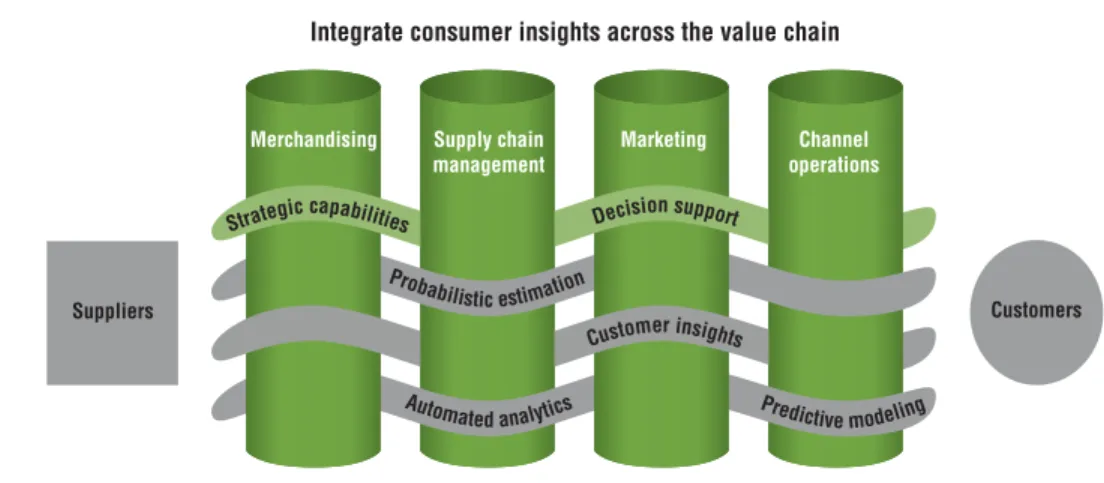
Refined business actions are the improvements that the retailer must make to continuously orient strategic capabilities around customer insights. Improvements based on customer insights may be as micro in nature as developing a targeted, personalized e-mail to custom-ers; or they may be as macro as changing the way store associates are trained. This range of possibilities implies that customer-based knowledge cannot be confined to the marketing department. Rather, it should span the value chain, increasing the utility of customer insights and driving better customer experiences. Experience-based customer insights should ulti-mately drive planning and inventory management, marketing and in-store merchandising, and the corporate culture (see Figure 4).
Figure 4. Using the CRM value cycle, retailers can make consumer insights visible across the enterprise, optimizing utility of their richest information source—consumers.
Source: IBM Institute for Business Value.
Enhancing strategic capabilities
One of the great failures of CRM in the past has been that many plans lead with technology rather than concrete business transformation. Traditionally, CRM has taken the form of a new technology module that the IT department “implements” in much the same way as they would an enterprise data warehouse or e-commerce tool. However, companies that choose to focus on a singular aspect of CRM, such as technological capability, will not drive optimal value if that capability does not adequately improve the customer experience.
Integrate consumer insights across the value chain
Suppliers Customers
Supply chain management
Channel operations
Automated analytics
Probabilistic estimation
Merchandising Strategic capabilities Marketing Predictive modeling Decision support Customer insights
Strategic capabilities include not only technology, but also the people and processes that work in concert with it to create the customer experience. Technology must be a customer-focused asset that enables the organization to provide great experiences. People across the organization must be galvanized around customer imperatives. Processes must be coordinated across the value chain to enhance customer experiences. Changes in culture and process don’t take place overnight simply because an executive writes a memo. Nor do they happen just because head-quarters writes a detailed strategic plan. They occur with deliberate planning and execution. The customer must become a key component of the retailer’s DNA.
Putting it all together: The CRM value cycle in practice
In practice, retailers will combine each part of the CRM value cycle to continuously align strategy, IT and organization to deliver successful CRM programs. Retailers must aggregate learning from thousands of customer and segment experiences. Then, using advanced analyt-ics — for example, probabilistic estimation — retailers can light the path to greater lifetime value and cross-channel spending of customers, rather than focusing solely on the next transaction (see Figure 5). The resulting intelligence will lead retailers to a series of refined business actions that can impact all facets of the value chain. Lastly, retailers can develop the new strategic capabilities necessary to customize and improve customer experiences over time.
Figure 5. In practice, the CRM value cycle is designed to ensure that activities are aligned with delivering optimal experiences and greater lifetime customer value.
Source: IBM Institute for Business Value.
Experience optimization
Customer experience Business actions Customer insights
Capture and grow lifetime value of customer Strate gic ca p a b ili tie s aStr te g ic ca pabi litie s
The road ahead
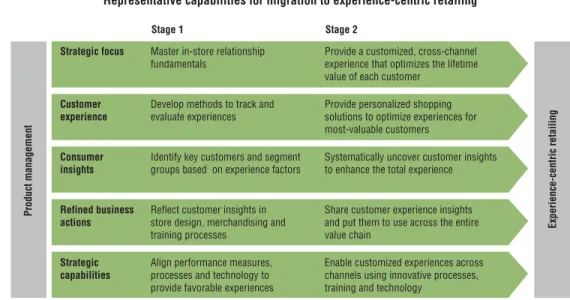
Clearly, a retailer cannot deliver this vision without significantly transforming its approach to customers. Retailers must change their traditional product-centric paradigm to one that seeks to continuously improve customer experiences. To effectively apply the CRM value cycle, retailers must first understand where they are today and where they need to go. The core ele-ments of the CRM value cycle can help you evaluate your current capabilities and design a migration path from product management to experience-centric retailing (see Figure 6).
The product management paradigm pervades the current retail environment and is the starting point for many retailers as they set a course for successful CRM. Retailers need to take initial steps to improve obvious deficiencies in the shopping experience. Data collection and analysis are the first steps in understanding customer needs, expectations and drivers of satisfaction. Applying the CRM value cycle requires that retailers take significant steps to redesign the cus-tomer experience around specific data insights. The central challenge is to convert information into distinct, executable business actions that are mutually beneficial to the consumer and retailer over time. If retailers systematically use deep insights about marketplace needs and preferences to enhance the total consumer experience, they can significantly strengthen the customer relationship.
In experience-centric retailing, value is created when the entire retail value chain is designed around pull-based selling that seeks to deliver the right products, in the right place, at exactly the right time. And while experience-centric retailing relies in part on technological capabil-ity, a true experience-based approach to CRM strategy and design uses technology to support, instead of drive, the customer experience.
Figure 6. The CRM value cycle can guide the migration from product management to experience-centric retailing. Source: IBM Institute for Business Value.
As retailers consider migration to experience-centric retailing, they should bear in mind that change management is the single most overlooked aspect of effectively implementing CRM programs. Clear strategic communication and deliberate change-management activities are critical to ensure organizational alignment and to avoid the common pitfalls of short-term activities focused solely on increasing revenue. Adherence to established “experience-driven” guidelines is crucial in keeping the organization moving on a consistent migration path. Retailers should pay close attention to ROI, with a target of increasing lifetime customer value and overall spending across channels, instead of simply the next transaction.
Successfully managing and measuring experience-based CRM programs also requires that retailers consider customer-centric measures as key performance indicators. For example: • Customer satisfaction and lifetime value
• Share of most-valuable customers and share of wallet • ROI per customer or customer segment
• Customer reaction rates to promotional offers
• Number of repeat visits, frequency of repeat visits and repurchase probability • Customer comments
• Employee retention and satisfaction.
Representative capabilities for migration to experience-centric retailing
Strategic focus Customer experience Consumer insights Refined business actions Strategic capabilities
Master in-store relationship fundamentals
Develop methods to track and evaluate experiences
Identify key customers and segment groups based on experience factors
Reflect customer insights in store design, merchandising and training processes
Align performance measures, processes and technology to provide favorable experiences
Provide a customized, cross-channel experience that optimizes the lifetime value of each customer
Provide personalized shopping solutions to optimize experiences for most-valuable customers
Systematically uncover customer insights to enhance the total experience
Share customer experience insights and put them to use across the entire value chain
Enable customized experiences across channels using innovative processes, training and technology
Product management
Experience-centric retailing
Conclusion
Improving business is a never-ending process in the retail industry, and CRM is no exception. Smart retailers listen to customers and customers are saying that experience is most important to their satisfaction. Retailers who work to improve the customer experience, by capturing customer insights and acting on them, will satisfy more customers, more often. When retailers can clearly see what they have to do to serve customers better, they can build and grow the strategic capabilities to support CRM initiatives.
Today, retailers should align their CRM strategies to focus on nurturing the value that their customers’ continued satisfaction creates, not simply on creating attractive promotions. Make no mistake, the financial rewards that can be reaped from continually meeting — even exceeding — customer expectations are significant. A loyal, lifelong customer is much more valuable to sustained profitability than one that is the subject of quick-hit deals, promotions, and slick technologies that focus on customers one transaction at a time. As the CRM value cycle comes full circle, retailers can continually improve customer satisfaction and enhance revenues and profitability.
In an industry where knowing what customers want determines financial success, many retail-ers have a long road to travel. Building an experience-centric business model that creates the kind of pull your company needs to capture loyal customers requires a well-planned CRM strategy. Please contact us at [email protected] if you would like to:
• Receive further information about the consumer research survey on which this paper is based • Obtain a copy of other papers in this series
• Explore how we might assist your company in designing CRM initiatives that can produce outstanding customer experiences.
To browse through additional resources for business executives, you can visit our Web site at:
ibm.com/services/strategy
As the CRM value cycle comes full circle, retailers can continually improve customer satisfaction and enhance revenues and profitability.
About the author
Julian Chu leads the Distribution Sector team at the IBM Institute for Business Value. Julian specializes in helping executives in the retail and consumer goods industries develop and implement leading-edge e-business ventures and initiatives. Julian can be contacted at
The IBM Institute for Business Value develops fact-based strategic insights for senior business executives around critical industry-specific and cross-industry issues. This executive brief is based on an in-depth study created by the IBM Institute for Business Value. This research is a part of an ongoing commitment by IBM Business Consulting Services to provide analysis and viewpoints that help companies realize business value. You may contact the author or send an e-mail to [email protected] for more information.
Somers, NY 10589 U.S.A.
Produced in the United States of America 12-02
All Rights Reserved.
IBM and the IBM logo are registered trademarks of International Business Machines Corporation in the United States, other countries, or both. Other company, product and service names may be trademarks or service marks of others. References in this publication to IBM products and services do not imply that IBM intends to make them available in all countries in which IBM operates.
2 “Making CRM Work for Retailers 2002 Survey.” IBM Institute for Business Value. 3
Pastore, Michael. “Customer Behavior Continues to Mystify Some Businesses.”
Cyberatlas, July 2001.
4 “Making CRM Work for Retailers 2002 Survey.” IBM Institute for Business Value. 5
“The Multi-Channel Retail Report Executive Summary.” Shop.org, J.C Williams Group and BizRate.com. 2001.
6 “Making CRM Work for Retailers 2002 Survey.” IBM Institute for Business Value. 7
Power, Denise. “Prada Opens First Epicenter Store, Ups Ante for CRM.” Executive Technology. December 17, 2001.
8 Maselli, Jennifer. “Businesses Find CRM Value In Assortment Of Apps.”
InformationWeek. April 22, 2002.
9
“Love Letters to Wegmans.” Wegmans Food Markets, Inc. [Press Release]. September 19, 2001. www.wegmans.com/about/pressRoom/pressReleases/ loveLetters.asp
10 Watson, James K., Jr., Frank Meister and Joe Fennne. “Customers Get the Message.”
InformationWeek. April 9, 2001. www.informationweek.com/832/prcustomer.htm
11
“Fifth Consecutive Year - Wegmans on Fortune Magazine’s list of ‘100 Best Companies to Work for in America’.” Wegmans Food Markets, Inc. [Press Release].
January 22, 2002. www.wegmans.com/about/pressRoom/pressReleases/2002Top100.asp 12 Daniels, Cora. “Careers With A Long Shelf Life.” Fortune. January 8, 2001.
www.fortune.com/indexw.jhtml?co_id=1558&doc_id=00003097&channel=artcol.jhtml &_DARGS=%2Ffragments%2Ffrg_top_story_body.jhtml.1_A&_DAV=artcol.jhtml
Printed on an IBM Infoprint® Color System Full-Color Digital Printer.