Internet Banking: An Exploration in Technology
Diffusion and Impact
Richard Sullivan; Zhu Wang*
Payments System Research Department Federal Reserve Bank of Kansas City
Working Paper 05-05
November 25, 2005
Abstract
This paper studies endogenous diffusion and impact of a cost-saving technological innovation -- Internet Banking. When the innovation is initially introduced, large banks have an advantage to adopt it first and enjoy further growth of size. Over time, as the innovation diffuses into smaller banks, the aggregate bank size distribution increases stochastically towards a new steady state. Applying the theory to a panel study of Internet Banking diffusion across 50 US states, we examine the technological, economic and institutional factors governing the process. The empirical findings allow us to disentangle the interrelationship between Internet Banking adoption and growth of average bank size, and explain the variation of diffusion rates across geographic regions.
Keywords: Technology Diffusion, Bank Size Distribution, Internet Banking JEL Classification: G20, L10, O30
---
* Payments System Research Department, Federal Reserve Bank of Kansas City, 925 Grand Blvd., MO, 64198. Emails: [email protected]; [email protected]. We thank seminar participants at Fed Kansas City for helpful comments, and Nathan Halmrast for valuable research assistance. The views expressed herein are solely those of the authors and do not necessarily reflect the views of the Federal
1
Introduction
Technology diffusion is an indispensable process through which technological potential
of innovative activities can be actually turned into productivity. Various
characteris-tics of the economic environment in which diffusion takes place may affect the pace
of diffusion, while the diffusion itself may also have feedbacks on the environment.
To better understand this process, many important questions have to be answered. Among them, economists are most curious about the following: who are the early
adopters of technological innovations, what factors determine the various diffusion
rates across adopter groups and geographic regions, and what feedbacks, if any, the
diffusion may have on the economic environment. The ongoing diffusion of Internet
Banking (IB) provides us a good opportunity to look closely at these questions.
1.1
Di
ff
usion of Internet Banking: Questions
In the US, the Internet era in the banking industry started in 1995 when Wells Fargo
first allowed its customers to access account balances online and thefirst Internet-only
bank, Security First Network Bank, opened. Ever since then, banks have steadily
increased their presence on the Web. A major driving force of adopting IB is the potential for productivity gains that it offers. On one hand, the Internet has made it
much easier for banks to reach and serve their consumers, even over long distances.
On the other hand, it provides cost savings for banks to conduct standardized,
low-value-added transactions (e.g. bill payments, balance inquiries, account transfer)
through the online channel, while focus their resources into specialized,
high-value-added transactions (e.g. small business lending, personal trust services, investment banking) through branches.
0 20 40 60 80 100 1999 2000 2001 2002 2003 2004 A dopt io n R a te ( % ) 0 200 400 600 800 1000 1200 M e a n A s s e t ( $ M illio n )
W ebsite Transaction W ebsite Bank Asset
Figure 1: Diffusion of Internet Banking and Growth of Average Bank Size
Figure 1 plots the diffusion trends of IB.1It shows that 35 percent of depository in-stitutions reported a Website address in 1999, rising to 75 percent in 2004. Moreover,
53 percent of depository institutions reported Websites with transactions capability
in 2003, rising to 62 percent in 2004.2 However, the adoption of IB varies significantly
across geographic regions. Figure 2 presents the adoption of IB across five regions 1Data Source: Call Report (1999-2004). Systematic data on Internet banking became available in 1999 when FDIC-insured depository institutions were asked to report their Website address. Data became more useful in 2003 when depository institutions were also asked to report whether their Website allows customers to execute transactions on their accounts. In this paper, we take extra effort to check the data for accuracy to make sure that banks are counted as having a Website only if it report a valid Website address.
2Though data on transactional Websites are not available for the whole sample of commercial banks before 2003, an independent survey conducted by OCC shows that 6% national banks adopted transactional Websites in 1998, and the ratio rose to 37% in 2000 (see Furst et al. (2001)).
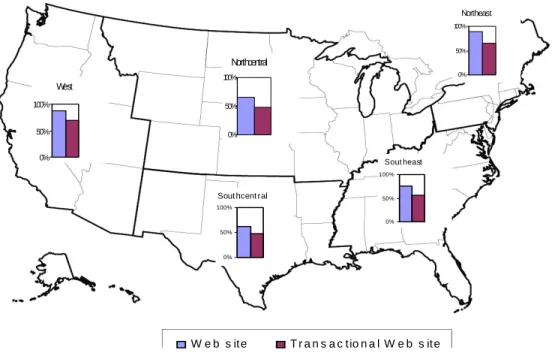
W e b s ite T r a n s a c tio n a l W e b s ite West 0% 50% 100% Sout heast 0% 50% 100% Northcentral 0% 50% 100% Northeast 0% 50% 100%
Sout hcent ral
0% 50% 100%
Figure 2: Regional Adoption for Internet Banking (2003)
of the US in 2003.3 The Northeast and the West have the highest adoption rates,
while the central regions of the country have the lowest. Also banks with large size
tend to adopt IB earlier. In 2003, 96 percent of banks with assets over $300 million
reported that they had a Website, compared to only 51 percent of banks with assets
under $100 million. These observations raise an important question: what explain
these variations of diffusion rates across banking groups and geographic regions? Meanwhile, the diffusion of IB has taken place in a continuously changing
environ-ment of US banking industry. Over the past decade, several reforms of US banking
regulatory framework were introduced and expected to affect the size distribution of
banks. In particular, the Riegle-Neal Interstate Banking and Branching Efficiency
Act was passed in September 1994. The act allows banks and bank-holding compa-3Data Source: Call Report (2003).
nies to freely establish branches across state lines. This new flexibility in branching regulation has opened the door to the possibility of substantial geographical
consol-idation in the banking industry. As a result, there has been a strong trend towards
higher average bank size (Figure 1). This suggests further interesting questions: if
bank size is an important factor in the adoption of IB, then how much has banking
deregulation affected IB adoption? At the same time, how much, if any, has adoption
of IB influenced the increase of average bank size?
1.2
The Hypothesis
Motivated by the aforementioned observations and questions, this paper tries to
pro-vide a general framework to study, theoretically and empirically, the endogenous
diffusion and impact of Internet Banking. The theory suggests that when a cost-saving technological innovation, e.g. IB, is initially introduced, large banks have an
advantage to adopt itfirst and enjoy further growth of size. Over time, due to
environ-mental changes (demand change, technological progress and industry deregulation),
the innovation gradually diffuses into smaller banks. As a result, the aggregate bank
size distribution increases stochastically towards a new steady state, and there are
important interactions between the IB adoption and growth of average bank size. Applying the theory to a panel study of Internet Banking diffusion across 50 US
states, we examine the technological, economic and institutional factors governing
the process. Using simultaneous-equation regressions, we are able to disentangle the
complex interrelationship between IB adoption and growth of average bank size, and
explain the variation of diffusion rates across US geographic regions.4
4In our empirical study, we use state-level aggregate data to estimate the IB adoption and bank size distribution. We only include state-chartered banks in our sample to avoid the complication of
1.3
Related Literature
Several studies have looked at Internet and related technology diffusion in the banking
industry. Courchane, Nickerson and Sullivan (2002) develop and estimate a model
for IB adoption at the early stages when there is considerable uncertainty about
consumers’ demand. Theyfind that relative bank size and demographic information predictive of future demand positively influence IB adoption. Furst, Lang, and Nolle
(2000) estimate a logit model for the determinants of IB adoption in a sample of
national banks. They find that larger banks are more likely to adopt IB as well
as banks are younger, better performing, located in urban areas, and members of a
bank holding company. Some other studies analyze the reverse effect of technology
on bank performance but obtain mixed results. Sullivan (2000) studies performance characteristics, including costs and profitability, of early adopters of IB and finds
little difference from non-adopters. Berger and Mester (2003)find that banks enjoyed
rising profits during the 1990s, and attribute this to banks’ increasing market power
gained by adopting new technologies. However, few of the existing studies have
explicitly considered the endogenous interactions between technology adoption and
bank performance measures.
This paper is afirst attempt to study the diffusion and impact of Internet Banking
with an equilibrium structural model. Built upon the recent work of Wang (2004)
and Olmstead and Rhode (2001), we refine the popular threshold diffusion model to
account for the interaction between technology adoption andfirm size. Our theory
ex-plicitly considers the heterogeneity of banks’ productivity and derives an empirically
plausible bank size distribution. Based on that, we then characterize the endogenous interstate banking. The state-chartered banks count for 75% of total commercial banks in the US, and they can be reasonally assumed to mainly serve the home states.
diffusion of IB and its reverse impact on the average bank size. Using the theory to construct a simultaneous-equation estimation that applies to a new dataset of IB
diffusion across 50 US states, the empirical results confirm our theoreticalfindings.
The approach that we develop in the paper goes far beyond the Internet Banking
by providing a general framework to study technology diffusion and evolution offirm
size distribution. Hence, it is also connected to a broad literature in related fields,
namely theories of industry dynamics (Hopenyahn 1992, Jovanovic and MacDonald
1994, Klepper 1996),firm size distribution (Lucas 1979, Sutton 1997, Axtell 2000) and studies of technology diffusion (Griliches 1957, Mansfield 1961, David 1969, Davies
1979, Manuelli and Seshadri 2003, Comin and Hohijn 2004).
1.4
Road Map
The paper is organized as follows. Section 2 presents the model, in which we study
competitive industry dynamics with endogenous technology diffusion. In particular,
we explore the dynamic interactions between technology adoption and change of bank
size distribution. Section 3 applies the model to a panel study on the diffusion of
Internet Banking across 50 US states. Using simultaneous-equation regressions, we
disentangle the complex interrelationship between IB adoption and growth of average bank size, and explain the variation of diffusion rates across US geographic regions.
Section 4 offersfinal remarks.
2
The Model
In this section, we construct a theoretical model to study the diffusion and impact of
2.1
Environment
The industry is composed by a continuum of banks which produce a homogenous
product — banking service. Banks behave competitively, taking market prices as
given. We assume banks are heterogenous in the cost of production, which causes
size differences across banks. At a point of time t, the aggregate demand takes a simple form — the consumers are willing to pay Pt for the total amount Qt of the
output. Over time, the demand Pt andQt might be shifted by economic forces, such
as changes in population, income or substitute services.5
2.2
Pre-Innovation Equilibrium
Before the technology innovation arrives, the industry is at a steady state. Taking
prices as given, each individual bank maximizes profit using the existing technology:
π0 =M ax
y0
P y0−αy0β
whereπ0 is profit,P is price, y0 is output, andα >0andβ >1 are cost parameters.
Solving the maximization problem, we have
y0 = (
P αβ)
1
β−1. (1)
Given individual bank’s heterogeneity of productivity, e.g. α, there is a bank size
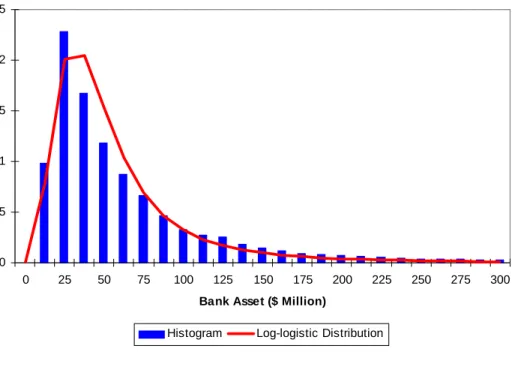
distribution G. Historically, bank size y0 fits well with a log-logistic distribution6,
5For simplicity, we assume consumers have inelastic demand so thatP and Qare exogenously determined. In fact, this is not an unreasonable assumption given our focus on state-chartered banks, a subsample of the banking population.
6We pick the log-logistic distribution here is not only because it serves as an easily tractable representative of the larger group of positively skewed distributions, but also because it connects our study to the typically observed logistic diffusion curves. See Wang (2004) for a detailed discussion.
0 0.05 0.1 0.15 0.2 0.25 0 25 50 75 100 125 150 175 200 225 250 275 300
Bank Asset ($ Million)
Fr e q u e nc y
Histogram Log-logistic Distribution
Figure 3: Bank Size Distribution (State-Chartered Banks, 1990)
whose cdf function is given as
Gy0(x) = 1−
1
1 +b1xb2
(2)
with the mean E(y0) and Gini coefficientg given as
E(y0) =b− 1/b2 1 Γ(1 + 1 b2 )Γ(1− 1 b2 ), g = 1 b2
where Γdenotes the gamma function Γ(μ)≡R0∞tμ−1exp(
−t)dt.
Rewriting the log-logistic distribution into a more intuitive form, we have
Gy0(x) = 1−
1
1 + (ηx/E(y0))1/g
(3)
where η=Γ(1 +g)Γ(1−g).
Figure 3 presents an example fitting the log-logistic distribution to the size
fre-quency of US state-chartered banks in 1990. As can be seen, the log-logistic
At equilibrium, aggregate demand equals supply, so that
N
Z ∞
0
y0dG(y0) =Q
where N is the total number of banks.
Notice that the assumption of log-logistic size distribution is robust to changes of
the market environment. For example, any shocks to the priceP and the mean bank
productivity7 E(α1−1β)only affect the mean of the size distribution but nothing else;
any shocks to the total demandQ only affect the number of banks N through entry and exit, but not the size distribution.
2.3
Post-Innovation Equilibrium
2.3.1 Individual Bank Decision
At timeT, the technological innovation, Internet Banking, becomes available.
There-after, at each period an individual bank maximizes profit and decides whether to
adopt the innovation or not ( 0= do not adopt, 1= adopt):
π=M ax{π0, π1} with π0 =M ax y0 P y0 −αy0β; π1 =M ax y1 P y1− α γy β 1 −k
whereγ is the cost saving by adopting the innovation,kis the period cost of adoption.
Solving the maximization problem, we have
y0 = ( P αβ) 1 β−1 ; π 0 = β−1 β P y0; y1 = ( γP αβ) 1 β−1 ; π 1 = β−1 β P y1 −k.
7Givenβ >1,α1−1β decreases withα. Hence,α
1
0 20 40 60 80 100 1999 2000 2001 2002 2003 2004 A d opt ion R a te % <$25 $25-$100 $100-$300 $300-$1000 >$1000
Figure 4: Diffusion of Web Sites by Bank Assets (Million)
An individual bank will adopt IB if π1 ≥π0, and there is a threshold size y0∗ for
adoption:
π1 =π0 =⇒y0∗ =
k
P(β−β1)(γβ−11 −1)
.
The size requirement for adoption suggests that large banks have an advantage
in adopting the innovation. Using bank assets as a size approximation, we show in
Figure 4 that it is indeed what happened in the diffusion of Internet Banking.8
2.3.2 Aggregate Adoption
Given the log-logistic bank size distributionGdefined in Equation 3 and the threshold
y∗
0 for adoption, the aggregate adoption rate of the IB innovation is :
F = 1−Gy0(y ∗ 0) = 1 1 + (ηy∗ 0/E(y0))1/g . (4)
Recall y0 = ( P αβ) 1 β−1; y∗ 0 = k P(β−β1)(γβ−11 −1) .
Then Proposition 1 follows.
Proposition 1 The adoption rateF increases with consumer demandP, mean bank
productivity E(α1−1β), cost saving γ, but decreases with adoption cost k.
Proof. Equation 4 suggests that ∂F/∂P > 0, ∂F/∂E(α1−1β) > 0, ∂F/∂γ > 0 and
∂F/∂k <0.
2.3.3 Average Bank Size
Notice E(y0) is not something directly observable. The observed mean bank size is
indeed E(y) = Z y∗ 0 0 y0dG(y0) + Z ∞ y∗ 0 y1dG(y0) =E(y0) + [γ 1 β−1 −1] Z ∞ y∗ 0 y0dG(y0).
Given that y0 takes a log-logistic distributionG, we have
Z ∞
y∗ 0
y0dG(y0) =E(y0)[1−β(1 +g,1−g;G(y∗0))]
where β is the incomplete beta function defined as
β(a, b;x)≡ Γ(a+b) Γ(a)Γ(b) Z x 0 ta−1(1−t)b−1dt with a >0, b >0, x >0, β(a, b; 0) = 0 and β(a, b; 1) = 1.
Therefore, the observed mean bank size can be derived as follows
E(y) =E(y0){1 + [γ
1
β−1 −1][1−β(1 +g,1−g; 1−F)]}. (5)
Proposition 2 The mean bank sizeE(y) increases with consumer demandP, mean bank productivityE(α1−1β), cost saving γ, but decreases with adoption cost k.
Proof. Given Proposition 1, Equation 5 suggests that∂E(y)/∂P >0,∂E(y)/∂γ >0,
∂E(y)/∂E(α1−1β)>0and ∂E(y)/∂k <0.
2.4
Industry Dynamics and Long-run Equilibrium
Equations 4 and 5 describe the post-innovation industry equilibrium at any point of
time. Notice that we have so far omitted time subscripts of all variables. To discuss the industry dynamics, we now make them explicit. As a result, we are going to see
that the diffusion path closely follows a logistic curve.
In fact, over time, consumer demand Pt may change with income or substitute
services, and mean bank productivityE(α
1 1−β
t ), IB cost savingγtand IB adoption cost
ktmay change with banking deregulation and technology progress. Taking these time
changes into account, let us consider a simple law of motion with constant growth as follows Pt =P0ezpt; E(α 1 1−β t ) =E(α 1 1−β 0 )e zαt; γ 1 β−1 t −1 = (γ 1 β−1 0 −1)e zγt; k t=k0ezkt.
Then, the diffusion path of IB can be derived from Equation 4
Ft = 1 1 + (ηy∗ 0,t/E(y0,t))1/g = 1 1 + [ηy∗ 0,0/E(y0,0)]1/ge 1 g{zk−zα−zγ−(ββ−1)zp}t . (6)
We may compare the diffusion formula derived here with the traditional logistic
model. The logistic model, based on a behavioral assumption of social contagion, assumes that the hazard rate of adoption rises with cumulative adoption
˙ Ft 1−Ft =vFt=⇒Ft = 1 [1 + (F1 0 −1)e −vt] (7)
where Ft is the fraction of potential adopters who have adopted the product at time
t, and v is a constant contagion parameter.
Comparing Equation 6 with Equation 7, we realize that our diffusion formula is
equivalent to the logistic model under very reasonable assumptions. In particular,
the diffusion parameters traditionally treated as exogenous terms now have clear
economic meanings: the contagion parameterv is determined by the growth rates of
consumer demand, industry deregulation, technology progress; the initial condition
F0 is the fraction of banks thatfind it profitable to adopt the innovation at the initial
period: v= ( β (β−1)zp+zγ+zα−zk)/g; F0 = 1 1 + [ηy∗ 0,0/E(y0,0)]1/g .
Over time, as more and more banks adopt the innovation, the mean bank size keeps rising and the aggregate size distribution of banks increases stochastically to a
new steady state. In the long run, as all banks adopt the innovation, the cumulative
distribution of bank size converges toGy1,t(x)which is still a log-logistic distribution
but with a higher mean.
Gy1,t(x) = 1− 1 1 + (Γ(1+Eg()yΓ(1−g) 1,t) x) 1/g; E(y1,t) =E(y0,t)γ 1 β−1.
Figure 5 illustrates the industry dynamic path. Before the IB innovation arrives,
the banking industry stays at a pre-innovation size distribution, drawn with a dotted
green line. After the IB innovation, in the long run, the banking industry converges to
a post-innovation long-run size distribution, drawn with a solid blue line. In between,
the banking size distribution is at a transitional path, drawn with a dashed red line. During the transition, at a point of time t, there is an critical size requirement y∗
0,t, which splits the size distribution into two parts. For banks with size y0,t ≥y0∗,t, the size distribution resembles the post-innovation long-run distribution for the range
Bank Size y Fr e que nc y G '( y ) y*0,t Pre-Innovation Distribution Post-Innovation Long-run Distribution Transitional Distribuion Maximum Size of Nonadoptor γ1/(ß-1)y* 0,t Minimum Size of Adopter
Figure 5: Illustration of the Industry Dynamics
y1,t > γ
1
β−1y∗
0,t, while for banks with size y0,t < y0∗,t the size distribution resembles the pre-innovation one. Over time, y∗
0,t falls due to environmental changes (demand change, technology progress and banking deregulation). As a result, the IB innovation
diffuses into smaller banks and the bank size distribution gradually converges to the post-innovation long-run distribution.
3
Empirical Study
In this section, we apply the theoretical model to a panel data of US banking industry
and study the diffusion and impact of Internet Banking.
The data we use covers Internet Banking adoption (Informational Websites and Transactional Websites) among state-chartered banks across 50 US states for years
2003 and 2004, which includes about 5600 out of the total 7500 commercial banks in the US. The reason that we choose state-chartered banks is because it is more
reasonable to define the state that they receive the charter as the market they serve.
The reason that we choose the years 2003 and 2004 is because 2003 is the first year
when depository institutions were required to report their transactional Websites.
3.1
Simultaneous Equations
The diffusion and impact of IB can be characterized by a simultaneous equation
system, which includes an adoption equation and a size equation as follows.
Recall Equation 1 F = 1−G(y0∗) = 1 1 + (ηy∗ 0/E(y0))1/g .
It can be rewritten into a log-linear form:
gln(1 F −1) = lnη+ ln β β−1 + lnk−lnP −ln(γ 1 β−1 −1)−lnE(y 0). (8) Recall Equation 2 E(y) =E(y0){1 + [γ 1 β−1 −1][1−β(1 +g,1−g; 1−F)]}.
An empirical approximation of Equation 2 can be written as
lnE(y) = lnE(y0)−b1[gln(
1
F −1)] +b2ln(γ
1
β−1 −1). (9)
Therefore, Equation 8 and 9 imply
gln(1
F −1) =a0−a1lnE(y) +a1[(b2−1) ln(γ
1
β−1 −1)−lnP + lnk] (10)
Also, Equation 1 suggests y0 = ( P αβ) 1 β−1 =⇒lnE(y 0) = 1 β−1lnP − 1 β−1lnβ+ lnE(α 1 1−β).
Hence we can rewrite Equation 9 as
lnE(y) =b0−b1[gln( 1 F −1)] +b2ln(γ 1 β−1 −1) + 1 β−1lnP + lnE(α 1 1−β) (11) where b0 = 1−1βlnβ.
The two Equations 10 and 11 are determined simultaneously and have to be
estimated with simultaneous-equation regressions. Since the variablekis in Equation 10 but not Equation 11, and E(α1−1β) is in Equation 11 but not Equation 10, they
can be used to define exclusion restrictions and identify structural parameters.
3.2
Empirical Specifications
In the empirical study, we estimate the following simultaneous equations9 based on
Equations 10 and 11 using state-level panel data 2003-2004, where each state is
indexed byj and each year is indexed by t:
gj,tln( 1−Fj,t Fj,t ) =a0+a1ln(E(y)j,t)+ X i ailn(Xi,j,t)+ X l alln(Il,j,t)+εj,t (Adoption) ln(E(y)j,t) =b0+b1[gj,tln( 1−Fj,t Fj,t )] +X i biln(Xi,j,t) + X l blln(Sl,j,t) +μj,t (Size)
• F is state-level adoption of IB (All Websites and Transactional Websites sepa-rately); g is the Gini coefficient of state-chartered bank size distribution; 9Olmstead and Rhode (2001) had a similar regression setup in their study of diffusion of tractor, but did not rationalize it with an explicit theoretical model.
• E(y) is a measure of state-level average bank size;
• X are variables shared in both equations, e.g. variables affectingP andγ;
• I are variables only in theAdoption equation, e.g. variables affecting k only;
• S are variables only in the Size equation, e.g. variables affectingE(α1−1β)only.
The dependent variables in the two equations are as follows (Detailed explanations
and sources of empirical variables are summarized in Table 1 in the Appendix ).
(1) Log odds ratio for IB adoption adjusted by the Gini coefficient, constructed
using the following variables: TRANSAVE — Adoption rate for Transactional Web-sites; WEBAVE — Adoption rate for All Websites (informational or transactional) ;
GINIASST— Gini coefficient for bank assets;
(2) Average Bank Size, constructed by ASSTAVE — Bank assets10.
As we have seen in the theory, there are four groups of exogenous variables:
consumer demand P, mean bank productivity E(α1−1β), IB cost saving γ and IB
adoption cost k. We have to find relevant empirical variables to proxy them. The following is a preliminary grouping.
(1) Consumer Demand P: METROAVE — Ratio of banks in metropolitan areas
to all banks in state; LNSPAVE — Specialization of lending to consumers (consumer
loans plus 1-4 family mortgages / total loans); PCY — Income per capita; POPDEN
— Population density;
10Using Bank deposits as an alternative measure of bank size, we get very similar regression results. See Tables 3(dep)-8(dep) in the Appendix.
(2) Mean Bank Productivity E(α1−1β): AGEAVE — Average age of banks;
IN-TRAREG — Indicator variable for whether the state had intrastate branching re-strictions after 1995; BHCAVE — Ratio of banks in bank holding companies to total
banks; DEPINTST — Ratio of deposits in out-of-state banks to total deposits; ASST90
— Bank assets in 1990;
(3) IB Cost Saving γ: INETADOPT — Household access rate for the Internet;
(4) IB Adoption Costk: IMITATE — Years since thefirst bank in the state adopted
a transactional Website; WAGERATIO — Wage ratio of computer analyst to teller; (5) Region dummies and Years.
Notice that the above is a preliminary grouping of variables. Some of the vari-ables may belong to more than one group. Take INETADOPT for example: if more
households have access to the Internet, local banks may get more cost savings γ
from adopting IB. However, the Internet access also allows the households to reach
non-local banking services, e.g. out-of-state banks, then may also lower the demand
P for local banking service. Another example is AGEAVE: more established banks typically achieve higher productivityα1−1β, so may have higher incentive to adopt IB.
However, they may also face higher IB adoption cost k compared to younger banks
since they have to adapt the IB to their legacy system. Therefore, we have to be
cautious to design and interpret our empirical study.
In particular, making the exclusion restrictions that define I and S becomes a
matter of economic judgement. We include two variables in I: the number of years
since thefirst bank in the state adopted a transactional Website (IMITATE) and the ratio of computer analyst wage to teller wage (WAGERATIO). They are expected
to affect the bank size only through the IB adoption. In S, we use four variables:
1995 (INTRAREG); the ratio of banks in bank holding companies to total banks (BHCAVE); the ratio of deposits in out-of-state banks to total deposits (DEPINTST);
and bank assets in 1990 (ASST90). They are expected to affect the adoption of IB
only through their effects on average bank size.
3.3
Data and Estimation Details
We run simultaneous-equation regressions on a sample panel dataset. The sample
consists of state-chartered, full service retail banks across 50 states of the US. Table
2 in the Appendix shows summary statistics for all empirical variables.
As the theory suggests, we use Gini-adjusted log-odds ratio as the dependent
variable. However, by the year 2004 four states had achieved full adoption of
trans-actional Websites, so that the log-odds ratio can not be calculated. Hence, there are 92 observations in the transactional IB estimation instead of 100. For the same
reason, there are 82 observations in the all IB (informational or transactional)
esti-mation. Also, for most empirical variables used in the estimation, we take the log
transformation and prefix the variables with “ln” in the notation.
To get robust estimates, we conduct regressions using various definitions of
depen-dent variables as well as different model setups. For the dependent variables, we use Transactional Websites and All Websites (informational or transactional) as
alterna-tive measures of IB adoption, and use Bank Assets and Bank Deposits as alternaalterna-tive
measures of bank size. For the regressions, we estimate three different setups
includ-ing a simultaneous-equation model on a pooled cross-section and time-series data,
a random-effect simultaneous-equation panel model, and simple OLS regressions on
two structural equations. Tables 3-5 in the Appendix report regression results with three model setups using Transactional Websites and Bank Assets as dependent
vari-ables; Tables 6-8 use All Websites (informational or transactional) and Bank Assets as dependent variables; Tables 3(dep)-8(dep) repeat the regressions in Tables 3-8 but
use Bank Deposits instead of Bank Assets as the measure of bank size.
3.4
Estimation Results
In the following discussion, we mainly refer to results in Table 3-5, which use Trans-actional Websites and Bank Assets as dependent variables. Results in other tables
are similar, and are used as supporting evidence whenever necessary.
Looking first at Table 5, which reports simple OLS regression results on two
structural equations without taking care of the potential simultaneity problem. The
coefficients of IB adoption (lnTRANODDS*GINIAVE) and bank size (lnASSTAVE)
are both found to be statistically significant. It confirms our hypothesis that IB adop-tion and bank size are simultaneously determined, and suggests that OLS estimates
may be inconsistent. To obtain consistent estimates, we use simultaneous-equation
techniques and report results in Tables 3-4. The main results are similar in the two
tables and we would therefore focus discussion on Table 3.
Table 3 presents results of estimating the model using instrumental variables where
the IB adoption rate is measured with Transactional Websites. For completeness we present estimates of reduced form equations but will focus on discussing estimated
structural equations. Overall, the structural model has a goodfit with a R-square of
72 percent for the adoption equation and 78 percent for the size equation. Most of
the signs of estimated coefficients, and all of those that are statistically significant,
are consistent with our theoretical predictions.
We turnfirst to the structural equation for IB adoption (Table 3, column 3). The coefficient on the fitted value of lnASSTAVE is negative and statistically different
from zero. An increase in a state’s average bank assets is associated with a fall in the odds ratio for transactional Website adoption. Consistent with our theoretical
model, this implies a rise in the adoption rate.
In the structural equation for average bank assets (Table 3, column 4), the coeffi
-cient on the fitted value of lnTRANSAVE*GINIASST is also negative, as expected,
though not statistically different from zero. However, we should have confidence with
the negative effect, since the simple OLS regressions in Table 5 have shown that zero
effect is not consistent with the data and we consistently get negative coefficient esti-mates using all alternative regressions. Moreover, when adoption rates are measured
using All Websites (informational or transactional), the coefficient turns statistically
significant (Table 6, column 4).
There is a negative coefficient on lnIMITATE (Table 3, column 3). The result
implies that the longer the state has had a bank with a Transactional Website, the
higher the state’s Internet Banking adoption rate. The leadership of the early adopter may have helped prepare other banks and customers to use Internet Banking through
lowering the adoption cost, financially or perceptionally.
Estimates show strong persistence in the asset size distribution across states. The
estimated positive coefficient on lnASST90 (Table 3, column 4), which is statistically
different from zero, implies that the average bank assets of a state in 1990 is a good
predictor of average assets in 2003 and 2004. Estimates suggest that interstate com-petition (lnDEPINTST) has a negative influence on the asset size of a state’s banks.
Although the effect is not statistically significant, it turns significant when adoption
rates are measured using All Websites (informational or transactional) (Table 6,
col-umn 4). Neither intrastate branching restrictions (INTRAREG) after 1995 nor BHC
structural equation, but BHC membership is shown to have significantly positive effects on IB adoption and bank assets in the reduced form regressions.
Explanatory variable that describe bank characteristics have a mixed impact on
Website adoption and average asset size. Our measure of the location of banks in
metropolitan areas (lnMETRO) seems to positively affect both bank size and IB
adop-tion, though not statistically significant in either structural equation. The significant
negative coefficient on lnLNSPAVE in the asset size equation (Table 3, column 4)
im-plies that greater specialization of a state’s banks in consumer lending is associated with a smaller average bank assets. Perhaps banks achieve greater average size with
lending focused on other areas, such as commercial loans. The significant negative
coefficient on lnLNSPAVE in the Website adoption equation suggests that greater
spe-cialization of a state’s banks in consumer lending is associated with a higher adoption
rate. This is consistent withfindings that early bank Websites offered services aimed
at retail customers and later added features useful to businesses (Sullivan (2004)). The average age of a state’s banks is significantly related to both Website
adop-tion and asset size. The positive coefficient on lnAGEAVE in the Website adoption
equation implies that as the average age of a state’s banks rises then the adoption rate
falls. This results is consistent with previous findings that denovo banks were more
likely to adopt Internet Banking than other banks (Furst, Lang, and Nolle (2000);
Sullivan (2000)). New banks mayfind it cheaper to install Internet Banking technol-ogy in a package with other computer facilities compared to older banks who must
add Internet Banking to legacy computer system. Many new banks may also
pur-sue consumers with demographics that favor Internet Banking and therefore adopt
appropriate technology.
of a state have expected signs and are statistically significant for both the Website adoption and the asset size equation. A state’s per capita income (lnPCY) is
pos-itively related to the average asset size of banks but is not significantly related to
Website adoption. Population density (lnPOPDEN) is also positively related to asset
size but negatively related to Website adoption. The latter result implies that
adop-tion of Internet Banking is higher where populaadop-tion is less dense, which is consistent
with a higher demand for Internet Banking in locations with higher cost of travel to
bank branches.
Finally, access of households to the Internet (lnINETADPT) is statistically
sig-nificant in explaining both Website adoption and asset size in sample states. Greater
household access to the Internet is associated with a higher Website adoption rate, as
expected. On these estimates, greater household access to the Internet is negatively
related to a state’s average bank assets. A possible explanation is that once on the
Internet a household has an opportunity to form a relationship with bank outside of their home state, which may have a negative impact on the size of banks in their
home state.
3.5
Empirical Findings on IB Di
ff
usion
The estimation results have confirmed our theoretical findings. First, there are
im-portant interrelationship between IB adoption and average bank size. Quantitatively,
as shown in Table 3, a 10 percent increase in average bank size would decrease the
Gini-adjusted adoption odds ratio by about 1.4 percent, and a 10 percent decrease of
adoption odds ratio would increase the average bank size by about 3.7 percent. The
effects become even stronger when IB adoption rates are measured using All Websites (informational or transactional).
Since the IB adoption and bank size are endogenous variables, they are determined by underlying technological, economic and institutional factors. In the theory, we have
grouped those factors into four basic categories that affect, respectively, consumer
demandP, mean bank productivity E(α1−1β), IB cost savingγ and IB adoption cost
k. The empiricalfindings then reveal their quantitative effects.
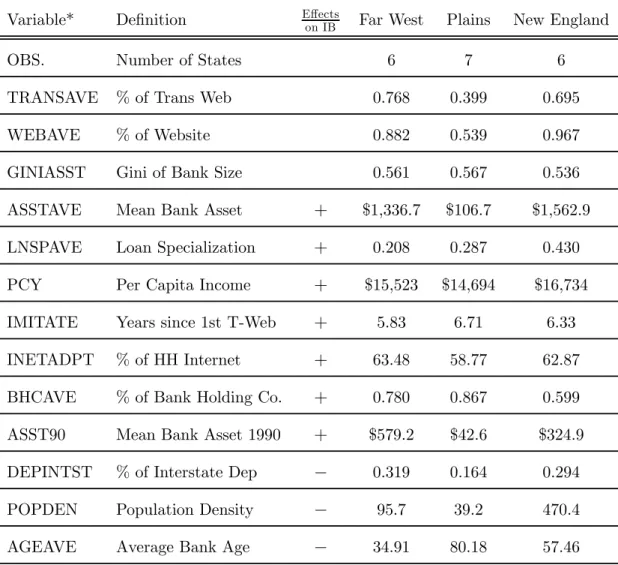
Table 9a: Mean Values of Selected Variables Across Regions (Far West, Plains and New England 2003)
Variable* Definition Eon IBffects Far West Plains New England
OBS. Number of States 6 7 6
TRANSAVE % of Trans Web 0.768 0.399 0.695
WEBAVE % of Website 0.882 0.539 0.967
GINIASST Gini of Bank Size 0.561 0.567 0.536
ASSTAVE Mean Bank Asset + $1,336.7 $106.7 $1,562.9
LNSPAVE Loan Specialization + 0.208 0.287 0.430
PCY Per Capita Income + $15,523 $14,694 $16,734
IMITATE Years since 1st T-Web + 5.83 6.71 6.33
INETADPT % of HH Internet + 63.48 58.77 62.87
BHCAVE % of Bank Holding Co. + 0.780 0.867 0.599
ASST90 Mean Bank Asset 1990 + $579.2 $42.6 $324.9
DEPINTST % of Interstate Dep − 0.319 0.164 0.294
POPDEN Population Density − 95.7 39.2 470.4
AGEAVE Average Bank Age − 34.91 80.18 57.46
*See Table 1 for details of variable definitions and sources.
rates across US geographic regions? To be specific, why do the Northeast and the West have the highest IB adoption rates, while the central regions of the country
have the lowest? To answer this question, we present regional average of variables
that are found significantly affecting IB adoption in our regressions in Table 9a, in
which we use Far West, Plains and New England to represent the West, Central and
Northeast regions respectively.
The data in Table 9a shows that in 2003 the Plains region has a similar number
of states and a similar Gini coefficient of bank size distribution compared to the other two regions, but the average IB adoption rate in the Plains region was only
about half of that of the other two regions. Compared with the Far West and New
England, the Plains region has smaller mean bank size, lower per capita income,
lower household access to Internet and older bank vintages. All these factors appear
to have contributed to slow diffusion of Internet Banking.
However, at the same time, the data reject several alternative explanations of slow IB diffusion in the Central regions. In particular, it is not caused by the imitation of
early adopters, percentage of BHC membership, competition from out-of-state banks
or population density. In fact, all those factors work in favor of adopting Internet
Banking in the Central region.
In a similar way, we can also compare variations of IB diffusion rates between
any other regions. Average value of variables for all eight US regions are reported in Table 9 in the Appendix.
Interestingly, after we control for other factors, most regional dummies are not
statistically significant explaining bank size or IB adoption. One exception is the Far
West. Some regional fixed effect may have played significant roles in promoting IB
4
Final Remarks
This paper studies the endogenous diffusion and impact of Internet Banking. When a
cost-saving innovation, such as Internet Banking, is initially introduced, large banks
have an advantage to adopt it first and enjoy further growth of size. Over time,
due to environmental changes (demand change, technology progress and banking
deregulation), the innovation diffuses into smaller banks. As a result, the aggregate bank size distribution increases stochastically towards a new steady state, and there
exists important interactions between the IB adoption and the average bank size.
Applying the theory to a panel study of the diffusion of IB across 50 US states, we
examine the technological, economic and institutional factors governing the process.
Using simultaneous-equation regressions, we are able to disentangle quantitatively
the complex relationship between IB adoption and growth of average bank size, and explain the variation of IB diffusion rates across geographic regions. Wefind that the
factors significantly affecting IB adoption include mean bank size, per capita income,
household access to Internet, average bank age, bank loan specialization, imitation of
early adopters, percentage of BHC membership, competition from out-of-state banks
and population density. In particular, it is the first four factors that are primarily
responsible for the slower diffusion of Internet Banking in the Central region than the West and Northeast regions.
The theoretical and empirical approach that we develop in the paper goes far
beyond the Internet Banking. It indeed provides a general framework to study the
joint evolution of technology adoption and firm size distribution, and can be readily
References
[1] Axtell, Robert L. (2000). “Zipf Distribution of U.S. Firm Sizes,” Science, 293:
1818-1820.
[2] Berger, Allen and Robert DeYoung (2002). “Technological Progress and the
Geo-graphic Expansion of the Banking Industry,”Finance and Economics Discussion
Series, 2002-31, Federal Reserve Board.
[3] Berger, Allen and Loretta Mester (2003). “Explaining the Dramatic Changes of
Performance of U.S. Banks: Technological Change, Deregulation and Dynamic
Changes in Competition,” Journal of Financial Intermediation, Vol. 12(1), pp
57-95.
[4] Comin, D. and Hohijn B., (2004). “Cross-Country Technological Adoption: Mak-ing the Theories Face the Facts,”Journal of Monetary Economics, January 2004,
pp. 39-83.
[5] Courchane, Marsha, David Nickerson and Richard J. Sullivan, (2002).
“Invest-ment in Internet Banking as a Real Option: Theory and Tests.” The Journal of
Multinational Financial Management, 12 (4-5), Oct.-Dec., pp. 347-63. [6] David, Paul, (1969). “A Contribution to the Theory of Diffusion,” mimeo.
[7] Davies, Stephen. (1979).The Diffusion of Process Innovations,Cambridge
Uni-versity Press.
[8] Furst, Karen, William Lang, and Daniel Nolle (2001). “Internet Banking in the
U.S.: Landscape, Prospects, and Industry Implications,” Journal of Financial
[9] Fisk, Peter R., (1961). “The Graduation of Income Distributions,”Econometrica, 29, 2, 171-185.
[10] Griliches, Zvi, (1957). “Hybrid Corn: An Exploration in the Economics of
Tech-nological Change,”Econometrica, 25, (Oct.), 501-522.
[11] Harker, Patrick and Baba Prasad (1997). “Mxamining the Contribution of
Infor-mation Technology Toward Productivity and Profitability in U.S. Retail
Bank-ing,”Working paper 97-09, Wharton Financial Institutions Center, The Wharton
School.
[12] Hopenhayn, H. A. (1992). “Entry, Exit, and Firm Dynamics in Long Run Equi-librium,”Econometrica, 60(2): 1127-1150.
[13] Jovanovic, Boyan and G. M. MacDonald, (1994). “The Life Cycle of a
Compet-itive Industry,”Journal of Political Economy, 102 (Apr.), 322-347.
[14] Klepper, Steven, (1996). “Entry, Exit, Growth, and Innovation over the Product
Life Cycle,” American Economic Review, 86 (June), 562-583.
[15] Lucas, Robert E., (1978). “On the Size Distribution of Business Firms,” The
Bell Journal of Economics, 9, 2, 508-523.
[16] Mansfield, Edwin, (1961). “Technical Change and the Rate of Imitation,”
Econo-metrica, 29 (Oct.), 741-766.
[17] Mansfield, Edwin, (1962). “Entry, Gibrat’s Law, Innovation, and the Growth of
Firms,”American Economic Review, 52 (Dec.), 1023-51.
[18] Manuelli, Rodolfo and Ananth Seshadri, (2003). “Frictionless Technology Diff
[19] Olmstead, Alan and Paul Rhode, (2001). “Reshaping the Landscape: The Im-pact and Diffusion of the Tractor in American Agriculture, 1910-1960,” The
Journal of Economic History, Vol. 61, No. 3. p663-698.
[20] Rogers, Everett (1995). Diffusion of Innovations, 4th Edition. Free Press, New
York.
[21] Stiroh, Kevin (2002). “Information Technology and the U. S. Productivity Re-vival: What do the Industry Data Say?” American Economic Review, Vol. 92(5),
pp 1559-1576.
[22] Sullivan, Richard, (2004). “Payment Services and the Evolution of Internet
Bank-ing,”Payments System Reserch Briefing, (Aug.), Federal Reserve Bank of Kansas
City.
[23] Sullivan, Richard, (2000). “How Has the Adoption of Internet Banking Affected
Performance and Risk in Banks? A Look at Internet Banking in the Tenth
Federal Reserve District,”Financial Industry Perspective, Federal Reserve Bank
of Kansas City.
[24] Sutton, John, (1997). “Gibrat’s Legacy,”Journal of Economic Literature, 35(1), pp. 40-59.
[25] Wang, Zhu. (2005) “Technology Innovation and Market Turbulence: A Dotcom
Example,”Working Paper, Payments System Research Department, Federal
Re-serve Bank of Kansas City.
[26] Wang, Zhu. (2004) “Learning, Diffusion and Industry Life Cycle,”Ph.D. Disser-tation, Department of Economics, University of Chicago.
Table 1
Empirical Variable Definitions and Sources
Variable name Definition Source
TRANSAVE Adoption rate for transactional Web sites Call Report
TRANODDS Odds ratio for adoption of transactional Web sites Call Report
WEBAVE Adoption rate information and transactional Web sites Call Report
WEBODDS Odds ratio for adoption of information and transactional Web sites Call Report
GINIASST Gini coefficient for bank assets Call Report
ASSTAVE Bank assets Call Report
METROAVE Ratio of banks in metropolitan areas to all banks in state Call Report LNSPAVE Specialization of lending to consumers (consumer loans plus 1-4
family mortgages / total loans)
Call Report
PCY Income per capita (in 1980-82 dollar) Statistical Abstract of the United States
POPDEN Population density Statistical Abstract
of the United States IMITATE Years since the first bank in the state adopted a transactional Web
site
Online Banking Report
AGEAVE Age of banks Call Report
INETADOPT Household access rate for Internet Statistical Abstract
of the United States
WAGERATIO Ratio of computer analyst wage to teller wage Bureau of Labor
Statistics
INTRAREG Indicator variable for whether the state had branching restrictions after 1995
FDIC
BHCAVE Ratio of banks in bank holding companies to total banks Call Report DEPINTST Ratio of deposits in out-of-state banks to total deposits FDIC Summary of
Deposits ASST90 Bank assets in 1990 Call Report
YEAR Year Call Report
SE Indicator variable for states located in the Southeast (AL, AR, FL,
GA, KY, LA, MS, NC, SC, TN, VA, WV)
Bureau of Economic Analysis
FARWEST Indicator variable for states located in the Far Western region (AK, CA, HI, NV, OR, WA)
Bureau of Economic Analysis
ROCKYMTN Indicator variable for states located in the Rocky Mountain region
(CO, ID, MT, UT, WY)
Bureau of Economic Analysis
SW Indicator variable for states located in the Southwest (AZ, NM,
OK, TX)
Bureau of Economic Analysis
NWENGLND Indicator variable for states located in New England (CT, MA, ME, NH, RI, VT)
Bureau of Economic Analysis
MIDEAST Indicator variable for states located Middle Eastern region (DC, DE, MD, NJ, NY, PA)
Bureau of Economic Analysis
GRTLAKE Indicator variable for states located in the Great Lakes region (IL,
IN, MI, OH, WI)
Bureau of Economic Analysis
Notes: data are for individual states. Data for banks are unweighted averages for those located in individual states. Selected banks were state-chartered, full-service, retail commercial banks.
Table 2 Summary Statistics
2003 2004
VARIABLE Obs Mean Std. Dev. Min Max Obs Mean Std. Dev. Min Max
TRANSAVE 50 0.573 0.166 0.277 1.000 50 0.671 0.169 0.353 1.000 TRANODDS 50 0.898 0.577 0.000 2.615 50 0.592 0.428 0.000 1.831 WEBAVE 50 0.757 0.162 0.443 1.000 50 0.813 0.153 0.471 1.000 WEBODDS 50 0.391 0.346 0.000 1.259 50 0.282 0.287 0.000 1.121 GINIASST 50 0.618 0.153 0.298 0.922 50 0.620 0.153 0.307 0.914 ASSTAVE* 50 $837.9 $1,648.0 $78.3 $9,485.8 50 $799.5 $1,292.7 $85.1 $6,023.8 METROAVE 50 0.759 0.190 0.264 1.000 50 0.763 0.190 0.264 1.000 LNSPAVE 50 0.365 0.120 0.130 0.609 50 0.355 0.120 0.124 0.591 PCY 50 $14,822 $1,819 $11,777 $19,816 50 $15,191 $1,881 $12,082 $20,412 POPDEN 50 187 256 1 1165 50 188 258 1 1173 IMITATE 50 6.700 1.111 4 9 50 7.700 1.111 5 10 AGEAVE 50 56.6 23.3 5.1 95.7 50 56.7 23.7 5.9 96.7 INETADPT 50 57.999 5.868 43.549 69.422 50 63.956 5.564 50.673 73.493 WAGERATIO 50 3.024 0.243 2.343 3.464 50 3.058 0.250 2.520 3.699 INTRAREG 50 0.240 0.431 0 1 50 0.240 0.431 0 1 BHCAVE 50 0.772 0.139 0.308 1.000 50 0.780 0.136 0.333 1.000 DEPINTST 50 0.278 0.187 0.002 0.741 50 0.328 0.201 0.003 0.840 ASST90* 50 $292.0 $504.4 $29.6 $2,451.2 50 $292.0 $504.5 $29.6 $2,451.2 YEAR 50 2003 0 2003 2003 50 2004 0 2004 2004 SE 50 0.240 0.431 0 1 50 0.240 0.431 0 1 FARWEST 50 0.120 0.328 0 1 50 0.120 0.328 0 1 ROCKYMTN 50 0.100 0.303 0 1 50 0.100 0.303 0 1 SW 50 0.080 0.274 0 1 50 0.080 0.274 0 1 NWENGLND 50 0.120 0.328 0 1 50 0.120 0.328 0 1 MIDEAST 50 0.100 0.303 0 1 50 0.100 0.303 0 1 GRTLAKE 50 0.100 0.303 0 1 50 0.100 0.303 0 1
Notes: Sample includes the 50 states in the U.S. See Table 1 for variable definitions and sources. *In millions.
Table 3
Simultaneous Equation Model of Adoption of Transactional Websites and Average Bank Assets Instrumental Variables Estimates
Reduced Forms Structural Equations
Dependent variable: lnTRANODDS*GINIAVE lnASSTAVE lnTRANODDS*GINIAVE lnASSTAVE
lnASSTAVE (fitted) -0.1445*
(0.0725)
lnTRANODDS*GINIAVE (fitted) -0.3662
(0.9122) lnIMITATE -0.5661** 0.1401 -0.4852** (0.2255) (0.4804) (0.2298) lnWAGERATIO -0.3157 2.2477* 0.1127 (0.3830) (1.1528) (0.4299) INTRAREG -0.0227 0.0893 0.0235 (0.0926) (0.2039) (0.2013) lnASST90 -0.1482 0.7778*** 0.6761*** (0.0954) (0.1545) (0.1920) lnBHCAVE -0.8057*** 1.1954* 0.9286 (0.2592) (0.6196) (0.9658) lnDEPINTST -0.0812** -0.1239* -0.1628 (0.0320) (0.0662) (0.1028) lnMETROAVE -0.2434 0.2373 -0.1904 0.1074 (0.2387) (0.4001) (0.1925) (0.4787) lnLNSPECAVE -0.2341 -0.4953 -0.3419* -0.7074* (0.1497) (0.4449) (0.1910) (0.4045) lnAGEAVE 0.3795*** 0.4946** 0.4183*** 0.6718** (0.1335) (0.2353) (0.1230) (0.3310) lnPCY 0.0279 2.0679** 0.3348 1.9618** (0.4447) (0.9207) (0.4843) (0.9646) lnPOPDEN 0.0734 0.2693* 0.1314* 0.3156** (0.0677) (0.1579) (0.0664) (0.1316) lnINETADPT -0.9300* -3.7095*** -1.6319*** -3.3892** (0.5556) (1.2342) (0.5284) (1.6507) SE -0.1455 0.5984** -0.1193 0.6322* (0.1471) (0.2734) (0.1735) (0.3703) FARWEST -0.5631*** 1.0452*** -0.4828** 0.8041 (0.1582) (0.2948) (0.1886) (0.5095) ROCKYMTN -0.0449 1.1088*** 0.0876 1.0561*** (0.1442) (0.3275) (0.1543) (0.3489) SW 0.1123 -0.0088 0.0221 0.1328 (0.1378) (0.2215) (0.1362) (0.2345) NWENGLND -0.0344 0.5222 0.1492 0.5050 (0.2037) (0.3833) (0.1757) (0.4010) MIDEAST -0.3224 -0.4515 -0.3767* -0.2785 (0.2612) (0.4362) (0.2209) (0.5260) GRTLAKE -0.0935 0.1138 -0.1394 0.2077 (0.1345) (0.2655) (0.1425) (0.2891) YEAR -0.0897 0.3355** -0.0588 0.2523 (0.0792) (0.1572) (0.0830) (0.1989) CONSTANT 183.89 -679.88** 121.09 -510.85 (159.48) (315.25) (167.23) (401.16) Observations 92 92 92 92 R-squared 0.77 0.79 0.72 0.78
Robust standard errors in parentheses. See Table 1 for variable definitions and sources. * significant at 10%; ** significant at 5%; *** significant at 1%.
Table 4
Simultaneous Equation Model of Adoption of Transactional Websites and Average Bank Assets
Random Effects Model using Generalized Least Squares
Structural Equations
Dependent variable: lnTRANODDS*GINIAVE lnASSTAVE
lnASSTAVE (fitted) -0.1449**
(0.0626)
lnTRANODDS*GINIAVE (fitted) -0.2222
(0.7756) lnIMITATE -0.4760* (0.2747) lnWAGERATIO 0.1526 (0.4484) INTRAREG 0.1698 (0.2970) lnASST90 0.8148*** (0.2272) lnBHCAVE 0.3925 (0.8277) lnDEPINTST -0.0586 (0.0852) lnMETROAVE -0.1896 0.5202 (0.2526) (0.7227) lnLNSPECAVE -0.2998 -0.0450 (0.2225) (0.5594) lnAGEAVE 0.4013*** 0.6698** (0.1329) (0.2671) lnPCY 0.3329 1.1476 (0.5310) (1.3452) lnPOPDEN 0.1256* 0.1512 (0.0729) (0.2174) lnINETADPT -1.6154*** -2.1535* (0.6180) (1.2558) SE -0.1347 0.3457 (0.2023) (0.5560) FARWEST -0.4750** 0.8040 (0.1975) (0.6440) ROCKYMTN 0.0740 0.6490 (0.1720) (0.5566) SW 0.0096 -0.1752 (0.1841) (0.5066) NWENGLND 0.1336 -0.0412 (0.2026) (0.6425) MIDEAST -0.3885* -0.5833 (0.2153) (0.7946) GRTLAKE -0.1511 0.0417 (0.1866) (0.5492) YEAR -0.0599 0.1995 (0.0772) (0.1771) Constant 123.44 -402.09 (153.95) (353.27) Observations 92 92 R-squared 0.72 0.76
Standard errors in parentheses. See Table 1 for variable definitions and sources.
Table 5
Single Equation Models of Adoption of Transactional Websites and Average Bank Assets
Ordinary Least Squares Estimates
Dependent variable: lnTRANODDS*GINIAVE lnASSTAVE
lnASSTAVE -0.1339** (0.0555) lnTRANODDS*GINIAVE -0.5603** (0.2537) lnIMITATE -0.4850** (0.2310) lnWAGERATIO 0.0962 (0.4221) INTRAREG 0.0199 (0.2030) lnASST90 0.6491*** (0.1810) lnBHCAVE 0.7741 (0.6094) lnDEPINTST -0.1778** (0.0823) lnMETROAVE -0.1987 0.0434 (0.1899) (0.4182) lnLNSPECAVE -0.3347* -0.7114* (0.1864) (0.4038) lnAGEAVE 0.4143*** 0.7154*** (0.1208) (0.2340) lnPCY 0.3255 1.9220* (0.4890) (0.9962) lnPOPDEN 0.1292* 0.3213** (0.0659) (0.1358) lnINETADPT -1.6011*** -3.5946*** (0.5312) (1.2315) SE -0.1308 0.5793* (0.1624) (0.3093) FARWEST -0.4957*** 0.7114** (0.1745) (0.3040) ROCKYMTN 0.0781 1.0382*** (0.1476) (0.3150) SW 0.0209 0.1319 (0.1360) (0.2382) NWENGLND 0.1350 0.4992 (0.1602) (0.3947) MIDEAST -0.3931* -0.3448 (0.2151) (0.4351) GRTLAKE -0.1494 0.1722 (0.1348) (0.2683) YEAR -0.0620 0.2237 (0.0843) (0.1576) Constant 127.46 -452.36 (169.87) (316.69) Observations 92 92 R-squared 0.72 0.78 Robust standard errors in parentheses. See Table 1 for variable definitions and sources.
Table 6
Simultaneous Equation Model of Adoption of Informational or Transactional Websites and Average Bank Assets
Instrumental Variables Estimates
Reduced Forms Structural Equations
Dependent variable: lnWEBODDS*GINIAVE lnASSTAVE lnWEBODDS*GINIAVE lnASSTAVE
lnASSTAVE (fitted) -0.2498**
(0.0969)
lnWEBODDS*GINIAVE (fitted) -1.3587**
(0.6613) lnIMITATE -0.7578** 0.6417 -0.4311 (0.3371) (0.5322) (0.2710) lnWAGERATIO -0.8403* 2.3330* -0.1374 (0.4718) (1.2836) (0.4608) INTRAREG -0.0307 0.1419 0.0648 (0.1135) (0.1811) (0.1486) lnASST90 -0.3958*** 0.8252*** 0.2794 (0.0925) (0.1637) (0.2745) lnBHCAVE -0.4848 -0.1173 -0.6859 (0.4422) (0.5407) (0.6379) lnDEPINTST -0.1131*** -0.0923 -0.2444** (0.0381) (0.0619) (0.0990) lnMETROAVE 0.2456 -0.2650 0.0059 -0.0596 (0.2686) (0.3894) (0.2056) (0.3855) lnLNSPECAVE -0.4597* 0.2990 -0.2441 -0.2741 (0.2644) (0.4228) (0.2364) (0.3705) lnAGEAVE 0.5823** -0.2981 0.3480 0.3646 (0.2603) (0.3564) (0.2096) (0.3946) lnPCY 0.8275 0.6025 0.7321 1.3679 (0.5958) (0.9183) (0.5475) (0.8367) lnPOPDEN 0.0948 0.0210 0.0624 0.1352 (0.0969) (0.1357) (0.0905) (0.1061) lnINETADPT -1.7127** -2.7048** -2.6341*** -4.5636*** (0.6644) (1.2193) (0.7277) (1.6887) SE -0.1724 0.1780 -0.4129* -0.1016 (0.1732) (0.2960) (0.2147) (0.3730) FARWEST -0.6106** 0.6868** -0.6144** -0.1743 (0.2389) (0.2842) (0.2414) (0.4602) ROCKYMTN 0.0267 0.4102 -0.0483 0.3528 (0.2583) (0.3099) (0.2522) (0.2749) SW 0.1457 -0.2703 -0.1278 -0.0619 (0.1550) (0.2034) (0.1611) (0.2330) NWENGLND -1.3722*** 1.6579*** -1.3430*** -0.2179 (0.2622) (0.4181) (0.4071) (0.9481) MIDEAST -0.4221 -0.3978 -0.7890*** -0.8067 (0.3038) (0.3365) (0.2579) (0.5028) GRTLAKE -0.2893** 0.3054 -0.3748** -0.0530 (0.1193) (0.2217) (0.1703) (0.3466) YEAR 0.0431 0.2493 0.0934 0.2305* (0.0949) (0.1517) (0.0879) (0.1278) CONSTANT -84.30 -494.01 -181.55 -450.68* (190.86) (304.31) (176.14) (256.47) Observations 82 82 82 82 R-squared 0.86 0.85 0.86 0.87 Robust standard errors in parentheses. See Table 1 for variable definitions and sources.
Table 7
Simultaneous Equation Model of Adoption of Informational or Transactional Websites and Average Bank Assets
Random Effects Model using Generalized Least Squares
Structural Equations
Dependent variable: lnWEBODDS*GINIAVE lnASSTAVE
lnASSTAVE (fitted) -0.2483***
(0.0716)
lnWEBODDS*GINIAVE (fitted) -0.6501
(0.9309) lnIMITATE -0.3990 (0.2969) lnWAGERATIO -0.1305 (0.4930) INTRAREG 0.1239 (0.2526) lnASST90 0.6611** (0.3060) lnBHCAVE 0.0002 (0.7685) lnDEPINTST -0.0649 (0.0627) lnMETROAVE 0.0039 0.1862 (0.2558) (0.7270) lnLNSPECAVE -0.2328 0.1087 (0.2425) (0.4685) lnAGEAVE 0.3414* 0.1941 (0.2007) (0.4911) lnPCY 0.6712 1.2014 (0.6034) (1.3582) lnPOPDEN 0.0549 0.0012 (0.0877) (0.2290) lnINETADPT -2.5128*** -2.8287 (0.6658) (1.7299) SE -0.4044* 0.0513 (0.2117) (0.6106) FARWEST -0.6143*** 0.1786 (0.2129) (0.7175) ROCKYMTN -0.0619 0.1664 (0.2009) (0.5708) SW -0.1194 -0.1845 (0.1866) (0.4561) NWENGLND -1.3243*** 0.4142 (0.3925) (1.5875) MIDEAST -0.7751*** -0.6632 (0.2428) (0.8475) GRTLAKE -0.3673* 0.0967 (0.1955) (0.6301) YEAR 0.0690 0.1991 (0.0851) (0.1518) Constant -132.74 -395.12 (170.62) (303.41) Observations 82 82 R-squared 0.86 0.87 Standard errors in parentheses. See Table 1 for variable definitions and sources.
Table 8
Single Equation Models of Adoption of Informational or Transactional Websites and Average Bank Assets
Ordinary Least Squares Estimates
Dependent variable: lnWEBODDS*GINIAVE lnASSTAVE
lnASSTAVE -0.2863*** (0.0701) lnWEBODDS*GINIAVE -0.9019*** (0.1504) lnIMITATE -0.4128 (0.2619) lnWAGERATIO -0.0632 (0.4412) INTRAREG 0.0728 (0.1472) lnASST90 0.4478** (0.1751) lnBHCAVE -0.4966 (0.5276) lnDEPINTST -0.1977*** (0.0672) lnMETROAVE 0.0218 -0.1141 (0.2037) (0.3464) lnLNSPECAVE -0.2521 -0.2166 (0.2359) (0.3522) lnAGEAVE 0.3443 0.2234 (0.2098) (0.3037) lnPCY 0.7323 1.2519 (0.5439) (0.8087) lnPOPDEN 0.0654 0.1331 (0.0885) (0.1034) lnINETADPT -2.6904*** -3.8292*** (0.6870) (1.2059) SE -0.3751* 0.0515 (0.1947) (0.3160) FARWEST -0.5757*** 0.0688 (0.2118) (0.2578) ROCKYMTN -0.0275 0.4029 (0.2366) (0.2532) SW -0.1253 -0.0682 (0.1588) (0.2135) NWENGLND -1.2151*** 0.3363 (0.3177) (0.4436) MIDEAST -0.7254*** -0.6116* (0.2244) (0.3383) GRTLAKE -0.3357** 0.1205 (0.1471) (0.2394) YEAR 0.0981 0.2565** (0.0849) (0.1265) Constant -190.46 -505.75* (170.26) (253.72) Observations 82 82 R-squared 0.86 0.88 Robust standard errors in parentheses. See Table 1 for variable definitions and sources.
Table 9
Mean Values of Selected Variables by Region 2003
VARIABLE New England Mideast Southeast Great Lakes Plains
Rocky
Mountain Southwest Far West United States
TRANSAVE 0.695 0.686 0.522 0.533 0.399 0.559 0.485 0.768 0.573 TRANODDS 0.528 0.487 0.992 0.931 1.646 0.850 1.235 0.337 0.898 WEBAVE 0.967 0.894 0.718 0.722 0.539 0.749 0.640 0.882 0.757 WEBODDS 0.038 0.121 0.409 0.404 0.921 0.346 0.666 0.155 0.391 GINIASST 0.536 0.691 0.677 0.765 0.567 0.529 0.572 0.561 0.618 ASSTAVE* $1,562.9 $2,536.5 $568.6 $558.6 $106.7 $174.6 $144.5 $1,336.7 $837.9 METROAVE 0.857 0.958 0.690 0.782 0.510 0.688 0.766 0.958 0.759 LNSPAVE 0.430 0.422 0.446 0.451 0.287 0.290 0.307 0.208 0.365 PCY $16,734 $17,066 $13,422 $14,920 $14,694 $14,072 $13,332 $15,523 $14,822 POPDEN 470.4 565.8 132.4 191.6 39.2 20.1 50.0 95.7 187 IMITATE 6.33 7.20 7.00 7.80 6.71 6.00 6.50 5.83 6.700 AGEAVE 57.46 53.75 55.13 76.43 80.18 44.05 44.98 34.91 56.6 INETADPT 62.87 60.84 52.11 56.41 58.77 61.29 53.09 63.48 57.999 WAGERATIO 2.81 3.21 3.01 3.17 3.10 2.97 2.98 2.97 3.024 INTRAREG 0.0 0.2 0.3 0.0 0.6 0.6 0.3 0.0 0.240 BHCAVE 0.599 0.701 0.785 0.850 0.867 0.820 0.743 0.780 0.772 DEPINTST 0.294 0.274 0.313 0.184 0.164 0.305 0.379 0.319 0.278 ASST90* $324.9 $1,080.0 $136.5 $138.1 $42.6 $73.4 $195.2 $579.2 $292.0 Obs. 6 5 12 5 7 5 4 6 50
Notes: See Table 1 for variable definitions and sources. See Table 2 for the national average of variables. *In millions.
Table 3 (dep)
Simultaneous Equation Model of Adoption of Transactional Websites and Average Bank Deposits Instrumental Variables Estimates
Reduced Forms Structural Equations
Dependent variable: lnTRANODDS*GINIAVE lnDEPAVE lnTRANODDS*GINIAVE lnDEPAVE
lnDEPAVE (fitted) -0.1751**
(0.0744)
lnTRANODDS*GINIAVE (fitted) -0.1867
(0.8871) lnIMITATE -0.5288** 0.0500 -0.4711** (0.2138) (0.4410) (0.2179) lnWAGERATIO -0.2812 2.0482** 0.1478 (0.3643) (1.0171) (0.4111) INTRAREG -0.0224 0.1228 0.0699 (0.0911) (0.1882) (0.1895) lnDEP90 -0.1476 0.8081*** 0.7439*** (0.0986) (0.1466) (0.1895) lnBHCAVE -0.8225*** 1.2957** 1.1540 (0.2446) (0.5902) (0.9251) lnDEPINTST -0.0648** -0.1155** -0.1324 (0.0287) (0.0506) (0.0842) lnMETROAVE -0.2260 0.1952 -0.1675 0.1205 (0.2276) (0.3698) (0.1812) (0.4532) lnLNSPECAVE -0.2398 -0.4846 -0.3724** -0.6520* (0.1457) (0.4173) (0.1793) (0.3708) lnAGEAVE 0.3902*** 0.4849** 0.4340*** 0.6040* (0.1298) (0.2253) (0.1181) (0.3104) lnPCY 0.0348 2.1423** 0.4066 2.0533** (0.4261) (0.8863) (0.4541) (0.9358) lnPOPDEN 0.0665 0.2804* 0.1370** 0.3102** (0.0649) (0.1513) (0.0613) (0.1313) lnINETADPT -0.9942* -3.5166*** -1.7193*** -3.1148** (0.5200) (1.1504) (0.4895) (1.5224) SE -0.1428 0.5812** -0.0696 0.6293* (0.1382) (0.2510) (0.1627) (0.3373) FARWEST -0.5516*** 1.0447*** -0.4197** 0.8989* (0.1512) (0.2902) (0.1836) (0.4782) ROCKYMTN -0.0397 1.1398*** 0.1386 1.0974*** (0.1391) (0.3105) (0.1450) (0.3359) SW 0.0974 0.0348 0.0420 0.1409 (0.1295) (0.2027) (0.1294) (0.2192) NWENGLND -0.0207 0.4673 0.2026 0.4446 (0.2031) (0.3772) (0.1627) (0.3956) MIDEAST -0.3024 -0.5015 -0.3171 -0.3074 (0.2522) (0.4052) (0.2075) (0.4761) GRTLAKE -0.0887 0.0793 -0.1071 0.1778 (0.1313) (0.2491) (0.1324) (0.2742) YEAR -0.0881 0.3198** -0.0508 0.2604 (0.0760) (0.1510) (0.0792) (0.1951) CONSTANT 180.62 -649.93** 104.91 -529.63 (152.96) (303.04) (159.58) (393.75) Observations 92 92 92 92 R-squared 0.78 0.80 0.73 0.79 Robust standard errors in parentheses. See Table 1 for variable definitions and sources.
Table 4 (dep)
Simultaneous Equation Model of Adoption of Transactional Websites and Average Bank Deposits
Random Effects Model using Generalized Least Squares
Structural Equations
Dependent variable: lnTRANODDS*GINIAVE lnDEPAVE
lnDEPAVE (fitted) -0.1751**
(0.0762)
lnTRANODDS*GINIAVE (fitted) -0.1919
(0.8726) lnIMITATE -0.4224 (0.3098) lnWAGERATIO 0.2508 (0.4284) INTRAREG 0.1863 (0.2805) lnDEP90 0.8436*** (0.2291) lnBHCAVE 0.5749 (0.9039) lnDEPINTST -0.0457 (0.0858) lnMETROAVE -0.1551 0.3504 (0.2908) (0.6941) lnLNSPECAVE -0.1748 -0.0002 (0.2420) (0.5498) lnAGEAVE 0.3587** 0.5800** (0.1450) (0.2657) lnPCY 0.3685 1.1103 (0.6109) (1.2844) lnPOPDEN 0.1041 0.1843 (0.0850) (0.2095) lnINETADPT -1.4884** -2.1444* (0.6975) (1.2719) SE -0.1251 0.2781 (0.2294) (0.5438) FARWEST -0.3893* 0.8586 (0.2300) (0.6404) ROCKYMTN 0.0609 0.7184 (0.2018) (0.5397) SW -0.0027 -0.1722 (0.2102) (0.4824) NWENGLND 0.1256 -0.0590 (0.2340) (0.6114) MIDEAST -0.3592 -0.6084 (0.2487) (0.7586) GRTLAKE -0.1504 -0.0115 (0.2142) (0.5252) YEAR -0.0752 0.1993 (0.0821) (0.1905) Constant 153.69 -401.70 (163.53) (381.03) Observations 92 92 R-squared 0.73 0.77 Standard errors in parentheses. See Table 1 for variable definitions and sources.
Table 5 (dep)
Single Equation Models of Adoption of Transactional Websites and Average Bank Deposits
Ordinary Least Squares Estimates
Dependent variable: lnTRANODDS*GINIAVE lnDEPAVE
lnDEPAVE -0.1498** (0.0574) lnTRANODDS*GINIAVE -0.5117** (0.2440) lnIMITATE -0.4699** (0.2203) lnWAGERATIO 0.1111 (0.4031) INTRAREG 0.0629 (0.1893) lnDEP90 0.6972*** (0.1741) lnBHCAVE 0.8914 (0.5659) lnDEPINTST -0.1526** (0.0649) lnMETROAVE -0.1856 0.0203 (0.1800) (0.3871) lnLNSPECAVE -0.3538** -0.6660* (0.1769) (0.3689) lnAGEAVE 0.4245*** 0.6831*** (0.1166) (0.2102) lnPCY 0.3777 1.9933** (0.4643) (0.9450) lnPOPDEN 0.1313** 0.3188** (0.0616) (0.1325) lnINETADPT -1.6401*** -3.4730*** (0.5042) (1.1513) SE -0.0965 0.5459* (0.1542) (0.2898) FARWEST -0.4501*** 0.7463** (0.1689) (0.2910) ROCKYMTN 0.1138 1.0707*** (0.1405) (0.2973) SW 0.0378 0.1385 (0.1294) (0.2235) NWENGLND 0.1694 0.4417 (0.1504) (0.3877) MIDEAST -0.3537* -0.4077 (0.2035) (0.4118) GRTLAKE -0.1299 0.1231 (0.1283) (0.2574) YEAR -0.0588 0.2140 (0.0810) (0.1468) Constant 120.70 -434.63 (163.17) (295.09) Observations 92 92 R-squared 0.73 0.79 Robust standard errors in parentheses. See Table 1 for variable definitions and sources.
Table 6 (dep)
Simultaneous Equation Model of Adoption of Informational or Transactional Websites and Average Bank Deposits
Instrumental Variables Estimates
Reduced Forms Structural Equations
Dependent variable: lnWEBODDS*GINIAVE lnDEPAVE lnWEBODDS*GINIAVE lnDEPAVE
lnDEPAVE (fitted) -0.3237***
(0.0918)
lnWEBODDS*GINIAVE (fitted) -1.2425*
(0.6240) lnIMITATE -0.7083** 0.5428 -0.4053 (0.3185) (0.4743) (0.2464) lnWAGERATIO -0.7422* 2.0839* 0.0021 (0.4388) (1.1170) (0.4339) INTRAREG -0.0500 0.1728 0.0782 (0.1087) (0.1647) (0.1359) lnDEP90 -0.4198*** 0.8801*** 0.3530 (0.0931) (0.1584) (0.2824) lnBHCAVE -0.6855* 0.2813 -0.4886 (0.4041) (0.4529) (0.6037) lnDEPINTST -0.0775** -0.0837* -0.1780** (0.0340) (0.0473) (0.0754) lnMETROAVE 0.2577 -0.3366 0.0245 -0.1335 (0.2545) (0.3626) (0.1905) (0.3535) lnLNSPECAVE -0.5286** 0.3409 -0.3105 -0.2792 (0.2515) (0.3764) (0.2217) (0.3569) lnAGEAVE 0.6746** -0.4099 0.3776* 0.3176 (0.2562) (0.3204) (0.1972) (0.3946) lnPCY 0.8154 0.6997 0.8152 1.3969* (0.5638) (0.8342) (0.5155) (0.7668) lnPOPDEN 0.1104 0.0182 0.0870 0.1447 (0.0913) (0.1249) (0.0823) (0.1017) lnINETADPT -1.8895*** -2.5079** -2.7722*** -4.4252*** (0.6413) (1.0905) (0.6699) (1.6228) SE -0.1546 0.1384 -0.3053 -0.0942 (0.1613) (0.2795) (0.1943) (0.3397) FARWEST -0.6334*** 0.7088** -0.5155** -0.1141 (0.2268) (0.2681) (0.2233) (0.4361) ROCKYMTN 0.0974 0.3775 0.0611 0.4137* (0.2482) (0.2756) (0.2342) (0.2438) SW 0.1386 -0.2368 -0.0797 -0.0522 (0.1437) (0.1851) (0.1468) (0.2120) NWENGLND -1.3734*** 1.5274*** -1.1423*** -0.2035 (0.2560) (0.4145) (0.3803) (0.9044) MIDEAST -0.3980 -0.4451 -0.6759*** -0.7915* (0.2816) (0.3159) (0.2374) (0.4547) GRTLAKE -0.2824** 0.2685 -0.3015** -0.0487 (0.1131) (0.2139) (0.1506) (0.3260) YEAR 0.0499 0.2305* 0.1024 0.2239* (0.0894) (0.1377) (0.0804) (0.1143) CONSTANT -97.54 -457.68 -199.67 -439.08* (179.85) (276.40) (161.31) (229.30) Observations 82 82 82 82 R-squared 0.87 0.87 0.88 0.88 Robust standard errors in parentheses. See Table 1 for variable definitions and sources.