http://www.ggf.org/ogsi-wg
K. Czajkowski, USC/ISI
I. Foster, ANL
J. Frey, IBM
S. Graham, IBM
C. Kesselman, USC/ISI
T. Maquire, IBM
T. Sandholm, ANL
D. Snelling, Fujitsu Labs
P. Vanderbilt, NASA
June 27, 2003
1
Open Grid Services Infrastructure (OGSI)
Version 1.0
Status of This Memo
This document provides information to the community regarding the specification of the Open Grid Services Infrastructure (OGSI). Distribution of this document is unlimited.
Abstract
Building on both Grid and Web services technologies, the Open Grid Services Infrastructure (OGSI) defines mechanisms for creating, managing, and exchanging information among entities called Grid services. Succinctly, a Grid service is a Web service that conforms to a set of conventions (interfaces and behaviors) that define how a client interacts with a Grid service. These conventions, and other OGSI mechanisms associated with Grid service creation and discovery, provide for the controlled, fault-resilient, and secure management of the distributed and often long-lived state that is commonly required in advanced distributed applications. In a separate document, we have presented in detail the motivation, requirements, structure, and applications that underlie OGSI. Here we focus on technical details, providing a full specification of the behaviors and Web Service Definition Language (WSDL) interfaces that define a Grid service.
2
GLOBAL GRID FORUM [email protected] www.ggf.orgFull Copyright Notice
Copyright © Global Grid Forum (2003). All Rights Reserved.
This document and translations of it may be copied and furnished to others, and derivative works that comment on or otherwise explain it or assist in its implementation may be prepared, copied, published and distributed, in whole or in part, without restriction of any kind, provided that the above copyright notice and this paragraph are included on all such copies and derivative works. However, this document itself may not be modified in any way, such as by removing the copyright notice or references to the GGF or other organizations, except as needed for the purpose of developing Grid Recommendations in which case the procedures for copyrights defined in the GGF Document process must be followed, or as required to translate it into languages other than English.
The limited permissions granted above are perpetual and will not be revoked by the GGF or its successors or assigns.
This document and the information contained herein is provided on an "AS IS" basis and THE GLOBAL GRID FORUM DISCLAIMS ALL WARRANTIES, EXPRESS OR IMPLIED, INCLUDING BUT NOT LIMITED TO ANY WARRANTY THAT THE USE OF THE INFORMATION HEREIN WILL NOT INFRINGE ANY RIGHTS OR ANY IMPLIED WARRANTIES OF MERCHANTABILITY OR FITNESS FOR A PARTICULAR PURPOSE.
Intellectual Property Statement
The GGF takes no position regarding the validity or scope of any intellectual property or other rights that might be claimed to pertain to the implementation or use of the technology described in this document or the extent to which any license under such rights might or might not be available; neither does it represent that it has made any effort to identify any such rights. Copies of claims of rights made available for publication and any assurances of licenses to be made available, or the result of an attempt made to obtain a general license or permission for the use of such proprietary rights by implementers or users of this specification can be obtained from the GGF Secretariat.
The GGF invites any interested party to bring to its attention any copyrights, patents or patent applications, or other proprietary rights which may cover technology that may be required to practice this recommendation. Please address the information to the GGF Executive Director (see contact information at GGF Web site).
3
Contents
1
Introduction...5
2
Notational Conventions ...6
3
Setting the Context ...7
3.1
Relationship to Distributed Object Systems ...7
3.2
Client-Side Programming Patterns ...8
3.3
Client Use of Grid Service Handles and References ...9
3.4
Relationship to Hosting Environment ...10
4
The Grid Service ...11
5
WSDL Extensions and Conventions...12
6
Service Data...14
6.1
Motivation and Comparison to JavaBean Properties ...15
6.2
Extending portType with serviceData...15
6.2.1
Structure of the serviceData Declaration ...16
6.2.2
Using serviceData, an Example from GridService portType ...18
6.2.3
Mutability...20
6.3
serviceDataValues...20
6.3.1
Defining Initial SDE Values within the portType ...21
6.4
SDE Aggregation within a portType Interface Hierarchy ...21
6.4.1
Initial Values of Static SDEs within a portType Interface Hierarchy ...22
6.5
Dynamic serviceData Elements ...24
7
Core Grid Service Properties ...24
7.1
Service Description and Service Instance...24
7.2
Modeling Time in OGSI ...25
7.3
XML Element Lifetime Declaration Properties ...26
7.4
Interface Naming and Change Management...28
7.4.1
The Change Management Problem...28
7.4.2
Naming Conventions for Grid Service Descriptions ...29
7.5
Naming Grid Service Instances...30
7.5.1
Grid Service Reference (GSR)...30
7.5.1.1
WSDL Encoding of a GSR ...32
7.5.2
Grid Service Handle (GSH) ...32
7.5.2.1
Service Instance Sameness...33
7.5.3
Service Locator ...33
7.6
Grid Service Lifecycle ...34
7.7
Common Handling of Operation Faults...35
7.8
Extensible Operations ...37
8
Grid Service Interfaces...39
9
GridService PortType ...40
9.1
GridService: Service Data Declarations ...40
9.2
GridService: Operations...42
9.2.1
GridService :: findServiceData...42
9.2.1.1
queryByServiceDataNames ...43
9.2.2
GridService :: setServiceData...44
9.2.2.1
setByServiceDataNames ...45
9.2.2.2
deleteByServiceDataNames ...46
4
9.2.3
GridService :: requestTerminationAfter ...46
9.2.4
GridService :: requestTerminationBefore ...47
9.2.5
GridService :: destroy ...48
10
HandleResolver PortType ...48
10.1
HandleResolver: Service Data Declarations ...48
10.2
HandleResolver: Operations ...49
10.2.1
HandleResolver :: findByHandle ...49
11
Notification ...50
11.1
NotificationSource PortType ...50
11.1.1
NotificationSource: Service Data Declarations ...51
11.1.2
NotificationSource: Operations...51
11.1.2.1
NotificationSource :: subscribe...51
11.2
NotificationSubscription PortType ...53
11.2.1
NotificationSubscription: Service Data Declarations ...53
11.2.2
NotificationSubscription: Operations ...54
11.3
NotificationSink PortType ...54
11.3.1
NotificationSink: Service Data Declarations ...54
11.3.2
NotificationSink: Operations ...54
11.3.2.1
NotificationSink :: deliverNotification ...54
12
Factory PortType...54
12.1
Factory: Service Data Declarations...54
12.2
Factory: Operations ...55
12.2.1
Factory :: createService...55
13
ServiceGroup ...56
13.1
ServiceGroup portType...56
13.1.1
ServiceGroup: Service Data Declarations...57
13.1.2
ServiceGroup: Operations ...58
13.2
ServiceGroupEntry portType...59
13.2.1
ServiceGroupEntry: Service Data Declarations...59
13.2.2
ServiceGroupEntry: Operations ...59
13.3
ServiceGroupRegistration portType ...60
13.3.1
ServiceGroupRegistration: Service Data Declarations ...60
13.3.2
ServiceGroupRegistration:Operations ...61
13.3.2.1
ServiceGroupRegistration :: add ...61
13.3.2.2
ServiceGroupRegistration :: remove...62
14
Security Considerations ...62
15
Editor Information...63
16
Contributors ...64
17
Acknowledgements...64
18
References ...64
18.1
Normative References ...64
18.2
Informative References ...64
19
Normative XSD and WSDL Specifications...65
19.1
http://www.gridforum.org/namespaces/2003/03/OGSI ...65
19.2
http://www.gridforum.org/namespaces/2003/03/serviceData ...84
5
1 Introduction
The Open Grid Services Architecture (OGSA) [Grid Physiology] integrates key Grid
technologies [Grid Book, Grid Anatomy] (including the Globus Toolkit® [Globus Overview]) with Web services mechanisms [Web Services Book] to create a distributed system framework based on the Open Grid Services Infrastructure (OGSI). A Grid service instance is a (potentially transient) service that conforms to a set of conventions, expressed as Web Service Definition Language (WSDL) interfaces, extensions, and behaviors, for such purposes as lifetime management, discovery of characteristics, and notification. Grid services provide for the
controlled management of the distributed and often long-lived state that is commonly required in sophisticated distributed applications. OGSI also introduces standard factory and registration interfaces for creating and discovering Grid services.
OGSI version 1.0 defines a component model that extends WSDL and XML Schema definition to incorporate the concepts of
o stateful Web services,
o extension of Web services interfaces,
o asynchronous notification of state change,
o references to instances of services,
o collections of service instances, and
o service state data that augments the constraint capabilities of XML Schema definition. In this specification we define the minimal, integrated set of extensions and interfaces necessary to support definition of the services that will compose OGSA.
No specification is written in isolation, and Web services and XML are particularly dynamic and evolving environments. We intend to ensure that the evolution of OGSI conforms with broader standards that evolve. Many of the concepts we define – for example, serviceData (§6) – are special cases of more general concepts that may appear in XML documents, messages, and Web services. In addition, we anticipate that work to implement the OGSI Web services component model in various hosting environments, such as J2EE, will lead to the need for modifications to subsequent revisions of this OGSI V1.0 specification.
In this document, we propose detailed specifications for the conventions that govern how clients create, discover, and interact with a Grid service instance.1 That is, we specify (1) how Grid service instances are named and referenced; (2) the base, common interfaces (and associated behaviors) that all Grid services implement; and (3) the additional (optional) interfaces and behaviors associated with factories and service groups. We do not address how Grid services are created, managed, and destroyed within any particular hosting environment. Thus, services that conform to this specification are not necessarily portable to various hosting environments, but any client program that follows the conventions can invoke any Grid service instance conforming to this specification (of course, subject to policy and compatible protocol bindings).
Our presentation is deliberately terse; the reader is referred to [Grid Physiology] for discussion of motivation, requirements, architecture, relationship to Grid and Web services technologies, other related work, and applications.
1
We use the term client loosely to mean an entity that calls a Grid service. In many scenarios, a Grid service is a client of other Grid services.
[email protected]
6
This document has four major parts:1. Sections 1 through 3 are introductory, non-normative, and add detail to the context set by [Grid Physiology].
2. Sections 4 through 7 introduce how the Grid services specification builds on the Web Services Description Language. We define a gwsdl extension to WSDL 1.1, intended as a temporary measure until WSDL 1.2 is complete. We also define the notion of
serviceData to expose state data of a service instance, and we define other core Grid services concepts.
3. Sections 8 through 13 define various required and optional portTypes, including GridService, HandleResolver, Notification, Factory, and serviceGroup.
4. Sections 14 through 19 are miscellaneous concluding matter.
2 Notational Conventions
The key words “MUST,” “MUST NOT,” “REQUIRED,” “SHALL,” “SHALL NOT,” “SHOULD,” “SHOULD NOT,” “RECOMMENDED,” “MAY,” and “OPTIONAL” are to be interpreted as described in RFC-2119 [RFC 2119].
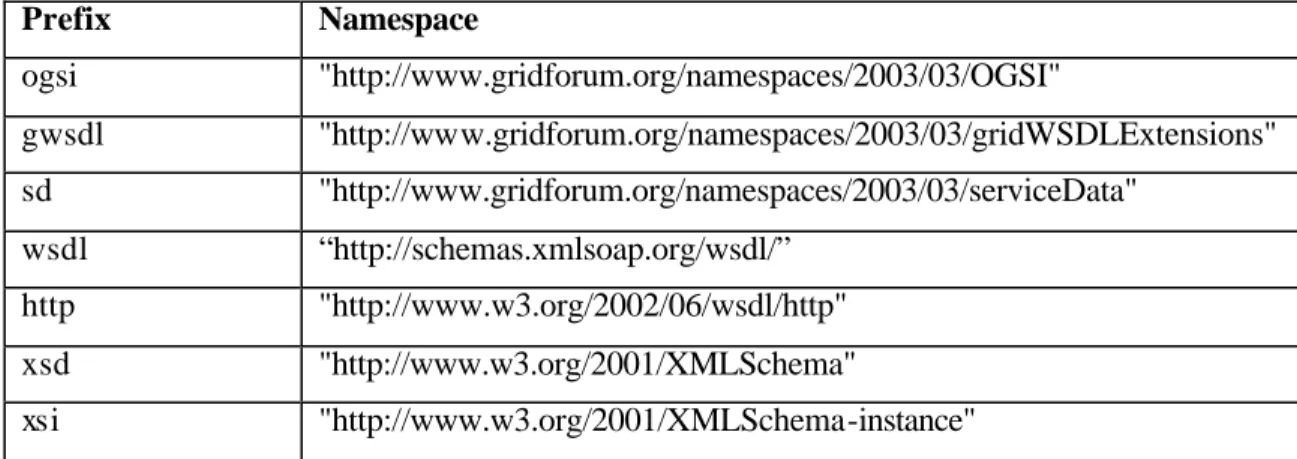
This specification uses namespace prefixes throughout; they are listed in Table 1. Note that the choice of any namespace prefix is arbitrary and not semantically significant.
Table 1: Prefixes and namespaces used in this specification.
Prefix Namespace ogsi "http://www.gridforum.org/namespaces/2003/03/OGSI" gwsdl "http://www.gridforum.org/namespaces/2003/03/gridWSDLExtensions" sd "http://www.gridforum.org/namespaces/2003/03/serviceData" wsdl “http://schemas.xmlsoap.org/wsdl/” http "http://www.w3.org/2002/06/wsdl/http" xsd "http://www.w3.org/2001/XMLSchema" xsi "http://www.w3.org/2001/XMLSchema-instance"
Namespace names of the general form "http://example.org/..." and "http://example.com/..." represent application or context -dependent URIs [RFC 2396].
The following abbreviations and terms are used in this document:
• GSH: Grid Service Handle, as defined in Section 7.5.
• GSR: Grid Service Reference, as defined in Section 7.5.
• SDE: Service Data Element, as defined in Section 7.2.
• The terms Web services, XML, SOAP, and WSDL, as defined in [Grid Physiology]. The term hosting environment is used in this document to denote the server in which one or more Grid service implementations run. Such servers are typically language or platform specific. Examples include native Unix and Windows processes, J2EE application servers, and Microsoft .NET.
[email protected]
7
3 Setting the Context
Although [Grid Physiology] describes overall motivation for the Open Grid Services Architecture (OGSA), this document describes its architecture at a more detailed level. We call the base for OGSA the Open Grid Services Infrastructure (OGSI). Correspondingly, we examine in this section several details that help put the remainder of the document in context. Specifically, we discuss the relationship between OGSI and distributed object systems and also the relationship between OGSI and the existing (and evolving) Web services framework. We exa mine both the client-side programming patterns for Grid services and a conceptual hosting environment for Grid services.
The patterns described in this section are enabled but not required by OGSI. We discuss these patterns here to help put into context certain details described later in this document.
3.1 Relationship to Distributed Object Systems
As we describe in much more detail below, a given Grid service implementation is an
addressable, and potentially stateful, instance that implements one or more interfaces described by WSDL portTypes. Grid service factories (§12) can be used to create instances implementing a given set of portType(s). Each Grid service instance has a notion of identity with respect to the other instances in t he distributed Grid (§7.5.2.1). Each instance can be characterized as state coupled with behavior published through type-specific operations. The architecture also supports introspection in that a client application can ask a Grid service instance to return information describing itself, such as the collection of portTypes that it implements.
Grid service instances are made accessible to (potentially remote) client applications through the use of a Grid Service Handle (§7.5.2) and a Grid Service Reference (§7.5.1). These constructs are basically network-wide pointers to specific Grid service instances hosted in (potentially remote) execution environments. A client application can use a Grid Service Reference to send requests (represented by the operations defined in the portType(s) of the target service description) directly to the specific instance at the specified network-attached service endpoint identified by the Grid Service Reference.
We expect that in many situations, client stubs and helper classes isolate application programmers from the details of using Grid Service References. Some client-side infrastructure software assumes responsibility for directing an operation to a specific instance that the GSR identifies. Each of the characteristics introduced above (stateful instances, typed interfaces, global names, etc.) is frequently also cited as a fundamental characteristic of distributed object-based systems. There are, however, also various other aspects of distributed object models (as traditionally defined) that are specifically not required or prescribed by OGSI. For this reason, we do not adopt the term distributed object model or distributed object system when describing this work, but we instead use the term Open Grid Services Infrastructure, thus emphasizing the connections that we establish with both Web services and Grid technologies.
Among the object-related issues that are not addressed within OGSI are implementation
inheritance, service instance mobility, development approach, and hosting technology. The Grid service specification does not require, nor does it prevent, implementations based upon object technologies that support inheritance at either the interface or the implementation level. There is no requirement in the architecture to expose the notion of implementation inheritance either at the client side or at the service provider side of the usage contract. In addition, the Grid service specification does not prescribe, dictate, or prevent the use of any particular development approach or hosting technology for Grid service instances. Grid service providers are free to implement the semantic contract of the service description in any technology and hosting
[email protected]
8
architecture of their choosing. We envision implementations in J2EE, .NET, traditionalcommercial transaction management servers, traditional procedural Unix servers, and so forth. We also envision service implementations in a wide variety of both object-oriented and non-object-oriented programming languages.
3.2 Client-Side Programming Patterns
Another important issue that we feel requires some explanation, particularly for readers not familiar with Web services, is how OGSI interfaces are likely to be invoked from client
applications. OGSI exploits an important component of the Web services framework: the use of WSDL to describe multiple protocol bindings, encoding styles, messaging styles (RPC vs. document-oriented), and so on for a given Web service. The Web Services Invocation Framework [WSIF] and Java API for XML RPC [JAX-RPC]are among the many examples of infrastructure software that provide this capability.
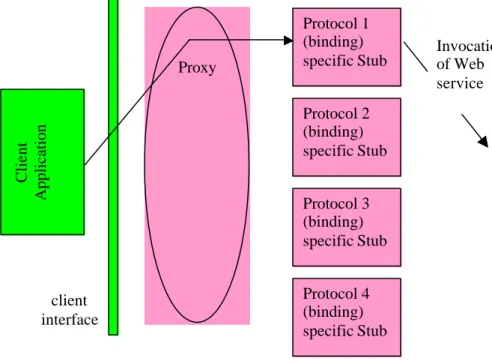
Client Application Proxy Protocol 1 (binding) specific Stub Protocol 2 (binding) specific Stub Protocol 4 (binding) specific Stub Protocol 3 (binding) specific Stub Invocation of Web service client interface
Figure 1: Possible client-side runtime architecture
Figure 1 depicts a possible (but not required) client-side architecture for OGSI. In this approach, a clear separation exists between the client application and the client-side representation of the Web service (proxy), including components for marshaling the invocation of a Web service over a chosen binding. In particular, the client application is insulated from the details of the Web service invocation by a higher-level abstraction: the client-side interface.
Various tools can take the WSDL description of the Web service and generate interface definitions in a wide-range of programming language-specific constructs (e.g., Java interfaces, C#). This interface is a front-end to specific parameter marshaling and message routing that can incorporate various binding options provided by the WSDL. Further, this approach allows certain efficiencies, for example, detecting that the client and the Web service exist on the same network host, and therefore avoiding the overhead of preparing for and executing the invocation using network protocols.
Within the client application runtime, a proxy provides a client-side representation of remote service instance’s interface. Proxy behaviors specific to a particular encoding and network protocol (binding, in Web services terminology) are encapsulated in a protocol (binding)-specific
[email protected]
9
stub. Details related to the binding-specific access to the Grid service instance, such as correct formatting and authentication mechanics, happen here; thus, the application is not required to handle these details itself.We note that it is possible, but not recommended, for developers to build customized code that directly couples client applications to fixed bindings of a particular Grid service instance. Although certain circumstances demand potential efficiencies gained this style of customization, this approach introduces significant inflexibility into a system and therefore should only be used under extraordinary circumstances.
We expect the stub and client s ide infrastructure model that we describe to be a common approach to enabling client access to Grid services. This includes both application specific services and common infrastructure services that are defined by OGSA. Thus, for most developers using Grid services, the infrastructure and application-level services appear in the form of a class library or programming language interface that is natural to the caller. WSDL and the GWSDL extensions provide support for enabling heterogeneous tools and enabling infrastructure software.
3.3 Client Use of Grid Service Handles and References
A client gains access to a Grid service instance through Grid Service Handles and Grid Service References. A Grid Service Handle (GSH) can be thought of as a permanent network pointer to a particular Grid service instance. The GSH does not provide sufficient information to allow a client to access the service instance; the client needs to “resolve” a GSH into a Grid Service Reference (GSR). The GSR contains all the necessary information to access the service instance. The GSR is not a “permanent” network pointer to the Grid service instance because a GSR may become invalid for various reasons; for example, the Grid service instance may be moved to a different server.
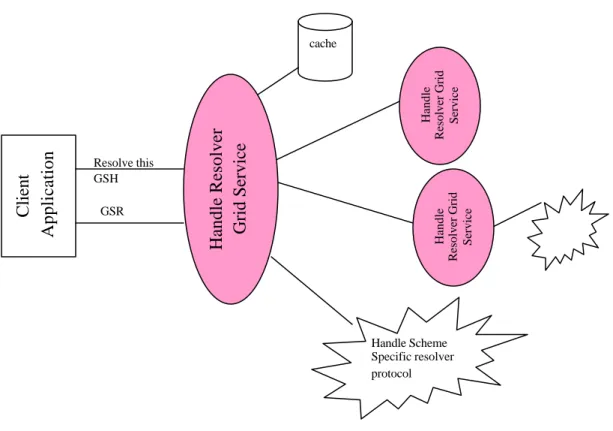
OGSI provides a mechanism, the HandleResolver (see §10) to support client resolution of a Grid Service Handle into a Grid Service Reference. Figure 2 shows a client application that needs to resolve a GSH into a GSR.
[email protected]
10
Figure 2: Resolving a GSH
The client resolves a GSH into a GSR by invoking a HandleResolver Grid service instance identified by some out-of-band mechanism. The HandleResolver can use various means to do the resolution; some of these means are depicted in Figure 2. The HandleResolver may have the GSR stored in a local cache. The HandleResolver may need to invoke another HandleResolver to resolve the GSH. The HandleResolver may use a handle resolution protocol, specified by the particular kind (or scheme) of the GSH to resolve to a GSR. The HandleResolver protocol is specific to the kind of GSH being resolved. For example, one kind of handle may suggest the use of HTTP GET to a URL encoded in the GSH in order to resolve to a GSR.
3.4 Relationship to Hosting Environment
OGSI does not dictate a particular service provider–side implementation architecture. A variety of approaches are possible, ranging from implementing the Grid service instance directly as an operating system process to a sophisticated server–side component model such as J2EE. In the former case, most or even all support for standard Grid service behaviors (invocation, lifetime management, registration, etc.) is encapsulated within the user process, for example via linking with a standard library; in the latter case, many of these behaviors are supported by the hosting environment. GSR Handle Resolver Grid Service Handle Resolver Grid Service
Client
Application
Handle Scheme Specific resolver protocol cacheHandle Resolver
Grid Service
Resolve this GSH
11
Grid service impl. protocol termination Demarshalling / Decoding / Routing container protocol termination protocoltermination service Grid
impl. Grid
service impl.
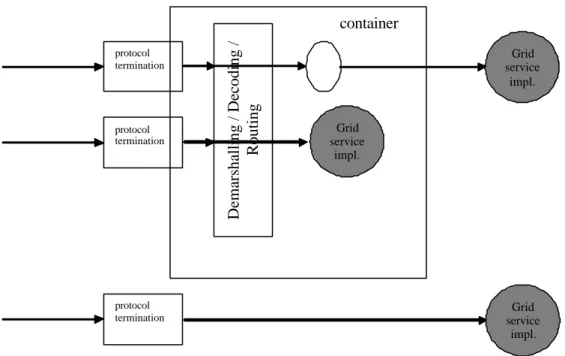
Figure 3: Two approaches to the implementation of argument demarshaling functions in a Grid service hosting environment
Figure 3 illustrates these differences by showing two different approaches to the implementation of argument demarshaling functions. We assume that, as is the case for many Grid services, the invocation message is received at a network protocol termination point (e.g., an HTTP servlet engine), which converts the data in the invocation message into a format consumable by the hosting environment. At the top of Figure 3, we illustrate two Grid service instances (the ovals) associated with container-managed components (e.g., EJBs within a J2EE container). Here, the message is dispatched to these components, with the container frequently providing facilities for demarshaling and decoding the incoming message from a format (such as an XML/SOAP message) into an invocation of the component in native programming language. In some circumstances (the lower oval), the entire behavior of a Grid service instance is completely encapsulated within the component. In other cases (the upper oval), a component will collaborate with other server-side executables, perhaps through an adapter layer, to complete the
implementation of the Grid service behavior. At the bottom of Figure 3, we depict another scenario wherein the entire behavior of the Grid service instance, including the
demarshaling/decoding of the network message, has been encapsulated within a single executable. Although t his approach may have some efficiency advantages, it provides little opportunity for reuse of functionality between Grid service implementations.
A container implementation may provide a range of functionality beyond simple argument demarshaling. For example, the container implementation may provide lifetime management functions, automatic support for authorization and authentication, request logging, intercepting lifetime management functions, and terminating service instances when a service lifetime expires or an explicit destruction request is received. Thus, we avoid the need to reimplement these common behaviors in different Grid service implementations.
4 The Grid Service
The purpose of this document is to specify the interfaces and behaviors that define a Grid service. In brief, a Grid service is a WSDL-defined service that conforms to a set of conventions relating to its interface definitions and behaviors. Thus, every Grid service is a Web service, though the
12
converse of this statement is not true. In the following sections, we expand upon this briefstatement by
• Introducing a set of WSDL conventions that we use in our Grid service specification; these conventions have been incorporated in WSDL 1.2 [WSDL 1.2 DRAFT].
• Defining service data, which provides a standard way for representing and querying metadata and state data from a service instance.
• Introducing a series of core properties of Grid service, including:
o Defining Grid service description and Grid service instance, as organizing principles for their extension and their use.
o Defining how OGSI models time.
o Defining the Grid Service Handle and Grid Service Reference constructs, which we use to refer to Grid service instances.
o Defining a common approach for conveying fault information from operations. This approach defines a base XML Schema definition and associated semantics for WSDL fault messages to support a common interpretation. The approach simply defines the base format for fault messages, without modifying the WSDL fault message model.
o Defining the lifecycle of a Grid service instance.
5 WSDL Extensions and Conventions
OGSI is based on Web services; in particular, it uses WSDL as the mechanism to describe the public interfaces of Grid services. However, WSDL 1.1 is deficient in two critical areas: lack of interface (portType) extension and the inability to describe additional information elements on a portType (lack of open content). These deficiencies have been addressed by the W3C Web Services Description Working Group [WSDL 1.2 DRAFT]. Because WSDL 1.2 is “work in progress,” OGSI cannot directly incorporate the entire WSDL 1.2 body of work.
Instead, OGSI defines an extension to WSDL 1.1, isolated to the wsdl:portType element, that provides the minimal required extensions to WSDL 1.1. These extensions to WSDL 1.1 match equivalent functionality agreed to by the W3C Web Services Description Working Group. Once WSDL 1.2 [WSDL 1.2] is published as a recommendation by the W3C, the Global Grid Forum commits to defining a follow-on version of OGSI that exploits WSDL 1.2, and to defining a translation from this OGSI v1.0 extension to WSDl 1.2.
We define a separate (and temporary) namespace, with the prefix gwsdl, to isolate the modifications to WSDL 1.1. In particular, gwsdl adds the following new constructs to the wsdl:portType element in the fashion proposed in [WSDL 1.2 DRAFT] to support open content model and portTypeextension.
The following is the XSD definition of gwsdl:portType: … targetNamespace= http://www.gridforum.org/namespaces/2003/03/gridWSDLExtensions xmlns:gwsdl= http://www.gridforum.org/namespaces/2003/03/gridWSDLExtensions …
[email protected]
13
<complexType name="portTypeType"> <complexContent> <extension base="wsdl:portTypeType"> <sequence> <any namespace="##other" minOccurs="0" maxOccurs="unbounded"/> </sequence><attribute name=”extends” use=”optional”> <simpleType> <list itemType=”QName”/> </simpleType> </attribute> <anyAttribute namespace="##other"/> </extension> </complexContent> </complexType>
The extends attribute on the gwsdl:portType element is a list of QNames, where each QName MUST refer to either a wsdl:portType or a gwsdl:portType.
In light of portType extension, there is a required clarification with respect to the namespace of operation elements. Although WSDL 1.1 allows operation name overloading (a WSDL 1.1 portType can have multiple operation child elements with the same name), the W3C Web Services Description Working Group decided to restrict this feature. The following is from [WSDL 1.2 DRAFT]:
A port type operation component describes an operation that a given port type supports. An operation is a set of message references. Message references may be to messages this operation accepts, that is input messages, or messages this operation sends, that is output or fault messages.
Port type operation components are local to port type components, they cannot be refered to by QName, despite having both {name} and {target namespace} properties
The properties of the Port Type Operation Component are as follows:
• {name} An NCName as defined by [XML Namespaces].
• {target namespace} A namespace name, as defined in [XML Namespaces].
• {variety} One of Input-Only, Output-Only, Input-Output or Output-Input
• {messages} A set of message reference components
For each port type operation component in the {operations} property of a port type component the combination of {name} and {target namespace} properties must be unique.
In cases where, due to a port type extending one or more other port types, two or more port type operation components have the same value for their {name} and {target namespace} properties, then the component models of those port type operation
components MUST be equivalent (see 2.12 Equivalence of components). If the port type operation components are equivalent then they are considered to collapse into a single component. It is an error if two port type operation components have the same value for their {name} and {target namespace} properties but are not equivalent.
[email protected]
14
Due to the above rules, if two port types that have the same value for their {target namespace} property also have one or more operations that have the same value for their {name} property then those two port types cannot both form part of the derivation chain of a derived port type unless those operations are the same operation. Therefore it is considered good practice to ensure , where necessary, that operation names within a namespace are unique, thus allowing such derivation to occur without error.And about Equivalence of components:
Two components of the same type are considered equivalent if the values of the properties of one component are the same as the values of the properties in the second component.
With respect to top-level components (messages, port types, bindings and services) this effectively translates to name-based equivalence given the constraints on names. That is, given two top-level components of the same type, if the {name} properties have the same value and the {target namespace} properties have the same values then the two
components are in fact, the same component.
Operation naming and extension in gwsdl portTypes is to be interpreted in the same fashion as defined by the WSDL 1.2 DRAFT text above.
6 Service Data
The approach to stateful Web services introduced in OGSI identified the need for a common mechanism to expose a service instance’s state data to service requestors for query, update and change notification. Since this concept is applicable to any Web service including those used outside the context of Grid applications, we propose a common approach to exposing Web service state data called “serviceData.” We are endeavoring to introduce this concept to the broader Web services community.
In order to provide a complete description of the interface of a stateful Web service (i.e., a Grid service), it is necessary to describe the elements of its state that are externally observable. By externally observable, we mean that the state of the service instance is exposed to clients making use of the declared service interface, where those clients are outside of what would be considered the internal implementation of the service instance itself. The need to declare service data as part of the service’s external interface is roughly equivalent to the idea of declaring attributes as part of an object-oriented interface described in an object-oriented interface definition language (IDL). Service data can be exposed for read, update, or subscription purposes.
Since WSDL defines operations and messages for portTypes, the declared state of a service MUST be externally accessed only through service operations defined as part of the service interface. To avoid the need to define serviceData specific operations for each serviceData element, the Grid service portType (§9) provides base operations for manipulating serviceData elements by name.
Consider an example. Interface foo introduces operations op1, op2, and op3. Also assume that the foo interface consists of publicly accessible data elements of de1, de2, and de3. We use WSDL to describe foo and its operations. The OGSI serviceData construct extends WSDL so that the designer can further define the interface to foo by declaring the public accessibility of certain parts of its state de1, de2 and de3. This declaration then facilitates the execution of operations on the service data of a stateful service instance implementing the foo interface.
[email protected]
15
Put simply, the serviceData declaration is the mechanism used to express the elements of publicly available state exposed by the service's interface. ServiceData elements are accessible through operations of the service interfaces such as those defined in this specification. Private internal state of the service instance is not part of the service interface and is therefore not represented through a serviceData declaration.6.1 Motivation and Comparison to JavaBean Properties
The OGSI specification introduces the serviceData concept to provide a flexible, properties-style approach to accessing state data of a Web service. The serviceData concept is similar to the notion of a public instance variable or field in object-orie nted programming languages such as Java™, Smalltalk and C++.
ServiceData is similar to JavaBean™ properties. The JavaBean model defines conventions for method signatures (getXXX/setXXX) to access properties, and helper classes (BeanInfo) to document properties. The OGSI model uses the serviceData elements and XML Schema types to achieve a similar result.
The OGSI specification has chosen not to require getXXXand setXXX WSDL operations for each serviceData element, although service implementers MAY choose to define such type safe get and set operations themselves. Instead, OGSI defines extensible operations for querying (get), updating (set), and subscribing to notification of changes in serviceData elements. Simple expressions are required by OGSI to be supported by these operations, which allows for access to serviceData elements by their names, relative to a service instance. This by-name approach gives functionality roughly equivalent to the getXXX and setXXX approach familiar to JavaBean and Enterprise JavaBean programmers. However, these OGSI operations MAY be extended by other service interfaces to support richer query, update, and subscription semantics, such as complex queries that span multiple serviceData elements in a service instance.
The serviceDataName element in a GridService portType definition corresponds to the BeanInfo class in JavaBeans. However, OGSI has chosen an XML (WSDL) document that provides information about the serviceData, instead of using a serializable implementation class as in the BeanInfo model.
6.2 Extending portType with serviceData
ServiceData defines a new portType child element named serviceData, used to define serviceData elements, or SDEs, associated with that portType. These serviceData element definitions are referred to as serviceData declarations, or SDDs. Initial values for those serviceData elements (marked as “static” serviceData elements) MAY be specified using the staticServiceDataValues element within portType. The values of any serviceData element, whether declared statically in the portType or assigned during the life of the Web service instance, are called serviceData element values, or SDE values.
Note in the following the use of the gwsdl:portType, which allows the appearance of elements from other namespaces.
<gwsdl:portType name="NCName"> * <wsdl:documentation … /> ?
<wsdl:operation name="NCName"> … </wsdl:operation> ? …
<sd:serviceData name="NCName" … /> * <sd:staticServiceDataValues>?
[email protected]
16
</sd:staticServiceDataValues>…
</gwsdl:portType>
For example, the following portType declares two serviceData elements, with qualified names “tns:sd1” and “tns:sd2”. Any service instance that implements this portType MUST have as part of its state these two serviceData elements.
<wsdl:definitions xmlns:tns=”xxx” targetNamespace=”xxx”> <gwsdl:portType name="exampleSDUse"> *
<wsdl:operation name=…> … </wsdl:operation> …
<sd:serviceData name="sd1" type=”xsd:String” mutability=”static”/>
<sd:serviceData name="sd2" type=”tns:SomeComplexType”/> … <sd:staticServiceDataValues> <tns:sdl>initValue</tns:sd1> </sd:staticServiceDataValues> </gwsdl:portType> … </wsdl:definitions>
6.2.1 Structure of the serviceData Declaration
Since sd:serviceData declarations are defining XML elements that may appear in
sd:serviceDataValue and sd:staticServiceDataValue elements, the XML Schema definition of sd:serviceData is modeled after the XML Schema definition of xsd:element. The sd:serviceData element uses five attributes with the same interpretation as xsd:element: name, type, minOccurs, maxOccurs,and nillable. The other xsd:element attributes do not make sense within the context of sd:serviceData. The sd:serviceData element also allows two additional elements: mutability, and modifiable.
The XML Schema definition for sd:serviceData is as follows. … targetNamespace = “http://www.gridforum.org/namespaces/2003/serviceData” xmlns:sd = “http://www.gridforum.org/namespaces/2003/03/serviceData” … <attributeGroup name="occurs"> <attribute name="minOccurs" type="nonNegativeInteger" use="optional" default="1"/> <attribute name="maxOccurs"> <simpleType> <union memberTypes="nonNegativeInteger"> <simpleType> <restriction base="NMTOKEN"> <enumeration value="unbounded"/> </restriction> </simpleType> </union>
[email protected]
17
</simpleType> </attribute> </attributeGroup> <complexType name="ServiceDataType"> <sequence><any namespace="##any" minOccurs="0" maxOccurs="unbounded"/> </sequence>
<attribute name="name" type="NCName"/> <attribute name="type" type="QName"/> <attribute name="nillable"
type="boolean" use="optional" default="false"/> <attributeGroup ref="sd:occurs"/>
<attribute name="mutability" use="optional" default="extendable"> <simpleType> <restriction base="string"> <enumeration value="static"/> <enumeration value="constant"/> <enumeration value="extendable"/> <enumeration value="mutable"/> </restriction> </simpleType> </attribute>
<attribute name="modifiable" type="boolean" default="false"/> <anyAttribute namespace="##other" processContents="lax"/> </complexType>
<element name="serviceData" type="sd:ServiceDataType"/>
<xsd:complexType name=”ServiceDataValuesType”> <xsd:sequence>
<xsd:any namespace="##any" minOccurs="0"
maxOccurs="unbounded" /> </xsd:sequence> </xsd:complexType> <element name=”serviceDataValues” type=”sd:ServiceDataValuesType”/> <element name=”staticServiceDataValues” type=”sd:ServiceDataValuesType”/>
The serviceData attributes are as follows.
• maxOccurs = (nonNegativeInteger | unbounded) : default to 1
o This value indicates the maximum number of serviceData element values that can appear in the servic e instance’s serviceDataValues or the portType
staticServiceDataValues.
• minOccurs = nonNegativeInteger : default to 1
o This value indicates the minimum number of serviceData element values that can appear in the service instance’s serviceDataValues or the portType
staticServiceDataValues.
o If the value is 0, then the serviceData element is optional.
[email protected]
18
o The name of the serviceData element MUST be unique among all sd:serviceData andxsd:element declarations in the target namespace of the wsdl:definitions element.
o The combination of the name of the serviceData element and the target namespace of the wsdl:definitions element’s targetNamespace attribute forms a QName, allowing a unique reference to this serviceData element.
• nillable = boolean : default to false
o This value indicates whether the serviceData element can have a nil value (that is a value that has an attribute xsi:nil with value=“true”).
§ For example a serviceData declaration
<serviceDataElement name=”foo” type=”xsd:string” nillable=true” />
§ can have a valid SDE value <foo xsi:nil=”true”/>
• type = QName
o This value defines the XML Schema type of the serviceData element value
• modifiable = “boolean” : default to false
o If true, it is legal for requestors to directly update the serviceData value through the setServiceData operation (see
§
9.2.2), subject to constraints on cardinality(minOccurs, maxOccurs) and mutability. If false, the serviceData element should be regarded as “read only” by the requestor, though its values may change as a result of other operations on the service’s interface.
• mutability = “static” | “constant” | “extendable” | “mutable” : default to extendable
o This value indicates whether and how the values of a serviceData element can change (see
§
6.2.3).• {any attributes with non-schema namespace}
o Open content on the attributes of serviceData declaration is allowed.
• Content
o
This is an open content element model, meaning elements from any other namespace (besides serviceData) may appear as child elements of the serviceData element. 6.2.2 Using serviceData, an Example from GridService portTypeTo show how serviceData can be used, we present an example, namely, the GridService
portType, described in Section 9. The (non-normative) serviceData elements declared for the Grid Service portType are as follows.
<wsdl:definitions …
<gwsdl:portType name=”GridService” …>
<wsdl:operation name=…> … </wsdl:operation> …
<sd:serviceData name=”interface” type=”xsd:QName” minOccurs=”1” maxOccurs=”unbounded”
mutability=”constant”/>
<sd:serviceData name=”serviceDataName” type=”xsd:QName” minOccurs=”0” maxOccurs=”unbounded” mutability=”mutable” nillable=”false”/> <sd:serviceData name=”factoryHandle” type=”ogsi:HandleType” minOccurs=”1” maxOccurs=”1” mutability=”constant” nillable=”true”/> <sd:serviceData name=”gridServiceHandle”
[email protected]
19
type=”ogsi:HandleType” minOccurs=”0” maxOccurs=”unbounded” mutability=”extendable”/> <sd:serviceData name=”gridServiceReference” type=”ogsi:ReferenceType” minOccurs=”0” maxOccurs=”unbounded” mutability=”mutable”/> <sd:serviceData name=”findServiceDataExtensibility” type=”ogsi:OperationExtensibilityType” minOccurs=”1” maxOccurs=”unbounded” mutability=”static”/><sd:serviceData name=”terminationTime” type=”ogsi:terminationTime” minOccurs=”1” maxOccurs=”1” mutability=”mutable”/> <sd:serviceData name=”setServiceDataExtensibility” type=”ogsi:OperationExtensibilityType” minOccurs=”2” maxOccurs=”unbounded” mutability=”static” /> …
The normative description of the individual serviceData elements is given in Section 9.1. The following is an example set of serviceData element values for a Grid service instance. … xmlns:crm=”http://gridforum.org/namespaces/2002/11/crm” xmlns:tns=”http://example.com/exampleNS” xnlns=”http://example.com/exampleNS”> <sd:serviceDataValues> <ogsi:interface>crm:GenericOSPT</ogsi:interface> <ogsi:interface>ogsi:GridService</ogsi:interface> <ogsi:serviceDataName>ogsi:interface </ogsi:serviceDataName> <ogsi:serviceDataName>ogsi:serviceDataName </ogsi:serviceDataName> <ogsi:serviceDataName>ogsi:factoryHandle </ogsi:serviceDataName> <ogsi:serviceDataName>ogsi:gridServiceHandle </ogsi:serviceDataName> <ogsi:serviceDataName>ogsi:gridServiceReference </ogsi:serviceDataName> <ogsi:serviceDataName>ogsi:findServiceDataExtensibility </ogsi:serviceDataName> <ogsi:serviceDataName>ogsi:terminationTime </ogsi:serviceDataName> <ogsi:serviceDataName>ogsi:setServiceDataExtensibility </ogsi:serviceDataName>
<ogsi:factoryHandle>someURI</ogsi:factoryHandle>
<ogsi:gridServiceHandle>someURI</ogsi:gridServiceHandle>
<ogsi:gridServiceHandle>someOtherURI</ogsi:gridServiceHandle>
<ogsi:gridServiceReference>…</ogsi:gridServiceReference> <ogsi:gridServiceReference>…</ogsi:gridServiceReference>
[email protected]
20
<ogsi:findServiceDataExtensibility inputElement=”ogsi:queryByServiceDataNames” /> <ogsi:terminationTime after=”2002-11-01T11:22:33” before=”2002-12-09T11:22:33”/> <ogsi:setServiceDataExtensibility inputElement=”ogsi:setByServiceDataNames” /> <ogsi:setServiceDataExtensibility inputElement=”ogsi:deleteByServiceDataNames” /> </sd:serviceDataValues> 6.2.3 MutabilityA mutability attribute on the serviceData element declaration indicates how a serviceData element’s values may change over its lifetime.
• mutability=“static”: this attribute value implies that the SDE value is assigned in the WSDL declaration (staticServiceDataValues) and MUST remain that value for any instance of that portType. A “static” SDE is analogous to a class member variable in programming languages.
• mutability=“constant”: this attribute value implies that the SDE value is assigned upon creation of the Grid service instance and MUST NOT change during the lifetime of the Grid service instance once it is set to a value.
• mutability=“extendable”: this attribute value implies that once elements are in the SDE value, they MUST be part of the SDE value for the lifetime of the Grid service instance. New elements MAY be added to the SDE value, but once these elements are added, they MUST NOT be removed.
• mutability=“mutable”: this attribute value implies that any of the elements in the SDE value MAY be removed at any time and others MAY be added.
Note: The functionality described here is different from the “fixed” and “default” attributes in theXML Schema’s element definition. While the XML Schema’s “fixed” attribute could be used to suggest a “static” value, the “extendable ” and “mutable” attributes would have to be modeled by a mutability attribute. The case where mutability=“constant” would be used to specify a property that does not change after a value is assigned. However, the value is not assigned by the service description but, rather, must be initialized at run time.
6.3 serviceDataValues
Each service instance is associated with a collection of serviceData elements: those serviceData elements defined within the various portTypes that form the service’s interface, and also, potentially, additional serviceData elements added at runtime (see §6.5). We call the set of serviceData elements associated with a service instance its “serviceData set”. A serviceData set may also refer to the set of serviceData elements aggregated from all serviceData elements declared in a portType interface hierarchy (see §6.4).
Each service instance MUST have a “logical” XML document, with a root element of serviceDataValues that contains the serviceData element values. We showed an example of a serviceDataValues element above. A service implementation is free to choose how the SDE
21
values are stored; for example, it may store the SDE values not as XML but as instance variables that are converted into XML or other encodings as necessary.The wsdl:binding associated with various operations manipulating serviceData elements will indicate the encoding of that data between service requestor and service provider. For exa mple, a binding might indicate that the serviceData element values are encoded as serialized Java objects. 6.3.1 Defining Initial SDE Values within the portType
Through the use of the staticServiceDataValues element, a portType MAY declare initial values for any serviceData element with mutability marked as “static” in its serviceData set, regardless of whether the serviceData element was declared locally, or in one of the portTypes it extends. Further, initial values MAY be declared in multiple portTypes within the interface hierarchy, so long as the total number of initial values does not exceed that element’s maxOccurs constraint. In this case, the initial values for this serviceData element is the collection of all of the initial values. For example, the following declarations are legal and declare two initial values for tns:otherSD: “initial value 1” and “initial value 2”.
<wsdl:definitions xmlns:tns=”xxx” targetNamespace=”xxx”> <gwsdl:portType name="otherPT">
<wsdl:operation name=…> … </wsdl:operation> …
<sd:serviceData name="otherSD" type=”xsd:String”
mutability=”static” maxOccurs=”unbounded”/>
<sd:staticServiceDataValues>
<tns:otherSD>initial value 1</tns:otherSD> </sd:staticServiceDataValues>
…
</gwsdl:portType>
<gwsdl:portType name="exampleSDUse" extends=“tns:otherPT”> <wsdl:operation name=…> … </wsdl:operation>
…
<sd:serviceData name="sd1" type=”xsd:String” mutability=”static” />
<sd:serviceData name="sd2" type=”tns:SomeComplexType”/>
<sd:staticServiceDataValues>
<tns:sd1>an initial value</tns:sd1>
<tns:otherSD>initial value 2</tns:otherSD> </sd:staticServiceDataValues>
…
</gwsdl:portType> …
</wsdl:definitions>
Init ial values MUST NOT be declared for a serviceData element with mutability other than “static”.
6.4 SDE Aggregation within a portType Interface Hierarchy
WSDL 1.2 has introduced the notion of multiple portType extension, and we have modeled that construct within the gwsdl namespace. A portType can extend 0 or more other portTypes. There is no direct relationship between a wsdl:service and the portTypes supported by the service
22
modeled in the WSDL syntax. Rather, the set of portTypes implemented by the service is derived through the port element children of the service element and binding elements referred to from those port elements. This set of portTypes, and all portTypes they extend, defines the complete interface to the service.The serviceData set defined by the service’s interface is the set union of the serviceData elements declared in each portType in the complete interface implemented by the service instance. Because serviceData elements are uniquely identified by QName, the set union semantic implies that a serviceData element can appear only once in the set of serviceData elements. For example, if a portType named “pt1” and portType named “pt2” both declare a serviceData named “tns:sd1”, and a portType named “pt3” extends both “pt1 and “pt2”, then it has one (not two) serviceData elements named “tns:sd1”.
Consider the following example. <gwsdl:portType name=”pt1”>
<sd:serviceData name=”sd1” … /> </gwsdl:portType>
<gwsdl:portType name=”pt2” extends=“pt1”> <sd:serviceData name=”sd2” … />
</gwsdl:portType>
<gwsdl:portType name=”pt3” extends=“pt1”> <sd:serviceData name=”sd3” … />
</gwsdl:portType>
<gwsdl:portType name=”pt4” extends=“pt2 pt3”> <sd:serviceData name=”sd4” … />
</gwsdl:portType>
The serviceData sets defined by the four portTypes defined here are as follows.
if a service implements… its serviceData set contains…
Pt1 sd1
Pt2 sd1, sd2
Pt3 sd1, sd3
Pt4 sd1, sd2, sd3, sd4
6.4.1 Initial Values of Static SDEs within a portType Interface Hierarchy
Initial values of static SDEs can be aggregated down a portType interface hierarchy. However, the cardinality requirements (minOccurs and maxOccurs) MUST be preserved. For example, in the following, a service instance that implements pt1 would have the value <sd1>1</sd1> for SDE named sd1.
<gwsdl:portType name=”pt1”>
<sd:serviceData name=”sd1” minOccurs=”1” maxOccurs=”1” mutability=”static”/>
<sd:staticServiceDataValues> <sd1>1</sd1>
</sd:staticServiceDataValues>
[email protected]
23
In the following, however, a service instance that implements pt2 would inherit the value<sd1>1</sd1> for SDE named sd1 and would have the value <sd2>2</sd2> for the SDE named sd2.
<gwsdl:portType name=”pt2” extends=“pt1”>
<sd:serviceData name=”sd2” minOccurs=”1” maxOccurs=”1” mutability=”static”/>
<sd:staticServiceDataValues> <sd2>2</sd2>
</sd:staticServiceDataValues> </gwsdl:portType>
A service instance that implements pt3 would have two values <sd3>3a</sd3> and
<sd3>3b</sd3> for the SD E named sd3. It would, of course, inherit the value for the SDE named sd1.
<gwsdl:portType name=”pt3” extends=“pt1”>
<sd:serviceData name=”sd3” minOccurs=”1” maxOccurs=”unbounded”
mutability=”static”/> <sd:staticServiceDataValues> <sd3>3a</sd3> <sd3>3b</sd3> </sd:staticServiceDataValues> </gwsdl:portType>
A service instance that implements pt4 would inherit the value for sd1 defined in pt1, but the absence of a staticServiceDataValues element implies that there is no initial value for sd4 (although most likely one would be defined in a portType that extends pt4).
<gwsdl:portType name=”pt4” extends=“pt1”>
<sd:serviceData name=”sd4” minOccurs=”0” maxOccurs=”unbounded”
mutability=”static”/> </gwsdl:portType>
A service instance that implements pt5 could not be created. Since there is no initial value for sd5 and since the minOccurs value is greater than zero, an error is generated when the instance is created. PortTypes of this sort can be encountered if it is the intention of the designer to declare an “abstract” portType, wherein portTypes extending the abstract portType define concrete values for SDEs with minOccurs greater than zero.
<gwsdl:portType name=”pt5” extends=“pt1”>
<sd:serviceData name=”sd5” minOccurs=”1” maxOccurs=”unbounded”
mutability=”static”/> </gwsdl:portType>
A service instance that implements pt6 could not be created. Since this portType declares an additional value for the SDE named sd1 (recall there is a value inherited from pt1) that exceeds the maxOccurs value for the SDE named sd1, an error is generated when the instance is created. <gwsdl:portType name=”pt6” extends=“pt1”>
</sd:staticServiceDataValues> <sd1>6</sd1>
<sd:staticServiceDataValues> </gwsdl:portType>
[email protected]
24
A service instance that implements pt7 has an interesting set of serviceData element values. First, it has a single value <sd1>1</sd1> for the SDE named sd1. Despite inheriting pt1 via pt2 and pt3, the initial values for sd1 are not repeated. The value <sd2>2</sd2> is the only value for the SDE named sd2, inherited from pt2. The SDE named pt3 has three values: <sd3>3a</sd3>,<sd3>3b</sd3> (inherited from pt3), and <sd3>7</sd3> locally defined. Moreover, there is a locally defined value for the SDE named sd7 (<sd7>7</sd7>).
<gwsdl:portType name=”pt7” extends=“pt2 pt3”>
<sd:serviceData name=”sd7” minOccurs=”1” maxOccurs=”1” mutability=”static”/> <sd:staticServiceDataValues> <sd7>7</sd7> <sd3>7</sd3> </sd:staticServiceDataValues> </gwsdl:portType>
In summary, values for static SDEs are aggregated down a portType interface hierarchy. If the resulting set of SDE values violates the cardinality of the SDE (the number of values is either less than the value of minOccurs or greater than the value of maxOccurs), an error is reported when a Web service instance is created.
6.5 Dynamic serviceData Elements
Although many serviceData elements are most naturally defined in a service’s interface definition, situations can arise where it is useful to add or remove serviceData elements dynamically to or from an instance. The means by which such updates are achieved is
implementation-specific; for example, a service instance MAY implement operations for adding a new service data element.
The GridService portType (§9) illustrates the use of dynamic SDEs. This contains a serviceData element named “serviceDataName” that lists the serviceData elements currently defined. This property of a service instance may return a superset of the service data elements declared in the GWSDL defining the service interface, allowing the requestor to use the subscribe operation (§11.1.2.1) if this serviceDataSet changes, and findServiceData (§9.2.1) operation to determine the current serviceDataSet value.
7 Core Grid Service Properties
We discuss here a number of properties and concepts common to all Grid services.
7.1 Service Description and Service Instance
We distinguish in OGSI between the description of a Grid service and an instance of a Grid service:
• A Grid service description describes how a client interacts with service instances. This description is independent of any particular instance. Within a WSDL document, the Grid service description is embodied in the most derived portType (i.e., the portType
referenced by the wsdl:service element’s port children (via referenced binding elements) describing the service) of the instance, along with its associated portTypes (including serviceData declarations), bindings, messages, and types definitions.
25
• A Grid service description may be simultaneously used by any number of Grid serviceinst ances, each of which
o embodies some state with which the service description describes how to interact,
o has one or more Grid Service Handles and
o has one or more Grid Service References to it.
A service description is used primarily for two purposes. First, as a description of a service interface, it can be used by tooling to automatically generate client interface proxies, server skeletons, and so forth. Second, it can be used for discovery, for example, to find a service instance that implements a particular service description, or to find a factory that can create instances with a particular service description.
The service description is meant to capture both interface syntax and (in a very rudimentary, non-normative fashion) semantics. Interface syntax is described by WSDL portTypes. Semantics may be inferred through the name assigned to the portType. For example, when defining a Grid service, one defines zero or more uniquely named portTypes. Concise semantics can be associated with each of these names in specification documents—and perhaps in the future through Semantic Web or other more formal descriptions. These names can then be used by clients to discover services with desired semantics, by searching for service instances and factories with the appropriate names. The use of namespaces to define these names also provides a vehicle for assuring globally unique names.
7.2 Modeling Time in OGSI
The need arises at various points throughout this specification to represent time that is meaningful to multiple parties in the distributed Grid. For example, information may be tagged by a producer with timestamps in order to convey that information’s useful lifetime to consumers; clients need to negotiate service instance lifetimes with services; and multiple services may need a common understanding of time in order for clients to be able to manage their simultaneous use and interaction.
The GMT global time standard is assumed for Grid services, allowing operations to refer unambiguously to absolute times. However, assuming the GMT time standard to represent time does not imply any particular level of clock synchronization between clients and services in the Grid. In fact, no specific accuracy of synchronization is specified or expected by this
specification, as this is a service-quality issue.
Grid service hosting environments and clients SHOULD utilize the Network Time Protocol (NTP) or equivalent function to synchronize their clocks to the global standard GMT time. However, clients and services MUST accept and act appropriately on messages containing time values that are out of range because of inadequate synchronization, where “appropriately” MAY include refusing to use the information associated with those time values. Furthermore, clients and services requiring global ordering or synchronization at a finer granularity than their clock accuracies or resolutions allow for MUST coordinate through the use of additional
synchronization service interfaces, such as through transactions or synthesized global clocks. In some cases it is required to represent both zero time and infinite time (for examples, see §7.3 and §9.2). Zero time SHOULD be represented by a time in the past. However, infinite time requires an extended notion of time. We therefore introduce the following type in the ogsi namespace, which MAY be used in place of xsd:dateTime when a special value of “infinity” is appropriate.
[email protected]
26
“http://www.gridforum.org/namespaces/2003/03/OGSI”<simpleType name="ExtendedDateTimeType">
<union memberTypes="ogsi:InfinityType xsd:dateTime"/> </simpleType> <simpleType name="InfinityType"> <restriction base="string"> <enumeration value="infinity"/> </restriction> </simpleType>
7.3 XML Element Lifetime Declaration Properties
Since serviceData elements may represent instantaneous observations of dynamic state of a service instance, it is critical that consumers of serviceData be able to understand the valid lifetimes of these observations. T he client MAY use this time-related information to reason about the validity and availability of the serviceData element and its value, though the client is free to ignore the information.
We define three XML attributes, which together describe the lifetimes associated with an XML element and its subelements. These attributes MAY be used in any XML element that allows for extensibility attributes, including the serviceData element.
The three lifetime declaration properties are as follows:
• ogsi:goodFrom: Declares the time from which the content of the element is said to be valid. This is typically the time at which the value was created.
• ogsi:goodUntil: Declares the time until which the content of the element is said to be valid. This property MUST be greater than or equal to the goodFrom time.
• ogsi:availableUntil: Declares the time until which this element itself is expected to be available, perhaps with updated values. Prior to this time, a client SHOULD be able to obtain an updated copy of this element. After this time, a client MAY no longer be able to get a copy of this element (while still observing cardinality and mutability constraints on this element). This property MUST be greater than or equal to the goodFrom time. The XML definitions for these attributes in the ogsi namespace are as follows. (The definition of ExtendedDateTimeType is given in §7.2.)
targetNamespace = “http://www.gridforum.org/namespaces/2003/03/OGSI”
<xsd:attribute name="goodFrom" type="ogsi:ExtendedDateTimeType"/> <xsd:attribute name="goodUntil" type="ogsi:ExtendedDateTimeType"/> <xsd:attribute name="availableUntil" type="ogsi:ExtendedDateTimeType"/>
<xsd:attributeGroup name="LifeTimePropertiesGroup"> <xsd:attribute ref="ogsi:goodFrom" use="optional"/> <xsd:attribute ref="ogsi:goodUntil" use="optional"/> <xsd:attribute ref="ogsi:availableUntil" use="optional"/> </xsd:attributeGroup>
We use the following serviceData element example to illustrate and further define these lifetime declaration attributes:
[email protected]
27
targetNamespace=”http://example.com/ns” xmlns:n1=”http://example.com/ns” … > <wsdl:types> <xsd:schema … “targetNamespace=http://example.com/ns” …> <xsd:complexType name="MyType"> <xsd:sequence><xsd:element name="e1" type="xsd:string" minOccurs="1"/> <xsd:element name="e2" type="xsd:string" minOccurs="1"/> <xsd:element name="e3" type="xsd:string" minOccurs="0"/> </xsd:sequence> <anyAttribute namespace="##any"/> </xsd:complexType> </xsd:schema> </wsdl:types> … <gwsdl:portType name=”MyPortType”> …
<sd:serviceData name=”mySDE” type= “n1:MyType” minOccurs=”1” maxOccurs=”1” mutability=”mutable”/> … </gwsdl:portType> … </wsdl:definitions>
And within the service instance’s serviceDataValues: <sd:serviceDataValues <n1:mySDE goodFrom="2002-04-27T10:20:00.000-06:00" goodUntil=”2002-04-27T11:20:00.000-06:00” availableUntil=”2002-04-28T10:20:00.000-06:00”> <n1:e1> abc </n1:e1> <n1:e2 ogsi:goodUntil=”2002-04-27T10:30:00.000-06:00”> def </n1:e2> <n1:e3 ogsi:availableUntil=”2002-04-27T20:20:00.000-06:00”> ghi </n1:e3> </n1:mySDE> </sd:serviceDataValues>
The goodFrom and goodUntil attributes of the n1:mySDE element refer to all of its child elements. These attributes declare to a consumer of this SDE the expected lifetime for the
element’s value, which in this example is from 10:20 am until 11:20 am EST on 27 April 2002. A consumer receiving this SDE at 10:20 am is thus advised that after one hour the SDE value is likely no longer valid. The client might therefore query the service instance again at 11:20 (giving the same name for the SDE: n1:mySDE) to obtain a newer value.
[email protected]
28
The availableUntil refers not to the service data value of the SDE, but rather to the availability of this named serviceData element itself. Prior to the declared availableUntil time, a clientSHOULD be able to query the same Grid service instance for an