NOVEL PROACTIVE PATCH PEER PROTOCOL TO
SUPPORT FASTER DELIVERY OF VIDEO-ON-DEMAND
1 Abdul Razaque 2 Khaled Elliethy 3 Fadel Hussen 4 Omer Etaech 5 Wafa Elmannai 1 [email protected] 2 [email protected] 3 [email protected] 4 [email protected] [email protected]
Department of Computer Science and Engineering University of Bridgeport, USA
Abstract:
An important feature in the convergence of network is provision of multimedia applications. Multimedia consists of different classes but video-on-demand (VoD) has been more focusing research area in recent years. VoD enables the users to watch and select the contents of songs and movies on demand. There is still no concrete technique to attain the goals of delivering the video on demand fastly. Secondly the delivery of video on demand to heterogeneous mobile environment is very exigent task because multimedia services face various limitations mostly caused by the wireless channel unpredictability, limited bandwidth, assorted behavior of protocols, standards and fading effect, etc. The users mostly face the issues of downloading the on-line applications and data by using VoD method on heterogamous networks. To reduce these problems, we propose and simulate the novel technique of proactive patch peer (PPP) protocol to support the delivery of VoD. This protocol gets the peer from server and requests the remaining part (patch) for playing the video from one distance neighbour node on the basis of stored information for one hop distance of node onto the profile of requesting nodes. The protocol uses unicast scheme to reduce the network traffic load and avoid the bottleneck. The other features of PPP are to save the bandwidth and make the faster delivery of video on demand as compare with other previous techniques. We first present the concept and architecture of PPP, and then introduce used techniques for unicast VoD method. We also target and evaluate the multicasting issues for delivery of VoD. Our experimental results demonstrate on the basis of simulation that the proposed PPP is more effective, faster and bandwidth saving protocol for delivery of VoD.
General Terms
Theory, Design, Development, Experimentation, performance
Keywords
Proactive Patchpeer, Mobility, Hybrid network, Video-on-demand, Mobile peer-to- peer, Random waypoint model.
INTRODUCTION
Video-on-demand (VoD) has been core research area of interest of market-oriented organizations and researchers for many years. The reason behind this interest is to provide versatile utilities and entertainment for all ages of people. Some of the performances affecting factors have been hurdle for provision of best quality of video-on-demand services to users; such as connectivity issues and high bandwidth requirement. Many techniques and architectures have been proposed to provide highly demanded services to users. The priority and interest of service provider is to design scalable architectures for large scale of IP based networks to support the large streaming, storage and content propagation. The lack of network support does not allow many applications to provide multicasting streaming but many of unicast streams are supported [3]. Many of the scalable proposals for video-on-demand streaming cannot provide required services with support of IP based multicasting and dedicated proxies [8]. IP based multicasting protocols require server and large bandwidth because these protocols grow slowly less than video requested rate and also require patching support [1],[10]. Unicast channels can satisfy the requests of many mobile
nodes, which are within the reach of base station [2]. Centralized peer-to-peer hybrid network improves the rate of delivery for video-on-demand streaming. Deployment of hybrid network is to reduce the burden of traffic from server and control the congestion in Access Point (AP) [4]. The demand of people for fast delivery of VoD has been growing with integration of emerging technologies in mobile devices; such as motion sensors, cameras and Global positioning System (GPS) with supported by broadband connections. Multimedia streaming applications are required to deploy with support of powerful server and maximum network resources [12]. In this paper, our focus is to provide the video-on-demand service, which is based on proactive patchpeer technique for peer-to-peer mobile devices with support of integrated network. The previous original patching and patchpeer techniques have shortcomings for fast delivery of video-on-demand. Our unicast proactive approach technique is more optimized to get the video-on-demand faster. Proactive transmission approach has one unique advantage because it can provide services to many clients by using less bandwidth [12]. Our technique can be useful for all walk of the people particularly students to get the faster video-on-demand to watch archived lectures. First, we explain Related Work & Background Study. Second, Description of APN Hybrid Network Architecture Scenario. Third, Proposed Proactive patchpeer technique. Fourth, Working process of novel proactive Video Patching Routing Protocol (PVPRP) protocol to support proactive patchpeer technique for delivery of video-on-demand over hybrid network. Fifth, Delivery of Video-on-demand streams. Sixth, Simulation Setup. Seventh, Simulation Results and finally conclude the contribution and future work.
2. Related Work & Background Study
This section surveys the different proposed techniques for delivery of multimedia in wireless and hybrid environment. We have studied a number of published conference and Journal research contributions and incorporated the salient
features. In [7] authors propose patchpeer video-on-demand technique over hybrid wireless mobile peer-to-peer networks. The technique is based on multicasting messages for obtaining the peer from neighboring clients. [7] claims to deal with the mobility and quality of service but network becomes congested by sending multicast messages to neighbors.[7] attempts to get peer from neighbors, if it is not obtained then request is sent to server, as this is very time consuming process because the client does not have pre information about neighbors, which leads to uncertain situation. [6] Proposes a patching algorithm based on overlay multicasting scheme. The node is arbitrary in wireless network and does not deal with mobility of nodes. wireless network is unstable, which can degrade the performance of video playback at client side due to expected link errors.[6] proposes to obtain the patch streams from server to control the expected link errors, while our proactive patchpeer gets peer from client on the basis of prior information by sending unicast message to known neighbor. The mobility of nodes does not affect the video playback quality of service. In [5], the author points out the issue of multicast and multipath unicast video communication over adhoc wireless network. To control the packet drop probability, inference aware multipath is proposed in [5], author also proposes two other techniques; parallel multiple nearly-disjoint tree multicast routing and serial multiple disjoint tree multicast routing for multiple tree video multicast (MTVM) to increase the robustness and recover the lost transmission. In [13], authors employ two modes in wireless local area network (WLAN); the first access mode delivers the base layer of media stream and adhoc mode delivers enhancement layers with support of multiple paths. The patchpeer uses wireless local area network (WLAN) and wireless wide area network (WWAN). The proposed architecture for patchpeer is based on (WWAN) and (WLAN), which takes sufficient time to integrate the patchpeer play the video. Authors in [15] have proposed distributed VoD system and suggested that minor change in existing cable infrastructures can support to video-on-demand. Large number of clients can be benefited by utilizing minimum resources. In [14], the authors mention three methods of delivering the video to clients, which are broadcast, unicast and multicast. [14] also points out that unicast is not scalable and multicast is not
supported by Wi-Fi hardware vendors and prefers to use broadcast method for live video. The paper does not clearly mention the reasons why unicast and multicast are affected for live video. One interesting point paper cites that on-demand video should be delivered to clients through unicast. Technical report in [9] focuses on broadcast and multicast. The report explains the features of broadcast and multicast in broadband, which improves spectrum efficiency.
3. Description of APN Hybrid Network Architecture
Several hybrid wireless networks have been proposed with support of different mobility models. Author in [16] has presented survey of proposed architectures in dissertation with detail. We simulate our simple APN hybrid network for delivery of video-on-demand explained in [11]. APN hybrid network combines the features of wired, wireless and Ad-hoc network. Each mobile node uses two interfaces to communicate either wired or wireless and Manet node. The mobile nodes use two different protocols; IEEE 802.11n is used in ad-hoc mode that improves the throughput of previous IEEE 802.11a & g from 54 Mbits/s to 600 Mbits/s. and EV-DO, which is also known as Evolution Data Optimized, Evolution Data Only and EVDO. This protocol is used for wired and wireless networks for accessing the internet services. EV-DO supports the brand band technology such as DSL or cable modem internet service. This protocol is based on asymmetric communications and supports up to 2.4 Mbps for downloading and 0.8 for uploading. Mobility Random Waypoint mobility model is incorporated in hybrid network, in order to make reasonable communication. The nodes, which make the possible communication between different segments of network, are called APN. An APN can play a role as coordinator in the network. The APNs can be located on different positions. An APN of MANET has information about the nodes, and these nodes are assigned the IPs locally through Dynamic Host Configuration Protocol (DHCP) Server. An APN that is part of MANET is said to be MANET Anchor Point Node (MAPN) similarly, the node that is located at the area where wireless range becomes weak is called Infrastructure Based Anchor Point Node (IBAPN). Both APNs can play a role as coordinators
and make possible communication for rest of nodes in fixed and MANET segment of network for delivery of video-on-demand given in figure 1. The nodes move to random destination with given velocity by using normal or uniform distribution [Velocity minimum, Velocity maximum] when nodes reach the destination, they stop for the time given by the “pause” time. The pause time can be constant value or uniform distribution [0, time pause maximum].After completion of pause time, mobile nodes decide the destination and direction randomly and this process continues till the simulation time ends.
MANET
CELLULAR (WIRELESS) WIRED
INFRASTRUCTED BASED ANCHOR POINT NODE
(IBAPN)
MANET ANCHOR POINT NODE (MAPN) COORDINATION & COMMUNICATION
DHCP SERVER LISTENS FOR REQUESTS & ISSUES IP
ADDRESSES BUFFER SERVER 192.168.10.12 192.168.10.13 192.168.10.14 192.168.10.11 192.168.10.10 192.168.10.15 192.168.10.16 192.168.10.17 192.168.10.18
Figure 1.Hybrid network architecture
4. Proposed Proactive patchpeer technique
This technique optimizes previous patchpeer technique and saves the bandwidth of network for obtaining the fast delivery of video-on-demand in hybrid network. It is based on two rules. Rule 1 shows interaction between requesting peer and base station for getting the requested patching and
regular stream. Rule 2 shows the interaction among the requesting peer, base station and neighbor peer. According to rule 1, requesting peer (requesting mobile node) gets the knowledge from one hop neighbor nodes about their resources. When requesting peer wants to play a video-on-demand; first, checks its table to get the information about the resources of neighbors, if the patching of intended video is available to any neighbor peer, the rule 2 is applied otherwise rule 1 is followed to save the time for search the required patch. According to rule1, the requesting peer sends ID of demanded video to server (through base station), the ID of demanded video can be the title of the video or used some familiar keywords. The server sends patching and regular stream to requesting peer given in figure 2. Base Station Requesting Peer 1. R EQ UES T FO R V OD WIT H REQ UIR ED ID 2. SE ND RE QU ES TE D P AT CH ING AN D RE GU LAR ST RE AM
Figure2. Collaboration diagram of Proactive Patchpeer between two entities
In some conditions, video-on-demand request is either is accepted or rejected and requesting peer has to wait for time until gets any response from server. If request is accepted after time, showing that demanded video was in use of any node, as that node could be more than one hop distance or remote place. If request is rejected, showing that
demanded video is neither available to server nor to neighbor peer explained in figure 3.
REQUEST FOR VOD WITH REQUIRED ID
GET REQUESTED REGULAR STREAM AND PATCHING FROM SERVER
LAST REGULAR TIME= NULL LAST REGULAR TIME= 1
WAIT FOR SERVER RESPONSE RECEIVED LAST REGULAR AND
PATCHING STREAM FROM SERVER
ACCEPTED/REJECTED REQUEST IS ACCEPTED
Figure 3. Flowchart diagram of requesting peer to request Regular stream and patchpeer from server
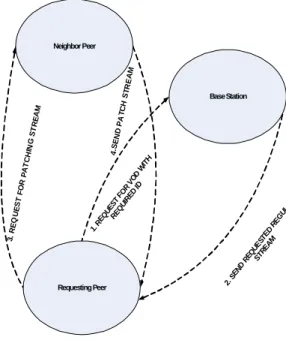
According to rule2, requesting peer gets the regular stream from server and patching from neighbor on the base of proactive approach shown in collaborative figure 4.
3. RE QU E ST FO R P AT CH IN G S TR E AM 4.S EN D P AT CH S TR E AM Base Station Requesting Peer 1. R EQ UE ST FO R V OD WIT H RE QU IRE D ID 2. S END REQ UE STE D R EG ULA R STR EA M Neighbor Peer
Figure 4. Collaboration diagram of Proactive Patchpeer between three entities
We use here unicast scheme for getting the patch from neighbor peer. The beauty of unicast approach is to reduce the network load. In the previous scheme [7] has been used multicasting scheme, as multicasting scheme makes the network congested and time consuming. The requesting peer has to wait for times until all the neighbor peers respond. Waiting time could be lengthy; in case requesting peer does not get respond from all the neighbor peers. Delay of respond from even single node, causes the multicasting message again because it does not know, which neighbor peer has not responded yet and keeps on waiting till time out occurs. As second attempt of using the multicast messaging can make the network highly flooded and resulting can be cause of jamming. In case of jamming. The requesting peer cannot play demanded video despite of getting the regular stream. If requesting peer gets back the response from all neighboring and gets no patching from any neighbor, then again, requesting peer has to request to server for patching. The request made to second time to server causes the wastage of extra resources. Multicasting scheme has one major disadvantage, inconsequence of getting patching from more than one neighbor peer, which
makes difficult for requesting peer to which patching should be used to integrate with regular stream to play the video-on-demand, the figure 5 shows operations of a requesting peer, server and neighbor peer.
REQUEST FOR VOD WITH REQUIRED ID
GET REQUESTED REGULAR STREAM FROM SERVER
LAST REGULAR TIME= NULL LAST REGULAR TIME= 1
WAIT FOR SERVER RESPONSE
RECEIVED REGULAR STREAM FROM SERVER AND PATCH FROM
NEIGHBOR PEER
ACCEPTED/REJECTED REQUEST IS ACCEPTED REQUEST FOR PATCH FROM
SERVER
Figure 5. Flowchart diagram of requesting peer in proactive patchpeer
5. Working process of proactive Video Patching Routing Protocol (PVPRP) protocol
Proactive Video Patching Routing Protocol (PVPRP) has been designed and proposed for video-on-demand delivery in hybrid network to get patching from one distance of neighbor. This is proactive based unicast protocol and following the some features of Bellman-Ford algorithm for calculating the path. The basic function of PVPRP is to
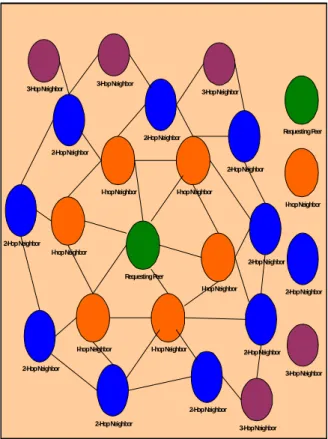
calculate the one hop distance but inheriting some features of DSDV and WRP routing protocols. Each node keeps the information at one hop distance of neighbors and maintains two tables because each node does not need information more than one distance neighbor. The way of maintaining two topological tables cannot make network congested because each node gets updated information from one hop. Each node maintains the tables on the basis of Node Profile (NP), which includes the information of Video Patching (VP) and Routing Table (RT), which keeps up-to-date information of previous and next neighbor nodes and maintains the table on the basis of joining or leaving the nodes at one hop distance. Each updated messages contain list of NP. The message transmitted to one hop distance is marked at the RT by getting the acknowledgement. If counter reaches zero, which shows that no acknowledgement is pending. In case of pending the acknowledgement, message is retransmitted to unacknowledged node. The retransmitted message is also sent through unicast process. The retransmitted message does not make the network congested because each node has already information, which node has not yet acknowledged. The situation of un-acknowledgement happens in rare cases due to being one hop distance. Nodes periodically exchanges the tables, if new node joins or leaves the at one hop distance. When node gets update message, it maintains the NP table. If updated message is about the joining of new node, then makes the entry of NP including VP information. In case of leaving the node, stored information against any node is eliminated from NP table. PVPRP does not require large storage for maintaining the two tables because the search process and storage information are limited at the one hop distance. The route making process is shown in figure 6.The green node is requesting peer, which is requesting the patch from known neighbor on the basis of maintained RT and NP tables. The requesting peer has neighbors with orange colored nodes and information against these neighbors is already maintained in tables. The search process for patching is dealt with only orange colored nodes. The remaining nodes are not searched for obtaining the patching. The nodes in blue and brown colored are available at 2 and 3 hop distance respectively. Information about hop 2 and 3 is not maintained in RT and NP tables.
I-hop Neighbor I-hop Neighbor I-hop Neighbor I-hop Neighbor I-hop Neighbor I-hop Neighbor Requesting Peer 2-Hop Neighbor 2-Hop Neighbor 2-Hop Neighbor 2-Hop Neighbor 2-Hop Neighbor 2-Hop Neighbor 2-Hop Neighbor 2-Hop Neighbor
3-Hop Neighbor 3-Hop Neighbor 3-Hop Neighbor
3-Hop Neighbor I-hop Neighbor Requesting Peer 2-Hop Neighbor 3-Hop Neighbor 2-Hop Neighbor
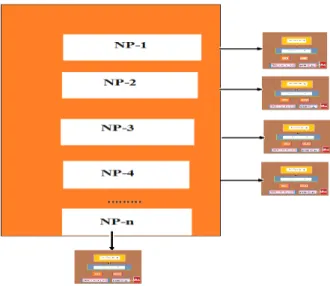
Figure 6. Proactive patchpeer routing process If any node joins the network, sends "hello" message to one-hop distance neighbors, as advertising the hello message process is completed with support of PVPRP, which helps to one-hop neighboring nodes to update their tables dynamically on the base of sent information through links. Each message has validity time (timeout); remains activate until timeout occurs but "hello" process does not take longer time due to being one-hop distance. The address of node is used as unique identifier in the network. All nodes can be multi-homed (multiple interfaces), which are participating in PVPRP environment. PVPRP uses UDP protocol for sending the control traffic. The process of detection the 1-hop neighbor is done by using main address of node. The both tables are updated on the creation of link entry. After completion of “hello" process, all one-hop neighboring nodes starts to maintain the RT and NP tables. When requesting node needs Video-on-demand, first checks the list of video patching to be stored with entry of neighbor patching profile in table of NP given in figure 7.
Figure 7. Neighbor Patching Profile Table (NP)
NP table shows the list of all stored neighboring profiles in form of NP1, NP2, NP3, NP4...NPn. Against each entry, the neighbor profile is stored in repository of node's database. Neighbor patching profile consists of some necessary information regarding the video patching. The stored information can be helpful for requesting peer to select best patching for video-on-demand. Neighbor patching profile includes the list of video patching. The list of video patching provides the index ID of all sorted video patching such as VP-1, VP-2, VP-3...VPn explained in figure 8.
Figure 8. Contents of Neighbor Patching Profile
Each Video patching (VP) includes the information about Video patching size and Video patching status. VP size provides the information of VP downstream and VP upstream. VP downstream and upstream could be of different size, depending on the size of video. VP status includes the specification and history of stored patching. History of VP gives the information about released date of patching. On the basis of this information, requesting peer gets the best patching from neighbor peer to play video-on-demand.
6. Simulation Setup
In the previous sections, working process of proactive patchpeer was explained with some logical reasoning. The purpose of this section is to analyze the performance of proactive patchpeer and critically evaluating the results with respect to mobility. Initially, we simulate the simple scenario to get the result and use some parameters same as explained in [7]. We also use acceptance ratio but get the throughput at the base of acceptance ratio explained in following formula.
Acceptance Ratio = Number of accepted bytes/time (minutes).
The random waypoint scenario is generated with the minimum speed of the node (Vmin) is 0 m/sec and maximum speed (Vmax) are 40 m/sec respectively. The moving speed of node is randomly obtained through uniform division [Vmin, Vmax]. We run simulations, which cover combination of the pause time and moving speed of nodes (Tracy camp. September 2002). We calculate throughput against length of video in time at the base of accepted request for playing the video. An accepted ratio shows that requesting peer obtains the patching and regular stream to play the video without loss of data (frames).two conditions are applied. First, if original stream and patching are received from server, request is considered to be accepted. Second, if original stream is obtained from server and remaining part means patching is received from neighbor peer, request is again considered to be accepted. A request can be delayed or rejected, if requested video is not found to the server side but at the side of neighboring peers, reject condition cannot happen because requesting peer has already stored the information
of list of video patching of neighboring peers. The used parameters are summarized in Table 1.
Table: 1. shows summarized Simulation parameters Parameters
Value
Simulation time (min) 40
Operating area (m×m) 600 *1200 Mean request inter-arrival 10 Number of mobile nodes 50 Transmission range (m) 250 Sensing and interference range (m) 550 WLAN bandwidth (kbps) 6000 Client forwarding buffer size (min)
12
Client playback buffer size (min) 12 WWAN bandwidth (kbps) 2400 Percentage of seed peers 10 Number of videos 1
Normal playback rate (kbps)
300
Video length (min)
40
Mean speed 20
Mean pause time (s) 10
Pause time delta (s) 1
Routing Protocol
Proactive Video Patching Routing Protocol
7. Simulation Result
In this section, we discuss the results of simulated scenario. We have simulated hybrid network Scenario with Random waypoint mobility model. Throughput has been collected on the basis of accepted ratio for original patching,
patchpeer and our proposed proactive patchpeer scheme to analyze the performance. The figure 14 shows the throughput performance for each scheme. The performance gradually decreases of original patching and patchpeer but proactive patchpeer provides better throughput during the total simulation time. The various performance affecting factors are noted such as radio channel fading, overload of multicasting messages in network gets network congested, unsuccessful search of patching in neighboring peers could be cause of long delay, repeated timeouts results the long delay, if patching is not found in neighboring peers, requesting again to server for obtaining, which makes the playback time lengthy. The declined request for demanded video from server affects the throughput. The mobility also degrades the performance of nodes because mobility causes of breaking the links and takes time to recover. All of these factors affect the performance of original patching and patchpeer. The affecting factors to our scheme are mobility, maintaining the routing tables and channel fading.
Figure14. Throughput of original patching, patchpeer and Proactive patchpeer
8. Conclusion and Future work
Proactive Patch Peer for video-on-demand streaming is novel technique for wireless hybrid network. The scheme
controls scalability issues related with original patching and more optimized than previously published patchpeer technique. Proactive patchpeer takes minimum time to playback the video-on-demand due to efficient algorithms of searching the video in server side and neighbor-peers. Technique makes the network less congested due to known information stored in RT and NP tables regarding neighbor-peers. Technique also reduces the over loaded burden of traffics onto the network by exploiting unicast message to particular node for obtaining the patching. The most significance of this technique is fast search for patch peer. In future, we will simulate complicated scenario by increasing the length of video and critically analyze the all parameters discussed in [7]. We will also prove our technique by using mathematical modeling and algorithms.
References
[1].Yanping Zhao, Derek Eager,Mary K. Vernon, “Scalable On-Demand Streaming of Non-Linear
Media",IEEE INFOCOM, 2004.
[2].Tarik Taleb,Nei Kato,Yoshiaki Nemoto, "On-demand media streaming to hybrid wired/wireless networks over quasi-geostationary satellite systems", Elsevier Journal, Computer Networks 47 (2005) 287–306.
[3].Frederic Thouin, Mark Coates,"Video-on-Demand
Networks: Design Approaches and Future Challenges",IEEE Network ,March/April 2007
[4]. Yifeng He, Ivan Lee, Xijia Gu,Ling Guan,"Centeralized Peer-to-Peer Video Streaming over Hybrid wireless", IEEE,2005.
[5]. Wei W (2006) Multipath unicast and multicast video communication over wireless ad hoc networks. Ph.D. thesis, Department of Electrical Engineering and Computer Sciences, University of California, Berkeley.
[6]. Dai H, Chan E (2008) Quick patching: an overlay multicast scheme for supporting video on demand in wireless networks. Multimedia Tools Appl 36(3):221–242. doi:10.1007/s11042-007-0143-6.
[7]. Tai T. Do, Kien A. Hua ,Ning Jiang , Fuyu Liu,
"Patchpeer: A scalable video-on-demand streaming system in hybrid wireless mobile peer-to-peer networks", Springer,
Peer-to-Peer Net Appl (2009) 2:182–201, 24 February 2009.
[8]' Ming Zhou, Jiangchuan Liu."A Hybrid Overlay Network for Video-on-Demand”, School of Computing Science Simon Fraser University, Burnaby, British Columbia, Canada, research partially supported by a Canadian NSERC Discovery and SFU President's Research Grant.
[9]. Henden L. (ed) (2005) Broadcast and multicast—a vision on their role in future broadband access networks.
http://cordis.europa.eu/ist/ct/proclu/c/broadcast.htm.
[10]. D. L. Eager, M. K. Vernon, and J. Zahorjan. Minimizing bandwidth requirements for on-demand data delivery. IEEE Trans. on Knowledge and Data Engineering, 13(5):742–757, Sept./Oct. 2001.
[11]. Razaque.A, Qadir.M.A, Shahzad.K, Osama Bin Nazeer, Hammad Khalid., Device Discovery with qualitative and quantitative Analysis of TCP Variants under mobility Based Anchor Point Node Hybrid Network, In Proceedings of IADIS International Conference Wireless Applications and Computing, Amsterdam, Netherlands. 22 - 24 July 2008.
[12]. Kien A. Hua, Mounir A. Tantaoui ,Wallapak
Tavanapong,"Video Delivery Technologies for Large-Scale Deployment of Multimedia Applications", research supported by U.S National Science Foundation grant ANI-0088026.
[13]. He Y, Lee I, Gu X, Guan L (2005) Centralized peer-to-peer video streaming over hybrid wireless network. In: ICME, pp 550–553.
[14]. De P, Sharma S, Shuvalov A, Chiueh T (2004) Wivision:a wireless video system for real-time distribution and ondemand playback. In: Proceedings of the IEEE consumer communications and networking conference (CCNC).
[15]. Advanced traveler information system capabilities:
human factors research needs.
http://www.fhwa.dot.gov/tfhrc/safety/ubs/98-186.pdf. [16].Wei H,"Integrating mobile ad hoc networks with cellular networks", Ph.D. thesis, Department of Electrical Engineering,Columbia University,2004.