Parallel Selective Algorithms for Nonconvex
Big Data Optimization
Francisco Facchinei, Gesualdo Scutari
, Senior Member, IEEE
, and Simone Sagratella
Abstract—We propose a decomposition framework for the parallel optimization of the sum of a differentiable (possibly nonconvex) function and a (block) separable nonsmooth, convex one. The latter term is usually employed to enforce structure in the solution, typically sparsity. Our framework is veryflexible and includes both fully parallel Jacobi schemes and Gauss–Seidel (i.e., sequential) ones, as well as virtually all possibilities “in between” with only a subset of variables updated at each iteration. Our theoretical convergence results improve on existing ones, and numerical results on LASSO, logistic regression, and some non-convex quadratic problems show that the new method consistently outperforms existing algorithms.
Index Terms—Parallel optimization, variables selection, dis-tributed methods, Jacobi method, LASSO, sparse solution.
I. INTRODUCTION
T
HE minimization of the sum of a smooth function, , and of a nonsmooth (block separable) convex one, ,(1) is an ubiquitous problem that arises in many fields of en-gineering, so diverse as compressed sensing, basis pursuit denoising, sensor networks, neuroelectromagnetic imaging, machine learning, data mining, sparse logistic regression, genomics, metereology, tensor factorization and completion, geophysics, and radio astronomy. Usually the nonsmooth term is used to promote sparsity of the optimal solution, which often corresponds to a parsimonious representation of some phenomenon at hand. Many of the aforementioned applications can give rise to extremely large problems so that standard optimization techniques are hardly applicable. And indeed, recent years have witnessed aflurry of research activity aimed
Manuscript received August 08, 2014; revised December 07, 2014; accepted January 18, 2015. Date of publication February 03, 2015; date of current ver-sion March 04, 2015. The associate editor coordinating the review of this man-uscript and approving it for publication was Prof. Eduard Jorswieck. The work of F. Facchinei was supported by the MIUR project PLATINO (Grant Agree-ment PON01_01007). The work of G. Scutari was supported by the USA Na-tional Science Foundation under Grants CMS 1218717 and CAREER Award No. 1254739. This work has been presented in part at the IEEE International Conference on Acoustics, Speech, and Signal Processing (ICASSP), Florence, Italy, May 4–9, 2014 [1].
(F. Facchinei and G. Scutari contributed equally to this work.)
F. Facchinei and S. Sagratella are with the Department of Computer, Control, and Management Engineering, University of Rome La Sapienza, Rome 00185, Italy. (e-mail: [email protected]; [email protected]).
G. Scutari is with the Department of Electrical Engineering, State University of New York at Buffalo, Buffalo 14260 USA (e-mail: [email protected]).
Color versions of one or more of thefigures in this paper are available online at http://ieeexplore.ieee.org.
Digital Object Identifier 10.1109/TSP.2015.2399858
at developing solution methods that are simple (for example based solely on matrix/vector multiplications) but yet capable to converge to a good approximate solution in reasonable time. It is hard here to even summarize the huge amount of work done in thisfield; we refer the reader to the recent works [2]–[14] and books [15]–[17] as entry points to the literature.
However, with big data problems it is clearly necessary to design parallel methods able to exploit the computational power of multi-core processors in order to solve many in-teresting problems. Furthermore, even if parallel methods are used, it might be useful to reduce the number of (block) variables that are updated at each iteration, so as to alleviate the burden of dimensionality, and also because it has been observed experimentally (even if in restricted settings and under some very strong convergence assumptions, see [13], [18]–[20]) that this might be beneficial. While sequential solutions methods for Problem (1) have been widely investigated (especially when is convex), the analysis of parallel algorithms suitable to large-scale implementations lags behind. Gradient-type methods can of course be easily parallelized, but, in spite of their good theoretical convergence bounds. they suffer from practical drawbacks. Fist of all, they are notoriously slow in practice. Accelerated (proximal) versions have been proposed in the literature to alleviate this issue, but they require the knowledge of some function parameters (e.g., the Lipschitz constant of , and the strong convexity constant of , when is assumed strongly convex), which is not generally available, unless and have a very special structure (e.g., quadratic functions); (over)estimates of such parameters affect negatively the convergence speed. Moreover, all (proximal, accelerated) gradient-based schemes use only the first order information of ; recently we showed in [21] that exploiting the structure of by replacing its linearization with a “better” approximant can enhance practical convergence speed. How-ever, beyond that, and looking at recent approaches, we are aware of only few (recent) papers dealing with parallel solution methods [8]–[13] and [20], [22]–[27]. The former group of works investigate deterministic algorithms, while the latter
randomones. One advantage of the analyses in these works is
that they provide a global rate of convergence. However, i) they are essentially still (regularized) gradient-based methods; ii) as proximal-gradient algorithms, they require good and global knowledge of some and parameters; and iii) except for [9], [10], [12], [26], they are proved to converge only when is convex. Indeed, to date there are no methods that are parallel and random and that can be applied to nonconvex problems. For this reason, and also because of their markedly different
flavor (for example deterministic convergence vs. convergence in mean or in probability), we do not discuss further random
1053-587X © 2015 IEEE. Personal use is permitted, but republication/redistribution requires IEEE permission. See http://www.ieee.org/publications_standards/publications/rights/index.html for more information.
algorithms in this paper. We refer instead to Section V for a more detailed discussion on deterministic, parallel, and sequen-tial solution methods proposed in the literature for instances (mainly convex) of (1).
In this paper, we focus onnonconvexproblems in the form (1), and proposed a new broad,deterministicalgorithmic frame-work for the computation of their stationary solutions, which hinges on ideas first introduced in [21]. The essential, rather natural idea underlying our approach is to decompose (1) into a sequence of (simpler) subproblems whereby the function is replaced by suitable convex approximations; the subproblems can be solved in aparallelanddistributedfashion and it is not necessary to update all variables at each iteration. Key features of the proposed algorithmic framework are: i) it is parallel, with a degree of parallelism that can be chosen by the user and that can go from a complete parallelism (every variable is updated in parallel to all the others) to the sequential (only one variable is updated at each iteration), covering virtually all the possibil-ities in “between”; ii) it permits the update in a deterministic
fashionof only some (block) variables at each iteration (a
fea-ture that turns out to be very important numerically); iii) it easily leads to distributed implementations; iv) no knowledge of and parameters (e.g., the Lipschitz constant of ) is re-quired; v) it can tackle a nonconvex ; vi) it is veryflexible in the choice of the approximation of , which need not be nec-essarily its first or second order approximation (like in prox-imal-gradient schemes); of course it includes, among others, up-dates based on gradient- or Newton-type approximations; vii) it easily allows for inexact solution of the subproblems (in some large-scale problems the cost of computing the exact solution of all the subproblems can be prohibitive); and viii) it appears to be numerically efficient. While features i)–viii), taken singu-larly, are certainly not new in the optimization community, we are not aware of any algorithm that possesses them all, the more so if one limits attention to methods that can handle nonconvex objective functions, which is in fact the main focus on this paper. Furthermore, numerical results show that our scheme compares favorably to existing ones.
The proposed framework encompasses a gamut of novel algorithms, offering great flexibility to control iteration com-plexity, communication overhead, and convergence speed, while converging under the same conditions; these desirable features make our schemes applicable to several different problems and scenarios. Among the variety of new proposed updating rules for the (block) variables, it is worth mentioning a combination of Jacobi and Gauss-Seidel updates, which seems particularly valuable in the optimization of highly nonlinear objective function; to the best of our knowledge, this is thefirst time that such a scheme is proposed and analyzed.
A further contribution of the paper is an extensive implemen-tation effort over a parallel architecture (the General Computer Cluster of the Center for Computational Research at the SUNY at Buffalo), which includes our schemes and the most compet-itive ones in the literature. Numerical results on LASSO, Lo-gistic Regression, and some nonconvex problems show that our algorithms consistently outperform state-of-the-art schemes.
The paper is organized as follows. Section II formally introduces the optimization problem along with the main as-sumptions under which it is studied. Section III describes our novel general algorithmic framework along with its
conver-gence properties. In Section IV we discuss several instances of the general scheme introduced in Section III. Section V contains a detailed comparison of our schemes with state-of-the-art al-gorithms on similar problems. Numerical results are presented in Section VI. Finally, Section VII draws some conclusions. All proofs of our results are given in the Appendix.
II. PROBLEMDEFINITION
We consider Problem (1), where the feasible set
is a Cartesian product of lower dimensional convex sets , and is partitioned accordingly:
, with each is smooth (and not neces-sarily convex) and is convex and possibly nondifferentiable, with . This formulation is very general and includes problems of great interest. Below we list some in-stances of Problem (1).
; the problem reduces to the minimization of a smooth, possibly nonconvex problem with convex constraints.
and , with
, and given constants; this is the renowned and much studied LASSO problem [2].
and ,
with , and given constants; this
is the group LASSO problem [28].
and (or
), with , and
given constants; this is the sparse logistic regression problem [29], [30].
and ,
with , and given; this is the
-regularized -loss Support Vector Machine problem [5]. and
, where and are the (matrix) optimization vari-ables, , and are given constants, is the -dimensional vector with a 1 in the -th coordinate and 0’s elsewhere, and and denote the Frobenius norm and the L1 matrix norm of , respectively; this is an ex-ample of the dictionary learning problem for sparse representa-tion, see, e.g., [31]. Note that is not jointly convex
in .
Other problems that can be cast in the form (1) include the Nu-clear Norm Minimization problem, the Robust Principal Com-ponent Analysis problem, the Sparse Inverse Covariance Selec-tion problem, the Nonnegative Matrix (or Tensor) FactorizaSelec-tion problem, see e.g., [32] and references therein.
Assumptions: Given (1), we make the following blanket
as-sumptions:
(A1) Each is nonempty, closed, and convex; (A2) is on an open set containing ;
(A3) is Lipschitz continuous on with constant ; (A4) , with all continuous and convex
on ; (A5) is coercive.
Note that the above assumptions are standard and are
satis-fied by most of the problems of practical interest. For instance, A3 holds automatically if is bounded; the block-separability condition A4 is a common assumption in the literature of par-allel methods for the class of problems (1) (it is in fact
instru-mental to deal with the nonsmoothness of in a parallel en-vironment). Interestingly A4 is satisfied by all standard usu-ally encountered in applications, including and , which are among the most commonly used functions. Assumption A5 is needed to guarantee that the sequence generated by our method is bounded; we could dis-pense with it at the price of a more complex analysis and cum-bersome statement of convergence results.
III. MAINRESULTS
We begin introducing an informal description of our algo-rithmic framework along with a list of key features that we would like our schemes enjoy; this will shed light on the core idea of the proposed decomposition technique.
We want to developparallelsolution methods for Problem (1) whereby operations can be carried out on some or (possibly) all (block) variables at thesametime. The most natural parallel (Jacobi-type) method one can think of is updating allblocks simultaneously: given , each (block) variable is updated by solving the following subproblem
(2) where denotes the vector obtained from by deleting the block . Unfortunately this method converges only under very restrictive conditions [33] that are seldom verified in practice. To cope with this issue the proposed approach introduces some “memory” in the iterate: the new point is a convex combina-tion of and the solutions of (2). Building on this iterate, we would like our framework to enjoy many additional features, as described next.
Approximating : Solving each subproblem as in (2) may be
too costly or difficult in some situations. One may then prefer to approximate this problem, in some suitable sense, in order to facilitate the task of computing the new iteration. To this end, we assume that for all we can define a function , the candidate approximant of , having the following properties (we denote by the partial gradient of with respect to thefirst argument ): (P1) is convex and continuously differentiable on
for all ;
(P2) for all ;
(P3) is Lipschitz continuous on for all . Such a function should be regarded as a (simple) convex approximation of at the point with respect to the block of variables that preserves thefirst order properties of with respect to .
Based on this approximation we can define at any point
aregularizedapproximation of with respect to
wherein is replaced by while the nondifferentiable term is preserved, and a quadratic proximal term is added to make the overall approximation strongly convex. More formally, we have
(3)
where is an positive definite matrix (possibly de-pendent on . We always assume that the functions
are uniformly strongly convex.
(A6) All are uniformly strongly convex on with a common positive definiteness constant ; furthermore,
is Lipschitz continuous on .
Note that an easy and standard way to satisfy A6 is to take, for any and for any and . However, if is already uniformly strongly convex, one can avoid the proximal term and set while satisfying A6.
Associated with each and point we can define the following optimal block solution map:
(4) Note that is always well-defined, since the optimiza-tion problem in (4) is strongly convex. Given (4), we can then introduce, for each , the solution map
The proposed algorithm (that we formally describe later on) is based on the computation of (an approximation of) . Therefore the functions should lead to as easily computable functions as possible. An appropriate choice depends on the problem at hand and on computational requirements. We discuss alternative possible choices for the approximations in Section IV.
Inexact Solutions: In many situations (especially in the case
of large-scale problems), it can be useful to further reduce the computational effort needed to solve the subproblems in (4) by allowing inexact computations of , i.e., , where measures the accuracy in computing the solution.
Updating Only Some Blocks: Another important feature we
want for our algorithm is the capability of updating at each iter-ation onlysomeof the (block) variables, a feature that has been observed to be very effective numerically. In fact, our schemes are guaranteed to converge under the update of only a subset
of the variables at each iteration; the only condition is that such a subset contains at least one (block) component which is within a factor “far away” from the optimality, in the sense explained next. Since is an optimal solution of (4) if and only if , a natural distance of from the optimality is ; one could then select the blocks ’s to update based on such an optimality measure (e.g., opting for blocks exhibiting larger ’s). However, this choice requires the computation of all the solutions , for , which in some applications (e.g., huge-scale problems) might be computationally too expensive. Building on the same idea, we can introduce alternative less expensive metrics by replacing the distance with a computationally cheaper error bound, i.e., a function such that
(5) for some . Of course one can always set
, but other choices are also possible; we dis-cuss this point further in Section IV.
Algorithmic Framework:We are now ready to formally intro-duce our algorithm, Algorithm 1, that includes all the features discussed above; convergence to stationary solutions1of (1) is stated in Theorem 1.
Algorithm 1:Inexact Flexible Parallel Algorithm (FLEXA) Data: for
.
Set .
If satisfies a termination criterion: STOP;
Set .
Choose a set that contains at least one index
for which .
For all , solve (4) with accuracy
Find s.t. ;
Set for and for
Set ;
: , and go to .
Theorem 1:Let be the sequence generated by Algorithm 1,
under A1–A6. Suppose that and satisfy the following conditions: i) ; ii) ; iii)
; and iv) for all
and some and . Additionally, if inexact solutions are used in Step 3, i.e., for some and infinite , then assume also that is globally Lipschitz on . Then, either Algorithm 1 converges in afinite number of iterations to a stationary solution of (1) or every limit point of (at least one such points exists) is a stationary solution of (1).
Proof: See Appendix B.
The proposed algorithm is extremelyflexible. We can always choose resulting in the simultaneous update of all the (block) variables (full Jacobi scheme); or, at the other ex-treme, one can update a single (block) variable per time, thus obtaining a Gauss-Southwell kind of method. More classical cyclic Gauss-Seidel methods can also be derived and are dis-cussed in the next subsection. One can also compute inexact solutions (Step 3) while preserving convergence, provided that the error term and the step-size ’s are chosen according to Theorem 1; some practical choices for these parameters are discussed in Section IV. We emphasize that the Lipschitzianity of is required only if is not computed exactly for
infiniteiterations. At any rate this Lipschitz conditions is auto-matically satisfied if is a norm (and therefore in LASSO and group LASSO problems for example) or if is bounded.
As afinal remark, note that versions of Algorithm 1 where all (or most of) the variables are updated at each iteration are particularly amenable to implementation indistributed environ-ments (e.g., multi-user communications systems, ad-hoc net-works, etc.). In fact, in this case, not only the calculation of the inexact solutions can be carried out in parallel, but the in-formation that “the -th subproblem” has to exchange with the 1We recall that a stationary solution of (1) is a points for which a
sub-gradient exists such that for all
. Of course, if is convex, stationary points coincide with global mini-mizers.
“other subproblem” in order to compute the next iteration is very limited. A full appreciation of the potentialities of our approach in distributed settings depends however on the specific applica-tion under consideraapplica-tion and is beyond the scope of this paper. We refer the reader to [21] for some examples, even if in less general settings.
A. Gauss-Jacobi Algorithms
Algorithm 1 and its convergence theory cover fully parallel Jacobi as well as Gauss-Southwell-type methods, and many of their variants. In this section we show that Algorithm 1 can also incorporatehybrid parallel-sequential(Jacobi—Gauss-Seidel) schemes wherein block of variables are updatedsimultaneously
by sequentially computing entries per block. This procedure
seems particularly well suited to parallel optimization on multi-core/processor architectures.
Suppose that we have processors that can be used in parallel and we want to exploit them to solve Problem (1) ( will denote both the number of processors and the set ). We “assign” to each processor the variables ; therefore is a partition of . We denote by the vector of (block) variables assigned to processor , with ; and is the vector of remaining variables, i.e., the vector of those assigned to all processors except the -th one. Finally, given , we partition as , where is the vector containing all variables in that come before (in the order assumed in ), while are the remaining variables. Thus we will write, with a slight abuse of notation .
Once the optimization variables have been assigned to the processors, one could in principle apply the inexact Jacobi Al-gorithm 1. In this scheme each processor would compute
se-quentially, at each iteration and for every (block) variable
, a suitable by keeping all variables but fixed to and . But since we are solving the problems for each group of variables assigned to a processor sequentially, this seems a waste of resources; it is instead much more efficient to use, within each processor, a Gauss-Seidel scheme, whereby
thecurrentcalculated iterates are used in all subsequent
calcu-lations. Our Gauss-Jacobi method formally described in Algo-rithm 2 implements exactly this idea; its convergence properties are given in Theorem 2.
Algorithm 2:Inexact Gauss-Jacobi Algorithm
Data: for and
.
Set .
: If satisfies a termination criterion: STOP; For all do (in parallel),
For all do (sequentially) a) Find s.t.
b) Set
Algorithm 3:Inexact GJ Algorithm with Selection
Data: for and
. Set .
: If satisfies a termination criterion: STOP;
Set .
Choose sets so that their union contains at least one index for which . For all do (in parallel),
For all do (sequentially) a) Find s.t.
b) Set
Set for all ,
, and go to .
Theorem 2: Let be the sequence generated by
Algo-rithm 2, under the setting of Theorem 1, but with the addition assumption that is bounded on . Then, either Algorithm 2 converges in afinite number of iterations to a stationary solu-tion of (1) or every limit point of the sequence (at least one such points exists) is a stationary solution of (1).
Proof: See Appendix C.
Although the proof of Theorem 2 is relegated to the Appendix, it is interesting to point out that the gist of the proof is to show that Algorithm 2 is nothing else but an instance of Algorithm 1 with errors. We remark that Algorithm 2 contains as special case the classical cyclical Gauss-Seidel scheme it is sufficient to set then a single processor updates all the (scalar) variables sequentially while using the new values of those that have already been updated.
By updating all variables at each iteration, Algorithm 2 has the advantage that neither the error bounds nor the exact so-lutions need to be computed, in order to decide which vari-ables should be updated. Furthermore it is rather intuitive that the use of the “latest available information” should reduce the number of overall iterations needed to converge with respect to Algorithm 1. However this advantages should be weighted against the following two facts: i) updating all variables at each iteration might not always be the best (or a feasible) choice; and ii) in many practical instances of Problem (1), using the latest information as dictated by Algorithm 2 may require extra calculations, e.g., to compute function gradients, and commu-nication overhead (these aspects are discussed on specific ex-amples in Section VI). It may then be of interest to consider a further scheme, that we might call “Gauss-Jacobi with Se-lection”, where we merge the basic ideas of Algorithms 1 and 2. Roughly speaking, at each iteration we proceed as in the Gauss-Jacobi Algorithm 2, but we perform the Gauss steps only on a subset of each , where the subset is defined ac-cording to the rules used in Algorithm 1. To present this com-bined scheme, we need to extend the notation used in Algorithm 2. Let be a subset of . For notational purposes only, we reorder so that first we have all variables in and then
the remaining variables in . Now, similarly to what done before, and given an index ,
we partition as , where is
the vector containing all variables in that come before (in the order assumed in ), while are the remaining vari-ables in . Thus we will write, with a slight abuse of notation . The proposed Gauss-Jacobi with Se-lection is formally described in Algorithm 3.
Theorem 3:Let be the sequence generated by
Algo-rithm 3, under the setting of Theorem 1, but with the addition assumption that is bounded on . Then, either Algorithm 3 converges in afinite number of iterations to a stationary solu-tion of (1) or every limit point of the sequence (at least one such points exists) is a stationary solution of (1).
Proof: The proof is just a (notationally complicated, but
conceptually easy) combination of the proofs of Theorems 1 and 2 and is omitted for lack of space.
Our experiments show that, in the case of highly nonlinear objective functions, Algorithm 3 performs very well in practice, see Section VI.
IV. EXAMPLES ANDSPECIALCASES
Algorithms 1 and 2 are very general and encompass a gamut of novel algorithms, each corresponding to various forms of the approximant , the error bound function , the step-size se-quence , the block partition, etc. These choices lead to algo-rithms that can be very different from each other, butall
con-verging under the same conditions. These degrees of freedom
offer a lot of flexibility to control iteration complexity, com-munication overhead, and convergence speed. We outline next several effective choices for the design parameters along with some illustrative examples of specific algorithms resulting from a proper combination of these choices.
On the Choice of the Step-Size : An example of step-size rule
satisfying conditions i)-iv) in Theorem 1 is: given , let
(6) where is a given constant. Notice that while this rule may still require some tuning for optimal behavior, it is quite reliable, since in general we are not using a (sub)gradient direc-tion, so that many of the well-known practical drawbacks asso-ciated with a (sub)gradient method with diminishing step-size are mitigated in our setting. Furthermore, this choice of step-size does not require any form of centralized coordination, which is a favorable feature in a parallel environment. Numerical results in Section VI show the effectiveness of (the customization of) (6) on specific problems.
Remark 4 (Line-Search Variants of Algorithms 1 and 2): It is
possible to prove convergence of Algorithms 1 and 2 also using other step-size rules, for example Armijo-like line-search pro-cedures on . In fact, Proposition 8 in Appendix A shows that the direction is a “good” descent direction. Based on this result, it is not difficult to prove that if is chosen by a suitable line-search procedure on , convergence of Algorithm 1 to stationary points of Problem (1) (in the sense of Theorem 1) is guaranteed. Note that standard line-search methods proposed for smooth functions cannot be applied to (due to the non-smooth part ); one needs to rely on more sophisticated proce-dures, e.g., in the spirit of those proposed in [6], [10], [12], [34].
We provide next an example of line-search rule that can be used to compute while guaranteeing convergence of Algorithms 1 and 2 [instead of using rules i)-iii) in Theorem 1]; because of space limitations, we consider only the case of exact solutions (i.e., in Algorithm 1 and in Algorithms 2 and
3). Writing for short and ,
with , and denoting by the vector whose component is equal to if , and zero otherwise, we have the following: let , choose , where is the smallest nonnegative integer such that
Of course, the above procedure will likely be more efficient in terms of iterations than the one based on diminishing step-size rules [as (6)]. However, performing a line-search on a multi-core architecture requires some shared memory and coordina-tion among the cores/processors; therefore we do not consider further this variant. Finally, we observe that convergence of Al-gorithms 1 and 2 can also be obtained by choosing a constant (suitably small) stepsize . This is actually the easiest option, but since it generally leads to extremely slow convergence we omitted this option from our developments here.
Choice of the Error Bound Function :
As we mentioned, the most obvious choice is to take
. This is a valuable choice if the computation of can be easily accomplished. For instance, in the LASSO problem with (i.e., when each block reduces to a scalar variable), it is well-known that can be computed in closed form using the soft-thresholding operator [11].
In situations where the computation of is not possible or advisable, we can resort to estimates. Assume mo-mentarily that . Then it is known ([35], Proposition 6.3.1)
under our assumptions that is an
error bound for the minimization problem in (4) and therefore satisfies (5), where denotes the Euclidean projection of onto the closed and convex set . In this situation we can
choose . If
things become more complex. In most cases of practical interest, adequate error bounds can be derived from ([10], Lemma 7).
It is interesting to note that the computation of is only needed if a partial update of the (block) variables is performed. However, an option that is always feasible is to take at each iteration, i.e., update all (block) variables at each iteration. With this choice we can dispense with the computation of altogether.
On the Choice of the Approximant :
The most obvious choice for is the linearization of at with respect to :
With this choice, and taking for simplicity ,
(7) This is essentially the way a new iteration is computed in most (block-)CDMs for the solution of (group) LASSO problems and its generalizations.
At another extreme we could just take
. Of course, to have P1 satisfied (cf. Section III), we must assume that is convex. With this choice, and setting for simplicity , we have
(8) thus giving rise to a parallel nonlinear Jacobi type method for the constrained minimization of .
Between the two “extreme” solutions proposed above, one can consider “intermediate” choices. For example, If is convex, we can take as a second order approximation of , i.e.,
(9) When , this essentially corresponds to taking a Newton step in minimizing the “reduced” problem
, resulting in
(10) Another “intermediate” choice, relying on a specific structure of the objective function that has important applications is the following. Suppose that is a sum-utility function, i.e.,
for somefinite set . Assume now that for every , the functions is convex. Then we may set
thus preserving, for each , the favorable convex part of with respect to while linearizing the nonconvex parts. This is the approach adopted in [21] in the design of multi-users systems, to which we refer for applications in signal processing and com-munications.
The framework described in Algorithm 1 can give rise to very different schemes, according to the choices one makes for the many variable features it contains, some of which have been detailed above. Because of space limitation, we cannot discuss here all possibilities. We provide next just a few instances of possible algorithms that fall in our framework.
Example #1—(Proximal) Jacobi Algorithms for Convex
Func-tions:Consider the simplest problem falling in our setting: the
unconstrained minimization of a continuously differentiable convex function, i.e., assume that is convex, , and . Although this is possibly the best studied problem in nonlinear optimization, classical parallel methods for this
problem ([33], Sec. 3.2.4) require very strong contraction condi-tions. In our framework we can take , resulting in a parallel Jacobi-type method which does not need any additional assumptions. Furthermore our theory shows that we can even dispense with the convexity assumption and still get convergence of a Jacobi-type method to a stationary point. If in addition we take , we obtain the class of methods studied in [21], [34], [36], [37].
Example #2—Parallel Coordinate Descent Methods for
LASSO:Consider the LASSO problem, i.e., Problem (1) with
, and . Probably, to date, the most successful class of methods for this problem is that of CDMs, whereby at each iteration asinglevariable is updated using (7). We can easily obtain a parallel version for this method by taking and still using (7). Alternatively, instead of linearizing , we can better exploit the structure of and use (8). In fact, it is well known that in LASSO problems subproblem (8) can be solved analytically (when ). We can easily consider similar methods for the group LASSO problem as well (just take ).
Example #3—Parallel Coordinate Descent Methods for
Lo-gistic Regression: Consider the Logistic Regression problem,
i.e., Problem (1) with
, and , where ,
and are given constants. Since is convex, we can take
and thus obtaining a fully distributed and parallel CDM that uses a second order approximation of the smooth function . Moreover by taking and using a soft-thresholding operator, each can be computed in closed form.
Example #4—Parallel Algorithms for Dictionary Learning
Problems: Consider the dictionary learning problem,
i.e., Problem (1) with and
, and
. Since is convex in and separately, one can take
and .
Although natural, this choice does not lead to a close form solutions of the subproblems associated with the optimiza-tion of and . This desirable property can be ob-tained using the following alternative approximations of : and , where .
V. RELATEDWORKS
The proposed algorithmic framework draws on Successive Convex Approximation (SCA) paradigms that have a long his-tory in the optimization literature. Nevertheless, our algorithms and their convergence conditions (cf. Theorems 1 and 2) unify and extend current parallel and sequential SCA methods in sev-eral directions, as outlined next.
(Partially) Parallel Methods:The roots of parallel deterministic
SCA schemes (whereinallthe variables are updated simulta-neously) can be traced back at least to the work of Cohen on the so-called auxiliary principle [36], [37] and its related de-velopments, see e.g., [8]–[13], [21], [23], [27], [34], [38], [39]. Roughly speaking these works can be divided in two groups, namely: solution methods for convexobjective functions [8],
[11], [13], [23], [27], [36], [37] andnonconvexones [9], [10], [12], [21], [34], [38], [39]. All methods in the former group (and [9], [10], [12], [38], [39]) are (proximal) gradient schemes; they thus share the classical drawbacks of gradient-like schemes (cf. Section I); moreover, by replacing the convex function with its first order approximation, they do not take any advantage of any structure of beyond mere differentiability; exploiting any available structural properties of , instead, has been shown to enhance (practical) convergence speed, see e.g., [21]. Com-paring with the second group of works [9], [10], [12], [21], [34], [38], [39], our algorithmic framework improves on their con-vergence properties while adding greatflexibility in the selec-tion of how many variables to update at each iteraselec-tion. For in-stance, with the exception of [10], [13], [18]–[20], all the afore-mentioned works do not allow parallel updates of only asubset
of all variables, a feature that instead, fully explored as we do, can dramatically improve the convergence speed of the algo-rithm, as we show in Section VI. Moreover, with the excep-tion of [34], they all require an Armijo-type line-search, which makes them not appealing for a (parallel) distributed imple-mentation. A scheme in [34] is actually based on diminishing step-size-rules, but its convergence properties are quite weak: not all the limit points of the sequence generated by this scheme are guaranteed to be stationary solutions of (1).
Our framework instead i) deals withnonconvex(nonsmooth) problems; ii) allows one to use a much varied array of approx-imations for and also inexact solutions of the subproblems; iii) is fully parallel and distributed (it does not rely on any line-search); and iv) leads to the first distributed convergent
schemes based on very general (possibly) partial updating rules of the optimization variables. In fact, among deterministic schemes, we are aware of only three algorithms [10], [13], [23] performing at each iteration a parallel update of only
a subset of all the variables. These algorithms however are
gradient-like schemes, and do not allow inexact solutions of the subproblems, when a closed form solution is not available (in some large-scale problems the cost of computing the exact solution of all the subproblems can be prohibitive). In addition, [10] requires an Armijo-type line-search whereas [23] and [13] are applicable only to convexobjective functions and are not
fully parallel. In fact, convergence conditions therein impose
a constraint on the maximum number of variables that can be simultaneously updated, a constraint that in many large scale problems is likely not satisfied.
Sequential Methods:Our framework contains as special cases
also sequential updates; it is then interesting to compare our results to sequential schemes too. Given the vast literature on the subject, we consider here only the most recent and gen-eral work [14]. In [14] the authors consider the minimization of a possibly nonsmooth function by Gauss-Seidel methods whereby, at each iteration, a single block of variables is up-dated by minimizing a global upper convex approximation of the function. However, finding such an approximation is generally not an easy task, if not impossible. To cope with this issue, the authors also proposed a variant of their scheme that does not need this requirement but uses an Armijo-type line-search, which however makes the scheme not suitable for a parallel/distributed implementation. Contrary to [14], in our framework conditions on the approximation function (cf. P1–P3) are trivial to be satisfied (in particular, need
not be an upper bound of ), enlarging significantly the class of utility functions which the proposed solution method is applicable to. Furthermore, our framework gives rise to parallel and distributed methods (no line search is used) whose degree of parallelism can be chosen by the user.
VI. NUMERICALRESULTS
In this section we provide some numerical results showing solid evidence of the viability of our approach. Our aim is to compare to state-of-the-art methods as well as test the infl u-ence of two key features of the proposed algorithmic frame-work, namely: parallelism and selective (greedy) selection of (only some) variables to update at each iteration. The tests were carried out on i) LASSO and Logistic Regression problems, two of the most studied (convex) instances of Problem (1); and ii)
nonconvexquadratic programming.
All codes have been written in C++. All algebra is performed by using the Intel Math Kernel Library (MKL). The algorithms were tested on the General Compute Cluster of the Center for Computational Research at the SUNY Buffalo. In particular we used a partition composed of 372 DELL 16 2.20 GHz Intel E5–2660 “Sandy Bridge” Xeon Processor computer nodes with 128 Gb of DDR4 main memory and QDR InfiniBand 40 Gb/s network card. In our experiments, parallel algorithms have been tested using up to 40 parallel processes (8 nodes with 5 cores per each), while sequential algorithms ran on a single process (using thus one single core).
A. LASSO Problem
We implemented the instance of Algorithm 1 described in Example #2 in the previous section, using the approximating function as in (8). Note that in the case of LASSO problems , the unique solution (8), can be easily computed in closed form using the soft-thresholding operator, see [11].
Tuning of Algorithm 1: In the description of our algorithmic
framework we consideredfixed values of , but it is clear that varying them a finite number of times does not affect in any way the theoretical convergence properties of the algorithms. We found that the following choices work well in practice: (i) are initially all set to , i.e., to half of the mean of the eigenvalues of ; (ii) all are doubled if at a certain iteration the objective function does not decrease; and (iii) they are all halved if the objective function decreases for ten consecutive iterations or the relative error on the objective function is sufficiently small, specifically if
(11) where is the optimal value of the objective function (in our experiments on LASSO is known). In order to avoid in-crements in the objective function, whenever all are doubled, the associated iteration is discarded, and in (S.4) of Algorithm 1 it is set . In any case we limited the number of possible updates of the values of to 100.
The step-size is updated according to the following rule:
(12)
with and . The above diminishing rule is based on (6) while guaranteeing that does not become too close to zero before the relative error is sufficiently small.
Finally the error bound function is chosen as
, and in Step 2 of the algorithm is set to
In our tests we consider two options for , namely: i) , which leads to afully parallelscheme wherein at each iteration
allvariables are updated; and ii) , which corresponds to updating only a subset of all the variables at each iteration. Note that for both choices of , the resulting set satisfies the requirement in (S.2) of Algorithm 1; indeed, always con-tains the index corresponding to the largest . We term the above instance of Algorithm 1FLEXible parallel Algorithm
(FLEXA), and we will refer to these two versions as FLEXA and FLEXA . Note that both versions satisfy conditions of Theorem 1, and thus are convergent.
Algorithms in the Literature: We compared our versions
of FLEXA with the most competitive distributed and sequen-tial algorithms proposed in the literature to solve the LASSO problem. More specifically, we consider the following schemes. FISTA: The Fast Iterative Shrinkage-Thresholding Algo-rithm (FISTA) proposed in [11] is afirst order method and can be regarded as the benchmark algorithm for LASSO problems. Building on the separability of the terms in the objective function , this method can be easily parallelized and thus take advantage of a parallel architecture. We implemented the parallel version that use a backtracking procedure to estimate the Lipschitz constant of [11].
SpaRSA: This is the first order method proposed in [12]; it is a popular spectral projected gradient method that uses a spectral step length together with a nonmonotone line search to enhance convergence. Also this method can be easily par-allelized, which is the version implemented in our tests. In all the experiments we set the parameters of SpaRSA as in [12]:
, and .
GRock & Greedy-1BCD: GRock is a parallel algorithm proposed in [13] that performs well on sparse LASSO prob-lems. We tested the instance of GRock where the number of variables simultaneously updated is equal to the number of the parallel processors. It is important to remark that the theoretical convergence properties of GRock are in jeopardy as the number of variables updated in parallel increases; roughly speaking, GRock is guaranteed to converge if the columns of the data matrix in the LASSO problem are “almost” orthogonal, a feature that is not satisfied in many applications. A special instance with convergence guaranteed is the one where only one block per time (chosen in a greedy fashion) is updated; we refer to this special case asgreedy-1BCD.
ADMM: This is a classical Alternating Method of Multipliers (ADMM). We implemented the parallel version as proposed in [40].
In the implementation of the parallel algorithms, the data matrix of the LASSO problem is generated in a uniform column block distributed manner. More specifically, each pro-cessor generates a slice of the matrix itself such that the overall one can be reconstructed as , where is the number of parallel processors, and has columns for
each . Thus the computation of each product (which is re-quired to evaluate ) and the norm (that is ) is divided into the parallel jobs of computing and , followed by a reducing operation.
Numerical Tests:We generated six groups of LASSO problems
using the random generator proposed by Nesterov [9], which permits to control the sparsity of the solution. For thefirstfive groups, we considered problems with 10 000 variables and ma-trix having 9 000 rows. Thefive groups differ in the degree of sparsity of the solution; more specifically the percentage of non zeros in the solution is 1%, 10%, 20%, 30%, and 40%, re-spectively. The last group is formed by instances with 100 000 variables and 5000 rows for , and solutions having 1% of non zero variables. In all experiments and for all the algorithms, the initial point was set to the zero vector.
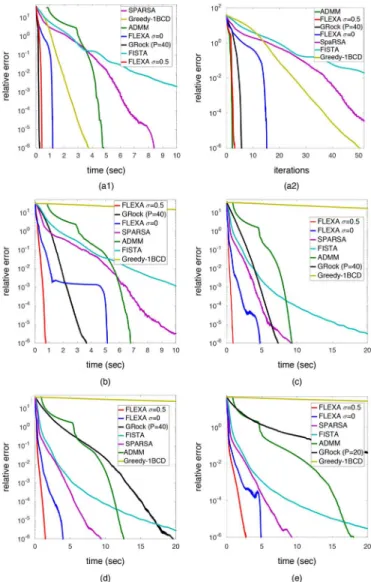
Results of our experiments for the 10 000 variables groups are reported in Fig. 1, where we plot the relative error as defined in (11) versus the CPU time; all the curves are obtained using 40 cores, and averaged over ten independent random realizations. Note that the CPU time includes communication times (for dis-tributed algorithms) and the initial time needed by the methods to perform all pre-iteration computations (this explains why the curves of ADMM start after the others; in fact ADMM requires some nontrivial initializations). For one instance, the one corre-sponding to 1% of the sparsity of the solution, we plot also the relative error versus iterations [Fig. 2(a2)]; similar behaviors of the algorithms have been observed also for the other instances, and thus are not reported. Results for the LASSO instance with 100 000 variables are plotted in Fig. 2. The curves are averaged overfive random realizations.
Given Figs. 1 and 2, the following comments are in order. On all the tested problems, FLEXA outperforms in a
con-sistent manner all other implemented algorithms. In particular,
as the sparsity of the solution decreases, the problems become harder and the selective update operated by FLEXA
improves over FLEXA , where instead all variables are updated at each iteration. FISTA is capable to approach rel-atively fast low accuracy when the solution is not too sparse, but has difficulties in reaching high accuracy. SpaRSA seems to be very insensitive to the degree of sparsity of the solution; it behaves well on 10 000 variables problems and not too sparse solutions, but is much less effective on very large-scale prob-lems. The version of GRock with is the closest match to FLEXA, but only when the problems are very sparse (but it is not supported by a convergence theory on our test problems). This is consistent with the fact that its convergence properties are at stake when the problems are quite dense. Furthermore, if the problem is very large, updating only 40 variables at each iteration, as GRock does, could slow down the convergence, es-pecially when the optimal solution is not very sparse. From this point of view, FLEXA seems to strike a good balance between not updating variables that are probably zero at the op-timum and nevertheless update a sizeable amount of variables when needed in order to enhance convergence.
Remark 5 (On Parallelism):Fig. 2 shows that FLEXA seems
to exploit well parallelism on LASSO problems. Indeed, when passing from 8 to 20 cores, the running time approximately halves. This kind of behavior has been consistently observed also for smaller problems and different number of cores; be-cause of the space limitation, we do not report these
experi-Fig. 1. LASSO with 10 000 variables; relative error vs. time (in seconds) for (a1) 1% non zeros; (b) 10% non zeros; (c) 20% non zeros; (d) 30% non zeros; (e) 40% non zeros; (a2) relative error vs. iterations for 1% non zeros.
Fig. 2. LASSO with variables; Relative error vs. time for (a) 8 cores and (b) 20 cores.
ments. Note that practical speed-up due to the use of a parallel architecture is given by several factor that are not easily pre-dictable and very dependent on the specific problem at hand, in-cluding communication times among the cores, the data format, etc. In this paper we do not pursue a theoretical study of the speed-up that, given the generality of our framework, seems a challenging goal. Wefinally observe that GRock appears to
im-prove greatly with the number of cores. This is due to the fact that in GRock the maximum number of variables that is updated in parallel is exactly equal to the number of cores (i.e., the de-gree of parallelism), and this might become a serious drawback on very large problems (on top of the fact that convergence is in jeopardy). On the contrary, our theory permits the parallel update ofanynumber of variables while guaranteeing conver-gence.
Remark 6 (On Selective Updates:It is interesting to comment
why FLEXA behaves better than FLEXA . To un-derstand the reason behind this apparently counterintuitive phe-nomenon, wefirst note that Algorithm 1 has the remarkable ca-pability toidentify those variables that will be zero at a solution; because of lack of space, we do not provide here the proof of this statement but only an informal description. Roughly speaking, it can be shown that, for large enough, those variables that are zero in will be zero also in a limiting solution . Therefore, suppose that is large enough so that this identifi ca-tion property already takes place (we will say that “we are in the identification phase”) and consider an index such that . Then, if is zero, it is clear, by Steps 3 and 4, that will be zero for all indices , independently of whether belongs to or not. In other words, if a variable that is zero at the solu-tion is already zero when the algorithm enters the identification phase,that variable will be zero in all subsequent iterations; this fact, intuitively, should enhance the convergence speed of the algorithm. Conversely, if when we enter the identification phase is not zero, the algorithm will have to bring it back to zero iteratively. It should then be clear why updating only vari-ables that we have “strong” reason to believe will be non zero at a solution is a better strategy than updating them all. Of course, there may be a problem dependence and the best value of can vary from problem to problem. But we believe that the expla-nation outlined above givesfirm theoretical ground to the idea that it might be wise to “waste” some calculations and perform only a partial update of the variables.
B. Logistic Regression Problems
The logistic regression problem is described in Example #3 (cf. Section III) and is a highly nonlinear problem involving many exponentials that, notoriously, give rise to numerical
dif-ficulties. Because of these high nonlinearities, a Gauss-Seidel approach is expected to be more effective than a pure Jacobi method, a fact that was confirmed by our preliminary tests. For this reason, for the logistic regression problem we tested also an instance of Algorithm 3; we term it GJ-FLEXA. The setting of the free parameters in GJ-FLEXA is essentially the same de-scribed for LASSO, but with the following differences:
a) The approximant is chosen as the second order approx-imation of the original function (Ex. #3, Section III);
b) The initial are set to for all , where is the total number of variables and .
c) Since the optimal value is not known for the logistic re-gression problem, we no longer use as merit function but
, with . Here
the projection can be efficiently computed; it acts
component-wise on , since .
Note that is a valid optimality measure function; indeed, is equivalent to the standard necessary optimality
TABLE I
DATASETS FORLOGISTICREGRESSIONTESTS
condition for Problem (1), see [6]. Therefore, whenever was used for the Lasso problems, we now use [in-cluding in the step-size rule (12)].
We tested the algorithms on three instances of the logistic regression problem that are widely used in the literature, and whose essential data features are given in Table I; we downloaded the data from the LIBSVM repository
http://www.csie.ntu.edu.tw/~cjlin/libsvm/,
which we refer to for a detailed description of the test prob-lems. In our implementation, the matrix is stored in a column block distributed manner , where is the number of parallel processors. We compared FLEXA
and GJ-FLEXA with the other parallel algorithms (whose tuning of the free parameters is the same as in Figs. 1 and 2), namely: FISTA, SpaRSA, and GRock. For the logistic regression problem, we also tested one more algorithm, that we call CDM. This Coordinate Descent Method is an extremely efficient Gauss-Seidel-type method (customized for logistic regression), and is part of the LIBLINEAR package available athttp://www.csie.ntu.edu.tw/~cjlin/.
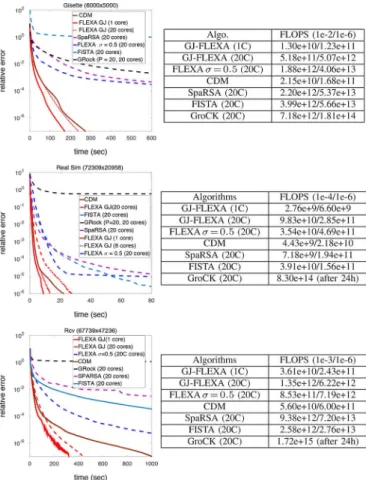
In Fig. 3, we plotted the relative error vs. the CPU time (the latter defined as in Figs. 1 and 2) achieved by the aforemen-tioned algorithms for the three datasets, and using a different number of cores, namely: 8, 16, 20, 40; for each algorithm but GJ-FLEXA we report only the best performance over the aforementioned numbers of cores. Note that in order to plot the relative error, we had to preliminary estimate (which is not known for logistic regression problems). To do so, we ran GJ-FLEXA until the merit function value went below , and used the corresponding value of the objective function as estimate of . We remark that we used this value only to plot the curves. Next to each plot, we also reported the overall FLOPS counted up till reaching the relative errors as indicated in the table. Note that the FLOPS of GRock on real-sim and rcv1 are those counted in 24 hours simulation time; when terminated, the algorithm achieved a relative error that was still very far from the reference values set in our ex-periment. Specifically, GRock reached 1.16 (instead of ) on real-sim and 0.58 (instead of ) on rcv1; the counted FLOPS up till those error values are still reported in the tables.
The analysis of thefigures shows that, due to the high nonlin-earities of the objective function, the more performing methods are the Gauss-Seidel-type ones. In spite of this, FLEXA still behaves quite well. But GJ-FLEXA with one core, thus a non parallel method, clearly outperforms all other algorithms. The explanation can be the following. GJ-FLEXA with one core is essentially a Gauss-Seidel-type method but with two key dif-ferences: the use of a stepsize and more importantly a (greedy) selection rule by which only some variables are updated at each round. As the number of cores increases, the algorithm gets “closer and closer” to a Jacobi-type method, and because of the high nonlinearities, moving along a “Jacobi direction” does not
Fig. 3. Logistic Regression problems: Relative error vs. time (in seconds) and FLOPS for i) gisette, ii) real-sim, and iii) rcv.
bring improvements. In conclusion, for logistic regression prob-lems, our experiments suggests that while the (opportunistic) selection of variables to update seems useful and brings to im-provements even in comparison to the extremely efficient, dedi-cated CDM algorithm/software, parallelism (at least, in the form embedded in our scheme), does not appear to be beneficial as in-stead observed for LASSO problems.
C. Nonconvex Quadratic Problems
We consider now a nonconvex instance of Problem (1); be-cause of space limitation, we present some preliminary results only on non convex quadratic problems; a more detailed anal-ysis of the behavior of our method in the nonconvex case is an important topic that is the subject of a forthcoming paper. Nev-ertheless, current results suggest that FLEXA’s good behavior on convex problems extends to the nonconvex setting.
Consider the following nonconvex instance of Problem (1):
(13) where is a positive constant chosen so that is no longer convex. We simulated two instances of (13), namely: 1)
generated using Nesterov’s model (as in LASSO problems in Section VI.A), with 1% of nonzero in the solution,
, and ; and 2) as
in 1) but with 10% sparsity, , and . Note that the Hessian of in the two aforementioned cases has
the same eigenvalues of the Hessian of in the orig-inal LASSO problem, but translated to the left by . In partic-ular, in 1) and 2) has (many) minimum eigenvalues equal to and , respectively; therefore, the objective func-tion in (13) is (markedly) nonconvex. Since is now always unbounded from below by construction, we added in (13) box constraints.
Tuning of Algorithm 1:We ran FLEXA using the same tuning
as for LASSO problems in Section VI.A, but adding the extra condition , for all , so that the resulting one dimensional subproblems (4) are convex and can be solved in closed form (as for LASSO). As termination criterion, taking into account that all points generated by the algorithm are feasible, we used
the merit function , with ,
and
where , and
denotes the -th component of . We stopped the iterations
when .
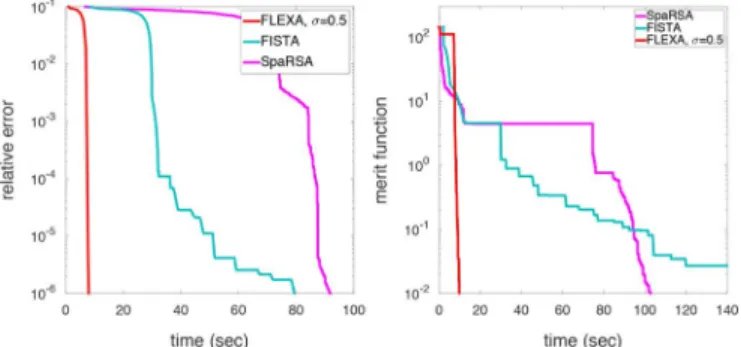
We compared FLEXA with FISTA and SpaRSA. Note that among all algorithms considered in the previous sections, only SpaRSA has convergence guarantees for nonconvex problems; but we also added FISTA to the comparison because it seems to perform well in practice and because of its benchmark status in the convex case. On our tests, the three algorithms always converge to the same (stationary) point. Computed stationary solutions of class 1) of simulated problems have approximately 1% of non zeros and 0.1% of variables on the bounds, whereas those of class 2) have 3% of non zeros and 0.3% of variables on the bounds. Results of our experiments for the 1% sparsity problem are reported in Fig. 4 and those for the 10% one in Fig. 5; we plot the merit value and the relative error versus the CPU time; the relative error is defined as in (11), where is the value of the objective function at the common stationary point reached by all the algorithms (estimated running FLEXA until the merit function value went below ). All the curves are obtained using 20 cores and averaged over 10 independent random realization. The CPU time includes com-munication times and the initial time needed by the methods to perform all pre-iteration computations. These preliminary tests seem to indicate that FLEXA performs well also on nonconvex problems.
VII. CONCLUSION
We proposed a general algorithmic framework for the minimization of the sum of a possibly noncovex differentiable function and a possibily nonsmooth but block-separable convex one. Quite remarkably, our framework leads to different new algorithms whose degree of parallelism can be chosen by the user that also has complete control on the number of variables to update at each iterations; all the algorithms converge under the same conditions. Many well known sequential and simulta-neous solution methods in the literature are just special cases of our algorithmic framework. It is remarkable that our scheme encompasses many different practical realizations and that this
Fig. 4. Nonconvex problem (13) with 1% solution sparsity: relative error vs. time (in seconds), and merit value vs. time (in seconds).
Fig. 5. Nonconvex problem (13) with 10% solution sparsity:relative error vs. time (in seconds), and merit value vs. time (in seconds).
problems that bring different challenges. Our preliminary tests are very promising, showing that our schemes can outperform state-of-the-art algorithms. Experiments on larger and more varied classes of problems (including those listed in Section II) are the subject of current research. Among the topics that should be further studied, one key issue is the right initial choice and subsequent tuning of the . These parameters to a certain extent determine the length of the shift at each iteration and play a crucial role in establishing the quality of the results.
APPENDIX
Wefirst introduce some preliminary results instrumental to prove both Theorem 1 and Theorem 2. Hereafter, for notational simplicity, we will omit the dependence of on and write . Given and , we will also denote by (or interchangeably ) the vector whose component is equal to if , and zero otherwise.
A. Intermediate Results
Lemma 7: Let . Then, the following
hold:
i) is uniformly strongly convex on with constant , i.e.,
(14) for all and given ;
ii) is uniformly Lipschitz continuous on , i.e., there exists a independent on such that
(15) for all and given .
Proposition 8: Consider Problem (1) under A1–A6. Then the
mapping has the following properties: a) is Lipschitz continuous on , i.e., there exists a pos-itive constant such that
(16) b) the set of thefixed-points of coincides with the set of stationary solutions of Problem (1); therefore has afi xed-point;
c) for every given and for any set ,
(17)
with .
Proof: We prove the proposition in the following order:
(c), (a), (b).
(c): Given , by definition, each is the unique so-lution of problem (4); then it is not difficult to see that the fol-lowing holds: for all ,
(18) Summing and subtracting in (18), choosing
, and using P2, we get
(19) for all . Observing that the term on thefirst line of (19) is non positive and using P1, we obtain
for all . Summing over we get (17). (a): We use the notation introduced in Lemma 17. Given
, by optimality and (18), we have, for all and in
Setting and , summing the two inequalities above, and adding and subtracting , we obtain:
Using (14) we can lower bound the left-hand-side of (20) as
(21) whereas the right-hand-side of (20) can be upper bounded as
(22) where the inequality follows from the Cauchy-Schwartz in-equality and (15). Combining (20), (21), and (22), we obtain the desired Lipschitz property of .
(b): Let be afixed point of , that is . Each satisfies (18) for any given . For some , setting and using and the convexity of , (18) reduces to
(23) for all and . Taking into account the Cartesian structure of , the separability of , and summing (23) over
, we obtain , for all
with and ; therefore is a
stationary solution of (1).
The converse holds because i) is the unique optimal solution of (4) with , and ii) is also an optimal solution of (4), since it satisfies the minimum principle.
Lemma 9 ([41], Lemma 3.4, p. 121): Let , and
be three sequences of numbers such that for all . Suppose that
and . Then either or else
converges to afinite value and .
Lemma 10: Let be the sequence generated by
Algo-rithm 1. Then, there is a positive constant such that the fol-lowing holds: for all ,
(24)
Proof: Let be an index in such that
(Step 2 of Algorithm 1). Then, using the afore-mentioned bound and (5), it is easy to check that the following chain of inequalities holds:
Hence we have for any ,
(25) Invoking now Proposition 8(c) with and , and using (25), (24) holds true, with .
B. Proof of Theorem 1
We are now ready to prove the theorem. For any given , the Descent Lemma [33] yields
(26) with and defined in Step 2 and 3 (Algorithm 1). Observe that
(27) where thefirst inequality follows from the definition of and
, and in the last inequality we used . Denoting by the complement of , we also have, for all ,
(28) where in the second equality we used the definition of and of the set . Now, using (28) and Lemma 10, we can write
(29)
(30) where is a (global) Lipschitz constant for (all) .
Finally, from the definition of and of the set , we have for all ,
(31) where in thefirst inequality we used the convexity of the ’s, whereas the second one follows from (26), (27) and (30), with
Using assumption (iv), we can bound as
which, by assumption (iii) implies . Since , it follows from (31) that there exist some positive constant and a sufficiently large , say , such that
(32) for all . Invoking Lemma 9 with the identifications
and while using , we deduce from (32) that either
or else converges to afinite value and
(33)
Since is coercive, ,
im-plying that is convergent; it follows from (33) and
that .
Using Proposition 8, we show next that
; for notational simplicity we will write . Suppose, by contradiction, that
. Then, there exists a
such that for infinitely many and also for infinitely many . Therefore, one can always find an infinite set of indexes, say , having the following properties: for any , there exists an integer
such that
(34) (35)
Given the above bounds, the following holds: for all ,
(36) where (a) follows from (34); (b) is due to Proposition 8(a); (c) comes from the triangle inequality, the updating rule of the algo-rithm and the definition of ; and in (d) we used (34), (35), and
, where . It follows from (36) that
(37) We show next that (37) is in contradiction with the convergence of . To do that, we preliminary prove that, for suffi -ciently large , it must be . Proceeding as in (36), we have: for any given ,
It turns out that for sufficiently large so that , it must be
(38) otherwise the condition would be violated [cf. (35)]. Hereafter we assume without loss of generality that (38) holds for all (in fact, one can always restrict
to a proper subsequence).
We can show now that (37) is in contradiction with the convergence of . Using (32) (possibly over a subse-quence), we have: for sufficiently large ,
(39) where in (a) we used (35) and (38), and is some positive constant. Since converges and , (39) implies , which contradicts (37). Fi-nally, since the sequence is bounded [by the coercivity of and the convergence of ], it has at least one limit point , that belongs to . By the continuity of
[Proposi-tion 8(a)] and , it must be .
By Proposition 8(b) is a stationary solution of Problem (1). As afinal remark, note that if for every and for every large enough, i.e., if eventually is computed exactly, there is no need to assume that is globally Lipschitz. In fact in (30) the term containing disappears, all are zero and all the
subsequent derivations hold independent of the Lipschitzianity of .
C. Proof of Theorem 2
We show next that Algorithm 2 is just an instance of the in-exact Jacobi scheme described in Algorithm 1 satisfying the convergence conditions in Theorem 1; which proves Theorem 2. It is not difficult to see that this boils down to proving that, for all and , the sequence in Step 2a) of Algorithm 2 satisfies
(40) for some such that . The following holds for the LHS of (40):
(41) where (a) follows from the error bound in Step 2a) of Algorithm 2; in (b) we used Proposition 8a); (c) is due to Step 2b); and (d)
follows from and
for some . It turns out that (40) is satisfied choosing as defined in the last inequality of (41).
ACKNOWLEDGMENT
The authors are very grateful to Loris Cannelli and Paolo Scarponi for their invaluable help in developing the C++ code of the simulated algorithms.
REFERENCES
[1] F. Facchinei, S. Sagratella, and G. Scutari, “Flexible parallel algorithms for big data optimization,” presented at the IEEE Int. Conf. Acoust., Speech, Signal Process. (ICASSP), Florence, Italy, May 4–9, 2014. [2] R. Tibshirani, “Regression shrinkage and selection via the lasso,”J.
Roy. Statist. Soc. Series B (Methodol.), pp. 267–288, 1996.
[3] Z. Qin, K. Scheinberg, and D. Goldfarb, “Efficient block-coordinate descent algorithms for the group lasso,”Math. Programm. Comput., vol. 5, pp. 143–169, Jun. 2013.
[4] A. Rakotomamonjy, “Surveying and comparing simultaneous sparse approximation (or group-lasso) algorithms,”Signal Process., vol. 91, no. 7, pp. 1505–1526, Jul. 2011.
[5] G.-X. Yuan, K.-W. Chang, C.-J. Hsieh, and C.-J. Lin, “A comparison of optimization methods and software for large-scale l1-regularized linear classification,”J. Mach. Learn. Res., vol. 11, pp. 3183–3234, 2010.
[6] R. H. Byrd, J. Nocedal, and F. Oztoprak, “An inexact successive quadratic approximation method for convex L-1 regularized opti-mization,” 2013, arXiv preprint arXiv:1309.3529 [Online]. Available: http://arxiv.org/abs/1309.3529
[7] K. Fountoulakis and J. Gondzio, “A second-order method for strongly convex L1-regularization problems,” 2013, arXiv preprint arXiv:1306. 5386 [Online]. Available: http://arxiv.org/abs/1306.5386
[8] I. Necoara and D. Clipici, “Efficient parallel coordinate descent al-gorithm for convex optimization problems with separable constraints: Application to distributed MPC,”J. Process Control, vol. 23, no. 3, pp. 243–253, Mar. 2013.
[9] Y. Nesterov, “Gradient methods for minimizing composite functions,”
Math. Programm., vol. 140, pp. 125–161, Aug. 2013.
[10] P. Tseng and S. Yun, “A coordinate gradient descent method for non-smooth separable minimization,”Math. Programm., vol. 117, no. 1–2, pp. 387–423, Mar. 2009.
[11] A. Beck and M. Teboulle, “A fast iterative shrinkage-thresholding al-gorithm for linear inverse problems,”SIAM J. Imag. Sci., vol. 2, no. 1, pp. 183–202, Jan. 2009.
[12] S. J. Wright, R. D. Nowak, and M. A. Figueiredo, “Sparse reconstruc-tion by separable approximareconstruc-tion,”IEEE Trans. Signal Process., vol. 57, no. 7, pp. 2479–2493, Jul. 2009.
[13] Z. Peng, M. Yan, and W. Yin, “Parallel and distributed sparse optimiza-tion,” inProc. IEEE Asilomar Conf. Signals, Syst., Comput., 2013, pp. 659–646.
[14] M. Razaviyayn, M. Hong, and Z.-Q. Luo, “A unified convergence anal-ysis of block successive minimization methods for nonsmooth opti-mization,”SIAM J. Optim., vol. 23, no. 2, pp. 1126–1153, 2013. [15] P. L. Bühlmann, S. A. van de Geer, and S. Van de Geer, Statistics for
High-Dimensional Data. New York, NY, USA: Springer, 2011. [16] Optimization for Machine Learning, ser. Neural Information
Pro-cessing, S. Sra, S. Nowozin, and S. J. Wright, Eds. Cambridge, MA, USA: MIT Press, Sep. 2011.
[17] F. Bach, R. Jenatton, J. Mairal, and G. Obozinski, “Optimization with sparsity-inducing penalties,” inFoundations and Trends® in Machine Learning. Norwell, MA, USA: Now Publishers, Dec. 2011. [18] Y. Li and S. Osher, “Coordinate descent optimization for
minimiza-tion with applicaminimiza-tion to compressed sensing; a greedy algorithm,” In-verse Probl. Imag., vol. 3, no. 3, pp. 487–503, 2009.
[19] I. S. Dhillon, P. K. Ravikumar, and A. Tewari, , J. Shawe-Taylor, R. Zemel, P. Bartlett, F. Pereira, and K. Weinberger, Eds., “Nearest neighbor based greedy coordinate descent,” inAdvances in Neural Information Processing Systems 24. Red Hook, NY, USA: Curran Associates, 2011, pp. 2160–2168.
[20] C. Scherrer, A. Tewari, M. Halappanavar, and D. Haglin, “Feature clus-tering for accelerating parallel coordinate descent,” inProc. 26th Annu. Conf. Neural Inf. Process. Syst. (NIPS), Lake Tahoe, NV, USA, Dec. 3–6, 2012, pp. 28–36.
[21] G. Scutari, F. Facchinei, P. Song, D. Palomar, and J.-S. Pang, “Decom-position by partial linearization: Parallel optimization of multi-agent systems,” IEEE Trans. Signal Process., vol. 62, pp. 641–656, Feb. 2014.
[22] Y. Nesterov, “Efficiency of coordinate descent methods on huge-scale optimization problems,”SIAM J. Optim., vol. 22, no. 2, pp. 341–362, 2012.
[23] J. K. Bradley, A. Kyrola, D. Bickson, and C. Guestrin, “Parallel coor-dinate descent for l1-regularized loss minimization,” presented at the 28th Int. Conf. Mach. Learn., Bellevue, WA, USA, Jun. 28–Jul. 2 2011. [24] I. Necoara, Y. Nesterov, and F. Glineur, “A random coordinate de-scent method on large optimization problems with linear constraints,” Tech. Rep., Jul. 2011, pp. 1–25 [Online]. Available: http://acse.pub.ro/ person/ion-necoara/
[25] I. Necoara and D. Clipici, “Distributed random coordinate descent method for composite minimization,” Tech. Rep., Nov. 2013, pp. 1–41 [Online]. Available: http://arxiv-web.arxiv.org/abs/1312.5302 [26] Z. Lu and L. Xiao, “Randomized block coordinate
non-mono-tone gradient method for a class of nonlinear programming,” 2013, arXiv preprint arXiv:1306.5918v1 [Online]. Available: http://arxiv.org/abs/1306.5918
[27] P. Richtárik and M. Takáč, “Parallel coordinate descent methods for big data optimization,” 2012, arXiv preprint arXiv:1212.0873 [Online]. Available: http://arxiv.org/abs/1212.0873
[28] M. Yuan and Y. Lin, “Model selection and estimation in regression with grouped variables,”J. Roy. Statist. Soc. Series B (Statist. Methodol.), vol. 68, no. 1, pp. 49–67, 2006.
[29] S. K. Shevade and S. S. Keerthi, “A simple and efficient algorithm for gene selection using sparse logistic regression,”Bioinformatics, vol. 19, no. 17, pp. 2246–2253, 2003.
[30] L. Meier, S. Van De Geer, and P. Bühlmann, “The group lasso for lo-gistic regression,”J. Roy. Statist. Soc. Series B (Statist. Methodol.), vol. 70, no. 1, pp. 53–71, 2008.