Santa Clara University Santa Clara University
Scholar Commons
Scholar Commons
Engineering Ph.D. Theses Student Scholarship
3-2020
Deep Generative Models for Semantic Text Hashing
Deep Generative Models for Semantic Text Hashing
Suthee Chaidaroon
Follow this and additional works at: https://scholarcommons.scu.edu/eng_phd_theses Part of the Computer Engineering Commons
SAN TA CLARA U N IVE RSITY
Depa r t m en t of Com pu t er . Scien ce a n d E n gin eer in g
Da t e: Ma r ch 2020
I H E RE BY RE COMME NDE D TH AT TH E TH E SIS P RE P ARE D UNDE R DR. YI F ANG BY
Su t h ee Ch a ida r oon
E NTITLE D
Deep Gen er a t ive Models for Sem a n t ic Text H a sh in g
BE ACCE P TE D IN P ARTIAL F ULF ILLME NT OF TH E RE QUIRE ME NTS F OR TH E DE GRE E OF
DOCTOR OF P H ILOSOP H Y IN COMP U TE R SCIE N CE & E N GIN E E RIN G
Th esis Advisor Dr . Yi F a n g
^ U ^ t -/-^ ^
Act in g Ch a ir of Depa r t m en t Dr . Silvia F igu eir a
/t c^ ^
-Th esis Rea der Dr . Silvia F igu eir a
Th esis Rea der
Dr . Tok u n bo Ogu n fu n m i
1.
^ (^ ^ "
^ —^ -
^
ll^ '
Th esis Rea der
Dr . Yu h on g Liu
Th esis Rea der Dr . Yin g Liu
Deep Generative Models for Semantic Text Hashing
by
Suthee Chaidaroon
Dissertation
Submitted in Partial Fulfillment of the Requirements for the Degree of Doctor of Philosophy
in Computer Science & Engineering
in the School of Engineering at Santa Clara University, 2020
To my wife Cho, my daughter Scarlett, and my parents.
Acknowledgements
I would like to acknowledge several people that supported the creation of this work. First and foremost, I would like to express my sincere gratitude towards my advisor Prof. Yi Fang for accepting me as his Ph.D. student. His teaching, collaboration, and our frequent discussions on various research topics throughout my doctoral studies were of key importance. It has been a privilege to work with such an excellent mentor and role model.
I would also like to thank my doctoral committee consisting of Prof. Silvia Figueira, Prof. Yuhong Liu, Prof. Ying Liu, and Prof. Tokunbo Ogunfunmi for their time, effort and valuable suggestions to improve this thesis.
I want to thank Travis Ebesu for helping me with the research paper writing. He is Prof. Yi’s Ph.D. student whom we traveled together to many conferences. It is always a pleasure to share the same sense of humor, as well as our research interests.
I would not be able to complete my dissertation without the unconditional love and lifetime of supports from my family. Especially, my parents who always encourages me throughout the Ph.D study. Finally, I thank my wife, Cho, for her kindness, patience, and faith in me. She has been given the best love and care to our child and me. She is such a strong woman and is well-deserved for all the credits.
Sincerely,
Deep Generative Models for Semantic Text Hashing
Suthee ChaidaroonDepartment of Computer Engineering Santa Clara University
Santa Clara, California 2019
ABSTRACT
As the amount of textual data has been rapidly increasing over the past decade, efficient similarity search methods have become a crucial component of large-scale information retrieval systems. A popular strategy is to represent original data samples by compact binary codes through hashing. A spectrum of machine learning methods have been utilized, but they often lack expressiveness and flexibility in modeling to learn effective representations. The recent advances of deep learning in a wide range of applications has demonstrated its capability to learn robust and powerful feature representations for complex data. Especially, deep generative models naturally combine the expressiveness of probabilistic generative models with the high capacity of deep neural networks, which is very suitable for text modeling. However, little work has leveraged the recent progress in deep learning for text hashing.
Meanwhile, most state-of-the-art semantic hashing approaches require large amounts of hand-labeled training data which are often expensive and time consuming to collect. The cost of getting labeled data is the key bottleneck in deploying these hashing methods. Furthermore, Most existing text hashing approaches treat each document separately
and only learn the hash codes from the content of the documents. However, in reality, documents are related to each other either explicitly through an observed linkage such as citations or implicitly through unobserved connections such as adjacency in the original space. The document relationships are pervasive in the real world while they are largely ignored in the prior semantic hashing work.
In this thesis, we propose a series of novel deep document generative models for text hashing to address the aforementioned challenges. Based on the deep generative mod-eling framework, our models employ deep neural networks to learn complex mappings from the original space to the hash space. We first introduce an unsupervised models for text hashing. Then we further introduce the supervised models that utilize document labels/tags as well as consider document-specific factors that affect the generation of words.
To address the lack of labeled data, we employ unsupervised ranking methods such as BM25 to extract weak signals from training data. We propose two deep generative semantic hashing models to leverage weak signals for text hashing. Finally, we propose node2hash, an unsupervised deep generative model for semantic text hashing by utilizing graph context. It is designed to incorporate both document content and connection information through a probabilistic formulation. Based on the deep generative modeling framework, node2hash employs deep neural networks to learn complex mappings from the original space to the hash space.
framework for model extension, uncertainty estimation, simulation, and interpretability. Based on variational inference and reparameterization, the proposed models can be in-terpreted as encoder-decoder deep neural networks and thus they are capable of learning complex nonlinear distributed representations of the original documents. We conduct a comprehensive set of experiments on various public testbeds. The experimental re-sults have demonstrated the effectiveness of the proposed models over the competitive baselines.
Contents
Acknowledgements iv
Abstract v
Contents viii
List of Figures xi
List of Tables xiii
1 Introduction 15 1.1 Introduction . . . 15 1.2 Overview . . . 19 1.3 Contributions . . . 21 1.4 Outline . . . 23 2 Related Work 24 2.1 Hashing . . . 24 2.2 Deep Learning . . . 26 2.3 Topic Models . . . 28
2.4 Unsupervised Sentence Representation Learning . . . 29
2.5 Weak Supervision . . . 29
2.6 Graph Embedding . . . 30
2.7 Deep Semantic Text Hashing . . . 32
3 Variational Deep Semantic Hashing 34 3.1 Introduction . . . 34
3.2 Methodology . . . 35
3.2.1 Unsupervised Learning (VDSH) . . . 35
3.2.2 Supervised Learning (VDSH-S) . . . 39 viii
Contents ix
3.2.3 Document-specific Modeling (VDSH-SP) . . . 41
3.2.4 Binary Hash Code . . . 43
3.2.5 Discussions . . . 44
3.3 Experimental Setup . . . 46
3.3.1 Data Collections . . . 46
3.3.2 Baselines and Settings . . . 47
3.3.3 Evaluation Metrics . . . 48
3.4 Experimental Results . . . 49
3.4.1 Baseline Comparison . . . 49
3.4.2 Retrieval with Fixed Hamming Distance . . . 51
3.4.3 Effect of Thresholding . . . 52
3.4.4 Effect of Term Weighting Schemes . . . 53
3.4.5 Qualitative Analysis . . . 53
3.5 Conclusions and Future Work . . . 56
4 Deep Semantic Text Hashing with Weak Supervision 58 4.1 Introduction . . . 58
4.2 Methodology . . . 60
4.2.1 Document Space Estimation . . . 60
4.2.2 Neighborhood Recognition Model (NbrReg) . . . 60
4.2.3 Decoder Function . . . 62
4.2.4 Encoder Function . . . 63
4.2.5 Utilize Neighbor Documents (NbrReg+Doc) . . . 64
4.2.6 Binarization . . . 65
4.3 Experimental Setup . . . 66
4.4 Experimental Results . . . 67
4.5 Conclusions and Future Work . . . 69
5 Node2Hash: Graph Aware Deep Semantic Text Hashing 71 5.1 Introduction . . . 71
5.2 Methodology . . . 74
5.2.1 Problem Description . . . 74
5.2.2 node2hash . . . 75
5.2.2.1 Word Generation Distribution P(wi|s) . . . 77
5.2.2.2 Neighborhood Generation Distribution P(aj|s) . . . 78
5.2.3 Parameter Estimation and Inference . . . 81
5.2.4 Binarization . . . 86 5.2.5 Discussions . . . 86 5.3 Experimental Settings . . . 87 5.3.1 Experiment Design . . . 87 5.3.2 Data Collections . . . 88 5.3.3 Baselines . . . 89
Contents x
5.4 Experimental Results . . . 91
5.4.1 Datasets with Explicit Connections . . . 91
5.4.2 Datasets with Implicit Connections . . . 94
5.4.3 Effect of Distance Functions on Implicit Connections . . . 95
5.4.4 Effect of Neighborhood Sampling Methods . . . 95
5.4.5 Effect of Monte Carlo Sampling Size . . . 97
5.4.6 Effect of Binarization . . . 98
5.4.7 Effect of Text and Connection Information . . . 100
5.4.8 Qualitative Analysis . . . 101
5.5 Conclusions and Future Work . . . 103
6 Conclusion 104 6.1 Summary . . . 104 6.2 Future Work . . . 107 7 Appendix 109 7.1 ELBO . . . 109 Bibliography 113
List of Figures
3.1 Architectures of (a) VDSH, (b) VDSH-S, and (c) VDSH-SP. The dashed line represents a stochastic layer. . . 38 3.2 The Precision within the Hamming distance of 2 on four datasets with
different hashing bits. . . 48 3.3 Precision@100 for different term weighting schemes on the proposed
mod-els with the 32-bit hash code. . . 54 3.4 Visualization of the 32-dimensional document latent semantic vectors by
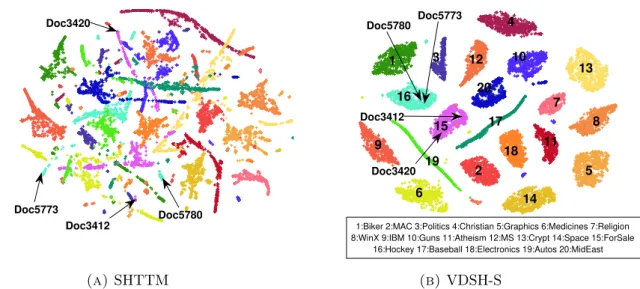
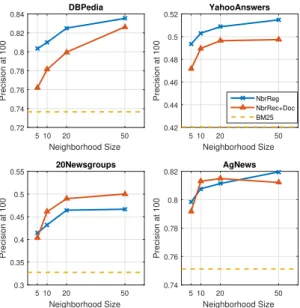
SHTTM and VDSH-S on the 20Newsgroup dataset using t-SNE. Each point represents a document and different colors denote different cat-egories based on the ground truth. In (b)VDSH-S, each number is a category ID and the corresponding categories are shown below the plot. . 55 4.1 Precision@100 for various neighborhood sizes on the proposed models
with the 32-bit hash code. . . 69 5.1 Architecture of node2hash. The encoderQ(s|d)maps documentdto the
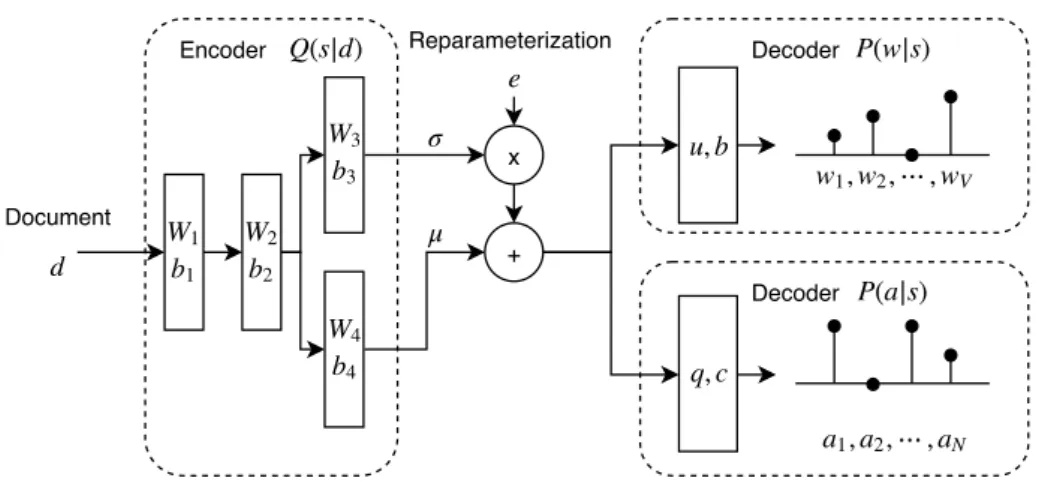
distribution parametersµ, ofQ(s|d). The reparameterization trick
ap-plies scaling and shifting transformation on Gaussian noise e to obtain semantic vectors. There are 2 decoders: the top decoder generates word distribution while the bottom decoder generates neighborhood distribu-tion of the input document d. . . 85 5.2 Precision at 100 for different distance functions on 20Newsgroups and
AgNews evaluated on node2hash. For a fair comparison, we use all im-mediate nodes as a neighbor document. . . 93 5.3 Precision at 100 for different neighborhood sampling methods on Cora,
Citeseer, Pubmed, and 20Newsgroups with the 32-bit hash code generated by node2hash. . . 96 5.4 Precision at 100 for different sampling sizes used by Monte Carlo
Sam-pling Method in Eqn.(5.11) on Cora, Citeseer, Pubmed, and Dblp, 20News-groups, and Agnews with the hash code generated by node2hash. . . 97 5.5 Precision at 100 of binary and semantic vectors generated by node2hash
and evaluated on Cora, Citeseer, Pubmed, and Dblp, 20Newsgroups, and Agnews for a various number of dimensions (hashing bits). . . 98
List of Figures xii 5.6 Precision at 100 of all components in node2hash on Cora, Citeseer, Pubmed,
and Dblp, 20Newsgroups, and Agnews for various the hash code. . . 99 5.7 Visualization of the 32-bit binary codes by STH+Graph, VDSH, and
node2hash on the Pubmed dataset using t-SNE. Each point represents a document and different colors denote different categories based on the ground truth. . . 102
List of Tables
3.1 Precision of the top 100 retrieved documents on four datasets with dif-ferent numbers of hashing bits. The bold font denotes the best result at that number of bits. † denotes the improvement over the best result of the baselines is statistically significant based on the paired t-test (p-value
<0.01). . . 45
3.2 Precision@100 of using different thresholding functions (Median vs Sign)
for the proposed models on four testbeds with the 32-bit hash code . . . 52 3.3 The titles of the four sample documents in Figure 5.7 . . . 54 4.1 Precision of the top 100 retrieved documents on four datasets with
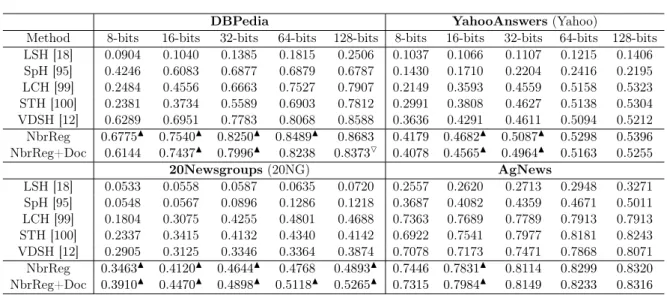
dif-ferent numbers of hashing bits. The bold font denotes the best result at that number of bits. N or O denote the improvement or degradation over the best result of the baselines is statistically significant based on the paired t-test (p-value< 0.05). . . 67
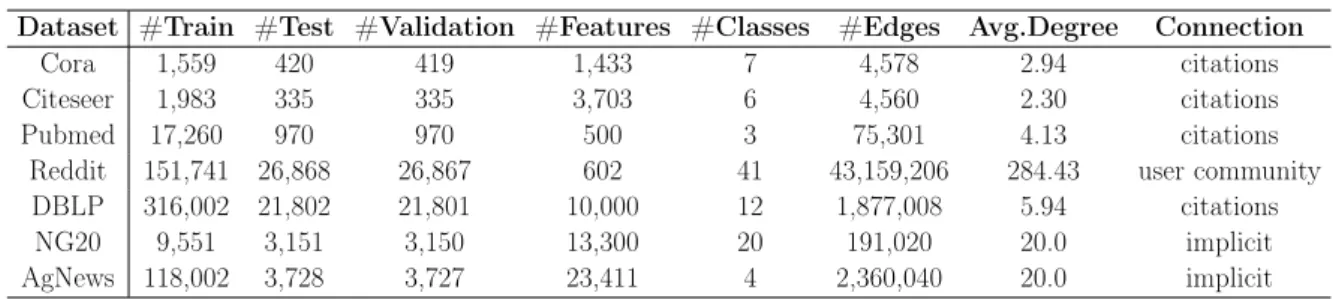
5.1 Notations in node2hash model . . . 75 5.2 Statistics of the datasets. . . 87 5.3 Precision and NDCG of the top 100 retrieved documents with different
numbers of hashing bits on datasets with explicit connections. The bold font denotes the best result at that number of bits. The superscript† de-notes the improvement over the best result of the baselines is statistically significant based on the paired t-test (p-value< 0.05). . . 92
5.4 Precision and NDCG of the top 100 retrieved documents with diff er-ent numbers of hashing bits on the datasets whose connections are con-structed by the cosine similarity on the TFIDF vectors. The bold font denotes the best result at that number of bits. The superscript † de-notes the improvement over the best result of the baselines is statistically significant based on the paired t-test (p-value< 0.05). . . 93
5.5 The document IDs of two sample documents and their neighbors in the Pubmed dataset . . . 102
Chapter 1
Introduction
1.1 Introduction
The task of similarity search, also known as nearest neighbor search, proximity search, or close item search, is to find similar items given a query object [89]. It has many important information retrieval applications, such as document clustering, content-based retrieval, and collaborative filtering [92]. In recent decades, the rapid growth of the Internet has resulted in massive textual data. This causes searching for relevant content in gigantic databases using traditional text similarity methods is prohibitively expensive because these methods are conducted in the original vector space and involved with a high cost of numerical computation in the high-dimensional spaces.
Many research efforts have been devoted to approximate similarity search that is shown to be useful for practical problems. For instance, in database management systems
Chapter 1: Introduction 16 (DBMS), tree-based data structures such as B+ tree [1] is employed for efficiently re-trieving large files. Apache Lucene [37], which is considered as one of the industry-standard search software libraries, uses an inverted index lookup and its variants for a fast text document search. Furthermore, the recent similarity search libraries such as Faiss [43] and Annoy 1 are deployed for similarity search on massive data. It is clear
that both academic research and industries have put tremendous efforts into tackling this core search problem.
There are various approximate nearest neighbor search algorithms have been proposed and implemented in the past. Some approaches rely on partitioning a search space [3] or utilizing graphics processing units (GPUs) for data parallelism [43] which have been proved to be effective and practical for many search problems. However, these algorithms still operate in high-dimensional spaces, which could be suboptimal. This thesis explores an alternative approach, called semantic hashing [27, 95, 78]. This approach performs a similarity search in low-dimensional spaces by compressing data into binary vectors, which could accelerate similarity search on massive data. Semantic hashing exploits dimensional reduction techniques, which makes semantic hashing a unique and attractive solution for approximate nearest neighbor search.
The semantic hashing approach typically designs compact binary codes in a low-dimensional space so that semantically similar documents are mapped to similar codes. This ap-proach is much more efficient in memory and computation. A binary representation of each document often only needs 4 or 8 bytes to store, and thus a large number of
Chapter 1: Introduction 17 encoded documents can be directly loaded into the main memory. Computing similarity between two documents can be accomplished by using a bitwise XOR operation, which takes only one CPU instruction. A spectrum of machine learning methods have been utilized in hashing, but they often lack expressiveness and flexibility in modeling, which prevents them from learning compact and useful representations of text documents. However, there are some challenges in learning binary codes directly from the standard text representation, such as a bag-of-words representation. Since text documents are characterized by large bodies of text, bag-of-words models may face scalability challenges as the size of vocabulary could grow into millions. In addition, since bag-of-words models focus on word occurrences, the meaning or semantics of the documents are often ignored. The models fail to recognize the semantic similarity between the documents that use different words. Also, the sparsity of many words in a text corpus is also troublesome. Many underrepresented words such as names of specific people or locations may often be treated as irrelevant information by the models.
On the other hand, the latent factor models are effective statistical models that cap-ture the semantics of the documents. The models including latent semantic indexing (LSI)[19], probabilistic latent semantic analysis (PLSA) [39] and latent Dirichlet alloca-tion (LDA) [5] represent semantically similar documents with similar document vectors. Also, the models generate a document vector that has much fewer dimensions than a bag-of-words vector. This makes the latent factor models are suitable for generating document vectors of a large text corpus. However, training these models are compu-tationally expensive. For instance, LSI [19] performs a singular value decomposition
Chapter 1: Introduction 18 (SVD) [29] on a large matrix while PLSA and LDA rely on Expectation-Maximization (EM) algorithm [21] for parameters estimation which is also not a scalable algorithm for a million of text documents.
Inspired by the recent progress of deep learning in the past decade and its impressive successes in a variety of domains including speech recognition, computer vision, and natural language processing [55], deep learning can be utilized to learn robust and powerful binary representations for text data as well as can be trained effectively on a large number of documents via a gradient-based optimization such as a stochastic gradient descent [7]. But a deep learning approach also poses some challenges in learning binary representation. First, a deep learning model is a parametric model that requires million or even billion parameters. The model without well-tuned hyperparameters could easily overfit to the training corpus. Second, deep learning models are susceptible to noisy data. The model could easily fit its parameters to the noisy data, which may result in an inaccurate representation. The typical remedy to prevent the model from overfitting is to add a regularizer, but this solution still requires parameter tuning. Recently, deep generative models with variational inference [76, 46] have further boosted the expressiveness and flexibility for representation learning by integrating deep neural nets into the probabilistic generative framework. The generative framework has two ad-vantages. Firstly, a probabilistic generative framework naturally incorporates domain knowledge as part of representation learning. This model assumption acts as a regu-larizer. Secondly, this framework is interpretable and easily extended, which is suitable when dealing with various text data sources. The existing model can be integrated with
Chapter 1: Introduction 19 additional data, which could be useful for many practical search tasks. Due to all these key advantages, to the best of our knowledge, no prior work has leveraged deep gener-ative models for text hashing tasks. The seamless combination of genergener-ative modeling and deep learning is attractive and makes them suitable for text hashing.
1.2 Overview
In this thesis, we propose a series of novel deep document generative models for text hashing, inspired by variational autoencoder (VAE) [76, 46]. The proposed models are the marriage of deep learning and probabilistic generative models [5]. They enjoy the good properties of both learning paradigms. First, with the deep neural networks, the proposed models can learn flexible nonlinear distributed representations of the original high-dimensional documents. This allows individual codes to be fairly general and con-cise but their intersection to be much more precon-cise. For example, nonlinear distributed representations allow the topics/codes “government," “mafia," and “playboy" to combine to give very high probability to the word “Berlusconi," which is not predicted nearly as strongly by each topic/code alone.
Meanwhile, the proposed models are probabilistic generative models and thus there ex-ists an underlying data generation process characterizing each model. The probabilistic generative formulation provides a principled framework for model extensions such as incorporating supervisory signals, utilizing implicit and explicit relationships between documents, and adding private variables.
Chapter 1: Introduction 20 Chapter 3 introduces the unsupervised and supervised models for text hashing [12]. These models can be interpreted as a variant of variational autoencoder for text docu-ments. The proposed unsupervised model, Variational Deep Semantic Hashing (VDSH), learns the hash codes from the content of the documents. This unsupervised model serves as the base model and are extended by the more sophisticated models which will be introduced in later chapters. For instance, the prior work in the literature [93] has demonstrated that the supervisory signals are crucial to boost the performance of semantic hashing for text documents. The first supervised model (VDSH-S) utilize the document label/tag information while the second supervised model further adds a pri-vate latent variable for documents to capture the information only concerned with the documents but irrelevant to the labels, which may help remove noises from document representations.
Chapter 4 proposes the unsupervised models that utilize noisy and low-quality data without the need of labeled data and external data source [13]. This idea is motivated by the fact that obtaining labeled data is not practical for a large corpus. Although the supervised text hashing models could yield the state-of-the-arts performances, building a large-scale semantic text hashing model also requires a lot of hand-labeled data which can be expensive to obtain. Therefore, generating binary codes without hand-labeled data is crucial because acquiring hand-labeled data is costly and time-consuming in many real-world scenarios.
Chapter 1: Introduction 21 utilizing graph context, called node2hash [14]. While considerable research has been de-voted to semantic hashing, most existing approaches only learn the hash codes from the content of the documents and treat each document separately and independently. We now view a text corpus as a graph with nodes representing documents and edges captur-ing relationships between documents. These explicit relationships between documents are pervasive in the text corpora, but they are largely ignored in the prior semantic hashing work. By assuming a generative process for the neighborhood of the document of interest. text hashing model proposed in this chapter effectively incorporates graph context into the hash modeling and yields a superior performance over the competitive unsupervised semantic hashing models.
Finally, the thesis discusses both advantage and disadvantage of deep generative mod-eling for text hashing as well as the future directions and some open research questions.
1.3 Contributions
The main contributions of the thesis can be summarized as follow:
• This thesis proposes a series of unsupervised and supervised deep document gen-erative models to learn compact representations for text documents. To the best of our knowledge, this is the first work that utilizes deep generative models with variational inference for text hashing. We conducted a comprehensive set of exper-iments on four public testbeds. The experimental results demonstrate significant
Chapter 1: Introduction 22 improvements in our supervised models over several well-known semantic hashing baselines.
• The lack of labeled data is mitigated by using unsupervised ranking to approximate the true document space and design two deep generative models to leverage the contents of the documents and the estimated neighborhood for learning a semantic hash function. Experiments results on four large public text corpora demonstrate that our models outperforms competitive unsupervised text hashing models. • This thesis proposed a graph-aware deep text hashing model, called node2hash. To
the best of our knowledge, this is the first work that explicitly models documents and their connections for semantic hashing. Different from much existing work, it can generate binary codes in online mode for unseen documents that have no connection to any training documents. Our comprehensive experimental results on five datasets with explicit connections and two with implicit ones demonstrate the effectiveness of node2hash over the competitive baselines.
• The proposed models enjoy both advantages of deep learning and probabilistic generative models. They can learn complex nonlinear distributed representations of the original high-dimensional documents while providing a principled framework for probabilistic reasoning.
• Finally, tractable variational lowerbounds are derived for the proposed models and reparameterize the models so that backpropagation can be applied for efficient parameter estimation.
Chapter 1: Introduction 23
1.4 Outline
This thesis is organized as follows: Chapter 2 reviews related work of semantic hashing, both traditional and deep learning approaches.
Chapter 3 introduces the unsupervised and supervised semantic text hashing models that directly learn the hash codes from the content of the documents. The unsupervised model (VDSH) is served as the base model. The rest of the proposed models in this thesis extend the unsupervised model by integrating or utilizing with different type of signals and data sources.
Chapter 4 introduces two unsupervised text hashing models, NbrReg and NbrReg+Doc that further improve the performance of VDSH by leveraging the contents of the k-nearest documents using the unsupervised ranking method such as BM25 [77].
Chapter 5 introduces the unsupervised text hashing model, called node2hash, that learns the hash codes by incorporating the relationships between the documents in the corpus. Finally, some promising future directions and challenges on modeling a semantic hashing for text documents using deep generative models are highlighted and discussed in 6.
Chapter 2
Related Work
In this section, we present four lines of related work. First, we discuss tradition semantic hashing methods. Second, we review deep learning-based semantic hashing methods. Third, we briefly mention the works that utilizes a weak supervision or noisy labeled data. Finally, we review graph embedding methods and its application in semantic hashing.
2.1 Hashing
Due to computational and storage efficiencies of compact binary codes, hashing methods have been widely used for similarity search, which is an essential component in a variety of large-scale information retrieval systems [92, 89]. Locality-Sensitive Hashing (LSH) [18] is one of the most popular hashing methods with interesting asymptotic theoretical
Chapter 2: Related Work 25 properties leading to performance guarantees. While LSH is a data-independent hash-ing method, many hashhash-ing methods have been recently proposed to leverage machine learning techniques with the goal of learning data-dependent hash functions, ranging from unsupervised and supervised to semi-supervised settings. Unsupervised hashing methods attempt to integrate the data properties, such as distributions and manifold structures to design compact hash codes with improved accuracy. For instance, Spectral Hashing (SpH) [95] explores the data distribution by preserving the similarity between documents by forcing the balanced and uncorrelated constraints into the learned codes, which can be viewed as an extension of spectral clustering [70].
The semantic hashing models based on the spectral method learns binary codes from the affinity matrix. This matrix is a similarity matrix where each entry is a distance between two documents. The choice of distance functions could lead to different hashing models [95, 100, 59, 61, 42]. Notably, Spectral Hashing (SpH) [95] uses an RBF kernel to construct a dense affinity matrix while Self-Taught hashing (STH) [100] uses a cosine distance to create a sparse affinity matrix. This work decomposes the learning procedure into two steps: generating binary code and learning hash function. Graph hashing [59] utilizes the underlying manifold structure of data captured by a graph representation. Supervised hashing methods attempt to leverage label/tag information for hash func-tion learning. It has attracted more and more attenfunc-tion in recent years. For example, Wang et al. [93] propose Semantic Hashing using Tags and Topic Modeling (SHTTM) to incorporate tags to obtain more effective hashing codes via a matrix factorization for-mulation. To utilize the pairwise supervision information in the hash function learning,
Chapter 2: Related Work 26 Kernel-Based Supervised Hashing (KSH) proposed in [60] used a pairwise relationship between samples to achieve high-quality hashing. Binary Reconstructive Embedding (BRE) [51] was proposed to learn hash functions by minimizing the reconstructed error between the metric space and Hamming space. Moreover, there are also several works using the ranking order information to design hash functions. Ranking-based Super-vised Hashing (RSH) [91] was proposed to leverage listwise supervision into the hash function learning framework. Semi-supervised learning paradigm was also employed to design hash functions by using both labeled and unlabeled data [90]. The hashing-code learning problem is essentially a discrete optimization problem which is difficult to solve. Most existing supervised hashing methods try to solve a relaxed continuous optimiza-tion problem and then threshold the continuous representaoptimiza-tion to obtain a binary code. Abundant related work, especially on image hashing, exists in the literature. Two recent surveys [92, 89] provide a comprehensive literature review.
2.2 Deep Learning
Deep learning has drawn increasing attention and research efforts in a variety of artificial intelligence areas including speech recognition, computer vision, and natural language processing. Since one main purpose of deep learning is to learn robust and powerful feature representations for complex data, it is very natural to leverage deep learning for exploring compact hash codes which can be regarded as binary representations of data. Most of the related work has focused on image data [96, 52, 25, 58] rather than text
Chapter 2: Related Work 27 documents probably due to the effectiveness of the convolution neural networks (CNNs) to learn good low-dimensional representations of images. The typical deep learning ar-chitectures for hash function learning consist of CNNs layers for representation learning and hash function layers which then transform the representation to supervisory signals. The loss functions could be pointwise [58, 11], pairwise [25, 57, 22, 17], or listwise [52]. Some recent works have applied deep learning for several IR tasks such as ad-hoc re-trieval [34], web search [40], and ranking pairs of short texts [79]. However, very few has investigated deep learning for text hashing. The representative work is semantic hashing [78]. It builds a stack of restricted Boltzmann machines (RBMs) [38] to dis-cover hidden binary units which can model input text data (i.e., word-count vectors). After learning a multilayer RBM through pretraining and fine tuning on a collection of documents, the hash code of any document is acquired by simply thresholding the output of the deepest layer. A recent work [97] exploited convolutional neural network for text hashing, which relies on external features such as the GloVe word embeddings to construct text representations.
Recently, deep generative models have made impressive progress with the introduction of the variational autoencoders (VAEs) [76, 46] and Generative Adversarial Networks (GANs) [30]. VAEs are especially an appealing framework for generative modeling by coupling the approach of variational inference [86] with deep learning. As a result, they enjoy the advantages of both deep learning and probabilistic graphical models. Deep generative models parameterized by neural networks have achieved state-of-the-art performance in unsupervised and supervised learning [46, 47, 67]. To the best of
Chapter 2: Related Work 28 our knowledge, our proposed models are the first work that utilizes variational inference with deep learning for text hashing. It is worth pointing out that both semantic hashing with stacked RBMs [78] and our models are deep generative models, but the former is undirected graphical models, and the latter is directed models. The underlying genera-tive process of directed probabilistic models makes them easy to interpret and extend. The proposed models are very scalable since they are trained as deep neural networks by efficient backpropagation, while the stacked RBMs are often much harder to train [38].
2.3 Topic Models
The classical works that attempt to represent a text document as a low-dimensional vec-tor such as Latent semantic indexing (LSI) [19], Probabilistic latent semantic analysis (PLSA) [39] and Latent Dirichlet allocation (LDA) [5]. LSI resembles a matrix factoriza-tion, in which it estimates document and word matrices from a term-frequency matrix. PLSA is LSI’s probabilistic counterpart. It formulates a generative model whose docu-ment vectors are latent random variables. It uses an expection-maximization algorithm [21] for inferencing. LDA extends PLSA by adding a prior distribution and coupling each observed word random variable with word-topic distribution and document-specific topic distribution. There are many follow-up works that extend LDA such as Corre-lated topic modeling [4], Supervised topic modeling [66], and Dynamic topic modeling [6]. There are also many task-specific document modeling. For instance, Btm [16]
Chapter 2: Related Work 29 models a short text such as tweets, dealing with sentiment analysis [56], learning from multiple document labels [74], or learning from a document network [15]. Application of topic models mentioned in [9].
2.4 Unsupervised Sentence Representation Learning
Several unsupervised learning approaches have been developed to learn a generic docu-ment representation for a downstream task. Skip-thought [50] encodes a sentence and reconstructs the previous and next sentences. The paragraph vector [54] adds a para-graph token to represent the missing information from a document context, but requires an additional inference when compute a paragraph vector of a new paragraph. The vari-ational autoencoder language model [8] uses a single-layer LSTM as an encoder and an additional LSTM as a decoder. The encoder generates a document latent vector.
2.5 Weak Supervision
The use of BM25 as a weak annotator is similar to [20] which uses the output from the BM25 ranking model to train a ranking model based on feedforward neural networks. However, the role of the weak signals is different from ours. We use the weak signals to estimate the true document space while the work [20] uses the weak signals as relevance scores. Another line of works that employs the k-nearest documents as weak signals is the query language modeling. The k-nearest documents are used to solve the vocabulary
Chapter 2: Related Work 30 gap between queries and documents. Some methods such as pseudo-relevance feedback is commonly used and mentioned in the query expansion literature [62].
2.6 Graph Embedding
Learning hash codes from both content and connections is closely related to the task of graph embedding [32]. There exists extensive research in learning a representation that encodes structural information of the graphs. The first line of work aims to map vertices in the graph to low-dimensional continuous representations based on the local graph context. The context information is typically sampled according to the pre-defined graph traversal methods such as a random walk [72], Breath-first search [83], Depth-first search, or a combination of both [32]. Inspired by the Skip-gram model [68], vertices that appear within the same local context have similar embedding. However, the key difference from our model is that these models are transductive and cannot encode an unseen vertex.
An inductive formulation aims to learn a representation of an unseen vertex. The general approach to inductive learning is to learn an embedding function that maps both input vertex and graph context to a low-dimensional space. In an autoencoder approach, an encoder function is designed for compressing a node’s neighborhood into a low-dimension vector, and a decoder function is designed for reconstructing the input neighborhood. Various neighborhood representations are proposed; for example, Wang et al. [88] represent the neighborhood as an adjacency matrix while Cao et al. [10]
Chapter 2: Related Work 31 formulates a neighborhood context as point-wise mutual information (PMI) matrix. However, these mentioned works do not utilize any content or attribute of a vertex. The neighborhood aggregation approach generates an embedding for a vertex by it-eratively gathering information from immediate vertices in the graph to improve the vertex’s representation. The main idea is to train the model with many iterations so that the vertex’s attributes from a faraway vertex is eventually collected. The choices of the aggregation functions and how to merge the current vertex’s embedding with its neighborhood information leads to different embedding models. For instance, Graph-Sage [35] uses mean, max-pooling, and LSTM to aggregate neighborhood information and concatenate the output with a vertex’s embedding. A graph convolutional networks (GCNs) [48] uses a weighted-sum as an aggregator and performs an element-wise mean to generate an embedding for each vertex. The recent unsupervised learning models that extend GCNs employ a different variation of the reconstruction loss: firstly, VGAE [49] calculates the reconstruction for a vertex’s attribution; Graphite [33] computes the reconstruction for an adjacency matrix as a factorized Bernoulli distribution. However, these models are unable to generate an embedding for an unseen vertex without knowing its connections in advance. Yang et al. [98] propose a neural network architecture to a vertex embedding by jointly training on a vertex classification and graph context pre-diction tasks. We mentioned this work here because Planetoid-I [98] is the only vertex embedding model that learns a vertex representation from the attribute directly without the need for knowing a connection to the existing vertices. However, Planetoid-I is a semi-supervised learning model which depends on labeled data, but node2hash is an
Chapter 2: Related Work 32 unsupervised learning model.
2.7 Deep Semantic Text Hashing
After the publication of Variational Deep Semantic Hashing for Text Documents in 2017 [12], the follow-up works have proposed to improve various component of the VDSH model. The main issue with VDSH is its two-stage training procedures. It learns a continuous document vector before binarizes them, which could not generate an optimal hash code. An end-to-end training by forcing the model to generate a hash code directly has proved to be more superior. For instance, Neural Architecture for Genearative Semantic Hashing (NASH) [80] replaces the Gaussian distribution prior with Bernoulli distribution prior and uses Straight-Through (ST) estimator [2] to approximate the Bernoulli stochastic layers. However, GMSH and BMSH models [24] replace the prior distribution with a mixture of Gaussian and Bernoulli distributions. The complex prior distribution further boosts the quality of hash codes. However, since the Straight-Through (ST) estimator is a biased estimator, Doc2hash model [101] replaces Bernoulli distribution prior with a categorical distribution. The model is trained end-to-end via the use of Gumbel-softmax trick [41, 64]. The proposed model by [36] uses a two-step embedding process to allow the model to learn word embedding independently from the hash code length. The model first selects word vectors from the original word matrix of higher dimensions, then transforms the vectors into the same space as the hash code. This work also uses a ranking component to enforce similar documents have a small
Chapter 2: Related Work 33 hash code distance. Generative Adversarial networks has been used for binary code learning. [73] uses GANs to generate more negative samples so that the model can learn a stronger hash codes. The discriminator component can also be used to guide the generator to generate more realistic binary codes that are not drawn from a random noise [87].
Chapter 3
Variational Deep Semantic Hashing
3.1 Introduction
The classical latent factor models such as latent semantic indexing (LSI) [19], proba-bilistic latent semantic analysis (PLSA) [39] and latent Dirichlet allocation (LDA) [5] are designed to discover a latent structure of text documents. The underlying assump-tion is that each word in a document does not appear by a random chance; instead, they are generated by an unobservable process. By imposing a correct assumption, the models can effectively discover a topic/theme/semantic of an individual document by employing a probabilistic formulation to estimate the underlying word generation process. The major drawbacks of these classical models include their slow parameter estimation (training) times as well as their inability to learn highly non-linear relation-ships between text documents. Deep generative models have addressed these limitations
Chapter 3: Variational Deep Semantic Hashing 35 by modeling a complex generative process using neural networks and uses an efficient backpropagation [44] for parameter estimation.
This chapter presents three novel deep document generative models to learn low-dimensional semantic representations of documents for text hashing. We first introduce the pervised generative model for text hashing. In the next section, 3.2.2 extends the unsu-pervised model by including label information to learn a more sensible representation. Finally, the last section 3.2.3 further incorporates the document’s private variables to model document-specific information. Based on the variational inference, all the three models can be viewed as having an encoder-decoder neural network architecture where the encoder compresses a high-dimensional document to a compact latent semantic vec-tor, and the decoder reconstructs the document (or the labels). Section 3.2.4 discusses two thresholding methods to convert the continuous latent vector to binary code for text hashing.
3.2 Methodology
3.2.1 Unsupervised Learning (VDSH)
In this section, we present the basic variational deep semantic hashing (VDSH) model for the unsupervised learning setting. VDSH is a probabilistic generative model of text which aims to extract a continuous low-dimensional semantic representation s 2 RK for each document. Letd 2RV be the bag-of-words representation of a document and
Chapter 3: Variational Deep Semantic Hashing 36 wi 2{0,1}V be the one-hot vector representation of theithword of the document where
V is the vocabulary size. d could be represented by different term weighting schemes such as binary, TF, and TFIDF [65]. The document generative process can be described as follows:
• For each document d,
– Draw a latent semantic vector s ⇠P(s) where P(s) = N(0,I) is the
stan-dard Gaussian distribution. – For theith word in the document,
⇤ Draw wi ⇠P(wi|f(s;✓)).
The conditional probability over wordswi is modelled by multinomial logistic regression and shared across documents as below:
P(wi|f(s;✓)) = exp(wT i f(s;✓)) PV j=1exp(wTjf(s;✓)) (3.1)
While P(s) is a simple Gaussian distribution, any distribution can be generated by
mapping the simple Gaussian through a sufficiently complicated function [23]. Thus,
f(s;✓)) is such a highly flexible function approximator usually a neural network. In
other words, we can learn a function which maps our independent, normally-distributed svalues to whatever latent semantic variables might be needed for the model, and then generate the word wi. However, introducing a highly nonlinear mapping from s to
Chapter 3: Variational Deep Semantic Hashing 37 wi results in intractable data likelihood
R
sP(d|s)P(s)dsand thus intractable posterior
distribution P(s|d) [46]. Similar to VAE, we use an approximation Q(s|d; ) for the
true posterior distribution. By applying the variational inference principle [86], we can obtain the following tractable lowerbound of the document log likelihood (see [46] and Appendix): L1 =Q ⇥XN i=1 logP(wi|f(s;✓)) ⇤ Q(s|d; )P(s) (3.2)
where N is the number of words in the document and is the Kullback-Leibler (KL)
divergence between the approximate posterior distributionQ(s|d; )and the priorP(s).
The variational distribution Q(s|d; ) acts as a proxy to the true posteriorP(s|d). To
enable a high capacity, it is assumed to be a Gaussian N(µ,diag( 2)) whose mean µ and variance 2 are the output of a highly nonlinear function of d denoted as g(d; ) parameterized by , once again typically a neural network.
In training, the variational lowerbound in Eqn.(3.2) is maximized with respect to the model parameters. SinceP(s)is a standard Gaussian prior, the KL DivergenceQ(s|d; )P(s)
in Eqn.(3.2) can be computed analytically. The first termQcan be viewed as an expected negative reconstruction error of the words in the document and it can be computed based on the Monte Carlo estimation [31].
Based on Eqn.(3.2), we can interpret VDSH as a variational autoencoder with discrete output: a feedforward neural network encoderQ(s|d; )compresses document
Chapter 3: Variational Deep Semantic Hashing 38 (a) (b) (c) d s w v s v s y y w µs µv w µ s µ Encoder Decoder
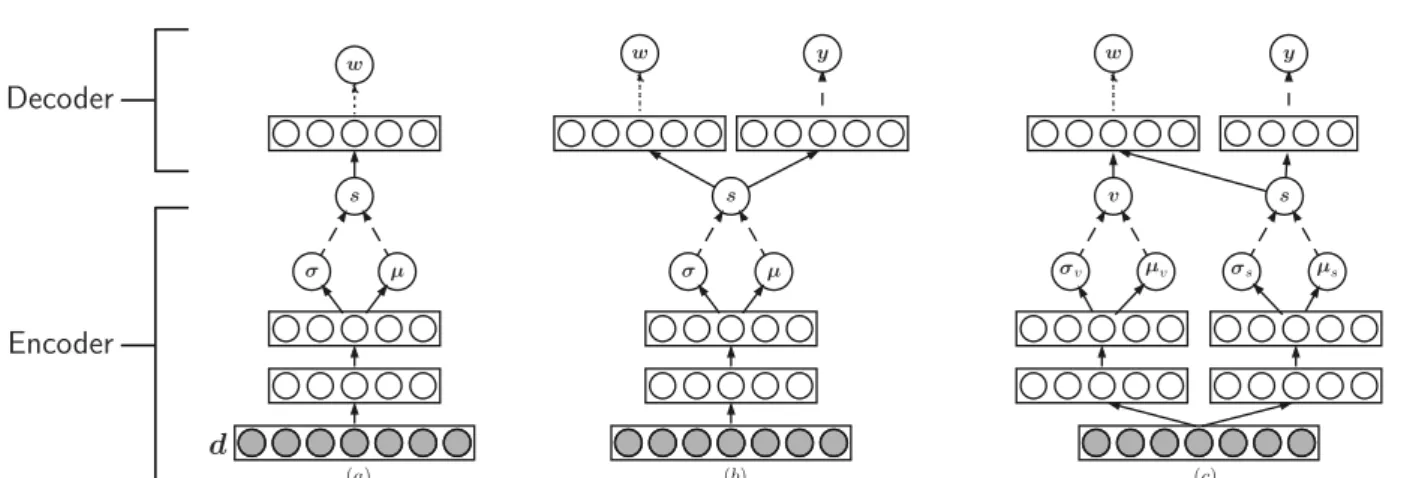
Figure 3.1: Architectures of (a) VDSH, (b) VDSH-S, and (c) VDSH-SP. The dashed line represents a stochastic layer.
reconstructs the documents by independently generating the words s! {wi}Ni=1. Fig-ure 3.1(a) illustrates the architectFig-ure of VDSH. In the experiments, we use the following specific architecture for the encoder and decoder.
Encoder Q(s|g(d; )) : t1 =ReLU(W1d+b1) t2 =ReLU(W2t1+b2) µ=W3t2 +b3 log =W4t2 +b4 s⇠N(µ(d),diag( 2(d))) Decoder P(wi|f(s;✓)) : ci = exp( sTGwi +bwi) P(wi|s) = ci PV k=1ck P(d|s) = N Y i=1 P(wi|s)
This architecture is similar to the one presented in VAE [76] except that VDSH has the softmax layer to model discrete words while VAE is proposed to model images as continuous output. Here, the encoder has two Rectified Linear Unit (ReLU) [31] layers. ReLU generally does not face gradient vanishing problem as with other activation
Chapter 3: Variational Deep Semantic Hashing 39 functions. Also, it has been shown that deep neural networks can be trained efficiently using ReLU even without pretraining [31].
In this architecture, there is a stochastic layer which is to sample s from a Gaussian distribution N(µ(d),diag( 2(d))), as represented by the dashed lines in the middle of the networks in Figure 3.1. Backpropagation cannot handle stochastic layer within the network. In practice, we can leverage the “location-scale" property of Gaussian distribution, and use the reparameterization trick [46] to turn the stochastic layer of s to be deterministic. As a result, the encoder Q(s|d; ) and decoder P(wi|f(s;✓)) form an end-to-end neural network and are then trained jointly by maximizing the variational lowerbound in Eqn.(3.2) with respect to their parameters by the standard backpropagation algorithm [31].
3.2.2 Supervised Learning (VDSH-S)
In many real-world applications, documents are often associated with labels or tags which may provide useful guidance in learning effective hashing codes. Document con-tent similarity in the original bag-of-word space may not fully reflect the semantic re-lationship between documents. For example, two documents in the same category may have low document content similarity due to the vocabulary gap, while their semantic similarity could be high. In this section, we extend VDSH to the supervised setting with the new model denoted as VDSH-S. The probabilistic generative process of a document with labels is as follows:
Chapter 3: Variational Deep Semantic Hashing 40 • For each document d,
– Draw a latent semantic vector s ⇠P(s) where P(s) = N(0,I) is the
stan-dard Gaussian distribution. – For theith word in the document,
⇤ Draw wi ⇠P(wi|f(s;✓)).
– For thejth label in the label set,
⇤ Draw yj ⇠P(y|f(s;⌧)).
where yj 2{0,1}L is the one-hot representation of the label j in the label set and L is the total number of possible labels (the size of the label set). Let us use Y 2 {0,1}L represent the bag-of-labels of the document (i.e., if the document has label j, the jth dimension of Y is 1; otherwise, it is 0). VDSH-S assumes that both words and labels are generated based on the same latent semantic vecotor.
We assume a general multi-label classification setting where each document could have multiple labels/tags. P(yj|f(s;⌧))can be modeled by the logistic function as follows:
P(yj|f(s;⌧)) = 1
1 + exp( yT
jf(s;⌧))
(3.3)
Similar to VDSH, f(s;⌧) is parameterized by a neural network with the parameter ⌧
Chapter 3: Variational Deep Semantic Hashing 41 The lowerbound of the data log likelihood can be similarly derived and shown as follows:
L2 =Q ⇥XN i=1 logP(wi|f(s;✓)) + L X j=1 logP(yj|f(s;⌧)) ⇤ Q(s|d,Y; )P(s) (3.4)
Compared to Eqn.(3.2) in VDSH, this lowerbound has an extra term,Q⇥ PLj=1logP(yj|f(s;⌧))
⇤
, which can be computed in a similar way with Q⇥ PNi=1logP(wi|f(s;✓))
⇤
in Eqn.(3.2), by using the Monte Carlo estimation. In addition, we can drop the dependence on variable Y in the variational distribution Q(s|d,Y; ) since we may not have the label
information available for new documents.
The architecture of the VDSH-S model is shown in Figure 3.1(b). It consists of a feedforward neural network encoder of a document d! s and a decoder of the words and labels of the document s ! {wi}Ni=1;{yj}Lj=1. It is worth pointing out that the labels still affect the learning of latent semantic vector by their presence in the decoder despite their absence in the encoder. By using the reparameterization trick, the model becomes a deterministic deep neural network and the lowerbound in Eqn.(3.4) can be maximized by backpropagation (see Appendix).
3.2.3 Document-specific Modeling (VDSH-SP)
VDSH-S assumes both document and labels are generated by the same latent semantic vector s. In some cases, this assumption may be restrictive. For example, the original
Chapter 3: Variational Deep Semantic Hashing 42 document may contain information that is irrelevant to the labels. It could be difficult to find a common representation for both documents and labels. This observation motivates us to introduce a document private variable v, which is not shared by the
labels Y. The generative process is described as follows:
• For each document d,
– Draw a latent semantic vector s ⇠P(s) where P(s) = N(0,I) is the
stan-dard Gaussian distribution.
– Draw a latent private vectorv⇠P(v)whereP(v) = N(0,I)is the standard
Gaussian distribution.
– For theith word in the document,
⇤ Draw wi ⇠P(wi|f(s+v;✓)).
– For thejth label in the label set,
⇤ Draw yj ⇠P(y|f(s;⌧)).
As we can see, s models the shared information between document and labels while v
only contains the document-specific information. We can view adding private variables as removing the noise from the original content that is irrelevant to the labels. With the added private variable, we denote this model as VDSH-SP. The tractable variational lowerbound of data likelihood can be derived as follows:
Chapter 3: Variational Deep Semantic Hashing 43 L3 =Q ⇥XN i=1 logP(wi|f(s+v;✓)) + L X j=1 logP(yj|f(s;⌧)) ⇤ Q(s|d; )P(s) Q(v|d; )P(v) (3.5)
Similar to the other two models, VDSH-SP can be viewed as a deep neural network by applying variational inference and reparametrization. The architecture is shown in Figure 3.1(c). The Appendix contains the detailed derivations of the model.
3.2.4 Binary Hash Code
Once a VDSH model has been trained, we can generate a compact continuous represen-tation for any new document dnew by the encoder function µnew =g(dnew; ), which is the mean of the distribution Q(s|d; ). The binary hashing code can then be obtained
by thresholding µnew. The most common method of thresholding for binary code is to take the median value of the latent semantic vector µ in the training data [93]. The
rationale is based on the maximum entropy principle for efficiency which yields balanced partitioning of the whole dataset [95]. Thus, we set the threshold for binarizing the pth bit to be the median of the pth dimension of s in the training data. If the pth bit of document latent semantic vector µnew is larger than the median, the pth binary code is set to 1; otherwise, it is set to -1. Another popular thresholding method is to use the Sign function on µnew, i.e., if the pth bit of µnew is nonnegative, the corresponding code
Chapter 3: Variational Deep Semantic Hashing 44 is 1; otherwise, it is -1. Since the prior distribution of the latent semantic vector is zero mean, the Sign function is also a reasonable choice. We use the median thresholding as the default method in our experiments, while also investigate the Sign function in Section 3.4.3.
3.2.5 Discussions
The computational complexity of VDSH for a training document is O(BD2 +DSV). Here, O(BK2) is the cost of the encoder, where B is the number of the layers in the encoder network and D is the average dimension of these layers. O(DN V) is the cost
of the decoder, whereS is the average length of the documents andV is the vocabulary
size. The computational complexity of VDSH-S and VDSH-SP isO(BD2+DS(V +L)) where L is the size of the label set. The computational cost of the proposed models
is at the same level as the deterministic autoencoder. Model learning could be quite efficient since the computations of all the models can be parallelized in GPUs, and only one sample is required during the training process.
The proposed deep generative model has a few desirable properties for text hashing. First of all, it has the capacity of deep neural networks to learn sophisticated semantic representations for text documents. Moreover, being generative models brings huge ad-vantages over other deep learning models such as Convolutional Neural Network (CNN)
Chapter 3: Variational Deep Semantic Hashing 45
RCV1 Reuters
Methods 8 bits 16 bits 32 bits 64 bits 128 bits 8 bits 16 bits 32 bits 64 bits 128 bits LSH [18] 0.4180 0.4352 0.4716 0.5214 0.5877 0.2802 0.3215 0.3862 0.4667 0.5194 SpH [95] 0.5093 0.7121 0.7475 0.7559 0.7423 0.6080 0.6340 0.6513 0.6290 0.6045 STHs [100] 0.3975 0.4898 0.5592 0.5945 0.5946 0.6616 0.7351 0.7554 0.7350 0.6986 Stacked RBMs [78] 0.5106 0.5743 0.6130 0.6463 0.6531 0.5113 0.5740 0.6154 0.6177 0.6452 KSH [60] 0.9126 0.9146 0.9221 0.9333 0.9350 0.7840 0.8376 0.8480 0.8537 0.8620 SHTTM [93] 0.8820 0.9038 0.9258 0.9459 0.9447 0.7992 0.8520 0.8323 0.8271 0.8150 VDSH 0.7976 0.7944 0.8481 0.8951 0.8444 0.6859 0.7165 0.7753 0.7456 0.7318 VDSH-S 0.9652† 0.9749† 0.9801† 0.9804† 0.9800† 0.9005† 0.9121† 0.9337† 0.9407† 0.9299† VDSH-SP 0.9666† 0.9757† 0.9788† 0.9805† 0.9794† 0.8890† 0.9326† 0.9283† 0.9286† 0.9395† 20Newsgroups TMC
Methods 8 bits 16 bits 32 bits 64 bits 128 bits 8 bits 16 bits 32 bits 64 bits 128 bits LSH [18] 0.0578 0.0597 0.0666 0.0770 0.0949 0.4388 0.4393 0.4514 0.4553 0.4773 SpH [95] 0.2545 0.3200 0.3709 0.3196 0.2716 0.5807 0.6055 0.6281 0.6143 0.5891 STH [100] 0.3664 0.5237 0.5860 0.5806 0.5443 0.6459 0.7044 0.7279 0.7381 0.7379 Stacked RBMs [78] 0.0594 0.0604 0.0533 0.0623 0.0642 0.4846 0.5108 0.5166 0.5190 0.5137 KSH [60] 0.4257 0.5559 0.6103 0.6488 0.6638 0.6608 0.6842 0.7047 0.7175 0.7243 SHTTM [93] 0.2690 0.3235 0.2357 0.1411 0.1299 0.6299 0.6571 0.6485 0.6893 0.6474 VDSH 0.2841 0.3166 0.3389 0.3262 0.3943 0.4330 0.6853 0.7108 0.4410 0.5847 VDSH-S 0.6586† 0.6791† 0.7564† 0.6850† 0.6916† 0.7387† 0.7887† 0.7883† 0.7967† 0.8018† VDSH-SP 0.6609† 0.6551† 0.7125† 0.7045† 0.7117† 0.7498† 0.7798† 0.7891† 0.7888† 0.7970†
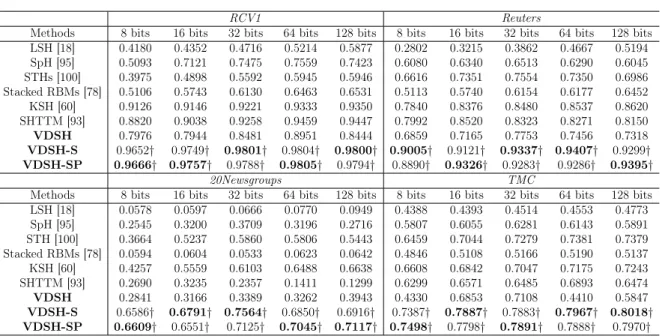
Table 3.1: Precision of the top 100 retrieved documents on four datasets with dif-ferent numbers of hashing bits. The bold font denotes the best result at that number of bits. † denotes the improvement over the best result of the baselines is statistically
significant based on the paired t-test (p-value <0.01).
because the underlying document generative process makes the model assumptions ex-plicit. For example, as shown in [95], it is desirable to have independent feature di-mensions in hash codes. To achieve this, our models just need to assume the latent semantic vector is drawn from a prior distribution with independent dimensions (e.g., standard Gaussian). The probabilistic approach also provides a principled framework for model extensions as evident in VDSH-S and VDSH-SP. Furthermore, instead of learning a particular latent semantic vector, our models learn probability distributions of the semantic vector. This can be viewed as finding a region instead of a fixed point in the latent space for document representation, which leads to more robust models. Compared with other deep generative models such as stacked RBMs and GANs, our models are computationally tractable and stable and can be estimated by the efficient backpropagation algorithm.
Chapter 3: Variational Deep Semantic Hashing 46
3.3 Experimental Setup
3.3.1 Data Collections
We use the following four public document collections for evaluation. 1)Reuters Corpus
Volume I (RCV1). It is a large collection of manually labeled 800,000 newswire stories
provided by Reuters. There are totally 103 classes. We use the full-topics version available at the LIBSVM website1. 2) Reuters215782. A widely used text corpus for
text classification. This collection has 10,788 documents with 90 categories and 7,164 unique words. 3)20Newsgroups3. This dataset is a collection of 18,828 newsgroup posts,
partitioned (nearly) evenly across 20 different newsgroups/categories. It has become a popular dataset for experiments in text applications of machine learning techniques. 4)
TMC4. This dataset contains the air traffic reports provided by NASA and was used as
part of the SIAM text mining competition. It has 22 labels, 21,519 training documents, 3,498 test documents, and 3,498 documents for the validation set. All the datasets are multi-label except 20Newsgroups.
Each dataset was split into three subsets with roughly 80% for training, 10% for valida-tion, and 10% for test. The training data is used to learn the mapping from document to hash code. Each document in the test set is used to retrieve similar documents based on the mapping, and the results are evaluated. The validation set is used to choose the
1https://www.csie.ntu.edu.tw/~cjlin/libsvmtools/datasets/multilabel.html 2http://www.nltk.org/book/ch02.html
3http://ana.cachopo.org/datasets-for-single-label-text-categorization 4https://catalog.data.gov/dataset/siam-2007-text-mining-competition-dataset
Chapter 3: Variational Deep Semantic Hashing 47 hyperparameters. We removed the stopwords using SMART’s list of 571 stopwords5.
No stemming was performed. We use TFIDF [65] as the default term weighting scheme for the raw document representation (i.e.,d). We experiment with other term weighting schemes in Section 3.4.4.
3.3.2 Baselines and Settings
We compare the proposed models with the following six competitive baselines which have been extensively used for text hashing in the prior work [93]: Locality Sensitive Hashing (LSH)6 [18], Spectral Hashing (SpH)7 [95], Self-taught Hashing (STH)8 [100],
Stacked Restricted Boltzmann Machines (Stacked RBMs) [78], Supervised Hashing with Kernels (KSH) [60], and Semantic Hashing using Tags and Topic Modeling (SHTTM) [93]. We used the validation dataset to choose the hyperparameters for the baselines. For our proposed models, we adopt the method in [28] for weight initialization. The Adam optimizer [45] with the step size 0.001 is used due to its fast convergence. Fol-lowing the practice in [94], we use the dropout technique [82] with the keep probability of 0.8 in training to alleviate overfitting. The number of hidden nodes of the models is 1,500 for RCV1 and 1,000 for the other three smaller datasets. All the experiments were conducted on a server with 2 Intel E5-2630 CPUs and 4 GeForce GTX TITAN X GPUs. The proposed deep models were implemented on the Tensorflow9 platform. For
5http://www.lextek.com/manuals/onix/stopwords2.html 6http://pixelogik.github.io/NearPy/
7http://www.cs.huji.ac.il/~yweiss/SpectralHashing/
8http://www.dcs.bbk.ac.uk/~dell/publications/dellzhang_sigir2010/sth_v1.zip 9https://www.tensorflow.org/
Chapter 3: Variational Deep Semantic Hashing 48 816 32 64 128 Precision 0 0.2 0.4 0.6 0.8 1 RCV1 816 32 64 128 0 0.2 0.4 0.6 0.8 1 Reuters 816 32 64 128 0 0.2 0.4 0.6 0.8 1 20Newsgroups 816 32 64 128 0 0.2 0.4 0.6 0.8 1 TMC LSH SpH STH RBMs KSH SHTTM VDSH VDSH-S VDSH-SP
Figure 3.2: The Precision within the Hamming distance of 2 on four datasets with different hashing bits.
the VDSH model on the Reuters21578, 20Newsgroups, and TMC datasets, each epoch takes about 60 seconds, and each run takes 30 epochs to converge. For RCV1, it takes about 3,600 seconds per epoch and needs fewer epochs (about 15) to get satisfactory performance. Since RCV1 is much larger than the other three datasets, this shows that the proposed models are quite scalable. VDSH-S and VDSH-SP take slightly more time to train than VDSH does (about 40 minutes each on Reuters21578, 20Newsgroups, and TMC, and 20 hours on RCV1).
3.3.3 Evaluation Metrics
To evaluate the effectiveness of hashing code in similarity search, each document in the test set is used as a query document to search for similar documents based on the Hamming distance (i.e., number of different bits) between their hashing codes. Following the prior work in text hashing [93], the performance is measured by Precision, as the ratio of the number of retrieved relevant documents to the number of all retrieved documents. The results are averaged over all the test documents.
Chapter 3: Variational Deep Semantic Hashing 49 There exist various ways to determine whether a retrieved document is relevant to the given query document. In SpH [95], the K closest documents in the original feature
space are considered as the relevant documents. This metric is not desirable since the similarity in the original feature space may not well reflect the document semantic similarity. Also, it is hard to determine a suitableK for the cutoffthreshold. Instead, we
adopt the methodology used in KSH [90], SHTTM [93] and other prior work [90], that is a retrieved document that shares any common test label with the query document is regarded as a relevant document.
3.4 Experimental Results
3.4.1 Baseline Comparison
Table 4.1 shows the results of different methods over various numbers of bits on the four testbeds. We have several observations from the results. First of all, the best results at different bits are all achieved by VDSH-S or VDSH-SP. They consistently yield better results than all the baselines across all the different numbers of bits. All the improvements over the baselines are statistically significant based on the paired t-test (p-value < 0.01). VDSH-S and VDSH-SP produce comparable results between them.
Chapter 3: Variational Deep Semantic Hashing 50 which may lead to overfitting to the training data. This probably explains why VDSH-SP generally yield better performance when the number of bits is 8 which corresponds to a simpler model.
Secondly, the supervised hashing techniques (i.e., VDSH-S, VDSH-SP, KSH) outperform the unsupervised methods on the four datasets across all the different bits. These results demonstrate the importance of utilizing supervisory signals for text hashing. However, the unsupervised model, STHs, outperforms SHTTM on the original 20 categories News-groups. One possible explanation is that SHTTM depends on LDA to learn an initial representation. But many categories in Newsgroup are correlated, LDA could assign similar topics to documents from related categories (i.e. Christian, Religion). Hence SHTTM may not effectively distinguish two related categories. Evidently, SHTTM and KSH deliver comparable results except on the 20Newsgroups testbed. It is worth noting that there exist substantial gaps between the supervised and unsupervised proposed models (VDSH-S and VDSH-SP vs VDSH) across all the datasets and configurations. The label information seems remarkably useful for guiding the deep generative models to learn effective representations. This is probably due to the high capacity of the neu-ral network component which can learn subtle patterns from supervisory signals when available.
Thirdly, the performance does not always improve when the number of bits increases. This pattern seems quite consistent across all the compared methods and it is likely the result of model overfitting, which suggests that using a long hash code is not always helpful especially when training data is limited. Last but not least, the testbeds may
Chapter 3: Variational Deep Semantic Hashing 51 affect the model performance. All the best results are obtained on the RCV1 dataset whose size is much larger than the other testbeds. These results illustrate the importance of using a large amount of data to train text hashing models.
It is worth noting that some of the baseline results are different from what were reported in the prior work. This is due to the data preprocessing. For example, [93] combined some categories in 20Newsgroup to form 6 broader categories in their experiments while we use all the original 20 categories for evaluation. [100] focused on single-label docu-ments by discarding the docudocu-ments appearing in more than one category while we use all the documents in the corpus.
3.4.2 Retrieval with Fixed Hamming Distance
In practice, IR systems may retrieve similar documents in a large corpus within a fixed Hamming distance radius to the query document. In this section, we evaluate the precision for the Hamming radius of 2. Figure 3.2 shows the results on four datasets with different numbers of hashing bits. We can see that the overall best performance among all nine hashing methods on each dataset is achieved by either S or VDSH-SP at the 16-bit. In general, the precision of most of the methods decreases when the number of hashing bits increases from 32 to 128. This may be due to the fact that when using longer hashing bits, the Hamming space becomes increasingly sparse and very few documents fall within the Hamming distance of 2, resulting in more queries with precision 0. Similar behavior is also observed in the prior work such as KSH [60]
Chapter 3: Variational Deep Semantic Hashing 52
RCV1 Reuters
Median Sign Median Sign
VDSH 0.8481 0.8514 0.7753 0.7851
VDSH-S 0.9801 0.9804 0.9337 0.9284 VDSH-SP 0.9788 0.9794 0.9283 0.9346
20Newsgroups TMC
Median Sign Median Sign
VDSH 0.4354 0.4267 0.7108 0.7162
VDSH-S 0.7564 0.7563 0.7883 0.7879 VDSH-SP 0.6913 0.6574 0.7891 0.7761
Table 3.2: Precision@100 of using different thresholding functions (Median vs Sign)
for the proposed models on four testbeds with the 32-bit hash code
and SHTTM [93]. A notable exception is Stacked RBMs whose performance is quite stable across different numbers of bits while lags behind the best performers.
3.4.3 E
ff
ect of Thresholding
Thresholding is an important step in hashing to transform a continuous document repre-sentation to a binary code. We investigate two popular thresholding functions: Median and Sign, which are introduced in Section 3.2.4. Table 3.2 contains the precision results of the proposed models with the 32-bit hash code on the four datasets. As we can see, the two thresholding functions generate quite similar results and their differences are not statistically significant, which indicates all the proposed models, whether being unsupervised or supervised, are not sensitive to the thresholding methods.
Chapter 3: Variational Deep Semantic Hashing 53
3.4.4 E
ff
ect of Term Weighting Schemes
In this section, we investigate the effect of term weighting schemes on the performance of the proposed models. Different term weights result in different bag-of-word represen-tations of d as the input to the neural network. Specifically, we experiment with three term weighting representations for documents: Binary, Term Frequency (TF), Term Frequency and Inverse Document Frequency (TFIDF) [65]. Figure 3.3 illustrates the results of the proposed models with the 32-bit hash code on the four datasets. As we can see, the proposed models generally are not very sensitive to the underlying term weighting schemes. The TFIDF weighting always gives the best performance on all the four datasets. The improvement is more noticeable with VDSH-S and VDSH-SP on 20Newsgroups. The results indicate more sophisticated weighting schemes may capture more information about the original documents and thus lead to better hashing results. One the other hand, all the three models