
International Journal of Emerging Technology and Advanced Engineering
Website: www.ijetae.com (ISSN 2250-2459, ISO 9001:2008 Certified Journal, Volume 3, Issue 11, November 2013)
277
Analysis and Comparative Study of Traditional and Web
Information Systems Development Methodology (WISDM)
Towards Web Development Applications
Abubucker Samsudeen Shaffi
1, Mohaned Al-Obaidy
21
Faculty of Computing Studies, Gulf College, Muscat, 2
Faculty Head for Computing Awards, Gulf College, Muscat Abstract-- There are many software development
methodology approaches that have been proposed for developing web application projects. Each methodology has different approaches and implemented for different applications. System developer chooses the software methodology according to the project requirements. The requirements are based on the application. For the web development, many software methodologies are supported for developing the web sites. These methodologies use more conventional approach and modify it as appropriate for web development. Most of the web development tools have different emphases such as user interface and security. This paper presents an analysis and comparative studies of traditional methodologies and WISDM methodology towards web development applications.
Keywords-- WISDM, Multiview, Traditional Methodology.
I. INTRODUCTION
Now a days most of the organization are developing the website for marketing and selling product to customer through internet. These organizations are more focused for developing the website which is more interactive and flexible for the customer. The organization uses the web site for global marketing and business transactions. The website developer uses different approach to develop the effective website. Those website have focus on the user interface, particularly on the look and feel of the website and also addresses the wider aspects of web based information systems. Web-site development has a multimedia application which requires various creative skills during the development process. There are many new technologies available in the market for developing the website. Most of the website focuses on user interface
II. TRADITIONAL METHODOLOGIES
The traditional methodologies such as System
Development Life Cycle (SDLC), Object oriented analysis and design (OOAD), Waterfall and Rapid Application Development (RAD) have struggled to accommodate the web-specific aspects into their method and work practices.
Most of the websites are based on graphical hypermedia systems, database-driven information system, and also security systems. Web based information system requires a collection of website development techniques together with traditional development competences in program design and database design.
Traditional methodology has some problems to accommodate web specific aspect in the terms of their
methods and implementation. Many traditional
methodologies are based on outmoded concepts dating back to the 1970s [1]. These methodologies are being utilized to develop web sites, and not surprisingly, they are limited since they were never intended to be used for this purpose [2]. Before selecting best methodology for web development, we discuss the traditional methodologies and their applicability to this process. This paper discusses some of these methodologies, providing a brief explanation of their strengths and weaknesses in relation to the Web development process.
A. System Development Life Cycle (SDLC):
System Development Life cycle (SDLC) is a technique that is used to divide the system development to many several stages. By following these stages the manager will find easy to manage any project. It is divided the system development into many stages which are:[3]
Problem definitions • Feasibility study • Requirements Engineering • Design • Implementation • Maintenance Strengths:
It follows sequence development steps and more strict
controls for ensuring to get the documents to make the proper analysis and design reviews to make sure of the quality, reliability and maintainability for the system development software.
International Journal of Emerging Technology and Advanced Engineering
Website: www.ijetae.com (ISSN 2250-2459, ISO 9001:2008 Certified Journal, Volume 3, Issue 11, November 2013)
278
It is ideal for supporting minimum experienced
developer and project manager.
System development activities are measurable.
Conserve the resources. Requirements will be less. Weaknesses:
Due to the sequence steps, the system development processes are inflexible, more time consuming and costly.
The requirement inconsistencies and missing system objects are discovered during the analysis and design phases
The problems can‟t be discovered until the system testing
System performance can‟t be indentified until the system is completed.
B. Waterfall Model:
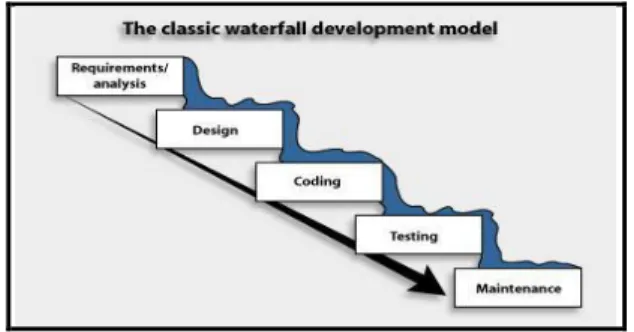
Waterfall methodology is “split in a sequence of consecutive phases. The output of each phase is the input for the next phase.”[4] The waterfall model is appropriate for large projects that its requirements well understood or very complex. [5] In waterfall model the developer cannot move from one stage to another stage except when the stage is completed [6].
Figure 1: Classic Waterfall Development Model Strengths:
It is like sequential steps which makes the
methodology very simple, easy to understand, and simple to implement.
It is suitable for large project that has well-defined requirements.
In the waterfall model, each stage produces
documentation and this makes understanding the product very simple.
Weaknesses:
It is time consuming to complete the project because of many steps.
In waterfall model the developer cannot go back to the previous stage because, the waterfall is a sequential process. So, if any previous stage has gone wrong, the modification will be very complicated to fix or modify it.
It is not suitable for small projects.
Small changes or errors that arise in the completed software may cause a lot of problems.
The Developer is communication with the client is extremely limited being either at the beginning or at the end of the development.
There is minimal feedback between the phases.
C. Object Oriented Analysis And Design (OOAD)
An Object Oriented Analysis and Design (OOAD) techniques has been prominence in 1990. The OOAD techniques utilized the same basic principles as OOP languages such as Java, C++, and other programming languages. An object is the concept of all OO approaches. An object is “An abstraction of the real world based on objects and their interactions with other objects”.[7]In OO approach represents, in a stand-alone package, the process and data related with the real-world object. An object can communicate with other objects via messages. [5] There are three processes which are:
System Analysis System Design
System Implementation Strengths:
It is more reliable and flexible than SDLC because it is depended on the object and object's behaviors. This makes the requirements more clear.
It is a modelling method which makes the system better in quality (increase or improve quality)
Weaknesses:
It is difficult to learn or understand it for the developer.
Time consuming to draw objects (or using UML
techniques e.g.10 diagrams)
D. Rapid Application Development Methodology (RAD): The goal of RAD methodology is to enable the developer to develop a system and produce information system more quickly or much faster.
• Requirements Planning • User Design
• Construction • CutOver [8]
International Journal of Emerging Technology and Advanced Engineering
Website: www.ijetae.com (ISSN 2250-2459, ISO 9001:2008 Certified Journal, Volume 3, Issue 11, November 2013)
279
Strengths:
It produces high quality system.
It requires high level of commitment from the
stakeholder, developer and customer.
The customer views are very important to focus on the system elements.
Based on customer demands, it provides the ability to change the system design.
It makes tight fit between the user requirements and system specifications.
Easy to use.
The development and process in any of project is faster because of the shortened life cycles as compared with difference life cycles.
Increases the project‟s quality in short time. Weaknesses:
This methodology is not useful for large projects or complex projects because of small time and short phases.
To fix any error that appears in the testing process, it takes more time to fix and more costly.
It is very difficult to achieve consistency within and between applications developed by the various team.
III. PROPOSED METHODOLOGY FOR WEB DEVELOPMENT
PROCESS
Now a days most of the web development processes adapt new web technology. The web technologies focus on technical skills and customer expectations. Building a web site is relatively easy, because the barriers to entry are low and development is largely uncomplicated. But building a web application is a hard work. Because of the rich content and its importance to the business. The developer should have to deal with many different stakeholders. Web developer should construct the website that is user friendly, it must also provide security and information consistency about businesses.
A. Wisdm Methodology:
Web site developer uses the WISDM methodology for the modification of multiview aspects used locally and uniquely for web development in practice.
Multiview‘s fundamental assumption: A system
methodology that relies much over an engineering
approach and technical rationality is, by itself, an
insufficient foundation for IS development.
The foundations of multiview needs of computer artefacts, organizations and individuals need to be considered jointly. The major concern of multiviews is the negotiations between technological, organizational, social and human aspects of system development.[9]
The WISDM mainly focuses on Organizational analysis, Information analysis, Technical design, Human computer interaction and Work design. There is no prior ordering of the five aspects of the said method. Each method has been emphasized alone during the website project development. Multiview frame work methodology of WISDM is shown in Figure 2.
Figure 2: WISDM as emerging methodology from the multiview framework.[9]
Organizational analysis:
Organizational analysis is represented in multiview soft systems methodology which is mainly focused on relevant situations characterized by complexity and stakeholder interests. Most of the projects get from the client organizations. The projects are web based in terms of E-commerce which is related to Marketing and Sales. The stakeholder‟s goal is to make the business more successful in terms of measure and ability to generate the revenue. The E-commerce project aims to market and sell products and give valuable services to customers. The organizational analysis consists of building an e-commerce strategy and conducting a market survey to get the feedback from the customer to improve the organization strength and future improvements. The E-commerce survey was concerned with the development project with business strategy. The market surveys focused on customers and identify the perceptions to the Internet, E-commerce and also get the
organizational information requirements. The
Organizational analysis is concerned with value creation because the website is made public, it also may be of interest to customer who can access the website globally. [9]
International Journal of Emerging Technology and Advanced Engineering
Website: www.ijetae.com (ISSN 2250-2459, ISO 9001:2008 Certified Journal, Volume 3, Issue 11, November 2013)
280
Information analysis:
Web developer collects the user requirements from the organization. The user requirement has objectives of new system information for developing the Website. The requirement might be in the form of documents with graphical notations and also be in software prototype. The indicative approach in WISDM uses UML Model. This model should represent the proposal functionality of the new system. The complete requirements are known at the outset and have strong initial ideas in our head. These are complete and require in depth exploration. The web developer should analyses the specific user requirements correctly and finding out exactly what is needed. The project plan is based on information analysis. The requirements Specification are met and consistent with client goal which includes all the functionality of the system.[9]
Work design:
The aim of work design is establishing relationship between customer and employee. It has been broaden from job satisfaction to a more general concern with user satisfaction in the e-commerce environment. The organization has managements. The management defines job requirements. These requirements fit for an employee‟s job expectations and job requirements to make the employee jobs satisfied. Most of the projects should target external customers and have minimal impact on working practices within the organization. The employee designs the website according to the customer needs. They always focus on usability, information quality and accessibility. The customer satisfaction is very important in web information system which enables the designer to reach other organizations to find external user during the development processes. [9]
Technical Design:
Technical design supports the website development. This design represents in the programming design and data structure to design the website. The website development can be categorized into static and dynamic website developments. The static websites are Standard HTML pages. It contains HTML code, which defines the structure and content of the Web page. Each time an HTML page is loaded, it looks the same. The dynamic websites contains server-side code, which allows the server to generate unique content each time the page is loaded. The website developments are based on client (Browser) and server (Web server) model. Most of the websites are hosted on the server. The web browser can request particular website to a server.
The server processes the request and gives the response. Many people are involved during the website development. The Genuine participation involves customer, project managers, website developers and stakeholders who influence each other„s plans policies and decisions which will affect the future outcomes of the website. The website development needs programming design , database design and server software which is indicated in Table-1.
Table 1
Web Technology Softwares.
Programming design
software
HTML, XML, XSD, XST Java Script, VB Script, ASP.Net, JSP,
PHP, CSS, FrontPage,
Macromedia Dreamweaver with Fireworks and Flash for graphics and animation.
Database design
Software
MS Access, Oracle and SQL Server
Server
Websever, Email Server, Database
server, Personal Web Server
(Windows 98), IIS(Windows
NT/2000/XP/2003), Apache,
iPlanet Web Server, Roxen and Zeus
The web developer designs the website as to the look and feel for the customer. When the developer designs the website, they should focus on following points:
Purpose of the website
Subject of the website
Target what the customer feels about the website (Graphical User Interface ) In the technical design, web service-oriented architecture provides the facilitating of inter-organizational computing and executes these services geographically through distributed computing. This architecture allows flexibility as web services can be provided locally or through an external provider. Table 2 indicates the web service standards.[10]
Table2
Web Service Standards.[10]
Web Technology XML, ASP, JSP
Support WS-Security
WS-Addressing
Process WS-BPEL
Services Definition
UDDI(Universal Description
Discover and Integration) WSDL(Web Service Definition Language)
Messaging SOAP
International Journal of Emerging Technology and Advanced Engineering
Website: www.ijetae.com (ISSN 2250-2459, ISO 9001:2008 Certified Journal, Volume 3, Issue 11, November 2013)
281
Human Computer Interaction:
It represents the interaction with user interface which is in between Technical design and work design. User interface design is an essential part of the overall web design development processes. The user interface design should be designed to match the technical skill, experience and expectation of the customer. The web developer must concentrate on the user interface design of the website which can be easily accessible, usable, flexible, secured and also supports the ergonomic factors. Web design has the following the following design principles.[11]
Design Principles represents the Colour, Font, Screen Resolution and graphics, Page Layout – tables, grids, Frames. Menu selection, form-fill and display audio and video.
Useable
Guidance not control
Predictability
Reversibility
Consistency
Reduces learning load
Increases recognition
Navigation Design
Dialogue styles: The dialogue is the way the user reacts with the system such as menu design. [12]
IV. COMPARATIVE STUDIES OF METHODOLOGIES.
The comparative studies done by the various aspects based on the methodology frame works, Phases, Sequence
Cycle, Timing, Project Size, widely understood,
complexity and main advantages. The summary of the comparison studies of the methodologies are given in Table 3.
Table 3
Comparison study between Methodologies.
Methodologies SDLC OOAD RAD Waterfall WSDM
Frame Work Iterative Iterative Iterative Iterative Multi views (Socio-technical views)
Phases
Sequence Cycles Time Consuming
Project Size Small, Medium,
Large Medium, Large Small, Medium Medium, Large
Small, Medium, Large Widely Understood Depends on the requirements Complexity
Cost Not Costly
Reducing cost as compared to the SDLC Low Cost Main Advantages Structured method and can be used in any size of project. Modelling
method increase the quality)
Shorten life cycle (quickly and faster development method)
Sequential model
Adress the wider aspects of web base application systems.
V. CONCLUSION
Each web site will have different goals and objectives and a unique set of problems, thus any methodology will require adaptation to the contingencies of each situation. It is hoped that the one proposed here will serve as a useful methodology to the technical skills and creativity thinking of web developer and easy to make the process of web development.
The methodologies used for traditional systems development or web development have their uses and also their limitations. It is merely intended to act as a useful framework to aid the web development process. WISDM methodology is a multiview approach because it support
Socio-technical view and respective techniques,
International Journal of Emerging Technology and Advanced Engineering
Website: www.ijetae.com (ISSN 2250-2459, ISO 9001:2008 Certified Journal, Volume 3, Issue 11, November 2013)
282
This paper discussed about the multiview frameworks, it has been used to explain how a Web Information System Development Methodology (WISDM) emerged on a web development project. A brief comparison of the presented WISDM methodologies is given emphasize for each methodology its strengths and weaknesses.
REFERENCES
[1] Fitzgerald B. (1997a) Time to turn update the clock,in Wojtkowski G, Wojtkowski W, Wrycza S and Zupancic J (eds.) Systems Development Methods for the Next Century, Plenum Press, New York.
[2] Powell, T A. (1998), Web Site Engineering. New Jersey. Prentice Hall.
[3] Britton, C. & Doake, J. (2003). Software System Development. Third Edition. USA: McGraw-Hill Education.
[4] Vidgen, R., Avison, D., Wood, B. & Wood-Harper, T. (2002). Developing Web Information Systems.Oxford: Butterworth Heinemann.
[5] Weaver, P. (2004). Success in Your Project: A Guide to Student System Development Projects. USA:Prentice Hall.
[6] Klein, F. J. (2008). The Waterfall Model of Software Development. [Online].
[7] RomiSatriaWahono. (2000). Object-Oriented Analysis and Design Methodology. [Online].
[8] Avison, D. & Fitzgerald, G. (2006). Information Systems Development: Methodologies, Techniques,and Tools. Fourth Edition. UK: McGraw Hill Education.
[9] Richard Vidgen, “Constructing a web information system development methodology” P 247-261, Blackwell Science Ltd. [10] Sommerville (2007). “Software Engineering” 8th Edision: Addison
Wessley.
[11] Preece et al “Interaction Design - Beyond Human-Computer Interaction” (2002) Wiley.
[12] Dix et al,(2003) “Human Computer Interaction” 2nd Edition,Prentice Hall.
![Figure 2: WISDM as emerging methodology from the multiview framework.[9]](https://thumb-us.123doks.com/thumbv2/123dok_us/17340.2502062/3.918.497.833.425.601/figure-wisdm-emerging-methodology-multiview-framework.webp)