Face Recognition Algorithms
Surpass Humans Matching Faces
over Changes in Illumination
Alice J. O’Toole,
P. Jonathon Phillips,
Senior Member,
IEEE,
Fang Jiang, Janet Ayyad, Nils Pe´nard,
and Herve´ Abdi
Abstract—There has been significant progress in improving the performance of computer-based face recognition algorithms over the last decade. Although algorithms have been tested and compared extensively with each other, there has been remarkably little work comparing the accuracy of computer-based face recognition systems with humans. We compared seven state-of-the-art face recognition algorithms with humans on a face-matching task. Humans and algorithms determined whether pairs of face images, taken under different illumination conditions, were pictures of the same person or of different people. Three algorithms surpassed human performance matching face pairs prescreened to be “difficult” and six algorithms surpassed humans on “easy” face pairs. Although illumination variation continues to challenge face recognition algorithms, current algorithms compete favorably with humans. The superior performance of the best algorithms over humans, in light of the absolute performance levels of the algorithms, underscores the need to compare algorithms with the best current control—humans.
Index Terms—Face and gesture recognition, performance evaluation of algorithms and systems, human information processing.
Ç
1
INTRODUCTION
ANincrease in security concerns worldwide has focused public
attention on the accuracy of computer-based face recognition systems for security applications. How accurate must a face recognition algorithm be to contribute to these applications? Over the last decade, academic computer vision researchers and commercial product developers have improved the performance of automated face recognition algorithms on a variety of challenging face recognition tasks. Information about the performance of automated face recognition systems is available to the public in the form of scholarly journal articles (for a review, see [1]), commercially disseminated product information, and US govern-ment sponsored evaluations (e.g., [2], [3], [4], [5]). There is remarkably little information available, however, about the accu-racy of face recognition algorithms relative to humans, although some previous work shows that automatic recognition of face sketches can surpass human recognition [6], [7]. Because humans currently perform face recognition tasks in most real-world security situations, it is unclear whether the use of algorithms improves security or puts it at greater risk.
Notwithstanding, the issue of human performance, it is difficult even to make direct comparisons among algorithms in a way that gives an accurate idea of the current state of the art [8]. This is
because most journal articles and product pamphlets consider only one or two systems at a time and report results that are based on facial image sets that vary widely in number and quality. US government funded competitions allow for direct comparisons among multiple recognition algorithms. Performance is measured in these competitions using standardized evaluation procedures applied to large sets of facial images (e.g., FERET, [4], Face Recognition Vendor Test 2000, [2], Face Recognition Vendor Test 2002, [5], and Face Recognition Grand Challenge, FRGC, [3]).
The present work builds on the most recent of these large-scale tests of face recognition algorithms—the FRGC. The evaluation procedures used in this test provide a unique opportunity to benchmark human performance against current face recognition algorithms. This competition was conducted between 2004 and 2006 and was open to academic, industrial, and research lab competitors. The developers of computer-based face recognition systems volunteered their algorithms for evaluation on one or more face matching tasks varying in difficulty.
We carried out a direct comparison between humans and seven face recognition algorithms1 participating in the most difficult
experiment of the FRGC: matching two-dimensional face images taken under different illumination conditions (Fig. 1). The problem of face recognition over changes in illumination is widely recognized to be difficult for humans [9], [10], [11], [12], [13] and for algorithms [14], [15]. Illumination changes can vary the overall magnitude of light intensity reflected back from an object, as well as the pattern of shading and shadows visible in an image [16]. Indeed, varying the illumination can result in larger image differences than varying either the identity [17] or the viewpoint [16] of a face. These illumination changes have well-documented, detrimental effects on human accuracy recognizing faces (for a review, see [18]).
For face recognition algorithms, the difficulty of the illumina-tion problem is evident in comparing the FRGC experiments for matching controlled versus uncontrolled-illumination image pairs. In the controlled illumination experiment of the FRGC, algorithms match the identity of faces in two pictures taken under similar, controlled illumination conditions. The algorithms that partici-pated in the controlled illumination experiment achieved a median verification rate of 0.91 at the 0.001 false acceptance rate—where verification rate is the proportion of matched pairs correctly judged to be of the same person and false acceptance rate is the proportion of mismatched pairs judged incorrectly to be of the same person. By contrast, the algorithms that competed in the uncontrolled illumination experiment achieved a median verifica-tion rate of 0.42 at a false acceptance rate of 0.001. The difficulties posed by variable illumination conditions, therefore, remain a significant challenge for automatic face recognition systems.
In the FRGC, algorithms determined if two faces in a pair of images were of the same person or of different people. Algorithms in the FRGC uncontrolled illumination experiment were required to match identities in approximately 128 million pairs of faces. Specifically, the test data for this experiment consisted of all possible pairs of 16,028 “target” faces and 8,014 “probe” faces [15]. The target images were taken under controlled illumination conditions typical of those used for passport photographs and the probe images were taken under uncontrolled illumination conditions (e.g., in a corridor) (Fig. 1).
. A.J. O’Toole, F. Jiang, J. Ayyad, N. Pe´nard, and H. Abdi are at the School of Behavioral and Brain Sciences, GR4.1, The University of Texas at Dallas, Richardson, TX 75083-0688.
E-mail: {otoole, fxj018100, jha011100, npenard, herve}@utdallas.edu.
. P.J. Phillips is with the National Institute of Standards and Technology, 100 Bureau Dr., MS 8940, Gaithersburg MD 20899.
E-mail: [email protected].
Manuscript received 14 Mar. 2006; revised 2 Oct. 2006; accepted 26 Jan. 2007; published online 7 Feb. 2007.
Recommended for acceptance by X. Tang.
For information on obtaining reprints of this article, please send e-mail to: [email protected], and reference IEEECS Log Number TPAMI-0228-0306. Digital Object Identifier no. 10.1109/TPAMI.2007.1107.
1. These algorithms comprised seven of the 12 submitted for evaluation in the FRGC and were selected as follows: Beginning with the original 12, two groups submitted results for two variations of the same algorithm. These variations had nearly identical performance on the uncontrolled illumination experiment and, so, only one algorithm from each group was included. An additional three submitted algorithms differed only in the preprocessing of images, using the control PCA algorithm for face matching. These algorithms were excluded here, because of the role of the PCA control in selecting easy and difficult face image pairs. Details on the performance of the original 12 algorithms can be found elsewhere [3]. 0162-8828/07/$25.00ß2007 IEEE Published by the IEEE Computer Society
Participating algorithms produced a16;0288;014matrix of
similarity scores for all possible face pairs. A similarity score represents the end result of an algorithm’s computations to establish the likelihood that the faces in the image pair are the “same” person. A higher similarity score indicates a greater likelihood that the two faces are the same person. The similarity score matrix is used to compute the algorithms’ “same person” versus “different person” judgments. Face pairs with similarity scores greater than a set criterioncare judged to be of the “same” person; pairs with similarity less than or equal tocare judged to be of “different” people. By varying the criterioncover the full range of similarity scores, a complete receiver operating characteristic (ROC) curve is generated. An ROC curve indicates performance level for all possible combinations of correct verification and false acceptance rate. The use of an ROC curve for characterizing the performance of algorithms makes it relatively straightforward to compare human face matching data to the algorithm data.
Testing humans on 128 million pairs of facial images is impossible. We focused, therefore, on a sample of the “easiest” and “most difficult” face pairs with a sampling procedure defined by a baseline algorithm. In three experiments, we tested human performance on “easy” and “difficult” face pairs, varying the exposure time of the face pairs from unlimited time to 500 ms. Humans rated the likelihood that the two images were of the same person. Next, we extracted similarity scores from the seven algorithms on the same set of face pairs matched by the human participants. Finally, ROC curves were generated for the algorithms and humans. These form the primary basis of our comparisons between humans and machines on the face-matching task.
2
EXPERIMENTS
2.1 Methods
2.1.1 Stimuli
Face stimuli were chosen from a large database developed for the FRGC study [15]. As noted, the uncontrolled illumination experi-ment from the FRGC used 8,014 probe faces and 16,028 target faces. The uncontrolled illumination probe images had a resolution of2;2721;704pixels. The controlled illumination target images had a resolution of1;7042;272pixels. For these experiments, we sampled face image pairs from 128,448,392 pairs available. Of these, 407,352 (0.32 percent) were of the same people (match pairs) and 128,041,040 (99.68 percent) were of different people (nonmatch pairs, see Fig. 1 for an example pair).
To make the task as challenging as possible, we narrowed the available pairs to include only Caucasian males and females. Restriction to this relatively homogeneous set of faces eliminates the possibility that algorithms or humans can base identity comparisons on surface facial characteristics associated with race or age. For the same reason, the face pairs presented to participants were matched by sex.
Next, we divided the face pairs into “easy” and “difficult.” To estimate pair difficulty, we used a control algorithm based on principal components analysis (PCA) of the aligned and scaled images. PCA algorithms are an appropriate baseline because they have been available and widely tested since the early 1990s [19], [20]. The FRGC version of this baseline was designed to optimize performance [21]. We show that this algorithm reliably predicts “easy” and “difficult” sets of face pairs for both humans and algorithms. The algorithm itself, however, is not considered “state of the art.”
The baseline algorithm generated a 16;0288;014 similarity matrix. We defined difficult match pairsto be image pairs of the same person with similarity scores less than two standard deviations below the average similarity score for the same-person match pairs (i.e., highly dissimilar images of the same person).
Easy match pairs were image pairs of the same person with similarity scores greater than two standard deviations above the mean similarity score for the same-person pairs (i.e., highly similar images of the same person).Difficult nonmatch pairsandeasy non-match pairswere chosen analogously (e.g., image pairs of different faces with similarity scores greater/less than two standard deviations above/below the average similarity score for the different-person pairs). The face pairs used in the experiments were selected randomly from face pairs meeting the above criteria.
2.1.2 Participants
Undergraduate students from the School of Behavioral and Brain Sciences at the University of Texas at Dallas volunteered to participate in these experiments in exchange for a research credit in a psychology course. A total of 91 students participated in the
experiments (Experiment 1, n¼22, 10 females and 12 males,
Experiment 2,n¼49, 25 females and 24 males, and Experiment 3,
n¼20, 10 females and 10 males). Participants in the experiment received no training or practice on the task.
2.1.3 Procedure
For all experiments, the task was to determine whether two face images, which appeared side by side on a computer screen, were pictures of the same person or of different people. Probe images were displayed on the left and target images were displayed on the right. The participants were asked to rate the image pairs using a 1 to 5 scale,
1. sure they are the same,
2. think they are the same,
Fig. 1. A sample pair of face images from (a) a “match” trial and (b) a “ no match” trial. Participants responded by rating the likelihood that the pictures were of the same person using a five-point scale ranging from “1 sure they are the same person” to “5 sure they are not the same people.” The face images were presented to participants in color. (The original color images in this figure can be found in the supplemental material, which can be found at http://computer.org/ tpami/archives.htm.)
3. don’t know,
4. think they are not the same, and
5. sure they are not the same.
In Experiment 1, 120 pairs of male faces served as stimuli. Half of the pairs were prescreened to be “easy” and half were prescreened to be “difficult.” Participants had unlimited time to enter a response for each pair, with images remaining on the screen until a response was entered.
Experiment 2 was similar to Experiment 1, but with exposure time limited to two seconds and with unlimited time to enter a response after the face pair disappeared from the screen. The next trial was initiated, when the participant entered a response. In this experiment, we included an equal number of male (120) and female (120) face pairs and balanced the inclusion of male and female human participants. Again, half of the pairs were prescreened to be “easy” and half were prescreened to be “difficult.” The exposure time was reduced to two seconds with the purpose of increasing error rates. This exposure time reduction did not diminish human performance significantly and, so, Experiment 3 was conducted.
Experiment 3 was identical to Experiment 2, but with exposure time set to 500 milliseconds. This reduced performance consider-ably. A pilot study, not reported here, showed that the error rates did not increase substantially from the unlimited time condition when the exposure time was reduced to 1 second.
The algorithm-human comparisons we report in this study are based on data from Experiment 2, (see the supplemental material, which can be found at http://computer.org/tpami/archives.htm for the results of Experiments 1 and 3). We chose Experiment 2 for comparison with the algorithms, because we think that two seconds is a “realistic” exposure time for many security applica-tions, and because the experiment includes a balanced number of male and female participants and male and female faces.
2.2 Results
2.2.1 Behavioral Data
For the purposes of conducting inferential statistical analyses on the behavioral data, participant responses were transformed into “same” or “different” judgments for individual pairs of faces, so thatd0could be computed. Responses 1 and 2 were deemed “same”
judgments and responses 3, 4, and 5 were deemed “different” judgments.2The correct verification rate (i.e., hit rate) was computed as the proportion of matched pairs correctly judged to be of the same person. The false acceptance rate (i.e., false alarm rate) was calculated as the proportion of non-match pairs judged incorrectly to be of the same person. Ad0was then computed from the hit and false alarm rates as Zhit rateZfalse alarm rate. ROC curves were computed from the full range of response data that assigned certainty values to each match/no-match judgment. These curves provide analogous data to the ROCs computed from the algorithms, across the range of verification and false acceptance rates. The
d0values served as the dependent variable in the analysis of variance
(ANOVA) results reported for each experiment.
The difficulty level of face pairs (i.e., as defined by baseline control algorithm) was evaluated as a within-subjects variable in all three experiments. The effects of sex of the participant (between-subjects variable) and sex of face pair (within-(between-subjects variable) were examined in Experiment 2, where both factors were closely
balanced. No significant differences or interactions were found for these gender variables, and so we do not consider them further.
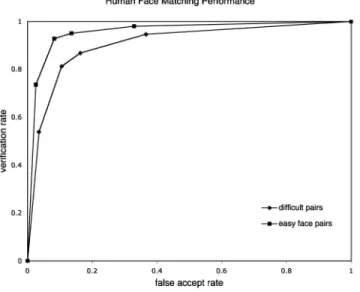
The PCA algorithm’s ability to predict accuracy for humans was verified in all three face-matching experiments. Humans were significantly more accurate on face pairs estimated by the PCA to be easy than they were on the face pairs estimated to be difficult (Fig. 2). This was true when people had unlimited time to match the pairs (Experiment 1, Fð1;20Þ ¼19:78, p < :0002), when the pairs were presented for two-seconds (Experiment 2, Fð1;48Þ ¼96:53,
p < :0001), and when the pairs were presented for 500 milliseconds (Experiment 3, Fð1;18Þ ¼62:65, p < :0001). Performance on the face-matching task was good, but not perfect (see Fig. 2, for the Experiment 2 results). In Experiment 2, average performance and participant variability can be characterized as follows: For the difficult face pairs, the average d0 was 2.34, (std:dev:¼0:43;
minimumd0¼1:33; maximumd0¼3:53). For the easy face pairs, the average d0 was 3.04, (std:dev:¼0:42; minimumd0¼1:92;
maximumd0¼3:79).3
Remarkably, human participants performed no better with unlimited time to examine each pair than with a 2 second time limit ðFð1;176Þ ¼1:65; ns:Þ. Match accuracy declined, however, when exposure time was limited to 500 milliseconds (Fð1;176Þ ¼22:37,
p < :0001).
Combining across the three experiments, two findings are worth noting. First, human face matching accuracy was roughly constant for exposure times varying from two seconds to “unlimited” time. Only in Experiment 3, where exposure time was reduced to 500 ms, was there a substantial decline in performance. This suggests that more time, or the use of a more analytic and time-consuming strategy by humans, would not have pushed performance levels to perfection. Whatever strategy humans employ to reach these “good” to “excellent” levels of performance seems to operate quickly and efficiently. The relatively stable performance of humans across the exposure times supports the use of these data as meaningful benchmark for algorithm performance.
A second result is that PCA can serve as an effective tool for prescreening easy versus difficult face pairs for humans.
2. Note that all key results in this paper are based on ROC curves (see Figs. 2 and 3). The match versus nonmatch threshold, which is needed to computed0for the inferential statistics, is not used in computing the ROC. Rather, the ROC provides a complete picture of human accuracy at the confidence threshold levels assessed (1 through 5). The ROC (Fig. 2) shows that accuracy for the easy face pairs was higher than for difficult pairs at all response ratings, indicating that a change in the match versus nonmatch threshold for computingd0would not affect the result.
3. The results of Experiments 1 and 3 are available in the supplemental material, which can be found at http://computer.org/tpami/archives.htm. Fig. 2. The accuracy of humans matching face identities for “easy” versus “difficult” face pairs, with easy/difficult estimated by the baseline PCA algorithm. Face pairs found to be more difficult for the PCA were likewise more difficult for humans.
2.2.2 Human-Algorithm Comparison
We compared human performance in Experiment 2 to the performance of seven algorithms participating in the illumination experiment of the FRGC. Three of these algorithms were developed at academic institutions and four were developed by commercial enterprises.
As noted, each participating algorithm produced a 16;028
8;014 matrix of similarity scores for all the face pairs. The similarity scores of the 240 (120 male and 120 female) face pairs presented to participants in Experiment 2 were extracted from each similarity matrix and analyzed as follows: A full ROC curve was generated for each algorithm by sweeping a match criterion, c, across the distributions of “match” and “no-match” similarity scores and assigning same or different responses for individual face pairs, (e.g., similarity score greater thancyielded “same” and similarity score less than or equal to c yielded “different”). The verification and the false acceptance rates were used to compute ROC curves for the algorithms. For the human data, we used the ROC curves in Fig. 2 for the comparison. The average human performance in the easy and difficult conditions was used, because it is the best estimate of how well a randomly selected human participant would perform the task.
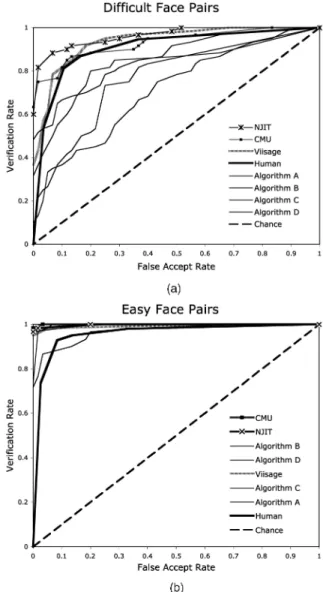
Fig. 3a shows the performance of the algorithms and humans on the difficult face pairs. Three algorithms were more accurate than humans at this task and four algorithms were less accurate than humans. Two of the three algorithms that surpassed human performance were developed at academic institutions [22], [23]. The third algorithm is from industry and is described partially in a recent paper [24].
The performance of algorithms relative to humans for the easy face pairs was even better. Six of the seven algorithms performed more accurately than humans (Fig. 3b). The seventh algorithm exceeded human performance only at low false acceptance rates.
In all cases, algorithm performance was better for the “easy” face pairs than for the “difficult” face pairs, echoing the pattern for humans.
Did human performance suffer from fatigue or waning attention over the course of the experiment? To examine this possibility, we assessed human performance over the sequence of face pairs presented. Accuracy did not vary with trial number for either the verification rateðr¼0:07; ns:Þor for the false acceptance rate ðr¼ 0:04; ns:Þ. It is unlikely, therefore, that the compara-tively lower performance of humans versus algorithms on the easy face pairs was due to difficulties in maintaining attention for the duration of the experiment.
3
GENERAL
DISCUSSION
There is an implicit assumption among computer vision research-ers, psychologists, and indeed much of the general public that human abilities recognizing and matching faces are currently beyond reach for machines. The present experiments challenge this assumption by showing that some current face recognition algorithms can compete with humans on a challenging task— matching face identity between photographs that are taken under different illumination conditions. Although algorithm perfor-mance may not seem impressive in absolute terms, it nonetheless compares favorably with humans. This is consistent with earlier work indicating similar results for face sketch recognition [6], [7]. The comparisons we report may lead us to wonder if human abilities with faces are overrated. Before concluding that they are, we note that human participants in these experiments were asked to match the faces of people previously unknown to them. This is an appropriate task for testing the abilities of a human security guard and/or algorithm, but may not show human face recogni-tion skills at their best. The robust recognirecogni-tion abilities that
characterize human expertise for faces may be limited to the faces of people we know well. Indeed, by contrast to performance with unfamiliar faces, human face recognition abilities for familiar faces are relatively robust to changes in viewing parameters such as illumination and pose [25], [26].
The consistent advantage of the algorithms over humans on the “easy” faces suggests that easy face pairs may simply be those in which the image-based features for the two faces are well matched and the illumination differences between images are minimal. Because image-based matching is a task that face recognition algorithms have done well for many years [1], it is perhaps not surprising that algorithms can compete with humans on this task. The algorithms might exploit useful, but subtle, image-based information that give them a slight, but consistent, advantage over humans.
An explanation for the better performance of algorithms on the difficult face pairs is less clear and may await more information and further tests of the algorithms that achieve this better performance. Although a discussion of these algorithms is beyond Fig. 3. Performance of humans and seven algorithms on the difficult face pairs (Fig. 3a) and easy face pairs (Fig. 3b) shown with ROC curves. Three algorithms outperform humans on the difficult face pairs at most or all combinations of verification rate and false accept rate (cf., [22] NJIT, [23] CMU for details on two of the three algorithms). Humans outperform the other four algorithms on the difficult face pairs. All but one algorithm performs more accurately than humans on the easy face pairs. (A color version of this figure is provided in the supplemental material, which can be found at http://computer.org/tpami/archives.htm.)
the scope of this paper, suffice to say that the Liu [22] and Xie et al. [23] algorithms represent a departure from past approaches. Both algorithms use kernel methods and both make efficient use of multiple “training” images of individuals to create a face feature space. The training images were made available to algorithm developers for “optional use” and were not included in the target or probe sets. The Liu [22] and Xie et al. [23] algorithms represent faces in the derived face feature space before matching by identity. It is possible that these algorithms work well because of information they can exploit from training images about the variability of individuals across changes in illumination. This may be similar to information humans acquire in developing face recognition skills and in becoming familiar with individuals.
The power of combining variable face images to improve face recognition has been explored also by Burton et al. [27]. They used a technique based on averaging multiple aligned face images of the same person and found that it outperformed comparable systems based on collections of instances. They demonstrated also that the
averaging procedure produced faces thathumansrecognized more
accurately than the original face images. Algorithms that make coordinated use of multiple images, therefore, can potentially offer insight into the question of how familiarity with multiple images of individual faces may help to buffer human and machine recognition against spurious changes in viewing parameters.
Finally, we tend to accept at “face” value, the pressing need to evaluate the performance of any algorithm that is placed in the field for a security application of importance. The tools and techniques for evaluating human face matching and recognition performance have been available for many years and make it possible to test humans before assigning them to security tasks. This is an important, even critical, step for evaluating the level of security provided by human operators, by machine operators, and by the human-machine partnerships that will likely become commonplace in the near future for many security applications.
ACKNOWLEDGMENTS
The primary goal of the FRGC is to encourage and facilitate the development of face recognition algorithms. To provide the face recognition research community with an unbiased assessment of state-of-the-art algorithms, research groups voluntarily submitted similarity scores from prototyped experiments to the National Institute of Standards and Technology (NIST) for analysis. The results of the analysis by NIST were anonymous, unless otherwise agreed to by the participating algorithm developers. All participat-ing groups were given the choice of remainparticipat-ing anonymous or being identified in this report. Performance results are from January 2005 for all algorithms except Xie et al., 2005, where results are from August 2005. This work was supported by a contract to A. O’Toole and H. Abdi from TSWG. P. J. Phillips was supported in part by funding from the US National Institute of Justice. The identification of any commercial product or trade name does not imply endorsement or recommendation by NIST.
REFERENCES
[1] W. Zhao, R. Chellappa, P.J. Phillips, and A. Rosenfeld, “Face Recognition: A Literature Survey,”ACM Computing Surveys,vol. 35, pp. 399-459, 2003.
[2] D. Blackburn, J.M. Bone, and P.J. Phillips, “FRVT 2000 Evaluation Report,” technical report, http://www.frvt.org, 2001.
[3] P.J. Phillips, P.J. Flynn, T. Scruggs, K.W. Bowyer, and W. Worek, “Preliminary Face Recognition Grand Challenge Results,” Proc. Seventh Int’l Conf. Automatic Face and Gesture Recognition,pp. 15-24, 2006.
[4] P.J. Phillips, H. Moon, P. Rizvi, and P. Rauss, “The FERET Evaluation Method for Face Recognition Algorithms,”IEEE Trans. Pattern Analysis and Machine Learning,vol. 22, pp. 1090-1104, 2000.
[5] P.J. Phillips, P. Grother, R. Micheals, D. Blackburn, E. Tabassi, and J.M. Bone, “FRVT 2002 Evaluation Report,” Technical Report NISTIR 6965, http://www.frvt.org, 2003.
[6] X. Tang and X. Wang, “Face Sketch Recognition,”IEEE Trans. Circuits, Systems, and Video Technology,vol. 14, no. 1, pp. 50-57, Jan. 2004.
[7] X. Tang and X. Wang, “Face Sketch Synthesis and Recognition,”Proc. Ninth IEEE Int’l Conf. Computer Vision,pp. 687-694, Oct. 2003.
[8] P.J. Phillips and E. Newton, “Meta-Analysis of Face Recognition Algo-rithms,”Proc. Fifth Int’l Conf. Automatic Face & Gesture Recognition,p. 235, 2002.
[9] W.J. Braje, “Illumination Encoding in Face Recognition: Effect of Position Shift,”J. Vision,vol. 3, pp. 161-170, 2003.
[10] W.J. Braje, D. Kersten, M.J. Tarr, and N.F. Troje, “Illumination Effects in Face Recognition,”Psychobiology,vol. 26, pp. 371-380, 1999.
[11] W.J. Braje, G.E. Legge, and D. Kersten, “Invariant Recognition of Natural Objects in the Presence of Shadows,”Perception,vol. 29, pp. 383-398, 2000.
[12] H. Hill and V. Bruce, “Effects of Lighting on the Perception of Facial Surface,” J. Experimental Psychology: Human Perception & Performance,
vol. 22, no. 4, pp. 986-1004, 1996.
[13] N.F. Troje and H.H. Bu¨lthoff, “How Is Bilateral Symmetry of Human Faces Used for Recognition of Novel Views?”Vision Research,vol. 38, pp. 79-89, 1998.
[14] R. Gross, S. Baker, I. Matthews, and T. Kanade, “Face Recognition Across Pose and Illumination,”Handbook of Face Recognition,S.Z. Li and A.K. Jain, eds., pp. 193-216, Springer, 2005.
[15] P.J. Phillips, P.J. Flynn, T. Scruggs, K.W. Bowyer, J. Chang, K. Hoffman, J. Marques, J. Min, and W. Worek, “Overview of the Face Recognition Grand Challenge,” Proc. IEEE Computer Vision & Pattern Recognition, vol. 1, pp. 947-954, 2005.
[16] M.J. Tarr and H.H. Bu¨lthoff, “Image-Based Object Recognition in Man, Monkey and Machine,”Cognition,vol. 67, pp. 1-20, 1998.
[17] Y. Adini, Y. Moses, and S. Ullman, “Face Recognition: The Problem of Compensating for Changes in Illumination Direction,”IEEE Trans. Pattern Analysis and Machine Learning,vol. 19, pp. 721-732, 1997.
[18] A.J. O’Toole, F. Jiang, D. Roark, and H. Abdi, “Predicting Human Face Recognition,”Face Processing: Advanced Methods and Models,W.-Y. Zhao and R. Chellappa, eds., Elsevier, 2006.
[19] L. Sirovich and M. Kirby, “Low-Dimensional Procedure for the Character-ization of Human Faces,”J. Optical Soc. Am.,vol. A, no. 4, pp. 519-524, 1987.
[20] M. Turk and A. Pentland, “Eigenfaces for Recognition,” J. Cognitive Neuroscience,vol. 3, pp. 71-86, 1991.
[21] H.J. Moon and P.J. Phillips, “Computational and Performance Aspects of PCA-Based Face Recognition Algorithms,”Perception,vol. 30, pp. 301-321, 2001.
[22] C. Liu, “Capitalize on Dimensionality Increasing Techniques from Improving Face Recognition Grand Challenge Performance,”IEEE Trans. Pattern Analysis and Machine Intelligence,vol. 28, pp. 725-737, 2006.
[23] C.M. Xie, M. Savvides, and V. Kumar, “Kernel Correlation Filter Based Redundant Class-Dependence Feature Analysis (KCFA) on FRGC2.0 Data,”
Proc. IEEE Int’l Workshop Analysis & Modeling Faces & Gestures,pp. 32-43, 2005.
[24] M. Husken, B. Brauckmann, S. Gehlen, and C. von der Malsburg, “Strategies and Benefits of Fusion of 2D and 3D Face Recognition,”Proc. IEEE Workshop Face Recognition Grand Challenge Experiments,P.J. Phillips and K.W. Bowyer, eds., 2005.
[25] P.J.B. Hancock, V. Bruce, and A.M. Burton, “Recognition of Unfamiliar Faces,”Trends in Cognitive Sciences,vol. 4, pp. 330-337, 2000.
[26] A.J. O’Toole, D. Roark, and H. Abdi, “Recognition of Moving Faces: A Psychological and Neural Perspective,”Trends in Cognitive Sciences,vol. 6, pp. 261-266, 2002.
[27] A.M. Burton, R. Jenkins, P.J. Hancock, and D. White, “Robust Representa-tions for Face Recognition: The Power of Averages,”Cognitive Psychology,
vol. 51, pp. 256-284, 2005.
.For more information on this or any other computing topic, please visit our Digital Library atwww.computer.org/publications/dlib.