RAISING
EXPECTATIONS
FOR PEOPLE WITH
BLADDER AND
Contents
1. About this report
2
2. Executive summary
4
3. Background
6
4. High quality care for people with bladder
8
and bowel problems
5. What matters to people with bladder
10
and bowel problems?
6. A snapshot of patient experience today
14
7. Making it happen
20
8. Useful links
30
9. About the organisations
32
10. References
36
The report has been developed by the Bladder and Bowel
Foundation (B&BF), Cystitis and Overactive Bladder Foundation
(COB), the Association for Continence Advice (ACA) and the
expert group on lower urinary tract symptoms (LUTS) with
support from Astellas Pharma Ltd. Astellas Pharma Ltd. provided
funding to MHP Health to provide communications and project
management support. Astellas Pharma Ltd. has had no input to
the report, except to review its content to ensure compliance
with the ABPI code of practice.
Bladder and bowel problems are common
1, but often
misunderstood. The purpose of this report is to share new
insights into what it is like to experience and cope with
bowel and bladder incontinence and other lower urinary
tract symptoms from the perspective of those living with
the condition. It establishes a number of imperatives for
the development of NHS practice and policy to improve
individual experiences and outcomes through more proactive
and cost-effective models of care.
The report is informed by a patient and professional workshop which took place in January 2014. The workshop was hosted by the expert group on lower urinary tract symptoms (LUTS) in partnership with the Bladder & Bowel Foundation (B&BF), the Cystitis and Overactive Bladder Foundation (COB) and the Association for Continence Advice (ACA). The workshop was organised by MHP Health on behalf of the three organisations, with support from Astellas Pharma Ltd. It sought to:
1. Gain insights into people’s experiences of living with bladder and bowel problems and their expectations of treatment and care – what do participants hope to achieve?
2. Understand more about individuals’ experiences of NHS services – have they met expectations?
3. Share ideas about how NHS services could put patients’ needs first
4. Identify ways in which patients could be more involved in decisions about their treatment and care
This report captures the perspectives of the workshop participants in an anonymised form. It should be noted that these are the views of a small group of individuals, however, their comments are consistent with the findings of other studies based on a larger cohort of patients, such as the National Audit of
Continence Care. The conclusions and recommendations in the report are based on the qualitative workshop as well as the wider evidence base in relation to continence needs and provision.
For more information about the report, please contact the secretariat of the expert group on LUTS, Poonam Arora.
[email protected] 020 3128 8210
In these circumstances, one expects the NHS –
established to provide healthcare according to need when people are at their most vulnerable – to offer reassurance, empathy and high quality clinical care. But the findings in this report show a very different picture. Based on insights gathered through a small qualitative workshop, which are supported by evidence collected through national clinical audits4, the report highlights how patients with bladder and bowel problems:
•
Did not feel listened to or taken seriously when they first sought help from their doctor•
Were not treated with dignity and respect•
Lacked confidence that clinicians understood their symptoms or knew how to treat their condition•
Were not offered adequate information about theircondition or their treatment options
•
Did not feel involved in decisions about their treatment and care•
Did not have access to high quality interventions that are recommended by the National Institute for Health and Care Excellence (NICE)Bladder and bowel problems lack the same ‘status’ as more recognised chronic conditions, even though the effect of moderate continence problems on quality of life is similar to that of conditions such as diabetes, high blood pressure or cancer5. This means that we often fail to get even the most basic aspects of care right. Addressing these shortcomings must now become a priority, given that:
•
Poor continence care compromises fundamentalNHS rights to dignity and respect – 22 out of the 33 cases presented as oral evidence to the Francis Inquiry
included “significant concerns” about continence care which led to “considerable suffering, distress and embarrassment” to patients6
•
Age is a major risk factor for bladder and bowel problems and as the population ages, demand for treatment and care will continue to grow7•
The cost of delayed, inadequate care is high – both for individuals and the NHS. Unmanaged symptoms can lead to avoidable morbidity and service use by increasing the risk of urinary tract infection, pressure ulcers and falls8,9•
Incontinence is associated with a number ofcomorbidities such as arthritis, asthma, chronic anxiety, depression, diabetes, heart disease, neurological conditions, sleep disorders10 and dementia11 - it cannot be overlooked if we are to improve outcomes that matter to patients
This report urges the new Government, NHS leaders, commissioners, providers, healthcare professionals and patients themselves to start talking about incontinence and to consider what steps they can take to raise expectations for people with bladder and bowel problems. Actions and recommendations are included in section 6 of this report, and are summarised as follows:
Going to the loo is an ordinary part of daily human life – something most of us do without
a second thought. But bladder and bowel problems, such as incontinence and overactive
bladder (OAB), are among society’s most enduring taboos. The desire to keep problems
hidden obscures just how common they are, with one in four people experiencing a
problem with bladder control at some point in their lifetime, and one in ten affected by
bowel incontinence
2. Misunderstanding of symptoms, embarrassment and shame due
to a perceived loss of control or dignity, means that many people delay seeking help for
manageable conditions, or assume that support is not available
3.
POLICY MAKERS –
make high quality
care for people with bladder and bowel
problems a priority
Action 1:
NHS England should prioritise the development of commissioning guidance on bladder and bowel incontinence to improve the quality of local commissioning
Action 2:
Both i) a diagnosis of bladder and/or bowel incontinence and ii) the provision of a personalised care plan, should be linked to an individuals’ NHS number so that the provision of personalised care plans can be audited
Action 3:
NICE should develop quality metrics based on existing and forthcoming quality standards (QS45, QS54 and QS77), to underpin local contracting and to inform future iterations of the CCG Outcomes Indicator Set
CLINICAL COMMISSIONING GROUPS
(CCGS)– seek improvements in the quality
of local services based on the outcomes
that matter to people with bladder and
bowel problems
Action 1:
CCGs should have an up to date estimate of local continence needs to inform the development of local commissioning and workforce plans
Action 2:
CCGs should work with primary and secondary care providers to improve local awareness of incontinence and to incentivise innovative models of service delivery such as nurse-led community continence clinics to improve patient and carer focus
Action 3:
CCGs should develop outcomes-based contracts with local providers to incentivise improvements in symptoms, quality of life and patient experience measured through patient feedback
CLINICIANS AND PROVIDERS – put people
with bladder and bowel problems at the
centre of your planning and decision-making
Action 1:
Healthcare professionals should offer a care planning approach for every patient with bladder and bowel problems, working with the patient to identify individual goals, develop a treatment plan and review the plan (including improvement against agreed outcomes and goals) according to the recommendations and timetable as set out in NICE guidance
Action 2:
When making referrals, GPs should offer patients a choice of provider, including the option of attending a specialist continence service
Action 3:
The Nursing and Midwifery Council (NMC) and the General Medical Council (GMC) should review their education standards and the quality assurance of curricula to ensure all nursing and medical professionals have a basic understanding of continence promotion and management at qualification
PATIENTS – may wish to consider the
information outlined in this report so as to
become more involved in decisions about
their treatment and care
Action 1:
Patients may wish to share a copy of this report with others who they think it might benefit – for example, through support groups or online networks
Action 2:
Patients may wish to consider asking their healthcare professional about the Expert Patients Programme (EPP) and contact COB and the B&BF to receive more information on their symptoms and their care
Action 3:
Patients may wish to share a copy of this report with their local MP and local NHS organisations such as GP practices and hospitals to help raise awareness of the issues facing people with bladder and bowel problems
Providing care and support to individuals based on their needs is one of the first principles of the NHS16. It is understood both in practice and statute, that patients should be informed and involved in decisions about their treatment and care17. Figure 1 outlines the core components of patient-centred care.
Patient-centred care is beneficial for a number of reasons:
•
It helps patients to achieve a better outcome: patients and professionals work together to identify what matters most to the patient and what they can expect from different treatment and care options•
It promotes independence and control: patients who are well-informed about their condition will be better able to take steps to self-manage their symptoms, to feel more in control and to live independently•
It supports better use of NHS resources: decisions are based on informed and meaningful choice and what matters most to the patient. This may support improved adherence to an agreed treatment and care plan and more effective targeting of resources•
It improves patient experience: patients who feel that they have been listened to, their concerns have been addressed and their values respected, are more likely to have a positive overall experienceImproved patient engagement improves the
cost-effectiveness of how long term conditions are managed by limiting unnecessary healthcare utilisation and waste18,19. For instance, patients who are identified and well-managed from an early stage and have control over their symptoms, will have less need for unplanned care, particularly in high cost, acute settings20.
This is well-recognised in ambulatory care for sensitive conditions such as diabetes and asthma21, but less so for bowel and bladder incontinence and other lower urinary tract symptoms where poor management can lead to infection, harm caused as a result of falls and pressure ulcers, all of which may result in hospital admission22. There is a wealth of guidance to establish the principles and practices of patient-centred care in the post-reform NHS including:
•
National measures in the NHS Outcomes Framework on the management of long term conditions under Domain 223, and on patient experience of services under Domain 424, – including the friends and family test•
A commitment in the Government’s Mandate to theNHS for 2014-15 that by 2015, everyone with a long term condition “will be offered a personalised care plan that reflects their preferences and agreed decisions”25 as part of the drive to improve quality of life
3. Background
What are bladder and bowel problems?
•
They refer to the range of symptoms which affect the normal control or function of the bladder and bowel.Incontinence is a loss of bladder or bowel control, leading to the involuntary passing of urine and/or faeces12
•
Urinary incontinence can be classified as ‘stress’ incontinence (involuntary urine leakage on effort such asexercise or sneezing) or ‘urgency’ incontinence (when leakage is preceded by an immediate need to urinate)13
•
Overactive bladder (OAB) is associated with urgency and usually frequency (needing to urinate often). Itcauses urinary muscles to contract involuntarily and can affect both men and women (but is more common
in women)14
•
Bladder pain syndrome is another bladder problem which causes symptoms of significant bladder and pelvicpain resulting in urinary frequency, and is sometimes characterised by chronic inflammation of the lining of
the bladder (interstitial cystitis)15
•
Some lower urinary tract symptoms, such as benign prostatic obstruction (BPO), only affect men.•
A NICE quality standard on patient experience and accompanying commissioning guidance•
A national shared decision-making programme,NHS Right Care and the NHS England House of Care model for long term condition management
•
Patient-centred initiatives led by the third sector such as the King’s Fund Point of Care programme and the Macmillan Values-Based StandardAll documents referenced above can be found in the ‘Useful links’ section.
However, all too often, these are not being adhered to. A lack of effective patient engagement may go at least some way to explaining the high profile failures in patient care at Staffordshire Hospital26, the escalating pressures on acute services and the growing costs of medicines waste and sub-optimal medicines use27.
The management of bladder and bowel problems provides an important case in point for the wider development of patient-centred approaches – and yet performance in this area still falls far short of expectations.
Figure 1: Realising patient-centred care
1. Behaviours and values: is the interaction between staff and patients based on compassion, dignity and respect?
2. Tools to support shared decision-making: are the right ways of working and tools in place: personalised care planning, self-management support, treatment reviews, ‘guided conversations’, access to personal health records, personal health budgets, decision-aids and expert patient programmes?
3. The wider system: does the NHS delivery system support patient-centred care? Does it feature in education and training and continuing professional development? Is it embedded within the
commissioning process – are patients involved in this and do contracts with providers require evidence of patient-centred care?
4. High quality care for
people with bladder and
bowel problems
The core components of high quality care for people with bowel and bladder incontinence and other lower urinary tract symptoms are summarised in NICE guidance, including:
•
Clinical Guideline 171 and Quality Standard 77, Themanagement of urinary incontinence in women
•
Clinical Guideline 97 and Quality Standard 45, The management of lower urinary tract symptoms in men•
Clinical Guideline 49 and Quality Standard 54, The management of faecal incontinence in adults•
Clinical Guideline 148, Management of lower urinary tract dysfunction in neurological disease•
Technology appraisal guidance for the treatment of OAB•
Evidence summaries covering treatments for bladder pain syndrome (interstitial cystitis)All documents referenced above can be found in the ‘Useful links’ section.
The patient pathway is summarised in Figure 2.
All patients who report bladder or bowel problems should be:
•
Offered a full assessment, including a physical examinationguided by symptoms and other medical conditions, urine and blood tests and a full medical history
•
Invited to complete a bladder and/or bowel diary, a symptom score questionnaire and quality of life assessment to understand how symptoms affect day-to-day life, and to inform diagnosis of the underlying condition and potential treatment options•
Given information on symptoms and support on lifestyle changes such as modifying fluid intake, reducing caffeine intake, and weight loss and physical therapies such as bladder training and pelvic floor muscle training•
Offered a choice of products, such as absorbent pads, toileting aids, skincare products and disposable gloves based on need. Containment products should wherever possible provide a temporary solution pending definitive treatment or as an adjunct to other therapiesThere are a number of treatments used to manage bladder and bowel problems, depending on the nature and severity of conditions and the underlying causes. It is usual for a patient to begin with the least invasive option, until the most appropriate method for managing their condition is identified, such as:
•
Pharmacological treatments•
Invasive treatments such as botulinum toxin A, certain types of neurostimulation, augmentation cystoplasty or instillations for bladderpain syndrome (interstitial cystitis)
•
Surgical approaches such as synthetic tapes, urinary diversion, resection of the prostateClinicians should provide accessible information and fully explain the relative benefits and potential side-effects of individual interventions. Treatments should be regularly reviewed to understand the extent to which the patient is benefiting from therapy, the impact of any side effects and to offer a choice of alternative treatments if appropriate.
Awareness and early presentation
Figure 2: The treatment and care pathway
Conservative management (lifestyle and therapeutic options) Symptom identification and initial assessment Specialist assessment and treatment Regular review and ongoing support
This and the following two sections centre on the views shared by a small group of people living with bladder and bowel problems during a qualitative workshop. Their views are corroborated by the findings of larger studies, such as the National Audit of Continence Care28.
Understanding the impact of
bladder and bowel problems
Participants described the impact of their condition on their quality of life. Bladder and bowel problems were perceived by many to be all consuming, as one participant remarked, they affected her “every second, every day”. The practical disruption to daily life was an important factor, with one participant commenting:
Another participant remarked on the impact on her sleep:
Other concerns were raised about the impact of symptoms on people’s experience at work, and one participant had been forced to give up work which she felt was an important part of her identity as well as her livelihood. As well as the practical implications, participants described the emotional and psychological effects of bladder and bowel problems, in part due to the significant social stigma of incontinence. They agreed that socialising or being in public places caused significant distress and anxiety, as one commented, “I don’t go to restaurants anymore because I can’t risk the embarrassment”. Another described the fear of an accident or a smell that might be noticed, and the loss of control which was humiliating:
5. What matters to people with
bladder and bowel problems?
“ I lost the whole of Sunday,
Monday and half of Tuesday
due to my condition – it was
one accident after the other
so I just stayed at home.
The worst part of it is being
housebound”
The starting point for patient-centred care is understanding the patient’s standpoint: how
their symptoms affect them and what they want to be able to achieve through treatment
and support.
“ I couldn’t help or stop it, I felt
everybody looking at me and
I didn’t know what to do. It
was terrible”
“ what I would love in life is
to be able to sleep at night.
Sometimes I get up four
times, it’s okay if you can get
back to sleep – sometimes
you can’t”.
“ I feel like I’m living in a bubble.
I see people outside walking along
and leading their lives and I think
‘that’s your life, and not mine’…
please can I have my life back”
“ My condition became
insidious – it crept into
everything and bit by bit it
stopped me doing things”
The stigma of bladder and bowel problems
A number of studies have explored the stigma of incontinence as well as urinary frequency and urgency which can be understood in several ways30:
•
The link between incontinence and ageing and the importance of control, competence and self-restraint in social norms•
The failure to comply with established notions of what is acceptable or appropriate because of the “undesirable mix of private behaviour and public space” and the assumption that if an accident does occur, it ought to be concealed•
Frequent or urgent trips to the toilet in the company of others can also cause stigma due to the “loss of socially-expected control of the body” and fears about speculation as to the nature or cause and the problemThe visibility of symptoms is another important factor in the stigma around incontinence because perceived weaknesses and vulnerabilities are exposed. The consequences of stigma on individuals are significant. It can lead to feelings of hopelessness, low self-esteem, anxiety, social isolation and depression. Moreover, stigma is associated with decreased use of health care and poorer overall health outcomes31.
Given the established links between stigma, bladder and bowel incontinence and other forms of lower urinary tract symptoms, treatment and care must necessarily address the social and behavioural consequences of symptoms.
Figure 3: A patient’s perspective - Hilary Shields, member of the expert
group on LUTS
“ When I first sought help for bladder symptoms, I had already been making small
adjustments to my daily life for a long time, such as ‘toilet-mapping’ on days out to
ensure I was always in close proximity to the loo should I need it. But despite many
near misses, I continued to put off seeking help. I was embarrassed and in denial about
the problem.
I knew the time had come to confront the issue when I found myself stuck in a traffic
jam on the M25 with no hope of reaching a toilet. I felt mortified - the feeling of shame
that I had lost control over such a fundamental part of my life, but also that I had let
things reach this stage, was unbearable. I had somehow convinced myself that surgery
would be my only option and I was afraid of the consequences of seeing my doctor.
The discomfort and embarrassment of dealing with bladder symptoms are a major part
of so many people’s daily lives, but due to stigma, shame or anxiety, often we simply
carry on in silence. Through an accurate and prompt diagnosis, people can access the
essential support and treatment they need to regain their dignity and self-respect, and
take a full part in life again.”
People living with incontinence often feel stigmatised because they perceive themselves to
be different to others and because their symptoms can cause a negative social reaction
29.
Implicit within the responses of patients
was a desire to get back to a previous
state of wellbeing.
Patients did not talk in terms of their
physical symptoms (I want to feel
continent or dry), rather they described
how they wanted to feel as a person.
How do patients want to feel and what do they want
to be able to do?
Participants shared numerous examples of the steps that they had taken to manage their symptoms, whether through diet, for example, by having less to drink during the day, or by proactively mapping the location of public toilets before leaving the house in order to avoid
socially unacceptable situations. The emotional distress, embarrassment and social stigma associated with symptoms may serve as a barrier to accessing care and “help-seeking” and can lead to poorer health outcomes32. These issues are explored further in Chapter 6.
These findings are instructive for commissioners, providers and individual healthcare professionals who will need to:
•
Consider the impact of symptoms on a person’s life and the consequences of social stigma on patients’ readinessto seek help, and what methods or approaches should be deployed as part of their treatment and care
•
Ask the right questions in order to understand what it will take to help patients feel better or “well” by their own definition or expectationThe next section explores some of the current barriers to patient-centred care for people living with bladder and bowel problems.
In terms of their goals, patients aspired to living
a normal life. They wanted to alleviate the
impact of their condition on:
•
Their relationships with friends and partners
•
Their ability to take part in day-to-day
activities
•
Their overall outlook
•
Their ability to make choices that they felt
others could take for granted
How do you want to feel? Confident Desirable and attractive Not embarr assed Mor e in contr ol Happ y and health y Not stressed What do you want to do? Find a partner who accepts me for who I am Have sex without pain or embarassment Be fr ee to mak e choices and look f orw ard to the futur e Tra vel without an xiety Attend a wedding wear ing a dr ess not tr ouser s Visit m y daughter who liv es ten min utes a way
The principles of high quality patient-centred
care are embedded within clinical practice
guidance, legislation, the NHS Constitution
and through good NHS practice, and are
summarised in Figure 4 below and
in Chapter 3.
Despite clear guidance, evidence gathered through the most recent National Audit of Continence Care shows that healthcare professionals are not consistently33:
•
Providing an assessment, diagnosis and follow-up to address identified symptoms in line with established NICE guidance•
Communicating information about causes and treatments of patients’ bladder and bowel symptoms•
Asking patients about their own goals for treatment•
Prioritising treatment and cure over containment approaches – rates of some treatments were lower than expected (eg therapeutic options for men with lower urinary tract symptoms)•
Developing care plans to achieve treatment goals and sharing these with patients and carers, where relevant•
Following up with patients to understand if their treatment goals are being metAlthough there are proven, cost-effective interventions that help to control symptoms and improve quality of life, many people experiencing incontinence and other bladder and bowel problems are not able to access appropriate treatment within primary care34.
These findings are supported by the views expressed during the workshop, when patients were asked to describe their practical experiences of services (Figure 5), and the extent to which these have centred on their needs and goals.
6. A snapshot of patient
experience today
Figure 4: What should patients
with bladder and bowel
problems expect?
•
To be offered a full assessment of theirsymptoms by an appropriately trained healthcare professional
•
To receive accurate, high quality informationabout their condition and the different treatment and management options available to them
•
To have their concerns listened to sensitivelyand be treated with dignity and respect
•
To be fully involved in decisions about theirtreatment and care
•
Have access to high quality interventions thatare recommended by NICE and be offered information about participating in clinical trials if clinically appropriate
“ If your GP isn’t willing or able
to help you, you’ve had it and
you can’t go any further”
Discussions centred on four key areas:
•
Knowledge and understanding within primary care
•
Information, choice and the expert patient
•
Accessing treatment
•
Addressing wider needs
Participants overwhelmingly viewed their initial encounter with NHS services as a negative experience. Most agreed that the lack of understanding and knowledge of bladder and bowel problems within primary care posed the most significant obstacle to their ability to access high quality, patient-centred care because GPs occupy a ‘gatekeeping’ role within the health system.
Participants made a distinction between the knowledge of GPs and their level of comfort in discussing and managing
taboo. One participant said that her GP “flushed with embarrassment” and “pushed it under the carpet” and expected much more given the courage it had taken to make an appointment: “If I can talk about it,
why can’t you?”
Others felt that doctors might not consider incontinence to be an interesting area of medicine or one that warranted their attention, and they felt that this was reflected in their reaction to patients during an appointment.
One participant said that she only received a diagnosis by going privately, after all the options were fully explained and she had struggled to get a referral to a specialist.
“I have had to use private medicine because I felt I had no choice”.
Another described the dismissiveness she had encountered when she was told her condition “will clear up”, while a number of other participants said that they were repeatedly prescribed antibiotics for symptoms which were not properly investigated and were assumed to be caused by an infection. Participants agreed that some GPs assume that women who had children were experiencing “inevitable” stress incontinence which meant that their concerns were not taken seriously, and they were less likely to receive a full assessment and appropriate conservative or therapeutic treatment.
Knowledge and understanding within primary care
“ If you live outside London
and want to get to [one of the
specialist centres] you’ve got
to have a very good GP”
Limited Excellent but
experimental Erratic Not easy to access when I need it Inconsistent Cared for without concern or empathy
Figure 5: How would you describe the care you currently receive?
“ There is a limit to their
knowledge and when you push
to go outside their sphere of
knowledge you have a battle”
The COB Foundation highlighted their experience of supporting patients through their helpline which suggested that some healthcare professionals trivialise bladder problems because symptoms are not seen as life limiting and HCPs underestimate the impact of symptoms on people’s lives:
Another participant described her frustration at the lack of knowledge of “interstitial cystitis” and how she was often asked to explain what the condition was to urology nurses working within hospital teams.
It was also recognised that some healthcare professionals may encounter incontinence as part of a multi-morbidity and may downgrade bladder or bowel problems among other conditions. This might not reflect patients’ own priorities but it could reinforce the belief that nothing can be done or that problems should be tolerated.
Overall, the group felt understanding of bladder and bowel problems is low among the general public, which is a further barrier to high quality care. Advertisements for incontinence products and the B&BF awareness campaign were highlighted as positive examples, but there is a need for much greater understanding and a recognition that symptoms affect people of all ages. Low awareness levels among patients may mean that there is insufficient pressure or expectation on primary care to respond more effectively.
Information, choice and the expert patient
Participants felt that the attitude and willingness of doctors was an important factor in patient-centred care. GPs are generalists and should listen to the concerns of patients and understand when to refer patients to an appropriately trained healthcare professional. The comments also pointed to the beneficial effect of pooling the skills and knowledge of patients, healthcare professionals and charities.
“When I had a good GP, I was able to make requests and ask what might help me, based on information from COB – I would never have been able to access the help I had without those two things”
It was acknowledged that an expert patient was much better placed to access high quality care and that organisations such as the B&BF and COB could assist through information provision, helping patients to engage in a more informed discussion with their doctor.
There was some discussion about the negative attitude of the healthcare professional towards a patient who “has their own ideas about things”. It was felt that the expertise of the individual, who lives with and experiences symptoms and understands the nuances of their condition, was often overlooked. Overall, there was a perception that the clinician controls the decision-making process, and that this can be directive and one-way, rather than based on a genuine partnership.
One participant felt that GPs were not routinely
signposting patients to support groups which provided high quality and reliable information. It was recognised that while useful, the internet could sometimes be misleading for patients because of the variability and anecdotal nature of some information. However, participants overwhelmingly wanted more information about their options and there was a perception that information was
“ I tell doctors the things that
are important to me, but I do
not feel it is heard”
“ I feel I am educating my GP
about my condition”
“ [Symptoms] can destroy
people. Some people who
call us are sobbing on the
phone and are significantly
distressed. We know of people
who have tried to end their
lives. These problems are not
trivial, they are life changing”
Accessing effective treatment
Participants had varying experiences of different interventions for bladder and bowel problems ranging from interventional procedures such as neurostimulation, containment products, therapeutic options, and surgical procedures. Some had found it particularly difficult to access treatment and specialist care in a timely way and felt that their options appeared to be very narrow in relation to the sorts of choices that they wanted to be able to make (see Figure 6).
For example, waiting times for some types of
neurostimulation, a treatment for incontinence/OAB for patients who have not benefited from therapeutic options such as anti-cholinergic treatments, were deemed significant (around a year) and only a small number of centres offer the technique. A lack of cost effectiveness data for some forms of neurostimulation was considered an inhibiting factor, as was the cost of staff training.
One participant described the difficulties she experienced in obtaining an adequate supply of containment products from her doctor that she could use from day to day:
“I just want to hold down a job, be part of society, pay council tax, drive to work, own a house…I can’t do those things without a pad. I can’t get from the bedroom to the bathroom without it.”
Similarly, another participant felt that overall her quality of life had improved since she had started taking medication that was prescribed by her doctor, but was unsure about what might happen in the future, which had led to some uncertainty and anxiety.
Participants living with bladder pain syndrome (interstitial cystitis) also experienced uncertainty and stress when trying to access treatment, because funding for particular interventions was not routine. Of particular concern, one participant was referred on the basis of suspected cancer just to secure an appointment with the right specialist. Overall, there was a sense that local commissioners, providers and staff had failed to establish the right pathways and processes that would expedite access to high quality treatment and specialist care for people presenting with bladder and bowel problems.
being withheld. Clinicians rightly use their judgement to determine which treatments are clinically appropriate and whether there is sufficient evidence to recommend a particular intervention, but the extent to which advice
is being properly communicated to patients is currently unclear. “[I want to know] everything about all treatments available so that I can then make a decision about what is best for me. This is not always the case”
Figure 6: What choices are important to you?
Products that work, whether they are provided by the NHS
or not
Support options
Being able to continue my care with a doctor
or team I trust
Participants agreed that there is insufficient psychological support for people with bladder and bowel problems, particularly given the significant consequence of
symptoms on people’s self-esteem and their relationships. One participant said that she was able to access some support as part of a pain management clinic (for pelvic pain) but she felt this was very rare. Another said that her continence nurse provided emotional support just after her
diagnosis but it was not provided over a sustained period. It was felt that healthcare professionals could provide additional supportive care through a shared decision-making approach. It was recognised that the costs of individual psychological support were potentially significant and that local support groups and social networking sites could offer alternative models.
7. Making it happen
Action 1:
NHS England should prioritise the development of commissioning guidance on bladder and bowel incontinence to improve the quality of local commissioning
Action 2:
Both i) a diagnosis of bladder and/or bowel incontinence and ii) the provision of a personalised care plan, should be linked to an individual’s NHS number so that the provision of personalised care plans can be audited
Action 3:
NICE should develop quality metrics based on existing and forthcoming clinical guideline (CG45, CG54 and QS77) to underpin local contracting and to inform future iterations of the CCG Outcomes Indicator Set
Action 4:
NHS England should prioritise the development of a CQUIN to incentivise the identification, assessment and treatment of patients with incontinence for local implementation
Action 5:
NHS England should work with partners to develop a template service specification under the standard contract for a rapid-response community
continence service
Action 6:
NHS England should update the enhanced service specification on Avoiding unplanned admissions: proactive case finding and patient review for vulnerable people to include an assessment of continence needs
Action 7:
NHS Choices should review and update the information available on its website in relation to bladder and bowel conditions to provide high quality, up to date information on diagnosis, treatment and support
The findings set out in this report
provide important insights into what
constitutes high quality patient-centred
care for people living with bladder and
bowel problems and the obstacles that
stand in its way. This section explores
what steps different actors within the
system should take to achieve this
standard of care.
Patient- centred care Healthcar e pr of essionals and pr ovider s Patients Commissioner s Polic y mak ersPOLICY MAKERS
Policy-makers can take action to support the national and local prioritisation of bladder of
bowel problems through the development of guidance, levers and incentives to improve the
overall quality of treatment and care.
Action 1:
CCGs should have an up to date estimate of local continence needs (including among people with comorbidities) to inform the development of local commissioning and workforce plans
Action 2:
CCGs should work with primary and secondary care providers to improve local awareness of incontinence and to incentivise innovative models of services delivery such as nurse-led community continence clinics to improve patient and carer focus
Action 2:
CCGs should work with primary and secondary care providers to improve local awareness of incontinence and to incentivise innovative models of services delivery such as nurse-led community continence clinics to improve patient and carer focus
Action 3:
CCGs should develop outcomes-based contracts with local providers to incentivise improvements in symptoms, quality of life and patient experience measured through patient feedback
Action 4 :
Local Healthwatch organisations should oversee the development of a local service directory setting out basic information about incontinence, NHS services and local support groups
Action 5:
CCGs should monitor the extent to which patients with identified bladder and bowel symptoms are offered a personalised care plan as part of contract management and withhold full payment to providers where the service falls short of expected thresholds
Action 6:
CCGs should work with their Local Education and Training Boards (LETB) to ensure that healthcare professionals responsible for the identification, diagnosis, treatment and management of bladder and bowel incontinence have appropriate training and skills to deliver care in line with
NICE guidance
Action 7:
CCGs should ensure that people with experience of bladder and bowel incontinence are involved in the process of planning and oversight of local continence services
COMMISSIONERS
Clinical commissioning groups (CCGs) are responsible for improving the health of their
local population by commissioning services and support that meet the needs of patients.
CCGs also have a duty to promote the involvement of patients in their treatment and care.
Although CCGs have a far reaching remit, there are a number of actions that they can take
to be assured that people with bladder and bowel problems are able to access high quality,
patient-centred care.
PATIENTS
The importance of the role of the patient in the effective
management of chronic illness is well established
35,36.
Self-management of bladder and bowel problems can
help to ensure that patients:
•
Change their behaviour to improve symptoms for some conditions, such as by losing weight, cutting down on caffeine or practicing bladder retraining or pelvic floor exercises•
Use medication as advised by their doctor and follow the advice of their healthcare professionals prior to and following procedures•
Track and monitor their symptoms through the use of bladder and bowel diaries to help professionals interpret problems correctly•
Alert healthcare professionals if they are dissatisfied with their treatment or feel that symptoms are not being adequately managed•
Adjust to lifestyle consequences such as the impact of their condition on their social or work life•
Are able to cope with psychological and emotional effects of symptoms In addition, the expertise of patients must be shared to complement the knowledge of healthcare professionals who are trained to treat medical problems, but who will not instinctively understand each patient’s circumstances and the impact of the condition on their life.The workshop participants put forward a number of solutions to support patients to become partners in their care, focusing on involvement, information and communication.
INVOLVEMENT
How can I feel more involved in
decisions about my treatment
and care?
•
Research your options and present them to your GP•
Try to get access to the ‘right’ people•
Make sure you know your facts and options and be the expert – knowledge is power•
Write questions down on a notepad•
Don’t be afraid to voice your concerns•
Don’t be railroaded•
Take a friend – two heads are better than one•
Consider counselling and support to feel morein control
COMMUNICATION
How can I be listened to?
•
Give your GP/nurse a copy of a written statement of your problems in order of greatest ailment•
State what is needed – be concise and get to thepoint immediately
•
Be clear about the problems you have and how they affect you•
Be well-informed•
Know your facts•
Be assertive and insistent•
Be very informed and clear about your condition•
Go in with one problem and three questionsINFORMATION
Where can I get more information
to make my own decisions?
•
Join an organisation like the B&BF or COB•
Use the internet (forum and social media), joinsupport groups, ask everyone – don’t be shy!
•
Read books•
Ask your consultant for information•
Keep in touch with others in a similar situation to exchange ideas•
Ask the right questions•
Speak to helpline staff•
Read patient-friendly versions of NICE guidanceCOMMUNICATION
What should I ask?
•
Do you understand my condition?•
If you had this condition, who would you go and see?•
How safe is this treatment? Are there anyside effects?
•
What treatments are you able to recommend that could help to reduce my symptoms?•
Can we discuss and agree a plan for my treatment and care together?•
When will my treatment review take place and what will it cover?•
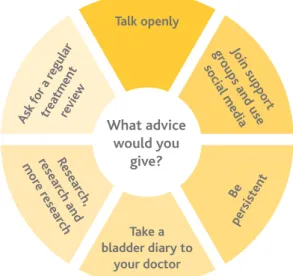
Where can I find a multi-skilled team such as a continence service?Key to this advice (summarised in Figure 7 below) was the notion of preparedness; being informed and ready to engage with a doctor and thinking through in advance what issues and questions to prioritise during the
consultation. Participants felt it was important for patients to ask questions that might help them access the right specialists, such as a continence nurse or adviser, and to ensure that there was a clear process of follow up – such as a review of their treatment and care plan to see if symptoms had improved.
It was recognised that the experience of seeing a doctor about a bladder or bowel problem can be very daunting, but that others’ experiences have shown that courage and confidence can help patients to be better heard.
Figure 7: What advice would you give
to a fellow patient?
In addition, there are tools and training available to support individuals to become actively engaged in the management of their condition. For example, the Expert patients
programme (EPP)37 is a course which is available to any patient with a long term condition to help them cope with symptoms, communicate with others about their condition, including healthcare professionals, and plan for the future38. Other tools, such as Pathways to success39, help individuals to understand and monitor their symptoms (for example, the urgency and frequency of toilet visits) and provide guidance on what they can expect from their doctor.
What can patients do to help
achieve patient-centred care?
Patients may wish to consider the information outlined in this report so as to become more involved in decisions about treatment and care.Action 1: Patients may wish to share a copy of this report with others who they think it might benefit – for example, through support groups or online networks
Action 2: Patients may wish to consider asking their healthcare professional about the Expert Patients Programme (EPP) and contact COB and the B&BF to receive more information on their symptoms and their care Action 3: Patients may wish to share a copy of this report with their local MP and local NHS organisations such as GP practices and hospitals to help raise awareness of the issues facing people with bladder and bowel problems
Healthcare professionals
and providers
In order to deliver high quality, patient-centred care for people with bladder and bowel problems, healthcare professionals must:
•
Uphold NHS values through a commitment to always deliver high quality care based on respect, dignity and compassion, where everyone is treated with equal respect and importance•
Adopt a shared decision-making approach through effective communication with the patient and a commitment to personalised care planning•
Have the right knowledge and skills to identify andsupport people with bladder and bowel problems and to signpost or refer them so that they can access appropriate treatment and care
Values-based care
Delivering treatment and care based on a set of values is not only morally right, it can also contribute towards improved patient experience and clinical outcomes40. It is also recognised that a compassionate approach is more likely to support the overall wellbeing of individuals whose condition may have psychological and social implications as well as physical symptoms41. Hence, for people with What advice would you give? Talk openly Take a bladder diary to your doctor Ask f or a r egular treatmentreview
Join suppor t gr
oups and use social media Resear ch, resear ch and mor e r esear ch Be per sistent
bladder and bowel problems, who face significant social stigma, the importance of sensitivity, empathy and non-judgement is of particular importance.
NHS England has sought to refocus staff on core values through the five-year strategy for nursing, midwifery and care staff Compassion in practice. Organisations such as Macmillan Cancer Support and the King’s Fund have developed their own initiatives to support values-based approaches and behaviours, such as the Values-based standard and the Point of care programme, but these must be embraced by healthcare professionals themselves, if they are to make a difference.
All documents referenced above can be found in the ‘Useful Links’ section.
Shared decision-making
Beyond their core values and behaviours, there are a number of steps that healthcare professionals can take to support shared decision-making.
Healthcare professionals should seek to establish a patient’s information needs at the earliest possible opportunity. Overwhelmingly, participants reported that they lacked information about their condition, their treatment options and how they could better support themselves. By improving the flow of communication, healthcare professionals can improve an individual’s independence and their ability to become an active partner in their care42. To do so, healthcare professionals should ensure that patients have access to high quality information that carries the Information Standard mark, such as the condition-specific pages on the NHS Choices website and take steps to signpost patients to relevant local support groups and charities such as the B&BF and COB Foundation.
Good communications skills are an essential
component of shared decision-making but participants frequently expressed their frustration at the perceived failure of healthcare professionals to listen and respond to their concerns. Advanced communication skills training is available to healthcare professionals to support both clarity of communication and effective patient engagement. Medical professionals who support people with incontinence and other bladder and bowel problems should seek to participate in training as part of their continuing professional development43. Of particular concern, none of the participants
recognised the process of personalised care planning and no-one had a care plan in place. Care plans record the outcomes from a care planning discussion including the steps that have been agreed. Under the the NHS Mandate for 2013-1544 and 2014-1545 the Government has set an objective that personalised care plans will be offered to everyone with a
long term condition by 2015. Given the historic underperformance in this area the development of personalised care plans for people with bladder and bowel problems must be used as a key measure of the successful implementation of the policy. Professionals should ensure that they challenge themselves to respond positively to questions that will support the care planning process, as set out in Figure 8.
Figure 8: Personalised care
planning – questions for healthcare
professionals
•
Do I communicate and listen effectively?•
Do I support individuals to make informed choices?•
Do I support individuals to access appropriateinformation?
•
Do I support individuals to develop skills inself-care?
•
Do I discuss risk?•
Do I put aside my own health beliefs?•
Do I view the individual in front of me as havingexpert knowledge in addition to mine?
•
Do I see the individual as a whole?•
Am I supporting this individual to take control?•
Do I ensure that those with complex needs arereceiving coordinated care?
•
Do I ask individuals if they have any ideas as tothe services they would like to be included in their plan?
Adapted from the Department of Health information sheet 1: personalised care planning
The key requirements for effective personalised care planning for people with bladder and bowel problems are as follows: 1. Undertake appropriate investigations and assessments
as recommended in NICE guidance. This should include:
•
The use of bladder and bowel diaries to build anaccurate picture of symptoms over a minimum of three days (eg for urinary symptoms this should include urgency, frequency and volume)
•
Symptom scoring and quality of life assessments:ICIQ, BFLUTS, I-QOL, SUIQQ, UISS, SEAPI-QMM, ISI and KHQ (this should be repeated to evaluate the effectiveness of therapies)
2. Provide or signpost patients to appropriate information sources based on their specific information needs 3. Work with the patient to identify and agree their goals
(eg “I want to reduce the number of times that I have to go to the loo each day” or “I want to be able to go out for the day without anxiety”)
4. Support individuals to take steps which may improve their symptoms, such as through a reduction in fluid and caffeine intake, weight loss, pelvic floor muscle training and bladder retraining and provide advice and support to help them to self-manage ongoing symptoms. This may entail making a referral to an appropriately trained continence adviser or specialist
5. Discuss pharmacological and non-pharmacological treatment options with patients and agree on what
treatment and other services and support would be beneficial
6. Agree and record the decisions and actions that have been agreed
7. Schedule a review date after treatment has been initiated in line with guidance (usually after four to 12 weeks depending on the treatment). The review should cover:
•
The extent to which symptoms have improved andare under control
•
Progress towards identified patient goals•
Whether there are any unwanted side effects fromtreatment and whether these are manageable
•
Treatment adherence•
Quality of life of the patient•
The extent to which the patient feels wellsupported
•
Whether patients are satisfied with the treatmentand care they are receiving
8. Depending on the outcome of the review of the care plan, patients should be offered a choice of alternative treatments in line with NICE recommendations There are a number of tools which are available to healthcare professionals to support the care planning process as shown in Figure 9.
Personalised care planning for people with bladder
and bowel problems
Figure 9: Examples of tools to support personalised care planning
Decision-aids
To help patients to navigate their options eg lower urinary tract
symptoms (in men)
Personal health
budgets
To ensure that interventions are directed towards what
patients want (eg temporary containment products or carer support)
Symptom scoring
and quality of life
assessments
To measure the extent to which interventions are making a differencePatient
satisfaction surveys
To gauge the extent to which patients feel that
treatment, care and support has met their
When referring, GPs should
offer patients a choice of
provider including the option
of attending a specialist
Knowledge and skills
Even more fundamentally, the extent to which healthcare professionals have the
right
knowledge and skills
to effectively identify, manage and treat patients with continence
needs has been challenged by a number of studies
46,47. In addition, a reduction in posts for
specialist continence nurses and advisers may further impede the quality of continence care.
This is an issue which poses wider questions for the training and education of medical and
nursing professionals and overall workforce planning which warrants further investigation.
In the immediate term, GPs, nurses and care workers must take appropriate steps to refer and signpost patients to an appropriate specialist where they identify a continence need which requires specialist assessment and support. Specialist continence services in the community provide access to specialist nurses, physiotherapists and nutritionists who are able to focus on a patient’s holistic symptoms using a multidisciplinary approach. Providers and commissioners will need to ensure that the general workforce is appropriately trained and that there are sufficient numbers of specialist posts to meet the increasing demand for continence care now and in the future.
What can healthcare professionals and providers do to
help achieve patient-centred care?
Action 1:
Healthcare professionals should offer a care planning approach for every patient with bladder and bowel problems, working with the patient to identify individual goals, develop a treatment plan and review the plan (including improvement against agreed outcomes and goals) according to the recommendations and timetable set out in NICE guidance
Action 2:
When referring, GPs should offer patients a choice of provider including the option of attending a specialist continence service
Action 3:
The NMC and GMC should review their education standards and the quality assurance of curricula to ensure all nursing and medical professionals complete their training with a basic understanding of continence promotion and management at qualification
Action 4:
Healthcare professionals should be required to
complete advanced communication training and shared decision-making as part of their continuing professional development
Action 5:
The NMC and GMC should require evidence of basic skills in continence promotion and management, effective communication and compassion as part of professional revalidation
Action 6:
Providers should review the extent to which staff have the rights skills, values and knowledge to deliver high quality patient-centred care for people with incontinence
Helpful links
•
The Bladder and Bowel Foundation. Available online via:http://www.bladderandbowelfoundation.org/
•
The Cystitis and Overactive Bladder Foundation.Available online via:
http://www.cobfoundation.org/
•
The Association for Continence Advice. Available online via:http://www.aca.uk.com
The King’s Fund
•
About the Point of Care Programme. Available online via:http://www.kingsfund.org.uk/projects/point-of-care/about
Macmillan
•
Macmillan Values Based Standard, 2013. Available online via:http://www.macmillan.org.uk/Documents/AboutUs/ Commissioners/Macmillan-Values-Based-Standard-Overview.pdf
NHS Choices
•
The Expert Patients Programme (EPP). Available online via:http://www.nhs.uk/NHSEngland/AboutNHSservices/ doctors/Pages/expert-patients-programme.aspx
•
The NHS Friends and Family Test, July 2014.Available online via:
http://www.nhs.uk/NHSEngland/AboutNHSservices/ Pages/nhs-friends-and-family-test.aspx
Guidance
NICE guidance
•
Quality Standard 45: Lower urinary tract symptoms in men, September 2013.Available online via:
http://www.nice.org.uk/Guidance/qs45
•
Quality Standard 54: Faecal incontinence,February 2014. Available online via:
https://www.nice.org.uk/Guidance/qs54
•
Quality Standard 77: The management of urinary incontinence in women, January 2015.Available online via:
https://www.nice.org.uk/guidance/qs77
•
Quality Standard 15: Patient experience in adult NHS services, February 2012.Available online via: http://publications.nice.org.uk/ quality-standard-for-patient-experience-in-adult-nhs-services-qs15
•
Clinical Guideline 171: The management of urinary incontinence in women, September 2013.Available online via: http://www.nice.org.uk/guidance/ CG171
•
Clinical Guideline 97: Lower urinary tract symptoms: The management of lower urinary tract symptoms in men, May 2010.Available online via:
http://www.nice.org.uk/guidance/cg97
•
Clinical Guideline 49: Faecal incontinence: The management of faecal incontinence in adults, June 2007.Available online via:
http://www.nice.org.uk/guidance/cg49
•
Clinical Guideline 148: Urinary incontinence in neurological disease: Management of lower urinary tract dysfunction in neurological disease, August 2012 Available online via:https://www.nice.org.uk/guidance/cg148
NHS England
•
CCG Outcomes indicator set. Available online via:http://www.england.nhs.uk/ccg-ois/
•
NHS Outcomes Framework 2014/15: Domain 2 Enhancing quality of life for people with long-term conditions, May 2014.Available online via:
https://indicators.ic.nhs.uk/download/Outcomes%20 Framework/Specification/NHSOF_Domain_4_S_V2.pdf
•
NHS Outcomes Framework 2014/15: Domain 4Ensuring that people have a positive experience of care, May 2014.
Available online via:
https://indicators.ic.nhs.uk/download/Outcomes%20 Framework/Specification/NHSOF_Domain_2_S_V2.pdf
•
Shared Decision Making, 2012.Available online via:
http://sdm.rightcare.nhs.uk/about/about-the-nhs-shared-decision-making-programme/
•
House of Care Model. Available online via:http://www.england.nhs.uk/resources/resources-for-ccgs/out-frwrk/dom-2/house-care-mod/
•
Right Care. Available online via: http://www.rightcare.nhs.uk/•
Compassion in Practice: Nursing and Midwifery and Care staff.Available online via:
http://www.england.nhs.uk/wp-content/ uploads/2012/12/compassion-in-practice.pdf
Department of Health
•
A mandate from the Government to NHS England April 2014-March 2015, November 2013.Available online via:
https://www.gov.uk/government/uploads/system/ uploads/attachment_data/file/256406/Mandate_14_15.pdf