Analysis of Agricultural Value Chain Finance in Smallholder
Palm Oil Processing in Delta State, Nigeria
Ike Pius Chinwuba1 Aberji Okompu Davina1 Aliu A. Lucky2
1.Department of Agricultural Economics, Delta state university, Asaba Campus, Nigeria 2.Ecobank Nig. Ltd
Abstract
This study analysed agricultural value chain finance in smallholder palm oil processing in Delta State, Nigeria by ascertaining the socioeconomic characteristics of palm oil processors and determining the effect of palm oil processors’ socioeconomic characteristics on the choice of credit channel in the value chain finance. Multi-stage random sampling procedure was applied to select 240 respondents from 12 communities in four local government areas. Data were obtained through the use of structured questionnaire and analysed by the use of descriptive and inferential (multinomial logit) statistical tools. Findings indicate that over 75% of the respondent palm oil processors are females while 70.42% are aged between 31 and 50 years and 69.17% are married. Also, 97% of the respondents had formal education while 85% have palm oil processing experiences of between 6 and 15 years and more than 51% have household size of between 7 and 10 persons. The multinomial logit model result suggests that the choice of source of credit channel by palm oil processors is significantly related to gender (p>0.10), age (p>0.01 and 0.10), education (p>0.01 and 0.05), level of income (p>0.01) as well as membership of organization (p>0.01 and 0.10) and location of business (p>0.05 and 0.10). The coefficients of the variables are positive which implies that the probability of the respondents accessing value chain finance from any of the sources relative to the formal finance increases with respondents’ gender, age, education, experience, level of income as well as membership of organization and location of business. It is the recommendation of the study that governments should implement measures that will bring down the interest rate paid on agricultural loans.
Keywords: Agriculture, Value chain finance, Palm oil Processing, Multinomial logit. Introduction
Despite the changes in agriculture and agribusiness, the typical offer for financial products and services for agricultural and rural production has been deficient and not particularly innovative; financial intermediaries still lack much depth in rural areas, and producers, especially smallholders, are still underserved. Conventional thinking is that the agricultural sector is too costly and risky for lending. Though; in developed countries like Netherlands and Mexico, large financial institutions such as Rabobank and Banorte express the view that provision of agricultural credit is profitable if producers are well integrated into a viable value chain (Shwedel, 2007; Martínez, 2006).
It is recognized that increases in finance and investment are needed at all levels of the food chain, with special interest in increasing the access to finance by those agricultural households and communities who are most vulnerable to food insecurity and poverty. As such, this study focuses on flow of value chain finance within the palm oil value chain particularly it’s processing.
Increasing finance and investment in a sustainable manner is not easy. Financing agriculture continues to be perceived as having high costs of operation, high risks and low returns on investment. Despite good intentions for directing credit to agriculture, the results of the agricultural lending programmes in developing countries commonly have unsatisfactory results with low rates of repayment in spite of (or often partly because of) high subsidies. Agricultural development banks have been slow to innovate, often due in part to governmental directives given to them. Commercial banks have traditionally shied away from this sector because of uncontrollable and systemic risks, higher costs and fear of the unknown for bankers not familiar with the sector and setting. The cost of directly lending to farmers, especially smaller ones, in hard-to-reach rural areas with less-educated and low-income populations is in fact generally prohibitive to most formal financial institutions. Microfinance institutions do reach some of these low-income households but at a high cost, with short-term loan products that are generally not able to address the full range of agricultural needs.
Even more important than the operational costs for transacting a loan or securing investments is the systemic or correlated risk in agriculture. This risk stems from both price volatility as well as from changeable weather patterns that can affect whole regions at a time, making repayment uncertain. In conventional lending, collateral is used to mitigate risks to the lender but the typical mortgage type of collateral commonly required by the banks is often not available or feasible in rural areas. This is due largely to land tenure restrictions and/or other requirements that are often designed to protect the livelihood assets of the community, but in doing so effectively limit their use as collateral. Hence, collateral is a major constraint to access to finance in agriculture not only from banks, but also from credit unions and other financing institutions.
agricultural financing. It improves the quality and efficiency of financing agricultural chains by identifying financing needs for strengthening the chain, tailoring financial products to fit the needs of the participants in the chain, reducing financial transaction costs through direct discount repayments and delivery of financial services and using value chain linkages and knowledge of the chain to mitigate risks of the chain and its partners.
For instance, traders use finance as a procurement facility, but input suppliers use it as part of sales incentive strategy. For financial institutions, it is an approach to lower risk and cost in providing financial services. For recipients of value chain finance, like the smallholder farmers or those purchasing their products, value chain finance is a mechanism to obtain financing that may not have been available due to lack of collateral or transaction costs of securing a loan and it can also be a way to guarantee markets for products.
Small scale palm oil processors in Delta State also face the challenges of inadequacy of finance to execute their businesses. Accessing finance from the formal financial institutions in the State by these categories of enterprises has been very difficult due to earlier adduced reasons. Worse still is the preponderance of women in the processing node of palm oil value chain in the State. Access to credit from the formal sector has always been biased against women (Ike, 2009). Thus, it becomes necessary to examine in full the socioeconomic characteristics of the actors that are involved in palm oil processing value chain in the study area as well as the effect of socioeconomic variables of palm oil processors on the choice of credit channel in the value chain finance. Specifically the study sought to:
(i) ascertain the socioeconomic characteristics of palm oil processors in the study area, and
(ii) determine the effect of palm oil processors’ socioeconomic characteristics on the choice of source of credit channel in the value chain finance.
METHODOLOGY
Study Area: Delta state, the study area was created in 1991 and has 25 local government areas, divided into three agricultural zones of Delta north, Delta south and Delta central. The State covers a landmass of about 18,050km2
of which more than 60% is land. It has a population of 4,098,391 composed of 2,074,306 males and 2,024,085 females (NPC, 2006). The State lies roughly between longitude 5000’ and 6045’ East and Latitude 5000 and 6030’
North. It is bounded on the North by Edo State, on the East by Anambra State and on the South-East by Bayelsa State. On the southern flank is the Bight of Benin which covers approximately 160 kilometers of the State’s coastline. Delta state is generally low-lying without remarkable hills. The state has a wide coastal belt inter-laced with rivulets and streams which form part of the Niger-Delta.
Sampling Procedure: A multi-stage random sampling procedure was used for selecting the respondents. First, simple random sampling method was used to select two agricultural zones. The zones selected were Delta central and Delta north agricultural zones. The second stage was the selection of two local government areas (LGAs) from each of the two sampled zones. The local government areas sampled were Aniocha south and Ika north east local government areas from Delta north agricultural zone while for the Central zone were Ethiope east and Sapele local government areas. The third stage involved the selection of three communities from each of the sampled local government areas and this gave a total of twelve (12) communities that were sampled for the study. The fourth stage in the sampling procedure was the selection of twenty (20) palm oil processors from each of the communities and this gave a total of 240 processors that were selected for the study.
Data Collection: Data for this study were collected from both primary and secondary sources. The primary sources of data were obtained through the use of structured questionnaire. Secondary data were obtained from textbooks, journals, past research works on the area of study, internet and other publications.
Data were collected on various variables of the respondents including age, educational qualification, gender, marital status, years of experience in palm oil processing, household size, number of bunches processed, different sources of fund and amount accessed, cost of fund (interest rate) amongst others.
Data Analysis: Descriptive and Inferential statistical tools were used for analysis of data. The socioeconomic characteristics of the respondents were summarized through the use of mean, percentages and frequencies while the effect of socioeconomic characteristics of palm oil processors on choice of source of credit channel in the value chain was achieved through the use of multinomial logit regression analysis. The econometric model was used to determine the attributes of palm oil processors availing short term loans from different credit channels.
Model Specification
Multinomial Logit Regression Analysis for estimating Determinants of Choice of Source of Fund
Multinomial logit (MNL) models are used to model relationships between a polytomous response variable and a set of regressor variables. It is a simple extension of logistic regression that allows each category of an unordered response variable to be compared to an arbitrary reference category, thereby providing a number of logistic regressions. This model was used because it is the standard method for estimating unordered, multi category dependent variables (Martey, Annin, Wiredu and Attoh 2012). It also assumes independence across the choices, that is, it does not allow correlation or substitution between them (Wooldridge, 2008). The MNL is also chosen
because it is widely used in studies involving multiple choices and easier to compute than its alternative, the Multinomial probit (Karki and Bauer, 2004; Hassan and Nhemachena, 2008).
The dependent variable is a multinomial response variable motivated from an underlying latent random utility model. The outcome yi, for processor i is one of m alternatives. Thus, yi = j is set if the outcome is the jth
alternative. Here, choice of credit channel j takes a value from a set containing six choices namely (1) Commercial/Microfinance Banks (2) Government microcredit programme (3) Isusu/Thrift and Loan schemes/cooperative societies (4) Relatives and friends (5) Village Money Lenders, (6) Palm oil buyer/Agents (j=1,2,3,4,5 6 respectively).
To reiterate, the values taken by j are arbitrary and unordered. For the ith palm oil processor faced with
m credit channel choice (in this case alternatives), the underlying latent utility of choice j is given as: = ’ +
Here, z is a vector of explanatory variables containing socioeconomic characteristics. Uijis not directly observable, but it is possible to define an observable dichotomous variable yijequal to 1 if > ℎ
≠ , and 0 otherwise. In other words, if the processor makes choice j in particular, then it is assumed that Uij is the maximum among the m utilities. The probability that processor or marketer i chooses jthcredit channel (Pri, j) from a choice set of m alternatives may then be written as:
, = ( , = 1) = [( ’ – ’ ) > − ] ∀ ≠
If it is assumed that the perturbations have identical and independent Weibull distributions, the difference ( − ) has a logistic distribution and the choice model is multinomial logit (Maddala, 1983; Glauben, Herzfeld and Wang, 2008). The multinomial logit approach doesn’t allow analyzing the probability of being allocated to a specific credit market channel.
Because of identification restrictions, only the relative probabilities can be discerned (Glauben et al, 2008). Here, it is assumed that the processors who chose commercial or microfinance banks as the choice of credit channel (j=1) as the base outcome and make all comparisons in relation to it. This normalization implies that the estimated model reduces to five log odds ratio of the form:
log( ,/ , =1) = ’ , = 2,3,4,5,6
Therefore, the estimated coefficient ( ’ ) can be interpreted as the marginal change in the logarithm of the odds of each possible alternative over the base outcome (in the case of this study is commercial or microfinance bank as a credit channel) caused by a change in the relevant explanatory variables.
RESULTS AND DISCUSSION
Socioeconomic Characteristics of Palm Oil Processors
The socioeconomic characteristics of the sampled palm oil processors that were discussed are gender, age, marital status, level of education, processing/marketing experience, household size and size of income. The findings with respect to each of the socioeconomic characteristics are as presented in Table 1.
The gender distribution shows that over 75% of the respondent palm oil processors are females. This shows that there is a preponderance of female folks in palm oil processing business, particularly at the small scale level. The male counterparts were mostly involved in operating milling machines or palm fruit bunch harvesting and cutting of bunches. There is female dominance in general palm oil processing such as boiling of fruits, threshing, milling and palm oil extraction. This finding supports the earlier works of Olagunju (2008) who found a preponderance of female folks in palm oil processing in Southwestern Nigeria.
The age distribution of the respondents indicates that majority (70.42%) of palm oil processors in the study area are within the ages of 31 and 50 years. The table further shows that 38.75% of the palm oil processors fall between the ages of 41-50 years. This age group falls into the active and productive group of the population of any society. This implies that at this age, the respondents are energetic enough to carry out most of the processing activities in palm oil business. This finding agreed with the work of Oluwatayo et al (2002) in a study carried out in Southwest of Nigeria, revealed that the respondents in the study area were between the mean ages of 41 and 50 years. Also, Upton (1987) recorded that age influence managerial decision making. The few elderly respondents were mostly women who are engaged in the traditional palm oil processing in the hinterlands.
Investigation into the marital status of the respondents shows that majority of palm oil processors are married constituting 69.17%. This is an indication that there is support from their spouse and children in carrying out palm oil business activities. Findings also reveal that over 97% of the respondent palm oil processors attained one form of formal education or the other. This will help them to carry out various activities in the marketing system smoothly. This is in line with the observation of Dogondaji and Baba (2010) that high literacy level could have positive impact on the adoption of new technologies.
Over 85% of the respondents have palm oil business experiences of between 6 and 15 years. The length of experience in an activity, all things being equal will lead to increased efficiency in that specific activity. Hence, with relatively long experience in palm oil processing, the respondents have all it takes to understand the terrain of business financing (sources, utilization and repayment) in the area.
Household size is the number in the respondents’ family that feed from the same pot. The result indicates that about 48.75% of respondents had a moderate family size of between 1 and 6 members. Over 51% of respondents have family members of 7 to 10 and above. The result of large family size might have implications on the family labour requirement in palm oil processing business in the area.
Level of income is another proxy to wealth and palm oil processors’ decision to adopt a given technology is influenced by the amount at his or her disposal especially where such technology need higher amount of money for the processors to acquire the various items required. Data in Table 4.1 shows the distribution of respondents by their level of income. Over 65% of the respondents’ income level fall within N100,000 to N300,000 ($588.24 - $1,764.71 at the rate of N170.00 per 1$ USD). This implies that most of the small scale palm oil processors in the area are operating at low income level.
Effect of Palm Oil Processors’ Socioeconomic Characteristics on the Choice of Credit Channel in the Value Chain Finance
In analyzing the attributes influencing palm oil processors’ credit channel choice, multinomial logit model was applied. The determinant variables included in the model are gender, age, marital status, level of education, household size, income, membership of organization and location of business activity. The multinomial logit model was used to estimate the parameters of the determinants of choice of credit channel by palm oil processors in the study area. The STATA software was used to estimate these parameters as well as the marginal effects. Commercial/microfinance banks was chosen as base category and used as the comparison group. The chi-square value of 1374.91 is highly significant (p>0.0000) at 1% significant level. This indicates that the explanatory variables included in the model jointly influence the respondents’ choice of alternative value chain finance channel.
The multinomial logit model result in Table 2 suggests that the choice of credit channel by palm oil processors is significantly related to gender, age, education, level of income as well as membership of organization and location of business. The coefficients of the variables are positive which implies that the probability of the respondents accessing value chain finance from any of the sources relative to the formal finance increases with respondents’ gender, age, education, experience, level of income as well as membership of organization and location of business.
The result shows that female processors of palm oil at 0.10 level are more likely to avail loans from Isusu/thrift/cooperative societies and palm oil buying agents as compared to formal credit from commercial and microfinance banks. This can be understandable and supports most works in literature (Ike, 2009) as females can hardly be attended to in formal finance sources (commercial and microfinance banks) without the consent of the husband as one of the guarantors. Most small scale female business operators in the study area belong to one thrift savings and loan scheme or the other. These schemes have all transformed into formal cooperative societies which enable them to access bigger loans from non-bank financial organization such as the Lift Above Poverty Organization (LAPO). LAPO avails her clients (mostly women) access to value chain finance so long she belongs and operates from a cooperative society. Also, at the 10 percent level of significance, female palm oil processors are more disposed to availing value chain loan from internal finance (palm oil buying agents) than from the formal banks. This is common in palm oil bearing communities as marketing agents distributes money and jerry cans of different sizes (20 liters or 25liters) to the processors with intent to collecting them at a later date. These palm oil buying agents live largely from commissions (PIND, 2011).
The result also reveals that older palm oil processors will avail value chain finance from relatives and friends at 1 percent level while at 10 percent level they will take value chain finance from marketing agents rather than from commercial or microfinance banks. The multinomial logit model result also shows that level of educational attainment by palm oil processors affect their choice of source of value chain finance. At the 1 percent and 5 percent levels of significance a more educated palm oil processor will avail value chain finance from Government microcredit scheme and Isusu/thrift/cooperative societies rather than the formal finance sources such as commercial or microfinance banks. This could be that the more educated in the society can avail appropriate information on the nature of different microcredit schemes being floated by the government. Typical example is the Delta state microcredit scheme which the government has claimed to have extended credit to needy clients in the State. The result also shows that higher income level processors will access value chain finance from government microcredit schemes and Isusu/thrift/cooperative societies at the 1 percent level as against accessing loan from the formal sources like the commercial or microfinance banks.
Palm oil processors who belong to registered organizations such as cooperative societies will chose to avail value chain finance for their business activities from Isusu/thrift scheme as well as cooperative societies than from commercial or microfinance banks. This is at the 1 percent level of significance. They would also at 10 percent level avail funds from palm oil marketing agents when compared with commercial or microfinance banks. Finally, the multinomial logit model result reveals that palm oil processors located in more remote areas from the urban areas would avail fund for their business activities from relatives and friends (0.05 level) and village money lenders (0.10 level) than choosing the commercial or microfinance banks. This finding is in line with apriori
expectation as the more remotely located a small scale business is from the urban areas, the more difficult it will be for the operators to access finance from the formal sources which are predominantly located in urban centers. Similar findings were made in the study by Kumar, Staal and Singh (2011) on Dairy Farmer’s Access to Modern Milk Marketing Chains in India.
Conclusion
This study has analyzed the agricultural value chain finance in palm oil processing and in Delta State, Nigeria by ascertaining the socioeconomic characteristics of palm oil processors in the study area as well as the effect of palm oil processors’ socioeconomic characteristics on the choice of credit channel in the value chain finance. Gender, age, education, level of income as well as membership of organization and location of the business, all played in concert to determine the choice of source of credit channel utilized by palm oil processors in accessing value chain finance. It is recommended that interest rate charged by both the formal and informal sources of value chain finance should be streamlined to a single digit percentage. Government at both federal and State levels can achieve this through increased funding of the various microcredit schemes floated for the agricultural sector at both the federal and State levels. Government can also make the usurious landlords/village money lenders to key into low interest rates by identifying and registering genuine ones and providing them with bulk fund which they can dispense to their clients at a regulated interest rate. This is necessary as farmers always patronize this source of value chain finance in spite of the high interest rate charged, reason being that this source is devoid of the usual bureaucratic procedures and other encumbrances inherent in the formal financial sector.
REFERENCES
Dongondaji, S. D. and K. M Baba (2010), Incomes distribution in large scale irrigation projects: A case study of dry season rice farmers at the Bakolori irrigation project, Zamfara state, Nigeria, Proceedings of the 24th Annual National Conference of the Farm Management of Nigeria held at the Adamawa State University, Mubi 11th – 14th October.
Foundation for Partnership Initiatives in the Niger Delta (PIND) (2011), ‘A report on Palm Oil value Chain Analysis in the Niger Delta
Glauben, T., T. Herzfeld, and X. Wang., 2008. Labor market participation of Chinese agricultural households: Empirical evidence from Zhejiang province. Food Policy, Vol. 33, Issue 4, August 2008, pp 329-340. Hassan R. and Nhemachena C. (2008), Determinants of African Farmers’ Strategies for Adopting to Climate
Change: Multinomial Choice Analysis. AfJare Vol. 2, No. 1, Pp 20
Ike, P.C.(2009) ‘Credit Availability, Utilization and Repayment Among Smallholder Women Crop Farmers in Enugu State, Nigeria’ Faman Journal 10 (1): 1-8
Karki L. B. and Bauer S. (2004), Technology, Adoption and Household Food Security: Analyzing Factors Determining Technology Adoption and Impact of Project Intervention: A case of smallholder peasants in Nepal. A paper presented in the Deutscher Tropentag, Humboldt-University, Berlin
Kumar, A., S.J. Staal, and D.K. Singh (2011), ‘Smallholder Dairy Farmer’s Access to Modern Milk Marketing Chains in India’ Agricultural Economics Research Review. Vol. 24 July-December 2011, pp 243-253. Maddala, G.S., 1983. Limited-dependent and Qualitative Variables in Econometrics; Econometrics Society
Monographs No 3. Cambridge University Press, Cambridge
Martey, E., Annin, K, Wiredu, A.N. and Attoh, C. (2012), ‘Does Access to Market Information Determine the Choice of Marketing Channel among Smallholder Yam Farmers in the Brong Ahafo Region of Ghana? A Multinomial Logit Regression Analysis’; Journal of Economics and Sustainable Development Vol.3, No.12
Martinez, E. (2006) ‘Banorte Banca agropecuaria’, presentation at the Latin America Conference
Miller and Jones, (2010), Agricultural Value Chain Finance: Tools and Lessons, Published by FAO and Practical Action Publishing, Rugby, UK.
National Population Census (NPC) (2006), FGN Provisional Census Figure: From Official
Gazette (FGP 71/52007/2500(OL24) Legal Notice on Publication of the Details of the Breakdown of the National and State Provisional Totals 2006 Census
Olagunju, F. I. (2008), ‘Economics of Palm Oil Processing in Southwestern Nigeria’;International Journal of Agricultural Economics & Rural Development 1 (2): Pp 69 - 77
Oluwatayo, I.B., Awoyemi T.T. and Sekumade A.B. (2002). Economics of Palm Oil Marketing in Ibadan North L.G.A of Oyo State, Nigeria. http://Ajol.info/index.php/joten/index
Shwedel, K. (2013) ‘Value chain financing: a strategy for an orderly, competitive, integrated market’, available from: www.ruralfinance.org/id /54079 [accessed 24 September 2009]
Upton, M. (1987), African Farm Management; Cambridge University Press, UK, 1987
Wooldrige, J. M. (2008). Introductory Econometrics; A Modern Approach. 4th ed. J. W. Calhoun: CENGAGE Learning.
Table 1: Socio-Economic Characteristics of Palm Oil Processors and Marketers
Variable Frequency Percentages (%)
Gender (Years) Male 58 24.17 Female 182 75.83 Age 20 – 30 30 12.50 31 – 40 76 31.67 41 – 50 93 38.75 51 – 60 38 15.83 61 and above 3 1.25 Marital status Single 32 13.33 Married 166 69.17 Divorced/Separated 12 5.00 Widowed/widower 30 12.50 Level of Education No formal education 6 2.50 Primary education 122 50.83 Secondary education 77 32.09 Tertiary education 35 14.58 Processing/Marketing Experience (Years) 1 – 5 26 10.83 6 – 10 150 62.50 11 – 15 55 22.92 16 – 20 9 3.75 Household Size 1 – 3 4 – 6 12 105 5.00 43.75 7 – 9 75 31.25 10 and above 48 20.00
Income Level (Naira)
N100, 000 – N200, 000 51 21.25
N201, 000 – N300, 000 106 44.16
Table 2: Estimate of Coefficient of the Multinomial Logit on Choice of Source of Value Chain Finance by Palm Oil Processors
Variable Government microcredit Isusu/thrift & Cooperative Relatives & Friends Village money lenders Marketing Agents Constant 0.946*** (0.0324) 1.642 (0.998|) 0.882** (.410) 0.678 (0.782) 1.630*** (0.065) Gender 0.951 (0.897 ) 1.862* (1.032|) 0.662 (1.007) 0.075 (0.088) 0.120* (0.065) Age 0.021 (0.020) 1.203 (1.198) 2.186*** ( 0.521) 0.256 (0.215 ) 2.031* (1.140) Marital status -0.156 (0.591) 1.153 (0.891) -0.184 (1.072) -0.890 (0.667) 0.038 (0.031) Education 7.123*** (1.048) 1.081** (0.582) 0.301 (1.197) -0.472 (0.821) 0.634 (0.835) Household size -0.046 (0.041) -0.012 (0.051) 0.306 (1.247) 0.631 (0.824) -0.032 (0.091) Income 17.49*** (1.146) 19.25*** (2.326) 6.251 (5.924) 0.521 (0.613) 1.279 (0.996) Membership of org. 0.149 (0.994) 16.69*** (1.250) 0.296 (0.941) 0.311 (1.296) 3.276* (1.790) Business location 1.190 (0.872) 1.662 (1.346) 1.80** (0.890 ) 1.71* (0.91) -0.872 (0.682) Number of observation 240
Base category Commercial/microfinance bank Wald Chi squared 1374.91
Prob > chi2 0.0000 Pseudo R-squared 0.1723 Log pseudolikelihood -160.3373
Figures in parenthesis are standard errors. *** Sig. at 0.01, **sig. at 0.05, *sig. at 0.10 level. Base category is availing loans from Commercial/Microfinance Banks
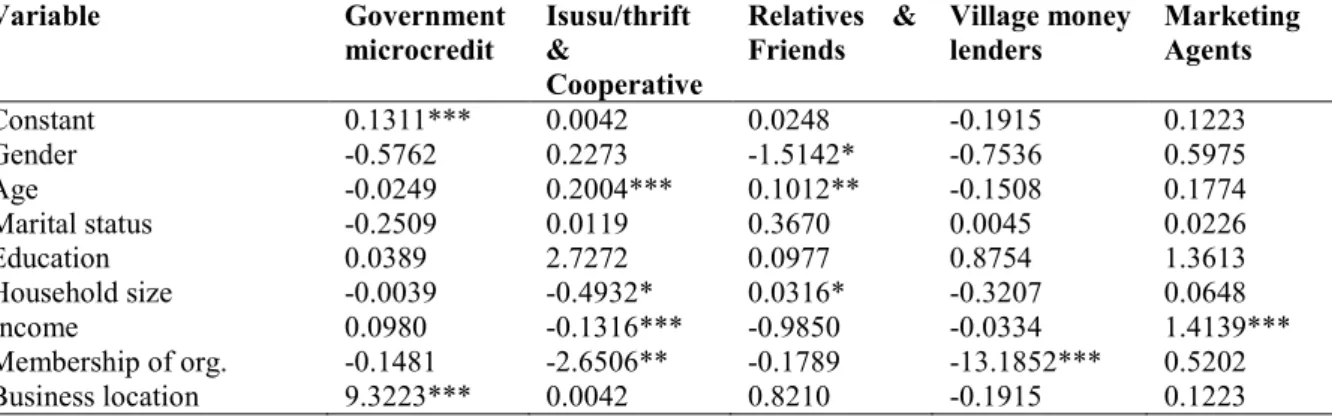
Table 3: Marginal Effects of the Multinomial Logit Model on Choice of Source of Value Chain Finance by Palm Oil Processors
Variable Government microcredit Isusu/thrift & Cooperative Relatives & Friends Village money lenders Marketing Agents Constant 0.1311*** 0.0042 0.0248 -0.1915 0.1223 Gender -0.5762 0.2273 -1.5142* -0.7536 0.5975 Age -0.0249 0.2004*** 0.1012** -0.1508 0.1774 Marital status -0.2509 0.0119 0.3670 0.0045 0.0226 Education 0.0389 2.7272 0.0977 0.8754 1.3613 Household size -0.0039 -0.4932* 0.0316* -0.3207 0.0648 Income 0.0980 -0.1316*** -0.9850 -0.0334 1.4139*** Membership of org. -0.1481 -2.6506** -0.1789 -13.1852*** 0.5202 Business location 9.3223*** 0.0042 0.8210 -0.1915 0.1223