Department Economics and Politics
Analysing Convergence in Europe
Using a Non-linear Single Factor
Model
Ulrich Fritsche and Vladimir Kuzin
DEP Discussion Papers
Macroeconomics and Finance Series
2/2008
Analysing Convergence in Europe Using a
Non-linear Single Factor Model
§Ulrich Fritsche∗
Vladimir Kuzin∗∗ June 7, 2008
Abstract
We investigate convergence in European price level, unit labor cost, income, and productivity data over the period of 1960-2006 using the non-linear time-varying coefficients factor model proposed by Phillips and Sul (2007). This approach is extremely flexible on order to model a large number of transition paths to convergence. We find regional clusters in consumer price level data. GDP deflator data and unit la-bor cost data are far less clustered than CPI data. Income per capita data indicate the existence of three convergence clubs without strong regional linkages; Italy and Germany are not converging to any of those clubs. Total factor productivity data indicate the existence of a small club including fast-growing countries and a club consisting of all other countries.
Keywords: Price level, Income, Productivity, Convergence, Factor Model, European Monetary Union
JEL classification: E31, O47, C32, C33
§The positions do not necessarily reflect those of other persons in the institutions the authors might be affiliated with. Thanks to Silke Bumann, Georg Erber, Michael Funke, Torsten Sch¨unemann, Thomas Straubhaar, Andreas Strasser and Sebastian Weber for helpful comments. All remaining errors are ours.
∗University Hamburg, Faculty Economics and Social Sciences, Department Economics and Politics, Von-Melle-Park 9, D-20146 Hamburg, and German Institute for Economic Research (DIW Berlin), Germany, [email protected]
∗∗German Institute for Economic Research (DIW), Macro Analysis and Forecasting, Mohrenstraße 58, D-10117 Berlin, Germany,[email protected]
1 Introduction
1
Introduction
The paper investigates the process of convergence in price indices, income, and total factor productivity in a number of European countries – most of these countries share a common currency now.1 In the course of the paper, we apply a new and – as the authors convincingly argue – appropriate time-varying econometric framework (Phillips and Sul, 2007) which allows for total or subgroup convergence under a variety of possible transition paths.
The last four decades saw several waves in the process of European in-tegration: in 1968, a tariff union was established, followed by the exchange rate regime nicely labeled as a “snake in the tunnel” in 1972, the forerun-ner of the European monetary system. The European internal market was initiated in the 1980s and almost completed in 1992. The most remark-able part of integration process however lies in the process of monetary integration, culminating in the creation of a single currency and the euro cash changeover in 2002. Since then, numerous countries in the Middle and East as well as in the South of Europe have joined the club. As Barry Eichengreen argues, there is no comparable predecessor in history, therefore historical analogies to study the effects of European integration have their limits (Eichengreen, 2008). In general, the European integration process and especially the introduction of a common currency has long been seen as an huge step forward in the convergence of income and living conditions (Emerson, Gros, and Italianer, 1992). Several arguments why a common monetary regime should foster integration and convergence across countries in Europe have been raised. The most prominent refers to individual price and price level convergence: falling trade barriers as well as increased arbi-trage possibilities should speed up convergence in individual prices – at least for tradable goods. This process should be reinforced by a stepwise harmo-nization of financial and product market regulations (Cuaresma, Egert, and Silgoner, 2007): firms from outside the EMU will set prices for the overall union (Devereux, Engel, and Tille, 2003). Even if the exact size of the effect is disputed (Rose and Engel, 2002), it is clear that increasing trade (Rose, 2000) should spur individual price convergence further. Diminishing differ-entials in relative prices do not necessarily imply price level convergence as the demand elasticities might differ. As Cecchetti, Mark, and Sonora (2002) show for the U.S., price level convergence is slow across cities due to a large share of non-traded goods (and possibly different weights in consumption baskets across cities). Over the long-run, differences in consumption baskets should however diminish (Corsetti, 2008).2
1
We apply the tests on a panel of EU 15 countries, keeping three countries which are not members of the currency union in the sample as a control group exercise.
2
Due to a lack of available data, we are not able to investigate this issue more deeply here.
1 Introduction
Beyond the much-disputed argument of enforced price level convergence, however, the level of other macroeconomic variables stressed in growth mod-els – e.g. per-capita income or total factor productivity – may be altered by forming a currency union. Alesina and Barro (2002) and Tenreyro and Barro (2007) argue that entering a common currency area enhances trade (Rose, 2000), increases price co-movement across the member states but decreases the co-movement of shocks to real GDP. This line of argumentation is con-sistent with a view that currency unions in general will lead to greater spe-cialization. Nonetheless, the changes in market-based and policy-supported adjustment mechanisms under the irreversible loss of nominal exchange rate policy instruments with respect to the majority of trading partners may not be easy (Allsopp and Artis, 2003).
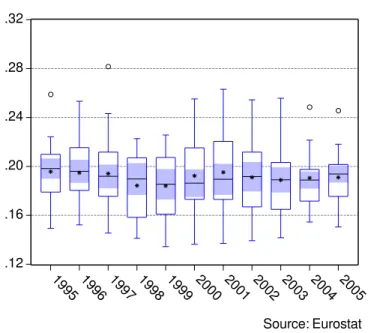
However, over the last couple of years, the observed phenomena of per-sistently large inflation differentials and diverging business cycle movements (Lane, 2006; Eichengreen, 2007; Altissimo, Ehrmann, and Smets, 2006; An-geloni and Ehrmann, 2004; AnAn-geloni, Aucremanne, Ehrmann, Gali, Levin, and Smets, 2006; Campolmi and Faia, 2006; European Central Bank, 2003) raised some doubts on the importance and strength of convergence ten-dencies in Europe. To illustrate the argument, we employed the publicly available data from the price level comparison project of Eurostat and cal-culated coefficients of variation, measured against the average of EU 15, for all EU 15 countries for each year from 1995 to 2005. We plot the co-efficients of variation using a Box-Plot for each year, allowing a birds-eye view on the distribution over time.3 As can be seen from this exercise, we observe a falling price dispersion until 2001, a widening distribution after 2002 and some tendency for a narrowing distribution afterwards. The study presented here tries to add to the literature by using a flexible convergence testing procedure on European data.4
Insert figure 1 here.
The question of the empirical convergence testing – initiated by the very influential papers by Barro and Martin (1991) and Barro and Sala-i-Martin (1992) – is typically based on the concepts ofβ- andσ-convergence. Presence ofβ-convergence implies that panel members show a mean revert-ing behavior to a common level. In contrast,σ-convergence measures the re-duction of the overall cross-section dispersion of the time series. Islam (2003) argues thatβ-convergence can be seen as a neccessary but not sufficient con-dition forσ-convergence – but is useful since it allows for a more appropriate
3
The median is plotted by a line in the center of a box together with shaded areas denoting a significance area, a box denoting the borders to the first and third quartile, and a whisker denoting the inner fences (1.5 times the interquartile range). Data points with a circle denote near outliers, stars indicate a far outlier.
4
2 The Non-linear Factor Model and Convergence
interpretation of results in terms of growth model frameworks. Islam (2003), Durlauf and Quah (1999), and Bernard and Durlauf (1996) discuss several problematic issues in empirical convergence testing. First, from a theoretical perspective, the implications of growth models for the final result of conver-gence (absolute converconver-gence, converconver-gence “clubs”) are not clear. There are different tests concerning the existence of “convergence clubs” (Hobijn and Franses, 2000; Busetti, Forni, Harvey, and Venditti, 2006), however these approaches often only test for certain aspects of convergence. Second, the different null hypotheses of the tests are not directly comparable – there-fore the results are not easy to interpret.5 Third, time series approaches as
well as the majority of distribution approaches both rely on different and to some extent very specific assumptions. To apply the tests, someone has to consider e.g. stationarity properties. Quite often, the tests assume very specific characteristics of the underlying panel structures – a reason why we observe the development of dynamic panel models and related tests in econometrics to overcome these restrictive assumptions.
A new and encompassing approach for the discussion of the convergence topic was recently proposed by Phillips and Sul (2007), in which the struc-ture of the panel is modelled as a “non-linear, time-varying coefficients factor model”. Phillips and Sul (2007) show that the asymptotic properties of con-vergence are well defined. A regression-based test is proposed, jointly with the development of a clustering procedure. This approach does not depend on stationarity assumptions and is comprehensive because it covers a wide variety of possible transition paths towards convergence (incl. subgroup convergence). Furthermore, one and the same test is applied for the over-all test and in the clustering procedure which strengthens methodological coherence.
In this paper we apply the procedure on price level, income and total factor productivity data of EU 15 member countries. The paper is structured as follows: Section 2 explains the theoretical framework, section 3 discusses the test procedures suggested by Phillips and Sul (2007). Section 4 presents the empirical results and section 5 concludes.
2
The Non-linear Factor Model and Convergence
2.1 Convergence of Factor Loadings
Over the past few years, factor models became a standard tool in analyzing panel data sets of different types. The instrument provides a very
straight-5
E.g. whereasβ-convergence is necessary forσ-convergence in most models, this does not hold vice versa.
2 The Non-linear Factor Model and Convergence
forward and appealing approach for modelling a large number of time series in a parsimonious way. The simplest example is a single factor model
Xit=δiµt+ǫit, (1)
whereXit are observable time series,δi andµtrepresent unit specific factor
loadings and the common factor respectively, whereasǫitstands for unit
spe-cific idiosyncratic components. All quantities on the right side of equation (1) are unobservable but in many cases their can be easily estimated by the method of principal components even if the number of time series is large, see for example Bai (2003).
However, without imposing additional non-linear structure, parametric modelling of (1) requires time independent factor loadings and covariance stationary idiosyncratic components, which in turn makes the analysis of converging time series problematic. Phillips and Sul (2007) suggest a dif-ferent specification of (1) allowing for time variation in factor loadings as follows
Xit =δitµt, (2)
where δit absorbs ǫit. Furthermore, Phillips and Sul (2007) model the
time-varying factor loadings δit in a semi-parametric form implying
non-stationary transitional behavior in the following way
δit=δi+σiξitL(t) −1
t−α
, (3)
where δi is fixed, ξit is iid(0,1) across i and weakly dependent over t, and
L(t) is a slowly varying function, for exampleL(t) = logt, so thatL(t)→ ∞ as t → ∞. Obviously, for all α ≥ 0 the loadings δit converge to δi,
allow-ing to establish statistical hypothesis testallow-ing concernallow-ing the convergence or divergence of the observed panel of time series Xit. For a particular cross
section unit α ≥ 0 is the appropriate null hypothesis of interest, but con-vergence testing in the whole panel leads to a null hypothesis in terms ofδi,
namely H0 :δit→δ for someδ ast→ ∞.
The setup proposed by Phillips and Sul (2007) has several interesting features. First of all, the approach does not rely on any particular assump-tions about trend stationarity or stochastic non-stationarity of Xit or µt.
Second, by focusing on the time-varying loadings δit a lot of information is
provided about the individual transition behavior of a particular cross sec-tion unit. Moreover, the time-varying factor representasec-tion allows empirical modelling of long run equilibria outside of the co-integration framework. For the purpose of analyzing co-movement and convergence within a heteroge-nous panel, long run equilibria can be defined in relative terms as follows:
lim
k→∞
2 The Non-linear Factor Model and Convergence
This in turn implies convergence of the loadings in the time-varying factor representation (2):
lim
k→∞
δi,t+k=δ. (5) 2.2 Relative Transition Paths
Estimation of the time-varying factor loadings δit is a central issue of the
approach proposed by Phillips and Sul (2007), since the estimates deliver information about transition behavior of particular panel units. A simple and practical way to extract information aboutδit is suggested by using its
relative version as follows
hit= Xit 1 N PN i=1Xit = 1 δit N PN i=1δit , (6)
under the assumption that the panel average N−1PN
i=1Xit is positive in
small samples as well as asymptotically, which is satisfied for many relevant economic time series like prices, gross domestic product or other aggregates. The so-called relative transition parameter hit measures δit in relation to
the panel average at time tand still describes the transition path of unit i. Obviously, if panel units converge and allδitapproach some fixedδwithin
the limit, then the relative transition parameters hit converge to unity. In
this case cross sectional variance of hit vanishes asymptotically, so that
σ2t = 1
N
X i=1
(hit−1)2→0 as t→ ∞. (7)
This property is employed to test the null hypothesis of convergence as well as to group particular panel units into convergence clubs.
However, in many macroeconomic applications the underlying time series often contain business cycle components, which renders the representation (2) inappropriate. Equation (2) can be extended by adding a business cycle component
Xit=δitµt+κit. (8)
At this stage some smoothing technique is required to extract the long run component δitµt. Phillips and Sul (2007) suggest employing the
Hodrick-Prescott filter or the coordinate trend filtering method proposed by Phillips (2005) to estimate the common component ˆθit=δditµt, so that the estimated
transition coefficients ˆhit can be calculated. Under the assumption that
estimation errors of ˆθit are asymptotically dominated byµt the consistency
3 Empirical Convergence Testing
3
Empirical Convergence Testing
3.1 The logt Regression
Phillips and Sul (2007) propose a simple regression-based testing procedure in order to test the null of convergence in the non-linear factor model (2). The test has power against the hypothesis of divergence in terms of different
δi as well as divergence if α < 0, so that H0 :δi = δ and α ≥ 0 is tested
againstHA:δi 6=δ for all iorα <0.
The procedure includes three steps. First, the cross sectional variance ratioH1/Ht is calculated, where
Ht= 1 N N X i=1 (hit−1)2. (9)
Second, the following OLS regression is performed: log H1 Ht −2 logL(t) = ˆa+ ˆblogt+ ˆut, (10)
for t= [rT],[rT] + 1, . . . , T with some r >0. L(t) is some slowly varying function, where L(t) = log(t+ 1) is the simplest and obvious choice, and ˆb= 2ˆαis the estimate ofαunder the null. The initial part of sample [rT]−1 is discarded in the regression putting major weight on observations that are typical for large samples. Since both, the limit distribution and the power properties, depend on this discarded sample fraction, the choice of r has an important role. Phillips and Sul (2007) suggest r = 0.3 based on their simulation experiments.
The third step consists of applying one sided ttest of nullα≥0 using ˆb
and a HAC standard error. Under some conditions stated in Phillips and Sul (2007) the test statistic tˆb is standard normally distributed asymptotically,
so that standard critical values can be employed. The null is rejected for large negative values oftˆb.
3.2 Clubs and Clusters
The convergence of all individual loadingsδit to some fixed value δ or their
overall divergence, where δit → δi and δi 6= δj for i 6= j, are obviously
not the unique possible alternatives. There may be one or more converging unit clusters as well as single diverging units in the panel. Identifying these kind of clusters by data driven methods can be of considerable interest for empirical researchers.
4 Convergence Analysis for EU 15 countries
Based on the logt test, Phillips and Sul (2007) propose a simple algo-rithm to sort panel units into converging subgroups given some critical value. The algorithm consists of four steps, which are shortly illustrated below:
1. Last Observation Ordering: panel units Xit are ordered accordingly
to the last observationXiT.
2. Core Group Formation: the firstk highest units are selected to form the subgroupGkfor someN > k≥2 and the convergence test statistic
tˆb(k) is calculated for each k. Then the core group size k∗ is chosen
by maximizingtˆb(k) over kunder the condition min
tˆb(k) >−1.65.
If k∗
= N, there are no separate convergence clusters and the panel is convergent. If the condition mintˆb(k) > −1.65 does not hold
for k = 2, then the first unit is dropped and the same procedure is performed for remaining units. If the same condition does not hold for every subsequent pair of units, then there are no convergence clusters in the panel. In all other cases a core group can be detected.
3. Sieve Individuals for Club Membership: after having formed the core group each remaining unit is added separately to the core group and the logtregression is run. If the corresponding test statistictˆbexceeds
some chosen critical valuec, then the unit is included into the current subgroup. The composition of the subgroup is followed by the logttest for the whole subgroup. Iftˆb >−1.65, the forming of the subgroup is
finished, otherwise the critical valuec is raised and the procedure has to be repeated.
4. Stopping Rule: after forming a subgroup of convergent units all maining units are tested for convergence jointly. If the null is not re-jected, there is only one additional convergence subgroup in the panel. In case of rejection steps 1, 2, and 3 are repeated for remaining units. If no other subgroups were detected, it can be concluded that the remaining units are divergent.
The exposed algorithm possesses notable flexibility, since it can identify cluster formations of all possible configurations: overall convergence, overall divergence, converging subgroups and single diverging units.
4
Convergence Analysis for EU 15 countries
4.1 Data
In the following, we present results from the analysis of price level, income and productivity convergence in EU 15 countries. The countries considered
4 Convergence Analysis for EU 15 countries
here are the twelve member states of the Euro area (before 2007), further-more Denmark, Sweden and United Kingdom. We mainly focus on price level convergence. To that end, we use three different panels of time series: consumer price index, GDP deflator and the nominal unit labor costs (in-dex). All data are from the AMECO database of the European Commission, DG ECFIN. The results for consumer prices indices (CPI) and GDP deflator series may differ because CPI data refer to consumer expenditure categories only, whereby in contrast the GDP deflator sums up information from a lot of other expenditure categories as well. Effects like the often-mentioned Balassa-Samuelson effect might impact both price series differently. Nom-inal unit labor costs have been taken into account because in a class of macroeconomic models – especially since the revival of New “Keynesian” or New “Neoclassical Synthesis” models – price setting is typically modelled as a (stationary) mark-up on unit labor costs. Assuming stable income dis-tribution, price level convergence should be accompanied by unit labor cost convergence.
In addition to price indices, we test for income convergence – measured by GDP per capita – and productivity convergence – measured by total fac-tor productivity. Both time series again have been extracted from AMECO (see the AMECO homepage for details).
Convergence is by definition a long-run concept. Obviously, reliable re-sults can only be achieved if the time series that are available are long enough to draw statistical inference from – sometimes the cross-section variance helps as well of course. The AMECO database contains all the described time series for a time span from 1960 to present (here 2006), plus the 2 upcoming years which in fact are the commission’s official forecasts. Since we use the Hodrick-Prescott filter for the the investigation, we kept the two data forecasted data points for the application of the filter (due to its nature, the HP filter has an “endpoint problem”, therefore more reliable results can always be expected if the conditional forecast of the time series can be added). However, we did not consider the forecasted data points for the convergence analysis.6
Following the suggestion in Phillips and Sul (2007), all data were indexed in line with their respective starting point (here: 1960) and logarithms are considered. The idea behind this strategy is simply grounded in the fact, that a base year effect diminishes when logarithms of time series are con-sidered depending from the distance to the starting point. Phillips and Sul (2007) propose a trimming of the first part of the sample to keep the base
6
However, one could argue, that our results are in a sense conditional on the rationality of the EU commission’s forecasts and indeed, this is right. We assume the forecasts to be unbiased and efficient – and the errors are small. This is in line with the EU commissions own results from the evaluation of past forecast errors, see Melander, Sismanidis, and Grenouilleau (2007).
4 Convergence Analysis for EU 15 countries
year effect as small as possible. In our case we were not able to trim the time series by 40 observations – as in the original paper – and considered a trimming of 15 years. The main reason was to focus on the convergence in the time span from 1975 to 2006 – a period of institutional progress in the European real and monetary integration process.
In our approach we generally and quite strictly follow Phillips and Sul (2007). The authors employ CPI indices to test for convergence in price levels across U.S. cities. However such a strategy is at the expense of size-able measurement errors. Strictly speaking the results have to be checked for robustness by using e.g. international price level comparison studies or purchasing power parity studies. This is true because of the fact, that the choosen base year is of course somewhat arbitrary. In our case, the problem could be worse than in the original paper because of the fact, that the data set under investigation here, covers a shorter time span than the one inves-tigated by Phillips and Sul (2007). Because of the arbitrarily choosen base year and a lack of long enough data sets, it could be possible that measure-ment errors do not diminish fast enough. On the other hand, international price level comparison projects are a quite recent field even if the efforts by organizations like the OECD, the World Bank and Eurostat are tremendous and reliable data are more or less available for the last 12-15 years only. This in turn makes a long-run analysis quite complicated. Either one can choose data of higher quality with a relatively short time span or longer time series with drawbacks. We follow the arguments in Phillips and Sul (2007) and opted for the strategy outlined here.
4.2 Results for Consumer Price Data
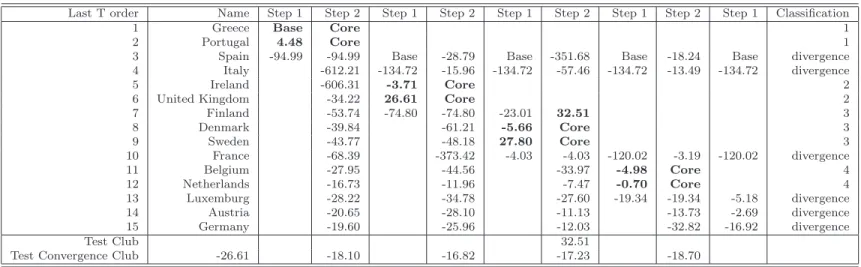
As outlined above, we start with the definition of a base entity (last obser-vation ordering) and the core group formation. For all countries we use the logtregression and try to enlarge the group by adding all other individuals separately (sieve individuals for membership). Once a group is established as a convergence group, we proceed by searching for clusters in the rest – always following the steps outlined above. The tables contain all relevant t-statistics from the logt regressions.
In the CPI data set, we identify Greece as the base entity in the panel. The core group test reveals, that Greece and Portugal – in fact two of the fast-growing and catching-up countries – form a first core group. We followed Phillips and Sul (2007) and setc= 0. Using this threshold, we are not able to add further countries to this group. We proceed as proposed and exclude both countries from the further investigation. In the next round, we start again with a base country – now Spain is selected because Greece was already excluded in the first round. The core group exercise gives the
4 Convergence Analysis for EU 15 countries
result, that United Kingdom and Ireland form a core group which was not to be extended using c= 0. In the third round we identify two Scandinavian countries – Denmark and Sweden – as another core group, however, the test indicates that we can savely add Finland to this group – which is the missing Scandinavian country for a third cluster. In the forth round and by repeating the procedure, we identify Belgium and Netherlands as members of a fourth cluster. We are neither able to expand this cluster nor find any sign of convergence in the remaining time series – which are threfore classified as “diverging”.
The results indicate, that regional clustering exists. Catching-up tries in the South of Europe (Greece and Portugal), English-speaking coun-tries (United Kingdom and Ireland) as well as the Scandinavian councoun-tries in the sample form separate clusters. Also Belgium and the Netherlands form a fourth cluster – and only by leaving out Luxembourg they miss the traditional “Benelux” definition. The fact that Greece and Portugal (and Spain) are found to be the series with the highest value at the sample end (they are ordered first), points to a general problem when using indices in-stead of direct price level comparison data. The base year effect might not diminish strongly enough over the trimming time span to compensate for that drawback and the overproportional increase of these series (mainly in the 1970s and 1980s) might reflect a catching-up phenomenon.
We also find, that the CPI level data for large countries do not belong to any cluster (this holds for Germany, Italy, France, and Spain). This is true for Austria and Luxemburg as well.
Insert table 1 here.
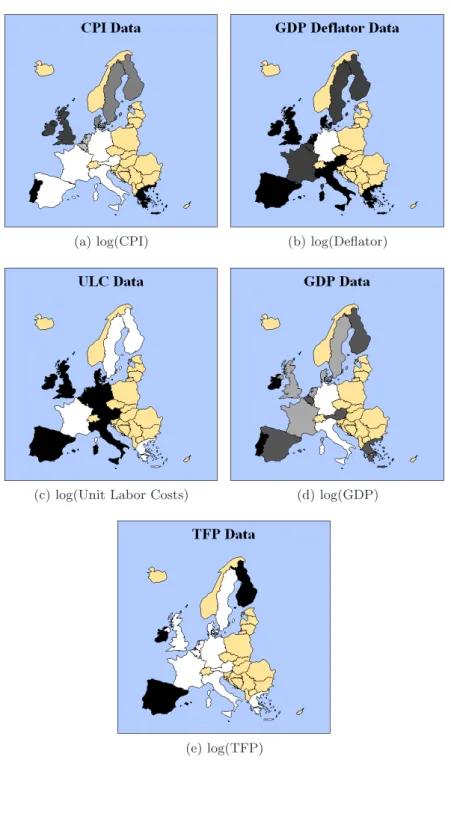
As an intuitive graphical representation, we use a greyscaled map of Europe, where the respective countries which form a subgroup or do not belong to any subgroup, are colored in the same manner. From the respective figure, the mentioned clustering can be distraced quite well.
Insert figure 2 here.
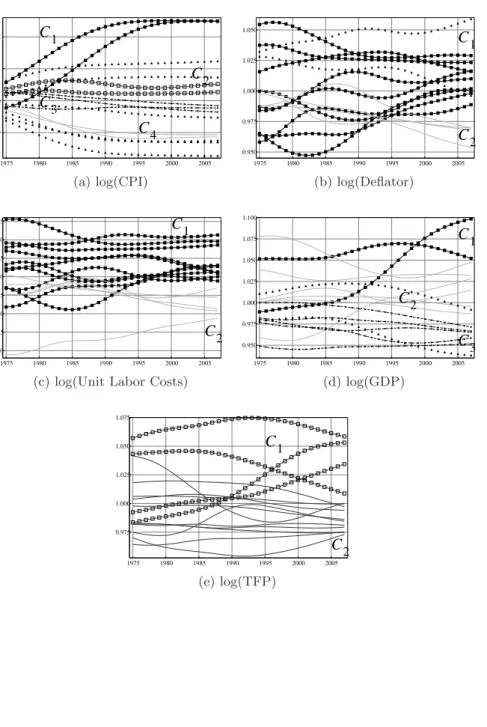
Looking at the transition curve graph for CPI data – we used the same style for all lines belonging to the same cluster and labelled the clusters –, there is no indication that the transition to the panel mean changed after 2002 for CPI data. In contrast, the relative position of the subgroups seems to be quite stable.
4 Convergence Analysis for EU 15 countries
4.3 Results for GDP Deflator and Unit Labor Cost Data
We jointly discuss results for GDP deflator and unit labor cost data jointly, because the results and therefore the conclusions do not differ much. How-ever, compared to the results for CPI data, the results do alter.
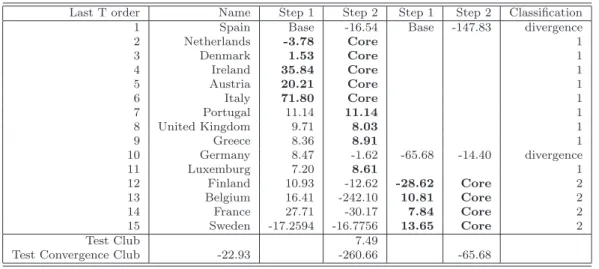
First, we present the results for the GDP deflator data set. Using the data for Spain as the base entity and starting to identify a core group, we identify a group of five countries – Netherlands, Denmark, Ireland, Austria and Italy. These countries form the first subgroup. The cluster can easily be enlarged to contain data for United Kingdom, Greece and Luxemburg as well. So the majority of countries form a first convergence club. In the next round, the GDP deflator series for Germany is the base series – but the time series does not belong to the second core group. In fact, we stop here as the data for all remaining countries except Germany form a second core group (France, Sweden together with Finland and Belgium). Germany is divergent as it does not belong to any group.
Insert table 2 here.
The results from the unit labor cost data set are qualitatively quite simi-lar. Here again we find that a majority of countries forms a first convergence club and a minority of countries forms a second club. France and Sweden are once more members of the second club – but this time accompanied by Ireland, Greece and Finland. This time Germany is found to be a member of the first club in contrast to the results above. The graphs suggest that it might well be the case that the first convergence club seems to be splitted into two subclusters since the mid 1990s/ early 2000s – a fact which is not been detected by the procedure (yet).
Insert table 3 here.
Looking at the respective transition curves (see figure 3) we observe that remarkable swings, but this holds for the 1980s and 1990s and therefore this tendency seems to be not related to the introduction of the common currency (even if we would allow for announcement effects). A view on the respective transition curves for ULC data reveals that within the first sub-group there is recently a tendency observable to form two separate clusters within the subgroup. According to that Luxembourg, Germany, Austria and Belgium seem to form a separate cluster in the last couple of years. Italy is a member of this subcluster as well but shows some tendency for higher ULC growth. The evidence for subclusters has not yet been detected by the procedure used here but could be a case for further investigation in the next years.
4 Convergence Analysis for EU 15 countries
4.4 Results for GDP per Capita Data
GDP per capita data show stronger clustering compared to GDP deflator or unit labor cost data – but the regional structure is more diverse. The procedure is applied as before. A cluster of catching-up countries (Ireland and Portugal) is easily identified. A second cluster contains the South-ern countries Greece and Spain but also Luxemburg, Finland, Austria and Belgium. A third cluster is found to be formed by France and some Scandi-navian countries. Germany and Italy do not belong to any of the identified clusters.
Looking again at the respective transition curves reveals that in fact, Greece and Portugal seem to have converged, the procedure however has clustered Portugal with Ireland. Furthermore, there is evidence, that Bel-gium could possibly be better counted as a member of the high-income club. Besides this, there is no evidence for a change in the transition behaviour over the last couple of years.
Insert table 4 here.
4.5 Results for Total Factor Productivity Data
Turning to the analysis of total factor productivity data, the results show quite strong signs of convergence for the majority of countries in the sample. This is a promising result in terms of convergence because throughout the standard growth theory literature differences in productivity explain the bulk of income convergence in the long-run (Weil, 2004).
Starting with a base country – Portugal here – we define again a core group in the first round. The group consists of Portugal and Ireland – two fast-growing countries. In the next step, we again try to add countries to this group. Finland and Spain pass the test. So we end up with a first convergence group – which are mainly catchig-up countries. The procedure is then applied to the rest. Interestingly, all other countries form a conver-gence club in the first test. So we can stop here with the result, that the majority of countries form a convergence club.
Insert table 5 here.
The transition curves show that Spain should possibly be counted as a member of the first club and Greece seems to have a tendency to move out of the second club – but again there is no evidence for a change in transition curves over the last couple of years.
5 Conclusion
5
Conclusion
In the paper, we applied a new convergence test procedure on EU 15 data from 1960 to present. This procedure is quite general and easily applicable and will definitely become a workhorse of convergence testing within the next years. In general, our results reveal interesting stylized facts on the convergence process in Europe.
• Consumer prices suggest clustering along the lines of geographical dis-tance. Countries with common borders as well as strong economic interactions (Benelux, Scandinvian countries, UK and Ireland) show convergence. There is no overall convergence.
• GDP deflator and unit labor cost data indicate two clusters: a large group of about 23 of all countries on the one hand and the rest on the other hand. Sweden and France always belonged to the second cluster, other countries differ in their membership. Spain and Germany are divergent for GDP deflator series. However, there are signs, that possibly a change around the mid 1990s /early 2000s occurred which would speak in favour of a further subclustering. However, so far evidence for such an event is still quite weak.
• GDP per capita data show the existence of three distinctive clusters: catching-up countries, middle-income countries and high-income coun-tries. Italy and Germany seem to be inconclusive about their mem-bership. For the case of Germany surely the reunification has led to a level shift in per-capita income downwards which makes it difficult for the procedure to cope with.
• The highest level of convergence is reached in total factor productivity. There is clear evidence for a catching-up cluster and all other countries seem to form a large cluster. This is the most promising result as it indicates that the long-run prospects for convergence in income and prices can be judged as reasonably good.
References
References
Alesina, A., and R. Barro (2002): “Currency Unions,” The Quarterly Journal of Economics, 117, 409 – 436.
Allsopp, C., andM. Artis(2003): “The Assessment: EMU, Four Years On,”Oxford Review of Economic Policy, 19(1), 1–29.
Altissimo, F., M. Ehrmann, and F. Smets (2006): “Inflation persistence and price setting behaviour in the Euro area. A summary of the IPN evidence.,” Occasional Paper Series 46, European Central Bank.
Angeloni, I., L. Aucremanne, M. Ehrmann, J. Gali, A. Levin, and F. Smets
(2006): “New evidence on inflation persistence and price stickiness in the Euro area: Implications for macro modelling,”Journal of the European Economic Association, 4, 562–574.
Angeloni, I., and M. Ehrmann (2004): “Euro area inflation differentials,” Working Paper Series 388, European Central Bank.
Bai, J.(2003): “Inferential Theory for Factor Models of Large Dimensions,” Economet-rica, 71, 135–172.
Barro, R., and X. Sala-i-Martin (1991): “Convergence across states and regions,” Brookings Papers on Economic Activity, 1991(1), 107–182.
(1992): “Convergence,”The Journal of Political Economy, 100(2), 223–251.
Bernard, A. B., and S. N. Durlauf (1996): “Interpreting tests of the convergence hypothesis,”Journal of Econometrics, 71, 161–173.
Busetti, F., L. Forni, A. Harvey,and F. Venditti(2006): “Inflation convergence and divergence within the European Monetary Union,” ECB Working Paper Series 574, European Central Bank.
Campolmi, A., andE. Faia(2006): “Cyclical inflation divergence and different labor market institutions in the EMU.,” Working Paper Series 619, European Central Bank.
Cecchetti, S., M. Mark, and R. Sonora (2002): “Price Level Convergence among United States Cities: Lessons for the European Central Bank,”International Economic Review, 43(4), 1081–1099.
Corsetti, G.(2008): “A Modern Reconsideration of the Theory of Optimal Currency Areas,” EUI Working Papers ECO 2008/12, EUI.
Cuaresma, J. C., B. Egert,andM. A. Silgoner(2007): “Price Level Convergence in Europe: Did the Introduction of the Euro Matter?,”Monetary Policy & the Economy, Q1/07, 100–113.
Devereux, M., C. Engel, andC. Tille (2003): “Exchange Rate Pass-through and the Welfare Effects of the Euro,”International Economic Review, 44(1), 223 – 242.
Durlauf, S. N., and D. T. Quah (1999): Handbook of Macroeconomics. Volume 1A.chap. The New Empirics of Economic Growth, pp. 235–308. Elsevier Science, North-Holland,.
Eichengreen, B.(2007): “The Breakup of the Euro Area,” NBER Working Paper 13393, NBER.
References
(2008): “Sui Generis EMU,” NBER Working Paper 13740, NBER.
Emerson, M., D. Gros, and A. Italianer (1992): One Market, One Money: An Evaluation of the Potential Benefits and Costs of Forming an Economic and Monetary Union. Oxford University Press.
European Central Bank(2003): “Inflation Differentials in the Euro Area: Potential Causes and Policy Implications,” Discussion paper, European Central Bank.
Hobijn, B., andP. H. Franses (2000): “Asymptotically perfect and relative conver-gence of productivity,”Journal of Applied Econometrics, 15, 59–81.
Islam, N.(2003): “What have we learnt from the convergence debate,”Journal of Eco-nomic Surveys, 17(3), 309–362.
Lane, P.(2006): “The real effects of EMU,” Discussion Paper Series 5536, CEPR.
Melander, A., G. Sismanidis,andD. Grenouilleau(2007): “The track of the Com-mission’s forecast: an update,” European Economy. Economic Papers 291, European Commission.
Phillips, P. C. B.(2005): “Challenges of Trending Time Series Econometrics,” Mathe-matics and Computers in Simulation, 68, 401–416.
Phillips, P. C. B.,andD. Sul(2007): “Transition modelling and econometric conver-gence tests,”Econometrica, 75, 1771 – 1855.
Rose, A.(2000): “One money, one market: the effect of common currencies on trade,” Economic Policy, 30, 7 – 45.
Rose, A., and C. Engel (2002): “Currency Unions and International Integration,” Journal of Money, Credit, and Banking,, 34(4), 1067–1086.
Tenreyro, S., and R. Barro (2007): “Economic Effects of Currency Unions,” Eco-nomic Inquiry, 45(1), 1–197.
Appendix
Appendix
.12 .16 .20 .24 .28 .32 1995 1996 1997 1998 1999 2000 2001 2002 2003 2004 2005 Source: EurostatFigure 1: Cross-section distribution of coefficients of variation in EU 15, 1995-2005, measured against EU 15 average, 41 product categories in eaxh country, Source: Eurostat
on v er ge n ce in E u ro p e in a N on -l in ea r F ac to r M o d el A p p en d ix
Table 1: Results for CPI data
Last T order Name Step 1 Step 2 Step 1 Step 2 Step 1 Step 2 Step 1 Step 2 Step 1 Classification 1 Greece Base Core 1 2 Portugal 4.48 Core 1 3 Spain -94.99 -94.99 Base -28.79 Base -351.68 Base -18.24 Base divergence 4 Italy -612.21 -134.72 -15.96 -134.72 -57.46 -134.72 -13.49 -134.72 divergence 5 Ireland -606.31 -3.71 Core 2 6 United Kingdom -34.22 26.61 Core 2 7 Finland -53.74 -74.80 -74.80 -23.01 32.51 3 8 Denmark -39.84 -61.21 -5.66 Core 3 9 Sweden -43.77 -48.18 27.80 Core 3 10 France -68.39 -373.42 -4.03 -4.03 -120.02 -3.19 -120.02 divergence 11 Belgium -27.95 -44.56 -33.97 -4.98 Core 4 12 Netherlands -16.73 -11.96 -7.47 -0.70 Core 4 13 Luxemburg -28.22 -34.78 -27.60 -19.34 -19.34 -5.18 divergence 14 Austria -20.65 -28.10 -11.13 -13.73 -2.69 divergence 15 Germany -19.60 -25.96 -12.03 -32.82 -16.92 divergence Test Club 32.51
Test Convergence Club -26.61 -18.10 -16.82 -17.23 -18.70
Appendix
Table 2: Results for GDP Deflator Data
Last T order Name Step 1 Step 2 Step 1 Step 2 Classification 1 Spain Base -16.54 Base -147.83 divergence 2 Netherlands -3.78 Core 1 3 Denmark 1.53 Core 1 4 Ireland 35.84 Core 1 5 Austria 20.21 Core 1 6 Italy 71.80 Core 1 7 Portugal 11.14 11.14 1 8 United Kingdom 9.71 8.03 1 9 Greece 8.36 8.91 1 10 Germany 8.47 -1.62 -65.68 -14.40 divergence 11 Luxemburg 7.20 8.61 1 12 Finland 10.93 -12.62 -28.62 Core 2 13 Belgium 16.41 -242.10 10.81 Core 2 14 France 27.71 -30.17 7.84 Core 2 15 Sweden -17.2594 -16.7756 13.65 Core 2 Test Club 7.49
Test Convergence Club -22.93 -260.66 -65.68
Table 3: Results for Unit Labor Cost Data
Last T order Name Step 1 Step 2 Classification 1 Spain Base Core 1 2 Netherlands -1.18 Core 1 3 Denmark 0.12 Core 1 4 United Kingdom 6.39 Core 1 5 Portugal 7.74 Core 1 6 Luxemburg 6.81 Core 1 7 Austria 11.18 Core 1 8 Germany 29.55 Core 1 9 Italy 21.09 Core 1 10 Belgium 36.75 Core 1 11 Ireland -4.04 -4.04 1 12 France -87.69 2 13 Sweden -19.40 2 14 Finland -62.31 2 15 Greece -0.02 2 Test Club
on v er ge n ce in E u ro p e in a N on -l in ea r F ac to r M o d el A p p en d ix
Table 4: Results for GDP per Capita Data
Last T order Name Step 1 Step 2 Step 1 Step 2* Step 1 Step 2 Classification 1 Ireland Base Core 1 2 Portugal 2.08 Core 1 3 Greece -7.20 -7.20 Base Core 2 4 Spain -27.35 1.8096 Core 2 5 Luxemburg -33.84 49.0264 Core 2 6 Finland -30.38 108.344 Core 2 7 Austria -33.32 38.06 38.06 2 8 Italy -30.52 6.66 7.52 Base -8.36 divergence 9 Belgium -26.99 -36.44 11.75 2 10 France -24.16 -5.10 -12.11 Core 3 11 Denmark -23.77 -6.37 102.04 Core 3 12 Netherlands -86.12 -16.95 8.96 8.96 3 13 Sweden -5841.59 -4.87 2.68 0.12 3 14 United Kingdom -39.85 -11.02 12.02 171.47 3 15 Germany -35.89 -6.03 -13.05 -40.64 divergence Test Club -0.14
Test Convergence Club -14.00 -18.37 -16.62 -37.91
Legend: * We increasedcunless thetˆb>−1.65, which was achieved atc= 8.
Appendix
Table 5: Results for Total Factor Productivity Data
Last T order Name Step 1 Step 2 Classification 1 Portugal Base Core 1 2 Ireland 470.55 Core 1 3 Finland 37.22 37.22 1 4 Spain 6.56 16.39 1 5 Greece -9.20 -400.55 2 6 Austria -5.39 2 7 Italy -27.03 2 8 Belgium -22.44 2 9 France -46.74 2 10 Luxemburg -2012.43 2 11 Denmark -9.86 2 12 Germany -13.07 2 13 United Kingdom -30.60 2 14 Netherlands -25.40 2 15 Sweden -34.73 2 Test Club 6.56
Appendix
Figure 2: Regional Clustering
(a) log(CPI) (b) log(Deflator)
(c) log(Unit Labor Costs) (d) log(GDP)
Appendix
Figure 3: Transition Curves
1975 1980 1985 1990 1995 2000 2005 0.9 1.0 1.1 1.2 C1 C2 C3 C4 (a) log(CPI) 1975 1980 1985 1990 1995 2000 2005 0.950 0.975 1.000 1.025 1.050 C1 C2 (b) log(Deflator) 1975 1980 1985 1990 1995 2000 2005 0.900 0.925 0.950 0.975 1.000 1.025 1.050 1.075 C 1 C2
(c) log(Unit Labor Costs)
1975 1980 1985 1990 1995 2000 2005 0.950 0.975 1.000 1.025 1.050 1.075 1.100 C1 C2 C3 (d) log(GDP) 1975 1980 1985 1990 1995 2000 2005 0.975 1.000 1.025 1.050 1.075 C1 C2 (e) log(TFP)