Imprint
™
4
VPS Impression Material
Contents
1. 3M ESPE – Great impressions
... 3
2. Portfolio overview
... 4 – 5
2.1 Recommended materials for the 1-step technique
2.2 Recommended materials for the 2-step technique
3. Material composition
... 6 – 7
4. Shortest intra-oral setting time through active self-warming
... 8 – 10
4.1 Time saving opportunity
4.2 Accelerated setting and active self-warming
5. Super-hydrophilicity
... 10 – 11
6. Physical and mechanical properties
... 12
6.1 Tensile strength
6.2 Overview mechanical properties
7. Clinical results
... 13 – 14
1
3M ESPE –
Great impressions
Since the introduction of the first elastomeric impression materials decades ago, 3M™ ESPE™ has constantly improved and expanded
its impressioning portfolio. Today, it offers a variety of high-performance vinyl polysiloxane (VPS) and polyether impression materials, fast and easy-to-use mixing devices and other impression-related products and accessories, as well as a digital impression solution. Numerous awards from trade publications and positive feedback from thousands of loyal customers agree: all 3M ESPE products are designed to reliably make superior impressions for perfectly fitting final restorations, helping dental professionals to optimize their impression procedures.
With the introduction of Imprint™ 4 VPS Impression Material, 3M ESPE offers a new product line for exceptionally precise impressions:
the innovative VPS material allows for an unprecedented short intra-oral setting time due to its active self-warming – caused by a unique chemical reaction. This 3M ESPE exclusive technology significantly accelerates the setting of the material, resulting in noticeable time savings. And because the reaction starts at the end of the working time, you can take the time you need to make your impressions.
Moreover, Imprint 4 is the first VPS impression material that is truly hydrophilic in the unset state. And that’s the crucial time – when the material is in contact with the moist oral environment. This super-hydrophilic behaviour helps to capture the finest details for unbelievably accurate impressions.
Imprint™ 4 VPS Impression Material is especially developed and
designed for all kinds of precision impressions using the 1-step and 2-step impression techniques, i.e. crown and bridge, inlay and onlay, implant, and orthodontic impressions.
Features and benefits at a glance:
Indications:
Super-hydrophilicity
For excellent flow and finest detail reproduction
Fresh material colours
For enhanced readability
Pleasant minty taste
For more patient comfort
Active self-warming
For accelerated setting
Shortest intra-oral setting time
For real time-saving
Adequate working time
2
Portfolio
overview
Available in a wide range of viscosities – from putty to ultra-light body – Imprint™ 4 VPS Impression Material offers essential
benefits for the 1-step and 2-step impression techniques. All tray materials – including putty – are available for fast and
convenient automatic mixing with the Pentamix™ 3 and Pentamix™ 2 Automatic Mixing Unit from 3M ESPE.
The working and setting times of Imprint 4 “Super Quick” and “Regular” setting materials are perfectly aligned when using the recommended material combinations:
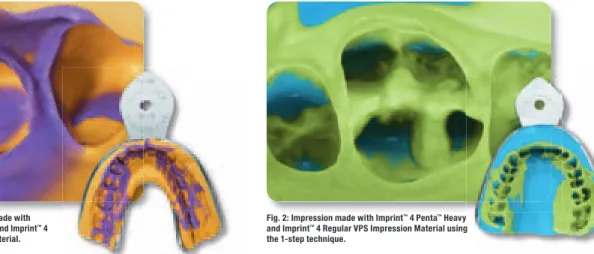
For the 1-step technique, the ideal tray material should be hydrophilic so it can perform well in the moist intra-oral environment plus it has a somewhat lower hardness in the set stage so that it can easily be removed from the patient’s mouth. Imprint 4 heavy body VPS materials have been designed to fully meet these requirements. If an increased flowability of the wash material is desired, the light viscosities are recommended. If it is more important for the wash material to remain in place at the tooth, the regular viscosities are recommended. In addition, all Imprint 4 wash materials are super-hydrophilic to capture finest details in the moist intra-oral environment.
Fig. 2: Impression made with Imprint™ 4 Penta™ Heavy
and Imprint™ 4 Regular VPS Impression Material using
the 1-step technique. Fig. 1: 1-step technique impression made with
Imprint™ 4 Penta™ Super Quick Heavy and Imprint™ 4
Super Quick Light VPS Impression Material.
Recommended materials for the 1-step technique
2.1
1-step
technique
Tray material Colour Recommended wash material Colour
Imprint™ 4 Penta™ Heavy Hydrophilic heavy body
Imprint™ 4 Light
Imprint™ 4 Regular
Imprint™ 4 Penta™ Super Quick Heavy Fast setting hydrophilic heavy body
Imprint™ 4 Super Quick Light
Imprint™ 4 Super Quick Regular
Imprint™ 4 Penta™ Putty
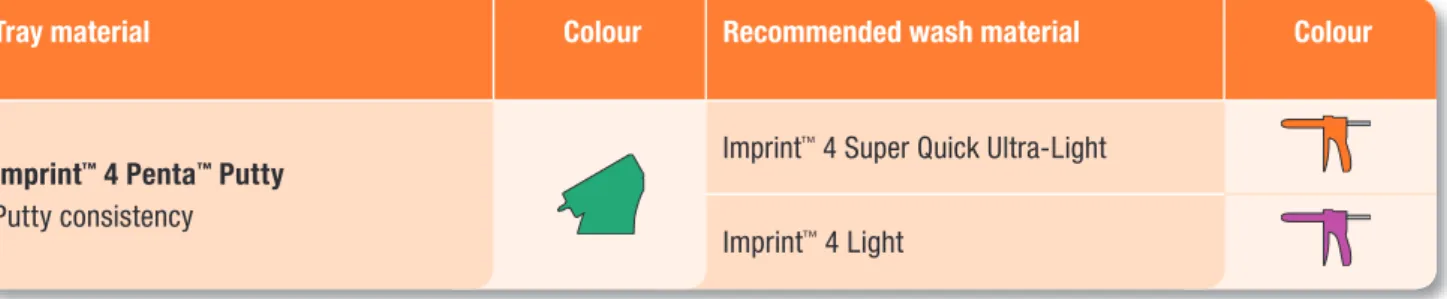
In the 2-step technique, it is important for the tray material to allow high insertion pressure so the wash material can be pushed deep into the sulcus. Plus, tray materials need to have good carving properties as well as high hardness in the set stage. The wash material must be able to generate very thin layers on the set tray material. The ideal solution is a wash material with low
viscosity and high structural viscosity (thixotropy), allowing it to flow very well when pressure is applied. Therefore, Imprint™ 4
Super Quick Ultra-Light and Light consistency washes are ideally suited for the 2-step technique in combination with Imprint™ 4
Penta™ Putty.
Fig. 3: 2-step technique impression made with Imprint™ 4 Penta™ Putty and
Imprint™ 4 Super Quick Ultra-Light VPS Impression Material.
Recommended materials for the 2-step technique
2.2
Tray material Colour Recommended wash material Colour
Imprint™ 4 Penta™ Putty Putty consistency
Imprint™ 4 Super Quick Ultra-Light
Imprint™ 4 Light
2-step
3
Material
composition
Imprint™ 4 VPS Impression Material is an addition-cured silicone (vinylpolysiloxane, VPS). The setting reaction which cures
the material is based on platinum-catalysed hydrosilylation. The unique features of Imprint 4 material are mainly the result of the development of a novel setting accelerator as well as a pioneering wetting enabler.
In addition to conventional components, all Imprint 4 heavy body and wash materials contain different reactive unsaturated
carbosilane (UCS) compounds. The proven polyfunctional UCS crosslinker known from 3M ESPE’s Express™ 2 VPS Impression
Material is utilized as network builder, providing the material with a strong reinforced network. Additionally, a newly developed monofunctional UCS is also used as a setting accelerator.
Examplified formulation of Imprint
™4 VPS Impression Material:
It is well known that increasing temperatures accelerate chemical reactions, and this is especially true for the setting reaction (hydrosilylation) of VPS impression materials in general.
With Imprint 4 VPS material, 3M ESPE has integrated a second mechanism which causes the active self-warming of the impression material. This is done by capping reactive components with a novel UCS setting accelerator. Due to the carefully chosen reactivity of the UCS setting accelerator, the warming reaction does not start until the end of the working time. This means the working time of the material is not adversely affected by self-warming but the intra-oral setting gets the additional “kick”. The result is a significant reduction of the intra-oral setting time, providing Imprint 4 Super Quick materials with the shortest intra-oral setting time compared to competitive VPS precision impression materials.
Base Catalyst
Vinyl polydimethylsiloxane Vinyl polydimethylsiloxane
Dimethyl (methyl hydrogen) polysiloxane Silica filler
Silica filler Silane-treated silica
Silane-treated silica Platinum catalyst
Polyethylene glycol, siloxane terminated Pigments
Modified polyalkyleneoxide wetting enabler Polyfunctional UCS crosslinker
Polyfunctional UCS crosslinker
Monofunctional UCS setting accelerator Peppermint flavour
Physically, this custom mix of surfactant and wetting enabler modifies the surface energy of the unset paste significantly, which allows the material to reproduce details better in the moist oral environment. This property is unique since it allows Imprint 4 material to develop outstanding hydrophilicity already shortly after mixing.
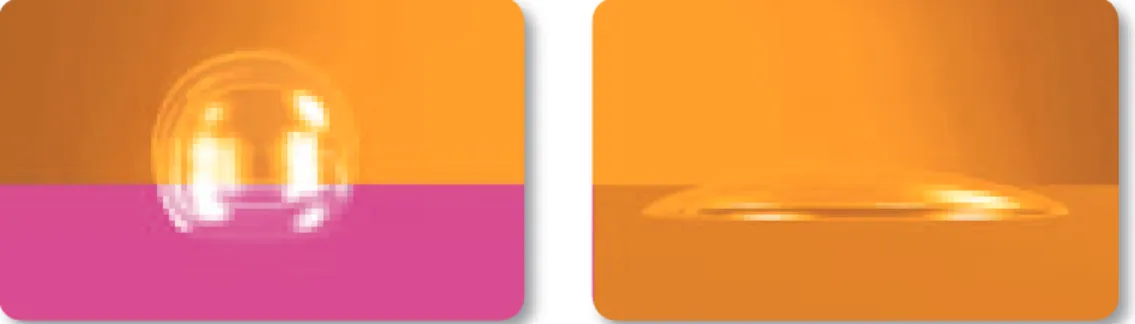
Fig. 5: Hydrophobic (left) versus hydrophilic behaviour of a water droplet on impression material (schematic pictures).
Hydrophilicity describes the affinity of a material or surface for water or aqueous solutions. By adding a novel modified polyalkylene oxide wetting enabler, it is possible to achieve outstanding hydrophilicity not only for the final impression but also for the uncured material from the first seconds of mixing. The wetting enabler synergistically increases the effectiveness of the proven surfactant and enables superior hydrophilicity in the uncured paste state as well – true super-hydrophilicity.
Monofunctional UCS setting accelerator (MUCS):
Polyfunctional UCS crosslinker (PUCS):
Vinylpolysiloxane: Unbound reactive components before the start of
the setting reaction. First vinylpolysiloxanes and Si-H polysiloxanes start to react. Monofunctional UCS setting accelerator binds causing self-warming reaction and accelerated setting.
Start of working time End of working time Setting
Fig. 4: Schematic representation of the setting reaction of Imprint™ 4 VPS Impression Material.
Working time Intra-oral setting
Reactive components
4
Shortest intra-oral setting time
through active self-warming
Imprint™ 4 VPS Impression Materials are available in two setting regimes with exceptionally short intra-oral setting times
while adequate working times are maintained.
The “Super Quick” materials are the ideal solution for 1- or 2-unit cases. A working time of up to 1:15 minutes at room temperature and up to 35 seconds of intra-oral working time allow ample time for this most common indication.
With a working time of up to 2:00 minutes at room temperature and up to 1:00 minute intra-orally, the “Regular” setting materials offer more working time – which is especially valuable for larger cases.
Imprint™ 4 “Super Quick” setting materials
• Shortest intra-oral setting time available on the market • Ideally suited for 1- or 2-unit cases
The tray can be inserted immediately after loading and once the tray is seated it is not necessary to add any unused working time. The indicated intra-oral setting times are always valid. There is no minimum working time – the total setting time is the intra-oral setting time plus the working time actually used.
Imprint™ 4 Penta™ Putty with a kneadable consistency for automatic mixing in the Pentamix™ System from 3M ESPE provides
enough working time – up to 1:30 minutes – plus an intra-oral setting time of 2:30 minutes. In combination with Imprint 4 wash materials, significant time can be saved, especially if the 2-step technique is used.
Time saving when using Imprint™ 4:
4.1
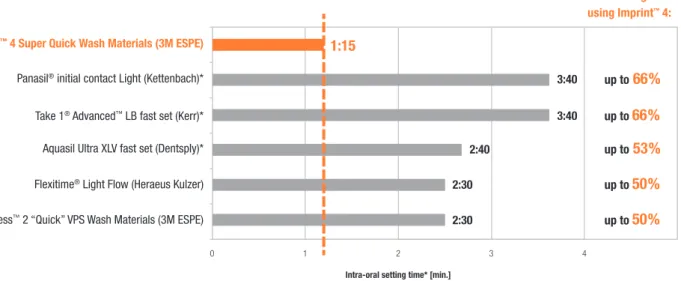
Fig. 6: Intra-oral setting times of leading VPS impression materials according to the respective manufacturers’ instructions for use in a single-unit case with 20 seconds’ working time.
* Manufacturer indicates total setting time. Calculated intra-oral setting time = total setting time minus 20 seconds working time.
Time saving opportunity
Due to its exceptionally short intra-oral setting times, Imprint 4 VPS material helps to save time – especially the Super Quick
heavy/wash combination. The below graph shows the time saving of Imprint™ 4 Super Quick wash materials compared to
competitive VPS materials. The indicated times were defined for a case with a working time of 20 seconds, e.g. loading and
seating a dual arch/double bite tray (e.g. Premier® Triple Tray®) with simultaneous intra-oral syringing of the wash material.
Imprint™ 4 “Regular” setting materials
• Long working time of 2:00 minutes for larger cases • Significantly reduced intra-oral setting time
Intra-oral setting time* [min.] 1:15 3:40 3:40 2:40 2:30 2:30
Imprint™ 4 Super Quick Wash Materials (3M ESPE)
Panasil® initial contact Light (Kettenbach)*
Take 1® Advanced™ LB fast set (Kerr)*
Aquasil Ultra XLV fast set (Dentsply)* Flexitime® Light Flow (Heraeus Kulzer)
Express™ 2 “Quick” VPS Wash Materials (3M ESPE)
0 1 2 3 4 up to66% up to 66% up to 50% up to 53% up to 50%
4.2
* see also: Shore Hardness of VPS Materials from Unset to Set Consistency, M. Neglia, D. Nobrega, G. Kugel, R.D. Perry, Tufts University, Boston, MA, AADR2012, #1023
The progression of setting is associated with an increase in material hardness. The maximum Shore hardness is reached at the end of the setting process. Thus, the faster the Shore hardness achieves its maximum, the faster the setting reaction is. Consequently, an increase in Shore hardness in relation to time is a reasonable method to measure the setting progression.* As shown in Fig. 7, Imprint 4 VPS material shows the steepest increase in Shore hardness and thus the fastest setting behaviour.
Accelerated setting and active self-warming
With Imprint™ 4 VPS Impression Material, a new dimension of setting behaviour of VPS impression materials is reached by employing
the temperature sensitivity of the hydrosilylation setting reaction. Imprint 4 material offers accelerated setting in the mouth whereas the working time remains unaffected. This setting behaviour allows for a more efficient workflow: a reduced intra-oral setting time results in a time-saving procedure and less stress for dentists and patients alike.
Fig. 7: Progression of setting reaction characterized by Shore hardness increase measured in different fast setting heavy bodies. Intra-oral setting times are shorter than those measured at room temperature (23 °C / 73.4 °F). Materials tested: Imprint™ 4 Super Quick Heavy (3M ESPE),
Aquasil Ultra Heavy Fast Set (Dentsply), Flexitime Heavy Body (Heraeus Kulzer), Affi nis Fast Heavy Body (Coltène), EXA’lence HB fast set (GC).
Source: J.C. Farr, H. Hoffmann, A. Maurer, P. Osswald, E. Wanek, Shore Hardness increase of Tray Materials during setting, CED IADR 2012, #674
100 90 80 70 60 50 40 30 20 10 0 Shore hardness vs.
final shore hardness [%
]
Time from start of mixing [min.]
0 1 2 3 4 5 6 7 8 9 10 Affinis Aquasil Flexitime Exa’lence Exa’lence Imprint™ 4
5
37 35 33 31 29 27 25 23 Temperature in C° Imprint™ 4Super Quick Light
33.2
Take 1 Advanced light fast
27.7 Flexitime light flow 25.5 Aquasil Ultra LV fast set 28.3 37,0 °C 98,6 °F 21,0 °C 69,8 °F Fig. 8: Maximum temperature increase of different VPS impression materials, Measurements
were taken at room temperature: maximum temperature is lower than in the mouth.
Source: S. Bhatt, J. Bair, R. Perry, G. Kugel, Shore Hardness and Temperature of VPS Materials During Setting, submitted for publication at IADR 2013
Imprint™ 4’s active self-warming is responsible for the accelerated
setting reaction in the mouth resulting in a short intra-oral setting time. Inside the mouth, the material warms up to body temperature (37 °C / 98.6 °F) which also increases patient comfort during impression taking.
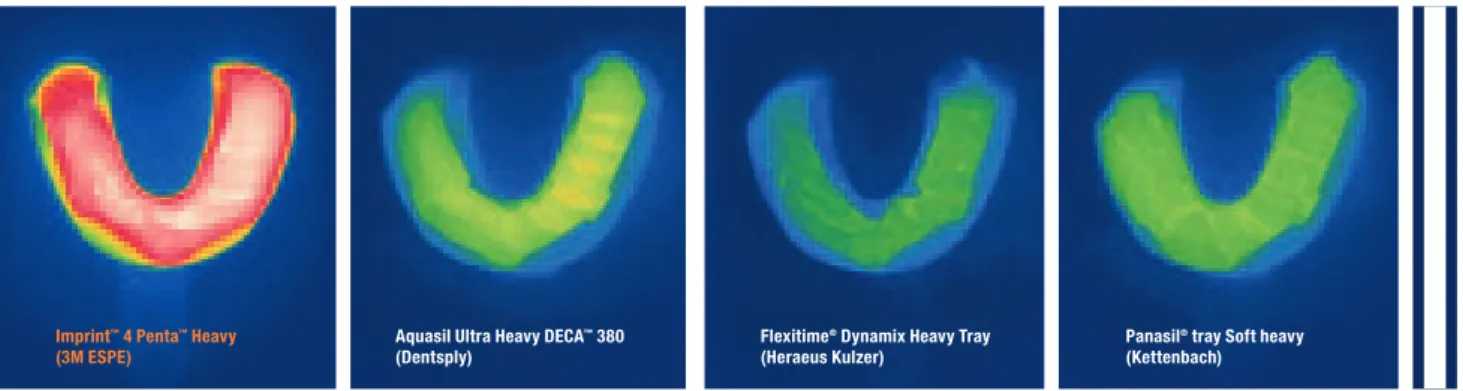
Fig. 8 shows that only Imprint 4 VPS impression material displays a significant temperature increase, compared to competitive VPS materials.
Super-
hydrophilicity
Highly detailed impressions are a prerequisite for perfectly fitting restorations. Detail reproduction capability must be maintained even under challenging conditions. Good flowability and excellent wetting properties are key features for an impression material that performs outstandingly even in a moist environment. Imprint 4 VPS wash materials are already super-hydrophilic in the unset state. After setting, the hydrophilicity of an impression material is essential for model manufacturing. An impression with high wettability helps to create precise, void-free dental models without the need to use additional wetting agents when pouring. To demonstrate the super-hydrophilicty of Imprint 4 VPS materials, a setup was chosen with a side by side interface of two different unset light body wash materials (competitive VPS materials shown left and Imprint 4 wash material shown right, both 40 sec. after start of mixing). When a water droplet is placed precisely at the middle of the interface, it flows to the material with the higher hydrophilicity i.e. with the higher affinity for water or another aqueous solution (like saliva or blood).
Infrared images (Fig. 9) display temperature differences as colours. The temperature range was chosen between 21 °C / 69.8 °F (dark blue) and 37 °C / 98.6 °F (white). Again, only Imprint 4 material shows a visible rise in temperature to body temperature.
Panasil® tray Soft heavy
(Kettenbach) Aquasil Ultra Heavy DECA™ 380
(Dentsply) Flexitime
® Dynamix Heavy Tray
(Heraeus Kulzer)
Imprint™ 4 Penta™ Heavy
(3M ESPE)
21.0 °C 69.8 °F 37.0 °C 98.6 °F
Fig. 9: Infrared images of Imprint™ 4 Penta™ Heavy VPS Material (3M ESPE), Aquasil Ultra Heavy DECA™ 380 (Dentsply), Flexitime® Dynamix Heavy Tray (Heraeus Kulzer) and Panasil®
tray Soft heavy (Kettenbach). Only Imprint™ 4 Material shows a signifi cant temperature increase. All images were acquired with a FLIR T640 infrared camera at room temperature
Express™ 2 “Quick” VPS Wash Materials
(3M ESPE)
53°
Aquasil Ultra XLV fast set (Dentsply)
69° 23º Imprint™ 4 Light VPS Impression Material (3M ESPE) Take 1® Advanced™ LB fast set (Kerr)
53°
Flexitime® Light Flow (Heraeus Kulzer)
45°
Panasil® initial contact Light (Kettenbach)
58°
In direct comparison with competitive VPS materials, the water droplet always flows to the more hydrophilic Imprint™ 4 Material.
Fig. 10: A water droplet of 25 μl (microliter) was applied … Fig. 11: ... to the interface of two unset light body VPS impression materials (40 sec. after start of mixing). All measurements were performed at room temperature (23 °C / 73.4 °F).
Fig. 12: Aquasil Ultra XLV (Dentsply) vs.
Imprint™ 4 Light (3M ESPE).
Fig. 14: Panasil® initial contact Light (Kettenbach) vs.
Imprint™4 Light (3M ESPE).
Fig. 13: Flexitime® Light Flow (Heraeus Kulzer) vs.
Imprint™4 Light (3M ESPE).
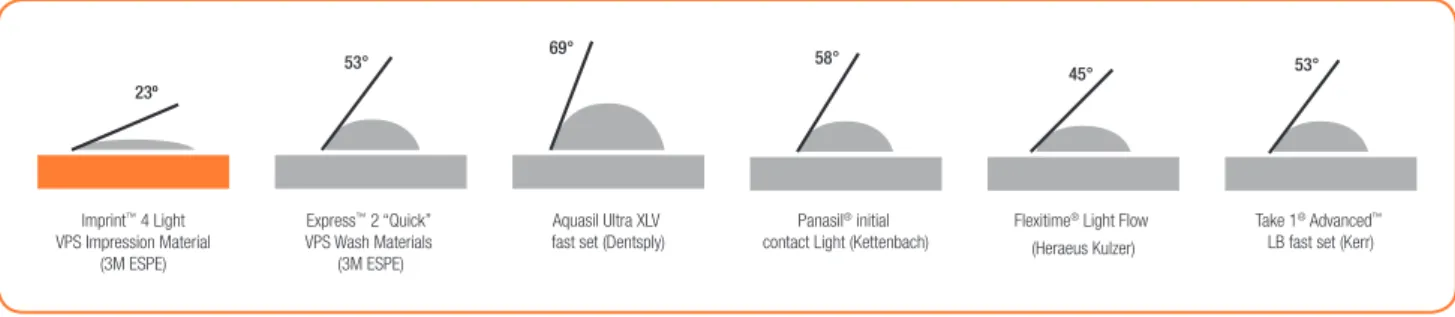
The method most often used to determine the hydrophilicity of an impression material is the contact angle measurement. In this test, a water droplet is placed on the surface of a specimen and then the spread of the water droplet across the surface is observed and the contact angle is measured. The lower the contact angle, the better the wettability and the higher the hydrophilicity of the impression material.
Fig. 15 shows the contact angle values 2 seconds after placing the water droplet on unset Imprint 4 Light material and competitive VPS impression materials with comparable setting times and viscosities (Shakourian et al., AADR 2012, #1024). The water droplets were placed 20 seconds after start of mixing. Imprint 4 material shows the lowest contact angle and therefore the highest hydrophilicity.
Source: 3M ESPE internal tests.
Fig. 15: Contact angles after 2 sec. on unset impression material for Imprint™ 4 Light and competitive VPS impression materials in the same setting version and with comparable viscosity.
6
6.1
6.2
Physical and mechanical
properties
Tensile strength
When an impression material is removed from the patient’s mouth, it is exposed to high compressive and tensile forces. Imprint™ 4
VPS Impression Material has a strong ability to withstand these forces due to its high tensile strength. This tensile strength is a result of a reinforced network formed with the polyfunctional UCS crosslinker. Tearing of impression material, especially at the margin, would result in an unsatisfactory impression and an insufficient marginal fit of restoration.
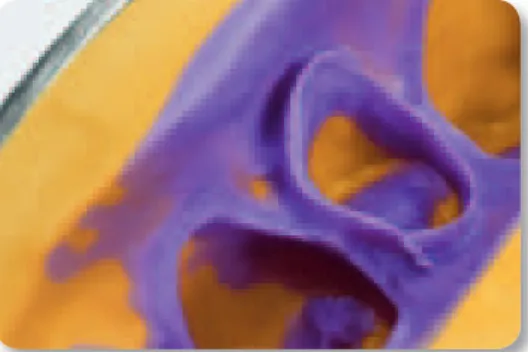
Figures 16 and 17 show that the preparation line is accurately captured by Imprint 4 material. No tearing of the impression material can be observed – even at the most critical areas where the material has flowed deep into the sulcus.
Overview mechanical properties
The following table provides an overview on the mechanical properties of selected Imprint 4 tray and wash materials:
Mechanical properties Imprint™ 4 Penta™ Super Quick
Heavy (tray material)
(LOT: B: AWT-0033; C: AWT-0034)
Imprint™ 4 Regular
(wash material)
(LOT: AWT-0039)
Consistency A+B [mm] (ISO 4823:2000) 34 39
Recovery from deformation [%] (ISO 4823:2000) 99.4 99.7
Strain in compression [%] (ISO 4823:2000) 2.2 3.8
Detail reproduction (ISO 4823:2000) Pass Pass
Linear dimensional change [%] (ISO 4823:2000) - 0.38 - 0.41
Shore hardness after 15 min (DIN 53505) 62 50
Shore hardness after 24 h (DIN 53505) 69 53
Tensile strength after 24 h [MPa] (3M ESPE internal) – 3.68
Contact angle on unset material (20 s after mixing at a drop age
of 2 s) [°] (3M ESPE internal) – 14
Contact angle on set material (drop age of 2 s) [°] (3M ESPE internal) 43 9
Contact angle on set material (drop age of 10 s) [°] (3M ESPE internal) 10 –
Working time at 23 °C of Imprint™ 4 Super Quick [min:s] 1:15 1:15
Mouth removal time of Imprint™ 4 Super Quick [min:s] 1:15 1:15
Working time at 23 °C of Imprint™ 4 [min:s] 2:00 2:00
Mouth removal time of Imprint™ 4 [min:s] 2:00 2:00
Fig. 17: Accurate and detailed impression of the situation. Impression made with Imprint™ 4 Penta™ Super Quick Heavy and Imprint™ 4 Super
Quick Light Material in the 1-step technique. (Photo courtesy of Dr. Gunnar Reich, Germany)
7
100% 90% 80% 70% 60% 50% 40% 30% 20% 10% 0% 58.0% 30.0% 5.0% 1.0% 6.0% Very satisfied Rather satisfied Neither nor Rather dissatisfied Very dissatisfied 100% 90% 80% 70% 60% 50% 40% 30% 20% 10% 0% No Yes 89.0% 11.0% 100% 90% 80% 70% 60% 50% 40% 30% 20% 10% 0% 82.7% 5.6% 10.3% 1.0%Much too long Somewhat too long Just perfect Somewhat too short Much too short
0.4%
Clinical
results
In an in-office evaluation, more than 3000 impressions were taken with Imprint™ 4 VPS Impression Material. 300 dentists from
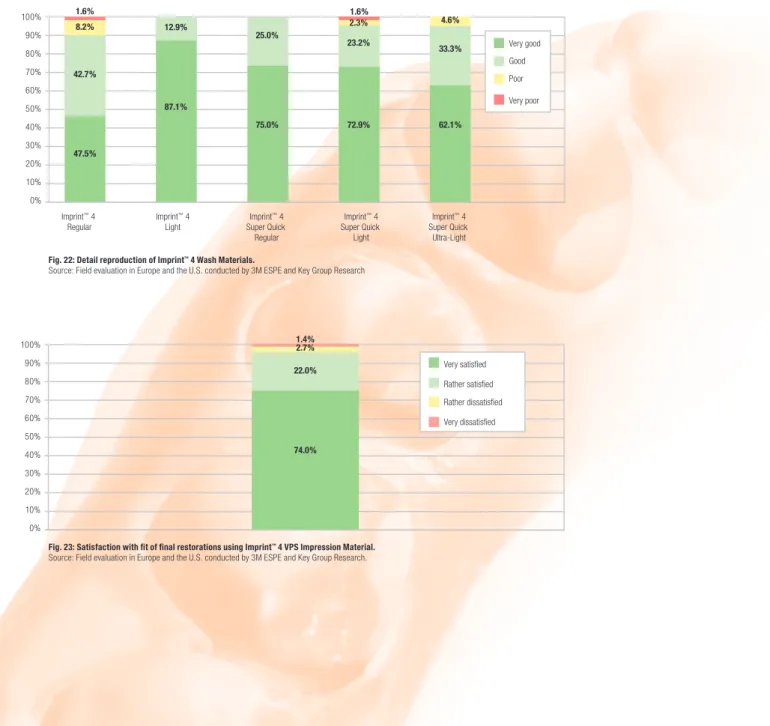
four countries – Germany, France, Italy, and the U.S. – participated in the evaluation. The dentists’ feedback confirms the very high clinical acceptance: 88% of the testers were very satisfied or satisfied with Imprint 4 VPS material (Fig. 18). 89% would recommend Imprint 4 VPS impression material to their colleagues (Fig. 19).
Fig. 18: General satisfaction with Imprint™ 4 VPS Impression Material.
Source: Field evaluation in Europe and the U.S. conducted by 3M ESPE and Key Group Research.
The short intra-oral setting time, combined with adequate working time (Figs. 20 and 21), was mentioned as one of the most significant application benefits. Impression accuracy including high detail reproduction (Figs. 22 and 23) was another reason for dentists’ overall satisfaction with Imprint 4. Imprint 4 material delivers extremely detailed and precise impressions thanks to its super-hydrophilicity, and thus allows for reliable and high-quality impression taking even under challenging moist conditions.
Fig. 19: Recommendation rate for Imprint™ 4 VPS Impression Material.
Source: Field evaluation in Europe and the U.S. conducted by 3M ESPE and Key Group Research.
Fig. 20: Dentists’ ratings for working time of Imprint™ 4 Tray and Wash Materials.
Fig. 22: Detail reproduction of Imprint™ 4 Wash Materials.
Source: Field evaluation in Europe and the U.S. conducted by 3M ESPE and Key Group Research
Fig. 23: Satisfaction with fi t of fi nal restorations using Imprint™ 4 VPS Impression Material.
Source: Field evaluation in Europe and the U.S. conducted by 3M ESPE and Key Group Research.
Fig. 21: Dentists’ ratings for intra-oral setting time of Imprint™ 4 Tray and Wash Materials.
Source: Field evaluation in Europe and the U.S. conducted by 3M ESPE and Key Group Research.
100% 90% 80% 70% 60% 50% 40% 30% 20% 10% 0% Very satisfied Rather satisfied Rather dissatisfied Very dissatisfied 74.0% 22.0% 1.4% 2.7% 100% 90% 80% 70% 60% 50% 40% 30% 20% 10% 0% Imprint™ 4 Regular Imprint ™ 4 Light Imprint ™ 4 Super Quick Regular Imprint™ 4 Super Quick Light Imprint™ 4 Super Quick Ultra-Light Very poor Poor Very good Good 33.3% 4.6% 62.1% 72.9% 23.2% 2.3% 75.0% 25.0% 87.1% 47.5% 42.7% 8.2% 1.6% 1.6% 12.9% 100% 90% 80% 70% 60% 50% 40% 30% 20% 10% 0% 80.3% 4.1% 14.1% 0.8% 0.7%
Clinical
case
Fig. 28: Imprint™ 4 Super Quick Light is syringed around the preparation using
3M™ ESPE™ Intra-oral Syringe Green.
Fig. 31: Final Lava™ Ultimate (3M ESPE) onlay restoration.
Fig. 30: Impression detail of the preparation area.
Fig. 29: Precision impression made in the 1-step heavy body/light body technique using Imprint™ 4 Penta™ Super Quick Heavy (tray material) and Imprint™ 4 Super Quick
Light (wash material). Fig. 24: Initial situation: glass ceramic inlay at tooth 46 needs to be replaced
due to chipped disto-lingual ridge and insuffi cient margins.
Fig. 26: To achieve optimum results, 3M™ ESPE™ Astringent Retraction Paste is
left on for 2 minutes.
Fig. 25: 3M™ ESPE™ Astringent Retraction Paste is injected
into the sulcus for hemostasis and gingiva displacement.
Fig. 27: Situation ready for impression taking.
Replacement of an insufficient glass ceramic inlay
3M, ESPE, Express, Imprint, Lava, Penta and Pentamix are trademarks of 3M Company or 3M Deutschland GmbH. Used under license in Canada. All other trademarks are owned by other companies.
© 2014, 3M. All rights reserved. XX (0X.2014)
3M Deutschland GmbH Location Seefeld 3M ESPE · ESPE Platz 82229 Seefeld · Germany [email protected] www.3MESPE.com