BR98I1332 FR170
RADIATION PROTECTION OPTIMISATION TECHNIQUES AND THEIR APPLICATION IN INDUSTRY
Dr. C. LEFAURE - CEPN
1st International Meeting on Industrial Radicprotection Sao-Paulo • Brazil - 17-20 March 1996
INTRODUCTION
Since the International Commission on Radiation Protection (ICRP) recommandation 60, the optimisation principle appears to be the core of the radiation protection system. In practice applying it, means implementing an approach both predictive and evolutionary, - that relies essentially on a prudent and responsible state of mind. The formal expression of this process, called optimization procedure, implies an indispensable tool for its implementation: the system of monetary values for the unit of collective dose. During the last few years, feed back experience corresponding to external occupational exposure shows that applying the ALARA principle means that a 'global work management approach' must be adopted, considering together all the factors contributing to radiation dose. In the nuclear field, the ALARA approach appears to be the more successful when implemented in the framework of a managerial approach through structured ALARA programmes. Outside the nuclear industry it is necessary to clearly define priorities through generic optimisation studies and ALARA audits. At the international level much efforts remain to be done to expand efficiently the
ALARA process to internal exposure as well as to public exposure.
L THE RADIATION PROTECTION SYSTEM : THE ROLE OF OPTIMISATION
Although the effects of exposure to high doses of ionising radiation lead to pathologies that are now well known (radio-dermatitis, cataracts, modification of blood formulations, etc...), these do not occur for low doses, which are those received by workers, public and patients during normal operation of various industrial, medical and nuclear facilities. Our knowledge of the risk of these low doses is still incomplete, though very intensive research has been carried out since the war. Observation, however, have clearly demonstrated that the predominant risk of low doses is an increase in the probability of cancer. The major uncertainty therefore concerns the relationship between cancer probability and dose.
disappears, and with respect to risk quantification, retaining the particularly cautious and practical assumption of a proportional relationship between the degree of exposure and the probability of the development of radio-induced cancer. This means that the risk of an individual developing radio-induced cancer after receiving a dose of 50 raSv (5 rem) is five times greater than if he had received a dose of 10 raSv (I rera).
Broadly speaking, the assumptions retained on the basis of the extrapolation of known data for instantaneous doses of over 0.2 sievert (20 rem) have led the international scientific community to estimate that there is a 5 % probability of an individual dying from radio-induced cancer if he has received an accumulated dose of 1 sievert (100 rem) during his lifetime. This corresponds to the unlikely case of a worker reaching the dose limit of 50 raSv (5) each and every year over a period of twenty years.
Since it has been cautiously assumed that the probability of cancer developing is proportional to the level of the individual dose, it is legitimate to add up these individual doses in order to estimate the excess number of cancer cases in an exposed population. For convenience, we shall call this sum collective dose (a notion that is obviously not based on biological grounds, but solely on epidemiological and statistical concepts), expressed in man-sieveit
Thus, for a hypothetical population of one million people who each receive a dose of 10 mSv (1 rem) accumulated over a lifetime, that is to say for a population whose collective dose is 1 000 man-sievert, the number of expected excess cancer cases would be 50; this excess would be the same for a population of 100 000 people who each receive a dose of 100 mSv (10 rem) accumulated over a lifetime, since the collective dose of this second population would be identical to the collective dose of the first
On the basis of these assumptions, even a very low dose could lead to harmful effect for the health; it therefore seems logical to attempt to reduce exposure resulting from human activities. From the moment a human activity involving exposure to ionising radiation (radiodiagnostics, nuclear power production, industrial radiography...) is deemed socially acceptable, that is to say if society considers ihat it will reap a net benefit therefrom, exposure must be reduced whenever possible. However, it is advisable to be « responsible », that is to say one must not waste resources or favour a group to the detriment of another.
The adoption of this cautious and responsible approach led to the elaboration of the optimization principle of radiation protection, or ALARA: « Exposure must be kept as low as reasonably achievable, taking into account economic and social factors » [1], The aim of such a principle therefore, is to seek the best compromise between the * residual risk », that is to say the risk that could remain after the implementation of protective measures, and economic and social criteria.
DOUBT OVER THE EXISTENCE OF A THRESHOLD FOR STOCHASTIC EFFECTS
fl
m
m
AS LOW AS REASONABLY ACHIEVABLE ZERO EXPOSUREFigure 1. The foundations of the optimization principle
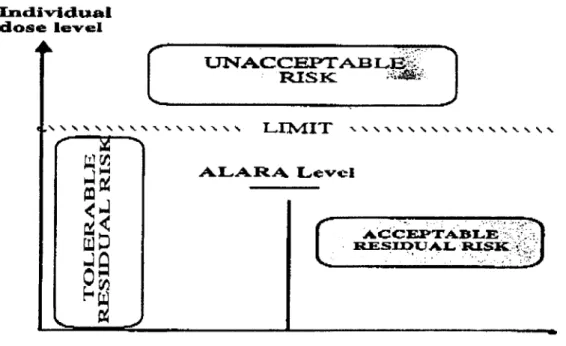
In its Publication 60 [2], the International Commission on Radiological Protection (ICRP) specifies the relative functions of the concepts of limit and optimization using the model known as risk tolcrability. An exposure limit is defined as the frontier between what is "unacceptable" and what is "tolerable." Thus, respecting a limit guarantees that an individual will not only suffer none of the pathologies known to be caused by high doses, but, in addition, that the probability of his eventually developing radio-induced cancer is not socially unacceptable.
those which are not only "tolerable," but also "acceptable" when protection has been optimized. A "tolerable" residual risk, therefore, may be considered acceptable from the moment that protection has been optimized. The model as a whole has been outlined in Figure 2: Individual close level UNACCEPTABLEI R I S K : -•*$ LIMIT ALARA Level
I
ACCEPTABLE RESIDUAL -I
Figure 2. The risk tolerability model
Furthermore, since the assumption retained is that the risk increases proportionally with the dose, international experts have recommended that for the application of the ALARA principle, the highest individual doses should be reduced in priority.
Finally one may stress that within the Radiation Protection System recommended by ICRP, the first principle i.e. the «justification » of a human practice ensures that a specific use of ionising radiation is deemed socially acceptable. Whenever one activity has thereby been justified, it involves an increased risk and the heart of the protection against that risk is the reduction ALARA of collective and individual exposures, verifying in a final step that no individual exposure exceeds the dose limit.
H. T H E O P T I M I S A T I O N : A P R E D I C T I V E B E H A V I O U R , A F O R M A L I S E D
P R O C E S S USING A M O N E T A R Y VALUATION O F T H E M A N - S I E V E R T
The effective implementation of the ALARA principle implies that all the persons concerned by radiation protection are aware of, and accept the assumptions upon which the principle of radiation protection optimization is based (see I above). This acceptance of the notion of residual risk is at the very foundation of each person's awareness of his responsibility and motivation in seeking the reduction of individual and collective risks. Therefore the ALARA approach corresponds essentially to a state of mind. From the practical point of view, applying radiation protection optimization should lead to a reduction in risk via the implementation of the most cost effective protection measures. This means implementing an approach that is both predictive and evolutionary. The approach is predictive, since, in order to «manage the risk», the doses associated with the planned work programme (industrial operations, medical examinations ...) have to be predicted, and possible protection measures have to be devised; the measures that are selected have to be compatible with available resources as well as equitable. It is an evolutionary approach because it has to be flexible enough to adapt to change in techniques, resources, and social context.
I I . 1. The ALARA procedure : a systematic and formalised process
Actually, health physicists and engineers, implement almost instinctively very often such a predictive approach, using sound technical judgement and past experience. If the solution to reduce cost effectively the risk is not immediately self evident, or ii" there is any need to justify later on the decision, it is worthwhile to carry out a systematic and formalised approach called the ALARA procedure'[3] within the framework of a process involving the various individuals concerned by the reduction of exposure.
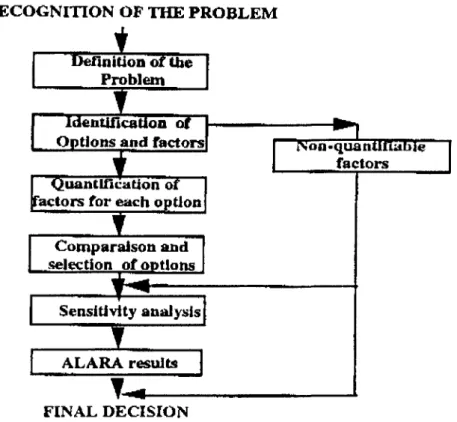
The key steps of this procedure are as follows: - to define the situation from the outset, setting boundaries to the analysis;- to identify alternative radiation protection options and to define the decision factors in terms of efficiency (collective doses, individual doses distribution) and costs (direct protection costs, impact of the options on other costs); - to quantify the factors for each option; - to make comparison of the options in order to select the optimal option or set of options. At this point the use of a reference system of monetary values of the man-sievert (see infra II. 2) is necessary to ensure that efficient and coherent decisions are proposed. Sensitivity analysis allows to check the robustness of the solution when some hypothesis have to be modified. This ALARA Procedure is merely an aid to decision making . The making of the decision itself remains the responsibility of the decision
considered important are explicitly included in the study. This helps to make decision-making, and the rationale behind final preferences, more transparent.
RECOGNITION OF THE PROBLEM
Definition of the Problem Identification of Options and factors!
JT
Quantification of factors for each optionComparison and selection of options Sensitivity analysis ALARA results FINAL DECISION rson-quanufiabJe factors
Figure 3. The ALARA Procedure steps
I I . 2 . The monetary valuation of the man-Sievert : model and statutes
In order to assess what are the reasonably achievable radiation protection options from an economic point of view, a monetary valuation of the unit collective dose (the cost of the man-Sievert , often referred to as the alpha value) is obviously essential. This concept first appeared in ICRP Publication 22 [4], in connection with the cost-benefit analysis model proposed by the Commission. The key feature of this model is to look for the minimum total cost i.e. the cost of protection plus the cost of the detriment defined as the monetary value of the potential health impact associated with the level of residual exposure. In its Publication 37 [5], ICRP emphasised the need to also take into account the 'subjective' aspects of health detriment such as the perception of risk by individuals, as well as risk transfers between various groups of population (public, workers, present and future generations).
Finally, in its last Recommendations, ICRP put more emphasise on the equity in the distribution of individual doses. The CEPN model presented hereafter has been developed during the late eighties in order to meet the following objectives: reduction of collective exposures, reduction of the dispersion of individual exposures with a priority for the highest individual levels of exposure. This model, largely inspired by the valuation scheme developed by NRPB [6] since the seventies, is generic enough as to allow its application to the various exposure situations (occupational, public, medical...) only by adapting the values of the parameters.
11.2.1. A model fitting with ICRP 60
In the field of risk management, the concept of equity usually refers to the aversion towards the dispersion of individual risks. The willingness to reduce in priority the dispersion of exposure for the highest levels of individual exposure corresponds to another notion in economic theory: the notion of prudence. The application of the concepts of aversion and prudence in the field of radiation protection, taking into account the hypothesis of a linear increase of risk with exposure level, means that one accepts to pay more in order to avoid a unit of exposure when the individual level of exposure increases, and, moreover, that this increment of the monetary value of exposure unit is more and more important. However, one assumption usually adopted is that under a certain level of individual exposure, the aversion towards the dispersion of individual exposure is not significant. Under this level, it seems then more appropriate to assume a constant monetary value for the unit of collective exposure. Above this level the monetary value of the man-sievert is increasing with the level of individual exposure, taking into account the degree of aversion to the dispersion of exposure. The proposed model for the monetary value of the man-sievert is the following [7] :
where:
otjjjfCd): reference monetary value of the unit of collective dose for the annual level of individual exposure d
d : annual level of individual exposure
o^m : basic monetary value of a unit of collective exposure
This model is illustrated in Figure 4 where the ordinate is the monetary value of the unit of collective exposure, and the abscissa is the individual level of exposure, generally in term of mean annual dose.
dBase
Monetary value of the unit of collective exposure
for d < do - dBase (d/do)» for d & do
Individual level of exposure (d)
Figure 4. A proposed model for the monetary valuation of the radiological detriment
In practice, in order to implement this model, it is necessary to give a value to the three parameters: 'aBa«', 'd0' and 'a1:
• The value of ' c t ^ ' represents the monetary value of the health detriment associated with one unit of collective exposure, i.e. the loss of life expectancy associated with one man-sievert. From the risk coefficients published by ICRP, the loss of life expectancy associated with one man-sievert is assumed to be equal to 0.88 year for occupational exposure, and to 1.16 years for public exposure. Two main methods can be used for the assessment of one life year: the Willingness To Pay approach which is based on the elicitation of individuals' preferences using contingent valuation surveys [8] or the Human Capital approach where the monetary value of one life year is given by the value of the Annual Gross National Product per inhabitant of the considered country.
• The value of 'd0' corresponds to the upper level of individual dose below which the
degree of acceptation of risk for the exposed population. In case of occupational exposure for example, it seems reasonable to adopt the value corresponding to the limit of individual exposure for the public (1 mSv/year).
• The 'a' coefficient reflects the degree of aversion to the dispersion of individual exposure. It can be demonstrated that 'a' must be greater than 1 to satisfy the three mentioned objectives. In case of occupational exposures, a range of values between 1.2 and L5 seems reasonable.
11.2.2. An international perspective
Many institutions in different countries have currently adopted systems of monetary values for the man-sieverL However, one characteristic feature of the international situation is the variety of statutes for existing values: values recommended by the authorities, values adopted by nuclear utilities and used internally, dialogue and negotiating tools between authorities and utilities.
Table 1. Recommendations of Authorities (US $ per man-rnSv)
Great Britain NRPB - 1993
Scandinavian countries (Radiological Protection Authorities) - 1991 United States (NRC) - 1993 Public Workers Patients: children Patients: adults Patients: the elderly
All situations Public-workers USS 30 USS 75 USS 150 USS 75 USS 15 USS 100 USS 100
As noticeable in Table 1 the recommendations of the authorities in different OECD countries range between US $ 15 and 150 per man-mSv. These values are generally assessed on the wealth of the country through the human capital approach. They are recommendations recognised by all of the professional bodies and institutions as being the lower boundary values which can be used to assist with decisions over radiological protection choices. The approach developed by the NRPB in Great Britain is currently the only one covering a great number of "different situations".
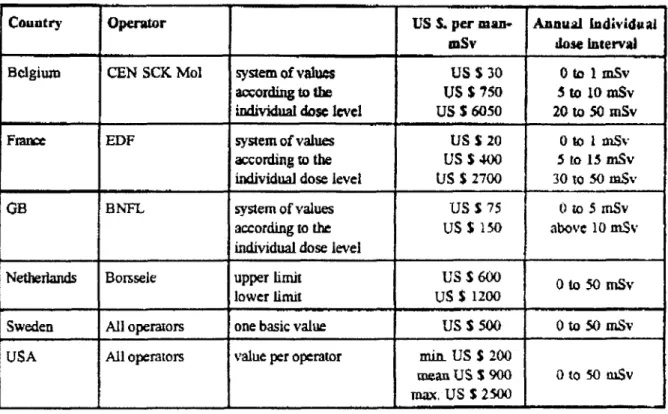
On the other hand, for many years, the nuclear utilities in many countries have had their own system of values for the dose unit. Table 2 clearly shows that their values are generally situated one order of magnitude higher than the authorities recommendations.
Table 2. Values adopted by nuclear utilities
Country Belgium France GB Netherlands Sweden USA Operator CEN SCK Mol EDF BNFL Boresele All operators All operators system of values according to the individual dose level
system of values according to the individual dose level system of values according to the individual dose level upper limit
lower limit one basic value value per operator
US S. per man-mSv US $30 US $ 750 US $ 6050 US$20 US$400 US $ 2700 US $ 75 US$ 150 US $600 US $ 1200 US$500 min. US $ 200 mean US $ 900 max. US $2500 Annual Individual dose interval 0 to 1 mSv 5 to 10 raSv 20 to 50 mSv 0 to 1 mSv 5 to 15 mSv 30 w 50 mSv 0 to 5 mSv above 10 mSv 0 to 50 mSv 0 to 50 mSv 0 to 50 mSv
In the United States, a study published in 1992 showed that each utility adopted "its own" monetary value for the dose unit In all cases this was a single value and the situation is marked by a wide range of values. This was also the case in Sweden up to 1994 when all nuclear companies have adopted the same basic value of US $ 500.
In France and Belgium, referring to the CEPN model, utilities have adopted systems with increasing values according annual individual dose ranges.
11.3. The reasonable cost method
The use of systems with several values of the unit of collective dose, according annual individual dose ranges, such as in France and Belgium tend to complicate the optimisation approach. In response to this, CEPN has developed a simple method, derived from the cost-benefit analysis, which is illustrated below for a valve inspection operation.
11
Each year, during the refuelling outage of a nuclear power plant, a valve must be disassembled for inspection and then reassembled The operation is carried out by three mechanics and it lasts five hours. Data from experience shows that the dose rate at the work-station is 0,5 mSv/b, and that there are only two sources contributing to this dose race: one pipe (0,4 raSv/h) which is filled with water throughout the work on the valve and the valve itself (0,1 mSv/h). The individual exposure to each mechanic is therefore 2,5 raSv and the total collective exposure for this operation is 7,5 man-mSv. The question raised by this situation is to ascertain whether the exposure level is as low as reasonably achievable, in other words, are there any radiological protection actions which could be applied, at reasonable cost, to reduce exposure even further?
For the purpose of this example, a single radiological protection action is planned, namely the installation of a shield between the pipe and the work-station, during work on the valve. For safety reasons, this shield cannot remain in place after the work has been completed. Both service workers carrying out the installation and removal of the shield spent 30 minutes in the area. After the installation of the shield, the dose rate at the workstation from the pipe is reduced to 0.1 mSv/h. This dose rate is added to the existing dose rate from the valve, which brings it to 0.2 mSv/h. However, the dose received by the service workers, at a rale of 0.5 mSv/h, must also be taken into account. The total collective dose therefore is reduced from 7.5 man-mSv to 3.5 man-mSv, due to a reduction of 4.5 man-Sv for the mechanics but including an additional dose of 0.5 man-mSv for the service workers.
The total cost of installing the shield is US$ 410 including the cost of an hour of labour by a service worker (at US$ 20 per hour) and the amortised cost of US$ 390 each time the shield is used.
This raises the question: is it reasonable to spend US$ 410 to save 4 man-mSv? The answer to this question obviously depends on the amount that the company is ready to pay to avoid a dose of one man-, or in other words, the system of reference monetary values for the raan-sieveit Since each specific type of worker is characterised by an average annual individual dose, a corresponding reference monetary value of me man-sievert can be assigned. Let us consider the example of the valve inspection, assuming that the mean individual annual doses to the mechanics and service workers are 12 mSv/year and 45 mSv/year, and the reference monetary values for the man-mSv are US$ 400 and US$ 2700 (see EDF Values - Table 2) respectively. These values are then used to determine the maximum amount that the company considers acceptable to spend on installing the biological shield, in view of the dose saving it represents. This amount is known as the "reasonable cost".
The nsa/innable cost can his drtfiiiOtl fur uach specific type of workers using the product of UJC
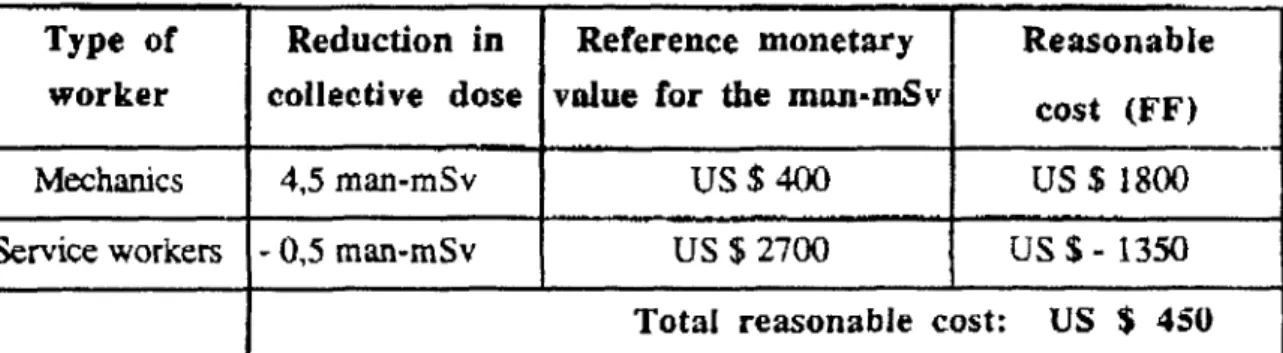
COlltCLivt Jn.ic icUuLlimt by lite inference monetary value of xhe raan-sieven. The total reasonable cost corresponds to the algebraic sum of the reasonable costs obtained for each specific category of workers. In the example given, this reasonable cost is US$ 450 (see Table 3) and leads to the shield being adopted since it only costs US$ 410.
Table 3. Reasonable cost assessment
Type of worker Mechanics Service workers Reduction in collective dose 4,5 man-mSv - 0,5 man-mSv Reference monetary value for the man-mSv
US$400 US $ 2700 Reasonable cost (FF) US $ 1800 U S $ - 1350 Total reasonable cost: US $ 450
11.4. The OPTIRP Software
During Ihe opeiatiou of mdusuial installations, in a large majority of the cases, decisions arc simplified to whether or not a particular protective action should be undertaken. When there is a choice of alternative or complementary radiological protection actions, one must choose the optimal combination of actions. In this case, one can use decision-aiding techniques. CEPN has therefore developed a software (OPTIRP) in collaboration with die NRPB as part of the Commission of the European Communities Radiological Protection research Programme.
This software allows to implement three different types of analysis ; • the cost benefit analysis
• the differential cost benefit analysis • the reasonable cost analysis.
The radiation protection options are characterised by two factors: The. collective do.se.
13
The selection of optimal options is made using a system of reference monetary values of the man-sievert. This system allows to obtain the monetary value of the collective dose associated with the protection options, in order to compare it with their financial protection
COSL The software give the possibility to take into account several monetary values of the
man-sievert depending upon the level of individual dose. The user can either create its own system of monetary values of the man-sievert, either use the library of systems input in the software.
11.4.1, Cost-Benefit Analysis
Given a set of options, the Cost-Benefit Analysis is based on the simple equation which defines the optimal option as the option minimising the total cost (financial cost plus detriment cost).
The detriment cost is quantified for each protection option by multiplying the total collective dose associated with the option by a monetary value of the man-sieverL
Cost-b«n»flt Analyst* 1200 dxt 100a "[• 800 " j o o • 20 30 40 50 -Prawtlian coll —-O— D«inm«nt C»«l ~>fr*Tom cart
TO Catadrv* d o »
11.4.2, Differential Cost-Benefit Analysis
Given a set of options, this method allows to select the "cost-effective" options by calculating the cost-effectiveness ratio which represents what has to be paid per unit of dose saved. This ratio is obtained by dividing the increment of cost between two options by the variation of dose between the 2 options.
The optimal option is the one presenting the higher cost-effectiveness ratio being lower tliau the reference monetary value of the man-sievert
Differential Cost-Ben*flt Analyst* Collective d<*» 1 O N D A - » « I Miactiwa oplton* M o M l w y VBJU* at ttw Optimum 20© 3 O 0 5 0 0 8 Q 0 1O00 Cart
11.4.3. "Reasonable" Cost Analysis
Given a set of options, this method allows to calculate the "reasonable cost" of each option by multiplying the increment of dose between two options by the monetary value of the raan-sievert This cost which represents what is "reasonable" to pay as a maximum, according to the dose saving is then compared to the actual financial increment of cost between the options. The optimal option is the one allowing the greater dose reduction being reasonable.
15
ALARA
AND OCCUPATIONAL EXPOSURE: A WORK MANAGEMENT APPROACHI I I . l . A global approach
During many years taking care of radiation protection, and of ALARA , was mainly the role of health physicists, who were essentially focusing on sources and dose rates reduction. There is now considerable evidence that applying the ALARA principle to occupational exposure means that a 'global work management approach1 must be adopted. Hie two main
characteristics of that approach are that - it implies the spreading of a common ALARA culture among all individuals- and it considers together all the factors contributing to radiation dose (dose rates, duration of exposure and number of workers involved in the work). Ambient du.w: rate Kxposure lime Number of workers
Figure 5. The work management system
In such a context the radiation protection actions to be envisaged are as well linked to the global organisation of the jobs (planning, scheduling, ...), to the management of working conditions (preparation of working areas, reduction of sources ...), to the choice of the job process (robots development, adaptation of tools to the environment...), as to the management of human factors (motivation, training, education...).
Taking into account work management factors during work preparation appears therefore as a priority. This phase of work is certainly the most important one as it has a direct impact on the '"good" realisation of works. It is during this phase that the feed-back experience will be used to improve work planning and procedure and that all aspects of work (schedule, working environment, tools, training of workers...) must be considered in order to optimise, for each job, the duration of exposure, the number of people exposed as well as the dose rates.
I l l , 2 Quantification of factors
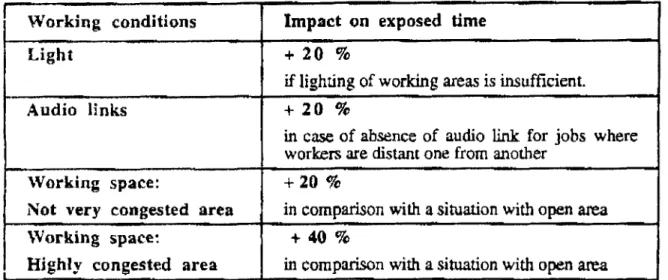
Since a few years much has been done to try to quantify the impact of all types of factors. As far as working conditions are concerned, four factors having an effect on the lengih of time a person work under radiation exposure, were quantified \9] : insufficient lighting, limited work space, provision of an audio link, and practical training of workers (Table 4).
Table 4. Impact of working conditions on the exposed time
Working conditions Light
Audio links
Working space:
Not very congested area Working space:
Highly congested area
Impact on exposed time
+ 20 %
if lighting of working areas is insufficient. + 2 0 %
in case of absence of audio link for jobs where workers are distant one from another
+ 20 %
in comparison with a situation with open area + 40 %
in comparison with a situation with open area
Another study [9] allowed to quantify the impact of wearing different individual protective clothing. This study took into account the operations in terms of the type of effort, the amount of work time, and the degree of precision required for the jobs. The results showed that the extra time needed to complete the job in protective clothing varied from 8% to 65% depending of the type of work (heavy or light, general or precise) and of the available space. It is now possible to take into account these factors when choosing the protective suit that will cause the least increase in the exposure time, while providing a sufficient level of protection for the given radiological conditions in which the job are to be carried out. It is
17
also possible to evaluate the impact of modifying these radiological conditions and therefore the type of protective suit needed.
The direct impact of some factors like the general organisation of tasks or the preparation of work is more difficult to quantify. Nevertheless, the importance of these factors has been underscored [9] in nuclear power plants by the analysis of routine maintenance and post-incidental operations. It would seem that between 20 % to 30 % of the collective dose associated with these maintenance operations could be due to mishaps. The main causes of mishaps where : a bad preparation of work (for example: scaffoldings not adapted, problems of schedules ...); -not adapted tools or malfunctioning ones; - a lack of workers training. It also proved possible to quantify the impact of the implementation of an ALARA approach, on the dose due to mishaps in the case of post incident jobs (Table 5). It was found that in the absence of a structured ALARA policy, approximately 70% of ihe collective dose comes from mishaps. However, if operating experience from earlier jobs is systematically used in the preparation stage, this percentage can be reduced on average to 10%.
Table 5, Effect of applying the ALARA approach on the proportion of dose due to mishaps for maintenance operations
Degree of implementation of the ALARA procedure Lack of a structured ALARA procedure No ALARA planning, but ALARA procedures
issued during the job ALARA planning and follow-up Unfamiliar technology used in the operation or
first operation of its kind ALARA planning and follow-up Use of feed back experience from earlier
operations
Average percentage of dose due to mishaps (min. - max.)
70% (50-80) 40% (30-50)
30 % (15-40) 10% (0-30)
111.3. Evaluation of protection actions
When evaluating radiation protection actions in connection with work management, it is important to differentiate between the "productive time" spent to complete the technical aspects of the job (given the level of technology available and the working conditions) from the time involved in dealing with various problems encountered during the job. The effectiveness of radiological protection actions can then be assessed, by varying the productive time (for instance, when the action consists in improving lighting in an area or modifying the tools needed to complete the job more quickly), by altering the time taken up by problems (for instance if area preparation work or job scheduling made it possible to eliminate mishaps), by altering the ambient dose rate, or by changing the number of workers needed to complete the job. From the economic point of view, the operating costs could be estimated by considering: the cost of entering the site, the cost of salaries, the cost of training, and the cost of waste disposal (from the protective clothing). The evaluation would involve calculating the number of shifts needed for each task and the total time taken to complete the job (including time spent in the area and time spent outside the area, the time to enter the work place, time taken in dressing and undressing, break time etc.).
Many empirical analyses, especially in the nuclear industry, suggest that during a first phasis, after a decision has been taken to implement ALARA through better preparation of the work and work management, the improvement of protection corresponds to a reduction of operational costs as illustrated in Figure 6. This is due to all what has been described in the previous paragraph : the reduction of mishaps, the impact of options on the duration of productive time and all the so called subsequent-operating-costs.
, , COLLECTIVE EXPOSURE
SAVINGS COSTS
19
I I I . 4 . Work management tools: the ALARA check-lists
Very efficient tools to ensure a good preparation of the work are the ALARA pre-job reviews made sufficiently early before the start of the work with die participation of the radiological protection workers and representatives of all the worker specialisms involved in the work, including members of contractor organisations.
During these reviews, the following three questions must be asked: • What are the highest dose tasks?
• What are the highest dose sources?
• What are the operator specialisms most affected?
Once these sources, tasks and specialisms on which radiological protection efforts must be concentrated in priority are identified, the systematic use of an ALARA check list makes it possible to cover the entire spectrum of possible radiological protection actions. In practice, these check lists rely on the judgement and experience acquired by the various participants, and have been found to be a particularly effective means of ensuring that die ALARA working group does not overlook any possible option.
Table 6 (next page) shows a typical ALARA pre-job review check-list.
ALARA check lists adapted to preparation the work by the maintenance workers and team leaders are also given in Appendix 1. These check lists can be used in the days or hours before the start of the work.
Table 6. Pre-job review check list
To be studied Yes No
Is there previous experience of similar operations ? Has it been taken into account ?
I,; Actions. /i>n*sources
Before shutdown : chemical filtration ? Decontamination ?
Configuration of circuits placing in water procedure ? Removal of a highly radioactive material ?
Other?
II; Protection
Biological: fixed, mobile, integral with the machinery ?
Against contamination : glove box ? Shielding ?
Integral with the tools ? Static containment ? Dynamic containment ? Sprinkling and drainage ? Adapted individual protection ? HI. Volume of work exposed Is this an essential task ? Is the procedure optimal ?
Is the task correctly scheduled ?
Is it to be entirely executed in an irradiated zone ? May some operators be moved to a distance ? Is number of operators justified ?
Is the distribution of work optimized ? Can doses be spread between operators ? Special tools for lessening dose exposure ? Opportunity for remote control or robotics ? Can clothing be modified to facilitate the work ? Improvement to ambient conditions (temperature, lighting) ?
Radio communications ? Televisual surveillance ? Easier access ?
Handling equipment available ?
Adequate superstructures ? (scaffolding, etc..) Standing, procurement areas ?
Procedures for packing equipment and waste ? Procedure for material evacuation ?
21
IV, A L A R A PROGRAMMES IN THE NUCLEAR FlELD
The success of the AIARA approach will be all the greater when implemented in the frameworic of a managerial approach through structured ALARA programmes (see figure 7), such as those implemented in many countries in ihe nuclear field. These programmes are characterised by:
• the determination at the end of the preparatory stage of any work, of optimized individual and collective doses goals that are not to be exceeded;
• the installation of a data acquisition system enabling a follow up of the evolution of these doses during the performance of the work programme in order to detect any drift and, if need, to implrtmrtnf corrective actions; statutory rinsimehic systems (films-badges) rarely enable such a follow-up or taking this type of decision, since they are only available with some deiay and incorporate all the activities performed during a month. Thus, it is generally not possible to accurately and rapidly determine the causes of the drift on the basis of film badge data. The use of an operational dosimetry system therefore seems essential at this stage;
• the analysis of results (i.e. ideally the dose iaiej> al workstations, the work exposure tunes, and collective and individual doses by task) and the explanation of any discrepancies in relation to objectives, indispensable for the proper analysis of feedback, that in turn permits the prediction and optimization of doses corresponding to subsequent work programmes. Preparation DOSIMETRIC OBJECTIVES ALARA PROGRAMME DOSIMETRIC PERFORMANCES Feedback experience FolloW'Up
To characterise this individual and collective dose management process, it is perfectly appropriate to refer to the various phases of a budgeting procedure:
• it begins with establishing a budget corresponding to the work programme for the coming year, becoming the objective to be attained once adopted,
• then, throughout the year, monitoring of the budgetary parameters liable to indicate a need for corrective action,
• finally, comparison of the expected and the actual results of the accounts at the end of the year, so as to better prepare the budget for the next year.
As in any budgeting procedure, it is also necessary to provide for an auditing system able to check that the overall ALARA programme is functioning correctly, that it is adapted to the situation and ensures that the optimum solutions are adopted. Such an audit system can either be internal to the organisation, in which case it must be independent from those who control the ALARA programme, or external to the organisation, calling upon institutions recognised for their expertise. Auditing can be implemented at the initiative of the management or at the request of the authorities.
Feed back experience shows that three major components are necessary LO ensure that ALARA programmes would be efficient:
• a commitment of all individuals involved in radiological protection • the existence of adapted structures
• the use of appropriate tools
I V . I . Commitment of all individuals
In theory, the ALARA principle corresponding mainly to a "state of mind" could be applied without any regulatory control. However, as in practice it necessarily involves calling behavioural patterns into question, the presence of a system of regulations, and particularly the will to apply iL play an important role.
Without the explicit commitment of the management on the need for applying ALARA principles, it is improbable that the objectives can be met. Efforts are liable to be patchy and it will be considered that not exceeding reference levels or limits will suffice. This need for an explicit commitment is all the greater in a country where ALARA culture is not
23
widespread. Commitment on the part of the management means that resources will be devoted to attaining the objective, i.e. provision is made for the structures and tools necessary for facilitating compliance with the commitment made (an example of such commitment is proposed in Appendix 2).
The commitment of the management is fundamental, but if the message is not clearly understood by the staff, or if they do not feel themselves to be involved in implementation of ALARA, there is little Likelihood that the programme will succeed It is therefore necessary to pursue a policy of motivation of staff, which can take many forms: training, supply of information, incentives etc... In nuclear power plants and many other nuclear power cycle facilities, a large proportion of the collective exposure is received by contractor staff (83% in 1993 in European PWR and BWR plants). For the programme to succeed, it is therefore essential that the managers, both of the plant and contractor companies, specifically pledge to apply the ALARA principle and co-operate effectively.
It is therefore important to:
• integrate reduction of exposure in the specification of the work to be performed, • study the dosimetric impact and the reasonable cost of contractor proposals, • include dosimetric objectives in orders,
• demand analysis of radiological protection experience feedback on closure of jobs.
I V . 2 . Dedicated structures ?
A key element of management's contribution to ALARA is having an organisational structure capable of ensuring that ALARA Is implemented. This structure must be sufficiendy flexible to avoid the organisational set-up or increasing prior administrative constraints. It can take different forms depending on the situation, but two basic trends are generally found in practice:
• In the first case. ALARA principles are considered to be a basic part of the general radiological programme, and the existing management bodies are adequate. Both for everyday management and in the special multidisciplinary committees set up to manage major projects, the radiological protection workers are always well represented and exert a considerable influence. This type of organisational set up was thus commonly encountered in the nuclear installations in UK, Sweden and Finland.
• In the second case, dedicated ALARA structures arc set up with a view to focusing attention on the application of ALARA principles. This type of structure is mainly
encountered in countries where ALARA culture is receot (United States, France, Belgium, Spain etc...)- What these structures are called and the particular form they take matters less than the functions they fulfil.
An ALARA structure generally consists of three basic parts:
1. the central part, the "ALARA Committee", headed by a senior manager,
2. the "ALARA Co-ordinator", engineer executive secretary of the Committee and responsible for implementation of the programme,
3. the ALARA project team or working groups with the task of making proposals and handling dossiers, organising ALARA reviews.
I V . 3 . Use of appropriate tools
Several kinds of tools are available to facilitate ALARA implementation: « project reviews fpre-job and post-job),
• check lists,
• ALARA interviews, • analytical tools,
• the man-sievert reference value system, • the radiological work permit,
• suitable dosimetry systems and databases.
During the job planning phase, these tools should make it possible to: • assess the expected individual and collective exposure,
• compare and select optimum actions, • set detailed exposure objectives. During execution of work:
• collecting accurate information on the basic tasks, • noting, describing and quantifying contingencies, • immediately implementing corrective actions. On completion of work:
• detailed performance analysis,
• evaluation of new developments, improvement of processes and organisation.
Figure 8 shows which stages of a job (planning, execution or building up an experience feedback file) correspond to the use of the different ALARA tools.
25
Preparation
. Analytical tools . ALARA pre-job . ALARA procedure . Decision aiding techniques . avaluet ALARA post-job . Reviews Feed-back reports . Data base Feedback experience ALARA TOOLS .HPWort Permit Operational job and area dosimrtry . ALARA meetings
Figure 8. ALARA tools and operational phases
Many of these tools have already been presented during this lecture, we will now only focused on the radiological work permit.
More and more frequently, in plants in a large number of countries, all workers must be in possession of a "radiological work permit" before entering a controlled area. These work permits generally contain the following information:
• date and time of job
• number of workers planned • brief description of job
• levels of dose rate and surface and air contamination • protective clothing required
» biological shielding required
• special safety measures (fire, release of gases etc.) • planned duration of job
In a nuclear power plant unit outage, 500 to 1000 work permits are thus issued. The use of radiological work permits has a number of advantages. Firstly, their issuing (whether subject to an ALAJRA project review or not) involves preparation and anticipation of the radiological protection requirements. Furthermore, radiological protection workers become well acquainted with all the operations planned in controlled zones and can thus monitor them
appropriately. In the field, the information contained in the permits fosters awareness of the radiological conditions of the job among the team leaders and workers. The work permit also makes it possible to control and thus limit entry, which constitutes an effective method of avoiding unnecessary entry into controlled zones.
V.
GENERIC STUDIES ANDALARA
AUDITS IN THE INDUSTRYOuiside the nuclear industry it is not obvious to implement ALARA programmes as well structured as in the nuclear field: - no specific structures are available,- the radiological risk appears to be marginal in many industrial firms, - sources are largely spread over a lot of firms... In such a context persons in charge of radiation protection are isolated, not well informed and do not know how to handle the optimisation process. It is then necessary to facilitate their job in clearly defining priorities through :
• generic studies at national level • ALARA audits
V . I . Generic studies at national level
Some expert teams at national or even international levels (from the authorities or the professional bodies), would propose optimised practices after the analysis of actual practices in a few firms. This analytical approach, will have - to rely, one way or another on operational even non sophisticated dosimetry, - and to lead to real optimisation studies. It will therefore be necessary to take can; of the different uses of ionising radiation in the industry', to analyse the work organisation, to define adapted protections, to appreciate the ircpact of these protections. The results of these studies will allow to provide data on optimised individual and collective exposure per task and thereafter to define «dose constraints* . It will then be possible for the person in charge of radiation protection to situate its firm's practice with regards to these dose constraints and to decide if it should be worthwhile to pursue some efforts in order to be closer to the optimised practice.
V . 2 . ALARA audits
Another way to help the responsible is to ask for an ALARA audit. Such audit should also be performed as periodic requirements whatever the dose trends. They may be prompted by internal management initiatives or regulatory authority requirements. They are never performed by individuals in charge of operational tasks.
27
Very efficient tools to implement an audit are the analytical trees. Such trees can be used as tools for identifying problems, investigating unwanted events (Le. accident situations), or Tor appraising systems to assess their effectiveness and appropriateness. An analytical tree consists of a major event or condition, which might be a desired objective or goal (positive tree) or an unwanted or injurious event (negative tree), together with all of the component events or conditions required to achieve the top event or condition. An example of a generic analytical tree is given in Figure 3. The user must decide how far to pursue the construction of the analytical tree, or in other words, how detailed to make it for a particular application. Generic analytical trees for different use sectors have been developed in a series of IAEA Publications. These can be adapted where necessary to be more site-specific or use-specific, and can be used for both simple and complex situations.
Figure 9. Effective occupational radiation control: (a) adequate control of source
VI. C O N C L U S I O N
Up to now much of the thinking in optimisation has tended to focus on occupational external exposure and is quite currently applied in the nuclear sector. Although the principle of optimisation clearly applies to all forms of exposure, it is often found in practice that internal exposure is treated in a very different manner to that for external exposure; with the approach being nearer to minimisation. Firstly unlike external exposure it is often quite difficult to predict the levels of intake and hence the doses; because so many variables come into play. The problem is compounded by the difficulties encountered for many isotopes in accurately measuring intakes that have occurred. Secondly internal exposure perception is quite different from the external one and leads to questions about the monetary man-sievert valuation. In case of public exposure the problem is even more complex as exposure is generally at a trivial level, but assessed with very conservative assumptions both in terms of radioactive releases (often the authorisations much more than the actual releases) and individual behaviour (consumption...). The tendency is now to go in a more realistic direction, and to convert ingested or inhaled Bq into fractions of sievert in order to check: - if the public exposure is reduced ALARA or not and what should be the cost and the efficiency of further reductions... There is then a need of monetary valuation of the man-sievert for the public in order to allow social transactions to be performed between those involved. This would tead to the distribution of residual risk between the groups of exposed population according to the expected and/or perceived benefits of each practice. In the future, the developments on the monetary value of the man-sievert should be focused on the necessary evolution towards a social risk management system.
29
APPENDIX 1
CHECK LIST OF ACTIONS NOT TO BE OMITTED
AUDIENCE: UTILITY AND CONTRACTOR MAINTENANCE WORKERS
Planning
1. Do you know exactly what you have to do? 2. Do you know the route to your work?
3. Have you checked that your work will not interfere with that of others? 4. Have you checked your tools before entering the zone?
5. Have you checked that nothing is missing and all are in a proper operating condition? 6. Are they adapted to the environment?
Environment
1. Are you aware of the exposure conditions of the work? dose rate?
risks of contamination ? positions of the main sources ? doses expected?
2. Do you know what collective shielding is planned and how it Is to be positioned? 3. Do you know what respiratory protection equipment you must use?
4. Do you know where you are to work? Where are the electrical outlets and utility connections?
5. Do you know what the nearest fallback point is for studying your work procedure sheet or waiting for another job to be completed?
If you do not know the answers to any of these questions, ask your team leader or the plant radiological protection worker.
APPENDIX 1 (continued)
CHECK LIST OF ACTIONS NOT TO BE OMITTED BEFORE OPENLNG A JOB SITE AUDIENCE: TEAM LEADERS
Planning
1. Hold a briefing session with ihe team before entering the controlled zone 2. In the briefing session, describe the work to be carried out
3. In the briefing session, describe the place where the work is to be carried out and the best route there in view of the radiological conditions (e.g. locations of hot points) 4. If necessary, describe any environmental constraints liable to complicate the use of tools and execution of the work (space, lighting, scaffolding, biological shielding in place etc.)
5. Indicate:
the provisional map the risk of contamination
the protection provided and its location che doses anticipated in performing the work
b. Indicate the fallback points
7. Indicate how the work is situated in the schedule relative to previous and subsequent work at the same place.
If you lack any of this information, ask the job co-ordinator and/or the radiological protection worker.
31
APPENDIX 2
Example of commitment on the part of the management: ALARA and EDF \ \
i
The process adopted by EDF in this field is noteworthy for a number of reasons. A j comparison of the collective doses received in French reactors with those received in similar operations in other countries, the unavoidable ageing of the plants and the associated increase in maintenance, and the small numbers of certain categories of siaff led the management of the French nuclear plant operating organisation to take the initiative of implementing an ALARA process throughout its facilities. Initially reserved for exceptional repair or maintenance operations (steam generator replacement from 1990, and the "reactor vessel head affair" from 1991), the process was subsequently made generally applicable in all the plants, resulting in the creation of a veritable corporate "ALARA Project". This project, intended to create a movement to ensure the adhesion of the different players to a common objective of dose reduction, covers different fields affecting radiological protection (training, good maintenance practice, optimisation of operations, collection and analysis of experience feedback, systems for gathering dosimetry data, relations with contractors etc.). The main thrust of this project is the objective of reducing the annual collective doses per unit from more than 2 man-sievert to 1.6 man.sievert on average in 1995 and to 1.2 man-sievert by 2000. This challenge was relayed by a policy of negotiating local dosimetry objectives (established on the basis of the past of each unit, the types of units and the operations planned), followed by integration of the latter in annual management contracts between the plant managers and the corporate management.
EDF thus set itself a goal of achieving better integration of ALARA radiological protection in overall corporate management by giving optimum reduction of exposure the status of a priority objective, alongside unit availability or cost control. This commitment on the part of the management also finds its expression in the publication in June 1993 of a "White paper on Radiological Protection" covering the radiological protection orientations and objectives within EDF, each objective being the subject of a local plan of action to be completed by the year 2000 and, in addition, by the appointment of a member of the Management Committee with the mission of implementing ALARA.
BIBLIOGRAPHY
flj International Commission on Radiological Protection, "Recommendations of the International Commission on Radiological Protection", Oxford, Pergamon Press, ICRP Publication 26, Annals of the ICRP, Vol.1, n°3, 1977.
[2] International Commission on Radiological Protection, "1990 Recommendations of the International Commission on Radiological Protection", ICRP Publication 60, Pergamon Press, Oxford, 1991.
[3] P. STOCKELL, J. CROFT, J. LOCHARD, J. LOMBARD, "ALARA from theory towards practice". CEC Report EUR 13796,1991.
[4] International Commission on Radiological Protection, "Implication of Commission Recommendations that Doses be kept as Low as Reasonably Achievable", ICRP Publication 22, Pergamon Press, Oxford, 1973.
[5] International Commission on Radiological Protection, "Cost Benefit Analysis in the Optimization of Radiation Protection", ICRP Publication 37, Pergamon Press, Oxford. 1983.
[6] M. CLARK, A. FLEISHMAN, G. WEBB, "Optimisation of radiological protection of the public (a provisional framework of the application of cost-benefit analysis to normal operation)", NRPB R-120, July 1981.
|7] C. LEFAURE, J. LOCHARD, T. SCHNEIDER, C. SCHIEBER, "Propositions pour un sysceme de valeurs mone"taires de reieYence de rhomme-sievert",
CEPN-R-193, FeVrier 1993.
[8] T. SCHNEIDER, G. LEBLANC, C SCHIEBER, "The use of the willingness to pay approach for the determination of monetary values of the man-sievert", In: IRPA 9, '15-19 April 1996, Vienna (to be published)
[9] C. SCHIEBER, M. PERIN, P. SAUMON, "ALARA and the work management", 3rd International Workshop on Implementation of ALARA at Nuclear Power Plant, BNL Ixmg Island New-York, May 8-11, 1994.
ACCJDENIES COIN MJENTES RA1MACT1VAS 11IIL1ZADAS EN LA 1NDU STRIA
Ellas Pfltocios
Elite National Regulador Nuclear, ARGENTINA
l.lNTRODLCCl6]N
hi uso de fuentes radiaclivas en disposilivos y proeesos industriales es?A ampliamente diflmdido en lodo el mundo. Estas tuentes posewi aetividades comprendidas cntrc varios MBcj y algunos dbq. Se utilizaii, principalmente, para la medici6n do puiatiieiros de proce.sos industrials, mi actividades pctroleras y en gammagrafia iticiusiiial.
Los estudios realizados por el Comii^ Cientiflco de las Naciones Unidas para e! Fsmdio de !as Radiaciones Atomicas1"4"' muestran que el 34% dc km Hccidenres K^VCIOS con victiinfl* fatales ocurridos entre ios aftos ]945 y J987 se debieron a fucntes industrial.es ffabla )) llstos apcidentes esrati iuertemente dominados por la practica de la gammasfi'afia industrial, la cual cs una tccnica no destructiva utilkada para investigar !a calidad dc soidaduras en
s. piezas de fundicion y ostmcturas
TABLAI
CASOS Dh SOBRKbXPOSlClON A LARADJACION OCUR1UDOS liN LA INDUSTRY A NUCLEAR Y NO NUCLEAR
Tipo de instalaciones Jnsialacioncs nucleares Instalaciones nn-nucleares Industria Investigacion Medicina N° de evemos 27 (34%) 42 (52%) 7 ( 9%) 4{ 5%) 80(100%) Sobrcexposicione^ 272 (64%) 84 (20%) 10 ( 2%) 62(14%) 428(100%) Muertes 5> (59%) 20 04%) • (-) 4( 1%) 59< 100°-o'!
En este trabajo se describe*] algunos accidentes severos con tiiemes sellada*;, \e anaiizan ii^ causan que han llevado a esas situaciones y se recomiendan aigunas acciones a seuuir para mejorai" la segiiridad de la psactioa
Se encuentran registrados en la bibliografia un numcro considerable cic accideoics ton fuentes aclladas de uso industrial. Sin embargo, los accidentes seveios quc provocaron victimns faialca en el publico se debieron casi oou exclusividad a la practlea de yammayraila industrial. Solo la NRC de Estados Unidos regisuo, entre el r" de abnl de 197] y el o de dicieinbre dc 1980, 48 casos de sobreexposicion accidental en gamrnagrafia industrial4,
varios de los cuales con serins consccuencias radiologicas. Algunos aecidentes significmivos ocurridos en el mundo se describen a contmuacion,
Ex Uni6n Sovi£ticn, 1960. Una persona demente encontro una fuente de M7Cs y id llevo en
el bolsillo del pantalon durantc algunos dias. Recibi6 una dosis inlioinogenca en todo cl cuerpo de 14,8 Ciy y presento sindrome agudo dc radiation despues dc 7 dias, lalleou * k>s
18 dias.
Mexico, 1962, Vn trabajador reoibio dc su cmplcador un contenedor con una ftjente 6K ?!i("u
de 0,1H Vbq para que la guarde en un lugar seguro, sin advertiric ci peligro que involucraba. El tiabajador, creyendo que sc trataba de algo valioso, la llevo a su casa y pur curiosidad abrio el blindaje donde se encontiaba alojada. Un hijo del trabajador saco la fuente v la puso en d bolsillo de su pantalon dande la Hev6 duiante algunos dias. Postenormenie el trabajador encontro una picza mctalica (la lliente) en algun lugai de ia oasa, !a reuuuio y la guard6 en una alacena en la cocina. E! etnpleador volvio a buscar el contenedor cuatro meses mas tarde.
Como consecuencia de lo ocurrido uno de los hijos del trabajador recibio una dosis en lodo cl cucrpo dc 30 a 50 Gy, otro de 14 a 18 Gy, la esposa dc 20 a 30 Gy, la suegra de i 5< a 30 Gy y todos ellos muricron, El trabajadoi, poi scr el que menos tienif?o permanecio en la vivienda en c»e periodo, recibio una dosis alta pero no letal.
Argentina, 1968, Vn soldador de una dcstilcria dc petroleo encont'6 una fuente dc 0.5 TBq dc Cs, la cua! habia sido extraviada por una empresa que rcal«/.ab« tineas de ganmiayrafia. El obrero recogio del piso una pieza metaiiea brillante sin saber que se trataba de una fuenie radiactiva y la guardo en uno de los bolsillos del pantalon duiante ese dia, tiausrnicndulii al olro bobillo al dia siguicntc. El responsable del equipo de gammagi aiia denuncio el exhavio dc la ilictuc a la autoridad regulatoria 24 d(as despues l.a ruente flie encoiurada en !H destilerin en el pantalon de trabajo de) operaiio, quien se encomraba hospitaiizado, io que permiti6 relacionar sus eiectos con la exposici6n a la ladiaciosi. Comu coHstxiienaa del accidente, cl invoiucrado recibio una dosis inhomogenca en todo el cusrpo dc 0.2 Gy y dos<s en la picl dc ambos muslos de 11.200 Gy y 17.000 Gy; la dosis en gonadas tiie esUmada ei^ 20 Gy. Al operario se le amputaron los dos miembros inferiores seis y ocho meses despucs del accidfinte
Jnpijn. 1971. Un obrero de la construcci6n encontro una fucntc dc !WIr en un astillcro y la
arrojo, sin conoccr su peligrosidad, dentro de un recinto utilizado por el personal. La tueme iue haJloda 8 dias despues. tiempo durantc cJ cual algunas personas la mantuvicron en sus manos Seis trabajadores recibieron dosis en todo el cuerpo entre 0,! y 1,5 GY y 4 dc cilos
dosis en manos de 26 a 90 Gy. Uno dc cllos presento sindrome gastrointestinal y en ottos 4 sc observwon lesionee en piel y depresion de celulas sanguineas
Esiados Unidos, 1976. En este a«o la NRC registr6 dos accidentes independientes con equipos de gmnmagraua. £n uno de ellos el operador sc aproxim6 y destornillo el tube m*ta cuando la fuente de )!2lr de 6,1 TBq no habia sido rctraida totalmente a! interior dc su
blindaje. El operador recibi6 dosis en manos dc 5 a 37 Gy que le provocaron eiitema y cngrosamiento de la piel en la palma de la mano dereclia
En el segundo accidente, el operadoi manipul6 cl tubo guia mientras la fucnte de 60Co de 6,1
TBq esiaba en su interioi, sin blindaje. Prcviamente el opcrador habia desconectado el sistema dc alarms de iadiaci6n. El operador rocibi6 dosis en manos de 15 Gy y de 0,1 Gy en el cristalmo, presentando eritcma y descamaci6n soca en la mano izquierda.
Sud Africa, 1977. Un ingeniero de mantcnimicnto Ievant6 del sueio de la fibrica. sin reconocerla, una fticnte de iy2ii de 0,25 TBq, La mostro a varios colcgos y !a !lov6 « su casu.
Los ires individuos mas expuestos recibieron dosis en todo el cuerpo de 1, i 6 Gy, 0,17 Gy y 0,1 Gy. La dosis en piel en el mas irradiado fue de 50 a 100 Gy y presento qucrnaduros en e! toiax y las niatios, lo quc rcquirio transplante de piel en el pecho.
Estados Uuidos. 1979. Un trabajador encontro una luente de Iy2lr, gin reconocerla, y la
coloco en el bolsillo trasero de su pantalon donde la llevo duranie 45 minutos El irabajadoi recibio una dosis en piel, en el gluteo derecho, de 200 Gy y 10 Gy a 7..S cm de profundidad HI irradiado presento serias quemaduras que lequirieron transplaulc dc pie! y eirugia rcparadota; el tratamiento 9e extendi6 durante dos afto$.
Marruecos, 1984. Una luente dc iy2lr se solt6 al scr retraida a eu biindaje quedando en el
suelo de la obra donde estaba stendo utiliz-ada. Una persona quc pusaba la levanto, desconociendo de que se irataba, y la llevo a su casa. Una famiiia Integra, compuesia por oclio personas, murieron como consecuencia de la sobtcexposicidn, Se. estimo la dosis recibida pui los niiembros de la famiiia en 8 a 25 Gy.
3. CALISAS » E ACCIDENTES
Al analizar las causas de lus accidentes con estc tipo de fuentes se observa que Lin iactoi predominante es la actitud negligente del responsable poi la operacion dd equipo. Esa actitud se manifiesta, lundamentalmente, violando prucedimientos elenwntaics pain monitorear la posicion de la ftxente durante la opciaci6n y luego dc finalizado los trabajos con la misma. En etecto, situaciones de sobre-exposid6n del operador por oreer que Id fuente se encuentra en su blindaje cuando en realidad aun permanece en cl tubo guia, eon muy fiecuentes.
Sin embat'go, los accidentes mas severos se debieron a la caida o perdida cie la fuente y *u posterior manipuleo por personas ajenas a la practica de gammagraiia Hn estos casos tambien la actitud irresponsable del operador, que no verifica con un medidor de radiacion
Una falla muy comiin es el desenganche de la fuente lo cual da lugar a ia caida y pe'rdida dc la fuente. La principal causa, en general, es la falta de mantenimiento adecuudo para conlrolar el desgaste progresivo del mecanismo de enganche. Solo en eomodas oportunidades ee obsorvaron fallas de desenganche de la fuente debidas ai diseflo o falla do matcrialcs.
En 1986 se ilevo a cabo con el patrocinio del Organismo interoacionai de Energ«a At6micn, un estudio sobrc las causas de flceidentes de gammagrafm industrial en lc>3 paises de Latino America. Se revisaron unos 20 accidentes observandose que en el 50H de los; casos aa debieron a fallas por desenganche o caida de la fuento seguido de la nogligencia del opcrador que no inoniloreo el area de trabajo a] finalizar la tarea.
CONCLUSION ES
La frecuencia de accidontes severos en gaminagrafia es alta y ocurren indcpendienienieute del grade dc desanollo del pais. La principal diferenda ntdica en que en )os patses con una estructura regulatoria debil, la mayor parte de Jas situaciones dc sobrccxposicion no son rcgistradaa o pasan inadvertidas para la ftutoridftd correspondiente.
Por otra parte, In seguridad de los equipos de gammagrafia industrial m.:iuainrior5te en uso depended fuertemente del opcrador y !a seguridad intrfnseca para evitai acx'identes es muy pobre. En particular sc debcrian introducir en el disefto del equipo sistcrvms quo j>crmitnn verificar la position scgura de la fuente, basados en la deteccion del campo dc ladiacion. dc mancra de reducir sensiblemente ta probabilidad de faJla
l-'aralelamente. las Autoridadcs Rcgulntoriaa dc los diversos paises deberian revisar sus requeiiinientos para oiorgar licencias de operacion cr. ganixnt'grafia mdLisiiial lVente a las numerosos casus de violacion de procedimientos y negligeticia observado^ En particular, las auturidudus debenan analizai' la necesidad de incrcmentar cl nivei de conoomieutoi extgsdos en sus regulacioncs, clarificando las obligaciones de los usuarios y las pc;u"iliUndei> a uphvai i* los infracuwes.
REFEUKNC1AS
(1) United Nations Scientific Committee on the Effects of Atomic Kadiations.
radiation: sources and biological effects. 1982. Report to the General Assembly, v-.ith annexes'. New York, United Nations, 1982.
(2) United Nations Scientific Committee on the Effects of Atomic Radiations. ' S effects dnd risk of ionizing radiations. H>88. Report to the General Assembly, >vith New York, United Nations, 1988.
0) United Nations Scientific Committee on the Hflfects of Atomic Radiations. '.Sources and unionizing radiation". New York, United Nations, 1993.