of International Studies © Foundation of International Studies, 2015 © CSR, 2015
Scienti
fi
c
P
apers
Jaroslav BelásTomas Bata University in Zlín Czech Republic
Email: [email protected] Přemysl Bartoš
Tomas Bata University in Zlín Czech Republic
Email: [email protected] Aleksandr Ključnikov Business and Law School Czech Republic
Email: [email protected] Jiří Doležal
Tomas Bata University in Zlín Czech Republic
Email: [email protected]
Abstract. Th e aim of this article is to defi ne and compare the major determinants of fi -nancial and credit risks between micro-, small and medium enterprises. Th e research of entrepreneurs’ opinions about business environment in Czech Republic was carried out in 2015. We found that fi nancial risk intensively impacts business environment, while only a small group of entrepreneurs stated they are able to properly manage those risks. Entrepreneurs agreed that the importance of credit risk increased during the crisis. Small and medium enterprises demonstrated better knowledge of credit conditions of commercial banks and gave more positive assessment of the transpar-ency of these conditions as compared to micro-enterprises.
Keywords: micro enterprises, small and medium enterprises, risk management, fi nancial risk, commercial bank, credit conditions
JEL Classifi cation: L 26, O 16, G 32
Received: May, 2015 1st Revision: July, 2015 Accepted: September, 2015 DOI: 10.14254/2071-8330.2015/8-3/2
Risk perception diff erences between micro-, small
and medium enterprises
INRODUCTION
Th e development of small and medium business is one of the basic preconditions for healthy economic development of the country. Small and medium enterprises (SMEs) play an important role in any market economy, because they can promptly meet the latest trends in demand and the needs and expectations of de-manding customers due to small fi rms’ higher adaptability and creativity. Th ey are an element of economic and social stability. (Májková, 2012; Fetisovová et al., 2012).
SMEs support the competitive dynamics of economic systems and have direct or indirect infl uence on large companies. Th is infl uence can be primarily noticed in the sector of increasing effi ciency and innova-tion. (Pavelková et al., 2009)
In this article we examine the selected approaches and attitudes of entrepreneurs from the SME sector to risk management, along with their risk perception features and diff erences, if any.
1. THEORETICAL BACKROUND
Most business decisions are carried out under conditions of uncertainty. Th is means that there is some uncertainty and randomness in the development of conditions for the business activities, during these activi-ties, and also in their results. If we are able to quantify the likelihood of diversions of actual processes and results from the expected level, we talk about risk. Th us the risk is quantifi ed uncertainty. (Fetisovová et al., 2012)
Business risk has a complex form because it involves multiple interrelated partial risks. Fetisovová et al. (2012) divide the entrepreneurial risk on: strategic risks, operational risks, fi nancial risks, social-political risks and reputation risks.
According to Hnilica and Fotr (2009) business risk can be considered as the possibility that real out-comes of the business activity will diff er from anticipated outout-comes, while and these deviations may be desirable (company achieve higher profi ts than planned) or adverse (company suff ers loss instead planned profi t); the magnitude of the variation may be variable. Th e authors classify the risks as production risks, economic, market, fi nancial, credit, legislative, political, environmental, personnel, information risk, and force majeure. Lusková, Hudáková and Buganová (2013) have the similar classifi cation of the business risks.
Enterprises that systematically manage key risks are able to eliminate these risks with signifi cantly high-er success rate than companies that do not have defi ned rules and structured approach to risk management. Th e companies with a comprehensive Enterprise Risk Management, which is typical especially for large and medium-sized enterprises, manage those risks at the most effi cient way. Less systematic ad-hoc approach is usual for small businesses, while most of them achieves mediocre results (Hudáková, 2013; Belás et al., 2014).
Best results are achieved by the enterprises that not only manage risks but also evaluate the eff ectiveness of its management. While the management of fi nancial risks (eg. foreign exchange and interest rate risk) and risks related to the insolvency of customers is common, businesses pay much less attention to other kinds of risks associated with their business partners, such as supply risks or market reputational ris. (Riadenie odberateľských…, 2013).
Association for Financial Professionals in cooperation with the Zanders Treasury and Finance Solutions Company conducted international survey targeted on global trends in risk management of enterprises in 2013. According to this survey, European companies consider the liquidity risk, foreign exchange risk and reputa-tion risk to be the biggest threat to their business. Great attenreputa-tion is paid to both business and counterparty default risk, whether in terms of credit risk of customers or the fi nancial stability of suppliers, banks and
other providers of fi nance. Th e results obtained from the survey also show that the most common objective of risk management in enterprises is to eliminate risks impact on the income statement (92 %) and to ensure compliance with legal requirements (91%). About 90 % of companies stated that they are more aware of the need for better risk management in the post-crisis period and they started to act like that, have imple-mented new internal controls and change processes in order to eliminate the risks; 23 % of companies have created special risk management teams, 81 % of privately held companies (not listed on a stock exchange) have implemented a program for active risk management. Th is means that the diffi cult market situation in the post-crisis period forced not only large companies, but even small businesses to pay attention to risk management (CFO, 2013).
According to the survey conducted by Th e Economist Intelligence Unit and Dun & Bradstreet in 2013, enterprises consider business risks associated with selling dependence on a small number of customers or specifi c market segments, credit risk (the risk of insolvency), and high administrative costs and time associ-ated with processing customers’ demands, to be the most signifi cant (Riadenie odberateľských…., 2013).
Th e aim of SMEs is to maximize profi t, while the objective of the process of risk management is to iden-tify, analyze, evaluate, treat and monitor the risks that could endanger the profi t of the company. Success of SMEs depends on their ability to adapt to varying conditions and unstable business environment in which they carry out their business activities. Risks arising from the volatility of the business environment represent the potential sources of crises for SMEs, which often lead to the termination of their business. Th e need to manage risks fast is based on the fact that a large number of SMEs is forced to terminate their business al-ready in the fi rst year of the business. Underestimation, mismanagement, respectively ignorance of business risks is the way to bankruptcy, and therefore it is necessary to choose the right form of risk management. Often the lack of knowledge and experience of the owners and managers in the risk management is a big problem in small and medium-sized enterprises (Buganová, 2013; Belás et al., 2014; Kozubíková, 2015).
Th e actual process of risk management has the great importance in achieving business goals in the seg-ment of SMEs. Th e risk management should implement the following activities: clearly formulated policies, strategies and objectives of risk management, proposed framework, principles and structure of the risk man-agement process, defi ned processes, methods and tools in the process of risk manman-agement, clearly established responsibilities and powers in the context of risk management, risk management system and its processes must be continuously monitored, evaluated, documented and improved. Th e core of risk management sys-tem is to learn how to live in the company at risk. It’s not just about to consider risk or to eliminate it, but it is more about to consider risk as part of SME at all levels. Total ignorance of the risk in nowadays is a very dangerous strategy that leads to crises which may have very devastating impact on the company (Buganová, 2013;Belás et al., 2014).
In our regional survey we found that the most important business risks which were perceived by entre-preneurs in the Czech Republic and Slovakia were as follows: market, fi nancial and personnel risks. Financial risk (poor access to fi nancing) was identifi ed as a key risk by 57.22% of entrepreneurs in the Czech Republic and 58.54 % in Slovakia (Belás et al., 2014).
SMEs in contrast to large enterprises are faced with a competitive disadvantage in the fi nancial, manu-facturing, personnel, legal and strategic fi eld (Pavelková et al., 2009) resulting from the nature of small and medium businesses (Májková, 2012).
Th e size of a company can play an important role in the context of obtaining external fi nancial sources and their prices. Smaller companies have greater diffi culties in obtaining external fi nancial resources (Kalus-ová and Fetisov(Kalus-ová, 2015; Pervan and Kuvek, 2013; Fetisov(Kalus-ová et al., 2012) and therefore have to pay higher prices (Ozturk and Mrkaic, 2014; Blazy and Weill, 2013; Fetisovová et al., 2012).
Higher risk of SMEs is determined by a low degree of diversifi cation of their business activities, small capital strength, limited access to credit, the method of liability of the owners and lower managerial skills (Fetisovová et al. 2012).
Kundin and Erecgovac (2011) have found that from 2008 to 2010 the interest rates for SME fi nancing increased from 124 basis points to 264 basis points. Th ey have also reported that the size of the fi rm plays an important role in getting fi nancing from the banks in the period of foundation. As the size of the fi rm increases, the interest rate decreases due to positive information about the fi rm in the market. During the period of fi -nancial distress, the credit spread between large fi rms and small fi rms grows and in the countries with high risk perception most of the SMEs are denied for credit. Th e increased borrowing costs for SMEs also increased the probability of default and hence, they were more vulnerable in the fi nancial distress periods.
Neuberger, Rathke, and Schacht (2006) state that the number of bank relationship increases with the fi rm size, because a larger fi rm needs more fi nancing and sometimes it is not possible to get the fi nancing just from one bank. Moreover, bank relationship deceases with fi rm category, manufacturing fi rms prefers to be with only one house-bank, in contrary service organization prefers to have more than one bank relationship for fi nancing. However, in contrast to previous research, they do not fi nd any signifi cant negative relation-ship between more than one bank relationrelation-ship and reduced supply of credit to small business. Nevertheless, the results show that, the relationship is higher for the micro fi rms and they are relying in relation to bank loans on the small mutual banks and the medium sized enterprises are having relationship with big banks.
Bruns and Fletcher (2008) found that, the availability of collateral, past fi nancial position and business competency are the determinant factors for enhancing credit. On top of that, CEO’s maturity and human capital, business plan and borrowers share to the investment also play an important role for granting the credit. Th ey have stated that CEO’s human capital can positively aff ect the future performance of the busi-ness and it can reduce the probability of future busibusi-ness failure.
Hanedar, Broccardo, and Bazzana (2014) brought a very interesting discovery in the fi eld of lending to SMEs. Th ey have examined the relationship between collateral requirements and loans to SMEs in 27 de-veloping and emerging economics in central Europe and Asia. Th e results show that, collateral requirements are more pronounced for the medium fi rm’s rather than micro or small fi rms. Th ey have argued that, most of the micro and small fi rms do not have enough assets to use it as collateral, thus they fi nd micro credit or informal institutions to be more useful sources of fi nance. Borrower’s credit features does aff ect the collateral in the developing countries, when the riskiness of the borrowers increases collateral can mitigate the adverse selection problem to a certain extent. However, they did not fi nd positive or negative eff ect of collateral and loan prices, it can be suggested that, collateral cannot reduce the interest rate of the loans in the selected countries. Th ey also did not fi nd any signifi cant relationship between information sharing by SMEs and banks in the competitive market. Hence, they did not fi nd any relationship between loan prices and trust-worthiness while lending to SMEs. Th ey have found that, SMEs situated in the cities, where there are more banks providing loans, the lower amount of collateral is requested in comparison to SMEs those are situated to the rural areas. Th ey argue that, in the rural areas there are not so much options to take loans because the number of banks are limited, hence they have to pay higher margin of collateral to take the loans.
2. RESEARCH OBJECTIVE, METHODOLOGY AND DATA
Th e aim of the article is to defi ne and compare the signifi cant attributes of risk management in the environ-ment of SMEs depending on the size of the company. Within the stated objective we compare the attitudes and approaches of entrepreneurs who own micro-enterprise with owners of small and medium-sized enterprises.
Th e survey of the quality of the business environment was carried out in the fi rst half of 2015 through a questionnaire on a sample of 1,141 respondents in the Czech Republic. Th e method of choosing companies was as follows. We randomly selected a total of 1650 companies from the Albertina database. Th ese companies were contacted via email, where the business owners were asked to complete a questionnaire, which was placed on the website1. If these companies had not responded to our mail, we addressed them by telephone.
Th e structure of the respondents was as follows: 75% men, 25% women; 48% of respondents reported that they have secondary education, 34% had the university degree and 18% reported that they have second-ary education without graduation; 65% of the total number of companies are micro enterprises, 27% are small enterprises and 8% are medium-sized enterprises. 62% of companies’ owners stated that the company exists for more than 10 years, 21% of them stated that they operate a maximum of fi ve years and 17% of them reported that the company belongs to an interval of fi ve to ten years of existence.
In accordance with the recommendation of the European Commission no. 2003/361 / EC we separated microenterprises employing 0-9, small enterprises (10-49 employees) and medium-sized enterprises (50-249 employees) within the category of SMEs in the questionnaire.
Respondents were representing the following sectors: trade (33%), manufacturing (23%), construction (14%), transport (6%), agriculture (3%) and other services (39%).
Based on research by other authors, which we presented in the previous section of the article and based on our own research in this fi eld we assume that the quality of the business environment is determined by the external environment (state, company, banks, business risks) and subjective characteristics of entrepre-neurs (gender, education, size and age of the company).
In this article we set out fi ve scientifi c hypotheses by the method of expert estimation:
H1: Financial risk intensively acts in the business environment. At least 70% of entrepreneurs agree with this opinion. Th ere are no statistically signifi cant diff erences in the responses of micro-enter-prise (ME) and larger entermicro-enter-prises in segment SMEs (LSMEs).
H2: Entrepreneurs can properly manage fi nancial risks in their companies. Up to 30% of entrepreneurs agree with this opinion. We assumed that LSMEs will to a greater extent agree with this opinion, in comparison with ME.
H3: Th e importance of credit risk increased during the crisis. At least 60% of entrepreneurs agree with this opinion. We assumed that LSMEs will to a greater extent agree with this opinion, in compari-son with ME.
H4: SME entrepreneurs are well informed about the conditions under which banks provide loans. Up to 30% of entrepreneurs agree with this opinion. We assumed that LSMEs will to a greater extent agree with this opinion in comparison with ME.
H5: Th e conditions under which banks provide loans to SMEs are transparent. Up to 30 % of entre-preneurs agree with this opinion. We assumed that LSMEs will to a greater extent agree with this opinion, in comparison with ME.
Statistically signifi cant diff erences between the designated social groups were compared through Pear-son statistics at signifi cance level of 5%. If the calculated p-value was lower than 5%, we reject the null hypothesis and the alternative hypothesis was adopted. Th e calculations were made through the free software available at: http://www.socscistatistics.com/tests. Statistically signifi cant diff erences in individual responses were investigated by means of Z-score. Th e calculations were made through the free software available at: http://www.socscistatistics.com/tests/ztest/Default2.aspx.
1 https://docs.google.com/forms/d/1U9coaC5JRL0N2QOOO6Xb8j3mnaZXdSM47Kugt4EDGFo/viewform?
3. RESULTS AND DISCUSSION
Table 1 presents the results of research on the assessment of fi nancial risk intensity.
Table 1 Assessment of fi nancial risk intensity in the Czech Republic. Source: own source
Financial risk intensively acts on the business environment (poor access
to external sources of fi nance, poor pay-ment discipline, etc.).
ME LSMEs p-valueZ-score
1. totally agree 120 61 0.6599 2. agree share in % (1+2) share in % total: 77.56 456 77.84 75.00248 0.7642*0.9442 3. take no position 109 51 0.3524 4. disagree 50 38 0.1010 5. completely disagree 5 3 0.8887 Together: 740 401 Chi-square p-value 3.4313 0.4884 *p-value is cumulative, includes responses 1+2
Source: own calculation.
H1 was confi rmed. More than 70% of entrepreneurs agreed that fi nancial risk intensively acts in the business environment. We found that there were no statistically signifi cant diff erences in the responses of ME and LSMEs.
In this context, we can present that the results of our fi ndings are comparable to Fetisovová et al. (2012) and Májková (2012).
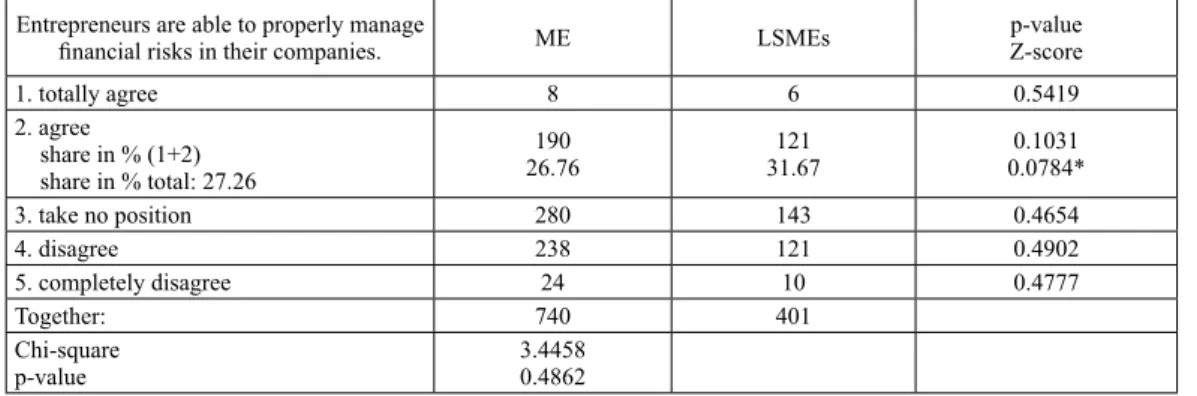
Table 2 presents the results in the fi eld of risk management. We asked entrepreneurs if they believe that they can properly manage fi nancial risks in their companies.
Table 2 Th e ability of entrepreneurs to manage fi nancial risks. Source: own source
Entrepreneurs are able to properly manage
fi nancial risks in their companies. ME LSMEs
p-value Z-score 1. totally agree 8 6 0.5419 2. agree share in % (1+2) share in % total: 27.26 190 26.76 121 31.67 0.1031 0.0784* 3. take no position 280 143 0.4654 4. disagree 238 121 0.4902 5. completely disagree 24 10 0.4777 Together: 740 401 Chi-square p-value 3.44580.4862
H2 was confi rmed. 27.26% of entrepreneurs stated that they are able to properly manage fi nancial risks in their business. We found that there were no statistically signifi cant diff erences in the responses obtained from ME and LSMEs.
Th ese results are diff erent from the results of our regional research conducted in 2013, in which 41% of entrepreneurs in the Czech Republic said that they are able to properly manage fi nancial risks in their business. (Belás et al., 2014)
We expect that our current research, which was conducted throughout the whole Czech Republic better describes the situation in fi nancial risk management in SMEs.
Table 3 presents an assessment of entrepreneurs in the current credit risk exposure.
Table 3 Assessment of the current credit risk situation in the company. Source: own source
The importance of credit
risks increased during the crisis. ME LSMEs p-valueZ-score
1. totally agree 61 40 0.3271 2. agree share in % (1+2) share in % total: 63.45 397 61.89 226 66.33 0.1362*0.0000 3. takes no position 217 97 0.0643 4. disagree 56 37 0.3271 5. completely disagree 9 1 0.0949 Together: 740 401 Chi-square p-value 22.2784 0.0002
Source: own calculation.
H3 was partially confi rmed. We found that 63.45% of all entrepreneurs agreed with this statement. Our assumption that LSMEs would agree more with this opinion in comparison to ME was not confi rmed (p-value = 0.1362).
According to our fi ndings Czech entrepreneurs agreed with the opinion that the importance of credit risk increased during the crisis grew. In this regard, the results of our research are compatible with the conclusion of Kundin and Erecgovac (2011). Assessment of the current situation in the credit risk is not dependent on the size of the company, therefore our fi ndings are diff erent from the conclusion of Kalusová and Fetisovová (2015), Pervan and Kuvek (2013) and Fetisovová et al. (2012).
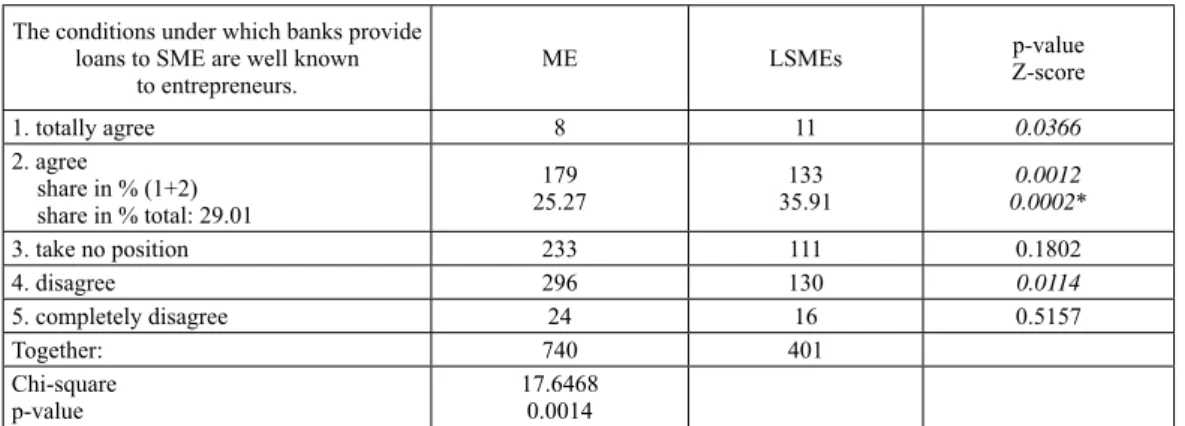
Table 4 presents the results of research in the fi eld of understanding of credit conditions by entrepre-neurs.
Table 4 Th e degree of understanding of credit conditions. Source: own source.
The conditions under which banks provide loans to SME are well known
to entrepreneurs.
ME LSMEs p-valueZ-score
1. totally agree 8 11 0.0366 2. agree share in % (1+2) share in % total: 29.01 179 25.27 133 35.91 0.00020.0012* 3. take no position 233 111 0.1802 4. disagree 296 130 0.0114 5. completely disagree 24 16 0.5157 Together: 740 401 Chi-square p-value 17.64680.0014
Source: own calculation.
H4 was confi rmed. 29.01% of entrepreneurs stated that they know the conditions under which banks provide loans to SMEs. Our assumption that LSMEs will to a greater extent agree with this opinion in com-parison to ME was confi rmed (p-value = 0.0002).
Th e results of our research showed that knowledge of credit criteria among Czech entrepreneurs is relatively low, thereby they are losing mentioned advantages and opportunities. In this context, for example Behr and Güttler (2007) see the solution on the side of the company to understand banks’ approach within the evaluation of creditworthiness and also to be able to evaluate their expected probability of default (PD) using rating model. Th is fact could help fi rms to understand their position from the bank’s point of view. Also this fact would lead them to be more willing provide necessary document about themselves for better assessment of their creditworthiness and also it would lead to the possibility of further negotiations between the bank and the company about credit conditions. According to authors, knowledge of own PD also allows the company to increase transparency in credit process. As well as it allows potential use for searching of external funding sources. If SMEs have knowledge about their creditworthiness, they may aff ect manage-ment decisions in favor of new sources of external funding due to the expanding range of fi nancing options.
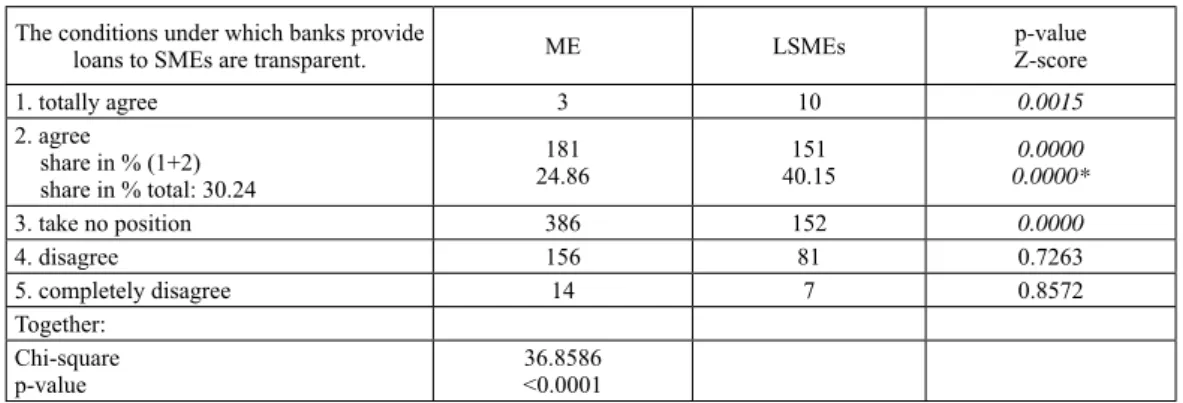
Table 5 presents an assessment of transparency of credit conditions by entrepreneurs.
H5 was partially confi rmed. Th e fi rst part of the hypothesis was not confi rmed, because we found that 30.24 % of entrepreneurs stated that they consider credit conditions to be transparent. Th e second part of the H5 was confi rmed, because we found that LSMEs agreed to the greater extent with this opinion in comparison to ME.
Table 5 Transparency of credit conditions. Source: own source
The conditions under which banks provide
loans to SMEs are transparent. ME LSMEs p-valueZ-score
1. totally agree 3 10 0.0015 2. agree share in % (1+2) share in % total: 30.24 181 24.86 40.15151 0.0000*0.0000 3. take no position 386 152 0.0000 4. disagree 156 81 0.7263 5. completely disagree 14 7 0.8572 Together: Chi-square p-value 36.8586 <0.0001
Source: own calculation.
According to our fi ndings, even employees of commercial banks do not know the exact credit condi-tions in the Czech Republic. In discussion with bank experts we found that only a narrow group of bank specialists knows for example weights of the rating models, which are used to evaluate the credit worthiness of SMEs in the bank, and banks in every way prevent the disclosure of these conditions. Th e banks assume that clients would abuse the knowledge of exact credit conditions for obtaining „bad credit“(credit with higher probability of default) (Belás et al.,2014).
On the other hand, it is strange if arbitrary interference in credit conditions may result in the situation that the bank will not extend the length of the credit for the client even in case that its fi nancial situation improved.
CONCLUSION
Th e aim of the paper was to defi ne and compare the signifi cant attributes of risk management in an environment of SMEs depending on the size of the company. Within the stated objective, we compared the attitudes and approaches of entrepreneurs who own micro-enterprises with the owners of other small and medium-sized enterprises.
Th e current business conditions for SMEs are very challenging. Th e business environment is deter-mined by a signifi cant decline in purchasing power of demand. Th is puts pressure on the amount of sales achieved and increases fi nancial risk. SMEs are then less able to access external fi nancial sources.
It is inevitable that the management of signifi cant risks in the business environment depends on the top managers in the company. Many of them are also owners of these companies. In our research we found that knowledge of the owners of SMEs in the management of fi nancial and credit risks is not excellent. We also found that owners of SMEs know conditions better, consider and think about them as transparent in the greater extent compared to micro-enterprises. We assume that one of the main reasons for this is that larger companies can be more successful in obtaining loans. Conversely, micro-enterprises, which are often fi nanced by their own resources, can not know the credit conditions of the banks, and therefore are nega-tively evaluat ed by them.
ACKNOWLEDGMENTS
Th e authors are thankful to the Internal Grant Agency of FaME TBU No. 005/IGA/FaME/2014: Optimization of
parameters of the fi nancial performance of the commercial bank, for fi nancial support to carry out this research.
Th e authors are thankful to the Internal Grant Agency of FaME TBU No. 000/IGA/FaME/2015: Th e possibilities
of the fi nancial performance growth for commercial banks in the context of the credit risk of SME and the customer satisfaction, for fi nancial support to carry out this research.
REFERENCES
Behr, P., Guettler, A. (2007). Credit Risk Assessment and Relationship Lending: An Empirical Analysis of German Small
and Medium-Sized Enterprises. Journal of Small Business Management 45(2): 194-213.
Belás, J., Macháček, J., Bartoš, P., Hlawiczka, R., Hudáková, M. (2014). Business risks and the level of entrepreneurial
optimism of SME in the Czech and Slovak Republic. Journal of competitiveness, Vol. 6, Issue 2, s.30-41.
Belás, J. a kol. (2014). Podnikateľské prostredie malých a stredných fi riem v Českej a Slovenskej republike. Žilina: Georg.
Belás, J., Bartoš, P., Hošták, P., Hlawiczka, R., Demjan, V. (2014). Determinants of credit risk of SMEs in the banking
sector of the Czech Republic and Slovakia. Proceedings of the 19th Annual International Konference on Macroeconomic
Analysis and International Finance, May 29.-31., Rethymno, Greece.
Belás, J., Bartoš, P., Habánik, J., Novák, P. (2014), Signifi cant Attributes of the Business Environment in Small and Med-uim-Sized Enterprises, Economics and Sociology, Vol. 7, No 3, pp. 22-39. DOI: 10.14254/2071-789X.2014/7-3/2
Blazy, R., Weill, L., (2013). Why do Banks Ask for Collateral in SME lending?Applied Financial Economics, Vol. 23(13),
pp. 1109-1122.
Bruns, V., Fletcher, M. (2008). Banks’s Risk Assessment to Swedish SME’s. Venture Capital, Vol. 10(2), pp. 171-194.
CFO.(2013).Risk manažment: najväčšie riziká, ktorým čelia európske fi rmy. Avalable at:
http://www.cfo.sk/articles/risk-manazment-najvacsie-rizika- ktorym-celia-europske-fi rmy#.UjbZIMZM-Qo
Fetisovová, E. a kol. (2012). Aktuálne problémy fi nancií malých a stredných podnikov. Bratislava: Ekonóm.
Hanedar, E.Y., Broccardo, E., Bazzana, F. (2014). Collateral Requirements of SMEs: Th e Evidence from Less developed
Countries.Journal of Banking and Finance, Vol. 38, pp. 106-121.
Hnilica, J., Fotr, J. (2009). Aplikovaná analýza rizika ve fi nančním managementu a investičním rozhodování. Praha: Grada.
Kalusová, L., Fetisovová, E. 2015. Determinanty fi nančnej štruktúry slovenských malých a stredných podnikov.
Eko-nomický časopis, Vol. 63, No. 3, pp. 278-300.
Kundin, A., Erecgovac, R. (2011). Credit Rationing in Financial Distress: Croatia’s SMEs Finance Approach.
Interna-tional Journal of Law and Management, Vol. 53(1): 62-84.
Kozubíková, L., Belás, J., Bilan, Y., Bartoš, P. (2015), Personal characteristics of entrepreneurs in the context of
percep-tion and management of business risk in the SME segment, Economics and Sociology, Vol. 8, No 1, pp. 41-54 DOI:
10.14254/2071- 789X.2015/8-1/4
Lusková, M., Hudáková, M., Buganová, K. (2013). Manažérstvo kvality a rizika. Žilina: Edis.
Májková, M. (2012). Možnosti fi nancovania malých a stredných podnikov v SR. Brno: Tribun.
Neuberger, D., Rathke, S., Schacht, C. (2006). Th e Number of Bank Relationship of SMEs: A Disaggregated Analysis
of Changes in the Swiss Loan Market. Economic Notes, Vol. 35(3), pp. 319-353.
Pavelková, D. a kol. (2009). Klastry a jejich vliv na výkonnost fi rem. Praha: Grada.
Pervan, I., Kuvek, T. 2013. Th e relevant Importance of Financial Ratios and Non-Financial variables in Predicting of
Ozturk, B., & Mrkaic, M. (2014). Access to Finance by SMEs in the Euro Area_ What Helps or Hampers. IMF Working Paper, European Department.
Riadenie odberateľských a dodávateľských rizík. (2013).Avalable at:http://www.cfo.sk/articles/riadenie-odberatelskych-a-dodavatelskych-rizik#.UxWBxl5NLA
http://www.socscistatistics.com/tests.