2017
Attack-resilient state estimation and testbed-based
evaluation of cyber security for wide-area
protection and control
Aditya Ashok
Iowa State University
Follow this and additional works at:
https://lib.dr.iastate.edu/etd
Part of the
Electrical and Electronics Commons
This Dissertation is brought to you for free and open access by the Iowa State University Capstones, Theses and Dissertations at Iowa State University Digital Repository. It has been accepted for inclusion in Graduate Theses and Dissertations by an authorized administrator of Iowa State University Digital Repository. For more information, please [email protected].
Recommended Citation
Ashok, Aditya, "Attack-resilient state estimation and testbed-based evaluation of cyber security for wide-area protection and control" (2017).Graduate Theses and Dissertations. 15252.
for wide-area protection and control
by
Aditya Ashok
A dissertation submitted to the graduate faculty in partial fulfillment of the requirements for the degree of
DOCTOR OF PHILOSOPHY
Major: Electrical Engineering
Program of Study Committee:
Manimaran Govindarasu, Co-major Professor Venkataramana Ajjarapu, Co-major Professor
Ian Dobson Umesh Vaidya Doug Jacobson
Iowa State University Ames, Iowa
2017
DEDICATION
TABLE OF CONTENTS
LIST OF TABLES . . . vii
LIST OF FIGURES . . . viii
ACKNOWLEDGEMENTS . . . x
ABSTRACT . . . xi
CHAPTER 1. INTRODUCTION . . . 1
1.1 Chapter Organization . . . 3
CHAPTER 2. WIDE-AREA MONITORING, PROTECTION, AND CON-TROL (WAMPAC) . . . 4
2.1 Introduction to WAMPAC . . . 4
2.2 WAMPAC - A Generic Architecture . . . 5
2.2.1 Cyber Attack Classification . . . 7
2.2.2 Coordinated Attacks on WAMPAC . . . 8
2.3 Literature Review . . . 9
2.3.1 Cyber Security Issues in WAMPAC . . . 9
2.3.2 Cyber Attacks on SE . . . 10
2.3.3 Measurement Design . . . 13
2.3.4 Mitigation of Cyber Attacks on SE . . . 15
2.3.5 Cyber-Physical System Security Testbeds . . . 16
CHAPTER 3. ATTACK-RESILIENT MEASUREMENT DESIGN FOR STATE
ESTIMATION . . . 21
3.1 Cyber Attacks on Power System State Estimation . . . 21
3.1.1 Cyber Attack Models . . . 21
3.1.2 Cyber Attack Scope . . . 22
3.1.3 Need for Application Security beyond Infrastructure Security . . . 23
3.2 Topology-Based Cyber Attacks . . . 25
3.2.1 Topology Processing . . . 25
3.2.2 Topology Error Processing . . . 26
3.2.3 Bad Data Detection . . . 27
3.2.4 Cyber Attack Scope and Attack Model . . . 27
3.2.5 Method to Create an Unobservable Cyber Attack through Topology Errors 29 3.2.6 Case Study . . . 33
3.2.7 Discussion . . . 40
3.2.8 Conclusions . . . 40
3.3 Offline Mitigation: Attack-resilient Measurement Design . . . 41
3.3.1 Attack-Resilient Measurement Design Methodology . . . 41
3.3.2 Case Study on IEEE 14-Bus System . . . 44
3.3.3 Practical Challenges . . . 47
3.3.4 Conclusions . . . 47
CHAPTER 4. ATTACK-RESILIENT ANOMALY DETECTION . . . 48
4.1 Proposed Online Anomaly Detection Methodology . . . 48
4.1.1 Proposed Detection Methodology . . . 48
4.1.2 Anomaly Detection Algorithm . . . 51
4.1.3 Factors Affecting Performance . . . 56
4.1.4 Empirical Method to Obtain Minimum Attack Magnitudes and Detection Thresholds . . . 58
4.2 Case Study on IEEE 14-bus System . . . 60
4.2.1 Experimental setup . . . 61
4.2.2 Performance results . . . 64
4.2.3 Receiver Operating Characteristics (ROC) . . . 69
4.2.4 Minimum Attack Magnitudes and Detection Thresholds . . . 70
4.3 Conclusions . . . 72
CHAPTER 5. TESTBED-BASED EXPERIMENTATION AND EVALUA-TION FOR WAMPAC . . . 73
5.1 Motivation for Testbed-Based Experimentation for WAMPAC . . . 73
5.2 Testbed Design Objectives and Tradeoffs . . . 74
5.2.1 Design Objectives . . . 74
5.2.2 Testbed Design Tradeoffs . . . 75
5.3 Uniqueness of HIL Testbeds for Supporting WAMPAC Cybersecurity Use Cases 77 5.3.1 Timing is Critical . . . 78
5.3.2 Network Behaviors During Attacks . . . 79
5.3.3 Modeling Communication Protocols . . . 79
5.4 Testbed Engineering Methodology - From Use Cases to Requirements and Ar-chitecture Elements . . . 80
5.4.1 Testbed Use Cases for WAMPAC Cyber Attack-Defense Experimentation 80 5.4.2 Testbed Requirements . . . 82
5.4.3 Testbed Engineering Tasks . . . 83
5.4.4 Testbed Infrastructure Resources . . . 84
5.5 Testbed Conceptual Architecture for WAMPAC Experimentation . . . 84
5.5.1 Generic Layered Architecture . . . 84
5.5.2 Addressing WAMPAC Cybersecurity Research Challenges . . . 86
5.6 Challenges for CPS Testbed Federation to Conduct Large-Scale WAMPAC Cy-ber Attack-Defense Experimentation . . . 87
5.6.1 Power System Simulation vs. Network Latencies . . . 87
5.6.3 Interoperability & Standardization . . . 91
5.6.4 Experiment Orchestration & Troubleshooting . . . 92
5.7 PowerCyber Testbed Implementation Architecture . . . 92
5.8 Experimental Case Studies on WAMPAC Applications . . . 94
5.8.1 Coordinated Attack-Defense Experimentation on Wide-Area Protection 94 5.8.2 Coordinated Attack Experimentation on Wide-Area Protection and Con-trol Applications - AGC and RAS . . . 101
5.8.3 Stealthy Cyber Attack-Defense Experimentation on Wide-Area Control Application . . . 109
5.8.4 Proof-of-Concept Testbed Federation . . . 120
5.9 Conclusion . . . 122
CHAPTER 6. CONCLUSIONS AND FUTURE WORK . . . 124
6.1 Conclusions . . . 124
6.2 Future Work . . . 125
6.2.1 Cyber-Physical Moving Target Defense (MTD)-based Approaches for Attack-Resilient State Estimation . . . 126
6.2.2 Machine Learning Techniques for CPS Model-based Anomaly Detection 126 6.2.3 Game-Theoretic Methods for Cyber-Physical Security of WAMPAC . . 127
6.2.4 Cyber Security of PMU-based WAMPAC Applications . . . 127
6.2.5 Modeling and Experimentation to Improve Testbed Federation . . . 128
BIBLIOGRAPHY . . . 129
LIST OF TABLES
Table 3.1 IEEE 14-bus system parameters . . . 36
Table 3.2 Base case power flow conditions . . . 37
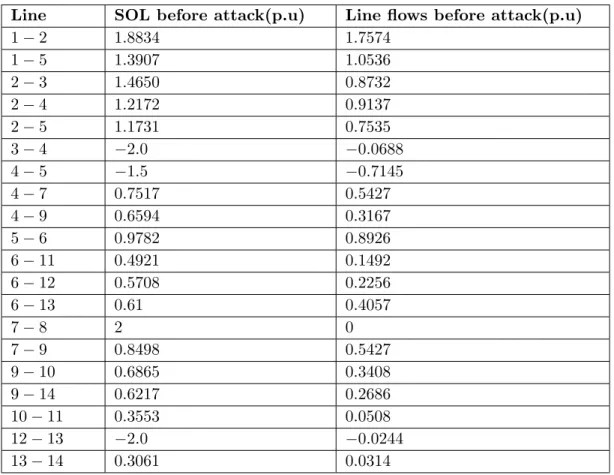
Table 3.3 SOL and pre-contingency line flows before the attack . . . 38
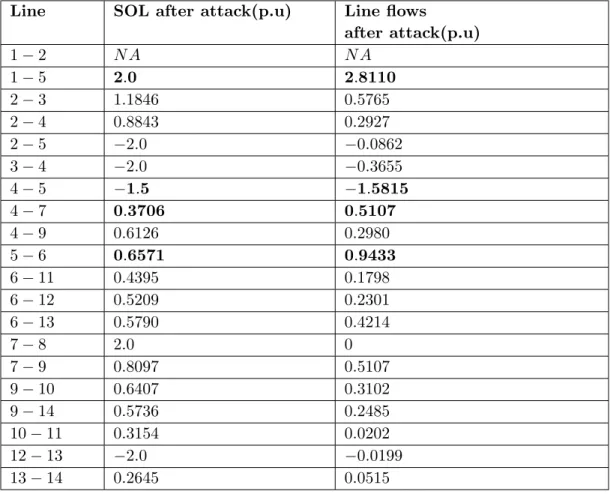
Table 3.4 SOL and pre-contingency line flows after the attack . . . 39
Table 3.5 Base case load scenario . . . 45
Table 3.6 IEEE 14-bus system baseline measurements . . . 46
Table 3.7 Results of measurement placement . . . 47
Table 4.1 Experimental parameters for case study . . . 62
Table 4.2 Minimum attack magnitudes and detection thresholds for IEEE 14-bus system . . . 71
Table 5.1 IEEE 9-bus system base case . . . 103
Table 5.2 RAS and UFLS configuration . . . 104
Table 5.3 Attack parameters for experimentation . . . 116
LIST OF FIGURES
Figure 2.1 Generic WAMPAC architecture . . . 6
Figure 2.2 Sample coordinated attack scenarios in WAMPAC . . . 9
Figure 3.1 Overview of SE in power system operations . . . 26
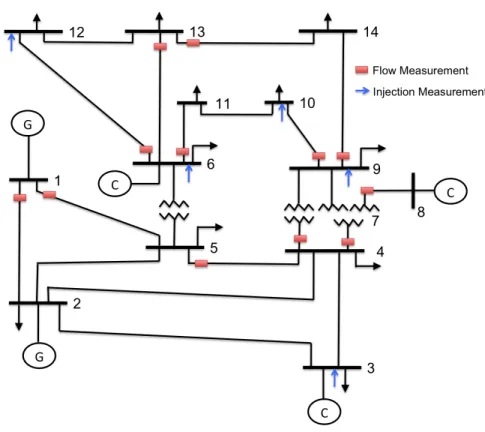
Figure 3.2 Method for creating an unobservable attack and studying its impacts . 33 Figure 3.3 IEEE 14-bus power system with measurement configuration . . . 34
Figure 3.4 Flowchart of attack-resilient measurement design . . . 44
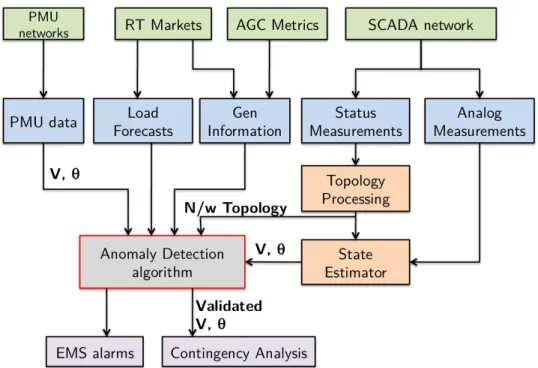
Figure 4.1 Overview of proposed anomaly detection methodology . . . 49
Figure 4.2 Anomaly detection algorithm flowchart . . . 51
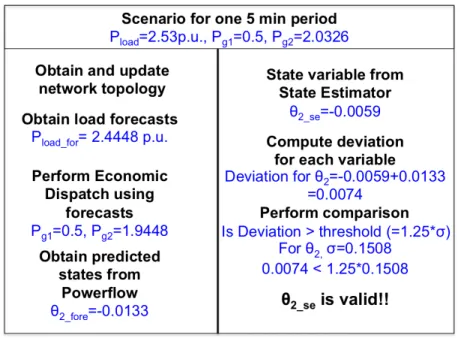
Figure 4.3 Illustrative example for the proposed anomaly detection algorithm . . 56
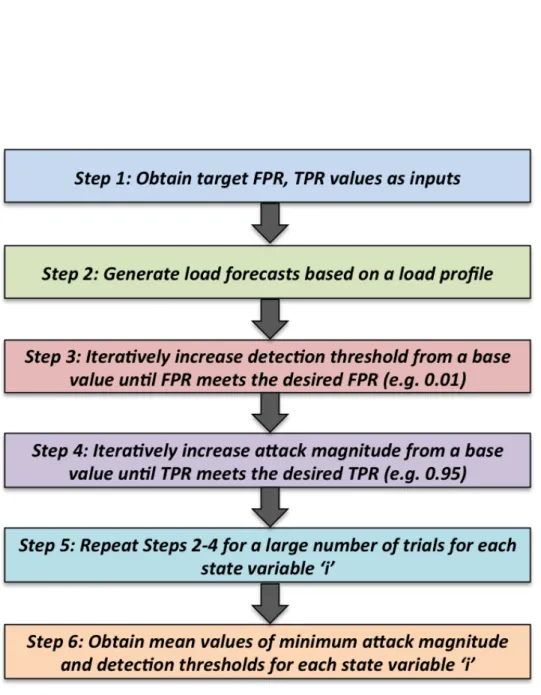
Figure 4.4 Empirical method to obtain minimum attack magnitudes & detection thresholds . . . 59
Figure 4.5 IEEE 14-bus power system with measurement configuration . . . 61
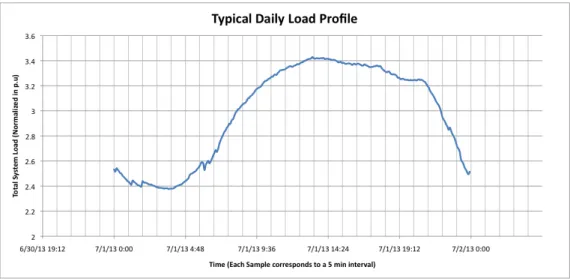
Figure 4.6 Typical daily load profile of sample data . . . 63
Figure 4.7 Deviation of predicted and actual state estimates over a day (θ13) . . . 64
Figure 4.8 Sensitivity to forecasts and synchrophasor data forθ2 . . . 65
Figure 4.9 Variation of FPR with threshold for state variableθ2 . . . 67
Figure 4.10 Variation of TPR with attack magnitudes for two detection thresholds: 1.4σ (dotted curve) and 1.6σ (solid curve) for state variable θ2 . . . 68
Figure 4.11 Points in ROC space for low (asterisk) and high (diamond) attack mag-nitudes with multiple detection thresholds for state variableθ2 . . . 70
Figure 5.2 Design tradeoffs for different types of Testbeds . . . 77
Figure 5.3 Comparison of HIL and simulation-based testbeds . . . 78
Figure 5.4 Testbed engineering methodology . . . 81
Figure 5.5 Layered Testbed Architecture . . . 85
Figure 5.6 WAMPAC-specific testbed conceptual architecture . . . 86
Figure 5.7 Centralized testbed federation architecture . . . 89
Figure 5.8 Decentralized testbed federation architecture . . . 90
Figure 5.9 PowerCyber testbed architecture . . . 93
Figure 5.10 IEEE 9-bus system with RAS mapping . . . 95
Figure 5.11 DoS protection scheme impact (switch flooding) . . . 97
Figure 5.12 DoS protection scheme impact (relay flooding) . . . 98
Figure 5.13 Impact of attack on system voltages . . . 99
Figure 5.14 Impact of attack on generation and line flows . . . 100
Figure 5.15 Implementation architecture of use case scenario on the PowerCyber testbed . . . 101
Figure 5.16 IEEE 9-bus model with AGC control areas and RAS location . . . 102
Figure 5.17 System frequency (Hz) and tie-line flows (MW) during the coordinated attack . . . 107
Figure 5.18 Bus voltages, generation and load levels during the coordinated attack 108 Figure 5.19 Attack-resilient control for AGC . . . 112
Figure 5.20 PowerCyber testbed configuration . . . 114
Figure 5.21 IEEE 9-bus system with 3 BAs . . . 115
Figure 5.22 System frequency and load during scaling attack without ARC . . . . 117
Figure 5.23 System frequency and load during ramp attack without ARC . . . 118
Figure 5.24 System frequency and load during scaling attack with ARC . . . 119
Figure 5.25 System frequency and load during ramp attack with ARC . . . 119
ACKNOWLEDGEMENTS
I would like to acknowledge several people who have supported, guided, and inspired me throughout the several years I have been in graduate school at Iowa State University.
First and foremost, I would like to convey my heartfelt and sincere thanks to my major professorDr. Manimaran Govindarasu for guiding me through my PhD over several years. His constant motivation and guidance has been critical in pushing myself to new areas in research and has been instrumental in the formation of my own research outlook. I’m also eternally grateful for the broad exposure outside core research that he provided me in terms of developing competitive research proposals, teaching opportunities, and external professional networking.
Second, I would like to thank my co-major professor Dr. Venkataramana Ajjarapu for his support and guidance throughout my PhD. Especially, his inputs were very critical in defining the direction of my PhD research during my initial years. I would also like to thank the other members of my graduate program of study committee for providing me valuable feedback at various points during my PhD that helped steer my research in the right direction.
Third, I would like to thank all those I have worked and collaborated with as part of the PowerCyber research group under Dr. Manimaran Govindarasu. Specifically, I would like to thank Dr. Adam Hahn for helping me with the basics of cybersecurity tools and experimenta-tion in the lab during my initial years as a graduate student.
Last, but not least, I would like to thank my family and friends for their unconditional love and support throughout my PhD. Especially, I would like to acknowledge my close group of friends at Iowa State University, the Madras Machis, for supporting me through the ups and downs of my PhD and for making me feel at home in Ames. Particularly, I would like to thank my dear friend and mentor,Dr. Siddharth Sridhar for always being there, both personally and professionally.
ABSTRACT
Critical infrastructures such as the power grid have been increasingly targeted by advanced and persistent cyber threats making cyber security one of the nation’s top research priorities. Traditional information technology (IT)-based cybersecurity measures are no longer adequate to address such threats, and there is a compelling need to develop a multi-layered defense strategy that utilizes a combination of infrastructure and application layer security measures. This dissertation specifically addresses attack-resilient application layer security approaches for critical wide-area monitoring, protection, and control (WAMPAC) applications. The first com-ponent, Attack-Resilient State Estimation, addresses the vulnerability of state estimation to stealthy cyber attacks, and discusses two complementary approaches to enhance its resilience. A topology-based attack vector that bypasses bad data detection methods and causes loss of system observability is identified. To mitigate the stealthy attacks on measurements and topology, an offline attack-resilient measurement design methodology is presented. Further, an online attack-resilient anomaly detection method that utilized load forecasts, generation schedules, and synchrophasor data to detect measurement anomalies is described. The sec-ond component, Testbed-Based Experimentation and Performance Evaluation, addresses the need to architect, develop, and leverage cyber-physical system (CPS) security testbed environ-ments specifically for performing realistic attack-defense experimentation for WAMPAC use cases. An overview of testbed design objectives and design tradeoffs are discussed for different types of testbeds. A three-layered WAMPAC specific testbed architecture to address critical research challenges is presented. Finally, three experimental case studies that involved realistic coordinated cyber attacks on critical WAMPAC applications such as Automatic Generation Control (AGC) and Remedial Action Schemes (RAS) are described in detail. Further, the hypothesis that timing of attack actions also plays a critical role in the attack impact severity is experimentally validated using the PowerCyber testbed.
CHAPTER 1. INTRODUCTION
The electric power grid is one of the most complex engineering machines ever built by man. It is a highly interdependent cyber-physical system where the dynamics of one system is tightly coupled to the other. The power grid, as we know of today, is undergoing a massive trans-formation in all its constituent segments like generation, transmission and distribution. This transformation of the grid is driven by the US Department of Energy’s Smart Grid vision[1]. Under this vision, the electric grid is envisaged to leverage advances in technology in several areas namely, renewable generation, advanced measurement devices like Phasor Measurement Units (PMU), Plug-in Hybrid Electric Vehicles (PHEV), Advanced Metering Infrastructure (AMI), and high-speed communication networks to enhance the security, and resiliency of the grid, at the same time reducing its dependence on non-renewable sources of generation and reducing energy production costs.
Supervisory Control and Data Acquisition (SCADA) systems are used to monitor and con-trol the operations of the power grid. Traditionally, SCADA systems were not designed keeping security as one of the important design criteria. Unfortunately, the exposure of SCADA network infrastructure to cyber threats has increased enormously due to increased interconnectivity of SCADA and public network infrastructures. In the last decade, the power grid’s SCADA and several other critical infrastructures (CI) such as banking, water distribution, oil and natural gas, etc., are increasingly being targeted by advanced, sophisticated adversaries as they are critical to national security and societal well-being [2,3,4,5,6,7,8,9].
National-level cybersecurity policies, standards and guidelines - Several govern-ment reports have highlighted the various deficiencies in cyber security for the electric sector that could result in major impacts due to emerging Advanced Persistent Threats (APTs), and also the urgent need to take measures to protect them [6,10,11]. The Department of Energy’s
(DOE) Office of Electricity Delivery and Energy Reliability (OE) was setup especially to over-see activities that enhance the reliability and resilience of the nation’s energy infrastructure. Recognizing the importance of the cyber security of the Energy Delivery Systems(EDS), the DOE OE released a roadmap in September 2011 to address the issues and concerns relevant to energy sector cybersecurity[12]. Also, OE created the Cybersecurity for Energy Delivery Systems (CEDS) program to assist the energy sector asset owners (electric, oil, and gas) by developing cybersecurity solutions for energy delivery systems through integrated planning and a focused R&D effort[13].
DOE, in coordination with the National Institute for Standards and Technology (NIST), and the North American Electric Reliability Corporation (NERC) developed a cybersecurity Risk Management Process (RMP) for the electric sector that will enable organizations to proactively manage cybersecurity risk[14]. Additionally, several efforts like NERC Critical Infrastructure Protection (CIP) [15], NIST Interagency Report (NISTIR) 7628[16] have been, and are being made at the national level to ensure that the appropriate standards and safeguards are put in place to prevent the electric power grid from potential cyber vulnerabilities and threats.
Beyond Infrastructure Security- The recent cyber attacks in Ukraine [9] on a distribu-tion utility’s power grid control network showed the inadequacy of relying on just infrastructure-based traditional cybersecurity measures when dealing with a resourceful and sophisticated adversary. The adversary was able to steal valid credentials through social engineering to get into the control network and perform reconnaissance and planning for several months. These types of incidents, similar in nature to insider threats, highlight the need to go beyond a single layer of security in order to detect and quickly recover from a sophisticated cyber attack. This need to develop intelligent countermeasures in multiple layers to secure SCADA infrastructure elements and the fundamental applications they support has been recognized in [17]. Also, the CEDS program has adopted a strategic and hierarchical approach to fund several R&D projects that specifically target multiple domains to develop novel solutions that go beyond traditional Information Technology (IT) infrastructure-based security to leverage the physical properties of the grid as part of application layer security.
One of the key motivations of the research presented in this disseration is to go beyond tra-ditional infrastructure security solutions to develop attack-resilient application layer security approaches for critical monitoring, protection and control applications, which leverage both cyber and physical aspects of the grid. Together with developing new cyber-physical attack-resilient approaches for fundamental applications such as state estimation (SE), the dissertation also addresses the need to architect, develop, and leverage cyber-physical security testbed en-vironments for performing realistic attack-defense experimentation to move the research closer to industry adoption.
1.1 Chapter Organization
The rest of this dissertation is organized as follows. Chapter 2 introduces wide-area mon-itoring, protection and control (WAMPAC), and then describes the different types of cyber attacks that could potentially impact WAMPAC. Also, it presents a detailed review of related work in the context of cyber security of WAMPAC. Chapter 3 and Chapter 4 describe how coordinated cyber attacks impact state estimation and their mitigation measures in detail. Chapter 5 discusses in detail CPS security testbed design, architecture, tradeoffs and experi-mental case studies specifically focusing on WAMPAC applications. Chapter6summarizes the main contributions of the current work and provides potential research directions for future work.
CHAPTER 2. WIDE-AREA MONITORING, PROTECTION, AND CONTROL (WAMPAC)
2.1 Introduction to WAMPAC
WAMPAC systems leverage Phasor Measurements Units (PMUs) and existing SCADA measurements to gain real-time awareness of current grid operations and also provide real-time protection and control functions such as RAS, SE, and AGC, besides other emerging applica-tions such as oscillation detection, transient stability predicapplica-tions, etc. While communication is the key to a smarter grid, developing and securing the appropriate cyber infrastructures and their communication protocols is crucial. WAMPAC can be subdivided further into its con-stituent components namely, Wide-Area Monitoring (WAM), Wide-Area Protection (WAP), and Wide-Area Control (WAC).
SE provides the operators with situational awareness of the entire system’s current oper-ating conditions and are one of the main deployments of WAM systems. The output of SE is used by several applications in the operations and planning of the power grid, like contin-gency analysis (CA), security constrained optimal power flow (SCOPF), markets, etc., to name a few. Figure 3.1 provides a high-level overview of the utility of power system SE and how SE is performed from the several thousands of SCADA analog and status points gathered ev-ery few seconds. Emerging WAM applications mainly utilize high sampling rates and accurate GPS-based timing from PMUs to provide very accurate, synchronized voltage and current mea-surements. While PMUs provide increasingly accurate situational awareness capabilities, their full potential will not be realized unless these measurement data can be shared among other utilities and regulators. The North-American Synchrophasor Initiative network (NASPInet), is a separate network for PMU data transmission and data sharing including real-time control,
quality of service and cybersecurity requirements, and is an example of the latest WAM system deployments to support emerging PMU applications of the future [18].
WAP involves the use of system wide information collected over a wide geographic area to perform fast decision-making and switching actions in order to counteract the propagation of large disturbances [19]. The advent of PMUs has transformed protection from a local concept into a system level wide-area concept to handle disturbances. Several protection applications fall under the umbrella of WAP, but the most common one among them is Special Protection Schemes (SPS). NERC defines SPS as an automatic protection system designed to detect abnormal or predetermined system conditions, and take corrective actions other than, or in addition, to the isolation of faulted components to maintain system reliability [20]. Such action may include changes in demand, generation (MW and MVAR), or system configuration to maintain system stability, acceptable voltage, or power flows. Some of the most common SPS applications are: generator rejection, load rejection, under frequency load shedding, under voltage load shedding, out-of step relaying, VAR compensation, discrete excitation control, and HVDC controls.
Until the advent of PMUs, the only major WAC mechanism in the power grid was AGC. The AGC functions with the help of tie-line flow measurements, frequency and generation data obtained from SCADA infrastructure. The purpose of the AGC in a power system is to correct system generation in accordance with load changes in order to maintain grid frequency at 60 Hz. Currently, the concept of real-time WAC using PMU data is still in its infancy and there are no standardized applications that are widely deployed on a system wide scale, though there are several pilot projects in that area [21]. Some of the potential WAC applications are secondary voltage control using PMU data, Static VAR Compensator (SVC) control using PMUs, and inter-area oscillation damping.
2.2 WAMPAC - A Generic Architecture
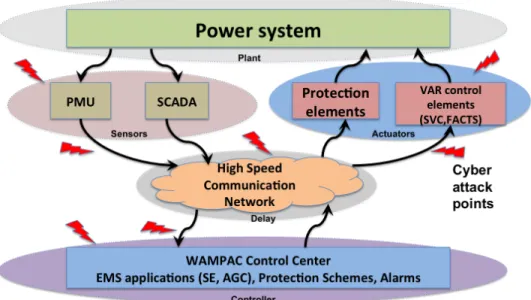
Figure 2.1 shows a generic WAMPAC architecture with the various components involved [22]. The system conditions are measured using measurement devices (relays and PMUs), these measurements are communicated to a WAMPAC controller to determine appropriate control
Figure 2.1 Generic WAMPAC architecture
actions for economic operations or in some cases for contingencies. Then, the appropriate control actions are initiated, usually through high-speed communication links. The inherent wide-area nature of these schemes presents several vulnerabilities in terms of possible cyber intrusions to hinder or alter the normal functioning of these schemes.
Even though the WAMPAC applications like SE,AGC or SPS are designed to cause minimal or no impact to the power system under failures, they are not designed to handle failures due to malicious events like cyber attacks. Also, as more and more applications are added in the power system, it introduces unexpected dependencies in the operation of the various schemes and this increases the risk of increased impacts like system wide collapse, due to a cyber attack. It therefore becomes critical to reexamine the design of the WAMPAC applications with a specific focus on cyber-physical system security.
Figure 2.1 also presents a control systems view of the power system and the WAMPAC applications at the control center. The power system is the plant under control, where the parameters like currents and voltages at different places are measured using sensors (PMUs) and sent through the high-speed communication network to the WAMPAC controller for ap-propriate decision-making. The controller decides based on the system conditions and sends
corresponding commands to the actuators which are the generators, protection elements and VAR control elements like SVC and FACTS. There are different places where a cyber attack can take place in this control system model. The cyber attack could affect the delays expe-rienced in the forward or the feedback path or it could directly affect the data corresponding to sensors, the actuators or the controller. Figure 2.1 also indicates the attack points on this control system model through the lightning bolts.
2.2.1 Cyber Attack Classification
Conceptually, we identify three classes of attacks on this control system model for WAMPAC. They are timing-based attacks, integrity attacks and replay attacks.
Timing attacks: Timing is a crucial component in any dynamic system (e.g. protection scheme) and typically the control actions should be executed on the order of milli-seconds after the disturbance. Therefore, WAMPAC applications cannot tolerate any type of delay in communications and therefore are vulnerable to timing-based attacks. Timing attacks tend to flood the communication network with packets and this slows the network down in several cases and also shuts them down in some cases, both of which are not acceptable. These types of attacks are commonly known as DoS attacks.
Data Integrity Attacks: Data integrity attacks are attacks where the data is corrupted in the forward or the reverse path in the control flow. This means that there could be an attack which directly corrupts the sensor data (measurement data), or the control data (commands given to the generators, protection elements or the VAR control elements). This translates to actions like blocking of the trip signals in scenarios where the controller actually sent a trip command to the protection elements or the controller commanded to increase VAR injection while the attack caused the injection to decrease or vice versa.
Replay Attacks: Replay attacks are similar to data integrity attacks, where the attacker manipulates the measurements or the control messages by hijacking the packets in transit between the measurement device and the control center. Several of the modern communication protocols have replay protection features that make it extremely hard to execute a successful replay attack. However, in some cases where legacy protocols are used, a replay attack could
be possible even under encrypted communication as the replayed packets are valid packets with the messages data integrity being intact except for the timestamp information.
2.2.2 Coordinated Attacks on WAMPAC
Coordinated attacks are cases where several different attack actions can be coordinated in space and/or time. For example, elements that do not share electrical or physical relationships can be forced to fail simultaneously, or in a staggered manner at appropriate time intervals depending on the system response, which could result in unanticipated consequences. Intelligent coordinated attacks can significantly affect a power system’s security and adequacy by negating the effect of system redundancy and other existing defense mechanisms after an initial attack. NERC has instituted the Cyber Attack Task Force (CATF) to gauge system risk from such attacks and develop feasible, and cost-effective mitigation techniques. NERC CATF identifies intelligent coordinated cyber attacks as a category of events that are classified as High-Impact Low-Frequency (HILF), which cause significant impacts to power system reliability beyond acceptable margins [11]. Therefore, the traditional approach to determining system reliability with (N-1) contingencies and a restricted set of multiple contingencies is no longer sufficient and new approaches have to be developed to deal with plausible (N-k) contingencies.
Figure2.2presents several sample coordinated attack scenarios on several important WAMPAC applications like SE, AGC, RAS respectively, and their impacts. A coordinated data integrity attack on a key monitoring application like SE could be achieved by compromising the vari-ous meters that measure or transfer the power flow measurements to the control center. This spatial coordinated attack results in a poor situational awareness of the power system and also could lead to incorrect system dispatch leading to line overloads and market impacts in terms of uneconomical generation [23]. Similarly, a coordinated data integrity attack on AGC would cause an imbalance in system generation and load resulting in frequency imbalance and relia-bility impacts [24]. Finally, we can consider the case of a coordinated attack on RAS, which are part of WAP. The attack scenario is a combination of data integrity and DoS attacks on the protection relays and substation communications happening in different locations, staggered in
time. Such an attack impacts reliability and could cause cascading outages depending on the system loading [25].
Figure 2.2 Sample coordinated attack scenarios in WAMPAC
2.3 Literature Review
This section identifies the related work in the context of cyber security of WAMPAC, especially pertaining to cyber attacks on SE and is grouped based on the specific focus of the work.The importance of SE in providing situational awareness and its dependence on wide-area measurements has been a major driving factor for the study of how cyber attacks impact SE. Existing literature in this area addresses one or more main themes, identifying attack vectors, characterizing impacts and proposing mitigation methods.
2.3.1 Cyber Security Issues in WAMPAC
The transition towards a smarter electric grid has spurred a lot of interest in cybersecu-rity research for the power infrastructure. Several papers have been published studying the applicability of cyber security for power system operations like AGC, voltage control, SE,
dis-tribution applications like AMI and infrastructure elements like Phasor Data Concentrators (PDC). In [24], the authors study the impact of data integrity attacks on the AGC system op-eration and quantify the attack impacts in terms of load-genop-eration imbalance and frequency violations. Similarly, in [26], the authors extend the data integrity attack model described in [24] to the voltage control loop and study how data integrity attacks on voltage control devices like FACTS, SVC, etc. can cause abnormal voltages, violating NERC reliability standards. The various cyber security issues related to confidentiality, integrity, availability, etc. for AMI have been discussed in [27]. Paper [28] discusses security issues for Phasor Data Concentrators and also presents a scenario of compromising the database which stores PMU data through a SQL-injection attack.
2.3.2 Cyber Attacks on SE
State Estimators rely on wide-area measurement data from SCADA networks to construct a real-time network topology based on the breaker and switch statuses, and also validate the analog measurements from the Remote Terminal Units (RTU) to provide accurate state estimates. The dependence on wide-area measurements creates an inherent vulnerability to data denial or manipulation through malicious cyber attacks either at the measurement source or in transit. The attacks could target either the integrity of the topology measurements or the analog measurements in the SCADA data, or it could also target the availability of the data at the control center. Integrity-based attacks require much more information than the actual attack, such as attack locations and attack values to remain undetected, whereas DoS attacks do not require too much information other than the target of the attacks.
2.3.2.1 False Data Injection Attacks
The paper by Liu et al. was one of the first works to look at the vulnerability of state estimation to cyber attacks is [23], where the attacker is assumed to possess knowledge about measurement configuration to create undetectable attacks. The paper characterizes attacks into two major types: random and targeted attacks, where targeted attacks aim to inject specific errors into selected state variables. The paper also identifies the potential attack vectors given
a particular attacker’s resource limitation and the characterizes the impacts in terms of injected error in the state variables. Bobba et al. proposes a method to detect such attacks by protecting a set of selected measurements and independently verifying certain state variables [29].
Kosut et al. developed a heuristic in [30] to find the attacks that impact bad data detection the most, given a set of compromised meters under a particular attacker. This paper also presents a new bad data detector which outperforms the traditional bad data detector. The work done by Kim et al. in [31] looks at protection of a subset of measurements from data injection attacks, given the attacker model as proposed in [23], under an optimization framework and also proposes an algorithm to aid in PMU placement on strategic buses in the network.
Le et al. present a false data injection attack, against the state estimation in deregulated electricity markets in [32]. They show that such a class of attacks bypass the bad data mea-surement detection, and can lead to profitable financial misconduct by affecting the locational marginal prices (LMP). The paper also presents a heuristic to find out the most profitable attack in terms of an optimization problem.
Giani et al. proposes an algorithm to determine the presence of attacks that involve minimal compromise of meters given a measurement configuration and also proposes a measurement placement algorithm to tolerate such attacks [33]. Dan et al. consider the attack template as proposed by [23], define a security metric that quantifies the cost to perform a stealthy attack and also an algorithm to compute the attack vectors [34]. The paper also proposes two approaches to place encryption devices to maximize security. Teixerira et al. considers a scenario where the attacker possess only a perturbed model of the system and proposes a method to find stealthy deception attacks [35]. The paper also identifies the limits of the attack vector for commonly used bad data detection methods in state estimators.
The papers mentioned previously [23,29,30,33,32], use the DC power flow model in their analysis of the false data injection attack on the state estimator. Hug et al. uses AC power flow analysis to distinguish their analysis and present a graph-based algorithm to find stealthy data injection attacks [36]. The paper also provides a comparative analysis of the errors introduced when using DC vs. AC power flow model and identifies that it is very difficult to create a truly undetectable attack due to the non-linearity of the power flow equations.
2.3.2.2 Topology-based attacks
Integrity-based attacks, commonly known as false data injection attacks, require knowledge about the measurement configuration in order to remain undetected as bad measurements due to measurement errors are inherently filtered out by Bad Data Detection(BDD) in SE. All of the existing literature discussed previously use the attack model as defined in [23]. However, all these papers make certain assumptions. The pertinent ones are
1. Network topology is valid and error free. 2. Measurement redundancy is adequate.
3. Only analog measurements (injection and flow) have errors.
Though these assumptions are reasonable to study some aspects of this problem, some of these assumptions do not hold considering the exposure of the SCADA network to cyber-based threats. Especially, the assumptions concerning valid network topology and errors only in analog measurements. Therefore, it becomes really critical to study the effects of how topology errors created by cyber attacks impact the SE and power system operations.
As part of the dissertation, we identified another type of attacks that are aimed at cre-ating topology errors by virtue of knowledge of measurement configuration while remaining undetected [37]. This paper addresses the problem of how topology errors, in particular, the branch status errors, can be created by malicious adversaries through intelligent cyber attacks. We have shown how an unobservable topology error can be created by manipulating the field devices corresponding to the critical measurements or critical branches in the SCADA mea-surement set configuration. Also, we have shown how the impacts of such an attack can be analyzed through system operating limit (SOL) violations on the altered network topology. More details about the work is presented in Section3.2.
2.3.2.3 DoS attacks
One could also identify another type of attack vector where the attacker just denies carefully chosen measurements from reaching the control center forcing the state estimator to lose total
system observability. SE normally handles loss of observability (critical measurements) by using pseudo-measurements, which are obtained generally from short-term forecasts or from historical and recent data. Pseudo-measurements are less accurate than regular measurements, and this directly contributes to a loss of accuracy in state estimates if done improperly [38]. Loss of SE accuracy when the system is operating under heavy system loads could impact operator decisions adversely. Though these type of attacks have not been not studied separately, the mitigation methods for these types of attacks are similar to the ones employed for topology-based attacks.
2.3.3 Measurement Design
We briefly introduce the measurement design problem before reviewing the existing litera-ture in this area. Typically, the objective of measurement design problem is to minimize the cost and the number of new measurements added to the measurement configuration such that it satisfies two main constraints. One is to maintain total system observability under all credible contingencies. The other is to satisfy accuracy requirements of the state estimates. Another byproduct of these two is the bad data detection capability of the estimator. An observable system with a reasonable accuracy of estimates ensures good bad data detection capability. It is to be noted here that the under the context of measurement design, contingencies could be actual contingencies that involve a change in the actual topology of the system, or situations where there is a loss of measurement availability at the control center.
The problem of measurement design has been very well researched and there is an excel-lent wealth of literature on this topic. Sarma et al. proposed a measurement design process that included multiple phases: (1) satisfying acceptable redundancy, (2) satisfying basic ob-servability, (3) elimination of critical measurements, and (4) measurement placement to handle measurement loss of single RTU failure [39]. Celik and Liu proposed an incremental measure-ment placemeasure-ment algorithm that created a ranking of buses with low accuracy and identified candidate measurements which are not leverage points to add to the measurement set until a desired accuracy is obtained [40].
Baran et al. proposed a meter placement method that addressed multiple aspects in the measurement design whilst also minimizing the cost of meter deployments [41]. The basic mea-surement placement addresses accuracy constraints in the form of a system accuracy index. The subsequent stages address meter placement for reliability using a marginal cost approach and meter placement for bad data detection eliminating critical measurements. More recently, Magnago and Abur presented a measurement placement approach that handled loss of any sin-gle branch measurement or sinsin-gle contingency without loosing network observability [42]. The approach identifies candidates for all situations where observability is lost and minimizes the cost of candidate measurements by formulating a binary integer linear optimization problem.
In the last few years, the papers on measurement design have focussed on optimal place-ment of PMUs for state estimation. Gou presented a generalized integer linear programming formulation for optimal PMU placement that included cases for redundant placement, complete and incomplete observability [43]. The paper introduced the concept of depth of one and depth of two unobservability, where the neighboring buses of any unobservable buses are rendered observable by PMU placement. Abbasy et al. also proposed a binary integer linear program-ming formulation for optimal PMU placement which also considers conventional measurement placements and loss of multiple PMUs [44]. Chakrabarti et al. proposed a binary search-based algorithm for determining the minimal number of PMUs to ensure full observability including single branch outage cases [45]. All the above papers on PMU placement assume that a PMU installation at a bus would enable measurement of all branch currents in the bus, whereas Emami et al. propose an optimal PMU placement method for branch PMUs that enable volt-age and current measurement only on one branch [46]. The method also addresses reliability aspects by considering loss of PMUs or branch outages into placement constraints, ensuring complete observabiliity.
Most of the literature mentioned previously, do not address the issue of loss of multiple measurements, except one or two of the earlier papers that addressed loss of RTU’s as part of the problem formulation. Most of the papers considered the loss of a single branch or measurement to be sufficient for measurement design. However, we strongly believe that measurement design
also needs to consider loss of multiple critical measurements, or even loss of measurements from multiple RTU’s due to targeted cyber attacks.
If we consider the possibility of the loss of multiple measurements or loss of multiple RTU’s simultaneously, we would encounter situations where there is incomplete observability and in order to handle such cases we typically resort to the use of pseudo-measurements. It is well known that pseudo-measurements are often generated with the help of forecast-based predic-tions or historical data, and depending on the load level and the quality of past measurements, pseudo-measurement quality also varies. This in turn influences how much variance is added in the state estimates. It has been shown that if pseudo-measurements are not used properly, their errors can impact the estimates of other state variables also [38]. We believe that this is another reason to rethink traditional measurement design process as not all cases of unobserv-ability should be handled with pseudo-measurements. With more and more push for utilizing transmission lines to their maximum capacity, errors in estimation of line flows impact opera-tional decisions to a greater extent. Therefore, we believe that an attack-resilient measurement design process should include a careful consideration of the type of contingencies that could occur, loss of multiple critical measurements, and the use of pseudo-measurements to address situations with incomplete observability.
2.3.4 Mitigation of Cyber Attacks on SE
While there are enough papers in the area of identifying possible attack vectors and impacts on the state estimates, markets and operations, not enough work has been done to address the problem of detecting and mitigating stealthy cyber attacks on state estimators.
Irrespective of the type of cyber attacks, the more there are measurements in the mea-surement configuration, the more resilient state estimator becomes, and the harder it gets for the adversary to execute a stealthy attack. The proposed solutions by existing literature fundamentally address two aspects: adding more measurements into the estimation process, in-directly protecting certain essential measurements from being corrupted, so that the adversary has to manipulate even more measurements to remain stealthy against the bad data detectors. Another way is by ensuring the security of enough number of essential measurements in the
measurement configuration by performing additional infrastructure security mechanisms such as encryption, authentication of the data. This problem of making the estimator robust to measurement corruption (natural and malicious) and measurement loss is known as the ‘mea-surement design’ problem. A well-designed mea‘mea-surement configuration in state estimation will make the possibility of creating a stealthy cyber attack very slim.
The existing category of solutions are mostly reliant on an efficient measurement design, which is an offline problem to increase the redundancy, accuracy and bad data detection ca-pabilities of the state estimators. Section 3.3proposes an attack-resilient measurement design methodology for SE to increase robustness against data injection and DoS attacks.
A well-designed measurement system increases the degree of difficulty of an attack, but cannot completely rule out the possibility of a highly skilled attack. In contrast to the former solution type, which is an offline process, the key in the second solution type is to use informa-tion that is independent of the SCADA data to validate the state estimates. We believe that to the best of our knowledge there is no prior work on an online anomaly detection method to detect cyber attacks and validate the state estimates and detect anomalies. Chapter4proposes an online anomaly detection method to leverage the information obtained from load forecasts, generation schedules, and real-time synchrophasor data to provide a coarse real-time validation for the state estimates produced from untrusted SCADA measurements, thereby enabling the detection of false data injection attacks.
2.3.5 Cyber-Physical System Security Testbeds
The development of CPS security testbeds and cybersecurity experimentation leveraging CPS testbeds has been an active research topic over the last few years. Several educational institutions and research laboratories are setting up individual CPS security testbeds for vali-dating their research and are also exploring possibilities for CPS testbed federation to perform large-scale, high fidelity, hardware-in-the-loop cyber attack/defense experiments.
The National SCADA Testbed (NSTB) at Idaho National Laboratory, is one of the ear-liest collaborative testbed efforts across several U.S national laboratories where actual power system resources (generation and transmission lines), and the associated cyber system
compo-nents were used to perform vulnerability assessments and impact analysis studies [47]. Sandia National Laboratory houses the Virtual Control System Environment (VCSE), which is a cyber-physical testbed with a hybrid mix of simulated, emulated and cyber-physical system components for attack-defense experimentation [48]. The powerNET testbed at Pacific Northwest National Laboratory (PNNL) leverages a combination of cloud-based computing platform for virtualiza-tion, real-time power system simulators, and a variety of field equipment such as multi-function protection relays and PMUs from multiple vendors to provide a highly customizable and config-urable environment for cyber-physical security experimentation [49]. The University of Illinois at Urbana-Champaign hosts the Virtual Power System Testbed (VPST), consisting of a mix of simulated, emulated and physical components to perform cyber security research across a wide range of topics including vulnerability assessments, communication protocol and security product testing and research validation [50].
The PowerCyber CPS security testbed at Iowa State University consists of a hybrid mix of industry grade SCADA hardware and software, emulators for wide-area network routing and real-time power system simulators, which enable a high-fidelity, hardware-in-the-loop, cyber-physical testbed environment for cyber-cyber-physical security research and experimental validation studies [25]. The SCADA testbed at the University College, Dublin is used to perform experi-ments on intrusion detection and anomaly detection related to power grid cyber security [51]. Mississippi State University consists of a SCADA security testbed, which is used to perform intrusion detection and security testing of PMUs and PDCs [52].
The University of Southern California‘s Information Sciences Institute hosts the DETER cyber security testbed, which is a large-scale testbed for cyber security experimentation, but it does not contain physical system resources, like relays and phasor measurement units, which some of the earlier testbeds mentioned have for hardware-in-the-loop experimentation [53]. The Smart Grid testbed at Washington State University consists of several hardware resources like PMUs and PDCs interfaced with a real-time power system simulator, but is primarily focused on developing new power system monitoring and control algorithms [54]. Other notable research efforts that leverage CPS security testbeds for experimentation on telecommunication, networking, and intrusion detection includes the European CRUTIAL project [55], TASSCS
testbed at the University of Arizona [56], SCADASim testbed at the Royal Melbourne Institute of Technology [57].
2.4 Dissertation Contributions
The dissertation is based on two main research components: 1. Attack-resilient State Esti-mation, 2. Testbed-based experimentation and performance evaluation of cyber attack-defense on WAMPAC applications. The following section details the various research components and the associated contributions.
• Attack-Resilient State Estimation In this component, a topology-based attack vec-tor that bypasses bad data detection methods and causes loss of system observability is identified. Two complementary mitigation measures are proposed to mitigate stealthy cyber attacks and improve resiliency of state estimators. First, an offline attack-resilient measurement design methodology is presented that increases robustness of state esti-mators against false data injection and DoS attacks. Second, an online attack-resilient anomaly detection method is presented that utilizes load forecasts, generation schedules, and synchrophasor data to coarsely validate state estimates and detect false data injection attacks.
The specific and expected contributions from this research component are given below: 1. Topology-based stealthy attacks and impact evaluation
– Identification of attack vector to create topology-based attack.
– Development of a methodology to analyze attack impacts in terms of SOLs.
– Case study on IEEE 14 bus system
2. Offline mitigation strategy for stealthy cyber attacks
– Development of attack-resilient measurement design methodology including SE redundancy, accuracy, bad data detection.
– Minimum cost optimization formulation for placement of new measurements.
3. Online mitigation strategy for stealthy cyber attacks
– Development of attack-resilient anomaly detection methodology leveraging load forecasts, and synchrophasor data.
– Sensitivity analysis of proposed method considering variation in load forecasts, measurement configurations, SE measurement accuracies and PMU data for different attack magnitudes.
– Analysis of false positives, and false negatives for a range of attack detection thresholds and attack magnitudes.
– Development of an empirical methodology to determine minimum attack detec-tion magnitudes and detecdetec-tion thresholds for target false positive rate (FPR) and true positive rate (TPR) specification.
– Case study on IEEE 14 bus system
• CPS Testbed - objectives, design methodology, architecture and performance evaluation of coordinated attacks on WAMPAC applications
In this component, we describe several aspects pertaining to CPS testbed design, develop-ment and experidevelop-mentation. We also showcase results from testbed-based experidevelop-mentation and performance evaluation of cyber attack-defense on critical WAMPAC applications. Overall, this component is expected to have the following contributions:
1. CPS security testbed - objectives, design methodology, architecture, and challenges
– An overview of the basic testbed design objectives and design tradeoffs for var-ious types of testbeds.
– A top-down methodology for the engineering of the CPS security testbed based on specific WAMPAC use cases.
– Three layered testbed architecture abstraction and its application to create an architecture for WAMPAC specific cyber attack-defense experimentation that addresses research challenges identified.
– Qualitative analysis of testbed federation looking at research challenges, feder-ation architectures, and WAMPAC specific use cases that could benefit from federation.
2. Attack-defense experimentation and performance evaluation on WAP and WAC applications
– Identification of novel coordinated attack vector for RAS that involved a com-bination of spatial and temporal coordination and its quantitative impact as-sessment experimentally using the testbed.
– Experimental case studies that show how CPS security testbeds enable realistic attack-defense experimentation on critical WAMPAC applications such as AGC, RAS that could not be performed on ordinary simulation-based environments.
CHAPTER 3. ATTACK-RESILIENT MEASUREMENT DESIGN FOR STATE ESTIMATION
This chapter describes about the cyber-physical security of state estimators against stealthy cyber attacks. The remainder of this section is organized as follows. Section3.1provides a gen-eral context to cyber attacks on SE by describing the attack models, attack scope and the need for application level security beyond traditional infrastructure security. Section 3.2introduces a topology -based stealthy attack and describes a methodology to study its impacts on the power grid. Section 3.3 describes an offline attack-resilient measurement design methodology that increases robustness of state estimators against false data injection and DoS attacks.
3.1 Cyber Attacks on Power System State Estimation
This section provides a brief overview of the two main attack vectors that have been men-tioned previously in the context of state estimators. Also, it explains the scope of the attacks in the context of the current security mechanisms in SCADA networks.
3.1.1 Cyber Attack Models
We consider the following types of cyber attacks on state estimators:
• Data integrity-based attacks - Attacks that target the integrity of analog or status mea-surements from the remote terminal units to the control center.
• DoS attacks - Attacks that target the availability of analog or status measurements from the remote terminal units to the control center.
The impact of DoS attacks on state estimators have not been studied in detail so far. How-ever, the potential impacts of such an attack are likely to reduce the available redundancy in
SCADA telemetry to very dangerous levels that could cause a significant deterioration in the quality of the produced state estimates and/or lack of total system observability translating into inadequate operator situational awareness. These type of attacks can cause other sec-ondary and tertiary impacts as they affect the performance of the SCADA networks used in system operations and also need to be systematically studied. In contrast, the two main types of integrity attacks, the ones where analog measurements are impacted (false data injection attacks) and the ones where status measurements are impacted (topology-based attacks) are more stealthy and therefore considered more harmful.
3.1.1.1 False Data Injection Attacks
The basic attack vector for a stealthy false data injection attack as mentioned in [23] is to find an attack vector athat satisfies the following equation:
z+a=Hx+e, where a=Hc is the attack injection. (3.1)
This ensures that the attack is undetected in the largest normalized residual test which the most commonly used BDD method in state estimators.
3.1.1.2 Topology-based attacks
The basic attack vector for a topology-based attack as mentioned in [37] is to find the critical measurements in a particular system measurement configuration and create a topology change that reduces the observability of the system.
If H is the system measurement matrix, then the critical branches in the system can be obtained through the procedure shown in Section 3.2.5.2. A topology change in any one of these measurements causes no change in the measurement residuals and therefore cannot be detected by the BDD in state estimators.
3.1.2 Cyber Attack Scope
The SCADA network is used to obtain telemetry from the RTUs that are located at the substations once every 2-10 seconds. The RTUs collect measurements from the Intelligent
Electronic Devices (IED), Merging Units, various types of measurement devices through a local communication protocol or through hard wired configurations. The communication from the RTU to the control center goes over the wide-area network and is typically one of the following protocols namely Distributed Network Protocol (DNP) 3, Modbus, Profibus, etc. The entire SCADA infrastructure is made up of a variety of these legacy devices and communication protocols. Therefore, the scope for cyber attacks on these devices are numerous despite several infrastructure protection mechanisms such as firewalls, VPNs and security standards such as NERC CIP [58]. Most of the devices like RTUs are still embedded devices which do not possess enough computation power to perform encryption and authentication mechanisms. Hence the chances of snooping clear text communications and manipulating control commands or measurements in the communication protocols is a real concern. Therefore, it becomes very necessary to provide tools and methods that analyze the possibility of cyber attacks and enhance application level security with the help of diverse information sources. Designing a secure system should ideally involve a defense-in-depth approach combining infrastructure and application level security mechanisms effectively.
3.1.3 Need for Application Security beyond Infrastructure Security
We briefly look at the need to secure cyber infrastructure involved, and about the relevant standards in place. Equally important to infrastructure security is application security, as state estimation depends heavily on both the SCADA infrastructure and its data. Here, we look at the need to have application specific security analysis beyond traditional IT and infrastructure security.
Lack of adequate security measures at the electronic perimeters for critical infrastructures could lead to attacks in the form of unauthorized access to confidential and critical data, control of cyber infrastructure elements, injection of malicious software, exploitation of security vulnerabilities in poorly patched software, etc. NERC Standards CIP-002-4 through CIP-009-4 provide a cyber security framework for the identification and protection of critical cyber assets to support reliable operation of the bulk electric system. They not only identify the critical cyber assets in the bulk electric system, but also the vulnerabilities to which they are exposed
to, which could be exploited to create cyber attacks. The following list provides a brief overview of some relevant CIP standards which help reinforce the cyber security of the power grid.
• CIP-002-4 - Requires the identification and documentation of the critical cyber assets which support the reliable operation of the bulk electric power system.
• CIP-003-4 - Talks about minimum security management controls to be put in place so as to protect critical cyber assets from unauthorized access, data and information breaches.
• CIP-005-4 - Requires the identification and protection of the Electronic Security Perime-ters (ESPs) inside which all critical cyber assets reside, as well as all access points on the perimeter.
• CIP-007-4 - Mandates the creation of methods, processes, and procedures for securing critical cyber assets within the ESP, which includes an annual cyber vulnerability assess-ment by responsible entities.
Even though the NERC CIP standards have identified and recommended several best prac-tices for cyber security, the possibility of cyber attacks happening is still high due to several factors. A poor implementation of the standards or security measures, or partial CIP com-pliance could still present several vulnerabilities which could be exploited to create attacks. Also, the partial or incremental deployment of security measures is another issue which could potentially lead to security holes. It could also be difficult to incorporate modern security mechanisms like encryption, authentication and intrusion detection algorithms, given the mod-erate capabilities available to several legacy SCADA field devices. Even in the case of complete deployment of security measures as identified by CIP standards, there are possibilities of cyber attacks through insider threats, where the attacker has a very thorough understanding of the systems and the security processes involved [59]. Another interesting possibility is that data integrity attacks could still be possible under a secure infrastructure in the form of a replay attack, where the same set of command packets could be replayed at a later point in time, bypassing the security mechanisms by virtue of eavesdropping. Therefore, it is essential for us
to develop adequate security measures at the application level also, in addition to securing the infrastructure elements, creating a layered defense mechanism against cyber attacks.
3.2 Topology-Based Cyber Attacks
This section explains how the topology of the system can be altered through cyber attacks without being detected by Bad Data Detection (BDD) in SE. The remainder of this section is organized as follows. Section3.2.1explains how topology processing, topology error processing, BDD fit in within the overall SE process as described in Figure 3.1. Also, it presents the cyber attack model in detail. Section3.2.5explains the method used in creating unobservable topology errors due to cyber attacks and studying their impact in terms of SOL violations. Section 3.2.6 shows how the methodology can be applied to an example power system model to find attack locations and also analyzes attack impacts.
3.2.1 Topology Processing
The Energy Management Systems (EMS) at the control center contain a network model which contains the power system topology information in terms of physical breakers and switches, commonly referred as a breaker-switch model. However, all the traditional power system analysis functions are performed on a bus-branch network model. The bus-branch net-work model is derived from the breaker-switch model by consolidating the status of breakers and switches obtained from telemetry and obtaining a reduced equivalent network topology[60]. This translation which involves the process of building a network topology is performed by the topology builder or the topology processor.
The topology processor is one of the key components of a state estimator. A wrong network topology can not only result in a significant error in the estimates of the system states, but also sometimes could result in the state estimator solution not converging [61]. This can result in several problems if left unattended for a long time. Operating the power system without a converged SE solution is like flying blind, in other words, the operators will have no situational awareness of the power system operating conditions. There are several procedures in place in the Independent System Operators (ISO)s to specifically handle the occurrence of SE solutions
not converging over a set of consecutive execution runs, as the ISO’s are required to maintain a high, valid SE solution availability.
Figure 3.1 Overview of SE in power system operations
3.2.2 Topology Error Processing
Since the process of network topology construction depends on telemetered status measure-ments from the field devices, it is bound to contain several sources of errors. There are several factors which can contribute to a wrong network topology:
1. Unavailability of status points due to network failure. 2. Faulty field devices.
3. Manual status update of certain devices during maintenance. 4. Outdated status in case of non-telemetered devices.
Therefore, every state estimator has a component which validates the network topology identified by the topology processor, and this is known as the topology error processor. There are two broad methods by which this topology error processing can be performed [61],[62]. The first set of methods are a priori methods, and are based on simple consistency checks correlating the analog measurements to validate the network topology. Other methods are based onposteriori processing, which rely on a converged SE solution to validate the network topology. It is to be noted here that a prioiri methods are based on fast and approximate techniques, and are applied usually at the substation level. Therefore, they may fail to identify several topology errors. Posteriori methods rely on results of a converged SE, which may not exist in the presence of some topology errors.
3.2.3 Bad Data Detection
One of the main functions of SE is to validate the measurements obtained from SCADA, as they are known to contain measurements with various types of errors. Therefore, detecting and identifying bad data in SE is very important, which is done by comparing the telemetered measurements with the estimated values of the states. It is worth mentioning that bad data detection and identification is dependent on the configuration of the entire measurement set of a system. Bad data in the measurements could be categorized as single or multiple, and interacting or non-interacting. Bad data can be detected using theChi−squarestest or using
normalized residuals. Identification of bad data, i.e, to find out which measurements actually contain bad data, can be done using largest normalized residual test and hypothesis testing identification method. One caveat is that bad data can be detected, only if removal of the measurement does not render the system unobservable. This means that bad data in critical measurements cannot be detected.
3.2.4 Cyber Attack Scope and Attack Model
The SCADA analog and status measurements are polled once every 2 to 4 seconds (typically) from RTU in every substation. The RTU collects this information at a much faster rate from IEDs like relays and circuit breakers. These measurements from the RTU travel through a
wide-area communication network to the control center. The communication network could be encrypted and/or authenticated using the protocol specific encryption or end-to-end solutions like Virtual Private Network (VPN) and firewalls.
Timing attacks based on delaying of the data are relevant when there is some sort of control mechanism involved, which requires a strict timing constraint. With respect to SE, since the data is expected to be unavailable occasionally, they do not pose any real threats. Replay attacks are similar in nature to data integrity attacks, where the attacker manipulates the status and analog measurements of the data that the RTU is sending by hijacking the packets in transit from the RTU to the control center. False data injection attacks, which several researchers have discussed with respect to state estimation, and the topology related attacks, which this work identifies, fall under this category. DoS attacks are those where the attacker can flood the communication network with arbitrary traffic to deny service to either the RTU or the control center. This can be achieved by either grabbing the packets sent by the RTU, or by bombarding the RTU, which acts as a server (data source) with too many data requests, causing it to crash.
In this work, the attacker’s objective is to create a topology error in the network model which the SE software uses, by intelligently finding appropriate locations inside the model, and attacking the relevant field devices in the SCADA network. The attack model can be characterized by the following set of assumptions:
1. The attacker has access to the SCADA measurement set configuration. 2. The measurement configuration does not have very high redundancy always.
3. Data integrity attacks are possible in cases where internal SCADA network traffic uses a clear text format and the network is protected using some sort of VPN or firewalls. 4. Replay attacks are possible even under encrypted data communications in the SCADA
network.
The above stated assumptions are considered to be realistic, considering the current SCADA network environment, which is characterized by legacy devices, protocols and network security
measures. Also, the complexity of cyber attacks executed in the recent past on SCADA net-works like Stuxnet [8], strengthen the validity of our assumptions.
3.2.5 Method to Create an Unobservable Cyber Attack through Topology Errors
It is obvious that a topology error can be created by manipulating any single field device through an arbitrary cyber attack. However, this type of naive attack can be easily detected as SE contains a bad data detection component, which identifies the topology error appropriately. An intelligent adversary would go well beyond the naive attack described above to remain undetected. There are certain elements in the SCADA measurement configuration which when manipulated can slip unnoticed by traditional bad data detection methods.
This section will describe the steps which are involved in creating such an attack by identi-fying what measurements are to be manipulated and thereby identify the attack target also (i.e. the corresponding breaker or field device). Also, this section will explain the steps to quantify attack impact in terms of SOL violations, which are monitored by operators constantly in ev-eryday operations. There are NERC standards which stipulate that the power system is always operated under SOL for all the line flows, voltage limits, etc., and any SOL violation needs to be addressed to within a period of 30 minutes through a generation re-dispatch [63],[64],[65]. The adversary’s aim is to create this unnecessary re-dispatch by causing some SOL violations, leading to potentially unhealthy system conditions, while also causing economic impacts.
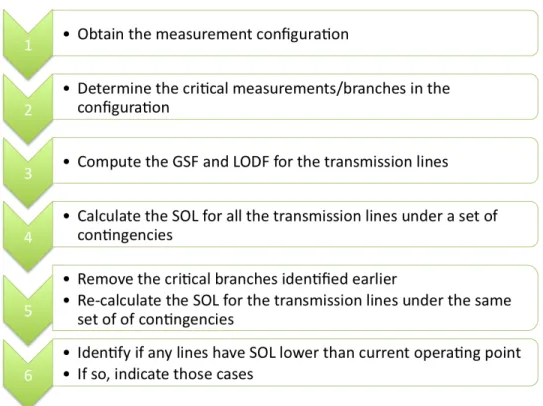
The following subsections will explain in detail the method of creating an unobservable cyber attack by manipulating the network topology selectively at carefully defined locations. Figure 3.2presents an overview of the method described below.
3.2.5.1 Identifying Critical Measurements
There are certain measurements in a SCADA measurement configuration called ‘critical measurements,’ which when removed makes some portion of the system unobservable. The approach to identify the critical measurements in a measurement configuration described below has been adopted from [61]. In this analysis, we use the linear Weighted Least Squares (WLS) formulation for our SE model. The problem of interest to us lies in the observability analysis