Issue 1
Fall 2013
November 2013
Wi-Fi a simple and efficient way for offloading data
traffic in mobile networks
Irena Malolli
National Agency for Information, [email protected]
Kozeta Sevrani
University of Tirana, [email protected]
Follow this and additional works at:
https://knowledgecenter.ubt-uni.net/ijbte
Part of the
Computer Sciences Commons
This Article is brought to you for free and open access by the Publication and Journals at UBT Knowledge Center. It has been accepted for inclusion in International Journal of Business and Technology by an authorized editor of UBT Knowledge Center. For more information, please contact
Recommended Citation
Malolli, Irena and Sevrani, Kozeta (2013) "Wi-Fi a simple and efficient way for offloading data traffic in mobile networks,"International Journal of Business and Technology: Vol. 2 : Iss. 1 , Article 3.
DOI: 10.33107/ijbte.2013.2.1.03
Wi-Fi a simple and efficient way for offloading data traffic in mobile
networks
Irena Malolli1 , Kozeta Sevrani2 1
National Agency for Information,
2
Head of Mathematics, Statistics & Applied Informatics Department
Faculty of Economy, UT
[email protected],[email protected]
Abstract. Mobile data traffic is significantly increased year by year due to a number of factors including new smart devices, new applications such as M2M, the so-called “always-on” applications and services etc. In addition the recent studies tell us that the forecasts for mobile data traffic in near future will be tenfold higher, while the revenue for this market is expected to be increased only twofold. This trend raised a number of challenges for the mobile network operators (MNOs) in the world and in our region. Different technical and commercial solutions are discussed and developed and / or under developing. The first idea how to cope with high data traffic is to increase the network capacities. Even this is a direct traditional way as a technical solution it is too expensive and time consuming. Alternative ways to cope with data traffic in order to satisfy consumer demand and to keep key performance indicators are under developing. Some solutions in place are linked with traffic management tools such as data optimization, throttling, filtering, caching, video compression etc. In addition, new pricing policies and the adoption of the appropriate business models in new era of mobile data traffic are in the process. On top of the ways mentioned above or alternatively, Wi-Fi is considered as a simple way of data traffic off-load in mobile networks. In this article, we will identify the positive aspects of Wi-Fi offload versus other traffic management tools and draw some conclusions. We will give some recommendations how MNOs improve the situation for high data traffic through Wi-Fi offload solution, how Wi-Fi offload is related with other commercial aspects and quality of service in order to meet the customer satisfaction.
Keywords: Mobile data traffic, Wi-Fi offload, data optimization.
1 Introduction
The latest reports from different sources tell us that mobile traffic data is dramatically increased. This is due to the advantage of mobile technology compared with fixed one as well as related with the high usage of smart devices, new applications and services provided. The challenge of mobile network operators today is to find the appropriate solutions to cope with high data traffic. This article will give the results of a research on the perspective of mobile data traffic in the world and in our region and on the technical solutions to cope with high data demand. Going through different studies and recent reports on this issue we will analyse the different solutions offered especially for data offload. At the end we sum up and give some conclusions on advantages of Wi-Fi offload and some recommendations for MNOs how to most benefit from this solution.
1.1 Data traffic over Mobile networks in the world
Data traffic over mobile networks in the world is increased significantly. Referring to Cisco white paper, “Cisco Visual Networking Index: Global Mobile Data Traffic Forecast Update 2012-2017”[1], the global mobile data traffic grew 70% in 2012. Global mobile data traffic reached 885 Petabytes per month at the end of 2012 compared with 520 petabytes at the end of 2011
Fig. 1. Mobile data Traffic 2012-2017 [Source: Cisco white paper]
Fig. 2. Mobile data offloaded [Source: Cisco white paper]
Globally, 33% of total mobile traffic was offloaded onto the fixed network through Wi-Fi or femtocells in 2012. In 2012, 429 petabytes of mobile data traffic were offloaded onto the fixed network each month. Is important to mention that without offload, mobile data traffic would have grown 96% rather than 70% in 2012.
In addition the Cisco report gives that mobile data traffic will increase 13 fold between 2012-2017, reaching 11.2 exabytes per month, while 46% of data traffic is expected to be offloaded.
Referring to a number of documents and market analysis the expectation for data traffic growth is some times higher compared with the revenues expected from data traffic. As it is given in the paper of Accuris-network “Mobile Wi-Fi offload” the “operators are having to carry more data while earning less revenue per subscriber”[2]. It is clear that the struggle of MNOs today is to adopt the appropriate business models and technical solution which leads to an efficient investments scheme.
1.2 Internet and data market in Europe Union and enlargement countries
Referring to the recent data presented from Cullen International Report “On electronic communication market and information society in the enlargement countries” [3], the total revenue for 2012 from electronic communication market is 16.97 billion € which means 4.8% increase year to year compared with 2011. The mobile market share remain high 62% based on total turnover of the electronic communication market, fixed market has 20% contribute in the total turnover and Internet and data together 18%. Besides this what is clear from ITU statistics and other studies such as given above the data traffic and especially data traffic through mobile devices is increased exponentially and the estimation is for a continuous significant growth in the future. In addition the main total investments made in the electronic market in the enlargement countries came from mobile market and especially in recent year the main focus in investment is related with data capacities, mobile broadband investments in 3G, LTE/4G networks. All of this show a great importance of mobile market in the region.
1.3 Development in broadband penetration and data speed in the region
Analyzing fixed broadband penetration versus mobile broadband we can notice that in EU countries the fixed broadband penetration was at 28.8% at the beginning of 2012, while in enlargement countries the fixed broadband penetration is between low level in Albania with 5.7%, followed by Kosovo with 8.4% and Turkey with 10.5% up to near EU average level such as in Croatia. The average fixed broadband penetration in the enlargement countries is 11.3%.Meantime, the number of users of mobile broadband through mobile devices is much higher.
In Albania the penetration of mobile broadband by the end of 2012 was 22.9% which is double compared with 11% in 2011 [ 4].
While analyzing internet and data traffic, it is important to look onto the speed offered. Due to the increased competition in the market and technology development the speed of internet and data is increased and prices are reduced. The recent figures for the market in the enlargement countries show that the data speed is improved year by year and from the 2-4 Mbps, the majority of users consume now 4-8 Mbps. Moreover, there are market offers with over 20 Mbps in all countries. In Albania the figures published from AKEP, clearly gives that the data speed is increased year by year from 256kbit/s as the main usage in 2009-2010 to 1-2Mbit/s during 2011, to 2-4Mbit/s and the trend is to pass the majority of users to 4-8Mbit/s speed.
1.4 Supply and demand side in mobile data traffic growth
Speaking for mobile data traffic we need to consider also a number of factors driving mobile data supply and demand. As this is summarized in the picture below from Analysis Mason [5] a great number of factors from supply and from demand side exists.
Fig. 3. Factors driving mobile data supply and demand [Source: Analysys Mason]
In this article we will focus more on technical solutions related with offload data. Additional research and work is needed to see all the impact of these factors.
1.5 The approaches to cope with high data traffic demand
There are a number of approaches to cope with data traffic demand. The White Paper of Accuris Networks 2010, “The business Value of Mobile Data Offload”[6] gives a summary of responses from market players. These answers jump into conclusion that the ways to cope with high data traffic demand converge in the four following approaches:
1. Traffic management 2. Backhaul upgrades 3. Infrastructure upgrades 4. Data offload
In the sections below we will go briefly on three first approaches and go into details for the last one: data offload and especially Wi-Fi data offload as an easy way to cope with data traffic.
1.6 Traffic management tools and Policy price control
Policy price control and traffic management tools are widely used from mobile companies to cope with high demand for data traffic. Traffic management tools such as throttling, filtering are criticized for their impact on net neutrality principle and consumer protection issues. Instead of those instruments or traffic management tools, Wi-Fi offload data traffic is seeing as a solution. In the section below we will describe briefly the different offload models used and especially focus on Wi-Fi offload for data traffic. On the other hand the data traffic management is related with other components such as Quality of Service, optimization, charging etc. All of these must be seen in close relation with systems and applications.
1.7 Key challenges in designing a mobile network
A traditional normal way to solve the capacity problems is to increase capacities and to design the network in all nodes to cope peak traffic and keep the quality and service and key performance indicators. The second and third
approaches given above are related with proper designing of mobile network. The proper design of a mobile network is not an easy task and of course asks for high investment.
Referring to Wiley 2005, “UMTS architecture Mobility and Services” [7] in designing a mobile network we need to address five main challenges as it is given in the figure below. Main challenges are related with:
radio spectrum scarcity,
backhaul transport,
radio communication constraints,
device mobility,
network manageability.
Besides this, for each of these issues, there are a number of factors and problems to be addressed. It is not in the focus of this article to analyse in detail the technical solution for a mobile network. We will analyse how the demand for capacity will be addressed in an alternative cost effective way.
Fig. 4. Challenges of a mobile network design [Source: Wiley 2005, “UMTS architecture Mobility and Services”]
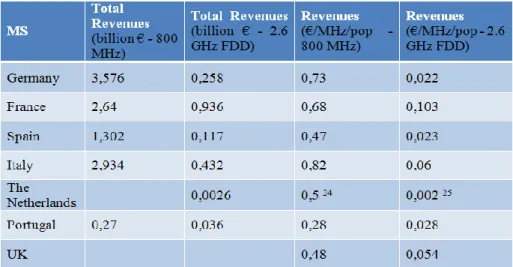
Regarding the investments needed to increase capacities we will give only the value for frequencies considering the digital dividend (DD) spectrum which is most interested today for provision of mobile data based on LTE/4G networks. The table below gives the price for frequencies auctioned in different EU countries.
Table 1: The prices for spectrum in the EU
The high value to have the right of use for such high interest frequencies necessary to build and develop mobile networks for broadband tell us that models to have a better efficient investments model is important. Using Wi-Fi based on 2.4 and 5.8 GHz will help to reduce the investments needed.
1.8 Options for Offload data traffic in MNOs
As presented in the report of Wipro Council for Industry Research “Data offload approached for mobile operators “Improving Network Efficiency and Strengthening Quality of Service” [8], there are six offload options known as it is given below:
Wi-Fi hotspot
LTE SmallCells/Relaynotes
Integrated Femto/WiFi
Direct Tunnel
Internet offload Gateway
M2M Gateway
For each of these offload ways for data traffic we have advantages challenges and benefits. Based on Wipro technologies a summary of comparative analyses for these ways is given. For a number of them one of the main challenges is related with scarcity and high value of licensed spectrum. The table below gives the conclusions of Wipro technologies for Wi-Fi hotspots solution:
Table 2. Advantages and challenges for Wi-Fi offload based on hot-spots [Source: Wipro technologies] DATA
OFFLOAD OPTIONS
ADVANTAGES CHALLENGES OPERATOR BENEFITS
Wi-Fi hotspots Use unlicensed frequencies Low power consumption Limited coverage Interference management and coverage Security challenges Selective data offload Lower set-up and maintenance costs
Regarding Wi-Fi hotspot solution some other advantages are related with the fact that the number of hotspots is increased globally and in national level. This helps:
in national level it is helpful for local traffic
globally it help for data roaming and from the perspective of user Wi-Fi solution is used to avoid bill shock for data roaming: it need careful from the user side on usage of applications/features of device In addition the establishment of Wi-Fi hotspots is easier and cost effective compared with large networks deployment and upgrades. On the other hand hotspot solution is limited considering the limitation of area covered. Nevertheless build the hot spot in most populated zones or the zones with high traffic.
The main advantage of using Wi-Fi is that it is used the solutions based on unlicensed spectrum. One of the big discussion in our days are the spectrum issues and the challenge for not enough spectrum for future mobile broadband. As scarce resource spectrum value is high and especially the recent auctions for digital dividend in Europe countries, as it is given in the table above, tell us that the value for spectrum is too high.
2 What is Wi Fi?
Traditionally when we speak for Wi-Fi we remember the solution for giving access for users near a hotspot such as all devices in a home, all users located in a public hotspot etc. Another important fact mentioned each time the WiFi is analyzed, is related with free frequency, or unlicensed frequencies bands, 2.4Ghz and 5.8GHz.
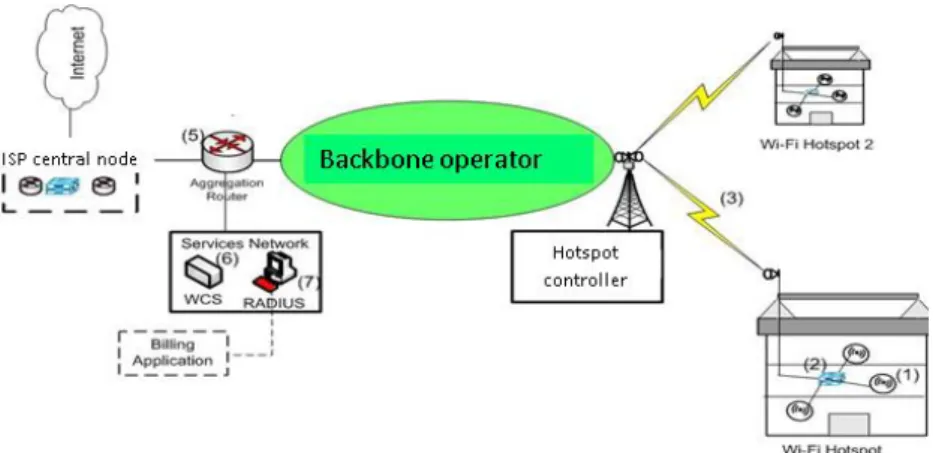
A simplified diagram of Wi-Fi network is presented in the picture below. Its main components and their analogy with the main parts of a mobile network are:
1. Access point with the functionalities like a BTS or NodeB 2. Small hub
3. IP Wireless link (FO alternatively)
4. WLC (Wireless LAN Controller) functionalities like BSC or RNC 5. Aggregation Router
6. WCS (Wireless Control System) for Wi-Fi management 7. RADIUS for authorisation and accounting
Fig. 5. A simplified Wi-Fi diagram
2.1 An example how to identify the need for WiFi offload
To give a simple example where and why Wi-Fi offload is needed, we commited a measurement of data speed in some main roads of Tirana city. A simple way of measuring the internet performance of a mobile operator is presented in the pictures below.
It is a drive test in a urban area of Tirana (some business buildings included). The download speed is tested while driving and the colors corresponds to the speed as per legend. The tool used is the iOS application called “i-Drive Test” and is a simulation of professional tools used by operators.
The red color testifies poor quality (DL speed less 500kbps) at some points. Considering that this low speed is related with more users located in that area and more capacities needed to keep the requires level of QoS or as the data speed is contracted with the consumer. In this areas Wi-Fi offload with hotspots will be a solution to solve the congestion or poor quality.
Analyzing the status, what the operator needs to do is: 1. Either to improve the coverage or,
2. to try off-loading traffic by other means, where the WiFi spots implementation is a prefered solution. Option 1 is very challenging in a urban area because new station / antenna is needed as well as more spectrum. All this factors bring along cost (imagine billions of Euros spent nowdays across Europe on spectrum auctions) and interference. It seems that the operator should definitely have a look on WiFi off-loading.
Fig. 6. DL performance [Source: The result of measurement made in urban area of Tirana]
2.2 Wi-Fi offload in Albania
There are four mobile operators in Albania three of them provide mobile broadband based on 3G networks. The mobile penetration is high 119%, based on active SIM cards. The usage of mobile services is increased year by year due to a higher competition, the reduction of prices, a great number of tariff packages and the bundles of services including voice and data.
In Albania the penetration of mobile broadband by the end of 2012 was 22.9% which is double compared with 11% in 2011. The global trend for high mobile data is evident in Albania too. Based on the figures published the mobile data traffic was increased seven to ten times during last two years.
This growth asks for solutions and Wi-Fi offload is one of them. The section above gives the result of a measure made in urban area of Tirana. There are a number of zones with red colour where Wi-Fi offload might be a simple solution.
A real example in the Albanian market is the “WiFi service” offered from Albtelecom and Eagle Mobile. It is accessible only from mobile subscribers of Albtelecom in some hot spots in Tirana and major cities of Albania, in places like parks, public beaches, city centers etc. But the benefits of this Wi-Fi service already implemented in Albania might be higher if this network will open for other networks too and not only for Eagle Mobile subscribers.
2.3 Wi-Fi off-load versus traffic management tools
Referring to different documents the MNOs are using various traffic management tools to cope with high data traffic demand. Throttling, blocking are between these traffic management tool. But throttling, blocking or reduction of speed /bandwidth after consuming an amount of data are critizied since these are not in line with net neutrality principle and unfair practice for the consumers.
Recently the European Commission initiated the process to revise the electronic communication regulation. The proposals in the process include the issues related with open internet. To implement net-neutrality principle the new rules asks for no blocking and no throttling. These new rules in the process will impose the MNOs to revise their traffic management tools currently use throttling and blocking to manage high data traffic.
Wi-Fi as a scheme to offload data traffic is not in contrary with net-neutrality principle; there is no any problem with consumer protection too.
Integrated Femto and WiFi will be a hybrid solution that utilizes both small cells and WiFi hotspot concepts for offloading data.
3 Conclusions and recommendations
Data traffic is increased significantly in mobile networks during last years. This trend will continue in the future. The mobile networks need to address the high demand data traffic in a proper and efficient way.
Different offload options are used. WiFi off-load solution is highly recommended for mobile operators, because no license is needed as it operates in the unlicensed band (2.4 GHz and 5.8 GHz).
Good data speed could be offered. It is proved that 6 – 22 Mbps per user can be achieved. Full interoperability with smart phones, tablets, laptops, data cards is provided.
The integration with GSM infrastructure (service provisioning and charging) is possible. The operators are recommended to go for it, in order to better attach this solution / service to their core business, both from technical and commercial perspective.
Different charging schemas could be applied. The most frequently used is the flat rate one. Improvement of indoor coverage is another benefit of WiFi solution. It is well known that 3G and LTE are suffering on that.
For the MNOs: WiFi to be considered as a complementary technology for 3G and LTE. To be implemented only in the areas where needed and not to heavily overlap with coverage provided by NodeB-s or eNodeB-s, otherwise the risk of cannibalization would be appeared.
In a longer term: Recently, powerful market players as well as many outstanding analysts jumped into conclusion that, after 2020, in the mobile world only 2G and 4G will survive. It is obvious that it is very difficult and expensive for an operator to develop, operate and maintain three parallel networks. 2G is very well established and expanded and very important for the coverage as well as quite reliable for the traditional voice. On the other hand the end users are requesting always higher and higher data speeds and LTE (ore LTE advanced) perfectly will meet that. So, 3G will die in 10-15 years and a gap will be created. Of course it is a gap to be filled and WiFi solution will still be there.
In a nutshell, the recommended timeline for data traffic offload is:
In short term: use Wi-Fi hotspot solution. Typically it happens when a matured 3G network is properly serving the customer needs , but more capacities are needed.
In mid term: use small cell LTE solution. When 3G network does not any more fulfill “need for speed” and LTE is implemented.
In long term: deploy hybrid solution femto/Wi-Fi using both lincensed and unlicensed spectrum. At this stage the data usage is well matured and customer needs are developing very fast.
References
1. Cisco “Cisco Visual Networking Index: Global Mobile Data Traffic Forecast Update 2012-2017”, available at: http://www.cisco.com/en/US/solutions/collateral/ns341/ns525/ns537/ns705/ns827/white_paper_c11-520862.html
2. Accuris-network “Mobile Wi-Fi offload” available at: http://www.accuris-networks.com/assets/files/pdf/fmc/AccuROAM_FMC_Datasheet.pdf
3. Cullen International 2013, Report on e-communications and information society in Enlargement countries, available at: http://ec.europa.eu/digital-agenda/en/news/2013-report-e-communications-and-information-society-enlargement-countries
4. www.akep.al/statistika
5. Analysys Mason, 2011 “3G and 4G spectrum requirements: a question of balance” available at: http://www.analysysmason.com/About-Us/News/Insight/Insight_spectrum_requirements_Jul2011/ 6. Acquris Networks 2010 “The business Value of Mobile Data Offload”, White Paper available at:
http://www.accuris-networks.com/home/wpgppce
7. John Wiley & Sons, H.Kaaranen, A. Ahtiainen, L. Laitinen, S.Naghian, V.Niemi “UMTS Networks” second edition (2005) 30-60
8. Wipro Council for Industry Research “Data offload approached for mobile operators “Improving Network Efficiency and Strengthening Quality of Service” available at: http://www.wipro.com/Documents/resource-center/Data_Offload_Approaches_for_Mobile_Operators.pdf
9. International Telecommunication Union (2012), “Trends in Telecommunication Reform 2012, Smart Regulation in Broadband World”, available at: http://www.itu.int/pub/D-REG-TTR.13-2012
10. AKEP “On wholesale broadband market analysis” available at: www.akep.al/konsultime
11. Qualcomm Intercoporated 2011, “A 3G/LTE Wi-Fi Offload Framework: Connectivity Engine (CnE) to Manage Inter System Radio Connections and Applications” available at: www. qualcomm.com
12. Acquris Networks 2012 “Why Wi-Fi offload and roaming are key to meeting growing data demands” White Paper, downloaded from: http://www.telecoms.com/40136/why-wi-fi-offload-and-roaming/
![Fig. 1. Mobile data Traffic 2012-2017 [Source: Cisco white paper]](https://thumb-us.123doks.com/thumbv2/123dok_us/490257.2558057/3.892.295.598.109.552/fig-mobile-data-traffic-source-cisco-white-paper.webp)
![Fig. 3. Factors driving mobile data supply and demand [Source: Analysys Mason]](https://thumb-us.123doks.com/thumbv2/123dok_us/490257.2558057/4.892.297.594.376.567/factors-driving-mobile-supply-demand-source-analysys-mason.webp)
![Table 2. Advantages and challenges for Wi-Fi offload based on hot-spots [Source: Wipro technologies]](https://thumb-us.123doks.com/thumbv2/123dok_us/490257.2558057/6.892.163.713.97.571/table-advantages-challenges-offload-based-source-wipro-technologies.webp)