2020
Towards understanding the challenges faced by machine learning
Towards understanding the challenges faced by machine learning
software developers and enabling automated solutions
software developers and enabling automated solutions
Md Johirul IslamIowa State University
Follow this and additional works at: https://lib.dr.iastate.edu/etd
Recommended Citation Recommended Citation
Islam, Md Johirul, "Towards understanding the challenges faced by machine learning software developers and enabling automated solutions" (2020). Graduate Theses and Dissertations. 18149.
https://lib.dr.iastate.edu/etd/18149
This Dissertation is brought to you for free and open access by the Iowa State University Capstones, Theses and Dissertations at Iowa State University Digital Repository. It has been accepted for inclusion in Graduate Theses and Dissertations by an authorized administrator of Iowa State University Digital Repository. For more information, please contact [email protected].
automated solutions
by
Md Johirul Islam
A dissertation submitted to the graduate faculty in partial fulfillment of the requirements for the degree of
DOCTOR OF PHILOSOPHY
Major: Computer Science
Program of Study Committee: Hridesh Rajan, Major Professor
Gianfranco Ciardo Gurpur Prabhu
Jin Tian Anuj Sharma
The student author, whose presentation of the scholarship herein was approved by the program of study committee, is solely responsible for the content of this dissertation. The Graduate College will ensure this
dissertation is globally accessible and will not permit alterations after a degree is conferred.
Iowa State University Ames, Iowa
2020
DEDICATION
TABLE OF CONTENTS
Page
LIST OF TABLES . . . vii
LIST OF FIGURES . . . viii
ACKNOWLEDGMENTS . . . x
ABSTRACT . . . xi
CHAPTER 1. INTRODUCTION . . . 1
1.1 Contributions . . . 2
1.2 Outline . . . 3
CHAPTER 2. RELATED WORK . . . 4
2.1 Empirical Study UsingStack Overflow . . . 4
2.2 Study of Challenges in ML . . . 5
2.3 Empirical Study of Bugs in Non-ML . . . 6
2.4 Empirical Study of Bugs in DNN . . . 6
2.5 Study of Fixing DNN Bugs . . . 7
2.6 Study of API-misuse Classification . . . 8
2.7 API Misuse Detection . . . 8
2.8 Model Testing . . . 9
CHAPTER 3. WHAT DO DEVELOPERS ASK ABOUT ML LIBRARIES? A LARGE-SCALE STUDY USING STACK OVERFLOW . . . 10
3.1 Introduction . . . 10
3.2 Methodology . . . 12
3.2.1 Classification of Questions . . . 13
3.2.2 Manual Labeling . . . 18
3.2.3 Threats to Validity . . . 19
3.3 Analysis and Results . . . 21
3.4 RQ1: Difficult stages . . . 22
3.4.1 Most difficult stage . . . 22
3.4.2 Data preparation . . . 24 3.5 RQ2: Nature of problems . . . 25 3.5.1 Type mismatch . . . 25 3.5.2 Shape mismatch . . . 26 3.5.3 Data Cleaning . . . 27 3.5.4 Model creation . . . 28
3.5.5 Error/Exception . . . 29
3.5.6 Parameter selection . . . 30
3.5.7 Loss function selection . . . 31
3.5.8 Training accuracy . . . 32
3.5.9 Tuning parameter selection . . . 32
3.5.10 Correlation between libraries . . . 34
3.5.11 API Misuses in All ML Stages . . . 35
3.6 RQ3: Nature of libraries . . . 38
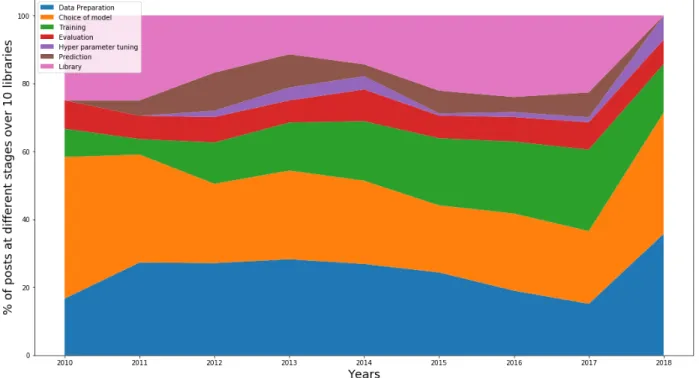
3.7 RQ4: Time consistency of difficulty . . . 40
3.8 Implications and Discussion . . . 42
3.8.1 Implications of RQ1 . . . 42
3.8.2 Implications of RQ2 . . . 43
3.8.3 Implications of RQ3 . . . 44
3.8.4 Implications of RQ4 . . . 44
3.9 Conclusion . . . 44
CHAPTER 4. A COMPREHENSIVE STUDY ON DEEP LEARNING BUG CHARACTERISTICS 46 4.1 Introduction . . . 46
4.2 Methodology . . . 47
4.2.1 Data Collection . . . 47
4.2.2 Classification . . . 49
4.2.3 Labeling the Bugs . . . 50
4.2.4 Types of Bugs in Deep Learning Software . . . 51
4.2.5 Classification of Root Causes of Bugs . . . 54
4.2.6 Classification of Effects of Bugs . . . 56
4.3 Frequent bug types . . . 57
4.3.1 Data Bugs . . . 57
4.3.2 Structural Logic Bugs . . . 59
4.3.3 API Bugs . . . 59
4.3.4 Bugs inGithubProjects . . . 60
4.4 Root Cause . . . 61
4.4.1 Incorrect Model Parameter (IPS) . . . 61
4.4.2 Structural Inefficiency (SI) . . . 61
4.4.3 Unaligned Tensor (UT) . . . 63
4.4.4 Absence of Type Checking . . . 63
4.4.5 API Change . . . 64
4.4.6 Root Causes inGithubData . . . 64
4.4.7 Relation of Root Cause with Bug Type . . . 64
4.5 Impacts from Bugs . . . 65
4.5.1 Crash . . . 66
4.5.2 Bad Performance . . . 67
4.5.3 Incorrect Functionality . . . 67
4.5.4 Effects of Bugs inGithub . . . 68
4.6 Difficult Deep Learning stages . . . 68
4.6.1 Data Preparation . . . 68
4.6.3 Choice of Model . . . 70
4.7 Commonality of Bug . . . 70
4.8 Evolution of Bugs . . . 72
4.8.1 Structural Logic Bugs Are Increasing . . . 73
4.8.2 Data Bugs Are Decreasing . . . 73
4.9 Threats to Validity . . . 74
4.10 Discussion . . . 75
4.11 Conclusion . . . 76
CHAPTER 5. REPAIRING DEEP NEURAL NETWORKS: FIX PATTERNS AND CHALLENGES 78 5.1 Introduction . . . 78
5.2 Methodology . . . 79
5.2.1 Dataset . . . 79
5.2.2 Bug Fix Pattern Classification . . . 80
5.2.3 Labeling . . . 85
5.3 Bug Fix Patterns . . . 85
5.3.1 Data Dimension . . . 85 5.3.2 Layer Dimension . . . 89 5.3.3 Version-related Fixes . . . 90 5.3.4 Network Connection . . . 90 5.3.5 Add Layer . . . 91 5.3.6 Loss Function . . . 92
5.3.7 Commonality of Fix Patterns inStack OverflowandGithub. . . 94
5.4 Fix patterns across bug types . . . 94
5.5 Fix Patterns across libraries . . . 98
5.6 Introduction of Bugs Through Fixes . . . 99
5.7 Challenges in Fixing Bugs . . . 100
5.7.1 DNN Reuse . . . 102
5.7.2 Untraceable or Semi-Traceable Error . . . 102
5.7.3 Fast and Furious Releases . . . 103
5.8 Threats to Validity . . . 104
5.9 Discussion . . . 105
5.10 Conclusion . . . 106
CHAPTER 6. AMIMLA: MISUSE DETECTION FOR MACHINE LEARNING APIS . . . 108
6.1 Introduction . . . 108
6.2 Motivation: Study of ML API Misuses . . . 110
6.2.1 Data Collection . . . 110
6.2.2 ML API Misuse Classification . . . 111
6.2.3 Observations . . . 113
6.2.4 Threats to Validity . . . 114
6.3 Amimla: ML API Misuse Detection . . . 115
6.3.1 Abstract Neural Network (ANN) . . . 116
6.3.2 Abstract ML Pipeline . . . 118
6.3.3 API Canonical Form . . . 120
6.3.5 Collecting Constraints fromStack Overflow . . . 122
6.3.6 Storing Fully Qualified Method Name of APIs . . . 123
6.3.7 Detection . . . 124
6.4 Empirical Evaluation . . . 129
6.4.1 Stack Overflow(SO) Misuse Dataset . . . 129
6.4.2 Github(GH) Misuse Dataset . . . 130
6.4.3 Accuracy Metrics . . . 131
6.4.4 ML API Misuse Detection Accuracy . . . 131
6.4.5 Analyzing Classification of Detection Results . . . 132
6.4.6 Usefulness Analysis . . . 132
6.5 Conclusion . . . 133
CHAPTER 7. CONCLUSION AND FUTURE WORK . . . 134
7.1 Future Work . . . 135
7.1.1 ML Pipeline Design . . . 135
7.1.2 ML Specific Static and Dynamic Analysis Tools . . . 135
7.1.3 ML API Design and Abstraction . . . 135
7.1.4 ML Specific Debuggers . . . 136
7.1.5 Automatic Detection of ML Bugs . . . 136
7.1.6 Automatic Program Repair . . . 136
7.1.7 ML Specific Intermediate Representation (IR) for Enabling ML Program Analysis . 136 7.1.8 Software Testing for ML Software . . . 137
7.1.9 Reuse of ML Models and Versioning . . . 137
LIST OF TABLES
Page
Table 3.1 Numbers of posts having different score (S) about ML libraries. The bold column represents selected posts.S =|NU| − |ND|where|NU|is the number of
upvotes and|ND|is the number of downvotes. . . 12
Table 3.2 Reputation of users for posts in our study. . . 21
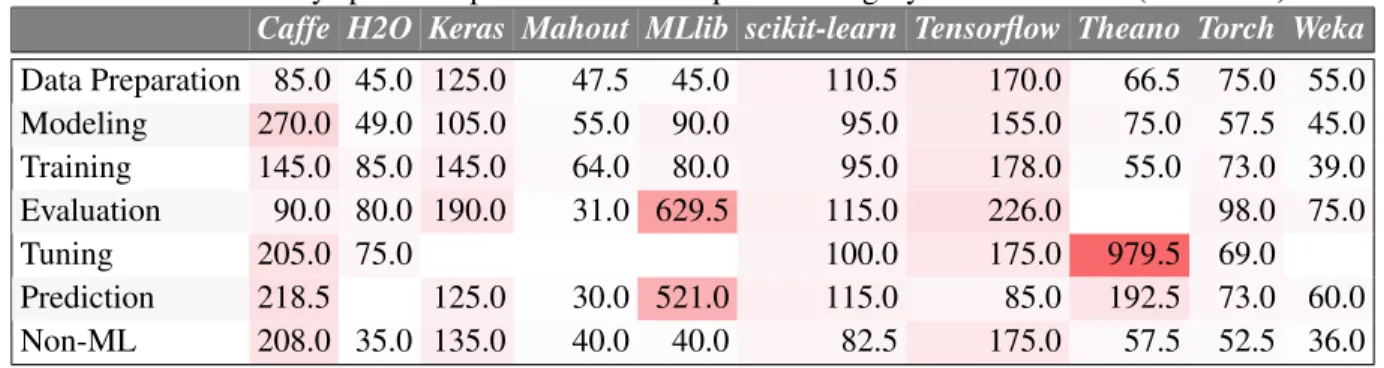
Table 3.3 Percentage of questions in each top-level category across libraries (in %). . . 21
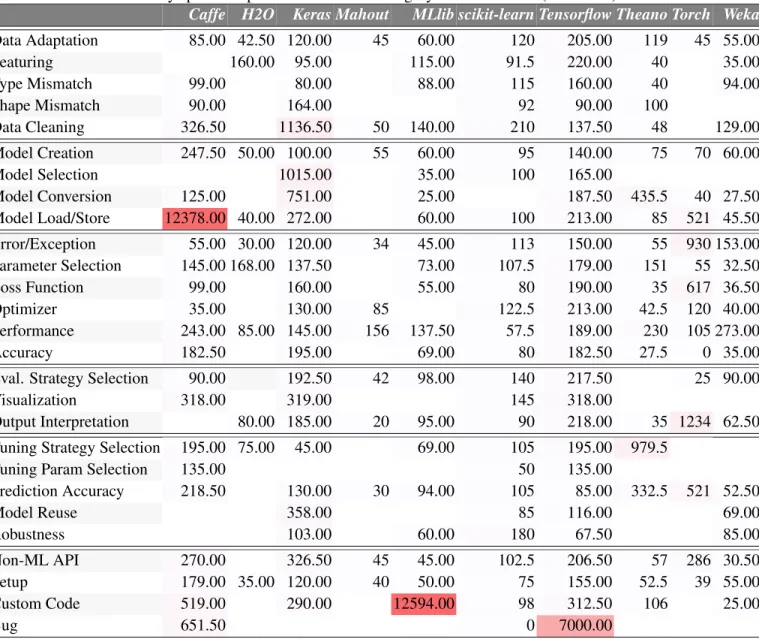
Table 3.4 Percentage of questions in each subcategory across libraries (in %). . . 22
Table 3.5 Library specific reputation in each top-level category across libraries (in me-dian). . . 29
Table 3.6 Library specific reputation in each subcategory across libraries (in median). . 30
Table 3.7 Number of occurrences utilizing the libraries inGithub. . . 40
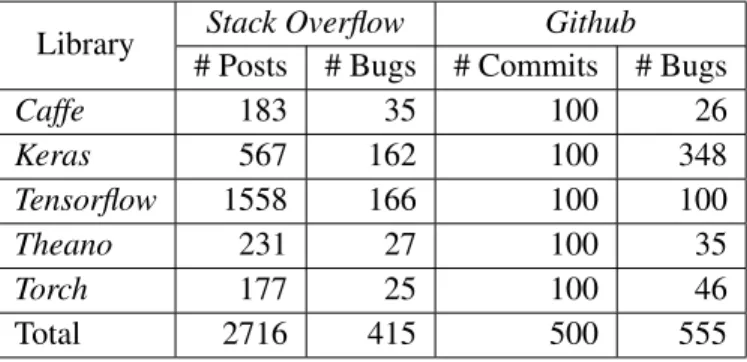
Table 4.1 Summary of the dataset used in the Study . . . 48
Table 4.2 Statistics of Bug Types inStack OverflowandGithub . . . 60
Table 4.3 Statistics of the Root Causes of Bugs . . . 77
Table 4.4 Effects of Bugs inStack OverflowandGithub . . . 77
Table 5.1 Summary of the bug repair dataset. . . 80
Table 5.2 Summary of the bug fix patterns. . . 81
Table 5.3 Bug Fixes inStack Overflow(SO) andGithub(GH) . . . 86
Table 5.4 P-value of the distribution of Bugs btween the libraries . . . 99
Table 5.5 Statistics of the Introduction of New Bugs During Bug Fix . . . 100
Table 5.6 TensorflowAPI changes. Change= # of operations changed in comparison to the previous version. . . 104
Table 6.1 Classification of Machine Learning API Misuses. . . 110
Table 6.2 Detection accuracy. . . 129
Table 6.3 Detection results by ML pipeline stages. . . 129
Table 6.4 Detection results by program elements. . . 130
Table 6.5 Impact Analysis. . . 130
LIST OF FIGURES
Page
Figure 3.1 Stages in a typical ML pipeline, based on [1]. . . 15
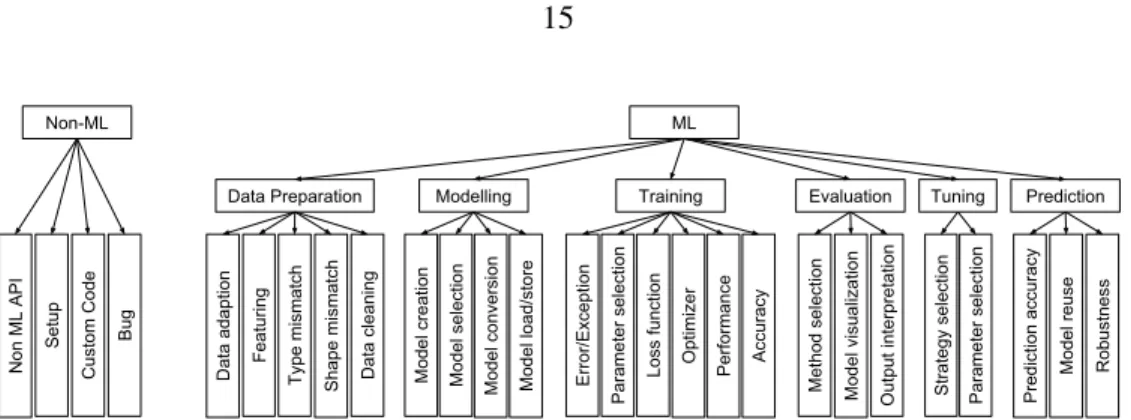
Figure 3.2 Classification used for categorizing ML library-related Stack Overflow questions for further analysis . . . 15
Figure 3.3 Cohen’s kappa coefficients for labeling process. . . 19
Figure 3.4 Question 40430186: An example showing dimension or shape mismatch problem in training in ML. . . 26
Figure 3.5 Question 12319454: An example question on model creation for distributed ML usingMahout. . . 28
Figure 3.6 Question 45030966: An example question aboutKerasshowing abstraction in deep learning libraries could make identifying root cause of an error/exception difficult. . . 31
Figure 3.7 scikit-learnissue #4800: An example of hyperparameter tuning problem. The user filed a bug report, but a developer of the library responded that the prob-lem was with hyperparameter tuning. . . 34
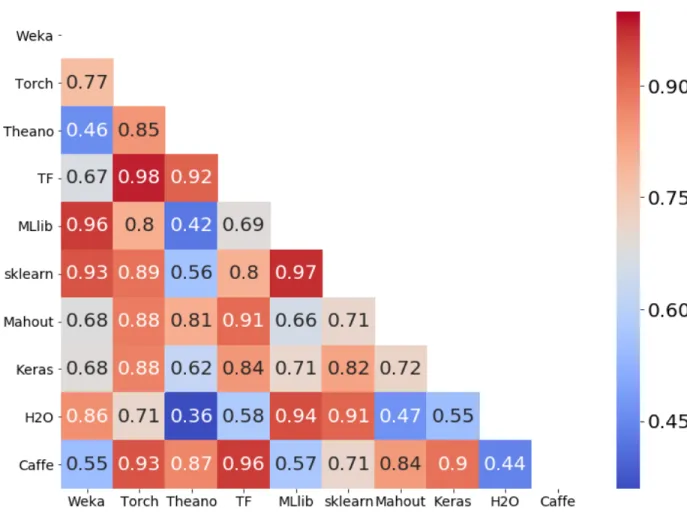
Figure 3.8 Correlation between distributions of percentage of questions over stages of the libraries. . . 34
Figure 3.9 Question 24617356: An example showing the API misuse problem in ML libraries. Code snippets are omitted. . . 36
Figure 3.10 Difficulties over time, across different stages . . . 41
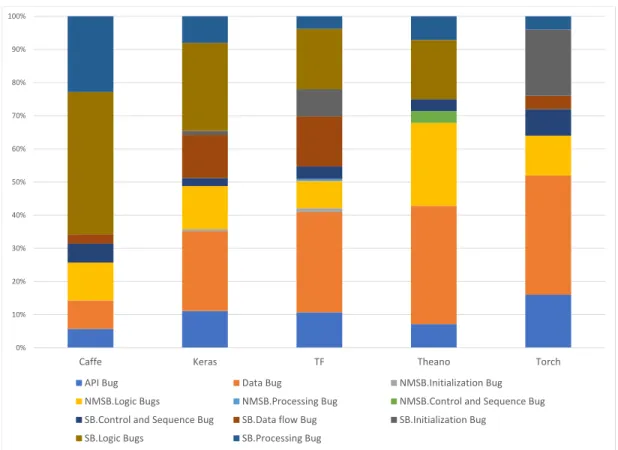
Figure 4.1 Distribution of Bug Types inStack Overflow . . . 58
Figure 4.2 Stack Overflow Root Cause Classification . . . 62
Figure 4.3 Relation between Root Causes and Types of Bugs . . . 65
Figure 4.4 Distribution of Bug Effects inStack Overflow . . . 66
Figure 4.5 Bugs across stages of the Deep Learning pipeline . . . 69
Figure 4.6 Correlation of Bug Types among the libraries . . . 71
Figure 4.7 Distribution of different antipatterns . . . 72
Figure 4.8 Example of similar antipattern inTensorflowandKeras . . . 73
Figure 4.9 Timeline of Evolution of Bugs . . . 74
Figure 5.1 Bug fix pattern distribution . . . 86
Figure 5.2 Distribution of Bug Fix Patterns for Different Bug TypesStack Overflow . . 95
Figure 5.3 Distribution of Bug Fix Patterns for Different Bug TypesGithub . . . 96
Figure 5.4 Fix ofStack Overflow#49742061 . . . 97
Figure 5.5 Fix ofStack Overflow#54497130 . . . 97
Figure 5.6 Bug fix pattern distribution: SB.P→SB.Processing, SB.L→SB.Logic, DF→Data Flow,SB.I→SB.Initialization, ATC→Absence of Type Checking, BP→Bad Performance, IF→Incorrect Functionality . . . 101
Figure 6.1 Overview of our detection approach and Amimla tool. . . 117
Figure 6.2 Code excerpt from Stack Overflow . . . 118
Figure 6.4 Bugfix due to wrong fully qualified method names. Red color indicates the deleted code and green color indicates the added code. . . 124
ACKNOWLEDGMENTS
I would like to take this opportunity to express my thanks to those who helped me with various aspects of conducting research and the writing of this thesis. I would like to thank Dr. Hridesh Rajan for his guidance, patience, and support throughout this research and the writing of this thesis. I am thankful to the US National Science Foundation for financially supporting this project under grants CCF-15-18897 and CNS-15-13263. I would like to thank my committee members Dr. Gianfranco Ciardo, Dr. Gurpur M. Prabhu, Dr. Jin Tian, and Dr. Anuj Sharma for their efforts and contributions to this work. I would like to extend my thanks to all the members of the Laboratory of Software Design for offering constructive feedback and timely suggestions during research. I would like the convey my special thanks to Hamid Bagheri, Gian Nguyen for helping me in data collection and manual labeling. I would also like to thank Dr. Hoan Nguyen to suggest improvements in my works and helping me in editing the papers.
The majority of this draft is adopted from the prior peer-reviewed papers in top tier software engineering venues. Chapter3is based on our paper [2] which is currently under revision for resubmission as per the
reviewers feedback. This thesis contains the updated revision of the draft. Chapter4is based on our accepted
paper [3] at ESEC/FSE 2019. Chapter5is based on accepted paper [4] at ICSE 2020. Chapter6is based
on our draft submitted to FSE 2020 and is being revised for resubmission. This thesis contains a revised version of the draft addressing the most major comments from the reviewers.
In this thesis, I do not include some of the other papers that I worked on during my Ph.D. For example, I got the chance to work on extending Boa [5] and show its effectiveness in the analyses of large scale transportation data, and our paper was accepted at the Journal of Big Data Analytics in Transportation [6]. I also got the chance to collaborate in creating a large scale dataset for analyzing data science programs that have been accepted at the data showcase of MSR 2019 [7]. I also got the chance to work on several projects related to the analyses of ML models, adversarial attacks to ML, and runtime monitoring of Deep Neural Network models [8].
ABSTRACT
Modern software systems are increasingly including machine learning (ML) as an integral component. However, we do not yet understand the difficulties faced by software developers when learning about ML libraries and using them within their systems. To fill that gap this thesis reports on a detailed (manual) examination of 3,243 highly-rated Q&A posts related to ten ML libraries, namelyTensorflow,Keras, scikit-learn,Weka,Caffe,Theano,MLlib,Torch,Mahout, andH2O, onStack Overflow, a popular online technical Q&A forum. Our findings reveal the urgent need for software engineering (SE) research in this area.
The second part of the thesis particularly focuses on understanding the Deep Neural Network (DNN) bug characteristics. We study 2,716 high-quality posts fromStack Overflowand 500 bug fix commits from
Githubabout five popular deep learning librariesCaffe,Keras,Tensorflow,Theano, andTorchto understand the types of bugs, their root causes and impacts, bug-prone stage of deep learning pipeline as well as whether there are some common antipatterns found in this buggy software.
While exploring the bug characteristics, our findings imply that repairing software that uses DNNs is one such unmistakable SE need where automated tools could be beneficial; however, we do not fully understand challenges to repairing and patterns that are utilized when manually repairing DNNs. So, the third part of this thesis presents a comprehensive study of bug fix patterns to address these questions. We have studied 415 repairs fromStack Overflowand 555 repairs fromGithubfor five popular deep learning librariesCaffe,
Keras,Tensorflow,Theano, andTorchto understand challenges in repairs and bug repair patterns. Our key findings reveal that DNN bug fix patterns are distinctive compared to traditional bug fix patterns and the most common bug fix patterns are fixing data dimension and neural network connectivity.
Finally, we propose an automatic technique to detect ML Application Programming Interface (API) misuses. We started with an empirical study to understand ML API misuses. Our study shows that ML API misuse is prevalent and distinct compared to non-ML API misuses. Inspired by these findings, we contributed Amimla (Api Misuse In Machine Learning Apis) an approach and a tool for ML API misuse
detection. Amimla relies on several technical innovations. First, we proposed an abstract representation of ML pipelines to use in misuse detection. Second, we proposed an abstract representation of neural networks for deep learning related APIs. Third, we have developed a representation strategy for constraints on ML APIs. Finally, we have developed a misuse detection strategy for both single and multi-APIs. Our experimental evaluation shows that Amimla achieves a high average accuracy of∼80% on two benchmarks of misuses fromStack OverflowandGithub.
CHAPTER 1. INTRODUCTION
Machine Learning (ML) is becoming an essential component of modern software engineering. More-over, its usage in safety-critical systems like self-driving cars, automatic traffic and flight control, robotic surgery, etc. is on the rise. Software developers use highly abstract machine learning libraries to write ML programs in their tools and applications. A large number of ML libraries are publicly available to support the increasing usage of ML in the development of software. For example, some of the popular libraries are
Caffe[9],H2O[10],Keras[11],Mahout[12],MLlib[13],scikit-learn[14],Tensorflow[15],Theano[16],
Torch[17], andWeka[18]. All these libraries abstract away the details of ML algorithms and provide Ap-plication Programming Interfaces (API) to the developers. Therefore, developers can easily write complex ML models using these APIs. This has given rise to the discussions related to the trustworthiness, correct-ness, robustness and performance of the models, characteristics of bugs in the ML programs, developers challenges, bug fix patterns, etc.
Therefore, it has become an urgent need to study the challenges faced by the developers in developing ML applications to pave the research for solving the ML developers’ challenges. To the best of our knowl-edge, no such studies existed prior to the work in this thesis. So, to fill in this gap we studied the challenges faced by ML developers in using the ML libraries to develop software, the characteristics of the bugs made by the deep learning software developers, the patterns followed by the developers in fixing those bugs, and we also proposed a novel technique to automatically detect API misuses in ML software.
Our key findings and results show that ML developers face most challenges in the model creation stage of the ML pipeline; developing deep learning applications are highly bug-prone with new patterns of bugs; fixing deep learning applications have several new and unique patterns along with new challenges. We also showed that a novel ANN (Abstract Neural Network) based API misuse detector is more effective in ML API misuse detection compared to the state of the art prior works in other domains of software engineering.
1.1 Contributions
In this thesis, we provide several studies to understand the challenges of ML software developers and propose an automatic technique to detect one of the bugs ML developers are likely to make. Our specific contributions are:
In chapter 3, we provide an empirical study to understand the difficulties faced by ML developers in
developing ML applications. We usedStack Overflowto understand the difficulties by analyzing the dis-cussions for the 10 most popular ML libraries. We studied 3,243 highly-rated posts fromStack Overflow
manually and conduct thorough intra-library and inter-library analyses to answer five different research questions identifying the challenges faced by the developers.
In chapter4, we conducted another empirical study to understand the characteristics of bugs made by
the developers in developing Deep Neural Network (DNN) software. We have studied 2,716 qualifiedStack Overflowposts in five different deep learning libraries and done both qualitative and quantitative analyses to answer five different research questions. We have found several unique bug patterns in DNN that needs innovations from software engineering research.
In chapter5, we studied the patterns of repairing DNN programs by the developers. We have studied
the 415 bugs fromStack Overflowand 555 bugs fromGithubfrom chapter4and manually analyzed how
those bugs are fixed to identify the fix patterns. We also answered five different research questions through detailed qualitative and qualitative analyses. We have reported several newly appearing patterns for fixing DNN applications and we have also identified some new challenges in fixing DNN software.
In chapter6, we proposed an automatic API misuse detector for ML API misuses made by the
develop-ers. We proposed a novel intermediate representation that is very effective in fixing the DNN bugs related to API misuse. We have shown that our approach outperforms the state of the art API misuse detectors in detecting bugs in ML. We have also shown the effectiveness of our approach by fixing some real-world bugs in the repositories by industry leaders like Google and IBM.
We also contributed four different publicly available manually labeled datasets that have the potential to advance the research related to fixing the problems faced by the DNN developers and enable follow up studies.
1.2 Outline
In the next chapter, we provide a detailed literature review on empirical studies conducted for under-standing challenges in other domains of software engineering, bug patterns, and program repair patterns in non-ML fields, API misuse, and API misuse detection techniques in non-ML domains. In chapter 3,
we provide a large study on the challenges faced by the developers usingStack Overflow and we answer several research questions through qualitative and quantitative analyses of data. In chapter4, we provide
a comprehensive study on the bug characteristics made by the DNN software developers. In chapter5, we
identify and study the program repair patterns for DNN programs and describe several unique DNN specific program patterns along with some new challenges. In chapter 6, we propose Amimla, an automatic
tech-nique to detect the API misuses by ML programmers. We evaluate Amimla with a state of the art techtech-nique and have demonstrated our approach is effective in detecting API misuses by detecting and fixing some API misuses by industry leaders like Google and IBM. Finally, in chapter7, we provide a conclusion and several
CHAPTER 2. RELATED WORK
2.1 Empirical Study UsingStack Overflow
Stack Overflowis the widely used platform to study software engineering practice from the developer’s perspective. However, existing work has not studied the usage of ML libraries usingStack Overflow. Mel-drumet. al.[19] studied 266 papers usingStack Overflowplatforms to show the growing impact ofStack Overflow on software engineering research. Treudeet. al. [20] did manual labeling of 385 questions to manually classify 385 questions into 10 different categories (how-to, discrepancy, environment, error, deci-sion help, conceptual, review, non-functional, novice, and noise) to identify the question types. This study is useful to learn the general categories of questions asked by developers.
Kavaleret. al.[21] usedStack Overflowdata to study the queries on APIs used by Android developers and showed the correlation between APIs used in producing Apps in the market and the questions on APIs asked by developers. Linares-Vásquezet. al.[22] studied the effect of the changes in Android API on the developer community. They used the discussions arising onStack Overflow immediately after the API is changed and the behavior of the API is modified to study the impact of the change among the developers.
Berral-Garcíaet. al.[23] studied machine learning-based algorithms, approaches, execution frameworks and presented a brief discussion of some libraries used in machine learning. Baruaet. al.[24] studiedStack Overflowposts and used LDA topic modeling to extract topics to study the trend of different topics over time.
Rebouçaset. al.[25] studied the usage pattern of swift programming language among developers using
Stack Overflowdata.
Schenk et. al. [26] studied the geographical distribution of usage and knowledge of different skills usingStack Overflowposts and users data. Stanleyet. al.[27] proposed a technique based on the Bayesian probabilistic model to predict the tags of aStack Overflowpost. McDonnelet. al.[28] presented a study of API stability usingStack Overflowdata and as a test case, they used the Android Ecosystem. Baltadzhieva
et. al.[29] proposed a technique to predict the quality of a new Stack Overflowquestion. Joorabchi et. al.[30] studied the challenges faced by computer science learners in different topics and subjects using the
Stack Overflowdata.
2.2 Study of Challenges in ML
The authors in [31, 32] have explored some major reasons of technical debts in ML and claimed that
the quick advances in ML are not coming out for free. The authors described that these technical debts are caused by complex models, data dependencies, feedback loops, and ML anti-patterns. The authors described these observations based on their experience and discussion with the researchers and developers at Google. On the other hand, in chapter 3 we conduct a large-scale study using the problems discussed by the
developers in a well-trusted Q&A forum. The difficulties faced by the developers using different libraries and creating different types of ML models enhance the coverage of this study. Our findings also comply with the discussions on technical debts made by [31,32] on model complexity and data dependency.
Ericet. al.[33] studied software from Google and built a point-based testing framework that checks the data, features, and model development process. Our key findings also suggest that model creation and data adaptation are the most prevalent challenges across all ML libraries we have studied. Our study has focused on other aspects of ML as well e.g., challenges faced in different stages of ML pipeline, commonalities and variabilities of the difficulties faced by the developers in the ten ML libraries, and the evolution of different challenges over the years, etc.
A more relevant study has been conducted by [34] that focuses on the problems faced by developers in Microsoft in different stages of the ML pipeline. This work focus on processes and pipelines in ML. On the contrary, we focus on APIs and cross library comparison.
Their findings show thatdata availability, collection, cleaning, and managementandModel evolution, evaluation, and deployement are some key problems faced by the professionals. However, the analyses presented in this thesis supports the difficulties observed at the industry level by [34] as well present a number of new findings e.g., type mismatches are prevalent, shape mismatch mostly occurs in Keras, most issues in ML code leads to failure, parameter selection, choice of loss function are a difficult task for most
of the ML developers, the commonality and variability of the 10 libraries in terms of issues found, etc. One other major contrast with [34] is, the authors in [34] studied ML pipeline and workflow using a survey, but we study the ML libraries using Q&A forum.
2.3 Empirical Study of Bugs in Non-ML
There are some empirical studies focused on specific types of bugs. Luet. al. [35] studied real-world concurrency bug characteristics. Gaoet. al. [36] conducted an empirical study on recovery bugs in large-scale distributed systems. API changes problems was studied by [37–40]. Our work focuses on the bugs in the usage of deep learning libraries.
Other prior work that have studiedStack Overflowposts, e.g. [19,21,22,24], have not focused on deep
learning software.
Pan, Kim, and Whitehead [41] have studied seven Java projects to discuss the bug fix patterns in these projects. They have also proposed a classification scheme in categorizing the bug fix patterns in Java. The classification includes 9 broad categories and a total of 26 lower-level categories. This prior research suggests that the IF-related and Method Call (MC) related bugs are most frequent. In DNN bug fix strategies, the MC and sequence addition or deletion related bug fix pattern is present. We do not find any evidence of other bug fix strategies in DNN and that has inspired us to derive a classification scheme using the open coding approach to classify the DNN bug fix patterns.
Programming bugs are well-studied in software engineering. There is a rich body of empirical studies on bugs, e.g. [35,42–47] and bug repair, e.g. [41,48–50]; however, these works have not studied DNN
bugs and repairs that have their own set of unique challenges [2,3,51,52].
2.4 Empirical Study of Bugs in DNN
The closest related work on deep learning bug characteristics is by Zhanget al. [51] who have investi-gated bugs from deep learning applications built on top of Tensorflow. They collected 500Stack Overflow
posts and filtered them to study 87 posts and selected 11 Github projects to include 82 commits with 88 bugs using keywords e.g., bug, fix, wrong, etc. In contrast, we studied a cross-section of five deep learning
libraries with different design constraints, using 555 bugs from GitHub and 415Stack Overflowposts, that allowed us to draw interlibrary observations.
Zhanget al.have studied the bugs and have categorized them into 7 types of bug/root causes and 4 types of impacts/symptoms. Our work expanded the study to include bug types from literature and categorizes the bugs into 11 bug types, 10 root causes, and, 7 impacts. In term of results, our study both confirms what was known as a small scale and produces new knowledge e.g., correlating antipatterns with bugs [53].
Thunget al. [52] studied three machine learning systems, Apache Mahout, Lucene, and OpenNLP, and manually categorize the bugs into different categories. They focused on bug frequencies, bug types, the severity of the bug, bug-fixing duration, bug-fixing effort, and bug impact. Different from them, we focus on bug types, bug root causes, and bug impact of five deep learning libraries which are Tensorflow, Keras, Torch, Caffe, and Theano.
2.5 Study of Fixing DNN Bugs
Zhanget al.[51] have studied bug patterns inTensorflowusing bothGithubandStack Overflow. They have discussed the new patterns and characteristics of the bugs byTensorflowusers to write DNN applica-tions. They have also discussed the three new challenges in detecting and localizing these bugs. The study was limited toTensorflowand also does not discuss the bug fix patterns. We generalize to a number of deep learning libraries and identify the new patterns of fixing the bugs in DNN software. We also discuss the new challenges in fixing these bugs. We have discussed three new challenges in fixing DNN bugs.
Sun et al. [54] studied the issues in 3 ML libraries scikit-learn, Caffe, and paddleto understand the bug fix patterns in these libraries. However, we study the DNN models created using DNN libraries. Our findings do not have any commonalities.
Zhanget al.[55] studied 715Stack Overflowbug related posts for TensorFlow, PyTorch, and Deeplearn-ing4j to classify the questions into 7 different categories and built an automated tool that categorizes ques-tions based on the frequently found words from each category and computing the tf-idf value with respect to the keywords. Also, the authors have studied the challenges of answering the question inStack Overflow
by calculating the response time for each category and have found 5 categories of root causes for the bug related posts. Whereas, our study has been on the bug fixing strategies for 5 DNN libraries.
Phamet al.[56] studied three deep learning (DL) librariesTensorflow,CNTK, andTheanoto localize and detect deep learning bugs using cross-validating different backend i.e.,Tensorflow,CNTK. In contrast, our work studied five DL libraries, using bug-fix commits fromGithubandStack Overflowposts, that allowed us to draw interlibrary observations of the fixing strategies. Also, our work expanded the study to include deeper discussion about each fix pattern, the common challenges developers face while fixing these bugs, and how fixing bugs introduces a new bug.
2.6 Study of API-misuse Classification
Classification of API-misuse from different perspectives and domains have been done previously. Clas-sification of software defects by IEEE served as the basis for IBM’s orthogonal defect clasClas-sification (ODC) as discussed in [57]. The defect types include conceptual program elements which arefunction,check, doc-umentation,assignment,algorithmandviolation type. More recently, [58] classified API-misuse for Java programming language.
The classification includes API-misuses like method calls, conditions, iterations, and exception han-dling. None of them support misuse detection for ML APIs.
2.7 API Misuse Detection
Amimla is the most closely related to static approaches for API-misuse detection. They typically mine frequent API usages, which are considered as good usages or usage patterns, and use them to detect misuses which are usages violating those patterns.
Ganteret. al.[59] extract call sequences from programs to perform formal concept analysis to analyze pairwise temporal properties of API calls as described by [60]. There has been works to infer tempo-ral properties of API calls described in the works by [61–66]. There have also been works to mine and model program as itemsets as described by [67–69] and infer pairwise programming rules by frequent item-set mining. [70] mines programs from Github and guard conditions against the predicates of the APIs.
GROUMiner [71] uses graphs to represent API usages and patterns, and detect misuses. Amimla uses min-ing for buildmin-ing the API canonical forms. Different from those works, we manually create the constraints of APIs from documentation and discussions of API usages. More importantly, Amimla models the network layers in neural network APIs with ANNs and API sequences as ML pipelines. Amimla uses ANNs to detect incompatibility between layers, and ML pipelines to detect incompatibility between stages.
2.8 Model Testing
Recent work has studied methods to validate ML models. For example, [72] used concolic testing to detect safety problems in deep neural networks. Specifically, they increased the test coverage by formalizing coverage criteria for DNNs. [73] used SMT to create a verification framework for feed-forward-multi-layer neural networks. This work supports deep learning developers by validating image classification decisions. [74] created a technique to verify the reachability properties of deep neural networks based on the simplex method. They have extended the simplex method to detect the reachable state’s models with ReLU activation function. [75] focuses on the robustness of DNNs by studying a generic reachability problem for feed-forward DNNs. Compared to these works, the focus of Amimla is on ML API misuse detection.
CHAPTER 3. WHAT DO DEVELOPERS ASK ABOUT ML LIBRARIES? A LARGE-SCALE STUDY USING STACK OVERFLOW
3.1 Introduction
Machine learning (ML) is becoming an essential computational tool in a software developer’s toolbox for solving problems that defy traditional algorithmic approaches. Software developers are fulfilling this need by development and refinement of a number of new ML libraries [76]. Recently it has also been suggested that ML can introduce unique software development problems [31–33]. However, we do not yet know about the problems that users of ML libraries face and those that they choose to ask about publicly.
Prior work has shown that studying question and answer (Q&A) forums such asStack Overflowcan give significant insights into software developer’s concerns about a technology [20–22,24–30,77–81], but has
not focused on ML libraries. More details of related work are discussed in chapter2.
This work presents a study of the problems faced by developers while using popular ML libraries. Our study also leverages the posts on Stack Overflow. Since 2015, there has been growing interest and significant increase in ML related questions and distinct users makingStack Overflowa representative source of dataset for our study. We selected 10 ML libraries to study, identified by a survey [76] and confirmed by counting the number of posts onStack Overflowrelated to those libraries. These libraries areCaffe[9],
H2O[10],Keras[11],Mahout[12],MLlib[13],scikit-learn[14],Tensorflow[15],Theano[16],Torch[17], andWeka[18].
Caffe[9] is a deep learning library for Python and C++.H2O[10] is a deep learning library for Java, R, Python or Scala, and its key feature is to provide a workflow-like system for building ML models.Keras[11] is a deep learning library for Python whose key feature is to provide higher-level abstractions to make creating neural networks easier. Keras also uses Tensorflow orTheano as the backend. Mahout [12] is aimed at providing scalable ML facilities for Hadoop clusters. MLlib[13] is aimed at providing scalable ML facilities for Spark clusters. scikit-learn [14] is a Python library that uses Tensorflow orTheano as
the backend. This library provides a rich set of abstract APIs [82] to hide the complexity of ML from the user in an effort to make ML features widely accessible. Tensorflow[15] provides facilities to represent a ML model as data flow graphs. Theano[16] and Torch[17] are aimed at scaling ML algorithms using GPU computing. A novelty ofTheanois that it provides some self-verification and unit testing to diagnose some runtime errors. Weka[18] is an ML library for Java. It provides API support for data preparation, classification, regression, clustering, and association rules mining tasks and a GUI for making models easier. All in all, this set is both representative and provides variety. We selected a total of 3,243 highly-rated
Stack Overflowposts for this study. A team of three Ph.D. students, with experience in coursework on AI and ML, and using ML libraries, independently read and labeled each of the posts producing 9,849 labels that were then compared for consistency producing 177 conflicting labels on 177 different posts. All of these conflicts were resolved using mediated, face-to-face conflict resolution meetings between all three participants. We then performed statistical analysis and a study of the data to answer the following research questions:
RQ1: Difficult stage Which stages are more difficult in an ML pipeline? Figure 3.1 shows stages in a
typical ML pipeline.
RQ2: Nature of problemsWhich problems are more specific to the library and which are inherent to ML?
RQ3: Nature of librariesWhich libraries face problems in specific stages and which ones face difficulties in all stages?
RQ4: ConsistencyDid the problems stay consistent over time?
The remainder of this chapter describes our study and results and makes the following contributions: (1) a labeled and verified, a dataset of 3,243 ML library-related Q&A on Stack Overflow, (2) a classification scheme for ML-related Q&A, (3) an intra-library analysis to identify the strengths and weaknesses of ML libraries, and (4) an inter-library analysis to identify relative strengths and weaknesses.
3.2 Methodology
Our study uses Q&A posts on Stack Overflow, a popular platform used by developers. Our first step was to find the total number of questions asked about all the ML libraries highlighted by some recent
Table 3.1: Numbers of posts having different score (S) about ML libraries. The bold column represents selected posts.S=|NU|−|ND|where|NU|is the number of upvotes and|ND|is the number of downvotes.
Library S≥0 S≥1 S≥2 S≥3 S≥4 S≥5 Caffe[9] 2,339 1,320 620 318 192 132 H2O[10] 771 452 167 73 34 17 Keras[11] 5,708 3,323 1,751 953 568 367 Mahout[12] 1,186 610 293 160 103 48 MLlib[13] 1,688 929 498 272 173 119 scikit-learn[14] 9,246 5,302 2,898 1,759 1,188 856 Tensorflow[15] 21,115 10,109 4,962 2,769 1,827 1,334 Theano[16] 2,332 1,341 711 421 265 192 Torch[17] 1,226 640 312 161 91 61 Weka[18] 2,512 1,216 568 293 181 117 Total 48,123 25,242 12,780 7,179 4,622 3,243
surveys [76,83,84]. Out of these, we selected 10 popular ML libraries for the study as shown in Table5.1.
We excluded the other five libraries because the numbers of questions about them were too few (less than 20).
OnStack Overflow, each question is rated by the community. The score of a question is computed as
S =|NU| − |ND|where|NU|is the number of upvotes and|ND|is the number of downvotes. The higher score is an indicator of the higher quality of the question, which has been used by prior works such as [19]. Table5.1shows the entire distribution of the questions for each library based on the score ofS.
We selected questions with the score of 5 or higher (bold column in Table5.1) to focus on high-quality
questions while keeping the workload of manually labeling each question manageable. Note that inStack Overflowduplicate questions are not allowed, and do not receive upvotes because moderators mark them as duplicate. So, duplicate questions are eliminated when we use the score as quality metric.
Next, we manually classified each Stack Overflowquestion into categories to study them further. We first discuss the classification of categories and then our labeling process.
3.2.1 Classification of Questions
We classify the questions inStack Overflowinto several categories. First, we classify the questions into two top-level categories based on whether the question is related to ML or not. Questions related to
instal-lation problems, dependency, platform incompatibility, Non-ML APIs, overriding the built-in functionality, adding custom functionality fall into Non-ML category as shown in Figure3.2. We classify the ML-related
questions into six categories based on the stages of a typical ML pipeline [1], also reproduced in Figure3.1.
Among those seven stages, data collection is out of the scope of this study because ML libraries do not provide this functionality, which leaves us with six categories. These six categories are further divided into different subcategories. To find these subcategories one of the Ph.D. students with ML expertise first studied 50% of posts and created the subcategories using open coding scheme adapted from earlier works [85–87]. These labelings were not exposed to the manual raters as discussed later. The goal of this step was to find the coding scheme needed to label the difficulties using an open coding approach. Then these subcategories were sent to three ML experts for review. The three ML experts are faculties who are actively involved in Artificial Intelligence and Machine Learning research. Based on the review of the experts, the subcate-gories were improved and the process continued until an agreement with ML experts was reached. Once, we reached an agreement on the classification scheme, each rater rated all the posts using this classification scheme.
Then, we have reported the results for each library in terms of the number of posts. We have utilized the difficulty of each category as the number of posts labeled as that particular category. To validate that the number of posts is a representative metric of the difficulty inStack Overflow, we have studied a prior work [88] that has identified the different bugs found in Java and Python. Then, we have counted the posts with tags i.e., for Java with performance-related issues, we have counted the number of posts under the tag ‘performance‘ and ‘java‘. We have found that there is a correlation between the number of posts about an issue and the difficulty faced by the developers. According to the authors, the top 3 problems faced by the Java and Python developers are Performance, Memory, and Security respectively. We have found that the count of posts also reflects this difficulty in Java and Python (Performance (3260)>Memory (2093)>
Security (1870)). Our study indicates that the number of posts can be utilized as a representation of the challenges found in the prior study. The full classification is shown in Figure3.2. We keep the Non-ML as a
separate category as it covers a major share of code in ML projects. The authors in [31] discussed that only 5% of the code in an ML project is related. Next, we describe its categories.
Data Collection
Data
Preparation Modelling Training Evaluation
Parameter Tuning Prediction
Figure 3.1: Stages in a typical ML pipeline, based on [1].
3.2.1.1 Data Preparation
This top-level category includes questions about converting the raw data into the input data format needed by the ML library.
Data adaption. Questions under this subcategory are about reading raw data into the suitable data format required by the library. Data reader provided by the library usually provides this functionality. Questions about converting data, encoding, etc., also fall under this subcategory.
Featuring. Questions under this subcategory are about feature extraction and selection. Feature ex-tractionis a process to reduce the dimensionality of the data where existing features are transformed into a lower-dimensional space. Feature selectionis another strategy of dimensionality reduction where informa-tive features that have an impact on the model are selected.
Type mismatch. Type mismatch happens when the type of data provided by the user doesn’t match the type required by the ML API. For example, if an API needsfloating pointdata as input but the client provides aStringthen the ML API raises an exception.
Shape mismatch. Shape mismatch occurs when the dimension of the tensor or matrix provided by a layer doesn’t match the dimension needed by the next layer. These kinds of errors are very common in deep learning libraries.
Data cleaning. Data cleaning phase, sometimes also called data wrangling, includes removal of null values, handling missing values, encoding data, etc. Without proper data cleaning the training may throw exceptions, and accuracy may be suboptimal.
Non-ML ML
Data Preparation Modelling Training Evaluation Tuning Prediction
Bug Custom Code Setup Non ML API Shape mismatch Type mismatch Featuring
Data adaption Data cleaning
Model conversion
Model selection
Model creation Model load/store
Output interpretation Model visualization Method selection Parameter selection Error/Exception Performance Optimizer
Loss function Accuracy
Parameter selection
Strategy selection
Model reuse
Prediction accuracy
Robustness
Figure 3.2: Classification used for categorizing ML library-related Stack Overflow questions for further analysis
3.2.1.2 Modelling
The subcategories of this category include:
Model selection. This subcategory includes questions related to the choice of the best model and choice of the API version (e.g. whether to chose SVM or decision tree).
Model creation. This subcategory includes questions related to creating the ML model using the APIs.
Model conversion. This subcategory includes questions related to conversion of a model trained using one library and then using the trained model for prediction in an environment using another library. For example, a model trained inTorchcan be used for further training or prediction usingTheano.
Model load/store. This subcategory contains questions about storing models to disk and loading them to use later.
3.2.1.3 Training
The subcategories of this category include:
Error/Exception. Questions about errors faced by users in the training phase fall into this subcategory. The errors may appear due to various reasons. If the errors are due to shape mismatch or type mismatch we put them into the data preparation category. Otherwise, all errors are placed into this subcategory.
Parameter selection. Some frameworks have optional parameters, and developers have to choose appropriate values for these parameters and also pass relevant values to the required parameters. Questions related to these problems fall into this subcategory.
Loss function. Questions related to choosing and creating loss functions fall into this category, e.g., whether to use cosine distance.
Optimizer. Questions related to the choice of optimizer are placed into this subcategory, e.g., should I pick Adam or AdaGrad?
Performance. In this subcategory, questions related to long training time and/or high memory con-sumptions are placed.
Accuracy. Questions related to training accuracy and/or convergence are placed into this subcategory.
3.2.1.4 Evaluation
The subcategories of this category include:
Evaluation method selection.In ML related problems, a model needs to be evaluated against different techniques and the choice of the technique has an impact on both achieving the desired performance and the intent of the developer [89] e.g. “which of the eight APIs for eight different types of validations in scikit-learn, namely KFold, LeaveOneOut, StratifiedKFold, RepeatedStratifiedKFold, RepeatedKFold, LeaveOne-GroupOut, GroupKFold and ShuffleSplit, should be used?”
Visualizing model learning. The developers sometimes need to visualize the behavior of the model to get a better understanding of the training process and also to know the effects of evaluation on the change of loss function and accuracy. Those questions are placed in this subcategory.
3.2.1.5 Hyper-parameter Tuning
Hyperparameter tuning is used to improve the model’s performance. The values of hyperparameters affect model accuracy. For example, a bad learning rate may cause a model to learn poorly and give low accuracy. The subcategories of this category include:
Tuning strategy selection.Questions about choosing among APIs for different tuning methodologies are placed into this subcategory. For example, one poster wondered whether they should use the grid search or randomized search or parameter sampling for parameter tuning inscikit-learn?
Tuning parameter selection.This subcategory covers discussions related to the selection of parameters for tuning. Some parameters may not affect the model accuracy other than increasing the training time while some might have a significant effect on the accuracy. For example, the following code from a post is trying to tune the kernel and C parameter of the ML algorithm to find the best combination from values given at line 4.
1 from sklearn import svm, datasets
2 from sklearn.model_selection import GridSearchCV
3 iris = datasets.load_iris()
4 parameters = {’kernel’:(’linear’,’rbf’), ’C’:[1,10]}
5 svc = svm.SVC()
6 clf = GridSearchCV(svc, parameters)
3.2.1.6 Prediction
After the model is trained and evaluated, the model is used to predict new input data. Questions in this top-level category are about problems faced by the developers during prediction and include the following subcategories.
Prediction accuracy. Questions related to prediction accuracy, e.g. due to overfitting, are placed into this category.
Model reuse.Developers might have difficulty in reusing existing models with their datasets for predic-tion to make use of the state of the art models from well-known providers.
Robustness. Questions in this subcategory are about the stability of the models with slight changes, possibly noise, in the datasets.
3.2.2 Manual Labeling
Manual labeling of the Q&A dataset was the most important (and time-consuming) step before our anal-ysis. To decrease the bias in manual labeling we recruited three participants and used inter-rater agreement to provide a common label for each post. Posts are questions with unique id’s. However, for labeling, the raters were asked to review the relevant answers with positive scores as well for understanding the problem
well. So when we talk about studying posts in the thesis, we mean studying both the questions and the answers.
Each participant had coursework in both AI and ML and had experience using ML libraries to solve problems. Each participant labeled all the questions producing 9,840 labels. The labels from the raters were mutually exclusive. We have usedStack Overflowtags to filter the questions related to a particular library. So a question having tag scikit-learn discusses programming problems related to the scikit-learn only.
Participant Training. Before the labeling, the participants were provided with the classification shown in Figure3.2. Then, a training session was conducted where each (sub) category was discussed and
demon-strated using examples.
Labelling Efforts. First, each participant gave each question one of the labels from top-level cate-gories namely Non-ML, Data Preparation, Modelling, Training, Evaluation, Tuning, Prediction. Then, (s)he assigned a subcategory.
Reconciling Results. After collecting labels separately from each participant, a moderator then com-pared them. If there was an inconsistency between participants for a question, the moderator created an issue in a repository for resolution. Among all 3,243 questions, 177 (5%) needed further discussion.
Then, the three participants had two in-person meetings to discuss those 177 questions. The participants read the questions carefully again and voted individually. If the votes matched we accepted those as resolved, otherwise, participants discussed the reasons behind choosing a label and tried to achieve consensus. In most cases, the opinions differed due to the ambiguous nature of the questions. For example, for a question asking about suboptimal accuracy, it was difficult to say from the question without further exploration whether it is talking about accuracy in the prediction stage or accuracy in the training or evaluation stage. We resolved these types of questions by a careful reanalysis of the Q&A text.
We measured the inter-rater agreements using Cohen’s kappa coefficient (κ) as shown in Figure3.3a. It
measures the observed level of agreement between raters of a particular set of nominal values and corrects for agreements that would appear by chance. The interpretation ofκ’s values is shown in Figure3.3b. From
Figure3.3a, we see that the kappa coefficient between all the raters involved in the labeling process is more
R1 R2 R3 R1 1.00 0.94 0.92 R2 0.94 1.00 0.91 R3 0.92 0.91 1.00
(a) Kappa coefficients (κ).
0.00–0.20 slight agreement 0.21–0.40 fair agreement 0.41–0.60 moderate agreement 0.61–0.80 substantial agreement 0.81–1.00 perfect agreement (b) Interpretation ofκvalue.
Figure 3.3: Cohen’s kappa coefficients for labeling process.
for finding IRR between more than 2 raters. The Fleiss coefficient was 90.68% indicating a perfect level of agreement. We computed all the IRR coefficients based on the ratings before the discussion for agreement. After the discussion for reconciling the conflicts in the presence of a moderator, the agreement level was 100%.
3.2.3 Threats to Validity
Internal Validity In the manual labeling, a threat can be due to the possibility that labeling could be biased. We mitigate this threat by using 3 raters and resolving the conflicts via in-person meetings. The inter-rater reliability coefficient shows that there was a perfect level of agreement between raters.
The possibility of missing relevant posts can also be a threat. We mitigate this bias by collecting the tags that are relevant to a particular ML library. We then collect all the posts containing those tags usingStack OverflowAPI.
Classification of questions in the top-level categories can also pose a threat. To mitigate this threat we use the categorization used and described by practitioners and researchers [1,13,91].
Classifying the top-level categories into subcategories can have bias and missing subcategories due to an open coding scheme. To mitigate this threat one Ph.D. student initially studied a subset of posts and came up with the subcategories. Then, three ML experts were consulted and their opinion on the classification was used for multiple rounds of revisions and improvements.
The ML expertise of the raters can affect manual labeling. To mitigate this threat we selected raters who have expertise in ML as well as using the libraries in the study. The raters also study the answers and comments in posts to improve their insights.
External ValidityInStack Overflowthreat to validity can be low-quality posts [92], and chronological order of posts. To eliminate the quality threat we studied only the posts that have the tag of the relevant library and then only kept the posts that have score≥5. This balanced both the quality and labeling efforts. The chronological order of the posts can introduce threats as some older posts may be resolved in a later version of the libraries. To alleviate this threat we classify questions that may appear only due to the API versions into the Non-ML category.
An external threat can be the expertise of the programmers asking the questions. If the questions are asked only by newbies then our results aren’t as general. To understand this threat, we measuredreputation, a metric used byStack Overflowto estimate expertise.Stack Overflowusers above 50 are considered reputable and are allowed to comment on posts. Table3.2 shows the reputation statistics of developers asking the
questions we studied. We have collected the reputation of users in the respective libraries. For example, the reputation statistics forKeraswill only have the reputation of the users earned by asking and answering questions related toKeras. We use tag names to filter out the reputation. For example, ifuser1has a total reputation of 100,000 in different technologies along with 5000 reputations inKeras, we only take 5000 as the relevant reputation inKeras. Our result shows that both the mean and median reputations are high (≥ 10 as perStack Overflowpolicy [93]) that indicates the expertise of the programmers asking the questions is not a threat to our study.
An external threat can also be the posts regarding ML frameworks e.g., CoreML, Azure, etc. However, to limit the scope, we have focused on Machine Learning libraries and did not consider the posts related to the ML framework in our dataset.
3.3 Analysis and Results
We have proposed four research questions to understand what developers ask about ML. We explore the answers to these research questions in this study. The research questions cover the following aspects: identifying the difficult stages in the current ML pipeline faced by the developers (RQ1), understanding whether the problems faced by the developers are only due to the design of library or there are some problems inherent to ML (RQ2), exploring whether some of the libraries are more difficult in certain stages and are
Table 3.2: Reputation of users for posts in our study. Library Min Max SD Mean Median Caffe[9] 0 23597 5605 1718 181 H2O[10] 30 168 42 66 50 Keras[11] 0 44553 2392 451 130 Mahout[12] 20 160 34 56 45 MLlib[13] 25 12594 1194 230 65 scikit-learn[14] 0 3820 313 213 100 Tensorflow[15] 0 12265 998 477 170 Theano[16] 20 1135 221 157 66 Torch[17] 0 1234 358 232 55 Weka[18] 25 1603 168 99 49
Table 3.3: Percentage of questions in each top-level category across libraries (in %).
Caffe H2O Keras Mahout MLlib scikit-learn Tensorflow Theano Torch Weka Q1 Q3 IQR Median SD Data Preparation 14.0 41.0 16.0 17.0 33.0 26.0 16.0 17.0 23.0 30.0 16.5 29.0 12.5 20.0 8.7 Modeling 32.0 24.0 28.0 44.0 29.0 25.0 27.0 27.0 33.0 20.0 26.5 31.2 4.7 27.0 5.5 Training 24.0 18.0 25.0 8.0 15.0 18.0 21.0 16.0 20.0 12.0 15.0 20.7 5.7 18.0 4.7 Evaluation 1.0 6.0 8.0 4.0 7.0 9.0 9.0 3.0 3.0 10.0 3.5 8.3 4.8 6.0 2.9 Tuning 1.0 6.0 0.0 0.0 2.0 4.0 1.0 1.0 0.0 0.0 0.0 1.5 1.5 1.0 1.9 Prediction 6.0 0.0 10.0 4.0 6.0 7.0 4.0 2.0 2.0 11.0 2.6 6.6 4.0 5.0 3.2 Non-ML 22.0 6.0 13.0 23.0 6.0 11.0 20.0 35.0 20.0 10.0 10.3 21.4 11.1 16.0 8.6
IQR=Q3−Q1: inter-quartile range. SD: standard deviation. Gradient colorredto represent increasing percentage.
there libraries that show comparable difficulties in all the stages (RQ3), exploring whether the problems faced by the developers changed over time or they stayed consistent (RQ4). Next, we answer these questions using a statistical analysis summarized in Tables3.3and3.4and present our findings.
3.4 RQ1: Difficult stages
If we know the relative difficulty of ML stages for developers, then software engineering R&D and educational efforts can prioritize work on challenging stages. This section explores this question.
3.4.1 Most difficult stage
Finding 1 ⇒ Model creation is the most challenging (yet critical) in ML pipeline, especially for libraries supporting distributed ML on clusters likeMahoutandMLlib.
Table 3.4: Percentage of questions in each subcategory across libraries (in %).
Caffe H2O Keras Mahout MLlib scikit-learn Tensorflow Theano Torch Weka Q1 Q3 IQR Median SD Data Adaptation 9.84 35.29 7.9 14.58 25.2 8.64 9.22 10.41 22.95 20.51 9.37 22.3 12.93 12.5 8.7 Featuring 0 5.88 1.09 0 4.2 9.34 0.74 0.52 0 4.27 0.13 4.3 4.17 0.92 3.03 Type Mismatch 1.52 0 1.09 0 2.52 2.92 2.02 2.08 0 1.71 0.27 2.07 1.8 1.61 1.02 Shape Mismatch 1.52 0 5.5 0 0 1.86 2.62 2.08 0 0 0 2.03 2.03 0.75 1.7 Data Cleaning 1.52 0 0.55 2.1 2.52 3.62 2.09 1.6 0 3.41 0.79 2.4 1.61 1.82 1.22 Model Creation 26.52 17.64 25.88 43.75 23.52 21.37 23.01 23.43 22.95 21.36 21.77 25.3 3.53 23.22 6.7 Model Selection 0 0 0.55 0 0.84 2.1 0.6 0 0 0 0 0.58 0.58 0 0.64 Model Conversion 3.79 0 0.27 0 0.84 0.33 2.25 2.6 4.91 3.41 0.24 3.21 2.97 1.54 1.71 Model Load/Store 1.5 5.88 1.63 0 5.04 1.75 1.94 1.01 4.91 1.71 1.55 4.2 2.65 1.73 1.88 Error/Exception 0.76 5.88 5.5 4.2 5.88 4.78 5.32 5.72 1.64 2.56 2.96 5.67 2.71 5.1 1.8 Parameter Selection 9.1 5.88 5.5 0 2.52 3.97 3.74 2.6 8.2 5.13 2.89 5.78 2.89 4.5 2.6 Loss Function 6.1 0 4.09 0 0.84 1.4 3.74 2.6 3.3 1.71 0.98 3.6 2.62 2.16 1.86 Optimizer 2.3 0 1.09 2.1 0 0.7 2.77 1.04 3.3 0.85 0.74 2.2 1.46 1.07 1.07 Performance 2.3 5.88 6.27 2.1 5.04 3.27 4.87 3.12 1.64 0.85 2.13 5 2.87 3.2 1.8 Accuracy 3.78 0 2.45 0 0.84 3.62 0.9 1.04 1.64 0.85 0.84 2.3 1.46 0.97 1.3
Eval. Strategy Selection 0.75 0 2.18 2.08 5.04 3.85 5.24 0 1.64 8.54 0.84 4.7 3.86 1.86 2.64
Visualization 0 0 1.63 0 0 2.68 1.65 0 0 2.68 0 1.23 1.23 0 0.95
Output Interpretation 0 5.88 3.82 2.1 1.68 2.21 2.17 2.6 1.64 1.71 1.69 2.5 0.81 2.13 1.47 Tuning Strategy Selection 0.75 5.88 0.27 0 1.68 3.5 0.45 1.04 0 0 0.07 1.52 1.45 0.6 1.82
Tuning Param Selection 0 0 0 0 0 0.81 0.08 0 0 0 0 0 0 0 0.24
Prediction Accuracy 6.1 0 6.81 4.2 5.04 5.25 3.97 2.08 1.64 8.54 2.55 5.85 3.3 4.6 2.44 Model Reuse 0 0 1.37 0 0 0.23 0.22 0 0 1.71 0 0.23 0.23 0 0.6 Robustness 0 0 1.65 0 0.84 1.28 0.3 0 0 0.85 0 0.85 0.85 0.15 0.59 Non-ML API 2.27 0 2.72 4.2 2.52 2.8 4.4 2.08 3.27 1.71 2.13 3.15 1.02 2.63 1.19 Setup 16.67 5.88 9.53 18.75 2.52 5.95 14.5 30.72 16.39 7.69 6.39 16.6 10.21 12.05 7.9 Custom Code 1.52 0 0.81 0 0.84 1.51 1.05 1.56 0 0.85 0.21 1.4 1.19 0.84 0.6 Bug 1.52 0 0 0 0 0.23 0.07 0 0 0 0 0.06 0.06 0 0.45
IQRandSDare defined in Table3.3. Gradient colorredto represent increasing percentage.
As Table3.3shows, and as expected the model creation is the most difficult, but surprisingly data preparation
is the next difficult stage which turns out to be more difficult than the training stage.
Model creation has a median of 23% across all the libraries which is the highest compared to all other stages in the ML pipeline. Some of the libraries for distributed ML e.g.,Mahout,Torch,Caffe,MLlibhave abnormally high difficulty in the model creation stage. This suggests that machine learning in a distributed environment is not developer friendly yet. To understand the reason behind the model creation related problems, we have studied the posts labeled as model creation inMahoutand have found that 40% of the model creation related posts are about the recommendation engines. There are different types of models needed to approach different types of recommendation systems, e.g., item-based, user-based recommen-dation systems. Also, users develop custom recommenrecommen-dation systems for their need and [94] has studied
different recommendation systems and benchmark them to notify developers regarding the better choice of recommendation system based on their intent.
[95] has built aKerasbased tool that helps the developer to create the ML model from the user’s intent. [96] has built a similar tool forWeka. Also, finding 1 indicates that, similar tool support in creating models, especially in distributed machine learning is needed.
Further analysis showed that libraries that model creation is especially harder for ML libraries that require developers to use multiple configuration languages to configure their models, for example inCaffe. For example inCaffe, questions about using multiple languages are discussed frequently. According to a case study by Amershiet al.[34], Microsoft developers face similar issues in the machine learning pipeline. It says that though Data Availability, Collection, Cleaning, and Management are most challenging for all three groups of the developer but Model Evolution, Evaluation, and Deployment are more significant for all groups according to the frequency. Our results from studying the posts support what was known as a corporate community and have found several new findings.
We have conducted an expertise analysis of the developers asking questions. We have used the library-specific reputation inStack Overflow. From Table 3.6, we have found that the median reputation of the
developers asking questions regarding model creation ranges from 45-270. This indicates that model cre-ation is hard for developers with varied expertise level.
3.4.2 Data preparation
Finding 2⇒ Data preparation, especially data adaptation, is the second most difficult stage in ML pipeline.
This top-level category includes questions about adapting the data to the format required by the library, featuring, dealing with type and shape mismatches, and data cleaning. Altogether, this stage is the next most difficult stage across ML libraries (median 20%).
Further analysis showed that ML libraries that use uncommon formats lead to additional difficulties among the developers to understand the format, use the new formats in their software, data wrangling and preprocessing to the format of the data. For example,Weka,MLlibhave a higher problem in data adaption due to their use of uncommon ARFF and RDD formats of data. For some libraries, data preparation turns out to be even more challenging compared to model creation. For example, H2O, TorchandWeka have 35.29%, 22.95% and 20.51% of posts, respectively, about data adaptation.
Finding 2 suggests that the tradeoff in the design of data preparation APIs, e.g. use of custom formats, needs more study. Interestingly, most of the ML textbooks and courses spend little time on data preparation related discussions. Thorntonet al. [96] has built a tool forWekathat not only helps the users develop a model but also performs data wrangling that removes data adaptation-related issues. However, more research is needed that can perform the data wrangling operations for other libraries to support the users’ need and matches with the ML models’ input.
The library-specific reputation analysis in Table3.5shows that these problems are faced by developers
with a median reputation in the range of 45-170. So, we have observed that data preparations related questions are asked by the developers with a comparatively less median reputation than the developers asking questions about model creation.
Surprisingly Tuning and Prediction stages of the ML pipeline—topics discussed frequently in the ML research papers—appear infrequently inStack Overflowquestions.
3.5 RQ2: Nature of problems
Are some difficulties inherent to ML and thus all ML libraries face them? If so, general solutions could be developed and adapted to all ML libraries. Otherwise, the design of the specific library could be improved by utilizing lessons learned in this section.
3.5.1 Type mismatch
Finding 3⇒ Type mismatches appear in most ML libraries.
Type mismatch questions have a median of 1.61%, SD of 1.02%, and IQR of 1.80%. The smaller IQR indicates that type mismatch appears in most of the ML libraries.scikit-learn,MLlib,TheanoandTensorflow
have higher difficulties in type-related problems with 2.92%, 2.52%, 2.08% and 2.02%, respectively.MLlib
uses a custom data format called RDD that seems to make type-related problems more frequent for this library. There are also questions about failures due to type mismatch inscikit-learn,Tensorflow, andTheano
as their APIs have type requirements that are not currently checked.
Finding 3 suggests that ML libraries have not focused on type correctness and ML-specific type correct-ness. A detailed work in this direction is needed to solve several type-related bugs and failures of the ML models. A static analysis tool might be able to prevent the majority of these problems. To understand the characteristics of the type mismatch related posts, we randomly select 44Stack Overflowposts. We found 31 out of 44 problems were caused by the abstraction created by the libraries to create ML types. The other 13 were standard Python type errors. As an example, the following exception is thrown due to an ML type error.
1 ValueError: (’Unknown loss function’, ’:root_mean_squared_error’)
Table3.6shows that inTheano, these questions are asked by developers with a relatively lower reputation,
3.5.2 Shape mismatch
Finding 4 ⇒ Shape mismatch problems appear frequently in deep learning libraries. Keras is an outlier in this subcategory with 5.5% of posts.
Shape mismatch related questions have a median of 0.75%, SD of 1.70%, and IQR of 2.03%. This problem appears in all deep learning library in which Kerasis an outlier with 5.50%. In these libraries, shapes of neurons at adjacent layers must be compatible otherwise the library will throw exceptions during training or fail during prediction. An example is shown in Figure3.4.
Figure 3.4:Question 40430186: An example showing dimension or shape mismatch problem in training in ML.
We have analyzed further and found that inKeras, the shape mismatch related problems are caused due to the confusion between input_shape and input_dim parameter, the channel first and channel last, and the shape of the dense layers. InKeras, there are two different types of parameters that conform to the size of the input for the input layer, input_shape, and input_dim. The operation of these two parameters is similar but the definition of them is different. Similarly, inKeras, we have found that users have confusion among the shape of the input that includes channel first (The dimension of the input to be first parameter e.g., (1,32,32)) and channel last (the dimension of the input is the last parameter e.g., (32,32,1)). Apart from these two problems, we have found that the inner structure of the dense operation has caused problems. The dense operation works on a 1D tensor and if the tensor is not 1D, instead of throwing an error, it executes the operation on the first dimension of the tensor, e.g., if the tensor size is (2,3), then dense will operate assuming the input shape is a 1D tensor of size 2. Finding 4 suggests that techniques for verifying shape and dimension compatibility are needed for deep learning libraries. Such techniques could verify if the data conforms to model architecture, and dynamic modification of the network against data shape.
![Figure 3.1: Stages in a typical ML pipeline, based on [1].](https://thumb-us.123doks.com/thumbv2/123dok_us/504399.2559505/27.918.111.813.150.293/figure-stages-typical-ml-pipeline-based.webp)