A Dual Ascent Framework for Lagrangean Decomposition of Combinatorial
Problems
Paul Swoboda
1, Jan Kuske
2, Bogdan Savchynskyy
3 1IST Austria,
2Universit¨at Heidelberg,
3TU Dresden
Abstract
We propose a general dual ascent framework for La-grangean decomposition of combinatorial problems. Al-though methods of this type have shown their efficiency for a number of problems, so far there was no general algorithm applicable to multiple problem types. In this work, we pro-pose such a general algorithm. It depends on several param-eters, which can be used to optimize its performance in each particular setting. We demonstrate efficacy of our method on graph matching and multicut problems, where it outperforms state-of-the-art solvers including those based on subgradient optimization and off-the-shelf linear programming solvers.
1. Introduction
Computer vision and machine learning give rise to a num-ber of powerful computational models. It is typical that inference in these models reduces to non-trivial combinato-rial optimization problems. For some of the models, such as conditional random fields (CRF), powerful specialized solvers like [48,49,12,52] were developed. In general, how-ever, one has to resort to off-the-shelf integer linear program (ILP) solvers like CPLEX [2] or Gurobi [36]. Although these solvers have made a tremendous progress in the past decade, the size of the problems they can tackle still remains a limiting factor for many potential applications, as the run-ning time scales super-linearly in the problem size. The goal of this work is to partially fill this gap between practical requirements and existing computational methods.
It is an old observation that many important optimization ILPs can be efficiently decomposed into easily solvable com-binatorial sub-problems [32]. The convex relaxation, which consists of these sub-problems coupled by linear constraints is known as Lagrangean or dual decomposition [31,50]. Al-though this technique can be efficiently used in various sce-narios to find approximate solutions of combinatorial prob-lems, it has a major drawback: In the most general setting only slow (sub)gradient-based techniques [51,57,50,42,61]
can be used for optimization of the corresponding convex relaxation.
In the area of conditional random fields, however, it is well-known [41] that message passing or dual (block-coordinate) ascent algorithms (like e.g. TRW-S [48]) signifi-cantly outperform (sub)gradient-based methods. Similar ob-servations were made much earlier in [59] for a constrained shortest path problem.
Although dual ascent algorithms were proposed for a number of combinatorial problems (see the related work overview below), there is no general framework, which would (i) give a generalized view on the properties of such algorithms and more importantly (ii) provide tools to eas-ily construct such algorithms for new problems. Our work provides such a framework.
Related Work Dual ascent algorithms optimize a dual problem and guarantee monotonous improvement (non-deterioration) of the dual objective. The most famous exam-ples in computer vision are block-coordinate ascent (known also asmessage passing) algorithms like TRW-S [48] or MPLP [28] for maximum a posteriori inference in condi-tional random fields [41].
To the best of our knowledge the first dual ascent algo-rithm addressing integer linear programs belongs to Bilde and Krarup [11] (the corresponding technical report in Dan-ish appeared1967). In that work an uncapacitated facility location problem was addressed. A similar problem (sim-ple plant location) was addressed with an algorithm of the same class in [30]. In1980 Fisher and Hochbaum [22] constructed a dual ascent-based algorithm for a problem of database location in computer networks, which was used to optimize the topology of Arpanet [1], predecessor of Internet. The generalized linear assignment problem was addressed by the same type of algorithms in [23]. The Authors con-sidered a Lagrangean decomposition of this problem into multiple knapsack problems, which were solved in each iter-ation of the method. An improved version of this algorithm was proposed in [34]. Efficient dual ascent based solvers were also proposed for the min-cost flow in [25], for the set
covering and the set partitioning problems in [24] and the resource-constrained minimum weighted arborescence prob-lem in [35]. The work [33] describes basic principles for constructing dual ascent algorithms. Although the authors provide several examples, they do not go beyond that and stick to the claim that these methods are structure dependent and problem specific.
The work [18] suggests to use the max-product belief propagation [73] to decomposable optimization problems. However, their algorithm is neither monotone nor even con-vergent in general.
In computer vision, dual block coordinate ascent algo-rithms for Lagrangean decomposition of combinatorial prob-lems were proposed for multiple targets tracking [8], graph matching (quadratic assignment) problem [78] and inference in conditional random fields [48,49,28,74,75,62,37,56,
72,39]. From the latter, the TRW-S algorithm [48] is among the most efficient ones for pairwise conditional random fields according to [41]. The SRMP algorithm [49] generalizes TRW-S to conditional random fields of arbitrary order. In a certain sense, our framework can be seen as a generalization of SRMP to a broad class of combinatorial problems.
Contribution. We propose a new dual ascent based com-putational framework for combinatorial optimization. To this end we:
(i) Define the class of problems, called integer-relaxed pairwise-separable linear programs(IRPS-LP), our frame-work can be used for. Our definition captures Lagrangean decompositions of many known discrete optimization prob-lems (Section2).
(ii) Give a general monotonically convergent message-passing algorithm for solving IRPS-LP, which in particu-lar subsumes several known solvers for conditional random fields (Section4).
(iii) Give a characterization of the fixed points of our al-gorithm, which subsumes such well-known fixed point characterizations as weak tree agreement [48] and arc-consistency[74] (Section5).
We demonstrate efficiency of our method by outperform-ing state-of-the-art solvers for two famous special cases of IRPS-LP, which are widely used in computer vision: the multicut and the graph matching problems. (Section6).
A C++-framework containing the above mentioned solvers and the datasets used in experiments can be obtained athttps://github.com/pawelswoboda/LP_MP.
We give all proofs in the supplementary material.
Notation. Undirected graphs will be denoted by G = (V, E), whereV is a finitenode setandE ⊆ V
2
isthe edge set. The set of neighboring nodes ofv∈V w.r.t. graph
Gis denoted byNG(v) :={u:uv∈E}. The convex hull
of a setX ⊂Rnis denoted byconv(X). Disjoint union is
denoted by∪.˙
2. Integer-Relaxed Pairwise-Separable Linear
Programs (IRPS-LP)
Combinatorial problems of the formminx∈Xθ(x), where X ⊆ {0,1}n are binary vectors, often have a
decompos-able representation asmin xi∈Xi i=1,...,k
Pk
i=1hθi, xiiforXi ⊆
{0,1}dibeing sets of binary vectors, typically
correspond-ing to subsets of the coordinates ofX. This decomposed problem is equivalent to the original one under a set of linear constraintsA(i,j)xi=A(j,i)xj, which guarantee the mutual
consistency of the considered components. By replacing
Xiby its convex hullconv(Xi)we switching to real-valued
vectors from binary ones and obtain aconvex relaxationof the problem. It reads:
min µ∈ΛG k X i=1 hθi, µii, whereΛGis defined as (1) ΛG:= (µ1. . . µk) µi∈conv(Xi) i∈F A(i,j)µi=A(j,i)µj ∀ij∈E . (2)
HereF:={1, . . . , k}are calledfactorsof the decomposi-tion andE⊆
F
2
correspond to thecoupling constraints. The undirected graphG= (F,E)is calledfactor graph. We will use variable namesµwhenever we want to emphasize
µi∈conv(Xi)andxwheneverxi∈Xi,i∈F.
Definition 1(IRPS-LP). Assume that for each edgeij ∈E the matrices of the coupling constraintsA(i,j), A(j,i) are
such that A(i,j) ∈ {0,1}K×di and A(i,j)xi ∈ {0,1}K
∀xi∈Xifor someK∈N, analogously forA(j,i). The
prob-lem minµ∈ΛG
P
i∈Fhθi, µii is called an Integer-Relaxed Pairwise-SeparableLinearProgram, abbreviated by IRPS-LP.
In the following, we give several examples of IRPS-LP. To distinguish between notation for the factor graph of IRPS-LP, where we stick to bold letters (such as G,F, E) we
will use the straight font (such asG,V,E) for the graphs
occurring in the examples.
Example 1(MAP-inference for CRF).A conditional ran-dom field is given by a graphG= (V,E), a discrete label
spaceX = Q
u∈VXu, unaryθu : Xu → Rand pairwise
costs θuv : Xu×Xv → Rforu ∈ V,uv ∈ E. We also
denoteXuv :=Xu×Xv. The associatedmaximum a poste-riori (MAP)-inference problemreads
min x∈X X u∈Vθu(xu) + X uv∈Eθuv(xuv), (3)
wherexuandxuvdenote the components corresponding to
local polytope relaxation [74] can be seen as an IRPS-LP by setting F = V∪E, that is associating to each node v∈Vandeach edgeuv∈Ea factor, and introducing two
coupling constraints for each edge of the graphical model, i.e.
E={{u, uv},{v, uv}:uv∈E}. For the sake of notation
we will assume that each labels∈ Xuis associated a unit
vector(0, . . . ,0, 1
|{z}
s
,0. . . ,0)with dimensionality equal to the total number of labels|Xu|and1on thes-th position.
Therefore, the notationconv(Xu)makes sense as a convex
hull of all such vectors. After denoting anN-dimensional
simplexas∆N :={µ∈RN+: PN i=1µi = 1}the resulting relaxation reads min µ∈LG hθ, µi:=X u∈V hθu, µui+ X uv∈E hθuv, µuvi (4)
in the overcomplete representation [71] andLGis defined as
µu∈conv(Xu) : µu∈∆|Xu|, u∈V µuv ∈conv(Xuv) : µuv∈∆|Xuv|, uv∈E A(uv,u)µuv=A(u,uv)µu: P xv∈Xv µuv(xu, xv) =µu(xu), uv∈E,(xu, xv)∈Xuv, u∈uv, xu∈Xu. (5)
Hereµu(xu)andµuv(xu, xv)denote those coordinates of
vectorsµuandµuv, which correspond to the labelxuand
the pair of labels(xu, xv)respectively.
Example 2(Graph Matching).The graph matching problem, also known asquadratic assignment[13] orfeature match-ing, can be seen as a MAP-inference problem for CRFs (as in Example1) equipped with additional constraints: The label set ofGbelongs to auniverseL, i.e.Xu⊆ L ∀u∈V
and each labels ∈ Lcan be assignedat most once. The overall problem reads
min x X u∈V θu(xu) + X uv∈E θuv(xu, xv)s.t.xu6=xv∀u6=v . (6) Graph matching is a key step in many computer vision ap-plications, among them tracking and image registration, whose aim is to find a one-to-one correspondence be-tween image points. For this reason, a large number of solvers have been proposed in the computer vision commu-nity [18,76,78,70,53,69,63,29,79,38,54,16]. Among them two recent methods [70,78] based on Lagrangean de-composition show superior performance and provide lower bounds for their solutions. The decomposition we describe below, however, differs from those proposed in [70,78].
Our IRPS-LP representation for graph matching consists of two blocks: (i) the CRF itself (which further decomposes into node- and edge-subproblems with variables(µu)u∈V
and (ii) additionallabel-factorskeeping track of nodes as-signed the labels. We introduce these label-factors for each labels∈ L. The set of possible configurations of this fac-torXs := {u ∈ V : s ∈ Xu} ∪ {#} consists of those
nodes u ∈ V which can be assigned the label s and an
additional dummy node#. The dummy node#denotes non-assignment of the labelsand is necessary, as not every label needs to be taken. As in Example1, we associate a unit binary vector with each element of the setXs, andconv(Xs)
denotes the convex hull of such vectors. The set of factors becomesF=V∪˙E∪L, with the set˙ E={{u, uv},{v, uv}: uv ∈ E} ∪ {{u, l} : u ∈ V, l ∈ Xu}of the factor-graph
edges. The resulting IRPS-LP formulation reads
min µ,µ˜ X u∈V hθu, µui+ X uv∈E hθuv, µuvi+ X s∈L hθ˜s,µ˜si (7) µ∈LG ˜ µs∈conv(Xs), s∈ L µu(s) = ˜µs(u), s∈Xu.
Here we introduced (i) auxiliary variablesµ˜s(u)for all
vari-ablesµu(s)and (ii) auxiliary node costsθ˜s ≡ 0∀s ∈ L,
which may take other values in course of optimization. Fac-tors associated with the vecFac-torsµuandµuvcorrespond to the
nodes and edges of the graphG(node- and edge-factors), as
in Example1and are coupled in the same way. Additionally, factors associated with the vectorsµ˜sensure that the labels
can be taken at most once. These label-factors are coupled with node-factors (last line in (7)).
Example 3(Multicut).The multicut problem (also known as correlation clustering) for an undirected weighted graph
G = (V,E)is to find a partition(Π1, . . . , Πk),Πi ⊆ V, V= ˙∪k
i=1Πiof the graph vertexes, such that the total cost
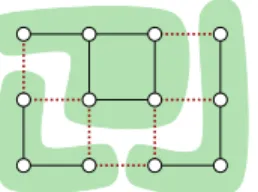
of edges connecting different components is minimized. The numberkof components is not fixed but is determined by the algorithm. See Fig.1for an illustration. Although the problem has numerous applications in computer vision [4,5,
6,77] and beyond [7,60,14,15], there is no scalable solver, which could provide optimality bounds. Existing methods are either efficient primal heuristics [66,58,27,19,20,9,10] or combinatorial branch-and-bound/branch-and-cut/column generation algorithms, based on off-the-shelf LP solvers [43,
44,47,77]. Move-making algorithms do not provide lower bounds, hence, one cannot judge their solution quality or employ them in branch-and-bound procedures. Off-the-shelf LP solvers on the other hand scale super-linearly, limiting their application in large-scale problems.
Instead of directly optimizing over partitions (which has many symmetries making optimization difficult in a linear programming setting), we follow [17] and formulate the problem in the edge domain. Letθe,e∈Edenote the cost of
graph edges and letCbe the set of all cycles of the graphG.
Each edge that belongs to different components is called a
cut edge. The multicut problem reads
min x∈{0,1}|E| X e∈E θexe, s.t.∀C∀e′∈C: X e∈C\{e′} xe≥xe′. (8)
Herexe= 1signifies a cut edge and the inequalities force
each cycle to have none or at least two cut edges. The formu-lation (8) has exponentially many constraints. However, it is well-known that it is sufficient to consider only chordless cycles [17] in place of the setCin (8). Moreover, the graph
can be triangulated by adding additional edges with zero weights and therefore the set of chordless cycles reduces to edge triples. Such triangulation is refered to aschordal com-pletionin the literature [26]. The number of triples is cubic, which is still too large for practical efficiency and therefore violated constraints are typically added to the problem iter-atively in a cutting plane manner [43,44]. To simplify the description, we will ignore this fact below and consider all these cycles at once. Assuming a triangulated graph and redefiningCas the set of all chordless cycles (triples) we
consider the following IRPS-LP relaxation of the multicut problem1: min µ,µ˜ X e∈E θeµe+ X c∈C X e∈c ˜ θe,cµ˜e,c, s.t. (9) µe∈conv({0,1}) = [0,1], e∈E ∀c∈C, e∈c: ˜ µc:= (˜µe,c)e∈c∈conv({0,1}3| ∀e′∈ c: P e∈c\{e′} ˜ µe,c≥µ˜e′,c) ≡conv({0,0,0},{0,1,1},{1,0,1},{1,1,0},{1,1,1}) µe= ˜µe,c (10) For the sake of notation we shortened a feasible set def-inition µ˜ ∈ conv(µ′ ∈ {0,1}n: constraints on µ′) to
˜
µ ∈ conv({0,1}n: constraints on µ˜). Hereµ
e is the
re-laxed (potentially non-integer) variable corresponding toxe.
Variableµ˜e,cis a copy ofµe, which corresponds to the
cy-clec. Therefore, eachµegets as many copiesµ˜e,c, as many
chordless cyclesccontain the edgee. For each cycle the set of binary vectors satisfying the cycle inequality is considered. For a cycle with3edges this set can be written explicitly as in (10). Along with copies ofµe,e∈Ewe copy the
corre-sponding costθeand create auxiliary costsθ˜e,c≡0for each
cycleccontaining the edgee. During optimization, the cost
θewill be redistributed betweenθeitself and its copiesθ˜e,c, c∈C. The factors of the IRPS-LP are associated with each
edge (variableµe) and each chordless cycle (variableµ˜c).
Coupling constraints connect edge-factors with those cycle-factors, which contain the corresponding edge (see the last constraint in (10)). An in-depth discussion of message pass-ing for the multicut problem with tighter relaxations can be found in [67].
3. Dual Problem and Admissible Messages
Since our technique can be seen as a dual ascent, we will not optimize the primal problem (1) directly, but instead 1One can show that this relaxation coincides with the standard LP
relaxation for the multicut problem [17]
Figure 1. Illustration of Example3. A multicut of a graph induced by three connected compo-nentsΠ1, Π2, Π3(green).
Red dottededges indicate cut edgesxe= 1.
maximize its dual lower bound.
Dual IRPS-LP The Lagrangean dual to (1) w.r.t. the cou-pling constraints reads
maxφ D(φ) :=Pi∈Fminxi∈Xihθ φ i, xii s.t. θφi :=θi+Pj:ij∈EA⊤(i,j)φ(i,j) ∀i∈F φ(i,j)=−φ(j,i) ∀ij∈E (11)
Hereφ(i,j)∈RKforA(i,j)∈ {0,1}K×difor someK∈N. The functionD(φ)is calledlower boundand is concave inφ. The modified primal costsθφare calledreparametrizations
of the potentialsθ. We have duplicated the dual variables by introducingφ(i,j):=−φ(j,i)to symmetrize notation. In practice, only one copy is stored and the other is computed on the fly. Note that in this doubled notation the reparametrized node and edge potentials of the CRF from Example1read
θφu(xu) =θu(xu) +Pv:uv∈Eφu,uv(xu) θφ
uv(xu, xv) =θuv(xu, xv) +φuv,v(xv) +φuv,u(xu) φu,uv=−φuv,u
It is well-known for CRFs that cost of feasible solutions are invariant under reparametrization. We generalize this to the IRPS-LP-case.
Proposition 1. P
i∈Fhθi, µii = Pi∈Fhθ
φ
i, µii, whenever µ1, . . . , µkobey the coupling constraints.
Admissible Messages While Proposition 1 guarantees that the primal problem is invariant under reparametriza-tions, the dual lower boundD(φ)is not. Our goal is to find
φsuch thatD(φ)is maximal. By linear programming du-ality,D(φ)will then be equal to the optimal value of the primal (1).
First we will consider an elementary step of our future al-gorithm and show that it is non-decreasing in the dual objec-tive. This property will ensure the monotonicity of the whole algorithm. Letθφbe any reparametrization of the problem
andD(φ)be the corresponding dual value. Let us consider changing the reparametrization of a factoriby a vector∆
with the only non-zero components∆(i,j)and∆(j,i). This will change reparametrization of the coupled factorsj(such thatij ∈ E) due to∆(i,j) = −∆(j,i). The lemma below
states properties of∆(i,j)which are sufficient to guarantee improvement of the corresponding dual valueD(φ+∆):
Lemma 1(Monotonicity Condition). Letij∈Ebe a pair of factors related by the coupling constraints andφ(i,j)be
a corresponding dual vector. Letx∗
i ∈argmin xi∈Xi hθφi, xiiand ∆(i,j)satisfy ∆(i,j)(s) ( ≥0, ν(s) = 1 ≤0, ν(s) = 0, whereν :=A(i,j)x ∗ i. (12) Thenx∗i ∈argmin xi∈Xi hθiφ+∆, xiiimpliesD(φ)≤D(φ+∆). Example 4.Let us apply Lemma1to Example1. Letij
correspond to {u, uv}, where u ∈ V is some node and uv ∈Eis any of its incident edges. Thenx∗
i corresponds
to a locally optimal label x∗u ∈ arg mins∈Xuθu(s) and
ν(s) = Js = x∗uK. Therefore we may assign ∆u,uv(s)
to any value from[0, θu(x∗u)−θu(s)]. This assures that
(20) is fulfilled andx∗uremains a locally optimal label after reparametrization even if there are multiple optima inXu.
Lemma1 can be straightforwardly generalized to the case, when more than two factors must be reparametrized simultaneously. In terms of Example1this may correspond to the situation when a graph node sends messages to several incident edges at once:
Definition 2. Let i∈F be a factor and J ={j1, . . . , jl} ⊆ NG(i) be a subset of its
neigh-bors. Letθ∆
i :=θi+Pj∈JA⊤(i,j)∆(i,j),∆(i,j)(=−∆(j,i))
satisfies(20)for allj ∈J and all other coordinates of∆ are zero. If there exists x∗i ∈ argminxi∈Xihθi, xii such thatx∗i ∈argminxi∈Xihθ
∆
i , xii, the dual vector∆is called
admissible. The set of admissible vectors is denoted by AD(θi, x∗i, J).
Lemma 2.Let∆∈AD(θφi, x∗i, J)thenD(φ)≤D(φ+∆).
Procedure 1:Message-Passing Update Step.
1 Input:Factori∈F, neighboring factors
J={j1, . . . , jl} ⊆ NG(i), dual variablesφ
Computex∗i ∈arg minxi∈Xihθ φ, x ii (13) Chooseδ∈Rdis.t.δ(s) >0, x∗i(s) = 1 <0, x∗i(s) = 0 (14)
2 Maximize admissible messages toJ:
∆∗(i,J)∈ argmax
∆∈AD(θφi,x∗i,J)
hδ, θφi+∆i (15)
3 Output:∆∗(i,J).
Message-Passing Update Step To maximizeD(φ), we will iteratively visit all factors and adjust messagesφ con-nected to it, monotonically increasing the lower bound (11). Such an elementary step is defined by Procedure1.
Procedure 1 is defined up to the vector δ, which satisfies (14) (see Proc. 1). Usually, δ(s) =
1, x∗i(s) = 1
−1, x∗i(s) = 0 is a good choice. Although differentδ
may result in different efficiency of our framework, fulfill-ment of (14) is sufficient to prove its convergence properties. The reparametrization adjustment problem (15) serves the intuitive goal to move as much slack as possible from the factorito its neighborsJ. For example, for the setting of Example4its solution reads∆u,uv(s) =θφu(x∗u)−θuφ(s).
Depending on the selectedδit might correspond to maxi-mization of the dual objective in the direction defined by admissible reparametrizations. Although maximization (15) is not necessary to prove convergence of our method (as we show below, only a feasible solution of (15) is required for the proof), (i) it leads to faster convergence; (ii) for the case of CRFs (as in Example1) it makes our method equivalent to well established techniques like TRW-S [48] and SRMP [49], as shown in Section4.1.
The following proposition states that the elementary up-date step defined by Procedure1can be performed efficiently. That is, the size of the reparametrization adjustment prob-lem (15) grows linearly with the size of the factoriand its attached messages:
Proposition 2. Let conv(Xi) = {µi : Aiµi ≤ bi}with Ai ∈ Rn×m. Let the messages in problem(15)have size n1, . . . , n|J|. Then(15)is a linear program withO(n+n1+ . . .+n|J|)variables andO(m+n1+. . .+n|J|)constraints.
4. Message Passing Algorithm
Now we combine message passing updates into Algo-rithm2. It visits every node of the factor graph and performs the following two operations: (i)Receive Messages, when messages are received from a subset of neighboring factors, and (ii)Send Messages, when messages to some neighbor-ing factors are computed and reweighted byω. Distribution of weightsω may influence the efficiency of Algorithm2
just like it influences the efficiency of message passing for CRFs (see [49]). We provide typical settings in Section4.1. Usually, factors are traversed in some given a-priori order alternately in forward and backward direction, as done in TRW-S [48] and SRMP [49]. We refer to [49] for a motiva-tion for such a schedule of computamotiva-tions.
We will discuss parameters of Algorithm2(factor par-titioning{Ji}, weightswJi) right after the theorem stating
monotonicity for any choice of parameters.
Theorem 1. Algorithm2monotonically increases the dual lower bound(11).
Algorithm 2:One Iteration of Message-Passing
1 fori∈Fin some orderdo 2 Receive Messages:
3 Choose a subset of connected factors
Jreceive⊆ NG(i) 4 forj∈Jreceivedo 5 Compute∆∗ (j,{i})with Procedure1. 6 Set φ=φ+∆∗( j,{i}). 7 end 8 9 Send Messages: 10 Choose partitionJ1∪˙ . . .∪˙Jl⊆ NG(i). 11 forJ∈ {J1, . . . , Jl}do 12 Compute∆∗(
i,J)with Procedure1.
13 end
14 Choose weightsωJ1, . . . , ωJl≥0such that
ωJ1+. . .+ωJl≤1. 15 forJ∈ {J1, . . . , Jl}do 16 Setφ=φ+ωJ∆∗ (i,J). 17 end 18 end
4.1. Parameter Selection for Algorithm
2
There are the following free parameters in Algorithm2: (i) The order of traversing factors ofF; (ii) for each factor
the neighboring factors from which to receive messages
Jreceive ⊆ NG(i); (iii) the partitionJ1∪˙ . . .∪˙Jl ⊆ NG(i)
of factors to send messages to and (iv) the associated weights
ωJ1, . . . , ωJlfor messages.
Although for any choice of these parameters Algorithm2
monotonically increases the dual lower bound (as stated by Theorem1), its efficiency may significantly depend on their values. Below, we will describe the parameters for Examples1-3, which we found the most efficient empirically.
Sending a message by some factor automatically implies receiving this message by another, coupled factor. There-fore, usually there is no need to go over all factors in Algo-rithm2. It is usually sufficient to guarantee that all coupling constraints are updated by Procedure1. Formally, we can always exclude processing some factors by settingJreceive
andJi,i = 1, . . . , lto the empty set. Instead, we will
ex-plicitly specify, which factors are processed in the loop of Algorithm2in the examples below.
Parameters for Example 1, MAP-inference in CRFs.
Pairwise CRFs have the specific feature that node factors are coupled with edge factors only. This implies that processing only node factors in Algorithm2is sufficient. Below, we de-scribe parameters, which turn Algorithm2into SRMP [49] (which is up to details of implementation equivalent to
TRW-S [48] for pairwise CRFs). Other settings, given in the supplement, may turn it to other popular message passing techniques like MPLP [28] or min-sum diffusion [64].
We order node factors and process them according to this ordering. The ordering naturally defines the sets of incoming
E+
u and outgoingE−u edges for each node u ∈ V. Here uv ∈Eisincomingforuifv < uandoutgoingifv > u.
Each nodeu∈Vreceives messages from all incoming edges,
which isJreceive =NG(u) =E+u. The messages are sent
to all outgoing edges. Each edgeuv∈Ein the partition in
line10of Algorithm2is represented by a separate set. That is, the partition reads∪˙e∈E−u{e}. Weights are distributed
uniformly and equal to we = {max{|E1−u|,|E+u|}},e ∈ E − u.
After each outer iteration, when all nodes were processed, the ordering is reversed and the process repeats. We refer to [49] for substantiation of these parameters.
Parameters for Example2, Graph Matching. Addition-ally to the node and edge factors, the corresponding IRPS-LP has also label factors (7). To this end all node factors are ordered, as in Example 1. Each node factor u ∈ V
re-ceives messages from all incoming edge factors and label factorsJreceive(u) =E+u ∪Xuand sends them to all
out-going edgesandlabel factors. The corresponding partition reads∪˙f∈NG(u)\E+
u{f}∪˙Xu. The weights are distributed
uniformly withwf={1+max{|1E−u|,|E+u|}}. The label factors
are processed after all node factors were visited. Each label factor receives messages from all connected node factors and send messages back as well: Jreceive(s) = {u ∈ V : s∈Xu}. We use the same single set for sending messages,
i.e.J1=Jreceive. After each iteration we reverse the factor
order.
Parameters for Example 3, Multicut. Similarly to Ex-ample 1, it is sufficient to go only over all edge factors in the loop of Algorithm2, since each coupling constraint contains exactly one cycle and one edge factor. Each edge factor ereceives messages from all coupled cycle factors
Jreceive = NG({c ∈ C : e ∈ c})and sends them to the
same factors. As in Example1, each cycle factor forms a trivial set in the partition in line10of Algorithm2, the parti-tion reads∪˙c∈C:e∈c{c}. Weights are distributed uniformly
withwe = |c∈C1:e∈c|. After each iteration the processing
order of factors is reversed.
4.2. Obtaining Integer Solution
Eventually we want to obtain a primal solutionx∈X
of (1), not a reparametrizationθφ. We are not aware of any
rounding technique which would work equally well for all possible instances of IRPS-LP problem. According to our experience, the most efficient rounding is problem specific. Below, we describe our choices for the Examples1–3.
Rounding for Example 1 coincides with the one sug-gested in [48]: Assume we have already computed a primal integer solutionx∗vfor allv < uand we want to computex∗u. To this end, right before the message receiving step of Algo-rithm2fori=uwe assign
x∗u∈argmin xu θu(xu) + X v<u:uv∈E θuv(xu, x∗v). (16)
Rounding for Example2 is the same except that we se-lect the best label xu among those, which have not been
assigned yet, to satisfy uniqueness constraints:
x∗u∈ argmin xu:x∗v6=xu∀v<u θφu(xu) + X v<u:uv∈E θuvφ (xu, x∗v). (17)
Rounding for Example 3. We use the efficient Kernighan&Lin heuristic [45] as implemented in [46]. Costs for the rounding are the reparametrized edge potentials.
5. Fixed Points and Comparison to
Subgradi-ent Method
Algorithm 2does not necessarily converge to the op-timum of (1). Instead, it may get stuck in suboptimal points, similar to those correspoding to the ”weak tree agree-ment” [48] or ”arc consistency” [74,3] in CRFs from Exam-ple1. Below we characterise these fixpoints precisely.
Definition 3 (Marginal Consistency). Given a reparametrization θφ, let for each factor i ∈ F a non-empty set Si ⊆ argminxi∈Xihθ
φ, x
ii, i ∈ F be given. DefineS=Q
i∈FSi. We call reparametrizationθφ
marginally consistent forSonij∈Eif
A(i,j)(Si) =A(j,i)(Sj). (18)
Ifθφis marginally consistent forSon allij∈E, we callθφ
marginally consistent forS.
Note that marginal consistency is necessary, but not suffi-cient for optimality of the relaxation (1). This can be seen in the case of CRFs (Example1), where it exactly corre-sponds to arc-consistency. The latter is only necessary, but not sufficient for optimality [74].
Theorem 2. Ifθφis marginally consistent, the dual lower boundD(φ)cannot be improved by Algorithm2.
Comparison to Subgradient Method. Decomposi-tion IRPS-LP and more general ones can be solved via the subgradient method [50]. Similar to Algorithm 2, it operates on dual variables φ and manipulates them by visiting each factor sequentially. Contrary to Algorithm2, subgradient algorithms converge to the optimum. Moreover,
on a per-iterations basis, computing subgradients is cheaper than using Algorithm2, as only (13) needs to be computed, while Algorithm2needs to solve (15) additionally. How-ever, for MAP-inference, the study [41] has shown that subgradient-based algorithms converge much slower than message passing algorithms like TRWS [48]. In Section6
we confirm this for the graph matching problem as well. The reason for this large empirical difference is that one iteration of the subgradient algorithm only updates those co-ordinates of dual variablesφthat are affected by the current minimal labelingx∗i ∈ argminxi∈Xihθ
φ
i, xii(i.e.
coordi-natesk: (A⊤(i,j)x∗i)k = 1), while in Algorithm2all
coor-dinates ofφare taken into account. Also message passing implicitly chooses the stepsize so as to achieve monotoni-cal convergence in Algorithm1, while subgradient based algorithms must rely on some stepsize rule.
6. Experimental Evaluation
Our experiments’ goal is to illustrate applicability of the proposed technique, they are not an exhaustive evaluation. The presented algorithms are only basic variants, which can be further improved and tuned to the considered problems. Both issues are addressed in the specialized studies [68,
67]. Still, we show that the presented basic variants are already able to surpass state-of-the-art specialized solvers on challenging datasets.
6.1. Graph Matching
Solvers. We compare against two state-of-the-art algo-rithms: (i) the subgradient based dual decomposition solver [70] abbreviated byDDand (ii) the recent “hungarian belief propagation” message passing algorithm [78], abbrevi-ated asHBP. While the authors of [78] have embedded their solver in a branch-and-bound routine to produce exact solu-tions, we have reimplemented their message passing ponent but did not use branch and bound to make the com-parison fair. Both algorithmsDDandHBPoutperformed alternative solvers [18,76,53,69,63,29,79,38,54,16] at the time of their publication, hence we have not tested against them. We call our solverAMP.
Datasets. We selected three challenging datasets. The first two are the standard benchmark datasetscarandmotor, both used in [55], containing 30 pairs of cars and 20 pairs of motorbikes with keypoints to be matched 1:1. The images are taken from the VOC PASCAL 2007 challenge [21]. Costs are computed from features as in [55]. Instances are densely connected graphs with20–60nodes. The third one is the novelwormsdatasets [40], containing 30 problem instances coming from bioimaging. The problems are made of sparsely connected graphs with up to600nodes and up to1500labels. To our knowledge, thewormsdataset contains the largest
10−1 100 101 101 102 103 runtime(s) car log( en er gy -lo w er b ou n d ) AMP HUNGARIAN-BP DD 10−1 100 101 100 101 102 103 runtime(s) motor log( en er gy -lo w er b ou n d ) 10−1 100 101 102 102 103 104 105 runtime(s) worms log( en er gy -lo w er b ou n d )
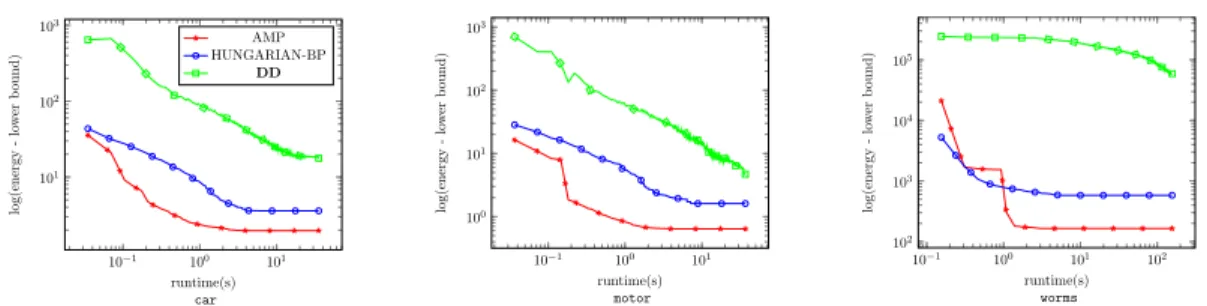
Figure 2. Runtime plots comparing averagedlog(primal energy−dual lower bound)values oncar,motorandwormsgraph matching datasets. Both axes are logarithmic.
10−2 10−1 100 −5,000 −4,800 −4,600 −4,400 −4,200 −4,000 runtime(s) knott-3d-150 en er gy MP-C CGC MC-ILP CC-Fusion-RWS CC-Fusion-RHC 10−1 100 101 102 −2.75 −2.74 −2.73 −2.72 −2.71 ·104 runtime(s) knott-3d-300 10−1 100 101 102 −8 −7.8 −7.6 ·104 runtime(s) knott-3d-450
Figure 3. Runtime plots comparing averaged primal/dual values on the threeknott-3d-{150|300|450}multicut datasets. Values are averaged over all instances in the dataset. The x-axis are logarithmic. Continuous lines are dual lower bounds while corresponding dashed lines show primal solutions obtained by rounding.
graph matching instances ever considered in the literature. For runtime plots showing averaged logarithmic primal/dual gap over all instances of each dataset see Fig.2.
Results. Our solverAMPconsistently outperformsHBP
andDDw.r.t. primal/dual gap and anytime performance Most markedly on the largestwormsdataset, the subgra-dient based algorithm DDstruggles hard to decrease the primal/dual gap, whileAMPgives reasonable results.
6.2. Multicuts
Solvers. We compare against state-of-the-art multicut al-gorithms implemented in the OpenGM [41] library, namely (i) the branch-and-cut based solverMC-ILP[44] utilizing the ILP solver CPLEX [2], (ii) the heuristic primal “fusion move” algorithmCC-Fusion[9] with random hierarchical clustering and random watershed proposal generator, de-noted by the suffixes-RHCand-RWSand (iii) the heuristic primal “Cut, Glue & Cut” solverCGC[10]. Those solvers were shown to outperform other multicut algorithms [9]. Al-gorithmMC-ILPprovides both upper and lower bounds, whileCC-FusionandCGCare purely primal algorithms. We call our message passing solver with cycle constraints added in a cutting plane fashionMP-C.
Datasets. We have selected three datasets
knott-3d-{150|300|450} from OpenGM [41].
The problems come from electron microscopy of brain tissue, for which we wish to obtain a neuron segmentation. Each dataset contains 8 instances with ≤ 972,5896 and
17074 nodes and ≤ 5656, 36221, and 107060 edges respectively.
Results. For plots showing dual bounds and primal solu-tion objectives over time see Figure3. Our algorithmMP-C
combines advantages of LP-based techniques awith those of primal heuristics: It delivers high dual lower bounds faster thanMC-ILP. Its has fast primal convergence speed and delivers primal solutions comparable/superior toCGC’s and
CC-Fusion’s.
7. Acknowledgments
The authors would like to thank Vladimir Kolmogorov for helpful discussions. The first authors was supported by the European Research Council under the European Unions Sev-enth Framework Programme (FP7/2007-2013)/ERC grant agreement no 616160, the second author by DFG Grant GRK 1653 and the last author by the European Research Council under the European Unions Horizon 2020 research and in-novation programme (grant agreement No 647769) and the DFG Grant ”ERBI” SA 2640/1-1.
References
[2] IBM ILOG CPLEX Optimizer. http://www-01.ibm. com/software/integration/optimization/ cplex-optimizer/.1,8
[3] Marginal consistency: Upper-bounding partition functions over commutative semirings.IEEE TPAMI, 37(7):1455–1468, 2015.7
[4] A. Alush and J. Goldberger. Break and conquer: Efficient cor-relation clustering for image segmentation. In E. R. Hancock and M. Pelillo, editors,SIMBAD, volume 7953 ofLecture Notes in Computer Science, pages 134–147. Springer, 2013.
3
[5] B. Andres, J. H. Kappes, T. Beier, U. K¨othe, and F. A. Ham-precht. Probabilistic image segmentation with closedness constraints. In D. N. Metaxas, L. Quan, A. Sanfeliu, and L. J. V. Gool, editors,ICCV, pages 2611–2618. IEEE Com-puter Society, 2011.3
[6] B. Andres, T. Kr¨oger, K. L. Briggman, W. Denk, N. Korogod, G. Knott, U. K¨othe, and F. A. Hamprecht. Globally opti-mal closed-surface segmentation for connectomics. In A. W. Fitzgibbon, S. Lazebnik, P. Perona, Y. Sato, and C. Schmid, editors,ECCV (3), volume 7574 ofLecture Notes in Com-puter Science, pages 778–791. Springer, 2012.3
[7] A. Arasu, C. R, and D. Suciu. Large-scale deduplication with constraints using dedupalog. In Y. E. Ioannidis, D. L. Lee, and R. T. Ng, editors,ICDE, pages 952–963. IEEE Computer Society, 2009.3
[8] C. Arora and A. Globerson. Higher order matching for con-sistent multiple target tracking. InProceedings of the IEEE International Conference on Computer Vision, pages 177– 184, 2013.2
[9] T. Beier, F. A. Hamprecht, and J. H. Kappes. Fusion moves for correlation clustering. InCVPR, pages 3507–3516. IEEE Computer Society, 2015.3,8
[10] T. Beier, T. Kr¨oger, J. H. Kappes, U. K¨othe, and F. A. Ham-precht. Cut, glue & cut: A fast, approximate solver for multicut partitioning. InCVPR. Proceedings, 2014.3,8
[11] O. Bilde and J. Krarup. Sharp lower bounds and efficient algorithms for the simple plant location problem.Annals of Discrete Mathematics, 1:79–97, 1977.1
[12] Y. Boykov, O. Veksler, and R. Zabih. Fast approximate energy minimization via graph cuts.IEEE Transactions on pattern analysis and machine intelligence, 23(11):1222–1239, 2001.
1
[13] R. E. Burkard, E. C¸ ela, P. M. Pardalos, and L. S. Pitsoulis.The Quadratic Assignment Problem, pages 1713–1809. Springer US, Boston, MA, 1999.3
[14] Y. Chen, S. Sanghavi, and H. Xu. Clustering sparse graphs. In P. L. Bartlett, F. C. N. Pereira, C. J. C. Burges, L. Bottou, and K. Q. Weinberger, editors,NIPS, pages 2213–2221, 2012.
3
[15] F. Chierichetti, N. Dalvi, and R. Kumar. Correlation clustering in mapreduce. InProceedings of the 20th ACM SIGKDD International Conference on Knowledge Discovery and Data Mining, KDD ’14, pages 641–650, New York, NY, USA, 2014. ACM.3
[16] M. Cho, J. Lee, and K. M. Lee. Reweighted random walks for graph matching. In K. Daniilidis, P. Maragos, and N. Paragios,
editors,ECCV (5), volume 6315 ofLecture Notes in Computer Science, pages 492–505. Springer, 2010.3,7
[17] S. Chopra and M. R. Rao. The partition problem. Mathemati-cal Programming, 59(1):87–115, 1993.3,4
[18] J. Duchi, D. Tarlow, G. Elidan, and D. Koller. Using combi-natorial optimization within max-product belief propagation. InNIPS, pages 369–376. MIT Press, 2006.2,3,7
[19] M. Elsner and E. Charniak. You talking to me? a corpus and algorithm for conversation disentanglement. In K. McKeown, J. D. Moore, S. Teufel, J. Allan, and S. Furui, editors,ACL, pages 834–842. The Association for Computer Linguistics, 2008.3
[20] M. Elsner and W. Schudy. Bounding and comparing methods for correlation clustering beyond ILP. InProceedings of the Workshop on Integer Linear Programming for Natural Langauge Processing, ILP ’09, pages 19–27, Stroudsburg, PA, USA, 2009. Association for Computational Linguistics.
3
[21] M. Everingham, L. Van Gool, C. K. I. Williams, J. Winn, and A. Zisserman. The Pascal visual object classes (VOC) chal-lenge.International Journal of Computer Vision, 88(2):303– 338, June 2010.7
[22] M. L. Fisher and D. S. Hochbaum. Database location in computer networks.Journal of the ACM (JACM), 27(4):718– 735, 1980.1
[23] M. L. Fisher, R. Jaikumar, and L. N. Van Wassenhove. A multiplier adjustment method for the generalized assignment problem.Management Science, 32(9):1095–1103, 1986.1
[24] M. L. Fisher and P. Kedia. Optimal solution of set cover-ing/partitioning problems using dual heuristics.Management science, 36(6):674–688, 1990.2
[25] D. Gamarnik, D. Shah, and Y. Wei. Belief propagation for min-cost network flow: Convergence & correctness. InSODA, pages 279–292. SIAM, 2010.1
[26] M. R. Garey and D. S. Johnson.Computers and Intractability: A Guide to the Theory of NP-Completeness. W. H. Freeman & Co., New York, NY, USA, 1979.4
[27] A. Gionis, H. Mannila, and P. Tsaparas. Clustering aggrega-tion.ACM Trans. Knowl. Discov. Data, 1(1):4, 2007.3
[28] A. Globerson and T. S. Jaakkola. Fixing max-product: Con-vergent message passing algorithms for MAP LP-relaxations. InNIPS, pages 553–560, 2007.1,2,6,13,14
[29] S. Gold and A. Rangarajan. A graduated assignment algo-rithm for graph matching.IEEE Trans. Pattern Anal. Mach. Intell., 18(4):377–388, 1996.3,7
[30] M. Guignard. A Lagrangean dual ascent algorithm for simple plant location problems. European Journal of Operational Research, 35(2):193–200, 1988.1
[31] M. Guignard and S. Kim. Lagrangean decomposition: A model yielding stronger Lagrangean bounds.Mathematical programming, 39(2):215–228, 1987.1
[32] M. Guignard and S. Kim. Lagrangean decomposition for in-teger programming: theory and applications.Revue franc¸aise d’automatique, d’informatique et de recherche op´erationnelle. Recherche op´erationnelle, 21(4):307–323, 1987.1
[33] M. Guignard and M. B. Rosenwein. An application-oriented guide for designing Lagrangean dual ascent algorithms.
Euro-pean Journal of Operational Research, 43(2):197–205, 1989.
2
[34] M. Guignard and M. B. Rosenwein. Technical note-an im-proved dual based algorithm for the generalized assignment problem.Operations Research, 37(4):658–663, 1989.1
[35] M. Guignard and M. B. Rosenwein. An application of La-grangean decomposition to the resource-constrained mini-mum weighted arborescence problem.Networks, 20(3):345– 359, 1990.2
[36] Gurobi Optimization, Inc., 2015.http://www.gurobi. com.1
[37] J. Jancsary and G. Matz. Convergent decomposition solvers for tree-reweighted free energies. InAISTATS 2011, 2011.2
[38] B. Jiang, J. Tang, C. Ding, and B. Luo. A local sparse model for matching problem. InProceedings of the Twenty-Ninth AAAI Conference on Artificial Intelligence, AAAI’15, pages 3790–3796. AAAI Press, 2015.3,7
[39] J. K. Johnson, D. M. Malioutov, and A. S. Willsky. La-grangian relaxation for map estimation in graphical models. InIn Allerton Conf. Communication, Control and Computing, 2007.2
[40] D. Kainmueller, F. Jug, C. Rother, and G. Myers. Active graph matching for automatic joint segmentation and annotation of C. elegans. InInternational Conference on Medical Image Computing and Computer-Assisted Intervention, pages 81–88. Springer, 2014.7
[41] J. H. Kappes, B. Andres, F. A. Hamprecht, C. Schn¨orr, S. Nowozin, D. Batra, S. Kim, B. X. Kausler, T. Kr¨oger, J. Lellmann, N. Komodakis, B. Savchynskyy, and C. Rother. A comparative study of modern inference techniques for struc-tured discrete energy minimization problems.International Journal of Computer Vision, 115(2):155–184, 2015.1,2,7,8
[42] J. H. Kappes, B. Savchynskyy, and C. Schn¨orr. A bundle ap-proach to efficient MAP-inference by Lagrangian relaxation. InComputer Vision and Pattern Recognition (CVPR), 2012 IEEE Conference on, pages 1688–1695. IEEE, 2012.1
[43] J. H. Kappes, M. Speth, B. Andres, G. Reinelt, and C. Schn¨orr. Globally optimal image partitioning by multicuts. In EMM-CVPR. Springer, Springer, 2011.3,4
[44] J. H. Kappes, M. Speth, G. Reinelt, and C. Schn¨orr. Higher-order segmentation via multicuts. CoRR, abs/1305.6387, 2013.3,4,8
[45] B. Kernighan and S. Lin. An efficient heuristic procedure for partitioning graphs.The Bell Systems Technical Journal, 49(2), 1970.7
[46] M. Keuper, E. Levinkov, N. Bonneel, G. Lavou´e, T. Brox, and B. Andres. Efficient decomposition of image and mesh graphs by lifted multicuts. InICCV, 2015.7
[47] S. Kim, S. Nowozin, P. Kohli, and C. D. Yoo. Higher-order correlation clustering for image segmentation. In J. Shawe-Taylor, R. S. Zemel, P. L. Bartlett, F. C. N. Pereira, and K. Q. Weinberger, editors,NIPS, pages 1530–1538, 2011. 3
[48] V. Kolmogorov. Convergent tree-reweighted message passing for energy minimization. IEEE Trans. Pattern Anal. Mach. Intell., 28(10):1568–1583, 2006.1,2,5,6,7,13,14
[49] V. Kolmogorov. A new look at reweighted message passing.
IEEE Trans. Pattern Anal. Mach. Intell., 37(5):919–930, 2015.
1,2,5,6,13,14
[50] N. Komodakis, N. Paragios, and G. Tziritas. MRF energy minimization and beyond via dual decomposition. IEEE Transactions on Pattern Analysis and Machine Intelligence, 33(3):531–552, March 2011.1,7
[51] C. Lemar´echal. Lagrangian decomposition and nonsmooth optimization: Bundle algorithm, prox iteration, augmented Lagrangian.Nonsmooth Optimization: Methods and Applica-tions, pages 201–216, 1992.1
[52] V. Lempitsky, C. Rother, S. Roth, and A. Blake. Fusion moves for Markov random field optimization.IEEE transactions on pattern analysis and machine intelligence, 32(8):1392–1405, 2010.1
[53] M. Leordeanu and M. Hebert. A spectral technique for cor-respondence problems using pairwise constraints. InICCV, pages 1482–1489. IEEE Computer Society, 2005.3,7
[54] M. Leordeanu, M. Hebert, and R. Sukthankar. An integer projected fixed point method for graph matching and MAP inference. In Y. Bengio, D. Schuurmans, J. D. Lafferty, C. K. I. Williams, and A. Culotta, editors,NIPS, pages 1114–1122. Curran Associates, Inc., 2009.3,7
[55] M. Leordeanu, R. Sukthankar, and M. Hebert. Unsupervised learning for graph matching.International Journal of Com-puter Vision, 96(1):28–45, 2012.7
[56] T. Meltzer, A. Globerson, and Y. Weiss. Convergent message passing algorithms - a unifying view. InUAI, pages 393–401. AUAI Press, 2009.2
[57] I. Necoara and J. A. Suykens. Application of a smoothing technique to decomposition in convex optimization. IEEE Transactions on Automatic Control, 53(11):2674–2679, 2008.
1
[58] V. Ng and C. Cardie. Improving machine learning approaches to coreference resolution. Proceedings of the 40th Annual Meeting on Association for Computational Linguistics - ACL ’02, (July):104, 2001.3
[59] C. Ribeiro and M. Minoux. Solving hard constrained short-est path problems by Lagrangean relaxation and branch-and-bound algorithms.Methods of Operations Research, 53:303– 316, 1986.1
[60] E. Sadikov, J. Madhavan, L. Wang, and A. Halevy. Cluster-ing query refinements by user intent. InWorld Wide Web Conference (WWW). ACM Press, April 2010.3
[61] B. Savchynskyy, J. Kappes, S. Schmidt, and C. Schn¨orr. A study of Nesterov’s scheme for Lagrangian decomposition and MAP labeling. InComputer Vision and Pattern Recogni-tion (CVPR), 2011 IEEE Conference on, pages 1817–1823. IEEE, 2011.1
[62] B. Savchynskyy, S. Schmidt, J. H. Kappes, and C. Schn¨orr. Efficient MRF energy minimization via adaptive diminishing smoothing. InUAI, pages 746–755. AUAI Press, 2012.2
[63] C. Schellewald and C. Schn¨orr. Probabilistic subgraph match-ing based on convex relaxation. InEMMCVPR, volume 3757 ofLecture Notes in Computer Science, pages 171–186. Springer, 2005.3,7
[64] M. I. Schlesinger and K. V. Antoniuk. Diffusion algorithms and structural recognition optimization problems.Cybernetics and Systems Analysis, 47(2):175–192, 2011.6
[65] D. Sontag and T. S. Jaakkola. Tree block coordinate descent for map in graphical models. InAISTATS, volume 5 ofJMLR Proceedings, pages 544–551, 2009.14
[66] W. M. Soon, H. T. Ng, and D. C. Y. Lim. A machine learning approach to coreference resolution of noun phrases. Compu-tational Linguistics, 27(4):521–544, 2001.3
[67] P. Swoboda and B. Andres. A message passing algorithm for the minimum cost multicut problem. InCVPR, 2017.4,7
[68] P. Swoboda, C. Rother, H. Abu Alhaija, D. Kainmueller, and B. Savchynskyy. Study of Lagrangean decomposition and dual ascent solvers for graph matching. InCVPR, 2017.7
[69] P. H. S. Torr. Solving Markov random fields using semi definite programming. InIn: AISTATS, 2003.3,7
[70] L. Torresani, V. Kolmogorov, and C. Rother. A dual decom-position approach to feature correspondence. IEEE Trans. Pattern Anal. Mach. Intell., 35(2):259–271, 2013.3,7
[71] M. J. Wainwright and M. I. Jordan. Graphical models, expo-nential families, and variational inference.Foundations and Trends in Machine Learning, 1(1-2):1–305, 2008.3
[72] H. Wang and D. Koller. Subproblem-tree calibration: A unified approach to max-product message passing. In30th International Conference on Machine Learning (ICML-13), pages 190–198, 2013.2,14
[73] Y. Weiss and W. T. Freeman. On the optimality of solutions of the max-product belief-propagation algorithm in arbitrary graphs.IEEE Transactions on Information Theory, 47(2):736– 744, 2001.2
[74] T. Werner. A linear programming approach to max-sum prob-lem: A review.IEEE Trans. Pattern Analysis and Machine Intelligence, 29(7):1165–1179, 2007.2,3,7,13,14
[75] T. Werner. Revisiting the linear programming relaxation approach to Gibbs energy minimization and weighted con-straint satisfaction.IEEE Trans. Pattern Anal. Mach. Intell., 32(8):1474–1488, 2010.2
[76] J. Yarkony, C. C. Fowlkes, and A. T. Ihler. Covering trees and lower-bounds on quadratic assignment. InCVPR, pages 887–894. IEEE Computer Society, 2010.3,7
[77] J. Yarkony, A. Ihler, and C. C. Fowlkes. Fast Planar Cor-relation Clustering for Image Segmentation, pages 568–581. Springer Berlin Heidelberg, Berlin, Heidelberg, 2012.3
[78] Z. Zhang, Q. Shi, J. McAuley, W. Wei, Y. Zhang, and A. van den Hengel. Pairwise matching through max-weight bipartite belief propagation. InThe IEEE Conference on Com-puter Vision and Pattern Recognition (CVPR), June 2016.2,
3,7
[79] F. Zhou and F. D. la Torre. Factorized graph matching. In