This article has been accepted for publication in a future issue of this journal, but has not been fully edited. Content may change prior to final publication. Citation information: DOI 10.1109/ACCESS.2017.2771562, IEEE Access
1
Constrained Interaction Testing: A Systematic
Literature Study
Bestoun S. Ahmed*, Kamal Z. Zamli, Wasif Afzal, and Miroslav Bures
Abstract—Interaction testing can be used to effectively detect faults that are otherwise difficult to find by other testing techniques. However, in practice, the input configurations of software systems are subjected to constraints, especially in the case of highly configurable systems. Handling constraints effectively and efficiently in combinatorial interaction testing is a challenging problem. Nevertheless, researchers have attacked this challenge through different techniques, and much progress has been achieved in the past decade. Thus, it is useful to reflect on the current achievements and shortcomings and to identify potential areas of improvements. This paper presents the first comprehensive and systematic literature study to structure and categorize the research contributions for constrained interaction testing. Following the guidelines of conducting a literature study, the relevant data is extracted from a set of 103 research papers belonging to constrained interaction testing. The topics addressed in constrained interaction testing research are classified into four categories of constraint test generation, application, generation & application and model validation studies. The papers within each of these categories are extensively reviewed. Apart from answering several other research questions, this study also discusses the applications of constrained interaction testing in several domains such as software product lines, fault detection & characterization, test selection, security and GUI testing. The study ends with a discussion of limitations, challenges and future work in the area.
Index Terms—Constrained interaction testing; constrained combinatorial testing; Software testing; Test generation tools; Test case design techniques.
I. INTRODUCTION
S
OFTWARE has become an innovative key for many applications and methods in science and engineering. Ensuring the quality and correctness of software is challenging because of the different configurations and input domains of each program. Ensuring the quality of software demands the exhaustive evaluation of all possible configurations and input interactions against their expected outputs. However, such an exhaustive testing effort is impractical because of time and resource limitations. Thus, different sampling techniques have been used to sample these input domains and configurations. The use of these sampling techniques for black box system testing is usually called as interaction testing, which can beB. Ahmed, Software Testing Intelligent Lab (STILL), Department of Computer Science, Faculty of Electrical Engineering Czech Technical Uni-versity, Karlovo nam. 13, 121 35 Praha 2, Czech Republic, (email: [email protected])
K. Zamli, Faculty of Computer Systems and Software Engineering, Uni-versity Malaysia Pahang, Gambang, Malaysia, (email: [email protected]) W. Afzal, School of Innovation, Design and Engineering, M¨alardalen University, Sweden, (email: [email protected])
M. Bures, Software Testing Intelligent Lab (STILL), Department of Computer Science, Faculty of Electrical Engineering Czech Technical Uni-versity, Karlovo nam. 13, 121 35 Praha 2, Czech Republic, (email: [email protected])
used to detect faults that are otherwise undetectable effectively. Interaction testing has been given other alternative names such as combinatorial testing (CT), combinatorial interaction testing (CIT), andt−way,t−wise, orn−wisetesting (wheretor
nindicate the interaction strength). However, throughout this paper, the term “interaction testing” is used as a representative term as it is a popular name in existing software testing literature.
Interaction testing has been used successfully for testing different configurable software systems. Several review and survey papers exist on the topic that covers developed strate-gies and their applications (see e.g. [1]–[3]). Although useful, interaction testing has suffered from a limitation of efficiently handling constraints. The ability to handle constraints is a crucial aspect for the real-world applicability of interaction testing techniques since most of the real-world systems are subjected to constraints among input parameters or among particular system configurations. Hence, recent times have seen a shift in interaction testing research that concerns the handling of constraints and is typically called as constrained interaction testing [4]. Adding this feature opens up several new directions for research that promises to guide further development of interaction testing [5]. However, there exists no comprehensive and dedicated review paper in this direction. Although many interaction testing strategies have been developed in the past, only a few of them can satisfy the con-straints in the final generated test suite. Handling concon-straints add extra complexity in designing efficient interaction testing strategies. Hence, in the last decade, researchers have looked into different ways of supporting the generation of constrained interaction test suites. Besides, application of constrained inter-action testing on various software systems and the associated empirical evaluations have started to surface. To this end, this paper provides a comprehensive systematic literature study to structure and categorize the available evidence for constrained interaction testing research during the last decade. The goal of the study is to identify the relevant papers, their results and the type of research such that one can discuss future research opportunities in the area. The study uses a systematic method to collect and analyze the related research published during the last decade. In doing so, methods and approaches for the generation as well as their applications are addressed.
The remainder of this paper is organized as follows: Section II presents the motivation and the overview of related work for this study. Section III describes the methodology of the literature study. Section IV presents the results and outcomes of the study. Section V discusses the threats to validity. Finally, Section VI concludes the work.
This article has been accepted for publication in a future issue of this journal, but has not been fully edited. Content may change prior to final publication. Citation information: DOI 10.1109/ACCESS.2017.2771562, IEEE Access
2
II. MOTIVATION AND RELATED WORK
Multiple factors motivated the decision to carry out a literature study in this paper. First, no existing paper aggregates available research inconstrained interaction testing (although several review papers exist on interaction testing in general). Second, constrained interaction testing is an upcoming re-search direction in interaction testing [6]; so it is interesting to investigate this topic. Third, a literature study paper is a community service that potentially saves significant time for interested researchers in getting to know about a research topic such as constrained interaction testing.
Nie and Lueng [2] conducted one of the first comprehensive reviews covering combinatorial testing and its applications. The study focuses on the basic concepts of combinatorial testing, the detailed methods of combinatorial test suite con-struction and the associated applications. The article also reviews constrained interaction testing methods. Kuliamin and Petukhov [7] also presented various methods of constructing combinatorial interaction test suites. On similar lines, Bestoun and Zamli [8] conducted a review study on the application of interaction testing. This paper is a useful complement to these existing review papers as it presents a more complete and recent review of the field. The previous review papers are not exhaustive in its coverage of constrained interaction testing. They are also not conducted as systematic literature studies.
Focusing on search-based test generation, Afzal et al. [1] and Ali et al. [9] have dedicated parts in their systematic literature reviews for interaction testing. More recently, Lopez-Herrejon et al. [3] published the first literature study on interaction testing for software product lines (SPL). Here, due to the presence of different constraints in SPL testing, the study has included and reviewed the constrained interaction testing. However, the study has only discussed constraints from the SPL application point-of-view.
This study considers the above-mentioned review papers as an excellent source of information since some of them include papers on constrained interaction testing. Our study further takes inspiration from other recently published systematic literature studies, e.g., [10], [11].
III. METHOD
This section illustrates the method that this literature study follows. This study follows the methodology recommendations given by [12]. The methodology has six stages. First is the definition of the research questions. Second is to undertake the search process, in which the search strategy is established, and the primary research papers are selected. The third stage is the selection and the quality assessment; this stage acts as a screening stage in which irrelevant papers are excluded based on the title, abstract, full-text reading and quality assessments. Data extraction is the fourth stage to extract data from the remaining papers. The fifth stage is the analysis and the data classification to classify the extracted information from the papers by tabulating and analyzing them. The last stage is the validity evaluation in which the threats to validity are evaluated and presented. For better illustration and organization of these
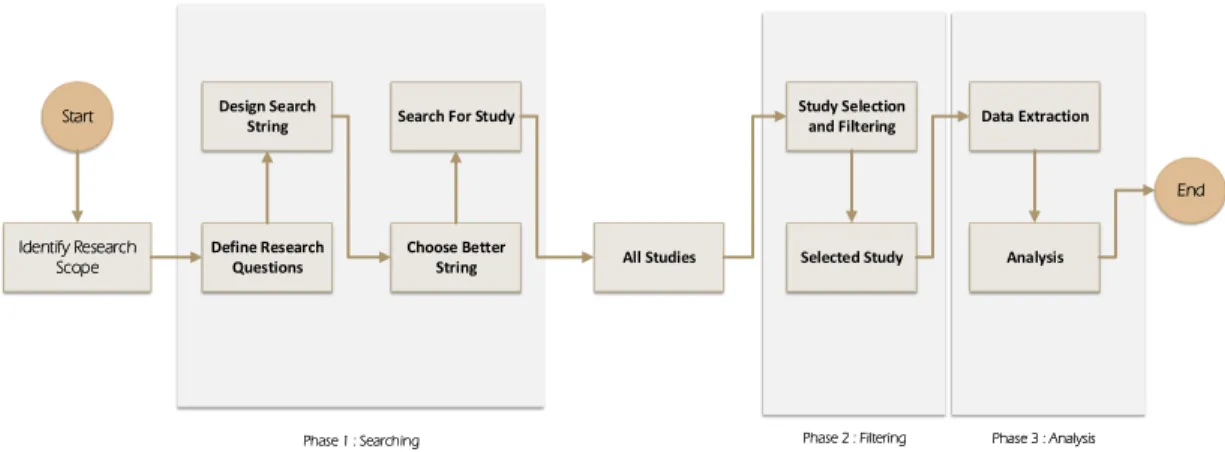
steps, they were further classified into three main phases, as shown in Figure 1.
• Phase 1. Searching: The research questions that
deter-mine the focus of the study are defined in this phase. Based on these research questions, the search string is designed. The search string has undergone an experimen-tal refinement process to identify and return only closely relevant papers.
• Phase 2. Filtering:Here, the relevant papers are selected, and their quality is assessed. Irrelevant papers are ex-cluded based on the title, abstract, full-text reading and quality assessments.
• Phase 3. Analysis: The relevant data answering the
research questions are extracted from the primary set of papers in this phase (in the case of this study 103 papers). The extracted data from the primary papers are classified and analyzed to visualize and understand the outcome. Here, Tables and Figures are used. Threats to validity are also analyzed and presented in this phase with the aim to disclose possible limitations of this study.
The following sections illustrate different stages covering the phases mentioned above that have been undertaken in detail. Input and output of each step are depicted in Figure 1. Some of the following subsections describe more steps joined. For example, defining research questions needs the research scope to be defined first. Hence, they are included in one subsection. In addition, the design, selection, and optimization of the search string are merged into one section.
A. Research Questions
As mentioned before, this study is a systematic literature study, and the goal is to structure and categorize the available evidence for constrained interaction testing research during the last decade. A number of research questions (RQs) were formulated to help achieve our goal:
• RQ1:What is the evolution in the number of published studies over the last decade in constrained interaction testing?
• RQ2: Which individuals, organizations, and countries are active in conducting constrained interaction testing research?
• RQ3: What topics/subjects have been addressed in the constrained interaction testing research and what is their distribution?
• RQ4: What are the existing strategies, tools, and
tech-niques that support the generation of constrained interac-tion test suites?
• RQ5:What kinds of benchmarks (industrial or otherwise)
are used to evaluate constrained interaction testing tech-niques and what is their provenance?
• RQ6:What are the applications of constrained interaction in software testing?
• RQ7:What are the current limitations and challenges in constrained interaction test generation?
• RQ8: What are the possible directions for future re-search?
This article has been accepted for publication in a future issue of this journal, but has not been fully edited. Content may change prior to final publication. Citation information: DOI 10.1109/ACCESS.2017.2771562, IEEE Access
3
Start
Identify Research
Scope Define Research Questions Design Search
String
Choose Better String Search For Study
All Studies Study Selection and Filtering Selected Study Data Extraction Analysis End
Phase 1 : Searching Phase 2 : Filtering Phase 3 : Analysis
Fig. 1. The systematic literature detail steps
B. Search Strategy
Identifying the keywords for textual search is a challenging task. Kitchenham and Charters [12] established the PICO (Population, Intervention, Comparison, and Outcomes) criteria to identify the keywords formally. ‘Population’ refers to a role in software engineering, an application area or a discipline in the field, while the ‘intervention’ refers to software engineer-ing tools, methodologies, procedures or strategies to address a specific issue. ‘Comparison’ identifies the different procedures or methods that have been used for comparison. ‘Outcomes’ deal with those keywords that are outcomes of the research and development, which are essential for practitioners such as improving performance or reliability.
Based on the research questions and the PICO guidelines, the keywords were categorized into three sets. The first set is related to the scoping the search for constrained interaction testing, i.e., “constrained interaction testing” or “constrained combinatorial interaction.” To make the search broader, the second set of keywords is constructed to form terms and strings related to the generation of constrained test suites such as “strategy.” The third set is related to the application of constrained interaction testing. These strings were combined to form one string but with different trials. To combine the search terms, Boolean AND is used, whereas Boolean OR is used to join alternate terms.
A preliminary string was constructed and then it took several trials to form the final search string (Set # 5 in Table I). These trials were needed mainly due to the close relationship between combinatorial interaction testing and constrained interaction testing. Since constrained interaction testing is the scope of this paper, a search string is required that returns only those combinatorial interaction strategies that support constraints. In doing so, these search strings were evaluated based on how much the returned results were related to the scope. In order to make sure that the search string is not missing out relevant papers, 20 “pilot” papers were selected, to make sure that different changes to the search (when experimented on IEEExplore and ScienceDirect indexing databases) are always able to find these 20 core/pilot set of studies. Finally, the string that is more related to the study area and can return these
studies was selected.
Table I shows the result of five trials of different search strings. The first three sets of the search strings were excluded in the selection process since there were many irrelevant results returned by them, even though they returned the pilot papers also. The reason behind these results is the general terms in the strings that led to return many irrelevant papers. In addition, during the trials, it has been found that the term “constraint” is used in different ways depending on its situation in the sentences. To this end, three different terms were used, (constraint OR constrained OR constraints), which led to covering more papers. Additionally, it was also found that these synonyms were used with different terms of interaction testing. As a result, those terms were observed in the literature and used in different ways (“interaction testing” OR “combinatorial testing” OR “combinatorial interaction” OR “combinatorial test design” OR “covering array” OR “t-way testing”). To make sure that the scope was fully covered in the research questions, additional terms were added such as (“strategy,” “technique,” “method,” “approach” and “tool”).
The databases were selected based on the guidelines and suggestions provided by [13], [14]. Based on these guidelines, the following databases were selected:
• IEEE Xplore
• ScienceDirect • ACM Digital Library • Scopus
• SpringerLink
During searching, indexing, and sorting of a large number of references, different duplicate references appeared due to the slight differences in the reference indexing in the databases. To manage the references and to remove duplicates, the well-known reference management software EndNote X7 was used. For more accuracy, Mendeley v1.16 reference manager soft-ware was also used. As mentioned earlier, this is a literature study covering the last decade starting from 2005 as there has been increasing research trends from that time. It should be mentioned here that this study started in early 2016 and finished early 2017. The papers from 2017 are not included in this study. To figure out the number of published research
This article has been accepted for publication in a future issue of this journal, but has not been fully edited. Content may change prior to final publication. Citation information: DOI 10.1109/ACCESS.2017.2771562, IEEE Access
4
TABLE I
SEARCH STRINGS TRIES ON THE INDEXING DATA BASES
Keyword Searching String ReturnedResults MissingStudies
Set # 1 (constrained) AND ((interaction testing) OR (combinatorial testing) OR (covering array) OR (t-way testing)) AND (testing) AND (strategy OR technique OR method OR approach)
242,439 0
Set # 2 (constrained OR constraint OR constraints) AND ((interaction testing) OR (combinatorial testing) OR (covering array) OR (t-way testing)) AND (testing) AND (strategy OR technique OR method OR approach)
511,049 0
Set # 3 (((constrained OR constraint OR constraints) AND (”interaction testing” or ”combinatorial testing” or ”combinatorial interaction testing” or ”covering array” or t-way testing) AND (strategy OR technique OR method OR approach) ))
226,894 0
Set # 4 (constrained OR constraint OR constraints) AND (”interaction testing” OR ”combinatorial testing” OR ”covering array” OR ”t-way testing”) AND (testing) AND (strategy OR technique OR method OR approach)
1,102 3
Set # 5 (constrained OR constraint OR constraints) AND (”interaction testing” OR ”combinatorial testing” OR ”combinatorial interaction” OR ”combinatorial test design” OR ”covering array” OR ”t-way testing”) AND (testing) AND (strategy OR technique OR method OR approach OR tool OR application)
1,172 0
TABLE II
NUMBER OF PUBLISHED RESEARCH
Database Search Results
IEEE Xplore 456
ScienceDirect 716
ACM Digital Library 43
Scopus 659
SpringerLink 794
Total 2,668
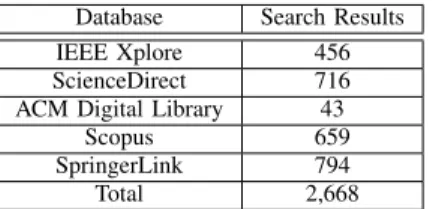
in this direction, Table II summarizes the number of research papers published in the mentioned period for each considered database.
C. Paper Selection Criteria and Quality Assurance
The papers were excluded or selected based on the title, abstract and full-text reading. The quality of the papers was also considered for the selection. To increase the reliability of selection, this process was conducted by the first author and reviewed again by other authors of the study. It should be mentioned that some papers can be selected or excluded based on the title and abstract. However, rest of them required full-text reading for deciding on their selection. For better understanding, the studies with the following criteria were selected:
• Studies for interaction testing with the support of
con-straints.
• Studies dealing with the applications of constrained
in-teraction.
• Studies that are in the field of Software Engineer-ing/Computer Science.
• Studies that are published online in the last decade (i.e., from 2005 when the first constraint-related paper got published).
It is also worth mentioning here the excluding criteria for the studies. Following the guidelines provided by [14], the pub-lished studies were excluded based on the following criteria:
• Studies dealing with interaction testing but without the support of constraints.
• Application of constrained interaction in fields other than
Software Engineering/Computer Science.
• Studies not published in the English language. • Studies without full text.
• Books and gray literature.
• Studies from non-peer reviewed sources.
Applying these criteria helped to capture better the number of papers that should be included in the study scope. As mentioned previously, many of these papers were duplicated, and they were removed finally. For example, some of those published papers in ScienceDirect were also indexed in Scopus database. In fact, Scopus acted as a valuable resource for double checking the results from other databases. Figure 2 shows these studies and the selection stages clearly.
As can be seen from Figure 2, to choose papers from a large set given by the selected databases, four filtering stages were applied. These stages have also been used in other literature studies [10], [15]. First, the related papers were identified in the selected databases (i.e., IEEE Xplore, ScienceDirect, ACM Digital Library, Scopus, SpringerLink). As mentioned previously, the outcome of this stage is 2,668 papers. It should be mentioned here that different papers were shared between these databases. Hence, “Filter 1” stage was performed in which all the duplicated titles, proceeding abstracts, and Pow-erPoint presentations were excluded. In the “Filter 2” stage, the papers were analyzed by reading the titles, abstracts, and if necessary the introduction sections of the papers. The selected papers were based on the exclusion and inclusion criteria provided earlier. In the “Filter 3” stage, the authors read the full-text of the chosen papers. Here, another set of papers was excluded due to multiple reasons. For example, many conference papers described an idea for research but do not include study results. In addition, the focus of some published papers was not entirely in software engineering and also not falling within the scope of the research questions. Finally, a snowballing stage was conducted by checking the references of the selected studies to not miss any relevant papers. Here, 14 more papers were added as an outcome of this stage. Hence, at the last stage, 103 papers were selected to answer the research
This article has been accepted for publication in a future issue of this journal, but has not been fully edited. Content may change prior to final publication. Citation information: DOI 10.1109/ACCESS.2017.2771562, IEEE Access 5 Applying Search on databases Result 2,668 Filter 1 Exclude duplicate titles Result 537 Filter 2 Analyze the titles
Result 132
Filter 3 Read the full text
Result 89 Snowball Sampling Result 14 Result 103 Total
Fig. 2. Number of included papers in the selection and filtering process
TABLE III
DATAEXTRACTIONTEMPLATE
Data item Value
Study ID Integer
Paper Title Name of the paper
Author Name Name of author(s)
Year of Publication Calendar year
Venue Name of publication venue
Country Name of the country for each participated author Area of research Knowledge area of research
Research topic Main topic or theme addressed by the study Research problem Research problem addressed by the study Proposal Proposed solution to the problem Contribution Main contribution of the paper Challenges Challenges addressed in the paper Evaluation process Which benchmark adopted for evaluation?
Case study Which case study used?
questions by extracting information from them. Appendix A lists the studied papers. Appendix A shows the references for these papers along with their full names and the publication years.
D. Data Extraction and Analysis
This phase aims to extract data from the selected studies and analyze them to answer the research questions. A spreadsheet was created to retrieve the required data from these identified studies. The template developed by [14], [16] was followed and adopted to construct the sheet. More fields of data were also added to the table. Table III shows the template that was used. General information about the paper was recorded, including paper ID, publication title, publication year, authors’ names and countries, venue, and area of research. More spe-cific data was extracted by including the research approach for the study, evaluation process, case study, applied techniques and challenges addressed. The data extraction process helped to understand each paper’s aim better and to get answers to the posed research questions. At the end of the process, the frequencies of papers were also calculated.
Each paper has a table with the information specified in Table III. To extract and analyze the information for all papers, a reliable method was followed. The information is extracted first by the first author and then double checked by the other authors separately. For better reliability, automatic text analyzer also used to verify the obtained information.
IV. RESULTS
This section is dedicated to answering the research questions in detail. Each research question from section III-A is ad-dressed here individually. A short title is used for each section that is extracted from the main research questions in section III-A.
A. Frequency of Publications (RQ1)
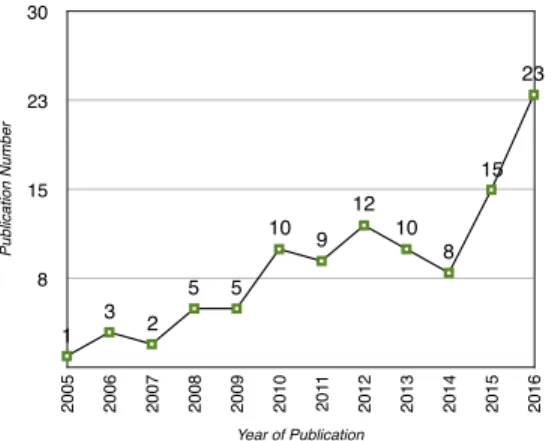
The identified studies were analyzed over the last decade (2005–2016) to know the frequency and evolution of the number of publications. Figure 3 shows the results of this analysis process. As mentioned earlier, 103 publications were considered in which the average number of publications per year is of 10 papers. The average number is influenced strongly by the growth of publication numbers after 2009.
It should be mentioned here that the first model of con-strained interaction for interaction testing purposes is proposed in a Ph.D. thesis in 2004 by Cohen [17]. However, this study did not appear in any database and was only published on the author (and university) website. In 2005, Hnichet al.[18] showed how to model handle constraints in Covering Array (CA); however, they did not explicitly address the constraints among the values of the input parameters, and they mention this as a problem to be solved in the future. In 2006, Bryceet al.[19] formalized the constrained interaction testing with CA mathematical object, while Hnichet al.[20] also defined and formalized the constraint models for CA in the same year. In the same time, Cohen et al. [21] tried to investigate the application of constrained interaction testing for SPL testing. The interest in constrained interaction testing moderately increased between 2005–2007, whereas, a significant increase of research can be observed in 2008 and beyond. This increase in the publication number is an indication of the increasing interest in researching constrained interaction testing in the software engineering community. Another potential reason behind this increase is a shift of constrained interaction testing from theory to practice, with more and more papers investigat-ing the application of this testinvestigat-ing technique in different case studies.
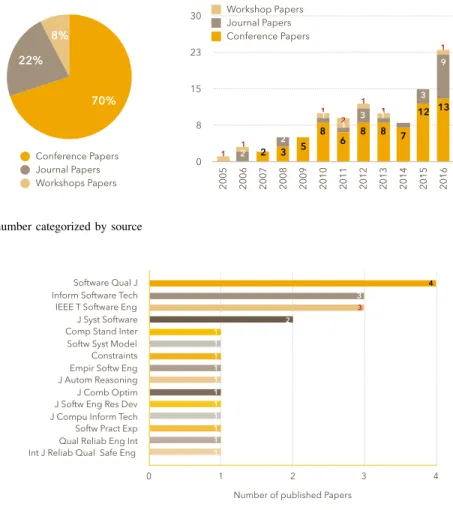
Regarding the type of the publication venue, Figure 4 shows this information. Majority of publications (around 70%) are conference publications, about 22% are journal publications, and around 8% are workshop publications. It should be men-tioned here that some conference publications are ultimately published as book chapters; however, their original venues, which are conferences, were considered.
This article has been accepted for publication in a future issue of this journal, but has not been fully edited. Content may change prior to final publication. Citation information: DOI 10.1109/ACCESS.2017.2771562, IEEE Access
6 4. Results
We dedicate this section for answering the research questions in detail.
4.1.Frequency of publication (RQ1)
We analyze the identified studies over the last decade (2005-2016) to know the frequency and evolution in the number of publication. Figure 3 shows the result of this analysis process. As mentioned earlier, we considered 104 articles in which the average number of publication per year is above 8 papers. The average number is influenced strongly with the growth of publication number after 2009.
It should be mentioned here that the first model of constrained interaction for interaction testing purposes is proposed in a PhD thesis in 2004 by Cohen [16]. However, this study does not appeared in any database and only published on the author and university websites. This was the only study in 2004 that mentioned constrained interaction testing for software testing purposes. In 2005, B. Hnich et al. [17] formalized the constrained interaction testing with Covering Array (CA) mathematical object.
Figure 3. Publication per year
The interest in constrained interaction testing moderately increased between 2006-2007, whereas, a significant increase of research can be observed in 2008 and beyond. This increase in the publication number shows the importance of constrained interaction testing in the software engineering research community. Another potential reason behind this increase is shifting of
12 Publication Number 8 15 23 30 Year of Publication 2005 2006 2007 2008 2009 2010 201 1 2012 2013 2014 2015 2016 1 3 2 5 5 10 9 12 10 8 15 23
Fig. 3. Publication per year
Given these results, it is also important to know the popular peer-reviewed journal, conference and workshop venues for constrained interaction testing. Figure 5 shows those active peer-reviewed journals where relevant papers are published. Journals names are given in abbreviations of Thomson Reuters Science Citation Index1 due to their long names. The full journal names corresponding to those abbreviations are given in Appendix B. Respectively, Figure 6 shows active confer-ences involved in constrained interaction testing research. The conference names are given in abbreviations, and the full names can be found in Appendix C.
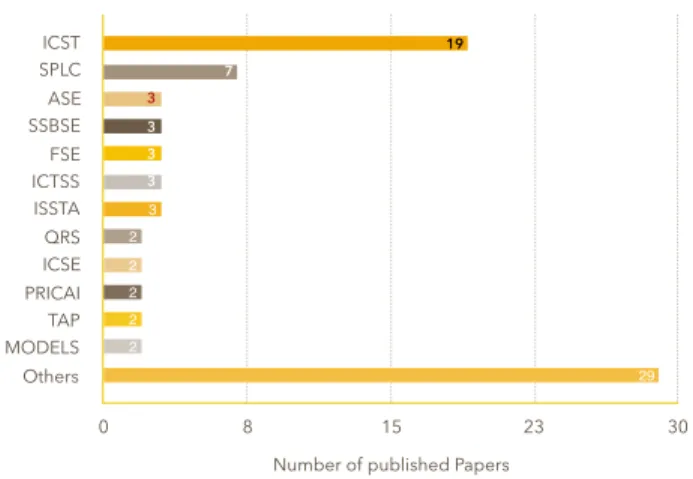
Figures 5 and 6 gives a clear picture of targeted venues for publication by authors of the considered studies. Looking at the journal publications specifically, it is clear that “Soft-ware Quality,” “Information and Soft“Soft-ware Technology,” “IEEE Transactions on Software Engineering,” and “Systems and Software,” journals are the most active and top four journals in terms of publication target (more than 52% of the journal publications). Considering the conference publications, it be can noted that many papers have been published in individ-ual conferences, however, “Software Testing, Verification and Validation (ICST)” and “Software Product Lines (SPLC)” are the most targeted venues for the authors (more than 36% of conference papers; 19 in ICST and 7 in SPLC). However, if we consider those conferences which published more than two papers, more than 68% of the papers were published in annual conferences. The remainder of the papers were published in 30 individual conferences (represented as others in Figure 6).
B. Active Individuals, Organizations and Countries (RQ2)
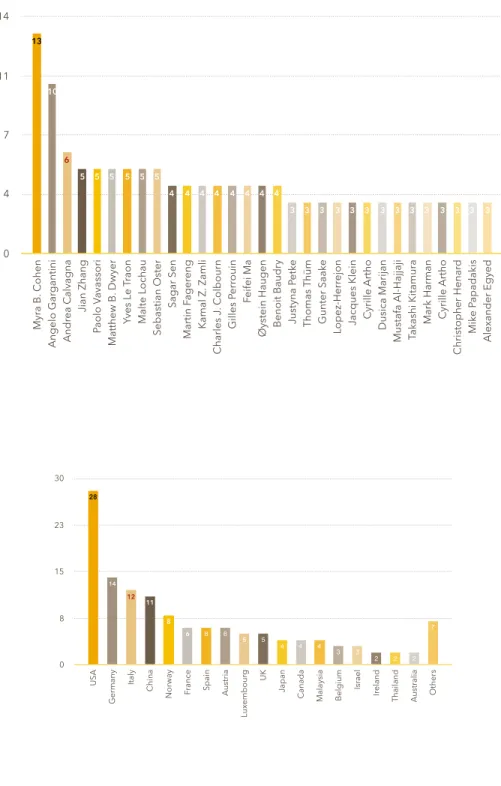
This research question aims to identify active researchers publishing studies about constrained interaction testing. A quick analysis reveals that many researchers are engaged in researching constrained interaction testing. In fact, it is clear that many authors were participating in a single re-search paper. Most active rere-searchers were designated as those who author/co-author more than three research papers. Such researchers are producing more than 83% (86/103) of the publications. Figure 7 shows the ranking of these researchers
1https://apps.webofknowledge.com
based on them being authors or co-authors of the papers. From the ranking, it is clear that “Myra B. Cohen”, “Angelo Gargantini” and “Andrea Calvagna” are top three researchers with 13, 10 and 6 published papers respectively. These three authors participated in almost more than 28% (29/103) of the total publications.
Table IV shows the ranking of the organizations and active research groups based on the published papers. The name of the group, participating researchers, reference to the published papers and the total number of papers is also presented in the table. The table complements the observations from Figure 7. In addition to the organizational ranking, the table also shows the collaboration among the authors. From the analysis of the table, it is clear that the research group from University of Nebraska - Lincoln (a collaboration between “Myra B. Cohen” and “Matthew B. Dwyer”) is the most active research group in constrained interaction testing. In addition, that the group from Chinese Academy of Sciences (a collaboration between Jian Zhang and Feifei Ma) and the group from Technischen Universit¨at Darmstadt (a collaboration between Malte Lochau and Sebastian Oster) are second active research groups since they are collaborating with other researchers in publishing 7 papers for each group. There are two active groups in the third rank. The group from Universit`a di Bergamo (a collaboration between “Angelo Gargantini”, and “Paolo Vavassori”), and University of Catania (active author “Andrea Calvagna”) have participated in 6 published papers.
Another analysis can be drawn from the active countries in published papers. Figure 8 shows the most active countries in the publishing of constrained interaction testing papers. The figure shows the participation of each country in published papers based on the organizational affiliation of the authors. It is clear that USA, Germany, and Italy are top three countries in publications, with 28, 14, and 12 publications respectively. For example, 13 papers out of those published from the USA comes from a collaboration between “Myra B. Cohen” and “Matthew B. Dwyer”. Germany is the second most active country in constrained interaction testing publications. This comes from the collaboration of three German universities with other groups. These organizations are, “Technischen Universit¨at Darmstadt” (active researchers: Malte Lochau and Sebastian Oster), “Technischen Universit¨at Braunschweig” (active researcher: Thomas Th¨um) and the “University of Magdeburg” (active researchers: Gunter Saake and Mustafa Al-Hajjaji).
Important observations can be made from the output of this research question. Although the topic is important and promising, few researchers participate in constrained interac-tion testing publicainterac-tions. For instance, 31 active authors are participating in more than two research papers, and they are responsible for more than 83% (86/103) of the publications. In fact, many more authors are participating in combinatorial interaction testing without constraint’s support.
C. Distribution of the Studies and Topics Addressed (RQ3)
Full-text of the considered papers was scanned carefully to answer this research question. Different topics and subjects
This article has been accepted for publication in a future issue of this journal, but has not been fully edited. Content may change prior to final publication. Citation information: DOI 10.1109/ACCESS.2017.2771562, IEEE Access
7 constraint interaction testing from theory to practice that investigate the application of this testing
technique in different software testing case studies.
Regarding the type of the publication venue, Figure 4 shows important information about this record. Majority of publications (around 67%) is coming from conference publications, around 25% from journal publications and around 8% from workshop publications. It should be mentioned here that some conference publications are published as book chapters. However, we consider its original venue as conference publication.
Figure 4. Publication ratio and number categorized by source
13 0 8 15 23 30 2005 2006 2007 2008 2009 2010 2011 2012 2013 2014 2015 2016 1 1 1 2 1 1 1 9 3 1 1 3 1 1 2 2 13 12 7 8 8 6 8 5 3 2 Conference Papers Journal Papers Workshop Papers 8% 22% 70% Conference Papers Journal Papers Workshops Papers
Fig. 4. Publication ratio and number categorized by source
17 0 4 7 11 14 Myr a B. C ohen Angelo Gar gantini Andr ea C alvagna Jian Zhang Paolo Vavassori Ma tthew B. Dwyer Yves L e Tr aon Malte L ochau Sebastian Oster Sagar Sen Mar tin F ager eng Kamal Z. Z amli Charles J. C olbourn Gilles P err ouin Feifei Ma Øystein Haugen
Benoit Baudr Justyna P
etk e Thomas Thüm Gunter Saak e Lopez-Herr ejon
Jacques Klein Cyrille
Ar tho Dusica Marijan Mustafa Al-Hajjaji Tak ashi Kitamur a
Mark Harman Cyrille
Ar tho Christopher Henar d Mik e P apadakis Ale xander Egyed 3 3 3 3 3 3 3 3 3 3 3 3 3 3 4 4 4 4 4 4 4 4 5 5 5 5 5 5 6 10 13 Software Qual J Inform Software Tech IEEE T Software Eng J Syst Software Comp Stand Inter Softw Syst Model Constraints Empir Softw Eng J Autom Reasoning J Comb Optim J Softw Eng Res Dev J Compu Inform Tech Softw Pract Exp Qual Reliab Eng Int Int J Reliab Qual Safe Eng
Number of published Papers
0 1 2 3 4 1 1 1 1 1 1 1 1 1 1 1 2 3 3 4
Fig. 5. Number of Published Papers vs. Journal Name
TABLE IV
RESEARCHERS AND ORGANIZATIONS INVOLVED IN CONSTRAINED INTERACTION TESTING RESEARCH
Organization Author(s) Papers Published Total
University of Nebraska - Lincoln Myra B. Cohen and Matthew B.Dwyer [21]–[33] 13
Chinese Academy of Sciences Jian Zhang and Feifei Ma [34]–[40] 7
Technische Universit¨at Darmstadt Malte Lochau and Sebastian Oster [41]–[47] 7
Universit`a di Bergamo Angelo Gargantini, and Paolo
Vavassori [48]–[53] 6
University of Catania Andrea Calvagna [30], [49], [51], [52],
[54], [55] 6
University of Luxembourg
Yves Le Traon , Jacques Klein, Christopher Henard, and Mike Papadakis
[44], [56]–[59] 5
IRISA/INRIA Sagar Sen and Benoit Baudry [44], [57], [60]–[62] 5
University of Oslo and SINTEF ICT Martin Fagereng Johansen [63]–[66] 4
University Sains Malaysia / University Malaysia Pahang
Kamal Z. Zamli [67]–[70] 4
SINTEF ICT Øystein Haugen [63]–[66] 4
University of Namur Gilles Perrouin [44], [57], [59], [71] 4
University College London Justyna Petke and Mark Harman [5], [29], [31] 3
Technische Universit¨at Braunschweig Thomas Th¨um [41], [43], [72] 3
University of Magdeburg Gunter Saake and Mustafa Al-Hajjaji [41], [43], [72] 3
Johannes Kepler University Linz Roberto E. Lopez-Herrejon and
Alexander Egyed [73]–[75] 3
Arizona State University Charles J. Colbourn [19], [76], [77] 3
National Institute of Advanced Industrial Science and Technology-Japan
Cyrille Artho, and Takashi Kitamura [78]–[80] 3
This article has been accepted for publication in a future issue of this journal, but has not been fully edited. Content may change prior to final publication. Citation information: DOI 10.1109/ACCESS.2017.2771562, IEEE Access
8
7. Conclusions and Future Directions
ID# Ref. Title Year
1 Combinatorial Testing for Feature Models Using CITLAB 2013 2 [20] Test Algebra for Combinatorial Testing 2013 3 [21] Multi-Objective Optimal Test Suite Computation for Software Product Line Pairwise Testing 24 ICST SPLC ASE SSBSE FSE ICTSS ISSTA QRS ICSE PRICAI TAP MODELS Others
Number of published Papers
0 8 15 23 30 29 2 2 2 2 2 3 3 3 3 3 7 19
Fig. 6. Amount of Published Papers vs. Conference Venues
have been addressed. Although the topics are broad in range, this study distributed the topics into four main high-level cat-egories. Within each category, many topics can be discussed. Table VI shows these four high-level categories and refers to the papers in each category. Based on a careful analysis, the studies are placed into the following categories:
• Constraint Test Generation Studies: Papers in this
category discuss the generation strategies, methods, and approaches for constrained interaction testing. The pa-pers are addressing the problem of generation by using different approaches including, exact methods, compu-tational algorithms, meta-heuristic algorithms, and con-straint solvers.
• Application Studies: Papers in this category consider
only the application of constrained interaction testing for a specific domain of research (such as Graphical User Interface (GUI) testing).
• Generation and Application Studies: Papers in this
category shows those studies that are considering a combination of generation and application. Here, the research papers are introducing a generation approach for a specific application(s).
• Model Validation Studies:Papers in this category either
introduce models of constrained interaction testing, for-malize the constrained interaction testing mathematically, or introduce models of problems that can be solved by constrained interaction testing.
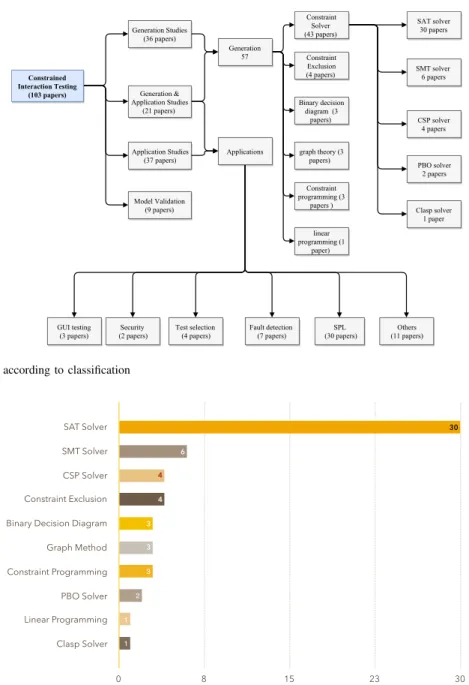
Figure 9 shows the detail distribution of the papers ac-cording to the classified topics. The following sub-sections illustrate these categories and the papers related to them in detail.
1) Constraint Test Generation Studies: As can be seen from Table VI, 36 papers are proposing and evaluating different generation strategies of constrained interaction test suites. In addition, there are also 21 papers proposing customized generation strategies for specific applications. Hence, in total, there are 57 papers containing generation methods in some form. Here, it is essential to know the used methods for solving and dealing with constraints and also the generation strategies. In fact, the generation strategies will be addressed in RQ4,
while this section addresses the constraint solving methods. As can be seen from Figure 10, different methods have been used to solve the constraints during the generation of constrained interaction test suites. By analyzing those 57 papers, a classification for those constraint solving methods can be made. Out of those 57 papers, 43 papers (75.43%) used a constraint solver package. Those constraint solvers are, SAT, SMT, CSP, PBO and Clasp solvers. SAT solver has the highest usage rate 69.7% (30/43) [5], [18], [20], [22]–[26], [28], [30], [31], [34], [38], [40], [41], [44], [45], [56]–[59], [65], [72], [73], [78], [79], [85], [95], [100], [113] then SMT solver 13.9% (6/43) [33], [44], [51], [54]–[56], then CSP solver 9.3% (4/43) [5], [42], [60], [99], and then PBO solver 4.6% (2/43) [37], [39]. Recently, one paper uses Clasp solver also [36]. The use of SAT solver seems to attract researchers because of its performance, accuracy, and simplicity for solving the constraints. Henard et al. [56] validated this result recently by conducting a comparative study between SAT and SMT solvers in case of flattening the CIT into a Boolean model. The research found that the SAT solver can process the flattening models faster than the SMT solver.
Another reported way of solving the constraints in the literature is by excluding the constraints from the search process. For instance, 4 papers [19], [42], [87], [98] of the generation papers follow this method. The method removes those tuples which are related to the constraints, in other words, the meaningless tuples. In this way, there is no need for a constraint solver. However, this method just considers the exclusion of constraints rather than their inclusion. For real applications, in some cases, there could be inclusion constraints. For example, some input parameters might come exclusively with a specific set of parameters.
Binary decision diagram [86], [115], [118] and graph theory [27], [88], [89] methods are also used to deal with the con-straints. Within the considered papers for generation approach, there are three papers for each of these methods. The binary decision diagram prevents the appearance of constraints in the final test suite by considering some form of cause-effect graph relationships. By considering this relationship, the generation method prevents the generation path from passing through those constraints. The graph theory method follows the well-known graph algorithms like graph coloring to generate test small test suites without violating the specified constraints.
Constraint programming [61], [62], [81] and linear pro-gramming [74] methods are also used rarely in the literature to deal with the constraints in combinatorial interaction test-ing. Constraint programming is mainly dedicated for solving hard combinatorial problems. Not much different from this definition, constraint programming is used within constrained interaction testing as an exact method to generate test suites without violating the constraints. Although it can be used with generation strategies in general, this method has been used only with SPL testing. Linear programming is also used with some similarities with this approach to solving the constraints but follows certain mathematical models. In general, linear programming is used with a mathematical model when the inputs have a linear relationship. Lopez-Herrejon et al. [74] followed this approach by using zero-one mathematical linear
This article has been accepted for publication in a future issue of this journal, but has not been fully edited. Content may change prior to final publication. Citation information: DOI 10.1109/ACCESS.2017.2771562, IEEE Access 9 17 0 4 7 11 14 Myr a B. C ohen Angelo Gar gantini Andr ea C alvagna Jian Zhang Paolo Vavassori Ma tthew B. Dwyer Yves L e Tr aon Malte L ochau Sebastian Oster Sagar Sen Mar tin F ager eng Kamal Z. Z amli Charles J. C olbourn Gilles P err ouin Feifei Ma
Øystein Haugen Benoit Baudry Justyna P
etk e Thomas Thüm Gunter Saak e Lopez-Herr ejon
Jacques Klein Cyrille
Ar tho Dusica Marijan Mustafa Al-Hajjaji Tak ashi Kitamur a
Mark Harman Cyrille
Ar tho Christopher Henar d Mik e P apadakis Ale xander Egyed 3 3 3 3 3 3 3 3 3 3 3 3 3 3 4 4 4 4 4 4 4 4 5 5 5 5 5 5 6 10 13 Software Qual J Inform Software Tech IEEE T Software Eng J Syst Software Comp Stand Inter Softw Syst Model Constraints Empir Softw Eng J Autom Reasoning J Comb Optim J Softw Eng Res Dev J Compu Inform Tech Softw Pract Exp Qual Reliab Eng Int Int J Reliab Qual Safe Eng
Number of published Papers
0 1 2 3 4 1 1 1 1 1 1 1 1 1 1 1 2 3 3 4 Fig. 7. Active Researchers
18 0 8 15 23 30 USA Germany Italy China
Norway France Spain Austria
Lux
embour
g UK Japan Canada
Malaysia Belgium Isr
ael Ireland Thailand Austr alia Others 7 2 2 2 3 3 4 4 4 5 5 6 6 6 8 11 12 14 28
Fig. 8. Active Countries
TABLE VI
DISTRIBUTION OFPAPERS BYRESEARCHTYPE(HIGH LEVEL CLASSIFICATION)
Research Type Number Papers
Constraint Test Generation Studies 36 [18]–[20], [22]–[26], [34]–[38], [40], [48]–[51], [56], [67]–[69], [76]–[79], [82]–[91]
Application Studies 37 [27]–[30], [41], [42], [44], [45], [47], [52], [57], [58], [62]–[64], [71], [73], [80], [92]–[110]
Generation and Application Studies 21 [5], [31]–[33], [39], [43], [59]–[61], [65], [66], [70], [72], [74], [75], [81], [111]–[115]
This article has been accepted for publication in a future issue of this journal, but has not been fully edited. Content may change prior to final publication. Citation information: DOI 10.1109/ACCESS.2017.2771562, IEEE Access
10
Fig. 9. Distribution of papers according to classification
5. Threats to validity
Like any other mapping study, this is study is not out of threats. We encountered several threats to validity during this study. We have eliminated many threats by following well known methodologies and designing unbiased experiments to count the research articles. However, we have still some threats that we must address here.
19 SAT Solver
SMT Solver CSP Solver Constraint Exclusion Binary Decision Diagram Graph Method Constraint Programming PBO Solver Linear Programming Clasp Solver 0 8 15 23 30 1 1 2 3 3 3 4 4 6 30
Fig. 10. Constraint Solving Methods
program with a multi-objective algorithm to solve the con-straint problem for SPL feature models. In fact, this approach is difficult to follow for big and general constrained interaction testing strategies as it is a non-deterministic polynomial (NP) hard problem [4], [121].
2) Application Studies : From the Table VI, it is clear that 37 published papers are dealing with the application of con-strained interaction testing without addressing the details of the generation process. The majority of these strategies used well-known and established tools and algorithms for generating constrained test suites. Those generation tools and algorithms are either adopted from other studies or used without much fo-cus on them in the published studies due to the more significant focus on the application itself. For generating the test suites, there is an essential need to represent the system-under-test as a model to recognize the input parameters and constraints.
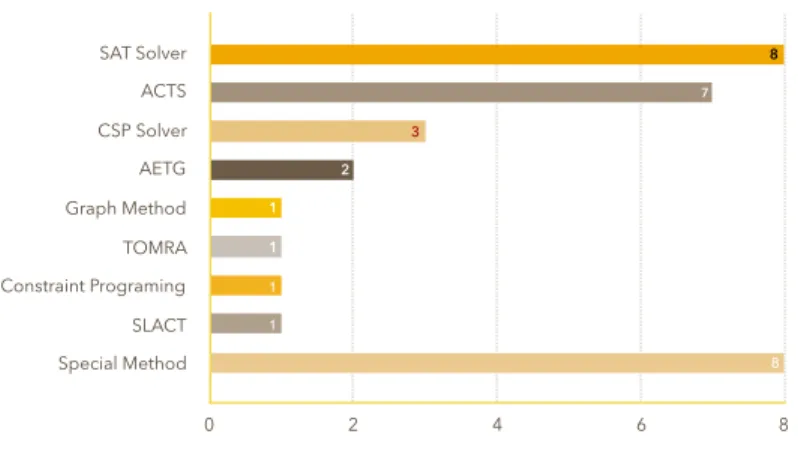
These inputs are then used to generate test cases. Figure 12 shows those adopted methods in the application studies. Out of those 37 published papers in the application direction, eight papers are using SAT solver directly to generate the test cases and for solving the constraints. Eight papers used ACTS2tool
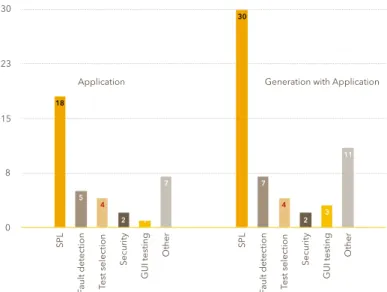
for the generation since it is a well-established, efficient, and an excellent performance tool. Specifically, those published papers used the IPO-family algorithms inside the ACTS tool. As can be seen from Figure 11, the applications are dis-tributed into six main areas. Constrained interaction testing is frequently used within five of those areas actively. Those active areas (with the citations to them) are, SPL testing [27], [41], [42], [44], [45], [47], [52], [57], [58], [62]–[64], [71], [99], [101], [104], [109], [110], fault detection and characterization [28], [29], [80], [95], [105], test selection [96], [97], [107],
This article has been accepted for publication in a future issue of this journal, but has not been fully edited. Content may change prior to final publication. Citation information: DOI 10.1109/ACCESS.2017.2771562, IEEE Access 11 22 0 8 15 23 30 SPL
Fault detection Test selection
Security
GUI testing
Other SPL
Fault detection Test selection
Security GUI testing Other 11 7 3 1 2 2 4 4 7 5 30 18
Generation with Application Application
Fig. 11. Application Areas of constrained Interaction Testing
[108], security [93], [102], and GUI testing [114]. The left-hand side of the graph shows the results of those research papers which are presenting the application focus. It should be mentioned here that the papers are showing the results of the testing process without much detail about the generation process. In fact, most of the research papers use one or more generation tools either from their previous research or other research. For instance, 15 research papers show the use and the benefits of the constrained interaction testing for the SPL. In total, 29 published papers are focusing on the use of constrained interaction testing for SPL.
Fault detection and characterization is another active re-search direction here. Fault detection has been examined in the literature with normal interaction testing without constraints. Within constrained interaction testing, fault detection and characterization is used for different purposes. In fact, there are five research papers published in this direction without the generation details and two more papers with the test generation details. In total, there are seven published papers, but there are no frequent author names in them.
Another active research direction for application of con-straint testing is the test selection direction. From Figure 11, it is clear that in total there are four published papers here. The test selection research originated from the normal combinatorial interaction testing. Again, there are no frequent names in these publications. This direction of research seems to catch less attraction by the researchers, but it still could be a productive future research direction.
Constrained interaction testing has been used for testing security issues. Security application is investigated first for normal combinatorial interaction testing for few studies (e.g., [122], [123]). In case of constraints, so far, two studies investigated its use in security. Bozic et al.[93] assessed the concept of constrained interaction for web security testing and Bouquetet al. [102] assessed it with model-based testing.
Combinatorial interaction testing has been used effectively to generate test cases for applications from the GUI point of
view. Here, the constrained interaction testing is used to solve invalid test cases in the final generated test suite. In total, there are three published papers in this direction.
In addition to those aforementioned frequent areas, con-strained interaction testing has been used in total within 11 different studies to solve real-life problems. More details on the above mentioned active applications and other areas are given while answering RQ6 in subsection IV-F.
3) Generation and Application Studies: Another category of research area within constrained interaction testing belongs to the “generation and application studies.” As can be noted from Table VI, 24 published papers are dealing with the ap-plication of constrained interaction testing and also addressing the generation process. It is clear from the right-hand side of Figure 11, there are still six frequent main areas for research. The right-hand side of the figure extends the left side by adding more papers to the application categories.
More papers are dealing with the SPL application but with more details about the generation of test cases. Here, the papers considered the generation of test cases for the SPL as a special case of constrained interaction testing due to different constraints in the feature models used within SPL. In addition, researchers tried to integrate the generation algorithms with the testing tools. Some of those algorithms were depending mainly on constraint solving solutions. For example, Model-based Software Product Line Testing frame-work (MoSo-PoLiTe) [66] uses CSP solver for solving the constraints in the feature models of the SPLs. Other tools deployed well-known algorithms for constrained interaction testing to generate test cases for the SPLs. CITLAB tool [52] deployed IPO-family algorithms that are available in ACTS [91] tool to generate test cases for SPL. In fact, the publication in this direction aimed to increase the efficiency of the generation algorithms. Other researchers used special algorithms to reach this aim. For instance, Al-Hajjaji et al.
[72] proposes an incremental approach for product sampling for pairwise interaction testing (called IncLing), which enables
This article has been accepted for publication in a future issue of this journal, but has not been fully edited. Content may change prior to final publication. Citation information: DOI 10.1109/ACCESS.2017.2771562, IEEE Access
12
7. Conclusions and Future Directions
ID# Ref. Title Year
21 SAT Solver ACTS CSP Solver AETG Graph Method TOMRA Constraint Programing SLACT Special Method
Number of published Articles
0 2 4 6 8 8 1 1 1 1 2 3 7 8
Fig. 12. Adopted Generation Methods for Applications
developers to generate samples on demand in a step-wise manner. Here, the performance of the generation algorithm is also improved by this incremental approach since there is no need to wait until the generation algorithm produces all the configurations. Lopez-Herrejon et al. [75] proposed Parallel Prioritized product line Genetic Solver (PPGS) algorithm, a parallel genetic algorithm for the generation of prioritized pairwise suites for SPLs. The study compared PPGS with the greedy algorithm prioritized-ICPL and in most cases, PPGS was found to be producing better results.
D. Marijan [61] has also introduced an algorithm to generate a minimal set of valid test cases for SPL that covers 2-wise feature interactions for a given time interval. Mainly, the algorithm is based on constraint solver and constraint programming. The study identifies the generation of a minimal configuration set for SPL from the feature model as a con-straint optimization problem. The algorithm can capture the relationships among the features in the input feature model by a constraint model that identify these relationships as constraints for the solvers. The algorithm then tries to generate a set that covers the 2−wiseinteractions of the features and also satisfy the constraints.
4) Model Validation Studies: Model validation studies form another category of published research papers on constrained interaction testing. From Table VI, it is clear that seven published papers ( [21], [46], [54], [55], [116]–[120]) address this issue for constrained interaction testing. The papers in this category deal with input models of an application under test. These models are then used to generate test cases accordingly. The rationale behind this research direction is the deployment obstacles to find the correct set of parameters and values with the restrictions (i.e., constraints) among them for real-life applications.
Generally, in combinatorial interaction testing, a model is composed of parameters and values for each of them. Constrained interaction testing adds some complex entity to the model validation process which is the constraint model among the parameters. The test generation strategies start from this model to construct the final test suite. Having a good model for the system under test will improve the quality of
the produced test suites by the strategy and also it could help in early defect discovery. The model will be more useful when we want to validate the produced test suites and assess their quality.
Calvagna and Gargantinia [55] presented a new approach to construct constrained 2−wise test suites. More parts of the paper discuss the models of input domains and how the constraints should be presented in the strategy. The paper presented a model also to generate customized test suites by exclusion and inclusion of ad-hoc combinations of input parameters. The research also formalized constrained inter-action testing as a logic problem. A model checker tool is presented in the paper to validate the model. In line with the approach of the paper, it presented a prototype tool for implementation. In another paper later, A. Calvagna and A. Gargantini [54] extended this approach to include more formalization of the model with more extensive evaluation process for the generation and validation process.
Segall et al. [118] then suggested a different approach to handle the complex relationship models between the parame-ters. The research suggested two different construction models. The first construction model is the type counter parameter, which is a special type of parameter that counts the number of specific values appearance for each input parameter in each test case. The second construction model is the type value property, which specifies the number of properties related to each parameter and values. The research showed that these two approaches will reduce the modeling complexity needed significantly. The research validated the two approaches on two real-life case studies. Although the approach is new in this direction, significant experimental results for validation could not be recognized.
Arcainiet al. [116] proposed a model validation approach for the constrained interaction testing, focusing more on the validation of the constraints rather than the interactions of parameters. The approach checks the consistency of the con-straint among the input parameters, to be sure that they are not contradicted by each other, and hence the input parameters and their values are necessary for the inclusion in the test suite. This has been done by checking whether the produced
This article has been accepted for publication in a future issue of this journal, but has not been fully edited. Content may change prior to final publication. Citation information: DOI 10.1109/ACCESS.2017.2771562, IEEE Access
13
test suites are consistent with the provided requirements in the beginning for the input parameters, values, and constraints among them. The research also provides a technique to identify potential causes for any appeared error and how to fix it. The research suggested four sets of checkpoints that each constrained interaction test suite must have. Those checkpoints are, the consistency of the constraints, the usefulness of the parameters and values, the correctness of the final test suite in term of constraints violation, and finally the importance of each test case in term of coverage. These checkpoints were validated by the benchmarks available in the CITLAB tool [49] and the constraints were validated with the help of SMT solver.
Tzoref-Brill and Maoz [119] explore the evolution of con-strained interaction test space modeling. The research showed that the Boolean semantics are inadequate for constrained interaction model evolution. The research extends the Boolean semantics to a lattice-based semantics to provide consistency of the interpretation for model changes. This has been done via Galois connection to establish the connection among the elements in an abstract domain. The research provides an extensive formulation of the models without showing any experimental results.
In contrast with the approaches mentioned above of general model validation, M. Spichkova and A. Zamansky [120] pro-poses a formal framework for model and validation framework of constrained interaction testing at multiple levels of abstrac-tion between elements. The framework is human-centric in which it provides queries to testers for helping to analyze and assess the quality of specific test plans, models, and constraints to check if they are complete and valid. The study presented a formal analysis of the framework without an extensive experimental evaluation.
While the model validation frameworks and approaches are feasible for constrained interaction testing, S. Khalsa, Y. Labiche [117] introduced the base choice criteria to account for constraints. Specifically, the researchers discovered two ex-tensions for the base choice to address complex constraints for complex systems. The criteria and models were evaluated on industrial and academic cases studies using different generated test suites by various testing tools. The evaluation was based on cost and effectiveness of the test suites in term of code coverage and fault detection.
D. Existing Generation Strategies, Tools and Techniques (RQ4)
For the answering of RQ4, this study is interested in knowing available generation strategies and tools. By answer-ing this question, it would also be possible to understand the features and drawbacks of each strategy. The generation process and the efficient algorithms of the strategies are also essential to show here. It is clear from discussions mentioned above that each generation strategy of constrained interaction testing needs a mechanism to deal with the constraints. In SectionIV-C1, it is illustrated that to solve the constraints, the researchers usually either using a constraint solver through constraint programming or they exclude the constraints. They
may also avoid the inclusion of constraints by following a particular algorithm. Having discussed those constraint issues, this Section is more about to know the algorithms used to derive the interactions for the final constrained interaction test suite.
There are many generation approaches for normal com-binatorial interaction testing, with few of them supporting the inclusion of constraints. From the examined papers, in general, there are three approaches for the generation. The first approach is to use a computational algorithm to construct and optimize the test suites; the second approach is to use a meta-heuristic algorithm to optimize the test suite. With these two approaches, a constraint handling mechanism (explained in Section IV-C1) is used to handle the constraints in the final test suite. The third approach is to use a constraint solver to construct the final test suite directly without violating the con-straints. The presented generation methods in the considered studies are falling under one of these approaches.
Following the first approach, Yu et al. [91] presented ACTS tool for generating different instances of combinatorial interaction test suites including the support for constraint handling. In fact, ACTS is a composition of many algorithms, mainly the IPO-family algorithms like IPOG [124], IPOG-D [125], and IPOG-F [126]. To handle the constraints, the ACTS tool relies on the Choco3 solver. The tool can handle large
configurations with a large set of constraints and large values of interaction strength, especially in the command line script. As mentioned previously, the tool has been used as a base for many applications in the literature.
Garvin et al. [25] followed the second approach and pre-sented an improved implementation of the original simulated annealing-based (SA) constrained test suite generator [26] called CASA. The tool includes the original implementation of the SA generator algorithm with some improvements. The im-provement is concentrated in the long run time for highly con-figurable systems with large constraint support. The research reformulated the search algorithm in the SA to efficiently incorporate the constraints. The tool uses SAT solver to handle the constraints. Through the evaluation process in the study, the tools perform well for the 35 benchmarks used. However, the tool becomes slow, and the performance degrades as the configuration benchmarks become large and it is not able to generate test cases for some complex configurations. In addition, it could be noted that the tool does not scale well when the interaction strength grows. As mentioned earlier, the tool has been used in other studies to investigate the application of constrained interaction test suites for real-world problems.
Remaining with the second approach, A. Kalaee and V. Rafe [115] presented an algorithm to generate constrained interaction test suites using the PSO algorithm. The constraints are handled by an ROBDD graph that helps to prevent them appearing during the construction. In the same way, Alsariera
et al. [70] presented an algorithm to generate the test suites using the Bat-inspired algorithm for SPL. The study handled the constraints by excluding them from the final test suite.
This article has been accepted for publication in a future issue of this journal, but has not been fully edited. Content may change prior to final publication. Citation information: DOI 10.1109/ACCESS.2017.2771562, IEEE Access
14
Both studies need more extensive evaluation, and also their performance is not comparable with ACTS and CASA.
Following the third approach, Banbaraet al.[113] presented an algorithm and a method to generate constrained interaction test suites using SAT solver directly. The study proposed modern CDCL SAT solvers with two encodings, one is order encoding while the other is a combination of order encoding. The use of these encodings helps to enhance the efficiency of generating better constrained interaction test suites in terms of size. The evaluation experiment showed this enhancement by generating better test suites sizes as compared with well-known results in the literature.
E. Used Benchmarks for Evaluation (RQ5)
By analyzing the considered papers for this study, it is clear that different studies are using standard benchmarks or what one can call “custom” benchmarks. As in the case of any benchmark, the aim of using it is to evaluate a particular approach within constrained interaction testing. In addition, it is also used to compare different approaches. Mainly, there are two types of benchmarks: benchmarks used to evaluate constrained interaction test generation efficiency in general and benchmarks used to evaluate the constrained interaction test generation efficiency for SPL.
Cohen et al.[26] used a set of experiments that have been used as a benchmark to evaluate a strategy for generating constrained interaction testing suites. Later in her study [23], Cohen has extended the set to include more real-world config-urations generated from well-known software systems. These benchmarks are input models of Apache, GCC, Bugzilla, SPIN simulator and SPIN verifier. Apache HTTP Server4 is an
open source software system that works on different platforms to feed web services. GCC5 is a multiple input language
infrastructure for supporting many programming languages like C, C++, Java, and Fortran. Bugzilla6 is a defect tracker from Mozilla that comes in open source to be used by software developers. SPIN model checker [127] is a software tool that is used as a case study for evaluation. In addition to these systems, 30 more system configurations were generated from the above systems to be used as benchmarks. These models are used as configuration benchmarks for 15 more published papers (see [22], [24]–[26], [36], [37], [54], [55], [68], [78], [79], [82], [85], [86], [90]). Other published papers rely on custom benchmarks, which are normally random configura-tions to simulate different scenarios of inputs.
Benchmarks for SPL test generation are commonly feature model files like XML files and contain different features and the constraints among them. These benchmarks may come from industry partners that use SPLs or may come from previously constructed sets for experimental use. In general, many papers use SPLOT7, which is a website for SPL tools
and repositories. In fact, 8 of the considered studies in this paper have been using the features models available on SPLOT
4httpd.apache.org/docs/2.2/mod/quickreference.html 5http://gcc.gnu.org/onlinedocs/gcc-4.1.1
6https://bugzilla.readthedocs.org/en/latest 7http://www.splot-research.org/
for benchmarks. These papers are: [44], [45], [58], [59], [62], [75], [99], [101].
F. Applications of Constrained Interaction Testing (RQ6)
As can be seen from Figure 11, there are mainly five areas in which the constrained interaction testing has frequently been used. In addition, there are 11 different areas where the constrained interaction testing has shown significant results concerning the application. Hence, in total, there are 16 areas of the application so far for constrained interaction testing. The following subsections discuss these application areas with more details.
1) SPL : SPL engineering is getting more attention recently due to considerable industrial interest. The approach of SPL is to establish a platform for common products in a product line by identifying variability and commonality of features during the development of individual products [128]. The testing foundation in the SPL is to produce test assets that can be reused by the products during the process of product line development. The test case includes entities that form common parts related to a variety of possible products that must be realized by the domain engineer. The testing process of the SPL is getting more and more attention in the last decade. Many approaches have been published for testing SPL. Neto
et al.[10] summarized different testing approaches for SPL in an extensive systematic literature study.
Due to huge features of modern products, it is very hard to generate a complete and feasible test suite and configura-tions. Here, combinatorial interaction testing can be a useful approach to construct an optimal and practical configuration for different potential products from a large set of features. However, in reality, there are different constraints among these features that tend to produce infeasible product configurations. Constrained interaction testing can be an excellent solution for this problem by generating an optimal configuration set without violating the constraints among the features.
To apply the constrained interaction testing for SPL, a set of activities need to be followed, as in the 29 papers identified earlier in Figure 11. These activities are the feature model adaptation including the constraints identification, interaction testing adaptation, and configuration set generation.
Feature model adaptation and constraint identification prob-ably is the starting point in any approach. This step starts by taking a standard input file that can also be represented in a feature diagram. For instance, Perrouin et al. [57] formal-ized different types of potential constraints from the feature models. The study also proposed a toolset to generate the final test suite for SPL. Calvagna et al. [52] presented a more extensive and mature method to translate the feature models into combinatorial interaction models in a framework named CITLAB. The framework gives many advantages for a tool to generate constrained interaction testing such as editing facilities, seeding, and generation algorithms.
Interaction testing adaptation is an important stage to use the constrained interaction testing for SPL. In fact, the majority of the published papers are converting the feature models to the CA mathematical object using the combinatorial model