Systems to Optimize Learning
WRITTEN BY: Liz Glowa Jim Goodell
The mission of the International Association for K–12 Online Learning (iNACOL) is to catalyze the transformation of K-12 education policy and practice to advance powerful, personalized, learner-centered experiences through competency-based, blended and
online learning. iNACOL is a non-profit organization focusing on research, developing
policy for student-centered education to ensure equity and access, developing quality standards for emerging learning models using competency-based, blended and online education, and supporting the ongoing professional development of classroom, school, and district leaders for new learning models. Learn more at www.inacol.org.
iNACOL, The International Association for K–12 Online Learning www.inacol.org
Glowa, L. and Goodell, J. (2016) Student-Centered Learning: Functional Requirements for Integrated Systems to Optimize Learning Vienna, VA.: International Association for K-12 Online Learning (iNACOL).
Section I: Student-Centered Learning ...
1Section II: Implications of the Nellie Mae Education Foundation’s Tenets of
Student-Centered Learning for Technology ...
4Section III: Design of a Student-Centered Learning Integrated Information
System - Requirements and Use Cases ...
10Section IV: Shifting from Traditional Course-Based Information Systems to
Integrated Student-Centered Learning Systems ...
31Section V: A Student-Centric Approach to Student-Centered Learning
Information System Design ...
39Section VI: Using this Information ...
60Section VII: Conclusion ...
62Endnotes ...
63Appendix A: Understanding Education Technology Standards ...
64Appendix B: Data and Application Design for an Integrated Student-Centered
Learning Information System ...
70Section I: Student-Centered Learning
The realities of the 21st-century learner require that schools and educators fundamentally change their practice.
“Educators must produce college- and career-ready graduates that reflect the future these students will face. And,
they must facilitate learning through means that align with the defining attributes of this generation of learners.”1
Today, we know more than ever about how students learn,
acknowledging that the process isn’t the same for every student and doesn’t remain the same for each individual, depending upon
maturation and the content being learned. We know that students
want to progress at a pace that allows them to master new concepts
and skills, to access a variety of resources, to receive timely feedback
on their progress, to demonstrate their knowledge in multiple
ways and to get direction, support and feedback from—as well as collaborate with—experts, teachers, tutors and other students.
The result is a growing demand for student-centered, transformative digital learning using competency education as an underpinning. THE PROMISE OF STUDENT-CENTERED LEARNING
The American system of education was built for a society and an
economy that no longer exists.3 The education system still in place in
many districts around the country was created in the early 1900s to
serve a different time with different needs. This model, often called
the factory model system, in essence monolithically processes
students in batches. Teachers teach the same subjects to groups of
students roughly the same age at the same pace. The system of the
one-to-many approach to teaching, as well as age-based cohorts, advancement based on age-grouping or time-based Carnegie credits rather than mastery and classroom-contained instruction, places limits on our children’s opportunities to learn and thrive in this changing world. Students learn at different paces, have different aptitudes and enter classes with different experiences and background knowledge.
Student-centered learning models personalize learning with the use of competency-based approaches, supported by blended and online learning modalities and environments, as well as extended learning options and resources. A focus exists on student ownership of learning. Students share responsibility for their own learning with their
teachers, parents/guardians and other support persons. Teachers use technology to analyze and utilize
real-time data to differentiate instruction, customize learning and engage students in Deeper Learning. Students use technology to consider their real-time progress data in focusing their learning, to access resources, to collaborate
and communicate with others and to demonstrate evidence of their learning.
“A growing body of research suggests that overall student
achievement is likely to increase when students are able to learn at their own pace
with a variety of teaching styles and formats available to
them. Personalizing students’ education enables them to
access a unique learning experience based upon their individual needs, rather than receiving instruction through a standard, paced curriculum.
In its ideal form, the needs of
Education that is student-centered has tremendous potential, and recent results are promising:
» Decrease in drop-out rates
» Increase in percentage of students accepted into college
» Increase in growth in mathematics—grade level indicators and state assessments
» Increase in growth in reading—grade level indicators and state assessments
» Increase in student engagement
» Decrease in student referrals
» Increase in student agency
Both the Nellie Mae Education Foundation and iNACOL consider the transformation of today’s education systems
///////////////////////////////////////////////////////////////////////////////////////////////////////////////////////////////////////////////////////////////////////////////////// While the law maintains many of the requirements for annual
testing, it is importantly coupled with greater flexibility to
states in the choice and design of those assessments, and
how to appropriately hold its public schools accountable. Additionally, the law explicitly provides room for more
creative, developmentally appropriate, and meaningful
assessment systems by establishing pilot opportunities for innovative, performance-based approaches. Opened initially for up to seven states, and informed by much of what has been learned by education pioneers living and working in the northeast, we believe the six New England states are well positioned to be home to at least one of
these initial seven pilot sites. Whether or not our region’s
contributions will lead to further concentration of federal dollars here or not remains to be seen.
As it moves leverage closer to the ground, ESSA endorses
the notion that local democratic processes must be respected. In a region where there are strong experiments
around how to focus a future orientation for readiness
through direct public dialogue versus a backward attempt
at repair through federal mandate, ESSA provides an
immediate chance to provoke a broader deliberation
around the purposes of education. This means we have
a chance to push the pendulum back from viewing public
education’s main purpose as one of competition among individuals, toward the purpose of readying all our K-12 students for success in post-secondary education so our communities prosper economically, civically and socially.
It is this fundamental public review of the core purposes of public education - along with an embrace of the notion that public education is an essential public good - that will allow this law to be the game changer it needs to be versus the repair job it had to be. If core cultural issues such as
these are left unattended, new approaches will only lead to familiar results.
At the Nellie Mae Education Foundation, we look forward to working with many others to make sense of this law, make the most of it and keep an eye on its imperfections so that we can move forward productively and positively
toward strong systems of public education characterized by rigorous, equitable student-centered approaches. In
this way we can leverage a long overdue policy change to secure a strong future for all New England learners and
communities.”
-Nick Donohue,
President & CEO, Nellie Mae Education Foundation, Nellie Mae Education Foundation Statement
on ESSA on December 11, 2015
“From our perspective at The Nellie Mae Education Foundation, the new law holds great promise for
advancing public education, as one of its explicit aims
is to grow, spread and improve innovative,
evidence-based, student-centered approaches to learning – where learning is personalized, competency-based, dependent
on strong student ownership, and not limited to traditional classrooms or classrooms at all. This is good news.
We also believe that there are aspects of this new
direction that demand vigilant attention. As we open up opportunities for creativity in terms of educational design, we must make sure that we organize for universal attainment of deeper learning outcomes and do not
unintentionally leave more learners behind in the process. If our nation is going to advance, we must be sure that creative learning designs are effective ones, including in
our poorest communities. We must ensure that we are elevating the learning and readiness of graduates of all
colors in all zip codes to combat the growing economic
inequalities that are so pervasive across our country. While
the move to state-owned responsibility and district-based accountability may be the way forward, as advocates
of equity, it leaves us uneasy, even as it replaces the
untenable approaches to securing equity in NCLB. ESSA mandates a big shift toward balancing shared responsibility, as the law moves significant decision-making about responses to low performance to the district level guided by state authority. However, the distribution of authority to the local level will demand capacity-building so that local communities can meet those responsibilities.
Today most districts do not have the capacity to do so, as
so much energy has been directed to a compliance-based
framework. This is an issue any advocates of dramatic,
equitable change and improvement will care about. It is one thing to open up opportunity. It is another to be able to fully, expertly and responsibly take advantage of the opportunity. Wealthy districts may be able to meet the
challenge even if they do not need to, while those who must cannot without support.
On the positive side for student-centered learning advocates, the law includes opportunities for more states to follow the lead of what many in New England have
been pursuing for years – personalized, competency-based approaches. It also allows for research supported
approaches. This is no accident. One can see echoes of good, innovative work from Rhode Island, Vermont, Maine,
Connecticut and particularly New Hampshire in many passages of ESSA. New England should be proud.
Section II: Implications of the Nellie Mae Education
Foundation’s Tenets of Student-Centered Learning for
Technology
The importance of student-centered learning for effective education is well established, yet teachers, schools
and districts struggle with its implementation. To actually put the tenets of student-centered learning into play
requires a whole school and school system transformation supported by a robust, integrated student-centered learning information system (SCL IS). Although a wealth of information has been written about student-centered
learning and technology, pulling this information together to determine what student-centered learning means for each end user segment and determining the fundamental requirements for the technologies needed to support
end users’ needs has yet to be comprehensively addressed. A student-centered learning ecosystem must support the complicated set of processes that make up personalized, student-owned, collaborative, anytime, anywhere learning and competency-based education. This paper examines these tenets in terms of the primary functional requirements for how technology can be used by students and educators. It looks at the implications
of the requirements for parents, advisors, mentors, and school and district leaders, and it proposes functional requirements for these user groups as well. Based on interviews, site visits and research, it emphasizes the
importance of analyzing and examining our knowledge of what is currently used and needed and what future
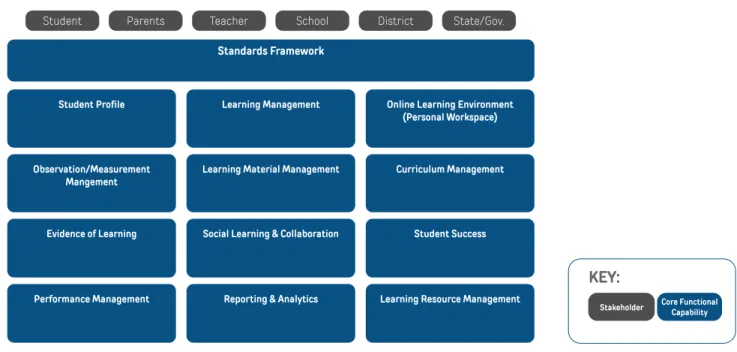
developments are needed in an integrated student-centered learning information ecosystem. The conceptual framework discussed in this paper details the design of integrated technology systems to support student-centered learning. The framework integrates the various functions of technology to address the needs of learners, educators, parents/families, administrators and other stakeholders in support of student-centered learning.
The conceptual framework is built on the assumptions of the following design principles for student-centered
learning:
» Learning is Personalized: Personalized learning recognizes that students engage in different ways and in different places. Students benefit from individually paced, targeted learning tasks that formatively assess existing skills and knowledge and that address the student’s needs and interests.
» Learning is Competency-Based: Students move ahead when they have demonstrated mastery of content,
not when they’ve reached a certain birthday or undergone the required hours in a classroom.
» Learning Happens Anytime, Anywhere: Learning takes place beyond the traditional school day and even the school year. The school’s walls are permeable—learning is not restricted to the classroom.
» Students Take Ownership Over Their Learning: Student-centered learning engages students in their own success and incorporates their interests and skills into the learning process. Students support one another’s
group- or teacher-centric. In anchoring this system design, one must consider: the individual learner’s learning
experiences, resources and interactions with peers, educators and others involved in the education; how these experiences and interactions are supported and assessed; and the ways in which these data and reports are used.
ARCHITECTURE DESIGNED TO SUPPORT STUDENT-CENTERED PROCESSES
This conceptual framework is guided by what learning scientists and cognitive science researchers have
discovered about how people learn, how people make sense of new concepts and how novices become experts. Many of the discoveries about how the human brain develops have been difficult to apply within traditional teacher and group-centric instructional models. Those same discoveries can and are being applied within technology-enabled models of student-centered learning.
The processes of student-centered learning and the data needed to address student-centered learning are
different than the processes and data used to support traditional classroom models, school operations and accountability. Some data essential for school administration, school accountability, legal compliance and answering policy questions are not the just-in-time, individual learner-specific type of data used to support the
processes at the core of student-centered learning. Instead, data such as the detailed transactions of learner
choices and learning experiences, formative feedback and progression within a competency framework prove more valuable in supporting student-centered processes.
The primary design objective of student-centered learning involves optimizing learning for each student. Therefore, one of the most critical functions of the system focuses on enabling personalized learning experiences, which may
happen through the learner’s direct interaction with a teacher, through a component of the system, with content
delivered by the system or as a combination of online and offline experiences. Whether the experience takes place online or offline, the system must facilitate the provision of learning experiences based on individual student strengths, needs, interests and motivations plus meaningful, timely feedback provided by multiple sources in a
student-centric interface.
An additional focus of the system design for student-centered learning involves facilitating student ownership of
learning by engaging students in co-planning their learning, incorporating their interests and skills into the learning process, monitoring their progression and celebrating their own successes. They gain a clear understanding of
what they have mastered, set goals for what they need to know and master long-range, determine what they need
to master short-term to reach long-term goals and receive frequent feedback on progress along the way. They use data to diagnose, direct and drive their learning. They find multiple opportunities to direct, reflect and improve on
their own learning through formative assessments and data reports that help them understand their own strengths
and learning challenges. Students take increasing responsibility for their own learning, using strategies for self-regulation and reflection. Students support one another’s progress and celebrate success.
The integrated student-centered learning system needs to support personalized instructional models focusing on meeting each student’s needs.
MODULAR ARCHITECTURE
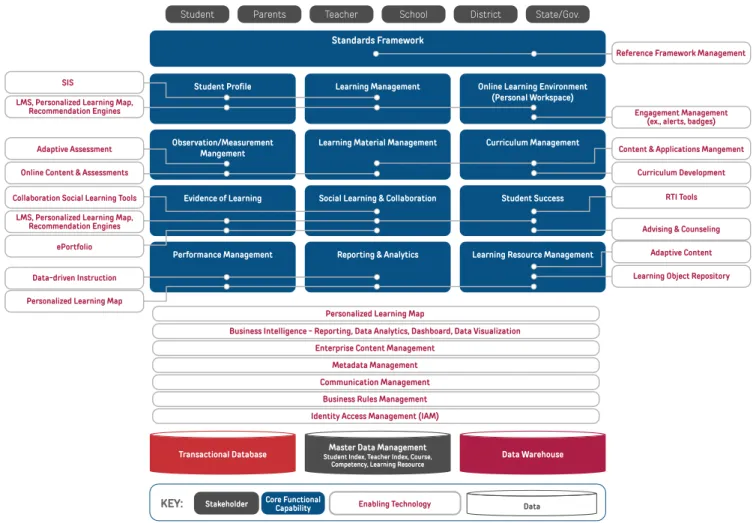
Supporting student-centered learning requires multiple systems that work together to enable the desired learning
ecosystem. The system must support a complicated set of processes and functionality that make up personalized
and competency-based learning, anytime, anywhere learning in multiple settings and during varying periods of time and student ownership. Therefore, this design is modular and based on the integration of multiple technologies. The
following core considerations prove essential to a well-designed student-centered learning system:
» A reference framework for aligning leaning experiences, resources, assessment and reporting to the
competencies
» Customized learner profiles that combine data from source systems and input from students, parent, educators
and others who work with the student
» Personalized learning plans that are responsive to the learner as he or she progresses and changes
» A variety of learning experiences within and beyond the school setting and calendar plus the collection of
associated data to inform student progress
» Access to content, digital resources, human resources and tools through a user-centric interface
» Meaningful, timely feedback during the learning process
» Multiple ways of demonstrating and assessing mastery towards competency
» Relationships, collaboration and communication
» Dashboards that reveal in real time which concepts and objectives students struggle with, pinpoint at-risk
students and enable targeted intervention
» Analytic tools to support data-informed practices (learning, teaching, administration)
» Integration of multiple systems and data flows using data and interoperability standards and practices
The software, services and learning content needed to support student-centered learning must be distributed. The integrated system must be flexible and draw on the best in the world resources and technology. In this design, the functions may be provided by different enabling technologies and will require the integration of different teaching, learning and business system applications. Using consistent data standards and establishing interoperability between these applications will enable data to flow more seamlessly. Standards are critical, especially at the points
in which separate systems need to integrate and the data from those systems need to interoperate. Numerous data
and technical standards exist within the educational space to support interoperability.
What can you take away from this paper?
What a reader might find most useful in this paper will vary by role.
If you are an educator, how will you work with your students and colleagues to optimize student learning, and how can technology promote innovation in a student-centered learning environment?
If you are a technology development leader, you might ask: How can your work fuel student-centered learning? Can
your system approach this work from a student-centric view? What can you do to learn from students, educators
and community members to engineer systems that meet the needs of the end users? How are you using design principles, data and interoperability standards so that your systems facilitate the openness, extensibility and coherent integration of functionality, in order to support the many nuances of student-centered learning? How are you structuring functional requirements in proposal requests with use cases to better identify appropriate IT
solutions?
WHAT ARE THE TENETS OF THE NELLIE MAE EDUCATION FOUNDATIONS DEFINITION OF STUDENT-CENTERED LEARNING?
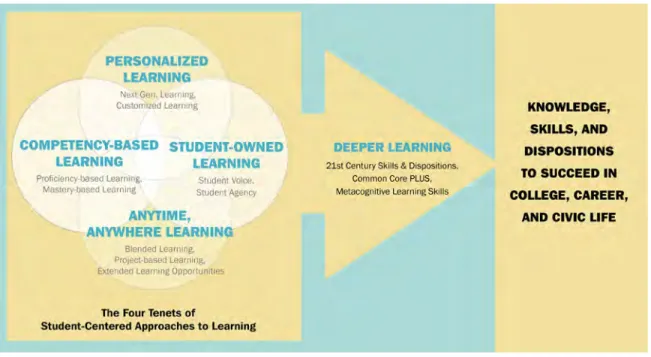
Let’s examine the four tenets of the student-centered learning definition. The following text and graphic
draw heavily from the Nellie Mae document, Putting Students At The Center: A Reference Guidehttp://www.
nmefoundation.org/our-vision.
There are four tenets of student-centered learning, based on the mind/brain sciences, learning theory and research
on youth development. 1. Learning is Personalized
2. Learning is Competency-based
3. Learning Happens Anytime, Anywhere
4. Students Take Ownership Over Their Learning
These four tenets are essential to students’ full engagement in achieving Deeper Learning outcomes and to enabling all students to achieve what they need to know and master to succeed in college, careers and civic life.
Learning is Personalized:
Personalized learning recognizes that students engage in learning in different ways and in different places. Students benefit from individually-paced, targeted learning tasks that start from the student’s current position, formatively assess skills and knowledge, provide ample, frequent and actionable feedback from multiple sources and address the student’s needs and interests. Tasks and learning units might be either individual or collective. Learning is deepened and reinforced through participation in collaborative group work, focused on engaging and increasingly complex and authentic problems and projects, as well as through relationships and community structures in the larger learning environment beyond the classroom itself (e.g., advisory groups,
mentoring, internships and community support partnerships). Learning is Competency-Based:
Students move ahead when they have demonstrated mastery of content, not when they’ve reached a certain
birthday or met the required hours in a classroom. “Competencies are defined by explicit learning objectives that empower students. Students receive timely, differentiated support, and they advance by demonstrating
evidence with meaningful assessments via mastery, not seat time.”4 Students have multiple means and
opportunities to demonstrate mastery through performance-based and other assessments. Each student is assured of the scaffolding and differentiated support needed to keep progressing at a pace appropriate to
reaching college, career and civic outcomes, even when unequal resources are required to achieve a more
equitable result.
In 2011, Sturgis and Patrick proposed a five-part working definition of competency education in partnership with the field of K-12 competency-based education leading practitioners at the Competency-based Education Summit hosted by iNACOL and the Council of Chief State School Officers (CCSSO):
» Students advance upon demonstrated mastery.
» Competencies include explicit, measurable, transferable learning objectives that empower students.
» Assessment is meaningful and a positive learning experience for students.
» Students receive rapid, differentiated support based on their individual learning needs.
» Learning outcomes emphasize competencies that include application and creation of knowledge along with the development of important skills and dispositions.5
This definition was expanded by the Smarter Balanced Assessment Consortium’s Proficiency-Based Learning Task Force, based on the growing body of work around competency education.
» Students advance upon demonstration of mastery of content, 21st-century skills and dispositions that prepare them for college and careers.
» Learning standards are explicit, understood by students and measurable.
» Instruction is personalized, flexible and adaptable to student needs—both initially and as required by
student learning.
» Students both direct and lead their learning, even as they learn from and with others—both within and
outside of school.
» Grading is used as a form of communication for students, parents and teachers—not control or
punishment.6
Learning Happens Anytime, Anywhere:
Learning takes place during and beyond the traditional school day—and even the school year. The school’s walls are permeable; learning is not restricted to the classroom or the building. Time and place are used flexibly, in ways that optimize and extend student learning and that allow for educators to engage in reflection and planning. Students have equitable opportunities to take advantage of digital technologies that can enhance learning, and they can receive credit for the learning they do outside of school, based on their demonstration of
skills and knowledge.
Students Take Ownership Over Their Learning:
Student-centered learning engages students in their own success and incorporates their interests and skills into the learning process. They gain a clear understanding of what they have mastered, set goals for what they need to know and master long-range, determine what they need to master short-term to reach their long-term goals
and receive frequent feedback on their progress. They use data to diagnose, direct and drive their learning. They have multiple opportunities to direct, reflect and improve on their own learning through formative assessments
and data reports that help them understand their own strengths and learning challenges. Students take
increasing responsibility for their own learning, using strategies for self-regulation and reflection. Students support one another’s progress and celebrate success.
While implementing any one of these tenets in isolation can be beneficial, the collective embrace and systemic
implementation of all the tenets is critical for transforming learning.7 There is no one-size-fits all strategy to
implementing student-centered learning, and both the implementation vision and approach will vary across
Section III: Design of a Student-Centered Learning Integrated
Information System - Requirements and Use Cases
WHAT THE IMPLICATIONS OF STUDENT-CENTERED LEARNING MEAN FOR TECHNOLOGY
Most existing IT systems in schools were implemented to support a teacher and course-centric approach, as well as compliance reporting for basic student data, course-taking, grades and scheduling data in a time-based system, rather a student-centered, competency-based system for anytime, anywhere learning. This poses particular issues when schools and systems shift to student-centered learning. How should administrators and teachers manage the
progress data on learning progressions that includes multiple forms of evidence and levels of mastery for student
learning? What systems support learning that takes place beyond the school walls? What is the progress on the student’s personalized learning plan? Is there an electronic portfolio and “data backpack” that collects a portfolio of student work and history? What competencies have been accomplished and how? What information are parents and students accessing to empower ownership, voice and choice of robust, personalized learning experiences in a student-centered environment? How is this information collected and shared to support the transition to college
and career?
The integrated student-centered learning ecosystem must support the complicated set of processes that make up
personalized, student-owned, collaborative, anytime, anywhere learning and competency-based education. This requires a different set of “functional requirements” mapped to the different components of a student-centered learning model. It requires breaking down what each end user segment needs to be able to do and identifying how technologies can support that functional need. A gap in the literature exists for the complex subject of functional requirements for student-centered learning. This paper intends to help fill that gap.
USER SCENARIOS
To better understand what student-centered learning would require of an integrated information ecosystem, let’s look more closely at some scenarios that describe what students, teachers, parents and educators might want to be able to do as part of their educational system. Then, we will consider the implications for technology.
Student Scenarios
» Personalized learning, student ownership - As part of mastering their science and written language
standards, Michelle and Rosa decided that they wanted to demonstrate their learning by developing an eBook about butterflies—their roles as pollinators and in the food chain. They took pictures and made observations about butterflies in their community. They collected images and information from the Web, as well as print resources. Working together they problem-solved how to coordinate their efforts, created a plan for getting the eBook completed and used Book Creator to add and organize their pictures, type text and add hand-written
they would need help in finding age-appropriate resources so she created a digital content page in the class’s
online learning environment with appropriate links and suggested key words. She met with them to help them
outline their book, monitored their project plan and supported them as needed throughout the process. They
were thrilled with the result of their work and shared their production with others during class and posted it to the class’s online learning environment. Each of them included the eBook in their ePortfolio and sent the eBook
portfolio link to family and friends. Their teacher used this project as one measure to assess their progress on
their content standards and recorded this information in the district’s electronic standards tracking system.
This information was then automatically updated in the students’ learner profiles.
» Competency-based learning and extended learning options - Hia has been fascinated by government,
politics and programs for young children all of her life. As part of her school program, she is participating in an
internship with the local city government office focused on early childhood initiatives. She continues to work with her learning team (herself, her parents, the local government office mentor and her advisor) to identify quarterly goals in her personalized learning plan for this internship; she then sets weekly targets for making and demonstrating progress toward these goals. She has developed a project plan using the school’s project-based learning tool. She logs her hours, journals her activities and reflections and collects artifacts to include
as evidence of her learning in this same tool. She aligns these articles with the competencies she needs to
demonstrate. Her learning team provides feedback on her activities and artifacts directly to Hia, both face-to-face and online, and notes this in her project plan. The learning team can also use the tool to communicate with one another. Hia will develop a showcase portfolio (demonstration) to prove her competence. She does this
electronically and will share it with her learning team. As she works on the portfolio, she receives structured
feedback by using a rubric that each team member completes over time. She is using this internship to demonstrate growth in her government and Habits of Mind competencies.
» Anytime, anywhere and community involvement - Joao is an 18-year-old who missed a year of school
due to family health and personal issues. He wanted to graduate within a year but had the equivalent of two years of credits to complete if following a traditional school approach and calendar. He met with his Youth Development Counselor (advisor) to review his personal data dashboard (which includes his Learner Profile),
revealing his credit status, progress on competencies and learning targets plus his interests. Together they
considered his progress, goals, interests and ways in which he likes to learn and demonstrate learning. He added this information to his Learner Profile. Using this information, they co-developed a personalized learning plan (PLP) that included an extended school day and year, a competency approach to obtaining the required credits and a career-oriented capstone project. As a result, he is taking online and face-to-face courses, some
of which are self-paced with teacher monitoring and support, while others are teacher/group-paced due to
the project-based learning nature of the tasks. Open Educational Resources are also being used to address specific skills and competencies. These resources include game-based learning, simulations and assessment ‘as’ learning within an online tutoring system. Using the data dashboard, Joao, his teachers, parents and Youth Development Counselor (YDC) are able to daily view his progress, make comments on the plan and provide feedback or reflections. He can make changes to his PLP to reflect changing needs, motivations and goals as time evolves. One of his teachers noticed that he really liked troubleshooting technology and suggested that he considered working as an intern in a technology group during the summer. His YDC facilitated his obtaining the internship through their youth development partnership network. He will be able to receive credit towards
competency completion for this work. The district also has a college/career platform so he can learn about possible career options in this area of interest. Through the district’s social learning platform, he can participate in monitored chats with professionals in the field. They can provide real information about potential jobs, a typical workday and different types of technology careers, without knowing his full name, age, school or any other personal information. The college/career platform also tells Joao what courses and extended activities could help him get access to two- or four-year institutions where he can become professionally accredited or receive a diploma in the field. The YDC is working with him to identify potential colleges, sources of funding and scholarship opportunities online. As he learns more, he updates his learner profile. The data from the competency completion is updated by his YDC during his weekly review meetings, based on reports from the
teachers and online course platform. Educator scenarios
Teachers - Eli is a 4th grader who performs unevenly in school. She is doing well in mathematics but struggling in some areas of reading. English is her second language. Her school system has aligned its digital resources to the
state standards. Eli’s teachers wants to move toward an integrated system that would allow them to:
» See how Eli is doing, review appropriate materials and strategies and assess whether there are any other
students in their classes with a similar profile
» Collaborate with Eli’s other teachers and support personnel in assigning materials, tasks and assessments
aligned at an objective level for the standards Eli needs to master, using a system that recommends appropriate
resources and strategies. Use the same interface to view the resources and to assign these materials, tasks
and assessments to other students with similar needs. Use the predictive analysis capabilities of the system to project student growth and discuss strategies
» Track daily performance and progress on these tasks and the associated objectives/competencies. The system
should accept multiple examples of evidence of learning and data points from the learning environment, allow
the teachers to add progress data for tasks and assessments not within the system and update the progress report as new assessment data is added.
» Update the progress report as new assessment data is added and revise the competency rating using the district-determined formula
» Integrate the updated progress data into Eli’s personalized learning plan to inform instructional planning
» Inform Eli and her parents of the work to be completed, her progress on that work and her current competency
attainment on her personalized learning plan8
School leader -Principal Orella is concerned about the number of students not doing well on the district and state interim and summative assessments, which have been aligned to the state standards. Principal Orella wants to:
» View how each student is doing by standard, delve into the areas of weakness and view the recommended
» Determine whether there are any gaps in how standards are covered within curriculum documents, so that curriculum revisions can be targeted, and taught by teachers so mentoring and coaching can be offered as
needed
» Use the data to look at student-teacher and content-teacher assignments and scheduling options
» Take advantage of the district information system to set up agile scheduling based on student needs rather
than fixed time period designations
Maryvale School District wants to:
» Analyze student attainment of standards over multiple years. It wants to break this data down by school,
teacher, student demographic information, course and individual student, by time period
» Track student achievement history, teacher comments, supports and interventions as well as other indicators,
then analyze this data to provide more targeted, effective and equitable student support services
» Evaluate the degree of alignment between instructional resources and standards and examine the relationship
between use of instructional resources and student performance
» Assess which resources are being used, when and by whom
» Support flexible scheduling options, such as the assignment of one or more teachers to a course, provide for
courses/sessions of variable lengths dependent upon student progression, support “just-in-time” modifications/ additions of courses/session to the schedule based on individual student, as well as group, needs
» Use predictive analytics to do short- and long-term planning of resources needed to support student learning
and organizational efficiency
At the core of each of the above scenarios is the focus on the student learning, alignment of competencies/ standards to content, assessments and reporting plus using evidence-based approaches and data regarding the
student’s progress to inform the student’s learning, as well as to inform educator and district practices. Timely,
meaningful data and the ability to act upon that data are essential to each of these scenarios. It enables students and educators to make informed judgments about what students have learned, how well they’ve learned it, what to learn next and effective strategies and resources. In addition, it’s crucial to connect students, educators and other supporters to one another and to resources—both material and human.
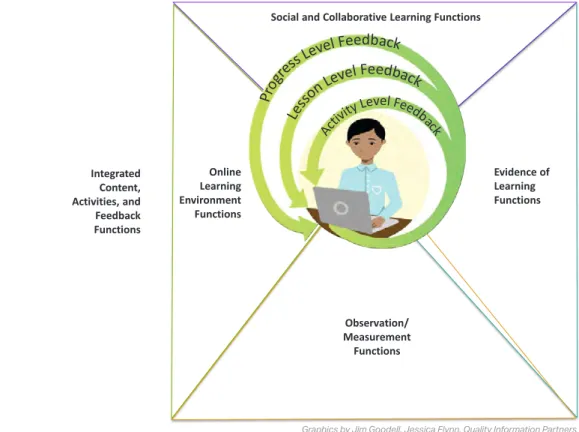
A number of things differentiate a student-centered instructional cycle from a traditional instructional cycle.
1. The student remains the center of learning, supported by a learning team of partners that include the student,
teachers, peers, parent, and others involved in the student’s education and well-being.
2. Learning is planned by the student and teacher and may involve others in the planning. During the
co-planning process, the student, teacher and others involved in the co-planning process use data, including data
in the Student Learning Profile, to review what the student knows and needs to know, as well as what the student wants to learn beyond the required outcomes. The team discusses the resulting personalized goals, competencies, and learning targets, how the student learns best, and the student’s interests. It uses this
information to determine how the student will demonstrate his/her learning. The locus of control for learning is
shared between the student and teachers; and it progressively moves more toward the student as he or she increasingly takes ownership and responsibility for his or her own learning.
3. Learning is based on the individual student’s goals plus progress on mastery of clearly defined competencies,
needs and strengths, interests and motivations. From this co-planning process, one can develop a personalized
learning plan (PLP) that includes goals, competencies, learning targets, instructional approaches and selected
ways to demonstrate learning. After developing the personalized learning plan, the learning team selects the
resources (digital and human) that will be incorporated into the PLP or a playlist-type function.
4. The learning cycle includes ongoing feedback based on multiple measures of student progression toward
attaining clearly defined learning targets and competencies.
5. The learning cycle is continuous. If a student does not demonstrate mastery, the learning team analyzes the data and revises the selection and use of instructional approaches, ways to demonstrate learning, selection and
assignment of resources (digital and human), feedback strategies and intervals during learning—and perhaps
the assessment measures and strategies, too. If a student does demonstrate mastery, the student and teacher
may decide that the student will move on or explore the concepts related to the competency in more depth. The central elements described here form a logical relationship for student learning, as represented in Figure 2 below.
This instructional cycle for student-centered learning serves as the foundation for understanding the information systems needed to support that cycle.
Is it likely that a single technology platform can support all of the nuanced functions in these scenarios and within
this instructional cycle? It is doubtful. Thus, we will explore in detail the implications for what functional capabilities need to be enabled and/or supported by instructional and information systems in student-centered learning models. The information below describes these functional capabilities by end user segment for each of the tenets of the Nellie Mae definition. Although it is unlikely that a school would implement all of these functions, a school district or governing body for a network of schools might have a variety of implementation models within their ecosystem. Districts and schools will need to determine what functional capabilities they want an integrated student-centered learning information system to serve. This is explored in more depth later in this document.
IMPLICATIONS FOR TECHNOLOGY TO MEET THE TENETS OF STUDENT-CENTERED LEARNING
The implications for technology in student-centered learning start with examining the user’s role and functions implied by the Nellie Mae tenets of student-centered learning:
» Learning is Personalized
» Learning is Competency-Based
» Learning Happens Anytime, Anywhere
» Students Take Ownership Over Their Learning
There are various models for implementing student-centered learning, and these models may or may not include all
of the implications described here. Schools and school systems will need to determine which of these apply to their
current and future practices as they move forward in this work.
The table below considers some of the primary uses of technology for supporting students and teachers. In the paragraphs following the table, the implications for parents, mentors/internship supervisors, and school and district leaders are considered. Students in this work can be anyone in the learner role, including students, teachers or administrators, but the primary lens utilized here remains on student learners. Teachers can be anyone in the
educator’s role, including teachers and administrators. In this paper, the primary lens utilized focuses on teachers working with student learners.
LEARNING IS PERSONALIZED
Student Teacher
Students engage in learning in different ways and in different places
Students utilize personalized learning plans (PLP) based
on student strengths and needs, learning preferences, interests and an understanding of what they need to learn
and information on how they learn best.
Teachers can manage student personalized learning plans one at a time and through the use of groups. The system
supports the use of filters to enable teachers to group
students with like strengths, needs and interests and to
create modifications/additions to the individual learning
plans of the grouped students simultaneously.
Teachers can provide online feedback on the activities/ tasks of their students. Feedback can be in the form of written comments, percentages, rubric scales and/or
grades depending upon the program design. Teachers
should be able to enter attendance and progress
information once and to have all systems that need that data populated.
Students co-construct PLPs with teachers and learning coaches. In addition to data imported into the learning plan from the system, teacher or coach, the student can add comments, additional information and learning outcomes.
Students can view the feedback on their activities/tasks and comment upon it. Feedback can be in the form of written comments, percentages, proficiency scales, rubrics and/or
grades depending upon the program design.
Students can electronically log the time spent on learning
activities (tasks/artifacts/presentations/projects) and reflect upon their work. The time log and reflections are linked with
learning activities, as well as with the associated learning target in their learning plan. The system also tracks time
spent, and this data can be made visible to student and
teacher.
Students have access to reports about how much effort and/or time they have spent on learning targets/
competencies and how they are progressing in comparison to their personalized learning plan (this assumes that in the PLP, the student and teachers have agreed to some estimated time parameters around how long attaining a learning target/competency should take. These time
parameters can be adjusted as needed). Students can use the predictive analysis capabilities of the system to project
their growth if they continue at the same pace or change their pace.
Teachers have access to individual and group reports
about how much effort and/or time students have spent
on learning targets/competency and how they are progressing in comparison to their personalized learning plan and to other students. The system supports the use
of filters to enable teachers to group students with similar
strengths, needs and interests and to view progress across the groups. Teachers can use the predictive analysis
capabilities of the system to project individual student
growth if that student continues at the same pace or changes the pace.
In addition to data imported into the learning plan from the system, teachers can add comments and additional information and determine who can see this information.
Students have access to a searchable system of curated
open education and commercial learning resources and options aligned with standards and metatagged using a
consistent metadata schema. Search and access is enabled
through single sign-on and provided at no cost to the
student by the school/ district. The resources are organized
into developmentally appropriate collections.
Teachers can add, hide and organize items within the system.
Teachers can assign individual items and collections to individual students or groups of students.
Teachers can select metatags from those generated from the system and/or add their own. The software has intelligent algorithms so it can make recommendations for metadata, especially key words and standards alignment for the item.
Teachers can edit the metadata of the items that they
have submitted and use an electronic workflow process to
suggest edits for other items. Teachers can rate items and add notations regarding the items use.
Teachers have reports that provide information about the properties of objects within the catalog (repository), including status, publisher, date published, file size, etc. Teachers have reports that provide information about
their students’ actions performed on resources within
the catalog (repository), for example, who viewed or
downloaded a resource and when. Students can rate items and add notations regarding the
items’ use.
The aligned learning resources incorporate UDL design
principles.
Students have 24/7, anywhere access to these resources and course materials, including formative assessments and
feedback from computer-scored assessments.
Students have the tools to develop artifacts of learning. Teachers have the same curated technology tools and
digital resources and can view artifacts, collections, presentations, metadata and student alignments in order
to provide feedback.
The teacher/school or district has set up the “tools”
with the learning targets, standards and competencies so students can easily associate them with their presentation and artifacts. (Policy and process issue as to who and how this is done.)
The software can make recommendations for key words
and standards aligned with the content object, and it
allows the teacher to select those that apply to add his or her own.
Teachers have the tools to view presentations, provide
feedback, and enter grade/score into the teaching and
learning platform or Student Information System as
appropriate (these systems exchange designated grade/ score information so only one entry is needed). Rubric/ feedback form can be associated with presentation and the teacher can score the rubric with student being able
to view the teacher score and student score. Students have the means to collect artifacts of learning and
metatag them, including alignment with learning targets, standards and competencies, and they can develop them into presentations.
When tagging their artifacts, students can select key words
and standards from a list of suggested items generated by
the software program.
Students have the means to demonstrate their learning through presentations which pull from an artifacts collection and additional student-developed material
specific to the presentation; rubrics can be associated with
the presentation and the student and teacher/others (with
permission) can score the rubrics with students being able
to view the teacher’s/others’ scores and their own score. Students have the means to share artifacts, collections and
presentations and to receive feedback from teachers as
Teachers have the means to share students’ artifacts,
collections and presentations and to view feedback provided by others.
Teachers can view reports on which students have
shared their artifacts, collections and presentations by individual student and by items. This would include who
shared, what they shared, with whom and the timeframes.
Individually paced, targeted learning tasks start from where the student is, formatively assess existing and developing skills and knowledge, and they address the student’s needs and interests.
Students are able to view learning maps/reference
frameworks with the associated evidence maps (maps
that show students different ways to demonstrate
mastery of a learning target/standard/competency).
Horizontal and vertical views are available.
Teachers can develop learning maps/reference
frameworks (policy issue with district—who can develop and edit learning maps and reference framework; this permission may be limited to certain roles).
Teachers can manage learning maps/reference
frameworks. The system supports the use of filters to enable teachers to view maps by competency, standard, learning target and associated proficiency scale, by proficiency scale and by evidence. Teachers can use the
maps to develop student personalized learning plans and
create modifications/additions to existing plans.
Teachers can use the maps to align curricular and assessment resources. The system has an intelligent
engine that supports automatic indexing and tagging to learning targets/objectives.
Students have the means to align standards, learning
targets and proficiency measures with digital content that
they discover or create.
Students are able to view their assessment results at
holistic standard/competency and learning target levels.
When a teacher scores an assessment in the system, it transfers that data to the competency tracker. A teacher can view assessment results data in the competency tracker.
Students have an individual student profile that includes
system and student/parent/teacher-generated information.
Teachers can add to students’ learning profiles. Teachers can view individual profiles, summary data from profiles
and delve within the summary data to view which students share similar characteristics.
Students have an individualized data dashboard that
displays the integration of data from assessments, interests, competency progressions, learning map/ reference framework and personalized learning plans, including recommendations for resources. The
Teachers can view and manage the student dashboards.
They can make comments and recommendations, assign individual tasks or provide multiple choices of lessons
and activities to specific students or groups of students,
Students are able to generate their own playlists and access playlists developed by their teachers/coaches.
The playlists provide indication of whether a student has completed, is in the midst of or has not accessed the item.
Playlists: easy construction of ordered learning experiences
which are linked directly to the items required for that
learning experience.
Teachers are able to generate playlists, access playlists developed by others, and assign selected playlists to
individuals and/or groups of students. The teacher has
reporting capabilities that allow the teacher to view playlists by students to whom they playlist has been assigned and for a playlist by status of completion of
each student.
In addition to other learning experiences, students use
software programs that incorporate intelligent algorithms/ adaptive software. Selected progress data from those
programs can be brought into the dashboard as determined by the teacher or district.
Teachers are able to view the program as a student and as
a teacher.
Progress data from the program is brought into the dashboard. (Policy issue: Determining what data is brought into the analytics engine and displayed in the dashboard and who determines this at what level/role, i.e. teacher, district, specific individual. Tech issue: Can the tech system allow for individual users and/or different roles to determine what data is brought into the analytics engine and displayed in the dashboard.)
LEARNING IS COMPETENCY-BASED
Students move ahead when they have demonstrated mastery of content.
Students can provide feedback on their assessment of their level of confidence in their demonstration of learning targets/competencies and provide feedback on the design
of the task.
Teachers can view the student self-reports by individual student and by learning target/competency.
They can provide feedback to students on student self-reports on their assessment of confidence, compare the student’s level of confidence with performance, engage
in online and face-to-face dialog with the students and
trigger interventions based on the data. Students have a layered, individualized data dashboard
that displays the integration of data from assessments, interests, competency progressions, learning map/ reference framework and personalized learning plans,
including recommendations for resources. The dashboard
presents a holistic picture and supports drilling down.
Teachers can view and manage the student dashboards.
They can make comments and recommendations, assign individual tasks or provide multiple choices of lessons
and activities to specific students or groups of students,
provide multiple choices of resources, and communicate
with specific students or groups of students. They have reports and filters that facilitate the use and management as well as the view of data in the dashboards.
Students have access to a repository of curated digital
resources and learning experiences that are designed to enable them to move to the next learning target within a competency, a different learning target or competency and, when a competency is completed, to move to the next competency and/or to enable them to move deeper into a competency area (whether designated by the teacher, the
program or student choice).
Teachers can develop resources, add them to the repository, metatag them, share them with others and students, and assign the resources to individual and groups of students.
Teachers are able to add additional content repositories
to the system. (Policy issue for district: Who can develop
and manage content repositories; this permission may be
limited to certain roles.)
Teachers are able to view and generate reports on the
use of the resources (which ones, who used them when,
for how long, and how often). Teachers are also able to view reports on the efficacy of the resources, allowing
them to take informed actions to improve their materials.
Teachers are able to view and generate reports on gaps
in content and assessment item alignment and coverage for the learning targets/competencies within topic areas/ courses.
Teachers can search for and review materials and
strategies that would be appropriate for students based on their student profiles.
Students have access to reports about how much effort
(or time) they have spent on learning targets/competency and how they are progressing in comparison to their personalized learning plan. (This assumes that, in the PLP, the student and teachers have agreed to some estimated time parameters around how long attaining a learning target/competency should take. These time parameters can
be adjusted as needed.)
Teachers have access to reports about how much effort
(or time) each student has spent on learning targets/ competency and how they are progressing in comparison to their personalized learning plan. (This assumes that, in the PLP, the student and teachers have agreed to some estimated time parameters around how long attaining a learning target/competency should take. These time
parameters can be adjusted as needed.) They can also view summary data by learning targets and drill down to
see individual student progress for assigned targets. Students have access to apps that remind them what they
need to do in addition to the dashboard. (Apps send the information as alerts/messages, whereas the dashboard is accessed by the student.) They can set parameters for these apps, as well as have them set by the teacher. They cannot override parameters set by the teacher.
Teachers have access to apps that remind them what
they need to do in addition to the dashboard. They can
set parameters for these apps, as well as have them set
by the school leader. They cannot override parameters set by the school leader.
They can set the parameters for students enrolled in their classes.
LEARNING HAPPENS ANYTIME, ANYWHERE
Learning takes place beyond the traditional school day—and even the school year. The school’s walls are permeable; learning is not restricted to the classroom or the building.
Students use systems that support blended, online, Face2Face (f2f) and extended experiences guided by their
personalized learning plan.
Teachers use systems that support blended, online, Face2Face and extended experiences personalized for
their students. Students have 24/7 access to a catalog and wide variety of
learning resources and options aligned with standards and
interests (see above).
Teachers use online resources and courses to support student learning aligned with standards, student needs and interests. Teachers can assign these resources to individuals and/or groups of students.
Students work with mentors, experts and advisors f2f
and virtually through the use of technology. They can communicate privately one-to-one or one-to-many
(examples: email, discussions, chats, texts, webinars, portfolios and public messaging).
Teachers work with their students’ mentors, experts and
advisors f2f and virtually through the use of technology. They can communicate privately one-to-one or one-to-many. Teachers and mentors can log time they have spent with
a student on a task/internship, reflect upon the work their
students have done, share this with their students, and
review and comment upon the student’s reflections.
Teachers have access to and can generate reports on the
number of contacts between students and mentors. They
can review, add and edit the learning targets that are in the PLP.
They can view reflections organized by student, mentor, and
learning targets.
Students collaborate with site mentors to establish learning
targets that are included in and reported upon in the PLP.
Students can electronically log their time spent on a task/
internship, reflect upon their work and share this with their
mentors/advisors.
Students are able to submit demonstrations of knowledge and skills obtained beyond the traditional school day and year, and have this work contribute toward their competency progression. Demonstrations can be aligned with learning targets, standards or competencies by the
student and those who support the student’s learning.
Students can select from teacher-designed proficiency scales and rubrics that can be used to assess student demonstrations. They can copy and then edit existing rubrics or design their own with teacher input and approval.
Teachers can design and share proficiency scales and rubrics that can be used to assess student demonstrations, use existing scales and rubric, and/or edit existing
proficiency scales and rubrics.
Demonstrations can be evaluated according to multiple
learning targets and standards/competencies.
Students are able to submit work, to read teacher feedback and comments, and to see rubric feedback and associated
grades/progress indicators online.
Teachers are able to view and comment on submitted work, provide feedback, provide rubric feedback and access
Students are able to take online assessments that provide timely, informative feedback in secure online assessment-taking conditions. Assessments embedded within online learning activities also provide feedback and contribute to
the evidence of learning.
Teachers have access to robust assessment development
tools that allow them to add item response, question
and assessment level hints and feedback. They are able to design online resources and assessments that provide informative feedback. Teachers can align whole
assessments, sections of assessments and assessment questions/components to standards and review
assessment reports that include standard mastery results. Teachers can view whether students read the hint or
feedback.
Students participate in formal and informal learning with
mechanisms in place to collect performance data (example: xAPI, journaling/blogs, portfolios, Caliper Analytics).
Teachers can view reports on student performance that includes this data, then apply this knowledge to planning.
Students have access to and use district-designated tools that support social learning.
Teachers are able to monitor student usage of the
district-designated tools that support social learning. They can message students to edit or remove postings/content and can edit or remove postings/content if needed.
Students have access to a single sign-on portal where
they can gain access to their dashboard, PLP, software and
applications, assignments, etc.
Teachers have access to a single sign-on portal where they
can gain access to their and their students’ dashboards,
PLPs, software and applications, assignments, etc.
Students have access to devices that may include mobile
devices. The technology is device agnostic (laptop,
smartphone, tablet) and supports UDL principles.
Teachers know how to support student usage of the devices.
Assistive devices are available as needed, and the integrated learning system components needed by
students function with the devices.
Assistive devices are available as needed, and the integrated learning system components needed by
teachers function with the devices. STUDENTS TAKE OWNERSHIP OVER THEIR LEARNING
Student-centered learning engages students in their own success—and incorporates their interests and skills into the learning process.
Students use information and tools to help them research career and college opportunities that match their individual talents and interests and to identify their personal career and college goals, revising these over time.
Teachers are able to add information to the tools. They have access to reports that show the student goals by student, by career and by educational requirements.
Students use information and tools to determine the educational requirements for reaching those goals and to
Students know what they are expected to know and do and the criteria by which proficiency will be assessed. This information exists in the district learning maps and in student-specific learning plans based on performance data.
Teachers have access to tools that support the development and sharing of learning targets,
competencies, proficiency scales and rubrics. They can
use these tools to access district-developed learning maps and to develop and share their own learning maps (policy issue). Teachers have access to tools that support the development and sharing of learning targets and student personalized learning plans.
Students have a strong understanding of what proficiency looks like—proficiency scales, rubrics and examples of student work can be easily referenced.
Students participate in and design their own projects/ learning experiences and align them with standards in collaboration with a teacher or learning coach. Projects/ experiences include assessment strategies that support students demonstrating Deeper Learning and progress
on competencies/standards. Students can select from
teacher-designed proficiency scales, rubrics, and forms that can be used to assess student projects/learning experiences, copy and then edit these or design their own
with teacher input and approval.
Teachers have tools that help them manage the workflow associated with student projects/learning experiences.
They can design their own and assign them to students,
becoming co-collaborators with students in designing and approving student-initiated projects.
Teachers can design and share proficiency scales and rubrics that can be used to assess student demonstrations, use existing scales and rubric, and/or edit existing
proficiency scales and rubrics.
Demonstrations can be evaluated according to multiple
learning targets and standards/competencies.
Students can review and comment upon the feedback
provided to them on assessments (formative and summative). The technology tracks the date and time that
the student reads the feedback.
Teachers can view reports on whether students have read
the feedback and can receive notifications if students have not read the feedback. They can use the tool to trigger notices to themselves and students about reading feedback, and they can also add additional feedback. Students use the data dashboard—integration of data from
assessments, interests, and ePortfolio—-to help them with
planning and decision-making.
Teachers can add to/edit the individual student data
dashboards.
Students can review reports on estimates of their
proficiency on a competency based on data accumulated
over time and multiple measures.
Teachers can review reports on estimates of student’s
proficiency on a competency, based on data accumulated over time through multiple measures by individual student, by group or class, by competency and by students within a
time period.
Students can reflect electronically on their learning—how
they have progressed (what they learned or continue to struggle with) and whether they would they use the same strategy/materials or change and how (forms, survey, portfolio), plus how they can apply what they have learned.
Teachers are able to design forms to help support reflection. They are able to view and develop reports by student, by group, by strategy, and by material and content
with which students have struggled.
Students are able to provide feedback electronically on
their perception of the quality of content and lessons, the classroom and school environment.
Teachers are able to read the feedback by student, by content, by object, by quality ratings/indicators.
Students have a personalized learning plan that is co-developed with a teacher or learning coach: What do I need
to know, how can I demonstrate this, and how will this be assessed. Students can update this plan based on progress
data and changes in personal interests and needs.
Teachers can contribute to a student’s PLP individually and by group. Teachers can review reports on the contents of the PLPs by individual student, by group or class, by competency, by students within a time period, by demonstration method and by resources assigned. Students are able to use technology to help communicate
to others their interests, needs, goals and progress.
Students use their learning plans and data dashboard, as
well as portfolio, to lead conferences in which they present their progress and evidence of progress.
Students can contribute information to their leaner profile. Teachers can contribute to student profiles and edit a profile if needed.
Students use technology to help with time management such as calendar scheduling, to-do items and task analysis.
Teachers are able to add items to students’ individual and
group calendars and to set up to-do lists that students can manage. See reports on who has accomplished or not accomplished assigned tasks.
Students use their data dashboard and alerts to help them identify when they need extra support, and they use the
system to seek such support. Proactive messaging and
alerting capabilities help students identify issues that
require the student’s or teacher’s attention.
Teachers have access to aggregated data so they can