AN OPEN VIRTUAL WORLD FOR PROFESSIONAL
DEVELOPMENT∗
Eliza Stefanova
Abstract. The paper presents a study that focuses on the issue of sup-porting educational experts to choose the right combination of educational methodology and technology tools when designing training and learning pro-grams. It is based on research in the field of adaptive intelligent e-learning systems.
The object of study is the professional growth of teachers in technology and in particular that part of their qualification which is achieved by or-ganizing targeted training of teachers. The article presents the process of creating and testing a system to support the decision on the design of train-ing for teachers, leadtrain-ing to more effective implementation of technology in education and integration in diverse educational contexts.
Introduction. Dynamic changes in economy, political and social rela-tions, and especially the field of technologies, have major influence over education. Three aspects of these changes have a more significant role.
ACM Computing Classification System(1998): H.4.2, I.2.1, I.2, I.2.4, F.4.1.
Key words: Decision support systems, Expert systems, Artificial intelligence, Knowledge representation and reasoning, Vagueness and fuzzy logic.
∗This article presents the principal results of the Ph.D. thesis Open Virtual Worlds for Professional Development by Eliza Stefanova (Faculty of Mathematics and Informatics at Sofia University), successfully defended at the Specialized Academic Council of FMI on 10 Decem-ber, 2012.
The first aspect of changes in the educational process is educational envi-ronment. The revolution in the field of information and communication technolo-gies (ICT) has influenced the infrastructures of schools and universities. Science research centres and technology institutes are developing different sorts of edu-cational software and internet applications. Their rate of change is considerably more important than before, because now the development of new technologies takes days or months, in the worst cases of couple of years. The use of this wide variety of ICTs takes time because education is a complex system. It changes the way of thinking, changes people and their relationship with the World. It takes time to understand how to use technology most efficiently. And by the time it has been analysed and is ready for use, new technology has appeared.
The second aspect in education is connected with the development of in-novative pedagogical approaches in schools and senior schools, in terms of public expectations. The presence of new technological environment demands new ap-proaches to education. This is why the researchers’ aim is the development of such use of technologies in education that would have deep and consecutive aca-demic and pedagogical efficiency. The standard ways of education are no longer satisfying the needs for professional development of the organizations neither or the needs of students.
Those two aspects are highly connected – technologies in education make the use of innovative methods possible, but the use of innovative methods de-mands knowledge of technologies so the right place and way of their use is cor-rectly chosen during the designing process.
The third aspect of changes concerns the demands of society in terms of results of education and the needs of business. The companies are interested in workers who have good skills in ICTs, skills in team work and work in projects.
The major weakness that has been found is that despite the huge invest-ments for making the technological base in education better, the use of ICT in the education is ineffective. The insufficient training of teachers in terms of ICT and their integration in the learning process are pointed out as one of the main reasons for that ineffectiveness. In parallel with that come the conclusions [1], indicating that the teacher’s professional development is examined as a necessary condition for the increase of students’ results, because it helps teachers to increase their knowledge and skills and to apply them in practice. Therefore one of the major conclusions and recommendations is [2]: “It’s necessary to educate teach-ers adequately so there can be an effective usage of the technologies in school.” Special time must be given to the professional development of teachers in the field of integrating ICT in the learning process, because teachers are an object and subject for the expected changes in education.
As a result, the following question arose: Is it possible to assist the cre-ators of this training for professional development of teachers by a system which guides them in making decisions, and how to fully adjust the programs for inte-grating technologies in education so they can correspond to the goals, individual characteristics, attitudes and demands? Developed that way, teachers’ training will become a precondition for more effective use of technologies by teachers in their practice in school.
To be able to answer that question, the research described in this paper is concentrated on the problem of the teachers’ professional development. In particular, the aim is to support the process of learning design in order to make a decision about the right combination of technologies and methodologies needed for meeting the educational goals and the specifics of the trainees. This research is based on studies in the field of intelligent adaptive systems for e-learning [3].
Research questions and hypothesis. The research question is: “How to support people preparing trainings in the process of making fast and optimal decisions for the design of the teachers’ training in the field of technolo-gies, so the created training will have a stable positive impact over the use of ICT in daily educational practice?”
The presented research answers that question using the following hypoth-esis:
Hypothesis 1: The design of training for professional qualification can be as-sisted by a system based on a formal model of professional development. Hypothesis 2: The process of professional development, assisted by
technolo-gies, can be described using a formal model.
Sub-hypothesis 2.1: The professional development, assisted by technolo-gies, can be parameterized.
Sub-hypothesis 2.2: Regularities and relations can be found between these parameters.
The main idea behind these hypotheses can be expressed using the fol-lowing statement: the design of lifelong teacher education can be modeled via virtual (abstract) worlds, which are flexible and open for changes, such as adding new components and parameters, as well as relations between them. So by de-veloping such a model and a system based on that model, which can be proved as successful for lifelong competence development of teachers, we can prove our hypotheses.
Key stages. In order to prove the hypotheses, our research went through the following stages:
• Analyse the problem in relation to:
• pedagogical, psychological and social dimensions; • existing models that can be used for solving it; • software approaches to implementing the model;
• Choose a formal method for describing the model and a system to assist
lifelong competence development of teachers supported with technologies;
• Identify key components used in practice when applying technologies for
lifelong competence development of teachers;
• Determine the main parameters of the components identified; • Specify relations between the main parameters of components;
• Define a theoretical model describing and explaining the components
iden-tified and their main parameters;
• Describe the relations between components and parameters using formal
instruments;
• Develop a prototype of a system, based on the model, to support decision
making when designing teacher trainings;
• Test and verify the model.
Pedagogical, psychological and social dimensions. The analy-sis of the pedagogical, psychological and social dimensions of the problem shows that courses, as a specific form of lifelong competence development, influence most the design of teacher education. Courses are especially useful when teach-ers need to receive knowledge about new programs, new educational approaches, new technologies or innovations coming from small groups of experts.
The models for designing teacher education based on technologies stress the importance of successful integration of content goals, pedagogical methods and technological solutions into education (Fig. 1), aligned with the personal characteristics of participants.
Fig. 1. Technological Pedagogical Content Knowledge [4] Most existing models assume that:
• Goals are always a component of education. They can be defined by
both the trainer and the trainee.
• The educational process depends on all participants – trainers and
trainees. It has to be personalized, considering the individual learning styles of trainees.
• The choice of appropriate methodology can have substantial influ-ence on the educational results.
• The design of educationincludes goal definition, assuming the specifics
of each trainee, choice and application of methodologies. However, existing models:
• do not offer a formal language to describe and present the design of a
system for such education;
• do not demarcate components and parameters in a way to allow their
de-scription using a formal model, aiming to support the design of an edu-cational system for lifelong competence development of teachers, based on technologies.
Theoretical model. Various decision support systems and expert sys-tems were examined in order to find the proper formal method for describing the model of such a system. The analysis shows that decision support systems based on AI seem to be the best candidate for solving our problem. Another result from this analysis is that fuzzy logic is quite suitable as a theoretical base for an expert system to support decision making in educational and training design.
From the abovementioned conclusions it follows that our research will include the following phases:
• retrieve the knowledge base from human experts to be used in the expert
system;
• describe the knowledge using fuzzy logic formalism; • develop the system.
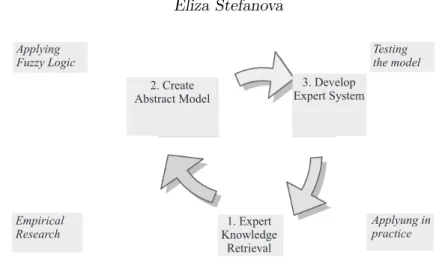
The phases and methods in this research are presented below (Fig. 2): Phase 1: Expert knowledge retrieval by studying human experts’ opinion using
theConcept Map development in a groupmethodology, as well as two meth-ods often used in pedagogical research: focus group and inquiry.
Phase 2: Creation of an abstract model, based on fuzzy logic, using the knowledge retrieved from the human experts.
Phase 3: Development of a software tool – expert system prototype, based on the model created in Phase 2. Testing the model using examples from real life.
Fig. 2. Research phases and methods
Expert knowledge retrieval. The retrieval of knowledge from the human experts is performed in two stages: (1) define components and their pa-rameters; (2) obtain relations between components and parameters and specify the values of parameters.
The identification of components is based on the collected information and opinions from human experts in educational technology. They were chosen on the base of their expertise how to use new technologies and innovations in teacher education in order to influence the effective use of ICT in school practice. The “Concept map development in a group” methodology was used to collect the needed information. It is a powerful approach, combining quantity and quality methods for the analysis of the human expert’s ideas and opinions. This approach is implemented in four steps: (i) retrieving human experts’ statements in reply to provoking questions, focusing on specific problems; (ii) sorting statements based on similarities; (iii) classifying statements based on their importance; (iv) data analysis.
Human experts were involved in the first three steps. Twenty-three ex-perts were invited to contribute and fifteen of them actively participated. They all are experts in training teachers how to apply ICT effectively and efficiently in their practice. The main goal of the experts was to determine the main factors, influencing teacher training, leading to the successful use of new technologies and innovations in education.
In the first step experts were involved in the formulation of the main factors by filling a questionnaire and answering via email. As a result all fifteen experts formulated 116 statements about the main factors.
factors collected so far and in response they had to:
• group factors via similarity;
• give names to all identified groups of factors, trying to generalize the main
concept in each group;
• sort the factors in each group, as well as sort the groups, based on their
importance in relation to the effective use of ICT in school.
During the last step a final analysis of all data received from human experts was performed. The initial analysis shows that several repeating groups exist with the same or similar factors, as in Fig. 3 and Fig. 4:
Stack Title or Main Topic: Technologies
Record here the identifying number of each item in this stack, separating the ID numbers by commas.
2, 3, 4, 6,26, 58, 59, 65,71, 72, 76,88, 95, 99, 103, 111 Stack Title or Main Topic:
Technical and technological supplies and resources
Record here the identifying number of each item in this stack, separating the ID numbers by commas.
8, 9,26, 39, 50,58, 59, 61, 71, 79,88, 95, 99, 103, 116 Fig. 3. Intersection ofTechnology related factors
Stack Title or Main Topic: Methodology
Record here the identifying number of each item in this stack, separating the ID numbers by commas.
1, 4, 7, 11, 12, 21, 23, 24, 28, 29, 30, 34,35,36, 38, 40, 45, 46, 60, 67, 68, 70, 72, 77, 78, 82, 80, 89, 90, 91, 92, 94,98, 100, 101, 104, 105, 106, 107, 108, 112 Stack Title or Main Topic: Methodology of teaching ICT
Record here the identifying number of each item in this stack, separating the ID numbers by commas.
7, 8,12, 13, 14, 64,98
Fig. 4. Intersection of Methodology related factors
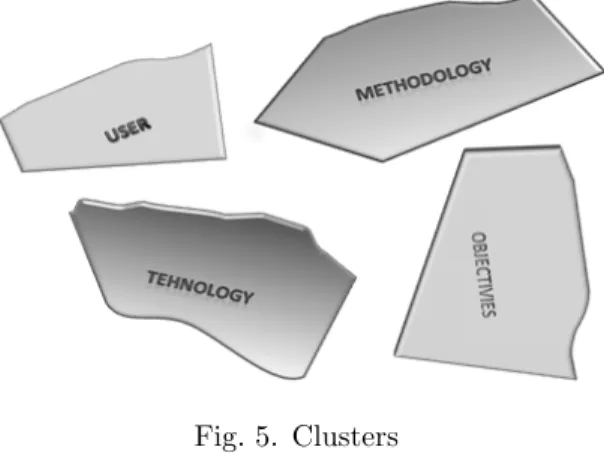
We continue the analysis by applying clustering techniques. We try to classify all factors (each factor represented in a single statement) in different groups (clusters) based on the proposals offered by experts. Furthermore, we use the ordering of factors in each group (cluster) proposed by human experts. As a result, on the base of the clustering techniques, we classify all factors in four
different clusters (Fig. 5). These results correspond to the analysis of pedagogical aspects of applying ICT for teacher training in other similar studies. There are small differences in the naming of some of the factors and clusters, but on the whole they confirm the validity of our research results.
Fig. 5. Clusters
So, as a result we define the four clusters identified as the main compo-nents of our model: user, objectives, methodology and technology.
Theoretical Framework of the Model. These four components are interrelated and not fixed once and forever. Each one of them is well defined by the set of parameters (the factors identified during the analysis), which we name linguistic variables.
Each main component is characterized by these linguistic variables, and each linguistic variable is defined by a set of values which can be assigned to it. Those value sets were also identified using the methodology presented in the previous chapter.
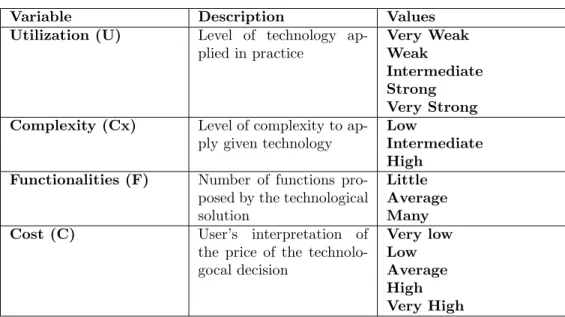
For example, the most important characteristics of the component Tech-nology is modeled by the linguistic variables (Table 1) Utilization (TU), Com-plexity (Cx), Functionality (F) and Cost (C).
Each of the linguistic variables of the technology component above is associated with a normalized numerical range of values (base of the fuzzy set).
The linguistic variables of each component are described in a similar way through their names, description and values. Afterwards a tabular and graphical representation of the values of the linguistic variables is made.
For instance, Table 2 represents the Cost values.
In the same way linguistic variables of other three components of the model are defined.
Table 1. Technology linguistic variables, description and values
Variable Description Values
Utilization (U) Level of technology ap-plied in practice Very Weak Weak Intermediate Strong Very Strong Complexity (Cx) Level of complexity to
ap-ply given technology
Low
Intermediate High
Functionalities (F) Number of functions pro-posed by the technological solution
Little Average Many Cost (C) User’s interpretation of
the price of the technolo-gocal decision Very low Low Average High Very High
Table 2. Values set of linguistic variableCost of the componentTechnology Linguistic variable: Cost – of the component Technology
Linguistic value: Notation Numerical Range (normalized) Fuzzy Sets of c Very Low VL [0, 0.3] Low L [0.1, 0.4] Average A [0.3, 0.8] High H [0.7, 0.9] Very High VH [0.8, 1]
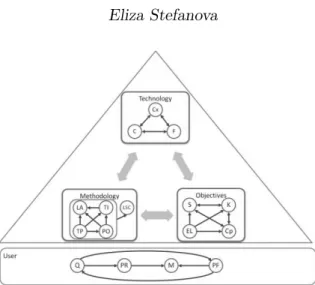
After the linguistic variables are defined, the dependences between them are identified. In this way 76 rules, on which the model is based, are constructed. They are extracted from the database of expert opinion, following the relations between the characteristics of the linguistic variables (Fig. 6).
The User component of the model with its linguistic variables is the basis of all other dependences. For example, higher Qualification (Q) affects directly Professional Reasons (PR), the Professional Reasons (PR) has direct ascendancy
Fig. 6. Relations between linguistic variables
over the Motivation (M). As a consequence Qualification increases the Motiva-tion (M). The MotivaMotiva-tion (M) is also affected by the Personal Factors (PF). On other hand, the Personal Factors (PF) reflects on the aspiration for higher qualification (Q).
The relations between linguistic variables of the component Objectives can be explained as follows: better Skills (S) leads to better Competences (Cp) and Knowledge (K); the same dependence exists in direction from Knowledge (K) to Skills (S) and Competences (Cp) as well as from Competences (Cp) to Knowledge (K) and Skills (S). From higher Educational Level (EL) follows the conclusion for better Skills (S), Knowledge (K) and Competences (Cp).
Linguistic variables of the component Technology are also logically inter-related. For example, bigger number of Functionalities (F) increases the Com-plexity (Cx) of the Technology and vise-versa, as well as influence the raising technology Cost (C).
The similar internal logic exists between linguistic variables of the com-ponent Methodology
All identified links between linguistic variables can be used to make fur-ther conclusions. For example, some of the linguistic variables are independent (in the frame of a given component), like educational level (EL) and technology presentation (TP). In contrast, some linguistic variables are dominating - most of other linguistic variables are dependent from (some of) them, like practical orientation of methodology (PO), educational level (EL) and technology presen-tation (TP).
dependencies between linguistic variables in components are identified, and used to define appropriate rules in the OVW expert system.
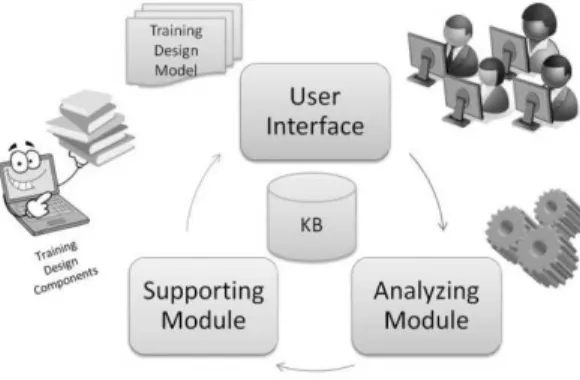
OVW decision support system. On the base of the model and the retrieved expert opinions, expert system Open Virtual World (OVW), supporting the decision for the design of teachers training, focused on technologies, was developed. The system architecture contains three main modules (Fig. 7).
Fig. 7. System architecture User Interface module is responsible for:
• users registration;
• maintains all users’ activities;
• development the design of training models; • update the design of training models; • storage the design of training models.
Analyzing module is using the knowledge database with fuzzy rules in order to:
• evaluate the training design model and provide feedback for Methodology,
Technology, User, and Objectives, based on Knowledge database with fuzzy logic rules
• provide tools for testing the user’s expectations about the calculated values
and the result provided by system, which could be used for OVW system evaluation purposes and for tuning the fuzzy logic rules.
Supporting module supports the training design process through:
• comparing two or more models for designs of training; • aggregating two or more models for designs of training; • clustering the models for training.
The component can process training design models in two modes:
• automatic – analyzing all models from a chosen folder and producing a file
with the common (aggregated) training design’s model.
• manual – analyzing models separately and presenting the results using the
system’s user interface.
Special attention is dedicated to the principles of the user interface. There are two main issues in the focus:
• How to collect the input values of the linguistic variables from the training
designers?
• How to present the system’s inference to designers?
The system is addressing them offering comprehensive contextual information and clear language and style.
The system uses fuzzy logic, based on rules, in order to take a decision in complex cases. The rules are retrieved from good practices of experts and they define the links between different variables. These rules strive to take into account the complexity and uncertainty of the real life, and to allow to model as close as possible the reality. In order to complete its tasks OVM system applies four step inference process, based on fuzzy logic in Mamdani style [6].
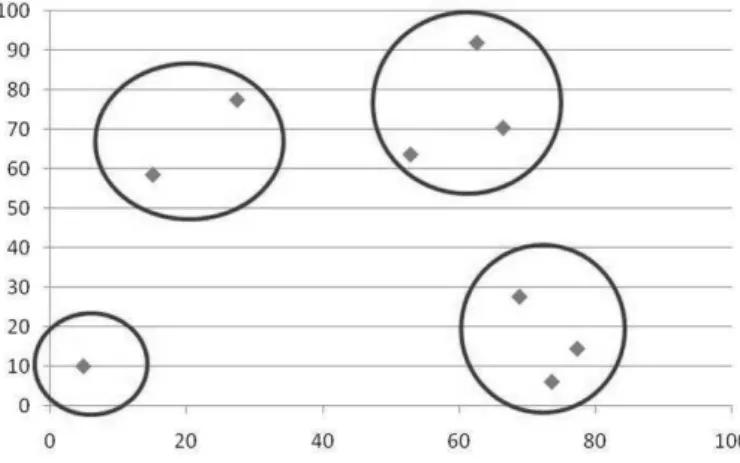
Multiple user training design models are analysed by the system and are clustered for similarity depending on neighbourhood thresholds (Fig 8).
Fig. 8. Clustered space to four training design models Two cases of cluster spaces could be observed:
• One of the clusters dominates – in this case designers could choose its
• None of the clusters is dominant – then the designers could split the group
on subgroups corresponding to clusters and perform aggregated training model for each cluster individually.
There are various scenarios for the use of the OVW expert system. Scenario 1: Development of a new model:
1. Educational/training designer is registered in the OVW system. 2. She/he creates new model for training designusing the system 3. She/he enters the values for all linguistic variables for each
compo-nent using the OVW system user interface.
4. She/he can analyze the model using the OVW system, which presents the results from this analysis using its own user interface.
5. She/he can save the model and make it usable for other system users.
Scenario 2: Changing existing model: 1. User loads existing model in the system.
2. She/he change some settings for the model (components, variables, values)
3. She/he saves the model under the same or under new name. Scenario 3: List and analysis of existing models:
1. User loads two or more existing models.
2. She/he inspects details and analyze each one of them in a different window.
Scenario 4: Comparing two models by difference. The user can compare two existing models by making cluster analysis and comparing differ-ences between values of all linguistic variables of all components of the two models. Scenario 5: Comparing two models by totals. In contrast to the previous scenario, here the comparison is made between the totals of linguistic variables in separate components.
The last two scenarios can be used from users to analyze what differences in values of linguistic variables can influence desired or unsatisfactory results in education. This analysis can direct the user to find the reasons for the success or failure of a given training, as well as to influence the results of training by changing the values of the input linguistic variables.
Scenario 6: Clustering training designs. When different training designs exist for similar trainees, the user can make a cluster analysis of these training designs, in order to find similarities and differences between them. Such analysis can be used for forming training groups with similar training designs, or
for suggestions how to change some of the training designs in order to have one general design for all trainees.
Experimental results. We performed extensive testing of the OVM model and its applicability in real practice. We used four concrete teachers’ train-ings: I*Teach [6],TENCompetence [7],AVITO [8], andShare.TEC [9]. For each of them we examined carefully prerequisites, participants, objectives, technolo-gies and methodolotechnolo-gies, used during the training. In addition, for each of them the conclusions about effectiveness of the design of the training, derived before the OVW model application, were described. Next, based on the description of trainings, each component of the model was developed through its concrete values of linguistic variables.
For example, the design ofI*Teach training, created through OVW model values of the linguistic variables of the componentsTechnology,User, Objectives, and Methodology, is shown in Table 3.
Table 3.
Variable Value Description
Learner activity (LA) Very High (FH) Level of active learners participa-tion in knowledge and skills de-velopment
Learning style correspon-dence (LSC)
Fully (F) Level of methodology correspon-dence to the learner style of learning
Practice orientation (PO) High (H) Level of connection of training approach with the application of the technology into practice Technology integration (TI) Fully (F) Level of technology and
method-ology integration
Technology presentation(TP) Concrete (C) Level of presentation of technol-ogy in the process of training Input values of the linguistic variables are as described in (1).
(1) t.cx=L t.f=M t.c=VL u.q=I u.m=E u.pf=D u.pr=I o.s=A o.k=TA o.cp=P o.el=P m.la=VH m.lsc=F m.po=H m.ti=F m.tp=C
Values of the linguistic variables, corresponding to theI*Teach design of training, stored by OVW system in XML format, are shown on Fig. 9.
Fig. 9. XML record for the I*Teach design of training according OVW model
In order to make the inference about technology utilization, it is nec-essary to choose in advance the components priorities: how the user orders by importance the component in the design of training. Thus it is possible to have methodology, technology or objective centred training approaches. In I*Teach
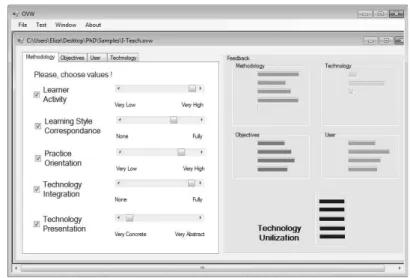
design of training the approach is Methodology centred. Taking the input values of the linguistic variables andMethodology training center approach, output value of the linguistic variable t.u(Technology Utilization), showing expected level of the technology utilization into practice, generated by the model and OVW system, are visualized at Figure 10.
From the output value of the variablet.u = Very Strong as generated from the system and based on the model, we can assume, that for these input values of the linguistic variables of the components of the model, the planned training design should have very good results in respect to application of tech-nologies in practice for the planned education.
For each of the trainings the conclusions, made with and without the OVW model, were compared. For example, when compare the conclusions for the I*Teach training, we can state, that: The conclusion generated from the
Fig. 10. Generated by the model and visualized by OVW system output value of the linguistic variable t.u for I*Teach training
I*Teach training model coincides with the analysis of results, made before the application of the model for the same training.
Applications of the OVW model and system. The results from this research can be applied in a variety of ways. Both the model and the deci-sion support system for the design of teacher training are very suitable in cases, when experts in technologies are involved in education, but they lack pedagogi-cal knowledge and expertise in teacher training. The OVW system can support the design of lifelong competence development of teachers using several different approaches:
• When the group of teachers to be trained is known in advance, the system
can advise the training designers what parameters from the model can in-fluence best the training in order to achieve some specific goals. This could be achieved by comparing the output results depending on different input values for the linguistic variables.
• When the parameters of objectives and technologies are known in advance,
the system can cluster the potential trainees in order to form optimal group-ing of teachers in order to have better results from traingroup-ing how best to apply technologies.
• When the technologies are known in advance, the system can guide the
de-signers how different methodology parameters values and users’ parameters can influence the achievement of different objectives.
The last way of application of the system is extremely important, as it can be used to assume if such training design exists, which using given technology be widely used with good results in school practice. If such design exists, what is the specific combination of parameters and their values, and for what type of users it will bring the best results.
Future developments. Unlike the existing systems supporting the teachers’ training design ([10], [11], [12], [13], [14]), the OVW system provides opportunity to observe the technologies effect, which could be achieved through the design training.
The OVW system could be improved through accumulated data. The information accumulated through next trainings can be stored, analyzed and used into the system in the form of new expertise. In such a case the system at every next step will improve the accuracy of decision support for the adequacy of the design of the teachers’ training. Automating the process is an opportunity to develop the system in the direction of Machine Learning.
Another direction of development of OVW system is through new rules, which can form the new extended expert knowledge to the system.. The potential for expansion of the rules, which are in the basis of the model and the system, make this virtual model for professional development open.
Third important opportunity for further development of the system is through its integration with other systems for designing courses for teachers’ professional development. In this case the OVW system can re-use from other systems the profile of the teachers, their training interests, level of knowledge and skills, data on the technologies and so on.
All these and other possible ideas for further development of the system are possible because both model and the system are open and flexible by design.
Conclusions. The research presented in this paper aims to contribute to solving the problem of inefficient integration of technology in education. It con-centrates on teacher training, as part of the qualification, which largely depends on those involved in design and implementation of training courses for teachers, aiming the effective integration of technology in various educational contexts.
The resulting model is abstract and virtual formalism, but it is reflecting reality and is derived from the practice of experts in the field of professional training of teachers, in particular, those who are working in the design of courses for the training of teachers. The model is designed to be open, flexible and easy to be extended in terms of components, their characteristics, and the links between them. The openness of the model is the reason does not to pretend for its
fullness. The inclusion in the model of variables, without apparent differentiation of dependent and independent variables, can also be seen as a small weakness. Despite these shortcomings, however, the studies conducted show that the created model reflects reality with great precision.
The main results obtained are based on years of experience in the design of teacher training for the implementation of ICT in education. Numerous such trainings of teachers in the last five years have enabled the accumulation of specific knowledge and skills, as well as a large amount of empirical data that contributed to the creation and testing of the OVW model and system.
The experimental part is based on participation in three successfully com-pleted international research projects, which is considered standard by the Euro-pean Commission. In frame of these projects trainings for teachers was conducted and used to test the model, underlying the expert system. These trainings are proven by the positive assessment from the European Commission, which further shows the versatility and applicability of the system.
In fact, the achievement of all these results consistently proves the main hypotheses.
Developed OVW system for decision support and results of its testing support the hypothesis 1: Design of vocational training can be supported by a system based on a formal model for professional development.
The selected formalism, on which a formal model is based, and its test through the OVW system, confirmed hypothesis 2: The process of professional development, supported by technology, can be described by a formal model.
Identified key components of teachers’ professional development, their characteristics and relationships derived with the help of experts, and set up on their base model OVW, is evidence that supports both sub-hypothesis 2.1: Professional growth, aided by technology, can be parameterized, and the sub-hypothesis 2.2: Among the parameters can be found relationships.
As a result, the research aim of this paper was achieved by developing a model and system that helps the process of deciding on a combination of tech-nologies and methodologies for teachers’ professional development with a view to effective integration into diverse educational context.
R E F E R E N C E S
[1] Hargreaves A., M. Fullan. Understanding Teacher Development. Teach-ers College Press, New York, 1992.
[2] Cachia R., A. Ferrari, K. Ala-Mutka, Y. Punie. Creative Learning and Innovative Teaching: Final Report on the Study on Creativity and In-novation in Education in EU Member States, Institute for Prospective Tech-nological Studies. http://ftp.jrc.es/EURdoc/JRC62370.pdf (15/01/2013) [3] Boytcheva Sv., M. Nisheva. Semantically Enhanced Adaptive e-Learning
System. In: Proceeding of 5th International conference on Emerging e-Learning Technologies and Applications, 2007, 367–373.
[4] Mishra P., J. M. Koehler. Technological Pedagogical Content Knowl-edge: A Framework for Teacher Knowledge. Teachers College Record, 108 (2006), No 6, 1017–1054.
[5] Mamdani E. H.Applications of fuzzy logic to approximate reasoning using linguistic synthesis. IEEE Transactions on Computers, 26 (1977), No 12, 1182–1191.
[6] Stefanova E., E. Sendova, I. Nikolova, N. Nikolova. When I*Teach means I*Learn: developing and implementing an innovative methodology for building ICT-enhanced skills. In: Abstracts and Proceedings of the Joint IFIP Conference WG3.1 Secondary Education, WG3.5, Primary Education: Informatics, Mathematics, and ICT: a ‘golden triangle’ IMICT 200 (Eds D. Benzie, M. Iding), CCIS, Northeastern University, Boston, MA, ISBN-13:978-0-615-14623-2.
[7] Stefanov K., N. Nikolova, M. Ilieva, E. Stefanova. Turning uni-versity professors into competent learners. International Journal Emerging Technologies in Learning,3 (2008), ISSN: 1863-0383, 46–52.
[8] Sendova E., P. Boytchev, E. Stefanova, N. Nikolova, E. Ko-vatcheva. Creating a Natural Environment for Synergy of Disciplines. In: Proceedings of the 4th European Conference on Technology Enhanced Learn-ing, Nice, France, 2009, Learning in the Synergy of Multiple Disciplines (Eds U. Cress, V. Dimitrova, M. Specht), EC-TEL 2009, LNCS, Vol.5794, Springer-Verlag Berlin Heidelberg, 2009, 549–555.
[9] Stefanova E., N. Nikolova, E. Kovacheva, K. Stefanov, P. Boytchev. Digital libraries with a learning resources, tailored to the user needs. e-journal Littera et Lingua, ISSN 1312-6172, Summer 2010. (in Bul-garian)
[10] Stoyanov S. Mapping in the educational and training design. Doctoral dis-sertation, University of Twente, Enschede, The Netherlands, Print Partners Ipskamp, 2001.
[11] De Croock M., F. Paas, H. Schlanbusch, J. van Merri¨enboer. ADAPTIT: Tools for Training Design and Evaluation.ETR&D,50 (2002), No. 4, ISSN 1042–1629, 47–58.
[12] Papanikolaou K., M. Grigoriadou, H. Kornilakis, G. Magoulas. Personalizing the interaction in a web-based educational hypermedia system: the case of ISPIRE.User Modelling and User-Adapted Interaction,13(2003), 213–267.
[13] Meneely J., M. Portillo. The adaptable mind in design: relating person-ality, cognitive style, and creative performance.Creativity Research Journal, 8(2005),291–298.
[14] Corbal´an-P´erez G., L. Kester, J. van Merri¨enboer. Towards a per-sonalized task selection model with shared instructional control. Instruc-tional Science,34(2006), 399–422.
Faculty of Mathematics and Informatics ”St. Kl. Ohridski” University of Sofia 5, J. Bourchier Blvd, P.O. Box 48 1164 Sofia, Bulgaria
e-mail: [email protected]
Received October 3, 2012 Final Accepted June 11, 2013
![Fig. 1. Technological Pedagogical Content Knowledge [4]](https://thumb-us.123doks.com/thumbv2/123dok_us/621558.2574594/4.892.275.617.759.873/fig-technological-pedagogical-content-knowledge.webp)