The Influence of Problem Based Learning on Students’
Generic Skill
Shafarizan Abd Samad
1, Vinothini Vasodavan
2, Adegoke Ojeniyi
3and Eunice M. Oyetade
4 1School of Education and Modern Languages, Universiti Utara Malaysia2Faculty of Education, University of Malaya 3School of Computing, Universiti Utara Malaysia
4Michael Otedola College of Primary Education, Epe, Lagos State, Nigeria
Abstract
:
Many countries have embraced formal education to confront illiteracy and unemployment within their society. This is because one major advantage of formal education is the transfer of generic skills which is the cognitive strategies and domain independent knowledge. Generic skills are vital today because life and workplaces are in flux and are getting more complex which requires initiative, emotional mastery, flexibility, creativity, and the ability to take on many different tasks (involve learning by doing and experience). However, many students are found to be deficient of this skill which is making them unfit for the labour market and unattractive to employers. In addition, very few schools teach generic skills which are making students unable to develop them and be employable attractive to employers. Therefore, this study investigates the impact of generic skills using problem-based learning (PBL). This paper represents the first part of the study, which is to investigate the influence of students’ PBL on their generic skills This paper makes used of action research method, while quantitative research approach using both survey and documentation is employed for the study data collection. The study finding show that there is a significant influence on problem-based learning (PBL) and generic skills (GS). Similar significant influence is found on critical thinking (CT) and generic skills (GS). It was further pointed out that there is no disparity on students’ gender and academic background (science and non-science) with their generic skills. This implies that problem-based learning (PBL) and critical thinking (CT) enhances students’ generic skills.Keywords:
Problem-based learning, critical thinking, teaching strategy1. Introduction
Skill is the enablement to execute a given task with pre-determined outcomes measures with energy dissipated and time taken or both. Skills are grouped into two namely generic skills (domain-general) and technical skills (domain specific). Generic skills are basic knowledge that is expected to be acquired by educated people and these include self-motivation, time management, creativity, emotional mastery, flexibility, and teamwork. On the other hand, technical skills are useful enablement for certain jobs only which are not general. Although, technical skills are very vital to companies and organizations, however, many technical skills are being supported by advancement in technology. This is making many companies and organizations to usually seek for employees with good generic skills. However, many students are found to be deficient in generic skills which will make them unattractive to employers and unfit for the labor market. In addition, very few schools teach generic skills which are making students unable to develop them and be employable attractive to employers. The rationale for this is that the traditional method of teaching students is focused on teacher-centred teaching, where the teacher talk about given theories and students are supposed to comprehend based on given classroom examples. Many studies nowadays are questioning the success of the teacher-centred learning method (Pobiner, 2016; Amolins et al, 2015; Knight, 2014; Kurki-Suonio & Hakola, 2007). These authors advocate for innovative educational methods that will increase students’ motivation and performance most especially in the area of impact of both generic and technical skills. Thus, this study examines PBL method into the learning
PBL ensures active participation of students in the learning and teaching process in order to ensure a significant improvement of student understanding and performance (Eddy, Converse & Wenderoth, 2015; Hazzan, Lapidot & Ragonis, 2014; Kulick, Toussaint, Lang & Lopes, 2013; Kassens-Noor, 2012). Hence, this paper will investigate the first part of the study on the influence of problem-based learning (PBL) on students’ acquiring generic skills during learning from their school teachers.
2. Methodology
This study employed action research method as proposed by Avison et al (1999). This research methodology was utilized because it was found to be most suitable for implementation and evaluation of problem-based learning intervention (Choi, Lindquist & Song, 2014). The study made use of 117 primary education college students from two different academic semesters in 2014/2015 academic sessions as study respondents’. The selection of these students as study respondents’ is based on purposive sample method as inspired by Topp, Barker, and Degenhardt (2004).
The study respondents are a mixture of both science and non-science backgrounds whereas their poor performance in generic skills is the major criteria used for their selection. The selection criteria are based on students’ previous assessments records related to their generic skills which include self-motivation, time management, creativity, emotional mastery, flexibility, and teamwork. The problem-based learning intervention was implemented during students’ learning sessions. Data were collected after the learning sessions based on quantitative research approach.
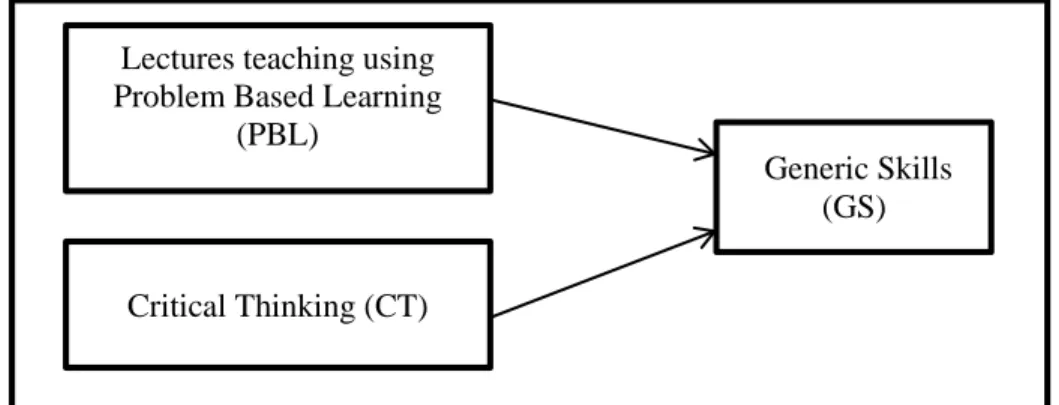
Data collection for quantitative research approach is done in two different ways, namely survey and documentation. The documentation makes use of students’ assessment records while the questionnaire makes use of a survey. The survey contains items on students’ backgrounds, perception and reflection on their lecturer teaching strategy (problem-based learning), critical thinking abilities and generic skills as illustrated in Figure 1
.
Fig. 1: Implemented Framework
Students’ generic skills are measured in term of their self-motivation, time management, creativity, emotional mastery, flexibility and teamwork which is based on Freudenberg, Brimble and Cameron (2011), Ballantine and McCourt Larres (2007) and Crebert et al (2004) studies. Critical thinking refers to students’ ability to intellectually and analytically process the teaching and learning instructions in order to form their beliefs and influence their actions. The items of students’ critical thinking skills are based on Stevens (2015), Ernst and Monroe (2004), Terenzini et al (1995). In addition, PBL is measured in terms of student experiences and perceptions on the intervention provided during teaching periods which is based on Ravankar et al (2016) and Ferreira and Trudel (2012). Therefore, the questionnaire is made up of students’ backgrounds, GS, CT and PBL which are used to collect data for the study. These data are analyzed using SPSS version 19
Lectures teaching using Problem Based Learning
(PBL)
Critical Thinking (CT)
Generic Skills (GS)
3. Findings
The study data depicts that out of the 117 students, 73 are with non-science backgrounds while 44 are with science backgrounds as shown in Figure 2.
Fig. 2: Study Respondents’ Academic Background
This implies that most of the study respondents are not science-based students. Nonscience-based students are those without previous knowledge of both science courses during their secondary school days and did not offer any science subjects such as physics and chemistry in their secondary school final examination. Similarly, the study data reflects that out of the 117 students, 93 are female while 24 are male as shown in Figure 3.
Fig. 3: Respondents’ Gender
This implies that most of the study respondents are majority females with 79 percent compared with their male respondents with 21 percent. Furthermore, correlation analysis was done in order to investigate the relationship significance between the three entities in this study. Results of the correlation analysis are summarized in Table 1. Non-Science 62% Science 38% Female 79% Male 21%
TABLE 1: Results of Correlation Analysis
Generic Skills (GS) Critical Thinking (CT) Problem-Based Learning (PBL) Generic Skills (GS) Pearson Correlation 1 .841 .926 Sig. (2-tailed) .000 .000 Critical Thinking (CT) Pearson Correlation .961 1 .957 Sig. (2-tailed) .000 .000 Problem-Based Learning (PBL) Pearson Correlation .926 .957 1 Sig. (2-tailed) .000 .000
**. Correlation is significant at the 0.01 level (2-tailed). *. Correlation is significant at the 0.05 level (2-tailed).
The result of the correlation analysis shows that GS has a value of Pearson correlation of .841 with CT. This means that there is a strong positive relationship between students’ critical thinking and their generic skills which is found to be significant because of Sig (2-tailed) value of .000. A similar result is gotten between GS and PBL with .926 which denotes strong positive relationship. Further analysis was carried out in order to examine students’ data t-test analysis which is presented in Table 2.
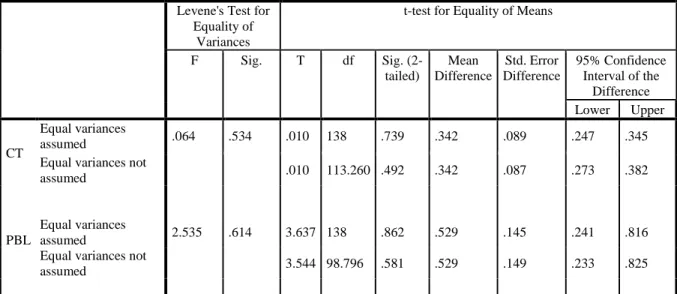
TABLE 2: Results of T-Test Analysis
Levene's Test for Equality of
Variances
t-test for Equality of Means
F Sig. T df Sig. (2-tailed) Mean Difference Std. Error Difference 95% Confidence Interval of the Difference Lower Upper CT Equal variances assumed .064 .534 .010 138 .739 .342 .089 .247 .345
Equal variances not
assumed .010 113.260 .492 .342 .087 .273 .382
PBL
Equal variances
assumed 2.535 .614 3.637 138 .862 .529 .145 .241 .816 Equal variances not
assumed 3.544 98.796 .581 .529 .149 .233 .825
Based on Table 2, the Levene test is not statistically significant in CT and PBL which reflects that the assumptions of equal variance are not violated. Likewise, the t-test of equality of means indicates that for both CT and PBL are not significant (p=.739 and .862 respectively). This means that there was no significant difference between CT and PBL with GS.
4. Discussion
The correlation analysis of this study has shown that there is unique significance in students’ critical thinking and problem-based learning with their generic skills. It shows that good performance in both critical thinking and problem-based learning influence their generic skills positively. This outcome can be attributed to the implemented intervention which is done by adopting action research during their teaching and learning sessions. This finding can be interpreted in two ways namely students’ academic background and their gender.
Firstly, the study respondent academic background as presented in Figure 2 shows that majority of the respondents are made up of non-science academic backgrounds (which is 62 percent of the total respondents). This study finding disagree with Craig, Gordon, Clark and Langendyk (2004) that students with non-science academic backgrounds usually cannot perform better in problem-based learning and critical thinking skills compare with science background students. Thus, this study argues that with suitable and efficient teaching and learning strategy, both science and non-science academic backgrounds can perform excellently in generic skills, problem-based learning, and critical thinking skills.
Secondly based on the study respondents’ gender as illustrated in Figure 3, it is seen that the study respondents are made up of female students with 79 percent. The finding of this study supports Geist and King (2008) argument that there is no gender disparity in the issue of generic skills. Thus, it is maintained in this study that although there are differences in learning styles between female and male students, however, there is no disparity between female and male students in their display of generic skills, critical thinking skills, and problem-based learning.
Furthermore, based on the t-test analysis there is no significant difference between students’ critical thinking and problem-based learning with generic skills. This implies that the implemented intervention greatly influences students’ generic skills which are evidenced in their generic performance measurements. This is the rationale for the non-significant difference between students’ generic skills, critical thinking skills, and problem-based learning.
5. CONCLUSION
This paper has investigated the influence of problem-based learning and critical thinking on students’ generic skills. The study made use of respondents with poor generic skills. The implementation of the PBL intervention shows that there is positive significance between problem-based learning and critical thinking with generic skills. The study further pointed out that with appropriate and suitable teaching and learning strategy there should not be any disparity in academic outcome between science and non-science background students in term of generic skills. Likewise, it is stated in this study that there is no gender disparity in the issue of generic skills. Both female and male are able to demonstrate critical thinking, problem-based skills, and generic skills if they are well tutored. In addition, this finding is further grounded that the problem-based learning approach intervention has a large influence on the generic skills of students. Hence, it is concluded that students’ generic skills can be enhanced with problem-based learning and critical thinking skills which in turn improve students’ performance in their workplaces.
6. References
Amolins, M. W., Ezrailson, C. M., Pearce, D. A., Elliott, A. J., & Vitiello, P. F. (2015). Evaluating the effectiveness of a laboratory-based professional development program for science educators.
Advances in physiology education, 39(4), 341-351.
Avison, D. E., Lau, F., Myers, M. D., & Nielsen, P. A. (1999). Action research. Communications of the ACM, 42(1), 94-97.
Ballantine, J., & McCourt Larres, P. (2007). Cooperative learning: a pedagogy to improve students' generic skills?. Education+ Training, 49(2), 126-137.
Choi, E., Lindquist, R., & Song, Y. (2014). Effects of problem-based learning vs. traditional lecture on Korean nursing students' critical thinking, problem-solving, and self-directed learning. Nurse education today, 34(1), 52-56.
Craig, P. L., Gordon, J. J., Clark, R. M., & Langendyk, V. (2004). Prior academic background and student performance in assessment in a graduate entry programme. Medical education, 38(11), 1164-1168. Crebert, G., Bates, M., Bell, B., Patrick, C. J., & Cragnolini, V. (2004). Developing generic skills at university, during work placement, and in employment: graduates' perceptions. Higher Education Research & Development, 23(2), 147-165.
Eddy, S. L., Converse, M., & Wenderoth, M. P. (2015). PORTAAL: a classroom observation tool assessing evidence-based teaching practices for active learning in large science, technology, engineering, and mathematics classes. CBE-Life Sciences Education, 14(2), ar23.
Ernst, J., & Monroe, M. (2004). The effects of environment‐based education on students' critical thinking skills and disposition toward critical thinking. Environmental Education Research, 10(4), 507-522. Ferreira, M. M., & Trudel, A. R. (2012). The impact of problem-based learning (PBL) on student attitudes toward science, problem-solving skills, and sense of community in the classroom. The Journal of Classroom Interaction, 47(1), 23.
Freudenberg, B., Brimble, M., & Cameron, C. (2011). WIL and generic skill development: The development of business students' generic skills through work-integrated learning. Asia-Pacific Journal of cooperative education, 12(2), 79-93.
Geist, E. A., & King, M. (2008). Different, not better: Gender differences in mathematics learning and achievement. Journal of Instructional Psychology, 35(1), 43-53.
Hazzan, O., Lapidot, T., & Ragonis, N. (2014). Active Learning and Active-Learning-Based Teaching Model. In Guide to Teaching Computer Science (pp. 15-22). Springer London.
Kassens-Noor, E. (2012). Twitter as a teaching practice to enhance active and informal learning in higher education: The case of sustainable tweets. Active Learning in Higher Education, 13(1), 9-21. Knight, D. B. (2014). Reversing the Logic An Outcomes-Based Student Typology for Determining “What
Works” in Promoting an Array of Engineering-Related Student Learning Outcomes. Educational Evaluation and Policy Analysis, 36(2), 145-169
Kulick, J., Toussaint, M., Lang, T., & Lopes, M. (2013). Active Learning for Teaching a Robot Grounded Relational Symbols. In IJCAI.
Kurki-Suonio, T., & Hakola, A. (2007). Coherent teaching and need-based learning in science: an approach to teach engineering students in basic physics courses. European Journal of Engineering Education, 32(4), 367-374.
Pobiner, B. (2016). Accepting, understanding, teaching, and learning (human) evolution: Obstacles and opportunities. American journal of physical anthropology, 159(S61), S232-S274
Ravankar, A. A., Imai, S., Shimamura, M., Chiba, G., Takasuka, T., & Yamanaka, Y. (2016). Nurturing Problem-Finding Skills in Graduate Students through Problem Based Learning Approaches. In
Advanced Applied Informatics (IIAI-AAI), 2016 5th IIAI International Congress on (pp. 542-546). IEEE.
Stevens, C. (2015). The Cognitive Neuroscience of Sign Language: Engaging Undergraduate Students’ Critical Thinking Skills Using the Primary Literature. Journal of Undergraduate Neuroscience Education, 14(1), A66.
Terenzini, P. T., Springer, L., Pascarella, E. T., & Nora, A. (1995). Influences affecting the development of students' critical thinking skills. Research in higher education, 36(1), 23-39.
Topp, L., Barker, B., & Degenhardt, L. (2004). The external validity of results derived from ecstasy users recruited using purposive sampling strategies. Drug and alcohol dependence, 73(1), 33-40.