East Tennessee State University
Digital Commons @ East
Tennessee State University
Electronic Theses and Dissertations Student Works
5-2013
Collegiate Academic Enhancement Programs: The
Benefits of Multi-Year Programs Compared to the
Benefits of One-Year Programs for Traditionally
Underrepresented Students
Derriell M. Springfield
East Tennessee State University
Follow this and additional works at:https://dc.etsu.edu/etd Part of theEducation Commons
Recommended Citation
Springfield, Derriell M., "Collegiate Academic Enhancement Programs: The Benefits of Multi-Year Programs Compared to the Benefits of One-Year Programs for Traditionally Underrepresented Students" (2013).Electronic Theses and Dissertations.Paper 1146.
Collegiate Academic Enhancement Programs:
Benefits of Multi-Year Programs Compared to One-Year Programs for Traditionally Underrepresented Students
A dissertation presented to
the faculty of the Department of Educational Leadership and Policy Analysis East Tennessee State University
In partial fulfillment of the requirements for the degree Doctor of Education in Educational Leadership
by
Derriell M. Springfield May 2013
Dr. Don Good, Chair Dr. Bethany Flora
Dr. Brian Noland Dr. Jasmine Renner
ABSTRACT
Collegiate Academic Enhancement Programs:
The Benefits of Multi-Year Programs Compared to the Benefits of One-Year Programs for Traditionally Underrepresented Students
by
Derriell M. Springfield
Student retention rates and graduation rates currently play a major role in measuring the success of institutions of higher education. To contribute to the likelihood of this success many
institutions offer programs designed to increase the academic performance of their students especially those classified as incoming freshmen. Others are more focused and target those who are from underrepresented populations. Nonetheless not many programs have been designed to aid those students in the subsequent years that follow freshman year.
The purpose of this research project was to determine if there are significant differences in the success of those students who participate in a multi-year program as opposed to those who participate in a program specifically designed for incoming freshmen. Additionally these 2 groups were compared with students who did not participate in either program.
The participants in this study were classified within 3 groups: Quest for Success, Student
Support Services, and nonprogram participants. Archival data were used to examine grade point averages, retention rates, and graduation rates. A random sample of 125 students from each of the 3 groups (375 total) was examined for the purposes of comparing mean grade point averages. For the purposes of comparing retention rates and graduation rates, however, the population was
Findings of the study are congruent with the literature in terms of the role that outreach programs play in the success of underrepresented students. These results revealed that students in the multi-year program, Student Support Services, had significantly higher grade point averages, retention rates, and graduation rates when compared to Quest for Success (a 1-year incoming freshman program). Student Support Services also had significantly higher grade point averages and retention rates than nonprogram participants from underrepresented student populations. Furthermore there were no significant differences found in comparisons between Quest for Success and nonprogram participants.
DEDICATION
This work is dedicated to my amazing wife Kiana Brooks for loving, supporting, and believing in me throughout this entire process. Through your persistence and determination, you continue to motivate me on a daily basis.
To my daughter Déja, who has always been proud of me and believes that I can do anything. Thank you for allowing me to be your Superman.
To my mom Gloria Springfield and my Granny Gloria Wade for always providing the encouragement that I needed to make it through any situation no matter how difficult.
To my in-laws Michael and Cynthia Brooks for providing me with words of encouragement and guidance when I needed it most.
To my mentors, Mary Jordan, Wilsie Bishop, and Brian Noland, for seeing my potential and not only believing in me but also taking a chance on me.
To my dissertation chair and advisor, Don Good, for keeping me focused although he knew and constantly reminded me that the task before me would be more than challenging.
To the ELPA department for providing me with the resources to pursue the career of my dreams.
To my alma mater, Tennessee State University for providing me with a solid educational foundation and to Ms. Deborah Watson who saw my potential from the beginning.
To my family and friends, especially Whitney Brooks, Reginald Cartmell, Starling Hooks, Billy Meneese, Charvis Rand, Alamazie Warren, and D’Errico Wylie, each of whom played an instrumental role in encouraging me to complete this process. From the bottom of my heart, I sincerely appreciate each of you for loving me and believing in me.
ACKNOWLEDGEMENTS
I express my sincerest thanks to all of my committee members, Dr. Bethany Flora, Dr. Don Good, Dr. Brian Noland, and Dr. Jasmine Renner, for your diligence in helping me through this dissertation process. Each of you played a very unique role in assisting me through this milestone in my life. Dr. Good, I thank you for serving as my chair and for the numerous hours you allowed me to spend in your office without an appointment. Dr. Flora, thank you for not only challenging me but also pushing me that extra mile. Dr. Noland, thank you for taking the time out of your demanding schedule to serve on my committee. Last but not lease, I thank you Dr. Renner for your unwavering encouragement. Again, I owe you each a debt of gratitude.
Thank you to Jeff Howard, Heather Levesque, Dr. Sally Lee, and the entire Office of Student Affairs for assisting me with my data collection. I cannot thank you all enough for time that you invested in helping me. I know you all do not think that it was a big deal but your selflessness is sincerely appreciated.
Chris Strode, I would also like to thank you for your assistance with data collection. I know it won’t be long before you finish with your writing.
I extend a special thanks to Ms. Mary Jordan, Ann Eargle, and Pat Sheets for their support and encouragement and for provided me with what I needed just when I needed it most.
I would also like to thank the Student Success Team for the support they provided at our weekly Monday meetings.
Thank you to my ELPA classmates, especially Cheri Clavier, Ivy Click, Luke Finck, Charlotte Hoover, and Miriam Philips. Because of this extraordinary group, I never felt like I
TABLE OF CONTENTS Page ABSTRACT ... 2 DEDICATION ... 5 ACKNOWLEDGEMENTS ... 6 LIST OF TABLES ... 10 LIST OF FIGURES ... 11 Chapter 1. INTRODUCTION ... 12
Statement of the Problem ... 17
Research Questions ... 18
Significance of the Study ... 19
Rationale ... 20
Definitions of Terms ... 21
Limitations and Delimitations ... 23
Overview of the Study ... 24
2. REVIEW OF LITERATURE ... 25
Underrepresented Students and Affirmative Action ... 25
The Need for Intervention ... 31
Role of Programs in Higher Education ... 34
Practices of Student Support Services ... 39
How College Affects Students ... 41
Summary of Literature ... 42
3. METHODOLOGY ... 43
Population ... 47 Sources of Data ... 48 Data Collection ... 49 Data Analysis ... 50 Chapter Review ... 51 4. FINDINGS ... 52 Demographic Characteristics ... 53 Research Question 1 ... 54 Research Question 2 ... 56 Research Question 3 ... 57 Research Question 4 ... 60 Research Question 5 ... 62 Research Question 6 ... 67
5. SUMMARY, CONCLUSIONS, RECOMMENDATIONS FOR PRACTICE, AND RECOMMENDATIONS FOR FURTHER RESEARCH ... 73
Summary of Findings ... 73 Research Question 1 ... 74 Research Question 2 ... 74 Research Question 3 ... 75 Research Question 4 ... 75 Research Question 5 ... 76 Research Question 6 ... 76 Conclusions ... 77
Recommendations for Practice ... 78
Appendix A: IRB Permission to Conduct Research ... 88
Appendix B: Quest for Success Demographics and GPAs ... 89
Appendix C: Student Support Services Demographics and GPAs ... 92
Appendix D: Nonprogram Participants Demographics and GPAs ... 95
VITA ... 98
LIST OF TABLES
Table Page
1. Inclusive Excellence Scorecard ... 16
2. BEST Design Principles ... 38
3. ETSU Enrollment by Race-Ethnicity (2011) ... 48
4. ETSU Enrollment by Gender (2011) ... 48
5. Participants’ Demographics ... 53
6. Means and Standard Deviations with 95% Confidence Intervals of Pairwise Differences ... 55
7. Means and Standard Deviations of Grade Point Averages ... 56
8. Means and Standard Deviations for College Grade Point Averages by HS GPA and Program ... 58
9. Means and Standard Deviations for College Grade Point Averages by Gender and Program ... 60
10.Retention Frequencies for all Participants ... 62
11.Results for the Pairwise Comparison for Retention ... 63
12.Retention Frequencies (Quest and None) ... 65
13.Retention Frequencies (SSS and None) ... 66
14.Graduate Frequencies for all Participants ... 67
15.Results for the Pairwise Comparison for Graduation ... 68
16.Graduate Frequencies (Quest and SSS) ... 70
LIST OF FIGURES
Figure Page
1. ETSU Enrollment by Gender ... 48
2. Boxplots of Mean College Grade Point Averages for all Programs ... 55
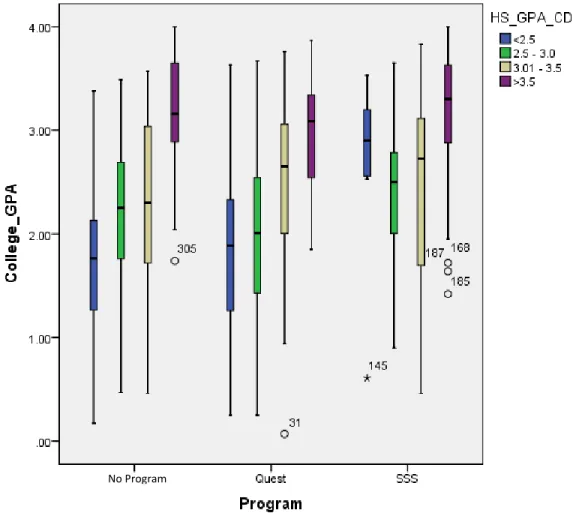
3. Boxplots for Mean College GPA and Mean High School GPA ... 57
4. Boxplots for Mean College GPA by Program and High School GPA ... 59
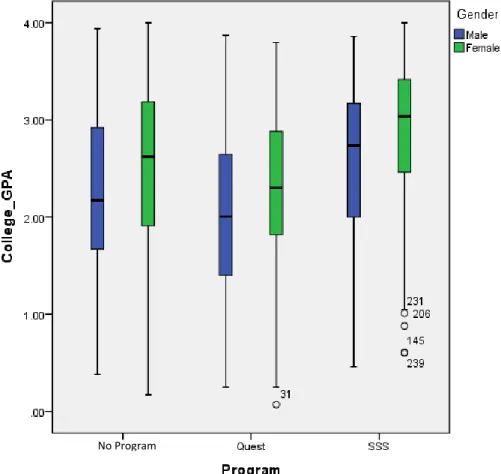
5. Boxplots for Mean College GPA by Program and Gender ... 61
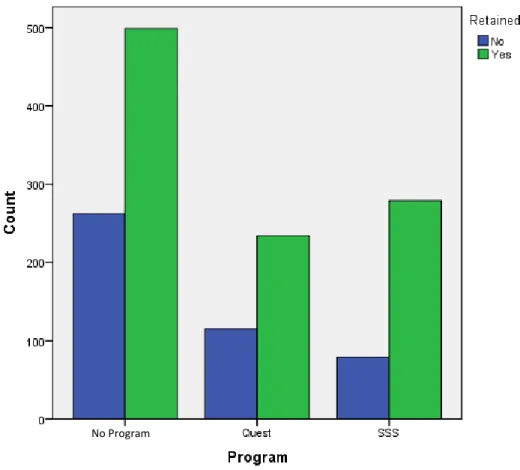
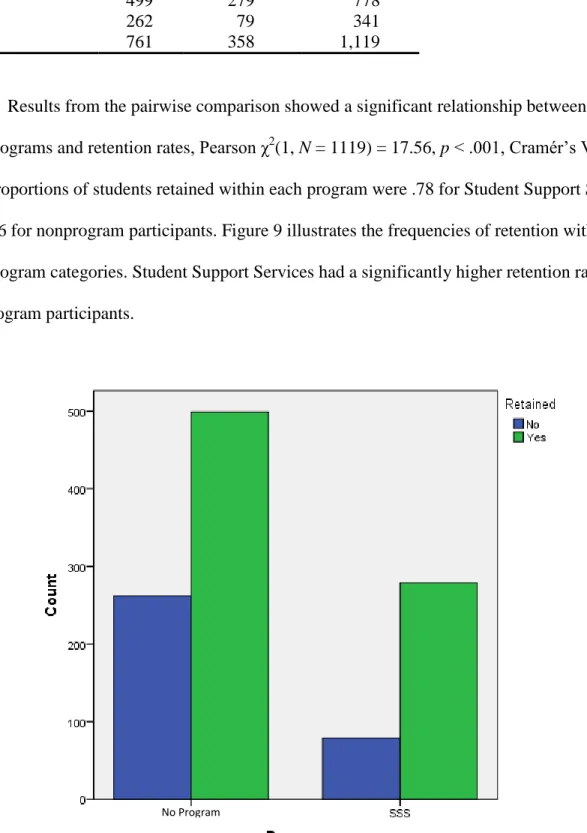
6. Bar Chart of Retention within Programs ... 63
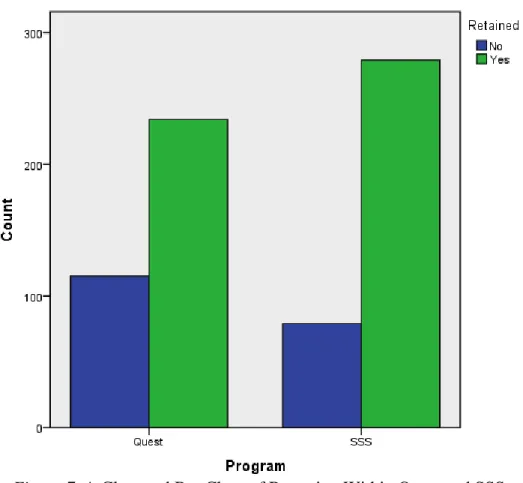
7. Bar Chart of Retention within Quest and SSS ... 64
8. Bar Chart of Retention within Quest and No Program ... 65
9. Bar Chart of Retention within SSS and No Program ... 66
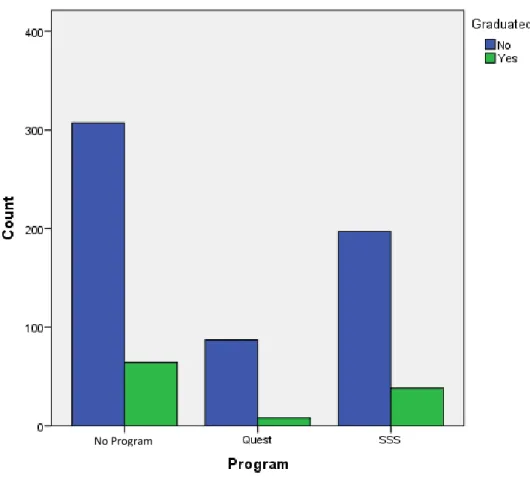
10.Bar Chart of Degree Completion within Programs... 68
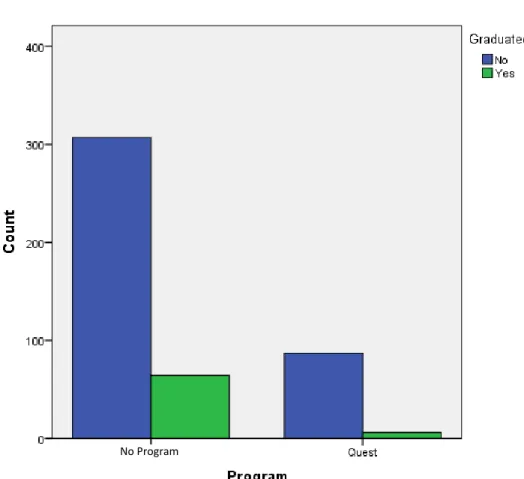
11.Bar Chart of Degree Completion within Quest and No Program ... 69
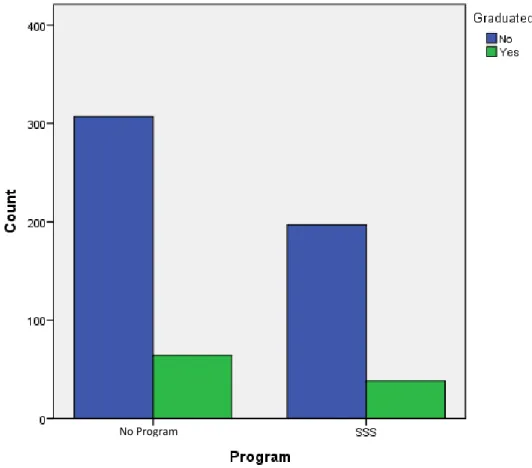
12.Bar Chart of Degree Completion within Quest and SSS ... 70
CHAPTER 1 INTRODUCTION
Having all the ingredients for chili does not mean one has chili. Something has to be done with the various ingredients just as something has to be done with certain characteristics and traits to help leaders evolve into more effective leaders in their specific areas of leadership (Chand, 2005). Although Chand is referring to leadership in this particular instance, this idea is applicable to development of any kind.
Several academic programs are designed to help nurture and enhance the academic performance of historically underrepresented college students. As more college campuses shift their attention to achieving diversity, words such as “inclusion” and “underrepresented” emerge. According to Harper (2008) inclusion must be an intentional educational practice. Harper also argues that learning is a byproduct of what happens outside of the classroom in addition to what occurs inside of the classroom. To that end, the learning environment should be a community that is both supportive and inclusive.
Outreach activities benefit the students they serve as well as the university’s civic mission by providing increased college access to underrepresented students (Kiyama, Lee, & Rhoades, 2012). The authors also added that those who are classified as underrepresented are “especially vulnerable in times of economic stress” (p. 276). The basic principle behind education is the pursuit of knowledge; however, during tough economic times educational attainment becomes secondary to job attainment, especially for underrepresented students (Moore, 2009).
Many underrepresented students attend college as an alternative to joining the workforce (Moore, 2009). The university then takes on the responsibility of providing these students with the resources they need to be successful in the academic setting by way of programming. Often these outreach efforts operate with limited funding and administrative support (Kiyama et al., 2012). Because many support programs rely heavily on a small support staff and operating budget, efforts risk failure when funding is depleted or the responsible administrator leaves the institution. Unfortunately underrepresented students and the programs designed to aid these students encounter barriers that hinder their successes.
In 2007 Spellman identified several college enrollment barriers that prospective students from underrepresented populations face in pursuit of higher education and the potential for a better life. The barriers that Spellman identified can be divided into three categories: situational, institutional, and dispositional. Barriers resulting from one’s circumstances in life are considered situational. Institutional barriers involve policies and practices that prevent, or make difficult, participation in activities or courses. An example of this would be the lack of financial
assistance. Dispositional barriers include the students’ perceptions or attitudes about their ability to succeed. Cooper (2011) also adds that “students’ academic literacy practices involve a degree of self-limitation and self-censorship” (p. 46). While these barriers are a hindrance for many underrepresented students, there are those who make it through the enrollment process and are then subject to placement testing. The use of placement tests often determines whether students are ready to handle the course load of the curriculum or if additional assistance is needed to foster stronger basic skills. As a result of placement testing, developmental courses in math, English, and/or reading may be required for these students. In addition to college enrollment barriers, demographic factors also influence retention.
There are seven demographic factors that influence retention: delayed entry, part-time employment, full-time work, financial independence, dependents, single parenthood, and community college attendance without a high school diploma (Spellman, 2007). Consequently the barriers that deter students from enrolling in college are sometimes the same barriers that prevent them from remaining in degree programs until completion. In addition to these obstacles, finding time to study and complete assignments can also present major difficulties for students and may eventually lead them to academic failure. To rectify this problem Bash (2003) suggests “collaboration and harnessing the learner’s own experience is a key factor in achieving
transformative learning” (p. 36).
Galbraith and Jones (2003), like Bash (2003), argued that student success was essentially the responsibility of the institution itself. They proclaimed that “higher education needs to take on the responsibility of fostering creativity in learners, faculties, and administrators who can function in shifting social and cultural climates” (p. 19). Based on this belief they suggest that individuals who feel a sense of trust, openness, respect, support, and acceptance are more likely to engage in learning activities, decision-making processes, program development, as well as marketing strategies. Furthermore creativity is enhanced when organizational life and those who comprise it demonstrate that risk-taking is valued and encouraged. Galbraith and Jones defined the selection of instructors and learners from diverse backgrounds who have varying interests, learning and thinking styles, experiences, and who reflect the various stages in life cycle
development as a basic necessity of enhancing creativity. Additionally by encouraging feedback, creative individuals are asked to engage in the process of praxis. The authors proposed that engaging in students’ creative action and allowing time for reflection are critical components of
the learning process. While feedback is essential in the promotion of creativity, creative people must feel a sense of trust, respect, and sincerity throughout the entire process.
Group support is also another factor influencing creativity in learning experiences. The primary, overall benefit of group interaction in the promotion of creativity, as denoted by Galbraith and Jones (2003), is that it provides an environment comprised of imaginative individuals who bring with them a set of opposing viewpoints that ultimately encourages imaginative thinking and gets the ‘creative juices flowing.’ However because creativity is a human endeavor, accidents and mistakes are inevitable. That being the case, the authors state, “Every effort should be made to plan for accidents and mistakes, but mistakes, unplanned accidents, or failures are necessary components in the creative process as they can serve as mechanisms for further reflection and innovation” (p. 22). As cited by Galbraith and Jones (2003, p. 23), “Even Albert Einstein suggested that creativity is far more significant than knowledge in the advancement of humankind.” By incorporating new ideas, a classroom becomes a place that begins to change, modify, and adapt to the possibilities that innovation is welcomed.
Williams, Berger, and McClendon (2005) provide an overview of how campuses can achieve Inclusive Excellence through comprehensive organizational change. The definition of Inclusive Excellence consists of four primary elements:
1. A focus on student intellectual and social development. Academically, it means offering
the best possible course of study for the context in which the education is offered.
2. A purposeful development and utilization of organizational resources to enhance student
learning. Organizationally, it means establishing an environment that challenges each student to achieve academically at high levels and each member of the campus to contribute to learning and knowledge development.
3. Attention to the cultural differences learners brings to the educational experience and that
16
4. A welcoming community that engages all of its diversity in the service of student and
organizational learning (p. vi).
Inclusive Excellence focuses on change related to four areas: (1) access and equity, (2) campus climate, (3) diversity in the formal and informal curriculum, and (4) learning and development. The four areas, definitions, and sample indicators of Inclusive Excellence are listed below in the Table 1.
Table 1
Inclusive Excellence Scorecard Table 3. Inclusive Excellence Scorecard
IE Area Definition Sample Indicators Source
Access and Equity The compositional number and success levels of historically
underrepresented
students, faculty, and staff in higher education
ß Number of students, faculty, and staff members of color at the institution
ß Number of tenured women faculty in engineering
ß Number of male students in nursing
ß Number of historically underrepresented students in science, technology,
engineering, and mathematics (STEM) fields Bensimon et al. 2004; Hurtado, et al. 1999; Smith et al. 1997 Diversity in the Formal and Informal Curriculum
Diversity content in the courses, programs, and experiences across the various academic
programs and in the social dimensions of the campus environment
ß Courses related to intercultural, international, and multicultural topics
ß Campus centers, institutes, and departments dedicated to exploring intercultural, international, and multicultural topics
ß Articles, monographs, lectures, and new knowledge that is produced around issues of diversity
Smith et al. 1997
Campus Climate The development of a psychological and behavioral climate supportive of all students
ß Incidents of harassment based on race, ethnicity, gender, and sexual orientation
ß Attitudes toward members of diverse groups
ß Feelings of belonging among ethnically and racially diverse groups on campus
ß Intergroup relations and behaviors on campus Smith et al. 1997; Hurtado et al. 1999 Student Learning and Development
The acquisition of content knowledge about diverse groups and cultures and the development of cognitive complexity
ß Acquisition of knowledge about diverse groups and cultures
ß Greater cognitive and social development derived from experiences in diverse learning environments
ß Enhanced sense of ethnic, racial, and cultural identity for all students
Gurin et al. 2002
Figure 2 depicts an IE Scorecard framework that integrates these four areas and also lists four important “levers” for enacting change: senior leadership and accountability, vision and buy- in, building capacity, and leveraging resources to help implement organizational change.
The authors (Williams et al., 2005) argued that colleges and universities should not be viewed a closed systems. Instead they should be viewed as open systems that are impacted by several outside influences of the larger organizational system such as evolving technologies, unpredictable economic markets, and changing demographics. “To create a ‘culture of inclusive excellence,’ higher education leaders must consider how their campus environments can adapt to meet the needs of today’s highly diverse entering students, rather than beginning with the
assumption that diverse students must assimilate into existing environments with relatively narrow measures of quality” (Williams et al., 2005, p. 9).
When educational inclusion, enrollment and retention barriers, and the need for a support system are considered, programming appears to be an essential component in the success of students from underrepresented populations. In recent years a variety of interventions have been developed and implemented, and through this variation several different models have been used. Some of those initiatives are designed for incoming freshmen, and others encourage students’ participation throughout their college career. Because resources to support such programs are so limited, examining the benefit of these various program models could prove to be beneficial and offer a method by which to conserve these resources (Kiyama et al., 2012).
Statement of the Problem
Several academic programs have been designed to help enhance the academic
performance of historically underrepresented college students. Out of these various programs several different models have been developed and implemented.
The purpose of this quantitative study was to determine if there are significant differences between the academic successes of multi-year program participants compared to freshman-year
program participants. Academic success was operationalized as grade point averages, retention rates, and graduation rates. Student Support Services will represent the multi-year program and Quest for Success will represent the freshman-year program. These two groups were also compared with a sample of students who do not participate in either program.
This study was an examination of the academic performance of students who have participated in the Quest for Success program and compares their performance to those students who participated in TRiO’s Student Support Services. Both programs were designed to
supplement the resources available to underrepresented students in an attempt to assist them in successfully completing college. The study examined students’ grade point averages and programs’ retention rates and graduation rates.
Research Questions
Through quantitative analyses, the grade point averages, retention rates, and graduation rates of Quest for Success and Student Support Services participants at East Tennessee State University were examined, compared, and cross-referenced with those nonprogram participants using archival data from the 2008 – 2009, 2009 – 2010, 2010 – 2011, and 2011 – 2012 school years. The following research questions were employed as part of the quantitative research serving as the focus of the investigation:
1. Is there a significant difference in the grade point averages of those underrepresented
students who participate in the Quest for Success Program, TRiO’s Student Support Services, and nonprogram participants?
3. Do the differences in college grade point averages among the three programs vary significantly as a function of high school grade point averages?
4. Do the differences in college grade point averages among the three programs vary
significantly as a function of gender?
5. Is there a significant difference in the freshman to sophomore retention rates of
underrepresented students in relationship to their participation in outreach programs?
6. Is there a significant difference in the graduation rates of underrepresented students in
relationship to their participation in outreach programs?
Significance of the Study
Student retention rates and graduation rates currently play a major role in measuring the success of institutions of higher education. To contribute to the likelihood of this success many institutions offer programs design to increase the academic performance of their students
especially those classified as incoming freshmen (Kiyama et al., 2012). Other programs are most focused and target those from underrepresented populations. Programs for underrepresented students are implemented as a result of the barriers they encounter in their attempt to gain access to education. Ness and Tucker (2008) claimed that the socioeconomic status and race or
ethnicities of students are identified as the most common barriers to college access. While much has been done to aid underrepresented students in gaining access, not many programs have been designed to aid those students in subsequent years that follow freshman year.
Kiyama et al. (2012) discussed the limited resources available to academic departments or colleges for the purposes of initiating their own programs. The resource limitations include
administrative staff support in addition to budgetary limitations. In other words many of these efforts tend to fail once funding has depleted or the responsible staff person leaves the institution.
The results of this study could be used to help departments, colleges, and universities preserve their resources by eliminating the duplication of services offered through programming. Furthermore by implementing more collaborative efforts in regards to programming, this study could help create relationships between departments and colleges or even the university at-large.
Rationale
The Quest for Success program was created in 2006 at East Tennessee State University. The program was developed to help historically underrepresented students become acclimated to life on ETSU’s campus. To accomplish this, the program focuses on the critical role that
networking plays in student success giving them a head start on developing a network of friends, faculty, and staff to assist them through their college journey.
Like the Quest for Success program, Student Support Services was developed to assist underrepresented students as well. The primary focus of the program is to help students from underrepresented populations stay in college until they earn their baccalaureate degrees. Free tutoring, career and personal counseling, academic advising, mentoring, and college survival skills are offered to all program participates. These resources offered by Student Support Services specifically target those students who are from low-income or first generation backgrounds or are minority students (Division of Academic Affairs at East Tennessee State University, 2012).
selected because of their targeted demographic group. Students chosen for these programs had previously been identified as being underrepresented therefore to remain objective, students examined for the purposes of this study have self-identified as being a member of an
underrepresented population.
Definitions of Terms
For the purposes of this particular research study, the following definitions were provided.
1. Grade point average: calculated by taking the sum the students’ individual class points earned and dividing by the total number of credit hours attempted (Back to College, 2012). Class points earned are assigned as follows: A = 4.00 grade points; A- = 3.70 grade points; B+ = 3.33 grade points; B = 3.00 grade points; B- = 2.70 grade points; C+ = 2.30 grade points; C = 2.00 grade points; C- = 1.70 grade points; D+ = 1.30 grade points; D = 1.00 grade points; D- = 0.70 grade points; F = 0.00 grade points. Students’ grade point averages are often used to determine student progress and failure standards. For the purposes of this study, student’s grade point averages will be examined at the end of the freshman year.
2. Outreach Program: Program whose efforts increase the availability and use of services especially through direct intervention and interaction with a target population (Glossary of Education, 2012).
3. Quest for Success Program: A college transition program designed to help first-year, historically underrepresented students become acclimated to East Tennessee State
University’s campus life while building a network of friends, faculty, and staff to assist them through their college journey (ETSU Office of Equity & Diversity, 2012).
4. Retention Rate: The rate at which students persist in their educational program at an institution, usually expressed as a percentage (Integrated Postsecondary Education Data System, 2012). For the purposes of this study, retention rates will be calculated between freshman year to sophomore year.
5. Socioeconomic Status (SES): The social standing or class of an individual or group. It is often measured as a combination of education, income, and occupation. Examinations of socioeconomic status often reveal inequities in access to resources, plus issues related to privilege, power, and control (American Psychological Association, 2012).
6. Student Support Services: One of the federally funded TRiO program that offers free tutoring as well as other types of academic support to students who qualify for the program. Students who are low-income individuals, first-generation college students, or individuals with disabilities qualify for this program (Division of Academic Affairs at East Tennessee State University, 2012).
7. TRiO Programs: Federal outreach and student services programs designed to identify and provide services for individuals from disadvantaged backgrounds. TRiO includes eight programs targeted to serve and assist low-income individuals, first-generation college students, and individuals with disabilities to progress through the academic pipeline from middle school to post-baccalaureate programs (U.S. Department of Education, 2011). 8. Underrepresented: To be inadequately represented (Merriam-Webster, 2012). The Office
disabilities. For the purposes of this study, underrepresented will be defined as those racial-ethnic minorities, the economically disadvantaged, or persons with disabilities who are inadequately represented on the campus of East Tennessee State University.
Limitations and Delimitations
This study is limited to subjects who are or who were students of East Tennessee State University located Johnson City, Tennessee. For the purposes of this study students entering in fall of 2007 through fall of 2012 were the focus. This study may not be generalized to any other population. Additional student outcomes may have been directly or indirectly affected by other factors not included as variables in this study.
Another limitation of the study is the use of grade point averages. Although frequently used as a measure of success, research suggests that there is little variance in grade point averages and its ability to make predictions about academic success beyond freshman year.
Grade point averages, retention rates, graduation rates are all cognitive variables. Because the study is limited to these cognitive variables of student success, this serves as a delimitation of the study. Other noncognitive variables such as student satisfaction, offices held within
organizations, goals, or self-efficacy were not examined in this study. Research does show a correlation between noncognitive variables and student success especially for historically underrepresented students (Tracey & Sedlacek, 1985, 1987, 1994).
The next limitation of this study is my role as an administrator on campus. I have been employed by East Tennessee State University since July of 2010 in the Office of Equity and Diversity. As a member of a committee that monitors the performance of the underrepresented
students, I had no direct access to any student data. I did, however, become familiar with the services offered by the institution to aid underrepresented students.
Overall the subjects of the study represent varying demographic backgrounds. Observations for all program participants were recorded and analyzed using archival data.
Archival data regarding grade point averages, retention rates, and graduation rates come from the 2008 – 2009, 2009 – 2010, 2010 – 2011, and 2011 – 2012 academic years. It is common to use a 6-year graduation rate; however, due to limited data for years dating before 2008 graduation rates are based on 4 years for this study.
Overview of the Study
Chapter 1 provides an introduction to the study, a statement of the problem, research questions, the significance of the study, definitions of terms used in the study, and limitations.
Chapter 2 provides a review of the literature on affirmative action in higher education. Furthermore the chapter presents pertinent information concerning the historical background of underrepresented students in higher education and the role that outreach programs play in the higher education setting.
Chapter 3 presents the statistical methods and techniques used to assess the successes of the Quest for Success program and TRiO’s Student Support Services.
Chapter 4 includes the statistical outcomes of the quantitative analyses of the data collected from archival data within the university’s database.
Chapter 5 provides a summary of the findings, conclusions, and recommendations for further research and recommendations for practice.
CHAPTER 2
REVIEW OF LITERATURE
Underrepresented Students and Affirmative Action
According to Admissions 360 (2012) underrepresented minorities include African-Americans, Hispanics, and Native Americans. The Office of Equity and Diversity at East Tennessee State University, however, defines underrepresented in relationship to individuals’ racial-ethnic identification, (disadvantaged) economic status, or persons with disabilities (ETSU Office of Equity & Diversity, 2012). Underrepresented students are becoming desirable to schools due to an increased effort to push campus diversity and affirmative action (Admissions 360, 2012; Kiyama et al., 2012).
East Tennessee State University’s Strategic Diversity Plan (2011) states the following in regards to diversity.
Diversity can be broadly defined as differences. When applied within the context of education and the educational community, diversity represents the inclusion and support of groups of people with a variety of human characteristics that go beyond the legally protected classes of race, sex, age, religion, national origin, disability status, veteran status, to include, but not be limited to, other categories such as socio-economic status, sexual orientation, first generation college status, urban or rural upbringing and other personal characteristics that shape an individual’s identity and life experience in a substantive way. (para. 2)
Due to an increasing number of conflicting lower court decisions on affirmative action within the past 2 decades, the Supreme Court began to engage in the issue of whether race-conscious admissions policies should be permissible on American college campuses. Prior to this the Supreme Court had not presented an opinion on affirmative action in higher education since
its ruling in the 1978 Bakke case that dealt with reverse discrimination. During this case the court
faculty employment in order to achieve diversity on campus (Bonnell, 2001; University of California Regents v. Bakke, 1978).
According to Bonnell (2001) that landmark ruling has formed the basis for affirmative
action policies in schools throughout the United States. Nevertheless the Bakke decision also
help fuel multiple lawsuits challenging affirmative action, with conflicting decisions by lower courts, leaving colleges and universities more confused than ever about which elements are permissible in admissions.
The Bakke decision in Regents of University of California v. Bakke, 438 U.S. 265 (1978)
was an attempt to implement diversity as a compelling state interest in an effort undo past ruins of discrimination and increase the number of underrepresented minorities in colleges and
universities. The University of California Medical School at Davis reserved 16 of the 100 places in each year's class for minority students. As a result of these policies, there was confusion over the legality of quotas and affirmative action. Allen Bakke, who was white, was denied
admissions by the university twice, took the matter to the state court claiming that his civil rights
had been violated under both the Fourteenth Amendment and Title IV of the 1964 Civil Rights
Act, 42 U.S.C. § 2000d. A California Superior Court ruled in Bakke's favor on both grounds and
also supported Bakke's right to be admitted solely on the basis of the Fourteenth Amendment that
guaranteed equal protection of the law to all citizens. Title IV held that no person can be
discriminated against because of race, color, or national origin under any federally-funded program or institution. The United States Supreme Court declared that, "preferring members of one group for no reason other than race or ethnic origin is discrimination for its own sake” (Nichols, Ferguson, & Fisher, 2005, p. 23).
The Supreme Court ruled that the attainment of a diverse student body was a goal for an institution of higher learning. According to the court the attainment of a diverse study body should not be acquired through a quota system based on race or ethnicity. Justice Powell asserted that colleges and universities can, however, contribute to educational pluralism by considering race in relationship to the perspective students' talents, service, maturity, and history or
overcoming disadvantage (Nichols et al., 2005).
In August of 2002 the federal appeals court in Atlanta ruled against affirmative action by ruling that the University of Georgia's admissions method was unconstitutional. The court
specifically objected to Georgia's policy (Johnson v. Board of Regents of the University of
Georgia,Nos. 00-14340, 00-14382, 2001) of awarding minority applicants bonus points that elevated them above nonminority candidates in the admissions competition.
Variations of this method were widely used throughout the United States, but uncertainty over their legality had caused a great deal of confusion for admissions officials of larger public schools who were receiving an increased number of applications from high school graduates, including applications from minority students. To help with the analysis of their numerous applicants, many of the larger schools use quantitative formulas, factoring in race or ethnic background to help ensure minority representation on campus. The more holistic approach taken by smaller, private schools includes evaluating applicants based on personal essays, interviews and recommendations, which are not so vulnerable to court challenges (Bonnell, 2001).
Some states, notably Texas, Florida, and California, have outlawed race-based admissions. Instead they use variations of a system that guarantees admission to the top graduates of every high school in the state. Background on these 3 plans is listed below according to Nichols et al. (2005).
Texas Percent Plan
In 1992, four white students, Cheryl Hopwood, Douglas Carvell, Kenneth Elliot, and David Rogers, applied for admission to the University of Texas Law School and were denied admission. The applicants argued that the law school's affirmative action admission policy violated equal protection. The United States District Court for the Western District of Texas, 861 F. Supp 551 (year) ruled in favor of the applicants. The Court of Appeals held that the state university law school's admission policy
discriminated in favor of minority applicants by giving substantial racial preferences in its admission policy in violation of equal protection (Hopwood v. Texas, 78 F, 3rd 932) (1996). The state of Texas's appeal to the United States Supreme Court was denied and the judgment of the United States Court of Appeals decision was that the admission policy did in fact discriminate in favor of minority applicants.
The students argued that the admission policies violated their Fourteenth Amendment right to equal protection (Hopwood v. Texas). The admission policy allowed African-American and Mexican-African-American students to be admitted with lower GPA and LSAT scores. The Fifth Circuit Court of Appeals in 1996 prohibited race-conscious admission policies at the law school. The Court of Appeals wrote:
"Within the general principles of the Fourteenth Amendment, the use of race in admission for diversity in higher education contradicts, rather than furthers, the aims of equal protection. Diversity fosters, rather than minimizes, the use of race. It treats minorities as a group, rather than as individuals. It may further remedial purposes but, just as likely, may promote improper racial stereotypes, thus fueling racial hostility. The use of race, in and of itself, to choose students simply
achieves a student body that looks different. Such a criterion is no more rational on its own terms than would be choices based upon the physical size or blood type of applicants" (Hopwood v. Texas).
The Court of Appeals' decision ended the university's race-conscious affirmative action plan and created a concern about enrollment and graduation rates of African-American and Mexican-American student admission at the University of Texas. A task force made up of faculty members associated with the Center for Mexican American Studies at the University of Texas, others from the University of Houston and the Mexican American Legal Defense and Educational Fund was established in response to a request from Senator Gonzalo Barrientos. The charge of the task force was to analyze the implications of the Hopwood decision and to generate alternatives that could become legislation. The recommendation of the task force was to draft a bill that included the automatic admission of each student in the top 10 percent of accredited public or private high schools as first-time freshman to public institutions. Universities had the option to extend the automatic admission threshold to the top 25 percent. In addition, universities had a list of 18 other factors that could be considered in admission (House Bill 588).
California Percent Plan
California was beginning plans to end the consideration of race/ethnicity in admission decisions around the time of the Hopwood ruling. In 1995, the University of California Board of Regents voted to ban the use of race/ethnicity in the admission process (University of California Office of the President, 2001). The California Civil Rights Initiative (Proposition 209), in 1996, banned affirmative action. Governor Gray Davis proposed that public and private high school graduates in California in the top four percent of his/her class receive admission to the University of California system.
Conservatives argued that the plan would impact the quality and reputation of University of California schools, especially UC Berkley and UCLA. There was concern that more qualified students would lose their places to less qualified students. Also, there was concern that students that were automatically admitted from lower-quality schools would be set up for failure in the University of California system.
Florida Percent Plan
In November 1999, Governor Jeb Bush implemented "One Florida" (Executive Order 99-281) (1999) which eliminated the use of race- or gender-conscious decision in college and university admission. Bush implemented the Talented 20 policy in the Florida State University System. Under this policy, public high school graduates that finished in the top 20 percent of their class were guaranteed only system admission beginning in the fall 2000.
The NAACP filed an administrative challenge to One Florida, arguing that the plan involved inappropriate decision-making process that changed university admission policies. Even so, officials in the State University System were ordered to stop using race, national origin and gender as considerations for admission (Florida Board of Regents, 2000). Administrative Law Judge Charles Adams struck down the NAACP's administrative challenge and the Talented 20 policy went into effect. Race consciousness was, however, allowed in awarding scholarships, conducting outreach, or developing pre-college summer programs (Executive Order 99-281).
Horn and Flores (2003) note that the percent plans in Texas, California and Florida have important differences. The eligibility of students differs in each state. In Florida, only public school students are eligible. Texas and California offer the plans to public and private high schools students. California and Texas offer the access to the state university system. Texas also offers access to premier institutions. Horn and Flores (2003) argue that the percent plans have little impact on the most competitive universities. Students in Florida and California are not guaranteed automatic admission into the most selective universities. Studies suggest that eligible students would have been admitted to the institutions without a percent plan. They contend further that percent plans, when they work, "...serve as a kind of shorthand for what university officials know are actually systems of openly- or loosely-veiled race-attentive outreach, recruitment, support programs, and financial aid that enhance the likelihood of application, admission, and enrollment for some students" (59). They also argue that while the world is debating the future of affirmative action, there are serious problems with non-racial alternatives. They
note that affirmative action is an effective tool that universities need to keep campuses diverse and contend that percent plans alone are not a solution.
Students of different races do not have the same opportunities for a college education, according to Horn and Flores. They point out that the proportion of minority students is increasing, the achievement gap between racial groups has been growing since the 1990s, dropout rates are rising, public school are becoming more segregated along the lines of race and income and these schools are inferior. Opponents of affirmative action should consider the above statements and the fact that many Americans believe that colleges and university should have diverse student bodies, diverse faculty and courses that focus on diversity. A poll released by the Ford Foundation's Campus Diversity Initiative found that 71 percent of people think that diversity brings society together and 91 percent agree that the more we know about each other the better we all will get along. Two-thirds of the participants believe that institutions should take steps to ensure diversity in the student body, 75 percent believe that steps should be taken to ensure a diverse faculty, 69 percent agreed that courses and campus activities that focus on diversity have a beneficial effort on college students. (p. 25 – 26).
When reflecting on cases such as Geier v. Alexander, 593 F.Supp. 1263 (1984), the
rationale behind affirmative action seemed to be justifiable for that moment in history. For this particular case the goal was to create a system of higher education that was tax supported where race was irrelevant. The defendants in this case constructed a plan in which predominately white institutions would aggressively recruit black students and faculty and vice versa for Tennessee State University, a historically black college or university. Because the plan failed, Tennessee State University and the University of Tennessee in Nashville were forced to merge into one desegregated institution that ultimately produced a more diverse environment on that campus.
Those who have worked on college campuses for more than 20 years see the everyday benefits of efforts to recruit and retain minority students. Since 1961 institutions have progressed from identifying affirmative action as a goal to voluntarily implementing diversity initiatives in our colleges and universities. According to Nichols et al. (2005) despite increases in minority enrollments and support programs, affirmation action continues to play a role in the admissions
In Grutter v. Bollinger, (02-241) 539 U.S. 306 (2003), the U.S. Supreme Court embraced the University of Michigan Law School's admission policy with the goal of creating a diverse student body population that is reflective of the United States. The outcomes of the Texas,
Florida, and California percent plans were more difficult to determine because the top percentage of high school graduates may not necessarily reflect the population. Nichols, Ferguson, and Fisher (2005) declared that Texas, Florida, and California needed to revisit their plans in order to allow public colleges and universities to accomplish the goal of a diverse student body that would be beneficial to all Americans and contribute to an educated society where all would be able to live in unity, despite differences.
When looking at Texas’s, Florida’s, and California's percent plans, the decision of the U.S. Supreme Court in Gratz v. Bollinger,123 S.Ct. 2411 (2003) played its role in history. However after meticulous examination, it became clear that percent plans did not meet the object of the court's decision to diversify college campuses. The problem with the University of
Michigan's undergraduate admission policy was not its effort to create a diverse student body but the use of a point system to meet that objective. The Texas, Florida, and California methods not only limited opportunities, they also set hidden quotas (Nichols et al., 2005).
The Need for Intervention
Higher education has the potential to transform lives in a positive way. However despite the potential higher education has to transform lives, the gaps between the financial return associated with education beyond high school and earnings by level of education are increasing with time (McGlynn, 2011).
The Lumina Foundation for Education (2009) released a report entitled, A Stronger Nation through Higher Education: How and Why Americans Must Meet a ‘Big Goal’ for College Attainment in 2009. The report expresses the sense of urgency of getting more students into college and ensuring their success once they are there. The report states the following:
Our nation – and every state within our nation – faces huge social and economic
challenges. At Lumina Foundation for Education, we are convinced these challenges can be addressed only by educating many more people beyond high school. This means that we as a nation must continue to focus on approaches that make higher education more accessible and affordable for all. It also means that all students who come to college must leave with meaningful, high-quality degrees and credentials so they can contribute to the workforce and provide for themselves and their families. Current economic conditions have only made this priority clearer and more urgent. (p. 1)
The report continues, “improving higher education success rates is a critical national priority particularly…where most low-income, first-generation students begin higher education” (Lumina Foundation for Education, 2009, p. 5).
According to research by the Public Agenda (Johnson, Rochkind, Ott, & DuPont, 2009), the image of traditional college students living in dormitories, attending college full-time, and is aged 18 – 22 is off the mark. Looking at students of today:
Forty-five percent of students in four-year institutions work more than 20 hours per week.
Twenty-five percent of students attend residential colleges
Twenty-three percent of college students have dependent children (U.S. Department of
Education, 2010).
In Measuring Up, The National Center for Public Policy and Higher Education (2008) noted that there were states within the United States that do a better job of preparing students to attend college compared to 2006. In fact the report found that students were taking more rigorous college preparation courses. Texas, for example, nearly tripled the number of high school
news, it is overshadowed by the fact other nations are advancing more quickly than the United States.
Those who graduate from college are now more likely to have taken courses that prepared them for college. On the other hand, far too many students graduate from high school underprepared or unable to handle college-level work and therefore need remediation.
Meanwhile access to college is moderately flat in America with small increases in some states and decreases in others. Additionally there are large disparities in higher education performance in reference to income, race-ethnicity, and geography.
According to Carnevale, Smith, and Strohl (2010) by the year 2018, the United States will need 22 million new college degrees (associates or higher) but fall short by at least three million. The nation will also need at least 4.7 million new workers with postsecondary certificates.
The notion is prevalent that many students are underprepared to be successful in college. In contrast, given the current status of United States where higher education is a presumed prerequisite to a middle class life and necessary for the nation to remain competitive economically, there is no just cause for leaving some behind (McGlynn, 2011).
Being underprepared for college-level work should not deter people from higher education (McGlynn, 2011). The challenge is for us to prepare students so that they are able to achieve. As Kuh, Kinzie, Schuh, and Whitt (2005) stated, “Teach the students you have, not the students you wish you had” (p. 78).
Student engagement has two key components that contribute to student success. The first is the amount of time and effort students put into their studies and other activities that lead to the experiences and outcomes that constitute student success. The second is the way the institution
allocates resources and organizes learning opportunities and services to induce students to participate in and benefit from such activities (Kuh et al., 2005).
Role of Programs in Higher Education
One of the keys to helping students succeed is to set transitional experiences that are intentionally introduces students to institutional values and academic expectations and exposes them to resources and opportunities available to them on campus (Kuh et al., 2005). Tinto (1975) developed a theoretical model of student retention and this model is still a common
conceptualization of the attrition phenomena in higher education. Tinto viewed colleges and universities as organizations composed of two interacting systems: an academic system and a social system. Student retention results come from a combination of students’ entering characteristics, their commitment to the institution, their commitment to goals, and their academic and social experiences (integration into the campus environment). In other words the college environment plays an essential role in determining student attitudes and behaviors toward diverse peers. The campus environment is particularly important during the student’s transition period from high school into college (Gurin, Dey, Hurtado, & Gurin, 2002; Hurtado, Engberg, Ponjoun, & Landreman, 2002; Jayakumar, 2008; Locks, Hurtado, Bowman, & Oseguera, 2008; Saenz, 2005).
Engagement is a learned behavior, a behavior that is shaped before students entered college. The results from a study performed by Hall, Cabrera, and Milem (2011) suggest that structural diversity in the precollege environment creates the preconditions for students to interact with diverse peers. Although the data do not allow them to explore what those
that “they emanated from high school practices” (Hall et al., 2011, p. 434).
According to Kuh et al. (2005) conditions characterizing a supportive campus
environment include (1) an institutional emphasis on providing students with the support they need for academic and social success, (2) positive working and social relationships among different groups, (3) help for students in coping with their nonacademic responsibilities, and (4) high-quality student relationships with other students, faculty, and the institution's administrative personnel. The authors referenced an orientation at Kansas University where members of the faculty and staff ensure that students were equipped with resources to succeed and that students connect to a club, organization, or group during their first semester. Furthermore they concluded, “different groups of students need different types of academic and social support” (Kuh et al., 2005, p. 253).
Perna (2002) claimed that ‘‘about one third of all colleges and universities offer at least one program to increase access for educationally or economically disadvantaged pre-collegiate students’’ (p. 67). Even with these programs the year prior to this claim only 18% of African Americans and 10% of Hispanics complete a 4-year college degree by the time they are 29, compared to 34% of whites (Snyder & Hoffman, 2001). Native Americans students during this time were less likely to complete a college degree than any other ethnic group in the United States. This raises questions about the level of motivation for these demographic groups or the lack thereof. “More people, from a wider, deeper, and more diverse pool of undergraduates are going to college (Keller, 2001), therefore admitting only the most talented and well-prepared students is neither a solution nor an option” (Kuh et al., 2005, p. 8).
In a 1991 study Pascarella and Terenzini “estimated freshman-to-senior gains that averaged approximately .56 of a standard deviation for general verbal skills, .24 of a standard
deviation for general mathematical or quantitative skills, and .87 of a standard deviation for specific subject matter knowledge. These numbers represented improvements over the entering student competencies of approximately 21 percentile points, 9.5 percentile points, 30.8 percentile points, respectively. The second main conclusion was that the evidence was unclear as to when during the postsecondary experience these changes or gains in subject matter knowledge and academic skills are most likely to occur. Some evidence suggested that the greatest gains occurred during the first two years of college, while others suggested that students continue to make important gains through their senior year” (p. 66).
The best predictors of whether students will graduate are academic preparation and motivation (Adelman, 2004; Pascarella & Terenzini, 1991, 2005). McGlynn (2011) discusses
motivation in her book and mentions two kinds of motivation defined by psychologists: intrinsic
motivation, motivation from within one’s self and extrinsic motivation, which is external motivation. Intrinsic motivation as the author illustrates in the context of college has to do with wanting to learn because of natural intellectual curiosity and desiring more knowledge. Extrinsic motivation, conversely, refers to learning for some external reward such as an “A” on an exam or the obtaining a college degree.
Before understanding motivation there must be an understanding of the generation currently enrolled in institutions of higher education. Those students born between 1982 and 2002, the millennial generation as they are often called, engage in social connections via cell phone, texting, and Facebook (McGlynn, 2011; Twenge, 2006). In order to reach this group, it is necessary to meet them where they are. Twenge (2006) has dedicated much of her work to studying generational differences. She suggested that culture has changed and therefore everyday
Twenge (2006) argued that in order to understand these differences in generations you must understand the psychology of each generation. By examining people during different points in time, neglecting the stereotypes and based on data, there seems to be many similarities from generation to generation. The only difference is motivation.
In a 2011 lecture Twenge asked the audience to examine the lyrics to The Greatest Love
of All, released by Whitney Houston in 1986. Below are the lyrics that she emphasized:
“Everybody's searching for a hero” “People need someone to look up to”
“I never found anyone who fulfilled my needs” “A lonely place to be”
“So I learned to depend on me”
In short the song focuses on preservation of self-esteem. So this current generation tends to have the notion that everyone is a winner, everyone gets a trophy, and there is no score keeping. This thinking, consequently, has carried over into today’s educational institutions. Today’s students feel that they are entitled to an education, and at the same time neglect the fact that an education must be earned. It is not an honor or form of recognition that is given away without regard for an individual’s hard work, discipline, and perseverance. While many students have difficulty realizing this fact on their own, Twenge (2011) argued that the key to
asphyxiating this “narcissistic barrier” is helping these students recognize that they are not alone. Gibson and Bruno (2012) reported on the C-MORE Program, a cohort based model enabling undergraduates to begin building collaborations and developing a peer support group. Borrowing from the concepts of Tinto (1975), the C-MORE Program recognized the vital role of the social system in aiding students during their transition period into college. The program lent itself the fear of isolation and lack of self-esteem that Twenge (2011) had shared about this generation. In fact the cohort based model was adopted to avoid having students feel isolated
during their undergraduate academic experience. Additionally one of the program objectives was to help these undergraduates to build confidence and self-esteem necessary for them to succeed (Gibson & Bruno, 2012).
The Building Engineering & Science Talent (BEST) Board of Directors (2004) outlined eight design principles to guide higher education programs aimed at broadening participation, and these guides were applied in the development of the C-MORE Program. Table 2 provides an outline of these eight principles.
1. Institutional leadership: Program is institutionalized and included in the annual budget.
2. Targeted recruitment: Form partnership throughout and beyond the university for feeder
systems
3. Engage faculty: Tenure and promotion process recognizes undergraduate mentoring as a
valuable service
4. Personal attention: Mentored by a faculty research supervisor; free tutoring
5. Peer support: Students interact at meetings and some end of the year event
6. Enriched research experience: Mentored and monitored research
7. Bridging to the next level: Help keep students on track in their undergraduate programs
8. Continuous evaluation: Ongoing monitoring (Gibson & Bruno, 2012, p. 15).
Table 2
BEST Design Principles
Institutional Leadership Commitment to inclusiveness across the campus community Targeted Recruitment Investing in and executing a feeder system, k–12
Engaged Faculty Developing student talent as a rewarded faculty outcome Personal Attention Addressing, through mentoring and tutoring, the learning
needs of each student
Peer Support Student interaction opportunities that build support across cohorts and allegiance to institution, discipline, and profession
Enriched Research Experience Beyond-the-classroom hands-on opportunities and summer internships that connect to the world of work
Bridging to the Next Level Institutional relationships that help students and faculty to envision pathways to milestones and career development Continuous Evaluation Ongoing monitoring of process and outcomes that guide
Noel-Levitz (2009) identified the top three practices used by all sectors of education in an effort to improve student retention. The three practices identified were academic support
program, programs designed specifically for first-year students, and an institution-wide emphasis on undergraduate teaching and learning. Furthermore, the researcher found that there is a direct correlation between retention rates and graduation rates. According to research done by and provided to Noel-Levitz, student engagement is the key to retaining students.
Practices of Student Support Services
Student Support Services has been the focus of numerous studies in the literature. In 1975 Student Support Services was studied by the Educational Testing Service and the found “few effects on college performance over what might have expected from past performance as defined by high school grades” (Chaney, Muraskin, Cahalan, & Goodwin, 1998, p. 199). The authors also studied the impact of Student Support Services on retention rates for participants. The authors identified three measures of retention: second-year retention at the same institution, third-year retention at the same institution, and third-year retention at any institution. These results demonstrated that Student Support Services had a significant impact on all three measures of retention. Variance in the impact of the program was found to have some correlation to the services that students used and their level of participation.
Mahoney (1998) performed a quantitative study measuring academic performance, continuing education, and graduation date over a 4-year period for three groups: all
undergraduates, Student Support Services participants, and students who did not participate in Student Support Services but were eligible. Measuring grade point averages, Mahoney found that the general undergraduates had the highest mean grade point average (2.77), followed by Student
Support Services participants (2.70), followed by eligible students who did not participate in Student Support Services (2.58). Mahoney also found that Student Support Services participants had the highest retention rates (72%) when compared to the general undergraduate population (67%) and student who did not participate in the program but had eligibility (59%). The same was found to be true when graduation rates were measured. Participants of Student Support Services program possessed the highest graduation rates (61%) when compared to the general undergraduate population (56%) and student who did not participate in the program but had eligibility (55%). These results showed that eligible students who participated in the Student Support Services program performed at a higher rate for each of the variables (grade point averages, retention rates, and graduation rates) than those eligible students who did not receive services from the program (Mahoney, 1998). However Student Support Services was second to the general undergraduate population in terms of grade point averages.
In 1997 Hebert performed a qualitative study to research the impact of Student Support Services at the University of Connecticut. This study examined the correlation between
persistence and achievement. The results of the study supported the theories that favored student programs and the positive impact they have on college achievement and persistence of Student Support Services participants. More specifically cumulative grade point averages were found to be statistically significant predictors of persistence.
Another study of Student Support Services found a correlation between student
persistence and services received (Chaney et al., 1998). Although the report showed that some pairings of services were more effective than others, “there was no clear evidence that one particular service was superior to another” (Chaney et al., 1998, p. 199). In 2003 the U.S.
increases in retention rates from first to second year (7%) and increases in retention rates from second year to third year (9%). During this study 2,900 students were tracked over 3 years and the greatest overall impact on students occurred during their first year (Devarics, 1997). In general the study found that students who participated in Student Support Services for more than 32 hours during their freshman year “raise[d] retention rates, grade point averages, and credit hours earned by disadvantaged students” (Devarics, 1997, p. 5).
The successes of Student Support Services are primarily cited because the program offers a variety of services and these services are designed to increase student integration (Chaney et al., 1998). The program also improves students’ chances of success in college, following the theoretical backing of Tinto’s (1975) model. Student Support Services programs are dedicated to providing students with the proper encouragement and assistance so that they can learn about themselves and realize their goals. Research suggests “student[s] that have been encouraged to recognize and [use] their strengths and are given tools to improve upon their weaknesses show remarkable improvement in the classroom” (Maxie, 2003, p. 1).
How College Affects Students
“Evidence attests to the vital role educational attainment plays in shaping subsequent occupational, social, and economic status” (Pascarella & Terenzini, 2005, p. 373). Educational attainment is defined by the authors as the number of years of schooling completed or degrees earned. This attainment plays two roles. The authors state the following about role of educational attainment:
First, education serves an indirect role by mediating the influence of an individual's background resources (such as family socioeconomic status) on subsequent occupational status and income. At the same time, because family socioeconomic status shapes college enrollment independent of an individual's abilities or prior achievements, education