NBER WORKING PAPER SERIES
EDUCATIONAL EXPECTATIONS AND ATTAINMENT Brian A. Jacob
Tamara Wilder Working Paper 15683
http://www.nber.org/papers/w15683
NATIONAL BUREAU OF ECONOMIC RESEARCH 1050 Massachusetts Avenue
Cambridge, MA 02138 January 2010
We would like to thank Nate Reid, Edie Ostapik and Sam Hwang for valuable research assistance. We would like to thank the Spencer and Russell Sage Foundations for their financial support. All errors are our own. The views expressed herein are those of the author and do not necessarily reflect the views of the National Bureau of Economic Research.
© 2010 by Brian A. Jacob and Tamara Wilder. All rights reserved. Short sections of text, not to exceed two paragraphs, may be quoted without explicit permission provided that full credit, including © notice, is given to the source.
Educational Expectations and Attainment Brian A. Jacob and Tamara Wilder NBER Working Paper No. 15683 January 2010
JEL No. I20,J01,J24
ABSTRACT
This paper examines the role of educational expectations in the educational attainment process. We utilize data from a variety of datasets to document and analyze the trends in educational expectations between the mid-1970s and the early 2000s. We focus on differences across racial/ethnic and socioeconomic groups and examine how young people update their expectations during high school and beyond. The results indicate that expectations rose for all students with the greatest increases among young women. Expectations have become somewhat less predictive of attainment over the past several decades but expectations remain strong predictors of attainment above and beyond other standard determinants of schooling. Interestingly, the data demonstrate that the majority (about 60 percent) of students update their expectations at least once between eighth grade and eight years post-high school. Updating appears to be based, in part, on the acquisition of new information about academic ability.
Brian A. Jacob
Gerald R. Ford School of Public Policy University of Michigan
735 South State Street Ann Arbor, MI 48109 and NBER [email protected] Tamara Wilder University of Michigan Weill Hall 735 S. State #5307 Ann Arbor, MI 48109-3091 [email protected]
I. Introduction
Education has become an increasingly important determinant of labor market success in the United States over the past several decades. The economic returns to a college degree have jumped dramatically. For example, the weekly earnings of workers with exactly a bachelor’s degree increased by roughly 22 percent from 1980 to 2005 relative to workers with a high school diploma alone (Goldin and Katz 2007). At the same time, rates of college completion have increased across all racial/ethnic and socio-economic groups during this period. Yet, economically disadvantaged groups still lag behind their more advantaged peers in terms of educational attainment. According to the U.S. Census, 37 percent of white, non-Hispanic twenty-five to twenty-nine year olds had at least a Bachelor’s degree in 2008 compared with only 21 and 12 percent of African-American and Hispanics respectively (U.S. Census, 2008).
Researchers, educators and policymakers have frequently looked to the educational expectations of young people – that is, their beliefs about their likely educational attainment - to gauge their future success. During the 1960s, William H. Sewell and Otis D. Duncan and their colleagues produced seminal research demonstrating a strong positive correlation between expectations and educational and occupational attainment. This research spurred almost fifty years of inquiry into the effects of expectations on attainment. While there is no convincing evidence that expectations influence attainment in a causal sense, many still believe that inspiring students to attend college will result in a more highly educated population.
In this paper, we examine the role of educational expectations in the educational
attainment process. Specifically, we investigate how the family experience, school functioning, and knowledge of the labor market pathways affect educational outcomes by means of
the early 2000s, highlighting how these trends have changed differentially across racial/ethnic and socioeconomic groups. While there is a considerable literature on expectations in the 1980s and 1990s,1 there is very little evidence on how expectations have evolved over the past fifteen years, arguably a period during which educational attainment has become even more important for disadvantaged youth.
To document these trends, we combine data from three longitudinal NCES datasets: High School and Beyond Survey (HSB), the National Education Longitudinal Survey of 1988 (NELS), and the Education Longitudinal Survey of 2002 (ELS). In addition, we use data from
Monitoring the Future (MTF), a rich source of information on a nationally representative set of high school students beginning in the mid-1970s that has never (to the best of our knowledge) been used for this purpose. Our trend analysis pays particular attention to the gap between expectations and actual attainment.
Next, we examine how expectations are related to attainment. Earlier research documents that conditional on a number of family, neighborhood, individual and school
characteristics higher expectations are associated with higher attainment. However, the growing gap between expectations and actual attainment suggests that this relationship has weakened over time. Our analysis focuses on how the relationship between expectations and attainment has changed over time for various groups.
We will examine how, if at all, students update their expectations in response to additional information about costs and benefits of college for themselves. Prior work has documented this updating among college students (Stinebrickner and Stinebrickner 2009), but there is no evidence on whether or not high school students or young adults in the labor force
1
For research on expectations in 1980s using HSB see Astone and McLanahan, 1991, Hanson, 1994 Teachman and Paasch, 1998. For research on expectations in the 1990s, see Kao and Tienda, 1998; Hu, 2003; McCarron and Inkelas, 2006.
update their educational expectations. Understanding the process by which students form expectations and how they update these expectations is critical to understanding variation in educational attainment. We use data on a nationally representative set of eighth grade students in 1988 from the NELS to explore how young people update their expectations during high school and to determine if schools and college costs affect students’ development and maintenance of expectations.
The remainder of the paper proceeds as follows. In Section II, we lay out the conceptual framework for how expectations affect attainment. In Section III, we describe the data used in our analysis. In Section IV, we document the trends in educational expectations and actual attainment from the late 1970s through the early 2000s, highlighting differences across racial/ethnic and socioeconomic groups. In Section V, we analyze the relationship between expectations and attainment. In Section VI, we develop a measure of the alignment between expectations and predicted attainment and investigate the determinants of misalignment in high school. Delving into the black box of expectations in Section VII, we document if and when students update their expectations and analyze how schools and state higher education policy can influence students’ expectations. Section VIII discusses the implications of our findings and concludes.
II. Conceptual Framework
Since the 1970s much research has focused on the link between educational expectations and educational attainment, with a focus on determining what factors influence the development of educational expectations. Much of the early literature in this area uses the terms expectations and aspirations interchangeably. In practice, however, these two concepts are quite distinct. Expectations refer to what individuals think will happen while aspirations refer to what they hope
will happen. In this paper, we focus on expectations for several reasons. First, historically aspirations are higher than expectations, perhaps because they are more heavily influenced by societal norms, but given today’s mantra of college for all, aspirations and expectations are indistinguishable. According to Monitoring the Future data, for example, 85.1 percent of the Class of 2007 aspired to attain a BA or more and 84.8 percent of the Class of 2007 expected at least a BA. Second, and related, expectations should be more amenable to rational updating based upon the acquisition of new information than aspirations. In this sense, expectations are the more appropriate target of social policies designed to increase educational attainment among young people.
The vast majority of this research was conducted by sociologists and psychologists, who view expectations formation as a social process whereby individuals draw on the experiences and expectations of those around them. Figure 1 displays the potentially complex relationship between expectations and attainment.
The squares and rectangles on the left side of the figure contain the determinants of educational expectations. Solid lines indicate relationships we hypothesize are unidirectional whereas dashed lines indicate potentially bi-directional relationship. Some of the determinants such as family factors and college costs are exogenous to the individual. Other factors such as an individual’s academic achievement and the attitudes/behaviors of one’s peers can vary with time, and are likely both influence and are influenced by one’s own expectations. For example, family SES affects a student’s expectations, but the student’s expectations are not likely to influence her family’s SES. However, the high school program a student is placed in affects her expectations, but her expectations may also affect the program in which the guidance counselor/administrator places the student.
Many of the factors that affect expectations are also determinants of attainment, seen by the curved arrows. Because expectations and attainment share many determinants, it is difficult to untangle the effect of expectations on attainment. It may be that any relationship between expectations and attainment is merely correlational, and the expectations merely mediate the relationship between various individual, family, neighborhood, schools and cost factors and attainment.
Yet, a substantial body of literature leads one to believe that arrow between expectations and attainment does exist. There are a variety of mechanisms through which expectations might influence attainment. For example, a student who expects to attend college may make a point of signing up for college entrance exams and/or researching financial aid options. Similarly, upon entering high school a student with college expectations may be placed in the college-prep high school program as opposed to the general program. These mechanisms are shown as dotted arrows in Figure 1. The purpose of this paper is to investigate the relationships outlined in Figure 1 to better understand the how expectations might influence educational attainment. III. Data
The analysis in this paper draws on several different data sets. To provide a consistent picture of educational expectations over a long-time period, we utilize data from the Monitoring the Future Survey (MTF). Funded by the National Institute on Drug Abuse and conducted at the University of Michigan’s Survey Research Center, MTF collects data on student attitudes, behaviors, and beliefs. Beginning in 1976, MTF has collected data annually on a national representative sample of twelfth graders, which has consistently asked twelfth grade students about their educational expectations. MTF began surveying eighth and tenth graders in 1991, asking them similar questions.
In order to more carefully investigate the determinants of educational expectations, we utilize data from a series of three longitudinal surveys conducted by the National Center for Education Statistics: High School and Beyond, 1980 (HSB); the National Educational
Longitudinal Survey, 1988 (NELS); and the Education Longitudinal Survey, 2002 (ELS). These surveys are longitudinal, following the high school sophomore classes of 1980, 1990, and 2002 into adulthood, thus documenting changes in expectations over time.
Each NCES survey follows students from the beginning of high school through entry into their young adult lives. Included in each survey are data gathered from students and their parents, teachers and schools, and administrative data such as high school transcripts. Because the goal of each survey is similar—to monitor students’ academic experiences and educational and occupational expectations to better understand the transition from high school to young adult life—the questions pertaining to educational expectations are consistently asked throughout each survey. Although previous research has utilized both HSB and the NELS to investigate
educational expectations, no research to date links these two surveys to the most current data from the ELS. This is our contribution to the literature.
In addition to information on individual, family and school characteristics, these datasets include demographic and local labor market data from the U.S. Census that is matched to the respondent’s county of residence in the corresponding censual year.2 Finally, in order to measure the cost of postsecondary education for each respondent, we created county-level measures of tuition and room and board costs at all degree-granting Title IV institutions using
2
In HSB, Census data was matched by NCES to the county in which the student’s tenth grade high school is located, in the NELS the Census data was matched to student’s twelfth grade high school, and in the ELS the Census data is matched to the county in which the student’s tenth grade high school is located. HSB incorporates data from the 1980 Census, NELS incorporates 1990 Census data and ELS incorporates 2000 Census data.
HEGIS/IPEDS data. In our analysis, we utilize the average in-state tuition and room and board data in $2007.3
In order to compare trends across all three files, in one of our analysis files we focus solely on the set of students from tenth grade through two years following expected high school graduation. In all three datasets, this entails tracking a nationally representative set of tenth graders for 4 years, even if they leave school. To facilitate our analysis, we exclude students who were missing data on tenth grade expectations or several key demographic variables such as race, gender, socio-economic status and test scores. This results in dropping 15 percent of students in HSB, 18 percent of students in NELS and 13 percent of students in ELS.
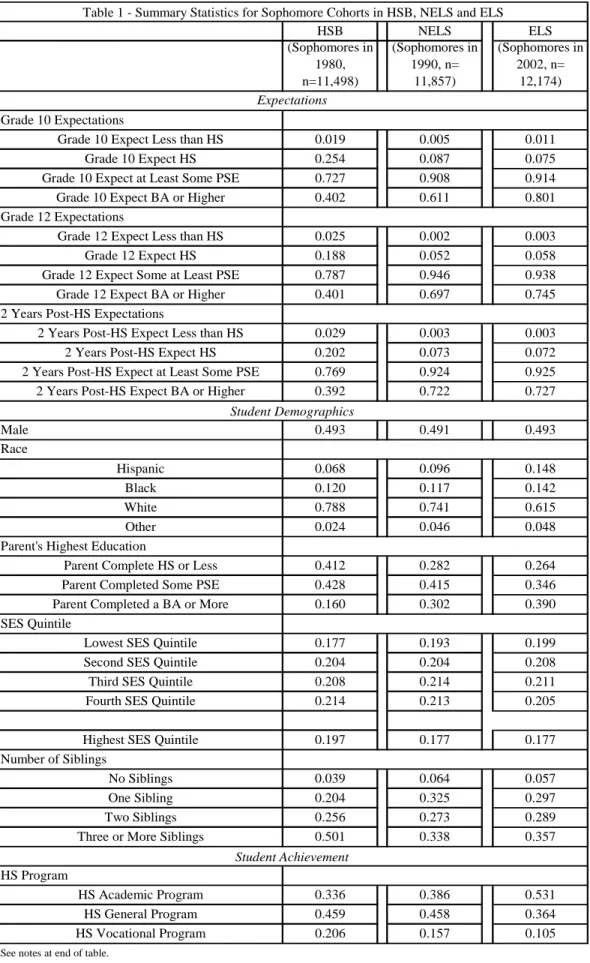
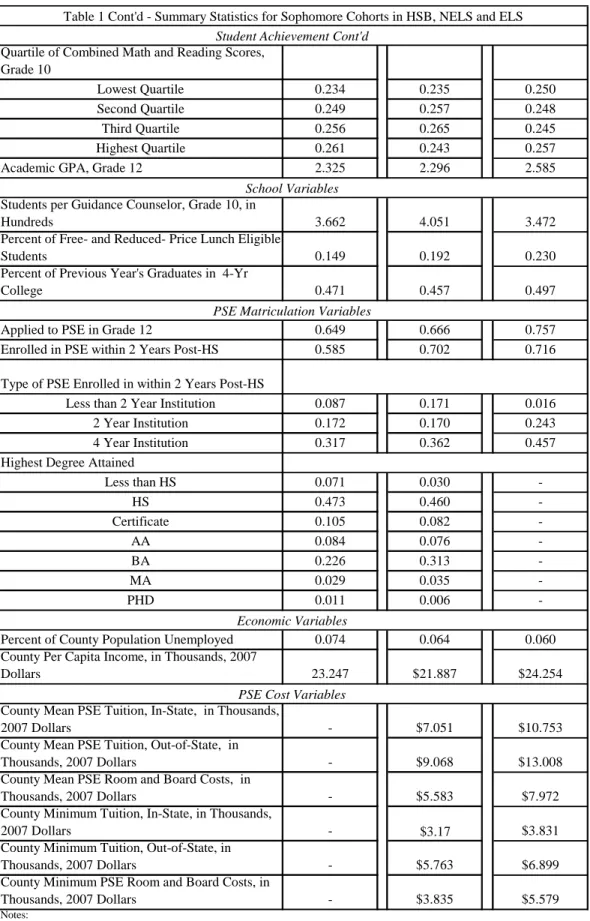
Table 1 presents the summary statistics from this three-cohort analysis sample. Several facts are worth noting. First, there is a sharp increase in the expectations for at least some college between 1980 and 1990, but little change from 1990 to 2002. In contrast, expectations regarding BA completion jumped considerably in all periods. Second, parental education of students increased over this period, particularly from 1980 to 1990. Last, the percent of students enrolling in 4-year post-secondary institutions increased by nearly 50 percent between 1980 and 2002.
In addition to the three-cohort panel, we also utilize the full NELS panel to more carefully examine how students update their expectations. This panel tracks a nationally representative set of eighth graders in 1988 for twelve years, with the final survey administered in 2000, when this cohort was eight years beyond their expected high school graduation date. Table 2 presents summary statistics for this sample. It is worth noting that the sample size varies across waves and outcomes as not all respondents have data for each variable in each wave.
IV. Trends in Educational Expectations
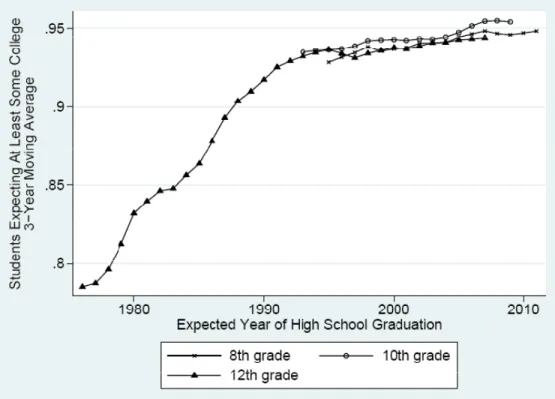
To begin, we present data on how educational expectations have evolved over the past several decades. As noted above, most prior research has utilized survey data from high school students in the early 1980s (HSB) and early 1990s (NELS). In Figure 2, we present similar data on educational expectations from the Monitoring the Future (MTF) survey, which has regularly surveyed nationally representative cohorts of students since 1976. This data not only allows us to extend our analysis beyond the scope of HSB and NELS, but also provides a useful cross-check on the reliability expectations data. To minimize the impact of sampling variability, we present three-year moving averages.
In the top panel, we see that in 1976, roughly 77 percent of high school seniors expected to complete at least some college. This fraction rose dramatically until the late 1990s, at which point about 93 percent of seniors expected to complete at least some college. Comparing the trends for eighth and tenth graders with those for twelfth graders, we see that on average, students’ expectations with respect to some college did not change during high school.
In the bottom panel, we see a similar pattern for the fraction of high school seniors expecting to complete at least a BA degree. Expectations increased rapidly from the 1970s through the mid-1990s, and somewhat less rapidly (but nonetheless steadily) from the mid-1990s through the present. At the same time, we see that on average students lower their expectations between eighth and twelfth grade. Among the class of 2006, for example, roughly 90 percent of students believed as eighth graders that they would complete a BA. But by the time that this cohort had reached twelfth grade, only a little more than 80 percent expected to attain a BA.
Comparing these trends to the statistics shown in Table 1, there appears to be a relatively good correspondence between the various data sets. Roughly 80 percent of the HSB cohort
believed that they would attain at least some college compared with about 85 percent in MTF, but only 40 percent believed that they would attain a BA (compared with 58 percent in MTF). Among the ELS cohort, who were seniors in 2004, 94 percent expected at least some college and 75 percent expected a BA (compared with about 95 percent and 80 percent in the MTF data).
Figures 3 and 4 show comparable trends for several different subgroups, focusing on twelfth graders. Figures 3a and 3b show trends by race and gender. Black females had noticeably higher expectations than all other groups at the beginning of the sample period (the late 1970s and early 1980s), with over 85 percent black female students reporting that they expected to attain at least some postsecondary education compared with roughly 78 percent among the other groups. Expectations among all groups increased sharply during the 1980s and 1990s, though both white and black females reported higher expectations than white and black males. For example, in 2006 over 95 percent of young women in twelfth grade expected to attain at least some postsecondary education compared with only slightly more than 90 percent of young men. Similar trends are apparent for expectations regarding BA completion shown in Figure 3b.
Figure 4 shows similar trends for males and females who come from more versus less advantaged backgrounds. In the mid-1970s, students whose parents had a BA degree had substantially higher educational expectations than their peers. About 75 percent of males and females with college educated parents expected a BA, while only 41 percent of females and 45 percent of males whose parents had less than a BA expected to do so. Interestingly, there was little difference in expectations of at least some college across gender within the parental education groups shown in this figure. However, by the mid-2000s with parental education groups, fewer males expected to attain a BA than did females. During the past thirty years,
expectations for all groups have risen steadily, but it is striking that the expectations of young women (from both more and less advantaged backgrounds) have risen more rapidly than the expectations of young men. In fact, the percent of females whose parents had less than a high school degree expecting a BA doubled between the mid- 1970s and mid-2000s, increasing from 41 percent to 82 percent.
V. The Relationship between Educational Expectations and Actual Enrollment
Researchers in the 1970s identified educational expectations as an important predictor of educational and occupational attainment (Duncan, Featherman and Duncan, 1972; Sewell, Haller,
and Ohlendorf, 1970; Sewell, Haller, and Portes, 1969; Sewell and Hauser, 1972).4 Even after
conditioning on an extensive set of family background characteristics, educational expectations are strongly correlated with educational attainment (Duncan, Featherman, & Duncan, 1972; Sewell & Hauser, 1980; Sewell, Hauser, & Wolf, 1980; Sewell & Shah, 1967).5
Of course, this correlation does not necessarily imply that expectations have a causal impact on attainment. The positive correlation may simply reflect the fact that individuals have better information about their future path than can be captured with the measures commonly available in the data used by researchers. For example, an individual may have access to money for college from a relative that does not show up in the family income measures available in standard datasets. Alternatively, some students with mediocre grades and test scores
undoubtedly have greater academic potential than others with similar high school performance. If those with greater “unobserved potential” indicate higher educational expectations, one would
4
Although our analysis explicitly investigates expectations and outcomes, much of the prior research in this area blurs the distinction concepts of expectations and aspirations. Because of ambiguity in the literature, unless the author’s explicitly define aspirations as hopes for educational attainment, we use the term expectations opposed to aspirations even in cases where the original researcher used aspirations.
5
The unconditional correlation between educational expectations and educational attainment tends to be on the order of .6 to .7 (Sewell, Hauser, and Wolf, 1980; Teachman, 1987).
find a positive correlation due to the presence of this unobserved factor and not because of the independent causal power of expectations themselves. In the analyses that follows, we not only document the relationship between expectations and attainment, but take considerable pains to assess, as best as possible, whether the documented relationship is causal or not.
To examine the relationship between expectations and enrollment, in Table 3 we present results from regressions of postsecondary enrollment on tenth grade expectations and other background variables. The top panel presents OLS estimates where the dependent variable is enrolled in any postsecondary institution whereas the bottom panel presents estimates where the dependent variable is enrolled in a four-year institution. Columns 1-3 show estimates in which the only predictors are tenth grade expectations. Columns 4-6 present estimates from a model that includes as predictors all family background variables, student demographics, and school and county characteristics.
In columns 1-3, we see that tenth grade expectations are indeed strong predictors of enrollment. For example, in the 2002 cohort of tenth graders, students who expected to attain at least some college were 23 percentage points more likely to be enrolled in postsecondary
education than their peers who expected to attain at most a high school degree. Interestingly, however, nearly 27 percent of students who, as tenth graders, did not expect to attain any college were enrolled in college within two years of their expected high school graduation. Similarly, students in this cohort who expected to attain a BA degree were roughly 41 percentage points more likely to be enrolled in a four-year college. Again, it is interesting to note that roughly 7 percent of students with no expectations of college report being enrolled in a four-year college in the second follow-up survey.
Even after we control for a host of individual, family and school characteristics, tenth grade expectations are strongly predictive of eventual enrollment (columns 4-6). For example, among the 2002 cohort of tenth graders, students who expected to attain at least some college were about 14 percentage points more likely to be enrolled in postsecondary education than their peers who expected to attain at most a high school degree. Similarly, students in this cohort who expected to attain a BA degree were roughly 16 percentage points more likely to be enrolled in a four-year college.
While these results indicate that expectations remain strong predictors of attainment above and beyond other standard determinants of schooling, the data also reveal that
expectations have become somewhat less predictive of attainment over the past several decades. In the 1980 cohort, tenth grade expectations explained roughly 25 percent of the variation postsecondary enrollment. This figure decreased to roughly 20 percent for the 1990 cohort and to roughly 15 percent in the 2002 cohort. The pattern is similar for BA attainment. One reason for the decreasing explanatory power of expectations is that variance of expectations decreased by about one-third between 1980 and 2002.
However, determining the causality in this association is difficult. Omitted variables
such as family wealth, personal connections or talent (athletic, musical, artistic) may be driving the apparent relationship between expectations and attainment. Additionally, the potential for reverse causality between expectations and the predictors is strong. For example, student grades directly affect both expectations and attainment but expectations may also affect grades such that as expectations increase students earn higher grades. The causal loop between expectations and grades makes it difficult to determine the primary mechanism (that is, grades or expectations) through which these two variables affect attainment.
To further examine the relationship between expectations and enrollment and attainment, we estimate increasingly comprehensive specifications for attainment using data from the
sophomore class of 1990. These results, shown in Table 4, come from OLS regressions. Panels A and B document the effects of expectations on enrollment and panels C and D show how expectations affect attainment. The coefficients on the expectations variables in the enrollment panels (A and B) are larger than those in attainment panels (C and D), but expectations remain strong predictors of attainment. Within each panel, each successive column includes additional predictors to demonstrate the robustness of the expectations effect. We see that the inclusion of family background and individual demographics in column 2 in each panel reduces the effect of expectations on both enrollment and attainment only slightly. The inclusion of high school achievement measures in column 3, however, dramatically reduces the coefficients on the expectations variables in each of the panels. Interestingly, the inclusion of a variety of non-achievement measures (column 4) including personality characteristics such as self-esteem and locus of control as well as behavioral measures (for example, TV watching, homework
completion, suspensions, etc) have very little, if any, effect on the relationship between
expectations and enrollment and attainment. Similarly, the coefficients on expectations decrease only slightly when measures of school characteristics (column 6) or school fixed effects (column 5) are added. The inclusion of county-level demographics and college cost variables (column 7) also do not influence the relationship between expectations and attainment. The fact that the inclusion of an increasingly rich set of observable characteristics does not change the
relationships between expectations and enrollment and expectations and attainment lends credence to the view that expectations themselves may directly influence attainment.
In a further attempt to dissect the relationship between expectations and attainment, Table 5 shows results from OLS regressions of various tenth grade behaviors on eighth grade
expectations. If expectations had a causal impact on attainment, one would expect them to also predict a host of mediating mechanisms such as time spent on homework, and high school GPA. Of course, the existence of a relationship between early expectations and subsequent behaviors
associated with schooling success does not by any means prove that expectations influence
attainment. But the absence of such relationships would be troubling. The results in Table 5 show that college expectations are positively associated with academic outcomes such as GPA, hours of homework per week and type of high school program, but are not related to self-reported absenteeism, self-self-reported TV watching, parent-self-reported behavior problems, or personality measures such as self-esteem and locus of control. While the results are somewhat mixed overall, the GPA and homework results are consistent with expectations having a causal impact on achievement and attainment.
It is important to recognize, however, that the results presented in Tables 3, 4, 5 are merely suggestive of a causal relationship between expectations and college enrollment and completion. Without a randomized assignment experiment in which all potential confounding factors are controlled for, we cannot be fully confident that increasing expectations will lead to college enrollment and completion.
VI. Understanding the Gap between Expectations and Attainment
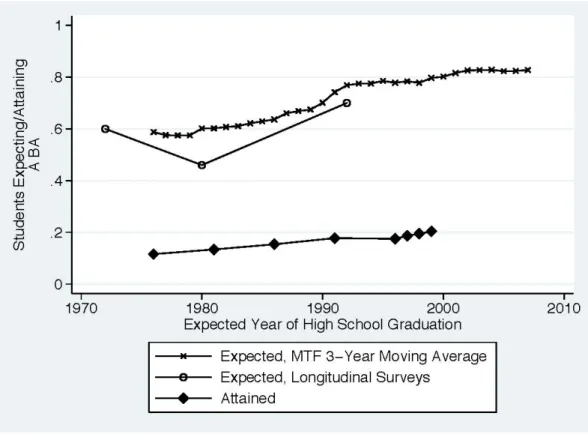
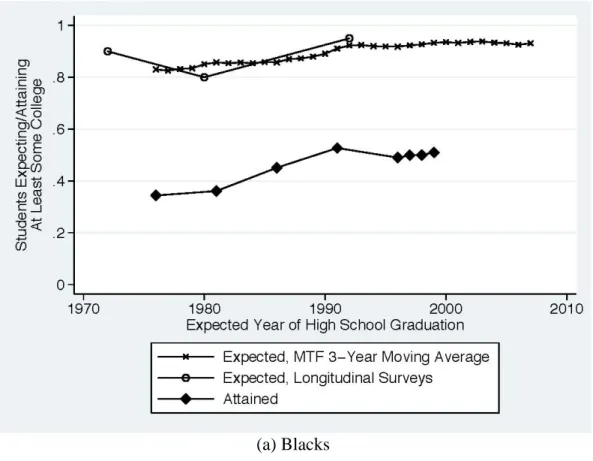
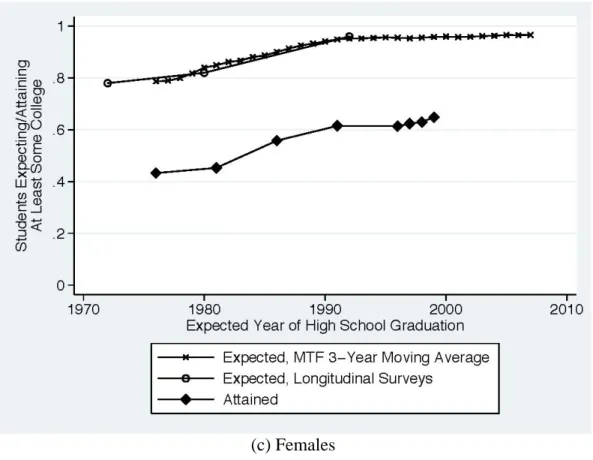
Prior literature has documented a substantial gap between the expectations and actual attainment of young people. Figures 5 and 6 document the trends, by race and gender, in both
expectations and BA attainment.6 Although expectations of a bachelor’s degree steadily
increased from about 60 percent in the early 1970s to over 80 percent by 2000, attainment of
6
such a degree did not rise accordingly for Blacks or whites. In fact, the percent of Blacks and males completing a BA has remained fairly constant over this time period. A greater proportion of females and whites have completed a BA today than in the early 1970s but the rising trend has not kept pace with increases in expectations.
Understanding why students’ educational expectations are much higher than actual attainment is important if it is desirable to change individuals’ expectations in an effort to attain more optimal outcomes. The first step in doing this is to understand how young people form educational expectations. Expectation formation is a complex process: individuals do not have access to the same information and likely weight various factors differently in determining expectations (Manski, 1993).
Determinants of Educational Expectations
Prior research documents a variety of factors that are associated with educational expectations, including children’s own abilities and school experiences (Duncan, Featherman, and Duncan, 1972; Hoelter, 1982; Sewell, Haller, and Portes, 1969; Teachman and Paasch, 1998) family characteristics such as parental educational attainment and income (Duncan, Featherman and Duncan, 1972; Kao and Tienda, 1998; Sewell, Haller, and Ohlendorf, 1970; Sewell, Haller, and Portes, 1969; Teachman and Paasch, 1998) and neighborhood characteristics (Teachman and Paasch, 1998). One means by which parental income likely influences children’s educational expectations is by the ability to pay for post-secondary education (Astone and McLanahan, 1991; McLanahan and Bumpass 1988). Parental involvement, as evidenced by activities such as monitoring their child’s homework, offering encouragement about school related activities and providing academic enrichment materials at home, is positively related to expectations (Astone and McLanahan, 1991; Kao and Tienda, 1998; Schneider and Stevenson, 1999). Additionally,
parents’ educational expectations for their children affect the children’s educational expectations
(Davies and Kandel, 1981; Schneider and Stevenson, 1999).7 A child’s community is important
for the development of expectations because it determines the types of interactions the child has with peers and other adults (Teachman and Paasch, 1998).
Much of the literature focuses on the influence of teacher encouragement and
expectations and peer expectations, finding significant positive effects of both on expectations (Davies and Kandel, 1981; Duncan, Featherman and Duncan, 1972; Hoelter, 1982; Kiuru, Aunola, Vuori and Nurmi, 2006; Schneider and Stevenson, 1999; Sewell, Haller, and Ohlendorf, 1970; Sewell, Haller, and Portes, 1969). Similarly, when neighborhoods are socially,
economically, and racially segregated, expectations may be depressed. Children growing up in neighborhoods of concentrated disadvantage likely do not have exposure individuals similar to themselves and their families with high levels of educational attainment. Consequently, children lack information about educational and occupational opportunities and may be unaware of the economic benefits to educational attainment. (Ogbu, 1991; Stewart, Stewart, and Simmons, 2007; Streufert, 1991; Wilson, 1987).
While the prior literature has documented strong correlations between the individual, family and neighborhood characteristics and children’s educational expectations, it is not at all clear that one should interpret these relationships as causal. For many of the reasons discussed above, it may be that factors omitted from the statistical models explain the observed relationship. For example, the value parents place on higher education influences the neighborhood in which a child lives and the schools he or she attends, and may explain a child’s expectations. But it may be hard to observe parents’ value of education, which is likely manifest in numerous ways,
7
However, the effect of parental expectations on children’s expectations can easily be overstated when parental expectations are measured via the child’s perception, not the parent’s reported expectations (Davies and Kandel, 1981). Perceived parental expectations in part represent the expectations they are supposed to predict.
making it seem as though other correlated observables such as neighborhood explain a child’s expectations.
Table 6 presents the determinants of tenth grade expectations for the NELS sophomore cohort. The results generally confirm the findings of the prior literature. SES and academic ability are the strongest predictors of expectations. Both SES and academic ability are positively related to expectations such that higher SES students have higher expectations than lower SES students and students with higher test scores and higher GPAs have higher expectations than students with lower academic ability. The only school level variable that affects expectations is enrollment in a private school, and this particularly true when looking at expectations of a BA or more.
Determinants of Misalignment
With a general understanding of what determines expectations, we can begin to
investigate potential explanations for the gap between expectations and attainment. Researchers have posed multiple explanations of the gap between expectations and attainment. In general, the gap exists because students’ expectations are too high. Expectations are a student’s best guess of their eventual attainment given their ability, family background, school quality, and neighborhood—all factors that determine attainment. Hence, the expectations-attainment gap implies inappropriate or “irrational” expectations given a student’s fixed characteristics and experiences.
Researchers often describe the gap as a problem in course-taking or preparation. While it is true that these factors influence attainment, they do not (technically) explain the gap given our definition of expectations: a student's best estimate of attainment using available information. If the question is how to help students attain their expectations, then these are reasonable paths to
pursue, but they do not offer insight into the causes of the expectations-attainment gap. There are two potential causes of the gap: one, misinformation about costs and/or requirements of college (that is, students expect they will be able to pay for college and easily complete the coursework) or two, an unexpected shock occurs after students form their expectations, which prevents them from attending. Shocks such as changes in family income or illness can be positive as well as negative which would drive the gap in different directions and this is not the pattern found in the data making random shocks an unlikely cause of the gap. The fact that most students attain less education than they expect (the expectations-attainment gap is negative) suggests that misinformation is the cause of the gap. Students have misinformation about the cost of college, the preparation they will need and the difficulty of completing college. Even conditional on adequate preparation and available funding students may simply realize that college is not a good match for them (Orfield and Paul, 1994; Schneider and Stevenson, 1999).
When a student has expectations that are misinformed or the student is unprepared to meet her expectations, sociologists say the student’s expectations are “misaligned.” Aligned expectations are those that fit with other life goals and with ability and those that are stable throughout high school (Schneider and Stevenson, 1999). Economists use slightly different terminology, typically speaking of “rational” expectations or expectations that would result in the largest economic gain for the individual given his/her affinity for schooling (Manski, 1993).
Previous research suggests that some groups are more likely to have misaligned
expectations than others. For example, a study of middle school students in two Massachusetts schools showed that urban students had less alignment between their educational expectations and their educational preparation (for example, college track v. vocational track) and their other life plans (for example, age of marriage and age of pregnancy/children) (Malcolmson, 2007).
In Table 7 we develop a measure of alignment and attempt to discern which students are more or less likely to have aligned expectations. We measure alignment in twelfth grade as the predicted probability of reaching one’s twelfth grade expectations based upon observable twelfth grade characteristics. Specifically, we regressed a binary indicator for a given level of
attainment (for example, BA degree, at least some college, high school) in 2000 (eight years after expected high school graduation) on a host of student, family, school and neighborhood factors measured as of twelfth grade. Using the coefficients from this regression, we predicted the probability that each student would attain the level of education they expected in twelfth grade. This prediction becomes the alignment measure for the student. For example, if a student expected to attain a BA degree, but the predicted likelihood of this is only .36, the student’s expectations are not particularly well aligned. If a student only expected to complete some college, then we use the predicted probability that she or he will attain at least some college as the measure of alignment. (Note that in this way we consider misalignment in a positive direction – predicted to attain more education than expected – the same as alignment.) Students assigned a higher value on our alignment measure are more likely to reach their expectations and low alignment values correspond to a low probability of reaching one’s expectations and a greater degree of misalignment.
Table 7 displays the results of a series of multilevel models estimating what affects expectation alignment in twelfth grade. With the full set of predictors (Column 5) the results show that lower SES students are less likely to reach their expectations and high achieving students are more likely to reach their expectations. Not surprisingly, students in larger schools and those with greater proportions of student eligible for free- and reduced-priced lunch are less likely to reach their expectations, and as the average test score in a school rises so too does the
likelihood that a student a within that school will reach her expectations. Positively, students with more “aligned” expectations—higher predicted probabilities of reaching their
expectations—in eighth grade are more likely to reach to their twelfth grade expectations. This finding highlights the importance of developing realistic and informed expectations early in a student’s academic career.
Perhaps, schools can play a role solidifying the link between expectations and attainment. The bottom of Column 1 shows that about thirty percent of the variance in the predicted
probability of reaching twelfth grade expectations schools can be explained by schools. Yet, once student characteristics such as demographics, family background variables, and academic ability are added to the model, schools only explain only seven percent of the variance in misalignment. Observable school characteristics such as the percent of free- and reduced-price lunch students, school size, and the number of students per guidance counselor account for about 3 percent of school level explained variance, leaving about 4 percent of the total variance in misalignment unexplained at the school level. Schools appear to be only minimally capable of helping students develop aligned expectations. Students’ own characteristics explain
misalignment much more than which high school they attended. VII. Informed Educational Expectations
Much of the expectations literature questions students’ abilities to develop informed expectations, arguing that individuals often do not have the information needed to form aligned expectations or to accurately calculate the returns to schooling (Manski, 2004; Orfield and Paul, 1994; Schneider and Stevenson, 1999). However, recent research suggests that college students may indeed update their expectations based on knowledge about their academic ability gained during school (Stinebrickner and Stinebrickner, 2009; Zafar, 2009). Stinebrickner and
Stinebrickner (2009) follow Berea College students from entrance through each semester of persistence, tracking their expected and actual performance. They find that students update their expectations based on their actual grade performance, with students whose performance is
significantly lower than expected being more likely to drop-out than students whose performance is as expected or better than expected. Zafar (2009) studied the expectations of college students at Northwestern University and found evidence of updating consistent with Stinebrickner and Stinebrickner (2009). Specifically, Zafar (2009) found that students revise their expectations of future GPAs based on their prior GPAs. Perhaps more interestingly, Zafar (2009) found that individuals are more likely to make revisions to expectations with higher degrees of uncertainty such as workplace outcomes than to revise expectations that are initially held with certainty such as parental approval and college completion.
To date, the literature has not investigated how high school students update their
expectations. The data presented in Figures 2a and 2b showing that students lower expectations of BA completion from eighth to twelfth grade provides some evidence that students do change their expectations as they move through the educational process, acquiring new information. If high school students do update their expectations based new information, policy interventions designed to help high school students develop rational/realistic expectations may be successful. In this section, we analyze NELS data to determine if, when, and why high school students update their expectations.8
Table 8 provides descriptive statistics on updating. Each row presents statistics on a different time period, with the fraction of students shown in the cells and the number of observations in square brackets. In row 1, we see that roughly 61 percent of students changed
8
Because the NELS is the most longitudinally comprehensive of the NCES surveys, spanning from eighth grade to eight years after expected high school graduation, we rely exclusively on the NELS to analyze updating behavior
expectations at least once between 1988 and 2000, with 24 percent changing exactly twice and 14 percent changing three or more times. (Note that students were surveyed in five years – 1988, 1990, 1992, 1994 and 2000 – so that a maximum of four changes that can be captured in this data. To the extent that students update more frequently, we may be understating the extent of
instability in expectations.) Perhaps not surprisingly, considerably more students lowered their expectations between 1988 and 2000 (29 percent) than raised their expectations (13 percent).9 Row 2 shows that virtually all students who changed over the entire period did so at least once in the first six years from 1988 to 1994. This makes sense insofar as one might expect that students learn a great deal about their potential success in college during and immediately following high school. Interestingly, if one compares expectations in eighth grade with expectations six years later, we see that slightly more students increased their expectations (19 percent) than decreased (15 percent). However, between 1994 and 2000, 28 percent of young people lowered their expectations compared with 6 percent who increased them and roughly 66 percent who did not change their expectations (row 3).
Looking within the high school years, we see that 35 percent of students changed their expectations between eighth and tenth grades. Interestingly, 13 percent increased their
expectations during this period while 22 percent lowered their expectations. Between tenth and twelfth grades, roughly 15 percent of students raised their expectations while 10 percent lowered their expectations (and 75 percent did not change their expectations).
Given that students frequently change their expectations during high school and that updating is not a random process, as students are more likely to update downward, we examine
9
Note that the sample used to calculate the statistics in columns 7 and 8 differs somewhat from the sample used to calculate the statistics in columns 1-6. This is because in order to have data in columns 7-8, respondents must have had non-missing expectations data in both 1988 and 2000, whereas in order to have data in columns 1-6,
respondents only had to have non-missing expectations data in two (or more) of the five survey waves from 1988 to 2000.
the nature of updating. We first explore whether students with in certain schools are more likely to update than others. Table 9 presents results from OLS regressions of updating on various individual characteristics. We include high school fixed effects, so that we identify the
relationships off of variation within each of the 1,016 schools included in the NELS eighth grade survey.10
SES and academic achievement are the strongest predictors of updating. Eighth graders in the lower SES quintiles update more than students in the highest SES quintile and males update more often than females. In fact, students in the lowest SES quintile are about 50 percent more likely to have updated their expectations than students in the highest SES quintile. Lower achieving students are also predicted to update more often than higher achieving students. More disadvantaged youth (in terms of family income and academic achievement) update their
expectations more often than peers. These socio-economically and academically disadvantaged students start out with extremely high expectations and, in general, lower them during high school. Interestingly, students with lower scores on indices of self-concept and locus of control and those that complete fewer hours of homework of per week are also more likely to update at least once between eighth and twelfth grade than students with high scores on the indices and those completing more hours of homework. Interestingly, the F-test for joint significance of the school fixed effects shows that schools seem to matter only in terms of updating expectations at least once between eighth and twelfth grade, but not for updating twice. This result suggests that serial updaters—those updating twice between eighth and twelfth grade—are influenced more by individual student and family characteristics rather than schools.
10
On average there are eighteen students per school. The minimum number of students at a school is one and the maximum number of students is fifty-eight. The schools at the twenty-fifth percentile have fourteen students and
Next, we investigate whether or not students update in a systematic way based on the acquisition of new information. To do so, we estimate the determinants of updating with panel data models and student fixed effects. These models essentially examine whether within-student changes in factors such as academic performance are systematically associated with within-student changes in educational expectations. The results in Table 10 demonstrate that changes in GPA are positively associated with changes in expectations, but that changes in test scores and SES are not associated with changes in expectations. When looking only at expectations for a BA, changes in test scores become positively associated with expectations in the models
spanning from eighth grade (1988) to twelfth grade and beyond (1992 and 1994). Having a child is a strong predictor of decreasing expectations.
Table 11 presents results separately for a variety of subgroups. Interestingly, students in the two lowest SES quintiles do not seem to update expectations based upon changes in GPA. Yet, GPA has the strongest association with updating for minority students and those in the fourth and fifth SES quintiles. For minorities, a one standard deviation increase in GPA is associated with over one-tenth of point increase in expectations, or about a 5 percent increase. The same increase in GPA is predicted to increase the expectations of students in the fourth and fifth SES quintiles by almost one-tenth of a point (about a 3.5 percent increase). Although negatively associated with the expectations of all groups, having a child is particularly
detrimental to the overall expectations of minorities and those in the middle SES quintile and the highest test score quartile; having a child is associated with almost a 9 percent decrease in expectations for minorities (.223 points), a 7 percent decrease in the highest SES quintile (.183 points), and a 10 percent decrease for students with the highest test scores (.292 points).11
11
To check the panel analysis assumptions we ran the 1988-1990 full model with the cross-sectional data, and found even stronger statistically significant relationships between expectations and GPA and expectations and test scores.
The bottom of Table 11 displays the results of changing academic and family
characteristics on the expectation of a BA by subgroups. The results are generally similar to those reported in the top panel, but a few differences are noteworthy. Changes in test scores are positively associated with expectations of a BA for males, whites, and those in the second test score quartile. The magnitudes of these relationships are small, but statistically significant. In general, almost all groups seem to update in the predicted directions based on changes in GPA and changes in parent status, but some groups are more affected by these changes than others. Interestingly, students in the middle of the SES distribution (that is, in the third and fourth quintiles) and students in the tails of the test score distribution seem to be the most influenced by changes in academic achievement. These results lend support to the conclusion that students develop informed expectations, relying mostly upon their own academic achievement to determine their college expectations. Yet, many students still do not reach their expectations, suggesting that the updating that takes place during high school based upon academic
achievement is not sufficient to link expectations to attainment.
Misunderstandings with regard to the costs of college may contribute to the observed expectations-attainment gap. Although, economic circumstances have not played a large role in the models thus far, the costs of college are the focus of many studies investigating barriers to college entry and completion, and states have control over the costs of their public higher
education institutions. Beginning in the early 1990s states began adopting broad based merit aid programs that award tuition and fees to student residents that meet a fairly low threshold of academic achievement, such as a high school GPA of 3.0 (Dynarski, 2004). The adoption of statewide merit aid programs was a dramatic shift from prior aid programs that at the federal level consisted mostly of need based aid (that is, Pell Grants and Stafford Loans) and at the state
level occurred mainly as subsidies to public universities to keep tuition and fees low (Dynarksi, 2004).12 Research suggests that broad based statewide merit aid programs have the potential to increase college enrollment. The literature concludes that a $1,000 decrease in college tuition is associated with about a 3.5 percent increase in enrollment (Dynarksi, 2003; Kane, 1995; Leslie and Brinkman, 1987).
Expectations may be a mediating factor between state merit aid programs and college enrollment. For this reason, Table 12 demonstrates the effects of state-run broad based merit scholarship programs on the expectations of two cohorts, the sophomore classes of 1990 and 2002. Controlling for state fixed effects, changes in the cost of college based upon the
implementation of a statewide merit aid program do not appear to influence student expectations for college. Because almost all sophomores in 1990 and 2002 expected to attend at least some college, the adoption of a statewide merit aid program may have provided the impetus for more of these students to act upon their high expectations and enroll in college, instead of raising the expectations of the10 percent of students who did not expect to attend any post-secondary education.
VIII. Conclusion
Expectations increased substantially since the early 1980s, but seem to have leveled off
with almost everyone expecting at least some college. Individual, family background and school
characteristics have become less predictive of student expectations over time. Expectations have become somewhat less predictive of attainment but remain strong predictors of attainment above and beyond other standard determinants of schooling. Determined largely by factors outside of the school walls, expectations do appear to have an important influence on college enrollment
12
Merit aid programs did exist at both the federal and state levels prior to the early 1990s but these programs were very small and targeted at the very highest performing students such as the National Merit Scholarship.
and persistence. Over 60 percent of students update their expectations at least once between
eighth grade and eight years post-high school. Updating seems to be somewhat based on
acquisition of new information, particularly ability, especially for marginal students in terms of college entry. Early alignment of expectations is predictive of greater likelihood of reaching later expectations. Demographic characteristics of students and schools explain away a substantial portion of the between school variation in the likelihood of students reaching their expectations. State policies decreasing the costs of college do not seem to influence student expectations.
These results suggest that to generate a cohort of students with expectations likely to lead to enrollment and persistence in post-secondary education, policies should be directed at helping middle school students attain their maximum academic potential. Students rely on knowledge of their academic ability to develop and maintain their expectations, lowering their expectations when presented with indicators of lower academic ability and raising their expectations when given signals of higher academic ability.
References
Astone, Nan M. and Sara S. McLanahan. 1991. “Family Structure, Parental Practices, and High
School Completion.” American Sociological Review 56(3): 309-320.
Blau, Peter M. and Otis D. Duncan. 1967. The American occupational structure. New York:
John Wiley & Sons.
Davies, Mark and Denise B. Kandel. 1981. “Parental and Peer Influences on Adolescents’
Educational Plans: Some Further Evidence.” American Journal of Sociology. 87(2):
363-387.
Duncan, Otis D., David L. Featherman, and Beverly Duncan. 1972. Socioeconomic background
and achievement. New York: Seminar Press.
Dynarski, Susan M. 2003. “Does Aid Matter? Measuring the Effect of Student Aid on College
Attendance and Completion.” The American Economic Review. 93 (1): 279-288.
Dynarski, Susan M. 2004. “The New Merit Aid.” In College Choices: The Economics of Where
to Go, When to Go, and How to Pay for It, edited by Caroline M. Hoxby. Chicago: The
University of Chicago Press.
Goldin, Claudia D. and Lawrence F. Katz. 2007. “Long-Run Changes in the Wage Structure:
Narrowing, Widening and Polarizing.” Brookings Papers on Economic Activity 2: 135-
165.
Hanson, Sandra L. 1994. “Unrealized Educational Aspirations and Expectations Among U.S.
Youths.” Sociology of Education 67(3): 159-183.
Hu, Shouping. 2003. “Educational Aspirations and Postsecondary Access and Choice: Students
in Urban, Suburban, and Rural Schools Compared.” Education Policy Analysis Archives,
11(14).
Hoelter, Jon W. 1982. “Segregation and Rationality in Black Status Aspiration Processes.” Sociology of Education 55(1): 31-39.
Kane, Thomas J. (1995, July). “Rising Public College Tuition and College Entry: How Well Do
Public Subsidies Promote Access to College?” NBER Working Paper Series. Working
Paper No. 5164.
Kao, Grace and Marta Tienda. 1998. “Educational Expectations of Minority Youth.” American
Journal of Education. 106(3): 249-384.
Kiuru, Noona, Kaisa Aunola, Jukka Vuori, and Jari-Erik Nurmi. 2007. “The Role of Peer Groups
in Adolescents’ Educational Expectations and Adjustment.” Journal of Youth and
Leslie, Larry L. and Paul T. Brinkman. 1987. “Student Price Response in Higher Education: The
Student Demand Studies.” The Journal of Higher Education 58 (2): 181-204.
Malcolmson, Carole N. 2007. Neighborhood, parents, no one: Home networks inform young
adolescents’ status attainment goals. Dissertation. Harvard University.
Manski, Charles F. 1993. “Adolescent Econometricians: How Do Youth Infer the Returns to
Schools?” In Studies of Supply and Demand in Higher Education edited by Charles
Clotfelter and Michael Rothschild. Chicago: University of Chicago Press.
______. 2004. “Measuring Expectations.” Econometrica 72(5): 1329-1376.
McCarron, Graziella P. and Karen K. Inkelas. 2006. “The Gap Between Educational Aspirations and Attainment for First Generation College Students and the Role of Parental
Involvement.” Journal of College Student Development 47(5): 534-549.
McLanahan, Sara S. and Larry Bumpass. 1988. “Intergenerational Consequences of Family
Disruption.” American Journal of Sociology 94(1):130-52.
Ogbu, John U. 1991. “Low School Performance as an Adaptation: The Case of Blacks in
Stockton, California.” In Minority status and schooling: A comparative study of
immigrants and in voluntary minorities edited by Margaret A. Gibson & John U. Ogbu. New York: Garland.
Orfield, Gary and Faith G. Paul. 1994. High Hopes, Long Odds: A Major Report on Hoosier
Teens and the American Dream. Indianapolis, IN: Indiana Youth Institute.
Schneider, Barbara and David Stevenson. 1999. The Ambitious Generation: America’s
Teenagers Motivated but Directionless. New Haven, CT: Yale University Press.
Sewell, William H., Archibald O. Haller, and George W. Ohlendorf. 1970. “The Educational and
Early Occupational Status Attainment Process: Replication and Revision.” American
Sociological Review 35(6): 1014-27.
Sewell, William H., Archibald O. Haller, and Alejandro Portes. 1969. “The Educational and
Early Occupational Attainment Process.” American Sociological Review 34(1): 82-92.
Sewell, William H. and Robert M. Hauser. 1972. “Causes and Consequences of Higher
Education: Models of the Status Attainment Process.” American Journal of Agricultural
Economics 54(5): 851-861.
Sewell, William H. and Vimal P. Shah. 1967. “Socioeconomic Status, Intelligence, and the
Sewell, William. H., Robert M. Hauser, and Wendy C. Wolf, W. 1980. “Sex, Schooling and
Occupational Status.” American Journal of Sociology 86(3): 551-583.
Stewart, Endya B., Eric A. Stewart, and Ronald L. Simons. 2007. “The Effect of Neighborhood
Context on the College Expectations of African American Adolescents.” American
Educational Research Journal 44(4): 896-919.
Stinebrickner, Todd. and Ralph Stinebrickner. 2008. “Learning About Academic Ability and College Drop-Out Decision.” Working Paper, University of Western Ontario.
Streufert, Peter. 1991. “The Effect of Social Isolation on Schooling Choice.” Working Paper, Institute for Research on Poverty.
Teachman, Jay D. 1987. “Family Background, Educational Resources, and Educational
Attainment.” American Sociological Review 52: 548-557.
Teachman, Jay D. and Kathleen Paasch. 1998. “The Family and Educational Expectations.”
Journal of Marriage and the Family 60(3): 704-714.
U.S. Census. (2008). Educational Attainment in the United States: 2008. Detailed Tables.
http://www.census.gov/population/www/socdemo/education/cps2008.html
Wilson, William. J. 1987. The Truly Disadvantaged: The Inner City, the Underclass, and Public
Policy. Chicago: University of Chicago Press.
_____. 1996. When Work Disappears: The World of the New Urban Poor. New York: Vintage
Books.
Zafar, Basit. 2009. “How Do College Students Form Expectations?” Working Paper, Federal Reserve Bank of New York.
Figure 1: Relationship between Educational Expectations and Educational Attainment Neighborhood Role Models Peers Family SES Parental Education Marital Status Household Composition Individual Ability Achievement Attention Behavior Motivation School Quality Program Peers Teachers Costs College Tuition Returns to College Degree
Take SAT/ACT Apply to College Apply for Financial Aid Educational Attainment Educational Expectations Placement in College-Prep HS Program
Figure 2: Expected Education by Grade and Year
(a) At Least Some College
Figure 3: Expected Education Among twelfth Graders by Race and Gender
(a)At Least Some College
Figure 4: Expected Education Among twelfth graders by SES and Gender
(a) At Least Some College
Figure 5: Expectations and Attainment of BA (a) Blacks
Figure 5 con’t. (c) Females (d) Males
Figure 6: Expectations and Attainment of At Least Some College
(a) Blacks
Figure 6 cont’d.
(c) Females
(d) Males
HSB NELS ELS (Sophomores in 1980, n=11,498) (Sophomores in 1990, n= 11,857) (Sophomores in 2002, n= 12,174) Grade 10 Expectations
Grade 10 Expect Less than HS 0.019 0.005 0.011
Grade 10 Expect HS 0.254 0.087 0.075
Grade 10 Expect at Least Some PSE 0.727 0.908 0.914
Grade 10 Expect BA or Higher 0.402 0.611 0.801
Grade 12 Expectations
Grade 12 Expect Less than HS 0.025 0.002 0.003
Grade 12 Expect HS 0.188 0.052 0.058
Grade 12 Expect Some at Least PSE 0.787 0.946 0.938
Grade 12 Expect BA or Higher 0.401 0.697 0.745
2 Years Post-HS Expectations
2 Years Post-HS Expect Less than HS 0.029 0.003 0.003
2 Years Post-HS Expect HS 0.202 0.073 0.072
2 Years Post-HS Expect at Least Some PSE 0.769 0.924 0.925
2 Years Post-HS Expect BA or Higher 0.392 0.722 0.727
Male 0.493 0.491 0.493 Race Hispanic 0.068 0.096 0.148 Black 0.120 0.117 0.142 White 0.788 0.741 0.615 Other 0.024 0.046 0.048
Parent's Highest Education
Parent Complete HS or Less 0.412 0.282 0.264
Parent Completed Some PSE 0.428 0.415 0.346
Parent Completed a BA or More 0.160 0.302 0.390
SES Quintile
Lowest SES Quintile 0.177 0.193 0.199
Second SES Quintile 0.204 0.204 0.208
Third SES Quintile 0.208 0.214 0.211
Fourth SES Quintile 0.214 0.213 0.205
Highest SES Quintile 0.197 0.177 0.177
Number of Siblings
No Siblings 0.039 0.064 0.057
One Sibling 0.204 0.325 0.297
Two Siblings 0.256 0.273 0.289
Three or More Siblings 0.501 0.338 0.357
HS Program
HS Academic Program 0.336 0.386 0.531
HS General Program 0.459 0.458 0.364
HS Vocational Program 0.206 0.157 0.105
Student Achievement
Table 1 - Summary Statistics for Sophomore Cohorts in HSB, NELS and ELS
Expectations
Quartile of Combined Math and Reading Scores, Grade 10 Lowest Quartile 0.234 0.235 0.250 Second Quartile 0.249 0.257 0.248 Third Quartile 0.256 0.265 0.245 Highest Quartile 0.261 0.243 0.257
Academic GPA, Grade 12 2.325 2.296 2.585
Students per Guidance Counselor, Grade 10, in
Hundreds 3.662 4.051 3.472
Percent of Free- and Reduced- Price Lunch Eligible
Students 0.149 0.192 0.230
Percent of Previous Year's Graduates in 4-Yr
College 0.471 0.457 0.497
Applied to PSE in Grade 12 0.649 0.666 0.757
Enrolled in PSE within 2 Years Post-HS 0.585 0.702 0.716
Type of PSE Enrolled in within 2 Years Post-HS
Less than 2 Year Institution 0.087 0.171 0.016
2 Year Institution 0.172 0.170 0.243
4 Year Institution 0.317 0.362 0.457
Highest Degree Attained
Less than HS 0.071 0.030 -HS 0.473 0.460 -Certificate 0.105 0.082 -AA 0.084 0.076 -BA 0.226 0.313 -MA 0.029 0.035 -PHD 0.011 0.006
-Percent of County Population Unemployed 0.074 0.064 0.060
County Per Capita Income, in Thousands, 2007
Dollars 23.247 $21.887 $24.254
County Mean PSE Tuition, In-State, in Thousands,
2007 Dollars - $7.051 $10.753
County Mean PSE Tuition, Out-of-State, in
Thousands, 2007 Dollars - $9.068 $13.008
County Mean PSE Room and Board Costs, in
Thousands, 2007 Dollars - $5.583 $7.972
County Minimum Tuition, In-State, in Thousands,
2007 Dollars - $3.17 $3.831
County Minimum Tuition, Out-of-State, in
Thousands, 2007 Dollars - $5.763 $6.899
County Minimum PSE Room and Board Costs, in
Thousands, 2007 Dollars - $3.835 $5.579
Notes:
SES is a composite measure of parents' education, parents' occupations, and family income. PSE means post-secondary education.
Data are weighted to be nationally representative.
PSE Cost Variables School Variables
PSE Matriculation Variables
Economic Variables
Table 1 Cont'd - Summary Statistics for Sophomore Cohorts in HSB, NELS and ELS Student Achievement Cont'd
1988 Wave 1990 Wave 1992 Wave 1994 Wave 2000 Wave
Expect Less than HS 0.015 0.025 0.007 0.007 0.024
Expect HS 0.099 0.103 0.052 0.085 0.214
Expect Some PSE 0.886 0.873 0.940 0.908 0.762
Expect BA or Higher 0.666 0.578 0.688 0.695 0.562 Male 0.499 Race Hispanic 0.106 Black 0.119 White 0.726 Other 0.048 SES Quintile
Lowest SES Quintile 0.206
Second SES Quintile 0.200
Third SES Quintile 0.211
Fourth SES Quintile 0.209
Highest SES Quintile 0.175
Number of Siblings
No Siblings 0.062 0.061
One Sibling 0.317 0.319
Two Siblings 0.270 0.270
Three of More Siblings 0.351 0.350
LEP Status 0.023 - - - -Gifted Status - - 0.088 - -HS Program HS Academic Program 0.365 HS General Program 0.470 HS Vocational Program 0.165
Student had child - 0.041 0.044 0.146
-Hours of TV Watched During Week 3.515 3.181 2.734 -
-Hours of Homework During Week 5.748 7.625 13.263 -
-Parent(s) Notified of Behavior at School 0.290 0.150 0.213 -
-Locus of Control (standardized) 0.013 0.021 0.028 -
-Self-Concept (standardized) 0.004 -0.002 0.000 -
-Parent(s) Unemployed 0.111 0.111 0.085 -
-Suspended - 0.089 0.083 -
-Days Absent - 9.893 11.291 -
-Live with 2 Parents 0.666 - 0.616 -
-See notes at end of table.
Table 2 - Descriptive Statistics for NELS 1988-2000 Panel, 8th Grade Cohort
Expectations
Time-Invariant Student Characteristics
Academic GPA (scale 0-4 ) 2.923 2.750 2.288 -
-School Size (in hundreds) 6.482 11.526 11.941 -
-Quartile of Combined Math and Reading Scores
Lowest Quartile 0.242 0.221 0.239 -
-Second Quartile 0.263 0.255 0.256 -
-Third Quartile 0.259 0.269 0.259 -
-Highest Quartile 0.236 0.255 0.246 -
-Students per Guidance Counselor, in Hundreds - 4.100 - -
-Percent of Free- and Reduced- Price Lunch
Eligible Students 0.241 0.199 - -
-Percent of Previous Year's Graduates in 4-Yr
College - 0.453 - -
-Private School 0.121 0.097 0.092
Applied to PSE - - 0.697 -
-Enrolled in PSE 0.734
Type of PSE Enrolled In
Less than 2 Year Institution 0.170
2 Year Institution 0.183
4 Year Institution 0.381
Highest Degree Attained
Less than HS 0.068 HS 0.472 Certificate 0.085 AA 0.072 BA 0.273 MA 0.029 PHD 0.005
Percent of County Population Unemployed 0.064
County Per Capita Income, in Thousands, 2007
Dollars $21.892 County Mean PSE Tuition, In-State, in
Thousands, 2007 Dollars $7.040
County Mean PSE Tuition, Out-of-State, in
Thousands, 2007 Dollars $9.051
County Mean PSE Room and Board Costs, in
Thousands, 2007 Dollars $5.598
County Minimum Tuition, In-State, in
Thousands, 2007 Dollars $3.102
County Minimum Tuition, Out-of-State, in
Thousands, 2007 Dollars $5.678
County Minimum PSE Room and Board Costs, in
Thousands, 2007 Dollars $3.803
Notes: N= 10,677
SES is a composite measure of parents' education, parents' occupations, and family income. PSE means post-secondary education.
Data are weighted to be nationally representative.
Table 2 Cont'd - Descriptive Statistics for NELS 1988-2000 Panel, 8th Grade Cohort
Economic Variables
PSE Cost Variables School Characteristics
PSE Matriculation Variables
Sophomores in 1980 Sophomores in 1990 Sophomores in 2002 Sophomores in 1980 Sophomores in 1990 Sophomores in 2002 (1) (2) (3) (4) (5) (6)
Expect Som