Comparing methods of
service delivery: A case
study on divorce
Report of findings
17
thMarch 2015
Prepared for: Legal Services Board and Legal
Services Consumer Panel
By: Karen Troubridge and Graham Williams,
BDRC Continental
Contents
Page No. 1. Executive Summary ... 4 1.1. Research objectives ... 4 1.2. Research methodology ... 4 1.3. Key findings ... 5 2. Background ... 92.1. Who is involved in the process ... 9
2.2. What is involved in the process ... 10
2.3. Approach to the research ... 11
3. Methodology ... 13
3.1. Reason for dual approach ... 13
3.2. Using Tracktion in this research context ... 13
3.3. Tracktion: Questionnaire Design ... 14
3.4. Tracktion: Fieldwork Timings ... 15
3.5. Post-event survey: Details ... 16
3.6. Post-event survey: Questionnaire Design ... 16
3.7. Post-event survey: Fieldwork Timings ... 16
3.8. Sample Profile: Tracktion vs. Post-event survey ... 17
3.9 Learning for the future ... 19
4. Findings ... 20
4.1. Channel chosen by petitioners through the divorce process ... 20
4.2. Why they were seeking a divorce ... 21
4.3. Research and preparation before the process ... 22
4.3.1. Choosing a provider ... 24
4.3.2. Amicable divorces by choice of provider ... 30
4.4. Stages in the process ... 31
4.5. Communications during the process ... 32
4.5.1. Discussions between the petitioner and respondent during the process ... 32
4.5.2. Advice sought proactively by petitioner during the process ... 33
4.5.3. Mediation and court involvement ... 36
4.5.4. Communication with their main service provider ... 38
4.6. Providers selected throughout the process... 38
4.6.1. Preparing arrangements and the divorce petition ... 41
4.6.2.2. Financial Arrangements ... 48
4.6.3. Payments during the divorce process ... 50
4.6.4. Agreement stage after submitting statements ... 52
4.6.5. Decree Nisi ... 55
4.6.6. Decree Absolute ... 56
4.7. Attitudes towards divorce: Ease of the process ... 58
4.8. Overall perceptions ... 65
4.9. Overall satisfaction with process ... 68
4.10. Where expectations fell short ... 69
4.11. Recommending their chosen channel ... 72
4.12. Reflection on the process ... 74
Case Study 1: Online Petitioner – A positive experience ... 76
Case Study 2: Face to Face Petitioner – A positive experience ... 77
5. Summary & Conclusions ... 79
6. Key terminology ... 80
7. About BDRC Continental ... 81
8. Appendix ... 82
8.1. Sample profiles ... 82
1. Executive Summary
1.1. Research objectives
The objectives of this research were to provide insight into the consumer experience of divorce and to seek to understand whether this differs by type of channel e.g. face to face services vs. online services. Within this research, we also wanted to understand:
Whether any potential regulatory risks arise in practice across the channels, and if so: The extent to which any risks identified are generic to all online services or features more
likely to be associated with divorce itself rather than the medium of delivery. In other words, the difference, if any, in the consumer experience between online or face to face delivery of divorce-related services.
The research was not expected to develop solutions to the problems id entified or to suggest whether there should be any intervention. However, by identifying risks the findings should allow the Legal Services Board (LSB) and Legal Services Consumer Panel (LSCP) to target future work looking at online legal services and suggest areas of interest for regulators wishing to respond to the challenges posed by online advice using divorce as a case study.
1.2. Research methodology
The survey process involved two separate, but linked, projects. The first used a longitudinal survey methodology called Tracktion. This allows engagement with consumers as they are actually experiencing service delivery, rather than waiting until the end of the process.
With post event research it is often the case that:
a) Respondents struggle to recall the finer details of an individual service interaction which may have taken place some weeks or even months before the interview.
b) Responses are coloured by the fact that the situation has been resolved at the time of interview and respondents have had a chance to reflect on the outcome and post-rationalise any frustration, anger or disappointment they may have experienced along the way .
Tracktion mitigates against this by engaging with respondents as they are actually experi encing service delivery and therefore controls for any outcome bias. Further details of the Tracktion methodology are included in the Methodology section.
The second part of the project comprised a traditional post-event survey to provide an additional perspective of how it was for the petitioner at the end of the process. A post-event study tends to be more defined by the outcome of the process, for example, in favour of the petitioners’ feelings on the distribution of assets.
Four groups of people were recruited who used both online and face to face providers. The “Tracktion” and “Post” surveys were both conducted over the phone. Below is a chart outlining the core approach taken:
Figure 1: Survey approach for “Tracktion” and “Post” Studies
1.3. Key findings
The research used these two methodologies to provide the LSB and the LSCP with an overall picture of the consumer service experience when going through the divorce proces s. Using two methodologies enabled the research to explore the petitioners’ viewpoint at the end of the process post rationalisation, as well as tracking sentiment and progress throughout the proceedings.
While sample sizes are small, the research allows some comparisons between the different groups in terms of their experience of the service. Further the overall cha racteristics of research participants are similar to those recorded in the wider divorce statistics. Of those using online services, the chief earner in the divorce was more likely to be in a higher managerial position. Overall income levels between face to face and online channels were similar, but the value of the estate for people using a face to face service was twice that of online services.
Figure 2: Provider data for face to face and online petitioners
Provider Data
FACE TO FACE ONLINE
Net Confidence prior process (Post/Tracktion)
n/a n/a 70% 84%
Sought advice from
internet 26% 72%
Sought advice from
friends/family 44% 17% Divorce was amicable 56% 86% Domestic Violence1 involved 47% 33% Reason for choosing provider: Cost 8% 31% Reason for choosing provider: Reputation 27% 17% Reason for choosing provider: Location 10% 0%
1In this research, domestic violence was defined broadly so that it included physical or mental abuse, including
violence, sexual abuse or neglect to the petitioner or any children involved at any point during the relationship.
NET Satisfied with
provider experience 79% 83%
A third of the petitioners in the overall Tracktion panel stated they were a victim of some form of domestic violence. Nearly half of the people who used a face to face method said they had been a victim of some form of domestic violence at some point over the course of their relationship, compared to a third for online (47% vs. 33% online). Focusing on the Tracktion results, the majority of cases were amicable, with online divorces significantly more likely to be amicable (86%) compared to those using a face to face service (56%). This suggests that people are, in the main, choosing the online divorce process where there appears to be little (or less) conflict. There appears to be a high degree of self-selection with consumers making rational choices about choosing the online route. For example, people consciously make the online choice thinking it’s the best option for them and most online divorces are amicable, follow a period of separation and are less likely to involve mediation. Even so, a significant minority of petitioners (30%) were not confident about using online providers before starting the process, this figure is even less for the Tracktion study (16%).
In terms of selecting a provider, 72% of online petitioners used the internet whereas those using a face to face service were more likely to rely upon advice or recommendations from friends or family (44%). In terms of choice of specific provider, for online providers, the main reason was the cost of the advice (31%), followed by reputation. For face to face users, the main reason was the firm’s reputation (27%), followed by location.
Research participants criticised the court procedures suggesting they slowed down an otherwise speedy process. If a divorce required court involvement or mediatio n then they were less likely to conduct the process through an online provider. This further suggests that more complex and difficult cases tend to be handled via a face to face service provider as opposed to online. Not surprisingly, the majority of mediation revolved around the financial statements and the arrangements for children.
Online divorces were reported to be significantly cheaper than those delivered via traditional methods. However, the costs of face to face services were skewed by a number of divorces costing in excess of £5,000. The amicability of the divorce, and thus the complexity and time required on the case, are also likely to be relevant factors here. Online divorces, perhaps because they are likely to be more straightforward, were more likely to be quoted on a fixed fee basis. Although many people (both online and face to face) felt costs were as expected, there
was a proportion who thought that costs were higher than expected. This is significantly higher for those using a face to face provider (41%) than online (19%). The small proportion of consumers who negotiated on fees achieved 100% success rate in getting the fees down. Consumers’ experience of the divorce process proved easier than expected – and this was particularly pronounced among online petitioners. Almost 9 in 10 online petitioners said they would broadly get any future divorce via an online provider. Further, the ‘customer effort’ scores were much lower among online users. Across both channels, prompt handling of queries and progress updates contributed to a low effort experience, whereas high effort scores were recorded when the consumer felt they had to do all the work or were continually having to chase. In terms of experience, the key issues related mainly to managing people’s expectations. There are good levels of satisfaction across all providers (79% for face to face providers and 83% for online providers) and no fundamental issues to address. Where there was dissatisfaction, online users were more likely to be disappointed with the quality of service, the information they received and how they were treated. Communication and administrative errors were more of an issue for online petitioners. For those using face to face services, the estimates of cost were more likely and caused more dissatisfaction, along with the quality of service and the information or communication provided throughout. However expectations are set, satisfaction with managing expectations and timescales varied across both channels.
It is clear that online users are nearly three times as likely to recommend their online provider when compared to users of a typical high street law firm.
Overall from the consumer experience of the process, the research did not find any evidence of any regulatory risks arising from the delivery of services online. While there is room for service improvement in both methods of delivery, there is no evidence to suggest that petitioners initially chose the ‘wrong’ channel and therefore changed midway through the process.
2. Background
42% of marriages are now expected to end in divorce; half of these occur within the first ten years or marriage. The number of divorces in England and Wales in 2012 was 118,140, an increase of 0.5% since 2011, with the highest proportion among men and women aged 40 to 44. Chances of divorce are higher in the early years of marriage, peaking at 3.25% 6 years after marriage, according to ONS figures for England & Wales2.
2.1. Who is involved in the process
When a marriage breaks down, one of the parties initiates the divorce procedure on behalf of themselves and their current marital partner (shown as ‘the Petitioner’ in the chart above). ‘The Respondent’ is the other party involved in the proceedings i.e. their current marital partner. There are usually two other parties involved: A solicitor or lawyer, and the court.
Figure 3: Diagram illustrating who is involved in the divo rce process
Traditionally, petitioners took advice from high street solicitors, but over the last fifteen years, people have chosen other methods, for example doing it themselves (with the Ministry of Justice (MoJ) placing template documents online) as well as using online divorce providers. Online providers have been operating in the UK since 1999, and offer two main types of services:
DIY Divorce – Divorce documentation and information is provided allowing the petitioner to handle the process without a solicitor as a litigant in person.
Managed Divorce – Divorce is managed throughout, documentation and correspondence between all parties and is handled by a solicitor.
Services can be run as standalone online providers or by regulated law firms that offer separate online solutions for their clients. In most cases, divorces are uncontested and an online solution can be a simple and cheap procedure. However, there is no existing evidence from the consumers’ perspective as to how these online services are performing and whether there are any risks for regulators to consider.
2.2. What is involved in the process
In most cases, divorce should be a relatively straightforward procedure involving the following steps:
Figure 4: The divorce process summarised in seven steps
The chart above illustrates the main stages of divorce from the initial notification stage through to Decree Absolute, the final stage of the divorce proceedings.
The stages included in the chart are common to all divorce proceedings but there may be additional parts to the process depending on the circumstances of the petitioner and the respondent. For example, a statement of arrangements may be drafted giving details of the proposed arrangements for children or finances. This is usually done at the outset and if there are any disputes between the petitioner and the respondent, they may then decide to go through mediation or go to court to attain a resolution.
The process is set out in more detail below, with associated timelines, gathered from the LSB ‘Data Digest report February 2014’3:
Draft petition setting out one of the five reasons for the marriage to have irretrievably broken down – adultery, unreasonable behaviour, desertion, 2 years separation, 5 years separation. If children are involved a Statement of Arrangements is also drafted. Parties involved may also decide to draft a Statement of Financial Arrangements in addition to this.
Agree the statement with the other party.
Send the petition and original marriage certificate to the court, along with the court fee of £410 and £45 for the decree absolute.
The court checks the documents and then sends them to the respondent when processed. There appears to be no set timescale for this part of the process.
The respondent sends the Acknowledgement of Service to the court within 1 week. (If the respondent wants to defend the divorce, they send an answer within 4 weeks).
When the court receives the Acknowledgement, it takes about 3 weeks to process this. The petitioner is then sent copies of the documents, and they must return a sworn Affidavit, costing £5.
A judge will decide usually within 4 weeks of receiving the correct documents whether or not to grant the first decree of divorce, which is called a Decree Nisi.
6 weeks and one day later, the Petitioner may apply for the second and final decree of divorce; this is called the Decree Absolute. When granted, the divorce is complete.
2.3. Approach to the research
As part of the programme of research, the LSB and the LSCP wanted to gain a better understanding the consumer experience of online legal services; in contrast to more traditional face to face service delivery. Divorce was used as a case study. Of most importance, they wanted to:
Explore customer experience of online divorce services.
Understand what, if any, differences there were between those who opted for each channel. Establish any issues affecting the regulators that are posed by online service provision. The project was only possible due to the participation of a number of divorce providers, who provided access to consumers who were going through a divorce. The contacts were provided confidentially to BDRC Continental and individuals were asked to opt into the research by their corresponding providers before their details were sent across. Each divorce provider who
3 Data from ‘Legal Services Board: Data Digest report for Divorce and Legal Services in England and Wales February
participated received a summary report of the views of their customers specifically. However, the research remains an independent study.
Although the sample was made up of both face to face and online providers, one of the providers of sample was a regulated law firm who also had a well-established online business. Therefore, about a third of the online providers were in fact regulated firms.
3.
Methodology
3.1. Reason for dual approach
The main reason for this two study approach was that it met the key objective of understanding the consumer experience of divorce in the context of other online experiences. The Tracktion approach allowed us to plot a pathway of the consumer experience and identify the key pressure points during the process, providing a 360 degree view of the process. The post-event research gave the petitioners the opportunity to give their considered view of the entire process. The survey incorporated both online and face to face samples of consumers i.e. those going through the traditional face-to-face approach with a lawyer and those opting for an online provider. Having both an online and face to face measure will contrast experiences and gives a deep understanding whether needs are met for petitioners using both approaches. The projects ran concurrently, although the Tracktion study lasted longer than the post-event survey due to the time periods in between interviews.
3.2. Using Tracktion in this research context
This research programme was based on a proprietary customer experience methodology developed by BDRC Continental – Tracktion.
This divorce research is the first time that the Tracktion approach has been deployed in the legal services sector, but it has potential application across the sector:
Conveyancing Property surveys Dispute resolution Insolvency
Probate
Essentially, any legal service, which follows a defined process and involves a series of engagements between a service provider and a customer, lends itself to measurement via Tracktion.
A key challenge in any Tracktion project is the retention of panellists from the point of initial recruitment (submission of a divorce petition in this case) through the subsequent periodic interviews, until their journey completes at a pre-defined point. Minimising respondent ‘drop-out’ between stages was obviously a key objective, especially given the elapsed period between
interviews (2.5 months on average). The overall dropout rate was as follows: Stage 1 to Stage 2: 43% and Stage 2 to Stage 3: 42%.
This can be attributed to two main reasons.
Firstly, some petitioners had completed the divorce process already and had received their decree absolute, therefore they were unable to go further in the Tracktion study. Although base sizes are small, these indicative results suggest that online applicants were more likely to progress through the process at a faster pace than those using a face to face method. By stage 3, which is approximately 5-6 months into the process, all petitioners had reached the ‘decree nisi’ stage and half of applicants had also applied for their ‘decree absolute’ (although this is more likely for those using a traditional face to face lawyer). The figures of those who completed their divorce are as follows: Stage 1-2: 14% and Stage 3: 32%.
Secondly due to a natural dropout within a Tracktion study. Reasons can range from the petitioner being unwilling to dedicate any more time to the study to a particular contact no longer being reached via existing contact details. Another aspect to consider is the somewhat sensitive nature of the topic researched, which may have had a more significant impact on dropout rates than a traditional Tracktion study. Furthermore, we did also come across individuals who decided not to proceed with their divorce process due to disagreements with the respondent, change in circumstances etc.
The Tracktion interviews with 84 petitioners were conducted across an agreed time period (i.e. April 2014 to January 2015) with up to three 20 minutes CATI interviews per individual taking part. Upcoming key events were checked at each stage. Each interviewee received a small cash incentive per interview, with a further small payment at the conclusion of the panel if they stayed with the process from start to finish.
3.3. Tracktion: Questionnaire Design
Central to the questionnaire was a detailed assessment of the impact and efficacy of communications and events to petitioners whilst going through the divorce process.
Topics included:
How the petitioner started the process
Decision making prior to commencing the process and during each stage Key events during the process
Support and advice sought prior to commencing the process and throughout Satisfaction with specific parts of the process
Clarity of next steps
In each case, the interviewer established recall, engagement and then calculated an overall effectiveness rating for each event. The questionnaire also sought to establish a detailed assessment of how the process met expectations and how suitable the type of channel was for particular petitioners.
This helped us to identify:
What improvements could be made The usefulness of any support provided
Impact and efficacy of communications to petitioners
Review of the process: Would they do it the same way again?
3.4. Tracktion: Fieldwork Timings
Interviews for the Tracktion survey were conducted in three stages to speak to petitioners as they progressed along their journey. The timescales are specified below:
Stage 1: 4th April – 29th July 2014
Petitioners were recruited to the Tracktion panel as early as possible into the process, as they started their divorce proceedings.
Stage 2: 17th June – 10th October 2014
We then reengaged with petitioners approximately 2.5 months after their initial interview to understand what had happened since their last engagement with BDRC.
Stage 3: 1st September 2014 – 5th January 2015
The final interview took place approximately 2.5 months after their second in terview and 5-6 months into the divorce process, where the vast majority of petitioners had completed the process and received their decree absolute.
The points at which we interviewed the petitioners were designed to provide sufficient time in between in each interview for key events to have taken place.
3.5. Post-event survey: Details
In addition to the Tracktion study, a number of post-event interviews were undertaken with petitioners who had recently completed the divorce process.
100 telephone interviews (CATI) were conducted across online and face to face petitioners. CATI was chosen as the methodology to ensure that there was consistency in data ca pture across both surveys.
The post-event survey lasted 25 minutes and covered similar topics to the Tracktion by focusing on the process rather than the details of the particular divorce.
3.6. Post-event survey: Questionnaire Design
The results of a post-event study are often defined less by the satisfaction with the service and more by the outcome of the divorce (the end result of division of finances for example ) as the process itself. Therefore the questions were drafted carefully to avoid bias.
The survey covered a range of topics to understand: The circumstances around the divorce.
Details of any advice sought. Costs and fees.
Outcome of the divorce. Satisfaction with the provider.
The survey was conducted through the same company as the Tracktion study to minimise any interviewing bias. Respondents were asked to focus on the process of the divorce rather than the emotional factors surrounding it or any dissatisfaction with the outcome, which had nothing to do with the way the divorce itself was handled. This was in order to mitigate against any post-event bias.
3.7. Post-event survey: Fieldwork Timings
Interviews for the post survey were conducted between 9th April and 29th July 2014. 100 interviews were undertaken with 36 of these users going through a purely online process.
3.8. Sample Profile: Tracktion vs. Post-event survey
Although the sample sizes are moderately small for both of these exploratory studies, the table below shows the broad similarities against the wider divorce statistics from the latest ONS report4.
Figure 5: Wider population and survey demographic data
Demographic breakdowns Wider Population (Source: ONS Report) TRACKTION POST Face to Face Online Face to Face Online
Average age (in years) 45 for males 42 for females 46 45 50 48 Male 10.8 divorces per thousand married males (%s were not available) 44% 36% 34% 39% Female 10.9 divorces per thousand married females (%s were not available) 56% 64% 66% 61% Divorced before 19% 12% 28% 12% 20% Duration of marriage prior divorce
14 years 14 years 14 years 12 years 11 years
Household Income
(Pre-divorce) Data not available £30,000 £36,000 £53,000 £47,000
In the table above, we illustrate the demographic splits represented in the study and how they compare with statistics from the ONS report. The results show that more female petitioners were picked up in each of our studies, which is comparable to the statistics from the ONS report.
Within the panel of Tracktion recruits, there was a mix of ages with an average age of 45 years old for petitioners. In addition to the ONS report, this also reflects the findings in the LSB ‘Data Digest report February 2014’ referred to on page 17, of which two thirds of petitioners (regardless of gender) were aged 30 to 49. There was an equal balance of chief income earners in the sample.
The majority of petitioners in the Tracktion panel had children (74%) of which the average age of the dependent was 14. 17% of the petitioners had also been divorced before, which reflects the statistics from the LSB ‘Data Digest report February 2014’ referred to earlier.
For the post-event survey, the demographic profile of the petitioner was also predominantly female (61% online) with over two thirds having children. The average age of petitioners was 48 years old, 28% of online divorces were with people who were over 55 years old. According to the ONS data for 2012, 18-34 year olds had the highest incidence of divorce, however in our small survey the 35-54 year age group was the highest.
1 in 5 applicants (21%) have a household income of under £20,000. Half (51%) of face to face petitioners have household incomes of under £30,000, whereas this figure reduces to a third (34%) for online petitioners.
3 in 5 petitioners were working full time with a mix of professions and social grades. A notable difference in the top tier chief income earner roles was that higher managerial petitioners were more often recorded as using the online method (18% vs. 12%), whereas the intermediate managerial petitioners were recorded as using the face to face method (44% vs. 34%).
Most consumers we interviewed were working full time with the average length of the marriage prior to the divorce being around 12 years for both online and face to face in the post-event survey and 14 years for the Tracktion survey.
Online divorce petitioners tended to have a higher social grade compared to those using face to face services.
Income levels between face to face and online were similar, but the value of the estate for people using face to face services was twice that of online petitioners.
At the end of each survey, a specific question was asked about whether the petitioner’s partner had ever been hurt or threatened by their partners5. A third of the petitioners in the overall Tracktion panel stated they were a victim of some form of domestic violence. Nearly half of the people who used a face to face method said they had, compared to a third for online (47% vs. 33% online).
Specific details of demographic splits are included in the appendix.
3.9. Learning for the future
The original target sample sizes for this study were not met because of a range of factors. During the recruitment and set up stages, we implemented a number of solutions to boost sample for these surveys, including:
Extending the lag time between receipt of the Decree Absolute and the post-event survey interview. Originally this was set at 6 months, but as this is such a significant event, we extended the time period to 3 years. However, the Tracktion sample was mainly made up of people who have completed the online divorce in the last few months.
We also gathered additional sample from an online recruitment survey with Net Mums and an online panel search from BDRC Continental’s network of panel providers.
This research offers an insight into the issues around this subject as opposed to a quantitative assessment of the benefits.
If this project were to be repeated, then recruiting participants into the Tracktion process might be more effective if people were contacted at the point of registry. For the post -event survey, it might be more effective to recruit people upon receipt of the Decree Absolute to take part in a survey in the next 12-24 months, for example.
5 In this research, domestic violence was defined broadly so that it included physical or mental abuse, including
violence, sexual abuse or neglect to the petitioner or any children involved at any point during the relationship.
4. Findings
This section of the report shows the findings of the post-event analysis and the Tracktion analysis. The findings are presented in chronological order, expanding on key areas where differences in divorce type are highlighted. For example, where children were involved or mediation occurred or other pain points such as if the respondent had queries on documents. The sample was split into two groups. The first group conducted their divorce through a regulated law firm (either using face to face or telephone channels), accounted for 62 out of the 100 interviews from the post-event survey and 34 out of 84 interviews from the Tracktion survey. The other group covered those who carried out their divorce process predominantly through online channels (either using online divorce specialists or other law firms who have an online offering), which accounted for 36 out of 100 from the post-event survey and 50 out of 84 from the Tracktion survey.
4.1. Channel chosen by petitioners through the divorce process
One of the core aims of the research was to understand how the consumer experience was for petitioners using different channels, especially given the emergence of online providers as a source of advice.
Figure 5 illustrates the blend of petitioners using different channels in the Tracktion study. The majority of the sample comprised petitioners using an online divorce specialist (55% of the total sample) with an additional 5% mentioning that they are proceeding with another online method. The post-event survey was more weighted towards face to face with almost two thirds using a high street or national law firm (64%); the other proportion used an online method.
Figure 6: Initial Divorce Application Method for Tracktion study
4.2. Why they were seeking a divorce
At the beginning of each interview, the petitioner was asked about their reasons for embarking on a divorce process in the first place and the stages involved.
Figure 7: Reasons given for applying to divorce: Post study
.
As shown in the slide above, the most common reason (using the definitions used by the Matrimonial Causes Act 1973 was unreasonable behaviour.
For both online and face to face providers, over half of petitioners mentioned this. This is comparable with the MoJ data included in the ONS report, which says that 54% of petitions are as result of unreasonable behaviour.
Interestingly, participants who were separated between 2 and 5 years were more likely to use the online route than face to face and over three times as many petitioners who had been separated over 5 years used an online approach than a face to face approach. In situations where the divorce would seem more contentious, such as adultery, petitioners were more likely to use a face to face method.
Taking a look specifically at the Tracktion profile and the profile of reasons for seeking a divorce, the results are very comparable to the post-event study, with the majority of petitioners applying for a divorce due to unreasonable behaviour, particularly those using a regulated face to face lawyer.
4.3. Research and preparation before the process
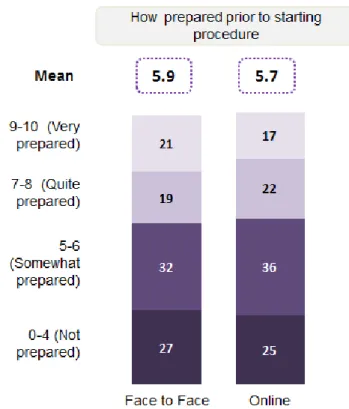
Prior to the process commencing, around 2 in 5 divorce petitioners said they felt very or quite prepared with little difference between channel types.
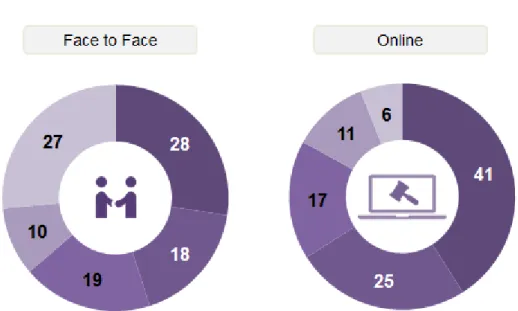
Figure 9: Preparation duration prior to divorce petition submission: Post study
Focusing on the results from the post-event survey, those using an online provider spent less time initially preparing for the divorce. 41% spent less than a month before submitting the divorce petition compared to 28% using a face to face method.
The Tracktion study interviewed petitioners shortly after the process began, allowing us to understand specific areas in more detail, and in this case, the research that they conducted prior to commencing the process. The main reasons for researching were to understand the ‘basics’ of the divorce process, for example what was involved and the fees that they were likely to be charged.
Here are some individual consumer comments below:
“Just generally what it would cost, what I would need to do and what reason I could give to the court for having a divorce.” (Face to face)
“I'd never been divorced so I wanted to know everything. I didn't know how it worked legally and the paper work and I didn't know how much [time] it would or could take.” (Face to face)
“Well I was looking to see whether I could do it without a solicitor and what procedure I would have to go through and I realised I couldn't do it myself, it was too complicated.” (Face to face) “Basically the cost. Whether I am entitled to any help with cost because it was to do with domestic violence and basically the cost and process because I haven't done it before so had no idea what I was doing.” (Face to face)
“How long it would all take, what was involved and the process.” (Online)
“About the process, difference between the [high] street and online, the cost, and how it'll affect us as a family.”(Online)
4.3.1. Choosing a provider
Before deciding on a provider, petitioners had to go through a process of research and decide what was important to them in choosing a particular provider.
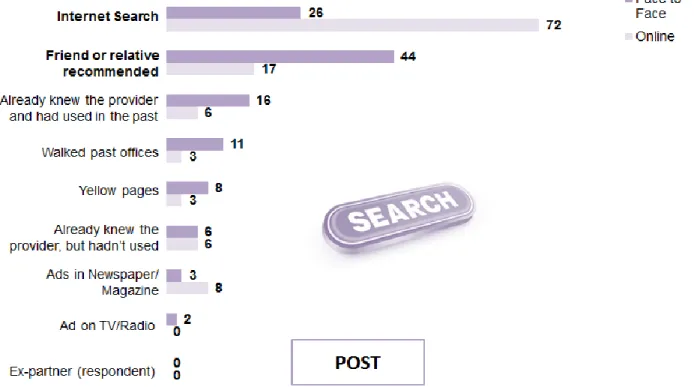
Figure 11: Means of discovery of the divorce advice provider: Post study
When asked about how they found out about their provider, not surprisingly 72% of online petitioners used the internet followed by a recommendation by a friend (17%). 8% saw an ad in a magazine or newspaper. For those using a face to face service, these petitioners were more likely to rely upon advice or recommendations from friends or family (44%) but using the internet was the second most common method of sourcing a divorce provider.
For those using the internet to find out about their divorce provider, the most common internet search was using the mainstream search engine, Google. All those using an online divorce provider used this search engine and 96% of petitioners who used a face to face provider. This underlines the importance of search engine optimisation for divorce providers. Although this was the stand out source of information on the internet, users also tended to visit a number of internet sites including gov.uk and legal (or more general) comparison sites.
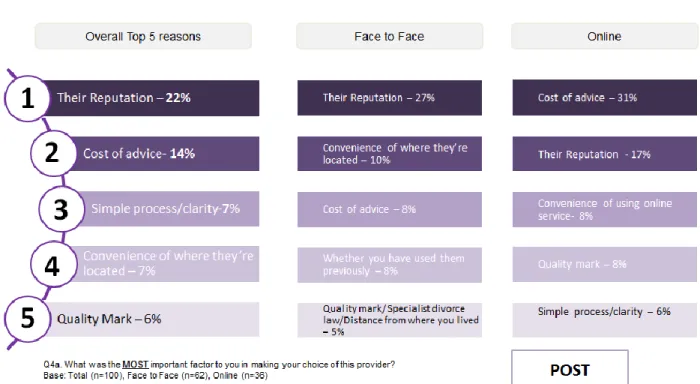
Figure 13: Reasons given for choosing their divorce provider: Post study
Following the choice of channel, the petitioners were also asked why they chose the actual provider(s) they did. For choosing online provides, the main reason considered was the cost of the advice (31%) followed by reputation. For face to face users, the main reason was the firm’s reputation (27%), followed by location (10%).
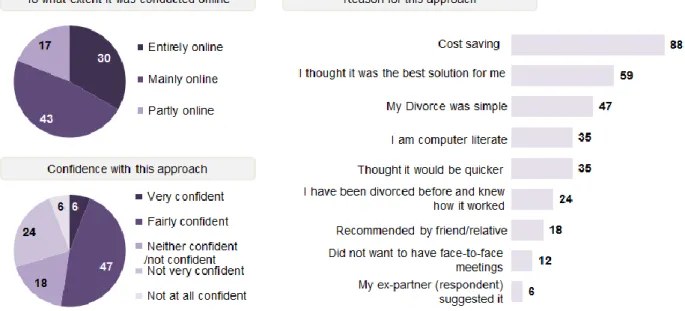
Figure 14: Reasons given for selecting online approach: Post study
For those who decided to use an online specialist, we asked a number of questions as to why they initially chose an online route.
The results show that cost savings are the main reason for choosing this approach (88%). The second highest reason was that users thought that the online process was the most appropriate to them (59%) and they thought that their divorce was simple (47%). Surprisingly speed of the process didn’t score as high (35%). It appears, the majority of petitioners are making informed decisions about the divorce process that best suit their circumstances.
Towards the end of the survey, a selection of risk questions were asked to see if consumers who chose an online approach had a different attitude to ‘risk’ compared to those using a face to face channel. The chart in the Appendix illustrates that people who use online providers are as likely to be risk takers as those using face to face providers. If anything, on the evidence of this data, they are more risk averse, so this does not appear to be a contributing factor to the choice of method.
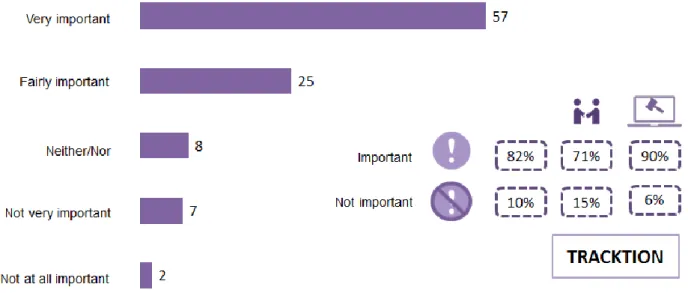
Figure 15: Importance of cost when making divorce provider choice: Tracktion study
When prompted about the importance of cost among the Tracktion petitioners, over half believed this was ‘very’ important in their decision to apply for the divorce using their chosen channel (57%). A further 1 in 4 felt this was fairly important (25%).
Those opting for an online channel felt this was much more important than those using a face to face method (90% of those using online providers felt it was important vs. 71% for those using face to face providers).
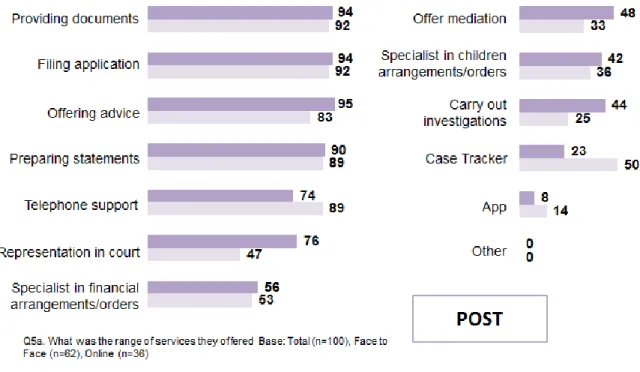
According to petitioners’ perceptions, online providers offered a variety of services to their clients, including other channel support, such as telephone support. Th e variety of services offered is very similar to face to face providers.
Figure 16: Range of services offered by provider: Post study
Figure 17: Most important services offered by provider perceived by petitioner: Post study
Of these range of services offered, when asked which ones were the most important, nearly half of users of face to face services, said it was the advice they offer (45%) compared to 25% for
online. Perhaps surprisingly, 17% of online users said that the telephone support was the most important, which was of equal importance with providing documents.
4.3.2. Amicable divorces by choice of provider
Despite the majority of the survey being focussed on factual questions about the process, it was important to understand the emotional factors too.
Figure 18: Overall levels of amiability and stress: Post study
According to the research, online divorces are more likely to be very amicable (50%) and are not considered to be particularly stressful (44%). This shows that people are, in the main, choosing the online divorce process where there appears to be little (or less) conflict.
There are two factors to consider. Amiability and stress of firstly the s ituation of the divorce, and secondly the level of stress occurred by the type of provider used. Some applicants believed a face to face provider would be better suited for a more stressful situation surrounding the divorce:
“Because I did not have much choice because it was very stressful.” “There was no other way of doing it. It was not an amicable divorce.”
“I was a bit apprehensive at first, but my friend told me that she had done it through the government pages and it was quick, painless and stress free”
“I would do it in the same way (online) because it was a simple process. I understand i have been divorced before and that was incredibly complicated and stressful. But this one was straightforward. There were no children involved, no financial arrangements to sort out, it was easy and simple to use and online specialist.”
4.4. Stages in the process
Figure 19: Stages undertaken in divorce process: Post study
The majority of people we spoke to in the post-event survey had received their decree absolute and completed the process (85%) with around a third involving statements of arrangements for children.
The Tracktion survey enabled us to assess the stages in further detail and track the movement between each part of the process.
During the first interview, over 2 in 5 of those using a face to face provider had at least drafted their statements of arrangements for either their children or finances; 1 in 4 had also submitted this.
At stage 1, online petitioners were at different “early steps”, from drafting statements to court processes. However, at stage 2, they were more likely to be waiting for the respondent to return papers to the court than face to face petitioners.
Between the three Tracktion stages, online applicants were more likely to ‘drop out’ of the process (36 petitioners vs. 18 face to face); and often this was because they had completed and received their decree absolute. Although base sizes are small, these indicative results indicate that online applicants were more likely to progress through the process at a faster pace than those using a face to face method.
By stage 3, which is approximately 5-6 months into the process, all petitioners had reached ‘decree nisi’ stage and half of applicants had also applied for their decree absolute, although this is much more likely for those using a face to face service. The number of those that completed their divorce is as follows:
Stage 1:6%
Stage 2:8%
Stage 3:32%
4.5. Communications during the process
4.5.1. Discussions between the petitioner and respondent during the process
Figure 20: Percentages of petitioners having discussions with respondent at each notable divorce stage: Tracktion study
The level of involvement of the partner depended on the stage involved. The chart above demonstrates that there are peaks of involvement with partners during preparation of the statement of arrangements around children and where the courts are involved.
4.5.2. Advice sought proactively by petitioner during the process
Figure 21: Main source of advice given: Post study
When asked about their main provider of advice during the divorce process, the majority tended to refer to the advice they received from their service provider, as opposed to friends and family for example. No petitioners saw their friends or family as their main source of advice.
Petitioners were asked who their main provider of advice was. Almost half of those who went through the process with an online provider felt that the online divorce specialist was their main provider for advice (47%). 17% used a more general online specialist and 22% used a provider which was more well known for its face to face activities and were characterised as a ‘high street’ law firm but had online capabilities.
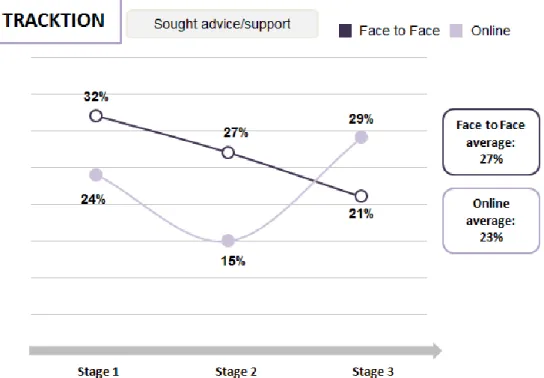
Figure 22: Number of those that sought advice or support: Tracktion study
The Tracktion survey highlights the point at which applicants looked for advice or support during the divorce process. Those using an online provider are slightly more likely to seek advice (from any source) but the point at which this is sought varies. For those using a face to face provider, 1 in 3 sought advice or support in the early stages of the divorce process , the need declines as the divorce progresses.
Figure 23: Advice Sought results: Tracktion study
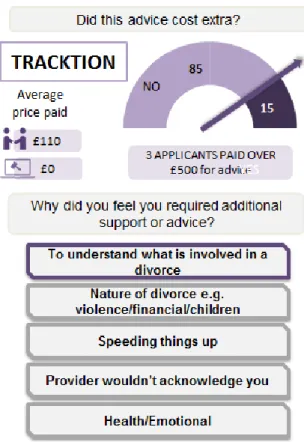
For those who did seek advice, the vast majority decided to do so themselves (75%) rather than the adviser highlighting a need. Interestingly, the majority of this advice did not cost extra (85%). The main reason for seeking additional support or advice was to understand what was involved in the divorce process, indicating that petitioners felt a little ‘in the dark’ about the stages involved and the parts of the process.
“So I could get a good idea of the next procedure and what would be happening next. ” (Sought advice online - Google)
“Because I think that often you need more support that just a lawyer. They are expensive and pay for every minute and they don't always give you the advice you need. They tell you what you want to hear. He told me it would be done and dusted in 5 months and when I spoke to other people they said that was completely unrealistic.” (Sought advice online)
Others referred to specific advice about the complexities of their divorce:
“I didn’t want to feel at a disadvantage and lose my children because I didn’t want to make mistakes.”
Some wanted advice on how to quicken the process:
“Just because it wasn’t going to plan. Because it has come to a halt.” Or petitioners saying that their provider was not acknowledging them:
“Because I wasn’t getting any (advice) from the online lawyer because of a lack of communication.”
Others needed support to deal with health and wellbeing:
“Emotional support and coping with the process and coping with the frustration from my provider being so bad.”
4.5.3. Mediation and court involvement
Figure 24: Usage of Mediation and Court Attendees: Post study
If a divorce required court involvement or mediation then users were less likely to conduct the process through an online provider. This further suggests that more complex and difficult cases tend to be handled via a face to face service provider as opposed to online. Not surprisingly, the majority of mediation revolved around financial statements and the arrangements for children.
The Tracktion looked into the area of mediation in some more detail, understanding whether petitioners expected to go through this process and what happened as a result. Over half did expect to go through mediation at the outset but 43% were either not expecting this to be the case or did not have any expectations either way.
Most petitioners, who went through mediation, did so at the outset or in the very early stages of the divorce process. The majority felt that it was a helpful process for them and resulted in an amicable agreement at the end, which is further emphasised by some of the comments from petitioners:
“We basically totalled up our debts and pensions and split them up and it was to s ee if two households could survive outside of each other so the children would be okay. We came to this agreement amicably.”
“It was amicable and it was all done quickly. We all agreed on what we both wanted. ”
Others had a disappointing experience where they could not reach an agreement, although these petitioners tend to refer to the respondent as the difficult party:
“I went for an hour and she just discussed how it works, and I didn't think she was sympathetic towards my situation.”
“I contacted the mediation agency and they contacted him and arranged an appointment and we both sat down with two ladies. I explained my point of view, he explained his and after two occasions everything was agreed. But we have the individual sessions in the beginn ing. He agreed to everything but has since gone back on his word.”
4.5.4. Communication with their main service provider
Figure 26: Petitioner means of contacting provider: Post study
Even with an online approach, people still need the reassurance that they can speak to someone if required. We saw evidence of people using multiple channels to speak to their divorce provider throughout the process.
From the Tracktion results, contact tended to drop off towards the end of the process, but for those who were not contacted at particular points, some expected to be. This was especially the case for those using the online approach, in the middle of the process.
Figure 27: Communication perception of petitioner: Tracktion study
For those who did receive communications, however, these tended to be very well received with the vast majority in agreement that these were clear with regards to setting expectations, providing details as to who to contact with queries and provided the necessary information. Petitioners tended to be much more satisfied with the communications received in stage 3, perhaps due to reaching a point of ‘certainty’ in the application process.
For those who were not contacted but expected to be, this was mainly about hearing about the key stages of the process e.g. decree nisi, and in the final stage interviews (about 5-6 months into the process), this was more likely to refer to the decree absolute. We have seen in the results that a lack of communication can become a frustrating factor, leading peopl e to become less satisfied and experiencing a higher effort process through having to chase:
“I expected the lawyer to contact me about if I have found the money and to tell me what the court had said. I haven't been told since the last time we spoke. This has been for I don't know a month.”
“To tell me it was finalised I had my decree absolute and Nisi, anything would have been good. ” “Being kept up to date about when his application would be received and what the next steps would be.”
Figure 28: Communication with service provider: Tracktion study
Over half of petitioners had to contact their service provider at some point in the process to chase or ask queries. This tended to be slightly more frequent for those using an online channel and was apparent at each stage of the process.
4.6. Providers selected throughout the process
Petitioners took advice from multiple sources before they started, but once they submitted the papers, all tended to stick with the same provider (although some would still consult with friends and relatives).
Most of the divorces covered by this research were relatively straightforward and most users were satisfied with their provider (particularly online) and so had no real cause to change.
In the Tracktion study, only two petitioners changed their provider part way through the process, which was picked up in stage 2 of the survey. These individuals did not change ‘channel’ but
process would be easier than it was and so decided to change. There were no further movements among petitioners.
4.6.1. Preparing arrangements and the divorce petition
Not surprisingly, before the submission of the petition, the person instigating the divorce spoke to someone about it.
Figure 29: Actions taken prior to preparing divorce petition form: Post study
As shown in the chart above, over three quarters (78%) taking an online approach spoke to their partner about the arrangements and 56% researched the process. Those taking the more traditional approach were most likely to take advice (61%) and more likely than online consumers to go through mediation (19%), although there are particularly small base sizes here.
Figure 30: Aspects discussed with petitioner’s ex-partner (the respondent): Post study
When asked what they discussed with their partner, the most common reason was regarding the financial arrangements. This was higher for face to face providers. The other factors, such as reason for the divorce, are consistent between online and face to face.
For the few who did not speak to their partner before the proceedings, nearly 2 in 5 thought that it had a negative effect on the divorce proceedings - the main reason was a breakdown in communication (accounting for a third of negative effect on the divorce).
Figure 31: Timing expectations for preparation of divorce: Post study
The majority of petitioners took up to 6 weeks to submit the petition from deciding to proceed (64% of online petitioners). It seems that people who decide to go online tend to move a lot quicker than face to face petitioners. For online, the speed of set up exceeds expectation, with over a third (37%) feeling it was quicker than expected compared to only 18% for those using a face to face service.
Looking at this stage in more detail, most people obtained the divorce petition form from their provider with very few using the gov.uk site.
Figure 32: Divorce Petition form source and completion: Post study
Forms tended to be completed with assistance of or solely by an adviser for petitioners using a face to face service. Completion of forms for online petitioners was more skewed towards self-completion.
4.6.2. Prepared Statements and Court Documents
In many cases, documents such as arrangements for children and finances were prepared to support the divorce case. This section of the report looks at how the var ious statements and arrangements were prepared and how well the advice was given on these separate aspects of the divorce.
Figure 33: Satisfaction with advice on preparing the statements for arrangements: Post study
This stage is relatively straightforward, so it is not surprising that the vast majority of peti tioners were very satisfied with the advice at this stage. Online and face to face service users gave very similar satisfaction scores at this stage.
4.6.2.1. Children
With those petitioners who had children, all prepared arrangements for them as part of the divorce.
Figure 34: Statements for arrangements for children completion: Post study
Overall, 88% prepared these before submitting a divorce petition and the overwhelming majority believed that they submitted it in a timely manner. Of those choosing an online divorce, 53% were very satisfied with the advice they received (86% satisfied in total).
Figure 35: Statements with advice adviser gave on preparing statements of arrangements for children: Post study
Only 3% of those arranging a statement of arrangements for their children were dissatisfied with the advice they received.
Below is a selection of comments from the Tracktion study with regards to preparing the statements of arrangements for children, placing emphasis on ‘getting it right’ for the children’s sake.
“I didn't want to feel at a disadvantage and lose my children because I didn't want to make mistakes. I value my children so I am forced to use a lawyer.” (Face to Face)
“I would like to have full custody of the children rather than part custody.” ( Face to Face) “Because I wasn't sure how to fill out the form for the arrangements of the children.” (Online)
4.6.2.2. Financial Arrangements
Figure 36: Statements for financial arrangements for completion: Post study
In the post-event survey, 70% of people who had an online divorce prepared a financial arrangement. Overall, 91% prepared these before submitting a divorce petition. 54% of online petitioners did the financial arrangements themselves, with a further 32% having help from the adviser. Only 12% got help from their partner.
Figure 37: Statements for financial arrangements satisfaction: Post study
As with the preparation of arrangements for children, petitioners were broadly satisfied with the advice they received from their adviser. Those going through the online process were slightly less satisfied, and the main reason was the lack of detail.
Here is a selection of comments from the Tracktion survey with regards to preparing the statements of arrangements for finances. These emphasise the importance and need for advice and assistance at this stage:
“I was given a list of options and given a cost of the divorce and plan of everything I would need to financial settle with my husband.” (Face to Face)
“Just to keep things moving to get the financial settlement. I would not have gotten that without my lawyer being involved.” (Face to Face)
“She's given me some good advice in regards to finalising our financial agreement, it was advice I wouldn't have thought of.” (Face to Face)
“Cheaper if you got the divorce and financial order together. There was another package involving custody arrangements of children but we did not need that.” (Online)
“Because I had to do quite a lot of the donkey work so especially with the finances. ” (Online)
4.6.3. Payments during the divorce process
We previously identified that cost was a key reason for petitioners to choose an online approach and building on this further, the research shows that the vast majority of petitioners (nearly three quarters) paid for it themselves.
Figure 38: Persons responsible for payment for help received: Post study
As shown in the chart above, almost 3 in 4 paid for all of the help received for both face to face and online petitioners (44% and 72% respectively) and only a minority received legal aid but none of these were using the online approach. This is most likely due to the fact that legal aid contracting rules prevented the use of online service delivery and recent forms on legal aid eligibility and scope.
Figure 39: Payment experience and medium advice was given: Post study
The majority of petitioners using an online process were quoted a fixed price for the work (69%). For those using face to face services, the most common method of how payment terms were presented was for an estimate of the cost of the advice (31%) and an hourly rate with a rough estimate of how many hours would be required (28%).
Although many people (both online and face to face) felt the costs were as expected, there is a proportion who thought that the divorce costs were higher than expected. This is significantly higher for those using a face to face provider (41%) than online (19%).
Petitioners were asked how much their divorce cost in total (excluding court fees). On average, for online services this was £1,250, and for face to face services was £2,700. These figures are skewed by a number of petitioners saying their divorces cost over £5,000. For online divorces, 84% cost under £1,000 with 53% under £500. Face to face methods were more expensive with 29% of these divorces costing over £5,000. Excluding divorces over £5,000, the average cost for a face to face divorce provider is £1,522 and for online is £613.
Only 11% of online users and 12% of face to face petitioners tried to negotiate on the fee. This is very low and particularly relevant, due to the fact that those who did negotiate achieved 100% success rate on getting the fees down.
4.6.4. Agreement stage after submitting statements
The next stage was submitting the documents to the courts.
Although most thought that the speed of this stage was as expected, or quicker than expected, there was still a significant proportion who thought that this stage of the process was slower than expected, almost half of face to face petitioners (45%) and a third of online providers (33%).
In only 14% of online cases, the respondent decided to challenge the documents submitted to the courts. Of these, only a third (a very small base) decided to take advice. Most of the cases where there was a challenge, a court hearing was required, which additionally slowed down the process.
As well as slowing down an otherwise speedy process, other aspects of the court procedures were criticised:
“I think if the court sent the paperwork out to the respondent, they should make sure that they get a reply from the recipient and if not, then they themselves should cover the costs for bailiffs etc. until they get an acknowledgement.”
“I think because I had to go myself and hand the form to court, it was the most emotional and difficult part of the process.”
“I sent the papers to court and they had to send it to my ex-husband. I didn't receive and acknowledgement of that until the decree nisi came through. So I didn't know whether he was going to challenge it or had agreed to it, so some form of letter to advise you on what is happening would have been helpful.”
Key take outs from what face to face petitioners of the “Tracktion” study said about the courts during the divorce process are as follows:
It can be sometimes difficult to get in contact with the court due to availability of the right personnel and time.
The court seems to take their time in the process sometimes frustrating petitioners. Questions are asked of the expenses and method of payment
Correspondence and clarification is sometimes needed from both sides, questioning the divorce process.
These points are emphasised by comments made by petitioners below:
“Well at the moment the court is limited on hours and because I have to work I find it hard to get a time to get through because they are only open limited hours.”
“Just to be able to chat to someone at the court and just not have to keep relying on
documents and I can appreciate that it's not advice you can quote but if you can't understand
the forms, the solicitors are your only options so it's keeping them in business.”
“It was to do with how to make a payment and it was so hard to get any contact with someone at the court.”
Key take outs from what online petitioners of the “Tracktion” study said about the courts during the divorce process are as follows:
Administrative errors from the court leave petitioners frustrated. Courts take a considerable time to process documents.
A few petitioners find themselves double-checking that everything is correct with the courts.
Greater lack of communication between online provider and courts than face to face provider and courts.
Perceived court fee rises.
These points are emphasised by comments made by petitioners below:
“I chase things a lot and I ring the court a lot check to make sure all the forms were correct.”
“The court fees have gone up and my process took so long that I had gone over the time where
I would not have to pay so I had to pay the extra court fees.”
“Just the lack of knowledge. I was looking to access legal advice free of charge but the court
wasn’t particularly helpful.”
Providers need to be clear upfront about the potential of delay in the courts, particularly where there is the potential for a challenge. Despite this not being particularly common, the impact of this could be shared with the petitioner to set expectations at the start.
4.6.5. Decree Nisi
One of the key points of certainty is the Decree Nisi stage.
Figure 42: Decree Nisi form source and completion: Post study
As with other stages, the forms were mainly provided by the online or face to face provider although online petitioners were much more likely to source it themselves.
All applicants reached decree nisi by the time their third interview took place (approximately 5 -6 months after commencing the process). This was considered as a key point of ‘certainty’ and provided respondents with reassurance that the process was progressing.
By this stage of the divorce, there was little conflict between the petitioner and the respondent. Expectations of delivery time were in the main, as expected. Only 13% of face to face services were quicker than expected compared to 28% of online providers.
4.6.6. Decree Absolute
The final stage of the process is Decree Absolute.
Figure 43: Decree Absolute form source and completion: Post study
As with other stages, the forms were mainly provided by the online or face to face provider. Online users were more likely to source the documents themselves, although two thirds were still sent the documents by their provider.
Figure 44: Respondent response to Decree Absolute and satisfaction with time taken: Post study
This stage of the divorce had negligible involvement from the r espondent (1% of online petitioners). For online in particular, once they had submitted the decree absolute, they thought that it was received in a timely way with only 9% claiming that the process was slower than expected.
The following factors had a detrimental impact on the experience of face to face petitioners when at the decree absolute stage:
Some petitioners seem taken aback by the time taken to complete the process, suggesting mismanagement of expectations.
In fact, differing expectations are set by the provider, which can leave the petitoner confused in terms of next steps.
Admistrative errors can delay confirmation of the divorce.
Below are some verbatim comments highlights the key points that arose:
“I have had the decree absolute and that didn't go through because of legal aid. There wasn't enough information to carry on and my lawyer decided he would send the paper work to the wrong person.”
“It's all eventually come through and he's taken a hell of a lot of time. It's been accepted and I'm just waiting to get it all stamped and finished. Waiting to get decree absolute.”