by
http://ssrn.com/abstract=1651223
Shiri Artstein-Avidan and David Dillenberger
“Dynamic Disappointment Aversion:
Don’t Tell Me Anything Until You Know For Sure”
PIER Working Paper 10-025
Penn Institute for Economic Research Department of Economics University of Pennsylvania 3718 Locust Walk Philadelphia, PA 19104-6297 [email protected] http://economics.sas.upenn.edu/pier
Dynamic Disappointment Aversion:
Don’t Tell Me Anything Until You Know For Sure
Shiri Artstein-Avidan
yDavid Dillenberger
zJuly 28, 2010
Abstract
We show that for a disappointment-averse decision maker, splitting a lottery into several stages reduces its value. To do this, we extend Gul’s (1991) model of disappoint-ment aversion into a dynamic setting while keeping its basic characteristics intact. The result depends solely on the sign of the coe¢ cient of disappointment aversion. It can help explain why people often buy periodic insurance for moderately priced objects, such as electrical appliances and cellular phones, at much more than the actuarially fair rate.
Keywords: Disappointment aversion, recursive preferences, compound lotteries.
1. Introduction
Assume you are waiting to receive an important announcement. For concreteness, assume that you …lled a betting ticket regarding the results of a horse race, which is taking place at the moment and will end in a short time. You have two ways of spending your time until the race ends. The …rst is to turn on the radio and hear the commentator describing “live” what is happening at the race. The second would be to sit back, wait patiently, and turn the radio on only once the results of the race are determined. Which one seems more appealing to you?
The answer to this question may depend on many factors, such as the amount of money you spent on the ticket, your …nancial condition, and most of all, on your personal character. A plausible answer might be: “I prefer to wait and hear only the …nal result. Being exposed to the resolution process bears the risk of perceiving intermediate outcomes as disappointing.
We thank Wolfgang Pesendorfer for helpful suggestions.
ySchool of Mathematical Sciences, Tel Aviv University. E-mail: [email protected] zDepartment of Economics, University of Pennsylvania. E-mail: [email protected]
Therefore, since I take disappointments hard, getting partial information in the middle of the process will only stress me further and cause me to su¤er more on average.”
A similar argument can be made by a Ph.D. candidate who has applied to a certain school. The …nal result is expected to arrive in a couple of months, but the student is aware that he is going to be judged sequentially until that date, according to many parameters (grades, preparation test results, recommendations, publication list). The student has no ability to a¤ect the …nal outcome once he has submitted his application. Against the natural curiosity and psychological need to be involved and receive as much information as possible regarding his ranking relative to other candidates, a no less natural attitude can be adopted by the easily disappointed candidate who prefers to receive no information at all until the …nal decision has been made.
Gul (1991) suggests a model to study disappointment-averse individuals. According to his model, the decision maker divides the support of a certain lottery into two groups: the dis-appointing and the elating prizes. The threshold to this division is determined endogenously, as follows: equipped with a utility function over prizes, he calculates the expected utility of the lottery while uniformly assigning to all the disappointing outcomes a greater weight. The value is thus the certainty equivalent of the lottery where all prizes with a value higher than this number are considered elations and all prizes with lower value disappointments. (Mathematical de…nition below in (1).)
Gul’s basic model is static, as all the decision maker cares about is the probability distribution over …nal outcomes. To study the e¤ect of potential disappointment emerging from gradual exposure to risk, one needs to extend his model into a dynamic setting. This requires some additional assumptions regarding the way compound lotteries (i.e., lotteries whose outcomes are tickets to other lotteries) are evaluated.
As we describe in detail below, we assume that the decision maker folds-back the prob-ability tree and applies the same (static) preferences as in Gul in every stage. The implied model maintains preferences, now de…ned over a richer domain, to be fully determined by the pair (u; )— a utility function over prizes and a coe¢ cient of disappointment aversion that determines the additional weight given to the disappointing outcomes, which is thought of as a characteristic of the decision maker. Palacious-Huerta (1999) adopts this approach and by working out an example, demonstrated the tendency of a disappointment-averse individual to prefer getting information that is resolved all at once rather than gradually. The lottery used in his example, however, is very special and contains only two prizes. Thus the division to disappointment and elation is, in that example, obvious at every step of the folding-back process.
gen-eral case and, in particular, to emphasize the linkage between the sign of the coe¢ cient of disappointment aversion and the attitude toward the way in which uncertainty is resolved over time. We show that a disappointment-averse decision maker, that is, one who is charac-terized by the pair(u; ) and >0, will always prefer any compound lottery to be resolved in a single stage. The opposite is true if 60.
As an application, we demonstrate that disappointment-averse individuals are likely to purchase dynamic insurance contracts, such as periodic insurance for electrical appliances and cellular phones, at much more than actuarially fair rates. The reason is that in addition to the standard risk premium, they are willing to pay a premium to avoid being exposed to the gradual resolution of uncertainty. These two premia reinforce one another, and this aspect makes the individual more reluctant to take risks. While the gradual resolution premium is non-negative for >0, it is not an increasing function of . This observation is valid in the general case and is independent of the speci…c insurance problem we consider. When is extremely large, the gradual resolution premium converges to zero, which is its level when the DM is an expected utility maximizer ( = 0). Therefore, there is always an interior value of in which the gradual resolution premium is maximized.
Dillenberger (2010) studies recursive preferences over compound lotteries and charac-terized preferences for one-shot resolution of uncertainty, that is, preferences to have any compound lottery resolved in a single stage. In this paper we give a direct proof that any disappointment-averse decision maker displays this property. It is remarkable that within the disappointment aversion class, only one parameter, , accounts for preferences for one-shot resolution of uncertainty. This feature sheds light on the driving force behind the variety of applications that use Gul’s preferences. (See, for example, Ang, Bekaert and Liu (2005) who use recursive disappointment aversion preferences to study a dynamic asset allocation problem.)
The remainder of the paper is organized as follows: In Section 2 we present the model and the statement of our main result. In Section 3 we give a complete mathematical proof of our result. In section 4 we apply our model to study an insurance problem. We conclude by suggesting extensions for the basic model.
2. The model and the main theorem
We consider an interval X R of prizes. A lottery P is a vector of probabilities indexed by x2X such that Px2Xpx = 1, and we restrict to the case in which in any given lottery
the number of possible prizes ( i.e., prizes with non-zero probability) is …nite. To avoid complicating notation, we assume that x 2 X is both the prize and its perceived value. In
the context of this paper no generality is lost by this, and the same results hold if we assume a utility function u:X !R, replacing the prize x by the valueu(x).
The value of a lottery is a function that assigns to each lottery a number between the largest and the smallestx2X and that depends on a parameter 1< <1. should be thought of as a property of the decision maker that captures his disappointment aversion, if > 0, or elation seeking, if 1 < < 0. (For = 0 the value will simply be the standard expectation.) The value V is de…ned as follows: it is the unique solution of the equation
v = P fx:x>vg xpx+ (1 + ) P fx:x vg xpx 1 + P fx:x vg px (1)
As discussed in the introduction, this de…nition goes back to Gul (1991). Thus, when computing the value V = V (P), if say > 0, we average the prizes in such a way that disappointing prizes are given an extra weight. The number V is the unique number such that if the decision maker sets his disappointment-satisfaction threshold at V, then he is indi¤erent between carrying out the lottery and receiving V dollars.
We turn to the de…nition of the value of a two-stage lottery. Assume that one is given m lotteries, denoted P(j) for j = 1; : : : ; m. Each lottery P(j) is de…ned by the probabilities it assigns to the di¤erent x 2X, which we denote p(xj). For the two-stage lottery, one is given
probabilities 1; : : : ; m for gaining the lotteriesP(1); : : : ; P(m)respectively. In the …rst stage
a lotteryP(j)is realized with probability
j and then, in the second stage, a prize is obtained
according toP(j).
Note that the probability distribution over …nal prizes induced by the two-stage lottery is the one in which a prize xis won with probability Pmj=1 jp
(j)
x . The value of this reduced
two-stage lottery is as de…ned in (1) above for a (one-stage) lottery,V(P). This corresponds to the case where the decision maker is not exposed to the gradual resolution of uncertainty. On the other hand, if the decision maker sees the results of the …rst stage of the lottery, then he or she will be disappointed or elated also with the results of this …rst stage. The value of the two stage lottery in this case will be the value of a lottery Q with prizes V(P(j)) with probabilities
j, for j = 1: : : m. (Notice that we now have a di¤erent set
Y = (V(P(j)))m
j=1 Rm of prizes.) Notice that the same parameter is used to decide the value of each lottery P(j) and the value of the lottery Q.
We now show that with the above de…nitions, a decision maker who is disappointment-averse prefers not to be exposed to the gradual resolution of uncertainty, and an elation-seeking decision maker will want to be involved and receive information as many times as possible during the resolution process, despite the fact that he has no possibility of a¤ecting
the outcome. More precisely our main theorem reads as follows:
Theorem 1: Given m lotteries P(j) = (p(j)
x )x2X, and numbers 0 j 1, j = 1; : : : ; m,
such that Pmj=1 j = 1, de…ne the lotteries P and Q as follows:
P assigns probabilityPmj=1 jp
(j)
x to the prize x2X,
Q assigns probability j to the prize V(P(j)).
Then, for 0 we haveV(P) V(Q), and for 1< 0 we haveV(P) V(Q).
3. Proof of the main theorem
In order to prove Theorem 1, we need to …rst discuss the functionV =V (P). We …x >0 and omit the index throughout this section. The case <0is completely analogous, and we comment on it at the end of the proof.
Rearranging equation (1), we see that V is de…ned as the intersection of the function fP(v) = X fx:x>vg px(x v) + (1 + ) X fx:x vg px(x v)
with thev-axis, that is, V is the solution offP(v) = 0. This function is continuous,
decreas-ing, and linear on every interval [xi; xi+1] that does not include points x with px >0 in its
interior. The slope offP at a pointv 2R(withpv = 0) is equal to( 1
P
x v
px). IfP is non
trivial (assigning positive probability to more than one value) then one has fP(minX)>0
and fP(maxX)<0.
Given two lotteries P and Q, showing that V(P) V(Q) is equivalent (since fP is
decreasing) to showing that fP(V(Q)) 0. Notice that by the de…nition of P and of fP we
have that fP(v) =
Pm
j=1 jfj(v)where we have denoted fP(j)(v) = fj(v).
For notational convenience we also denote the value ofP(j) byvj =V(P(j))and the value
of Q byw=V(Q), so thatw is the solution for the equation fQ(w) = X fj:vj>wg j(vj w) + (1 + ) X fj:vj wg j(vj w) = 0:
The above implies that X
jvj w=
X
fj:vj wg
j(w vj): (2)
Proof of Theorem 1. We wish to show that fP(w) 0. We subtract from it 0 =
Pm
j=1 jfj(vj), which does not change the expression, and regroup the terms as follows
fP(w) = m X j=1 j(fj(w) fj(vj)) = X fj:vj<wg j
(
X fx:x>wg p(xj)(vj w)+ X fx:vj<x wg p(xj)( x+vj (1 + )w) + (1 + ) X fx:x vjg p(xj)(vj w))
+ X fj:vj>wg j(
X fx:x>vjg p(xj)(vj w)+ X fx:w<x vjg p(xj)( x+ (1 + )vj w) + (1 + ) X fx:x wg p(xj)(vj w))
= m X j=1 jvj w ! + 2 4 X fj:vj<wg j 0 @ X fx:vj<x wg p(xj)(x w) + X fx:x vjg p(xj)(vj w) 1 A 3 5+ 2 4 X fj:vj>wg j 0 @ X fx:w<x vjg p(xj)(vj x) + X fx:x wg p(xj)(vj w) 1 A 3 5:We already see that the …rst and third terms are nonnegative. We now use the relation (2) and substitute the …rst term by
m X j=1 jvj w ! = X fj:vj<wg j(w vj) = X fj:vj<wg j X x2X p(xj)(w vj):
The constant appears as a coe¢ cient in all three terms now, so we have that
fP(w)= = 2 4 X fj:vj<wg j 0 @ X fx:vj<x wg p(xj)(x vj) + X fx:x>wg p(xj)(w vj) 1 A 3 5 + 2 4 X fj:vj>wg j 0 @ X fx:w<x vjg p(xj)(vj x) + X fx:x wg p(xj)(vj w) 1 A 3 5:
It is evident that both expressions on the right-hand side are non negative. In particular we get that for > 0, fP(w) 0, which in turn implies that V(P), which is the zero of
fP(v), satis…es V(P) w = V(Q). We did not use the fact that > 0 anywhere in the
derivation (which consisted of equalities only), and similarly we get that for 1< <0one hasfP(w) 0, so that in the case of elation seeking we have V(P) w=V(Q).
4. Application, an insurance problem
Theorem 1 can be readily extended to compound lotteries with arbitrary (…nite) number of stages. The decision maker evaluates anyn-stage lottery by folding back the probability tree and applying the same V in each stage. A decision maker with such preferences prefers to replace each compound sub-lottery with its single-stage counterpart. Let Qn be an n-stage lottery that induces the same probability distribution over …nal outcomes asP. The amount V (P) V (Qn) is the gradual resolution premium, that is, the amount that the decision
maker would pay to replaceQn withP.1 By Theorem 1, >0impliesV (P) V (Qn)>0.
Understanding the e¤ect of the gradual resolution premium, insurance companies, when o¤ering dynamic insurance contracts, can require much greater premiums than the actuari-ally fair ones and still be sure of consumers’participation. This can help explain why people often buy periodic insurance for moderately priced objects, such as electrical appliances and cellular phones, at much more than the actuarially fair rates. An example is given by Tim Harford (“The Undercover Economist”,Financial Times, May 13, 2006):
“There is plenty of overpriced insurance around. A popular cell phone retailer will insure your $90 phone for $1.70 a week— nearly $90 a year. The fair price of the insurance is probably closer to $9 a year than $90.”
To illustrate, consider the following insurance problem: an individual with Gul’s prefer-ences, with a linearu and >0, owns an appliance (e.g., a cellular phone) that he is about to use for n periods. The individual gets utility1 in any period the appliance is used and0 otherwise. In each period, there is an exogenous probability(1 p) that the appliance will not work (it might be broken, fail to get reception, etc.). The individual can buy a periodic insurance policy, which guarantees the availability of the appliance, for a pricez 2(1 p;1). Therefore, if he buys insurance for some period, he gets a certain utility of(1 z), and oth-erwise he faces the lottery in which with probability p he gets 1, and with the remaining probability he gets 0. For simplicity, assume that the price of a replacement appliance is0, 1In this section we keep assuming thatuis linear. More generally the gradual resolution premium is the
so that the individual either carries it over from the last period or gets a new one for free in the beginning of any period.
Let P be the probability distribution over …nal outcomes (without insurance). Denote
by X the total number of periods in which the appliance works. Since X is a binomial
random variable, Pr (X =k) = nk pk(1 p)n k, for k = 0; :::; n. Applying Gul’s formula,
one obtains V (P) = Pn k=h+1 n k p k(1 p)n k k+ (1 + )Phk=0 nk pk(1 p)n k k 1 + Phk=0 nk pk(1 p)n k
whereh(p; ; n)is the unique natural number such that all prizes greater than it are elating and all those smaller than it are disappointing.
LetQn be the corresponding gradual (n-stage) lotteryas perceived by the individual. By then-stage folding back procedure, its value is:
V (Qn) = 1 (1 + (1 p))n Pn k=0 n k p k(1 p)n k (1 + )n kk:
Using standard backward induction arguments, it can be shown that the individual will buy insurance for allnperiods if > (1z z(1)(1p)p) >0. In that case,z <1 V (nQn). Nevertheless, if is not too high,2 we have1 p <1 V (P)
n < z, meaning that he would not buy insurance
at allif he could avoid being aware of the gradual resolution of uncertainty.3 This observation
explains why and how the attractiveness of a lottery depends not only on the uncertainty embedded in it, but also on the way this uncertainty is resolved over time.
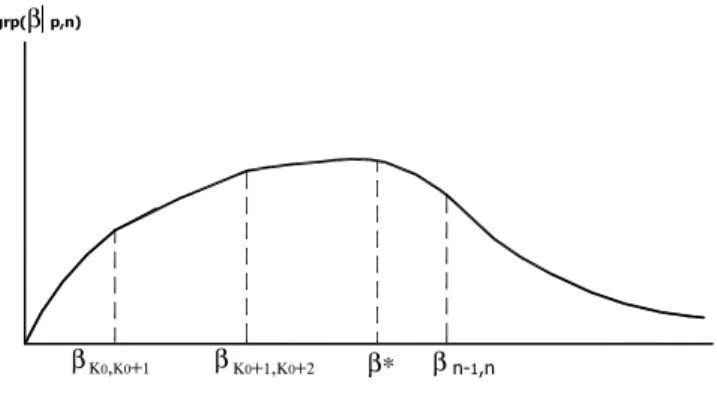
Since V (P) decreases with , the risk premium, rp( jp; n) :=np V (P), is a strictly increasing function of . The behavior of the gradual resolution premium, grp( jp; n) := V (P) V (Qn) is more subtle. We have the following result:
Proposition 1: In the insurance problem described above:
(i) grp( jp; n)>0 8 2(0;1) (ii) grp(0jp; n) = 0 and lim
!1grp( jp; n) = 0
(iii) Single-peakness: There exists (p; n) <1 such that either 0 < < 0 < or
< 0 < implies
grp( jp; n)<grp( 0jp; n)<grp( jp; n) See …gure 1.
2The condition is: 1 + <minn pn pn+n(1 p) 1;
pnz
(1 z)(1 pn) p(1 pn 1) 1 o
:
3Nayyar (2004) termed such a situation an “insurance trap.” Note that DM still acts rationally given
Κ0,Κ0+1
β
grp(β p,n)
βΚ0+1,Κ0+2 β∗ βn-1,n β
Figure 1: grp( jp; n). k;k+1 is the value of where h( jp; n) decreases from (n k) to
(n (k+ 1)). grp( jp; n)is non-di¤erentiable in each such k;k+1. k0 is the smallest natural
number that solves max
k0>n(1 p)
n k0
n
In its original context, a higher implies greater disappointment aversion (as well as greater risk aversion). As we argued in the introduction, being averse to the gradual res-olution of uncertainty can be interpreted as dynamic disappointment aversion. Under this interpretation, it seems intuitive to expect the gradual resolution premium to be an increas-ing function of . This intuition is wrong and, in fact, item (ii) remains valid independent of the decision problem under consideration. To see this, note that grp( jp; n) is de…ned
as the di¤erence of two functions, both strictly decreasing in . When = 0, DM cares
only about the expected value of the lottery. When is su¢ ciently large, all prizes but 0 become elating, and hence the value of P converges to 0. Correspondingly, the value of the gradual lottery, Qn, converges to the value of the worst sub-lottery that by itself
ap-proaches0. Since grp( jp; n)is a continuous function and is strictly positive on the positive reals, there must exist a …nite , denoted in …gure 1, in which grp( jp; n)is maximized. Item (iii) sheds further light on the behavior of moderate disappointment-averse individu-als. It suggests that (p; n) is unique, and that grp( jp; n) is single-peaked. Behaviorally speaking, moderately disappointment-averse individuals are more inclined to pay a higher premium than individuals who are either approximately disappointment-indi¤erent or ex-tremely disappointment-averse.
5. Extensions
Until now we assume that the function V , which is applied recursively, does not change
over time. Time independent V implies that the decision maker does not care when the
uncertainty is resolved as long as all resolution happens in a single stage. We now brie‡y suggest how to incorporate preferences for the timing of resolution of uncertainty into our basic model. While we keep assuming that the decision maker evaluates compound lotteries using the folding-back procedure, we relax the assumption that V is time independent. In particular, we assume that for allt,V t is a disappointment aversion function, in whichut=u
for all t and t is positive and increasing with t (for example, t = 1 t+11 ). Increasing
(while keepingu…xed) implies that the decision maker becomes more disappointment-averse (and more risk-averse) as the time of consumption gets closer.4 Intuitively, an early bad
signal is more likely to be corrected than a late signal, hence the decision maker is more sensitive to later signals.
For a given lottery P, consider the set of two stage lotteries that induce the same proba-bility distribution over …nal outcomes. If 1 < 2, the decision maker faces a trade-o¤: since
t > 0 for t = 1;2, Theorem 1 implies that he is averse to the gradual resolution of
uncer-tainty. But sinceV (P)decreases in , he prefers a lottery in which all resolution occurs in the …rst stage to a lottery in which all resolution happens in the second stage. Therefore, while a compound lottery that fully resolves in the …rst stage is unambiguously the most preferred, it is not clear whether the decision maker prefers a non-degenerate compound lottery to a lottery in which all resolution takes place in the second stage. An increase in the distance between 1 and 2 favors the gradually resolved lottery, whereas the one-shot aspect dominates as the compound lottery becomes more degenerate (for example, when one of the second stage nodes is obtained with probability 1 ", and " >0 is small enough).5
A di¤erent extension is a model in which the sequence of s, instead of being exogenously determined, evolve endogenously as a function of the history of disappointments and elations 4Theorem 5 in Gul (1991) establishes that the risk attitude of two decision makers who have the same
ucan be ranked solely by comparing their di¤erent s. If only changes in risk aversion were concerned, we could, alternatively, …x t= for allt, and make the concavity ofutincreases witht.
5A similar tradeo¤ between early and one-shot resolution of uncertainty was studied in Köszegi and Rabin
(2009). Köszegi and Rabin study a model in which utility additively depends on both current consumption and on recent changes in (rational) beliefs about present and future consumption, where the latter component displays loss aversion. Denote by t;T the weight that is given to changes in period t < T beliefs about
consumption in periodT, and assume that the sequencef t;Tg is increasing witht. Under this assumption,
Köszegi and Rabin provide a set of results that identify the tradeo¤ that the decision maker faces. In stating these results, however, they con…ne their attention to the case in which consumption happens only in the last period and is binary. In our setup, this corresponds to compound lotteries over only two monetary prizes. With the modi…cation of the sequencef tgdescribed in the text, we can generate similar predictions
in prior stages. Such model can address experimental evidence that suggest that the way in which risk unfolds over time a¤ects risk attitudes (see, for example, Thaler and Johnson (1990)). For a model along these lines, see Dillenberger and Rozen (2010).
6. Appendix
Proof of Proposition 1
Let 4V( jp; n) :=grp( jp; n), and for k = 2;3; :::; n 1, denote 4V( jp; n) with h( jp; n) =n k by 4V(k)(
jp; n). Some calculations show that
4V(k)( jp; n)
=np (1 p)
(1 p)k 1 Pnj=0(k+1) j+kj 2 pj +pn k nn(k+1)2 + n kn 1 + 1 (1 + (1 p)) Pnj=k1 1 j (kj 1) pj (k 1) (1 p)k+ 1
The denominator of4V(k)(
jp; n)is always positive, whereas the coe¢ cient np (1 p)is strictly positive for >0. At = 0the numerator is equal to1 n kn 1 (1 p)k 1pn k which is positive since nn k1 (1 p)k 1pn k is simply the probability of n k successes in n 1 trials of a Bernoulli random variable with parameter p. We then note that the nominator is also increasing with . Indeed, this is the case if Pnj=0(k+1) j+kj 2 pj > pn k n 2
n (k+1) , which is true since p < 1 and Pnj=0(k+1) j+kj 2 = n kn 21 . Therefore, item (i) is implied. Since = 0 implies expected utility, the …rst part of item (ii)is immediate. For the second part of item (ii), observe that as increases, the value of the sequential lottery (V(Qn)) is
(smoothly) strictly decreasing and converges to0, the value of the worst prize in its support. The value of the one stage lottery (V(p)b) is a¤ected in two ways when increases. First, given a threshold h( jp; n), the value is (smoothly) strictly decreasing with . Second, h( jp; n) itself is a decreasing step-function of . For large enough, all prizes but 0 are elated and the value of the lottery is given by
Pn k=1( n k)p k(1 p)n kk 1+ (1 p)n !!10.
To show the existence of (item (iii)), pick 0 > 0 such that grp( 0jp; n) = > 0.
Since lim
!1 grp( jp; n) = 0, there exists := max grp( jp; n) = 2 and <1. Thus
grp( jp; n) is a continuous function on the compact interval 0; , and hence achieves its maximum on this domain. For single-peakness, we have the following two claims:
Claim 1: 8k= 2;3; :::; n 1, 4V(k)(
jp; n)is either strictly increasing or single-peaked on
Proof: By di¤erentiating4V(k)(
jp; n)with respect to , one gets: @ @ 4V (k)( jp; n) =np C 2+ 2Apk(1 p)k 2pn n 2 n k 1 (1 p) k + (1 p)pk pn n 1 n k (1 p) k pk( +p 1)2 B ( p+ 1)k+ 1 2
Where C is some constant, andA:= Pjn=0(k+1) j+kj 2 pj .
The roots of @ @ 4V
(k)(
jp; n) are the roots of the second-degree polynomial in that appears in the nominator.
Evaluated at = 0, this polynomial is equal to pk ppk pn n 1
n k (1 p) k . Note that pk ppk pn n 1 n k (1 p) k >0()1> n 1 n k p n k(1 p)k 1
which is true as claimed before.
In addition, the slope of that polynomial at = 0 is equal to the coe¢ cient of ,
2Apk(1 p)k 2pn n kn 21 (1 p)k, which is positive since Pnj=0(k+1) j+kj 2 pj > pn k n kn 21 . To summarize, both the slope and the intercept of the polynomial in the nominator are
positive at = 0. Therefore, if C 0 then @
@ 4V
(k)(
jp; n) has no positive roots, and otherwise it has exactly one positive root.k
Note that 4V( jp; n) is a continuous function that is not di¤erentiable in the points
where h( jp; n) changes. For k = 2;3; :::; n 1, let k;k+1 be the value of where
h( jp; n)decreases from (n k) to (n (k+ 1)). Using the same notation as above, we claim that at the switch point, the slope of the resolution premium decreases.
Claim 2: lim ! k;k+1 @ @ 4V (k)( jp; n)> lim !+ k;k+1 @ @ 4V (k+1)( jp; n)
Proof: Apart from at = 0, where 4V(k)(0jp; n) = 4V(k+1)(0jp; n) = 0, it can be shown that the two curves cross at exactly one more point, given by
k;k+1= np (n k) Pn (k+1) j=0 (n k j) j+k 1 j pj (1 p) k+1
Note that k;k+1 > 0 i¤ p > n kn . To prove the claim it will be su¢ cient to show that
@ @ 4V
(k)(0
crosses 4V(k)(
jp; n) from above. Now @ @ 4V (k)(0 jp; n) =np pk ppk pn n 1 n k (1 p) k pk and @ @ 4V (k+1)(0 jp; n) =np pk+1 ppk+1 pn n 1 n k 1 (1 p) k+1 pk+1 : Therefore, @ @ 4V (k+1)(0 jp; n)> @ @ 4V (k)(0 jp; n) () p1kn( p+ 1) k pn p n 1 k+n +p n 1 k+n 1 n 1 k+n 1 >0 ()p n 1 k+n +p n 1 k+n 1 n 1 k+n 1 >0 ()p > n 1 k+n 1 n 1 k+n + n 1 k+n 1 = (n k) n :k
To complete the proof, we verify that both claims above are also valid for the two extreme cases: k = 1(where only the best prize, n, is elation) andk =n (only the worst prize, 0, is disappointment).
k = 1: Using the same notation as above we have:
4V(1)( jp; n) = np n 2 X j=0 pj ! (p 1)2 + 1 (1 + (1 p) ) (1 + (1 pn) ) and @ @ 4V (1)( jp; n) =n(1 p) (p pn) (1 pp n) 2+ 2 + 1 ( +pn 1)2( +p 1)2 >0 for all 0 so 4V(1)(
jp; n) is strictly increasing with (claim 1). For the second claim, similar calculations establish that:
@ @ 4V (2)(0 jp; n)> @ @ 4V (1)(0 jp; n)()p > n 1 n so claim 2 follows as well.
k =n: 4V(n)( jp; n) =np2 (1 p) nP1 j=1 n 1 j p j 1( 1)j 1 ! (1 + (1 p)) (1 + (1 p)n) Let C = nP1 j=1 n 1 j p j 1( 1)j 1 ! , so: @ @ 4V (n)( jp; n) = Cnp2(p 1) 2(1 p)n+1 1 ( ( p+ 1)n+ 1)2( +p 1)2
which is clearly single peaked on (0;1) (claim 1), and, again by similar calculations: @ @ 4V (n)(0 jp; n)> @ @ 4V (n 1)(0 jp; n)()p > 1 n which is claim 2.
Combining claim1 and claim 2 ensures that4V( jp; n)is single-peaked on (0;1).
References
[1] Ang, Andrew, Geert Bekaert, and Jun Liu (2005), “Why Stocks May Disappoint.” Jour-nal of Financial Economics, 76: 471-508.
[2] Dillenberger, David (2010), “Preferences for One-Shot Resolution of Uncertainty and Allais-Type Behavior.” Econometrica,forthcoming.
[3] Dillenberger, David and Kareen Rozen (2010), “Disappointment Cycles.” Unpublished Manuscript, University of Pennsylvania.
[4] Köszegi, Botond and Matthew Rabin (2009), “Reference-Dependent Consumption Plans.”American Economic Review, 99: 909–936.
[5] Gul, Faruk (1991), “A Theory of Disappointment Aversion.”Econometrica, 59: 667-686. [6] Nayyar, Shivani (2004), “Disappointment Aversion and the Insurance Trap.”
Unpub-lished manuscript.
[7] Palacious-Huerta, Ignacio (1999), “The Aversion to the Sequential Resolution of Uncer-tainty.”Journal of Risk and Uncertainty, 18: 249-269
[8] Thaler, Richard and Eric Johnson (1990), “Gambling with the House Money and Trying to Break Even: The E¤ects of Prior Outcomes on Risky Choice.”Management Science, 36: 643–660.