T E C H N O L O G Y W H I T E P A P E R
This white paper provides an overview of Alcatel-Lucent’s perspective on Evolved Packet Core and how Alcatel-Lucent is addressing radically new requirements imposed on data and control planes in LTE. With unprecedented amounts of bandwidth to be unleashed in the data plane for new services, LTE-focused architecture is needed to ensure end-to-end QoS, reliability and scalability, as well as to provide service awareness of data flows with per-service, per-subscriber, per-application QoS. Alcatel-Lucent’s EPC solution is delivered through high-performance, purpose-built service-aware platforms that bring forward
Alcatel-Lucent Evolved Packet Core Solution:
Table of contents
1 1. Executive summary
2 2. Alcatel-Lucent’s EPC solution
3 2.1 Different network requirements for data and control plane in LTE
3 2.2 Alcatel-Lucent’s approach to EPC
4 2.3 EPC Gateways: Serving Gateway and Packet data Network (PDN) Gateway
5 2.4 Alcatel-Lucent Mobility and Policy Management
6 3. Delivering technical innovation for LTE core: Alcatel-Lucent EPC
6 3.1 Service-aware IP routing with advanced end-to-end QoS capabilities
6 3.2 Non-compromising scalability
6 3.3 Secure and dynamic mobility and policy management
7 3.4 Integrated cross-domain network and service management
8 4. Fixed-mobile convergence
1. Executive summary
The Evolved Packet Core (EPC) is an integral part of Alcatel-Lucent’s end-to-end Long Term Evolution (LTE) solution. Alcatel-Lucent envisages the EPC as the cornerstone of full and complete IP trans-formation in mobile networks and a key enabler of the evolved wireless broadband.
EPC is a new, all-IP mobile core network for the LTE, and a converged framework for packet-based real-time and non-real-time services. It is specified by 3GPP Release 8 standards (Q1 2009).
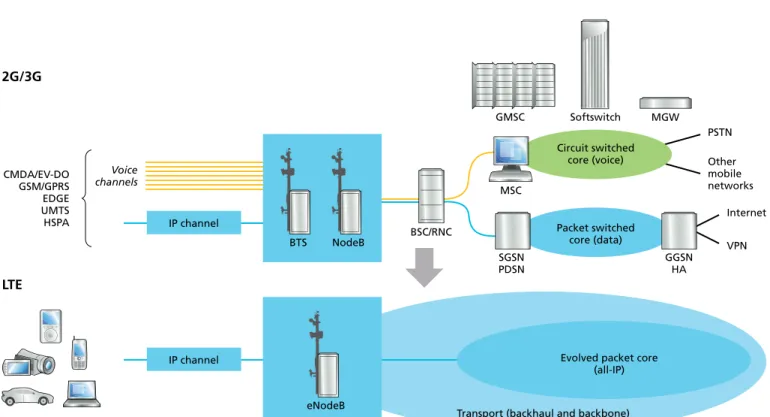
The EPC provides mobile core functionality that, in previous mobile generations (2G, 3G), has been realized through two separate sub-domains: circuit-switched (CS) for voice and packet-switched (PS) for data. As shown in Figure 1, in LTE, these two distinct mobile core sub-domains, used for separate processing and switching of mobile voice and data, are unified as a single IP domain. LTE is all-IP, end-to-end: from mobile handsets and other user end (UE) terminal devices with embedded IP capabilities, over IP-based Evolved NodeBs (LTE base stations), across the EPC and throughout the application domain (IMS and non-IMS).
EPC is essential for end-to-end IP service delivery across the LTE. As well, it is instrumental in allowing the introduction of new business models, such as partnering/revenue sharing with third-party content and application providers. EPC promotes the introduction of new innovative services and the enablement of new applications.
EPC in ThrEE PoinTs
• Evolved Packet Core is a new mobile core for LTE – all-IP, end-to-end
• EPC must address a radically new set of network requirements to deliver true wireless broadband Quality of Experience (QoE)
• EPC must enable new business models and rapid introduction of new services
Figure 1. LTE: Evolution from separate Cs and Ps core sub-domains (3GPP case shown) to one common iP core
Circuit switched core (voice) GMSC SGSN PDSN Packet switched core (data) Softswitch MGW PSTN Other mobile networks Internet VPN MSC BSC/RNC GGSN HA BTS NodeB IP channel eNodeB IP channel Voice channels CMDA/EV-DO GSM/GPRS EDGE UMTS HSPA 2G/3G LTE
Evolved packet core (all-IP)
Alcatel-Lucent Evolved Packet Core Solution | Technology White Paper 2
2. Alcatel-Lucent’s EPC solution
The Alcatel-Lucent EPC solution is purpose-built service-aware EPC, developed in-house and optimized for the future of mobile broadband. It is based on Alcatel-Lucent’s:
• Technical leadership in IP/MPLS and service routing (service-aware IP)
• Broad and long expertise in mobility management across all wireless technologies (3GPP, 3GPP2, IEEE)
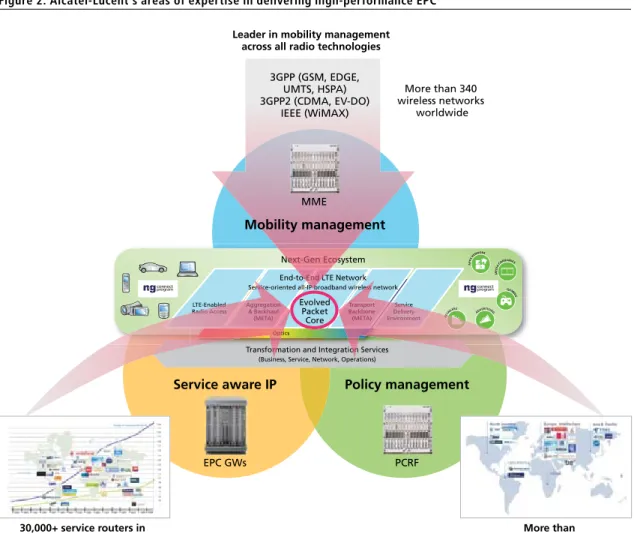
• Expertise and a proven track record in large-scale, real-time dynamic policy management These three key areas of Alcatel-Lucent’s expertise and leadership are graphically represented in Figure 2.
Figure 2. Alcatel-Lucent’s areas of expertise in delivering high-performance EPC
Alcatel-Lucent views the introduction of the EPC as a fundamental shift in mobile networks towards all-IP wireless broadband; a new core that is a foundation for wireless broadband for years to come. Alcatel-Lucent reduces the overall cost of LTE with forward-looking product architectures that minimize hardware upgrades. At the same time, its EPC solution has the capability to unleash new business models by allowing integration with third-party content providers, allowing managed and secure network openness (presence of new devices and applications), and rapidly enabling and activating new services.
Policy management Service aware IP
30,000+ service routers in 260+ customers worldwide
Leader in mobility management across all radio technologies
More than 50 triple play networks
PCRF EPC GWs
Transformation and Integration Services (Business, Service, Network, Operations)
End-to-End LTE Network Service-oriented all-IP broadband wireless network
Optics M ED IACO MPANIES ADVERTISING RETA ILERS GAMING LTE-Enabled
Radio Access Aggregation& Backhaul
(META) Transport Backbone (META) Evolved Packet Core Service Delivery Environment Next-Gen Ecosystem ormm rvice Oppt bledd
Radddio Accesss AAggreg& Backaationhhaul
(METAA) o on ess R REE T Transport B Backkbone (MEETA) Servvice Delivvery Environnment En E o-EnEnEndnd LT P b N t Next-GenG EcosE
Mobility management MME 3GPP (GSM, EDGE, UMTS, HSPA) 3GPP2 (CDMA, EV-DO) IEEE (WiMAX) More than 340 wireless networks worldwide
2.1 Different network requirements for data and control plane in LTE
While LTE introduces a clear delination of the data (user) plane and a control plane, it also imposes two sets of distinct technical requirements on the data plane and control plane:
• Data plane – needs to address requirements for high bandwidth, high availability and scalability,
with aggregate throughput (per gateway) easily reaching over 100 Gb/s. At the same time, the data plane needs to allow unaffected wirespeed performance with sophisticated processing of millions of service data flows and data bearers turned on, while being able to provide sophisti-cated, fine-granular (per-application, per-service, per-user) QoS.
• Control plane – needs to address the requirements for high scalability and high availability of
secure mobility and connection management, along with highly reliable and scalable network-wide policy and subscriber management.
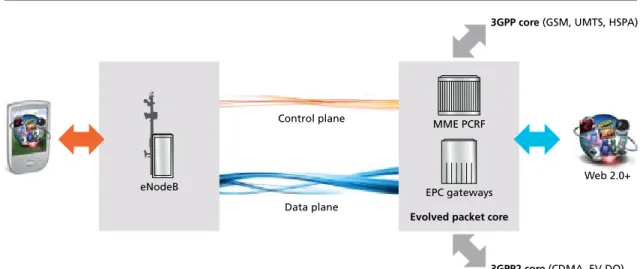
Figure 3 shows how the distinct LTE requirements for data and control planes are addressed.
Figure 3. Addressing distinct LTE requirements for data and control planes
2.2 Alcatel-Lucent’s approach to EPC
Alcatel-Lucent is addressing different technical requirements imposed on the data (user) and control planes in EPC/LTE with network elements that are purpose-built and optimized to perform dedicated data and control plane functions:
• EPC gateways are delivered through an in-house, proven and leading service-aware IP/MPLS routing platform with advanced QoS processing.
• EPC control plane functions are realized through dedicated mobility and policy management elements based on in-house ATCA platform.
EPC gateways MME PCRF
3GPP2 core (CDMA, EV-DO)
3GPP core (GSM, UMTS, HSPA)
Data plane Control plane
Web 2.0+ eNodeB
Alcatel-Lucent Evolved Packet Core Solution | Technology White Paper 4
Figure 4 shows the purpose-built elements of the EPC.
Figure 4. Alcatel-Lucent EPC: Purpose-built elements
All Alcatel-Lucent EPC components are forward-looking, purpose-built elements, developed in-house and optimized for the future of wireless broadband.
2.3 EPC Gateways: Serving Gateway and Packet data Network (PDN) Gateway
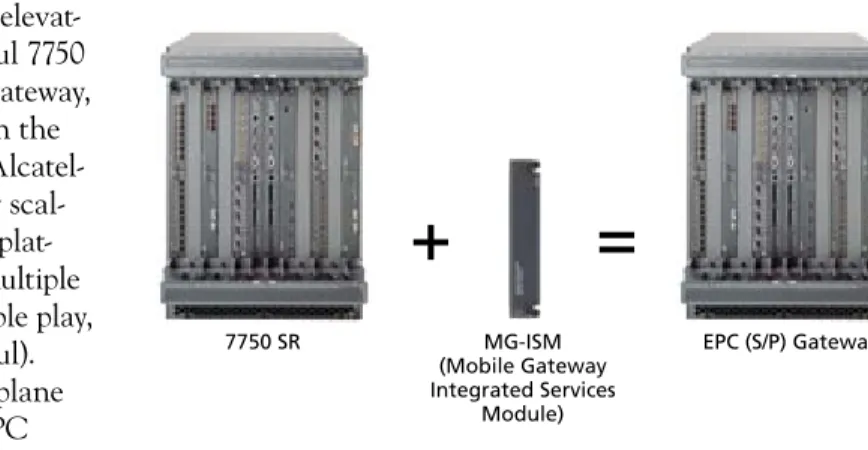
With the addition of a Mobile Gateway Integrated Services Module (MG-ISM), Alcatel-Lucent is elevat-ing its advanced and successful 7750 Service Router into an EPC gateway, building upon its leadership in the areas of Service IP Routing. Alcatel-Lucent 7750 SR is a massively scal-able service-aware IP routing plat-form, already proven across multiple segments (business VPNs, triple play, mobile backbone and backhaul). Figure 5 shows the EPC data plane elements that make up the EPC gateway.
Service Awareness on the 7750 SR is instrumental to ensure the delivery of advanced QoS needed for the ultimate wireless broadband Quality of Experience (QoE). EPC gateways come with a full suite of IPv4/IPv6 functionality, along with integrated DPI capabilities.
The 7750 SR SGW is a data plane element whose primary function is to manage user-plane mobility and act as a demarcation point between the RAN and core networks. SGW maintains data paths between eNodeBs and the PDN Gateway (PGW). From a functional perspective, the SGW is the termination point of the packet data network interface towards E-UTRAN.
Serving Gateway Packet Data Network (PDN) Gateway
EPC gateways based on 7750 Service Router
• Serving gateway: serves a large number of eNodeBs,
with focus on highly scalable and secure data connectivity
• PDN gateway: responsible for IP management (”IP anchor”)
and connection to external data networks; focus on highly scalable data connectivity and QoS enforcement
Mobility Management Entity Policy and Charging Rules Function
MME and PCRF based on in-house ATCA platform
• MME: control-plane element responsible for high volume mobility management and connection management; managing thousands of eNodeBs
• PCRF performs network control of flows: detection, gating,
QoS and flow-based charging, authorizes networkwide use of QoS resources (manages millions on service data flows)
7750 SR EPC (S/P) Gateway
+
=
MG-ISM (Mobile Gateway Integrated Services Module)Like the 7750 SR SGW, the 7750 SR Packet Data Network Gateway (PDN GW) is the termination point of the packet data interface towards the Packet Data Network(s). As an anchor point for sessions towards the external Packet Data Networks, the PDN GW supports:
• Policy Enforcement features (applies operator-defined rules for resource allocation and usage) • Packet filtering (for example, deep packet inspection for application type detection)
• Charging support (for example, per-URL charging)
2.4 Alcatel-Lucent Mobility and Policy Management
The Alcatel-Lucent MME is a purpose-built high-performance network element, designed and manufactured for carrier-grade reliability. It has redundant hardware architecture and high availabil-ity ensured with built-in self-healing fault monitoring and recovery capabilities, including in-service software upgrades.
The Mobility Management Entity (MME) is a nodal element within the LTE EPC. It performs the signaling and control functions to manage the User Equipment (UE) access to network connections, the assignment of network resources and the manage ment of the mobility states to support tracking, paging, roaming and hand overs. MME controls all control plane functions related to subscriber and session management.
The Alcatel-Lucent PCRF is a carrier-grade, purpose-built policy management system, capable of dynamic scaling and high performance. It provides tight integration with EPC gateways and the MME, as well as with LTE/EPC network and service management platforms.
In the generic policy and charging control 3GPP model, the Policy and Charging Enforcement Function (PCEF) is the generic name for the functional entity that supports service data flow detection, policy enforcement and flow-based charging. The Application Function (AF) here represents the network element that supports applications that require dynamic policy and/or charging control. In the IMS model, the AF is implemented by the Proxy Call Session Control Function (P-CSCF).
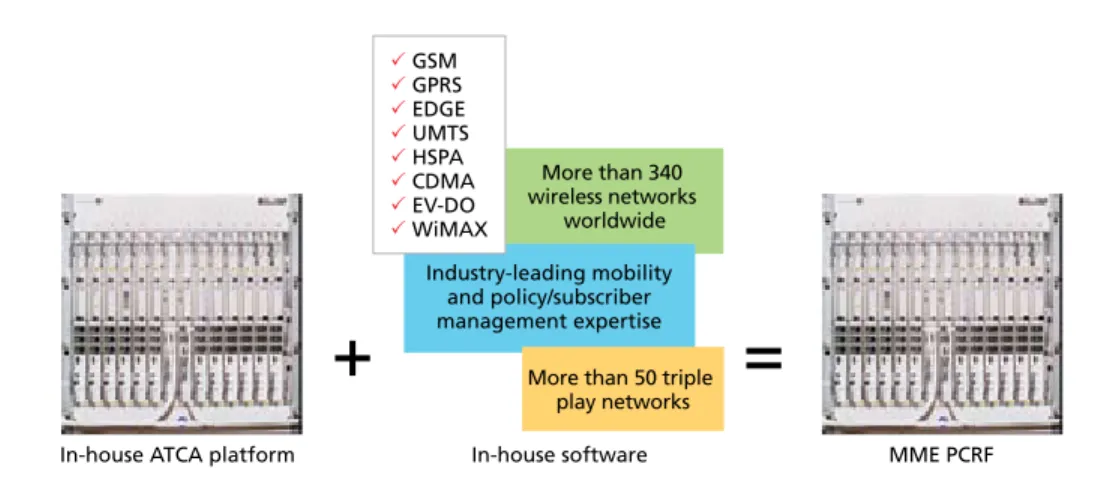
Although based on the common ATCA hardware, MME and PCRF are realized as two separate elements. Figure 6 graphically represents the approach taken by Alcatel-Lucent when delivering these purpose-built control plane elements for LTE.
Figure 6. Alcatel-Lucent EPC control plane elements: MME and PCrF
In-house ATCA platform MME PCRF
+
=
In-house software Industry-leading mobility
and policy/subscriber management expertise
More than 50 triple play networks � GSM � GPRS � EDGE � UMTS � HSPA � CDMA � EV-DO � WiMAX More than 340 wireless networks worldwide
Alcatel-Lucent Evolved Packet Core Solution | Technology White Paper 6
3. Delivering technical innovation for LTE core: Alcatel-Lucent EPC
Alcatel-Lucent EPC solution brings significant innovation to EPC in these key areas: • Service-aware IP routing with advanced end-to-end QoS capabilities
• Non-compromising scalability
• Secure and dynamic mobility and policy management • Integrated end-to-end network and service management
3.1 Service-aware IP routing with advanced end-to-end QoS capabilities
Service Awareness, used in the context of IP routing, is the unique ability of Alcatel-Lucent’s EPC gateways to analyze, understand and process LTE traffic (service data flows and bearers), without affecting the system’s wirespeed performance. The advanced processing of traffic takes into consi-deration different traffic types and service requirements from the perspective of network flows (L1-L3), sessions and applications (L4-L7).
Advanced to-end QoS capabilities are achieved through advanced traffic management, with end-to-end visibility of all network resources. EPC gateways guarantee high performance and scalability with fine granularity of multiple service levels (QoS definitions) per-subscriber, or per traffic or application type. This ability to perform advanced QoS and traffic management on several levels is referred to as hierarchical QoS or H-QoS.
H-QoS provides additional control over network resources and optimizes bandwidth efficiency and service quality, while ensuring maximum isolation and fairness between various services and applications. H-QoS enables bandwidth allocation and management according to the bandwidth budget and/or priority of each base station type, individual traffic or service category (and potentially for individual applications used within a service category). For example, voice traffic can be granted the highest priority, followed by video services, and finally high-speed Internet traffic (with various quality grades for specific Internet applications). OTT Internet traffic (for example, YouTube) can be detected and managed using a pre-defined network policy. H-QoS can also optimize resource utilization by ensuring that any unused bandwidth allocated to higher priority services automatically becomes available, as needed, for lower classes of service.
3.2 Non-compromising scalability
Alcatel-Lucent EPC gateways can address the most stringent LTE scalability requirements, because they are architecturally tailored to allow unrestricted scaling without performance degradation. A typical advanced multiservice router currently on the market cannot address this requirement for scaling without serious performance degradation. The Alcatel-Lucent EPC gateway addresses LTE requirements without any impact on the performance.
3.3 Secure and dynamic mobility and policy management
Alcatel-Lucent’s architecture of the EPC control plane elements — MME and PCRF — has been chosen to also address a very important aspect of security.
MME has been designed for high-volume computing and extreme performance, in order to support the increased signaling load and direct control plane management of thousands of eNodeBs, while ensuring the interworking with multiple standards legacy networks.
At the same time, the Alcatel-Lucent PRCF platform is a result of Alcatel-Lucent’s industry leader-ship in fixed broadband. The PRCF platform is developed using Alcatel-Lucent’s leading expertise in subscriber management and its vast experience in managing large IPTV installations (for example, AT&T’s Lightspeed network).
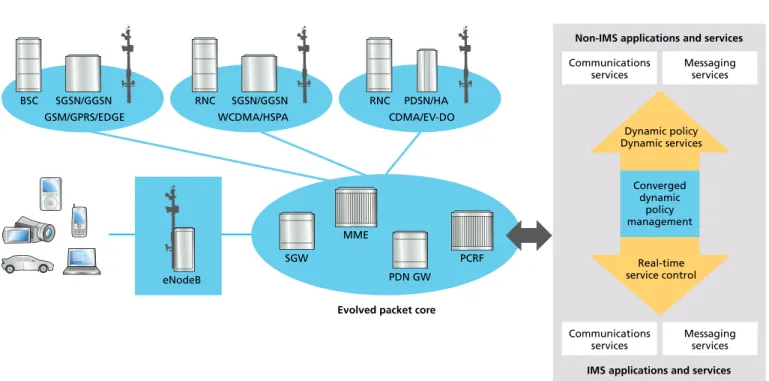
Figure 7 illustrates the secure and dynamic mobility and policy management in EPC.
Figure 7. secure and dynamic, highly reliable and scalable mobility and policy management in EPC
3.4 Integrated cross-domain network and service management
Network and service management also play a key role in LTE networks. The LTE QoE — in terms of coverage, bandwidth, latency, and mobility (handover) — is directly impacted by the configuration and management of LTE network elements (eNodeBs, gateways, MME, PCRF) as well as the inter-working with legacy 2G and 3G layers. From an operator standpoint, an efficient and consolidated management system is crucial to contain the total cost of network ownership, optimize asset usage, and streamline multi-technology network operations.
With Alcatel-Lucent’s integrated network management system, operators will experience continuity in look and feel and usability for GSM, W-CDMA to LTE, and EV-DO to LTE management tools — now managing IP capabilities end-to-end across mobile and transport domains. Under the 5620 Service Aware Manager, the EPC seamlessly merges with the IP/MPLS transport network and the 5620 SAM allows:
• Common IP management domain
• Common security procedures, network level fault isolation, detection and resolution • Coordinated management/provisioning across network elements
• Seamless inter-technology QoS continuity ensuring smooth service continuity between legacy and LTE networks
• Tight integration of mobile and transport
eNodeB SGW MME PDN GW PDSN/HA RNC PCRF
Evolved packet core
CDMA/EV-DO SGSN/GGSN RNC WCDMA/HSPA GSM/GPRS/EDGE SGSN/GGSN BSC Dynamic policy Dynamic services Real-time service control Converged dynamic policy management Communications
services Messagingservices
Non-IMS applications and services
IMS applications and services
Communications
Alcatel-Lucent Evolved Packet Core Solution | Technology White Paper 8
Figure 8 shows the Alcatel-Lucent 5620 SAM’s network management solution.
Figure 8. Common network management across EPC mobile and transport domains using the Alcatel-Lucent 5620 service Aware Manager
4. Fixed-mobile convergence
Alcatel-Lucent views the introduction of the LTE as a fundamental shift in mobile networks towards all-IP wireless broadband. This is the reason Alcatel-Lucent EPC has been engineered and built to act as a foundation for wireless broadband for many years to come — addressing multi-dimensional scalability of network bandwidth, applications, services, users and terminals. With a full suite of IP capabilities already widely deployed in many fixed environments, Alcatel-Lucent EPC delivers advanced end-to-end IP capabilities to LTE mobile environments.
As such, Alcatel-Lucent EPC solution is perfectly suited to evolve to a multi-access, multiservice core that will be the cornerstone of the full convergence of fixed and mobile environments — with common service delivery and policy management domain — delivering ubiquitous universal broad-band over any type of access.
Transport Mobile
Cross-layer (domain) coordination and management
SGW MME PCRF PGW
Evolved packet core
eNodeB
Mobile backhaul IP/MPLS aggregation network Mobile backhaul
7705 SAR 9500 MPR 7210 SAS
7450 ESS 7710 SR 7750 SR
IP/MPLS
End-to-end IP management (including services) 5620 SAM
7705 SAR 9500 MPR
7210 SAS 7710 SR
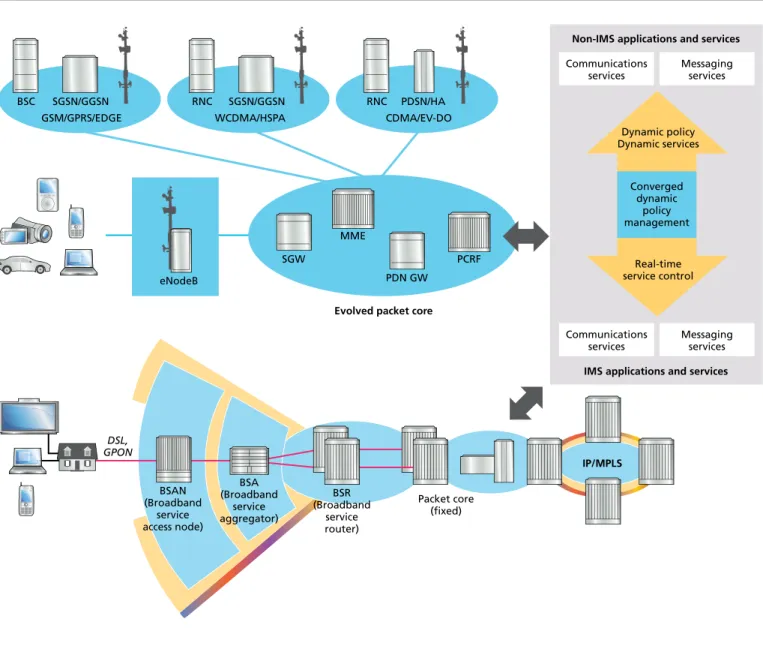
While it may take some time for this vision to become reality, Alcatel-Lucent EPC solution (see Figure 9) is fully capable of addressing these requirements, as already proven in the largest IP transformations in many fixed and mobile environments.
Figure 9. Alcatel-Lucent EPC as a cornerstone for multi-access, multiservice core convergence
5. Conclusion
Alcatel-Lucent’s EPC solution delivers a new, service-aware all-IP mobile core for LTE, capable of true wireless broadband QoE, with advanced end-to-end QoS with secure and dynamic bearer, mobility and policy management.
eNodeB SGW MME PDN GW PDSN/HA RNC PCRF
Evolved packet core
CDMA/EV-DO SGSN/GGSN RNC WCDMA/HSPA GSM/GPRS/EDGE SGSN/GGSN BSC Dynamic policy Dynamic services Real-time service control Converged dynamic policy management Communications
services Messagingservices
Non-IMS applications and services
IMS applications and services
Communications
services Messagingservices
BSA (Broadband service aggregator) BSAN (Broadband service access node) BSR (Broadband service router) Packet core (fixed) DSL, GPON IP/MPLS
Alcatel-Lucent Evolved Packet Core Solution | Technology White Paper 10
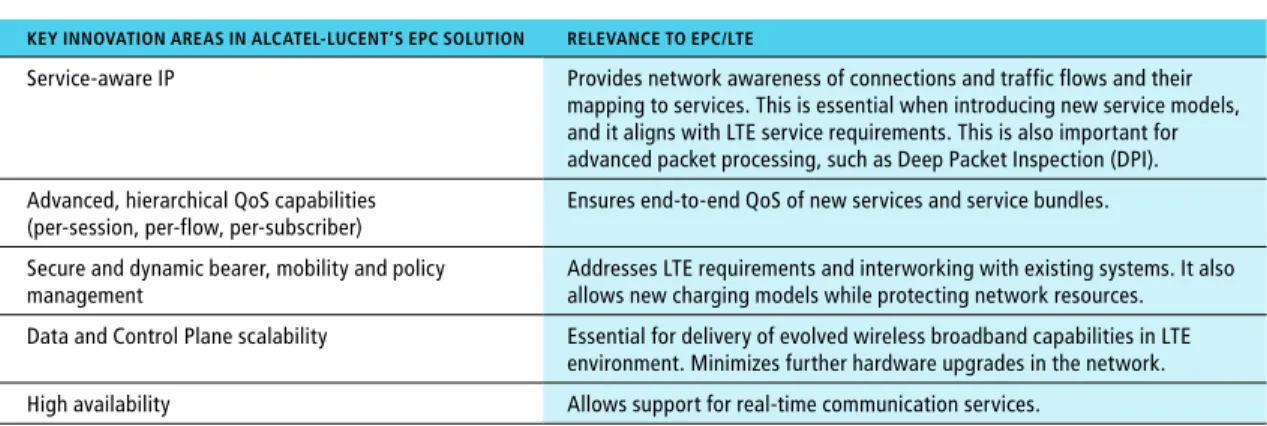
Table 1 outlines key innovation areas of Alcatel-Lucent’s EPC solution.
Table 1. Key innovation areas of Alcatel-Lucent’s EPC solution
6. Abbreviations
KEy innovATion ArEAs in ALCATEL-LuCEnT’s EPC soLuTion rELEvAnCE To EPC/LTE
Service-aware IP Provides network awareness of connections and traffic flows and their mapping to services. This is essential when introducing new service models, and it aligns with LTE service requirements. This is also important for advanced packet processing, such as Deep Packet Inspection (DPI). Advanced, hierarchical QoS capabilities
(per-session, per-flow, per-subscriber)
Ensures end-to-end QoS of new services and service bundles. Secure and dynamic bearer, mobility and policy
management
Addresses LTE requirements and interworking with existing systems. It also allows new charging models while protecting network resources. Data and Control Plane scalability Essential for delivery of evolved wireless broadband capabilities in LTE
environment. Minimizes further hardware upgrades in the network. High availability Allows support for real-time communication services.
3GPP 3rd Generation Partnership Project 3GPP2 3rd Generation Partnership Project 2 AF Application Function
AS Access Stratum
CDF Charging Data Function CDMA Code Division Multiple Access CDR Charging Data Record CGF Charging Gateway Function CRF Charging Rules Function CS Circuit Switched
CSCF Call Session Control Function
DL Downlink
E-UTRAN Evolved-UTRAN EDGE Enhanced Data rates for
GSM Evolution
EMM EPS Mobility Management eNodeB evolved NodeB
EPC Evolved Packet Core EPS Evolved Packet System
GERAN GPRS EDGE Radio Access Network GGSN Gateway GPRS Support Node GMSC Gateway Mobile Switching Center GPRS General Packet Radio Service GSM Global System for Mobile communications GTP GPRS Tunnelling Protocol
HLR Home Location Register
HSDPA High Speed Downlink Packet Access HSPA High Speed Packet Access HSS Home Subscriber Server HSUPA High Speed Uplink Packet Access IETF Internet Engineering Task Force IEEE Institute of Electrical and Electronics
Engineers
IMS IP Multimedia Subsystem
IMSI International Mobile Subscriber Identity
IMT-2000 International Mobile Telecommunications 2000 ISIM IMS Subscriber Identity Module ITU International Telecommunication
Union
LTE Long Term Evolution
MBMS Multimedia Broadcast and Multicast Service
MIMO Multi Input Multi Output MGCF Media Gateway Control Function
MGW Media Gateway
MME Mobility Management Entity MMD MultiMedia Domain MNC Mobile Network Code MSC Mobile Switching Center MT Mobile Terminal NAS Non Access Stratum NGN Next Generation Network OFDM Orthogonal Frequency Division
Multiplexing
OFDMA Orthogonal Frequency Division Multiple Access.
P-GW PDN Gateway
PCEF Policy and Charging Enforcement Function
PCRF Policy and Charging Rules Function PDCP Packet Data Convergence Protocol PDF Policy Decision Function PDP Context Packet Data Protocol Context PLMN Public Land Mobile Network PoC Push-to-talk over Cellular PS Packet Switched domain
RNC Radio Network Control S-GW Serving Gateway
SAE System Architecture Evolution SDF Service Data Flow
SGSN Serving GPRS Support Node SIM Subscriber Identity Module SIP Session Initiation Protocol SM Session Management SMS Short Message Service TA Tracking Area
TCP Transmission Control Protocol TDMA Time Division Multiple Access TDD Time Division Duplex TE Terminal Equipment
TISPAN Telecommunication and Internet converged Services and Protocols for Advanced Networking
UDP User Datagram Protocol
UE User Equipment
UL Up-Link
UMB Ultra Mobile Broadband
UMTS Universal Mobile Telecommunications System
USIM Universal Subscriber Identity Module UTRAN Universal Terrestrial Radio Access
Network
WCDMA Wide band Code Division Multiple Access
WiMAX Worldwide Interoperability Microwave Access
www.alcatel-lucent.com Alcatel, Lucent, Alcatel-Lucent and the Alcatel-Lucent logo are trademarks of Alcatel-Lucent. All other trademarks are the property of their respective owners. The information presented is subject to change without notice. Alcatel-Lucent assumes no responsibility for inaccuracies contained herein. Copyright © 2009 Alcatel-Lucent. All rights reserved. CPG 2896090227 (03)