CLUSTER-BASED ESTIMATORS FOR
MULTIPLE AND MULTIVARIATE LINEAR
REGRESSION MODELS
EKELE ALIH
UNIVERSITI SAINS MALAYSIA
2015
CLUSTER-BASED ESTIMATORS FOR
MULTIPLE AND MULTIVARIATE LINEAR
REGRESSION MODELS
by
EKELE ALIH
Thesis submitted in fulfilment of the requirements
for the degree of
Doctor of Philosophy
DEDICATIONS
Anabel-Martha Ugbedeojo, Mummy’s death has made you unstable– I just wish I can make up for you upon my return
Gabriel-AkoEkele, Daddy left you to study just few hours after you came–I just hope you will recognize me when I return
ACKNOWLEDGEMENTS
I give honour, thanks, gratitude and appreciation to the Creator God for bringing me
into this world, for being with me in times of trouble, for providing all my needs and
above all for giving me sound wisdom, knowledge and understanding even in the face
of uncertainties in the course of this Doctorate Degree Programme.
My special appreciation goes to Associate Professor Hong Choon Ong, who welcomed
me like a father will welcome a son when I arrived in Malaysia; who guided me like a
father will guide his son during my registration process to be a PhD student of USM;
who provided for me, all I needed to do in my research when I eventually settled down
as a PhD student of PPSM, USM; who took all the pains to go through every line of this
Thesis and offered suggestions and corrections. I sincerely thank him for condoning
all my acts, both ‘the good’, ‘the bad’ and ‘the ugly’ and for heartily moderating this research project to its peak. Once, again, Remain blessed, Prof. Ong.
I thank my Parents, Mr. Stephen Ibrahim Alih and Mrs. Martha Ibrahim Alih, through
whom I came into this world. They have persistently been praying for my success and
hope to celebrate my victory in this PhD journey. Thank you, ‘MUM&DAD’.
My wife made sacrifices in no small measure in the course of my PhD pursuit. One of
those sacrifices was to allow me to travel for the PhD program barely 8 days after you
underwent a caesarian operation that gave birth to our boy, Gab. You borne the pains
is love at its peak. These gestures are indelible in my mind. Thank you, Stella-Gbelei.
The Federal Polytechnic Idah is immensely appreciated for providing my funding
through the TETFUND of the Federal Republic of Nigeria. Thank you to the
Gov-ernment of ‘myfatherland’
I appreciate my two kids, Anabel and Gabriel, who missed me dearly and whom I
dearly missed while I am away to pursue the PhD. I love you and will soon join you as
we hope to grow together in God’s path.
Colleagues and staff of Maths/Statistics Department, Federal Polytechnic Idah are also
acknowledged for their co-operation with me while pursuing the programme. Thank
you all.
Above all, I thank once more the Almighty God for His unquantifiable journey mercies
and for sustaining my life all through the period of study. Once again, I acknowledge
that I am divinely favoured.
Ekele Alih
TABLE OF CONTENTS
Acknowledgements ii
Table of Contents iv
List of Tables ix
List of Figures xii
List of Abbreviations xiv
List of Symbols xviii
List of Publications xxiii
Abstrak xxv
Abstract xxvii
CHAPTER 1 –INTRODUCTION
1.1 General Introduction 1
1.2 Motivation of the Study 3
1.3 Research Objectives 5
1.4 Thesis Organization 6
1.5 Regression background and Notation 6
1.6 The Least squares Regression-LS 10
1.6.1 Terminology 11
1.7 Leverage and the Hat Matrix 13
1.7.1 Altered Hat Matrix 15
1.8 Outlier Diagnostics 16
1.9 Influence Diagnostics 18
2.1 Introduction 20
2.2 Location and Dispersion Estimators 22 2.2.1 The Forward Search Procedures 23
2.2.1(a) The Stahel-Donoho Estimator 23 2.2.1(b) The Stalactite Plot Analysis 25
2.2.1(c) The Orthogonalized Gnanadesikan-Kettenring Estimator 27
2.2.1(d) TheBACON: Block Adaptive
Computationally-Efficient Outlier Nominators 29
2.2.2 The Elemental or Resampling Procedures 32 2.2.2(a) The Minimum Volume Ellipsoid Estimator for
Location and Dispersion in the presence of Outliers 32
2.2.2(b) The Minimum Covariance Determinant Estimator for
Location and Dispersion in the presence of Outliers 36
2.2.2(c) The Deterministic Minimum Covariance Determinant
(DetMCD)Estimator for Location and Dispersion in
the presence of Outliers 39
2.3 Robust Estimators for Multiple Linear Regression Analysis 43
2.3.1 Low Breakdown Regression Estimators 44 2.3.2 M and Bounded Influence Regression 45
2.3.3 High Breakdown Regression Estimators 49 2.4 Multivariate Linear Regression Analysis 53
2.4.1 Robust estimation in Simultaneous equation models 55
2.4.2 The MCD Robust Multivariate Regression (MCDreg) 56 2.4.3 The Multivariate RegressionS-estimators (MSreg) 57 2.4.4 The Multivariate Least-trimmed Square Estimator (MLTSreg) 59
CHAPTER 3 –THE PROPOSED MULTIVARIATE OUTLIER IDENTIFICATION WITH ITS LOCATION AND DISPERSION ESTIMATOR
3.2 The Proposed MMD Forward Search Algorithm Estimator 67
3.2.1 Definition of MMD Estimator 69 3.3 The Rationale of MMD Algorithm Estimator 73
3.4 Numerical Illustration and Monte Carlo Simulation Experiment 75 3.4.1 Artificial Dataset Illustration 75
3.4.2 Dilemma Dataset Illustration 78
3.4.3 Monte Carlo Simulation Experiment 83 3.5 Equivariance, Robustness and Efficiency Properties of MMD 87
3.5.1 Equivariance Properties 88
3.5.2 Numerical Equivariance 90
3.5.3 Breakdown Value (Robustness) of MMD Estimator 92
3.5.4 Finite Sample Efficiency 94
CHAPTER 4 –THE PROPOSED UNIVARIATE SIMPLE AND MULTIPLE REGRESSION PROCEDURE
4.1 Introduction 98
4.1.1 The Concentration Steps Algorithm 100
4.1.2 The Concept of Cluster Analysis 102 4.2 The Proposed Cluster-based L2 Robust Regression-CL2RR 106
4.2.1 TheC-step Phase 107
4.2.1(a) Definitions 107
4.2.1(b) TheCL2RRInitial Estimator Algorithm 110 4.2.2 The Sequential Regression Phase 112 4.2.3 TheCL2RRNumerical Demonstration 118 4.2.3(a) Analysis ofCL2RRInferences 126 4.2.3(b) Empirical Assessment ofCL2RRInferences 127 4.3 Numerical Example and Monte Carlo Simulation 130
4.3.1 The Stackloss Data set 130
4.3.2 The Pendleton and Hocking Data set 134 4.3.3 Monte Carlo Simulation Experiment 137
4.4 Robustness and Equivariance Properties of CL2RR 144 4.4.1 Robustness properties of CL2RR 144
4.4.2 Equivariance properties of CL2RR 146
4.5 Chapter Summary and Conclusion 148
4.5.1 Summary 148
4.5.2 Conclusion 149
CHAPTER 5 –THE PROPOSED CLUSTER-BASED MULTIVARIATE REGRESSION PROCEDURE
5.1 Introduction 151
5.2 The Proposed Cluster-based Multivariate Robust Regression-CMRR 152
5.2.1 Definitions 152
5.2.2 Robustness properties 157
5.3 CMRR Algorithm 158
5.3.1 TheCMRRNumerical Demonstration 161 5.3.2 Analysis ofCMRRInferences 170 5.4 Numerical Example and Monte Carlo Simulation 171 5.4.1 The Pulp-fibre Data set 171
5.4.2 The Milk Data set 181
5.4.3 Monte Carlo Simulation 188 5.4.4 Finite Sample Efficiency 195
5.5 Summary 196
6.2 Current Regression Methodologies 199
6.2.1 The Ordinary Least Squares 199
6.2.2 The M-regression 200
6.2.3 The Bounded Influence Regression 200 6.2.4 The Least Median of Squares Regression 200
6.2.5 The Least Trimmed Squares Regression and Least Trimmed
Absolute Value Regression 201
6.2.6 TheMMRegression 201
6.2.7 Findings and Contribution of This Thesis 202 6.2.8 Recommendations for Future Research 203
References 205
APPENDICES 210
A.1 R programming Code for Outlier Identification and Computation of
Location and Dispersion Estimator via theMMDAlgorithm. 211 B.1 R programming Code for theCL2RRNumerical Demonstration 216 C.1 R programming Code for theCMRRNumerical Demonstration 231
LIST OF TABLES
Page
Table 3.1 Artificial Dataset 76
Table 3.2 Robust Mahalanobis Distances ofMMD,MV E,DetMCDand
BACON estimators for Artificial Dataset 77
Table 3.3 Dilemma Dataset 79
Table 3.4 Robust Mahalanobis Distances ofMMD,MV E,DetMCDand
BACON estimators for Dilemma Dataset 81
Table 3.5 Performance Evaluation ofMMD,MV E,DetMCDandBACON
estimators for Dilemma Dataset 82
Table 3.6 Monte Carlo Performance Evaluation ofMMD,MV E,
DetMCDandBACON estimators 85
Table 3.7 Simulation results of Deviation from Affine Equivariance,
dCL2RR ofCL2RR 91
Table 3.8 Finite Sample Efficiency of theMMDestimators 95
Table 4.1 Simulated simple linear regression data 119
Table 4.2 The pivot point estimate,BfromLS-regression. 121
Table 4.3 Similarity matrix computed from
si j = (bi−bj)′(CD(B))−1(bi−bj) 122
Table 4.4 CL2RR Parameter estimates, Other Competitors and the True
Parameter Values 125
Table 4.5 CL2RR Analysis of Variance 127
Table 4.6 Monte Carlo Performance Evaluation on the CL2RR Inferential
Statistics 129
Table 4.7 The Stackloss Dataset 131
Table 4.8 A Summary ofCL2RREstimation and Robust ANOVA for
Stackloss Data set 133
Table 4.10 A Summary ofCL2RREstimation and Robust ANOVA for
Pendleton and Hockings Dataset 136
Table 4.11 Simulation result of estimators’ performances atd=0%(i.e. no
outlier) 139
Table 4.12 Simulation result of estimators’ performances atd=20% 140
Table 4.13 Simulation result of estimators’ performances atd=30% 140
Table 4.14 Simulation result of estimators’ performances atd=50% 141
Table 5.1 Multivariate Regression Artificial Data 163
Table 5.2 Mahalanobis distance fromMMDestimator 164
Table 5.3 Mahalanobis distance of residualsdi2(βββˆ,ΣΣΣmˆ )and its rankRd 165
Table 5.4 Mahalanobis distance of residualsdi2(βββˆ,ΣΣΣmˆ )and its rankRd at
convergence of Steps 1 and 2 166
Table 5.5 The Leverage Weightsπππ(di) 168
Table 5.6 CMRR Analysis of Variance 171
Table 5.7 The Pulp-fibre Dataset 172
Table 5.8 CMRRParameter Estimates and Inferential Statistics for Pulp
Fibre Data 176
Table 5.9 MSregParameter Estimates and Inferential Statistics for Pulp
Fibre Data 177
Table 5.10 MLT SregParameter Estimates and Inferential Statistics for
Pulp Fibre Data 178
Table 5.11 MCDregParameter Estimates and Inferential Statistics for Pulp
Fibre Data 178
Table 5.12 The Milk Dataset 181
Table 5.13 CMRRParameter Estimates and Inferential Statistics for the
Milk Data 186
Table 5.14 MSregParameter Estimates and Inferential Statistics for the
Milk Data 187
Table 5.15 MLT SregParameter Estimates and Inferential Statistics for the
Table 5.16 MLT SregParameter Estimates and Inferential Statistics for the
Milk Data 188
Table 5.17 Simulation results of Bias of Coefficient Matrix 191
Table 5.18 Simulation results of MSE of Coefficient Matrix 191
Table 5.19 Simulation results of Computing Time(t in sec.)of Coefficient
Matrix 192
LIST OF FIGURES
Page
Figure 1.1 Scatter Plot Illustrating Outliers and Leverages 12
Figure 3.1 Index Plot of Location and Dispersion Estimator for Artificial Dataset: (a) Index Plot of MMD Estimator (b) Index Plot of MVE Estimator (c) Index Plot of DetMCD Estimator and (d)
Index Plot of BACON Estimator. 77
Figure 3.2 Index Plot of Location and Dispersion Estimator for Dilemma Dataset: (a) Index Plot of MMD Estimator (b) Index Plot of MVE Estimator (c) Index Plot of DetMCD Estimator and (d)
Index Plot of BACON Estimator. 82
Figure 3.3 Line Plots of Percentage Detection Rates for MMD, MVE,
DetMCD and BACON Estimators. 86
Figure 3.4 Line Plots of Percentage Swamping Rates for MMD, MVE,
DetMCD and BACON Estimators. 87
Figure 3.5 Line Plots ofMMDefficiency 96
Figure 4.1 Dendrogram Plot of Simple Linear Regression Data. 122
Figure 4.2 The FF Plot of Linear Regression Fits forOLS,LT S,MM,CBI,
andCL2RR 125
Figure 4.3 Regime Plot of computation time for Simulated Data: (bi) Time plot at zero percentage outlier(d=0%), (bii) Time plot at
d=20% outlier (biii) Time plot atd=30% outlier, and (biv)
Time plot atd=50% outlier 142
Figure 4.4 Regime Plot of bias for Simulated Data: (ai) Bias plot at zero percentage outlier(d=0%), (aii) Bias plot atd=20% outlier (aiii) Bias plot atd=30% outlier, and (aiv) Bias plot at
d=50% outlier 143
Figure 5.1 Dendrogram Plot of Multivariate Linear Regression Data. 167
Figure 5.2 Dendrogram Plot of Pulp Fibre Data. 175
Figure 5.4 Dendrogram Plot of Milk Data. 186
Figure 5.5 Regime Plot of Bias for Simulated Data: (ai) Bias plot at zero percentage outlier(d=0%), (aii) Bias plot atd=20% outlier (aiii) Bias plot atd=30% outlier, and (aiv) Bias plot at
d=40% outlier 193
Figure 5.6 Regime Plot of computing time for Simulated Data: (bi) Time plot at zero percentage outlier(d=0%), (bii) Time plot at
d=20% outlier (biii) Time plot atd=30% outlier, and (biv)
LIST OF ABBREVIATIONS
3SLS 3 Stage Least Squares
AHC Agglomerative Hierarchical Clustering
ANOVA Analysis-of-Variance
BACON Block Adaptive Computationally-efficient Outlier Nominator
BDP Break Down Point
BI Bounded Influence
BIR Bounded Influence Regression
BLUE Best Linear Unbiased Estimator
CBI Cluster-Based Bounded Influence Regression
C-Step Concentration Steps
CL2RR Cluster-based L2 Robust Regression
CLreg Cluster-based Estimator for Multiple and Multivariate Linear Regression
CMRR Cluster-based Multivariate Robust Regression
det Determinant of a Matrix
DetMCD Deterministic Minimum Covariance Determinant
df Degree of Freedom
DFFITS Difference in Fits influence diagnostics
DFFITSi Difference in Fits influence diagnostics whenith observation has been
removed
DFFITSl Difference in Fits influence diagnostics when the set oflobservations has
been removed
DHC Divisive Hierarchical Clustering
FastMCD Fast Minimum Covariance Determinant
FSA Forward Search Algorithm
GM Generalized Maximum Likelihood Estimator
iid Independently and identically distributed
IRLS Iteratively Reweighted Least Squares
LAD Least Absolute Deviation
LS Least Squares
LTA Least Trimmed Absolute Deviation
LTS Least Trimmed Squares
M A type of Maximum Likelihood Estimator
MAD Median Absolute Deviation
MCD Minimum Covariance Determinant
MCDreg Minimum Covariance Determinant Regression
MLR Multiple Linear Regression
MVE Minimum Volume Ellipsoid
MLE Maximum Likelihood Estimator
MLTSreg Multivariate Least Trimmed Squares Regression
MM A type of Maximum Likelihood Estimator in two phases
MMD Minimum Mahalanobis Distance Algorithm
MSreg Mean Squared Regression
MSres Mean Squared Residuals
MSreg Multivariate Scale Regression
OLS Ordinary Least Squares
OLSWO Ordinary Least Squares when observations identified as outliers have been removed from the dataset
PDS Positive Definite and Symmetric Matrix
PRESS Prediction Residuals
RD Robust Distances
REWLS Reweighted Least Squares
SSE Sum of Square Error
SLR Simple Linear Regression
SS Sum of Squares
SSreg Sum of Squares Regression
LIST OF SYMBOLS
α Level of significance
βββ Regression parameters
βj Element ofβββ relating to the jthregressor
ˆ
βββˆˆ An estimate ofβββ ˆ
βj Element of ˆβββˆˆ relating to the jthregressor C Covariance matrix
⌈ ⌉ Ceil: Rounds up a float to a specified number of decimal places
Cℓ MMD’s covariance matrix
Cm Main cluster
Cτ Minor cluster
Chm Main cluster containing onlyhobservations CJ Covariance matrix ofJthsubsample
δ cutoff value for a diagnostic statistic
di(.) Theith Mahalanobis distance of an argument εεε Random error matrix
εi Theithrandom error
f(.) Model function
∀ For all
γ Breakdown point, i.e. fraction of outlier that an estimator can tolerate
H Hat matrix
h Number of observations defining a half dataset of data
hii Theithdiagonal ofH
hi j Theithrow and the jthcolumn element ofH Hy The altered hat matrix
J Subsample size
Jm Initial sample
l Size of minor clusters to be activated
L1 Least absolute deviation regression loss function
m Mean vector
˜
m Median vector
mℓ MMD’s mean vector
m Size of initial Sample or Initial subset
mJ Mean vector ofJth subsample
µµµ Population Mean ˆ µˆ µµˆ Estimate ofµµµ MMD(βββ) MMD-variance N Population size n Number of observations
p Number of predictor variables
# Paired sample with parallel and equal size
q Number of response variables
Rstudenti The Studentizedt-like diagnostics r Residual vector
ri,−i Residual values atx
′
iwhenithobservation is removed σσσ2 Vector of variances
σσσ Vector of standard deviations
ΣΣΣ Population covariance matrix ˆ
ΣΣΣˆˆ Estimate ofΣΣΣ
s Root mean square error forOLSregression
s−i Root mean square error forOLSregression whenith observation is removed
ui Robust projection distances
v Direction vector ofk×1 or p×1 dimension
x Predictor variable of interest
xi Theithpredictor variable
xji Theithobservation for the jthpredictor X Predictor matrix including intercept
x′i Theithrow ofX
Xy Predictor matrix with intercept and augmented with the response vector
y Response variable of interest
yi Theithresponse variable
yi,−i Fitted values atx
′
iwhenithobservation is removed
yki Theithobservation for thekthresponse ˆy Predicted response vector
Z Predictor matrix excluding intercept
z′i Theithrow ofZ
LIST OF PUBLICATIONS
LIST OF PUBLICATIONS
[1] Alih, E., and Ong, H. C., (2015), Robust Cluster-Based Multivariate Outlier Di-agnostics and Parameter Estimation in Regression Analysis,Communications in Statistics - Simulation and Computation, Accepted: DOI 10.1080/036
10918.2014.960093. [ISI Impact Factor:0.288]
[2] Alih, E., and Ong, H. C., (2015), An Outlier-resistant Test for Heteroscedasticity in Linear Models, Journal of Applied Statistics, 42:8, 1617-1634. [ISI Impact Factor: 0.656 ].
[3] Alih, E., and Ong, H. C., (2015), Cluster-based Multivariate outlier identification and Re-weighted Regression in Linear Models, Journal of Applied Statistics,
42:5, 938-955. [ISI Impact Factor: 0.656].
[4] Alih, E., and Ong, H. C., An Outlier resistant algorithm of T2 Control Chart for Skewed Population, Statistical Methods & Applications, Under Review. [ISI Impact Factor: 0.571].
[5] Alih, E., and Ong, H. C., Cluster-based L2 Re-weighted Regression, Statistical Methodology, Accepted: DOI 10.1016/j.stamet.2015.05.005. [ISI Impact Fac-tor: 0.708].
[6] Ong, H. C., and Alih, E., Cluster-based Multivariate Regression,Pakistan Journal of Statistics, Accepted. [ISI Impact Factor: 0.336].
[7] Ong, H. C., and Alih, E.,(2015), A Control Chart Based on Cluster-Regression Adjustment for Retrospective of Monitoring Individual Characteristics, PLoS One,10(4):e0125835. [ISI Impact Factor: 3.534].
[8] Alih, E., and Ong, H. C., (2014), The performance of robust multivariate regres-sion in simultaneous dependence of variables in linear models,AIP Conference Proceedings,1606, pp 1028-1033.
[9] Alih, E., and Ong, H. C., (2015), Cluster-based Control Chart Method, National Symposium on Mathematical Sciences (SKSM22) Shah Alam, Kuala Lumpur.
PENGANGGAR BERASASKAN
KELOMPOK BAGI MODEL REGRESI
BERGANDA DAN LINEAR MULTIVARIAT
ABSTRAK
Dalam bidang pemodelan regresi linear, regresi kuasa dua terkecil (LS) klasik adalah
mudah dipengaruhi oleh titik terpencil manakala penganggar regresi rendah-kerosakan
seperti regresi M dan regresi pengaruh terbatas mampu menahan pengaruh peratusan
kecil titik terpencil. Penganggar tinggi-kerosakan seperti kuasa dua trim terkecil (LTS)
dan penganggar regresi (MM) adalah teguh terhadap sebanyak 50% daripada
pence-maran data. Masalah prosedur penganggar ini termasuklah permintaan
pengkompu-teran luas dan kebolehubahan subpensampelan, kerentanan koefisien teruk terhadap
kebolehubahan kecil dalam nilai awal, sisihan dalaman daripada trend umum dan
kebo-lehan dalam data bersih dan situasi rendah-kerosakan. Kajian ini mencadangkan suatu
penganggar regresi baru yang menyelesaikan masalah dalam model regresi berganda
dan regresi multivariat serta menyediakan maklumat berguna tentang kehadiran dan
struktur titik terpencil multivariat. Dalam model regresi berganda, prosedur yang
dica-dangkan menyeragamkan fasa langkah tumpuan (langkah-C) dengan fasa regresi
ber-jujukan. Jarak varians Mahalanobis yang minimum dirujuk sebagai MMD-algoritma
tumpuan varians yang menghasilkan penganggar awal. Selepas itu, satu analisis
ke-lompok berhierarki dilakukan dan data seterusnya disusun ke dalam keke-lompok utama
awal kuasa dua terkecil dihasilkan dari kelompok utama dengan perbezaan dalam
sta-tistik sesuai yang mengaktifkan secara jujukan kelompok minor dalam senario regresi
pengaruh terbatas. Dalam penetapan regresi multivariat, suatu penentu kovarians jarak
minimum Mahalanobis dirujuk sebagai MMCD-algoritma tumpuan kovarians
meng-hasilkan penganggar awal. Jarak reja dikira daripada penganggar awal yang menjadi
metrik jarak bagi analisis kelompok berhierarki aglomeratif (AHC). AHC menyusun
data seterusnya ke dalam kelompok utama ’set setengah’ dan kelompok minor
da-lam satu kumpulan atau lebih. Anggaran kuasa dua terkecil awal diperolehi daripada
kelompok utama. Anggaran awal kemudiannya dioptimumkan dengan
menggunak-an lmenggunak-angkah tumpumenggunak-an ymenggunak-ang menurunkmenggunak-an fungsi objektif reja disetiap lmenggunak-angkah
tumpu-an. Bagi menambahbaik kecekapan anggaran awal, statistik DFFITS digunakan bagi
mengaktifkan kelompok minor. Oleh kerana langkah yang dicadangkan bercampur
fasa kelompok dengan ulangan fasa regresi kuasa dua terkecil ia dikenali sebagai
pe-nganggar berasaskan kelompok bagi model Regresi Berganda dan Linear Multivariat
(singkatannya CLreg). CLreg mencapai titik kerosakan-tinggi yang dapat ditentukan
oleh pengguna. Ia mewarisi sifat normal asimptot regresi kuasa dua terkecil dan
ju-ga varians samaan. Perbandinju-gan kajian kes dan eksperimen simulasi Monte Carlo
menunjukkan kelebihan prestasi berbanding cara kerosakan-tinggi lain daripada segi
kestabilan koefisien. Satu plot dendogram yang diperolehi daripada analisis
kelom-pok digunakan bagi pengenalpastian titik terpencil multivariat. Secara keseluruhannya,
prosedur yang dicadangkan merupakan suatu sumbangan dalam bidang regresi teguh
yang menawarkan sudut pandangan berbeza terhadap analisis data dan gabungan
CLUSTER-BASED ESTIMATORS FOR
MULTIPLE AND MULTIVARIATE LINEAR
REGRESSION MODELS
ABSTRACT
In the field of linear regression modelling, the classical least squares (LS) regression is susceptible to a single outlier whereas low-breakdown regression estimators likeM re-gression and bounded influence rere-gression are able to resist the influence of a small
per-centage of outliers. High-breakdown estimators like the least trimmed squares (LT S) and MM regression estimators are resistant to as much as 50% of data contamina-tion. The problems with these estimation procedures include enormous computational
demands and subsampling variability, severe coefficient susceptibility to very small
variability in initial values, internal deviation from the general trend and capabilities
in clean data and in low breakdown situations. This study proposes a new high
break-down regression estimator that addresses these problems in multiple regression and
multivariate regression models as well as providing insightful information about the
presence and structure of multivariate outliers. In the multiple regression model, the
proposed procedures unify a concentration step (C-step) phase with a sequential regres-sion phase. A minimum Mahalanobis distance variance referred to as (MMD)-variance concentration algorithm produces a preliminary estimator. Thereafter, a hierarchical
cluster analysis is performed and then the data is partitioned into a main cluster of “half
es-timate arises from the main cluster with a difference in fit statistic (DFFIT S-statistic) that sequentially activates the minor clusters in a bounded influence regression
sce-nario. In the multivariate regression setting, a minimum Mahalanobis distance
covari-ance determinant referred to as (MMCD)-covariance concentration algorithm produces a preliminary estimator. Residual distances computed from this preliminary estimator
serves as a distance metric for agglomerative hierarchical cluster(AHC)analysis. The
AHC then partition the data into a main cluster of “half set” and a minor cluster of one or more groups. An initial least squares estimate is obtained from the main
clus-ter. The initial estimate is thereafter, optimized using concentration steps that lower
the objective function of the residuals at each concentration step. To improve the
ef-ficiency of the initial estimates, a difference in fit statistic (DFFIT S-statistic) is used to activate the minor cluster. Since the proposed method blends the cluster phase with
repeated least squares regression phase, it is called the Cluster-based estimators for
Multiple and Multivariate Linear regression Models (CLreg for short). CLreg achieves
a high breakdown point which can be determined by the user. It inherits the
asymp-totic normal properties of the least squares regression and is also equivariant. Case
studies comparisons and Monte Carlo simulation experiments depict the performance
advantage of CLreg over the other high breakdown methods for coefficient stability. A
dendrogram plot obtained from cluster analysis is used for multivariate outlier
detec-tion. Overall, the proposed procedure is a contribution in the area of robust regression,
offering a distinct philosophical viewpoint towards data analysis and the marriage
CHAPTER 1
INTRODUCTION
1.1 General Introduction
While least squares methods have dominated the statistical literature on regression for
many years, a significant interest in alternative methods has emanated in the last few
years. One reason for the interest is an increasing awareness of and sensitivity to the
problems that occur with the naive application of least squares. In the professional
statistical domain, there is a ‘usual tale’ that the world is fundamentally linear and
nor-mal. Interestingly, the ‘usual tale’ translated into two assumptions viz a viz linearity
and normality assumptions. These two assumptions form the bedrock of many
statis-tical procedures over the wide range of fields where statistics is applied. Under these
assumptions, there exist in abundance, of attractive statistical theory that is carefully
put together into a broad weapon store that can be exploited to analyse data. It may
even propose to the analyst, the experimental design pattern needed to optimize a given
criteria. This is an outstanding prospect to analysts and researchers, but may as well,
produce misleading inferences, or assurances, in the desired output.
Experimental data are usually contaminated data. According to Hampel et al. (2011),
real data are presumed to contain between 1% to 10% gross contamination. In
inevitable. The resulting effect is that such contaminated data points may indicate that
the regression model is misspecified, that the presumed linear model is not suitable, or
better still, human error occurred during experimental stage or in data recording stage.
In the long run, a statistical analyst is left at the mercy of the validity of the assumptions
being made when conducting analysis. Conditioning a linear model for an experiment
as well as restricting outcomes to an independently and identically distributed random
error is an assumption of convenience because then, the accompanying analysis to be
performed is fixed. On the other hand, assumptions of convenience may not essentially
be the valid assumption. Moreover, adapting a given analytical approach exclusively
because it is very ‘popular’ will arbitrarily restrict the quality of desired results.
The advent of computer science has been the reason for a kind of breakthrough in
the field of Applied Statistics. Due to the discovery of the personal computer in the
1970s, applications involving computer technology have been growing upwards at a
geometric rate. Entree to computer programs and softwares has become almost
triv-ial. Procedures and approximation algorithms that were once seen as too complex to
compute are now viable alternatives. Computational confidence is now developed to
emphatically pursue new techniques and new algorithms in applied statistics.
Statisti-cal procedures that rely on the assumption of Gaussian paradigm such as the classiStatisti-cal
methodologies are no longer the only viable option. To an extent, convenience has
1.2 Motivation of the Study
Identification of influential observation often referred to as outliers is a common goal
of a data analyst. Classical methods using euclidean and Mahalanobis distances have
been developed to detect such spurious observations but they fail to detect them
be-cause they are affected by the observations they are supposed to identify. Billor et al.
(2000) presented an algorithm for selecting the initial subset in a forward search
proce-dure for multivariate outlier identification. Fan et al. (2013) used the hierarchical
clus-tering procedure to improve the capability of certain multivariate control chart methods
in identifying the presence of multivariate outliers. Hubert et al. (2012) proposed the
deterministic algorithm for robust location and scatter. It turns out that the robust
Ma-halanobis distance computed from the robust location and scatter matrix forms the
ba-sis for outlier identification. The problem with these estimators is that they are
imprac-tical to compute exactly in large samples. As a result, approximation algorithms are
used. The algorithms generally produce estimators with lower consistency rates and
breakdown values than the exact theoretical estimator. This discrepancy grows
spo-radically with sample size, with the implication that huge computations are required
for good approximations in large high-dimensional samples. In the end, masking and
swamping effects lead to false identification of observation as either outlying or
other-wise. This phenomenon motivated this study to investigate and propose an alternative
outlier identification procedure.
The classical least squares(LS)regression produces the ‘best’ estimates when assump-tions of Gaussian paradigm are all valid. However, the presence of outliers influence
gener-alized regression M-estimator reported in Huber and Ronchetti (2011) is an example
of robust regression alternative for small percentage of outliers in the y-dimension. Hamzah and Nasser (2014) discussed various types of high breakdown M-regression estimation in the context of generalized linear models; while the least median of
squares (LMS) estimator reported in Rousseeuw and Leroy (2003), least trimmed squares (LT S) estimator reported in Rousseeuw and Leroy (2003) and the MM es-timator reported in Maronna et al. (2006) are examples of high breakdown regression
estimators that can resist up to 50% contaminations in datasets. The problem with
these robust alternatives is that the generalized regressionM-estimator can only han-dle small percentage of outliers in the y-dimension and breaks down whenx-outliers are present. According to Hawkins and Olive (2002), the high break down regression
estimators such asLMS,LT SandMMon the other hand implement ‘elemental set ’ or ‘resampling algorithms’ . These algorithms turn out to be completely ineffective in
high dimensions with high level of outlier observations. This is because the algorithm
involves combinatoric-based analysis which becomes completely overwhelmed even
with modest sample size. The phenomenon injects some sort of random sample
vari-ability into the analysis. Hence, reproducibility or lack thereof, becomes a real issue.
Accordingly, the need for an alternative robust regression in multiple regression model
is desirable.
According to Rousseeuw et al. (2004), the classical multiple regression is highly
sus-ceptible to little contaminations in datasets. This setback also occurs in multivariate
regression analysis. Methods such as MCD regression, multivariate S-estimator for robust estimation and inferences, and multivariate least trimmed squares regression
These robust alternatives like their multiple regression counterparts implement
‘resam-pling algorithms ’ and ‘elemental subset’. The drawback is that methods that
imple-ment ‘resampling algorithms’ and ‘eleimple-mental subset’ are ineffective and fail to produce
estimators that are reliable in high dimension. They are characterized with poor
effi-ciency and lack of reproducibility. This research is motivated by these ill-effects to
investigate and propose an alternative multivariate robust regression estimator to
ad-dress the inherent issue with existing alternatives.
1.3 Research Objectives
This research is centered on the study of robust, high breakdown estimators for
loca-tion and dispersion in multivariate outlier identificaloca-tion and its extension to regression
modeling in the multiple and multivariate scenarios with the following objectives.
1. To develop a new estimator for outlier identification that is:
(a) Robust and utilizes substantial information about the sampling distribution,
(b) Able to handle masking and swamping effect in the presence of extreme
observations,
(c) Not computationally intensive.
2. To develop a new regression procedure in the multiple and multivariate models
(b) Offers informative summary about likely multivariate outlier structure,
1.4 Thesis Organization
The remaining parts of chapter 1 discuss the background of classical regression
ap-proach alongside some classical outlier diagnostic in regression analysis. A case study
is presented for the purpose of illustration and comparisons. Chapter 2 deals with
lit-erature review of robust methods such as the various robust procedures for computing
location and dispersion estimators and outlier identification procedures, followed by a
review of robust regression methods with emphasis on low breakdown and high
break-down scenarios for multiple regression. A review of existing robust alternatives toLS
multivariate regression concludes chapter 2. The proposed method for outlier
iden-tification is presented in chapter 3 alongside its equivariance property, Monte Carlo
simulation experiment and numerical examples. The proposed algorithm for multiple
regression method is presented in chapter 4 alongside its numerical illustrations, Monte
Carlo simulation and theoretical properties. Chapter 5 introduces the proposed
multi-variate regression method, its theoretical robustness, Monte Carlo simulation
experi-ment and real data application. Chapter 6 concludes the research work with summary
of findings, and areas for future research.
1.5 Regression background and Notation
Regression study can be seen as the study of how two sets of variables are related. The
first set of variables defines the p-predictors denoted asxji=x1i,x2i,x3i, ···,xpi;i=
are fixed. They are sometimes called regressor or independent variables. Their
nu-merical values are either experimental outcomes or sometimes designed in advance
of the experiment. The second set of variables contains the q-responses denoted as
yki =y1i,y2i,y3i,···,yqi;i=1,···,n; k=1,···,q. They are often called dependent
variables since their values depend on the regressor variables. Three scenarios can be
described by the aggregation of regressor and response variables. Scenario 1 describes
a situation where p=q=1 and is referred to as the simple linear regression model. The second scenario is when p>1,q=1 and it is referred to as the multiple linear re-gression model. Scenario 3 is whenp>1,q>1 and it is referred to as the multivariate linear regression model.
The generalized statistical model that expresses the response as a function of the
re-gressor variables with the addition of an error term arising from the random experiment
is given as
yi= f(x1i,x2i,x3i,···,xpi) +εi,i=1,···,n (1.1)
where n is the sample size. The specific form of the model in Equation (1.1) is re-stricted to a family of linear function given by
yi=β0+β1x1i+β2x2i+β3x3i,···,βpxpi+εi. (1.2)
Note that Equation (1.2) is linear in terms of the unknown parametersβββj∈Rp×1.
In line with the typical linear regression notation, the data are displayed in an n×1 response vector,y, and ann×pregressor matrix,X. Defineβββj∈Rp×1as the parameter
vector, andε as then×1 error vector, the linear regression model is given by
y=Xβββ+εεε (1.3)
The model in Equation (1.3) can be written elementwise as
y1 y2 y3 .. . yn = 1 x11 x21 x31 ··· xp1 1 x12 x22 x32 ··· xp2 1 x13 x23 x33 ··· xp3 .. . ... ... ... . .. ... 1 x1n x2n x3n ··· xpn β0 β1 β2 .. . βp + ε1 ε2 ε3 .. . εn .
For easy understanding, it is important to define some matrices that are pivotal in the
computational process of various regression methods. Create then×(p+2)matrixXy
by augmenting the vector ofyto the matrixXto obtain
Xy= 1 x11 x21 x31 ··· xp1 y1 1 x12 x22 x32 ··· xp2 y2 1 x13 x23 x33 ··· xp3 y3 .. . ... ... ... . .. ... ... 1 x1n x2n x3n ··· xpn yn .
In Chapter 3 where the proposed method for outlier identification will be discussed, as
well as location and dispersion estimators, it becomes crucial to remove the column of
ones from the design matrixXand the augmented matrixXy. LetZbe then×pmatrix
Z= x11 x21 x31 ··· xp1 x12 x22 x32 ··· xp2 x13 x23 x33 ··· xp3 .. . ... ... . .. ... x1n x2n x3n ··· xpn ,
such thatZyrepresents then×(p+1)matrix formed by augmenting the vectorytoZ, given by Zy= x11 x21 x31 ··· xp1 y1 x12 x22 x32 ··· xp2 y2 x13 x23 x33 ··· xp3 y3 .. . ... ... . .. ... ... x1n x2n x3n ··· xpn yn .
In order to be able to reference each of the individual observations, theith row of X
will be referred to as the 1×prow vectorx′i, and the 1×prow ofz′iwill represent the
ithrow ofZ. When the dependent variable is augmented, the notation becomesx′y,iand
z′y,ifor theith row ofXy andZyrespectively.
The ‘hat ’ symbol is used to denote estimates of parameters. For instance, ˆβββˆˆ denotes the estimates of the parameter vectorβββ and then×1 vector of predicted responses is obtained as ˆy=Xβββˆˆˆ such that ˆyi represents the predicted response at theith regressor
space. Also, then×1 vector of residuals is computed as r=y−yˆ such thatri is the
1.6 The Least squares Regression-
LS
The classical least squares(LS)-regression procedure is a method of estimating the pa-rameter vectorβββ of the regression model that is based on the assumption of Gaussian paradigm. Apart from the model specification assumption, the LShas other assump-tions concerning the error term. It assumes that the errors are independent and
identi-cally distributed(iid)random variables whose distribution is that of a normal random variable with mean 0 and a constant varianceσ2. The vector of parameter estimates,
ˆ
βββˆˆ, is computed from the loss function popularly referred to as Ordinary Least Squares
(OLS): min ∀β n
∑
i=1 (yi−β0−β1xi1−β2xi2−βi3xi3− ··· −βpxip)2The expression describes the deviation between the observed response values, yi and
their corresponding predicted response values, ˆyiwhich is a function ofx′i. Hence, the
ordinary least squares(OLS)minimizes the sum of squared residuals, as a result, it is named least squares(LS).
When the assumptions of Gaussian paradigm are all valid, the LS-estimator is said to be the ‘best’ linear unbiased estimator, orBLUE. This implies that theLS-estimator has the least deviation among all other linear unbiased estimators. Moreover, the maximum
likelihood estimator(MLE)turns out to be theLS-estimator under the validity of these assumptions.
1.6.1 Terminology
Robust regression deals mainly with the tendency of an estimator to resist the influence
of extreme observations in datasets. The terms outliers and leverages are often used to
describe these extreme observations, thus, they are defined below.
An outlier can be described as an observation that is extreme in the response space in
relation to the general pattern exhibited by the bulk of the data. Leverage on the other
hand is the term used to define the location of an observation in the predictor space.
A low leverage observation is the data point located near the central tendency of the
predictors while a high leverage observation stays in some extreme position far away
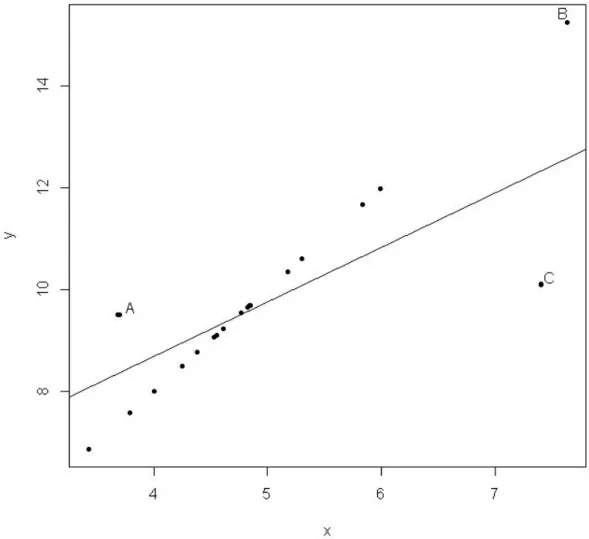
from the central tendency of the predictors. In a concise term a point (y′i,x′i) which does not follow the linear pattern of the bulk of the data but whose x′iis not outlying is called vertical outlier. A point(y′i,x′i)whose correspondingx′i is outlying is called a leverage point. A point (y′i,x′i)is a bad leverage point when it does not follow the pattern of the bulk of the data; otherwise, it is a good leverage point (this is because it
Figure 1.1: Scatter Plot Illustrating Outliers and Leverages
Figure 1.1 depicts the differences between outliers, good leverage points and bad
lever-age points. PointAis an outlier, pointBis a good leverage observation, and pointCis a bad leverage observation.
TheLSregression is extremely susceptible to influential observations. This is because an outlier may have a large residual which, when squared, it wrecks theLS objective function. This is illustrated in theLSregression fit of Figure 1.1 where pointsAandC
pulled theLSregression line from passing through pointBwhere the bulk of the data trend follows.
To summarize, theLSregression is susceptible to as little as one influential observation. As a consequence, parameter estimates and inferential statistics about the estimation
process turns out to be misleading. If LS regression is blindly implemented without any exploratory data analysis, it may be unknown when the analysis has severe flaws.
The phenomenon may lead to a conclusion that does not support the data in the actual
sense. It is therefore, necessary to make a right choice of regression methodology in
data analysis.
With the intent to curtail the drawbacks and risks of failure of Gaussian assumptions
in LS procedure, diagnostic approaches have been proposed for the identification of contaminated observations. These diagnostic tools are applicable in the framework of
robust regression as well.
1.7 Leverage and the Hat Matrix
By definition, the tendency for an observation to overwhelm an estimator relative to
its position in the predictor hyperplane, irrespective of whether the corresponding
re-sponse variable is an outlier or not is referred to as an observation’s leverage. The major
difference between conventional regression and robust regression lies in the
quantifi-cation of this concept.
To begin with, for a p-dimensional predictor variables in a regression model without intercept parameter, the Mahalanobis distance metric, di, for the ith observation is
given by
di=
√
wheremis the p×1 mean vector andCis the p×pcovariance matrix.
Furthermore, consider the scenario in which the intercept parameter is included in the
model, the ‘hat matrix’ replaces the Mahalanobis distances. This matrix (hat matrix) described as the p×p matrix H= X(X′X)−1X′, acquired the name hat matrix be-cause it maps the observed response variable into the predicted values of the response
variables as ˆy=X ˆβ =Hy. This matrix plays an important role in classical outlier diagnostics. Myers (2000) enumerated the properties of theHat matrixas follows:
1. The hat matrix is symmetric and idempotent.
2. The trace ofHequalsp, the dimensional size: i.e ∑n
i=1
hii=p.
3. Theith hat diagonalhii is bounded such that:
(a) For models with intercept, 1n≤hii≤1,∀i,
(b) For models without intercept, 0≤hii≤1,∀i.
4. Ifhii =1, thenhi j=hji=0,∀i̸= j.
5. Every row ofH(and by symmetry, every column) sums to one i.e.
n ∑ j=1
hi j=1,∀i.
6. Theith hat diagonal,hii is monotonically related to theith Mahalanobis distance
disuch hii= di2 n−1+ 1 n. (1.5)
ten-dency in the predictor space (Myers, 2000). As a result, theLS-regression procedure uses the hat diagonal to measure its leverage. Since the sum of all n hat diagonals equals p, and thus 2pn is twice the mean hat diagonal, Myers (2000) proposed a rule of thumb for identifying leverage points as any observation withhii ≥2pn .
The main drawback of the hat diagonals and the Mahalanobis distance is that they are
both functions of the mean. As a result they are affected by the observation they are
supposed to identify. As can be seen from Equation (1.5), describing the relationship
of hat diagonal to the Mahalanobis distances, these hat diagonals are functions of the
classical mean denoted asm, and the corresponding sample covariance denoted asC. According to Billor et al. (2000), both m and C are susceptible to influential obser-vations, and hence, they are not reliable estimators. Consequently, the discussion of
more resistant estimator for m and C is hitherto a desirable alternative. Precisely, a robust Mahalanobis distance metric will be proposed by substitutingmandCby more resistant estimators of multivariate location and dispersion.
1.7.1 Altered Hat Matrix
The hat matrix is based on the predictor variables only. As a result, it does not account
for outlying observations in they-subspace. In order to account for the likely presence of outliers in the response variable, the n×n altered hat matrix, Hy is described as Hy=Xy(Xy′Xy)−1X′y. Myers (2000) reported that the altered hat matrix also have the
pfor the usual hat matrix. Myers (2000) has shown that
Hy=H+ rr′
SSE, (1.6)
whereris the residual vector andSSEthe sum of squares error, both computed from theLS-regression. SinceHyis based onH,LSresiduals andSSE, its diagonal elements are susceptible to outliers or high leverage points.
1.8 Outlier Diagnostics
In searching for outliers in the response variable, it is ideal to begin with residual
analysis. However, Myers (2000) stated that high leverage points tend to have small
residuals because they overwhelm the fitted values and are masked by it. Consequently,
a cautionary approach when making inferences from the set of residuals is ideal.
Given that residuals constitute the units of the response variable, the extent of what
constitutes a large residual is a function of the scale parameter. Hence, an estimate
forσ, denoted bySis used to re-scale the residuals. Myers (2000) suggested the root mean square error(RMSE)obtained from the classical regression analysis of variance
(ANOVA) table. The RMSE is then, defined in terms of an internally studentized residualgiven by
r′i= ri
s√1−hii
. (1.7)
where ri is the ith element of the residual vector r. Lest for lack of independence,
Equation (1.7) follows a Studentt-distribution. Given that the numerator and denomi-nator are not independent andri′ does not follow a truet-distribution. However, Myers
(2000) deemed it to be nearlyt-like, and suggested that anith observation is deemed outlier if the corresponding|ri′| ≥2.
The performance of a regression procedure can be assessed by viewing the regression
analysis when a particular observation is included and when it is removed and then
measure the change in both scenarios. This type of assessment is called ‘single point
deletion analysis’ or the ‘prediction residual(PRESS)approach’. For purpose of no-tation, ‘−i’ subscript could mean that the analysis is carried out without the ith data point. Therefore, ˆyi,−idenotes the fitted value atx′i when the regression is carried out
withoutx′iandyi. Ordinarily, thePRESSanalysis appears to involve the computation
ofnseparate regressions, each with a reduced sample sizen−1. As a result of manip-ulations, only the full data regression is required. That is, the residualri,−i=yi−yˆi,−i
usually referred to as thePRESSresidual can be computed asri,−i=(1−rih
ii).
The presence of outlier in the response space tends to inflate the estimate of scale,
s2 . To deflate such inflation, an alternative to the internally studentized residual is desirable. Myers (2000) suggested to compute,s2−i, in thePRESSprocedure, where
s−i=
√
(n−p)s2−r2
i/(1−hii)
n−p−1 (1.8)
is used to compute theexternally studentized residualsdefined as
Rstudenti= yi−yˆi s−i √ 1−hii . (1.9)
numerator and denominator are now independent. An outlier is identified by a Rstudent
value if|Rstudenti|>t(1−α),(n−p−1). When the effect of theith data point is high, the data point will have a larger Rstudent value than the internally studentized residual.
This is because the estimate of scale s2−i used in the denominator without this data point tends to be smaller than the estimate of scale obtained when using all of the data.
1.9 Influence Diagnostics
Huber (1981) defines the term influence, as the relative effect of a particular observa-tion’s presence on the resulting estimator. Since high leverage outlier has a distorting
effect on theLSestimator, their deletion has a significant effect on the estimator. There-fore, they are said to be substantially influential. Armed with this definition, one can
infer that single point deletion analysis plays a significant role in influence diagnostics.
The influence of the ith observation can be measured using the statistic referred to as ‘difference in fits’ (DFFITS)-statistic, given as
DFFIT Si= ˆ yi−yˆi,−i s−i √ hii . (1.10)
Myers (2000) have shown that theDFFIT S-statistic can be written as
DFFIT Si=Rstudenti[
hii
1−hii
]12 (1.11)
The advantage of theDFFIT S-statistic as an influential diagnostic tool is that it con-stitutes an outlier diagnostic component,Rstudenti, and a leverage diagnostic
compo-nent, [ hii (1−hii)]
1
the outliers and leverages in its evaluation of an observation’s influence on an
estima-tor (Atkinson et al., 2004). For this reason, theDFFIT S-statistic is used as a measure to determine the influence of an outlier cluster on the proposed multiple regression
model.
More robust outlier identification, location and dispersion estimator as well as
outlier-resistant regression methodologies are now discussed in Chapter 2. These estimators
are resistant to contaminations of various sorts and can work well in data analysis when
CHAPTER 2
LITERATURE REVIEW
2.1 Introduction
This chapter discusses the various robust procedures for computing location and
dis-persion estimators and outlier identification procedures. In what follows is the review
of robust regression methods with emphasis on low breakdown and high breakdown
scenarios for multiple regression. A review of existing robust alternatives toLS multi-variate regression concludes this chapter.
Traditionally, nearly all robust outlier identification procedures are based on the
loca-tion and dispersion estimators. This accounts for why the two (localoca-tion and dispersion
estimator and outlier identification methods) are jointly discussed. Outlier
identifica-tion methods can be broadly classified into two groups, namely, the forward search
algorithms and the elemental or resampling set algorithms. The forward search
proce-dure heuristically searches for a ‘half subset’ from a data set through a forward stepping
algorithm. The method involves selecting an initial subset that is outlier-free and then
load it (initial subset) according to a decision criterion until the initial subset contains
‘half subset’. Observations with indexes corresponding to the half subset is used to
compute the robust location and dispersion. The robust location and dispersion
esti-mators are in turn, used to compute the Mahalanobis distance. Observations whose
as an outlier. The coordinatewise median, the Stahel-Donoho estimator, the Stalactite
plot analysis, the Orthogonalized Gnanadesikan-Kettenring estimator (OGK) and the block adaptive computationally efficient outlier nominator(BACON)are examples of the forward search algorithm procedure. The elemental or resampling set procedures
on the other hand computes the location and dispersion estimators by taking a subset
from a data set based on a given objective function that minimizes the error in the
subset selection criterion. A resampling step then optimizes this criterion by
lower-ing the objective function at each resampllower-ing step until an optimum subset which is
free is obtained. A location and dispersion estimator arising from this
outlier-free subset is then used to compute a Mahalanobis distance. A candidate outlier is that
observation whose index corresponds to the Mahalanobis distance that is greater than a
specified threshold (sayδ). The minimum volume ellipsoid(MV E), the minimum co-variance determinant(MCD)and the Deterministic minimum covariance determinant
(DetMCD)are members of robust outlier identification that implement the elemental or resampling procedure.
The goal of robust statistics in outlier identification is the desire to obtain a robust
multivariate location estimator, denoted bym, and a multivariate dispersion estimator, also denoted as C in such a way that the influence of spurious observations can be subdued. The significance of these techniques to robust regression arena hinges on the
ability to extract information about outlier presence as well as its structures especially
in multivariate settings. This implies a transformation from the Gaussian approach
of ‘equal weight assignment’ into another optimistic more robust approach of weight
p+1)/2]-observations in outlier identification as well as multiple regression settings. It is modified as h = [(n+k+1)/2];k= p+q in multivariate regression settings. The outlier identification procedures based on the location and dispersion estimators
discussed below is relative to the data matrixZy.
2.2 Location and Dispersion Estimators
Suppose that Zy is taken from a population with a multivariate normal distribution,
then the classical mean and covariance estimators are computed, respectively, as the
k×1 sample mean vector,
m= n ∑ i=1 zy,i n (2.1)
and thek×ksample covariance (dispersion) matrix,
C= n ∑ i=1 (zy,i−m)(zy,i−m)′ n−1 (2.2)
Equations (2.1) and (2.2) are apparently, functions of the mean and hence, any outlier
observation can erratically deflate or inflate them. The repercussions are that
infer-ences drawn from these estimators, such as the hat diagonals, for instance, are severely
unreliable in the presence of unusual or extreme observations. Therefore, it is
imper-ative to think of alternimper-ative estimators that can resist the influence of these extreme
observations.
One simple way to estimate m and Cis to adopt a robust multivariate location esti-mator in a coordinatewise manner. In the same way as the univariate location
estima-tion, replace the sample mean by the sample median for each of thek-variables. The covariance matrix turns out to be the covariance estimation that is centered by this
co-ordinatewise median. According to Billor et al. (2000), the coco-ordinatewise median is
thought to be more robust as much as 50% than the mean. Although the
coordinate-wise median and the dispersion estimator computed from it is robust, computational
convenience appears to have determined the choice of the median in the past. This is
because in the multivariate setting, the coordinatewise median location estimator is not
affine equivariant. According to Rousseeuw and Leroy (2003), this estimator is not
affine equivariant, implying that linear transformations of the data are not equivalently
transformed by the estimator. The procedures discussed below combine outlier
identi-fication with estimation of location and dispersion estimators. They are classified into:
the forward search procedures and elemental or resampling procedures.
2.2.1 The Forward Search Procedures
Several estimators exist that can replace the non robust sample mean vector and
dis-persion matrix estimators. Some of these estimators differ mainly in terms of their
objective functions and theoretical properties. The following are major outlier
resis-tant estimators for multivariate location and dispersion that adopt the forward search
procedure.
2.2.1(a) The Stahel-Donoho Estimator
Proposed independently by Stahel (1981), Donoho (1982) and Dodge (2002) described
es-ferently from the bulk of the data when they are outlying in a correct metrics. The
procedure is implemented in two stages. A projection computation is used to
deter-mine a robust distance in the first stage. At the second stage, the robust distances serve
as a weight function with a weighted mean vector and weighted dispersion matrix.
According to Rousseeuw and Leroy (1987), this approach is affine equivariant, and
at-tains high breakdown point when the data are in general position. The algorithm itself
is presented below.
Algorithm 2.1: The Stahel-Donoho Projection-based Location and Dispersion Al-gorithm;Source: Rousseeuw and Leroy (1987)
1. Obtain a robust distance, denoted byui, for theith observationzy,i, as:
ui= sup ||v||=1 |z′y,iv−m ∀jed(z ′ y,jv)| m ∀ked|z ′ y,kv−∀mjed(z ′ y,jv)| , (2.3)
where v is the k×1 directional vector, through which the projections of all n
observations are made. The robust distance that is a function of weights obtained
from ui is used to classify outliers into a different cluster while the clean data
points remain in the main cluster.
2. Using thenrobust distances,uiand the data setZythe robust location estimator
is computed as m= n ∑ i=1 w(ui)zy,i n ∑ i=1 w(ui) , (2.4)