Flip the Library:
Introducing Digital Instructional Tutorials Sarah Nakashima
Learning Design and Technology College of Education University of Hawai'i at Mānoa
[email protected] Library Essentials Basics Site Abstract:
The Hamilton Library at the University of Hawaiʻi at Mānoa supports scholastic efforts of students from varied academic levels. Aligned with the Association of College & Research Libraries, “Framework for Information Literacy for Higher Education”, Hamilton Library conducts instructional sessions partnered with the English department’s First Year Writing program. Twice a semester, English 100 classes visit the library first to be introduced to basic research strategies and database searching; and a second time to learn evaluating information techniques. Instruction librarians at Hamilton Library have long struggled to balance the limited time available in these sessions and the amount of information to be communicated, coupled with students’ lack of preparation. Taking into account the increase in distance learning programs the University offers, and the heavy reliance society has on online tools, can the library impact students’ learning outside of the traditional classroom? How would utilizing online tools and non-traditional pedagogical approaches affect learning occurring in library sessions? Results of this study found students’ innate knowledge of research concepts influences learning occurring through the tutorial. While the pedagogy can impact the application of learned concepts. The purpose of this action research is to explore the impact of a flipped learning pedagogy utilizing instructional tutorials in preparing students for library instruction sessions.
Keywords: Information Literacy, Flipped Learning, Digital Instruction, Instructional Tutorials, Library
Statement of the Problem
Hamilton Library strives to provide support for students’ success and growth through their academic journey at the University of Hawaiʻi at Mānoa (UHM). One avenue through which this is accomplished is the offering of Information Literacy instruction for undergraduate and
graduate students. This effort parallels the Framework for Information Literacy for Higher Education as adopted by the Association of College and Research Libraries (ACRL) in January 2015 and supports efforts for WASC Senior College and University Commission (WSCUC) accreditation.
University of Hawaiʻi at Mānoa English 100 instructors (often doctoral students in the English department) schedule library instruction sessions for their classes before the beginning of every semester. The purpose of these sessions is to introduce new college students to the rigors of scholarly research and the unique expectations of scholarly communication. This new thinking is introduced in the Library Essentials Basics sessions. Students are expected to arrive to these sessions having chosen an overarching research topic. From this topic students conduct
preliminary research allowing them to deduce a research issue they are interested in. From this issue, students will formulate at least two research questions they seek to answer. It is expected that students will bring this information with them to the face-to-face (f2f) Basics session. In the f2f session Hamilton librarians introduce library databases and research methods students can use when exploring or learning about their research issue and questions.
While library sessions are a part of the course schedule, these f2f sessions are often viewed as optional by students. Enthusiasm and motivation to participate in the sessions is often minimal. In addition, librarians leading these sessions have found student knowledge of distinctions between reference topics, reference issues and reference questions ranges from minimal to non-existent. Students are asked to complete a pre-session research issues worksheet and bring this artifact to the Basics session. This does not always happen. Instructional sessions are only 50 to 75 minutes and covering the prerequisite information of research issues can take 20 to 30 minutes of this limited time. UH Mānoa English 100 students’ have variable research preparedness and often require degrees of specialized attention from librarians covering prerequisite information before introducing research methods.
Instructional librarians of Hamilton Library have long wondered what solutions could alleviate the issues of preparation and motivation. The paper worksheet can be easily forgotten, or incomplete prior to arrival and have no impact on pre-orienting students. Therefore, it was decided another printed worksheet or tactical pre-assignment was not the solution. This was an existing problem requiring a new solution. As UHM students’ needs shift, it has become apparent the campus is moving from that of a traditional four-year immersive experience to a commuter campus. This means that many students are only coming to campus for scheduled class times and not spending extra time beyond that on campus. Students are not necessarily seeking additional workshops or sessions keeping them on the physical campus. They tend to look for classes offered online, and library resources are slowly migrating to digital collections to accommodate these needs. Would an online tutorial meet the evolving needs of the student community?
Introducing online tutorials would allow librarians to help University of Hawaiʻi at Mānoa students in multiple ways. First, online tutorials function as tools supporting students in the research process outside of library hours. Second, online tutorials would reach distance education students. So far, library instruction has yet to be tailored to online environments. Third, offering online instruction expands librarians’ time to develop advanced information literacy instruction workshops. These online tutorials would address intricate aspects of the Information Literacy Framework that the current instruction schedule does not allow. This raises two questions; what are other campuses doing? And can we adopt or adapt their solutions to meet our needs?
An environmental scan of other Association of Research Libraries (ARL) instruction pages showed possibilities of digital solutions. Instructional tutorials ranged from screenshots with text explanations to libguides (University of Pittsburgh Library, MIT Library, University of Waterloo Library). The viewed library tutorials lacked an interactive component and were not visually engaging. Those covering beginning research did not communicate the desired information on research issues and research questions. When the instructional librarians discussed what was desired from a digital tutorial for Hamilton library, it was agreed the tutorial needed to be interactive and be able to collect data per English 100 section. The lack of materials to adopt leaves Hamilton instructional librarians with no ready solution.
The need to create a brand-new tutorial was deemed necessary for two reasons. One, the breakdown of information for the purposes of database learning at Hamilton Library was not found in other library tutorials. Two, the viewed tutorials were tedious and not very engaging. Having a video tutorial be interactive and able to collect data would assist instructional librarians in knowing the preparation level of students before the instruction session even began. In
discussing the role, a digital tutorial would have in a library session, it was decided the tutorial would be most impactful using a flipped pedagogical approach, mimicking the previous printed worksheet. Having students view and answer embedded tutorial questions would provide immediately accessible artifacts for in-class activities. Creating the online tutorial alone would not solve the problem. There must then be an implementation and assessment period observing whether or not the flipped online instruction worked in this setting. Thus, the purpose of this action research was to explore the impact an interactive video tutorial has in improving English 100 learners’ classification and application of research topics, research issues and research questions during flipped library instruction sessions at Hamilton Library.
Literature Review
Information Literacy and Online Instruction
What does it mean to be information literate? There are many interpretations of this phrase in terms of practice, ability and impact. Yet, it seems the ALA Presidential Committee on
Information Literacy, in their final report released in 1989, gave the most resonating definition. "To be information literate, a person must be able to recognize when information is needed and have the ability to locate, evaluate, and use effectively the needed information”. These practices are not innate but must be developed and demonstrated as an essential element of critical
thinking. Equipping discerning citizenry is often viewed as the designated responsibility of schools and higher education institutions. However, libraries also contribute to the equipping of individuals with sustaining lifelong information accessibility. Considering the current
information climate, utilizing critical skills to access and evaluate information is essential. For first-year college students, gaining these abilities at the beginning of their scholarly careers will influence their evolution as lifelong creators and consumers of information. This is not just a “library skill” or “research skill” but a necessary skill for engaged, productive citizens. In an effort to support libraries seeking to teach these information skills, the Association of College and Research Libraries (ACRL), a division of ALA, released the Framework for Information Literacy for Higher Education (2015). This framework outlines the identified
information literacy threshold concepts, and key Knowledge Practices and Dispositions. Through the framework, individuals encounter information exploration through six different frames:
1. Authority Is Constructed and Contextual 2. Information Creation as a Process 3. Information Has Value
4. Research as Inquiry
5. Scholarship as Conversation 6. Searching as Strategic Exploration
This framework, however, poses many challenges to individuals unfamiliar with evaluating information in this way.
When identifying challenges in this framework, the target audience must be considered.
Extensive research has been conducted on the college freshman transition moving into the higher education sphere. Surveying college freshman information literacy skills has shown a significant under preparedness in their ability to conduct the level of research needed to satisfy their
assignments (Head, 2013). The survey found many students were employing Google-searching strategies with minimally successful results. This further illustrates how students’ research needs quickly outstrip their novice research abilities. Unfamiliarity with best practices in conducting research and inexperience utilizing library resources often leaves students feeling unsupported. Considering the lack of searching skills students are equipped with, and yet their proclivity for using digital resources; how can Hamilton library best meet this need? Many libraries have implemented digital tools and online instruction options for conducting information literacy sessions (Lapidus, et al, 2012; Porter, 2013; Saunders, 2018). Locally, this gap has remained largely unaddressed. Kodani (2012) conducted a research survey study of University of Hawai‘i Maui College (UHMC) English 100 students in determining their need for library instruction via online library tutorials. This study focused on electronic resources and digital instruction and students’ comfort using them. It functioned as a needs assessment of a specific population and recommended how UHMC librarians may improve digital instruction. While this need was not uncovered at Mānoa; the student characteristics and environment described is recognized as parallel to the environment found at Mānoa. This need, identified in 2012, had yet to be addressed at Mānoa.
Pedagogy and Instructional Strategy
The model for Guided Inquiry, is proposed as a way of introducing topics relevant to students as they engage with information. This model emphasizes personal buy-in to the search process, and experience is a byproduct of individual effort. The positives of embedded learning and the focus inquiry brings to research is found to produce richer information presentations with students involved and evaluating along the way. Student engagement is encouraged to occur frequently as the model is learner centered and not product driven (Kuhlthau, 2014). Guided Inquiry looks at the affective and technical aspects of the information search. The point of Guided Inquiry is to develop in learners the skills to explore and play with information in order to move from a position of intake and regurgitation to a place of reflection and synthesizing information. While
all students will not actively contribute to academic literature, they do live in and navigate an information-saturated society. Their research habits and methods will dictate the type of engaged citizens, informed parents, and enthusiastic hobbyists they will develop into. When we
overcomplicate things and make the process seem so rigid and overwhelming, we lose the learner. Incorporating this model focuses the learner and their emotions through the research process.
Flipped classroom is a new model of course delivery that emerged around 2005 from Salman Khan (Plunkett, 2014). In this model, course materials are delivered beforehand, while the classroom is used as a venue for answering inquiries (Loo et al., 2016). The purpose of flipped classroom methodology is to motivate students to engage actively with course content and to improve interactions. The flipped classroom model optimizes the limited time instructors have with students (Obradovich et al, 2015, p. 752). The flipped classroom fundamentally shifts the way the classroom is structured; from an instructor-focused teaching model to a collaborative space where learning is created. This pedagogical approach will focus the library sessions on the learners and the results of explorative searches.
Research and Assessment
While quantitative research provides librarians with numerical data of effectiveness; qualitative research may offer a deeper understanding of the subtleties of user interaction with library
services and collections. Qualitative research provides a detailed understanding of issues within a target population and their contexts (Hennink et al., as cited in Shen, 2018, p. 53). Furthermore, this type of research allows for the exploration of new topics to build and create understanding of issues and behaviors (Hennink et al., as cited in Shen, 2018, p. 53).
This project evaluated the impact and effectiveness of the asynchronous tutorial using action research. Action research has been described as a contained and experimental research method (Cook, 2011, p. 7). It involves examining one’s own practice with the intent of improving it. It is a recursive inquiry with multiple, layered points of data entry. In action research, collected data may be collected from interviews, or observations (Brown & Walker, 2011).
Methodology Audience Analysis
Who are English 100 students at UHM? While English 100 may be an introductory or general course in the UHM catalog, students taking the course do not have a general description. There are many freshmen students taking the course in their first year at University. With the increased efforts of the University to make a college education attainable for all, more military personnel and spouses – often returning to school after ten plus years – and kūpuna (elder) students are increasing non-traditional enrollment. This dispersion in age also translates to a dispersion in motivation to complete the course and a self-definition of what success in English 100 looks like.
All students have a basic understanding of English composition concepts and are learning about academic research writing. Most students are juggling busy lives including jobs, family
obligations and community obligations in addition to homework. Because of these many demands on their time, students are interested in distance learning options. The students’ technology abilities can be varied depending on age, with kūpuna students sometimes needing more one-on-one attention to explain using databases. While their diverse backgrounds
encourage a range of interesting topics explored in class; age and social experience does not directly influence understanding of research and its intricacies. (see Appendix A)
Learning Domain
With no ready materials available, it became necessary for Hamilton instructional librarians to create a solution. To create an interactive video tutorial, instructional librarians must consider several factors to include beyond the tutorial content. For the purpose of this instructional design, the learning domain for instruction must focus on the Cognitive domain. The content of this instruction will be knowledge based and important for students to have comprehension from which they will be able to apply concepts. The content of this instruction will scaffold learners from describing components of research inquiry to developing research questions.
Utilizing this domain of learning, the strategy for engagement with information was a Cognitivist approach. This approach seeks to reflect how learners learn and make sense of their world
(Sanderson, 2011, p. 378). Gathering information for use and interacting with multiple types of information occur on a daily basis. Taking those learned approaches and ways of thinking students may use when looking up a local pizza spot can be related to information gathering for academic purposes. This relativity makes concepts easier to understand and engage with. Having abstract research terms may not be enough to move students from a place of knowing to
applying. Paralleling the content with known ways of searching and information engagement scaffolds new content on known methods, triggering a recall response from students. Creating this bridge between the prior and the new helps students better retain information.
Content
The focus of this interactive tutorial was on teaching students to define and construct a research topic, research issue and research questions. Using the Association of College & Research Libraries (ACRL), Framework for Information Literacy for Higher Education, the content of this tutorial will emphasize the Research as Inquiry frame. This frame focuses on research as iterative and depends upon asking increasingly complex or new questions whose answers, in turn,
develop additional questions or lines of inquiry in any field (2015). Within the Research as Inquiry framework particular attention was on two points. The first point is Knowledge Practice, defined as the ability to, “Deal with complex research by breaking complex questions into simple ones, limiting the scope of investigations” (ACRL, 2015). The second focus is on the framework Disposition, which is, defined as the ability to, “Consider research as open-ended exploration and engagement with information” (ACRL, 2015). Students will then be exposed to resources to find research topics, research issues, and form their own research questions.
Using these principles as the framework for information dissemination, the instruction tutorial objectives or goals for students learning was targeted to three points. By the end of the tutorial students would be able to:
1) Identify the difference between a research topic and a research issue. 2) Construct a research issue and keywords or synonyms list.
3) Develop two research questions.
Each student would be required to access the online tutorial and complete the lesson before attending the library session. If they fail to do so, students would be asked to complete the online tutorial at that time, before joining the larger group activity.
Research Questions and Goals
As stated previously, the purpose of this action research was to explore the impact an interactive video tutorial has in improving English 100 learners’ classification and application of research topics, research issues and research questions during library instruction sessions at Hamilton Library. This project sought to understand the role a digital tool would have in enhancing or supplementing traditional instruction. Aligning with this purpose, three research questions guiding creation of materials and evaluation practices.
1. What impact does the online tutorial have on students’ ability to create research topics, research issues and research questions accurately?
2. How does the online tutorial impact students’ perception of applying research topics, research issues and research questions when searching for relevant sources?
3. How will the pedagogical approach influence the application of learned knowledge to research concepts during library sessions?
The first question sought to comprehend the impact of the instructional tutorial on students’ knowledge of concepts following their engagement. This required students to complete pre and post surveys. Additionally, what is the students’ perception of how the tutorial impacted their understanding and subsequent searching? From the students’ point of view, would the
prerequisite knowledge enhance interactions and completion of research activities within the f2f sessions? Thirdly, while the primary focus of this project was to better understand the role digital tools can have in the library classroom, attention to the pedagogical approach of the flipped learning style was necessary to structure the interface appropriately as this shifts the traditional learning structure. A flipped learning model was employed with the expectation that students will complete the video tutorial before attending the library session. How then will students’ in-class abilities be affected? The purpose of the digital tool was to better equip students to be successful in employing research skills and strategies in the classroom. While the instructional video tutorial served as a source of instruction, learning will still occur during library sessions. Evaluation Instruments and Procedures
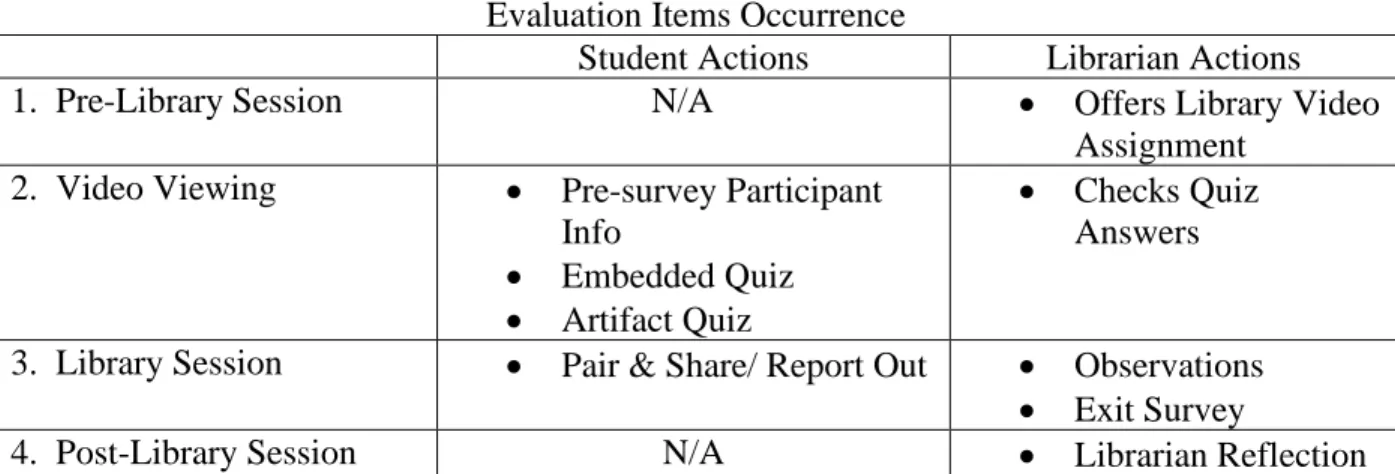
Data was collected in a variety of ways and at multiple points in the study. This was first a means of measuring and evaluating the various modes of instruction as well as their effect in equipping students. Secondly, the collected data measured the impact of the interactions throughout the instructional process. Finally, the collection focused on evaluating the instructional tutorial, the pedagogical style, and the interactions of the two. Data was collected in three ways: 1) video, 2) f2f and 3) activities; as shown below.
Evaluation Items Occurrence
Student Actions Librarian Actions 1. Pre-Library Session N/A • Offers Library Video
Assignment 2. Video Viewing • Pre-survey Participant
Info
• Embedded Quiz • Artifact Quiz
• Checks Quiz Answers
3. Library Session • Pair & Share/ Report Out • Observations • Exit Survey
4. Post-Library Session N/A • Librarian Reflection
Table 1. Evaluation Items Occurrence
The first activity occurring in this study was the engagement participants had with the instructional tutorial prior to attending library sessions. Before beginning the tutorial,
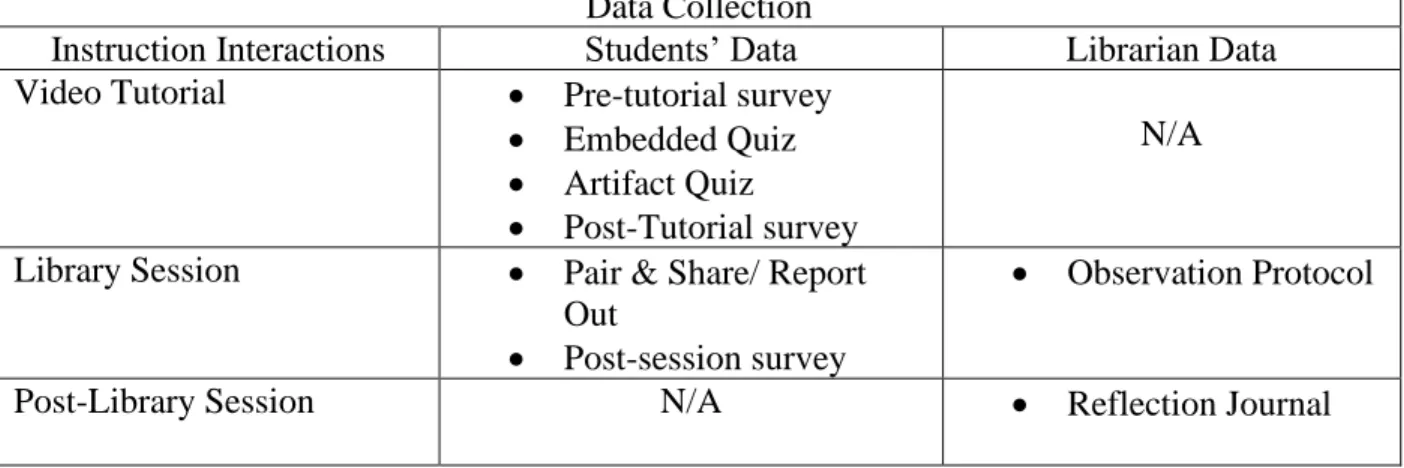
participants were prompted to complete a pre-tutorial survey (see Appendix B) capturing basic demographic information and existing knowledge before encountering any instruction. At the conclusion of the tutorial, participants were again prompted to complete a post-tutorial survey (see Appendix C). In addition to the survey data, participants completed an embedded quiz (see Appendix D). After engaging with the tutorial, they completed a form organizing their research process (see Appendix E). Data for surveys and quizzes were collected via Google Forms. The collected data assisted the instructing librarian in gauging the preparedness level of the participants before beginning sessions. The librarian reviewed student research issues and questions when preparing resource searching sessions. These functioned as a needs assessment for the librarian to know the exact number of students arriving ill-equipped for the f2f session. Once the f2f session instruction had occurred, librarian observations and informal discussions served as the main source of data for f2f interactions. The observation protocol tool was used to record this data (see Appendix F).
Data was collected reflecting the impact instructional strategies had on participants’ application of taught research concepts. It was collected through completion of activities in the f2f sessions. All activities occurred in the standard 50-minutes library workshops. Pair and share’s were conducted when students first entered the session. The application of abilities was assessed through Scavenger Hunt Worksheets used by participants as guiding documents when retrieving information sources from databases (see Appendix G). These worksheets were used in
in Basic sessions. The observational protocol guided the instructional librarian in documenting the perceived ability of students through the session. The post-session survey was distributed in the last 5 minutes of the session. Following the conclusion of the total interaction, the researcher took the time to reflect on the experience and actions of students. These insights were collected through journaling (see Appendix I).
Data Collection
Instruction Interactions Students’ Data Librarian Data Video Tutorial • Pre-tutorial survey
• Embedded Quiz • Artifact Quiz
• Post-Tutorial survey
N/A
Library Session • Pair & Share/ Report Out
• Post-session survey
• Observation Protocol
Post-Library Session N/A • Reflection Journal
Table 2. Data Collection Process Product Design
The interactive video tutorial was created especially for this research project. The video content was created using PowerPoints designed for the tutorial. The large concept was divided into three videos with each one focusing on one element of the research process: topics, issues and questions, and keywords. These PowerPoints were then imported into the software Camtasia where the librarian recorded two to three-minute videos. Camtasia software allowed librarians to include interactive links and interactivity of animation and highlighting in the videos. In addition to the videos Google documents, such as a downloadable organizer, and Google forms were created for students to engage further in their learning and to create the artifacts librarians used to gauge the incoming student's needs. The videos were designed to scaffold learning and
encourage interactive and reflective moments.
The video series began presenting topics in terms of “mapping” the research journey. The start of the map was identified as the research topic, with the research issue being the end goal. Research landmarks were described as keywords to be recognized on the way to the end goal. At the end of the video content, students brought together all elements to create their own research “road map”.
The video instruction is scaffolded by asking students to familiarize themselves with research topics at the start. They do this by exploring introduced library resources through which they learn specific facets of their chosen research topic. Students were encouraged to choose topics that interested or challenged them with personal questions. From the research topic, research issues developed. students added complexity of layered questions or information which required answers beyond ‘yes’ or ‘no’. It was encouraged issues were best articulated as questions or
argumentative statements. Students paused the video to create their own research issues. On returning to the video, students had the option to engage with an embedded quiz on research issues and research questions to further understanding. The video series concluded with students describing their research topic, research issue and research question with three keywords. They were encouraged use topic-focused keywords to help their search process in the library. All created videos, materials and links were embedded on a Google site. A Google site was chosen as the librarian could limit accessibility only to those with a hawaii.edu login and could make it undiscoverable on the web. In addition to the materials created for this project, library resources such as affiliated databases and free online books and websites helpful to the research process were linked in the Google site. The site was intended to function as a one-stop for student pre-search needs, very similar to a libguide. Participants were emailed the URL to this site.
Figure 2. ‘Topics’ page on the Instructional Module
Results and Discussion
The purpose of this research was to measure and evaluate the impact of the online instructional tutorial on students’ classification and application of the nuances of the research process. The research questions asked focused on different aspects of the learning and resulting application of learned concepts. The following sections address the research questions and the learning that may have occurred through the module.
First, a class of twenty English 100 students were asked to engage with the tutorial prior to their library session. Over the course of recruitment 20 (n = 20) students participated, 5 (25%) in-person and 15 (75%) online-students. Of the 20 students, fifteen completed the tutorial for a 75% participation rate (Table 3). Over half the participants were first year students and the remainder fell into second- or third-year categories. Of the fifteen participants, there numbered thirteen females (87%) and within this group was the greatest range of academic years represented. Participating were seven, first-year students; four, second-year students and one, third-year participant. The remaining participants were two males who categorized themselves as a second year and third-year students respectively.
These participants were given access to the online tutorial two weeks before their scheduled library instructional session. The completion of the tutorial happened asynchronously and no
weight, or grade, was added for students who completed the tutorial as opposed to those who did not.
Demographics of Participants___________________ Characteristics Number Percentage
_____________________________________________ Gender Female 13 87% Male 2 13% _____________________________________________ School Year First Year 8 54% Second Year 5 33% Third Year 2 13% _____________________________________________ Table 3. Student Demographics
Of note, several events influenced and impacted the collection period. One, library and campus engagement was low, and the normal number of classes usually offered had dramatically fallen off. Two, the beginning of the COVID-19 pandemic disrupted communication channels and dried up the usual funnel of scheduled classes. While face-to-face interactions were a planned major part of the observation protocol, in light of world events, some deviations occurred. Impact of tutorial on students’ ability to create
Participants started the tutorial by completing a survey gauging their understanding of research concepts prior to instruction. These responses will be referenced as Pre-Test Results. After this, they engaged with the online tutorial which required creation of artifacts documenting learning occurring. At the conclusion of the tutorial, participants were asked the same Pre-Test questions in a Post-Test survey gauging learning occurring from the module. The questions they were asked reflected the stages of the research process they engaged with via the videos and activities. They were asked: 1) How would you define a research topic? (Appendix L), 2) How would you define a research issue? (Appendix M), 3) How would you define a research question?
(Appendix N), 4) How would you define a research strategy? (Appendix O).
The correct answers recorded through the surveys helped measure the learning occurring from before and after the tutorial (Table 4). The learning that occurred was small but measurable. It was anticipated participants would be able to define a research topic. One puzzling aspect from the survey was at no point did the participants correctly define the concept of a research topic. However, the number of participants who accurately defined this concept remained consistent from pre to post-tests (Appendix L). The greatest changes or gains for learning occurred in defining and learning the concept of research issues. Though the instruction did not translate into total understanding – as reflected in the surveys – from pre-to pos-test answers, there was an increase of 50% in correct answers recorded (Appendix M). Although it was anticipated participants would be able to define research questions – this was never reflected in the survey.
However, by the end of the tutorial, a growth of 30% occurred in this area (Appendix N). Almost unanimously, participants were able to define research strategies at the beginning of the tutorial (Appendix O). At the conclusion of the tutorial there was an increase of 20% growth in the number of participants who understood this concept. Which meant by the end of the tutorial, all participants were able to define accurately what a research strategy was.
Number of Correct Pre-Test and Post-Test Items Research Topics Research Issues Research Questions Research Strategies Pre-Test 12 5 9 13 Post-Test 12 10 12 15 Percentage 0 50 30 20
Table 4. Instructional Pre and Post-Test Survey Results
Again, though small, the percentage of learning occurring reflects the nuances between research concepts. The incorrect answers could be construed as ways individuals had of defining the concepts, rather than the researcher’s definition. The small growth could also reflect students’ prior knowledge and entrenched ideas of research and how to define it. However, minute learning did occur which is gratifying for a pilot project.
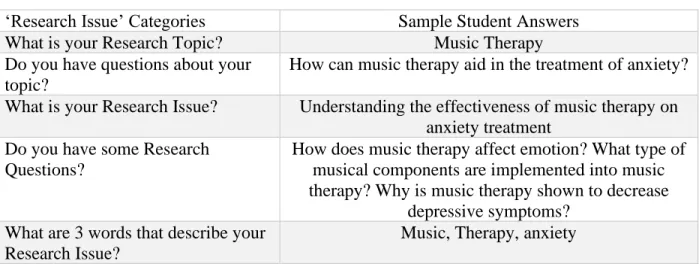
In addition to the surveys, participants were asked to create artifacts of their learning of taught concepts. The artifacts articulated their chosen topics and created research issues and research questions from their journey through the tutorial (Appendix P). For the librarian, the artifact was most important in preparation for library instruction. The artifact was further evidence of
participants’ thought process through the tutorial. Additionally, it showed their understanding coming into the library and how they planned to engage with the research process.
‘Research Issue’ Categories Sample Student Answers
What is your Research Topic? Music Therapy
Do you have questions about your topic?
How can music therapy aid in the treatment of anxiety? What is your Research Issue? Understanding the effectiveness of music therapy on
anxiety treatment Do you have some Research
Questions?
How does music therapy affect emotion? What type of musical components are implemented into music therapy? Why is music therapy shown to decrease
depressive symptoms? What are 3 words that describe your
Research Issue?
Music, Therapy, anxiety Figure 3. Sample Student Research Artifact
For example, Figure 3 shows a participant research artifact. This participant started with the research topic of Music Therapy. When prompted to think about their topic and specific interests in it, the response showed an interest in music therapy and how it applies to treating anxiety. This was labeled the research issue. From this issue the participant was then prompted to think about their questions about the research issue and write them down. Finally, the participant wrote 3 words to describe the major points of their research concepts.
Impact of tutorial on students’ application
In the complimentary library session, the researcher observed participants and their application of learned concepts with introduced library databases. While the circumstances of instruction were altered by world events, the impact of the new pedagogical approach was still detected. Librarian observations occurred during one-on-one library sessions with participants, which occurred in video-conferencing consultations. Rather than observing a group as originally anticipated, the librarian engaged individually with participants. The observations were categorized under the following categories.
What worked well: Having usable artifacts, as created in the tutorial provided a shared baseline from which the participant and librarian could build upon together. Introducing participants to databases showed them where they may need to be more specific with their research issues and keywords. It also helped the librarian to be more efficient in supporting their research process. For example, Figure 4 shows a research artifact and the adjustments made to it by the participant after being introduced to library databases.
‘Research Issue’ Categories Sample Student Answers What is your Research Topic? Music Therapy
Do you have questions about your topic?
How can music therapy aid in the treatment of anxiety? (Who’s? When? For what? Why?)
What is your Research Issue? Understanding the effectiveness of music therapy on anxiety treatment in University students, in test anxiety, in depression
What is the effectiveness of music therapy on University students anxiety?
Do you have some Research Questions?
How does music therapy affect emotion? Why is music therapy shown to decrease depressive symptoms?What type of musical components are implemented into music therapy? Not aligned with the rest of your questions, What are 3 words that describe
your Research Issue?
Music Therapy, anxiety treatment, students, stress, depression
Figure 4. Sample Student Research Artifact after Librarian consultation. (Red text denotes additions made after working with a librarian.)
Rather than stopping instruction to only focus on research concepts, the librarian was able to demonstrate database searching in two platforms before participants engaged in independent searching. In the databases, it was observed participants were able to self-direct when
was observed participants found at least two articles in each database during the instructional session.
What did students know well: An immediate observation the librarian found, was when engaging with participants, there was a shared language. Because of having gone through the tutorial, participants referred to concepts and were able to engage in discussion. They understood the definitions of the research process and how they applied to the work being accomplished through the process and the library session. Students who completed the flipped classroom assignment had better understanding of their topic and this allowed the researcher to scaffold their learning toward research keywords and questions. Participants themselves were able to suggest new questions and keywords in response to discoveries they had searching library databases. Where did students need additional review: Librarian observations showed the artifacts were a great asset to the session and helping students retrieve viable resources for their assignments. However, the artifacts did not always show as focused a specificity as was desired, and some time (though not near the original amount) was necessary to tease out more details in issues and keywords than what participants had put down.
What needs revising: An effort was made to keep the length of the videos short to not
unnecessarily monopolize participants time. However, through observations it was noted creating a separate page covering in more detail research questions may be of benefit to students in
encouraging focused, detailed scope for the research process. It was observed the 5Ws were consistently reviewed regarding research questions on the artifacts.
Other thoughts: Going through the transition process with participants, the librarian noted it was not always innate how to articulate research issues in database searching. The librarian wondered if towards the end of the tutorial search techniques or database searching should be mentioned. This introduction before the real searching may better prepare participants to transition research concepts to database searching.
Impact of pedagogical approach on library session
Another element introduced through the online instructional tutorial was the pedagogical
“flipped” approach. In addition to the flipped approach, the circumstances required flexibility on the part of the librarian and conducting library sessions. Thus, the impact of the online tutorial juxtaposed to traditional instruction was thwarted somewhat by the switch to complete online learning that occurred in the midst of this study. However, what needed to be distinguished was the learning that may be occurring as a result of the action of watching the videos. To do this, at the conclusion of the tutorial participants were asked to complete a survey about their learning experience. Participants were asked to rate the clarity of tutorial content using a Likert scale anchored at the ends (1 = very unclear; 5 = very clear). Of the 15 participants, nine (60%) rated the clarity of content a four and six (40%) gave the content a very clear five.
Table 5. Clarity of Tutorial Content
When asked about their video learning experience, participants shared words like “clear” and “concise”. When asked overall the engagement they experienced with the online tutorial participants described the content and the visuals.
Figure 5. How clear was tutorial content? Figure 6. How engaging was tutorial content? Participants were asked to share their thoughts on the tutorial. There were only positive
comments about the experience, such as the following: • “I really enjoyed working on this.”
• “All instructions were clear and easy to understand.”
• “I discovered some sites I will use in the future and really enjoyed the videos.” • “It was fun, simple, and helpful.”
Within the library session, it was observed participants had confidence when talking about their topics and about the research process. The librarian credited this to having participants engage with pre-search process before attending the library session. As noted, before, less time was spent covering these concepts and therefore more time could be dedicated to exploring diverse databases and how to engage with them in addition to the unique offerings they possessed. The quality of student research occurring in the session encouraged the librarian that this
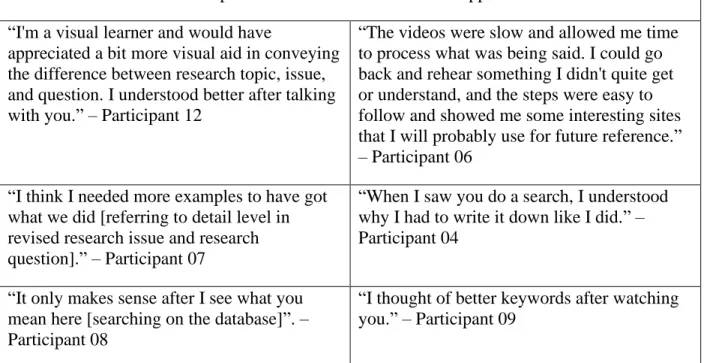
approach was an engaging way to introduce participants to the research process and to demystify the library resources. Additionally, the success of the retrieval during the library session was an encouraging result. When participants were asked in the session if they felt the videos prepared them to search databases there were mixed responses. The shared sentiments seem to speak to the brevity of the instruction on the tutorial.
Participant Comments on Instructional Approach “I'm a visual learner and would have
appreciated a bit more visual aid in conveying the difference between research topic, issue, and question. I understood better after talking with you.” – Participant 12
“The videos were slow and allowed me time to process what was being said. I could go back and rehear something I didn't quite get or understand, and the steps were easy to follow and showed me some interesting sites that I will probably use for future reference.” – Participant 06
“I think I needed more examples to have got what we did [referring to detail level in revised research issue and research question].” – Participant 07
“When I saw you do a search, I understood why I had to write it down like I did.” – Participant 04
“It only makes sense after I see what you mean here [searching on the database]”. – Participant 08
“I thought of better keywords after watching you.” – Participant 09
Table 6. Participants thoughts on instructional approach
The implementation of this tutorial was anticipated to have faculty support when approaching classes for participation. The lack of instructors able to participate in the study was
unanticipated. Instructors saw the tutorial as being in addition to their courses and their courses not having enough time or room for an addition of library work or sessions to require of their classes. While librarians often view themselves as educators, (Osborne, 2017) others may not. However, if librarians and the library resources are not introduced to students, are students’ scholastic efforts and output severely affected? If students do not feel prepared to engage with research do instructors expect them to independently acquire these skills? This illuminates the need for librarians to be advocates for themselves, their import to the education experience and the valuable asset they can be supporting students.
Through this action research, the implementation of an online instructional module encountered unplanned anomalies. The instruction was intended to employ a flipped classroom pedagogy. It was anticipated there would be session of gathering where community learning and information sharing would occur. This flipped strategy was not achieved in the original intention as face-to-face instruction had been suspended.
However, these anomalies also highlighted the forward thinking of instructional design as well as the flexibility of online instruction and its significance to higher education and library
instruction. Having a prepared online module ready during the beginning of COVID ensured instruction and subsequent consultations could still occur utilizing the flexibility of online instruction. This was a novel approach for Hamilton Library which may have impacted the quantity and quality of data collected. The total online approach first negated attempts to compare the effectiveness and impact of online instruction to traditional instruction. The advantage of having the online module ready was learning and instruction could still occur though instruction was not following traditional implementation. Instead, the complete online approach assisted the researcher in documenting learning occurring outside the library; as well as the interaction between librarian and students following the online module. The intention for data collection to happen through the mixed methods approach of action research was still honored through video conferencing platforms. The flexibility of instruction and data collection continued to focus on the learner, as was originally intended.
The purpose of this study was to explore the impact of the pedagogy and the online tutorials in preparing students to search in library instruction sessions. Through interactions between librarian and students following their work through the module, it was observed how students were prepared to talk about and think through complexities of their topic. Students seemed more dexterous at using keywords in academic databases and interchanging keywords. The non-traditional approach assisted learning occurring before the session. Even those who needed additional review had the previous exposure from the tutorial which they were able to build upon.
Future iterations of this project should seek to add more robust content, by increasing the number of videos included on the site. The videos would contain more examples as visual cues for
students and the content of the videos would be expanded. Additionally, the complexity of the artifact’s students create through the module would be broadened. Having students complete a less-rigid framework that also visualized the funnel of information happening with each research concept encountered may help further students’ ownership of their research topics. The success of future iterations would be greatly impacted by faculty interest and support of implementation of the module during their students’ research process. This module could be used to introduced faculty to librarians as educators and the asset of librarians as co-educators in their courses and for their students learning and development.
Conclusion
While librarians recognize the importance and relevance of ways of thinking and searching for information, students do not always share this sentiment. Showcasing the library’s relevance to
the digital learner, this project was created to meet the needs of students completing research projects outside of library hours of operation. Results from this action research study highlight the importance of creating an interactive and engaging platform. Not only does the platform engage college students, it teaches them the research skills they need to be successful in their academic journey. This was accomplished through interactive videos, artifact creation and a flipped learning approach prior to library instruction. Students experience with this learning platform enabled their forming strong research questions related to their topic. This prepared their retrieving relevant articles from multiple databases. This action research suggests this approach and technique can prepare students to expertly engage with the research process, preparing them for academic searching in the library. While online learning spaces were explored it was evident through this process librarians need to be advocates for themselves as assets to the scholastic community. Librarians bring their own expertise when assist students in searching, in addition to familiarizing students with information, scholarly communication, and the scholastic web. With this partnership, instructors and librarians can better support their students and their research projects while creating positive perspectives of the library.
References
American Library Association. (1989). Presidential committee on information literacy: Final report. Retrieved from:
http://www.ala.org/acrl/publications/whitepapers/presidential
Association of College & Research Libraries. (2015). “Framework for Information Literacy for Higher Education.” 2015. http://www.ala.org/acrl/standards/ilframework.
Brown, Robin, & Walker, Willis C. (2011). Design and Analysis Challenges in a Multicampus Research Study. In D. Cook & S.J. Lesley (eds.), Using Qualitative Methods in Action Research: How Librarians can get to the why of data. (pp. 173-185). Chicago, IL: American Library Association.
Cook, D., & Farmer, Lesley S. J. (2011). Using qualitative methods in action research: How librarians can get to the why of data. Chicago: Association of College and Research Libraries.
Head, Alison J. (2013). Learning the Ropes: How Freshmen Conduct Course Research Once They Enter College, Project Information Literacy. Retrieved from: https://bit.ly/2WYEpdm.
Kodani, L., Ho, C., Eichelberger, A., & Gose, E. (2012). Information Literacy for Electronic Resources. Retrieved from: https://bit.ly/2meTScw.
Lapidus, M., Mccord, S., Mccloskey, W., & Kostka-Rokosz, M. (2012). Combined Use of Online Tutorials and Hands-On Group Exercises in Bibliographic Instruction for Pharmacy Students. Medical Reference Services Quarterly, 31(4), 383-399.
Maniotes, L. K., & Kuhlthau, C. C. (2014). Making the shift. Knowledge Quest, 43(2), 8-17.
Maybee, D., & Flierl, M. (2016). Information Literacy in the Active Learning Classroom. The Journal of Academic Librarianship, 42(6), 705-711.
Obradovich, A.,Canuel, R., and Eamon P Duffy. (2015). A Survey of Online Library Tutorials: Guiding Instructional Video Creation to Use in Flipped Classrooms. The Journal of Academic Librarianship 41(6), 751-57.
Osborn, J. (2017). Librarians as Teachers: Forming a Learning and Teaching Community of Practice. Journal of the Australian Library and Information Association, 66(2), 162–169. Porter, B. (2014). Designing a Library Information Literacy Program Using Threshold Concepts,
Student Learning Theory, and Millennial Research in the Development of Information Literacy Sessions, Internet Reference Services Quarterly, 19(3-4) 233-244.
Saunders, L. (2018). Information Literacy in Practice: Content and Delivery of Library Instruction Tutorials. The Journal of Academic Librarianship, 44(2), 269-278.
Sanderson, H. (2011). Using Learning Styles in Information Literacy: Critical Considerations for Librarians. The Journal of Academic Librarianship, 37(5), 376-385.
Shen, J. (2018). "Flipping the Classroom for Information Literacy Instruction." Journal of Information Literacy, 12(1), 48-67.
List of Appendices
Appendix A: Audience Analysis ………. 23 Appendix B: Instructional Tutorial Pre-Survey ………... 24 Appendix C: Instructional Tutorial Postsurvey ………... 26 Appendix D: Instructional Tutorial ‘Issues’ Embedded Quiz .…….……..…….……… 28 Appendix E: Instructional Tutorial ‘Research Issue’ Form ……….……… 29 Appendix F: Observation Protocol ……….. 30 Appendix G: Scavenger Hunt Worksheet ……… 32 Appendix H: Hamilton Library Basic Instruction Handout ……….33 Appendix I: Research Journal Template ………..36
Appendix J: Consent Form ………..37 Appendix K: Recruitment Poster to First Year Writing Instructors ………...………… 39 Appendix L: Pre and Post-Test Research Topic ……….. 40 Appendix M: Pre and Post-Test Research Issue ……….. 41 Appendix N: Pre and Post Test Research Question ……… 42 Appendix O: Pre and Post Test Research Strategies ………... 43 Appendix P: Sample Student Research Artifacts ………...………. 44
Appendix A Audience Analysis
Audience Analysis
Cognitive Affective
o Understands basic English composition concepts
o Understands research writing components
o Understands how the UH Manoa Library website is laid out
o Able to use digital videos and forms
o Motivated to complete assignment o Motivated to learn efficient ways of
research
o Interested in homework that can be completed from a distance (i.e. from home or on the go)
o ed in tools that are available any time the need arises.
Physiological Social
o Age 18-60 years old
o Traditional and Non-traditional undergraduates
o Able to access UH Manoa Library online catalog and databases
o Able to use digital videos and forms
o Able to access internet and online links
o Able to communicate with librarian and instructor digitally
o Understands and interacts with interactive tool
o Has budgeted specific time to dedicate to schoolwork in addition to work and family
Appendix B
Instructional Tutorial Pre-Survey
Page 1:
Check the box that best applies: Student Demographics
□
Male□
Female□
First year student□
Second year student□
Third year student□
Other Have you experienced video tutorials before?□
Yes□
NoPage 2:
Choose the best answer
How would you define a research topic?
□
A. A research topic is complex with multiple answers.□
B. A research topic is a subject or issue you are interested in.□
C. A research issue is what you are writing about in your paper.□
D. A research topic is a plan of action to produce quality results.Page 3:
Choose the best answer
How would you define a research issue?
□
A. A research issue is a plan of action to produce quality results.□
B. A research issue is what you are writing about in your paper.□
C. A research issue is a subject or issue you are interested in.□
D. A research issue is complex with multiple answers.Page 4:
Choose the best answer
How would you define a research question?
□
B. A research question is a subject or issue you are interested in.□
C. A research question is what you are writing about in your paper.□
D. A research question is a plan of action to produce quality results.Page 5:
Choose the best answer
How would you define a research strategy?
□
A. A research strategy is a plan of action to produce quality results.□
B. A research strategy is a subject or issue you are interested in.□
C. A research strategy is what you are writing about in your paper.Appendix C
Instructional Tutorial Postsurvey
Video Content
How clear was the tutorial content?
□
Very Unclear□
Unclear□
Neutral□
Clear□
Very ClearPlease explain: (Optional) ___________________________________________
How engaging was the tutorial content?
□
Very Disengaging□
Disengaging□
Neutral□
Engaging□
Very Engaging Please explain: (Optional) ___________________________________________Can you define the terms from the tutorial? Choose the best answer
How would you define a research topic?
□
A. A research topic is a plan of action to produce quality results.□
B. A research topic is a subject or issue you are interested in.□
C. A research topic is what you are writing about in your paper.□
D. A research topic is complex with multiple answers.Choose the best answer
How would you define a research issue?
□
A. A research issue is a plan of action to produce quality results.□
B. A research issue is complex with multiple answers.□
C. A research issue is what you are writing about in your paper.□
D. A research issue is a subject or issue you are interested in.Choose the best answer
How would you define a research question?
□
A. A research question is what you are writing about in your paper.□
C. A research question is a plan of action to produce quality results.□
D. A research question is a subject or issue you are interested in.Choose the best answer
How would you define a research strategy?
□
A. A research strategy is complex with multiple answers.□
B. A research strategy is a subject or issue you are interested in.□
C. A research strategy is what you are writing about in your paper.Appendix D
Instructional Tutorial ‘Issues’ Embedded Quiz
When do you know if you really have a research issue? Read through the topics and issues. Mark ‘Yes’ or ‘No’, for the statements you feel are real issues or not.
Topics Issues Yes No
Zebras Is zebra hunting ethical and contributing to conservation efforts?
Flamin Hot Cheetos Are flamin hot Cheetos the cause of ulcers? Men in Black Did UFO encounters in the US inspire the
creation of the real Men in Black force? Coral Reef How can enforced beach etiquette rules save
coral reefs?
Green Tea Can green tea help you live longer?
Feedback:
Is zebra hunting ethical and contributing to conservation efforts?
This is an issue as the question has the possibility of many answers. You may choose to research culture, ethics, or conservation perspectives on this topic.
Are flamin hot Cheetos the cause of ulcers?
This is not an issue. It is a question you may search on Google and find the answer on Quora, ScienceWorld Report, and WebMD.
Did UFO encounters in the US inspire the creation of the real Men in Black force?
This is not an issue. This is an intriguing conspiracy theory but there is no legitimate evidence or work to support the question either way.
Can enforced beach etiquette rules save coral reefs?
This is an issue as the question has the possibility of many answers. You may choose to research culture, ethics, or conservation perspectives on this topic.
Can green tea help you live longer?
This is not an issue. It is a question you may search on Google and find the answer on Healthline or WebMD.
Appendix E
Instructional Tutorial ‘Research Issue’ Form
Research Topic: ______________________________
Questions you have about your topic:
____________________________________________________________ _____________________________________________________________ ______________________________________________________________ ______________________________________________________________ Research Issue: ________________________________________________ ________________________________________________ Research Question: __________________________________________________________
What are 3 words to describe your research issue? 1.
2. 3.
Appendix F Observation Protocol Title: Library Essentials: Basic Session Observation Name: Sarah Nakashima
Purpose Statement: The purpose of this action research is to explore the impact of an
interactive video tutorial has in improving English 100 learners’ classification and application of research topics, research issues and research questions during library instruction sessions at Hamilton Library.
My Research Questions:
1. What impact does the online tutorial have on students’ classification of research topics, research issues and research questions?
2. How does the online tutorial impact students’ perception of applying research topics, research issues and research questions in searching?
3. How will the pedagogical approach influence the application of learned knowledge to research concepts during library sessions?
Application Observation Tool
Student First 10 Minutes Midway Last 10 Minutes
❑ I1 ❑ I2 ❑ I3 ❑ I4 ❑ N1 ❑ N2 ❑ N3 ❑ N4 ❑ F1 ❑ F2 ❑ F3 ❑ F4 ❑ I1 ❑ I2 ❑ I3 ❑ I4 ❑ N1 ❑ N2 ❑ N3 ❑ N4 ❑ F1 ❑ F2 ❑ F3 ❑ F4 ❑ I1 ❑ I2 ❑ I3 ❑ I4 ❑ N1 ❑ N2 ❑ N3 ❑ N4 ❑ F1 ❑ F2 ❑ F3 ❑ F4 ❑ I1 ❑ I2 ❑ I3 ❑ I4 ❑ N1 ❑ N2 ❑ N3 ❑ N4 ❑ F1 ❑ F2 ❑ F3 ❑ F4 ❑ I1 ❑ I2 ❑ I3 ❑ I4 ❑ N1 ❑ N2 ❑ N3 ❑ N4 ❑ F1 ❑ F2 ❑ F3 ❑ F4 ❑ I1 ❑ I2 ❑ I3 ❑ I4 ❑ N1 ❑ N2 ❑ N3 ❑ N4 ❑ F1 ❑ F2 ❑ F3 ❑ F4 ❑ I1 ❑ I2 ❑ I3 ❑ I4 ❑ N1 ❑ N2 ❑ N3 ❑ N4 ❑ F1 ❑ F2 ❑ F3 ❑ F4 ❑ I1 ❑ I2 ❑ I3 ❑ I4 ❑ N1 ❑ N2 ❑ N3 ❑ N4 ❑ F1 ❑ F2 ❑ F3 ❑ F4 ❑ I1 ❑ I2 ❑ I3 ❑ I4 ❑ N1 ❑ N2 ❑ N3 ❑ N4 ❑ F1 ❑ F2 ❑ F3 ❑ F4 ❑ I1 ❑ I2 ❑ I3 ❑ I4 ❑ N1 ❑ N2 ❑ N3 ❑ N4 ❑ F1 ❑ F2 ❑ F3 ❑ F4 ❑ I1 ❑ I2 ❑ I3 ❑ I4 ❑ N1 ❑ N2 ❑ N3 ❑ N4 ❑ F1 ❑ F2 ❑ F3 ❑ F4 ❑ I1 ❑ I2 ❑ I3 ❑ I4 ❑ N1 ❑ N2 ❑ N3 ❑ N4 ❑ F1 ❑ F2 ❑ F3 ❑ F4
Issues I1 - Incomplete I2 - Topic defined I3 - Issue defined I4 - Question(s) defined ON TASK Behaviors
N1 - Uses defined issues in search N2 - Finds related synonyms to issues in search
N3 - Finds related materials N4 -Saves an article
OFF TASK Behaviors F1 - No defined terms in search
F2 - Cannot find synonyms for search
F3 - Cannot find materials F4 - Does not save an article
Appendix G
Scavenger Hunt Worksheet
Scavenger Hunt Worksheet
Search Phrases ____________________________ ____________________________ ____________________________ Goal _________________________________________________________________________ Results Scholarly Article Citation: Purpose _________________________________________________________________________ Newspaper Article Citation: Purpose _________________________________________________________________________
Appendix H
Hamilton Library Basic Instruction Handout
1. OneSearch (Articles, Books, and More)
Simple Search
a. Go to the University of Hawaii Manoa Library Website
b. In the Search for books, journals, articles, and more box, enter your search terms c. On the right, under Tweak my results, click on Books (you get a mix of print &
electronic)
• Print books: Available at UH Manoa (Call Number) • Ebooks: Available Online
d. On the right, under Tweak my results, click on Peer Reviewed Journals
e. On the right, under Availability, click on Available Online (you get all electronic) f. Click on the title of a record
g. Click on Email > Email the article to yourself
h. Scroll up a bit, click on the icon with the blue Push Pin (Keep this item) i. Click on Citation > Select the appropriate citation style (the default is APA) j. On the right, examine the suggested readings in Related reading column. k. On the left, click the large X to close the title record.
l. On the top upper right corner, click on Guest
m. Click on Sign In > Login with Your UH student ID and password
English 100
Basic Library Instruction Session
Fall 2019
n. In the upper right, next to your name, click on the push pin and see if your record is saved
o. Access your email
p. In the email from donotreply (Item sent by OneSearch), click on Available Online q. Click on Full text available via underlined database name.
r. On the resulting page, you may have to click on another icon - example: PDF
Too Many Results
Too Few Results
1. Use Advanced Search 1. Verify that you spelled everything correctly
2. Change the search box dropdown menu to 2. Erase unnecessary search terms “Title” or “Abstract” or “Subject” 3. Try different/broader search terms 3.Use quotation marks around topics that are 4. Use the Boolean operator OR between search
more than one word [example: terms [example: cars OR automobiles]
“emotional support animals”] 5. Remove any limits you may have added.
4. Add additional search terms 6. Change the search dropdown menu to Any
5. Limit to peer-reviewed journals field or “All Text” or “Entire Document”
6. Limit by date, subjects or full-text 7. Try a different database
Advanced Search
a. Start a New Search
b. Towards the top of the page on the right, click on Advanced Search
c. In the 1st search box, type your first research topic [example: “sign language”] d. On the left of the 1st search box, change the dropdown menu from Any field to Title e. In the 2nd search box, type your second research topic [example: “teaching children”] f. On the left of the 2nd search box, change the dropdown menu from Any field to Title g. On the right of the search box, change the dropdown menu from Any Year to Last 5
h. Click on Peer-Reviewed i. Click on Available Online
j. Click on the title of a relevant record
k. Examine the screen. Each record has a Citation (quotation marks), Email (envelope), Keep this item (push pin), Show actions (three dots)
l. Click on the title of a relevant article m. Click on Available Online
n. At the Full Text available via link, click on one of the underlined options
o. Note: If No Full text available, click on Request document via Interlibrary Loan
What Happens if I Can’t Access the Full Text of An Article?
Google Scholar often prompts you to pay for full text articles. Don’t do it! Here are two ways to get it: (1) email the author and ask, (2) Get it through our Interlibrary Loan (ILL) Service. To place an ILL request, go to the last page of this handout for instructions.
2. Government Sources
a. Go to the University of Hawaii at Manoa Library Website b. Click on English 100 Students
c. In the Find box, click on Government Sources d. Click on USA.gov
3. New York Times
a. Go to the University of Hawaii at Manoa Library Website b. Click on English 100 Students
c. In the Find box, click on Articles d. Click on New York Times
e. Login
f. Click on Create Account
4. Honolulu Star Advertiser
a. Go to the University of Hawaii at Manoa Library Website b. Click on English 100 Students
c. In the Find box, click on Articles
Appendix I
Research Journal Template Research Journal 01
Date: Time: ________________ What worked well?
What did students know well?
What did students need additional review with?
What needs revising?
Other thoughts: