Calhoun: The NPS Institutional Archive
Theses and Dissertations Thesis Collection
2012-09
An Analysis of Multiple Award Indefinite Delivery
Indefinite Quantity Contracts at the Army Contracting
Command Aberdeen Proving Ground
Fusco, Michael P.
Monterey, California. Naval Postgraduate School
NAVAL
POSTGRADUATE
SCHOOL
MONTEREY, CALIFORNIA
JOINT APPLIED PROJECT
An Analysis of Multiple Award Indefinite Delivery Indefinite Quantity
Contracts at the Army Contracting Command – Aberdeen Proving
Ground
By:
Michael P. Fusco
September 2012
Advisors: John Dillard, Janie Maddox
REPORT DOCUMENTATION PAGE Form Approved OMB No. 0704–0188
Public reporting burden for this collection of information is estimated to average 1 hour per response, including the time for reviewing instruction, searching existing data sources, gathering and maintaining the data needed, and completing and reviewing the collection of information. Send comments regarding this burden estimate or any other aspect of this collection of information, including suggestions for reducing this burden, to Washington headquarters Services, Directorate for Information Operations and Reports, 1215 Jefferson Davis Highway, Suite 1204, Arlington, VA 22202–4302, and to the Office of Management and Budget, Paperwork Reduction Project (0704–0188) Washington DC 20503.
1. AGENCY USE ONLY(Leave blank) 2. REPORT DATE
September 2012 3. REPORT TYPE AND DATES COVEREDJoint Applied Project 4. TITLE AND SUBTITLE
An Analysis of Multiple Award Indefinite Delivery Indefinite Quantity Contracts at the Army Contracting Command –Aberdeen Proving Ground
5. FUNDING NUMBERS 6. AUTHOR(S) Michael P. Fusco
7. PERFORMING ORGANIZATION NAME(S) AND ADDRESS(ES) Naval Postgraduate School
Monterey, CA 93943–5000
8. PERFORMING ORGANIZATION REPORT NUMBER
9. SPONSORING /MONITORING AGENCY NAME(S) AND ADDRESS(ES)
N/A 10. SPONSORING/MONITORINGAGENCY REPORT NUMBER
11. SUPPLEMENTARY NOTES The views expressed in this thesis are those of the author and do not reflect the official policy or position of the Department of Defense or the U.S. Government. IRB Protocol number ____N/A____________.
12a. DISTRIBUTION / AVAILABILITY STATEMENT
Approved for public release; distribution is unlimited 12b. DISTRIBUTION CODEA 13. ABSTRACT (maximum 200 words)
This purpose of this project is to review and analyze the changes in the Federal Acquisition Regulation (FAR) over the past few years to place a preference on award of multiple contracts when using an Indefinite Delivery Indefinite Quantity (IDIQ) type contract. The project examines the changes and their impacts on the contracting workforce. Following this examination, the project looks at multiple award information from the Army Contracting Command – Aberdeen Proving Ground to determine whether anything can be learned from the data. The project also examines the minimum quantity requirements of IDIQ contracts to determine whether there is a quantity that could be so low it would not represent a binding contract. The project concludes with a summary and recommendations based on the research conducted.
14. SUBJECT TERMSMultiple Award, Contracts, Indefinite Delivery Indefinite Quantity,
ACC-APG, IDIQ, competition 15. NUMBER OFPAGES
87 16. PRICE CODE 17. SECURITY CLASSIFICATION OF REPORT Unclassified 18. SECURITY CLASSIFICATION OF THIS PAGE Unclassified 19. SECURITY CLASSIFICATION OF ABSTRACT Unclassified 20. LIMITATION OF ABSTRACT UU
NSN 7540–01–280–5500 Standard Form 298 (Rev. 2–89)
Approved for public release; distribution is unlimited
AN ANALYSIS OF MULTIPLE AWARD INDEFINITE DELIVERY INDEFINITE QUANTITY CONTRACTS AT THE ARMY CONTRACTING
COMMAND – ABERDEEN PROVING GROUND
Michael P. Fusco, Civilian, Department of the Army
Submitted in partial fulfillment of the requirements for the degree of
MASTER OF SCIENCE IN CONTRACT MANAGEMENT
from the
NAVAL POSTGRADUATE SCHOOL September 2012
Authors: _____________________________________ Michael P. Fusco
Approved by: _____________________________________ John Dillard, Lead Advisor
_____________________________________ Janie Maddox, Support Advisor
_____________________________________ William R. Gates, Dean
AN ANALYSIS OF MULTIPLE AWARD INDEFINITE DELIVERY
INDEFINITE QUANTITY CONTRACTS AT THE ARMY
CONTRACTING COMMAND – ABERDEEN PROVING GROUND
ABSTRACT
This purpose of this project is to review and analyze the changes in the Federal Acquisition Regulation (FAR) over the past few years to place a preference on award of multiple contracts when using an Indefinite Delivery Indefinite Quantity (IDIQ) type contract. The project examines the changes and their impacts on the contracting workforce. Following this examination, the project looks at multiple award information from the Army Contracting Command – Aberdeen Proving Ground to determine whether anything can be learned from the data. The project also examines the minimum quantity requirements of IDIQ contracts to determine whether there is a quantity that could be so low it would not represent a binding contract. The project concludes with a summary and recommendations based on the research conducted.
TABLE OF CONTENTS
I. INTRODUCTION...1
A. BACKGROUND ...1
B. OBJECTIVES OF THIS RESEARCH...2
C. SCOPE, LIMITATIONS, AND ASSUMPTIONS ...2
D. ORGANIZATION OF REPORT ...3
E. SUMMARY ...4
II. REGULATION/LITERATURE REVIEW...5
A. FEDERAL ACQUISITION REGULATION REVIEW ...5
B. MINIMUM QUANTITY LITERATURE REVIEW...13
1. Minimum Quantity Case Review ...13
C. SUMMARY ...15
III. ACC-APG STATISTICAL DATA...17
A. OVERVIEW OF DATA GATHERING PROCESS...17
B. PRESENTATION OF STATISTICAL DATA RESULTS...18
C. SUMMARY ...25
IV. DATA ANALYSIS...27
A. ANALYSIS OF MULTIPLE AWARD IDIQ DATA ...27
B. ANALYSIS OF DELIVERY/TASK ORDER DATA...29
C. ANALYSIS OF MINIMUM QUANTITY DATA...31
D. SUMMARY ...32
V. CONCLUSIONS AND RECOMMENDATIONS...33
A. SUMMARY ...33
B. RECOMMENDATIONS...33
C. CONCLUSIONS ...33
D. AREAS OF FURTHER RESEARCH...34
APPENDIX A...35 16.504 -- Indefinite-Quantity Contracts...35 16.505 -- Ordering...40 APPENDIX B ...57 16.504 -- Indefinite-Quantity Contracts...57 16.505 -- Ordering...61 LIST OF REFERENCES...69
LIST OF TABLES
Table 1. Summary of FAR Changes ...5
Table 2. ACC-APG Contract Overview ...18
Table 3. Awards Per Solicitation ...27
Table 4. Solicitations Awarded to All Offerors ...28
Table 5. Total Delivery/Task Orders by Year...30
Table 6. Competitive Delivery/Task Order Analysis...30
LIST OF ACRONYMS AND ABBREVIATIONS
ACC-APG Army Contracting Command – Aberdeen Proving Ground AFARS Army Federal Acquisition Regulation Supplement
CAR Contract Action Report
DFARS Defense Federal Acquisition Regulation Supplement DO Delivery Order
DoD Department of Defense EDA Electronic Document Access FAC Federal Acquisition Circular FAR Federal Acquisition Regulation
FEDLINK Federal Library and Information Network FPDS Federal Procurement Data System
FPDS-NG Federal Procurement Data System – Next Generation GAO Government Accountability Office
GMQ Guaranteed Minimum Quantity
HUBZones Historically Underutilized Business Zones IDIQ Indefinite Delivery Indefinite Quantity IDV Indefinite Delivery Vehicle
TO Task Order
ACKNOWLEDGMENTS
The author would like to thank John Dillard and Janie Maddox for their help and support for this project. A very special thanks is given to the authors wife, Sarah for her patience and support during the project. The author also thanks the Army Contracting Command – Aberdeen Proving Ground Office of the Principal Assistance Responsible for Contracting for their help in providing the data utilized in this project.
I.
INTRODUCTION
A. BACKGROUND
The Federal Acquisition Regulation (FAR) contains the policies and procedures for acquisitions conducted by all executive agencies. The FAR is broken up into different parts that govern various topics related to procurement. Different agencies within the government further supplement the FAR with its own regulations and revisions specific to that agency. For example, the Defense Federal Acquisition Regulation Supplement (DFARS) applies to the Department of Defense (DoD) and the Army Federal Acquisition Regulation Supplement (AFARS) applies to the Army. For purposes of this research project, emphasis will be placed on FAR part 16.504 and 16.505 as it relates to Indefinite Delivery Indefinite Quantity (IDIQ) contracts. The DFARS and AFARS will not be reviewed as part of this research, as these supplements do not add any additional requirements pertinent to the research being conducted. An IDIQ contract is initially awarded as a base contract that establishes the scope of services or goods that can be ordered against it. The base contract has no funding associated with it and merely lays out the terms and conditions applicable to any orders placed against the base contract. It also establishes the ordering procedures to include maximum and minimum order
requirements. These base IDIQ contracts can be awarded to a single vendor or multiple vendors. In the event the solicitation results in award to multiple vendors each base contract has the same terms and conditions and is for the same scope of services or goods. When the need arises to place orders against multiple award contracts all vendors holding a base contract are requested to provide a proposal. This proposal request also details how selection of the order will be made. Unlike this multiple award scenario that maintains competition over the life of the contract, single award contracts only have competition when the base IDIQ contract is solicited and awarded. Changes in the FAR since 2008 have placed a greater emphasis on multiple award contracts, which given the savings a competitive environment can produce is not surprising (Kove, 2007, p. 44).
B. OBJECTIVES OF THIS RESEARCH
The objective of this research is to study the FAR requirements for multiple award contracts. This study will examine the policy changes that have led to an emphasis on multiple award contracts and competition among multiple award contracts. The research will also examine the requirement for the Guaranteed Minimum Quantity (GMQ) in IDIQ contracts to be nominal. FAR 16.504 spells out the requirement that for Indefinite Quantity contracts the government must order at least a stated minimum quantity of supplies or services and that minimum quantity must be more than a nominal quantity. It further stipulates that this quantity should not exceed what the “government is fairly certain to order.” This examination will explore what precedence the GAO has established regarding the minimum quantity being more than a nominal quantity. Specifically the research will focus on what minimum quantity is necessary to form a binding contract.
The first part of the research will be the policy study identified above. Following the policy study, the researcher will review statistical data from the Army Contracting Command – Aberdeen Proving Ground (ACC-APG) as it relates to multiple award IDIQ contracts. This data will then be analyzed and recommendations presented based on the analysis.
C. SCOPE, LIMITATIONS, AND ASSUMPTIONS
The scope of this research will be limited to only multiple award contracts issued by ACC-APG since 2008. The data will further be limited to what information can be retrieved from the Federal Procurement Data System (FPDS). The data may further be subject to human error in reporting.
The researcher has laid forth three main assumptions that this research is aimed at validating. The first assumptions being made for this research is that prior to changes in FAR policy that now require exemptions to fair opportunity be approved at levels similar to justification and approvals for other than full and open competition (FAR part 6); Task Order (TO)/Delivery Order (DO) were issued without obtaining competition on a more frequent basis due to the absence of these approval levels. This project will examine
data within the ACC-APG to determine whether the changes to the FAR have led to increased competition among multiple award contracts. The second assumption is that multiple award service contracts have been awarded to expedite the contracting process for certain services. These service contracts cover a broad range of services
(e.g.engineering, program management), and often have a large pool of contractors who hold base contracts. Because of this, an assumption is made that for these large service contracts award seems to be made to all acceptable offerors without any real tradeoff. For example, ten acceptable or better proposals are received and ten base contract awards are made. The reality for these contracts is that for various reasons offerors do not propose on every task/delivery order request for proposal, and if you have a base pool of ten
contractors you may only receive proposals from three of those contractors. The final assumption the researcher has made for this project is related to the multiple award service contracts referenced in the second assumption. This assumption holds that the GMQ under these large contracts is so low that it encourages award to all acceptable or better offerors. The project will examine the FAR requirements for the GMQ to be nominal, and see if any case can be presented that the GMQ under the ACC-APG contracts examined may not have been sufficient enough to form a binding contract.
D. ORGANIZATION OF REPORT
Chapter I begins with background surrounding the project. It then discusses the objectives of the research. The scope, limitations, and assumptions of the project are then laid out. Chapter I will conclude by covering the organization of the report
Chapter II provides the regulation and literature review that was conducted. Chapter II begins with a discussion of what the FAR states regarding multiple award IDIQ contracts. It then discusses what guidance the DFARS has regarding multiple award IDIQ contracts. The chapter then lays out a discussion regarding the minimum quantity requirement for IDIQ contracts and explores what Government Accountability Office (GAO) cases have ruled regarding the minimum quantity requirement.
Chapter III will begin with a discussion of the process used to gather statistical information for this research. The chapter will conclude with a presentation of the statistical data.
Chapter IV will discuss how the data was analyzed. Specifically this chapter will address the analysis of: multiple award IDIQ data; task order competition data; GMQ data. Following the analysis of the data Chapter IV will outline any trends that can be seen in the data.
Chapter V contains an overall summary of the project. Recommendations based on analysis of the data will be provided. Conclusion that can be drawn from the data will be presented. Chapter V will conclude with any areas of further research that can be pursued as a result of this project.
E. SUMMARY
This chapter has presented some background on the requirement for multiple award IDIQ contracts. It has laid out the objectives of the research. The scope and limitations of the research were presented along with the main assumptions that the research is aimed at either validating or disproving. Finally, the chapter concluded with an overview of the remaining chapters of this research project.
II.
REGULATION/LITERATURE REVIEW
A. FEDERAL ACQUISITION REGULATION REVIEW
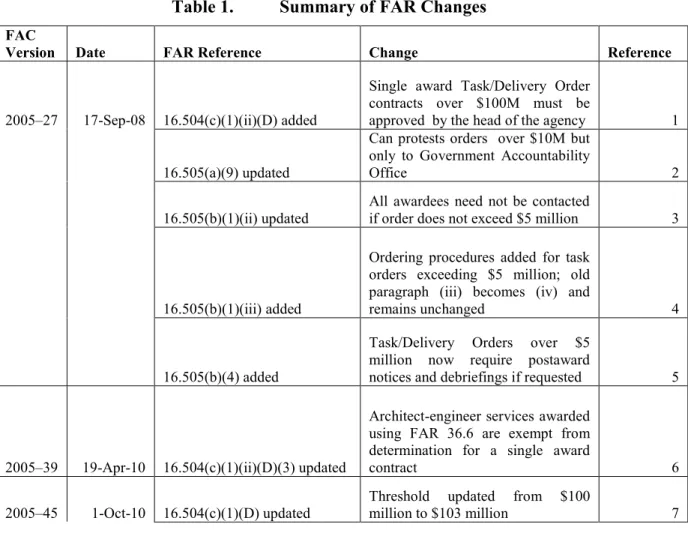
The FAR contains the policies and procedures for acquisitions conducted by all executive agencies (FAR, 2012a). As this research project is focused on multiple award IDIQ contracts a review of FAR parts 16.504 “Indefinite-Quantity Contracts” and 16.505 “Ordering” is necessary. Beginning in 2008 and continuing to the present these sections of the FAR have undergone significant revisions to focus on multiple award contracts and maintaining competition among contractors with these IDIQ contracts. The magnitude of the changes is apparent when you compare the length of Appendix A to the length of Appendix B. Table 1 briefly summarizes the changes that have taken place to these parts of the FAR since 2008:
Table 1. Summary of FAR Changes
FAC
Version Date FAR Reference Change Reference
2005–27 17-Sep-08 16.504(c)(1)(ii)(D) added
Single award Task/Delivery Order contracts over $100M must be
approved by the head of the agency 1
16.505(a)(9) updated
Can protests orders over $10M but only to Government Accountability
Office 2 16.505(b)(1)(ii) updated All awardees need not be contactedif order does not exceed $5 million 3
16.505(b)(1)(iii) added
Ordering procedures added for task orders exceeding $5 million; old paragraph (iii) becomes (iv) and
remains unchanged 4
16.505(b)(4) added
Task/Delivery Orders over $5 million now require postaward
notices and debriefings if requested 5
2005–39 19-Apr-10 16.504(c)(1)(ii)(D)(3) updated
Architect-engineer services awarded using FAR 36.6 are exempt from determination for a single award
contract 6 2005–45 1-Oct-10 16.504(c)(1)(D) updated Threshold updated from $100million to $103 million 7
16.504(c)(2)(i) updated
Contract Advisory and Assistance Service value updated from $11.5
million to $12.5 million 7
2005–50 16-May-11 16.505(b)(2)(i)(E) and (F)added
Added exemption allowing ordering to be placed on a sole source basis if a statute expressly authorizes or requires it; added ability to create set asides within; multiple award
contracts 8
16.505(b)(2)(ii) added
Requires any exceptions to fair opportunity to be in writing; specifies formats and approval levels for the exception; lays out
requirements to post the exception 9
16.505(b)(1)(ii) updated 16.505(b)(1)(iii) added
-$5 million reference removed from (ii)
-Ordering procedures added for
orders exceeding the SAT 3
2005–55 2-Feb-12 16.505(a)(4) added
Adds requirements for procuring items peculiar to one manufacturing; requiring exception to fair opportunity and posting of the
notice 10
1. Federal Acquisition Circular (FAC) 2005–27, dated September 17, 2008, enacted a number of changes related to multiple award IDIQ type contracts. One such change was the addition of FAR 16.504(c)(1)(ii)(D). This addition contained three major parts. First it added the requirement for the head of the agency to approve any determination to award a task or delivery order contract to a single source that was estimated to exceed $100 million. This addition was followed by conditions that could warrant award to a single source. Secondly, it required that the head of the agency notify Congress within 30 days after approving any determination such determination. Finally, it stated that the requirement for the determination applies in addition to the requirements of FAR 6.3.
A review of Appendix B, specifically FAR 16.504(c)(1)(ii)(C), shows what was expected prior to FAC 2005-27. This reference states, “The contracting officer must document the decision whether or not to use multiple awards in the acquisition plan or contract file.” The only requirement prior to FAC 2005-27 was that contracting officers document the decision to single award a task or delivery order contract. For those acquisitions exceeding $100 million, the decision was simply documented in the acquisition plan, and no separate document need be prepared.
Although the FAR still stated that preference should be given to making multiple awards, the regulations did not make it difficult to make a single award. By adding FAR 16.504(c)(1)(ii)(D) in FAC 2005-27 it ensured that higher dollar value Indefinite Delivery Indefinite Quantity contracts would receive even more preference than they previously had. Requiring a head of the agency determination in addition to documenting the decision in the acquisition plan ensured a separate document dedicated to a single award determination. By making the head of the agency the approval of the determination and further requiring that the head of the agency report all approved determinations to Congress, it ensured single award task or delivery order contracts in excess of $100 million would be the exception rather than the rule. When you consider that most task or delivery order contracts are awarded for three to five years, this change was certainly intended to ensure that competition could be maintained over the duration of these contract estimated at greater than $100 million.
2. FAR 16.505(a)(9) received an update in FAC 2005-27 that introduced more power for offerors who hold a base contract but are unsuccessful in receiving award of a task order. The update added FAR 16.505(a)(9)(i)(B), allowing offerors to protest award of orders exceeding $10 million; however, this protest can only be to the GAO. Prior to this change, as seen in Appendix B, FAR 16.505(a)(9) only allowed task or delivery orders to be protested on the grounds that the order increased the scope, period, or maximum value of the
contract. The change granted unsuccessful offerors the ability to protest to GAO, and this protest for orders exceeding $10 million was no longer limited to an increase in scope, period, or maximum value of the contract.
One of the byproducts of this policy change is certainly that all task orders valued over $10 million have detailed-enough documentation and award decisions to withstand a protest. Prior to this change documentation may not have been as thorough, as there was not a concern that the order would be protested. Ensuring that all base contract holders had recourse if they felt they were not evaluated properly or did not receive fair opportunity for a task order award was certainly one of the intents of this update.
3. FAC 2005-27 and 2005-50 both made changes to FAR 16.505(b)(1)(ii). FAC 2005-27 revised this paragraph to state that for orders not exceeding $5 million, “the contracting officer need not contact each of the multiple awardees under the contract before selecting an order awardee if the contracting officer has information available to ensure that each awardee is provided a fair opportunity to be considered for each order” (FAR, 2008). As can be seen in Appendix A, FAR 16.505 was further revised in FAC 2005-50 to replace the $5 million requirement in FAR 16.505(b)(1)(ii) with orders not exceeding the simplified acquisition threshold. In addition, FAC 2005-50 added paragraphs to FAR 16.505 specifying the ordering requirements for orders exceeding the simplified acquisition threshold. This change details the requirements for ensuring any order exceeding the simplified acquisition threshold is placed on a competitive basis and requires a written determination to waive this requirement.
These policy changes are certainly geared at ensuring competition, and ensuring that fair opportunity is afforded to all base contract holders. The changes to FAR 16.505 in 2005-50, were necessary as a result of the changes in reference 10 requiring written justification for exceptions to fair
to contact each of the multiple awardees under a contract provided they are offered fair opportunity for the order this could be difficult to actually put in practice. It is possible this requirement could be referring to the use of a website or other electronic request for proposal system, where the contracting officer can make each task order request for proposal available to all awardees without actually contacting them. The use of these procedures would ensure all awardees were provided fair opportunity even though they may not have been directly contacted. In the absence of a system similar to this the researcher is unsure of how a contracting officer could actually meet the prescriptions of this paragraph.
4. FAC 2005-27 revised FAR 16.505 to add ordering procedures for any task order in excess of $5 million. Specifically, this revision required all awardees to be provided a fair opportunity to be considered for award and established five minimum requirements for these orders. These five requirements are: a clear statement of the agency’s requirements; allow awardees a reasonable time to respond to the order request for proposal; provide awardees an explanation of how their proposal will be evaluated to include any factors or sub factors that will be rated and their importance in the award decision; when using a best value approach the contracting office is required to document the basis for award; and finally the contracting office needs to allow awardees the opportunity for a post award debrief if requested.
Compared to Appendix B, these changes are significant, prior to these changes there was nothing specifying what the minimum requirements for placing orders under multiple award contracts. Most of these changes probably stem from changes in references 2 and 5 that allowed for protests and debriefings, the minimum requirements simply ensure the contracting office will be able to offer debriefings to awardees as well as defend any protest that may be received. With the exception of the added requirement to allow for post award debriefings all other requirements were most likely being met by contracting offices. For instance, awardees cannot develop proposals if
the requirements are vague and the response time doesn’t allow them enough time to adequately propose. In addition, anytime you’re using factors you need to explain to awardees what the evaluation process is and this in turn leads to the need for the contracting office to document the award decision. Based on this example, it is likely that these changes merely formalized most of the practices that were already being followed.
5. The final change made to FAR 16 in FAC 2005-27 was in regards to post award notices and debriefings. Specifically, when the task order value exceeds $5 million the contracting officer is required to notify unsuccessful awardees. In addition, the unsuccessful awardee may request and receive a debriefing for orders in excess of $5 million, and the contracting office shall maintain a summary of the debriefing in the order file.
These changes added a little more transparency to the task or delivery order process. Prior to these changes, there was no requirement to notify an unsuccessful awardee nor would unsuccessful awardees receive any insight into how they had been evaluated for a particular order. These changes created an environment where awardees are able to be more informed on orders they do not receive, and can possibly lead to better proposals based on the
information learned in the debriefing process. These results are certainly beneficial to both the government and contract awardees.
6. FAC 2005-39, issued 19 April 2010, updated 16.504(c)(1)(ii)(D)(3) to exempt architect-engineer services awarded using FAR 36.6 from the requirements of a determination to issue a single award IDIQ contract in excess of $100 million.
This exemption is most likely due to the unique nature of architect-engineering service contracts. As evidenced by the fact that FAR 36.6 provides unique source selection procedures from those covered in FAR 15.
Given this the change most likely is a result of the nature of architect-engineering service work not being conducive to a multiple award environment.
7. The FAC 2005-45 updates to FAR 16.504 did not bring any major changes that would significantly alter the acquisition process. The updates were simply to increase the threshold for multiple award contracts from $100 million to $103 million, and the Contract Advisory and Assistance Service threshold from $11.5 million to $12.5 million. These threshold changes most likely account for inflation in prices from the originally established thresholds. 8. The changes implemented in FAC 2005-50 had a significant impact as it
relates to exceptions to the fair opportunity process for multiple award contracts. As seen in Appendix B, FAR 16.505(b)(2)(i) was updated to add two additional exceptions to fair opportunity. One being that contracting agencies are now allowed to create set-asides for small businesses within multiple award contracts. The second exception allows an exception to fair opportunity if there is a statute that expressly authorizes or requires the purchase to be made from a specified source. These two changes are closely related in that the first allows for set asides to small business in accordance with FAR 19. FAR 19.13 and 19.14 contain statutes allowing for the placement of awards on a sole source basis to Historically Underutilized Business Zones (HUBZones) and Service-Disabled Veteran-Owned Small Businesses (SDVSOB); hence the second change to FAR 16.505.
The change to allow for set-asides to be used in multiple award contracts is a beneficial change for contracting offices. By allowing for set-asides within multiple award contracts not only are you increasing your awards to small business you are also better able to meet your agencies small business goals without developing new contracts. In addition, by allowing set-asides for small businesses you are allowing small business to be more competitive for receipt of orders under the base contract in that they no longer have to
receive award. Awarding to small business also saves contracting agencies time as they do not need to evaluate and approve a subcontracting plan prior to award of an order.
9. The other significant changes made by FAC 2005-50 were regarding the exception to fair opportunity process. As can be seen by comparing the differences between FAR 16.505(b)(2) in Appendix’s A and B the change three main areas. Requiring the justification to be in writing and follow a specific format is the first area covered by the change. The second area lays out the approval thresholds for the justification. Finally, the last area has to deal with the requirement to post the justification.
These changes definitely caused an impact on the way contracting activities handle awarding task/delivery orders on a sole source basis. As can be seen by a simple comparison of the changes from Appendix A to Appendix B, the requirements changed substantially. The required format of the justification was changed from simply annotating the file as the what exception was used, to writing the justification in a format similar to the requirements for a Justification and Approval for Other than Full and Open Competition as detailed in FAR 6. The approval levels established for the exception to fair opportunity went from a contracting officer’s note in the file to established levels similar to the FAR 6 requirements. Finally, the contracting office is now required to post the approved exception. Staffing these exceptions to fair opportunity for signature and also reviewing them for redactions prior to posting them lengthens the procurement timeline for these sole source actions. It also ensures transparency into procurement process for these task/delivery orders as previously base contract holders would have no way of knowing an order had been issued on a sole source basis.
10. FAC 2005-55 added ordering procedures to FAR 16.505 for items peculiar to one manufacturer, otherwise known as brand name or equal items. As seen in Appendix A, this change now requires a justification to an exception to fair
opportunity be in writing to support orders meeting this criteria and that this justification is posted as well.
The impacts of this change would be similar to those detailed in reference 9, however, depending on the nature of the contracting activities work it may not have much of an impact. For example, if the contracting activity focused on research and development contracts they are likely to see little impact from this change as they don’t deal in brand name items much.
B. MINIMUM QUANTITY LITERATURE REVIEW
The IDIQ contract is unique in its requirement that the government order and the contractor furnish a minimum quantity of supplies or services (reference FAR
16.504(a)(1)). FAR 16.504(a)(2) further elaborates on this requirement stating that the quantity must be more than nominal to ensure that the contract is binding.
Dictionary.com offers the following definitions for nominal; “named as a mere matter of form, being trifling in comparison with actual value; minimal” and, “minimal in
comparison with real worth or what is expected; token” (Nominal, n.d.). When you consider these definitions with the requirements from 16.504(a)(2) that this nominal quantity should not exceed what the government is fairly certain to order one could assume this quantity could be almost anything. Given this information, it appears that it would be incredibly difficult for a contractor to win a protest solely on the grounds the government did not meet the nominal quantity requirement.
1. Minimum Quantity Case Review
The GAO has considered several protests regarding the guaranteed minimum quantity on IDIQ contracts. In the majority of the protests the case being presented was that the minimum quantity was insufficient to form a binding contract. Of particular importance to this research are the following:
a. GAO Case B-278404.2: Sea-Land Service, Inc., protested that a minimum quantity of one container per carrier was insufficient to bind the parties. GAO denied this protest, and found that a quantity of one did represent a nominal quantity to bind the parties. As part of denying
the protest GAO pointed out that the multiple award nature of the contract made it impossible for the government to predetermine the minimum quantity it would award to each contractor. (Calhoun & Melody, 1998)
b. B-285833: Carr’s Wild Horse Center protested that the guaranteed minimum quantity of 100 horses/burros was insufficient to form binding contract. GAO denied the protest on the grounds that historical data indicated that 100 horses/burros was a number the government was fairly certain to order and that given the multiple award nature of the IDIQ contract there was no certainty how many horses/burros each individual contractor would handle over the life of the contract.
(Gamboa, 2000)
c. B-291185: ABF Freight System’s protested the minimum quantity of a multiple award IDIQ contract for freight transportation services on the grounds the quantity was inadequate. GAO denied the protest stating, “We also find here that the minimum quantity guaranteed for each lane, even if it amounts to only a few hundred dollars, is sufficient consideration to form a binding contract. Although it may be true that the guaranteed minimum quantity for certain lanes appears low
(particularly as compared to the minimums guaranteed for other lanes), this does not alone demonstrate that the guaranteed quantity is
insufficient to support a contract.” (Gamboa, 2002)
d. B-299255: GAO denied the protest of Information Ventures finding that the guaranteed minimum amount of $1,000 was reasonable to form a binding contract. This contract was also a multiple award IDIQ contract and GAO again argued that given the best value nature for placing delivery orders there was no way of telling how many awards any one contractor would receive. (Kepplinger, 2007)
e. B-318046: The GAO found no basis to object to a guaranteed minimum of $500 for the Library of Congress’s Federal Library and
Information Network (FEDLINK) program. Of particular interest in this finding was that there was no historical data upon which to make a determination that the $500 minimum was either too high or too low. (Gordon, 2009)
Based on these GAO determinations one can conclude that it would be incredibly unlikely that a contractor will be successful in protesting solely on the ground that the minimum quantity was not sufficient to form a binding contract (i.e., it was not nominal). When you factor in the movement to more multiple award contracts the argument
becomes even harder to make. As seen above, GAO has found multiple times that given the best value aspects of multiple award contracts almost any dollar value or quantity amount can be reasonable to form a binding contract and thus be considered nominal. Even a guaranteed minimum of $2,500 when compared to a contract maximum of $150,000,000 has been upheld as meeting the requirement to form a binding contract (Gamboa, 2005).
C. SUMMARY
This chapter focused on the changes made to FAR 16.504 and 16.505 since 2008. The impacts these changes had on contracting activities was also discussed. In addition, the chapter looked at the requirements for the guaranteed minimum quantity under IDIQ contracts to be nominal. GAO cases were reviewed to determine if any precedent existed for determining a minimum quantity was insufficient to form a binding contract.
III. ACC-APG STATISTICAL DATA
A. OVERVIEW OF DATA GATHERING PROCESS
In order to assess whether changes in policy regarding multiple award IDIQ contracts, have had any impact on contracts awarded by ACC-APG existing contract information had to be obtained. Specifically, the information was obtained through reports run against the Federal Procurement Data System – Next Generation (FPDS-NG) system and the Electronic Document Access (EDA) database. This information was limited to active multiple award IDIQ contracts dating back to 2008. The information obtained was aimed at providing answers to the following questions:
1. How many multiple award base contracts were awarded by ACC-APG for supplies? How many were for services? Were any for a combination of supplies and services?
2. For base contracts how many proposals were received and how many awards were made?
3. How many delivery/task orders have been issued against the contracts obtained in question 1?
4. What was the competitive status of the delivery/task orders awarded? 5. For competitively issued delivery/task orders how many received multiple
proposals?
6. How many delivery/task orders were awarded on a non-competitive basis? 7. What is the GMQ and ceiling for the base contracts identified in question 1? The data obtained is bound by a few limitations. First, all information pertaining to the number of contracts, competitive status, number of offers is limited to only what could be obtained from the FPDS-NG system. The accuracy of this information is dependent upon information input by contract specialists at the time these contracts were issued. Any awards that were reported incorrectly or not reported at all in the FPDS-NG system are not captured in the data. The second limitation is that all information pertaining to the GMQ and ceiling amounts is derived from accessing the contract
through the EDA database. If the contract does not clearly state this information it was excluded from the data. A final limitation is that the data was limited only to ACC-APG contracts and only focused on active contracts dating back to 2008. If a multiple award contract was issued in 2008 for a period of three years it will not be reflected in the data obtained.
The ACC-APG systems office ran the report queries of the FPDS-NG data. The data was provided in three separate files. One file was just active IDIQ contracts from 2008 to present. The second file contained the delivery/task order information for multiple award contracts where more than one bid was received. The final file contained delivery/task order information for multiple award contracts where only one bid was received.
B. PRESENTATION OF STATISTICAL DATA RESULTS
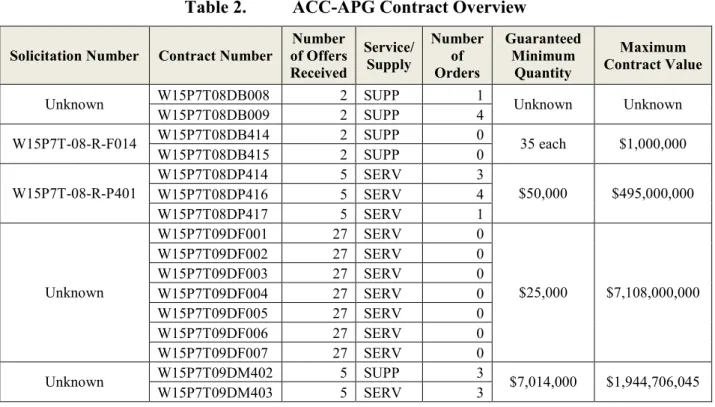
After compiling all the data it was organized into a single file. The results compiled a list of 59 solicitations that resulted in award of 273 multiple award base contracts, with 405 delivery/task orders being issued against those contracts. A complete list of the results in shown in Table 2:
Table 2. ACC-APG Contract Overview
Solicitation Number Contract Number of OffersNumber Received Service/ Supply Number of Orders Guaranteed Minimum Quantity Maximum Contract Value
Unknown W15P7T08DB008 2 SUPP 1 Unknown Unknown W15P7T08DB009 2 SUPP 4 W15P7T-08-R-F014 W15P7T08DB414 2 SUPP 0 35 each $1,000,000 W15P7T08DB415 2 SUPP 0 W15P7T-08-R-P401 W15P7T08DP414W15P7T08DP416 5 SERV5 SERV 34 $50,000 $495,000,000 W15P7T08DP417 5 SERV 1 Unknown W15P7T09DF001 27 SERV 0 $25,000 $7,108,000,000 W15P7T09DF002 27 SERV 0 W15P7T09DF003 27 SERV 0 W15P7T09DF004 27 SERV 0 W15P7T09DF005 27 SERV 0 W15P7T09DF006 27 SERV 0 W15P7T09DF007 27 SERV 0 Unknown W15P7T09DM402 5 SUPP 3 $7,014,000 $1,944,706,045 W15P7T09DM403 5 SERV 3
Solicitation Number Contract Number of OffersNumber Received Service/ Supply Number of Orders Guaranteed Minimum Quantity Maximum Contract Value W15P7T-08-R-N201 W15P7T09DN005 9 SERV 2 $25,000 $77,444,000 W15P7T09DN006 9 SERV 1 W15P7T09DN007 9 SERV 2 W15P7T09DN008 9 SERV 1 W15P7T09DN009 9 SERV 0 W15P7T09DN010 9 SERV 1 Unknown W15P7T09DP012 6 SERV 3 $50,000 $900,000,000 W15P7T09DP013 6 SERV 19
Unknown W15P7T10DA803W15P7T10DA804 10 SERV10 SERV 25 $50,000 $245,000,000 W15P7T10DA805 10 SERV 3 W15P7T-08-R-E0001 W15P7T10DD406 27 SERV 2 $25,000 $16.4 Billion W15P7T10DD407 27 SERV 0 W15P7T10DD408 27 SERV 1 W15P7T10DD409 27 SERV 1 W15P7T10DD410 27 SERV 5 W15P7T10DD411 27 SERV 5 W15P7T10DD412 27 SERV 2 W15P7T10DD413 27 SERV 4 W15P7T10DD414 27 SERV 0 W15P7T10DD415 27 SERV 0 W15P7T10DD416 27 SERV 2 W15P7T10DD417 27 SERV 2 W15P7T10DD418 27 SERV 1 W15P7T10DD419 27 SERV 0 W15P7T10DD420 27 SERV 0 W15P7T10DD421 27 SERV 1 W15P7T10DD422 27 SERV 0 W15P7T10DD423 27 SERV 1
W25G1V-11-R-0023 W25G1V11D0002 12 SUPP 4 not specifiedUnknown
-on c-ontract Unknown W25G1V11D0003 12 SUPP 5
Unknown W58P0508D0003W58P0508D0004 7 SUPP7 SUPP 00 3,500 each $3,000,000.00 W58P0508D0005 7 SUPP 0
Unknown W58P0509D0001W58P0509D0002 9 SUPP9 SUPP 00 1,000 each 20,000 each W58P0509D0003 9 SUPP 0
Unknown W58P0509D0004W58P0509D0006 5 SUPP7 SUPP 00 Unknown Unknown W58P0509D0007 7 SUPP 0 Unknown W58P0509D0013 11 SUPP 0 5,000 each 70,000 each W58P0509D0014 11 SUPP 0 W58P0509D0015 11 SUPP 0 W58P0509D0016 11 SUPP 0
Solicitation Number Contract Number of OffersNumber Received Service/ Supply Number of Orders Guaranteed Minimum Quantity Maximum Contract Value
Unknown W909MY09D0001 7 SUPP 1 SDD Phase Varies by CLINno dollar value set W909MY09D0002 7 SUPP 2
W9115U-11-R-0004 W9115U11D0002 3 SUPP 0 20 each 2,000 each W9115U11D0003 4 SUPP 0 20 each 7,000 each
Unknown W911QY08D0016 10 SERV 1 Unknown -not specified on contract $20,000,000 W911QY08D0017 10 SERV 3 W911QY08D0018 10 SERV 3 W911QY08D0019 10 SERV 0 W911QY08D0020 10 SERV 0 W911QY08D0021 10 SERV 2 W911QY08D0022 10 SERV 4 W911QY08D0023 10 SERV 0 W911QY08D0024 10 SERV 0
W911QY-08-R-0003 W911QY08D0033 3 SUPP 0 $13,800 $24,500,000 W911QY08D0034 3 SUPP 0
W911QY-08-R-0012
W911QY09D0004 6 SUPP 1 Varies per CLIN -different items per contract Quantity varies per CLIN W911QY09D0005 6 SUPP 0
W911QY-09-R-0020 W911QY09D0020 2 SERV 0 $2,500 $10,000,000 W911QY09D0021 2 SERV 1
W911QY-09-R-0035 W911QY09D0026 4 SUPP 0 varies perQuantity CLIN Quantity varies per CLIN W911QY09D0027 4 SUPP 0 W911QY09D0028 4 SUPP 0 W911QY-09-R-0021 W911QY09D0031 6 SUPP 1 $25,000 $3,000,000 W911QY09D0032 6 SUPP 0 W911QY09D0033 6 SUPP 1 W911QY09D0034 6 SUPP 1 W911QY-09-R-0008 W911QY09D0040 12 SERV 1 $2,500 $20,000,000 W911QY09D0041 12 SERV 3 W911QY09D0042 12 SERV 6 W911QY09D0043 12 SERV 5 W911QY09D0044 12 SERV 4 W911QY09D0045 12 SERV 5 W911QY09D0046 12 SERV 3 W911QY09D0047 12 SERV 2 W911QY09D0048 12 SERV 1 W911QY09D0049 12 SERV 3
W911QY-09-R-0034 W911QY10D0001W911QY10D0002 3 SUPP7 SUPP 12 $200,000.00 $220,000,000.00 W911QY10D0003 3 SUPP 2
Solicitation Number Contract Number of OffersNumber Received Service/ Supply Number of Orders Guaranteed Minimum Quantity Maximum Contract Value W911QY-10-R-0005
W911QY10D0019 5 SUPP 2 Unknown -not specified on contract (minimum per order $10k) $23,000,000.00 W911QY10D0020 5 SUPP 4 W911QY10D0021 5 SUPP 5
Unknown W911QY10D0027 2 SERV 0 60,000 units 625,000 units W911QY10D0031 2 SERV 0
W911QY-10-R-0026 W911QY10D0054W911QY10D0055 6 SUPP6 SUPP 00 $25,000.00 $247,000,000.00 W911QY10D0056 6 SUPP 1
W911QY-10-R-0049 W911QY10D0064W911QY10D0065 8 SUPP8 SUPP 22 uniforms20,000 uniforms300,000 W911QY10D0066 8 SUPP 2 W911QY-10-R-0066 W911QY11D0015 7 SUPP 0 Unknown -not specified in contract (minimum order is $12,500) $248,512,500.00 W911QY11D0016 7 SUPP 1 W911QY11D0017 7 SUPP 0 W911QY11D0018 7 SUPP 3 W911QY11D0019 7 SUPP 0 W911QY11D0020 7 SUPP 0 W911QY11D0021 7 SUPP 0 W911QY-10-R-0067 W911QY11D0022 27 SUPP 0 Unknown -not specified in contract (minimum order is $2,500) $997,000,000.00 W911QY11D0023 27 SUPP 0 W911QY11D0024 27 SUPP 0 W911QY11D0025 27 SUPP 0 W911QY11D0026 27 SUPP 1 W911QY11D0027 27 SUPP 0 W911QY11D0028 27 SUPP 0 W911QY11D0029 27 SUPP 0 W911QY11D0030 27 SUPP 0 W911QY11D0031 27 SUPP 0 W911QY11D0032 27 SUPP 0 W911QY11D0033 27 SUPP 0 W911QY11D0034 27 SUPP 0 W911QY11D0035 27 SUPP 0 W911QY11D0036 27 SUPP 0 W911QY11D0037 27 SUPP 0 W911QY11D0038 27 SUPP 0 W911QY11D0040 27 SUPP 0 W911QY11D0041 27 SUPP 0 W911QY11D0042 27 SUPP 0
W911QY-10-R-0025 W911QY11D0043W911QY11D0044 10 SUPP10 SUPP 00 $50,000.00 $465,000,000.00 W911QY11D0045 10 SUPP 0
W911QY-10-R-0027
Solicitation Number Contract Number of OffersNumber Received Service/ Supply Number of Orders Guaranteed Minimum Quantity Maximum Contract Value
awards W911QY11D0049 14 SERV 0 W911QY11D0050 14 SERV 0 W911QY11D0051 14 SERV 0 W911QY11D0052 14 SERV 0 W911QY11D0053 14 SERV 1 W911QY11D0054 14 SERV 0 W911QY11D0055 14 SERV 1 W911QY11D0056 14 SERV 0 W911QY11D0057 14 SERV 3 W911QY11D0058 14 SERV 0 W911QY11D0059 14 SERV 0 W911QY11D0060 14 SERV 0 W911QY-10-R-0027 - small business awards W911QY11D0061 12 SERV 0 W911QY11D0062 12 SERV 0 W911QY11D0063 12 SERV 0 W911QY11D0064 12 SERV 0 W911QY11D0065 12 SERV 0 W911QY11D0066 12 SERV 1 W911QY11D0067 12 SERV 0 W911QY11D0068 12 SERV 0 W911QY11D0069 12 SERV 0 W911QY11D0070 12 SERV 0 W911QY11D0071 12 SERV 0 W911QY11D0072 12 SERV 1
W911QY-10-R-0025 W911QY11D0080 10 SUPP 0 $50,000.00 $465,000,000.00 W911QY11D0081 10 SUPP 0
W911QY-11-R-0001 W911QY12D0006 7 SUPP 1 uniforms1,250 75,000 uniforms W911QY12D0007 7 SUPP 1 Unknown W911SR08D0012 3 SERV 0 Unknown -not specified in contract (minimum order is $50,000) $50,000,000.00 W911SR08D0013 3 SERV 1 W911SR08D0014 3 SERV 0 W911SR-09-R-0023 - large business awards W911SR10D0001 11 SERV 3 $25,000.00 $485,000,000.00 W911SR10D0002 11 SERV 1 W911SR10D0003 11 SERV 0 W911SR10D0004 11 SERV 12 W911SR10D0005 11 SERV 2 W911SR10D0006 11 SERV 2 W911SR10D0007 11 SERV 1 W911SR10D0008 11 SERV 0 W911SR10D0009 11 SERV 3 W911SR10D0010 11 SERV 2 W911SR-09-R-0023 W911SR10D0011 10 SERV 1
Solicitation Number Contract Number of OffersNumber Received Service/ Supply Number of Orders Guaranteed Minimum Quantity Maximum Contract Value - small business
awards W911SR10D0013W911SR10D0014 10 SERV13 SERV 02 W911SR10D0015 13 SERV 0 W911SR10D0016 13 SERV 0 W911SR10D0017 13 SERV 3 W911SR10D0018 13 SERV 0 W911SR10D0019 13 SERV 0 W911SR10D0020 13 SERV 1 W911SR10D0021 13 SERV 0
W911SR-11-R-0002 W911SR12D0001 6 SUPP 2 canisters150,000 12,000,000canisters W911SR12D0002 6 SUPP 1 W9124A-08-R-0003 W9124A09D0003 18 SERV 9 $50,000.00 Unknown -ordering maximum is $750k W9124A09D0004 18 SERV 0 W9124A10D0001 18 SERV 11 W9128Z-08-R-0001 W9128Z08D0001W9128Z08D0002 3 SUPP3 SUPP 00 $50,000.00 $30,000,000.00 W9128Z08D0003 3 SUPP 0 W9128Z-09-R-0003 W9128Z09D0007 4 SUPP 0 $50,000.00 $35,000,000.00 W9128Z09D0008 4 SUPP 0 W9128Z09D0009 4 SUPP 0 W9128Z09D0010 4 SUPP 0 W9128Z-09-R-0004 W9128Z09D0013 2 SUPP 0 $50,000.00 $28,008,075.00 W9128Z09D0014 2 SUPP 0
Unknown W9128Z11D0005W9128Z11D0006 14 SERV14 SERV 177 $50,000.00 $892,000,000.00 W9128Z11D0007 14 SERV 4 W91CRB-07-R-0046 W91CRB08D0024 6 SERV 2 $1,000,000.00 $452,951,232.00 W91CRB08D0025 6 SERV 0 W91CRB08D0026 6 SERV 0 W91CRB08D0027 6 SERV 2 W91CRB-08-R-0065 W91CRB08D0040 2 SERV 3 $100,000.00 $5,500,000.00 W91CRB08D0041 2 SUPP 4 W91CRB-08-T-0029 W91CRB08D0043 5 SUPP 0 $5,000.00 $5,500,000.00 W91CRB08D0044 3 SUPP 0 W91CRB-08-R-0049 W91CRB08D0060 8 SUPP 1 $1,000.00 $300,000,000.00 W91CRB08D0061 8 SUPP 0 W91CRB08D0062 8 SUPP 0 W91CRB08D0063 8 SUPP 1 W91CRB-07-R-0041 W91CRB09D0001 10 SUPP 0
500 sets Varies by CLINno dollar value set W91CRB09D0002 10 SUPP 1
W91CRB09D0003 10 SUPP 0 W91CRB09D0004 10 SUPP 0
W91CRB-08-R-0061 W91CRB09D0029 2 SERV 6 target locator100 laser 9,000 systems W91CRB09D0030 3 SERV 4
Solicitation Number Contract Number of OffersNumber Received Service/ Supply Number of Orders Guaranteed Minimum Quantity Maximum Contract Value modules W91CRB-07-R-0079 W91CRB09D0047 8 SUPP 0 500 IOTV (vests) and 500 DAP (protectors 736,000 IOTV, and 253,000 DAP W91CRB09D0049 9 SUPP 1 W91CRB09D0050 8 SUPP 0 W91CRB-08-R-0092 W91CRB09D0054 8 SERV 4 $100,000.00 $494,000,000.00 W91CRB09D0055 8 SERV 3 W91CRB09D0056 8 SERV 0 W91CRB09D0057 8 SERV 2 W91CRB09D0058 8 SERV 2 W91CRB-09-T-0138 W91CRB10D0002 5 SERV 0 $4,000.00 $5,500,000.00 W91CRB10D0003 5 SERV 0 W91CRB10D0004 5 SERV 0 W91CRB10D0005 5 SERV 0 W91CRB10D0006 5 SERV 0 Unknown W91CRB10D0008 8 SUPP 0 44 IOTV and 12 DAP 736,000 IOTV, and 253,000 DAP W91CRB10D0009 8 SUPP 0 W91CRB10D0010 8 SUPP 0 W91CRB10D0011 8 SUPP 0 W91CRB10D0012 8 SUPP 0 W91CRB10D0013 8 SUPP 0 W91CRB-10-T-0135 W91CRB10D0043 2 SUPP 0 $750,000.00 $5,500,000.00 W91CRB10D0044 2 SUPP 0 W91CRB-09-R-0021 W91CRB11D0001 7 SERV 18 $2,500.00 $400,000,000.00 W91CRB11D0002 7 SERV 13 W91CRB11D0003 7 SERV 3 W91CRB11D0004 7 SERV 5 W91CRB11D0005 7 SERV 0 W91CRB11D0006 7 SERV 4 W91CRB11D0007 7 SERV 2 W91CRB-10-R-0029 W91CRB11D0013W91CRB11D0014 2 SERV2 SERV 00 $25,000.00 $5,500,000.00 W91CRB-10-R-0051 W91CRB11D0082 2 SUPP 6 1 system Varies by CLINno dollar value
set W91CRB11D0083 2 SUPP 19 W91RUS-07-R-0004 W91RUS08D0001 23 SERV 4 $2,500.00 $499,000,000.00 W91RUS08D0002 23 SERV 2 W91RUS08D0003 23 SERV 4 W91RUS08D0004 23 SERV 5 W91RUS08D0005 23 SERV 3 W91RUS08D0006 23 SERV 7 W91RUS08D0007 23 SERV 0 W91RUS08D0010 23 SERV 1 W91RUS08D0011 23 SERV 1
Solicitation Number Contract Number of OffersNumber Received Service/ Supply Number of Orders Guaranteed Minimum Quantity Maximum Contract Value W91ZLK08D0009 3 SUPP 0 C. SUMMARY
This chapter provided a discussion of the data gathering process. It laid out the sources for obtaining the data and the questions the data was aimed at answering. A discussion of the processes limitation was also discussed. The chapter concluded with a presentation of the data obtained.
IV. DATA ANALYSIS
This chapter presents an analysis of the contract data obtained for ACC-APG. During analysis of the data, some of the data was found to be coded incorrectly in the FDPS system. The Contract Action Report (CAR) in FPDS contains a field entitled “Multiple or Single Award Indefinite Delivery Vehicle (IDV).” The analysis found that this field was being coded as “Multiple Award,” but the “Number of Offers Received” field indicated only one offer was received. This coding error resulted in an inflated number of IDIQ contracts, as multiple awards are not possible if only one offer is received. The data was updated to reflect only multiple award contracts where the number of offers was greater than one.
A. ANALYSIS OF MULTIPLE AWARD IDIQ DATA
The contracting process begins with the issuance of a solicitation. Contractors submit proposals in response to the solicitation that are then evaluated by the
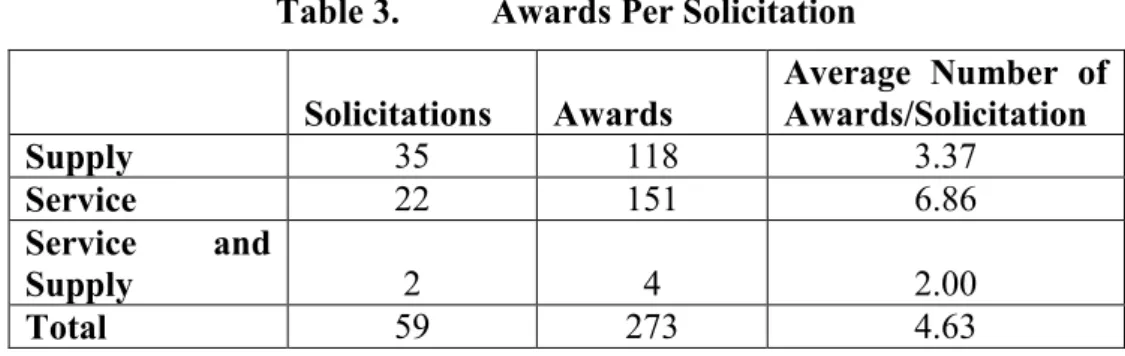
government. Once the evaluation is complete, a contract is awarded to the successful offeror(s). In the case of an IDIQ contract, task/delivery orders are issued against the contract for the performance of work or delivery of supplies. Given this contracting process, the data was analyzed to determine how many contracts were awarded per solicitation issued by ACC-APG. Table 3 provides a summary of this analysis:
Table 3. Awards Per Solicitation
Solicitations Awards Average Number ofAwards/Solicitation
Supply 35 118 3.37
Service 22 151 6.86
Service and
Supply 2 4 2.00
Total 59 273 4.63
The solicitations listed in Table 3 only represent those solicitations that resulted in more than one award being issued. On average, ACC-APG issued four awards for every solicitation issued. When ACC-APG issued a solicitation for supplies, the average
decreased to three awards per solicitation. There are a few circumstances that may explain this decrease. First, when purchasing supplies, quantity discounts are generally offered for purchasing larger quantities. These discounts are the result of economic purchase quantities on raw materials and production efficiencies gained from producing larger numbers of supplies (i.e., the learning curve). Secondly, when dealing with supplies, it is desirable to keep all contractors in production. This is because any breaks in production may lead to increased costs on future orders due to repeating testing on initial production quantities or paying for production start-up costs.
Not surprisingly, the average number of awards ACC-APG issued per service solicitation is almost seven. This difference is most likely attributable to the wide range of services the base contract covers. Having more contractors, who can compete on tasks orders of varying nature, can be beneficial to ensuring competition is maintained when issuing task orders. It is interesting to note that only two solicitations were issued for a combination of supplies and services. In both instances, only two awards were made: one for the service aspect and another for the supply.
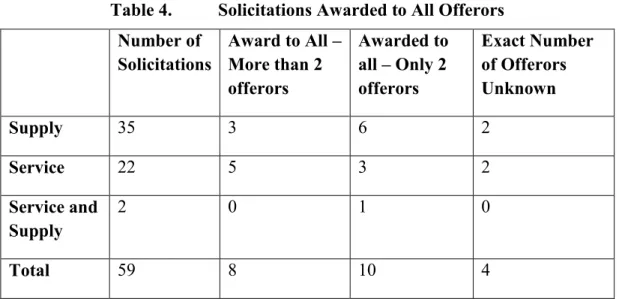
One of the assumptions of this project was that when multiple awards are made, there is a tendency for the contracting activity to award to all offerors, especially if the solicitation was for services. Table 4 presents an overview of this analysis:
Table 4. Solicitations Awarded to All Offerors Number of
Solicitations Award to All –More than 2 offerors Awarded to all – Only 2 offerors Exact Number of Offerors Unknown Supply 35 3 6 2 Service 22 5 3 2 Service and Supply 2 0 1 0 Total 59 8 10 4
As indicated in Table 4, four solicitations contained coding errors that made it impossible to determine whether a contract had been awarded to all offerors. The CAR in FDPS, from which this data was obtained, contains a field entitled “Number of Offers Received.” Generally, when making multiple awards against a solicitation, the number of offers for that solicitation is the same for all awards made against that solicitation. For those solicitations where the number of offerors was unknown, the number of offers varied for awards made against the same solicitation. For example, if two awards were made from one solicitation, the first award would indicate that two offers were received, and the second award for that same solicitation would indicate four offers were received. This may be the result of split awards where offerors were not required to bid on all items in the solicitation.
In reviewing the supply solicitations issued by ACC-APG, where more than two offers were received, contracts were awarded to all offerors only 8.57 percent of the time. When applying these same conditions to service solicitations issued by ACC-APG, the number increases to 22.72 percent. Overall, when more than two proposals are received, ACC-APG awarded to all offerors only 13.56 percent of the time. Given these results, the assumption regarding awarding contracts to all offerors is partially validated. The data suggests that if a solicitation was awarded to all offerors, it is most likely as a result of only receiving two offers. There are instances in which ACC-APG awarded to all offerors when more than two offers were received; however, the majority of the time ACC-APG did not award to all offerors.
B. ANALYSIS OF DELIVERY/TASK ORDER DATA
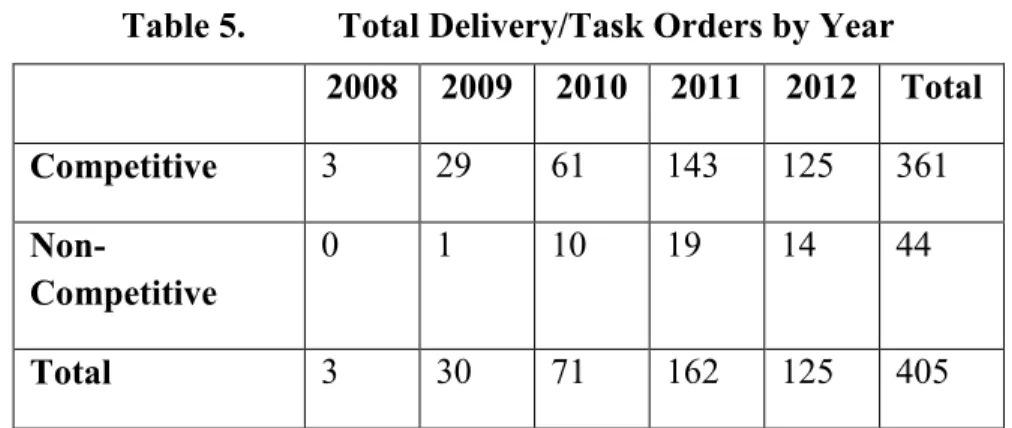
After completing an analysis of the base contract information, the delivery/task order information was analyzed. The data was separated into the year the delivery/task order was issued, and then further broken out by competitive status. Table 5 presents a summary of this analysis:
Table 5. Total Delivery/Task Orders by Year 2008 2009 2010 2011 2012 Total Competitive 3 29 61 143 125 361 Non-Competitive 0 1 10 19 14 44 Total 3 30 71 162 125 405
The majority of time the ACC-APG issued delivery/task orders on a competitive basis. Since 2008, only 10.86 percent of the time did ACC-APG award delivery/task orders on a non-competitive basis. Overall, this initial data would seem to suggest that the changes in the FAR had no real impacts on the number of non-competitive delivery/task orders issued by ACC-APG. As indicated in Table 5, the number of non-competitive delivery/task orders awarded by ACC-APG in a single year never exceeds 15 percent of the total number of delivery/task orders awarded. This disproves the assumption that changes in the FAR led to a decrease in non-competitive delivery/task orders.
After reviewing competitive status of the delivery/task orders issued by ACC-APG, the competitive delivery/task orders were examined more closely. Specifically, these delivery/task orders were examined to determine how many were awarded on a competitive basis, yet only resulted in one offer being received. Table 6 summarizes these findings:
Table 6. Competitive Delivery/Task Order Analysis
2008 2009 2010 2011 2012 Overall Competitive 3 29 61 143 125 361 Competitive – Only 1 Offer 1 7 4 41 19 72 Percentage – Only 1 Offer 33.33% 24.14% 6.56% 28.67% 15.20% 19.94%
Almost 20 percent of the time that a competitive delivery/task order Requests For Proposal (RFP) was issued by ACC-APG, it resulted in only one proposal being received. Overall, this suggests that the majority of the time competition is obtained when a
competitive delivery/task order RFP is issued by ACC-APG. It is worth pointing out that in 2011, the same year that the FAR changed to require non-competitive delivery/task orders be approved similar to other non-competitive contracts, the number of competitive delivery/task orders with only one offer was nearly 30 percent. This could be a result of ACC-APG adjusting to the policy change, and issuing competitive delivery/task order RFP’s that would previously have been awarded on a non-competitive basis. This would have led to only one of the offerors being able to perform the work and in turn receiving only one proposal. This increase may also be a result of a coding error in FDPS, resulting in the CAR being coded as competitive to avoid the recently implemented approval process (i.e., the delivery/task order was close to award when the policy changed resulting in following the old process rather than the new).
As shown in Tables 5 and 6, ACC-APG has been able to achieve competition on delivery/task orders the majority of the time. Only a small percentage of the time has ACC-APG awarded delivery/task orders on a non-competitive basis. The only interesting observation is that delivery/task orders coded as competitive did not always result in competition being obtained.
C. ANALYSIS OF MINIMUM QUANTITY DATA
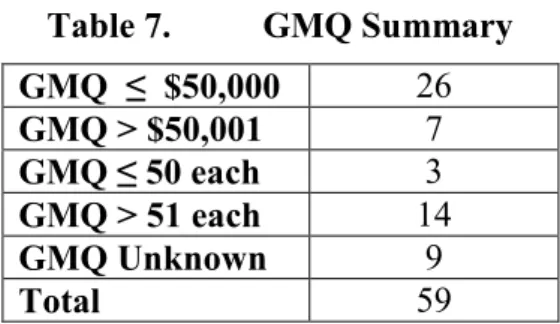
As discussed in Chapter II of this project, the GMQ necessary to form a binding contract can be almost anything provided the contracting activity has the market research to substantiate the minimum quantity contained in the solicitation and resultant contract. The EDA was accessed to determine what the GMQ was on multiple award contracts awarded by ACC-APG. The GMQ on a contract can be specified as a dollar amount or a unit of issue. As such, Table 7 organizes the data into these categories as follows:
Table 7. GMQ Summary GMQ ≤ $50,000 26 GMQ > $50,001 7 GMQ ≤ 50 each 3 GMQ > 51 each 14 GMQ Unknown 9 Total 59
For a complete list of the GMQ and contract ceiling amounts see Table 2 in Chapter III of this project. As indicated in Table 7, almost half of the solicitations issued by ACC-APG contained a GMQ of $50,000 or less. Of these 26 solicitations, with a GMQ of $50,000.00 or less, eight had a GMQ of $5,000.00 or less. Compared to the contract ceiling amounts listed in Table 2, these GMQ’s seem incredibly low. The largest GMQ found was for $7,014,000.00. When analyzing solicitations that specified a unit of issue, only once was a GMQ stated as a quantity of one; and in the majority of the cases the quantities were greater than 50 with multiple line items representing the GMQ.
An unexpected discovery was the absence of a clearly identifiable GMQ for nine of the 59 solicitations reviewed. This discovery is shown by the inclusion of the “GMQ Unknown” field in Table 7. Some of these contracts specified a minimum order quantity, the minimum quantity that can be ordered at one time, but it was unclear as to whether this was intended represent the GMQ. Both the minimum order quantity and GMQ need to be included in the contract as they represent two different elements that are required in an IDIQ contract. Solicitation cannot be accessed through the EDA system so it is unclear whether the solicitations for these contracts clearly specified the GMQ.
D. SUMMARY
This chapter presented an analysis of the multiple award date from the ACC-APG. The number of solicitations and resultant awards were analyzed. Following this analysis, an analysis of the delivery/task order information was presented. The chapter discussed trends, statistics, and observations that could be drawn based on the data. Finally, the chapter concluded with an analysis of the GMQ for the contracts analyzed.
V.
CONCLUSIONS AND RECOMMENDATIONS
A. SUMMARY
This study presented a discussion and analysis of the policy changes that have led to an increased emphasis on multiple award contracts. The increased focus on obtaining competition for delivery/task orders issued against these multiple award base contracts was also discussed. The discussion also presented the potential impacts these policy changes may have on the contracting activities. The study also presented a discussion of what minimum quantity is necessary to form a binding contract. In the end, this analysis concluded that almost any quantity or dollar value -- no matter how low it may seem compared to the contract ceiling -- can be sufficient to form a binding contract.
Following the policy discussion, statistical data from ACC-APG was presented and analyzed. The analysis conducted was aimed at validating the assumptions this project began with. Overall, the data provided some validation and other interesting findings.
B. RECOMMENDATIONS
Based on the results of this study, several recommendations are offered to the ACC-APG. The first recommendation is that ACC-APG consider offering clarification to the contracting workforce regarding when to code contracts in FDPS as multiple award versus single award. This clarification will hopefully prevent errors in FPDS coding on future contracts. It is also recommended that ACC-APG consider revising the contract information in FPDS that incorrectly identifies IDIQ contracts as multiple award when only one offer was received. Given that the results of this research identified some contracts without a GMQ clearly identified, it is recommended that ACC-APG provide a reminder to the contracting workforce that IDIQ contracts must have a GMQ specified.
C. CONCLUSIONS
This project began with three main assumptions to which conclusions can now be provided. The first assumption was that prior to the 2011 changes to the FAR, non-competitive delivery/task orders were issued on a more frequent basis. Based on an
analysis of the data, this assumption was found to be untrue. The data actually showed a relatively low number of non-competitive delivery/task orders in each year, with no drastic increases or decreases. The second assumption was that multiple award IDIQ service contracts were awarded to all offerors. An analysis of the data did show that at times ACC-APG issued service contracts to all offerors; however, the majority of the time this was not the case. The final assumption was that the GMQ on multiple award contracts was so low it leads to awarding to all offerors. The analysis of the GMQ information did reveal that in most cases GMQ amount is low when compared to the contract ceilings. This could partially validate this final assumption as the low GMQ’s helped make it possible to award contracts to all offerors. However, given that the data shows awarding to all offerors is not a common practice within ACC-APG, the low GMQ does not appear to be as significant a factor in the award decision as originally assumed.
D. AREAS OF FURTHER RESEARCH
Based on the findings of this project, there are several areas that could be further explored. First, a closer examination of delivery/task orders issued on a competitive basis but only receiving one proposal could be conducted. This study could focus on an
examination of the delivery/task order files to determine if there are any common factors that lead to only one proposal being received. This research was limited to only
information from ACC-APG, an area of further research could be to expand the data to cover other organizations or government agencies. In addition, when expanding the scope of the data additional sources beyond FDPS and EDA could be used to assemble the information. This expanded research could examine whether multiple award contracts are better suited for certain contracting centers based on their mission (research and
APPENDIX A
Federal Acquisition Regulation Current to FAC 2005–55 Effective 2 February 2012 16.504 -- Indefinite-Quantity Contracts
(a)Description. An indefinite-quantity contract provides for an indefinite quantity, within stated limits, of supplies or services during a fixed period. The Government places orders for individual requirements. Quantity limits may be stated as number of units or as dollar values.
(1) The contract must require the Government to order and the contractor to furnish at least a stated minimum quantity of supplies or services. In addition, if ordered, the contractor must furnish any additional quantities, not to exceed the stated maximum. The contracting officer should establish a reasonable maximum quantity based on market research, trends on recent contracts for similar supplies or services, survey of potential users, or any other rational basis.
(2) To ensure that the contract is binding, the minimum quantity must be more than a nominal quantity, but it should not exceed the amount that the Government is fairly certain to order.
(3) The contract may also specify maximum or minimum quantities that the Government may order under each task or delivery order and the maximum that it may order during a specific period of time.
(4) A solicitation and contract for an indefinite quantity must—
(i) Specify the period of the contract, including the number of options and the period for which the Government may extend the contract under each option;
(ii) Specify the total minimum and maximum quantity of supplies or services the Government will acquire under the contract;
(iii) Include a statement of work, specifications, or other description, that reasonably describes the general scope, nature, complexity, and purpose of the supplies or services the Government will acquire under the contract in a manner that will enable a prospective offeror to decide whether to submit an offer;
(iv) State the procedures that the Government will use in issuing orders, including the ordering media, and, if multiple awards may be made, state the procedures and selection criteria that the Government will use to provide awardees a fair opportunity to be considered for each order (see
16.505(b)(1));
(v) Include the name, address, telephone number, facsimile number, and e-mail address of the agency task and delivery order ombudsman (see
16.505(b)(6)) if multiple awards may be made;
(vi) Include a description of the activities authorized to issue orders; and (vii) Include authorization for placing oral orders, if appropriate, provided that the Government has established procedures for obligating funds and that oral orders are confirmed in writing.
(b) Application. Contracting officers may use an indefinite-quantity contract when the Government cannot predetermine, above a specified minimum, the precise quantities of supplies or services that the Government will require during the contract period, and it is inadvisable for the Government to commit itself for more than a minimum quantity. The contracting officer should use an indefinite-quantity contract only when a recurring need is anticipated.
(c)Multiple award preference— (1)Planning the acquisition.