NETWORKED NPOs IN THE GLOBAL SOUTH:
KNOWLEDGE MANAGEMENT
AND
ORGANISATIONAL EFFECTIVENESS
Titilayo Olujumoke Akinsanmi
Student No: 0616775D
Dissertation submitted to the Faculty of Management, University of
Witwatersrand, in fulfilment of the requirements for the degree of
Master of Management (by dissertation in the field of Public and
Development Management)
September 2010
ii
ABSTRACT
This research sought to understand the knowledge management (KM) practices in use by networked southern non-profit organisations (NPOs), which directly or indirectly impact on their effectiveness. It explores the realm of NPOs, and the concepts of organisational effectiveness (OE) and KM, with the aim of identifying their
interrelationships from a theoretical and practical perspective. The three organisations studied are the Association for Progressive Communications (APC), South Africa NGO Network (SANGONet) and Women’s Network (Women’sNet).
Using a conceptually formulated research framework, data gathered was analysed to examine the KM concepts of people capacity, systems and procedures, information and knowledge flow and stakeholder relations within and across all three case studies and their use of information and communications technologies (ICTs) as an enabler.
The research concludes with an integrated framework, an addition to the existing body of knowledge on KM theory with key elements for a KM system for effectiveness for networked southern NPOs.
iii
DECLARATION
I declare that this report is my own, unaided work. It is submitted in fulfilment of the requirements of the degree of Master of Management (by dissertation in the field of Public and Development Management) in the University of the Witwatersrand,
Johannesburg. It has not been submitted before for any degree or examination in any other university.
___________________________
Titilayo Olujumoke Akinsanmi (0616775D)
iv
DEDICATION
This report is dedicated to the One who has taught, encouraged and supported me through my life that ‘wisdom is the principal thing…and in all my getting [of wisdom] to seek and get understanding (Bible, Proverbs 4:7).
v
ACKNOWLEDGEMENTS
I am grateful to all whom in one way or the other supported this journey of discovery, without which this research would have remained an idea floating around in my mind.
To my friends and family – e Seun! Indeed ‘aso l’eniyan’. A pe fun ara wa!
To the friends within the APC, SANGONeT and WOMENSNeT – thank you for your assistance, your openness and your accessibility to my many prodding questions. There would be no study without your willingness to participate.
To my Supervisor, Ms. Luci – thank you for your unending patience, willingness to help me learn and grow. I can say that without your continuing encouragement – beyond the call of duty I would not be here yet.
I acknowledge the continuing encouragement of my best friend, OloMi Oni Temi, Oore Mi, OluMakinde who gently prodded me when I slacked, encouraged and cheered the loudest when I passed a milestone.
vii
CONTENTS
ABSTRACT ii DECLARATION iii DEDICATION iv ACKNOWLEDGEMENTS ... vLIST OF ACRONYMS ... xiv
LIST OF TABLES... xv
LIST OF FIGURES ... xv
LIST OF ANNEXURES ... xvi
CHAPTER 1. THE THIRD SECTOR: CIVIL SOCIETY ... 1
1.1. Introduction ... 1
1.2. Non-Profit Organisations... 3
1.2.1 NPO characteristics ... 5
1.2.2 NPOs and management... 8
1.3. Contemporary management theories ... 9
1.3.1 NPO management ... 10
1.3.2 NPOs and social change... 11
1.4. Southern NPOs ... 13
1.5. NPOs and organisational effectiveness ... 16
1.5.1 Three networked southern NPOs... 17
1.5.1.1 The Association for Progressive Communications... 19
1.5.1.2 SANGONet... 19
1.5.1.3 Women’sNet... 20
CHAPTER 2. TRACING THE LINKS: NETWORKED SOUTHERN NPOs’ KM PRACTICES AND ORGANISATIONAL EFFECTIVENESS... 21
2.1. Introduction ... 21
2.2. Theoretical perspectives on organisational effectiveness... 21
viii
2.4. Information and communications technologies for development ... 25
2.5. Knowledge management and organisational effectiveness ... 28
2.5.1 Understanding the concept of knowledge ... 28
2.5.2 Perspectives on KM ... 31
2.5.2.1 Enablers and barriers to knowledge management... 33
2.6. The Internet, NPO networks and knowledge management ... 34
2.7. The information society ... 35
2.8. Networked NPOs ... 36
2.8.1 NPOs and decentralisation ... 37
2.8.2 Virtual organisations... 38
2.9. Knowledge management in the networked southern NPOs ... 40
2.10. The nature of knowledge-based networked southern NPOs ... 43
CHAPTER 3. RESEARCH FRAMEWORK ... 45
3.1. Introduction ... 45
3.2. Problem statement ... 45
3.3. Purpose statement ... 46
3.4. Research questions ... 47
3.5. Qualitative research methodology ... 48
3.6. Interpretive social science... 50
3.7. Hermeneutics: the theory of meaning ... 51
3.8. Research design: case study methodology ... 52
3.8.1.1 Limitations of case studies ... 54
3.9. Data collection: triangulation and case study methodology ... 54
3.10. Data analysis: coding, a grounded theory analytical approach... 57
3.11. Delimitations, limitations and significance of the research... 60
3.11.1 Delimitations... 60
3.11.2 Limitations ... 60
3.11.3 Significance... 61
CHAPTER 4. CREATING SOCIAL CHANGE: THE APC... 62
4.1. Introduction ... 62
ix
4.3. History of APC ... 63
4.4. APC people, governance and programmes ... 67
4.4.1 People ... 68
4.4.2 Governance... 69
4.4.3 Programmes, projects and activities ... 71
4.4.3.1 Policy programme ... 72
4.4.3.2 Strategic Uses Programme (SUP) ... 73
4.4.3.3 Women's Networking Support Programme (APC WNSP) ... 74
4.5. Knowledge products and areas of activity ... 75
4.5.1 SA Broadband Strategy Project ... 75
4.5.2 GISWatch... 77
4.5.3 Gender Evaluation Methodology (GEM) for Internet and ICTs ... 77
4.5.4 GenderIT.org... 80
4.6. Research findings ... 81
4.6.1 People capacity... 82
4.6.1.1 Multiple roles, multiple sources of knowledge ... 82
4.6.1.2 Fluidity/flexibility in information and knowledge sharing... 84
4.6.1.3 Peer-to-peer skills and knowledge sharing ... 84
4.6.1.4 Informal learning and training in virtual spaces ... 85
4.6.1.5 Staff longevity and succession planning ... 86
4.6.1.6 Passion, interest, family and activist orientation... 88
4.6.2 Systems and procedures ... 88
4.6.2.1 Project identification ... 89
4.6.2.2 Decision-making... 90
4.6.2.3 Communities of practice... 92
4.6.2.4 Learning organisation... 93
4.6.3 Information and knowledge flow... 94
4.6.3.1 Knowledge portal ... 94 4.6.3.2 Web 2.0 ... 95 4.6.3.3 Knowledge products... 98 4.6.4 Stakeholder relations ... 99 4.6.4.1 Engagement ... 99 4.6.4.2 Donor relations ... 100
x
4.7. Reflections and analytical overview ... 100
CHAPTER 5. SUPPORTING/FACILITATING SOCIAL CHANGE: SANGONeT ... 103
5.1. Introduction ... 103
5.2. Methodology and limitations ... 104
5.2.1 History of SANGONeT ... 104
5.2.2 SANGONeT people, governance, programmes... 109
5.2.2.1 People ... 109
5.2.2.2 Governance... 110
5.3. SANGONeT programmes, projects and activities... 112
5.3.1 Knowledge products and areas of activities... 113
5.3.1.1 SANGONeT NGO and development information portal: NGO Pulse 113 5.3.1.2 Thetha: The SANGONeT ICT discussion forum ... 115
5.3.1.3 SANGONeT’s Annual ICTs for Civil Society Conference & Exhibition: Mobile Active 08 ... 117
5.4. Research findings ... 119
5.4.1 People capacity... 119
5.4.1.1 Personal commitment/interest/passion ... 119
5.4.1.2 Multiple roles, multiple sources of knowledge ... 121
5.4.1.3 Succession planning ... 122
5.4.1.4 Team dynamics: cross fertilisation (or lack of) ... 124
5.4.1.5 People development... 126
5.4.2 Systems and procedures ... 127
5.4.2.1 Structured/hierarchical organisation... 127
5.4.2.2 Synergies ... 128
5.4.2.3 Learning organisation... 129
5.4.2.4 Communities of practice... 129
5.4.3 Information and knowledge flow... 130
5.4.3.1 Communication, information and knowledge silos ... 130
5.4.3.2 Web 2.0 technologies... 131
5.4.4 Stakeholder relations ... 132
5.4.4.1 Governance... 132
xi
5.4.4.3 Engagement ... 135
5.5. Reflections and analytical overview ... 135
CHAPTER 6. ENABLING SOCIAL CHANGE: WOMEN’SNET... 139
6.1. Introduction ... 139
6.2. Methodology and limitations ... 139
6.2.1 History of Women’sNet ... 140
6.2.2 Women’sNet people, governance, programmes... 143
6.2.2.1 People ... 145
6.2.2.2 Governance... 146
6.2.2.3 Programmes, projects and activities ... 146
6.2.3 Knowledge products and areas of activities... 149
6.2.3.1 Girls'Net... 149
6.2.3.2 Citizen journalism ... 152
6.2.3.3 Web Portal ... 153
6.3. Research findings ... 153
6.3.1 People capacity... 154
6.3.1.1 Gender and size ... 154
6.3.1.2 Passion and personal interest ... 154
6.3.1.3 Management structure/style ... 155
6.3.1.4 Articulated KM strategy ... 155
6.3.1.5 Skills development and retention ... 156
6.3.2 Systems and procedures ... 157
6.3.2.1 Needs and funds driven project identification... 157
6.3.3 Information and knowledge flow... 157
6.3.3.1 Learning and cross fertilisation... 157
6.3.3.2 Communities of practice... 158
6.3.4 Stakeholder relations ... 158
6.3.4.1 Engagement ... 158
6.3.4.2 Usage of Web 2.0 ... 160
6.3.5 Reflection and analytical overview ... 160
CHAPTER 7. TRENDS IN THREE NETWORKED SOUTHERN NPOs: KM AND ORGANISATIONAL EFFECTIVENESS ... 164
xii
7.1. Introduction ... 164
7.2. The research framework ... 165
7.2.1 Conceptual framework ... 165
7.3. Effective knowledge management practices for creating, facilitating and enabling change in networked southern NPOs... 169
7.3.1 APC: creating social change ... 170
7.3.2 SANGONet: facilitating social change... 172
7.3.3 Women’sNet: enabling social change ... 174
7.4. Analysis of generic findings and implications for networked southern NPOs 176 7.4.1 Governance... 179
7.4.2 Participatory and open access to network leadership... 180
7.4.3 Virtual operations ... 181
7.4.4 People capacity... 182
7.4.4.1 Interest, passion, commitment and connectedness ... 182
7.4.4.2 Multiple roles: within and across organisations ... 183
7.4.4.3 Communal skills-sharing and development in virtual learning networks 184 7.4.4.4 Network succession planning... 184
7.4.5 Systems and procedures ... 185
7.4.5.1 Collaborative virtual knowledge networks ... 186
7.4.5.2 Communal project identification, adaptation and learning’s ... 187
7.4.6 Information and knowledge flow... 187
7.4.6.1 Articulated internal knowledge management process... 188
7.4.6.2 Network driven and developed knowledge products and portals using Web 2.0 ... 188
7.4.7 Stakeholder relations ... 189
7.4.7.1 Stakeholder orientation and engagement across networks ... 190
7.4.7.2 Synergies in virtual spaces and across stakeholder groups ... 190
CHAPTER 8. AN INTEGRATED KM FRAMEWORK FOR EFFECTIVE SOUTHERN NPOs... 193
8.1. Introduction ... 193 8.2. Integrated framework on KM practices for NPO organisational effectiveness 195
xiii
8.3. KM theory: organisational effectiveness for networked southern NPOs ... 197
8.3.1 Networked participatory project leadership, KM and organisational effectiveness... 197
8.3.2 People recognition, development, appreciation, retention ... 198
8.3.3 Networked information and knowledge flows impacting organisational effectiveness... 199
8.3.4 Creating synergies and leveraging stakeholders from inter- and intra-connected networks... 200
8.3.5 Adaptive use of ICT and KM for organisational effectiveness... 201
8.4. Conclusion ... 202
BIBLIOGRAPHY ... 205 ANNEXURES 222
xiv
LIST OF ACRONYMS
Association for Progressive Communications APC
Executive Director ED
Information and Communications Technologies for Development ICT4D
Information and Communications Technologies ICTs
Knowledge Management KM
Non-profit Organisations NPOs
Organisational Effectiveness OE
Southern African Non-Governmental Network SANGONet
Terms of Reference ToR
xv
LIST OF TABLES
Table 7.1 Findings on practices of KM concepts impacting organisational effectiveness
in networked southern non-profit organisations ... 178
Table 7.2 Practices by Southern NPOs within KM Concept OE ... 192
LIST OF FIGURES
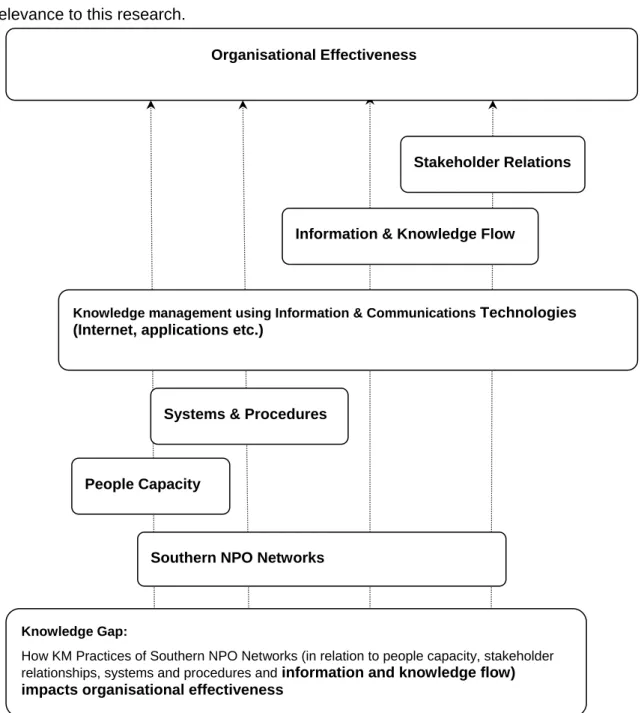
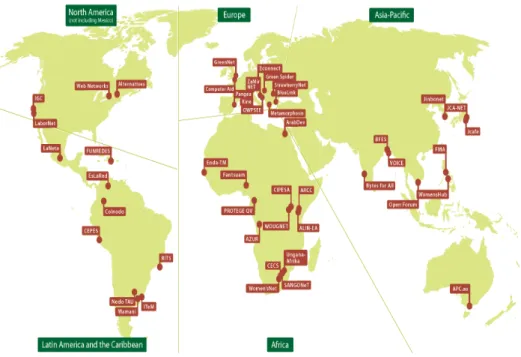
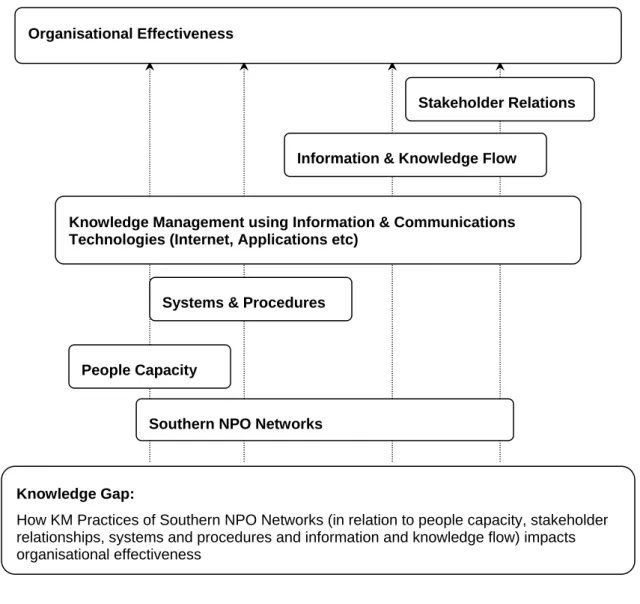
Figure 2.1 Research framework (based on Akinsanmi, 2009)... 44Figure 4.1 APC Members by Region (APC, 2009) ... 67
Figure 4.2 APC website ... 95
Figure 4.3 NING social networking platform ... 97
Figure 4.4 Lessons from APC – input to KM framework for southern NPO effectiveness ... 102
Figure 5.1 NGO Pulse - ‘A development information portal for NGOs in South Africa’ ... 114
Figure 5.2 Lessons from SANGONet – input to KM framework for southern NPO effectiveness ... 136
Figure 6.1 Women’sNet portal ... 143
Figure 6.2 Girls’Net Web Portal ... 150
Figure 6.3 Girls’Net Gist Newsletter ... 152
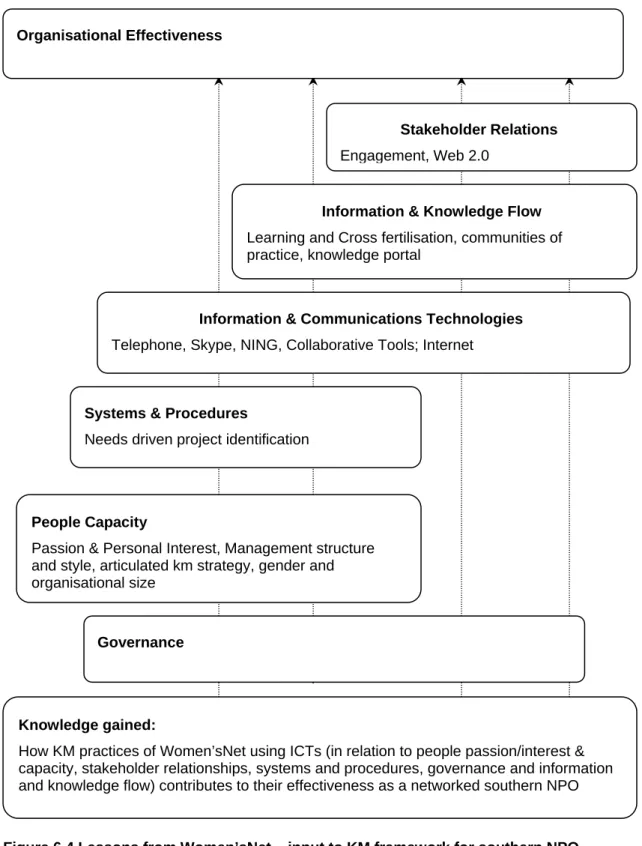
Figure 6.4 Lessons from Women’sNet – input to KM framework for southern NPO effectiveness ... 162
xvi
Figure 7.1 The Research Framework ... 168 Figure 7.2 Lessons from APC – input to KM framework for southern NPO effectiveness
... 172 Figure 7.3 Lessons from SANGONet – input to KM framework for southern NPO
effectiveness ... 174 Figure 7.4 Lessons from Women’sNet – input to KM framework for southern NPO
effectiveness ... 176 Figure 8.1 Integrated framework on KM practices for organisational effectiveness ... 196
LIST OF ANNEXURES
Annexure A Survey Introductory Letter... 222 Annexure B Semi-structured questionnaires ... 224 Annexure C Interview schedule ... 226
1
CHAPTER 1. THE THIRD SECTOR: CIVIL SOCIETY
1.1. Introduction
The world as we now know it is as a result of a series of evolutions from purely one sectoral form (in some terms - feudal systems) to the one with clear delineations and power. Society has evolved beyond clearly defined areas of government, private sector, and what is traditionally known as the civil society sector. Now, there is more than ever before, a blurring of lines; not just in areas of primary responsibilities but also in the way in which those responsibilities are implemented. This research focuses on the third of these sectors – i.e. civil society.
Civil society is seen as the continuously shifting ‘socio-sphere located between the family, the state, and the market and operating beyond the natural confines of national societies, polities and economies’ (Anheier & Themudo, 2002). Robertson (1986) drew a distinction between civil society as an ‘ensemble of socioeconomic relations and the forces of production’, and the state, seen as ‘the super-structural manifestation of class relations inside civil society’. Other theorists such as Gramsci (in Bendell, 2000a) see civil society as lying somewhere between the ‘coercive relations of the state and the economic sphere of production’.
These 20th century theorists all imply that the notion of the civil society exists in the spaces between the clearly definable elements of the world that is government and the private sector. In other words, civil society is identifiable by what it is not. Its definite description is thus contingent on descriptions of other elements of society, which in themselves continuously evolve, and thus civil society continues to change in size and character as well. Civil society also occupies the unenviable role of watchdog and alternatively, when either of the other two sectors of society fail, take up their function, albeit arbitrarily in most cases. Over the last few years’ authors such as Anheier and Themudo (2002) have given credence to a more contemporary definition of civil
2
society. Chandhoke (2002) also describes civil society as ‘located somewhere between the state, the market, and the family’.
Edwards (2000) sees civil society as ‘the arena in which people come together to advance the interests they hold in common, not for profit or political power, but
because they care enough about [an issue] to take collective action’. These definitions identify the private sector more formally as outside of civil society. The sense of civil society being defined by what it is not, however, remains. Edwards (2000) goes on to emphasise that the role of civil society is to ‘occupy the spaces in a healthy democracy and not to substitute it for government’ or the private sector. It is within this flexible socio-sphere that we find non-profit organisations.
The growth and expansion of Civil Society Organisations (CSOs) can be traced to the alienation of specific needs or voices by states and markets. CSOs emerged as a response to these unmet human needs and to act as a collective rising to fill the vacuum created by states withdrawing, or being unable to give or perform the social functions they should undertake (Bendell, 2000b). Chandhoke (2002:43) suggests that the economic imperatives of the neo-liberal agenda:
‘dictated [that]: (a) the state, particularly in Third World countries, should withdraw from the social sector; (b) the market should be freed from all constraints; and (c) people in civil society should organise their own social and economic reproduction instead of depending on the state’.
Teegan, Doh & Vachani (2004) stipulate that civil society organisations came into existence when ‘market mechanisms ignored [human] needs and governmental regimes are deemed repressive, weak, or resource-strapped to serve them’. The growth in the importance and ‘strength’ of CSOs, according to Thielemann (2000), can be directly linked to the retreat of the state from historical areas of activity and the private sectors’ ever-growing reach within the larger society.
3
Kaldor, Anheier & Glasius (2003b) identify four ‘manifestations of global civil society’ in interaction with the state and the private sector. First is what they refer to as ‘new public management’, where civil society serves as sub-contractors to policy makers; then there is the ‘corporatisation’ which is when CSOs partner with the private sector; third is the ‘social capital or self-organisation’ manifestation wherein CSOs build trust through networking, and finally ‘activism’.
The latter is when CSOs monitor and challenge power-holders; be it in the public or private sphere. These manifestations exist within one of four organisation types, as identified by Fottler (1981).
Fottler (1981) identifies four classes of organisations along the continuum between classical, private, profit making firms and strictly governmental agencies. These are private for-profit, private non-profit, private quasi-public, and public. These four types have varied management functions, which are determined by the different sub-sectors of society that they receive their support from. These sub-sectoral dependencies create different values, incentives and constraints for management.
Organisations have emerged over time, that are expressly formed to serve the needs of the polity (Bendell, 2000b) and which fall somewhere within these traditional classifications of organisations identified earlier. One such organisational form that flourishes in, and emerges from, this dynamic called ‘civil society’ is the Non-Profit Organisation (also referred to as Non-Governmental Organisations in some literature).
1.2.
Non-Profit Organisations
A Non-profit Organisation (NPO) is defined as an organisation with the primary objective of supporting a development or a social issue, usually of public concern, for non-commercial purposes. NPOs are, in a sense, a hybrid of business enterprise and government, but at the same time different from both. James (1983) indicates that unlike the for-profit organisations (but like government), ‘NPOs usually have no owners
4
to whom it distributes profits; instead all its resources and seeming profits are ploughed back internally to reach set goals’. On the other hand, unlike government but similar to for-profit organisations, ‘NPOs must raise funds on a voluntary basis but do not enjoy the ‘powers of voluntary taxation’.
NPOs usually have one of two origins: those established by government but not for profit, and those established without governmental influence either by the private sector or by individuals within the society. The latter are popularly referred to as Non-governmental Organisations (NGOs) and appear in article 71 of the United Nations Charter (United Nations, 2003).
NGOs have been described as non-profit-making, independent and campaigning organisations ‘whose stated purpose is the promotion of environmental and/or social goals rather than the achievement or protection of economic power in the market place or political power through the electoral process’ (Bendell, 2000a). Teegan et al.
(2004), quoting the UN, describe an NGO as:
‘…any non-profit, voluntary citizens’ group which is organised on a local, national or international level. Task-orientated and driven by people with a common interest, NGOs perform a variety of services and humanitarian functions, bring citizens’ concerns to Governments, monitor policies and encourage political participation at the community level. They provide analysis and expertise; serve as early warning mechanisms and help monitor and implement international agreements. Some are organised around specific issues, such as human rights, the environment or health’.
This level of diversity in NGOs translates to a complex set of goals and missions based on multiple influences. This results in overlapping and diffused relationships within which they are usually accountable (Jegers & Lapsley, 1998). The NGO ‘label’ though, describes a huge number of organisations that have very little in common beyond the label ‘NGO’. For the purposes of this research, non-profit organisations with no
5
government influence will be used as an all-encompassing term.
1.2.1
NPO
characteristics
Lettieri, Borga & Salvoldelli (2004) identify certain factors as characteristic of NPOs. The first of these is the ‘existence of strategic goals that are not strictly linked to the creation of economic profit for the stockholders’. That is, there exists a service or commodity from which profit is derived, but the ultimate goal is to be able to use this to pursue the core mission of the organisation which is not-for-profit in nature. They indicate that most NPOs also typically have the need to ‘achieve a large consensus on strategy because of their associative nature which is dependent on agreed values and a need for continuous non-financial motivation of human resources’.
6
This points to another characteristic of NPOs with regards to the presence of voluntary resources which Lettieri et al. (2004) say are ‘often characterised by heterogeneous experience and knowledge), high motivation, non-continuous presence and high rates of turnover’. NPOs also tend to focus on, and in, the short term, due to these scarce or limited resources; in particular financial. This focus on short-term resource allocation, according to Lettieri et al. (2004), results in a ‘preference for activities which give immediate results, rather than for long-term investments whose benefits are postponed and uncertain’. NPOs usually also have a strong capacity for establishing ‘cooperative relationships with other stakeholders by building communities around specific social needs and problems. The various members of these communities make resources of different types available in order to achieve the agreed goals’ (Lettieri et al. 2004).
A second characteristic is that NPOs are known to have a strong traditional role for self-organisation and developing social capital and leading activism. Existence in a largely commercial world, though, means NPOs face the need to organise, and to adopt some business practices and technologies to survive in a world where there is fierce competition for funds and skilled manpower, and where effectiveness and accountability to stakeholders is of great importance.
Edwards (2000) argues that the phenomenal growth in NPOs since the Cold War can be traced to three reasons. First, Edwards (2000) sees ‘a move away from a belief that free trade and liberalisation is the only recipe for growth and poverty reduction together with a dawning awareness that NPOs are no longer there just to pick up the pieces that fall through the cracks’. Increasingly they have become ‘alternatives and forces of transformation’. Second is the growing awareness that their involvement is a ‘cost-effective public relations activity and partnership’ for government and/or the private sector. Third, these NPOs are an additional, and in most instances, a ‘trust worthier’, channel for popular participation for those on the margins of society.
7
‘Ironically, the idea that people in civil society should organise their own reproduction has emerged at exactly the same moment as globalisation has drastically eroded the capacity of the same people to order their own affairs … [NPOs have] emerged … to take over functions hitherto reserved for the state.’
Factors such as ‘the increasing numbers of “emerging” nations which are embracing democracy and the hegemony of market based solutions; the communications
revolution; and the increasing levels of social inequality and environmental degradation have all contributed directly to the increase in size and importance of the NPO sector’ (SustainAbility, 2003). NPOs are an increasingly important phenomenon and their rise is both a reflection of profound changes within human experiences identified and a source of that change. They are increasingly central to both the current transformation, as a counter to the transformation, of society visible by globalisation.
This interaction and involvement with international, regional and national governance is helping southern nations, and as a result NPOs in particular, to mobilise and organise themselves like never before. In the developing nations NPOs have the unenviable role of offering an active alternative to ‘total market-driven private sector domination of societies’ that have non-active or absent governments (Glasius & Kaldor, 2002). Though in most cases NPOs can only ‘operate … within the narrow confines set by dominant states and international capital, they can amend international structures but not transform them’ (Glasius & Kaldor, 2002). Thus even though they operate with a lot more freedom, and across a wider spectrum in society, they are still very limited with regards to their actual power to create policy-related change.
It is probably this ‘combination of growing significance (with increasing numbers of previously unheard voices in international/regional discourse) and crucially
circumscribed power that can lead NPOs into the treacherous terrain in which they walk a fine line between getting too close to funding bodies, the State and corporations (and thereby risking their independence, legitimacy and the trust of their grass roots support), whilst struggling to survive and maintain their integrity and effectiveness in
8
the face of increasingly subtle attack from the vested interests that they challenge’ (Gray, Bebbington & Cillison, 2006).
These largely neutral voices of NPOs attempt to balance the development debate but are even more threatened by the treacherous terrain referred to above when they are perceived as, or are actually, not being managed effectively.
1.2.2
NPOs and management
Management broadly refers to the process of leading and directing all or part of an organisation through the deployment and manipulation of resources (human, financial, material, intellectual or intangibles) with the main objective of achieving the highest productivity or service delivery possible. In both philosophy and theory, the ‘manager’ (which could be an individual or a collective) is compelled to consider particular viewpoints, value guidelines and ideas, amongst a whole range of other factors, to perform the task of management effectively. There are three generally accepted theories of management: the traditional or autocratic theory of management; the human relations or laissez faire theory; and the human resources or democratic theory of management.
Fayol (1841-1925) and Taylor (1856–1915) both through their scholarly lifetimes viewed management as primarily concerning the structures and activities of formal or official organisations. They described the various branches of management and their inter-relationships. This theory of management is largely based on power relations in an organisation. Its major characteristics include a lack of trust in the people, close and autocratic supervision and a very top-down management process. It is a repetitive style of management where subordinates are expected, without questioning, to obey orders with no room for unauthorised individual initiative or creativity.
Other early theorists, including Tead (1891–1973) and Mayo (1880–1949) applied the principles of psychology and sociological perspectives (human relations theory) to
9
management. This theory is based on the belief that extraordinary attention should be given to the well-being of employees, including the satisfaction of social needs. Practitioners of this theory of management believe firmly that if workers are treated well, they will be motivated to perform better. Managers practice an open-door business approach. Managers to a certain level consult with lower cadres in the organisation in the spirit of participative management. A shortfall though is that workers are not always included in the decision-making process.
A third management theory deals with humans as resources of the organisation – it’s most prized resources. It emphasises not treating but on using employees well.
Staff members are utilised according to their skills, knowledge and capabilities. They are encouraged to use their thinking abilities and initiative, which in turn builds trust and responsibility (Legge, 2004). This is closely linked with the modern-day social systems theory as developed by Luhmann (1927–1998) identifying amongst others the conceptualisation of ‘organising and managing human resources as social processes’ and the new importance of ‘individuals as essential elements’ in the organisation.
1.3. Contemporary
management
theories
The lines between these linear approaches to management have become blurred in the last two decades with the emergence of a non-rigid or scalar management structure reflected in networked organisations, including NPOs. Senge (1990) in his book, The Fifth Discipline states that ‘…there must be basic innovation in traditional methods of management and governance…growing uncertainty, economic and political turbulence, and the increasing interdependence of global markets and global
enterprises have led to calls for radical change’.
Systems theory has had a significant effect on management science and
understanding organisations. A system in this context is a collection of parts unified to accomplish an overall goal and having inputs, processes, outputs and outcomes and
10
sharing feedback between each of these four aspects. In an organisation inputs would include resources such as raw materials, money, technologies and people. Outputs would be products or services to a market. Outcomes could be enhanced quality of life or productivity for customers/clients, productivity. Feedback would be information from human resources carrying out the process, and customers/clients using the products, etc. Feedback also comes from the larger environment of the organisation, e.g., influences from government, society, economics, and technologies.
The Ubuntu (meaning humanness) management philosophy is one such theory, based on the traditional African concept of one being a person through other human beings. According to Broodryk (2005), it is ‘the application of a more human approach to management for better productivity and service’ in a democratic, happy and informal environment. This management philosophy allows for openness in a responsible way within an organisation.
Another unnamed, but emerging model, of management features new twists contributed by technological revolution, which pushes one to do more, faster. Associated with this is the rate at which information is generated, shared and converted into knowledge by corporate bodies, NPOs and even individuals. This notion is further discussed in the section on knowledge management in the second chapter of this research. A last twist is found in the aftermath of the reengineering movement, which has resulted in doing more with fewer people.
1.3.1
NPO
management
All organisations need a basic management philosophy, which forms the foundation for implementing its vision, mission and strategy. Such a philosophy is about making clear sense of a process and/or existing practices, and a continuing culture of dynamism by being positively critical to rethink such practices – in essence being able to utilise theory and accept that it only precedes practice. Hatten (1982) states that NPO management is often treated as the poor stepchild in management thinking, with
11
emphasis placed on profit making organisations. Rigid adherence to a particular management style may not respond appropriately to the ever-changing environment encountered in the NPO sector (Wasdell, 1980). This has over the years, fed by the notion that indeed the generic theory of management requires continuous empirical testing.
The generic approach to management theory and practice is based on the assumption (largely untested) that the differences that exist between the four organisational
classes referred to by Fottler (1981) are insignificant in terms of their effect on management processes. Organisations in each of the four classes though, do differ from one another in terms of their characteristics and the conditions and constraints under which management processes are carried out. Gasell (2000) suggests that there ‘are difficulties inherent in managing non-profit organisations that differentiate them from the private sector’. A definite example is that management decisions are often made by a diverse group of individuals in NPOs, including board members, professional managers and technical specialists. This diverse group with varied backgrounds, views and priorities all have some managerial responsibility.
Such splintered management roles pose multi-layered problems for the NPO involved in social change, in terms of managerial accountability for decisions, the separation between strategic and operations and service/product implementation decisions, and the general direction of the organisations development. In an ideal scenario, the board of the NPO serves as the final arbitrator of conflict since it bears ultimate responsibility for the organisation’s use of resources in achieving societal change. This is only possible where the boards’ interests are balanced and not skewed in either of two extremes – i.e. having no direct interest or having too detailed an interest by engaging in the day-to-day management of the NPO.
1.3.2
NPOs and social change
12
either eliminates the cause of the problem or alters programmes, policies, funding streams and/or services to reduce the impact of the problem on a long-term basis. Social change occurs when there is an attempt at a structural transformation of political, social and economic systems and institutions to create a more equitable and just society. It systemically delves behind immediate problems, involves new ways of applying resources to underlying causes, and results in tangible and enduring benefits. This includes a shift in the character of the institutions, the behaviour or the relations of a society, the community of people, and/or other social structures (Shackman, Liu & Wang, 2005). In most communities, NPOs are at the forefront of creating these social changes.
Social change-oriented NPOs endeavour to serve or give voice to an
under-represented constituency or community, or they may advocate on a specific issue. This is often a 'thankless' process with NPOs having to work with constantly shifting resources from conceptualisation through to implementation, and in attracting further support from individuals, donor agencies, government and/or businesses.
It is important to note that not all NPOs that have the characteristic of being completely separate from government are active on social issues. Gordenker and Weiss (1995) in their article on pluralising global governance identify three significant deviations from the specifications on NPOs described so far.
These include GONGOs (government organised non-governmental organisations) which achieved notoriety during the Cold War and were fronts for administration activities with funding from government); QUANGOs (quasi non-governmental
organisations) which receive the bulk of their funding from public coffers; and DONGOs (donor organised non-governmental organisations) distinguished by their formation and funding through the perceived needs of donors.
NPOs in their extensive variety bring expertise, commitment and grassroots perceptions that they utilise in achieving their goal of social change via better
13
governance in an improved world. They function in a variety of ways, including the delivery of services from intangible technical advice to more tangible resources for relief, development and other purposes. In the United Nations (UN) system they are referred to as ‘observers’ or as having consultative status. They also play educational and advocacy roles, primarily by influencing citizens and targeting key decision makers via mostly unofficial participation in key decision sectors such as parliament.
Human rights advocates, gender activists, indigenous peoples and representatives of defined interests, over the last two decades, have become more active in political work arenas once reserved for governments and their representatives. This growth is largely attributable to the demands by informed citizens for accountability from the private and government sectors. In a world rife with so many systemic problems, NPOs work diligently to respond to the challenges that they face in bringing about social change in effective ways. The power that they bring to the table is their ability to organise, educate, and mobilise. In no other section of the world is this of more
importance than in the largely less-developed southern hemisphere.
1.4. Southern
NPOs
Southern NPOs are loosely defined in their operations in developing nations by their origination and geographical location in the global south, or in some rare cases, simply by their focus on only societal issues typical to the global south. They are
characterised by their focus on serving very specific societal interests by focusing their advocacy and/or operational efforts on social, political and economic goals such as equity, education, health, environmental protection and human rights, amongst others. The majority of their work is centred on influencing key decision-makers and a
relatively ‘young’ private sector by working to transform policy and existing relationships among all sectors of society.
Generally, these NPOs, like their northern counterparts, can be classified by the benefits they create: those that produce benefits geared toward their members and
14
social purpose NPOs that promote broader social interests. The latter is usually broken down based on their principal activities of advocacy or operational NPOs. Advocacy NPOs work on behalf of others who lack the voice or access needed to promote their own interests; while operational NPOs are said to provide critical goods and services to clients with unmet needs. Although some NPOs engage exclusively in either advocacy or operational efforts, ‘…many are hybrids, which use both advocacy and operational means to achieve social benefit’ (Parker, 2003). It is with this hybrid nature that most southern NPOs operate.
Southern NPOs advocate by ‘lobbying, serving as representatives and advisory experts, conducting research, holding policy influencing conferences, monitoring and exposing the actions (and inactions) of government and the private sector,
disseminating information to key constituencies, setting and or defining agendas, developing and promoting codes of conduct, and or organising boycotts’ (Hudson, 2002). Their advocacy strategies can be ‘distinguished as “insider” strategies aimed at influencing decision-makers directly and “outsider” strategies intended to mobilise public opinion’ (Peterson, 1992).
As insiders, they work within the ‘frameworks of powerful institutions as entities granted official status or as “partners” with key decision-makers’ (Brinkerhoff, 2002). As
outsiders, they ‘challenge these institutions' existence or limit their impact by, for example, appealing to the court of public opinion’ (Florini, 2003).
According to Barrow and Jennings (2001), although the advocacy efforts of NPOs are much more widely visible, some of the most ‘essential value created by them stems from their operational activities’. Southern NPOs are well known for stepping in to serve as ‘critical safety nets [by] filling voids generated where markets fail, where politically challenged, indebted, or corrupt states are unable or unwilling to provide for unmet needs and where global problems defy neat nation-state responsibilities’ (Brinkerhoff & Brinkerhoff, 2002).
15
Southern NPOs thus usually become adept at providing certain goods and services due to the technical expertise gained from working in difficult settings and/or with underserved populations. Given this expertise and the subsequent trusted position, they are often ‘best suited to provide high-quality services at low cost to these
communities’ (Leonard, 2002). This proximity to local clients affords these NPOs the opportunity ‘to expand the range and mix of offerings to a diverse public beyond standard service packages’ proffered by the private and governmental sectors (Brinkerhoff, Smith & Teegan, 2003).
Southern NPOs contribute to building or rebuilding social capacity which typically involves the ‘shaping of policy; providing training, resource access, and know-how on service delivery; sharing best practices; and creating and supporting institutional development that promotes social welfare’ (Brown & Kalegaonkar, 2002). These southern NPOs’ capability to continue to relevantly contribute to these development activities and improve on their influencer capabilities is very much affected by, and dependent on, their effectiveness as an organisation.
A final key characteristic of southern NPOs is that they operate in a society that has become largely driven by access to information and knowledge – in an age termed ‘the information society’ in the 21st century. These southern NPOs, like their other
counterparts in society (government and the private sector), find themselves
increasingly responding to the driving need for up-to-date and relevant information by the constituencies they serve.
These constituencies, unlike before, due to ever improving technologies have an increased and direct access to information and knowledge on an ever widening range of issues – social, political or otherwise. This in itself creates a greater demand on their ability to share and effectively utilise information as they deliver on their social change objectives.
16
1.5.
NPOs and organisational effectiveness
Understanding and assessing any NPOs’ effectiveness is predicated upon a range of issues. Arguments exist that what determines an NPO’s effectiveness is the extent to which it is achieving its organisational mission. Others say that an NPO’s effectiveness should be determined by its rapid growth by tracking increase in revenue and funding versus those who are running a deficit and have had to cut back. Contention exists, though, when the question is asked, ‘if an organisation’s revenue is increasing and it’s growing rapidly but not achieving its missions and goals, is it still deemed effective?’ On the other hand, it is often also technically difficult to assess the extent to which an NPO’s mission is being accomplished in relation to the extent of the issue being addressed and its prevalence in the society.
In a majority of cases, the effectiveness of southern NPOs is influenced by funding and/or manpower, though, as indicated above, these are not the only influencing factors. Southern NPOs regularly engage in what is termed ‘cross subsidisation’ (Patel, 1998) to address a range of issues from designing information systems and flows, enhancing people’s capacity to deliver on the goals of the organisation,
improving systems and procedures for operational activity, and increasing capacity to raise funds; all of which relate to organisational effectiveness. This trend of cross subsidisation also occurs between NPOs (North-North, South-South, South-North); between NPOs and the private sector and/or government in relation to the technology, people capacity and information and knowledge flow. These have, over the past decade and a half, seen the value in doing projects jointly by pooling their skills and expertise to implement their organisational mandate.
Another factor that influences the effectiveness of southern NPOs is the capacity of its people (usually a combination of core staff and a pool of volunteers and part-time paid labour). The leadership of such NPOs must continuously deal with the high turnover of its skilled labour as well as unreliability in performance and the enthusiasm of its volunteer force. There is also the growing trend of sharing administrative personnel,
17
and in some cases, an outsourcing of functions, such as accounting, to sharing office costs to reduce overheads.
Dabbs (1991) suggests that, ‘generally, wealth-creating businesses monitor and control their activities by the three Es - efficiency, effectiveness and economy - with efficiency being the main element’.
He defines efficiency as ‘the relationship of inputs to outputs, which usually generates profits’ while in the non-profit sector, effectiveness, perceived as the extent to which objectives are achieved, is of more importance. Though success or failure in the not-for-profit organisation is not so clearly measured as it is in private enterprises’ financial results, NPOs have the same responsibility to effectively serve the consumers of its products and services. Thus a defined management approach and Knowledge management practices are necessary to achieve effectiveness, and are the direct concern this research.
1.5.1
Three networked southern NPOs
These NPO networks have been chosen as they reflect the characteristics of not just a networked southern NPO but are also widely known as sector leaders in their area of service and within their respective locales. Each case study has either a global, sub-regional or a national reach within which their target communities exist. They each have similarities in the way they are formed, organised and managed.
These NPO networks were formed to strengthen the individual member organisation’s voice and capacity to fulfil its mission of either advocacy and/or service delivery. They are all located in the global south, specifically operating out of the African region, with each having a different mandate but with the common denominator of being a network-type NPO. That is, being one of a number of NPOs with similar mandates coming together to work as a collective to achieve a broader and deeper mandate. All three NPOs also rely heavily on the use of Internet-based technologies, amongst others, for
18
the day-to-day management of the organisation and the implementation of their mandate.
19
1.5.1.1 The Association for Progressive Communications
The Association for Progressive Communications (APC), is a not for profit international network of civil society organisations operating since the ‘90s. It is dedicated to
empowering and supporting groups and individuals working for peace, human rights, development and protection of the environment, through the strategic use of
information and communication technologies (ICTs), including the Internet (APC website, 2006). Its programmes are carried out within three broad areas of policy, strategic uses, and women’s networking support programmes. Within each of these broad areas the APC is involved with a much knowledge production via policy briefs, issue papers, research and training manuals.
A council, consisting of appointed representatives drawn from network member organisations, governs the APC and sets its strategic priority areas every four years. This council in turn elects an eight person Executive Board (EB) that works directly with staff members to produce action plans and monitor its implementation. The core team of staff, the EB and programme/project-based working groups, all living and working in different countries, then develop, run, implement and manage the programmes and projects of the APC from day to day.
It implements its activities via a multi-part team made up of EB members, staff and project members (each of these interchanging roles and some voluntary) reducing the lines and structures of traditional management and making leadership accessible to all recipients and members of the community.
1.5.1.2 SANGONet
SANGONet, founded in 1987, has as it mission ‘facilitating access, sharing information, building capacity, raising awareness, enhancing reach and impact, and linking people and organisations through the use of ICTs in Southern Africa’. Over the past 20 years, it has developed into a dynamic civil society organisation with a history closely linked to
20
the social and political changes experienced by South Africa during its transition to democracy.
SANGONet’s ICT services and interventions continue to be shaped by the goal of strengthening the capacity of NGOs in finding long-term and sustainable solutions in response to Southern Africa’s development problems. As a non-profit organisation, SANGONet has no shareholders and its Board of Directors is the highest governing structure. Board meetings are held three times per year. Board members represent expertise in a wide range of areas of key importance to the strategic focus and direction of SANGONet, including finance, business, leadership, governance and IT.
SANGONet staff publishes content, organise the annual SANGONet conference, validate entries in its directories, and provide technical support to southern African NGOs while engaging in various other organisational activities.
1.5.1.3 Women’sNet
Women’sNet is a feminist organisation that works to advance gender equality and justice in South Africa using Information and Communication Technologies (ICTs). They offer training and facilitate content dissemination and creation that supports women, girls, and related gender organisations and networks to take control of their own content and ICT use. The website (www.womensnet.org.sa) is a hub for information by women, about women and gender, and has a focus on South African and African content. They help women to find the people, issues, resources and tools they need for social activism.
21
CHAPTER 2. TRACING THE LINKS: NETWORKED
SOUTHERN NPOs’ KM PRACTICES AND
ORGANISATIONAL EFFECTIVENESS
2.1. Introduction
To establish a solid foundational framework for this study, an in-depth exploration is given in this chapter on the theories that exist on organisational effectiveness, knowledge management and the NPO sector. The field of knowledge management (KM) and its links to the effectiveness of an NPO operating with and using 21st century technologies is also discussed.
2.2. Theoretical
perspectives
on organisational effectiveness
Drucker (1974; 1992) says that ‘efficiency is concerned with doing things right; while effectiveness is doing the right things.’ He argues that ‘effectiveness reveals itself as crucial to man’s development, to organisation development and to the fulfilment and viability of modern society.’ To attain the goal of continuing development either as an individual, an organisation or a society, effectiveness (doing the ‘right things’) in action, delivery and management is important.
The first theoretical perspective on organisational effectiveness relevant to this research on networked southern NPOs is the multiple constituency model, which recognises that ‘an organisation comprises multiple stakeholders or constituents who are likely to use different criteria to evaluate its effectiveness’ (Sammuto, 1984). This model postulates that differing groups of stakeholders from clients to staff, to
volunteers and funders, all have different perspectives and interpretational approaches to achieving the organisational goal. It is key to recognise the differences in their interests/approaches and perspectives. Given the overall nature of NPOs, this multiple
22
constituency model is an important part of the approach taken to understand the effectiveness networked southern NPOs.
The social constructivist theory treats organisational effectiveness as ‘stakeholder judgments formed in an ongoing process of sense making and implicit negotiation’. Although multiple constituency models share with social constructionism an emphasis on effectiveness as judgments by stakeholders, multiple constituency models treat stakeholder goals (effectiveness criteria) as rationally predictable and somewhat stable, and as being influenced by processes (Meyer & Rowan, 1977).
Herman and Renz(1998) describe NPO effectiveness assessment using the parable of the blind man and the elephant. As one man touches the elephant’s tail and declares that the elephant is like a rope; another touches the back and concludes that the animal is something big and bristly. This analogy implies that ‘effectiveness is a real thing that may be perceived in partial and thus different ways’. The social constructivist view on organisational effectiveness, however, says there is no elephant at all. Rather, different people look for different things and what they ‘see’ is determined by a social process.
A third theory on organisational effectiveness, i.e. institutional theory, predicts that when there is high uncertainty about the technology for achieving specific outcomes or when outcomes are difficult to measure, organisations are likely to emphasise
approved procedures to achieve or maintain their legitimacy (DiMaggio & Powell, 1983).
Helms (2001) identified four key models of organisational effectiveness. The first model measures organisational effectiveness in terms of production, commitment, leadership, and interpersonal conflict. Production was established as the flow of output from the organisation; commitment as a component to measure the degree of
attachment to the organisation; leadership as the degree of influence and personal ability, and interpersonal conflict relates to the degree of perceived misunderstanding
23
between supervisors and subordinates.
The second organisational effectiveness model was developed based on inter-related organisational processes. This model utilises organisational survival and maximising returns as key variables of effectiveness, along with self-regulation. A third model is the competing value framework (CVF).
The CVF was developed initially from research conducted on the statistical analyses of effectiveness indicators within organisations (Quinn & Rohrbaugh, 1983). The fourth model outlines indicators of organisational effectiveness, including management experience, organisational structure, political impact, and knowledge management. This study focuses on the knowledge management indicator.
Finally, Butler (1991) argues that organisations are constrained by their environments and set the criteria for effectiveness via ‘performance norms’ under-pinned by essential values. In any given organisation there will be multiple notions of effectiveness, which are mostly hidden within the relationships that exist in the internal workings of such an organisations (Pedler & Aspinall, 1996). Even though there may be competing or contradictory norms, management has the crucial task of translating these norms into an ‘internal ideology’ which provides the foundations for decision-making, process setting, and knowledge management, thus influencing such an organisation’s effectiveness.
2.3. NPOs’
approach
to
organisational effectiveness
The NPO sector consistently changes in dramatic, complex, and dynamic ways, demanding that they continually reconsider what it is that they do and how they do it – thus influencing how KM takes place, and this in turn continues to influence their effectiveness as an organisation. According to Seashore (1983), three distinctive approaches can be identified to develop measures of organisational effectiveness; namely the ‘natural systems approach’, the ‘goal approach’, and the ‘decision process
24
approach’.
The natural systems approach is ‘concerned with system boundaries, differentiation and integration of the subsystems that are ‘parts’ of the focal system,
input-transformation-output processes, boundary transactions and system maintenance processes’ (Seashore, 1983). Therefore, the effectiveness of an organisation is determined by its ability to acquire the necessary resources from its environment in order to sustain its functioning. This organisational effectiveness model can easily be applied to non-profit organisations because they substantially depend on outside sources of funding, voluntarism, and the like.
Accordingly, these organisations are effective to the extent they have competed successfully for the resources needed to deliver services to their designated ‘clients’. However, an organisation may be able to obtain resources needed to maintain its existence without necessarily meeting its mission or objectives; thus this model may not adequately enhance the purposes for which an organisation was established.
The goal approach, however, addresses an organisation’s purpose, and effectiveness is measured by the degree of goal attainment (Denison, 1990). Although the definition is clear-cut, it is rather problematic in practice to assess effectiveness with respect to organisational objectives because organisational goals are often complex,
incommensurable, or even conflicting (Hall, 1991). Even if one finds the goals of non-profit organisations explicitly defined, the objectives of specific programmes and services may not be explicitly determined or even aligned with the mission. However, according to the goal model, organisational effectiveness is measured by the extent to which a non-profit organisation meets the needs of the population it serves, and the quality and sustainability of the services needed to the clients.
The third approach to organisational effectiveness, called the ‘decision process approach’, focuses on the processes used by non-profit organisations to achieve their purpose, thus emphasising internal governance processes (Denison, 1990). According
25
to Seashore (1983), an effective organisation is thus ‘one that optimises the processes for getting, storing, retrieving, allocating, manipulating, interpreting, and discarding information’. Thus, if processes are performed well, then they result in overall organisational effectiveness. The departure point for this research is to know which processes and practices characterise an effective non-profit organisation.
Green and Griesinger’s (1996) extensive research on measurements of organisational effectiveness identifies six key areas influencing NPOs’ organisational effectiveness. These include fundraising, mission and policy (programmes and services), financial management, governance, human resources management, and public or constituency communication. This research is focused on an adaptation of the last four areas from a knowledge management perspective (specifically people capacity, systems and procedures, information and knowledge flows, and relationships with stakeholders).
2.4.
Information and communications technologies for
development
Development as a term refers to a variety of ideas and beliefs premised on the fact that some parts of the world are developed while others are not, and thus the latter need to achieve ‘development’. The post World War II era has witnessed a range of
development theories from those rooted in capitalist ideology to Marxist ideology; some approaches promoting state-led development and others market-led development (Mathews, 2004).
Proponents of development as an economic include Rosenstein-Rodan (1902-1985) and the neo-classical development theorists, Bhagwati and Krueger (1995). They view economic development ‘as a growth process that requires the systematic reallocation of factors of production from a low-productivity, traditional technology, decreasing returns, mostly primary sector to a high-productivity, modern, increasing returns, mostly industrial sector’ (Adelman & Morris, 1988). They speak of development as that
26
possessed and not balanced out by their social dimensions.
Development in its simplest form is a process. ‘It is the upward directional movement of society from lesser to greater levels of energy, efficiency, quality, productivity, complexity, comprehension, creativity, enjoyment and accomplishment which all go to achieve development’ (Asokan, 1997). This upward directional movement of society is at the core of the mission of a majority of NPOs – in particular those based in the global south in what are termed the ‘developing’ nations of the world.
Aspects of society (the public, private and civil parts), in their pursuit of social and economic development, have sought to identify mediums or platforms with which they can reach their particular goals. To foster the continuing upward growth of
development, factors such as technological innovation, global affirmation of the individual, the rights of the common man, the accumulation and codification of
knowledge in all fields, and the accelerating pace of creativity and innovation have all come together.
Historically, technology, in whichever form (as it relates to industry or even the discovery of fire), has changed human societies by its use and diffusion and has evolved due to social conditions and vice versa. In the 21st century, new technologies increasingly render information barriers either ineffective or economically unsound. Modern communications technologies have made it possible to ignore borders and to create communities based on common values and objectives (on a grassroots or trans-national level) that were once practically the exclusive purview of trans-nationalism. In the last 15-20 years the Internet (a global collection of interlinked computers, working together interchanging data by packet switching using the standardised Internet Protocol (IP) Suite) by blurring traditional boundaries, has emerged as an enabler for development goals.
This multi-billion dollar network is a direct outcome of strategically motivated military research begun in the 1960s with U.S. federal sponsorship. A fertile mixture of
‘high-27
risk ideas, stable research funding, visionary leadership, extraordinary grass-roots cooperation, and vigorous entrepreneurship’ (Cerf, n.d.) has led to a Global Information Society linking people, ideas, and information beyond all physical boundaries, and creating an environment filled with constantly innovate technologies which, where well utilised, continue to revolutionise the way society at large interacts and develops. Bach and Stark (2004) capture the essence of a component of the Internet, the World Wide Web, with their emphasis on its capacity to ‘link, search [and] interact’.
The emergence of the Internet as a platform for varied applications and components as a worldwide system of communication, information exchange, education and
commerce has opened up vast opportunities for even more rapid development. It is eliminating barriers to communication imposed by space and time, it is levelling the playing field between rich and poor, and it is making possible universal access to information and services at very low cost.
The importance of the Internet - the most relevant technology of the 21st century - in helping development processes cannot be over stated. This first became apparent in 1985 when the Maitland Commission presented the Missing Link report, highlighting the significant role of telecommunications in the socio-economic development of every cadre of the world.
Bach and Stark (2004), in identifying the political implications of this multiplicative, interactive technology, suggest that the Internet creates a space for something to happen as well as a space within which something happens, including social bonds and new forms of organisation management. They clearly state that it is ideal for lowering costs, increasing participation, and impacting on and streamlining operations in a wider context – it is ideal for achieving the goal of organisational effectiveness.
In this information age, attaining organisational effectiveness is closely related with an organisations’ ability to use information timely, accurately and relevantly in any
28
technologies like the Internet, VOIP, Enterprise Resource Planning (ERP) systems and Intranets, amongst a whole range of other applications and software, to solve
organisational problems of information access and integration and manage organisational knowledge, thereby directly improving organisational effectiveness (Skratulja, 2003).
2.5. Knowledge
management and organisational
effectiveness
An important foundation for effectiveness within any organisation is the will to manage what constitutes relevant knowledge. The organisation has to first determine what constitutes relevant knowledge. This is, however, contingent on the industry, the organisation, the people, the time, and the competitive environment. Knowledge management for any organisational type should cut across internal and external borders such as those between departments, organisations or countries.
It is important to note that for this research, knowledge management is rightly perceived as a process, rather than an organisational system or a piece(s) of technology used to manage the storage of data and information. A definition of information and knowledge is given in the next section to aid in the understanding of the concept of knowledge management.
2.5.1
Understanding the concept of knowledge
To understand the nature of knowledge in any organisation, it is important to first differentiate between information and knowledge. There is extensive literature on defining what knowledge is, with a focus on two themes: the distinction between information and knowledge; and the nature of human knowledge. Numerous definitions of information exist with the central theme that there is some form of
29
data with context), processed and then resulting in knowledge. With some authors this progression continues to include some or all of the following; experience, intelligence, understanding and wisdom.
A working definition of knowledge is its ‘capacity to act effectively, with the view that this as an attribute of people, with currently only few exceptions in narrow domains’ (Dawson, 2000a). In contrast, information is defined as ‘anything, which is or can be digitised’ (Shapiro & Varian 1998). These two concepts are linked through the processes of internalisation of information and its transformation into personal
knowledge, and then the externalisation of personal knowledge into information in the public domain (Nonaka & Takeuchi, 1995).
Haeckel's hierarchy (Haeckel & Nolan, 1993) is an information hierarchy which progresses from data to information, becomes intelligence (that of making inferences from information), is processed, and then becomes knowledge which overtime is then translated as wisdom. Knowledge, Haeckel (1993) says, is ‘subjective intelligence with certitude’. In contrast, Ackoff (1986) approaches the debate from a
‘question-answering’ standpoint. He concurs with the views that data are facts and observations, and that information is data in context, being the answers to description questions ('What?' 'Where?' and 'How many'). Knowledge, for Ackoff (1986), is then ‘information with meaning, but meaning with an application orientation; while understanding is also knowledge but with insight’. Knowledge can therefore be said to reside in people, although they may not necessarily be able to explain it, or even be conscious of it, partly as people can know far more than they can communicate to others (Polanyi, 1967).
This distinction between information and knowledge helps to clarify the difference between information management and knowledge management. Information management is confined to the management of digitised or manually stored information, and thus is a subset of knowledge management, which deals with the larger concept of how people in organisations are enabled in performing