IJSRSET162444 | Received : 12 July 2016 | Accepted : 18 July 2016 | July-August 2016 [(2)4: 210-221]
© 2016 IJSRSET | Volume 2 | Issue 4 | Print ISSN : 2395-1990 | Online ISSN : 2394-4099 Themed Section: Engineering and Technology
210
Using Simulation for Energy Saving Design Education in Building
Construction Programs
Sahra Shakouri
Faculty of Architecture and Arts, University of Guilan, Rasht, Guilan, Iran
ABSTRACT
Due to global warming, energy resource constraints and the rapid increase in energy consumption in the construction sector, building design with low energy consumption is an undeniable requirement. The first step in this path is the quality assessment of building performance and the calculating energy consumption in the early stages of design, which are offered as general concepts in the design courses of the fields of building. Because the amount of interfering factors in improving the performance quality and the building efficiency abound, it is very difficult to consider all of them at the same time; hence, the use of computer simulation technology in building design is one of the most effective teaching methods of the quantity assessments of building performance in the fields related to building. Simulation is a process which allows to designers to virtually assess various projects prior to constructing and manufacturing in the real world and analyze and improve it from different aspects. As a result, using the simulation analysis, designers are able to achieve to the major changes in energy consumption by small and reasonable costs in building design and resolve the issues without duplication in the future. In this paper, regarding the impact of simulation in reducing building energy consumption, the use of simulation in building design training is examined. Using a quantitative research method, the capabilities of simulators have been studied in different phases of the design process, and the impact of simulation on the process of design, building performance, energy efficiency, and students’ knowledge in these sectors are investigated. The results of this study show a significant difference between students’ perception of design processes before and after the use of the simulation.
Keywords: Simulation, Construction, Energy, Design Patterns
I.
INTRODUCTION
Energy
Considering the reduction of energy resources around the world, energy conservation is now crucial. Building industry is accounted for a significant amount of the world energy consumption. The rapid increase in energy consumption in the construction sector in recent decades is due to the change in living patterns. Now the construction sector is accounted for more than 30 percent of the completely worldwide energy consumption (Chou & Bui, 2014); therefore, issues of energy saving and optimum design in the field of construction is very important, and thus the construction of buildings that are properly designed and implemented.
The third factor in greenhouse gas emissions to the environment is the construction industry, so that more than 10 percent of the gas emitted in the atmosphere is from buildings (Liu, Meng, & Tam, 2015). In order to reduce greenhouse gas emissions, particularly Carbon emissions, the building is one of the priorities of the construction industry, thus good design decisions in the early stage, the design plays an important role in achieving to sustainable buildings (Liu, Meng, & Tam, 2015). On the other hand, budget constraints and increasing customer expectations put more pressure than before on designers, and as a result, good design decision plays an important role in realizing sustainable buildings in the early stage.
International Journal of Scientific Research in Science, Engineering and Technology (ijsrset.com)
has been known as one of the factors influencing the environment through high energy consumption. Hence today, to supply the functional and structural needs of the buildings is only a part of the design objectives. Now, the things such as energy supply, performance and attitude suitable for providing a good thermal behavior of buildings are of the things that paying attention to them during the design is essential (Bleil de Souza & Knight, 2007). At the present time, not only the practical ideas on energy savings are considered in the design processes in many areas of the world, but also the amount of the efficiency of these ideas is carefully measured after construction and during the efficiency of the building.
Simulation Impact In Reducing Energy Consumption
In this condition, the focus of ideas is drawn toward the ways which can improve the sustainability of a building as well as control energy consumption and reduce LCC. Among this, one of the most effective methods is the use of computer simulation technology to simulate energy consumption in building designs which in recent years has been employed in the design processes of sustainable buildings (Liu, Meng, & Tam, 2015). Using simulation to test initial ideas can have a positive effect on preventing the occurrence of errors in the early stages of construction. This will also help to designers to perceive the most important issues which affect the buildings and think of appropriate solutions to deal with them.
The modeling of building information specifies Geometry, spatial relationships, geographic information, quantities and properties of building elements, cost estimates, inventories and project planning. Simulation can be used to show the entire lifecycle of a building. Simulation can also be taken into account as a virtual process which allows the members of a design team (owners, architects, engineers, and contractors) to work together more accurately and efficiently than using the traditional processes by modeling all aspects of building in a virtual form (Azhar, 2011).
Simulation programs of buildings enable designers to analyze the building performance and estimate energy consumption by the implementation of information on their own model. And in addition to providing the ability to compare performance of different samples,
they reduce the risk of system failure and evaluate the desirability of the solutions.
Simulation programs of building performance have been developed during the past 25 years to virtual construction, analysis, and evaluation (Hensen, 2002). According to various discussions related to building, there are different simulation programs which provide various items in the form of modeling to designers and engineers such as temperature calculations, radiation and humidity, the degree of energy consumption, planning and project control, cost estimates, calculations of ventilation and lighting, etc.
Simulation In Training
Simulation is applied as one of the most effective ways to provide experience to students and to maximize their learning (Goedert & Rokooei, 2016; Goedert, Rokooeisadabad, & Pawloski, 2013). This is an effective teaching method which can be used to help increase the number of students and decrease resource constraints. Using the simulation in training, considerably improves knowledge, performance, satisfaction, and self-confidence in learning, because frequent and exact observation is the only effective way to provide a high quality experiential learning (Scherer, Foltz-Ramos, Fabry, & Chao, 2016).
The use of simulation-based learning in nursing and medical training has been increased in recent years. This kind of training is based on experiential learning (Hung, Liu, Lin, & Lee, 2016). The role of rich interactive simulation in improving educational experience in the fields such as health care has been proven (Goedert, Pawloski, Rokooeisadabad, & Subramaniam, 2013). So that both safety and skills have been improved when using the simulation in anesthesia training, cardiovascular and laparoscopic techniques (Goedert, Rokooei, & Pawloski, 2012; Rokooei, Goedert, & Weerakoon, 2014).
International Journal of Scientific Research in Science, Engineering and Technology (ijsrset.com)
through experiential learning (Rahul Tiwari, Nafees, & Krishnan, 2014).
Using simulations in teaching architecture provides the ground to apply simulation in architecture design in career. There is an abundant difference in using simulator software during architectural education and career (CK Seely, 2004), because the objectives of using software and the way of applying simulation in career is different from educational course. Students are usually eager to use the latest software available and experience new technologies. During this period, architects have more opportunities to experience software without worrying and experience using different additional methods when doing a design project. Economic constraints of professional employment limit the time of experiencing various ideas. The cost of learning a new ability in career is very high (CK Seely, 2004), For this reason, the use of simulators during educational courses can have very beneficial effects on its proper application in building companies.
Since simulations enable students to gain real experiences without actual costs or danger, they have become an effective tool for construction training. Reduction of the different risks of construction training as well as costs have made simulation a highly efficient and effective tool for construction training (Rokooei & Goedert, 2015).
Simulation in Construction
Occurring the environmental crisis, many architects and engineers have found that in addition to building designs with attractive appearance, they should also provide many other aspects in their design. Today, buildings not only should be beautiful, but also they should produce healthy spaces which provide comfort and convenience for the residents. The buildings should be flexible enough to easily adapt to changes in performance and technology, thus the total cost of their lifecycle will be suitable and reasonable (Tang & Kim, 2004).
Employer, architects (and urban planners), structural engineers and analysis engineers are the most involved groups in design of a project and decisions of all these groups will influence the degree of final performance of buildings behavior on the environment. But two groups including architects and structural engineers
undoubtedly will have the most influence in the amount of energy consumption of buildings.
Architects are influencing it because they put the foundation for building design, and they establish almost all of the decisions that determine the final behavior of buildings in relation to the environment. Building orientation, determination of its being full or empty, choice of materials, the design of building facades, etc. are all issues which are determined by architects. Also structural engineers ultimately ensure that the building will have favorable conditions in terms of interior space quality by making building design systems. Architects take over the work in the early stages, and given that the number of cases which have been finalized at this stage is very low, each of the discussions will have a great impact on the final quality of building at this stage (Andreas, 2003), and the ability of a building to be in harmony with environment will be determined in the first weeks. Hence the use of simulation to test initial ideas can have a positive effect on preventing the occurrence of errors in the early stages of construction.
Architecture, engineering, construction and industry are always looking for techniques to reduce project costs and project delivery time, and increase productivity and quality. Modeling of building information with construction project simulation in a virtual environment increases the potential to achieve these goals (Azhar, 2011; Rokooei, 2015).
According to the same investigations, many buildings do not perform as their designers intended them to do. The reasons for this problem are faulty construction and equipment, incorrect control systems of configuration and inappropriate operational procedures (Haves, Salsbury, Claridge, & Liu, 2001); the first step in the detection and prevention of these problems is evaluating building performance. Quantitative assessment of building performance requires a reference which can be in comparison with the actual performance of the building.
International Journal of Scientific Research in Science, Engineering and Technology (ijsrset.com)
performance assessment in pre-construction phase or even during the construction phase practically contribute to decision-makers, designers, and engineers to determine the best orientation of the building, the most useful design, and choose features and properties with minimum harmful effect on the environment (Valinejad Shoubi, Valinejad Shoubi, Bagchi, & Shakiba Barough, 2015).
Many cases which determine the marginal efficiency of buildings should be considered in the early design stages. That is why various simulators have now been developed to help engineers in design stages. If the designers use them, they will be able to get aware of the degree of building performance during the design, and improve their ideas through this at every stage of design. Building simulation is expanded more about a concept of predicting the performance. The philosophy of simulation making is based on creating a virtual building where the user can predict the outcome of building performance which is very close to reality (Andreas, 2003).
II.
METHODS AND MATERIAL
As mentioned above, simulation programs of building performance have been developed to a virtual construction, analysis, and evaluation during the past 25 years (Valinejad Shoubi, Valinejad Shoubi, Bagchi, & Shakiba Barough, 2015). Using the results from the survey conducted by 30 architects, we evaluate the effectiveness of simulation in designers’ performance, in this paper. A questionnaire, based on the results of the studies, is one of the most effective tools for survey in researches. Questionnaires often contain standard answers, which make the possibility of dada collecting easier. Thus, in this study, the survey was conducted and the information was gathered by designing questionnaire and submitting it in written form to a number of architecture students. The questionnaire includes simulator capabilities in different parts of the design as well as its impact on design process, performance, and the knowledge of individuals in these parts. After specifying trained simulators and the way of their own learning in the designed questionnaires, students determine simulations, which they practically use in the meantime. Using the results of this question, one can compare the popularity of simulators together. Among these simulators are EnergyPlus, Ecotect, Designbuilder, and ESP-r.
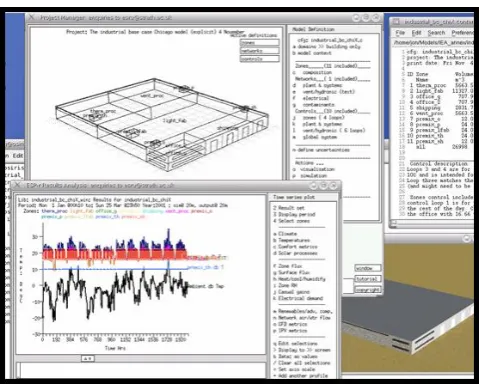
1. ESP-r is one of the most complete simulator package available which has been designed based on interconnected simulation algorithm, and its user interface is non-graphic. Heat simulation, solar analysis, and airflow simulation are of the properties of this software.
Some of ESP-r capabilities in construction modeling
Calculating the capacity of heat transfer by conduction, convention and radiation (long and short waves),
thermo-physical properties and time-dependent heat transfer surfaces
calculating ventilation, air flow, humidity, and lighting (ESRU, n.d.).
Figure 2: ESP-r Environment
2. Design builder is a simulator, which has the capability of construction modeling in various aspects such as physic of buildings (building materials), building architecture, heating and cooling systems, lighting system of various energy consumption of buildings, etc. in a dynamic form. One of the special capabilities of this simulator is the ability to extract the modeling results as diagrams or Excel files, which can be used for further analysis.
Some applications of design builder:
Calculating the energy consumption of buildings Evaluating building facade with regard to heat and
visual appearance
thermal and natural simulating of building ventilation
International Journal of Scientific Research in Science, Engineering and Technology (ijsrset.com) modeling and calculating of control systems of
lighting and daylight
visualizing site combination and solar shading Calculating the size of heating and cooling
equipment (Carli, n.d.).
Figure 3: DesignBuiler Environment
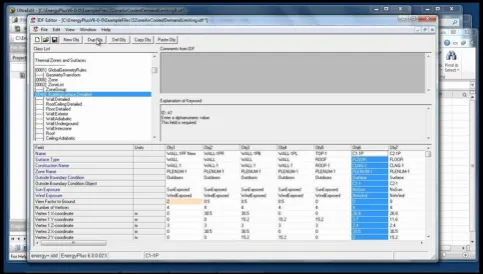
3. EnergyPlus can calculate heating and cooling loads based on building specifications such as its physical structure, residents, mechanical and electrical systems, as well as hourly annual climatic data of building site in order to maintain temperature or a range of particular thermal comfort in the building, or predict temperature and the levels of building space based on building properties and its mechanical systems and climatic conditions of the location of the building at any time of the year.
This simulator lacks the graphical user interface and its input and output are textual. The user should define and enter necessary information categories, depending on the characteristics of the building and its systems, so that the software will be able to simulate the thermal performance of building based on the input data and provide the user’s desired output. Taking advantage of EnergyPlus is somewhat difficult due to lack of graphical environment. But, as a powerful Moto simulator, this software can be associated with many of the programs with the graphical interface (EnergyPlus, n.d.). This means that the user can apply some programs with graphical interface as a mediation between himself and EnergyPlus to provide some of the textual input required by EnergyPlus.
Key capabilities of EnergyPlus software:
Integrated simulators
climate files, input and output based on textual format
transient heat conduction
model for combined heat and mass transfer and models for thermal comfort
advanced calculation of window including window curtain control, electro chromic glass, calculation of solar energy absorbed by the windows
calculation of lighting and radiation and visual comfort
related calculation of atmospheric pollutants the standard summary and detailed output report
with the ability to choose the time of the annual timeframe under an hour (EnergyPlus, n.d.).
Figure 4: EnergyPlus Environment
International Journal of Scientific Research in Science, Engineering and Technology (ijsrset.com)
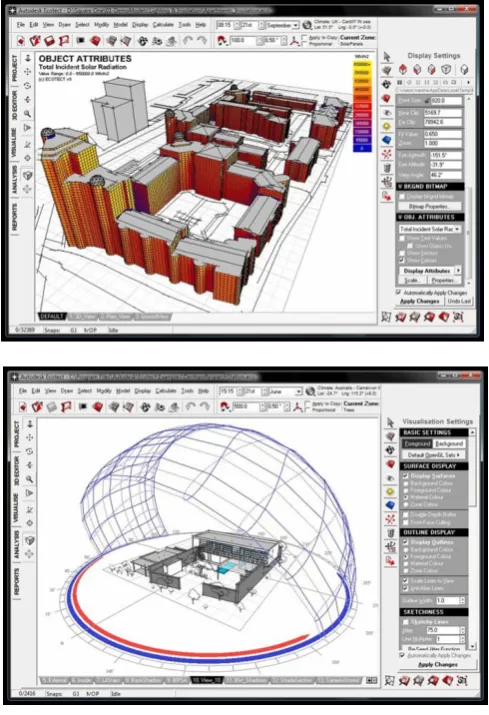
Some of the capabilities of this simulator are calculation of annual sun radiation on the external surfaces, graph modeling of movement of the Sun and the analysis capability of developed model in Autotect by other engines such as EnergyPlus and Radiance (Marsh, 2003).
In the following, a table has been designed to determine the knowledge of individuals before and after working with the simulator. This table contains some of the capabilities required by designers in simulation. The purpose of this table is to access to the degree of individuals’ knowledge in different construction sectors in the way of using simulator and compare it with traditional and manual method of calculation. These capabilities include four main parts of the construction process: design, energy management, materials, and planning and control of project.
Design section consists of determining the proper orientation of building, resource management, control and simulation of radiation, calculations related to windows and proper distribution of windows and
canopies. This section measures the individual’s perception of the early stages of design in modeling and testing the initial ideas by using simulators and comparing it with manual calculation, using the path diagram of movement of the Sun, solar conveyor, and the relevant formulas.
Energy management section including the modeling of thermal comfort, calculating the amount of energy intake from surfaces, calculating building thermal loads, natural ventilation, calculating lighting and atmospheric pollutants presents information about the role of simulations to estimate energy consumption of building.
Material section contains the analysis and calculation of conductive heat transfer from surfaces, insulation, pass-light curtains, material density. This section measures the knowledge of individuals by simulators before they predict and analyze the performance of their components and control risk of their ineffectiveness.
Planning and project control section also consists of planning and scheduling cost estimation, resource planning, and sequence of activities. In this way, students can score based on their understanding of each case, before and after they work with simulator. The effectiveness of simulators in better understanding of mentioned cases is determined by examining results of this table.
In the next step, students determine impact of various factors on their performance in the use of simulator. These factors include personal mistakes, work experience, training inside/ outside university and simulator guide. Through this section, the factors affecting the performance are classified according to the degree of their influence. Then they have been asked to score the degree of simulator attractiveness, the degree of outputs applicability, the impact on time management of design, graphics and ease of use, the accuracy of calculations concerning the use of simulator. The purpose of this section is to achieve students’ opinions about the effectiveness of simulator. Finally, they express their opinions about the degree of attractiveness and positive and negative points of simulator.
International Journal of Scientific Research in Science, Engineering and Technology (ijsrset.com)
III.
RESULTS AND DISCUSSION
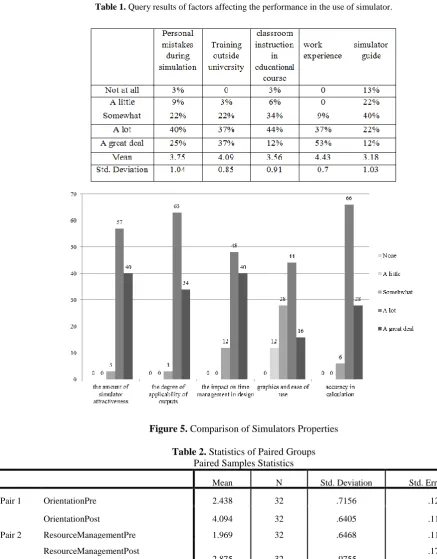
Thirty-two students of architecture participated in this study that among them 56% were female and 44% male. The average age of them was 25, and the age range of them was 24 to 27 years. Among them 37% were engaged professionally in the labor market. 12% used all these three simulators: EnergyPlus, Designbuilder, and Energytect, 22% practically used both Designbuilder and EnergyPlus, and 66% only used the simulator Designbuilder. As aforementioned, lack of graphical user interface makes it somewhat difficult to take advantage of EnergyPlus, but this powerful Moto simulator can associate with many of the programs with graphical interface. More precisely, some users can apply Designbuilder to provide some of the textual inputs required by EnergyPlus as an interface between themselves and EnergyPlus, and thus facilitate the achievement of their desired results. During this simulation, as shown in Table 1, work experience and personal mistakes affect their performance more than simulator guide, because lots of simulators lack adequate user guides with the assumption that the software users are only the expert ones. They also know that training outside university is more effective than classroom instruction courses. Convenient and practical training courses in design as well as the use of simulation at the same time in the course of study plays an effective role in increasing the efficiency and construction process in harmony with environment.
The attractiveness of simulators is very high for most users. The simulator creates space and atmosphere similar to the real one, and shapes the motif of designs through qualitative understanding in a virtual space. In addition to the facilitating the performance, this also makes learning possible during design.
According to students’ opinion the degree of outputs applicability is high as well. Applicability of outputs has a direct relationship with the simulator applied and the degree of architects’ ability to output analysis.
Almost all of the individuals concurred the impact of simulator on time management in design. It is obvious that manual calculation in design is time consuming, but by doing the complex and time-consuming calculations, the software provides the possibility of paying more attention to building design which can
improve the quality of construction. Depending on the type of applied simulator, users have given different scores to the graphics and ease of use. Users of the simulators with a graphical environment have given higher scores than the users of the simulators with textual data.
Simulation with high precision and in a short time leads to high satisfaction of simulators in the field of accuracy of calculations. The simulation results have usually been verified and have considerable accuracy, reliability and validity. Students’ reaction to the degree of attractiveness of using simulators are comments like interesting and very effective, interesting and functional, accurate and better than manual computation, interesting and with high performance, and in some cases the answer is interesting but a bit complicated. It can be concluded from this section that a high percentage of students agree to attractiveness and desirability of the use of simulators.
Various cases have been raised about positive and negative points of using simulators. In the positive points section, there have been responses such as good performance and accurate simulators, facilitating the action or performance and design process, enabling the capability to analyze different cases. One of the main problems of the analysis of energy consumption in building is the need for much knowledge and experience in computational complexity of the field. Simulators have reduced these problems as much as possible and facilitated the process of interactive calculations and comparison of their results in design stages. Negative points which have just mentioned are as follows: lack of comprehensive graphical software (EnergyPlus), Different languages of softwares which are complementary in terms of performance, lack of output analysis, restrictions on graphical interfaces, difficulty in entering input data (EnergyPlus), Textual format of EnergyPlus, long-term simulation, complexity of EnergyPlus environment, inappropriate user interface.
International Journal of Scientific Research in Science, Engineering and Technology (ijsrset.com)
established in design stages, entering precise values of information is not possible for designer in some cases. Also, the receiving system of these information is a linear system instead of being based on designers’ investigated demands. This makes difficulty of entering information doubled.
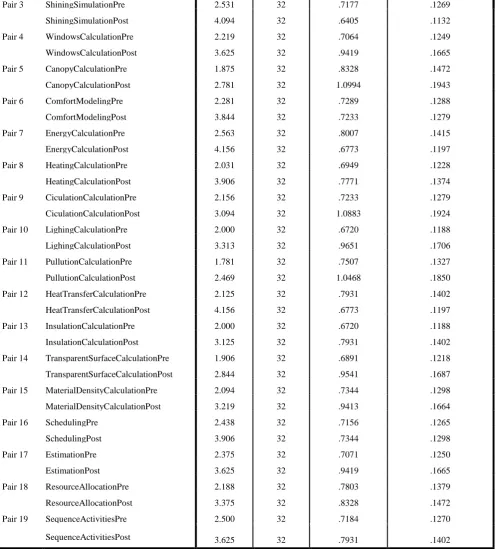
Students also examined their understanding of the impact of using simulator in construction training before and after the introduction of the use of
simulator. Tables 2 and 3 show the T-test results for the groups which have been obtained “before” and “after” using the simulator. In all fields related to the simulator, there is a meaningful statistical difference between the groups before and after using it, as shown in table3. This suggests the effectiveness of the simulator in teaching the concepts of energy saving in building design.
Table 1. Query results of factors affecting the performance in the use of simulator.
Figure 5. Comparison of Simulators Properties
Table 2. Statistics of Paired Groups Paired Samples Statistics
Mean N Std. Deviation Std. Error Mean
Pair 1 OrientationPre 2.438 32 .7156 .1265
OrientationPost 4.094 32 .6405 .1132
Pair 2 ResourceManagementPre 1.969 32 .6468 .1143
ResourceManagementPost
International Journal of Scientific Research in Science, Engineering and Technology (ijsrset.com)
Pair 3 ShiningSimulationPre 2.531 32 .7177 .1269
ShiningSimulationPost 4.094 32 .6405 .1132
Pair 4 WindowsCalculationPre 2.219 32 .7064 .1249
WindowsCalculationPost 3.625 32 .9419 .1665
Pair 5 CanopyCalculationPre 1.875 32 .8328 .1472
CanopyCalculationPost 2.781 32 1.0994 .1943
Pair 6 ComfortModelingPre 2.281 32 .7289 .1288
ComfortModelingPost 3.844 32 .7233 .1279
Pair 7 EnergyCalculationPre 2.563 32 .8007 .1415
EnergyCalculationPost 4.156 32 .6773 .1197
Pair 8 HeatingCalculationPre 2.031 32 .6949 .1228
HeatingCalculationPost 3.906 32 .7771 .1374
Pair 9 CiculationCalculationPre 2.156 32 .7233 .1279
CiculationCalculationPost 3.094 32 1.0883 .1924
Pair 10 LighingCalculationPre 2.000 32 .6720 .1188
LighingCalculationPost 3.313 32 .9651 .1706
Pair 11 PullutionCalculationPre 1.781 32 .7507 .1327
PullutionCalculationPost 2.469 32 1.0468 .1850
Pair 12 HeatTransferCalculationPre 2.125 32 .7931 .1402
HeatTransferCalculationPost 4.156 32 .6773 .1197
Pair 13 InsulationCalculationPre 2.000 32 .6720 .1188
InsulationCalculationPost 3.125 32 .7931 .1402
Pair 14 TransparentSurfaceCalculationPre 1.906 32 .6891 .1218
TransparentSurfaceCalculationPost 2.844 32 .9541 .1687
Pair 15 MaterialDensityCalculationPre 2.094 32 .7344 .1298
MaterialDensityCalculationPost 3.219 32 .9413 .1664
Pair 16 SchedulingPre 2.438 32 .7156 .1265
SchedulingPost 3.906 32 .7344 .1298
Pair 17 EstimationPre 2.375 32 .7071 .1250
EstimationPost 3.625 32 .9419 .1665
Pair 18 ResourceAllocationPre 2.188 32 .7803 .1379
ResourceAllocationPost 3.375 32 .8328 .1472
Pair 19 SequenceActivitiesPre 2.500 32 .7184 .1270
SequenceActivitiesPost 3.625 32 .7931 .1402
Paired Samples Test
Paired Differences t df
Sig. (2-tailed)
Mean
Std. Deviation
Std. Error Mean
95% Confidence Interval of the Difference Lower Upper
International Journal of Scientific Research in Science, Engineering and Technology (ijsrset.com) Pair 2 ResourceManagementPre -
ResourceManagementPost
-.9063 .8561 .1513 -1.2149 -.5976 -5.988 31 .000 Pair 3 ShiningSimulationPre -
ShiningSimulationPost -1.5625 1.0140 .1793 -1.9281 -1.1969 -8.717 31 .000 Pair 4 WindowsCalculationPre -
WindowsCalculationPost -1.4063 .8747 .1546 -1.7216 -1.0909 -9.094 31 .000 Pair 5 CanopyCalculationPre -
CanopyCalculationPost
-.9063 .9625 .1701 -1.2533 -.5592 -5.326 31 .000 Pair 6 ComfortModelingPre -
ComfortModelingPost -1.5625 .9817 .1735 -1.9164 -1.2086 -9.004 31 .000 Pair 7 EnergyCalculationPre -
EnergyCalculationPost -1.5938 .9456 .1672 -1.9347 -1.2528 -9.534 31 .000 Pair 8 HeatingCalculationPre -
HeatingCalculationPost -1.8750 .9755 .1724 -2.2267 -1.5233 -10.873 31 .000 Pair 9 CiculationCalculationPre -
CiculationCalculationPost -.9375 1.0140 .1793 -1.3031 -.5719 -5.230 31 .000 Pair 10 LighingCalculationPre -
LighingCalculationPost -1.3125 .9980 .1764 -1.6723 -.9527 -7.440 31 .000 Pair 11 PullutionCalculationPre -
PullutionCalculationPost -.6875 .8590 .1519 -.9972 -.3778 -4.527 31 .000 Pair 12 HeatTransferCalculationPre -
HeatTransferCalculationPost -2.0313 .8975 .1587 -2.3548 -1.7077 -12.803 31 .000 Pair 13 InsulationCalculationPre -
InsulationCalculationPost -1.1250 .9419 .1665 -1.4646 -.7854 -6.757 31 .000 Pair 14 TransparentSurfaceCalculationP
re -
TransparentSurfaceCalculationP ost
-.9375 1.0453 .1848 -1.3144 -.5606 -5.073 31 .000
Pair 15 MaterialDensityCalculationPre -
MaterialDensityCalculationPost -1.1250 1.0999 .1944 -1.5215 -.7285 -5.786 31 .000 Pair 16 SchedulingPre - SchedulingPost -1.4688 .9832 .1738 -1.8232 -1.1143 -8.450 31 .000 Pair 17 EstimationPre - EstimationPost -1.2500 .9158 .1619 -1.5802 -.9198 -7.721 31 .000 Pair 18 ResourceAllocationPre -
ResourceAllocationPost -1.1875 1.0906 .1928 -1.5807 -.7943 -6.159 31 .000 Pair 19 SequenceActivitiesPre -
SequenceActivitiesPost -1.1250 1.0395 .1838 -1.4998 -.7502 -6.122 31 .000
IV.
CONCLUSION
Since architects are organizing the totality of a building, the impact of architects’ decisions in the early stages of design on the formation of the final behavior of buildings is irrefutable. The formation of thermal behavior of buildings is of duties of architects. Architects as a builder of the early foundation of buildings have duty to design buildings with high
energy capability and high efficiency and buildings in harmony with environment. As mentioned in this study, one of the efficient methods in teaching the optimal design of buildings is the use of computer simulation.
International Journal of Scientific Research in Science, Engineering and Technology (ijsrset.com)
achieving the right solutions through modeling, conducting time-consuming computations, testing ideas and reviewing them several times. Wide applicability and usefulness that comes from the ability to create virtual model and capability to spatial experience before construction leads to the increase in the degree of using simulators every day.
But using the simulators capabilities relies upon “the users’ control on performance, the way of using simulators, the ability to output analysis and other prerequisites for the use of simulators”. Using simulation in architecture education provides a suitable context for the use of simulation in architectural design in professional career. Based on existing researches, using simulation in training considerably boosts knowledge, performance, satisfaction, and self-confidence in learning, because frequent and exact observation is the only effective way to prepare an experiential learning with high quality for students. Students’ positive comments on the conducted survey confirm the claim that design training through simulation is an effective way to better understanding the issues and optimum design, but the complexity of some stimulators is one of the main obstacles facing students in this direction.
Also, during the conducted study with a comparative view, students’ perception of different parts of the construction process has been studied before and after using the simulators. Great difference among users’ knowledge before and after familiarity with the simulators shows that teaching how to use the simulators in design can be an effective step in increasing students’ understanding and ability in design based on energy saving; but it should be noted here that optimal use of simulator occurs when it leads to its application in project designing, not just to a mere training.
V.
REFERENCES
[1] AbouRizk, S. (2011). Role of Simulation in
Construction Engineering and Management. Construction Engineering and Management, 1140-1153.
[2] Andreas, C. (2003). A thesis submitted to the
Degree of Doctor of Philosophy. Towards the Integration of Simulation into the Building Design Process.
[3] Azhar, S. (2011). Building Information
Modeling (BIM): Trends, Benefits, Risks, and Challenges for the AEC Industry. Leadership and Management in Engineering 11, 241-252.
[4] Bleil de Souza, C., & Knight, I. (2007). Thermal
Performance Simulation from an Architectural Design Viewpoint. Tenth International IBPSA Conference. Beijing, China.
[5] Carli. (n.d.).
http://www.fenestration.com/index.php. Retrieved from Carli, Inc.
[6] Chou, J.-S., & Bui, D.-K. (2014). Modeling
heating and cooling loads by artificial intelligence for energy-efficient building design. Energy and Buildings 82, 437-446.
[7] CK Seely, J. (2004). Digital Fabrication in the
Architectural Design Process. MS Thesis in Architecture Studies, Massachusetts Institute of Technology (MIT), Department of Architecture.
[8] EnergyPlus. (n.d.). https://www.EnergyPlus.net.
Retrieved from EnergyPlus.
[9] ESRU. (n.d.). http://www.esru.strath.ac.uk.
Retrieved from Energy Systems Research Unit.
[10] Goedert, J., & Rokooei, S. (2016).
Project-Based Construction Engineering Education in a Virtual Environment. International Journal of
Construction Education and Research.
doi:10.1080/15578771.2015.1121936
[11] Goedert, J., Pawloski, R., Rokooeisadabad, S.,
& Subramaniam, M. (2013). Project-Oriented
Pedagogical Model for Construction
Engineering Education Using
Cyberinfrastructure Tool. Journal of
Professional Issues in Engineering Education & Practice, 139(4), 300-309.
[12] Goedert, J., Rokooei, S., & Pawloski, R. (2012).
Virtual Interactive Construction Education: A
Project-based Pedagogical Model for
Construction Engineering and Management. 7th Conference on Higher Education Pedagogy- Virginia Tech (pp. 73-74). Blacksburg: 7th Conference on Higher Education Pedagogy.
[13] Goedert, J., Rokooeisadabad, S., & Pawloski, R.
International Journal of Scientific Research in Science, Engineering and Technology (ijsrset.com)
Higher Education Pedagogy. Blacksburg:
Virginia Tech.
[14] Haves, P., Salsbury, T., Claridge, D., & Liu, M.
(2001). Use of Whole Building Simulation in On-Line Performance Assessment: Modeling
and Implementation Issues. Seventh
International IBPSA Conference Building
Simulation. Rio de Janeiro.
[15] Hensen, J. (2002). Simulation for performance
based building and systems design: some issues and solution directions. 6th International Coference on Design and Decisions Support Systems in Architecture and Urban Planning (p.
14). Ellecom: Technische Universiteit
Eindhoven, Netherlands.
[16] Hung, C.-C., Liu, H.-C., Lin, C.-C., & Lee,
B.-O. (2016). Development and validation of the simulation-based learning evaluation scale. Nurse Education Today 40, 72–77.
[17] Liu, S., Meng, X., & Tam, C. (2015). Building
information modeling based building design optimization for sustainability. Energy and Buildings 105, 139-153.
[18] Marsh, A. (2003). ECOTECT and EnergyPlus.
Building Energy Simulation User News, Vol 24, No. 6.
[19] Rahul Tiwari, S., Nafees, L., & Krishnan, O.
(2014). Simulation as a pedagogical tool: Measurement of impact on perceived effective
learning. The International Journal of
Management Education 12, 260-270.
[20] Rokooei, S. (2015). Building Information
Modeling in Project Management: Necessities, Challenges and Outcomes. Proceedings of the 4th International Conference on Leadership,
Technology, Innovation and Business
Management (ICLTIBM-2014) (pp. 87-95). Procedia - Social and Behavioral Sciences. doi:10.1016/j.sbspro.2015.11.332
[21] Rokooei, S., & Goedert, J. D. (2015). Lessons
learned From a Simulation Project in
Construction Education. 122nd ASEE Annual Conference & Exposition. Seattle, Washington: American Society for Engineering Education. doi:10.18260/p.24420
[22] Rokooei, S., Goedert, J., & Fickle, K. (2015).
Using a Simulation Model for Project Management Education. 7th Conference on
Higher Education Pedagogy. Blacksburg:
Virginia Tech.
[23] Rokooei, S., Goedert, J., & Weerakoon, A.
(2014). Simulation as an Effective Tool for
Gender Education in Construction. 6th
Conference on Higher Education Pedagogy. Blacksburg: Virginia Tech.
[24] Scherer, Y. K., Foltz-Ramos, K., Fabry, D., &
Chao, Y.-Y. (2016). Evaluating Simulation Methodologies to Determine Best Strategies to
Maximize Student Learning. Journal of
Professional Nursing, 1-9.
[25] Tang, D., & Kim, J. (2004). Simulation Support
For Sustainable Design Of Buildings. ESRU
Consultancy, University of Strathclyde,
Glasgow, UK.
[26] Valinejad Shoubi, M., Valinejad Shoubi, M.,