© 2015 IJSRSET | Volume 1 | Issue 2 | Print ISSN : 2395-1990 | Online ISSN : 2394-4099 Themed Section: Engineering and Technology
A Procurement Mechanism for Dynamic Resource Pricing in Cloud
Computing
Priya D, Revathy G, Yogalakshmi A, Jasmin Suji V
Department Of Computer Science and Engineering,
Dhanalakshmi Srinivasan College of Engineering and Technology, Chennai, Tamilnadu, India
ABSTRACT
Procurement is the acquisition of goods, services or works from an outside external source. We present a cloud resource procurement approach which not only automates the selection of an appropriate cloud vendor but also implements dynamic pricing. Three possible mechanisms are suggested for cloud resource procurement: cloud-dominant strategy incentive compatible (C-DSIC), cloud-Bayesian incentive compatible (C-BIC), and cloud optimal (C-OPT). C-DSIC is dominant strategy incentive compatible, based on the VCG mechanism, and is a low-bid Vickrey auction. C-BIC is Bayesian incentive compatible, which achieves budget balance. C-BIC does not satisfy individual rationality. In C-DSIC and C-BIC, the cloud vendor who charges the lowest cost per unit Quality of Service is declared the winner. We also propose a procurement module for a cloud broker which can implement C-OPT to perform resource procurement in a cloud computing context. In C-C-OPT, the cloud vendor with the least virtual cost is declared the winner. C-OPT overcome the limitations of both C-DSIC and C-BIC. In additional we also implement the dynamic pricing and enable the link for specified clients.
Keywords: Resource procurement, dynamic pricing, cloud broker, multiattribute auctions
I.
INTRODUCTION
Cloud computing is an increasingly popular paradigm of offering services over the Internet [1]. It is also an active area of research, and the popularity of this paradigm is growing rapidly. Many companies like Amazon, IBM, Google, salesforce.com, Unisys, and so on, now offer cloud services. The main advantage of cloud computing is the ability to provision IT resources on demand (thus avoiding the problems of over-provisioning and under-provisioning which are commonly seen with organizations that have widely variable requirements due to growth/shrinkage, seasonal peaks, and valleys, etc.). The resources offered may include storage, CPU processing power, IT services, and so on. These resources are often geographically distant from users. We can say the following:
A cloud user is a person or an organization (such as an SME—small and medium enterprise) that uses cloud services.
A cloud vendor is an organization that offers cloud services for use on payment.
A cloud broker [2] is a middleware that interacts with service providers on behalf of the user. It is responsible for configuring the user’s settings suitably and for procuring resources.
PROBLEM STATEMENT
automated method to perform resource procurement in the cloud. C-DSIC dominant strategy incentive compatible mechanism. It is based on the VCG mechanism. The ratio of cost and Quality of Service is computed for each cloud vendor. The cloud vendor with the lowest ratio of cost to Quality of Service is the winner. The payment rule is based on the VCG mechanism. The user pays the price as per the next lowest bid. DSIC is a low-bid Vickrey auction. C-DSIC achieves allocative efficiency and individual rationality but it is not budget balanced. C-BIC mechanism is based on the DAGVA mechanism. In C-BIC, each cloud vendor contributes a participation fee. This money is used for paying other cloud vendors. Hence, C-BIC is budget balanced and allocative efficient. In this mechanism also, the vendor with lowest cost and Quality of Service ratio is declared the winner. The procurement cost for the user is less here compared with C-DSIC. C-BIC does not satisfy individual rationality but achieves allocative efficiency and budget balance.
DEMERITS
C-DSIC achieves allocative efficiency and individual rationality but it is not budget balanced.
C-BIC does not satisfy individual rationality.
Figure1. System Architecture
Cloud broker procurement module architecture.
PROPOSED SYSTEM
Each cloud user has resource requirements. The users perform reverse auctions for procuring resources. Cloud vendors offer resources, but with varying costs and quality metrics. The goal of the cloud user is to minimize the total cost of procuring resources without
compromising quality of service. To minimize the procurement cost, it is necessary for the cloud user to know the real costs of cloud vendors. So here we are proposed a new method called dynamic pricing. A buyer or user will get more advantage. Here dynamic pricing is including all the factors of buyer, seller and middleman(broker). For an example let we take any online shopping website like Filpkart, OXL and so on. Now in online shopping we can get the static or fixed price for all products. But by using the dynamic pricing concept all buyer, seller and middleman(broker) will get benefit. Because of dynamic pricing will be based on all of their reliable cost. for an a example the dynamic pricing will be based on the buyer reliable cost, seller reliable cost and also broker reliable cost. A user announces its specifications for desired resources and quality of service to all cloud vendors, with the broker acting as a middleman. The cloud vendors decide whether to participate in the auction based on the user information and submit their bids to the broker. C-OPT mechanism is proposed to overcome the limitations of both C-DSIC and C-BIC. The winner determination and payment rule are different compared to DSIC and C-BIC. We compute virtual cost for every cloud vendor. This virtual cost is used to determine the winner. In our model, virtual cost is a function of cost and Quality of Service. We rank the cloud vendors based on their virtual costs. The cloud vendor with lowest virtual cost is declared the winner. The payment is computed based on the quoted cost and the expectation of the allocation.
MERITS
Costs and tasks are uniformly distributed. It achieves individual rationality.
II.
METHODS AND MATERIAL
1. Cloud-Dominant Strategy Incentive Compatible (C-DSIC)
lowest bid. DSIC is a low-bid Vickrey auction. C-DSIC achieves allocative efficiency (objects are allocated to the cloud vendors who value them most) and individual rationality (cloud vendors get negative payoff if they withdraw from the auction) but it is not budget balanced (there is no external funding in the system). If all cloud vendors use the same probability distribution of price and QoS, then C-DSIC is to be preferred.
2. Cloud-Bayesian Incentive Compatible (C-BIC)
In C-BIC, each cloud vendor contributes a participation fee. This money is used for paying other cloud vendors. Hence, C-BIC is budget balanced and allocative efficient. In this mechanism also, the vendor with lowest cost and QoS ratio is declared the winner. The procurement cost for the user is less here compared with C-DSIC. C-BIC does not satisfy individual rationality but achieves allocative efficiency and budget balance. C-BIC is suitable for government organizations. Generally, the participants in government-sponsored procurement auctions pay a participation fee and this is the accepted practice in them. The loss of a cloud vendor’s money in the C-BIC can be viewed as the fee for participating in procurement auction.
3. Cloud-Optimal(C-OPT)
This mechanism is proposed to overcome the limitations of both C-DSIC and C-BIC. The winner determination and payment rule are different compared to C-DSIC and C-BIC. We compute virtual cost [12], [22] for every cloud vendor. This virtual cost is used to determine the winner. In our model, virtual cost is a function of cost and QoS. We rank the cloud vendors based on their virtual costs. The cloud vendor with lowest virtual cost is declared the winner. The payment is computed based on the quoted cost and the expectation of the allocation. There is no single mechanism which can be applied to all the scenarios. C-DISC is to be preferred as long as cloud vendors have quasilinear utility function. C-BIC is to be preferred when the social planner/cloud broker wants Bayesian Nash equilibrium. C-OPT satisfies all the properties except allocative efficiency.
4. Algorithm
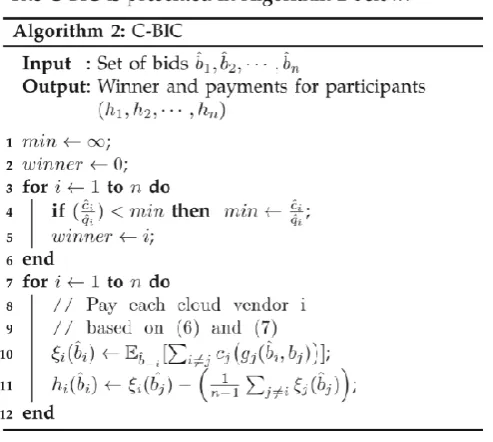
loop, the minimum cost per QoS is calculated. The participant with lowest cost over QoS is the winner. The payment function hi is computed based on the VCG mechanism according to (4). The C-DSIC algorithm is a low-bid Vickrey auction, and hence, only the winner gets a payment. The other participants do not receive any remuneration. The properties satisfied by C-DSIC are:
Dominant strategy incentive compatibility. The C-DSIC mechanism is based on VCG mechanism. VCG is DSIC and, hence, the proposed mechanism is DSIC.
Individual rationality. The payments received by the cloud vendors are greater than or equal to zero. In this mechanism, cloud vendors never pay the user and have a nonnegative payoff.
Allocative efficiency. The winner is the cloud vendor with lowest cost over QoS. Hence, C-DSIC is allocative efficient.
for loop, the minimum cost per QoS is calculated. The participant with lowest cost per QoS is the winner. The payment function hi is computed based on the dAGVA mechanism. The C-DSIC algorithm is a low-bid Vickrey auction and hence only the winner gets paid. The other cloud vendors do not get any money.
The C-DSIC mechanism is not budget balanced. On the other hand, even though the C-BSIC mechanism is budget balanced, it is not individually rational. Hence, we propose the C-OPT mechanism to address the limitations of both the C-DSIC and C-BIC mechanisms.
C-OPT reduces to C-DSIC under the following conditions:
Cloud vendors are symmetric.
The joint distribution function is regular.
The mechanisms presented in this paper have linear time complexity. Hence, they are appropriate for implementing procurement auctions.
III.
RESULTS AND DISCUSSION
PERFORMANCE ANALYSIS
The mechanisms proposed are decentralized in nature. To determine the lower bound on the procurement cost, they use a naı¨ve centralized algorithm. This centralized algorithm sorts the bids in the ascending order and allocate jobs according to the order. This algorithm assumes that resource providers are nonstrategic. They do not use a standard grid toolkit because their goal is to evaluate mechanisms and not to simulate low-level grid tasks. They build a customized simulation environment with an appropriate level of abstraction. Costs and tasks are uniformly distributed. The average procurement cost is calculated in every mechanism and compared.
We follow a similar methodology to simulate C-DSIC, C-BIC, and C-OPT. Our simulation approach is as follows:
Figure 2: The x-axis scale is with one unit length representing 100 cloud vendors
TABLE 1
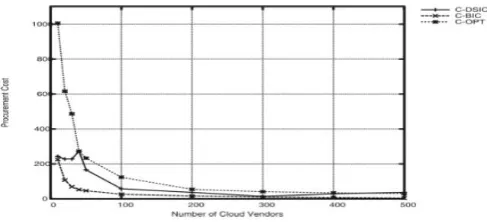
In Fig. 2, the x-axis scale is with one unit length representing 100 cloud vendors. The minimum number of cloud vendors is taken to be 10. Similarly, also is the case with Fig. 3.
Table 1 shows the procurement cost to the user in C-DSIC, C-BIC, and C-OPT for different number of cloud vendors in the Scenario 1. In this scenario, QoS is uniformly distributed. Table 2 shows the procurement cost in Scenario 2, where QoS is normally distributed.
Figure 3. Comparison of procurement costs of C-DSIC, CBIC, and C-OPT in Scenario 2.
TABLE 2
Procurement Costs in Scenario 2
In Table 2, the C-DSIC procurement cost is less than that for C-OPT. Also, the C-OPT procurement cost steadily decreases in both scenarios when cloud vendors increase in number (see Tables 1and 2).In most cases,
the procurement cost of C-OPT is slightly greater than C-DSIC (see Table 1) because in our setting, the cost valuation is high (8,000). When we reduce the highest cost valuation, the C-OPT procurement cost is less than with C-DSIC. Hence, the C-OPT procurement cost depends on the interval of the cost.
IV.
CONCLUSION
Currently, the cloud user pays a fixed price for resources or
services. This type of pricing is called fixed pricing. Fixed pricing is very popular with telecom providers. On the flip side, there is no provision for incentives for users in the fixed strategy. Resource procurement is not only an important problem in cloud computing but is also an unexplored area. Currently, resource procurement is done manually and there is a pressing need to automate it.
To automate procurement, we have presented three mechanisms: C-DSIC, C-BIC, and C-OPT. C-DSIC is a lowbid Vickrey auction. It is allocative efficient and individual rational but not budget balanced. If the mechanism is not budget balanced, then an external agency has to provide money to perform procurement. C-BIC is a weaker strategy compared to C-DSIC and it is Bayesian incentive compatible. In C-BIC, vendorss reveal the truth only if other vendors reveal the truth, unlike C-DISC where vendors reveal the truth irrespective of others’ choices. C-BIC achieves budget balance and allocative efficiency but not individual rationality.
C-OPT achieves both Bayesian incentive compatibility and individual rationality, which the other two mechanisms cannot achieve. This mechanism is immune to both overbidding and underbidding. If a cloud vendor overbids, then the incentive is reduced. If it underbids, then it may not be a winner. C-OPT is more general compared to both C-DSIC and C-BIC—even if cloud vendors use different distributions for cost and QoS, we can safely use C-OPT. Hence, C-OPT is the preferred mechanism in more cases in the real world.
This usercentric pricing is a step toward implementing dynamic pricing in the cloud. This work enables the user to select the appropriate cloud vendor, and the mechanism chosen also decides the price for the resource. OPT is more general compared to both C-DSIC and C-BIC—even if cloud vendors use different distributions for cost and QoS, we can safely use C-OPT. Hence, C-OPT is the preferred mechanism in more cases in the real world.
VI.
REFERENCES
[1] Y. Narahari, C. Raju, K. Ravikumar, and S. Shah,
“Dynamic Pricing Models for Electronic Business,” Sadhana, vol. 30, pp. 231256, 2005.
[2] S. Parsons, J.A. Rodriguez-Aguilar, and M. Klein,
“Auctions and Bidding: A Guide for Computer Scientists,” ACM Computing Surveys, vol. 43, no. 2, article 10, Jan. 2011, doi:10.1145/1883612.1883617.
[3] G. Iyengar and A. Kumar, “Optimal Procurement
Mechanisms for Divisible Goods with Capacitated Suppliers,” Rev. Economic Design, vol. 12, no. 2, pp. 129-154, June 2008.
[4] I. Foster, C. Kesselman, C. Lee, B. Lindell, K. Nahrstedt, and A. Roy, “A Distributed Resource Management Architecture that Supports Advance Reservations and Co-Allocation,” Proc. Int’l Workshop Quality of Service, pp. 27-36, 1999.
[5] H. Casanova and J. Dongarra, “NetSolve: A Network
Server for Solving Computational Science Problems,” The Int’l J. Supercomputer Applications and High Performance Computing, vol. 11, pp. 212-223, 1995. [6] S.J. Chapin, D. Katramatos, J.F. Karpovich, and A.S.
Grimshaw, “The Legion Resource Management System,” Proc. Job Scheduling Strategies for Parallel Processing, pp. 162-178, 1999.
[7] R. Buyya, D. Abramson, J. Giddy, and H. Stockinger, “Economic Models for Resource Management and Scheduling in Grid Computing,” Concurrency and Computation: Practice and Experience, vol. 14, nos. 13-15, pp. 1507-1542, 2002.
[8] M. Mihailescu and Y.M. Teo, “Dynamic Resource
Pricing on Federated Clouds,” Proc. IEEE/ACM 10th Int’l Conf. Cluster, Cloud and Grid Computing (CCGRID ’10), pp. 513-517, 2010.
[9] B. Kalyanasundaram, M. Velauthapillai, and J.
Waclawsky, “Unlocking the Advantages of Dynamic Service Selection and Pricing,” Theory Computing System, vol. 38, pp. 393-410, July 2005.
[10]Y. Narahari, D. Garg, R. Narayanam, and H. Prakash, Game Theoretic Problems in Network Economics and Mechanism Design Solutions. Springer, 2009.
[11]A. Mas-Colell, M.D. Whinston, and J.R. Green,