Journal of Digital Forensics,
Journal of Digital Forensics,
Security and Law
Security and Law
Volume 12 Number 4 Article 8
12-2017
A DATA HIDING SCHEME BASED ON CHAOTIC MAP AND PIXEL
A DATA HIDING SCHEME BASED ON CHAOTIC MAP AND PIXEL
PAIRS
PAIRS
Sengul DOGAN SD
Firat University, [email protected]
Follow this and additional works at: https://commons.erau.edu/jdfsl
Part of the Information Security Commons, and the Other Computer Engineering Commons
Recommended Citation Recommended Citation
DOGAN, Sengul SD (2017) "A DATA HIDING SCHEME BASED ON CHAOTIC MAP AND PIXEL PAIRS," Journal of Digital Forensics, Security and Law: Vol. 12 : No. 4 , Article 8.
DOI: https://doi.org/10.15394/jdfsl.2017.1456
Available at: https://commons.erau.edu/jdfsl/vol12/iss4/8
This Article is brought to you for free and open access by the Journals at Scholarly Commons. It has been
accepted for inclusion in Journal of Digital Forensics, Security and Law by an authorized administrator of Scholarly Commons. For more information, please
•
•
•
A DATA HIDING SCHE1\1E BASED ON
CHAOTIC MAP AND PIXEL PAIRS
Sengul Dogan Firat University, Turkey
ABSTRACT
Information security is one of the most common areas of study today. In the literature, there are many algorithms developed in the information security. The Least Significant Bit (LSB) method is the most known of these algorithms. The LSB method is easy to apply; however, it is not effective on providing data privacy and robustness. In spite of all its disadvantages, LSB is the most frequently used algorithm in literature, due to providing high visual quality. In this study, an effective data hiding scheme alternative to LSB, 2LSBs, 3LSBs and 4LSBs algorithms (known as xLSBs), is proposed. In this method, random numbers which are to be used as indices of pixels of the cover image are obtained from chaotic maps and data hiding process is applied on the values of these pixels by using modulo function. Calculated values are embedded in cover image as hidden data. Success of the proposed data hiding scheme is assessed by Peak Signal-to-Noise Ratio (PSNR), payload capacity and quality.
1.
INTRODUCTION
The development of technology, especially m communication systems, greatly facilitates human life. The progress in communication technologies enables us to use electronic devices such as smartphones and tablets without time and place concerns, thanks to mobility and wide-area networks. But as technology continues to improve, electronic data security has become an important issue in daily life [1,2]. Main purpose of data security is to prevent unauthorized copying, changing or damaging of any data whether it is stored in a storage device or internet. Precautions are needed to provide data security [3]. Several methods such as Data Hiding [4-6],
Cryptography [7-9] and Watermarking [10,11]
are used to provide data security. All these methods need to have three base qualities
which are listed below [12].
Identity: There must not be an identity problem between sender and receiver. Integrity: There must not be any change in data during transmission process.
Privacy: Data must not be seen by any party other than the receiver.
Watermarking is used for determining ownership of data which is in a network or World Wide Web. Watermark is embedded into a data such as image, an audio or a video by the owner of data. Anyone who has an extraction function to decode the watermark, gets the ownership information of the data
[13]. In cryptography method, data transformed a different format by the way of encryption. Thus, any third-party who gets the
JDFSL V12N4
have the raw data [7]. The main purpose of
data hiding algorithms is to ensure
transmission of data with a seemingly innocent
cover object. At the end of data hiding process,
less the cover object changes, more successful
is the algorithm [5, 6]. Data hiding methods
can be performed in spatial domain, frequency
domain and compression domain. Vector
Table 1.
D ata ffdI . mg P rocess wit . h LSB M et o h d
A Data Hiding Scheme Based on Chaotic Map ...
Quantization (VQ) is one of the most widely
used methods in compression domain [14].
Also, the most popular method among
developed methods is LSB in spatial domain. In LSB method, secret data is embedded into
least significant bits of cover object as shown in Table 1 [15].
Secret Pixel value of Binary value Binary value Pixel value of
of cover
message cover image
image
11 CL,j=l08 1101100
CL,j+1= 111 1101111
In
the frequency domain, the specificcoefficients are obtained by applying
methods such as Discrete Wavelet
Transform (DWT) [16], Discrete Cosine
Transform (DCT) [17], and Discrete
Fourier Transform (DFT) [18]. The
obtained coefficients from these methods
are embedded in secret data. DFT, widely
used in image processing, is capable of
distinguishing the frequency components of
of stego
stego image
image
1101101 SL,j=l09
1101111 SL,j+i=lll
a picture from each other. Thus, low and
high-pass filtering operations are provided
at different ratios. DWT is another
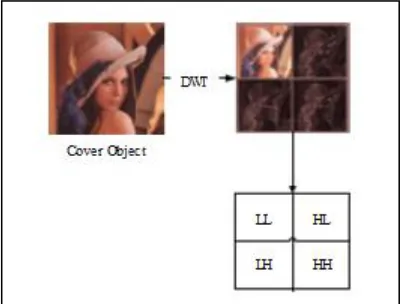
technique used in the frequency domain. in this technique an image is passed through
the low and high pass filter to obtain the
sub-bands. LL, LH, HL, HH sub-bands
obtained from DWT method are shown in
Figure 1.
IL HL
1H HH
• • • • •
DCT transmits the pixel values to the
frequency domain by splitting the image into
blocks of 8 x 8 size. Robustness of cover image is increased by embedding secret data into
coefficients of these subbands [16].
2.
LITERATURE REVIEW
There are many studies about data hiding in literature. Zhao et al. [19] propose an enhanced
data hiding scheme based on modulus function (MF) and pixel-value differencing (PVD) using indeterminate equation. Their study ensures
higher embedding than modulus function-PVD
and PVD methods. Gholampour and Khosravi [20] introduce a data hiding method using multiple q-ary schemes. Their results provide less corruption and high security. Pan et al.
[21] perform an effective data hiding method
using side-match distortion based on joint
neighboring coding. According to the results
obtained, higher embedding capacity and
image quality than comparable methods. Hong
and Chen [22] present a data hiding scheme
using adaptive pixel pair matching ( APPM). Their experimental results provide higher performance than between optimal pixel
adjustment process and diamond encoding.
Their method also provides high security for known steganalysis methods. Weng et al. [23] propose an improved hiding method using pairwise difference adjustment (PDA) on pixel pairs. In this method, PDA tries to arrange the
embedding process according to this value by
setting a threshold value to minimize the
distortion of the pixel pairs. Thus, PDA allows to increase the embedding capacity and solve
overflow- underflow problems. Thus, a higher
PSNR value is obtained. Tai et al. [24] introduce a new data hiding scheme using histogram modification. Their experimental
results ensure large embedding capacity by
reducing distortion. Yang et al. [25] present an
improved data hiding method in edge areas of images with least-significant-bit domain using
PVD. The embedding capacity is increased for
gray images with their proposed method.
In this paper, a data hiding scheme based
on pixel pairs is proposed. Chaotic maps are
described in section 2. The proposed method is presented in section 3. In section 4, the results
are given. Finally, conclusion of this study is
presented in section 5.
3.
CHAOTIC MAPS
Chaos theory is a mathematical technique
which aims to define a system under chaos.
According to the rules of chaos theory [3,26]:
Chaotic systems are not linear.
They are complex.
They exist in structure of nature. They have feedback mechanism.
They are extremely sensitive to initial
conditions.
Chaotic theory has many uses in areas such
as education, science, social studies, and
engineering. For instance, random numbers
which are needed by several security
algorithms in computer systems, can be
generated by random number generators
(RNG) [27,28]. However, these RNGs may
generate the same numbers in a specific
iteration which is not desirable. To solve this
problem, chaotic maps may be used instead of RNGs [29,30]. Random numbers generated by
chaotic maps has an order in their own
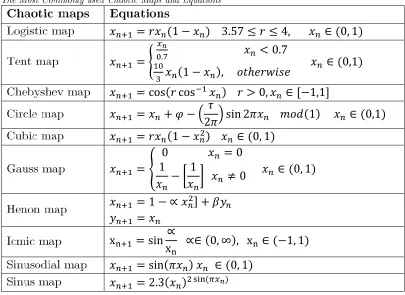
disarray. Widely used equations of chaotic
𝑥
𝑛+1= 𝑟𝑥
𝑛(1 − 𝑥
𝑛) 3.57 ≤ 𝑟 ≤ 4, 𝑥
𝑛∈ (0, 1)
𝑥
𝑛+1= {
𝑥𝑛
0.7
𝑥
𝑛< 0.7
103
𝑥
𝑛(1 − 𝑥
𝑛), 𝑜𝑡ℎ𝑒𝑟𝑤𝑖𝑠𝑒
𝑥
𝑛∈ (0,1)
𝑥
𝑛+1= cos(𝑟 cos
−1𝑥
𝑛) 𝑟 > 0, 𝑥
𝑛∈ [−1,1]
𝑥
𝑛+1= 𝑥
𝑛+ 𝜑 − (
𝜏
2𝜋
) sin 2𝜋𝑥
𝑛𝑚𝑜𝑑(1) 𝑥
𝑛∈ (0,1)
𝑥
𝑛+1= 𝑟𝑥
𝑛(1 − 𝑥
𝑛2) 𝑥
𝑛
∈ (0, 1)
𝑥
𝑛+1= {
0 𝑥
𝑛= 0
1
𝑥
𝑛− [
1
𝑥
𝑛] 𝑥
𝑛≠ 0
𝑥
𝑛∈ (0, 1)
𝑥
𝑛+1= 1 − ∝ 𝑥
𝑛2] + 𝛽𝑦
𝑛𝑦
𝑛+1= 𝑥
𝑛x
n+1= sin
∝
x
n∝∈ (0, ∞), x
n∈ (−1, 1)
𝑥
𝑛+1= sin(𝜋𝑥
𝑛) 𝑥
𝑛∈ (0, 1)
𝑥
𝑛+1= 2.3(𝑥
𝑛)
2 sin(𝜋𝑥𝑛)𝑥𝑡+1 = 𝑟𝑥𝑡(1 − 𝑥𝑡), 𝑡 = {1,2, … , 𝑚𝑛},
𝑥 ≠ 0.5, 𝑥 ∈ (0,1), 𝑟 ∈ [3.57,4]
𝑥𝑡
JDFSL V12N4 A Data Hiding Scheme Based on Chaotic Map ...
Table 2.
Th M e ost C ommonry use d Ch aotic M aps an dE quations
Chaotic maps Equations
Logistic map
-Tent map
-Chebyshev map
Circle map
Cubic map
Gauss map
-Herron map
Icmic map
-Sinusodial map Sinus map
4
. THE PROPOSED
SCHElVlE
-The proposed method is similar to data hiding
algorithms based on pixel pairs. This algorithm
carries out data hiding process by using a
single pixel and random numbers which are the
virtual pairs of this pixel. Chaotic maps are
r-+ logistic map multiplier t-+ iteration number
-+t. chaotic number
Step 2: Convert numbers obtained in step 1 into two dimensions and encode these numbers
in user specified range.
-used as deterministic RNGs. Data hiding steps
of this method is given below.
Step 1: Generate random numbers as much as the number of pixels in the cover image.
Chaotic maps are used for generating random
numbers. Equation of logistic map, as being
the most frequently used chaotic map, is given
in Equation 1.
(1)
Step 3: Determine data hiding capacity. If data
will be embedded with b bit capacity, secret
ℎ = {
−1, 𝑥
𝑖,𝑗𝑚𝑜𝑑 2 = 0
+1, 𝑥
𝑖,𝑗𝑚𝑜𝑑 2 = 1
, 𝑖 = {1 , 2 , … , 𝑚}, 𝑗 = {1 , 2 , … , 𝑛}
𝐺𝑉
𝑖,𝑗= 𝑆𝐼
𝑖,𝑗+ ℎ𝑥
𝑖,𝑗𝑚𝑜𝑑 2
𝑏, 𝑖 = {1, 2, … , 𝑚}, 𝑗 = {1, 2 , … , 𝑛}
ℎ
𝐺𝑉𝑖,𝑗
𝑆𝐼𝑖,𝑗
𝑂𝐼𝑖,𝑗
𝐺𝑉𝑖,𝑗= 𝑆𝐼𝑖,𝑗± 𝑥𝑖,𝑗 𝑚𝑜𝑑 2
𝑏 =
1, 𝑥𝑖,𝑗 = 45 𝑂𝐼𝑖,𝑗= 125 𝐺𝑉𝑖,𝑗 = 1
45 𝑚𝑜𝑑 2 = 1
(125 + 45) 𝑚𝑜𝑑 21= 0
𝐺𝑉𝑖,𝑗
𝑆𝐼𝑖,𝑗 = 𝑂𝐼𝑖,𝑗+ 1
126 +
45 𝑚𝑜𝑑 21= 1
(2)
Step 5: Apply the equation below for data hiding process
----+ -1, +1
----+ Secret data set
----+ Selected pixel value of stego image
----+ Selected pixel value of original image
If the equation is not ensured, pixel values
are changed according to determined rules and
equation is ensured. For example, if 1 bit per pixel (bpp) data will be embedded into cover
image, equation must
be ensured. To ensure this equation, pixel
values of cover image is increased by one or are
not changed. For instance, if it is assumed
and , the
processes below are performed.
Due to used.
be equal to
below is performed.
, addition operator is
but this value must
For this reason, process
Because of process, new
value of pixel will be 126. Thus, data hiding process is performed by ensuring
equation.
As given in the example, the pixel values of the cover image are increased by one or are not
changed for embedding 1 bpp in the proposed
method. Namely, the pixel value set is expressed with R= {0, 1} for embedding 1
Table 3.
The Comparison of Probabilities
Methods
lbpp
LSB
1
/
3
The proposed algorithm
1
/
2
(3)
bpp. The pixel value set is expressed with R=
{-1, 0, 1} when the same process is performed with LSB. While there are two values in change set of the proposed method, there are
three values in change set of LSB. If data
hiding is performed with the proposed method, pixel values remain unchanged by P=0.5 probability, but this probability value is 0.33 in LSB. These values mathematically prove that the proposed algorithm decreases quality of cover image less than LSB. If 2LSBs is used for data hiding process, pixel values remain unchanged by 1/7 probability in 2LSBs but
this probability in the proposed method is 1 / 4. The pixel values of cover image change
between [-7, 7] range in 3LSBs but pixel values
change between [-4, 3] range in the proposed
method. Also, the pixel values of the cover
image change between [-15, 15] range in 4LSBs but pixel values change between [-8, 7] range
in the proposed method. Comparison of these probability results are shown in Table 3.
2bpp
3bpp
4bpp
1
/
7
1
/
15
1
/
31
1
/
4
1
/
8
1
/
16
Taking Table 3 and the examples into consideration, the probability of unchangeably of cover
𝑃
𝑙𝑠𝑏=
1
2
𝑏+1− 1
𝑃
𝑝𝑚=
1
2
𝑏𝐺𝑉
𝑖,𝑗= 𝑆𝐼
𝑖,𝑗+ ℎ𝑥
𝑖,𝑗𝑚𝑜𝑑 2
𝑏JDFSL V12N4 A Data Hiding Scheme Based on Chaotic Map ...
(4)
(5)
The most important advantage of the
proposed method is to optimize the selection of
pixel pairs embedding data in accordance with
the xLSBs and minimize the change in the
cover image. The disadvantage of the proposed
method is also overflow problem. In order to
solve overflow problem, either normalization process is performed or pixels which will not
cause overflow is collected and data hiding
process is performed on these pixels. The
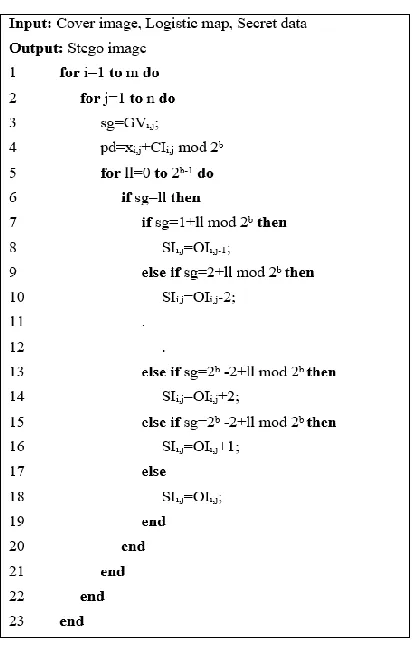
pseudo code of the proposed method is given in Figure 2.
Input: Cover image, Logistic map, Secret data Output: Stego image
for i=l tom do
2 for j= 1 to n do
3 sg=GV;j;
4 pd=xij+CLj mod 2b
5 for ll=O to 2b-J do 6 if sg=ll then
7 ifsg=l+ll mod 2b then
8 Slij=OLj-1;
9 else if sg=2+11 mod 2b then
10 Slij=Ol;j-2;
11
12
13 else if sg=2b -2+11 mod 2b then
14 Slij=Ol;J+2;
15 else if sg=2b -2+11 mod 2b then
16 Sl,j=OLJ+l;
17 else
18 Slij=Ol;j;
19 end
20 end
21 end
22 end
23 end
Figure 2. The Pseudo Code of the Proposed Method
In the proposed method, data extraction
step consists of the following 3 steps:
Step 2: Generate RNG whose seed values are
obtained.
Step 1: Obtain the size of the secret data and
the value of RNG from stego-key.
Step 3: Obtain secret data by using Equation 6.
𝑀𝑆𝐸 = 1
𝑚𝑛∑ ∑(𝐶𝐼𝑖,𝑗− 𝑆𝐼𝑖,𝑗)
2 𝑛
𝑗=1 𝑚
𝑖=1
𝑃𝑆𝑁𝑅 = 10 log𝑀𝑎𝑥(𝐶𝐼𝑖,𝑗
2)
𝑀𝑆𝐸
𝐶𝐼𝑖,𝑗
𝑆𝐼𝑖,𝑗
𝑚 𝑛
5.
RESULTS AND
DISCUSSIONS
In this study, the obtained results are
evaluated using MATLAB 2014a with Windows 10 operating system. In this paper, Kodak image dataset [32] and test images [33]
(i) (j)
Figure 3. The Test Images
are used and varied sized secret data are
embedded into both of the image sets. Test
images which are named as Lena, F16, Baboon, Barbara, Boat, Pepper, House, Sailboat, Elaine, Tiffany, Toys, and Zelda are
512x512 sized and gray-scale. In Figure 3,
these test images are shown.
(k) (I)
(a) Lena (b) Baboon (c) Pepper (d) Barbara (e) Boat (f) F16 (g) Elaine (h) Sailboat (i) House (j) Tiffany (k) Toys (1) Zelda
The proposed method is assessed by PSNR [34] and Quality values [35]. PSNR equations are
given in Equation 7, 8.
(7)
(8)
-+ Cover image
-+ Stego image
-+ Line number of cover/stego image
JDFSL V12N4 A Data Hiding Scheme Based on Chaotic Map ...
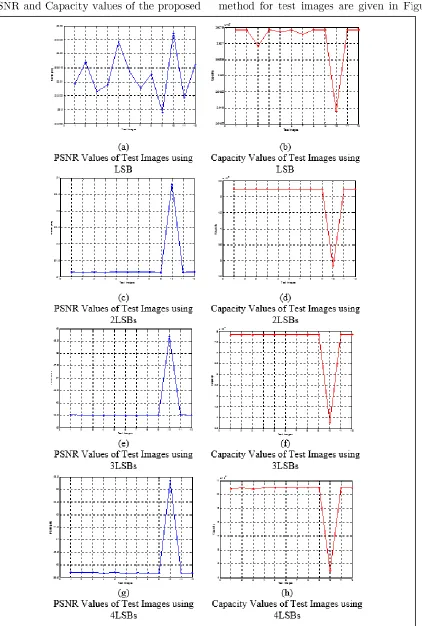
PSNR and Capacity values of the proposed method for test images are given in Figure 4.
I I I I I I t I I
I I I I I I I I I
--:---:---:---:--_._ _ -:---:---:---:-
-I I I I I I
I I I I I I
--0: - --~--~ , I I I
L ~--•---•---•-
I I I II I I I I I t I
I I I I I I
-- --r-- r - - - , ,
-1 I I I I
' ' '
I I I I I I I I
--:---:---:---:---:---:---:---:--1 I I I I I I
I I I I I I I
(a)
PSNR Values of Test Images using
LSB
I I I I I I I I
--,---,--- .. -- .. -- .. -- .. -- .. -- ..
--T--1 I I I I I I I I
I I I I I I I I I I
I I I I I I I I I I I
1i --L--L--L--L--L--L--L--L--!- ! _, __
I I I I I I I I I I I
I I I I I I I I I I I
I I I I I I I I I I I
i
a;
--~ --~ --
~--
~--
~--
~--
~--
~-
-i-
-i-
i
-I~ --~ -~-
~--I I I I I I I I I I l
--,---r---r--r--r--r--r--r-- --r--
--., __ ~_,_--,....----,.---,,__.,..__,__,____,__,,__.,,_....,.,...--<
-•-p•
(c)
PSNR Values of Test Images using
2LSBs
I I I I I I I I I
I I I I I I I I I
--r--r---r--,--,--,--,--,--,--•
--•--~--•--~--~--•--•--•--•-' I I I I I I I I
I I I I I I I I I I
L L L L L L L L L L L
-I I I I I I I I I I
I I I I I I I I I I
I I I I I I I I I
! ~ --~--~--~--~--~--~--~--~--~
I I I I I I I I I
--~--~--~--~--~--~--~--~--~ I I I I I I I I I
I I I I I I I I
I I I I I I I I I I
--r--1---r--1 ___ 1 ___ 1 ___ 1--,
--,--• I I I I I I I I
I I I I I I I I
--,--(e)
PSNR Values of Test Images using
3LSBs
I I I I I I I I I
--. --1 --. --. --. --.
--.---1---.--1 I I I I I I I I
I I I I I I I I I
I I I I I I I I I
Cl __ L __ L __ L __ L __ L __ L __ 1 ___ 1 ___ 1_
I I I I I I I I I
i : : : : : : : : : f ••i.:i --r - -i --r --r - - r - -r - -,- --:--
-,-' '
+I _ _ ..,. _ _ ..,. _ _ ..,. _ _ ..,. _ _ ..,. _ _ ..,. _ _ , _ _ _ 1 1
-I I I I I I
--,---,---,---,---,---,---,---1--- --1--
--1 I I I I I I I I
(g)
PSNR Values of Test Images using
4LSBs
~; --~--~--~--~--~--~--~--~--!
I I I I I I I I I
I I I I I I I I
1
~~--r--r--r--r--~--r--r--r--f-• I I I I I I I I
~; --~--~--~--
~--i"--t--t--t--i-' '
I I I I I I I I I I
$:Q!IQ, --r--r--r--r--1---T--T--T--+--
--,--' '
""-'
>--_,_-+----+---!---+--+----+---....,....-(b)
Capacity Values of Test Images using
LSB
I I I I I I I I I
u --r--r--r--r--~--r--~--~--~
I I I I
l • - -~ - -~ - -~ --~ - -~ - -~ --~ - _:_ - -~
:! : : : :
I I I I
I I I I I I I I I
r r r r , r , 1 ,
-I I I I
I I I I
I I I I
(d)
Capacity Values of Test Images using
2LSBs
...
I I I I I I I I
r r r r r r r r
-1 I I I I I I I I I
I I I I I I I I I I
-r-r-r-r--
--r-• I I I I I I I I I
I I I I I I I I I I
- - r - - r - - r - - r - - r - - r - - r - - r - - r
-r-• I I I I I I I I I
I I I I I I I I I I
,. --,---,---r--,---,---r--r--1---r -r
( I I I I I I I I I I
:!~
--~--~--i"--~--~--i"--i"--~--i"-1 I I I I I I I I
- -~- -~- -i"- - ~- - ~- -i"--i"--
~--i"-1 I I I I I I I I
~
--~--~--~--~--~--~--~--~--~-' I I I I I I I I I
- - ~ - - ~ - - L - - ~ - - ~ - - L - - L - - ~ - - L - - ~
-1 I I I I I I I I
I I I I I I I I I
(f)
Capacity Values of Test Images using
3LSBs
I I I I I I I I I
- -,- - -r - -r- -,- --1- -- , - -- i - -- , - -- -- , - - -
-I I I I I I I I I I I
I I I I I I I I I I I
__ , __ -L _ -L- _1 ___ 1 ___ , ___ 1 ___ , ___ 1 __ , ___ _
I I I I I I I I I I I
I I I I
' ' '
_ - L _ -~ _ - ~ _ - L __ 1 ___ , __ -1- __ , ___ ,_
I I I I I I
' ' '
-- ... --,---,---...
--1---,---1---,---,-I I I I I I I I I
' ' '
' ' '
- -,- - -r - -r - -,- -- 1 - -- , - -- i - -- , - - ,
-I I I I I I I I
I I I I I I I I I
--:---~ --~ --:---:---:---:---:---:-
-I I I I I I
I I I I I I
(h)
Capacity Values of Test Images using
In the results obtained in Figure 4, test 2-Fl6 3-images are numbered as [1-Lena,
Baboon 4-Barbara 5-Boat 6-Pepper 7-House 8-Sailboat 9-Elaine 10-Tiffany 11-Toys 12-Zelda].
I I I I I I I I I I I I I I I I I I I I I I I I I I I I I I I I I I I I I I I I I
- I_ 1 J - L J -•- 1 J - '-1 _,_ L J -'-.I. J -L J _1_ L
I I I I I I I I I I I I I I I I I I I I
(a)
PSNR Values ofK.odak Dataset using
LSB
i
!
I I I I I I I I I I I I I I I I I I I I I I I I I I I I I I I I I I I I I I I I I I I I I I I I
I I I I I I I I I I I I I I I I I I I :N -I -1-+_,_I- .. -1-+_,_I- .. -1-+_,_I- .. -1-+ _,_
I I I I I I I I I I I I I I I I I I I I I I I I I I I I I I I I I I I I I I I I I I I I I I I I I I I I I I I I I , - I"" T - , -r , - r T - , -r , - r T - , -r , - r T ,
-1 I I I I I I I I I I I I I I I I I I I I I I I I I I I I I I I I I I I I I I I I I I I I I I I I I I I I I I I I I I I I I I I I I I , -r y-,-r, -r r-,-r, -r r-,- r ,-r r-, ,-.-
r-,-' I I I I I I I I I I I I I I I I I I I I I I I I I I I I I I I I I I I I I
•::i= ,-, I I , I -,-, ,-, I I I I I , -,-, ,-1, -,-, ,-1 I I I I I I I I I I , -, I I I I I I
i
,-,-.-,-' I I I I I I I I I I I I I I I I I I I I I I I I I I I I I I I I I I I I I
I I I I I I I I I I I I I I I I I I I I - . -I 1-1 I - . - I 1-1 I -1-I 1-1 I -1- I I
(c)
I- I-,-j -.
PSNR Va]ues of Kodak Dataset using
2LSBs
I I I I I I I I
I I I I I I I I
I I I I I I I I I I
I I I I I I I I I I J -L .L -•-L J -L .L -•-L .J -L .L -•-L .J - L .L -•- .J -L .L _1_
1 I I I I I I I I I I I I I I I I I I I I I I I t I I I I I I I I I I I I I I I I I I t I I I I I I I I I I I I I I I I I T - 1 - l " ' , - r T - 1 - l " ' , - r T - 1 - l " ' , - r T - 1 - 1 " ' , I I I I I I I I I I I I I I I I I I I I I I I I I I I I I I I I I I I I I I .I -I.. .L - • - I. .I -1.. .L - • -I. .I -1.. .L - • - I. .I -1.. .L -•
I t I I I I I I I I I I I I I I I I I I I I I I
I I I I I I I I I I I I I I I I I I I I I I I I I I I I I I I I I I I I I I I I I I I I I -1- I 1-1 I - , - I 1-1 I - , - I 1-1 I - , - I I I i - I -j -I I I I I I I I I I I I I I I I I I I I I I I I I I I I I I I I I I I I I I I
+ -•-.. -1-1-+ -•-.. -1-1-+ -•-.. -1-1-+ -•-... I I I I I I I I I I I I I I I I I I I I I I I I
(e)
' ' '
_._ .L _1_
PSNR Va]ues of Kodak Dataset using 3LSBs
Figure 5 continued below.
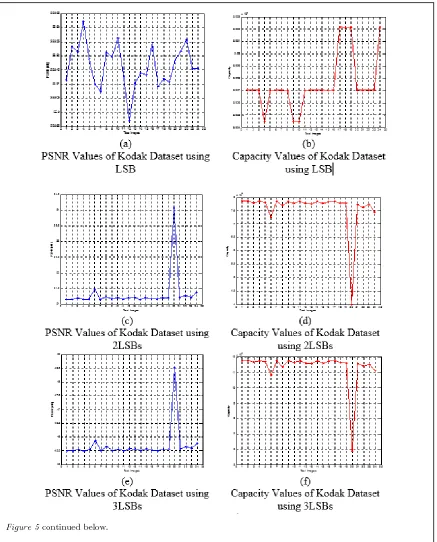
PSNR and Capacity values of the proposed method for Kodak data set are given in Figure
5.
I I I I I I I I I I I I I I I I I I I I I
I I I I I I I I I I I I I I I I I I I I 1-1- I 1-1 1-1•1 1•1 I - , - 1 1•1 I - -,- ,•,-t-i I I I I I I I I I I I I I I I I I I I
I I I I I I I I I I I I I I I I I I I I I I I I 1-1- I 1-1 1-1•1 1•1 I - , - 1 1•1 I 1-1 1-1 I 1-1 I I I I I I I I I I I I I I I I I I I I I I I I I
, - . -I 1-1 1-1-1 1-1 1-1-1 1-1 I 1 - j j . - , - . - , - . I I I I I I I I I I I I I I I I I I I I I I I I
I I I I I I I I I I I I I I I I I I I • 1-1- I 1-1 1-1-1 1-1 1-1-1 1-1 1-1-1 I
I I I I
.- i -.-.
I I I I ._ .L J_ l I I I I I I I I I I I I I I I I I I I
~ UII ~ - : -f ~ -~ ~ -:-~ ~ -~ f -:-~ ~ -~ -:-~ ~
' ' '
H,i-+,s!,-+,-+, -:-~~-. I I I
I I I I I I I I I I I I
(b)
Capacity Values of Kodak Dataset usingLSBI
t .
t
I I I I I I I I I I I I I I I I I
'A<.:
.,
' ' '·
-•-
~
J _._ .L-•-L .J-L .1-L .L -•-L .J-L .1 - • -.L -•- J_ .1 -•-.a. I I I I I I I I I I I I I I I I I I I I I I I I I I I I I I I I I I I I I I I I I I I I I I I I I I I I I I I I I I I I I I I I I I I I I I I
, -r r-,- r -1-r 1-r T -,-r-.-r 1-1- r-,- -. r 1-,-i
I I I I I I I I I I I I I I I I I I I I I I I I I I I I I I I I I I I I I I I I I I I I I I I l
.. -1-+ -,-.. - , - 1 - , -1-+ -•-.. - , - 1 - . , -•-+ -•-... I I I I I I I I I I I I I I I I I I I
I I I I I I I I I I I I I I I I I I I I--, • I • T
I I I I I I I I ._.I-·-.I. J _._ .L _,_ L .J-L .1 _._ .L _1_ L .J-L .1 _1_ .L -•-L
I I I I I I I I I I I I I I I I I I I
I I I I I I I I I I I I I I I I I I I
I I I I I I I I I I I I I I I I I I I I I I I I
, -r r-1-r -1-r 1-r T -,- r-1-r 1-,- r-,-r I I I I I I I I I I I I I I I I I I I I I I I I I I I I I I I I I I I I I I • -1-+-,-I--,-1--, -1-+ -1-I--,-1--, -1-
+-•-I-I I I I I I I I I I I I I I I I
(d)
I I I l r 1-,-i
I I I I I I I I
-1--, • I • T
I I I I
Capacity Values of Kodak Dataset
using2LSBs
I I I I I I I I I I I I I I I I I I I I I I I I I I I I I I I I I I I I I I I I I I I I I I I I I I I I I I I I I I I I I
I • -1-•• I • + - t -I-• • I -• -1-+ - t • I-• -1-•• I • + • I I I I I I I I I I I I I I I I I I I
I : : : : : : : : : : : : : : : : : : : "1 - , -"1 -1• T -,-1"' "1 - , -"1 - 1 - T -,-1"' "1 - , -"1 -1• T
I I I I I I I I I I I I I I I I I I I I I I I I I I I I I I I I I I I I I I I I I I I I I I I I I I I I I I I I I I I I I I I I I I I I I I
, -r ,-,- r -.- r , - r , -,-r-.- r ,-r ,-,- r r-.·r,
I I I I I I I I I I I I I I I I I I I I I I I I I I I I I I I I I I I I I I
1 ~ -L ~ _,_ .L ~ -L ~ -~ ~ -:-f ~ -~ ~ -~ ~ -:- f
I I I I I I I I I I I
(f)
- L J . L J
I I I I
I I I I I
Capacity Values of Kodak Dataset
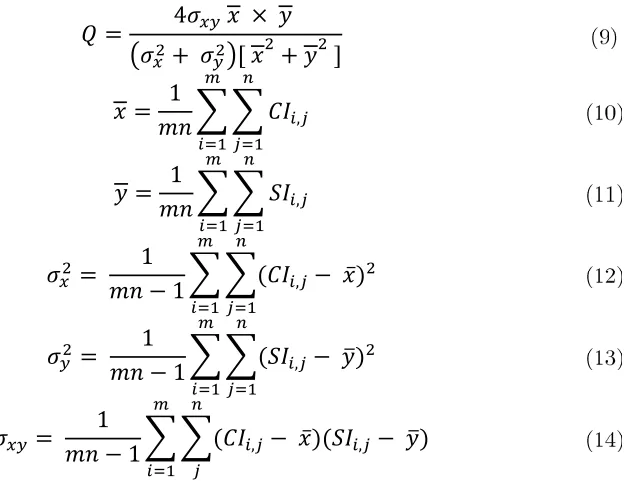
𝑄 =
4𝜎
𝑥𝑦𝑥 × 𝑦
(𝜎
𝑥2+ 𝜎
𝑦2
)[ 𝑥
2+ 𝑦
2]
𝑥 =
1
𝑚𝑛
∑ ∑ 𝐶𝐼
𝑖,𝑗𝑛
𝑗=1 𝑚
𝑖=1
𝑦 =
1
𝑚𝑛
∑ ∑ 𝑆𝐼
𝑖,𝑗𝑛
𝑗=1 𝑚
𝑖=1
𝜎
𝑥2=
1
𝑚𝑛 − 1
∑ ∑(𝐶𝐼
𝑖,𝑗− 𝑥̅)
2 𝑛
𝑗=1 𝑚
𝑖=1
𝜎
𝑦2=
1
𝑚𝑛 − 1
∑ ∑(𝑆𝐼
𝑖,𝑗− 𝑦̅)
2 𝑛
𝑗=1 𝑚
𝑖=1
𝜎
𝑥𝑦=
1
𝑚𝑛 − 1
∑ ∑(𝐶𝐼
𝑖,𝑗− 𝑥̅)(𝑆𝐼
𝑖,𝑗− 𝑦̅)
𝑛 𝑗 𝑚 𝑖=1 JDFSL V12N4 •-' ' ' ' '
-.-
-.-' ' ' ' ' -,- -.-'-.-
-.-
, --.-
-.-I I I I
-,- -,- -.- - -,-'
'
J_ I 1-'
0 '
' ' '
- _,_ J_
' ' ' ' ' '
, ... 1111:•
(g)
' ' ' ' - + -,-
-1-,' ' ' ' ' I I I I
T-,-0'' ' ' '
I I I I 1 T -,-
-.-' -,-' ' J_
PSNR Va]ues of Kodak Dataset using
4LSBs
A Data Hiding Scheme Based on Chaotic Map ...
' '
.. -= -:-r-:-+-: + :-·-:--:-:--:-,--:-:--:-r-:-, I I I I I I I I I I I I I I I I
•A _l_!,__l_.!,_1 ___ 1_.!,_l _ _!_l _ _!_l _ _!_l _ _!_!__I _ _ _ _ _ _ _ _ I I I I I I I I I I I I I I I I I I I I I I I I I I I I I I I I I I I I I I I I I I I I I I I I
-1.ll _1_ !,_ _1_ .!, _1_ .!, _1_ .!, _1_ .! _1_ .! _1_ .! _1_ .! - !. _1_ I _I !,_ _1_ !,. _1_
1 I I I I I I I I I I I I I I I I I I I I I I I I I I I I I I I I I I I I I I I I I I I I I I I
4.2 .J -L J -L J -L _. _ L _,_ .L _,_ .1 _,_ .1 _,_ 1 -L .J - .J L .J -L J
l
~ M J _L: : : : : :
J_ L:
: : :
:
: : : : : : : : : : : : :
J_ L ..I-L _,_ 1 -'-1 _,_ 1 _,_ 1-L J _L J L J _L J
I I I I I I I I I I I I I I I I I I I I I I I I I I I I I I I I I I I I I I I I I I I I I I I I • J_I_J_LJ_L.J_L_l_.1_1_,l_l_J._I_.L_LJ_t_ LJ_LJ
I I I I I I I I I I I I I I I I I I I I I I I I I I I I I I I I I I I I I I I I I I I I I I I I
:-1 J _ L -•-J. _1_ J. -•- J. -L J - L J - L J - L J -L J - L L J _ L J -I I I I I I I I I I I I I I I I I I I I I I I
I I I I I I I I I I I I I I I I I I I I I I I
:.a J - L J -L J -L ..1 -L _1_ J. - ' -J. _1_ J. _1_ J. -L J - L - L J - L J
I I I I I I I I I I I I I I I I I I I I I I I I I I I I I I I I I I I I I I I I I I I
: -f : 1 4 : I • I I -1: H -f1 -f1 ill -C:: . . -t• -II i i ::C 11 :::r :::r H l :
-· 111:•
(h)
Capacity \ alues of Kodak Dataset using4LSBs
Figure 5. PSNR and Capacity Values for KODAK Dataset
The capacity and PSNR values given in
Figure 5 are presented for the 25 selected images from the Kodak data set. The obtained
average PSNR value is 58.34 dB with the
payload of 50,000 bits for test images (Lena, House, Baboon, Peppers, Barbara, Airplane). Also, the obtained average PSNR value is 64.86 dB with the payload of 50,000 bits for Kodak image dataset. In the proposed method,
when the results obtained in Figures 4 and 5
are evaluated, it is seen that close PSNR
values are obtained for the same payload capacity. Besides, considering experimental results, the proposed algorithm has high data hiding capacity and visual quality.
Another visual quality criterion in data hiding applications is Quality. Q measures the similarity of two images. The closer Q is to 1,
the more two images are similar. Q equations
are given in Equation 9-14.
𝑥 → 𝑦 →
𝜎𝑥2→
𝜎𝑦2→
𝜎𝑥𝑦→
.
the mean value of cover image, the mean value of stego image, the variance of set cover image, the variance of stego image,
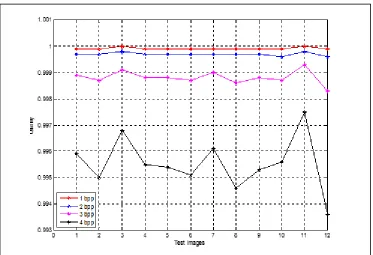
the covariance of the values from the cover image and stego image The proposed method for different payload
capacity is evaluated in terms of Quality and
the results are shown in Figure 6.
1-001 . - - - - , c - - - - , - - - , - - - , c - - - - , - - - , - - - , - - - - , - - - , - - - , - - - , - - - - ,
I I I I I I I I I
1 ----~----~--- ---l----l----J ____ J ____ J ____ .J--
--~---' 0_""3 - - - -~ --~ -- --~ - -- -~ ---- : -- -~ -- -- _:_ ----:- - -
-:-' '
' '
9:5:i - - - -L - -- - L -- - - .L - - - -.I ----.I - ---.J ----.J ----.J -----1--- - -1- -- - -1- - -
-I I I I I I I I I
----I- ----I- ----+ -- - -• -- --• - -- -... --- - ... --- - ... - - -- -,---- -•- -
-I I I I I I I I I
I I I I I I I I I
' ' ' I I I I I I I
---- ----.--- - r -- -T----y----,----
----,----~----1----1-'
I I I I I I
' ' '
----r---- ----y----,----,---- ----•--- •-- -
-.-
----,---,---' I I I I I I I
' ' '
I I I I I I
' ' '
.----~·
- i t -1 t?P : , , ,1 , , , , ,
- . t -2bpp , , , , , , , 1 , ,
---+---3 p :
- . -, t?P :
Qm '-==c::::::::5L-_j _ __JL__j _ _ j _ _ j _ _ j _ _.i _ _ i _ _j_ _ _J
0 4 5 6 7 8 9 10 11 12
Figure 6 Quality Values of the Proposed Method
6.
CONCLUSION
frequency domain and used for data hiding into other multimedia objectsIn this paper, a new data hiding scheme based on chaotic maps is presented. Chaotic maps
and modulo function are used for data hiding in this method. Data privacy is provided by
using random number generator based on
chaos. It is shown that, this algorithm being
fast and easy to perform, can be used instead of xLSBs. If the proposed algorithm is applied
in frequency domain, robustness of the
algorithm may be increased. In the future
[1]
[2]
[3]
[4]
[5]
[6]
[7]
[8]
[9]
[10]
[11]
[12]
[13]
[14]
[15]
[16]
[17]
JDFSL V12N4 A Data Hiding Scheme Based on Chaotic Map ...
REFERENCES
Celik, M. U., Sharma, G., Saber, E., &
Tekalp, A. M. (2002). Hierarchical
watermarking for secure image
authentication with localization. IEEE
Transactions on Image Processing, 11(6),
585-595.
Warkentin, M., Bekkering, E., & Schmidt,
M. B. (2008). Steganography: Forensic,
security, and legal issues. The Journal of
Digital Forensics, Security and Law: JDFSL, 3(2), 17.
Dogan, ~- (2016). A new data hiding
method based on chaos embedded genetic algorithm for color image. Artificial Intelligence Review, 46(1), 129-143.
Sutherland, I., Davies, G., Pringle, N., &
Blyth, A. (2009). The impact of hard disk
firmware steganography on computer
forensics. The Journal of Digital Forensics,
Security and Law: JDFSL, 4(2), 73.
Wang, X., Ding, J., & Pei, Q. (2015). A
novel reversible image data hiding scheme based on pixel value ordering and dynamic
pixel block partition. Information
sciences, 310, 16-35.
Dogan, S. (2017). A reversible data hiding
scheme based on graph neighbourhood
degree. Journal of Experimental e3
Theoretical Artificial Intelligence, 29( 4),
741-753.
Kulkarni, A., Goldman, J., Nabholz, B., &
Eyre, W. (2009). Detection of
Steganography-Producing Software
Artifacts on Crime-Related Seized
Computers. Journal of Digital Forensics,
Security and Law, 4(2), 5-26.
Ou, D., Sun, W., & Wu, X. (2015).
Non-expansible XOR-based visual cryptography
scheme with meaningful shares. Signal
Lai, H., Xiao, J., Li, L., & Yang, Y. (2012).
Recursive hiding of biometrics-based secret
sharing scheme using
structure. Information
Letters, 112(17), 683-687.
adversary
Processing
Tuncer, T. (2017). A novel image
authentication method based on singular
value decomposition. Journal of the
Faculty of Engineering and Architecture of Gazi University, 32(3), 877-886.
Ahmed, A. M., & Day, D. D. (2004).
Applications of the naturalness preserving transform to image watermarking and data
hiding. Digital Signal Processing, 14(6),
531-549.
Faircloth, J. (2014). Chapter 5
-Information Security, Enterprise Applications Administration, 175-220.
Vaishnavi, D., & Subashini, T. S.
(2015). Robust and invisible image
watermarking in RGB color space using
SVD. Procedia Computer Science, 46,
1770-1777.
Chang, C. C., Tai, W. L., & Lin, C. C.
(2006). A reversible data hiding scheme
based on side match vector
quantization. IEEE Transactions on
Circuits and Systems for Video Technology, 16(10), 1301-1308.
Lin, Y. K. (2014). A data hiding
scheme based upon DCT coefficient
modification. Computer Standards e3
Interfaces, 36(5), 855-862.
Liu, T., & Qiu, Z. D. (2002, August). A
DWT-based color image steganography
scheme. In Signal Processing, 2002 6th
International Conference on (Vol. 2, pp. 1568-1571). IEEE.
[18]
[19]
[20]
[21]
[22]
[23]
[24]
[25]
[26]
[27]
[28]
[29]
[30]
[31]
[32]
[33] steganography using quantization index
modulation m DCT domain. Pattern
Recognition Letters, 27(5), 455-461.
Chen, W. Y. (2008). Color image
steganography scheme using DFT, SPIHT
codec, and modified differential phase-shift keying techniques. Applied Mathematics
and computation, 196( 1), 40-54.
Zhao, W., Jie, Z., Xin, L., & Qiaoyan,
W. (2015). Data embedding based on pixel value differencing and modulus function using indeterminate equation. The Journal of China Universities of Posts and Telecommunications, 22(1), 95-100.
Gholampour, I., & Khosravi, K. (2015). Steganographic schemes with multiple
q-ary changes per block of pixels. Signal Processing, 108, 206-219.
Pan, Z., Hu, S., Ma, X., & Wang, L. (2015). A new lossless data hiding method based on joint neighboring coding. Journal of Visual Communication and Image Representation, 26, 14-23.
Hong, W., & Chen, T. S. (2012). A
novel data embedding method using
adaptive pixel pair matching. IEEE transactions on information forensics and
security, 7(1), 176-184.
Weng, S., Zhao, Y., Pan, J. S., & Ni,
R. (2008). Reversible watermarking based on invariability and adjustment on pixel pairs. IEEE Signal Processing Letters, 15,
721-724.
Tai, W. L., Yeh, C. M., & Chang, C.
C. (2009). Reversible data hiding based on histogram modification of pixel
differences. IEEE Transactions on Circuits
and Systems for Video technology, 19( 6),
906-910.
Yang, C.H., Weng, C. Y., Wang, S. J.,
& Sun, H. M. (2008). Adaptive data hiding
in edge areas of images with spatial LSB domain systems. IEEE Transactions on Information Forensics and Security, 3(3),
488-497.
Lou, D. C., & Sung, C. H. (2004). A
steganographic scheme for secure
communications based on the chaos and
Euler theorem. IEEE Transactions on
Multimedia, 6(3), 501-509.
Yi, S., & Zhou, Y. (2017). Binary-block
embedding for reversible data hiding in
encrypted images. Signal Processing, 133, 40-51.
Bailey, J. P., Beal, A. N., Dean, R. N.,
Hamilton, M. C., & Tugnait, J. K. (2014). High-frequency reverse-time chaos
generation using digital chaotic
maps. Electronics Letters, 50(23), 1683-1685.
Baykasoglu, A. (2012). Design optimization with chaos embedded great
deluge algorithm. Applied Soft
Computing, 12(3), 1055-1067.
Roy, R., Sarkar, A., & Changder, S.
(2013). Chaos based edge adaptive image
steganography. Procedia Technology, 10,
138-146.
Arivazhagan, S., Jebarani, W. S. L.,
Kalyani, S. V., & Abinaya, A. D. (2017, March). Mixed chaotic maps based
encryption for high crypto secrecy.
In Signal Processing, Communication and
Networking (ICSCN), 2017 Fourth
International Conference on (pp. 1-6).
IEEE.
Kodak Lossless True Color Image
Suite, http://rOk.us/graphics/kodak/
(05.01.2015)
L. University, UCID Image Dataset,
[34]
[35]
JDFSL V12N4
Zhang, W., Ma, K., & Yu, N. (2014). Reversibility improved data hiding m encrypted images. Signal Processing, 94, 118-127.
Wang, Z., & Bovik, A. C. (2002). Image and Multidimensional Signal Processing-A Universal Image Quality Index. IEEE Signal Processing Letters, 9(3), 81-84.