Geschke Center
Doctoral Dissertations Theses, Dissertations, Capstones and Projects
2016
The Life Experiences of Ten Female Refugees from
Iraq and Iran: An Oral History Research Study
Nicole Ludwig
University of San Francisco, [email protected]
Follow this and additional works at:https://repository.usfca.edu/diss
Part of theEducation Commons, and theNear and Middle Eastern Studies Commons
This Dissertation is brought to you for free and open access by the Theses, Dissertations, Capstones and Projects at USF Scholarship: a digital repository @ Gleeson Library | Geschke Center. It has been accepted for inclusion in Doctoral Dissertations by an authorized administrator of USF Scholarship: a digital repository @ Gleeson Library | Geschke Center. For more information, please [email protected].
Recommended Citation
Ludwig, Nicole, "The Life Experiences of Ten Female Refugees from Iraq and Iran: An Oral History Research Study" (2016).Doctoral Dissertations. 301.
THE LIFE EXPERIENCES OF TEN FEMALE REFUGEES FROM IRAQ AND IRAN:
AN ORAL HISTORY RESEARCH STUDY
A Dissertation Presented to the Faculty of the School of Education
International & Multicultural Education Department
In Partial Fulfillment of the Requirement for the
Degree Doctor of Education
By
Nicole Ludwig
San Francisco, California
Winter 2016
THE UNIVERSITY OF SAN FRANCISCO
DISSERTATION ABSTRACT
The Life Experiences of Ten Female Refugees from Iraq And Iran:
An Oral History Research Study
This qualitative study about the experiences of 10 religiously persecuted female
refugees from Iran (Baha’i) and Iraq (Chaldean) was conducted in both Northern (Bay
Area) and Southern (San Diego County) California. The study focused on three periods in
their lives: previous experiences in the refugee’s home country prior to resettlement;
adaptation to a third country during the resettlement process, especially in regard to
experiences with resettlement agencies; and finally, resettlement as refugees in the United
States. An oral history methodology was used to conduct the in-depth interviews with the
participants.
Key findings in the research study included identifying various pull and push
factors for leaving their home country and resettling in the United States, such as
religious persecution in their homelands as a push factor and the availability of education
in the United States as a pull factor. In addition, the findings revealed the hardships the
refugees were exposed to while waiting in a third country for processing of their
resettlement. Lastly, in regard to the refugees’ experience in the United States, findings
showed that the refugees’ identity was more closely tied to their religion
(Baha’i/Chaldean) rather than to their nationality and also revealed that some women had
a stronger level of independence in the United States than in their home countries.
Keywords: Refugee, women refugees, forced migration, Baha’i, Chaldean
SIGNATURE PAGE
This dissertation, written under the direction of the candidate’s dissertation committee
and approved by the members of the committee, has been presented to and accepted by
the Faculty of the School of Educationin partial fulfillment of the requirements for the
degree of Doctor of Education. The content and research methodologies presented in this
work represent the work of the candidate alone.
Nicole Ludwig January 26, 2016
________________________________ ________________
Candidate Date
Dissertation Committee
Dr. Susan Katz January 26, 2016
________________________________ _________________
Chairperson Date
Dr. Shabnam Koirala Azad January 26, 2016
________________________________ _________________
Date
Dr. Stephen Zunes January 26, 2016
________________________________ _________________
DEDICATION
I want to dedicate this dissertation to all the displaced individuals, whether it be
resettled refugees who are faced with a new country, asylum seekers, or the millions of
refugees currently living in uncertain conditions, particularly the ones who had to make a
home for themselves for the time being in one of the many refugee camps around the
world. I also want to dedicate this to my family, in particular to my mom and stepdad
who were so supportive in my time as a doctoral student. Finally, I want to dedicate this
dissertation to my wonderful partner Manuel.
ACKNOWLEDGEMENTS
First of all I want to thank my committee members, Professor Susan Katz,
Professor Shabnam Koirala-Azad, and Professor Stephen Zunes of the University of San
Francisco for helping me get through the dissertation process, in particular each time I
got discouraged during the long process of finding a topic, defending the proposal,
conducting the interviews, and preparing for the final defense.
Secondly, I would like to thank all of the participants for making time to let me
interview them during long sessions and responding to follow up questions even many
months after the initial interviews. I also want to thank my participants for placing trust in
a stranger and opening up with their personal life stories to someone they have never met
before.
I also want to thank Sahba Aminikia and Shirin Hedayati, Bay Area residents, for
helping me connect to many members in the Baha’i community and introducing me to
wonderful Persian food. I want to thank the Board of Directors at Ladies of Hope in El
Cajon, San Diego, particularly Nada Mati, the president of Ladies of Hope, who
introduced me to many members of the community and personally put me in touch with
many participants. I also want to thank the members of the Board of Directors at Ladies
of Hope for inviting me to the Board meetings and appreciating my input about their
projects. I also want to thank the Director of the Chaldean Social Services and an
anonymous case worker at the local International Rescue Committee for letting me
interview them during one of my visits in San Diego and giving me pointers and
A huge thank you to Assim Alkhawaja who brought me down to San Diego for
the very first time in the fall of 2013 and helped me connect to the Chaldean community
in El Cajon, even attending a church service in Aramaic with me. I would like to also
thank his family and friends in San Diego for hosting me on multiple occasions, for
taking me around San Diego, giving me airport rides, and letting me enjoy their
wonderful Middle Eastern food at Café Bassam. Pam Ly, I will owe you forever for
letting me stay at your wonderful apartment in North County for weeks, putting up with
me sleeping on you couch, and going to early morning yoga classes with me.
I would also like to express my deep thank you to the other doctoral students at
USF, especially Julie Sullivan, Kirsten Guan, Ion Vlad, Mijiza Sanchez, and Lindsay
Padilla, for offering words of advice on many occasions during the years at IME,
particularly during the dissertation process.
I would like to thank many of the participants and faculty of the Summer Institute
of 2013 at the Refugee Studies Centre at the University of Oxford for inspiring me to
refine my topic and giving me incredibly valuable insights about the world of refugee
studies. In particular, I am grateful to Ewa from the Red Cross in Sweden, Mette in
Copenhagen, and Maria in Spain, for answering questions about the life of refugees in
Europe and sending me valuable information.
To my family in Germany I would like to give a big hug to their support, in
particular my mom and my stepdad for encouraging and reminding me that education is
the most important thing in a girl’s life. To my wonderful boyfriend, Manuel Rodriguez, I
would like to thank him deeply for being there for me in the last few months of my
TABLE OF CONTENTS
DISSERTATION ABSTRACT ... ii
SIGNATURE PAGE ... iii
DEDICATION ... iv
ACKNOWLEDGEMENTS ... v
TABLE OF FIGURES AND TABLES ... ix
CHAPTER I: INTRODUCTION ... 1
Statement of the Problem ... 2
Background and Need ... 3
Theoretical Framework: Post-colonial/Third World Feminism ... 14
Purpose of the Study and Research Questions ... 16
Limitations of the Study ... 17
Significance of the Study ... 18
Background of the Researcher ... 19
Definition of Terms ... 22
CHAPTER II: LITERATURE REVIEW ... 25
Introduction ... 25
Legal Framework of Refugee Rights ... 25
The Refugee Regime ... 30
UNHCR and Other Stakeholders ... 30
Refugees in the United States ... 33
Refugees in the Western Hemisphere: Resettlement and Asylum ... 33
Iraqi and Iranian Refugee Populations ... 39
Summary ... 45
CHAPTER III: METHODOLOGY ... 47
Research Design and Methodology ... 47
Participants ... 48
Data Collection ... 52
Data Analysis ... 54
Protection of Human Subjects ... 55
Research Question 1: ... 63
Research Question 2: ... 75
Research Question 3: ... 87
CHAPTER V: ... 97
SUMMARY, DISCUSSION, RECOMMENDATIONS & CONCLUSION ... 97
Summary ... 97
Discussion ... 99
Recommendations ... 110
Personal Reflections ... 115
Conclusion ... 117
REFERENCES ... 119
Appendix A: ... 125
TABLE OF FIGURES AND TABLES
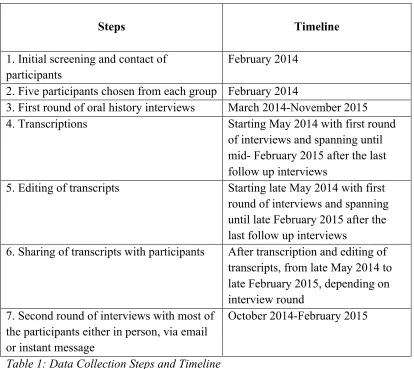
Table 1: Data Collection Steps & Timeline ………55 Table 2: Participants………...………..……….58
CHAPTER I: INTRODUCTION
"We are witnessing a paradigm change, an unchecked slide into an era in which
the scale of global forced displacement as well as the response required is now clearly
dwarfing anything seen before" (UNHCR, 2015, para.1). Former United Nations High
Commissioner for Refugees António Guterres stated in regard to the current crisis of
massive displacement fueled by the violence and instability in the Middle East (and in
particular Iraq, Syria and Afghanistan). According to the UNHCR (2015), worldwide
forced displacement was at its highest ever in 2014. At the end of 2014, 59.5 million
people were displaced, an immense increase from 51.2 million just a year earlier, and
from only 37.5 million a decade ago. Currently, one in every 122 individuals has a status
as a refugee, internally displaced person (IDP), or is seeking asylum, which would
constitute the 24th largest country by population (United Nations, 2015). This number
included 19.5 million refugees, 38.2 million internally displaced persons and about 1.8
million people with pending asylum applications (UNHCR, 2015).
The UNHCR (n.d.) defines a refugee as an individual who is:
persecuted for reasons of race, religion, nationality, membership of a particular
social group, or political opinion, is outside the country of his nationality and is
unable to or owing to such fear is unwilling to avail himself of the protection of
that country. (para. 1)
In contrast to refugees, IDP’s are defined as people who “have not crossed an
international border to find sanctuary but have remained inside their home countries.
Even if they have fled for similar reasons as refugees, IDPs legally remain under the
neighboring countries of their originating country, and only a very small percentage has
the opportunityto leave their region of origin and get resettled to an industrialized
country. From 2002 to 2012 about 836,000 refugees were resettled, mainly through the
UNHCR and with the help of some NGO’s to Europe, North America and Australia
(UNHCR, 2013). Consequently, forced displacement of populations continues to be a
serious problem in the 21st century and is doomed to increase over the next years due to
continued political instability and conflicts in many regions of the world.
Statement of the Problem
Of the world’s refugees, 48% are women and girls, who constitute a particularly
vulnerable group of displaced people (UNHCR, 2013). While all refugees have to face
certain kinds of hardship in fleeing their home country, women and girls usually have to
deal with added pressures, ranging from being subjected to sexual abuse and violence in
refugee camps, difficulty attaining refugee status based on “gender-related” asylum
claims (such as persecution due to female genital mutilation, forced marriage, domestic
abuse), being exposed to harsh conditions in detention centers while waiting for asylum
claims to process and identity struggles due to not feeling at home in a new country
(Brane & Wang, 2013; GAO, 2003; Musalo, 2010; Okigbo, Reierson & Stowman, 2009).
A small number of recent studies have examined the experiences of women
refugees from Iran (members of the Baha'i religion) and Iraq (members of the Christian
faith, who identify as either Chaldean or Assyrian); therefore a gap in the research exists
for these specific groups. Furthermore, many of the empirical studies that research
women from different countries and cultures, who come out of different reasons, might
have very distinct experiences. For instance, Okigbo, Reierson and Stowman (2009)
stated that their participants were from numerous countries, but at no point did they
highlight what the differences in their home countries and diverse backgrounds might
mean for the findings.
Even among the studies that did focus on Iraqi refugees in the U.S. (Government
Accountability Office, 2010; Hanna 2011; Yako & Biswas, 2013), none discussed the
distinct experiences of females as they all were mixed gender studies. Even though
Ghorashi (2008) and Williams (2009) focused on female Iranian refugees in their studies,
Williams (2009) concentrated on Iranian refugees in Australia and not in the U.S., and
Ghorashi (2008) did not focus on Baha’i women despite including women in the United
States among her participants. Furthermore, no study has attempted the objective of this
study to compare the Iraqi and Iranian refugee population, or used the methodology of
oral history in order to allow the participants to delve into great detail about their lives.
Thus this dissertation study was unique in the scholarly literature.
Background and Need
Minority Persecution in Iran
Even though Iran is dominated by Shia Muslims, the religious composition of the
population is very diverse with Baha'i, Christian, Jewish, Zoroastrian and Mandean
individuals as the minority (Sanasarian & Davidi, 2007). Each of these minority groups
has experienced a certain degree of discrimination, but none to the degree that have
affected members of the Baha’i faith. The Jewish population has suffered attacks, such as
also subjected to harassment; for example, some churches are closed and identity checks
are made before entering Christian centers. Even kidnappings of pastors have occurred in
the last decade (Sanasarian & Davidi, 2007).
Discrimination against non-Muslims is further illustrated by blood money (money
being paid as compensation to the family of victims by the perpetuator, even in case of an
accident) being less for non-Muslims than Muslims; blood money for a non-Muslim male
is half that of a male Muslim man. The outcome of this continued discrimination against
religious minorities in Iran is the rapid decline of these minorities, as the Jewish
population has decreased from about 80,000 in the 1970s to 13,000 in 1996, while 15,000
to 20,000 Christians are emigrating each year (Sanasarian & Davidi, 2007). However,
none of the other religious groups have faced as much discrimination as the Baha’i.
Oppression of the Baha’i
An early version of the Baha’i religion (called Babi) was founded by The Bab in
the mid-nineteenth century; ever since its early days the faith has faced persecution. The
Bab was killed by the government as the traditional clerical class saw a threat to its
monopoly if the Babi religion would spread further (Kazemzadeh, 2000). The religion
was continued by a prominent follower of The Bab, Mirza Hoseyn Ali Nouri (later called
Baha'u'llah), who renamed the religion to Baha'i. Persecution of the faith continued under
the two Pahlavi Shahs (1925-1979); Baha'i schools were closed, marriages were not
recognized, and generally members of the faith were treated as second-class citizens.
Since the overthrow of the Shah and the Islamic revolution in 1979, the
persecution of the Baha’i has intensified severely. Baha'is have been subjected to a
practicing many professions (i.e. law, medicine, psychology) and attending universities
(Kazemzadeh, 2000). The cruelest measure of the government has been the killings and
disappearances of Baha'i leaders since the revolution in 1979. As Kazemzadeh (2000)
points out, “ The strategy was plain. Destroy the head and the body will wither and die”
(p. 548). Baha'i is also the only religion which is not mentioned and legitimized in the
current Constitution of Iran, thus having the status of “unprotected infidels.”
(Kazemzadeh, 2000).
Momen (2005) argues that the situation of the Baha'i in Iran can be compared to a
certain extent with the genocides that occurred against the Jewish and Armenian
populations. Since 1979 the Iranian government was actively proceeding towards
genocide of the Baha'i. This movement was somewhat stopped by international
campaigns led by members of the Baha'is outside Iran, resulting in a number of United
Nations resolutions, most recently resolution 67/182in December 2012
.
Therefore, thecurrent situation in Iran could be correctly labeled as a “suspended genocide” (Momen,
2005, p. 239).
A more appropriate term not only because it is more accurate, but also because it
prevents any relaxation of vigilance over a situation that could deteriorate to a full
genocide at any time. This is borne out by the fact that the persecutions worsened
again during the period when reporting in Iran was dropped from the agenda of
the UN Commission on Human Rights. (Momen, 2005, p. 239)
Despite this harsh persecution and repression, Karlberg (2010) describes how the
Baha'i in Iran have “pursued a distinctively non adversarial approach to social change
discrimination in Iran, the Baha'i are committed to obedience of the laws of the state,
peaceful creation of alternative institutional models, and commitment to face persecution
with love and compassion.
An example of an “alternative institutional model” is the Baha'i Institute for
Higher Education (BIHE), an underground university created in 1987 to provide higher
education for Baha'i who banned from entrance to universities in Iran (Karlberg, 2010).
In addition, the international Baha'i community outside Iran has adopted a strategy that
shines light on human rights abuses against this religious minority in Iran in order to
heighten global awareness. This strategy has been very successful as the United Nations
has taken notice of oppression, international media has given the struggle of the Baha'i
some attention, and human rights organizations have lobbied on behalf of the Baha'i
(Karlberg, 2010).
While the severity of the prosecution of Baha’i ebbed in the 1990s, it has
intensified again in the last decade (Kazemzadeh, 2000). According to the Baha’i
International Community (BIC), an organization affiliated with the United Nations,
government-led attacks on Baha’i in Iran have been on the rise since 2005. As of 2014,
136 Baha’is are reportedly imprisoned on false charges related to the practice of their
religious belief system (Baha’i International Community, 2014). Since 2005 more than
710 Iranian Baha’is have been arrested including all seven Baha’i leaders who currently
serve 20-year sentences (Baha’i International Community, 2014). Among the more
disturbing recent imprisonments are cases where Baha'i women have been imprisoned
together with their infants. For example, on April 27, 2013, a woman and her
were documented where babies were imprisoned along with their mothers (Baha’i
International Community, 2014).
In 2010, Iran had its first Universal Periodic Review (UPR), a mechanism of the
Human Rights Council at the United Nations. At the end of the review, of the 188
recommendations by the United Nations in regard to human rights, Iran accepted 123.
Several of the accepted recommendations concerned religious freedoms and four of those
recommendations mentioned specifically the Baha’í. In the Summer of 2013 President
Rouhani won the elections. His campaign platform included a number of promises to
improve human rights in Iran, including pledges to end religious discrimination (Baha’i
International Community, 2014). Iranian government officials have publicly denied any
discrimination towards Baha’i, or have proclaimed that if any Baha’í members are
detained or otherwise negatively affected, it is because Baha’í is a political movement
(Baha’i International Community, 2014).
Despite the public assertions of the Iranian government, human rights atrocities
against Baha’ís have continued and in many ways worsened (Baha’i International
Community, 2014). Since the 2010 UPR report, more than 400 Baha’ís have been
detained, constituting an increase in arrests from the preceding years. In addition, in the
period since the 2010 UPR, anti-Baha’í propaganda has been widely distributed in Iran’s
government controlled media. Baha’ís have been portrayed as the source of any
conceivable evil; for instance, Baha’is have been accused of acting as foreign agents and
branded as social outcasts who should be shunned (Baha’i International Community,
Currently, most young Baha’í do not have access to higher education. In 2003,
international pressure led the government to modify the university entrance examination
in order for individuals identifying as Baha’i to be able to take the exam. However, in
practice, most Baha’í are still excluded from universities in Iran due to a computer
program that returns applications as “incomplete” once the applicants are confirmed to be
Baha’i. Even official government documents have shown a systematic approach to
exclusion. In 2006, the government wrote a memorandum to most universities ordering
the expulsion of Baha’í students if their religion was revealed. Furthermore, educational
discrimination extends even to high school and elementary schools. While the
government allows Baha’i to attend pre-university education, students still face
harassment by administrators and teachers (Baha’i International Community, 2014).
Since 2010, efforts to marginalize the Baha’i community have continued.
Multiple attempts to close the Baha’i Institute of Higher Education (BIHE), the
underground university, have been made by the government. Such attempts have
included efforts to arrest teachers and administrators of the institution. In May 2011,
agents raided 30 homes all over Iran and arrested 16 Baha’is who were involved with
BIHE. Of those arrested 12 were sentenced to four to five years in prison (Baha’i
International Community, 2014). Furthermore, the Iranian government has made it
increasingly tougher for Baha’i to achieve an adequate living standard due to
discrimination in employment opportunities. Government jobs and careers in education
and law have excluded Baha’is since 1979.
In addition, entrepreneurial endeavors by Baha’i been discouraged by shop
businesses (Baha’i International Community, 2014). Furthermore, the perpetrators of
violence against Baha’is and vandalism against their properties have been protected from
prosecution by the Iranian government. Between the years of 2005 to 2012, hundreds of
violent attacks took place against Baha’is or their properties. However, during the same
time period, none of the perpetrators of attacks were prosecuted (Baha’i International
Community, 2014).
Persecution of Christians in Iraq
Christianity in Iraq has a long history, dating back to when Christianity
established itself in Mesopotamia during the first century and developed into a
well-structured community during the second century. The Christian population continued to
play an important role in modern day Iraq and at the beginning of the second Gulf War in
2003 Christians made up between four and five per cent of the Iraqi population
(approximately one million individuals). The majority consisted of Aramaic-speaking
Chaldeans with 70%, and the remaining percentage being comprised of Syrian Catholic,
Syrian Orthodox, and Assyrians, as well as smaller numbers of Armenians, Protestants
and Greek Orthodox, for example.
Even though many scholars do not distinguish between Chaldeans and Assyrians
since both are Christians, a distinct difference exists between the two groups; usually
people’s identity is tied very strongly to either being Assyrian or Chaldean.
Approximately two-thirds of Christians are Chaldeans, belonging to an Eastern rite of the
Catholic Church, and about a third are Assyrians who follow the Church of the East.Both
Rights Watch, 2009). The majority of those Christians have been living in the cities of
Baghdad, Mosul (including a multitude of town and villages surrounding Mosul in the
Nineveh area), and Basrah (Rassam, 2008).
In 1972 the Ba’ath party supported recognizing the cultural rights of the
Aramaic-speaking people. As a result, Aramaic was included as a language of instruction in
primary and secondary schools, programs in Aramaic were broadcasted on television, and
even magazines were published for the Chaldo-Assyrian population (Hanish, 2011).
However from the mid 1970s the government introduced “arabization,” which sought to
alter the ethnic composition of northern Iraq by displacing thousands of Kurds,
Chaldeans, Assyrians, as well as other minorities from their land, re-populating the land
with Arabs. This policy lasted until the U.S. invasion in 2003 (Human Rights Watch,
2009).
Since the U.S. invasion of Iraq in 2003, the number of Christians, namely
Chaldeans and Assyrians, in Iraq have declined rapidly, since they have been the target of
both Sunni and Shi’a Islamist groups (Hanish, 2011). From 2003 to 2008, over 350,000
Christians out of a population of 1,000,000 fled Iraq before the invasion of the US
(Youash, 2008). From 2003 onwards, especially in the Nineveh area (a traditional
stronghold for Christians in Iraq), where the Arab-dominated central government and the
Kurdistan Regional Government (KRG) struggle for control, Chaldo-Assyrians have
suffered greatly (Human Rights, 2009). Right after the invasion of Iraq in 2003, Kurdish
militia fighters (peshmerga) vied for control in Nineveh, and a civil war between Sunni
who were accustomed to much privilege and influence before 2003 (Human Rights
Watch, 2009).
In extremist Islamist propaganda, Chaldo-Assyrians are often perceived as
collaborators with the US since they share a common religion; one common extremist
message to Christians is “Death to U.S. Agents” (Youash, 2008, p. 347). Usually
Christians are given the option of either converting to Islam and showing commitment in
their conversion, or facing threats of kidnappings and murder. If these threats are
unsuccessful, many members of the Chaldo-Assyrian community are kidnapped or
murdered and churches are often bombed or attacked (Youash, 2008).
In the summer of 2007, Christians were threatened in their own homes with the
orders: “Convert to Islam, or leave, or face the consequences.” This is how the “al-Dora”
neighborhood in Baghdad was emptied of the vast majority of Christians. “Al-Dora” used
to be nicknamed the Vatican of Iraq, since mostly Christians lived in the area amidst a
strong presence of religious buildings, with two cathedrals as well as of several churches,
the Chaldean seminary and theological college (Rassam, 2008).
One of highest profile attacks against the Chaldo-Assyrian community happened
on February 2008, when Archbishop Paulus Faraj Rahho from Mosul was kidnapped.
The assailants shot his driver and killed the Archbishop later on (Human Rights Watch,
2009). An Assyrian leader states, “Before we understood that we had a totalitarian
government and therefore abuses happened. But now we are supposed to be free and
Baghdad, the Christians who remain in the city rely on checkpoints for their protection
and security. Even though heightened security is in place, incidences of severe violence
are happening, such as a hostage taking in the Saidat al Najat (Our Lady of Salvation)
church in Baghdad in October 2010, motivating many Christians to migrate (IOM, 2011).
In the last two years, the severity of the persecution has increased dramatically
due to the rise of the terrorist organization of the Islamic State of Iraq and the Levant
(ISIS) (referred to inter-changeably as ISIL, Islamic State or Daesh in the media), taking
over parts of Iraq, particularly the Nineveh area. For the very first time in almost 2,000
years, virtually no Christians were left in the city of Mosul after ISIS issued a statement
on July 18, 2014, warning that all Christians should convert to Islam. The remaining
Christians were ordered to either pay the “jizya,” a tax by Muslims over non-Muslims, or
else face death. In addition, Christians were not allowed to take belongings with them
when leaving the area (Human Rights Watch, 2015). In the aftermath, Mosul’s Christian
sites have been either destroyed or converted into mosques (Isaac, 2014). The Christians
have largely migrated to Dohuk or Irbil in Kurdistan to seek refuge (Cole, 2014).
According to Cole (2015), the Human Rights Commission of Iraq, an institution
attached to the Iraqi parliament, issued statistics in June 2015 outlining the one-year
impact of ISIS on that country. Such statistics show 3,000,000 Iraqis displaced and
50,000 killed within the one-year time span beginning in the summer of 2014. On June
10, 2014, ISIS took over Mosul (Cole, 2015). This organization has committed many
atrocities, such as ongoing suicide attacks, executions, torture, gender discrimination,
around Mosul. A multitude of Christian towns, which for thousands of years were
inhabited by Assyrians, Chaldeans, and Syriacs are now abandoned. For instance, in the
town of Telskuf, the main square is deserted, which was once a thriving market with an
abundance of food. Of the previous 7,000 residents, only a handful remain (Human
Rights Watch 2015). Militants have also marked Christian homes with a red Arabic ‘‘n,’’
for Nasrane, a slur, and have taken over the water supply, which supplied the surrounding
Nineveh Plain (New York Times, 2015). The estimate is that instability since the 2003 war
and persecution by ISIS have reduced the population of Christians in Iraq to around
260,000, from a peak of about 1,250,000 during the rule of Saddam Hussein (AINA,
2015).
The arrival of ISIS has led to the creation of Christian self-defense units in areas
where Christians have been persecuted by the militants. For example, The Nineveh Plain
Forces (NPF), a 500-member militia comprised by Christians, patrols a number of towns
with Christian populations. The NPF, the Dwekh Nawsha, and the Nineveh Plains
Protection Units (NPU), are all locally formed militias, whose aim is to take back the
Christian lands from ISIS. (New York Times, 2015).
The extensive historical background in this section is intended to portray the
difficult circumstances which the Iranian Baha’i and the Iraqi Chaldean refugees in this
study experienced in their home countries. Many of these issues and challenges directly
impacted all the participants. While religious persecution exists in the countries
discussed, the persecution is experienced somewhat differently in each country. In Iran,
the government is spearheading the persecution, while in Iraq the religious persecution
in the last few years by ISIS. Even though the persecution comes from very different
factions in those nations, the end result is the same: the daily life of religious minorities is
negatively affected to the extent that living in their home country is no longer feasible.
Theoretical Framework: Post-colonial/Third World Feminism
This study was framed by Post-colonial/Third World Feminist Theory
(Johnson-Odim, 1991; Mohanty, 1984, 1991; Spivak, 1988) One of the most widely read
post-colonial theorists is Chandra Mohanty (1984), who in her landmark essay, “Under
Western Eyes,” presents her criticism of “Western” feminism. Mohanty in particular
rebukes the fact that Third World women are often seen as a monolithic group by the
West:
feminist writings colonize the material and historical heterogeneities of the lives
of women in the third world, thereby producing /re-presenting a composite,
singular third world woman - an image which appears arbitrarily constructed, but
nevertheless carries with it the authorizing signature of Western humanist
discourse. (p. 19)
As Mohanty (1991) further explains in “Cartographies of Struggle:”
Just as Western women or white women cannot be defined as coherent interest
groups, Third World women also do not constitute any automatic unitary group.
Alliances and divisions of class, religion, sexuality, and history, for instance, are
necessarily internal to each of the above groups. (p. 49)
Mohanty (1984) also elaborates how the image of an “average third world
woman” is socially constructed, defining her as sexually oppressed, uneducated, home
educated, modern and in control of her own life. Mohanty (1984) supports her argument
with examples of writers who represent “Third World” women as this “homogenous
powerless group,” such as Fran Hosken (1980) who writes about female genital
mutilation, or Patricia Jeffery (1976) who portrays women as victims of Islam (Mohanty,
p. 23). Similarly, Mohanty criticizes how Gail Omvedt (1979) discusses “Indian women,”
but conducts her case study on a specific group of females in Maharashtra, or Minces
who discusses “Arab women” as if all women in the Middle East are the same. Mohanty
(1984) explains that not only do a large number of Western writers focus on these same
topics (i.e., women are oppressed by men), but putting Third World women in such
homogenous categories is very problematic, as it “assumes an ahistorical, universal unity
between women based on a generalized notion of their subordination” (p. 31). Mohanty
(1984) states that this portrayal of Third World women is a “colonial move,” as those
females never rise above an “object status” (p. 39).
Spivak (1988) discusses in another landmark essay, “Can the Subaltern Speak?,”
the representation of individuals in the Third World, especially women. Traditionally the
colonial subject or what Spivak (1988) refers to as the “subaltern” (men and women of
the illiterate classes, tribes and lowest classes of the urban dwellers) is represented as the
“other” in the first world. Spivak (1988) states:
Both as object of colonialist historiography and as subject of insurgency, the
ideological construction of gender keeps the male dominant. If, in the context of
colonial production, the subaltern has no history and cannot speak, the subaltern
as female is even more deeply in shadow. (p. 287)
World woman is represented as monolithic and needs to be saved by the white man from
the brown man. Thus, Spivak comes to the conclusion that no, the “subaltern cannot
speak” (p. 308).
Johnson-Odim (1991) states in her contribution to Third World Feminism that the
oppression of Euro-American women is associated with gender and class, but Third
World women’s oppression is also linked to race and imperialism. As the author states:
… gender oppression cannot be the single leg on which feminism rests. It should
not be limited to merely achieving equal treatment of women vis a vis men. This
is where feminism as a philosophy must differ from the shallow notion of
‘women’s right.’ (p. 320)
Thus, Johnson-Odim (1991) concludes that feminism must be a “comprehensive and
inclusive ideology” and if it does not include issues such as race and imperialism, then it
does not apply to the majority of women in the world (p. 321).
It is crucial to view the stories of the participants in this study through a
Post-colonial/Third World feminist perspective versus traditional Western feminism. All of the
issues that Mohanty (1984,1991), Spivak (1988), and Johnson-Odim (1991) address
apply to female refugees from Iran and Iraq who resettled in the United States. Many
times, female refugees from a varied background of countries are seen as a monolithic
group and the differences between the women’s cultural, religious and ethnical
background are neglected.
Purpose of the Study and Research Questions
The purpose of this study was: (1) to analyze the life experiences of women
to identify strategies and coping mechanisms that the participants found effective in
facilitating the transition to their new home. The study was guided by the following
research questions:
1. What are the push factors for leaving their home country and the pull factors
for resettling as refugees in the United States?
2. What is the impact of government programs/inter-governmental
organizations/NGO’s/local communities?
a. What role did the government and inter-governmental programs play
in helping female refugees make the transition from the home country
to the United States?
b. What role did NGO's/local communities play in the transition and
acclimation of women refugees in the United States?
3. What kind of experiences do women refugees from Iraq and Iran have in the
United States?
a. How do their experiences in the US impact the identity of the women
refugees?
b. How do women refugees from Iraq and Iran adjust to United States
society?
Limitations of the Study
Participants were chosen from two different communities: Iraqi Chaldean
refugees in El Cajon (East San Diego) in Southern California and Iranian Baha’i refugees
in the Bay Area and North San Diego. Since only five participants were chosen per group
possible. Secondly, some of the Iraqi and Iranian participants were not fluent in English,
and thus an interpreter was employed for two of the ten participants. Due to the nature of
interpretation, some details of the interview might have been lost in translation. Thirdly,
since the participants were describing their experiences of persecution in Iran and Iraq,
which occurred several years ago, selective or incomplete memory was possible. Finally,
since I was an outsider to both communities, trust, and willingness to participate was an
issue especially in the Chaldean community. This lack of trust also may have led to the
fact that some of the participants did not tell me the most personal and private of their
experiences.
Significance of the Study
By examining the experiences that women refugees face in the United States and
hearing their perspectives, government organizations, NGO’s, inter-governmental
organizations such as the United Nations or other organizations concerned about women
refugees will benefit from insights on how to support this population more effectively.
Especially, local organizations that deal directly with the communities of Iranian and
Iraqi refugees will benefit greatly from the detailed insights gained from this study.
Examples of these organizations are the Ladies of Hope, or the local chapter of the
International Rescue Committee in San Diego County that serve the Chaldo-Assyrian
population in El Cajon. Lastly, underrepresented voices of female refugees from Iran and
Iraq were heard and represented in detail due to the oral history methodology, to allow
Background of the Researcher
My interest in the Middle East stems partially from my own family background.
When I was in my late teens, my mother remarried a Muslim man from Lebanon. All of a
sudden my conservative and somewhat sterile family was surrounded by the hospitality
and warmth of another culture and a big family. My mother did not only marry my
stepfather but also inherited his four brothers and one sister, who quickly became my
extended family as well. In 1975, right after the Civil War in Lebanon started, my
stepfather left Beirut with his family and fled to Turkey. After a few years in Turkey, the
whole family decided to emigrate to Germany to start a new life. When I was a teenager
my mother met my stepfather in Stuttgart, Germany. Once my stepfather was part of my
family, I was fascinated and intrigued by his stories about his home country and culture.
The first time I came to the United States was in the early 2000s, not long after
9/11, and I originally believed that the United States was an amazing melting pot of
cultures, races and ethnicities that more or less lived peacefully with each other. Oprah
Winfrey, Bill Cosby, Michael Jordan, some of the most recognized names in the
entertainment industry are non-white, so I naively imagined the Unites States to be the
land of equal opportunity for all. After a few months of living in San Francisco, I quickly
realized that actually racism, discrimination and unequal opportunities were the harsh
reality, even in the supposedly most liberal city of the United States. In fact, I found out
the Bay Area and California in general are quite segregated racially and ethnically in
regard to housing as well as social interactions. Specifically, I noticed the segregation of
Afghani population, and El Cajon, near San Diego, hosts the second largest Iraqi
(Assyrian/Chaldean) population.
In February 2012, one of the foremost scholars in the United States on racism and
white privilege, Tim Wise (2013), compared the United States with Pakistan in a speech
at the University of San Francisco:
Benazir Bhutto, was twice elected Prime minister of Pakistan. It would be absurd
for anyone to suggest that Pakistan has conquered all issues of sexism. And yet, in
America, the election of Barack Obama has been pointed to by the mainstream
media as evidence that racism no longer exists. (Wise, 2013)
Moreover, I was especially horrified that in the post 9-11 era, the Middle East and
Islam were often associated with terrorism, Jihad and anti-Americanism. However, after a
few years in the United States, I also realized how I as a white, European woman
benefitted from white privilege. Countless examples over the years come to my mind; for
instance, I am never asked by law enforcement what I am doing in a certain
neighborhood at a certain time, when I am in a store the employees treat me nicely, and
most of the time people are excited and interested in my German heritage. I also have
seen how the reaction I am receiving from mainstream society is not the same treatment
that my non-white friends receive.
I continued my interest in Middle Eastern studies during my undergraduate years
where I majored in History and minored in Political Science. I intensified this interest
during my Master’s in International Policy Studies at the Monterey Institute of
International Studies, where my study emphasis was human rights. After joining the
and taking classes such as Whiteness, Power and Privilege, Race and Ethnicity in the
United States, and Immigration and Forced Displacement, I realized further how deeply
entrenched institutional and societal discrimination are in the United States and how, at
the same time, white privilege is the norm.
As Peggy McIntosh (1990) explains, white privilege is:
… an invisible package of unearned assets that I can count on cashing in each
day, but about which I was meant to remain oblivious. White privilege is like an
invisible knapsack of special provision, maps, passports, codebooks, visas,
clothes, tools, and black checks. (p. 1)
Furthermore, Pease (2012) states, “most privilege is not recognized as such by
those who have it. Not being aware of privilege is an important aspect of privilege” (p.9).
By acknowledging my deeply rooted privilege not only as a white woman, but also as
someone who came willingly to the United States and grew up in a democratically stable
and developed country, I am taking the first step necessary to start a productive
interaction with my participants. I am not oblivious to my “knapsack” (McIntosh, 1990,
p. 1) but aware that I had and still have many advantages because of the color of my skin
and my heritage. Pease (2012) explains,
… from a social justice perspective, members of privileged groups have a
responsibility to critically reflect upon their own position. Members of
privileged groups need to be aware of the ways in which their speaking positions
can be oppressive and dangerous and, at the same time, not retreat from political
work that is contentious. (p.31)
woman from Iraq or Iran, not only due to the cultural differences, but also because of my
white privilege. I could never know how it feels to be uprooted from your country
unwillingly, even persecuted, or to encounter a new country that is not always hospitable
and welcoming. Thus, I was always an outsider among my participants, but I did my best
to be empathetic and listen to my participants’ stories. Just as Pease (2012) states, I had to
be careful that my speaking position as a white researcher did not become oppressive at
any point during the data collection process. Thus, I believe an oral history approach fit
best as my methodology so that my participants were freely able to tell their stories.
Definition of Terms
Asylum:
“The terms asylum-seeker and refugee are often confused: an asylum-seeker is
someone who says he or she is a refugee, but whose claim has not yet been definitively
evaluated. National asylum systems are there to decide which asylum-seekers actually
qualify for international protection. Those judged through proper procedures not to be
refugees, nor to be in need of any other form of international protection, can be sent back
to their home countries” (UNHCR, n.d., para.1).
IDP: Internally Displaced People
“Unlike refugees, IDPs have not crossed an international border to find sanctuary
but have remained inside their home countries. Even if they have fled for similar reasons
as refugees (armed conflict, generalized violence, human rights violations), IDPs legally
remain under the protection of their own government – even though that government
Protracted Refugee Situation:
“A protracted refugee situation isone in which 25,000 or more refugees
originating from the same country have sought asylum in another country (or countries)
for at least five consecutive years” (United States Department of State, year, para.1).
Refugee:
“ An individual owing to a well founded fear of being prosecuted for reasons of
race, religion, nationality, membership of a particular social group, or political opinion, is
outside the country of his nationally and is unable to or owing to such fear is unwilling to
avail himself of the protection of that country” (UNHCR, n.d., para. 3).
Resettlement:
Resettlement involves the selection and transfer of refugees from a State in which
they have sought protection to a third State which has agreed to admit them - as refugees
- with permanent residence status. The status provided ensures protection against
‘refoulement’ and provides a resettled refugee and his/her family or dependents with
access to rights similar to those enjoyed by nationals. Resettlement also carried with it the
opportunity to eventually become a naturalized citizen of the resettlement country”
(UNHCR, 2011, p. 9).
Resettlement agencies:
The resettlement agencies which help the refugees in the adjustment period in the United Stated include the International Rescue Committee, the Catholic Charities,
Alliance for African Assistance and the Hebrew Immigrant Aid Society (HIAS).
The UNHCR is the main stakeholder and gatekeeper in the international refugee
regime and works closely with NGO’s and governments in fields such as refugee camp
management, resettlement and repatriation (Clark, 2008).
Baha’i Institute of Higher Education (BIHE)
The Baha’i Institute of Higher Education (BIHE) is an underground university in
Iran established 1987, that was founded and operated by Baha’i leaders in response to the
government policy of not allowing Baha’i to any of the public universities in Iran after
1979. Many of the participants of this study or their family members have completed
coursework or attained Bachelor or Master degrees at BIHE. The university was first
based in Professors private residences and other private homes, and in the last decade
more and more classes were offered online. Currently BIHE has about 700 faculty
members and offers over 1000 courses either classroom based or online and graduates of
BIHE have been more and more accepted to universities in the USA, Australia and
Europe. However, the Iranian government has not up to this day recognized degrees
obtained at BIHE, and faculty and students have faced oppressive conditions, such as
arrests of teachers, raids of locations, and confiscations of equipment, from the Iranian
government for teaching and attending BIHE up to this day (BIHE, 2006).
CHAPTER II: LITERATURE REVIEW Introduction
This literature review is divided into three main sections. The first part explores
the international legal framework of refugee rights, with the 1951 Convention relating to
the Status of Refugees and the 1967 Protocol relating to the Status of Refugees. The
second part examines the refugee regime with particular attention to the activities of the
UNHCR. The third and final part discusses the United States refugee population. It first
portrays the experiences of refugees who have gone through the resettlement and asylum
process, and then discusses Iraqi and Iranian refugee populations.
Legal Framework of Refugee Rights
International Legal Framework: 1951 Convention Relating to the Status of Refugees
and 1967 Protocol Relating to the Status of Refugees
The main pillars of the international legal framework regarding refugee law are
the 1951 Convention relating to the Status of Refugees and the 1967 Protocol relating to
the Status of Refugees (Clark, 2008; Musalo, Moore, & Boswell, 2011; Goodwin-Gill,
McAdam, 2007). Musalo, Moore and Boswell (2011) explain that the 1951 Convention
was created in the aftermath of World War II. The original intent was to create a
document that would protect individuals fleeing from persecution related to World War
II; as a result, it originally was limited in its scope to events happening before 1951 and
only pertaining to Europe. Not until 1967, with the amendment of the Protocol relating to
the Status of Refugees, were both the geographic and time limitations lifted, making it
apply to individuals created by events at any time in order to keep up with new refugee
apart from this expansion, all the articles in the 1951 Convention and the 1967 Protocol
are the same (Musalo, Moore, Boswell, 2011).
According to Goodwin-Gill and McAdam, (2007), refugees are identifiable by
having four main characteristics based on the refugee definition outlined in Article 1 by
the 1951 Convention and the 1967 Protocol:
1. They are outside their country of origin 2. They are unable or unwilling to seek
or take advantage of the protection of that country, or to return there, 3.
Suchinability or unwillingness is attributable to a well-founded fear of being
persecuted; and 4. The persecution feared is based on reasons on race, religion,
nationality, membership of a particular group, or political opinion.
(Goodwin-Gill, McAdam, 2007, p. 37)
One of the most important aspects of the 1951 Convention is article 33, which
covers prohibition of expulsion or return, also called “non-refoulement” (Clark, 2008;
Musalo, Moore, & Boswell, 2011; Goodwin-Gill, & McAdam, 2007). Specifically,
article 33of the 1951 Convention states:
1. No Contracting State shall expel or return(“refouler”) a refugee in any manner
whatsoever to the frontiers of territories where his life or freedom would be
threatened on account of his race, religion, nationality, membership of a
particular group or political opinion.
2. The benefit of the present provision may not, however, be claimed by
arefugee whom there are reasonable grounds for regarding as a danger to the
security ofthe country in which he is, or who having been convicted by a final
community of that country (UNHCR, 1951, p.30).
Clark (2008) states that Article 33 prohibits any refugees to return to a country if life or
freedom of the refugee could be threatened, including individuals whose status has yet to
be determined, meaning asylum seekers who appliedfor refugee status (Clark, 2008). In
the rest of the articles of the 1951 Convention and the 1967 Protocol, the rights and
obligations of a refugee are outlined, ranging from access to religion, education, and
labor rights, to just name a few (Clark, 2008).
Academics and field practitioners debate in recent years whether the current
definition of a refugee is outdated and should be expanded. The topic is very complex, as
some realize that the capacity of who should be considered a refugee is already
approaching its limits with recent conflicts such as the Syrian Civil War; however others
strongly believe more individuals should be granted the privileges of a refugee (Betts,
2010; Bierman & Boas, 2010; Lister, 2013; Hathaway, 1997; Gibney, n.d).
Betts (2010) is one of the academics who strongly believe that many forced
migrants suffer unnecessarily under inadequate legal framework to protect them. Betts
(2010) notes that traditionally states have seen people who cross borders as either falling
under the 1951 Refugee Convention, or as voluntary economic migrants. But in the last
years the notion emerged that some migrants do not qualify for either of these categories.
Betts (2010) describes a new set of migrants, called survival migrants, including those
compelled by new drivers of forced migration such as environmental disaster, livelihood
failure, and state fragility. These are “persons who are outside their country of origin
because of an existential threat for which they have no access to a domestic remedy or
framework, based on the consolidation of existing state obligations alongside a much
clearer division of responsibility between existing international organizations” (p. 379).
Betts (2010) supports this argument with international case studies where
international response was minimal for certain groups of survival migrants. For instance,
during his research in Angola, Betts found that hundreds of thousands of Congolese have
fled to Angola for survival migration reasons. Many of the diamond mines in the Congo
have collapsed, and low employment rates are driving emigration. The Angolan
government has deported most of the Congolese migrants who arrived between 2003 and
2009, even though the Congolese face dire situations in their home country. The
institutional responsehas been almost nonexistent as UNHCR argues that these migrants
fall outside its mandate. The International Organization for Migration (IOM) has tried,
but failed, to receive funding for the situation. Many NGO’s who are on location have
been denied access from the government; thus only a very limited amount of outside
actors are allowed to help. As Betts (2010), points out, this is one of the situations where
institutional response has been close to nothing, causing great suffering for these survival
migrants.
Another case of forced migrants being forced out of their homes without coverage
by the current legal framework is that of “climate refugees.” Bierman and Boas (2010)
define climate refugees as:
… people who have to leave their habitats, immediately or in the near future,
because of sudden and gradual alterations in their natural environment related to
at least of the three impacts of climate change: sea –level rise, extreme weather
Bierman and Boas (2010) state that by 2050, current estimates expect 200 to 250 million
people to be displaced by rising sea levels and other climate change impacts. The authors
urge that climate induced individuals be recognized as refugees by the international
community. The two authors propose a new legal instrument that addresses climate
refugees, called a Protocol On Recognition, Protection and Resettlement of Climate
Refugees, which would attach to the existing United Nations Framework Convention on
Climate Change.
However, other academics, lawyers and field practitioners do not favor a revision
or addition of the current legal framework (Gibney, nd.; Lister, 2012, Hathaway, 1997).
Gibney, a world renowned scholar who focuses on refugee issues (n.d), states that since
Internally Displaced People (IDP’s) do not fall under the legal definition of a refugee, the
international community is prevented from intervening in the domestic affairs of other
states (Gibney, n.d).
Lister (2012) also argues against broadening the refugee definition, claiming that
poverty or natural disasters should not be grounds for inclusion in the Refugee
Convention. His view is that it is more feasible for these individuals to remain in their
home country by promoting economic development and relieving the effects of natural
disasters. Lister claims that aid in place would help many more people, rather than
helping only a few by offering services such as resettlement.
Hathaway (1997) agrees with Gibney (n.d.) and Lister (2010) that it is crucial that
the current definition of what a refugee constitutes should not be expanded. Hathaway
argues that adhering to the current definition is needed if operational paralysis of the
UNHCR and other stakeholders is to be avoided. For that reason, Hathaway states that
for refugee status eligibility. He further points out that refugee law is for people who do
not have access to national protection of their home countries, but in all the cases
mentioned, that is not true (Hathaway, 1997).
The Refugee Regime
UNHCR and Other Stakeholders
The United Nations High Commissioner for Refugees (UNHCR) is
internationally the main stakeholder and gatekeeper in the refugee regime. However,
UNHCR is hardly the only actor in the refugee regime; it also works together closely
with Non-Governmental Organizations (NGO’s), governments and organizations, such as
the International Organization for Migration (IOM) (Barnett, 2011; Chimni, 2004; Clark,
2008; Crisp 2009). Clark (2008) points out that the UNHCR was created in 1950 and its
scope of work is to prevent refugees, to prepare for possible emergencies, to protect
refugees, and to offer post-conflict relief. More specifically UNHCR (2013) describes its
mandate as:
Using the 1951 Geneva Refugee Convention as its major tool, UNHCR's core
mandate is to ensure the international protection of uprooted people worldwide. It
promotes the basic human rights of refugees and that they will not be returned
involuntarily to a country where they face persecution. It helps them to repatriate
to their homeland when conditions permit, integrate into states of asylum or
resettle in third countries. UNHCR promotes international refugee agreements,
helps states establish asylum structures and acts as an international watchdog over
refugee issues. (para. 1)
Crisp (2010) explains that the UNHCR has still somewhat broadened its boundaries of
protection in the last decades. For instance, UNHCR has been involved in a number of
natural disaster operations that fall outside their mandate, such as the Asian tsunami, the
floods in the Philippines and the earthquake in Pakistan, and even work at times with
IDP’s. Crisp (2010) explains that the broadening of the UNHCR’s boundaries is due to
several reasons. In 1950 UNHCR started with a handful of staff and a small budget; it has
since expanded to 6,600 staff members and a budget of $2.3 billion. Also, increased
awareness in humanitarian disasters due to advocacy and the media is present (Crisp,
2010). However, Crisp (2010) also points out that many of the key donor states have
often expressed wariness in response to this expansion and have advised that UNHCR
should return to its core mandate of helping those who fit the refugee definition.
One of the core tasks of the UNHCR is finding durable solutions for refugees,
such as resettlement to a third country or repatriation (Barnett, 2011; Chimni, 2004).
Chimni (2004) outlines that the UNHCR has changed its directions for durable solutions
for refugees over the decades from promoting the solution of resettlement to shifting
towards repatriation. Specifically, Chimni states that from the end of World War II to
1985, the Northern states with help of the UNHCR promoted resettlement to offset the
significant loss of the labor force that resulted because of the war. However, from 1985
onwards, since no labor shortages were present in the Northern states, voluntary and safe
repatriation to the home country was the preferred solution. From 1996 onwards, the
policy of imposed return has been supported by UNHCR, even if conditions in the home
country are less than optimal. One of the reasons imposed repatriation became necessary
in many cases poor and dependent on international aid themselves (Chimni, 2004).
Chimni (2004) points out the examples of Zaire and Tanzania, which gave 2.5 million
refugees asylum in 1994 during the crisis in Rwanda. Tanzania abandoned its open door
policy since the country was not able to afford to care for that many refugees.
Barnett (2011) explains how the UNHCR is a paternalistic organization. The
author defines paternalism as “the inference with a person’s liberty on the grounds that it
is his or her best interests” (p. 106). This paternalism contributed to the actions of the
UNHCR to make decisions on behalf of refugees, without their consent, as in the case of
repatriation. Barnett states, “its determination to promote repatriation is based not only on
the refugees preference but more fundamentally on UNHCR’s objective assessment of
whether life was better at home relative to life in the camps” (p.124). Specifically,
UNHCR realized it was next to impossible to receive consent from thousands or often
times hundreds of thousands of refugees. It introduced terms such as “voluntariness” that
meant that the consent of the refugees was not necessary and the home country’s situation
only needed to appreciably improve or even only have the promise of improving (Barnett,
2011).
UNHCR also was criticized for failing to ensure the safety of women and girl
refugees in camps. The United Stated General Accounting Office (GAO), an evaluative
and investigative branch of Congress, states that limited UNHCR’s resources and weak
management have endangered the safety of women and girls. In regard to resources,
donors failed to meet funding commitments, which resulted in budget cuts of UNHCR,
and those led to a reduction in safety programs targeted for women as well as limited
Tanzania, UNHCR had one junior officer in charge of 155,000 refugees over five refugee
camps. The result of this was that management of camps had to be taken over by locally
hired staff and even refugees. Furthermore, refugee women remain susceptible to sexual
abuse due to the high level of poverty in camps, which at times leads to exchanging
sexual favors for necessities such as food, clothing, and cooking items. Finally, some
UNHCR employees hold cultural attitudes that tolerate abusive situations. For instance,
UNHCR staff members in Nepal were fired for tolerating sexual misconduct among
Bhutanese refugee women by men (government officials and refugee men) in the camps
(U.S. GAO, 2003).
Refugees in the United States
Refugees in the Western Hemisphere: Resettlement and Asylum
Refugees can come to a country in the West through either resettlement or asylum
(Hanna, 2011; Clark, 2008; Kerwin, 2012, Musalo, Moore, & Boswell, 2011, UNHCR,
2013). Clark (2008) describes the difference between resettled refugees and asylum
seekers as “resettled refugees are chosen and wanted. They arrive with a resident status
and a welcome. Asylum seekers are unwanted and are tainted with negative
characteristics” (p. 134). The UNHCR (2011) defines resettlement as the
… selection and transfer of refugees from a State in which they have sought
protection to a third State which has agreed to admit them –as refugees- with
permanent residence status. The status provided ensures protection against
refoulement and provides a resettled refugee and his/her family or dependents
with access to rights similar to those enjoyed as nationals. Resettlement also
resettled country. (p. 3)
In contrast, asylum seekers are defined as:”an individual who has sought international
protection and whose claim for refugee status has not yet been determined” (UNHCR,
2013, p. 5).
Traditionally, the United States led in the number of both resettlement and asylum
claims (Musalo, Moore, & Boswell, 2011, Nezer, 2013, UNHCR, 2013). As Nezer
(2013) points out, in 2011 out of the world’s 61,649 resettled refugees, 43,215 (70 %)
were resettled in the United States, followed by Canada (11%), Australia (9%) and the
Scandinavian countries (7% Sweden, Norway, Denmark and Finland combined) (Nezer,
2013). However, out of the world’s millions of refugees less than 1 percent of refugees
had the opportunity to be resettled in the Western hemisphere (Nezer, 2013). In the
United States, the president decides the quota each year of how many refugees will be
resettled, ranging from between as low as 27,000 right after the 9/11 attacks to as high as
207,000 in 1980 (Nezer, 2013). UNHCR (2013) points out in its annual report on asylum
trends that in 2012 the top five industrialized countries (comprising 57% of the worlds
asylum claims) for asylum claims were the United States (84,000) Germany (64,500),
France (54,900), Sweden (43,900), and United Kingdom (27,400) (UNHCR, 2013).
The resettlement and asylum policy in the United States is mainly based onthe
Refugee Act of 1980 (United States domestic legal framework) as well as international
law (Kerwin 2012; Musalo, Moore & Boswell, 2011). Musalo, Moore and Boswell
(2011) explain that before 1980, United States refugee policy included the requirement
that a refugee was fleeing a communist country or came from the Middle East. With the