World Maritime University
The Maritime Commons: Digital Repository of the World
Maritime University
World Maritime University Dissertations Dissertations
2016
Private ownership of shipping lines in Ghana: the
challenges and the way forward
Priscilla Akua Afful
World Maritime University
Follow this and additional works at:http://commons.wmu.se/all_dissertations Part of theEconomics Commons, and theTransportation Commons
This Dissertation is brought to you courtesy of Maritime Commons. Open Access items may be downloaded for non-commercial, fair use academic purposes. No items may be hosted on another server or web site without express written permission from the World Maritime University. For more information, please [email protected].
Recommended Citation
Afful, Priscilla Akua, "Private ownership of shipping lines in Ghana: the challenges and the way forward" (2016).World Maritime University Dissertations. 522.
WORLD MARITIME UNIVERSITY
Malmö, Sweden
PRIVATE OWNERSHIP OF SHIPPING LINES IN
GHANA: THE CHALLENGES AND THE WAY
FORWARD
By
PRISCILLA AKUA AFFUL
Ghana
A dissertation proposal submitted to the World Maritime University in partial
Fulfillment of the requirements for the award of the degree of
MASTER OF SCIENCE
In
MARITIME AFFAIRS
(SHIPPING MANAGEMENT AND LOGISTICS)
2016
ii
Declaration
I certify that all materials in this dissertation that is not my own work has been
identified, and that no material is included for which a degree has previously been
conferred on me.
The contents of this dissertation reflect my own personal views, and are not necessarily
endorsed by the university.
(Signature)
(Date): September 19, 2016
Supervised by: Professor Patrick Donner
World Maritime University
Assessor: Professor IIias Visvikis
Organization/Institution: World Maritime University
Co-assessor: Dr. Kofi Mbiah
iii
Acknowledgement
“Giving thanks always for all things unto God and the Father in the name of our Lord Jesus Christ” (Ephesians 5:20).
I thank the Almighty God for His grace and goodness in my life and assisting me to
complete this dissertation. It would not have been possible without Him. My journey
here at the World Maritime University has not been easy but with the support of my
family and loved ones I have been able to get this far.
I would like to show my appreciation to the management of Regional Maritime
University for granting me the permission to be absent from work in order to pursue my
master’s degree. Not forgetting Joel Amanze, Millicent Mensah and Andrew Tex Salifu
for all their assistance in the gathering of information for this research.
My profound gratitude goes to the Ghana Education Trust Fund (GETFUND) and
American Bureau of Shipping (ABS) for granting me the opportunity to study in this
prestigious institution by providing me with a scholarship and their support as well. Not
forgetting the government of Ghana specifically the Ministry of Transport for their
support and assistance throughout my stay here in Sweden.
I would like to take this opportunity to express my deepest appreciation to my
supervisor, Professor Patrick Donner as well as Professor Michael Manuel for taken
time out of their busy schedule to guide, support and contribute to the completion of this
study.
I am very grateful to the librarians at the World Maritime University, Mr. Chris Hoebeke
and Ms. Anna Volkova and the faculty staff for their immense contribution towards the
iv
I would like to express my deepest gratitude to my new found family here in Malmö
which include Helena Claudia Amafu, Vida Dabire, Jemima Ansa-Otu, Isaac Attobrah,
Makuta Kamara, Brian Latha and the others for their contributions in making this
research a success.
Finally, my sincere thanks goes to my family, friends and the Class of 2016, especially
the Shipping Management and Logistics class for their advice, love and support as well
as making my stay at the Henrik Smith Residence an enjoyable one.
v
Abstract
Title of Dissertation: Private Ownership of Shipping Lines in Ghana: The Challenges and Way Forward
Degree: MSc
Private Shipping Line is a business venture in the shipping industry that Ghana cannot boast of as compared to the ports in the country and as such the research seeks to delineate the challenges associated with private ownership of shipping lines in Ghana and the way forward towards the future.
An account is given on the challenges of private ownership of shipping lines which takes into consideration the challenges faced by the national shipping line which led to its demise. Policies made by government are assessed and examined to determine their effects on private entities. A number of solutions are investigated to help minimize the challenges identified.
From the research, it was discovered that the government of Ghana does not financially assist its indigenes with the acquisition of vessels. In addition, the accessibility of funds was proven to be very challenging for potential ship owning investors in the shipping business, as the local banks are either unwilling or unable to grant loans.
The research revealed that a majority of Ghanaian seafarers is employed by foreign shipping lines as a result of the unavailability of private shipping lines owned by nationals. Interestingly, a national shipping line was preferred over a private shipping line for the country.
The results attained are analyzed in the concluding chapter which discusses the challenges faced by private ownership of shipping lines and solutions necessary to curb them and hence outlines recommendations for the encouragement of the private individuals of Ghana to engage in private shipping line.
vi
Table of Contents
Declaration ... ii
Acknowledgement ... iii
Abstract ... v
Table of Contents ... vi
List of Tables ... xiii
List of Figures ... xiv
List of Abbreviations ... xv
Chapter One ... 1
Introduction to the Study ... 1
1.1 Introduction ... 1
1.2 Background to the Study ... 1
1.3 Statement of problem ... 5
1.4 Aims and objectives ... 5
1.5 Research questions ... 5
1.6 Scope of the Study ... 6
1.7 Justification of the Study ... 6
1.8 Organization of the Research ... 6
Chapter Two ... 7
2.1 Introduction ... 7
2.2 National Shipping Line - Black Star Line ... 7
2.2.1 Background of the Black Star Line ... 7
vii
2.2.3 Impact of the fall of BSL on the economy of Ghana ... 9
2.3 The Economic Environment of Ghana ... 10
2.4 Concept of Shipping Companies ... 13
2.4.1 Services of a Shipping Company or Ship Management Company ... 14
2.4.2 Types of shipping company ownership ... 15
2.4.2.1 Private Ownership ... 15
2.4.2.1.1 Pros of Private Ownership ... 15
2.4.2.1.2 Cons of Private Ownership ... 16
2.4.2.2 Public Ownership ... 17
2.4.2.2.1 Pros of Public Ownership ... 17
2.4.2.2.2 Cons of Public Ownership ... 18
2.4.2.3.1 Pros of PPP ... 19
2.4.2.3.2 Cons of PPP ... 20
2.5 Ship Finance ... 21
2.5.1 Private Fund ... 21
2.5.2 Bank Finance (Loan) ... 22
2.5.3 Capital Market ... 23
2.5.4 Special Purpose Company (SPC) ... 23
2.6 Risks in the Shipping Industry/Companies ... 23
2.6.1 Business Risk ... 24
2.6.1.1 Freight Rates ... 24
2.6.1.2 Bunker (Fuel) Prices ... 24
viii
2.6.1.4 Interest Rate ... 26
2.6.2 Liquidity Risk ... 26
2.6.3. Credit or Default Risk ... 26
2.6.4. Market Risk ... 27
2.6.5. Political Risk ... 27
2.6.6. Technical and Physical Risk ... 27
2.7 Ship Registration ... 28
2.7.1 Open Registry ... 28
2.7.2 Closed Registry ... 29
2.8 Private Ownership of Shipping Lines in Other Countries ... 30
2.8.1 Greece ... 30
2.8.2 Nigeria ... 30
2.8.3 Germany ... 31
2.8.4 India ... 32
Chapter Three ... 33
Research Methodology ... 33
3.1 Introduction ... 33
3.2 Research Design ... 33
3.3 Data Collection Methods ... 34
Sources of Data ... 34
3.3.1 Primary Data ... 35
3.3.1.1 Interview ... 35
ix
3.3.2 Secondary Data ... 37
3.4 Sampling Technique ... 37
3.5 Research Participants ... 38
3.5.1 Ministry of Transport, Ghana ... 38
3.5.2 Financial Institutions ... 39
3.5.3 Shipowners ... 39
3.5.4 Seafarers ... 39
3.5.5 Ghana Maritime Authority (GMA) ... 39
3.6 Ethical Issues ... 40
3.7 Limitation of the Research ... 40
Chapter Four ... 42
Presentation and Analysis of Data ... 42
4.1 Introduction ... 42
4.2 Findings and Analysis of Questionnaires ... 42
4.2.1 Demographical analysis of Respondents ... 42
4.2.2 Period of waiting before employment ... 44
4.2.3 Employed by a Foreign Shipping Company or Ghanaian Shipping Company ... 44
4.2.4 Preferred Shipping Line for Ghana ... 45
4.2.5 Ghanaian-owned shipping line will increase the number of indigenous seafarers . 48 4.2.6 Challenges Preventing Private Ship owning in Ghana ... 49
4.2.6 Solutions to minimize the challenges identified ... 49
4.3 Findings and analysis from the interview conducted... 50
x
4.3.1.1 Knowledge of the shipping industry ... 51
4.3.1.2 Financial capacity to invest in the shipping industry or ship purchasing ... 51
4.3.1.3 Terms and Conditions for Issuing Loans ... 52
4.3.1.4 Other ways of raising funds for ship acquisition ... 52
4.3.2 Governing Bodies (Ministry of Transport and Ghana Maritime Authority (GMA)) ... 52
4.3.2.1 Registration of Ghanaian Seafarers ... 53
4.3.2.2 Governmental Policies and Funds ... 53
4.3.2.3 Challenges Preventing Ghanaians from owning ships ... 54
4.3.2.4 Solution to the identified challenge ... 54
4.3.2.5 Choice of shipping line for Ghana ... 54
4.3.2.6 Legal Requirements ... 54
4.3.3 Shipowners ... 55
4.3.3.1 Period of investing in the shipping industry ... 55
4.3.3.2 Challenges faced with the establishment and operation of shipping lines ... 56
4.3.3.3 Solutions to minimize the challenges ... 56
4.3.3.4 Governmental policies and support ... 56
4.3.3.5 Finance ... 57
4.3.3.6 Employment of Ghanaian seafarers ... 57
Chapter Five ... 58
Summary of Findings ... 58
5.1 Introduction ... 58
xi
5.3 Shipping Line for Ghana ... 59
5.4 What are the challenges in setting up a private shipping line? ... 60
5.4.1 Finance ... 60
5.4.2 Lack of Knowledge ... 61
5.4.3 Attitude of Ghanaians ... 62
5.4.4 Competition ... 62
5.4.5 Business environment ... 63
5.4.6 Registration Process ... 64
5.4.7 Lack of Governmental Support ... 65
5.5 What can be done to resolve the challenges and take advantage of opportunities? .. 65
5.6 What are government policies that could influence the establishment and operation of private shipping lines? ... 67
Chapter Six ... 70
Conclusion and Recommendations ... 70
6.1 Introduction ... 70
6.2 Conclusion ... 70
6.3 Recommendations ... 72
6.3.1 Feeder Services ... 72
6.3.2 Regional Integration ... 74
6.3.3 Partnership ... 74
6.3.4 Training and Education ... 75
6.3.5 Renaissance of the National Shipping Line ... 75
xii
Reference ... 77
Appendix 1 (Questionnaire) ... 84
xiii
List of Tables
Table 1: Students Graduating from Regional Maritime University ... 4
Table 2: Ages of respondents ... 43
Table 3: Response on the preferred shipping line ... 46
Table 4: Responses on the number of indigenous seafarers increasing if there is a
xiv
List of Figures
Figure 1: Exports and Imports of Ghana ... 2
Figure 2: An African map showing the strategic position of Ghana ... 3
Figure 3: A graph depicting inflation rate in Ghana ... 11
Figure 4: Annual GDP growth rate of Ghana ... 12
Figure 5: Types of ship finance ... 21
Figure 6: Data Collection Process ... 35
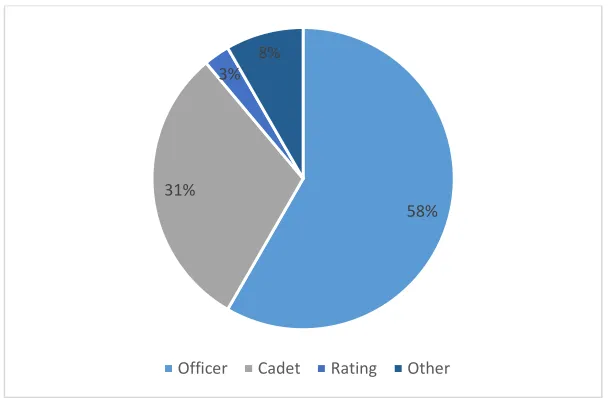
Figure 7: Ranks of Seafarers ... 43
Figure 8: Responses on how long it took to obtain employment ... 44
Figure 9: Responses on which shipping company respondents work for ... 45
Figure 10: An image of a feeder vessel with its particulars ... 73
xv
List of Abbreviations
ABS American Bureau of Shipping
ADB Agricultural Development Bank
AOS A.O. Shipping
BBC British Broadcasting Corporation
BIMCO Baltic and International Maritime Council
Bps Basic points
BSL Black Star Line
COC Certificate of Competence
Dwt Deadweight tonnage
EBIT Earnings Before Interest and Taxes
ECOWAS Economic Community of West African States
et al And others
etc. Etcetera
GCB Ghana Commercial Bank
GDP Gross Domestic Product
GETFUND Ghana Education Trust Fund
GMA Ghana Maritime Authority
GNA Ghana News Agency
xvi
GRT Gross Registered Tonnage
GSA Ghana Shippers’ Authority
GSS Ghana Statistical Service
IMF International Monetary Fund
IMO International Maritime Organization
ISM International Safety Management
ISPS International Ship and Port Facility Security
KNSL Kenyan National Shipping Line
Ltd Limited
MoU Memorandum of Understanding
MSC Mediterranean Shipping Company
n.d. No date
NISA Nigerian Ship Owners Association
PPP Public Private Partnership
RMU Regional Maritime University
SASBF Ship Acquisition and Ship Building Fund
SCI Shipping Corporation of India
SOAAG Shipowners and Agents Association of Ghana
SPC Special Purpose Company
xvii
STCW International Convention for Standards of Training, Certification
and Watchkeeping for Seafarers
U.S. United States
UK United Kingdom
UNCTAD United Nations Conference on Trade and Development
USD United States Dollar
1
Chapter One
Introduction to the Study
1.1 Introduction
This chapter introduces the problem under study by eliciting the background of the
research, statement of problem, aims and objective, scope and organization of the
research.
1.2 Background to the Study
Ghana, formerly known as Gold Coast, is a West African country bordered by Togo to
the East, to the West by Ivory Coast (Cote d’Ivoire), North by Burkina Faso and South,
the Gulf of Guinea. The country’s total landmass is 239,460 square kilometers (sq km)
of which approximately 50% is arable (Oxford Business Group, 2014). In view of this,
Ghana is recognized as the second-largest cocoa and gold producer in Africa since most
of its people engage in farming and mining activities on a large scale (Economic
Freedom, n.d.). The country is also rich in natural resources such as diamonds,
manganese ore, bauxite and oil and other agricultural products which include grains,
yam, oil palms, Kola nuts, Shea nuts, timber and many others that form the basis of
Ghana’s economy. Most of these products are exported to the different parts of the world
so as to generate revenue for the country.
In 2014, $10.2 billion worth of products were exported by Ghana, comprising of 23% of
gold, 22% cocoa beans, 26% crude petroleum, manganese ore approximately 2% and
many others to countries like Switzerland, the Netherlands, France, China, South Africa
and United Kingdom (UK). The imports which amounted to $14.8 billion were mostly
2
(4%) and others from China, United States (U.S.), Nigeria, Belgium, India and the
Netherlands (OEC, n.d.).
Figure 1: Exports and Imports of Ghana
Source: Author
Figure 1 illustrates the quantity of products which are being shipped in and out of the
country signifying the demand in trade. Geographically, it may be impossible for trading
activities to be carried out between countries but for shipping lines, which have made it
possible by bridging the gap between them with the use of ships which transport these
products by sea.
Due to Ghana’s strategic positioning along the coast of the Gulf of Guinea, as shown in
Figure 2, the country established a national shipping line called the ‘Black Star Line’
(BSL) in order to optimize the benefits of the maritime transport sector. The shipping
line was a maritime corporate institution completely owned by the state, whose aim was
to explore extensively trading activities within the West African sub-region and the
world at large. The BSL was established to sustain the economy of the country in times
of crisis and to create job opportunities for the teeming maritime professionals and
seafarers in the country. However, the BSL collapsed as a result of poor leadership
3
collapse of BSL, the national shipping line, unemployment of seafarers has increased,
even though some are being employed by foreign shipping companies. Presumably, BSL
would have still been in existence and optimized to its fullest potential, if it had been
owned by a private entity.
Figure 2: An African map showing the strategic position of Ghana
Source: Google image
The number of seafarers being produced in Ghana is increasing by leaps and bounds due
to the vibrant nature of the maritime institution which is continuously training seafarers.
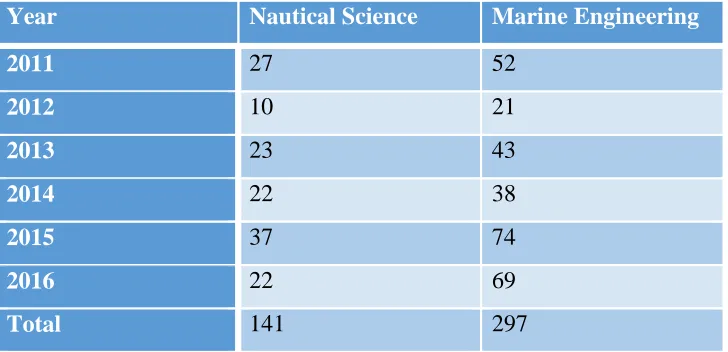
Table 1 shows the number of students graduating from the Regional Maritime
University (RMU) in Ghana on a yearly basis. These students graduate with the
expectation of getting immediate employment onboard vessels but their dreams and
aspirations are shattered as a result of their inability to obtain employment. This has
4
Table 1:
Students Graduating from Regional Maritime University
Year Nautical Science Marine Engineering
2011 27 52
2012 10 21
2013 23 43
2014 22 38
2015 37 74
2016 22 69
Total 141 297
Source: Regional Maritime University
Private ownership means a situation in which a company is owned by private individuals
("Private Ownership," n.d.). A shipping line is; a form of trade, which uses ships in its
operation that is either owned by it or not ("Shipping Line," n.d.). From the two
definitions, private ownership of shipping lines is a business which operates ships owned
by private individuals. The private ownership of a shipping line administers discipline,
efficiency and effectiveness which will result in high productivity, optimization of
resources and profit maximization.
In Ghana, private ownership of shipping lines is rare, as with the case of Nigeria and in
other parts of the world. There is the need for local private individuals to venture into
private shipping lines which will absorb some of these seafarers to minimize the rate of
unemployment. Currently, the economic power of the country is dwindling; the
development of private ownership of shipping lines will help improve the economy.
Ghana News Agency (GNA) (2013) reported on the very first Ghanaian owned ship
(MV Adobia) being launched which employed about 40 Ghanaian seafarers onboard the
5
1.3 Statement of problem
Ghana is growing significantly in the shipping industry through transportation of oil,
exportation and importation of goods like foodstuff, timber, cocoa, gold and others.
However, the country lacks the ownership of shipping lines and ships being either
private or public for the transportation and carriage of these products.
This research seeks to identify the challenges which prevent individuals from venturing
into private ownership of shipping lines and ascertain the solutions in minimizing the
challenges identified. Furthermore, to assess the existing policies of government in the
establishment and operation of shipping lines and examine the possibility of developing
private ownership shipping lines in Ghana.
1.4 Aims and objectives
The aim of this study is to provide data useful for the individual citizens of Ghana in
considering the possibility of owning ships or shipping lines as participants in Ghana’s
shipping industry.
The objectives of the study are:
a) To critically identify and evaluate the challenges facing indigenes of Ghana in
the establishment of shipping lines
b) To assess and examine the policies of government which either motivate or
discourage private individuals in the setting up of private shipping lines.
c) To examine the feasibility of private ownership of ships in Ghana.
1.5 Research questions
a) What are the challenges in setting up a private shipping line?
b) What are government policies that could influence the establishment and
operation of private shipping lines?
6
1.6 Scope of the Study
The scope of the study is limited specifically to the shipping industry in Ghana and
government policy and private sector opportunities.
1.7 Justification of the Study
The expected result of this research will provide data that will
a) help increase knowledge of the potential of private sector investment in shipping
b) serve as a tool for government and stakeholders to guide policy about ship
ownership in Ghana.
1.8 Organization of the Research
The study consists of six chapters which are described below
Chapter one is the introduction of the study comprising of the background, statement of
problem, objectives and scope of the study.
Chapter two describes the concept of shipping lines and private ownership of shipping
lines in other countries such as Nigeria and Greece. It also discusses the factors that led
to the collapse of the national shipping line (BSL) and the challenges of its absence on
the maritime sector and the economy of the country.
Chapter three examines the methodology used in obtaining data from the respondents.
Chapter four looks at the data analysis of the findings relating to the challenges of
establishing private ownership of shipping lines in Ghana and assesses the impact of the
maritime administration in terms of regulations and policies on private shipping lines.
Chapter five provides the summary of analysis by discussing the findings into detail and
answering the research questions.
7
Chapter Two
Literature Review
2.1 Introduction
This chapter talks about the literature review of the study which includes the concept of
private shipping lines, private ownership of shipping lines in other countries like
Nigeria, Greece and others as well as the factors that led to the collapse of the national
shipping line Black Star Line (BSL) and the challenges of its absence on the maritime
sector and the economy of the country.
2.2 National Shipping Line - Black Star Line
2.2.1 Background of the Black Star Line
The Black Star Line (BSL) was set up in 1957 as the national shipping line of Ghana
with the financial and managerial assistance of the Israeli ZIM Shipping. BSL was to
trade between Ghana and North West Europe as well as Ghana and North America. ZIM
Shipping was bought out of its interest in the BSL in 1960 thereby making the company
to be wholly owned by the government with the aim of the company attaining 40% of
ocean traffic in the country’s international seaborne trade (Couper, 2015). The BSL was,
however, established to prevent the British shipping firms from attaining all the profits
through the transportation of import and export cargoes to and from the country. The
establishment of National Shipping Lines in African countries brought about the
reduction of charges for exports and passenger services to a considerable degree and the
profits accrued were used for financing other economic development projects and the
expansion of the shipping lines (Barrow, 1969). In addition, BSL was established to
provide the economic stability of the country in the event of financial crisis and to
8
many vessels including MV Keta, Tano, Sissili, Volta, Lake Bosomtwe and others
engaging in several international regular sailing schedules. The company owned some of
the large vessels at the time with tonnage of about 16,000 that gathered export
commodities such as cocoa, manganese, timber and others to be transported to other
countries (Ghana Shipping Guide, 2014).
2.2.2 Factors that led to the fall of the BSL
The BSL brought the development of a maritime academy to train seafarers and dry
docks for ship repairs, which became the lifeblood of the country. However, the BSL
faced some challenges that led to its fall or collapse as a result of the following factors
indicated by Adjetey (2005)-:
Imbalanced trade
The trading vessels of the BSL were unable to obtain enough cargo on their return leg as
a result of the Western African market dominating the shipping industry which posed a
problem to the BSL due to the retaliation of the foreign ports. This affected the earnings
of the company, but increased the operational cost of the vessels.
Reluctance of staff
The productivity and competitiveness of the BSL with other shipping lines reduced due
to the reluctance of the staff in performing their duties even though their jobs were
secured. This also led to a drop in operational standards of the BSL vessels since
inspections of the vessels were not regularly carried out in order to address any
deficiencies found.
Poor Performance
The inability of the management to address issues in the company led to industrial action
9
to attain better working conditions and higher remuneration. This significantly affected
the performance of the company as it resulted in the dismissal of most of the competent
seafarers in the company. The company, however, contracted foreign seafarers from the
Philippines and indigenous naval officers who required high remuneration which
resulted in high operational cost and unemployment of Ghanaian seafarers.
Difficulty in handling growth
In 1978, the company expanded its fleet by ordering four new multipurpose general
cargo vessels from South Korea. However, the management was unable to handle the
growth and expansion of the company due to the weakness in its internal systems.
Poor supervision
The supervision of the BSL by the government was inadequate which resulted in the
compounded issues facing the company as well as showing complacency in the
increment of the operational cost of management. In addition, the government seemed
not to be interested in addressing the issues of communication and compensation
between the management and the seafarers.
2.2.3 Impact of the fall of BSL on the economy of Ghana
The fall of the national shipping line had a significant impact on the economy of the
country and some of these impacts are described in the following sections-:
High Price of Imported Products
Ghana imports a majority of the goods and services utilized in the country and exports a
greater percentage as well of its commodities like cocoa, bauxite, manganese, timber and
others. With the nonexistence of the national shipping line, the services of private
shipping lines are engaged for the carriage of these goods. However, in order for these
10
bound for Ghana are delivered. Sometimes, these goods are transhipped thereby
exposing the goods to damages as a result of the re-stowing or re-handling of the goods.
Subsequently, the re-handling of these goods incurs extra charges which are
incorporated in the transportation costs resulting in high prices of the final product in
Ghana (Ghana Shipping Guide, 2014).
Unemployment of Seafarers
A report made by the Minister of Ports, Harbour and Railways indicated with reference
to ratings that since the sale of the BSL vessels due to poor performance of the company,
Ghanaian seafarers have been unemployed for the past 20 years and their search for jobs
have proved futile (GNA, 2003). This has resulted in the increment of unemployed
seafarers in the country, especially cadets after their graduation from the maritime
academy. A statement made by the Ghana Maritime Authority indicated that
approximately 4000 Ghanaian seafarers who are mostly graduates from the maritime
academy are currently unemployed as a result of the unavailability of deep sea vessels
owned by the country (Ajarfor, 2016).
2.3 The Economic Environment of Ghana
For over two decades, the political situation in Ghana has been stable since its inception
as a democratic country, thus, returning to the multi-party system (World Bank, 2016).
Ghana’s economy saw significant expansion during this period and the re-denomination
of the Ghana Cedi in 2007. Despite the fact that the economy has been growing
sluggishly, coupled with high inflation resulting in the costly living standards of its
citizenry, it is ranked 5th and 72nd, in Africa and the world respectively (Economic
Freedom, n.d.).
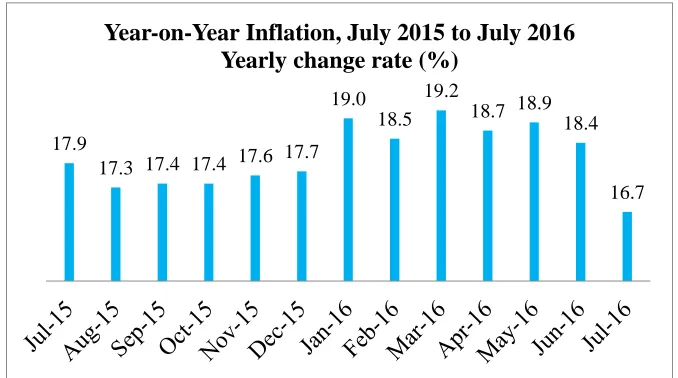
Ghana is constantly faced with high inflation rate, though efforts are being made to
tauten monetary policy in the country. The inflation rate increased from 17.7% in
11
basic points (bps) policy rate, which is a common measuring unit for interest rate and
other percentages in finance (World Bank, 2016). However, the inflation rate declined
from the 18.5% in February 2016 to 16.7% in July 2016 even with the increase recorded
in March 2016 as shown in Figure 3.
Figure 3: A graph depicting inflation rate in Ghana
Source: Ghana Statistical Service (GSS)
According to the World Bank (2016), Ghana’s real gross domestic product (GDP) is
anticipated to grow from 3.4% in 2015 to 5.2% in 2016 due to the stability of energy
supply and the tremendous contribution from the oil and gas and agriculture industries
which have affected the GDP positively. The African Development Bank Group (2015)
also pointed out that the growth in the country's economy in 2016 will be as a result of
an upsurge in the production of oil and gas, private sector investment, improved public
infrastructure and the political stability of the country. Nevertheless, the predominant
fall in international prices of oil may slow down the growth of the economy in the near
future. In 2015, oil and gold, which account for 50% of Ghana’s export, dropped by 47%
and 8% respectively in the international market (World Bank, 2016), which in turn
affected the trade of these commodities. 17.9
17.3 17.4 17.4 17.6 17.7 19.0
18.5 19.2
18.7 18.9 18.4
16.7 Year-on-Year Inflation, July 2015 to July 2016
12
Figure 4: Annual GDP growth rate of Ghana
Source: TradingEconomics/GSS
Figure 4 indicates that Ghana’s economy has increased by 4.9% in the three month to
March 2016 as compared to the slower growth in the previous three months which was
4.1%. The growth was contributed to by the expansion of the major drivers of the
economy including the service sector, which constitutes 50.2% of the economy,
agriculture and industry at 19.9% and 28.4% respectively (African Development Bank
Group, 2015). As a result, it can be agreed that the economy of the country is gradually
picking up even with the power rationing, high inflation and high public debt.
The current economic crisis in the country resulted from the poor management of public
finance by the government, which has given rise to an escalating deficit and the
continual growth of public debt, although the majority of the country’s debt was
cancelled in 2005 (Economic Freedom, n.d.). As a result of, the World Bank indicated
that the current account deficit of Ghana has decreased significantly from 9.6% of GDP
in 2014 to 7.8% of GDP in 2015 resulting from the increase in private transfers with
remittances included and other services exports compensating for the growth in trade
deficit (2016). In order for the government to address this issue, a negotiation was
carried out with the International Monetary Fund (IMF) to obtain a credit facility worth
13
The re-denomination of the Ghana Cedi in 2007 was undertaken to strengthen the value
of the currency against other foreign currencies, however, this objective was achieved
for a short period. This is because, in 2015, it lost 18% of its value against the USD but
was relatively stable against the Euro due to an Eurobond issuance ($1 billion) and
payment of the cocoa syndicate loan of USD 1.8 billion in October as stated by the
World Bank (2016).
2.4 Concept of Shipping Companies
A shipping company is defined as “a legal organization which owns ships” (Stopford,
2009). Dolgopolov (2010) also gave a similar definition in the context of a shipping
company being a commercial company, which engages in the transportation of cargo
and passengers by ship. Stopford (2009) indicated that a shipping company may either
be a legal partnership or company or corporation situated in an area with obligatory law
of corporate governance and has a controlling interest in the ship which it operates. The
controlling interest of the vessel may sometimes be owned by an individual known as
the shipowner. The day –to-day operation of the ship is the responsibility of the
personnel within the company.
Wijnolst and Wergeland (2009) explained in their work that a shipowner is required to
manage the commercial utilization of the vessel as well as the operational part which
includes technical management, crew management and the different administrative
functions such as organizing insurance, purchasing equipment and others. Stopford,
however, discussed that the shipowner usually maintains the ownership of the vessels
and contracts a management company to run the daily activities of the vessels (2009).
This management company is termed as a ship management company and Willingale
defined it as “the professional supply of a single or range of services by a management company, separate from the vessel’s ownership in support of the primary objectives of
14
the shipowner taking into consideration the primary objective of the shipowner in terms
of profit making through the employment of the vessel.
2.4.1 Services of a Shipping Company or Ship Management Company
The services provided by shipping companies or ship management companies include
some or all of the following services: crewing, insurance (crew and vessel), quality and
safety services including certification of the vessel (ISM and ISPS), purchasing (spare
parts, lubricants, victuals, chemicals, etc.), employment of the vessel (chartering) and
others (Willingale, 1998). These services are categorized into the following as indicated
through the works of Willingale (1998) and Wijnolst and Wergeland (2009):
Technical Management
This type of management deals with technical operation of vessel with the main aim of
operating the vessel in a safe, pollution free and cost efficient manner in accordance with
international rules and regulations as well as giving protection to the asset value.
Technical management includes vessel inspection, purchasing and supplying (spare
parts, victuals, stores, lubricants, chemicals, etc.), vessel drydocking, reporting,
budgeting, repair and maintenance and certification of the vessel.
Crew Management
Crew management involves the recruitment of well qualified and trained seafarers as per
the required nationality of the shipowner onboard the vessel in order to ensure that the
vessel operates in safe and efficient condition in accordance with international
regulations. In addition to recruitment, this kind of management includes performance
appraisal of crew, training, certification control, welfare, crew relief planning and
anything related to seafarers.
Commercial Management
This deals with the commercial activities of the vessel in relation to its employment in
15
and patterns in order for the appropriate decision to be made regarding the chartering of
the vessel. Commercial management also includes the post fixture services such as
receipt of freight income, maintaining the vessel account, monitoring invoices,
appointment of agents and others.
2.4.2 Types of shipping company ownership
Shipping companies may be owned and operated privately, publicly (government) or a
combination of both in the form of partnership (BIMCO, 2013).
2.4.2.1 Private Ownership
Private ownership as defined by InvestorWords (n.d.) is “a situation in which a company is owned by private shareholders”. In the shipping industry, privately owned shipping
companies are usually owned by private individuals or families who engage in the
operation of vessels (owned or not owned) without any interference from the
government as compared to the publicly owned. Examples include Mediterranean
Shipping Company, Maersk Line of A.P. Moller- Maersk Group, CMA CGM Group and
others (MoverDB.com, n.d.).
2.4.2.1.1 Pros of Private Ownership
Lack of Government Interference
One of the most significant characteristics of private ownership is the independence of
the company without any interference from the government though it is governed by the
laws of the country where the company is established. In addition, the company is less
vulnerable to political changes as well as potential electoral cycles (Holzwarth &
Kraemer, 2000).
16
Privately owned companies are known to be efficient in the discharge of their services as
a result of the need to satisfy their shareholders and stakeholders. The staff of a private
organization is well trained in their respective line of duties which enables them to work
effectively and efficiently resulting in high productivity for the company.
Control
Owners of private companies have full control over every aspect of the business
resulting in their protection from the sale of their companies by third parties. They have
authority over the operational decisions of the organization and are therefore not
pressured by shareholders or stakeholders unless the company is listed on a stock
exchange. Also, private owners attain high revenues since they often retain all the
profits.
2.4.2.1.2 Cons of Private Ownership
Lack of Competition
Most private companies are monopolistic in nature, as seen in liner shipping, thereby
making them less competitive in the market and hence, their inability to provide quality
products and services to meet clients’ expectations. Due to their monopolistic nature,
they increase prices of products or services to cover up any cost incurred in the
company.
Lack of Government Subsidy
The proprietor of a private company is solely responsible for raising funds (capital) for
the establishment and operation of the organization, which is often high, especially in
the shipping industry. Privately owned companies are usually not entitled to subsidies
17
Personal Interest
Profit making is primarily the source of existence of some private companies resulting in
the fall of the organization if profit is lost consistently. In this effect, privately owned
companies disregard public welfare for their own personal interest by utilizing all
available means to obtain profit so as to sustain their businesses as indicated already by
Thompson (1917). The company does not take into consideration the pollution of
environment which affects the health and living conditions of the public as a result of
their daily operations.
2.4.2.2 Public Ownership
Public ownership (government or state ownership) is defined as the circumstance in
which the government or state owns a company, an industry or property (Cambridge
Dictionaries Online, n.d. (b)). Shipping companies owned by the government are often
termed as national shipping lines. In this regard, the operation and management of the
companies are carried out by the government as well as the ownership of the vessels.
Examples of government owned shipping companies include the Kenyan National
Shipping Line (KNSL) established in 1988 by the Kenyan Government (KNSL, n.d.)
and others.
2.4.2.2.1 Pros of Public Ownership
Upfront Capital
Companies owned by government are able to attain upfront capital unlike the privately
owned companies which have to raise funds by themselves. This results in the
immediate development and establishment of the company as well as vessel acquisition
18
Job Opportunities
Employment opportunities are also created which reduces the rate of unemployment in
the country and improving the livelihood of the citizens of the country (Roe, Grieg-Gran
& Schalken, 2001). As a result, citizens are beneficiary of job opportunities, either
onshore and/or offshore.
Government Regulations
As a result of the government controlling the managerial and administrative matters of
the corporation, regulations governing public corporation are often flexible which
lessens the burden of taxes and policies associated with the business.
2.4.2.2.2 Cons of Public Ownership
Corruption
Corruption and fraud may seep into publicly owned companies rendering them
inefficient and ineffective. This is because those with top managerial positions tend to
recruit people, specifically family members, who are unqualified and inexperienced in
the duties assigned to them. Also, they award projects to unqualified contractors in order
to return a favor offered by them in the past.
Poor Management
The improper management by government regarding the corporation often results in the
collapse of the organization as seen in the case of the national shipping lines of many
countries including Ghana. The poor management of national organizations emanates
from the inability of the government to supervise the operational performance of the
staff as well as their misconduct within the organization.
Lack of control
The government can lose control over facilities, employees and rates when there is no
19
or over exploited due to improper handling which leads to the country not attaining any
benefits from these resources.
Bureaucracy
The bureaucratic nature of governmental corporations tends to delay and hinder
development due to the slowdown in decision making by officials. As result, large and
profitable investment opportunities are lost in the process.
2.4.2.3 Public Private Partnership (PPP)
Public Private Partnership is defined as a risk and profit sharing relationship between the
public sector and one or more partners from the private sector to improve performance
through mutual goals or to attain a publicly agreed outcome or service (Building Better
Partnerships as cited in Geddes, 2005). In the shipping industry, this type of partnership
identifies the public sector, which is the central government of a country, as the
shipowners and the daily administration and operations of the vessel are carried out by
the private sector which may be the shipping company.
2.4.2.3.1 Pros of PPP
Infrastructural development
The advantages of PPP can be seen in the significant role it plays in the development
and improvement of infrastructure as well as in the maintenance, management and
operation of existing transport infrastructural facilities, including ships, terminals, roads
and others (World Bank Group, n.d.).
Retention of Ownership and employees
The government retains the ownership of the asset which may be the vessel and remains
the regulatory body of the company while it delegates the managerial and administrative
responsibilities to the private sector. This enables the company to be effective and
20
country as a whole. In addition, the public also enjoys some benefits in the form of
retaining their jobs and also, flexibilities in rates and charges regarding services offered
to them.
Accessibility of Capital
Financing of the company is easily attainable due to the involvement of the government.
Also, with the government as the regulatory body, the company may enjoy tax
exemptions as well as subsidies from the government.
2.4.2.3.2 Cons of PPP
Conflict of Interest
PPP may have some limitations which include conflict of interest resulting from the
difference in interest between the public and company. Generally, the organization’s
main objective is to gain profit while the public demands for low prices for services
provided (Thompson, 1917).
Liability
Confusion tends to arise when liabilities occur in terms of the responsibilities of the
parties, especially if it is not included in the contractual agreement (Holzwarth &
Kraemer, 2000). These liabilities relate to damages to public property, legal matters
arising from claims made by clients resulting from non-performance of contract and
many more.
Government Interference
The government may interfere with the administration and running of the business,
which in turn may affect the performance of the organization. When the performance of
the organization is affected, most of the employees will be laid off as a result of low
21
2.5 Ship Finance
Financing in the shipping industry is very essential due to the high capital intensity of
the business. This requires shipowners or investors in the shipping business to raise
funds in order for them to pursue their investment goals in the form of purchasing or
building vessels or establishing a shipping company.
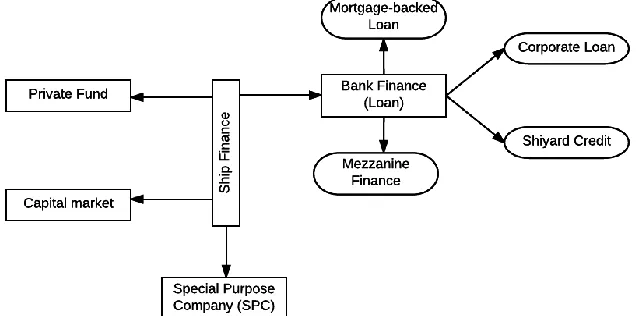
Stopford (2009) discussed the ways in which a shipowner can finance a shipping
company or purchase a ship. The ways include private funds, bank loans, capital markets
and Special Purpose Company (SPC) as indicated in Figure 5.
Figure 5: Types of ship finance
Source: Author
2.5.1 Private Fund
This fund is described by Stopford (2009) as the method whereby a shipowner or
shipping company is financed by the private resources of the owner or an investment or
loan from family or friends. This type of financing has always been the main capital start
22
being common in some countries such as Denmark, Greece, Norway, Sweden and many
others.
2.5.2 Bank Finance (Loan)
This type of ship finance is the traditional method most shipping companies and
shipowners use in attaining capital for their business (Drewry Shipping Consultants,
1996). As indicated by Stopford (2009), bank loan is the main source of finance for
operators (shipowners, charterers, shipping companies) in the shipping business due to
its flexibility in refinancing when there is a change in circumstances. Shipowners and
shipping companies have the option of accessing any of the three major sources of loans
available which are mortgage-backed loans, corporate loans, shipyard credit loans and
sometimes mezzanine finance may be organized by the bank.
A mortgage-backed loan is a type of loan offered on the basis of securing the loan with
the vessel as collateral. In the event of default, the bank can foreclose and take
possession of the vessel in order to recover the loan (Stopford, 2009).
A corporate loan is defined as “a loan given to a company, rather than a government organization or an individual person” (Cambridge Dictionaries Online, n.d.(a)). This
type of loan is usually preferred by large shipping companies with well-established
financial structure since it requires the use of their corporate balance sheet as collateral
instead of one of their vessels (Stopford, 2009).
Shipyard credit loans are loans offered by governments or agencies to aid local
shipyards in attaining orders (Stopford, 2009).
Mezzanine finance is a type of finance which consists of equity and debt and is often
23
shipowner or borrower provides a certain percentage of the capital through preference
shares known as equity and the remaining percentage is offered by the bank or financial
institution.
2.5.3 Capital Market
The capital market, as described by Stopford (2009), is often accessed by large shipping
companies to acquire funds either by issuing bonds (also known as a note which is a
debt security redeemed on a specified date with an interest paid by the issuer) or by
providing a public offering of shares (trading shares of the company on the stock
exchange). This type of ship finance provides comprehensive finance which is fast and
quite an inexpensive method of obtaining a lump sum of money.
2.5.4 Special Purpose Company (SPC)
Investopedia defined SPC as a company whose main operations are to acquire and
finance specific assets (n.d.). This method is used in raising funds to purchase vessels
which are either leased or chartered out. The funds are usually obtained from equity
investors and possibly a supplement from banks (Stopford, 2009). The SPC is different
from the parent corporation and as a result protects either of them from being affected in
the event of bankruptcy or a default.
2.6 Risks in the Shipping Industry/Companies
The shipping industry is cyclical and volatile in nature due to the fluctuations in the
market rates and prices. In line with this, the industry is susceptible to risks which
significantly affect the revenues of the investors (ship owners, charterers, etc.) involved
in its operations. These risks, as identified by Kavussanos and Visvikis (2006), can be
24
2.6.1 Business Risk
The main cause of this risk is Earnings Before Interest and Taxes (EBIT) which
indicates the profit of a company (difference between revenue and expenses) excluding
tax and interest. Investors in the shipping industry face this risk as a result of the
variability of the under listed factors;
2.6.1.1 Freight Rates
Freight rate, as defined by Stopford, is “the amount of money paid to a shipowner or
shipping line for the carriage of each unit of cargo (tonne, cubic meter or container load)
between named ports" (2009). This money is negotiable and often paid by the shipper to
the shipowner. According to Stopford (2009), shipowners and shippers establish freight
rates through negotiations which show the balance between availability of vessels and
cargoes in the market. Freight rates are low when there is oversupply of ships and high
when there are few ships available in the freight market.
Ma (2015) highlighted that the volatility of the freight rate depends on the fluctuation of
the market as a result of supply and demand. Freight rate is the main earnings of the
shipowner which is usually used to offset the operating expenses (costs) of the vessel.
The fluctuation of the freight rate may either cause cash surplus or deficit for the
shipowner. This is based on the fact that the cash flow of the shipowner is affected
tremendously by the volatility of the freight rate.
2.6.1.2 Bunker (Fuel) Prices
Fuel prices are considered to be one of the most critical costs for shipowners with
regards to the operation of vessels. Shipowners have faced large increases in fuel prices
over a long period which affects their business considerably (Zuskin, Grubisic &
Sumner, 2015). Stopford (2009) indicated that 47% of voyage cost is fuel cost whereas
25
couple of years there has been a general reduction in the prices of fuels. According to
Ma (2015), bunker (fuel) costs are directly dependant on the international oil market. In
this regard, fuel prices are affected by the fluctuation of the oil prices in the international
market thereby resulting in the volatility of the fuel prices. The volatility of the bunker
prices pose a risk to the shipowners due to the effect it has on their cash-flow.
Shipowners tend to forget about this risk when the freight market is strong and earnings
are high, however, if the bunker cost is controlled, it results in a better management of
the cash-flow (Kavussanos & Visvikis, 2006).
2.6.1.3 Foreign Exchange Rates
The shipping industry requires the use of different currencies in its daily business
transactions. Kavussanos and Visvikis (2006) explained that the global nature of the
shipping industry exposes the shipowner’s cash-flow transactions to involve different
foreign currencies. As discussed in Akatsuka and Leggate (2001), the main revenue of
the shipowner in this international business is the US dollars (USD) and a majority of
the operating expenses of the vessel is usually in other denominations which require the
conversion of the USD. The conversion of USD to the other foreign currency has an
impact on the cost and revenue of the shipowner thereby affecting the profit margin of
the shipowner (Kavussanos & Visvikis, 2006).
In the 1970s, the fall of the fixed exchange rate regime led to the volatility of currencies
in the shipping industry. The fluctuations of the exchange rates between these currencies
have a tremendous impact on the business performance of the shipowner in terms of the
effect on the cash-flow (Akatsuka & Leggate, 2001). Foreign exchange rates are prone
to changes in the market which may result in the appreciation or depreciation of the total
26
2.6.1.4 Interest Rate
The capital intensive nature of the shipping industry creates the need for shipping
companies to attain financial assistance from banks or directly from the public or
through bond issues so as to carry out their investment plans (Kavussanos & Visvikis,
2006). These loans are usually interest bearing which has to be repaid by the shipping
companies. The interest rate may either be floating or fixed depending on the terms and
conditions of the loan. Batrinca and Burca (2011) indicated that the financing of the
acquisition of vessels through loans is priced on the basis of floating interest rates in
which the unexpected fluctuations in the interest rate may have adverse consequences on
the assets and liabilities of the companies. A fixed interest rate, however, does not have
an adverse impact on the shipping companies due to the uniformity of the rate until the
maturity of the loan. The changes in the interest rate as a result of the changes in the
world economy cause fluctuations in the cash-flow of the shipping companies
(Kavussanos & Visvikis, 2006). In line with this, the shipping companies are exposed to
business risk due to the volatility of the interest rate.
2.6.2 Liquidity Risk
The Supervisory Policy and Guidance of the Federal Reserve (n.d.) indicates liquidity
risk as the risk to the financial condition of an organization as a result of its inability to
meet a contractual obligation. The definition obtained from Kavussanos and Visvikis
(2006) refers to the inability of a shipping company to sell its asset within a short term
period.
2.6.3. Credit or Default Risk
Kavussanos and Visvikis (2006) described credit risk as the risk whereby counterparties
in the shipping business are unable to meet their contractual obligations in terms of the
payment loans or freight rates. This risk is often faced by financial institutions and other
27
risk faced by financial institutions is as a result of the volatility of the vessel’s income
and fluctuation of the vessel value since they serve as the main source of repayment and
security of the loan respectively. The cyclical nature of the shipping industry exposes all
parties involved in any form of business transaction within the industry to this risk.
2.6.4. Market Risk
Stopford (2009) identified market risk as the risk that emanates from the instability of
the shipping industry. Due to the long term and severity of the freight market, the ability
of the shipping company to meet its contractual obligations is affected. Kavussanos &
Visvikis (2006), however, identified this risk as the risk faced by a shipping company
listed in the stock exchange resulting from the changes in the stock price due to the
volatility in the stock market. This type of risk affects the capital cost of the company as
well as the probability of a company with low market value being overtaken.
2.6.5. Political Risk
This risk occurs as a result of political decisions or events such as wars, closure of a
canal and others which may affect shipping businesses (Kavussanos & Visvikis, 2006).
The cash-flow and balance sheets of a shipping company are often the most affected
when there is any form of political unrest in any part of the world due to the global
nature of the shipping industry.
2.6.6. Technical and Physical Risk
The technical and physical risks are related to the sudden breakdown of the vessel which
may include engine or steering failure, accident and others, which the shipping company
may be susceptible to. The effect of these risks on the shipping company may be loss of
revenue and reputation as well as the loss or damage of the vessel (Kavussanos &
28
2.7 Ship Registration
Nationality of ships has become the fundamental principle in the shipping domain and as
a result stateless ships are denied entry into ports, not entitled to engage in trade as well
as not being protected by the international law (Ready, 1998). The aforementioned
results in the vitality of ship registration in the shipping industry since it enables ships to
be identified and governed by the jurisdiction of the State whose flag they fly. As
indicated in Article 5 of the Convention on the High Seas (1958), a State can confer its
nationality on a ship provided the ship was registered in its territory and permits it to fly
its flag. Ship registration primarily consists of two types of registry systems which are
open and closed.
2.7.1 Open Registry
Open registry, also known as the Flag of Convenience, is the type of registry that allows
the registration of foreign owned vessels. This system of registration is characterized by
its easy access of entry; limited charges which include registration fee, tonnage based
annual fee as well as low or no revenue taxes (Romero, 2015). In addition, it allows the
employment of non-nationals on its vessels. This helps the shipowner in reducing costs
as he can recruit seafarers from low or minimum wage countries such as the Philippines
(BBC NEWS, 2014).
Whilst the open registry helps in minimizing costs for the shipowner it can also be
disadvantageous as often shipowners choose to register their vessels under less stringent
flags since their vessels may detained due to safety reasons which may render them
unseaworthy. These Flag States sometimes lack the resources to conduct periodical
29
Open registry is a business and it is stated that all businesses aim to make profit. So
without thinking of what might be at stake, states register vessels with very low
standards so as to attract more vessels.
Countries that engage in the open registry system are Panama, Liberia, Marshall Islands,
Malta and others, but it must be noted that, these named countries are considered to
uphold safety standards, while some others do not.
2.7.2 Closed Registry
According to Mukherjee & Brownrigg (2013), closed registry refers to the conferring of
nationality on ships only owned by the citizens of that state. This implies that ships
owned by foreigners are not entitled to enter the registry. Maritime States who are
involved in closed registry system, put in place stringent requirements relating to
crewing, ownership, management and administration so as to allow the entry of a ship
into their registry (Romero, 2015). This suggests that the crew must be nationals of that
State including their license and certificates, the class of the vessel must be carried out
by a classification society recognized by the State as well as having the company
established within the Flag State as indicated by Mukherjee & Brownrigg (2013).
The stringent requirements associated with closed registries positively affect States
involved with them by producing job opportunities for their citizens. In addition, vessels
registered under the closed registry system maintain a higher level of standards
regarding safety, maintenance, security and others. This, in turn, protects the marine
environment and prevents the vessels from being detained.
Some examples of countries engaged in this system include Russia, United States of
30
2.8 Private Ownership of Shipping Lines in Other Countries
2.8.1 Greece
Greece is known as the largest and most significant maritime country in the world since
it controls approximately 16.11% of the world fleet (United Nations Conference on
Trade and Development (UNCTAD), 2015) and 43% of the capacity of the European
Union fleet in 2014 based on a report made by the Oxford Economics (2014). The
activities of the shipping industry are usually carried out by privately owned shipping
companies such as Thenamaris, Tsakos, Anangel and many more engaged in the
different shipping markets, which may include container, tanker or dry bulk shipping.
Most of these companies own and/or manage vessels of various types and sizes which
enables the transportation of goods worldwide. According to UNCTAD (2014, 2015),
more than 16% of the world’s deadweight tonnage of vessels is owned and controlled by
the private citizens of Greece. These companies contribute tremendously to the economy
of the country as well as to the employment of its citizens. For instance, in 2014, the
industry contributed 66 billion Euros to the Gross Domestic Product (GDP) of the
country and employed about 6,000 people and now, the country has about 192,000
people working in the shipping industry.
2.8.2 Nigeria
Nigeria is a Western African country situated along the coast of the Gulf of Guinea. The
country is endowed in natural resources like oil and gas. In line with this, the privately
owned shipping companies such as the Morlap Shipping Company Ltd, Starzs
Investment Company Ltd and others engage in the tanker shipping market due to the
large quantity of oil exported by the country. As indicated by the Premium Times
(2015), approximately 10% of the 600 vessels operating in the oil and gas industry in
Nigeria are owned by its citizens. In order to complement this capacity, the Nigerian