World Maritime University World Maritime University
The Maritime Commons: Digital Repository of the World Maritime
The Maritime Commons: Digital Repository of the World Maritime
University
University
World Maritime University Dissertations Dissertations
11-5-2017
Developing key performance indicators for IMO member states in
Developing key performance indicators for IMO member states in
the context of IMO member state audit scheme
the context of IMO member state audit scheme
Sang Ho Kim
Follow this and additional works at: https://commons.wmu.se/all_dissertations
Part of the International Trade Law Commons
Recommended Citation Recommended Citation
Kim, Sang Ho, "Developing key performance indicators for IMO member states in the context of IMO member state audit scheme" (2017). World Maritime University Dissertations. 571.
https://commons.wmu.se/all_dissertations/571
i
WORLD MARITIME UNIVERSITY
Malmö, Sweden
Development of Key Performance Indicators
(KPIs) for Imo Member States in the Context of
the IMO Member State Audit Scheme
By
Sang Ho Kim
The Republic of Korea
A dissertation submitted to the World Maritime University in partial
Fulfilment of the requirements for the award of the degree of
MASTER OF SCIENCE
In
MARITIME AFFAIRS
(MARITIME SAFETY AND ENVIRONMENT ADMINISTRATION)
2017
ii
DECLARATION
I certify that all the material in this dissertation that is not my own work has been identified, and that no material is included for which a degree has previously been conferred on me.
The contents of this dissertation reflect my own personal views, and are not necessarily endorsed by the University.
(Signature):
(Date):
Supervised by: Jens-Uwe Schröder-Hinrichs Armando Graziano
iii
ACKNOWLEDGEMENTS
I would like to express my sincere gratitude to my supervisors, Professor Jens-Uwe
Schröder-Hinrichs and Technical Officer Armando Graziano, for the continuous
support of my research and led me to the successful dissertation with profound
knowledge. I must deliver my deepest appreciation to Professor Daniel Seong-Hyeok
Moon and Professor Dong-Wook Song for their encouragement and insightful
comments.
I would like to thank Anne Pazaver for the language review of my dissertation and
her comments. Also, my appreciation goes to Jin-Young Yang, Seok-Jin Kang, and
Byeong-Yun Lee for their support in data collection.
I also would like to thank Min Jung and Seo Hyeong Kang for their support and
encouragement to finish this dissertation.
Last but not the least, I would like to thank my parents, Kong Joo Park and Jay Won
Kim, for their wonderful support and warm encouragement. Without their guidance
iv
ABSTRACT
Title of Dissertation: Development of Key Performance Indicators (KPIs) for IMO Member States in the context of IMO Member State
Audit Scheme
Degree: MSc
This dissertation aims to develop Key Performance Indicators for IMO Member
States through application of CMO method to assist Member States to meet their
obligations as stated in the III Code. As a pilot study to apply CMO method to the III
Code, the method is only applied to flag States part of the III Code to verify its
suitability for development of KPIs. Application of the CMO method could achieve the
complete review of the requirements of the Code in terms of context, mechanism, and
outcome.
By using the KPI work sheets, the author developed a total of 43 KPIs which covers
all the requirements of the III Code. Furthermore, categorization of developed KPIs is
performed to classify the roles of its KPIs.
From the validation process of developed KPIs by applying the data from the
Republic of Korea, 43 KPIs from the KPI work sheets satisfied the full scope of the
flag State performance and addressed limitations of previous studies by covering the full spectrum of flag State performance by using measurable KPIs and KPIs for the existence of procedures.
The most obvious finding to emerge from the analysis is that the Republic of Korea has a high level of performance in terms of flag State performance. However, the significant problem was identified through the trend analysis that the follow up for the PSC detention and the number of FSC inspections should be improved to increase the overall performance of Korea. Additionally, the result of this study indicates that the developed KPIs are enabled to monitor, evaluate, and continuous improvement for the performance of IMO Member States.
v
TABLE OF CONTENTS
Declaration ii
Acknowledgement iii
Abstract iv
Table of contents v
List of Tables vii
List of Figures viii
List of Abbreviations ix 1. Introduction 1 1.1 Background 1 1.2 Objectives 4 1.3 Scope of study 5
2. Literature review 7
2.1 Flag State Responsibilities 7 2.2 Flag State Performance 10
2.3 Key Performance Indicators 16
2.4 Summary 16
3. Implementation of IMO Instruments 18
3.1 From VIMSAS to IMSAS 18
3.2 IMO Instruments Implementation Code 23
3.3 The Context of the Republic of Korea 27
3.4 Summary 29
4. Context-Mechanism-Outcome Method to develop KPIs 30
4.1 Introduction of the Realist evaluation 30
4.2 Applying CMO method to the III Code 33
vi
5. Application of CMO on the III Code 37
5.1 KPIs developed through the CMO method 37
5.2 Categorization of developed KPIs 44
5.3 Summary 47
6. Application of KPIs: the context of Korea 48
6.1 Validation of developed KPIs 48
6.2 Response to the findings of the VIMSAS 60
6.3 Trend analysis using KPIs 62
6.4 Discussion 65
7. Summary and conclusion 67
7.1 Summary and conclusion 69
7.2 Limitations and further research 69
References 70
Appendices Appendix 1 KPI Sheet 73
Appendix 2 Definition of developed KPIs 163
vii
LIST OF TABLES
Table 1. Administrative, social, and technical performance of flag States 9
Table 2. Flag State Conformance Index 11
Table 3. Shipping Industry Flag State Performance Table 13
Table 4. Summary of the affinity diagram 14
Table 5. Performance Indicators for 13 strategy 15
Table 6. The Shipping KPI Standard 17
Table 7. CMO questions 36
Table 8. Part 2: Flag States 38
Table 9. KPI sheet for III Code requirement 39
Table 10. Developed KPIs through the CMO method 41
Table 11. Categorization of KPIs - Implementation 45
Table 12. Categorization of KPIs - Delegation of authority 46
Table 13. Categorization of KPIs - Enforcement 46
Table 14. Categorization of KPIs - Organization system and human resources 47
Table 15. Implementation - link with NSKI 50
Table 16. Delegation of authority - link with NSKI 53
Table 17. Enforcement - link with NSKI 55
viii
LIST OF FIGURES
Figure 1. Percentage and numbers of findings 21
Figure 2. Analysis of audit results by parts of the Code 22
Figure 3. Composition of the III Code 24
Figure 4. KPI development process 34
Figure 5. Pie chart for developed KPIs 44
Figure 6. Trend analysis using KPI1 62
Figure 7. Trend analysis using KPI5 63
Figure 8. Trend analysis using KPI4 64
ix
LIST OF ABBREVIATIONS
BGW Black/Grey/White
BIMCO Baltic and International Maritime Council CMO Context-Mechanism-Outcome
COLREG International Regulations for Preventing Collisions at Sea FSC Flag State Control
FSI Flag State Implementation GBP British Pound Sterling
GISIS Global Integrated Shipping Information System ICAO International Civil Aviation Organisation
ICS International Chamber of Shipping III IMO Instruments Implementation IMO International Maritime Organisation IMSAS IMO Member State Audit Scheme
INTERCARGO International Association of Dry Cargo Ship Owners INTERTANKO International Association of Independent Tanker Owners ISF International Shipping. Federation
ISM International Safety Management
ISO International Organisation for Standardization
ITOPF International Tanker Owners Pollution Federation Limited KCG Korea Coast Guard
KIMFT Korea Institute of Maritime and Fisheries Technology KMOU Korea Maritime University
KMST Korea Maritime Safety Tribunal
KOEM Korea Marine Environment Management Corporation KOMDI Korea Maritime Dangerous Goods Inspection Center KPI Key Performance Indicator
KR Korea Register of Shipping
KST Korea Ship Safety Technology Authority KTC Korea Testing Certification
LL Load Line Convention
MARPOL International Convention for the Prevention of Pollution from Ships
MOU Memorandum of Understanding NIFS National Institute of Fisheries Science NSKI The National Strategy of Korea for IMSAS MMU Mokpo Maritime University
MOF The Ministry of Oceans and Fisheries PI Performance Indicator
PSC Port State Control
RO Recognized Organisation SAF Self-Assessment Form
SOLAS Safety of Life at Sea Convention
x
TONNAGE International Convention on Tonnage Measurement of Ships UN United Nations
1
1. INTRODUCTION
1.1 Background
Since the establishment of the International Maritime Organization (IMO) in January 1958, the specialized agency of the United Nations (UN) has adopted and implemented a large number of international Conventions, Codes, and Resolutions to promote maritime safety and marine pollution prevention. As a result of these initiatives, the safety standards for maritime safety and protection of the marine environment on board vessels have improved substantially in the last decades (Lee and Park, 2013).
2
Goodman, 2009; Kim, 2006; Mansell, 2009; Perepelkin et al., 2010; Takei, 2013).
From 1958, the IMO (formerly known as IMCO) commenced its work by adopting the 1960 Safety of Life at Sea Convention (SOLAS), which was an updated version of SOLAS 48, and the Load Lines Convention (LL) in 1966. The IMO gained pace from the capsize of the Torrey Canyon in 1967 which triggered rapid adoption of international Conventions (Intervention Convention, 1969; Civil Liability Convention, 1969; International Convention for the Prevention of Pollution from Ships (MARPOL), 1973) (Schröder-Hinrichs et al, 2013). In the 1970s, the IMO mainly focused on pollution prevention since there were huge tanker disasters with 252 major oil spills, resulting in 3,142,000 tonnes of oil spilt (ITOPF, 2017). As a result, the IMO incorporated a wide range of work programmes to deal with preventive measures for collisions, groundings and operational activities, and continued its work in line with the United Nations Convention on the Law of the Sea (UNCLOS) III in this decade (Mansell, 2009). UNCLOS, as an international instrument to set the responsibilities of flag State jurisdiction, requires every State to take measures to secure safety at sea.
Article 911 of the United Nations Convention on the Law of the Sea (UNCLOS) states that there must exist a genuine link between the State and the ship. Moreover, Article 942 requires flag States to effectively exercise jurisdiction and control over the ships entitled to fly their flag which imposes flag State responsibilities for maritime safety based on the principle of genuine link, and the word “effectively” can be interpreted to the idea of flag State performance (Graziano, in press). However, one of the main issues is that the regulatory regime that is implemented and enforced is often inadequate (Mansell, 2009). It is believed that the under-performance of flag States is caused by the failure of IMO Member States to effectively comply with IMO Conventions (Kim, 2006; Mansell, 2009). Due to these concerns, for international organizations such as the IMO, it is fundamental that each Member State properly implement and enforce the legislative framework to which they are party rather than
1 Article 91: Every State shall fix the conditions for the grant of its nationality to ships, for the registration of ships in its territory, and for the right to fly its flag. Ships shall have the nationality of the State whose flag they are entitled to fly. There must exist a genuine link between the State and the ship.
3
adopting new conventions.
Therefore, to strengthen maritime safety and protection of the marine environment and assist Member States in terms of the implementation of IMO instruments, the IMO Assembly adopted the IMO instruments implementation Code (III Code) in December 2013 through Resolution A.1070(28)3 which entered into force on 1st January 2016.
As an ‘Umbrella Code’ underlying IMO’s individual Conventions, one of the main objectives of the III Code is to assist Member States in adopting and implementing key IMO instruments and, as a consequence, enhancing maritime safety and environmental protection. The Code highlights three main aspects for a maritime administration, namely implementation, enforcement and review. According to the III Code, a Member State has to assess its performance periodically with regard to its responsibilities as a flag State, port State and coastal State and the level of implementation and enforcement of the IMO instruments to which it is a party.
Since the IMO’s main goal is to ensure maritime safety and marine pollution prevention, implementation and enforcement of IMO instruments by IMO Member States is the key to assessing whether or not IMO’s tasks are achieved (Barchue, 2009). The problem is that the Member State may not have a proper evaluation and review system to measure its performance (IMO, 2011). Developing countries might be especially in disadvantage in building a new evaluation system given human and financial resource constraints (IMO, 2013; IMO, 2014). Even though the Member States has their own evaluation system, the administration has to perform systematic analysis, evaluation and review of the maritime data for continuous improvement(IMO, 2007).
In addition, the final VIMSAS (now IMSAS) audit report of the Republic of Korea of VIMSAS (now IMSAS) has highlighted that the measurement of performance of the State is carried out by the ISO quality management system, but the analysis of the outcome as well as the effectiveness of its management system is insufficient. Consequently, to achieve the goal of the IMO, the development of performance measuring tools for the flag, port, and coastal States would be of great help for both
4
IMO and the Member States.
In general, Key Performance Indicators (KPIs) are a type of performance measurement that evaluates the success of an organization, and facilitates the capture of performance trends as a quantitative measure of quality (HIQA, 2010). Therefore, KPIs can be a measuring tool to evaluate performance. It is the author’s belief that the KPIs developed during this research endeavor may bring a positive effect to the flag States, which can lead to the achievement of IMO’s goals. For all the reasons stated above, the development of KPIs will be meaningful to help the evaluation and review process, and determine the current performance of IMO Member States.
1.2 Objectives
Lack of effective implementation of Convention by flag States has become a serious obstacle to the achievement of the IMO’s main goal of which is the “Safe, secure and efficient shipping on clean oceans”. The starting point for this dissertation is the requirement of the III Code which asks flag States, port States and coastal States to review their performance periodically to improve their level of implementation with IMO Conventions. In order to improve the development of a performance management system for IMO Member States, this study aims at developing Key Performance Indicators (KPIs) by applying a context-mechanisms-outcome (CMO) to review the requirements of IMO Instruments Implementation Code (III Code). The CMO method aims at reviewing the policy programmes in different stages of their applicability (Valdez Banda, 2017).
5
• Developing Key Performance Indicators (KPIs) applying the CMO method suggested by Banda, O. A. V., Hänninen, M., Lappalainen, J., Kujala, P., & Goerlandt, F. (2016).
• Validating the KPIs by comparing with the National Strategy of Korea for IMSAS (NSKI) and applying the data from the Republic of Korea.
• Evaluating the current performance of the Republic of Korea through the developed KPIs.
1.3 Scope of the study
This dissertation is organized into 7 Chapters. Chapter 1 introduces the background, objectives and the scope of the study.
A literature review regarding the implications of flag State responsibilities and flag State performance is provided in Chapter 2. It outlines the different perspective of authors on determining flag State performance, as well as on the limits and benefits of each methodology. Furthermore, Chapter 2 discusses the necessity of Key Performance Indicators (KPIs) and their effectiveness to work as the monitoring function to measure the performance of flag, port, and coastal States.
Chapter 3 gives an overview of the III Code including the background, features, and legal implications. Specifically, Chapter 3 examines the duties and tasks required by the III Code under the review requirement. Moreover, the relationship with IMSAS regarding the flag State performance is examined to assist in understanding the importance of KPIs. In order to validate KPIs by using data from Korea, Chapter 3 describes the status of Korea in preparation for the IMSAS.
6
relation to the measurement of performance in the maritime industry to prove the importance of this study.
Chapter 5 shows the result of the application of the CMO method to the III Code. One example of the application of the CMO method and the final set of KPIs from the KPI sheet are explained. Moreover, categorization of the developed KPIs are included in this chapter.
Chapter 6 describes the application of the KPIs to the Korean context in order to validate the developed KPIs. The validation process proceeds in two steps: 1. Conduct contrastive analysis with the NSKI. 2. Substitute data to KPIs to validate its measurability. Furthermore, the author performed a trend analysis for Korea to show the effectiveness of the developed KPIs in terms of their utility in identifying problem areas and trend fluctuations.
7
2. LITERATURE REVIEW
This chapter presents previous studies on flag State responsibility and flag State performance regarding their benefits and limitations, and identifies current progress in the measurement of flag State performance from the perspective of developing KPIs using the III Code.
2.1 Flag State Responsibilities
Flag States have achieved the right to sail ships on the high seas and register ships under their flags through the Article 904 and 915 of UNCLOS. Moreover, as a counterpart, the flag State has the responsibility to exercise effective jurisdiction and control over administrative, technical, and social matters on its ships6. The list of responsibilities has grown significantly in areas such as safety standards, maritime security, pollution prevention, and training of seafarers (Kim, 2009; Mansell 2009). There still remain contentious issues regarding the effectiveness of flag State
4 Article 90: Every State, whether coastal or land-locked, has the right to sail ships flying its flag on the high seas.
5 Article 91: 1. Every State shall fix the conditions for the grant of its nationality to ships, for the registration of ships in its territory, and for the right to fly its flag. Ships have the nationality of the State whose flag they are entitled to fly. There must exist a genuine link between the State and the ship. 2. Every State shall issue to ships to which it has granted the right to fly its flag documents to that effect.
8
responsibility as well as the ever-present debate on “open registries”7, and the role of the port State and the coastal State (Goodman, 2009; Hosanee, 2009; Mansell 2009). Moreover, much of the literature highlights the failure of flag States to fulfilling their responsibilities properly (Hosanee, 2009; Mansell, 2009; Perepelkin et al., 2010; Takei, 2013).
Mansell (2009) studied flag State responsibility from a historical perspective, including development of registration and control of ships, and major changes in the shipping industry to analyse the effectiveness of flag State performance. Mansell raised key issues related to flag State responsibilities, in particular, the performance of the flag State. In order to analyse the flag State responsibilities and their performance, Mansell pointed out the fact that the most of the flag States are not fulfilling their international obligations as they are required to do based on the international Conventions. Since industry stakeholders often seek to reduce operational costs and increase benefits, “open registers” have proliferated in recent years, allowing regulatory insufficient flag States to register ships without assurance.
Goodman (2009) also stressed that lack of enforcement by flag States, and delegation of the main responsibilities to Recognized Organizations, often Classification Societies, have undermined the effectiveness of the system. In addition, she acknowledged that the general inadequacy of flag State implementation and enforcement has been an ongoing issue which affects maritime safety and the preservation of the marine environment. Moreover, flag States do not always discharge their duties in a satisfactory manner. Zwinge (2011) conducted research on the obligations of flag States for implementation and enforcement of international standards, and concluded that enforcement of international standards and rules by third parties, especially through port State control is the most effective method to increase enforcement.
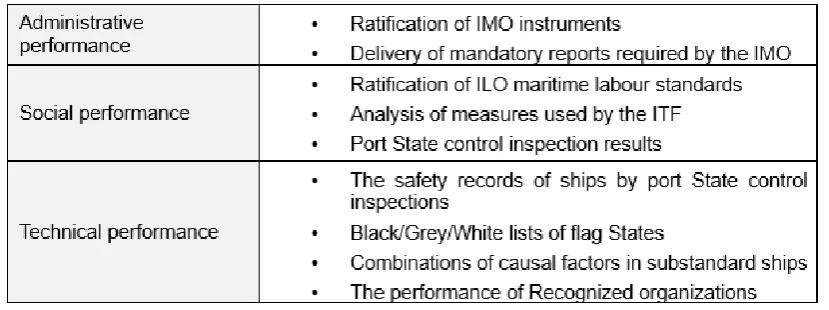
The importance of flag State performance is recognized because the effective implementation of international standards and regulations are connected to the willingness of flag States. Mansell (2009) has divided flag State performance into
9
three categories, administrative, social, and technical to measure the performance of flag States and identify areas to be measured, as described in Table 1, to clarify flag States with poor performance,.
Table 1. Administrative, social, and technical performance of flag States
Source: Mansell (2009)
Detailed analysis using the indicators in Table 1 has confirmed that International and Pseudo-National8 flag States have lower performance than the majority of National flag States. Additionally, a correlation was found between flag State performance and the age of ships. Moreover, he concluded that the main problem in enforcement of international instruments is the insufficient oversight of IMO Member States and measurement of their performance, and recognized the importance of an auditing scheme for IMO Member States.
Tan (2005) has argued that the lack of effectiveness of flag State performance to comply with international regulations is due to a lack of reward to comply, and Anderson (1998) pointed out that effective enforcement of flag States to comply with international regulations is a challenging task. But from a business point of view, since poor flag State records result in vessels of the flag State being targeted for PSC inspections or even complete bans from EU ports, the performance of flag State has become an important topic for the industry as well (Corres and Pallis, 2008).
10
2.2 Flag State Performance
The performance of flag States for implementation and enforcement of international regulations is a hotly debated topic addressed in international fora (Moen, 2008; Tan, 2005). The demand for new indicators to measure flag State performance has become important over the last decade (Graziano, in press). Before reviewing the literature focusing on flag State performance (FSP), it would be helpful to clarify the word “performance”. According to the Oxford Dictionary, performance means “the action or process of performing a task or function” which can be understood that the performance of a system is the action or process of performing the goal of the system. Graziano (in press) have identified two main areas characterizing the concept of flag State performance, efficiency and effectiveness, and explained that the evaluation of performance entails knowing “what a Flag State is supposed to do”, and evaluating “how well this is carried out”. In this regard, identifying possible indicators will be the first step in evaluating the performance of flag State. For that reason, a review of the academic literature dealing with the topic of flag State performance is performed in this section.
Takei (2013) examined flag State performance from a legal perspective, and stated that a lack of control by flag states over their ships is considered to be the main cause of the current crisis in maritime safety management in the world. He suggested that flag State performance should be based on the legal responsibilities of flag States which include exercising jurisdiction and control over administrative, social, and technical performance. Furthermore, he clarified the margin of discretion enjoyed by the flag State in the implementation of its duties, and pointed out that further development of flag State performance assessment is needed, especially, quantified measurement of flag State performance.
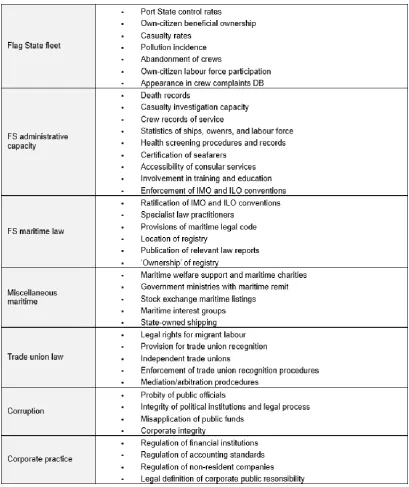
11
considering the assigned scores on performance indicators.
Table 2. Flag State Conformance Index
12
The FLASCI index identified Cambodia as the most unregulated flag State, which provides a regulatory free environment for ship owners (Alderton and Winchester, 2002). However, this index only focused on the ranking of flag States and most of the categories, such as Trade union law and Corruption, are not fit for the requirements of the III Code, which promotes the need for new evaluation tool to meet the obligations in III Code.
From an institutional perspective, the measurement of flag State performance was introduced in the Paris MOU in 1999 through the establishment of the Black/Grey/White (BGW) list. The BGW list measures the performance of flag states through their detention records. The Tokyo MOU also introduced a BGW list in 2002. The BGW list measures the performance of a flag state through its detention records and flag States are classified into black, grey, and white lists every three year. The grey list represents flags with an average performance; the black list represents flags that perform worse than average, and the white list represents flags that perform better than average. However, the measurement of flag State performance in the BGW list is mostly based on the records of inspections and detentions, and is subjective and inaccurate in its measurements (Mansell, 2009).
Therefore, Perepelkin et al. (2010) proposed a new methodology which applies new factors, such as deficiencies and casualties, to the BGW list to overcome the main drawbacks of the BGW list. But both the BGW list and the new method proposed by Perepelkin et al. (2010) focused mainly on the fleet performance of flag States, by which is not possible to measure the full spectrum of flag State performance for compliance with IMO instruments (Graziano, in press).
13
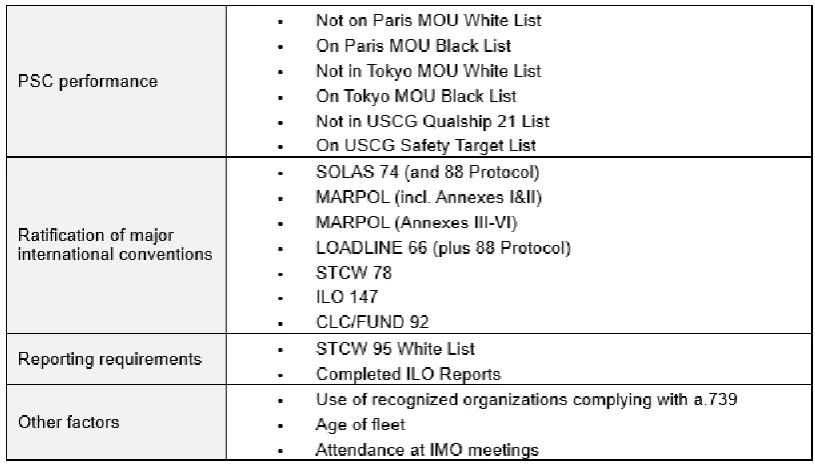
Table 3. Shipping Industry Flag State Performance Table
Source: ICS (2016)
The ICS Industry Flag State Performance table, which was developed by international institutions (BIMCO, Intertanko, Intercargo, ICS, and ISF) in 2006, produced a rough answers by indicating performance of flag States with green and red squares, and avoided giving conclusions on underperforming flag States. Consequently, Corres and Pallis (2008) added weighting factors in order to produce a quantitative assessment to draw specific conclusions on performance, resulting in 26 excellent, 34 good, 27 average, and 20 bad flag States. This study found that the gaps of national flags and international flags are becoming smaller in terms of flag State performance.
14
the objective of this dissertation which is the development of KPIs for IMO Member States.
Table 4. Summary of the affinity diagram
Source: Graziano (in press)
15
Table 5. Performance Indicators for 13 strategy
16
2.3 Key performance indicators in shipping industry
Drucker (1998) emphasized the importance of measuring performance through performance indicators, stating "If you can’t measure it, you cannot manage it”. KPI is an objective performance tool that helps organizations find deficiencies, benchmark improvements, and maintain self-improvement (Parmenter, 2015). Performance indicators are a key component as a measuring tool for organisations because it is not possible to determine the success or failure of a performance goal if the achievement is not accurately measured. KPI is commonly implemented to monitor and review performance in practice (Reiman and Pietikäinen, 2012).
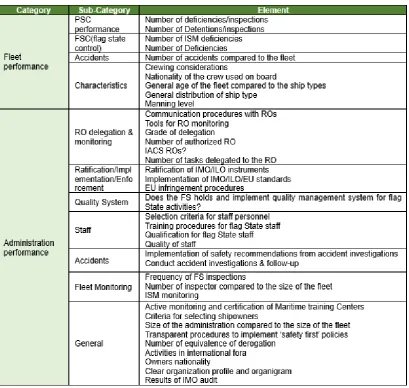
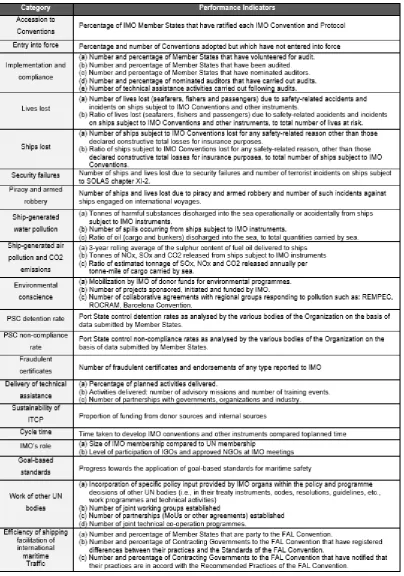
Performance indicators are widely used in the shipping industry, such as shipping companies, ports, and administrations to measure performance for continuous improvement (Graziano, in press). Currently, the Shipping KPI Standard provided by BIMCO uses 64 performance indicators to compare different types of ships to identify improvements for the shipping industry as shown in Table 6. Moreover, it provides measurement proposals for the shipping industry to analyse several fields integrated in the industry (Valdez Banda et al., 2016). KPIs listed in the Shipping KPI Standard are possible to use as an indicator for measurement of fag State performance by using indicators such as, PI48 Number of PSC deficiencies or PI49 Number of PSC detentions, as shown in Table 6.
2.4 Summary
17
Table 6. The Shipping KPI Standard.18
3. IMPLEMENTATION OF IMO INSTRUMENTS
This chapter provides the historical development of IMSAS and overview of the III
Code regarding its background and implications. Moreover, the current status of the
Republic of Korea in preparation for IMSAS is described.
3.1 From VIMSAS to IMSAS
The International community has developed standards to secure the safety of shipping and prevention of pollution over the past half century as Churchill and Lowe (1999) stated:
“…most States are reluctant to impose stricter safety legislation on their shipowners than other States impose on theirs. For these reasons, therefore, the international community has developed a set of uniform standards to promote the safety of shipping.”
19
the lack of political will and financial resources in most of the cases as stated in the summary by the International Commission on Shipping in 20009.
In order to secure safety of shipping and pollution prevention, the international regulatory framework ratified by IMO and the effective implementation of IMO instruments are the major factors for the shipping industry. The IMO has the most important effect upon the law of the sea (Churchill and Lowe, 1999), and one of the important aspects of IMO regulations is that once a Convention is ratified and entered into force, it is automatically applied to ships all over the world through flag State control and port State control. Nevertheless, the Secretary General of the IMO10 in 2001 stressed that the implementation and enforcement of IMO instruments by flag States had failed and stronger measures were required for its Member States to carry out their obligations.
IMO took its first step by promoting the IMO Flag State Self-Assessment Form (SAF form) in 2001. This was intended to enable flag States to assess their own performance and capability by completing a questionnaire through which they could identify their weak points requiring additional effort. However, about 17% of the IMO Member States did not submit the SAF form since it was an entirely voluntary methodology. Therefore, as a next step, a proposal was raised, at the eleventh session of Flag State Implementation (FSI) in 2003, to counteract ineffective flag State implementation and enforcement of mandatory IMO instruments by amending Resolution A.847(20)11 , and introducing a Voluntary flag State Audit Scheme
9 “…Major reasons stated for the failure to implement the necessary measures were the lack of competent personnel and financial resources, and a lack of political will in many cases…There was a widespread view throughout the Commission’s inquiry that the IMO’s work on flag State performance has been largely ineffective”. (International Commission on Shipping, 2000)
10 “… I believe that the problems perceived today do not lie basically with shipping’s regulatory framework or with the mechanism by which that framework is constructed, but with its implementation. Inherent in a system based on international consensus such as that which is developed through IMO are both rights and responsibilities. All IMO Members have the right to a voice in defining standards and regulations that will be applied to international shipping and that right is equal for all regardless of the size of their fleets, the strength of their economies or the depth of their maritime traditions. But the rights bring with them responsibilities and accountabilities that are commensurate with the rights.” (Mansell, 2009)
20
(VIMSAS)12 . VIMSAS benchmarked the audit programme of the International Civil Aviation Organization (ICAO) to monitor the performance of each Member States to improve its performance, in November 2003 at the twenty-third session of the IMO Assembly. To provide the audit standard and procedures for the upcoming Member State audit, Resolution A.973(24)13 and A.974(24)14 were adopted at the twenty-fourth IMO Assembly in November-December 2004.
VIMSAS has been acknowledged as the most successful tool for measurement of flag State performance in terms of jurisdiction and control, and it is believed that there should be mandatory standards for the performance of flag States as well as ROs (Mansell, 2009). Moreover, the round table of international shipping association (Consists of BIMCO, ICS, INTERTANKO, and INTERCARGO) reaffirmed its intention to strongly support the VIMSAS in November 2005 and decided that the results of IMO audits should be the targeting factor of the port state control, and the factor to identify areas that need to be improved for the safety of the shipping (Kim, 2006).
The IMO Assembly, in December 2013, decided to make the Member State Audit Scheme mandatory as an important step towards the effective oversight of flag State performance to secure the safety of shipping and prevention of pollution from substandard ships, by adopting Resolution A.1068(28)15and Resolution A.1070(28)16, which will underpin the mandatory audit scheme. On 1 January 2016, IMSAS and a majority of the necessary amendments to IMO instruments became mandatory. A total of 9 instruments are included in the scope of the scheme:
12 Resolution A.946(23). Voluntary flag State Audit Scheme (VIMSAS).
13 Resolution A.973(24). Code for the implement of mandatory IMO instruments.
14 Resolution A.974(24). Framework and Procedures for the Voluntary IMO Member State audit scheme
15 Resolution A.1068(28). Transition from the voluntary member state audit scheme to the IMO Member State audit scheme.
21
• SOLAS 1974
• SOLAS PROTOCOL 1988
• MARPOL 73/78
• MARPOL PROTOCOL 1997
• STCW 1978
• LOAD LINES 1966 (LL66)
• LL 66 PROTOCOL 1988
• TONNAGE 1969
• COLREG 1972
It took almost 13 years for the IMSAS to become mandatory. During the VIMSAS phase, only 14 States volunteered for audits up to March 31 2006, and a total of 75 member states have undertaken voluntary audits to date (IMO, 2017). The IMO has provided an audit summary report with a total of 59 audits.
Figure 1. Percentage and numbers of findings according to the parts of the Code.
54%
29% 9%
8%
59 AUDITS - 52 MEMBER STATES
Flag States, 295 findings Common Areas, 158 findings
22
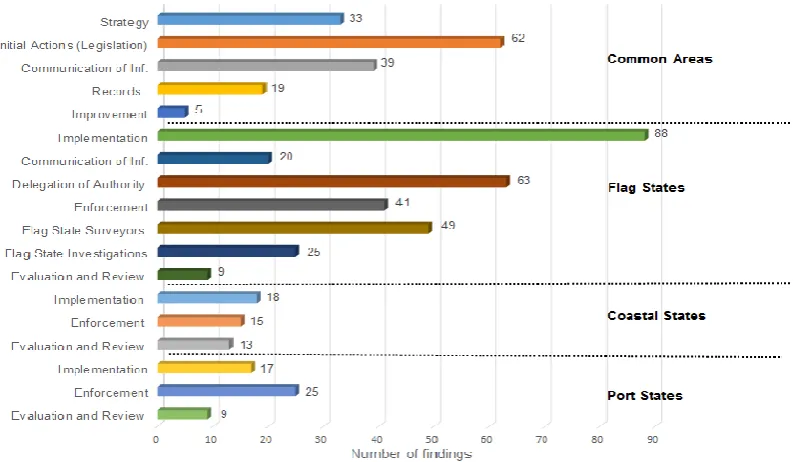
The audit summary report as described in Figure 1 shows that most of the findings in the audits pertained to the flag State responsibilities and obligations area which accounts for about 53.6%, followed by the Common Areas (28.7%), Port States (9.2%), and Coastal States (8.3%). In detail, the number of findings in the implementation of IMO instruments by flag States was the highest in the audits among all the factors, as seen in Figure 2.
Figure 2. Analysis of audit results by parts of the Code. IMO (2014b).
It is obvious that the performance of flag State is the main problem of the implementation and enforcement of IMO instruments as shown in Figure 1 and Figure 2. A review of consolidated audit summary reports revealed that the major causes of ineffective implementation of IMO instruments by the audited States were the lack of procedures and processes; lack of national provisions; lack of national resources; lack of coordination with other entities; and lack of training programmes (IMO, 2014b).
23
there is a problem with the maritime administration, it is expected that several disadvantages will be imposed on the audited country such as increase in insurance premiums, exclusion of charters, and strengthening of PSC inspection (Kim, 2006). It is clear that there are difficulties for IMO to proceed with the IMSAS, however, it is expected to ultimately reduce the gap between implementation and enforcement of IMO instruments (Jessen and Zhu, 2016).
3.2 IMO Instruments Implementation Code
The objective of the III Code is to strengthen the role of IMO Member States in their functions as flag States, port States, and coastal States to enhance the safety of shipping and protection of the marine environment, and enable the IMO to better evaluate the performance of the IMO Member States as the international maritime standard setting organization (NIA, 2015).
Overall, the overarching objective of the III Code is to assist IMO Member States in the implementation of IMO instruments which represents the IMO’s key objective (Jessen and Zhu, 2016). Since the IMSAS became mandatory as well as the III Code, it is clear that the IMO Member States should understand and comply well with the III Code.
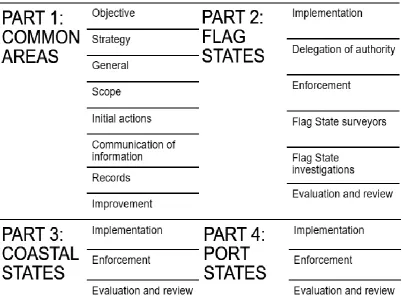
The III Code is comprised of four parts which are common areas, flag States, coastal States and port States as presented in Figure 3. The III Code highlights three aspects of a maritime administration, which are implementation, enforcement and review. Those three aspects are addressed in the common areas17 of the Code wherein a member State must have an available methodology to evaluate the performance of
17 III Code Paragraph 3: “In order to meet the objectives of this code a state is recommended to;
1. Develop an overall strategy to ensure its international obligations and responsibilities as a flag, port and coastal state are met,
2. Establish a methodology to monitor and assess that the strategy ensures effective implementation and enforcement of relevant international mandatory instruments, and
24
its ships, seafarers, and the effectiveness of its enforcement of the mandatory Conventions.
Moreover, the member States should review trends and formulate strategy based on the data from the performance evaluation. The III Code specifically requires Member States to establish a strategies which covers “implementation and enforcement of IMO instruments; adherence to international recommendations; continuous review and verification of the effectiveness of the State to meet is international obligations; and achieve, maintain and improve overall organizational performance and capabilities” (IMO, 2013b).
25
The strategy of the Member States entails an important mechanism for the State to assess its performance in meeting its obligations, and should include procedures for all the stakeholders in the State’s maritime activities to establish competence and areas of responsibility, and an evaluation system to monitor, evaluate, and enhance the performance of the Member State (Schröder-Hinrichs, 2017).
Furthermore, communication of information, records, and improvements are included in the common areas indicating that the IMO Member States should establish and maintain records to demonstrate their effective compliance. In addition, all Member States should encourage a culture that provides opportunities for performance improvement regarding maritime safety and environmental protection, and identify the causes of non-conformities and implement corrective action through review and analysis of their performance to prevent recurrence of problems (IMO, 2013b).
The III Code was amended twice to cover the amendments that occurred between 2007 and 2011. In 2011, the IMO was requested to incorporate a process of periodic review of flag State performance in order to help IMO Member States comply with their obligations (Jessen and Zhu, 2016). In this regard, the Code has stated the duties of flag States pertaining to the evaluation and review in paragraphs 42, 43, and 4418 wherein a flag State should evaluate its performance periodically with the performance indicators given in the paragraphs. Port States and coastal States are also required to evaluate their performance according to the part 3 and 4 of the III Code.
As a result, maritime administrations must collect a wide range of data to create comparative statistics which covers the data from the PSC, accident, reports, exemptions issued and all the factors that provide the performance of ships entitled to fly their flag.
26
It is important to monitor the performance as required by the III Code, and it is significantly dependent on the Port State Control (PSC) inspection due to its role as a powerful criterion for any flag State assessment (Corres and Pallis, 2008). Nonetheless, a considerable number of Member States, especially developing countries, have not enough manpower for PSC, Vessel Traffic Service (VTS) center, and accident investigation centers (MOF, 2006). The III Code stipulates the continual review and verification of the performance of the State, and it expects performance indicators to show certain data to review its performance. The whole scope of the III Code requires the collection and analysis of a wide range of data, which is the objective of this thesis through the development of KPIs to analyse the performance of IMO Member States.
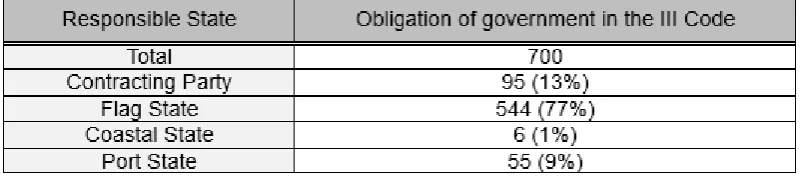
As mentioned above, most of the findings in the VIMSAS were from the flag States part of the III Code. It is notable that the requirements of the III Code are mainly focused on the obligations of the flag States as shown in Table 6. About 77% of the obligations required in the III Code are for flag States which indicates that the role of flag States is the most important aspect of compliance with the III Code, and once again highlights the importance of flag State performance. Therefore, this dissertation will focus on the development of KPIs for the flag States part of the III Code as a basic study for quantification of the performance of IMO Member States.
Table 6. The number of requirements of the III Code for each responsible entity
27
3.3 The context of the Republic of Korea
Korea has achieved a high level of maritime safety through its efforts in the
development of marine safety along with the growth of maritime forces which have
enabled Korea to be a Category “A” Member of IMO five times consecutively.
However, there are many administrative tasks that have not been enacted, and which
make it difficult to ensure that the current maritime safety administration in Korea is
operating in accordance with international requirements (MOF, 2017). Therefore, it is
necessary to investigate the actual situation of safety management in Korea, centered
on the obligations of the flag states, the port states, and the coastal states specified
in the III Code in order to prepare for the IMSAS.
From January 2016, IMO has planned to audit 25 Member States each year and
Korea is expected to be audited in 2020. In 2007, Korea successfully completed a
VIMSAS with only three findings. Nevertheless, there is a need for sufficient
preparation for the IMSAS since a number of significant maritime accidents19 have
occurred since the VIMSAS and the safety organization system20 has changed
several times. In addition, thorough precautionary measures and preparations are
necessary for economic loss prevention and maintaining the status of Category “A” in
IMO. Therefore, Korea has set a strategic plan with high level objectives and
strategies with regard to its maritime policy as required in paragraph 321 of the III
Code. The strategic objectives are:
19 Hebei Spirit (2007), Sewol (2014)
20 Ministry of Land, Transport and Maritime Affairs (2008) changed to Ministry of Oceans and Fisheries (2013). Disband Korea Coast Guard in 2014 and reorganized in 2017.
21 Paragraph 3:In order to meet the objective of this Code, a State is recommended to:
.1 develop an overall strategy to ensure that its international obligations and responsibilities as a flag, port and coastal State are met;
.2 establish a methodology to monitor and assess that the strategy ensures effective implementation and enforcement of relevant international mandatory instruments; and
28
• Enhancement of Maritime Safety Management System
• Build governance
• Strengthen human capacity
In Korea, most of the policies for the implementation of the III Code are developed
by the Maritime Affairs and Safety Policy Bureau, and Ministry of Oceans and
Fisheries (MOF) has delegated seven areas of its work: ship inspection, prevention
of marine pollution, management of examination for qualification of seafarers,
education, ISM and ISPS inspection and certification, inspection of dangerous goods,
and consignment of accommodation facility to Korea Ship Safety Technology
Authority (KST), Korean Register (KR), National Institute of Fisheries Science (NIFS),
Maritime Universities (KMOU and MMU), Korea Institute of Maritime and Fisheries
Technology (KIMFT), Korea Testing Certification (KTC), Korea Marine Environment
Management Corporation (KOEM), and Korea Maritime Dangerous Goods Inspection
Center (KOMDI). Among them, the ROs that are subject to IMSAS are KST, KR, and
KIMFT.
Moreover, accident investigation is divided into marine accident and marine pollution
accident investigation. In case of marine accidents, Korea Maritime Safety Tribunal
(KMST) investigates the causes of accidents and Korea Coast Guard (KCG) is in
charge of the investigation regarding judicial procedure. When a pollution accident
occurs, the investigation function is diverted and it is anticipated that many
inconveniences are expected due to duplicate investigations.
The biggest problems that have arisen for the IMSAS are mostly the lack of human
resources, lack of education and training, lack of documented work procedures, and
overlapping of similar tasks between departments (MOF, 2017). Therefore, it is clear
that the evaluation of Korea’s performance regarding the III Code is important for the
29
3.4 Summary
To summarise, IMSAS has become mandatory, which requiring IMO Member States
to meet their obligations as required by the III Code. However, it is difficult for all the
Member States to comply with the III Code due to lack of resources, personnel, and
procedures. In addition, Korea accomplished VIMSAS successfully in 2007 with three
findings and is preparing for the upcoming IMSAS in 2020. It is clear that a new
evaluation tool is needed to measure the effectiveness of Member States’
performance in order to identify problem areas and implement corrective action. In
the following chapter, the methodology for the development of KPIs will be presented.
30
4. CONTEXT-MECHANISM-OUTCOME METHOD TO DEVELOP KPIS
This chapter introduces the benefits and limitations of the realist evaluation, and the procedure for applying the CMO method to the III Code.
4.1 Introduction of the realist evaluation
The realist evaluation, formerly known as realistic evaluation, was first proposed by Pawson and Tilley (1997). It provides a structured review of policy programmes. The purpose of a realistic evaluation is to identify and reveal the nature of programmes, and it ultimately asks “‘what works for whom in what circumstances and in what respects, and how?’” by using four key concepts: “mechanism”, “context”, “outcome”, and “context-mechanism-outcome (CMO) pattern configuration” (Pawson and Tilley, 2004). Moreover, the CMO method explains how the programme caused the expected change and identify underlying theories in the particular programme (Gill and Spriggs, 2009).
31
The second step is to identify the context of the policy programme, and it shows what the characteristics of the conditions in the programmes are. The next step is outcome patterns. The outcomes of programmes have intended and unintended results from different mechanisms in different contexts, and this allows for a more comprehensive evaluation of complex programmes. For the final step, context-mechanism-outcome pattern configurations (CMOCs) indicates how the programmes use mechanisms under various conditions (Pawson and Tilley, 2004).
Although few studies using this method yet, and it requires a number of refinements due to the lack of elaborate and universal principles on how to apply it, the CMO method is very helpful in terms of analyzing the effectiveness of certain policy programmes (Westhorp, 2014). The CMO method is probably the best way to analyse particular programmes, and it can be carried out by a researcher if no survey or interviews can be done. However, there are several challenges involved in applying the realist evaluation.The application of CMO to the programme largely depends on the researcher and requires a great deal of skill. The researcher should identify the correct context and deduce how the intervention interacts with the context to make an outcome (Gill and Spriggs, 2009).
32
“Context: assess the form the requirement and guidelines included in the applied safety management norms are subjected to the reasoning and environment of the affected organization.
Mechanisms: assess the use of resources to make the system functional and supportive to achieve the planned objectives through the implementation of the applied safety management norms.
Outcome: assess the possible consequences arising from the application of these safety management norms, and how to adapt these to the plans and procedures of the system.” (Valdez Banda, 2017)
It is notable that the CMO method allows the researcher to identify “what works for whom in what circumstances”(Tilley, 2000), and what aspects of an intervention make the policy programme effective or ineffective (Stuart et al., 2015).
33
4.2 Applying CMO method to the III Code
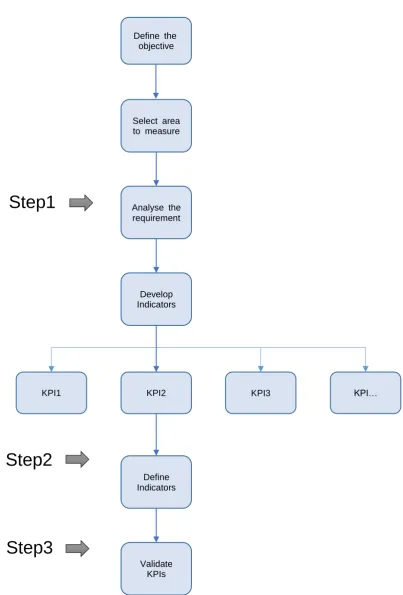
In order to develop KPIs, Figure 4 demonstrates the process of this study step by step. It is essential to define the objective of the measurement and the reasons for the measurement as a first step. Since the goal of the development of the KPIs is to measure the performance of IMO Member States, the III Code is selected to achieve the aim of this study because of its role as a compulsory guidance for the IMSAS. The one of the objectives of this study is to evaluate the performance of the IMO Member States regarding their implementation of administrative processes, procedures and resources as required by the III Code, and identify those factors which have to be improved by a performance evaluation tool.
The nature of the III Code was analysed through the CMO methodology to understand the requirements of the III Code and determine the mechanism needed to satisfy the requirements. As a result, the CMO method developed by Valdez Banda et al. (2016) is applied to the flag States part of the III Code to achieve the objective of this thesis.
34
Select area to measureKPI1 KPI2 KPI3 KPI…
Analyse the requirement
Develop Indicators
Define Indicators
Validate KPIs
Step1
Step2
Step3
Define the objective
35
As a pilot study to apply a realist evaluation to the III Code, the CMO questions are applied only to flag States part of the III Code to verify the suitability of the CMO method for development of KPIs. For the reasons mentioned above, the CMO questions are applied to paragraphs 15-4422 of the III Code, and are intended identify and develop the KPIs by conducting a three step process as below:
1. Applying the CMO questions to the flag States part of the III Code. Then,
selecting and developing of KPIs through the CMO questions conducted.
2. Provide definitions and categorization for each developed KPI in order to
clarify its representativeness, suitability, and relevance to the III Code.
3. Apply the developed KPIs to the Republic of Korea to verify its validity,
compatibility, and reliability.
The CMO method, is largely divided into context, mechanism, and outcome with 14 questions, as shown in Table 7. Questions in the context part require the author to provide information regarding the organizational aspect, current task developed, organizational conditions likely to be influenced, responsible body, and links with other implemented norms. The mechanism part requires the author to answer how to achieve the requirements from the III Code, and the outcome part shows the expected results when the flag State implements the requirements as required by the III Code. It is a structured method that helps to focus on context, mechanism, and outcome of
the III Code, but it is also a subjective method whereby different teams can come to
different results.
36
Table 7. CMO questionsSource: Valdez Banda et al. (2016)
4.3 Summary
37
5. APPLICATION OF CMO METHOD ON THE III CODE
This chapter provides the results of the application of the CMO method on the III
Code. The procedure to apply the CMO is introduced and the KPIs developed from
the CMO method as well as the categorization of KPIs are presented.
5.1 KPIs developed through the CMO method
This part of the thesis presents examples of how the CMO questions were applied to the III Code and of the KPIs developed from the CMO questions. The questions in Table 7 evaluated the context, mechanism, and the outcome of the III Code and identified not only what the III Code requires, but how it works in various circumstances. Every requirement of the flag States part of the III Code was assessed with the questions, and it provided the response and the justification for the KPIs for the corresponding requirements.
38
Table 8. Part 2: Flag States.In order to apply the CMO method to the III Code, initial discussions were held between the author and experts, including a Professor. This was followed by a formal completion of the KPI work sheets, as shown in Appendix 1, and the results were reviewed by the Professor and selected experts. Finally, a table of KPIs was developed to meet the requirements of the III Code.
Table 9 presents the KPI sheet, which shows the response to the CMO questions, and shows the link between the performance indicators and the requirement. Paragraph 15 of the III Code was assessed with questions to identify the requirement, and the mechanism to implement that requirement, as well as the expected outcome for the flag State to achieve, as shown in Table 9.
40
Secondly, factors to be considered regarding paragraph 15.1 were identified after applying the CMO questions. They are effectiveness of enactment and amendment procedures of relevant national laws and regulations, the level of policy development and update for implemented policies, the adequacy of development and dissemination of commentary on regulations, appropriateness of establishing administrative guidelines necessary for the implementation of international regulations, and appropriateness of the international Convention conformance check system.
Consequently, a total of 10 groups of indicators were selected to satisfy the identified factors in the requirement of paragraph 15.1. Selected indicators are connected to the response to each question and justify what kind of KPIs can cover the response to each question, as described in Table 9. The 10 selected indicators are listed below:
(1) An indicator about fleet performance in terms of Port State Control,
and accident numbers.
(2) An indicator about the guidance for different IMO conventions
(SOLAS, LOAD LINE, TONNAGE etc.) that are covered by policies and guidelines
(3) An indicator covering the number of policies and documents issued
as guidance to administrations, ship-owners and other maritime stakeholders
(4) An indicator about the availability of an administration to deal with this
requirement
(5) An indicator for the quantity and quality of information disseminated
to stakeholders
(6) An indicator for targeted flag State inspection programs
(7) An indicator for qualification and training of maritime administrative
41
(8) An indicator for regular reviews of the technical regulations in terms
of consistency with other national instruments and in terms of gaps that may still exist
(9) An indicator for regular review of the level of compliance with
international obligations
(10) An indicator about customer satisfaction with the administration
Finally, the 10 groups of indicators identified what has to be measured to satisfy the requirement and resulted in 18 KPIs to cover the context, mechanism, and outcome of paragraph 15.1.
The rest of the paragraphs of the III Code were assessed in the same way, and the results from the CMO questions in the KPI sheets are attached in Appendix 1 since it is not possible to describe all of the realist evaluations performed.
The application of the CMO method to the III Code resulted in 43 KPIs for assessing the performance of the flag State as required by the III Code. The 43 KPIs are listed according to their corresponding requirements in the III Code as shown in Table 10.
Table 10. Developed KPIs through the CMO method.
Suggested KPIs No. Developed KPIs
(1) An indicator about the fleet performance in terms of Port State Control, accident numbers etc.
KPI1 Port State Control detention follow up
KPI2 Port State Control deficiency follow up
KPI3 Fleet loss ratio
KPI4 Accident follow up
KPI5 Flag State Control follow up
(2)
An indicator about the guidance for the different IMO conventions (SOLAS, LOAD LINE, TONNAGE etc.) that are covered by policies and guidelines.
KPI6 Policy Implementation ratio
KPI7 Legislation ratio
(3)
An indicator covering the number of policies and documents issued as guidance to administrations, ship-owners and other maritime stakeholders.
KPI8 Commentary regulation published
KPI9 Administrative guidance published
(4)
An indicator about the availability of an administration to deal with assigning responsibilities.
KPI10 Assign responsibilities of Administration
(5) An indicator for the quantity and quality of information disseminated to stakeholders. KPI11 Communication quantity
(6) An indicator for targeted flag State inspection programs KPI12 FSC inspection rate
42
of maritime administrative personnel administrative personnel
KPI14 Training Standards for administrative personnel
(8)
An indicator for regular reviews of the technical regulations in terms of consistency with other national instruments and in terms of gaps that may still be existing.
KPI15 Validation of national legislation
(9)
An indicator for regular review of the level of compliance with international obligations.
KPI16 Periodical evaluation of the III Code
KPI17 Follow up for nonconformities from periodical evaluation
(10) An indicator about customer satisfaction with the administration KPI18 Customer satisfaction
(11)
An indicator about documentation of the responsibilities in the administration (Duty segregation table of each department)
KPI19 Assigning responsibilities of personnel
KPI20 Assigning responsibilities of maritime organizations
(12) An indicator covering the procedures for flag State inspection. KPI21 FSC inspection procedure
(13)
An indicator about the administrative personnel who are available to carry out Flag State Inspections.
KPI22 Qualification of flag State surveyors
(14)
An indicator covering the level of training for competence of seafarers which is in
compliance with the STCW requirements. KPI23 The level of training of seafarers
(15)
An indicator which verifies the standards for assessment of seafarers’ competence which is in compliance with the STCW requirements.
KPI24 Standards for qualifications of seafarers
(16) An indicator covering the standards for issuing certificates and endorsements for seafarers (including external verification)
KPI25 Standards for issuing certificates for seafarers
(17)
An indicator about the procedures of withdrawal, suspension or cancellation of
certificates or endorsements issued. KPI26
Procedures of withdrawal/suspension /cancellation of certificates.
(18)
An indicator covering the procedures for impartial accident investigation by investigators.
KPI27 Procedures of accident investigation
(19) An indicator covering the appropriateness and promptness of the marine accident investigation
KPI28 Marine accident investigation
(20)
An indicator covering the appropriateness and promptness of the countermeasures
for substandard ships. KPI29 Countermeasures for substandard ships
(21)
An indicator which shows current manning level of ships entitled to fly its flag, and compliance with the Principles of Safe Manning.
KPI30 Manning level
(22)
An indicator about the administration performance in terms of RO delegation &
monitoring. KPI31 RO delegation & monitoring
(23) An indicator about the communication between ROs and administration KPI32 Communication with ROs
(24)
An indicator about supplementary surveys for flagged ships in order to oversight ROs.
KPI33 Supplementary surveys for flagged ships
(25)
An indicator about the presence of formal written agreement between the Administration and the ROs.
KPI34 Agreement conclusion with ROs
(26) An indicator about the instructions detailing actions to be followed by ROs for substandard ships.
KPI35 Instruction for ROs
(27)
An indicator about the penalty regulation for substandard ships and individuals who
violated international rules. KPI36
Penalty regulation for substandard ships and individuals
43
who violated international rules.
(29)
An indicator about the number of investigation report which have reported
to the IMO KPI38 Reporting to IMO
(30)
An indicator about the appropriateness of the providing statistical data and trend analysis.
KPI39 Providing statistical data
(31)
An indicator which verifies the control and monitoring program for responding to deficiencies and alleged pollution incidents.
KPI40 Responding to deficiencies and pollution accident
(32) An indicator for qualification and training of flag State investigators. KPI41 Qualification and training of flag State investigators.
(33)
An indicator covering the procedures for training program provided to flag State surveyors.
KPI42 Training program for flag State surveyors
(34) An indicator covering the procedures for training program provided to flag State investigators.
KPI43 Training program for flag State investigators
There are 34 group of indicators found which show how the requirement of the III Code are covered by the KPIs, and a total of 43 KPIs are developed by analysing those groups of indicators. The development of KPIs mainly focused on the quantification of flag State performance to assist Member States to measure their performance and identify problem areas through trend analysis.
For the measurable KPIs, performance indicators such as PSC detention rate or accident rate in the Shipping KPI Standard are selected, but the number of follow ups for the PSC, FSC detentions and accidents are also included to measure the willingness of the flag State to carry out corrective actions.
44
5.2 Categorization of developed KPIs
It was possible to understand the objective of the III Code by applying the CMO method, and the author identified main components of paragraphs 15 to 44. The realist evaluation enabled the author to categorize developed KPIs into the main components of the III Code. The flag States part of the Code are divided into Implementation, Delegation of authority, Enforcement, Organization system and Human resources after analysing every requirement of the Code, as shown in Figure 5. Classification of KPIs can help users not only identify the problem areas but also understand the immediate need to address problem areas. Although proposed categories are not the only way to divide the flag States part into smaller groups, but this method of categorization could be a step toward broader study.
15
5 12
11
Categorization of developed KPIs
Implementation Delegation of authority
Enforcement Organization system and human resources
45
Implementation
Implementation consists of procedures for issuing national legislation, in compliance with STCW Convention, procedures for marine accident investigation, flag State