Mentors and reflective frameworks: Internationalising the
local provision of professional development in e-Learning:
A New Zealand case study
John F. Clayton
Waikato Institute of Technology
New Zealand
Abstract
The concept of reflection as a tool to improve professional practice has been widely debated in educational circles for a number of decades. Advocates of reflective practice assert deep learning occurs as individuals make meaning from their experiences through the process of reflection. To engage participants in the reflective process, to aid them in making connections between their previous experiences and accepted international standards, self-reflective frameworks have been developed. Reflective frameworks enable professionals to identify both their key strengths and focus areas for improvement. As individuals compare their current performance against accepted best-practice they are able to take ownership of their professional development and generate personal learning plans (PLPs) to meet their identified needs. However, an inherent risk in this self-reflective approach is the existing cognitive ability of the individual to undertake the complex tasks of reflection and the subsequent creation of a PLP. One way to mitigate this inherent risk is through the appointment of a mentor. This case study will explore the design, development and deployment of a self-reflective framework, The Competency Assessment Tool (The CAT), and describe how mentor-learner roles and responsibilities are defined. The study will conclude that through this process of on-going refection, mentoring, feedback and follow-through a local environment, encouraging greater autonomy, personal transformation and deeper self-reflection is created on the foundation blocks of international best-practice.
Key Words: Reflection, Reflective Frameworks, Mentors, Personal Learning Plans
Context
Driven by fiscal restraints and the need to remain globally completive in an increasingly knowledge-based, networked world, successive New Zealand governments have introduced a raft of educational initiatives (Ministry of Education, 2010). In the tertiary education sector these reforms have focused on firstly, improving performance and efficiency ensuring more learners, national and international, from a broader ethnic, cultural and educational
Conceptions of Teaching
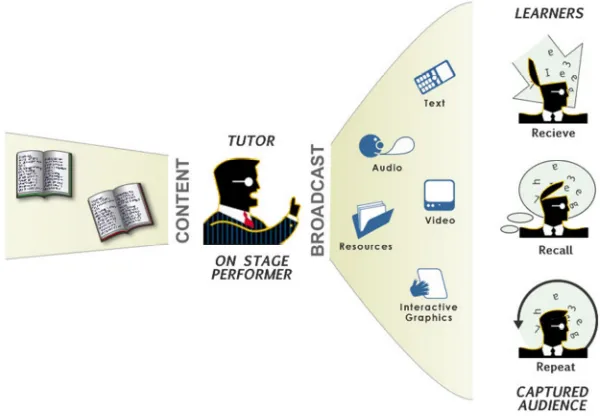
Traditionally educators in the New Zealand tertiary sector have been employed for their depth of knowledge in a specific discipline rather than for their expertise in teaching practice. Not surprisingly, many of these educators have a limited repertoire of teaching skills often dominated by transmission modes of delivery such as, demonstrations, tutorials, workshops or lectures (Brockbank & McGill, 2007). In these modes the educator is a ‘broadcaster’ transferring ideas, facts, processes and concepts wholesale into learners' heads. This concept of the educator broadcaster is illustrated in Figure 1 below (Clayton, 2009, p.10).
Figure 1Educator broadcaster
The acceptance by tertiary institutions of increased enrolments of learners from broad ethnic, cultural and educational backgrounds creates a culturally diverse learner cohort. This cohort holds multiple-views of phenomena and has multiple-meanings for words that have proved to be useful to them in making sense of the world that surrounds them. In the learning
environment created by this cohort it is an expectation educators will adapt instructional strategies and content presented to meet the educational, social and cultural needs of this diverse audience (Zimmerman & Schunk, 2001). This approach aligns with constructivist theories of teaching. Constructivists acknowledge learners hold views of the world and meanings for words that are intelligible, (coherent and internally consistent) plausible,
Figure 2Educator facilitator
Use of e-Learning
In a recent review of the range e-learning courses and activities developed and delivered by training organisations and educational institutions, it was clear developers, providers and users appear to have different concepts of what is meant by e-learning (Clayton, Elliott, Saravani, Greene, and Huntington, 2008). Individual learning events, courses and
programmes differed in the degree of interactivity occurring between learners and tutors, the multi-media richness of content developed and the delivery mechanisms used to manage the learning experience. Each educational institution appeared to develop and deliver e-Learning based upon the current experiences of its tutors, the financial and physical resources available and the perceived learning needs of students (Clayton, 2007).
In practise e-Learning typically involves interactivity, such as student engagement with digital content, online interaction between learners and their instructors and online interaction between learners and their peers. It is facilitated by the use of computers (stand-alone and networked), digital communication tools (such as chat, e-mail, forums, messenger, VoIP) digital content creation tools (such as Wikis, Blogs and Web-folios) and digital content (such as web- pages, CD-Roms and DVDs) (Clayton & Elliott, 2007). In some cases, such as in an instructor facilitated video-conference, e-learning activities are carried out in ‘real-time’ and the activity undertaken is time constrained and dependant on attendance of all participants. This is known as synchronous e-learning. In other instances, such as student engagement with a CD-ROM simulation activity, the learning will occur in ‘nominal-time’ and the activity undertaken is not time constrained and is independent of other participants. This is referred to as asynchronous learning, or self-paced learning (Clayton & Elliott, 2007). In essence e-Learning can be usefully described as learning that is enabled or supported by the smart use of information and communications technology (ICT).
Provision of Professional Development
In the provision of professional development (PD) in e-learning there appears to be a natural association between staff acquiring skills (are competent), deploying these skills in their professional practice (are confident) and believing the use of Information and
students as learners (are capable) (Clayton, et al, 2009). This suggests that, in structuring a balanced PD programme, three key elements should be logically addressed:
• Competencies (How): Practical sessions should be offered on ‘how’ to competently operate various ICTs both for administrative and academic purposes and for learners to utilise them in their learning activities.
• Confidence(When):Sessions, enhanced by authentic examples, should be designed to show ‘when’ ICTs can be successfully integrated into learning activities and
administrative tasks.
• Capability (Why): Sessions, supported by applied research, should be structured to illustrate ‘why’ using ICT in learning environments and for administrative purposes is beneficial to tutors, learners and organisations.
Reflection
Traditional professional development activities focused on information delivery (for example classroom instruction or lecture), and conducted at venues outside the workplace, often fail to influence professional practice (Yukawa, & Harada, 2011). Research has demonstrated that changes in professional practice are most effective when they are situated within a
community that encourages reflection on genuine problems (Webster-Wright, 2009). The concept of reflection (the conscious act of purposefully thinking about activities undertaken) has been widely debated in educational circles for a number of decades (Kreber, 2004: Korthagen, & Vasalos 2005). To advocates of reflective practice, deep learning is dependent on individuals making meaning from their professional experiences through the process of reflection (Brockbank & McGill, 2007). The outcomes of the reflective process help
individuals firstly, highlight the strengths of their current professional practice and, secondly, identify areas where undertaking professional development will facilitate increased
professional capability. It is argued this on-going reflection helps individuals iteratively build their professional capability and capacity (Clayton et al, 2009; Sugerman et al, 2000). In essence, reflection encourages a professional development environment that is on-going (sustained), connected to practice (situated) and focused on professional tasks (authentic).
Self-Reflective Frameworks
A fundamental criterion for the success of reflective practice is the underlying ability of the individual to make the appropriate connections between their existing professional
experiences and acceptable professional behaviours. If a practitioner has limited professional experience, or limited exposure to other professionals, his/her capacity to make informed judgements, to make the required connections, will be limited (Clayton, 2011). To address this barrier, to engage participants in the self-reflective process and to aid them in making connections between their previous experiences and professional practices, self-reflective frameworks, based on acceptable professional standards have been developed (Clayton, 2011a).
(PLPs) (Ward and Richardson, 2007) enabling them to become self-regulated learners (Zimmerman, 1990).
Mentors
It could be argued the focus on standards-based criteria as the foundation of reflective frameworks act as a constraint in the reflective process; it will restrict academic freedom and prescribe rigid learning events (Strudler & Wetzel, 2009). These valid concerns can be addressed by the appointment of an experienced mentor. The term mentor originates from Greek mythology when the well-travelled, and absent parent, Odysseus entrusted the care and education of his child to his friend called Mentor (Penner, 2001). Traditionally, in business and industry, mentoring strategies are used to attract, retain, and promote employees, ultimately improving individual and corporate performance and effectiveness (Luna and Cullen, 1995). In the compulsory education sector (pre-tertiary) mentoring has long been acknowledged an integral part of professional learning and development. For example, in initial teacher education practicums student teachers learn skills and techniques from
experienced classroom teachers. In the first years of their profession newly-qualified teachers learn professional skills and strategies from experienced colleagues (Scottish Government, 2011). In higher education, while it is not always been easy for staff themselves to access, mentoring has long been regarded as an important adjunct to teaching and learning, (Darwin & Palmer, 2009). Through sustained feedback and follow-up mentors create environments that encourage greater autonomy, personal transformation and deeper self-reflection (Galbraith, M. 2003: Basile, Olson, & Nathenson-Mejia, 2003). As such they should be regarded as a critical aspect of the self-reflective process.
Portfolios
Historically speaking, in artistic circles, portfolios not only summarised an artist’s creative achievements but they also illustrated those achievements in a physical form. As portfolios encourage the accumulation of physical evidence to illustrate achievement they are seen to be a valuable tool for the formal assessment of competencies and are used in many professions such as nursing, medicine, and teaching (McColgan, & Blackwood, 2009). Similarly, in formal accreditation environments, systematically compiled digital portfolios provide a protected shared space where learner evidence of competencies can be rigorously controlled and systematically evaluated (Fiedler, Mullen, & Finnegan, 2009). But portfolios go beyond assessment. For example, in initial teacher education portfolios provided a number of benefits including, on-going opportunities for participants to reflect on their teaching experiences, improved understanding of required teaching standards and enhanced on-going
communication between staff and learners (Strudler & Wetzel, 2009). In today’s educational world a portfolio can be regarded as the purposeful collection of a learner’s work structured to exhibit and illustrate the learners’ efforts and achievements over time (Kim, Ng, & Lim, 2010). Portfolios should be viewed as a personal learning management tool encouraging individual improvement, personal growth and development, and a commitment to life-long learning by encouraging on-going reflection (Abrami & Barrett 2005).
Internationalising the Curriculum: A New Zealand Case Study
The Certificate in Open, Flexible and Networked Learning (COFNL)
5 modules based on identifiable Unit Standards registered with the New Zealand
Qualification Authority (NZQA, 2011). Basing the modules on these registered standards ensured the institute was following best national practice and it aligned institutional PD delivery with national goals.
The CAT: A Reflective Framework
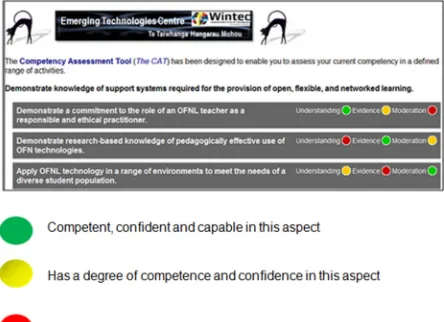
To engage participants in reflective practice and to aid them in making connections between identified pedagogical standards in ICT and their previous experiences a self-reflective competency assessment tool (The CAT) was created for COFNL learners. The CAT was designed to enable learners to assess their current competencies against nationally defined standards. The CAT interface (see figure 3 below) provides the learner with a series of statements relating to each of the five modules within the COFNL. The statements within each module are classified within three categories, understanding, evidence and moderation.
Figure 3: Categories, statements and responses
Participants are asked to reflect upon and then respond to individual statements. As
participants progress through the CAT their answers affect the indicator colour on the index page. The indicator colours are based on the familiar “traffic light” theme (green, go: Yellow, caution: Red, Stop) and this is illustrated in figure 4 below;
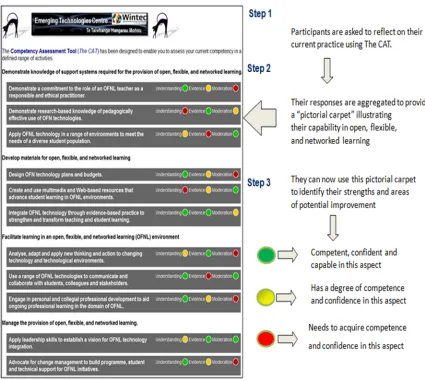
As the participant progress through the modules, categories and statements, their responses provide a pictorial reflective framework carpet. This reflective framework and visual carpet is illustrated in figure 5 below.
Figure 5: The visual carpet
The visual carpet produced from learner engagement provides the learner with; • An initial assessment of their current knowledge, experience and understanding of
individual aspects of this domain.
• An indication of potential starting points to begin a learning journey, and
• Navigational tips to map a learning route from starting points to intended achievements. In essence engaging with The CAT assists the learner in the creation of a personalised learning plan empowering them to become self-regulated learners.
The Supervised Mode
learners personalised learning plan to guide learners by providing appropriate links to educational theory and practical demonstrations. However, mentorship is not a one-way process. COFNL identifies both the responsibilities of the mentor and learner. The responsibilities of the mentor include:
• Being available at predetermined times throughout the duration of the learners’ enrolment in the course.
• Providing ongoing guidance, encouragement and support, and assist students to achieve their identified learning outcomes.
• Ensuring learners’ receive timely and appropriate feedback on course progress and on outcomes of specific requests.
• Monitoring the individual learner to ensure completion of a comprehensive record of achievement in a personal online e-portfolio
The responsibilities of the learner include
• Acting in an ethical and responsible way in all communications associated with the course.
• Submitting evidence of achievement of individual outcomes on a regular basis. • Submitting evidence of achievement of learning outcomes in the format outlined by
their mentor.
• Abiding by any response timeframe set by mentors to ensure appropriate and timely feedback is received.
Digital Portfolios
In accreditation environments like COFNL, digital portfolios can provide a protected space where learner evidence of competencies can be rigorously controlled and systematically evaluated. In COFNL learners are shown how to structure their portfolio around the assessment rubric created for each of the five modules. The assessment rubric provides a measure of quality of performance based on established practice in open, flexible and networked learning environments as identified by the New Zealand National Qualifications Authority (NZQA, 2011). In essence the rubric is based upon what the participant can
demonstrate they have learnt, rather than what has been taught. As such it should be regarded as an authentic competency assessment tool. Crucially the evidence provided will be the learners own creation showing how their experiences have met the identified standard. An example of this structure is illustrated in Table 1below.
Main Category Sub-category
Demonstrate knowledge of theoretical models of adult learning
Apply sound knowledge and understanding of adult learning theories and epistemological principles to the effective design of learning objectives, curriculum and application of OFNL technologies in learning and teaching.
Contribute to the development of the knowledge base of the OFNL community.
Discussion and Conclusion
This paper has argued recent educational reforms, the need to remain global competitive and internationally relevant has seen higher educational institutions in New Zealand aggressively market their course offerings. The result of this marketing strategy is the creation of diverse cultural learning cohorts and the increased integration of e-learning applications in course delivery. As a consequence, educators are now engaging with increased numbers of
distributed learners in ICT rich environments they are often unfamiliar with. This requires a fundamental shift in their perceptions of teaching, e-learning technologies and how
subsequent individual professional development needs are identified. To empower individuals, to ensure professional development is sustained, situated and authentic a reflective practice model has been advocated. The reflective process enables individuals to create personal learning plans (PLPs) allowing them to take ownership of the professional development process.
However, an identified risk inherent a shift to a reflective model is the existing abilities of educators to effectively reflect upon their current practice. In short do they have the depth of knowledge, or relevant experience, to identify the professional development required? To mitigate this risk it is argued firstly, a self-reflective framework approach, where educators are able to make meaningful connections between their current practice and recognised international standards, is appropriate. Secondly, to overcome perceived potential constraints generated by the reliance on international-based standards as the criteria for reflective
frameworks, mentorship strategies should be used. This self-reflective framework and mentorship approach enables educators to work independently, manage time effectively, and think self-critically. The active engagement of individuals in the design of their own
professional development encourages them to become self-regulated practitioners’. This means individuals are able to ensure professional development activities undertaken will be firstly, effective: do what they say they will do, secondly, efficient: use the resources
allocated in the most appropriate ways and finally, relevant: ensure development undertaken is professionally recognised.
The effect of a model of professional development driven by an internationally focused reflective-framework approach and mentorship will be positive. Through the process of sustained refection, mentoring, feedback and follow-through a local environment,
encouraging greater autonomy, personal transformation and deeper self-reflection, can be created on the foundation blocks of international best-practice.
References
Abrami, P. & Barrett, H. (2005) Directions for Research and Development on Electronic Portfolios Canadian Journal of Learning and Technology Volume 31(3) (Electronic version) Retrieved October 30 from http://www.cjlt.ca/index.php/cjlt/issue/view/13 Basile, C., Olson, F. & Nathenson-Mejia, S. (2003) Problem-based Learning: reflective
coaching for teacher educators Reflective Practice, 4 (3), 291-302
Brockbank, A. & McGill, I. (2007) Facilitating Reflective Learning in Higher Education (second Edition). Maidenhead, UK, Open University Press,
Clayton, J. (2007). Educational levels of Internet use. In ICT: Providing choices for learners and learning. Proceedings ascilite Singapore 2007.
Clayton, J. (2009) Evaluating online learning environments, Köln, Germany: LAP Lambert Academic Publishing.
Clayton, John (2011) Reflective-frameworks and international education: Rethinking, teaching, learning and the curriculum: A case study. In: Cambridge International Conference on Open, Distance and e-Learning: Internationalisation and Social Justice: the role of Open, Distance and e-Learning: Collected Conference Papers and Abstracts: September 2011. The Von Hügel Institute, St Edmund’s College,
Cambridge, in association with The Open University and The Commonwealth of Learning, Cambridge, England, pp. 74-85.
Clayton, John (2011a) Self-reflective frameworks and portfolios: Promoting empowerment models of learning: A New Zealand case study. Keynote presentation in: Equity in Education: The 4th International Conference on Educational Reform (ICER 2011). Mahasarakham University, Maha Sarakham, Thailand, pp. 60-69.
Clayton, J & Elliott, R (2007) Report 1: A review of the literature (pp92): E-Learning Activities in Aoetearoa / New Zealand Industry Training Organisations. Tertiary e-Learning Research Fund, Wellington Retrieved 17/6/2007 from
http://ito.e-learning.ac.nz/
Clayton, J., Elliott, R. & Saravani, S-J.(2009) ICT PD Cluster Programme: Past Practices and Future Trends. ICT PD Cluster Programme Research Review Project Review Project. Ministry of Education Research Division, Wellington (pp 20)
Clayton, J., Elliott, R, & Saravani, S. (2009a) ICT PD Cluster Programme Research Review Project: Report of trends, lessons, and best practice, from exiting clusters.
Unpublished Project Report. Ministry of Education Research Division, Wellington.. Clayton, J & Elliott, R., Saravani, S., Greene, N., & Huntington, N. (2008) e-Learning in
Industry: A Summary of Activities (pp80): e-Learning in Industry: Tertiary e-Learning Research Fund, Wellington Retrieved 17/7/2008 from http://ito.e-learning.ac.nz/ Darwin, A. & Palmer, E. (2009) Mentoring circles in higher education Higher Education
Research & Development 28 (2) 125–136
Fiedler, R. L., Mullen, L., & Finnegan, M. (2009). Portfolios in Context: A Comparative Study in Two Preservice Teacher Education Programs. Journal of Research on Technology in Education, 42(2), 99-122.
Galbraith, M. (2003) Mentoring toward self-directedness Adult Learning 14(4), 9-11
Gilbert, J. (1993).Teacher development: A literature review. In B. Bell (Ed.), I know about LISP but how do I put it into practice? (pp. 15-39). Hamilton: CSMER University of Waikato.
Gunstone, R. (1994). The importance of specific science content in the enhancement of metacognition. In P. Fensham, R. Gunstone & R. White (Eds.), The content of science: A constructivist approach to its teaching and learning (131-147). London: The Falmer Press.
Kim, P., Ng, C., & Lim, G. (2010). When cloud computing meets with Semantic Web: A new design for e-portfolio systems in the social media era. British Journal of Educational Technology, 41(6), 1018-1028.
Korthagen, F. & Vasalos, A. (2005) Levels in reflection: core reflection as a means to enhance professional growth. Teachers and Teaching 11(1) 47-71
Kreber , C. (2004) An Analysis of Two Models of Reflection and their Implications for Educational Development. International Journal for Academic Development 9(1), 29– 49
Washington, D.C.; Retrieved October 30, 2011 from
http://eric.ed.gov/PDFS/ED399888.pdf
McColgan, K., & Blackwood, B. (2009). A systematic review protocol on the use of teaching portfolios for educators in further and higher education. Journal of Advanced Nursing, 65(12), 2500-2507.
Ministry of Education (2010), Tertiary education strategy 2010-15, New Zealand Government, Wellington, New Zealand
Ministry of Education (2004), Taking the next step: The interim tertiary e-learning framework, , Wellington, New Zealand, Ministry of Education
NZQA (2011) New Zealand Qualifications Authority, New Zealand Government Retrieved March 3 2011 from http://www.nzqa.govt.nz/
Osborne, R., & Freyberg, P. (1985). Learning in science: The implications of children's science. Auckland: Heinemann Press.
Penner, R. (2001) Mentoring in Higher Education Directions 30(1) 45-52
Scott, P. H., Asoko, H., & Driver, R. (1991, March). Teaching for conceptual change: A review of strategies. Paper presented at the International workshop 'Research in physics learning: Theoretical issues and empirical studies'. Bremen.
Strudler, N. & Wetzel, K. (2008) Costs and Benefits of Electronic Portfolios in Teacher Education: Faculty Perspectives Journal of Computing in Teacher Education 24 (4) 135-142
Sugerman, D., Doherty, K. & Garvey, D. (2000) Reflective learning: theory and practice
Kendall/Hunt Publishing Company, Dubuque, Iwoa, USA
Scottish Government (2011) Mentoring in Teacher Education (electronic version) Retrieved 30 October 2011 from: http://www.hmie.gov.uk/documents/publication/mite.html
Ward, R. & Richardson, H. (2007) Personalised learning plans in Lifelong Learning
Networks, Report to HEFCE by the Centre for Recording Achievement retrieved from
http://www.hefce.ac.uk/pubs/rdreports/2007/rd11_07/
Webster-Wright, A. (2009). Reframing Professional Development Through Understanding Authentic Professional Learning. Review of Educational Research, 79(2), 702-739 Yukawa, J., & Harada, V.. (2011). Authentic Learning Is Not Just for Students: It's for
Librarians, Too! School Library Monthly, 27(4), 5-8.
Zimmerman, B (1990) Self-regulated learning and academic achievement: An overview. Educational Psychologist, 25(1), 3-17