California State University, San Bernardino California State University, San Bernardino
CSUSB ScholarWorks
CSUSB ScholarWorks
Theses Digitization Project John M. Pfau Library
2011
Ore's theorem
Ore's theorem
Jarom Viehweg
Follow this and additional works at: https://scholarworks.lib.csusb.edu/etd-project
Part of the Mathematics Commons
Recommended Citation Recommended Citation
Viehweg, Jarom, "Ore's theorem" (2011). Theses Digitization Project. 145.
https://scholarworks.lib.csusb.edu/etd-project/145
Ore's Theorem
A Thesis
Presented to the
Faculty of
California State University,
San Bernardino
In Partial Fulfillment
of the Requirements for the Degree
Master of Arts
in
Mathematics
by
Jarom Vlehweg
Ore's Theorem
A Thesis
Presented to the
Faculty of
California State University,
San Bernardino
by
Jarom Viehweg
June 2011
Approved by:
Garjo8jrimni
Corey Dunn, Committee Member
Zahid Hasan, Committee Member
Peter Williams, Chair,
Department of Mathematics
an
DateCharles Stanton
Ill
Abstract
In elementary group theory, containment defines a partial order relation on the
subgroups of a fixed group. This order relation is a lattice in the sense that it is a
partially ordered set in which any two elements have a greatest lower bound and a least
upper bound relative to the ordering. Lattices occur frequently in mathematics and
form an extensive subject of study with a vast literature. While the subgroups of every
group G always form a lattice, one might ask if every conceivable lattice is isomorphic to
the subgroup lattice of some group. Furthermore, one might ask which kinds of lattice
structures are isomorphic to which types of group structures. Such investigations are the
content of this thesis, with the ultimate goal being to study the classical result in this
IV
Acknowledgements.
I must begin by thanking Dr. Gary GrifSng, who was integral in the development
of my knowledge relating to the content of this thesis. I am grateful as well for his
comments and suggestions throughout the writing the thesis itself and all of the time
that he put into this effort. In addition, I would like to thank Dr. Gorey Dunn and Dr.
Zahid Hasan for serving on my thesis committee. I must also thank Paul Taylor for the
use of his Commutative Diagrams ETgX package and his helpful comments relating to
its use. I also wish to thank the many teachers and professors I have had throughout
my formal education. Their impact on my mathematical development has been profound
and is appreciated.
Finally, I thank my family for their support in all of my educational endeavors
over the years as well as for the countless other ways they have supported me throughout
my life. Most especially, I thank my wife Kerri for the numerous personal sacrifices
she has made. Without your selfless and tireless support, I would not have been able
to balance all of my numerous obligations and acheive this personal goal of earning my
Table of Contents
Abstract iii
Acknowledgements
List of Figures vi
1 Introduction ^
2 Lattices 3
2.1 Basic Definitions and Examples 3
2.2 Distributive Lattices . . 10
2.3 Lattices and Groups . . . . . . 12
3 The Structure of Finite and Finitely Generated Abelian Groups 18
3.1 Basic Group Theory 18
3.2 Finite Abelian Groups 20
3.3 Finitely Generated Abelian Groups 25
4 Ore's Theorem
5 Conclusion 36
VI
List of Figures
2.1 Power set of {a,6,c} 5
2.2 Lattice chains • 6
2.3 Lattice antichains 7
2.4 Sub(Z36) • 9
2.5 Sub(Z2 X Z2) 12
2.6 Lattice chains and subgroup lattices 13
2.7 Sub(Zpg) 13
2.8 Sub(53) 14
Chapter 1
Introduction
In elementary group theory, containment defines a partial order relation on the
subgroups of a fixed group. This order relation can be represented visually with a
so-called Hasse diagram (for subgroups A and B,B is below A in the diagram- if and only if
B C A). Each of these Hasse diagrams forms a lattice in that it is a partially ordered set
in which any two elements (subgroups in this case) have a meet, or greatest lower bound,
and a join, or least upper bound.
For any group G, let Sub(G) denote the subgroup lattice of G as described
above. Sub(G) can be formed in two primary ways. First, considering all subgroups
of G, we can form the meet of any two subgroups by taking the intersection of those
subgroups and the join of two subgroups by forming the subgroup generated by those
subgroups. Second, we can create a lattice using only the normal subgroups of G where
the meet is again the intersection of any two subgroups; however, in this case the join of
two subgroups is created by taking the product of the two normal subgroups. In both of
these cases, the ordering is by inclusion. Note that for commutative groups, these two
methods coincide. That is, as every subgroup of a commutative group is normal, the
product of any two subgroups equals the subgroup generated by them.
As we can form a lattice from every group, one might ask the converse, that is,
if every conceivable lattice is isomorphic to the subgroup lattice of some group. Further
more, one might ask which kinds of lattice structures are isomorphic to which types of
group structures. In so doing, we can investigate a property X possessed by a class of
to say: "A group G satisfies property X if and only if its corresponding subgroup lattice
satisfies property y." Such investigations are the content of this thesis, with the ultimate
goal being to study the classical result in this direction discovered by 0. Ore in 1938, as
Chapter 2
Lattices
2.1 Basic Definitions and Examples
We begin by introducing the formal definition of a lattice, its meet and join, and
some examples of lattices. Before we define a lattice, however, we must understand the
underlying structure of lattices, namely partially ordered sets. Therefore, we will begin
with the following definition:
Definition 2.1. Let P be a set equipped with a binary relation <, sometimes denoted
by (P;<)• Then P is considered to be a partially ordered set (or poset) if < satisifies the
following three axioms for all o,6,c G P:
1. a < a (Reflexive property)
2. a < b and b < a implies a = 6 (Anti-symmetric property)
3. a <b and b < c implies a < c (Transitive property)
Furthermore, < itself is said to be a partial ordering (or ordering) of P.
As we move forward, it will be useful to define the dual of a partially ordered
set and to prove the duality principle. This will be especially useful as when we discuss
Proposition 2.2. Let {P]<) be a poset. Then (P;>) is also a poset.
Proof. First, we note that the binary relation > is well-defined: a > b simply means
b < a. Then for elements a,b,c G P where < is a partial ordering, each of the three
partial order axioms are satisfied for >, meaning > is a partial ordering as well, and
(P;>) is a poset. □
Definition 2.3. Given (P;<), the poset (P; >) is called the dual of P and is denoted
by P^.
Proposition 2.4 (The Duality Principle). If an expression $ involving ordering is true
in all posets, then is also true in all posets.
Proof. It is clear that 4> holds in (P; <) if and only if holds in (P; >). □
Definition 2.5. Given a poset P, the meet of two elements a, b G P is the greatest lower
bound, denoted a A b. That is, a A b is the (necessarily) unique element such that
1. a f\b < a and a Ab < b.
2. If there exists an element c G P such that c < a and c < b^ then c < a Ab.
Definition 2.6. Given a poset P, the join of two elements a,b G P is the least upper
bound, denoted a V b. That is, a V b is the (necessarily) unique element such that
1. a < a V b and b < a V b.
2. If there exists an element c G P such that a < c and b < c, then a\/ b < c.
Note that meet and join are duals of each other as described in Definition 2.3.
This fact will be useful as we move forward, particularly with regards to distributive
lattices (see Definition 2.24).
Proposition 2.7. Whenever meet and join are defined as above, a Ah — b A a and
ay b — by a for all a,b ^ P.
Proof. Definitions 2.5 and 2.6 imply that meet and join of two elements are unique. Therefore, since b A a is the meet of a and b, bAa = aAbhY uniqueness of meet. We also
With the above definitions in hand, we are ready to formally define the concept
of a lattice.
Definition 2.8. A lattice L is a partially ordered set in which every pair of elements has
a meet and a join. Furthermore, a subset of a lattice L is called a sublattice of L if it is
itself a lattice with respect to the join and meet on L.
The following are examples of lattices:
Example 2.9. Consider the power set of S, i.e., the set of all subsets of a given set S,
denoted F(S'). V{S)forms a lattice where ordering is containment, meet is intersection,
and join is union (See Figure 2.1).
{a,b,c}
{a,b} {a,c} {b,c}
Figure 2.1; Power set of {a,b,c}
Example 2.10. Any (open or closed) interval of real numbers, rational numbers, or
integers forms a lattice with the usual ordering where meet and join are the binary
operations of min and max, respectively. Specifically, these intervals form lattice chains
Definition 2.11. We say a lattice L has a top element T if a < T for all a e L. Similarly,
we say L has a bottom element ± if ± < a for all a & L.
Example 2.12. The lattice formed by the power set P(S') has S as its top and the empty
set as its bottom (See Figure 2.1).
Example 2.13. The closed interval of real numbers [0,1] forms a lattice as described in
the preceding example. It has T = 0 and T = 1. The open interval of reals (0,1) has
neither a top nor a bottom. The real interval [0,1) has T = 0 but no top, and the interval
(0,1] has T = 1 but no bottom.
In addition to those examples we have presented, two common types of posets
that are used to form lattices are chains and antichains, defined and pictured below.
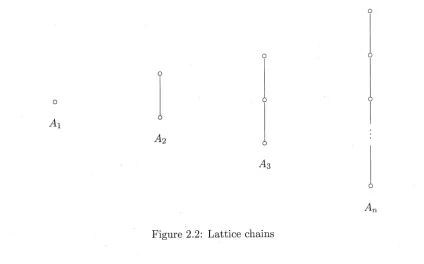
A2
Figure 2.2: Lattice chains
Definition 2.14. A chain is a poset P in which for two elements x and y in the set,
either x < y ov y < x. That is, all elements of P are said to be comparable.
It is simple to verify that chains form not only posets, but lattices as well. We
can see that the chain Ai is the trivial lattice, A^ is the chain with exactly two comparable
elements, and in general, A„ds the chain with exactly n comparable elements. In general,
7
Example 2.15. The converging sequence of rational numbers 1,1/2,1/4,1/8,... with
the usual ordering and the binary operations of min and max as meet and join is an
infinite descending chain. This lattice has as its top T = 1, but does not have a bottom.
Note that although 0 is the greatest lower bound of this set, it is not an-element of the
lattice, and thus cannot be the bottom of the lattice. The sequence of integers 1,2,4,8,...
is an infinite ascending chain.
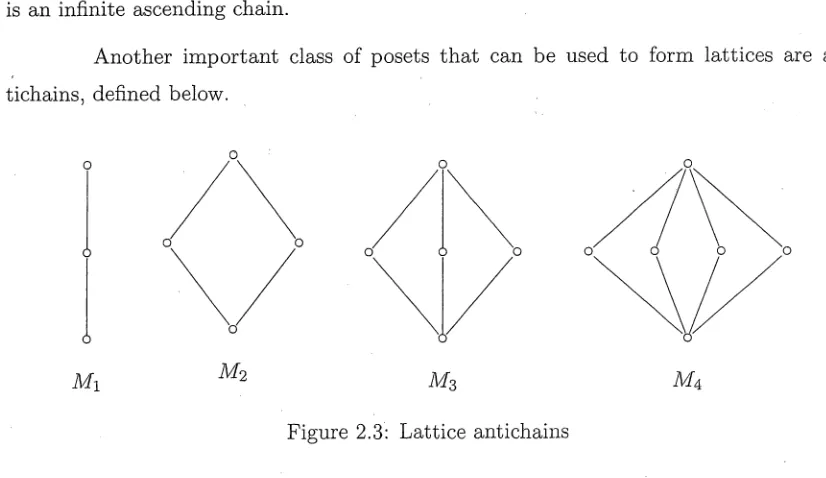
Another important class of posets that can be used to form lattices are an
tichains, defined below.
M2
Ml Ms M4
Figure 2.3: Lattice antichains
Definition 2.16. An antichain is a poset P in which for two elements x and y, x < y
implies x — y. If x y, we say that x and y are parallel, i.e., x || y.
An antichain with more than one element does not form a lattice as no two
distinct elements have a meet or join. However, if we adjoin a top and bottom to an
antichain, it does become a lattice. (By adjoin, we mean define a new ordering in which
the elements of the antichain are still incomparable, but the top is greater than or equal to every element in the antichain and the bottom is less than or equal to every element
in the antichain.) We note that that the lattice M2 contains the antichain with exactly
two parallel elements (and a top and bottom), M3 contains the antichain with exactly
three parallel elements, and M„ contains the antichain with exactly n parallel elements.
We will refer to these lattices as antichain lattices.
Although chains and antichains are important classes of lattices, not to mention
the many other types of lattices worthy of study, our main focus is to study lattices and
Definition 2.17. Let Sub(G)denote the poset formed from the collection of all subgroups
of a fixed group G where ordering is given by containment.
Proposition 2.18. Let G be a group and let X
be any subset of G. Write {X)= Pjp G
where L is the collection of subgroups G C G that contain X. Then (X) is the smallest
(contained in every other) subgroup of G containing X.
Proof. It is well-known that the intersection of subgroups is a subgroup. The intersection
is contained in every C € T, therefore it is the smallest. □
Definition 2.19. We will call {X) in the proposition above the subgroup generated by
X.
Proposition 2.20. The meet of two subgroups in Sub{G) is the intersection of those
subgroups, and the join of two subgroups is the subgroup generated by their union. As
such, Sub{G) is a lattice with T = G and JL = {e}.
Proof. It is clear from the definition of the intersection of two subgroups that the meet in
Sub(G) is in fact the intersection. (Thus, we can say that Sub(G) is a meet-sublattice of
V{S).) However, the union of subgroups is not typically itself a subgroup, and therefore
cannot be the join.
Claim. In Sub(G), the join of two subgroups A,B C G is given by the subgroup generated
by A and B.
Let X = AllB. Then {X) = fjr C* where T is the collection of subgroups G CG
that contain both A and B. It is clear that A C {X) and B C {X). Moreover, if we
find a subgroup D such that A Q D and B Q D, then D G F, and {X) C D. As such,
{X) fulfills the exact criteria for join listed in Definition 2.6. Finally, because Sub(G) is
a poset with binary meets and joins, Sub(G) is a lattice.
D
Example 2.21. We will now proceed to completely describe Sub(Z). Note that Z and
all of its subgroups are cyclic. We know (6) C (a) if and only if a | 6.
Claim, (a) A (6) = (c) where c = lcm(a, b) and (a) V (b) = (d) where d = gcd(a, b).
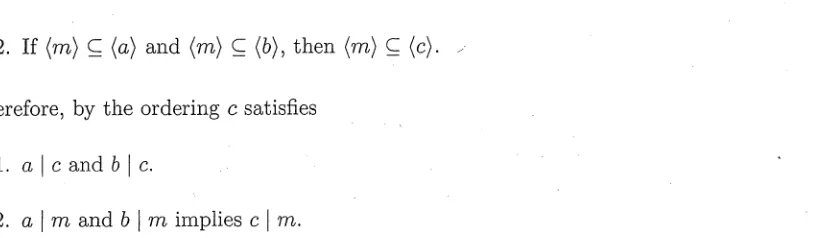
2. If(m)C (a) and (m) C {b), then (m)C (c). ^
Therefore, by the ordering c satisfies
1. a I c and b \ c. .
2. a \m and b|m implies c|m.
As the above properties are precisely the definition of least common multiple, we
have c = lcm(o,6). By similar analysis, we find that (a) V (6) =(d) where d = gcd(a,5).
This is also true for Zn under calculations modulo n. The example below gives
details of this calculation for Z36, whose subgroup lattice is pictured in Figure 2.4.
Example 2.22. The following are some calculations for meet and join in Sub(Z3e):
^36
(2) (3)
(4) (6) (9)
(12) (18)
(0)
Figure 2.4: Sub(Z36)
1. (2) V (3) = Z36 whereas (2) A (3)= (6).
2. (4) V (9)= Z36 and (4) A (9)=(0).
3. (3) V(12)= (3) and (3) A (12)= (12).
10
In the sections that follow, it will become important for us to talk about what
it means for a lattice L to be isomorphic to the subgroup lattice Sub(G) for some group
G. Hence, we will define a lattice isomorphism below.
Definition 2.23. Let L and K be lattices. A map cj) : L K is a. lattice homomorphism
if it preserves meets and joins, that is, ^{a Ab)= (/)(a) A 0(6) and 0(a V 6) — 0(a) V 0(6)
for all a^b E L. If 0 is bijective, we call 0 a lattice isomorphism.
Two lattices L and K are considered to be isomorphic^ denoted by L = A, if there exists a lattice isomorphism (j) : L -A K.
2.2 Distributive Lattices
Definition 2.24. A lattice L is called distributive if for all a^b^c E L:
1. a V (6 A c) — (a V 6) A (a V c), and
2. a A (6 V c) == (a A 6) V (a A c).
An important consequence of the Principle of Duality is that statement 1 of
Definition 2.24 holds for every poset if and only if statement 2 holds for every poset.
Thus, when we verify the distributive property we need only verify one of these two
statements. In the same vein, part of the distributive law automatically holds for every
lattice as shown below.
Proposition 2.25. Let L be a lattice and let a,b\c E L. Then
1. ay(6 A c) < (a V 6) A (a V c), and
2. {a A b) y {a A c) < a A {b y c).
Proof. 1. To show aV(6Ac) < (aV6)A(aVc) we will first show aV(6Ac) < (aV6) and
a V(6Ac) < (aVc). But it is clear by Definition 2.5 that (6Ac) < 6 and (6Ac) < c,
and so a V(6 A c) < (a V 6) and a V(6A c) < (a V c). But (a V 6)A(a V c) is the greatest
lower bound of a V 6 and a V c by definition, and so a V (6 A c) < (a V 6) A (a V c).
2. We use a similar approach to that used in part 1 above. To show (a A 6) V(a A c) <
11
definition, a Ab < a and a Ac < a. But (a A 6) V (a A c) is the least upper bound
of a A 6 and a A c, sO (a A 6) V (a A c) < a. Additionally, a A b < b and a Ac < c,
respectively. But then (aA6)V(aAc)is below both b and c. Since 6Ac is the greatest
lower bound of b and c,(aA6)V(aAc) <.(feAe). Thus,(aA6),V {a Ac). < aA{b\/c).
This proposition greatly simplifies our work in proving that a lattice is distribu
tive. It enables us to prove equality by simply showing (a V 6) A (a V c) < a V (6 A c) or
a A (6 V c) < (a A 6) V (a A c). , .
Now, we will look at some examples of distributive and non-distributive lattices.
Example 2.26. It is easy to show that the power set ViS) is distributive for every set
S. . . .
For a fixed group G, we note that when regarded as a poset, Sub(G) is a sub
poset of V{G). However, Sub(G) is not a sublattice oi T{G) as the joins are different.
Additionally, while ■p(S') is always distributive, Sub(G) is only sometimes distributive as
illustrated in the two examples below.
Example 2.27. For G = Z36, Sub(G) is distributive.
This can be verified directly by repeatedly replacing every combination of three
elements in Sub(Z36) into statement 1 of Definition 2.24. For example, we verify the
left-hand side of statement 1 of Definition 2.24 using the subgroups (3), (4), and (18).
Then we have (3) V ((4) A (18)) = (3) V (0) = (3). Checking the right-hand side, ((3) V
(4))a((3)v(18)) = Z36A(3) = (3).
Clearly, this would be a painstaking process if it were continued for all combina
tions of the elements in Sub(Z36) However, this fact follows readily from Ore's Theorem
(Theorem 4.6).
Example 2.28. For G = Z2 X Z2, Sub(G) is not distributive.
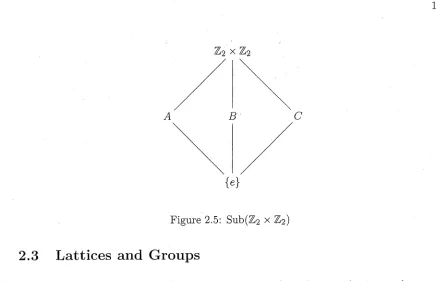
Let A = ((0,1)),B = ((1,1)) and G = ((1,0)) be the three non-trivial cyclic
subgroups of Z2 X Z2 (See Figure 2.5). Considering the left-hand side of statement 1
of Definition 2.24, A V (B A G) = A V {e} = A. Qn the right-hand side, however, we get (A V B) A (A V G) = (Z2 x Z2) A (Z2 x Z2) = Z2 x Z2, and so Sub(Z2 x Z2) is not
12
Z2 X Z2
Figure 2.5: Sub(Z2 x Z2)
2.3 Lattices and Groups
Thus far, we have begun to see the correspondence between lattices and groups.
At this point, one may begin to wonder to what extent lattices and groups are related.
Specifically, we might ask if every lattice is isomorphic to Sub(G) for some group G. We
begin by considering chains. It is obvious that the trivial chain Ai is simply formed from
the trivial group, G — {e}. But what about A2,A3, etc.? We must begin by considering
the structure of such lattices and try to find a group whose subgroup lattice exhibits the same structure.
Considering A2, we must find a group whose only proper subgroup is the trivial
subgroup. Indeed, one such example is the group Zp for any prime p. As we proceed to
seek out a group whose subgroup structure is equivalent to that of A3, we might try to
construct a group that has Zp as its only non-trivial proper subgroup. We find that Zp2
is such a group, and A3 is indeed its subgroup lattice. Now a clear pattern has emerged,
and if we continue this pattern inductively, we find that Sub(Zpn-i)= A„. We have thus
found a class of groups that capture all finite chains.
But what about other classes of lattices? For example, can we find a group G
such that Sub(G)= M„,for example? The lattice Sub(Zp2)= A3 = Mi as shown above,
and we have already seen that Sub(Z2 x Z2)= M3 (Compare Figures 2.3 and 2.5). It is
also relatively simple to find (distinct) groups whose subgroup lattices are isomorphic to
13
Zp3
(p)
{0} (p)
{0}
(p')
A2
{0}
^3 {0}
A4
Figure 2.6: Lattice chains and subgroup lattices
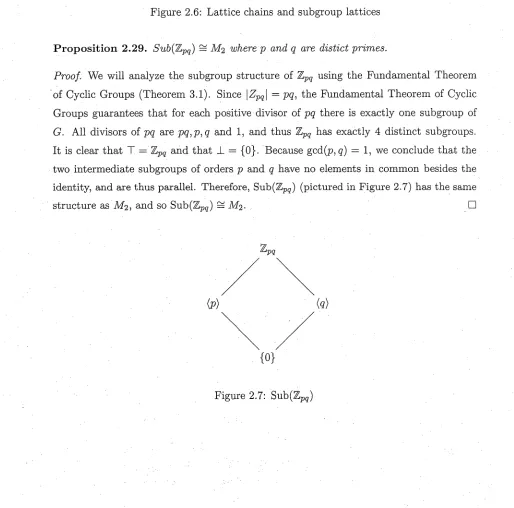
Proposition 2.29. Sub{Zpq)= M2 where p and q are distict primes.
Proof. We will analyze the subgroup structure of Zpg using the Fundamental Theorem
of Cyclic Groups (Theorem 3.1). Since \Zpq\ = pq, the Fundamental Theorem of Cyclic
Groups guarantees that for each positive divisor of pq there is exactly one subgroup of
G. All divisors of pq are pq,p,q and 1, and thus Zpq has exactly 4 distinct subgroups.
It is clear that T = Zpq and that T = {0}. Because gcd(p,q)= 1, we conclude that the
two intermediate subgroups of orders p and q have no elements in common besides the identity, and are thus parallel. Therefore, Sub(Zpg)(pictured in Figure 2.7) has the same
structure as M2, and so Sub(Zpg)= M2. . □
{0}
14
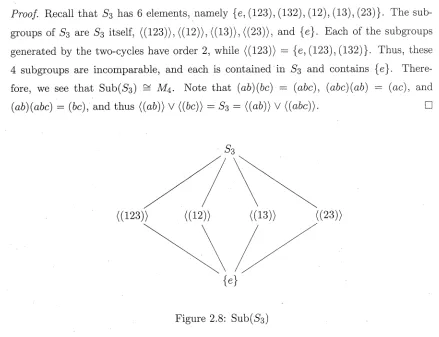
Proposition 2.30. Sub{Si)= M^.
Proof. Recall that
has 6 elements, namely {e,(123),(132),(12),
(13),
(23)}. The sub
groups of Sz are Sz itself, ((123)),((12)),((13)),
((23)), and {e}. Each of the subgroups
generated by the two-cycles have order 2, while ((123)) = {e,(123),(132)}. Thus, these
4 subgroups are incomparable, and each is contained in Sz and contains {e}. There
fore, we see that Sub(S'3) =
M4. Note that {ab){bc) = (abc), {abc){ab) = (ac), and
{ab){abc)= (be), and thus {{ab)) V {{be))= Sz = {{ab)) V {{abc)).
□
((123)) (12) ((13 ((23))
Figure 2.8: Sub(53)
We have now managed to capture Mn for 1 < n < 4; however, we have not been able to do so as neatly as we did for Although we were able to find a single class of groups G such that Sub(G) = each of the groups whose subgroup lattice is
isomorphic to have been distinct types. While we might try to extend those results we already have for M„ as we did with we will find very quickly that such extensions
will not work. {S4, for example, has 30 subgroups, and Sz has over 100! [Gallian, 96]).
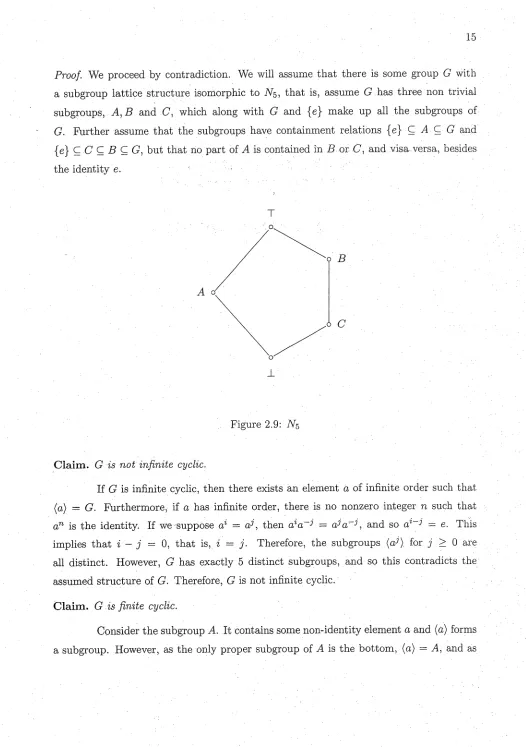
Indeed, finding groups whose subgroup lattices are isomorphic to Mn becomes a much more difficult question to answer in general, and leads us to question whether it is possible to find a group G such that Sub(G) = L for every lattice L. It turns out that the answer to this question is no. In order to show this, we will consider the pentagonal lattice iV5,
represented in Figure 2.9.
15
Proof. We proceed by contradiction. We will assume that there is some group G with
a subgroup lattice structure isorhorphic to N5, that is, assume G
has three non trivial
subgroups, A,B and G, which along with G and {e} make up all the subgroups of
G. Further assume that the subgroups have containment relations {e} C A C G and
{e} C C C B C G, but that no part of A is contained in S or G, and visa,versa, besides
the identity e.
T
o B
A o'
A G
±
Figure 2.9: N5
Claim. G is not infinite cyclic.
If G is infinite cyclic, then there exists an element a of infinite order such that
(a) = G. Furthermore, if a has infinite order, there is no nonzero integer n such that
a" is the identity. If we suppose
= a^, then a^a~^ =
and so
-= e. This
implies that i -j = 0, that is, i = j. Therefore, the subgroups (a^ for j > 0 are
all distinct. However, G has exactly 5 distinct subgroups, and so this contradicts the
assumed structure of G. Therefore, G is not infinite cyclic.
Claim. G is finite cyclic.
Consider the subgroup A. It contains some non-identity element a and (a)forms
16
such, A is cyclic. By Claim 1, \A\ < oo. Now, by the Fundamental Theorem of Cyclic
Groups (see Theorem 3.1) we can determine the order of A. The theorem states that
A must have exactly one subgroup of order equal to each of its divisors. However, the
bottom has only one element, and thus has order 1. Therefore, as 1 is the only divisor of
\A\ (besides itself), A must have prime order p. Similarly, the subgroup C is cyclic, i.e.,
[c)= C for some c in C, and must have prime order q.
Now, consider the subgroup H. Since C C B,c G B. More specifically, however,
C C B, so B
must contain another element b G B \ C. Now, as (b) ^ C and there are
no subgroups contained in C besides the bottom, {b) = B, implying that B is cyclic.
Moreover, because C is a subgroup of B, \C\ divides |B| by Lagrange. Suppose \B\ = mq
for some m > 1. Recall that B already has one subgroup of order q. By the Fundamental
Theorem of Cyclic Groups, B must have exactly one subgroup of order every divisor of
m. However, B contains no other subgroups besides C and the bottom. Additionally,
|B| \C\ as the orders must be distinct, so the only other possible choice is m = g, that
is, \B\ = .
Finally, we consider G. Either G = AUHorAUHCG. Since G is closed, we
have that ab G G. However, ab cannot equal e because ab = e implies that a and b are inverses of each other. If that were so, then b G A and a G B, respectively, which would
contradict the assumed lattice structure of Sub(G). But a ^ B and b ^ A, so ab ^ A and
ab ^ B. Therefore, G ^ AuB. Thus, we can find an element g such that g G G\{AuB).
But then (g)forms a subgroup of G. Because g ^ AUB,g ^ A and g ^ B or any of their
subgroups. Thus,(g) = G, and therefore G is cyclic.
Now, because G is finite, the orders of A,B and C, which are p,q^ and q respec
tively, must divide the order of G by Lagrange. Then |G1 = mpq^ for some m > 1. But
then G = {g) would have at least one more subgroup of order pq distinct from A,B and
C by the Fundamental Theorem of Cyclic Groups. Therefore, G cannot be a group with
the assumed subgroup lattice structure. □
Having proven the preceding result, we now know definitively that not every lattice is isomorphic to the subgroup lattice of some group. So, while it is true that there
exists a lattice that is isomorphic to Sub(G) for every group G, namely Sub(G) itself,
the converse is not true for every lattice. That is, by Proposition 2.31, not everly lattice
17
of some group G,in 1946 Ph. Whitman was able to find a direct correspondence between
groups and sublattices as follows.
Theorem 2.32 (Ph. Whitman, 1946). Every lattice is isomorphic to a sublattice of
Sub{G)for some group G.
Proof. A proof of this result is not only difficult, but far beyond the scope of this project.
However, an interested reader can find one proof of this theorem in Gratzer, p. 196. □
We wonder if we can find a certain class of lattices that are always isomorphic
to Sub(G) for some group G. For example, by Proposition 2.31, we might ask if every
18
Chapter 3
The
Structure of Finite and
Finitely Generated Abelian
Groups
As Ore's Theorem truly is a bridge between lattice theory and group theory, its proof is steeped in the structure of groups in addition to lattice theory. Because to this, we will need to discuss fundamental results about the structure of finite abelian groups and finitely generated abelian groups as wellas associated results. The proof of Ore's Theorem also relies the Second Isomorphism Theorem of Groups, which is presented hereafter. Additionally, the Fundamental Theorem of Cyclic Groups was referenced numerous times as we discussed the structure of cyclic groups and their associated subgroup lattices. Its statement and proof are given subsequently.
3.1 Basic Group Theory
In this section, groups are considered abstract and are written multiplicatively
Theorem 3.1 (Fundamental Theorem of Cyclic Groups). Consider the cyclic group G
V; . Then
1. Every subgroup of G is cyclic.
19
3. For each positive divisor k of n = \G\ there is exactly one subgroup of G, namely
{oF'^).
Proof.
1. Let
be a subgroup of G. We will consider the set S' — {fc G Z'^|a^ G i/}.
Suppose H ^ {e}. Then dP is an element of iL, S is non-empty, and by the
Well-Ordering Principle, S has a least element, say t. We will show that H — (a^) by
double-inclusion. First, since a^ E H D {of) by closure. Second, we consider
h E H. We note that h = of for some k e2G. By the Division Algorithm, we can
find integers q and r such that k = tq-Er where 0 < r < k. Then a^ =
= af^a^.
This implies oE E H. Now,as t is the least element of S,r — 0, and so h = a^^ E {af.
So H C (a^). Therefore, H -(a^).
2. This follows from Lagrange.
3. To show there is exactly one subgroup for each divisor of n, we suppose by contra diction that there are two subgroups of G of order A:, namely H and K. Suppose H = {a^) and K — {a^) where 5 and t are the least positive integers such that
of E H and a^ E K. Then t\m and s|m for all m where of^ E H and G K. Be
cause oP e E H DK^t and s must divide n as well. Now, as n is the least positive
integer such that oP = e and fc is the least such that {of)^ = e, of^ — oP — a^~t , so
k = j. Similarly, k = implying j= so t = s. Thus, H = K = {of), and as
□
Definition 3.2. If G is a group and H and K are subsets of G, HK — {hk \ h E H,k E K}.
Note, HK is also a subset of G. In fact, sometimes, HK is more than a subset;
it can form a subgroup, as shown in the following.
Theorem 3.3 (Second Isomorphism Theorem of Groups). Let H and K be subgroups
of a group G where K is a normal subgroup of G, denoted by K < G. Then HK is a
subgroup of G and H/{H H K) ^ HK/K.
Proof. We first show that HK is a subgroup of G. We note that HK contains the
20
test. First, we show that HK is closed. We take a = hiki and b = h2k2- Then we
must show that at = hikih2k2 € HK. But then ah = hih2h2^kih2k2 as e G HK. But
h2^kih2 € GKG~^ C K since W is a normal subgroup of G, i.e.,
^^1^2 = /cs, and
hih2kzk2 € HK,so HK is closed. Second, we must show that
= {hk)~^ = k~^h~^ G
HK. But k~^h~^ = h~^hk~^h~^. But as hk~^h~^ G GKG~^ = h^^k' G HK. Therefore, HK is a. subgroup of G.
For the second part ofthe theorem,consider the homomorphism 4>: H —> HK/K
that takes h to hK. We note that (/> is onto since given an hkK G HK/K, we find that
h maps to hK = hkK.
Now, we take h G keicci). Then 4i{h) = IK = K. But as 4>{h) = hK, we have
hK = K, which is true if and only ii h ^ K. Thus, ker <?!> = H r\K. Hence, applying the First Isomorphism Theorem of Groups, we have that
HI{H f\K)^ HK/K.
□
3.2 Finite Abelian Groups
The goal of this section is to determine the structure of finite abelian groups.
Theorem 3.12 and Theorem 3.16 together state that a finite abelian group breaks down
into a direct sum of cyclic p-groups {direct sum and p-group are defined below; see Defi
nitions 3.8 and 3.4).
In this section, all groups will be written additively and assumed to be abelian.
Definition 3.4. A p-group is a group of order p"' for some prime p and with 7r > 1.
Definition 3.5. Let A be an abelian group and let p be prime. We will let A{p) denote
the set of all elements of A whose order is a power of p.
Theorem 3.6 (Cauchy's Theorem). If G is a finite commutative group whose order is
divisible by a prime p, G contains an element of order p.
Proof. Suppose that the only subgroups of G are {e} and G itself. Then there exists some non-trivial element a such that (a) = G, and |a| = p as desired. Thus, G contains at
21
K C G (Note that \K\ < |G| necessarily), there exists an element b e H with 16| = p.
Now, if there exists some nontrivial subgroup H C G, \G\ — \G/H\ • \H\ by Lagrange.
This results in the following two cases:
Case 1: p divides \H\.
Since \H\ < |G|, Then by our inductive hypothesis, there exists an element
b E H of order p. Since b E H, b E G.
Case 2: p divides \G/H\ and p doesn't divide \H\.
By the same inductive hypothesis stated above,for g ^ H we can find gH E GjH
such that H ={gHY = g^H. Then there must be an element hi E H such that g'^hi = e.
Now, consider the map cp: H ^ H that maps h f-> h^.
j
Claim, p is bijective.
We first want to show that = kP implies h = k. Indeed, = kP does imply
that {hk~^y — e. But then \hk~^\ divides p, and so \hk~^\ — 1 or \hk~^\ = p. But if
\hk~''^\ = p^ p divides H by Lagrange, which contradicts our assumption on H. So we
have that \hk~'^\ = 1, and so h is the unique inverse of
i.e., = /c as desired. Thus,
p is injective. Since |-ff| is finite and p is 1-1, p is onto as well, and we have that p is
bijective.
Since p is onto, we can find an element h2 E H such that hi = /i2^- Then b — gh2 satisfies IP = (5/12)^ = 9^h2^ — Q^hi = e. Now, |6| = 1 implies g E H, a. contradiction.
Therefore, we have that |6| = p. □
Proposition 3.7. For any prime p, A{p) is a subgroup of A. Moreover, if A{p) is finite, A{p) is a p-group.
Proof. We first notice that A{p) is non-empty as e has order p^. If |a| = p^^ and |6| = p^"^,
\ab\ divides
implying that \ab\ is a power of p. It is clear that a~^ E A{p) since
\a\ = Therefore, by the two-step subgroup test A{p) is a subgroup of A.
Now, suppose that A{p) is finite and not a p-group, that is, that the order of
A{p) is |A(p)| = p^m where gcd(p,m) = 1. If a prime q | m then by Cauchy's Theorem
above, A{p) has some element of order q. But by definition,, the order of every element A{p) is a power of p. Thus, we have arrived at a contradiction, and the order of A{p)
22
Definition 3.8. Let Bi^B2^ . .. ^Bnhe subgroups of an abelian group A. Then we denote
the direct sum of thesb subgroups as A = Si0^20 • • • 0 if: 1. A — Bi + B2+ • •'+ Bn = {bi + 62 +'■ '+ 1 bi E Bi}.
2. (Si 0 • • • 0S-j) rn S^-^1 = {0} for all ^ ^ i ^ ti 1.
Note: An element in the direct sum is zero if and only if the components are all
zero, shown as follows: If 0 — miui + • • • + mkdk G Ai0• • •0 and rrikcik ¥" 0^ we
have that —rrikak = miai+m2a2+'•'+mk-iCik-i^ and so Ai0A20- • '®Ak-ir\Ak ^ {0},
a contradiction. Therefore is 0. Continuing by induction, all mi — 0.
I
Definition 3.9. An exponent of a group is any integer that annihilates that every element in the group. 1
Note, if G has exponent n, then G also has exponent kn where /c is a positive integer.
Example 3.10. Zn has exponent n,2n,3n,... On the other hand, Z does not have an
exponent.
|
Example 3.11. Zn[x regarded as an infinite abelian group, has exponent n,2n,3n,. . .
Theorem 3.12. Let A be a finite abelian group. Then A is the direct sum of its subgroups A{p) for all primes p fpr which A{p) 7^ {0}.
Proof Consider a finite abelian group A with exponent n. We can write n = mm'
where gcd(m,m^) = ij Then there exist integers r,s such that 1 = rm + srn'. Then,
for a e A,a = arm -|j- asm' = mra + m'sa =
ma'+ m'a" where a',a" E A. Thus,
A C mA + m'A. But as mA C A and m'A C A,mA + m'A C A, and so A = m.A + m'A.
Now, we consider an element b such that b E mA fl m'A. Then b = mai = m'a2
I
for some 01,02 € A. Thus, mh = mm'02 = 002 = 0, and similarly m'b = 0. Therefore,
b — b -1 = rmb+sm'b U 0, and so A = mA0m'A.
We will now let Am ~ {a & A \ ma = 0} and Am' = {a G A \ m'a = 0}.
Taking m'a G m'A, we have mm!a = na = 0, so m'a G Am- Similarly, ma g Am'
Conversely, if we take aln element b G Am,b — b-1 = brm + bsm' — rmb + m'sb, and thus
b = m'sb = m'a G m'A. Therefore, rn'A = Am, and similarly mA = -A^/, which means
23
Write n = a prime power decomposition with pi = pj implying i = j.
Assume
{0}. Then A —
® Aq where n = p\^q (an exponent of A). We will
use induction on order. That is, whenever S is a finite ahelian group with \B\ < |A|
and having an exponent , then B = B ® • ® B p. The base case is left to
the reader. Since \Aq\ < |A| and q is an exponent for Ag, Aq — A^n 0 • • • 0 A^p and
k ■ ■■ r , ■ ■ ^ ■
therefore, A = 0 A Moreover, A ^ {0}.
i=l ■ ■
Finally, we must show that Ah = A{pi). Let a &Ah. Then pfa = 0 implies
Pi Pi
that \a\ divides thus |a| is a power of that is, A C A{pi), Now, as \a\ is a power
Pi
of pi^ \a\ = p\ for some positive integer t. Since n is an exponent for A^ p\ divides n. But
then pI divides
so ppa — 0, i.e., A{pi) C A^i. Therefore, A^e^ — A{pi)^ and A can
be written as follows:
k
A = © A{pi) with each A{pi)^ {0}.
i=l
□
Example 3.13. Consider an abelian group A of order 36 == 2^ • 3^. Then A(2) consists of
all elements of orders 1, 2, and 2^ and A{3) consists of those of orders 1, 3, and 3^. Thus,
by Theorem 3.12 A = A(2) © A(3).
Lemma 3.14. Let A be an ahelian group. Consider b E A with b ^ 0, and let k be a
positive integer such that p^b ^ 0. If \p^b\ — p'^, then \b\ = p^+^,
Proof. Since p^{p^b) — p^^^b = 0, |6| divides
This implies that \b\ =
for
0 < i < p + m. But 0 = 6) implies divides p^~^ which can only
happen if z = 0, that is, if \b\ = p^+^.
□
Lemma 3.15. Consider a finite abelian, non-cyclic p-group A, and let ai G A be an
element of maximal order p^^. Consider Ai = (ai) C A and the quotient AjA\. Let b = a + Ai G A/Ai be an element of order p^. Then there exists a representative a ofb
with order p'^.
24
Since p^h = 0, p^b + = 0+ Ai, so p'^b G Ai. Therefore, p'^b = nai for some n > 0. We
can write n = p^fi with gcd(p,fi) = 1. Then p'^b = p^fiai.
We will show that \ai\ = |/iai|. Since = \ai\ annihilates ai and thus /xai, we
have that \fiai\ divides |ai|. Therefore, |/iail = p^ for some 1 < j < ri, so p^(^ai) = 0.
But (p^/i)ai = 0 implies that p^^|pPji. Hence, p'^^ |p^, implying p^^ = p^, and therefore
\ai\ = |yuai|. We can thus conclude that \p^pai\ —
with k <ri.
Now, we have p^b 7^ 0, and \p^iiai\ — \p^b\ —
so by Lemma 3.14, |6| =
pTi-k+r ^ As p^Y is a maximal order for elements of A,
< p^^, and thus r+ri — k <
ri, so r < &. We write k = r + t where 0 < t < fc. Then, p^6 = p^/iai = p^'+^p,ai =
P^(pVq^i), and if we write c = p^jJ^ai, we have p^b — p^c with c G Ai.
Consider a — b — c. Then a = 6 — c = 6 — c = 5+0 = 6, and a is a representative
for b. Furthermore, p^b ~ p^c, and so p^{b — c) = 0, which implies that p^a = 0,
and so \a\ < p^ = \a\. Additionally, by the first paragraph above \a\ < |a|, and thus
p'^ = 1^1 = |<^|- □
Theorem 3.16. Every finite abelian p-group is isomorphic to a direct sum of cyclic
p-groups. Moreover, this direct sum is unique up to reordering the factors.
Proof. Let A be a p-group and let ai G A be an element of maximal order. If A is cyclic, there is nothing to show. Therefore, we can assume that A is not cyclic. Let Ai = (ai) C
A with Jail = p'^L Now, consider A/Ai with order less than |A|. Then by Lagrange,
A/Ai is a p-group of lesser order than A. By induction, we assume A/Ai = B2® ■ - - ® Bg where each Bi is a cyclic subgroup of A/Ai of order p'^^ with 2 <i < s.
Let al — a[ + Ai be a generator for each Bi. By Lemma 3.15, we can find a
representative ai G A of each ai having order p^' where 2 < i < s. Suppose Ai = (a^) C A
for 2 < i < 5.
da.im. A — Ai 0 A2 0 • • • 0 Ag.
We must first show that A — Ai + A2 H pAg. It is clear that A 0 Ai + A2 +
• • • + Ag. To show A C Ai + A2 + • • • + As, we take x e A and consider x G A/Ai. By our induction hypothesis, A/Ai = 520- • -^Bg, sox = m2^+ \-mga^ = m2a2 + • • • + mgag for representatives Ui of ai. Therefore, x - (m2a2 + • • • + mgag) e Ai = (ai). Thus, X — (777,2^2 4 hmsUs) = miui, for some mi and so x = miai +m2a2 + • • • + mgag, that
25
We now show that {Ai H 1- n = {0} for alH = 1,...,s- 1. Suppose
there are mi,...,rris > 0 such that miOi + • • ■ + m^Os — 0. Claim, nii = 0. for alii.
We can assume that m,; < Applying the natural homomorphism 0: A
A/Ai to mioi + • • • + m^Us = 0, we have miOi -!- • • • + m^^ = 0. Now, as 0 = mial+
h msOTs G -B2 ® • ■ • 0Bs, mi = 0 for 2 < i < s. But then, we have miOi = 0, implying that mi = 0, so mi —Q for all i such that 0 < i < s.
Finally, y G Aj+i D X)i=i
implies mi+iUj+i = y = Yl)=i'mjaj for some
mj. Since y — y = 0, we have that mj = 0 for all j,0 < j < i + 1. Therefore, A =
Ai0• • •0A5, a direct sum of cyclic p-groups by Definition 3.8. Uniqueness of this direct
sum decomposition can also be shown to hold (See Lang p. 48). □
Example 3.17. Recall our abelian group of order 36 with A = A{2) 0 A(3) from Ex
ample 3.13. Then by Theorem 3.16, A(2) decomposes as Z4 or Z2 0 Z2 and A(3) breaks
down as Zg or Z3 ^) Z3. This leaves us with 4 potential decompositions for A:
1. A = Z4 0 Zg.
•
/
2. A = Z2©Z2(® Zg.
3. A = Z30Z3f® Z4.
4. A — Z2 0 Z2 (0 Z3 0 Z3
3.3 Finitely Generated Abelian Groups
The last major result we will need before proceeding to Ore's Theorem is the Fundamental Theorem of Finitely Generated Abelian Groups (see Theorem 3.28) as well
as associated definitions and results. Like the major results of the previous section,
the Fundamental Theorem of Finitely Generated Abelian Groups details the direct sum
decomposition of finitely generated abelian groups.
Definition 3.18. If a, 6 are any two elements of an abelian group A, then for scalars
a,13 G Z the element aa + Pb is called a linear combination of a and b in A. This
26
of A is linearly independent if whenever a linear combination of elements equals zero, all
the scalars equal zero.
Definition 3.19. An abelian group has a basis if there exists a subset of linearly in
dependent elements with which every element of the group can be written as a linear
combination.
Definition 3.20. An abelian group A is called free if it has a basis.
Example 3.21. Any direct sum ©^Z is an abelian group; moreover, it has a basis (stan
dard basis) consisting of the functions : / -> Z whose value at j is zero A j i and 1
if j= i where i,j E I. Therefore ©^Z is free.
Lemma 3.22. Let f: A -E A' be a surjective homomorphism of abelian groups where A'
is free, and let B be the kernel of f. Then
1. There exists a subgroup C of A such that f restricted to C induces an isomorphism
with A!.
2. A = B®C.
Proof. We may visualize assertion 1 with the diagram pictured below.
A A'
1. Because A' is free abelian by hypothesis, it has a basis, : i E I}. Additionally,
as / is surjective, each x[ has a preimage Xi E A such that f{xi)= x[. Let C =(A),
the subgroup generated by A = {xi : i E 1} in A. We will consider the restriction
of / to C, denoted by /'=
27
We know that f is a homomorphism because it is a restriction of /, which is itself
a homomorphism. Thus, we need only show that f is bijective. To show that /'
is surjective, we consider a' G A!. Because A' is free, we can write a' =
where ai G Z. Then the element a E C given by a =^ satisfies f'iYl —
^oijf'{xj} — YjCijx'j = a'. Thus,f is onto.
We now show that /' is injective. Let c e C with f'{c) = 0. Then c G {X),
which implies that there exists & J C I that is. finite and scalars aj G Z such that
c = YljOLjXj. Then 0 = /'(c) = f'iY^otjXj) =
Since the
XjS are a basis each aj = 0 and thus c = 0. Therefore, /' is injective, and thus
f: C A' is an isomorphism.
2. To show A — B ® C, we must show that B D C = {0}, and that A = B + C. If
we take x G B D C,f{x) = 0 since B = ker/. But since x G C,f{x) = fix).
As /' is injective, x = 0 and thus B D C = {0}. If we take a G A,/(a) G A'.
So /(a) = Y^Oijx'j. for some scalars aj. If we take c =
^oijXj G C, consider
a - c. Applying /, we have /(a - c) = /(a)- /(c) = /(a)- /(X]OijXj) = /(a)
Y^ajfixj) = /(a)- Ylocjx'j = f{a)- /(a) = 0. Thus, a - cE B, i.e., a ~ c = b,
and so, a = 6+ c as desired. Therefore, A = B ® C. □
Theorem 3.23. Let B he a subgroup of a finitely generated free abelian group A. Then B is a free abelian group itself on a basis with cardinality less than or equal to the cardinality
of a basis for A.
n
Proof. Suppose A has n generators, A = ©Zj, (Z^ = Z). We proceed by induction on n.
If A is free on one generator, that is, A = Z, then B C Ais either free on zero generators,
that is, either B = {0}, or since every non-zero subgroup of Z is infinite cyclic, 5 is
infinite cyclic and therefore free on one generator.
Now we assume that the theorem is true for any group with fewer than n
generators. Consider the surjective projection homomorphism vr: A —> Zi that sends
(xi, . . . ,Xn) <-^ Xi.
n
We note that keryr =
2
which we regard as an identification. We define
n
Bi = B D kerTT = ker7r|^. Thus, Bi C ©Z^, and is free on less than n — 1 generators
2
by the induction hypothesis. Now, we consider the direct image of B under ix,ti[B) =
28
Case 1: 'k{B)= {0}.
If 7r(5)='n\B{B)= {0}, then B = kervrlB. But as ker7r|B = Bi,B = Bi is free
on < n — 1 generators.
Case 2: 7r(B) 7^ {0}.
'If Tr{B) 7^ {0}, then 'k{B) is a non-zero subgroup of Z, and is therefore infinite
cyclic. Thus,■k{B) = Z, and as Z is free on one generator, 7r(B) free on one generator. Now, as 7r|s is onto it's image, there exists a subgroup C of B by Lemma 3.22 such that
B — C ® ker7r|s with C = ■k\b{B). Thus, C is free on one generator, and B\ is free on
< n — 1 generators, and therefore B is free on < n generators. □
Definition 3.24. A torsion element of an abelian group is any non-zero element with
finite order. If a group has no torsion elements it is called torsion-free.
Example 3.25. Every element of Z^ (integers modulo n) is a torsion element. Q/Z is an infinite group whose elements are all torsion. Note: ©/Z (whereIis any index set) is
torsion free.
Note: ©
n
Z is the typical case of a finitely generated torsion-free abelian group
i=l
as the following theorem (Theorem 3.26) shows.
Theorem 3.26. If A is a finitely generated torsion-free abelian group, then A is free.
Proof. Assume A ^ {0}, and let 5 be a finite set of generators of A. Suppose X =
{xi,. . . , Xn} is a maximal linearly independent subset of S. If B is the subgroup generated
by X, then B is free by definition.
By maximality on X, given any z ^ S, there exist integers mi, . . . ,mn not all equal to zero and /a 0 such that iLiz +miXi + • - +mnXn = 0. Therefore, fiz E B. Thus,
we note that we can find such a [li with piZi E B for each of the finitely many elements
of S. Supposing there are k generators of A, we take m = pip2 ' • - Pk- Now, given y E A,
i.e., y — Y^aiZi{zi E 5, E 1^),my = Y2ai{mzi) E B. As this m is independent of the
choice of y E A, mA C 5.
Now, we consider the homomorphism (j): A mA that sends x to mx. Further
more, because A is torsion-free, ker(/> = {0}, and thus our map is also one to one, and
therefore an isomorphism of A onto mA C 5, a subgroup. Therefore, we can conclude
29
Lemma 3.27. Let A be an abelian group. Then At, the set of all torsion elements of A,
forms a subgroup of A.
Proof. We note that At is non-empty as e G At- Suppose a,6 G At with = e and
= e. Then
— {e)~^ — e, so a~^ G At. Furthermore, [abf'^'^^ ~
^mnjjmn _ _ gg _ Thus, ah G At, and by the two-step subgroup
test, At is a subgroup oi A. □
Theorem 3.28 (Fundamental Theorem of Finitely Generated Abelian Groups). Let A
be a finitely generated abelian group, and let At be the subgroup of all torsion elements
of A. Then
1. At is finite.
2. AIAt is free.
3. There exists a subgroup B C A such that B is free and A = At © B.
Proof. 1. If a G At, there exist scalars G Z such that, a = cxiXi. Since there
are finitely many generators and finitely many distinct scalars modulo \xi\ such
that aiXi 7^ 0, there are finitely many elements in At, and so At is finite.
2. We begin by showing A/At is torsion-free. Let X — {zi, . . . , Zn}, one for each
generator Xi of A, be a basis for the free abelian group F on A whose elements have
the form Ya=i where G Z. By the Universal Mapping Property there exists
a unique homomorphism <p: F ^ A such that f{^cxiZi) = Note that f is
onto A.
Considering just the torsion elements At of A, the inverse image of At under f is a.
subgroup of F. Since F is free on n generators, (I)~^{At) is free on < n generators by
Theorem 3.23. Additionally, as f is onto A, f is onto At, and so (j){f~^{AT)) = At. Because is finitely generated, 0(0"^(At-)) is finitely generated as well. So
At = 4^{4^~^{At)) is finitely generated and abelian.
30
3. Consider the natural surjective homomorphism f: A A/At, which sends x
X + At- Then ker/ = At- By Lemma 3.22, there exists a subgroup B of A such
that- fls■ B AjAT is an isomorphism. Thus, B is free, and A = B ® At
31
Chapter 4
Ore's Theorem
With the structures of finite abelian and finitely generated abelian groups in
hand, we are prepared to prove Ore's Theorem. Before proceeding to Ore's Theorem,
however, we need the following definition and lemmas. Note that in this section all
groups are written multiplicatively. Cn will denote a cyclic group of order n and Coo
will denote an infinite cyclic group. Note: Cn = and Cqq = Z. Also, when written mutliplicatively, direct sum is refered to as direct product and defined in an analogous
manner.
Definition 4.1. For any group G, Z{G)= {x E G \ xg = gx for all g' E G} is called the
center of G. Note that Z{G) is always a subgroup of G.
Lemma 4.2. Let H be a subgroup of G, and let H C Z(G). Then H <G. Furthermore,
if GfH is cyclic, then G is abelian.
Proof. First, we show H < G. By the normal subgroup test, it suffices to show that
g~^hg E H. But since h E Z{G),g~^hg = g'^gh = h e H,so H is normal.
Next, we assume that GfH — (gH) is cyclic. Consider elements gi,g2 ^ G.
Then giH — g'^H, thus gi — g'^hi for some hi E H. Similarly, g2 = g^h2 for some
h2 E H. Then we have gig2 = g'^hig^h2 = g'^g^hih2 = g^'^^hih2 — g^^'^hih2 = g^g'^'hih2
■=
g^g'^h2hi = g^h2g'^hi = g2gi since hi,h2 E Z{G). Therefore, G is abelian.
□
Definition 4.3. A group is locally cyclic if every finite number of elements generates a
32
Note that every cyclic group is locally cyclic because every subgroup of a cyclic
group is cyclic. The converse, however, is not true as illustrated by the following example.
Example 4.4. Consider the group of rational numbers under addition and note that any
two elements ajh and cjd in Q are contained in the cyclic subgroup generated by l/6d.
Therefore, although Q is clearly not cyclic, it is locally cyclic. Lemma 4.5. Every locally cyclic group is abelian.
Proof. Let G be a locally cyclic group. Taking any elements x and y of G,{x, y) — (g) for
some g E G. Then x = g'^ and y = g'^, and thus xy = g'^g'^ — g'^'^'^ = gU+m _ =
yx. □
Theorem 4.6 (Ore's Theorem). Given a group G, Sub(G) is distributive if and only if
G is locally cyclic.
Proof. We begin by assuming that Sub(G) is distributive. Consider a,b E G. First, we will show that the subgroup generated by a and 6, denoted (a, 6), is cyclic. Recall
that that we form the meet of two subgroups by taking the subgroup generated by those
subgroups. Hence, (ab) V (a) is the subgroup generated by (ab) and (a). We want to show that {ab) V (a) = (a, b). It is clear that the subgroups generated by (ab) and (a) are each seperately contained in the subgroup generated by (a, 6), and so {ab) V (a) C (a, 6). To
show that (a, 6) C {ab) V (a), we need only show the generators of (a, 6) are in the set
{ab) U (a). We have that a E {ab) U (a) by closure. As both a and ab E {ab) U (a), a~^ab =
b E {ab) U (a) as well. So (a, b) C {ab) V (a) and by double inclusion {ab) V (a) = (a, b).
We can similarly show that {ab) V {b) = (a, b).
Now, since Sub(G) is distributive, {ab) V ((a) A {b)) — {{ab) V {a)) A {{ab) V {b)). But since {ab) V (a) = {u^b) = {ab) V (6), we have that {ab) V ((a) A (6)) = (a, 6). It is
important to note that a and b commute with all the elements of (a) A (6) as follows: Given
c E {a) A (6), c has the form c = a^ and c = V. Then ac = aa^ =
= a^a = ca.
Similarly, be = bb^ = b^'^^ =
= Vb = cb. Therefore, (a) A {b) C Z((a, 6)). Hence, by
Lemma 4.2 above, (a) A (b) < (a, 6), and so by the 2nd Isomorphism Theorem for Groups
(Theorem 3.3),
33
of Finitely Generated Abelian Groups (Theorem 3.28) applies, and (a, b) decomposes as
(a,b) = (a,6)t x F, the direct product of respective torsion and free subgroups of (a,b).
This decomposition yields the following three cases:
Case 1: (a,&)t = {0}.
If (a, b) has no torsion elements, it is a free group on 2 generators and is thus
isomorphic to Coo x
Cqo-Case 2: (a,6)t has one generator.
If (a, b)T has one generator, F is free on < 1 generator by Theorem 3.23.^ Then
(a,b)T = Cn and F = Coo or F — {0}. Thus,(a,b) = Cn or (a,b) = Cn x Coo, a product of
cyclic groups.
Case 3: (a,6) = {a,b)T'
Because (a,b) is finite abelian. Theorem 3.16 applies, and (a,b) is a direct prod
uct of no more than 2 finite cyclic subgroups.
As we have shown above, (a,6) = {u) x (t*), a direct product of cyclic groups.
This implies that {u) A (u) = {e}, and so by display 4.1, {u,v)/{{u) A (u)) == {u,v) is
cyclic. But (a,6)= {u) x {v) = {u^v)\ and so (a,6) is cyclic and thus G is locally cyclic.
For the converse, assume that G is locally cyclic, and let A,F, and G be sub
groups of G. We want to show that Ay {B A G) — {AV B) A {Ay C). By Proposi
tion 2.25, Ay {B A G) C {Ay B)A {Ay G)is always true, and we need only show that
{Ay B) A {Ay G) C Ay {B AG). Because G is locally cyclic, G is commutative and
therefore every subgroup is normal. Since the meet of any two subgroups is the intersec tion of those subgroups and the join of two normal subgroups can be formed by taking
the product of those subgroups, it suffices to show that AB H AC C A{B fl G).
We take x G AB fl AG. Then x = ab and x = o!c for some E A,b E B and c E G. Because G is locally cyclic, {a^a\b^c) = (g) for some g E G. Let A' =
An{g),B'^Bn{g), and C'= C fl {g).
Claim, {g)- A'B^ and (g)= AC.
It is clear that A!B' C (^) and NG'C {^g). To show {g) C A!B', we need only
show that the generators a^a\b and c of {g) are in A^Bh Note that a,a^ G A^B^ and
b E A!B'. Because a'c = ab^c ~ a'^^ab E A'B' as well, and so {g) C A'B'. Similarly,
34
X G A{B n C). If either B' or C == {e},x = a oy x — a', and thus x G A{B n C), and we
are done. Therefore, we assume none of A\B' or C are trivial.
Now, let a =
— g^\b = ^ and c
g^. Since A^B^ = (g) we can find
integers i and j such that g — g'^g^ with g'^ G A' and g^ G B', and hence g^ = g'^'^'^Ai^
Now, X — a'c — g^'
— g^'g'^'^g^^. Then g^'g'^^ G A' and g^^ G
Pi C\ and so
X G A^{B'n C)C A{B n C). Therefore, Sub(G) is distributive as desired. □ .
The following result follows immediately from Ore's Theorem and the definition
of locally cyclic.
Corollary 4.7. If G is a finite group, Sub(G) is distributive if and only if G is cyclic.
Proof. Since every cyclic group is locally cyclic, if G is cyclic we have that G is distributive
by Ore's Theorem. Conversely, if we assume that G is distributive, G is locally cyclic by
Ore's Theorem. But because every finite number of elements generates a cyclic subgroup
by the definition of locally cyclic and since G itself is a finite group, G itself must be
cyclic. □
Definition 4.8. A poset satisfies the ascending chain condition (AGO) if every ascending
chain of elements eventually terminates.
There are many mathematical structures that satisfy AGO.
Example 4.9. In any finite-dimensional vector space, every collection of subspaces sat
isfies AGO.
Example 4.10. In any principle ideal domain i?, every collection of ideals satisfies AGG.
Theorem 4.11, A group G is cyclic if and only if Sub{G) is distributive and satisfies
the ascending chain condition.
Proof. Suppose that G is cyclic. Then Sub(G) is distributive by Ore's Theorem, and we
need only show that Sub(G) satisfies AGG. Since G is cyclic, let G = (a) for some a e G.
Then {a^) C (a^) if and only if A; is a divisor of j. This implies that every ascending chain
in Sub(G) is finite, and thus terminates, and so Sub(G) satisifes AGG.
35
must terminate at some step, say n. Thus, an+j G (ai,...,a„) for every j> 0. But then
(ai,a2,...) C (ai,02,...,Un), and so G is finitely generated. Additionally, G is locally
cyclic by Ore's Theorem. Now, as G is finitely generated, Definition 4.3 implies that G
36
Chapter 5
Conclusion
In the introduction of this thesis, we asked a series of questions. First, we
wondered if every conceivable lattice is isomorphic to the subgroup lattice of some group.
Although we were able to find a class of groups whose subgroup lattices are isomorphic
to the class of all finite lattice chains, for example, we found that there is no group whose
subgroup lattice is isomorphic to the lattice N^. However, Ph. Whitman was able to
show that every lattice embeds as a sublattice in Sub(G) for some group G. This does
not indicate that the lattice itself is a Sub(G') for some group G\
Second, we wondered what kinds of lattice structures are isomorphic to which
types of group structures. After a considerable amount of group theory involving the
structure of finite abelian groups and finitely generated abelian groups, Ore's Theorem and its corollaries provide us with several results relating distributive lattices with cyclic groups. Specifically:
1. Given a group G, Sub(G) is distributive if and only if G is locally cyclic.
2. If G is a finite group, Sub(G) is distributive if and only if G is cyclic.
3. A group G is cyclic if and only if Sub(G) is distributive and satisfies the ascending
chain condition.
In light of these results, we have a beautiful connection between two seemingly
37
Bibliography
[D02] B.A. Davey and H.A. Priestley. Introduction to Lattices and Order^ second edition,
Cambridge University Press, New York, 2002.
[Ga06] Galiian, J. Contemporary Abstract Algebra, sixth edition, Houghton MifHin Com
pany, Boston, 2006.
[Gr78] Gratzer, G.A. General Lattice Theory,first edition, Academic Press, Boston, 1978.
[L84] Lang, S. Algebra, second edition, Addison Wesley Publishing Company, Boston,
1984.
[S94] Schmidt, R. Subgroup Lattices of Groups, Expositions in Math., vol. 14, de Gruyter,