California State University, San Bernardino California State University, San Bernardino
CSUSB ScholarWorks
CSUSB ScholarWorks
Theses Digitization Project John M. Pfau Library
1998
Torus embedding and its applications
Torus embedding and its applications
Rick Hung Nguyenhuu
Follow this and additional works at: https://scholarworks.lib.csusb.edu/etd-project
Part of the Geometry and Topology Commons
Recommended Citation Recommended Citation
Nguyenhuu, Rick Hung, "Torus embedding and its applications" (1998). Theses Digitization Project. 1572.
https://scholarworks.lib.csusb.edu/etd-project/1572
TORUS EMBEDDING AND ITS APPLICATIONS
A Project
Presented to the
Faculty of
California State University,
San Bernardino
In Partial Fulfillment
ofthe Requirements for the Degree
Master ofArts
in
Mathematics
^ by.,.
Rick Hung Nguyenhuu
TORUS EMBEDDING AND ITS APPLICATIONS
A Project
Presented to the
Faculty of
California State University,
San Bernardino
by
Rick Hung Nguyenhuu
June 1998
Approved by:
axiang Wai^,
Principal Aj^sor ~
Date
Dr./^enxiang Wa%
Dr. Cbetan Parka
Dr. John Sarli
Dr. Terry I^allett, Graduate Coordinator
Abstract
In my project,I will use The Theory ofToroidal Embeddings and its teclmiquesto
conq)actify the space ofThe Universal ElHptic Curve,X = G x H/ ,where C = a set
ofconqjlex numbers,H={x +iy,y> 0} called upper halfplane, and is defined as of
foUow:
= semi-direct product, r X
^ /z+ m\v + n aw + b\
A stands for afiSne act on C X H by(z,w) I —, -)
V CW + d cw + d/
where m,n e Z and
r =
d) ^ ~ ^ ^ 1(modk),b = c = O(modk)|^
■ , , ■ , . . aw + b
acts upper halfplane H by: w i-^ —r
■ ; ■ , cw;+ d.
k >3 then X is smooth
The project consists ofthree chapters. First,Iintroduce the Theory ofTorus
Embeddings. Second,Ifurther demonstrate the theory by an example in two dimensions
with pictures attached . Third, I use the technique ofTorus Embedding Theory to
con:q)actify the space ofThe Universal Elliptic Curve, X.
Table Of Contents
AfiSIltACT...^ ..iii
v
introi>uctioN;^... i
CHAPTERONE
THEORY OF TORUS EMBEIJDINa ;. . . . ; . . .2
Definition ofan AfSne Toms Embed(fing... ...3 Definition ofa Convex Rational PolyhedTalCone... ...4
Constmction of 8
Orbit Decomposition... ... 8
Defining Equation ofX^...,... ...9
CHAPTER TWO
11
Exanq)le...,.,.w;...,... 11
The Requirements ofConvex KationalPolyhedral Cone d in R^ 12
Orbit Decomposition in R^.. 15
CHAPTERTHREE
CQMPACTIFY THE UNIVERSAL ELLIPTIC CURVE. 19
Lemma ofThe Conqyactificatiom... ...21
Corollary ofThe Conqjactffication... ....:.. 22
BIBLIOGRAPHY.... . 25
List ofFigures
Figure 1
Figure 2...
Figure 3
Figure 4
Figure 5
Figure 6
Figure 7
...3
16
18
19
20
22
Introduction
To compactify a non compact smooth conq)lex space is one ofthe interesting problem in algebraic and differential geometry,
In order to study this space in the content ofdifferential geometry, one Hkes to
obtain a compactification without adding singular points. A singular point ofan n-space
(n-dhnension)is a point at which the space is not locally diffeornorphic to an open set of
(J^. In my project,I mainly consider complex 2-spaces,i.e. surfaces. There are different
methods ofobtaining smooth conpactifications. I will study one ofthem,the torus
embedding. This method will exphcitly construct the conq)actification through algebraic
construction. The theory oftorus embedding is due to Mumford[2]from algebraic
geometry. I wiU introduce this theory in chapter one and demonstrate the theory on a
complex surface = xy ofC^\ {0} where 0=(0,0,0)is a singular point.
Finally, the theory will be used to conq)actify the space ofthe Universal Elliptic
Chapter One
Theory Of Torus Embedding
We work only over the con^lex number field C.
T= n-dimesional algebraic torus over C
= (c*f,c*= e -{0},
as an analytic space with the structure ofmultiplicative group.
M = Honigig group(T,C*):the group ofcharacters on T
fa {the monomials = n ~ Z" fa {(ri,...,rn)}. . ■/ i=i- . i
N= Homaig.groi^(C*, T): the group of one-parameter subgroups in T.
Z" fa N
a = (ai,...,an)
Aa : C* ^(C>, a e Z"
t e C* and t
(t®\...,t®").
M andN are dual to each other by the pairing
< , > : MxN -> Z
( r, a )->• ^riai or X^(Aa(t) ) =
There are natural isomorphism
1) N fa 7ri(T) fa Hi(T,Z),
2) N (g> C fa theuniversal covering space of T.
3) N (g) C/N fa T,
4) N (g) C -> N ® C/N : the covering map
. . . .. C"
where e() = exp(27r\/^()).
We write Nc = N (8> C,Nr = N (g) R,Mr = M (g> R,as a real analytic group.
Nc/N ~ (Nr/N) X Nr
X +\^ly iiiod N -> (xmodN, y).
In particular the projection onto the imaginary part
Tm ; T ~ Nc/N —> Nr
is an epimorphism ofreal analytic groups whose kernelis a real compact torus.
Definition ofan affine torus embedding:
i) An afBne torus embedding ofT,X,is an aflSne C-scheme(resp. a C-scheme)such that
1) X contains T as a Zariski open dense subset;
2) Tacts on X extending the natural action on itselfdefined by translation.
ii) Let X (resp. X')be the torus embedding of T (resp. T )
A morphism f: X-> X' oftorus embeddings is a morphism ofC-schemes such that
1) f(T) - T,
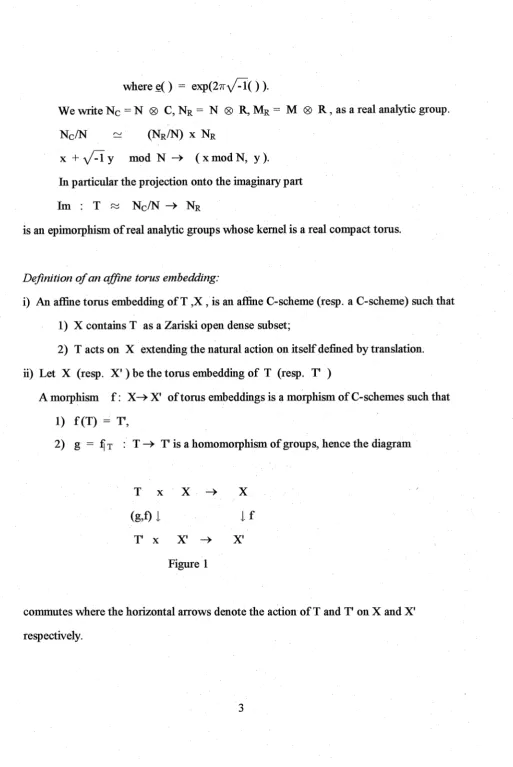
2) g = f|T : T -> T is a homomorphism ofgroups,hence the diagram
T X X X
(g,f)i i f
T X X' ^ X'
Figure 1
commutes where the horizontal arrows denote the action ofT and T'on X and X'
Definition ofa convex rationalpolyhedral cone:
i) A cone cr in Nr or Mr is called a convex rationalpolyhedralcone(abbreviated to a
c.r.p. cone)if
a= { a e Nr (or Mr);<ri, a> > 0, i= 1, m,with ri e M (or N)}.
ii) A (finite) rationalpartialpolyhedral decomposition(abbr. to an (f.) r.p.p.
decomposition) of Nr is a(finite)collection ^={5q,}ofc.r.p. cones in Nr such
that
0) 6a, contains no linear subspaces;
1) If 5 is a face of e ^(we write 6 < 6^),then 6 e 1
2) for 6a,6p e Y., 6f)6p<6a, <6p .
iii) Let ^ (resp. ^')be an r.p.p. decomposition of N (resp. N').
A morphism ofr.p.p decompositions is a linear map i/^ iN-^N" with
finite cokemel such that for 5 e ^ there is a 6' e with V'r(i5) C 6' where
ip^= (g) R : Nr-^ Nr'. Thus r.p.p. decon^ositionsform a category.
rv) By the correspondence 6 —> ^ ^ ^nd its faces}the set ofc.r.p. cones can
be considered as a full subcategory ofthe category ofr.p.p. decompositions.
Category ofr.p.p. decompositions
U
Category offr.p.p. decompositions
I '
U
The dualcone of 6 m NR is defined to be
5 = (r e Mr: < r,a > >0 for Va e 5}.
Let S be a subsemigroup ofM containing 0. Then the C vector space
C[S]-C[X^]r,s G
generated by X^, r e S,is the sabring ofC[M].
The following claims hold.
i) For subset I of S, {rijid generates S as a semigroup
}i e I generates C[S]as a ring.
ii) dim Spec( C[S])= dimension ofthe R-vector space generated by S ia Mr..
(will be defined later at p. 8)
iii) Denote the quotient field ofan integral domain R by Q(R), Then
Q(C[S])= Q(C[M]) <^4^ S generates M as a group.
In this case Spec(C[S])is an aflSne torus embedding by C[S] C CpVI].
Conversely all afiSne torus embeddings can be constructed in this way.
iv) Suppose that S generates M as a group. Then C[S]is normal o S is saturated,i.e.
for r e M, n e N; nr e S ^ r e S.
Theorem: There are equivalences ofcategories:
{r.p.p. decompositions of N } ^ {normaltorus embeddings ofT locally offinite type}
U U
{fr.p.p. decompositions of N} ^ {normaltorus embeddings ofT locally offinite type}
U U
where the last correspondence is given by6 —>•
- Spec(C[5 fi M]) and the property
6 nM={aeN; ^lim Aa(t)eX^}.
0
The Proofis based on the following two facts
Proposition: For c.r.p. cones 6 , r
1)
T C S
Xs homomorphism
U U
T = T
2) T < 6 ^ X ^ c X^ open unmersion
U U.
T = T.
Proof: 1)
r C 5 ^
5 C r''
C[(5" n M] c C[t" n m] c C[M]
^ Xr ^ Xs
, u u
T = T.
2) Similar.
Corollary: Given an r.p.p. decon^osition ^ = {5q,}, the aflSne torus
embeddings X^^ patches together to form a torus embedding X^ = Ua X^^ by X^^
C Xs^ for 6a < 6^ . Hence we have a morphism ofcategories ^ X^.
Theorem: If T acts on a normal variety X locally offinite type,then X is
Thistheorem inches that the correspondeiice ^ —> is an equivalence of
categories.
The action of T on determines an orbit decomposition whose structure can
be described in terms of ^ as follows.
Definition oforbit; Vx e X^, Ox={L-x t e T}
PropnsitioTi! Let ^ be an r.p.p. decon^osition and X^ the correspondiig
torus embedding of T. Then there is a bijective correspondence
^ {T-orbits in X^}
6 -> Os
where ={(?q)e X^ ;?q ^ 0 if q e N(t)or
jq = 0 if q ^ N(r)}
such that
i) for a e N
a e 5° ^ lim Aa(t) e
where denotes the relative interior of 5, i.e. 5- U proper faces of 6. Here the limit
inthe right hand side dose not depend on a ;
ii) 6 < T ^ (Os)' D Or ;
in) dim 6 + dim = n = dim T;
iv) 0{o} = T.
Construction of Xs'
Let 5 be a c.r.p. cone and suppose that
This is equivalent to say that with an immersion
T -> C"
is the scheme-theoretic closure ofi(T) ili C"'. T actsoit as
, t:;x:;=• (x^i(t)xiv...,:^'(t):x„i)v ^
■
•■ .jfor t e T and (xi , ... , Xm) e ■
Orbit decomposition:
First note that to choose
{._T < 5 to give a suset N(t) of {I'l, ... ,r„,} s.t. I'i e N(t) <ri, .>| = 0,
v- 'aild':' .■V^; V
T < r' ^ N(r)
a e r <ri, a> = 0 for Vri e N(r),
a e r° ^ < ri, a> = 0 for V ri e N(t) ,
. .<ri, a> > 0 for Vri ^ N(r) .
i0Aa(t) =
hence
lim Aa (t) = (Ai)vAi = 1 if ri e
t^O
= 0 if Ti ^ N(t).
Therefore we have
O, = {(xi) e X^; Xi 0 if rj e N(r),
= 0 if ri ^N(r),
eXs ; Xi =0 if rj ^ N(r)}.
Defining equation of Xs:
Let {si ,..., be a generator ofrelations of {ri} ,i.e. a generator ofthe
kernel pfhombniorphism
Z® ^ M
m (ai,...,am) -> ^ airi .
i = l
For each
- (a® ,...,a®) put
bj® = max{a®, 0} , c® = max {-a® , 0}.
Then the ideal I in C[Xi,...,Xm] defining X^ is generated by
m y.® m (j)
^(x) = n Xi' -
n Xi' ,
i=l i=l
i.e.
Some geometric properties of can be expressed also in terms ofthose of
Proposition:
1) For a c.r.p. cone 6,
is nonsiagular iff 5is given by a part ofa
basis of N .(We call such 6 regular .) In particular in this case 6 is a cone over a
smq)lex.
2) X^ is proper iff ^ is finite and Nr = U .
3) X^ is quasi- projective iff^is finite and there is a real convex
fijnction on the convex huU of U 6^ such that
i) f is continuous ;
ii) f is R - linear on .
iii) f(N n C Z ;
iv) for each 6^ there are Xi e M and ni >0 such that
Uif >ri on USa and 6^ = {ae Nr ;<ri, a> = n f(a)}.
(We call such f a polar function.)
In this casefdefines a T-invariant arople invertible sheafon X^.
Chapter Two
A Closer Look At Torus Embedding With An Example
To embed a torusin a space, one idiould have to go throu^the following steps: First, one should know what a torus is. Two dimensionalrealtorus isjust like a
tire, empty inside. This torus can be formed by a method called product space,for
example Si X Si. Torus in n-dimension is denoted by T(an algebraic torus over C) and
T = CW.
Next,we start out with the cone. The cone could be one or more dimensions.
The general definition ofn-dimension convex rational polyhedral cone is: 6={ae Nr (orMr) ; <ri ,a> >0, 1,...,m with ri eM orN }
If dimM = dimN = 1, we only have one linear inequality, so a cone is not
formed. To make the definition more clear, we can look at a sinqile case, a two-dimension
cone.
Example:
Let 6 be a cone as offollowing:
8 = R"*"(3,l) + R'''(l,l)
: Convex RationalPolyhedral Cone in R^.
= {(x,y) ; x-y >0 & -x + 3y >0}
8 is called a convex rational polyhedral cone. 8 can be non regular or regular. In either
case, we can use 8 to budd a singular or non singular space respectively.
When we have the cone, 8,and ifit is smooth then there is no further problems,
the process oftorus embedding can be continued to the next step. Ifnot,we have to
deconq)ose 5 to smaller cones 8^ , and we want to keep i minimum This process is
called finite rational partial polyhedral deconq)osition(f.r.p.p; deconq)osition) of Nr,
defined as ^ = {5a } ofconvex rational polyhedral cone in Nr such that the criteria
for decoruposition could be summarized astwo following requirements:
The requirements ofconvex rationalpolyhedralcone 6 in R^:
1) 5a contains no linear subspace (5 can only be formed by halflines).
2) If 5 is a face of 5a , we write 5 < 5a,then 5 e ^ (two consecutive 5's can
only share a common face,no over lapping. The deconq>osition process can also be called
desingularization 5 into 5i. Each sub cone 5i is now used to build a dual cone called
5". The whole concept ofbuilding 6^ is somewhat similar to the orthogonalvectors of
dot product.
The dual of 5 in Mr = Nr is 5^" = {reMR; <r,a> >0 for all a e 5 }.
Example (cont):
The conjugate vectors to vector (3,1) are (-1,3)&(1,-3). Because the definition
of 5^" we only pick (-1,3) since <(-1,3)•(1,1) >0 >. Similarly, we also pick(1,-1)
as a conjugate vector for (1,1).
Now
5" = R+(1,-1)+ R>1,3)
5^ n is a sub semigroup of containing 0.
C[5^ n Z^]= C[X^,r e 5 n Z^] isasubringof
C[Z2]=[Ti,T-/,...,T„,T^]. lf(ri,r2,...,r^}isabasisfor5'^nZ^ie
5'' n Z^ = Z^ri +Z^r2 +... +Z^tm ; t{e7? m .>n.
Where z? in ,and {0,0,0} is a singular point of = S= xy.
Hence,from the exao^le, we have:
5" n z2 =. 2^(1,-1)+ Z^(-1,3)+Z^(0,1) . ,
. = (ri,r2,r3)'
Ti^ monomial, mr; in C[Ti,Tj^, T2,T2^]
where Ti=(l,0)
'Ir=(-1,0)
T2 =(0,1)
l2=(0rl)
mti=
mr, = Ti^T^, rOrj = T2.
Define map
i? : (C*)^
->
(tl,t2) ^ (tlt2\ ti^l,t2)
=(x,y,z) .
then t5((C*)^) C the surface S :=
= xy
Note: (C*)^ = torus.
For each dual cone 5 , we canbtuld X^j,a sub space. Now,we have to keep in
mind that regardless of 6 regular or not, this process can always be done. The following
example will demonstrate the step offorming the subspace X.
Example (cont):
Nowwejust called "S" the X^ (in algebraic geometry X^ = Spec(C[n^i])) S„ = S \ {singular point). S is the natural closure of So in but singular. We are
hence going to use torus embedding to obtain a smooth completion.
Let 6i = R+(2,l) + R'"(l,l) C 6
5i : a subcone in 5.
then = R^(l,-1) + R^(-l,2)
5;nz^ - z" {(1,-1),(-1,2)} = z^{(si, S2)}
i,, : (C^ ^ C\
(ti,t2) 1—^ (titj^ f/t2)
- the closure of i^j((C*)^) in
Similarly,let 62 = R^ {(2,1),(3,1)}
then = RM(1,-2),(-1,3)}
62nz2 = ^ {(l,-2),(-l,3)}
i^, :(cy ^
C2
(tl,t2)
(tit2^ ,f/t^)
X,, = C2
Ti = R+(l,l)
rf
= RM(1,-1),(-1,1),(0,1)}
Tinz2= 2^ {(1,-1),(-1,1), (0,1)}
= {(tlt2^t"A2 ,t2) ; C^}
= { xy = 1 } in
r2 = R^(2,l)
T2
= R^{(-1,2),(1,-2),(0,1)}
,t2), c^}
rs = R^(3,l)
= R+{(1,-3),(-1,3),(0,1)}
X73
{(11^2^ 5
? ^2)5
}
Since C 5 5^ D 6
Z+{S1,S2} = 5; n Z2 D 6^ n Z2=z^{ri,r2,r3}
a: X^i ^
(u,v)
(u,uv^,uv) = (x,y,z)
u = titj^ = (1,-1) , ri =si
,
Si =(1,-1)
v= tiH^=(-l,2), r2 = si+2s2 ,
S2= (-1,2)
rs = Si + S2 .
q; is 1-1 on{Z 7^ 0} to make
, X^^ & X^ to be part of X^ Then C[5^nM]
is a sabring generated by X^^,..., X'™ of CjM].
Now, we want to look at the definition of Xs by the following
X^ = spec[C(6" n M)]= spec[ C(X'S ..., X'")] C
then
T = spec[C(M)]
X^ = spec(C[5^ n M])
in fact i ; T —> Xg
Kt) = <X"(t)... y-W) € C"
Orbit decomposition in :
After each X^. isformed by the corresponding ,we can glue these spaces
together by orbit decomposition. The finalstep is where toms embeddings take place.
When we have X^j pasted together,this will yield a non singular space because after we
decotr5)ose a non regular cone 6, andby going through aU fiie steps mentioned earlier,
the final step will give us a space that is con^lete non singular (smooth).
91 0= '-\Zi £ri=T o = i i 'o
j(p)~
oq
1V {0} n {0^ Af(o'it'o)}n {0 ^x !(o'o'x)} n
{0 ^ zAxt(z'A'x)}
•sjjBdmoj o^tii
?x ssodtnoosp9AV ZsinSi j '9l
.(p)
pxre '^o {(o'o)nr {(o'o'o)} n {0^Af(iA'o)} n
"
,. '"■0
{0
^
^'(o'^'o)} n 0=
'\o {0^ itif(o'tti)} n ~
o=u|t/^o
{0 /
x'(o'o'x)}n
o.o {0
^ tAinf(iA'iti)}=
^—
"o=
0|Wlx °0
{0 7^
zXx '(z'A'x)}
=
(lA'in) ~ (lAin'iAiti'iti)
?, = n°.o n'^.o '^.on
n n n°o = ^x
i^> {zs'u}
Orbit deconq)ositioii ofX^j
={(ui,vi) ,uivi ^ 0} U {(ui,0) ,ui ^ 0} U {(0,vi) ;vi ^ 0} U {0}
a i = Go U U Or^ U 0^1 .
X/ = Go U Or, U 0^3 U G^
We do the same thing for X^^, X^^^, X^^, X^j
e.q
X^, = Go u Or,
i = {( X, y,Z); xy = 1, z ^0} U {( x, y,0) ; xy =1}
X^3 = Go U Or, u G^3 , U 0^3
Let
x^ = n Xf. n Xr,
Gluing them by these maps
. Mfact,
X^ = Go U G^^ U Or, u Or, U G^^ U G^,
i
(C*)2
c*
C*
G*
• pt
.pt
X^ = Go U Or, U G^3. U G^
^ = {G,Ti ,T2,T3 ,^1 ,52,} is called an rational polyhedral decon^osition of S.
^ is regular
X^ is smooth. X^ is a smooth completion ofnon-conplete
surface So = {(x,y,z) e (C)^ \{0} ; z^ - xy}. hithis sense, X^ is
desingularization ofthe surface S = { z^ = xy} C C^.
The boundary of So in :
pt. _pt.
i
•pt. . .i...- Figures. . .. ..
The natural boundary of Sq in = ^gular set of S :
Chapter Three
Compactify The Universal Elliptic Curve
The third part ofmy project is to use the concept oftorus embedding to
compactify the Universal Elliptic Curve denoted as X. This X is smooth noncompact.
We can picture it as ofthe three dimensional Chinese hat with a hole on the top.
Torus embedding is one ofthe method I want to use to compactify X. The
process ofcompactification wiU be demonstrated as offollowing:
Fix an integer k > 3 once for aU then H/T is the moduh space(this space refers
to aU different equivalent classes)for elHptic curve with level k structure and X =
CxH/T is the universallevel K elliptic curve over M, via the canonical projection P:X
M. The problem is M and X are not con:q)act and we seek compactification. We
want to build X* and M* which are conq)act. The compact spaces can be constructed
by torus embedding such that
X C X* and M C M*
X inclusion X*
i i
M inclusion M
Figured
The usual procedure for M is to note that since M is one-dimensional,there is a
unique non-singular con^lete algebraic curve M* such that M = M* - (finite set).
Then firom the theory ofalgebraic surfaces, one can also find a canonical X* : the unique
so - called non singular relatively minimal model over M*. These method do not however
generalize to higher dimensional cases and we seek to describe M* and X* by more
direct "scissors and glue" construction involved torus embedding.
We dealt first with the cusp ioo e 5H(a singular point at infinity). Consider the
subgroup
Ti - I ^J j^ b = 0 mod K I
and factor pj ; H ^ H/r = M via
H exp A ❖
Figure 5
where q is the coordinate on A
$
and exp is defined by
q = .
g(27rw/k)i= cos^ + /sin^
This makes A* isomorphic to H/Ti ,hence tt fectors via exp. Moreover define:
H = { w|Im w > d}
A*= {q I 0 <|q| < e"^"'"'^ }.
Then Ha = exp"^( A^)and A^
Ha / Fi . The following lemma is easy to check:
Lemma ofThe Compactification:
3 dn such,that for all w e H. 76 T.(wand 7W e Hh,) ^ 7 e Ti.
Therefore res tt' maps injectively to M'. Moreover, as d 00,it is well known
that the sets 7r(Hd) C M are a fundamental system ofneighborhoods ofthe cusp ioo.
Therefore, we find that we can glue via this map by taking M plus
Ad. =( q I lq| < }
and identifying them via resTr' on .
Every rational point p/q e 5H defines a cusp of M too except that p/q and 7
e r define the same cusp. Now a fundamental system ofneighborhood of p/q in M*
are the sets 7r(Wd), where Wd(p/q) is the closed disc in H ofradius d, tangent to the
real axis at p/q(a so-called horocycle)and, if d is small enough, F equivalence of
points of Wd(p/q)becomes Ti(p/q) equivalence, where
ri(p/q) = {7 e 7(p/q) = p/q)
So we can mimic the above construction to obtain M* by gluing. But even more simply,
we can use the fact that SL2(Z) acts transitively on the set ofrational points plus 00,
hence SL2(Z)/r acts on M and permutes transitively all its cusps. Thusifwe know how
to fill in one, we can fillin the others by acting by SL2(Z)/ F.
Now look upstairs C x H. Define:
subgroup of F^ generated by
= (z, w) (z+l,w),and Ri Z
(z,w) t—> (z,w + k)
= {subgroup ofTi generated by Pf and
a:(z,w) H-(z+ w,w)}.
Factor: H: CxH CxH/r^ = X via
C X H
e?q)
C* x A*
X
Figure 6
n is a map sending all same classes to a single point.
C* X A* : an open subset ofthe 2 dimensional torus C* x C*,
where x is the coordination C*,on q on A* and exp is defined by:
X = e^'^^
q =
This makes C* x A* isomorphicto CxH/I^. Now Pf is a normal subgroup of
P^, P^/Pf ~ Z with generator a and P^/Pf actson C* x A*. The previous
lemma now gives us:
Corollary ofThe Compactification:
3 do such that for all(z.wl e CxH, 7 e P^, (z,w) and
7(z,w) e CxHd„ ^ 7 e P^.
Therefore,
resTr': C* x A^^/{q;'^} —> X =
isinjective (1- 1). To con[q)actify X over ioo e M*,it suffices to enlarge C* x
to
an analytic manifold over Ad„, equivariantly with the action of a and so that mod(a),
we get amanifold proper over Ad„:
a acting
C*x A,
?? / {a""}
Proper
Ad„
Figure 7
Here is where tori come in: think of C x A as an open subset ofthe 2-dimensional
torus C*x C*(coordinates x, q). a acts on the viiole torus by
(x,q)
(q'^x. q).
We shall construct a torus embeddiag C*x C* C
j and the sought - for analytic
manifold ?? will be the closure of C*xAj^ in X^^^j. In fact,identify N(C*xC*)
with ZXZ and note that a acts on N(C*x C*)by
(a,b) 1-^ (a + kb,b)
We choose 6^ to be the foUowing infinite chain , n e Z:
Note that a carries 6^ to in+k ,so that mod a there are only finitely many i's.
The corresponding Xj^^j may be pictured asfollows:
Clearly a acts on X{5^}. Since each is generated by a basis of ZxZ,
} is a manifold. Moreover a whole neighborhood ofthe boundary X{^^}\ C*x C*
is contained in C*x ^ so define ?? to be
Y
- closure of C xA^^ in X^^^}
=(C*xA;) U (X,,.,- C'xC').
What happens when we divide by a? a dose not act discontinuously on the
whole of C*xC* (i.e., if |q| = 1)so we cannot form C*x C*/{q;'^}. However,it can be
checked to act discontinuously on Y and the quotient looks like:
We can now define that part of X* that hes over ioo e M* by gluing X and
Y/{q;^} together on the common open set C x A^^/la"^}. As before, we can take care of
the other cusp (p/q) by pushing this boundary around by SL2(Z)/r . This gives us a
compact non-singular surfece X*, proper over M*,with its fibers efiiptic over M and
rational k-gons over the cusps. In this way, we find analytic construction not only of M
and X but oftheir natural completions M* andX*.
'■BibUQjp'aphy
1VT.itika. S . AlgebraiG Geometry. Springer-Verlag. New York, 1982.
2) ken^£ KnudsenMimiford ToroidalEmbeddiiig:L Springer-Verlag. Berlin, 1973.
3) Lang. S . Elliptic Functions. Springer-Verlag. New York. 1987.
4) Namikawa, Yukihiko, Toroid^ Cnnipactification of Siegel Spaces. Springer-Verlag,
New York, 1980.
5) Oda, Tado. Convex Bodies and Algebraic Geometry. Springer-Verlag. foky^o. 1985.
6) Tsunoda, S., Degenerations of Surfaces. Kmoknniva. Tokvo and North-Holland
Amsterdam, New York, Oxford, 1987.
7) Wantanabe, K., On Plurigenera ofNormal Isolated Singularities. Tokyo
andNorth-Holland, 1986.