Available online on 15.07.2016 at http://jddtonline.info
Journal of Drug Delivery and Therapeutics
An International Peer Reviewed Journal Open access to Pharmaceutical and Medical research
© 2016, publisher and licensee JDDT, This is an Open Access article which permits unrestricted noncommercial use, provided the original work is properly cited
REVIEW ARTICLE
BASIC CONCEPT OF PROCESS VALIDATION IN SOLID DOSAGE FORM
(
TABLET):
A REVIEW
Rajpal Govind,* Arya Rajeshwar Kamal Kant, Kunwar Nitin
Department of Pharmaceutical Sciences, Bhimtal Campus, Kumaun University Nainital, India
*Email of corresponding Author: [email protected]
Received 02 June 2016; Review Completed 30 June 2016; Accepted 30 June 2016, Available online 15 July 2016
ABSTRACT
Process validation is an essential component for the safety of drug product and also to maintain the quality of the product. Process validation is the fundamental component for assuring the quality system used by pharmaceutical industries. Process validation is the key element to assure the identity, purity, safety, efficacy and also maintaining the quality of final product. The Process validation precisely focused on the aim, method of analysis, and knowledge. The Process validationestablishes the flexibilities and limitations which are faced during the manufacturing process; the variables are controlled for attaining the desired attributes, which assures a consistency in quality of product throughout the product life. In this article an overview is given on process validation with special reference to tablet.
Key-words: Process validation, good manufacturing practices (GMP), Critical Process Parameter
INTRODUCTION
The main aim of the designing a dosage form is to get the predictable medicinal responses of the drug from the dosage form. The product should be a quality product, the quality assessment is the most important part for any product, the product should confirm all the criteria given in the pharmacopoeia; it should be reproducible when manufactured in large scale. For the assurance of quality, there a lot of features are required, which are related to chemical and physical stability of drug and formulation, preservation from microbial contamination, content uniformity of drug and should be well accepted by the physicians and patients1. Building quality in the product is a most convincing concept, rather than testing the final product, quality cannot be assured by testing in-process or finished product,2 therefore each and every step of product manufacturing should be controlled to achieve the predetermined design and quality attributes including specification. Therefore each and every step should be performed and validated.
Validation is essential part of good manufacturing practices (GMP). Validation is therefore, an element of quality assurance which confirms the quality of product, equipment, manufacturing steps, and analytical test procedures.3 From the economic point of view validation is very important it helps in decreasing the rejection and retesting, which minimized the waste and cost. Validation is prerequisite for product
approval from various regulatory bodies like USFDA and CGMPs, Validation can be for a process, equipment and analytical method.
When we validate a set of all individual step of manufacturing, this is known process validation. Process validation is assuring and documenting the process within their specified and designed criteria, therefore the manufactured product will meet its predetermined criteria and quality attributes with reproducible and constant result2. In 1970’s FDA officials Ted Byers and Bud Loftus have given the concept of validation for improving the quality of pharmaceuticals. In present scenario, validation is the prerequisite for pharmaceutical industry which is much talked subject and done by almost all pharmaceutical companies.
Definition of validation: Action of proving in accordance with the principles of Good Manufacturing Practice, that any procedure, process equipment, material, activity, or system actually leads to the expected result4.
USFDA defined process validation as “A documented evidence which provides high degree of assurance that a specific process will consistently produce a product meeting its predetermined specification and quality characteristics”5.
We can perform the process validation:-
1. For new product in which trail batch, development batch are manufactured.
2. Products produced at the sending site or transferred product
3. The original product before revalidation.
Why process validation is required? 6,7
The process validation is very essential for pharmaceutical industry. There are various reasons for performing process validation, which include:
1. For New product or existing products if there are any changes as per SUPAC.
2. If the manufacturing site is changed.
3. If the batch size, equipment and the manufacturing process of existing products is to be changed.
4. If the composition or components and critical control parameters are to be changed.
5. If the vendor of API or critical excipient is to be changed.
6. If the quality parameters shows any abnormality in Annual Product Review (APR).
7. If there is trend of OOS or OOT is observed in next batches.
TYPES OF PROCESS VALIDATION 8,9
1. Prospective validation 2. Concurrent validation 3. Retrospective validation 4. Revalidation
Prospective validation
The Prospective validation is executed before commercialization of product, it is performed before or during the development of either a new product or in changing production process, the risk and errors that may arise during production are check out, these changes may have a significant effect on the properties of the product. It is a predetermined scientific approach having a validation protocol which include steps of process development, sampling plan, batch record, specifications for API/ excipient/packaging material, pilot runs, transfer of technology from scale-up to commercialized batch, list of all processes to be performed with environmental controls like temperature and humidity.8
1. The validation batch size should be up to 10times of the representative development batch.
2. In general practice in pharmaceutical industries first three batches which meet the set specification of product quality considered for prospective validation before marketing.
3. The process should include identification and evaluation of individual steps, identification of critical situations, design of trial plans and set of priorities, performance of trial, recording result, assessment and evaluation of observed results.
Concurrent validation: A process can be monitored by monitoring processing steps of a finished product or the process validation is done in ongoing process. In different batches the quality of product may vary. Some of the conditionsare given here:
1. If a prevalidated process is transferred to a third party contract manufacturer or shifting to any other manufacturing unit.
2. If a product of different strength from a prevalidated batch having the same ratio of active/inactive ingredient is to be changed.
3. If a small volume batch is needed for production or on market demand.
4. In case of urgent supply is needed due to shortage.
5. If there any deviation is arises the justification should be documented approved by validation team.
6. If any adverse reaction is seen in concurrent validation a proper plan for handling of the marketed product should be there.
7. The 3 consecutive batches are acceptable for study.
Retrospective validation: Retrospective validation is performed for a product already in the market, and it is based on the historical data to establish a process validation. This may be performed for the old product which was not prevalidated by the manufacturer earlier and now to be validated to confirm the requirements of regulatory bodies. Some of the necessary components aregiven below:
a) Batch size/strength/manufacturing year/period.
b) MMR and BPR documents.
c) A complete list of deviations and its rectification measures and changes to manufacturing documents.
d) Stability testing data of different batches.
e) All analytical method to be used.
Re-Validation: The need of re-validation is arises when there is any critical process parameter, formulation, packaging material, excipient, equipment and building is changed. If the product get failed to meet the specifications in batches, this require re-validation. Re-Validation becomes essential in some condition; there few conditions are given below where re-validation is required.
1. In case raw materials to be changed (physicochemical properties that may affect the process or product).
2. In case the vendor of API/excipient/ packaging materials is to be changed.
3. In case the packaging material is to be changed (primary container/closure system).
4. In case the process variables are (e.g., mixing time, drying temp. and batch size) to be changed.
5. If the equipment is to be changed (e.g. addition of automatic detection system).
6. If the plant/facility is to be changed.
7. Variations revealed by trend analysis (e.g. process drifts).
APPROACHES FOR PROCESS VALIDATION 9.10.11,12
In process validation a series of unit operations are conducted throughout the lifecycle of the product and process. There different approaches are used in process validation recommended by USFDA, ICH and CPV. There are three stages are recommended by USFDA in process validation.9
Stage 1–Process Design: In process design the manufacturing process for commercialization is defined on the basis of previous knowledge of development and scale-up activities.
Stage 2–Process Qualification: In process qualification the capability of producing reproducible results on commercialization of manufacturing process is determined by evaluating process design.
Stage 3–Continued Process Verification: In continuous process verification the concurrent
assurance is obtained during the routine production which is remains in a state of control.
Second approach is recommended by ICH; according to ICH guideline three things are considered, which include Pharmaceutical development (ICH Q8 (R2), Quality Risk Management (ICH Q9) and Pharmaceutical Quality System (ICH Q10).
According to ICH guideline the pharmaceutical development is done. During the development of a product and its manufacturing process, information is generated from the scientific approaches and quality risk management. Pharmaceutical development (ICH Q8) is done for the marketing application and can be updated to support new information obtained over the lifecycle of a product. A complete knowledge of product and manufacturing process is obtained for reviewers and inspectors. Pharmaceutical and manufacturing sciences give an idea about regulatory flexibility. The regulatory flexibility is based on relevant scientific information. It is programmed that the manufacturing process should provide a quality product with consistency in performance as determined previously. The information which is obtained from development studies and experiences, gives the scientific understanding for establishing designing space, criteria, and process controls. This Information may be a used for the quality risk management (ICH Q9). The quality cannot be tested into products. Quality should be built in by design. The changes in formulation and manufacturing process, at the time of development and lifecycle management may be used to get information and can be used to establish in space designing. From the experiments and unexpected results, the relevant information is obtained which should be included. According to this guideline, to understand the role and impact of attributes and parameter on product or in- process material, all attributes and parameter should be checked and re-evaluated to make new information. Those attributes tell about the degree of control on risk to the process and output, the higher degree of control is appropriate for attributes that pose higher risk. Pharmaceutical Quality System ICH (Q10) is the management responsibility; it is used to prepare quality policy, quality planning and resource management.
Figure 1: showing relationship between Q8, Q9 and Q10
ICH Q9
Quality Risk
Management
ICHQ8
Pharmaceutical
Development
Continuous Process Verification is an alternative approach to the traditional validation, where the manufacturing process is continuously monitored and tested, this is science and risk based on real time approach to verify and demonstrate that a process that operates within the predefined specified parameters consistently produce material which meet all its critical quality attributes and quality strategy requirements. It is recommended that the industry should perform suitable in-line or at-line controls and the performance and quality of product monitored regularly.
1. The quality attributes of raw material or in-process and finished material should be collected, including verification of attributes, parameters, and end point, the CQA and the critical process parameters should be assessed.
2. Process analytical technology application like NIR spectroscopy with or without feedback loop(e.g. end point determination, blend uniformity, granule surface area, assay) and multiple statistical process control can also view for continuous process verification validation
Identification of Critical Process Parameter9
The critical process parameters are identified with the help of process capability. Process capability is defined as the studies to determine critical process parameters or operating variables which influences the process output and also the range of numerical data. These studies result in acceptable output. For manufacturing of any dosage form certain process is used and some process capability qualification is considered as given below:
1. Specification, testing methods and acceptance criteria related to raw materials
2. The basic rational for using excipients
3. Quantitative formula of final product
4. Specification, testing methods and acceptance criteria related finished product
5. Details of instrument and apparatus to be used for preparing a batch size in 10time multiplication.
6. The stability reports of finished product.
7. Process Flow diagram showing details of each stage in logical manner with excipient added, control variable, major equipment and test parameters for each process variable.
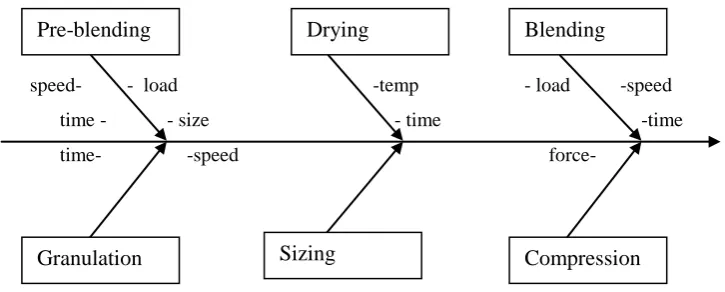
For finding out the critical process parameters the study of process characterization and process ranging with performance qualification is done. In process characterization different methods are used to find out critical parameter process or test parameter include cause and effect shown by fish bone diagram, constraint analysis Pareto principle etc, process ranging is the study to find out critical process or test parameter
and their respective control limits which will also affect the quality and consistency of product (outcomes/attribute). A brief discussion on fish bone diagram and constrain analysis will be relevant here.
1. Fish bone diagram9
Let us consider a tablet manufacturing process, all the steps are as follows:
1. Preblending (Mixing of API and excipient)
2. Granulation
3. Drying
4. Milling
5. Blending
6. Compression
Step1: Preblending: The factor could influence the preblending processes are:
a) Speed of Propeller/blades
b) Load in the mass mixer
c) Total mixing Time
Step 2- Granulation: The factors which could influence the granulation process are:
a) Load of mixture
b) Rate of oscillation/ rotation
c) Speed
d) Time
Step 3:Drying: The factors which could influence the drying are:
a) Temp
b) Size for drying
c) Time for drying
Step 4: Milling: The factors which could influence the Milling are:
a) Mesh size of screen
b) Speed of oscillation/rotation
Step5: Mixing/ lubrication
a) Load in blender
b) Speed of rotation
c) Time
Compression
a) Force of die
b) Speed of machine
speed- - load -temp - load -speed
time - - size - time -time
time- -speed force-
Figure 2: Process flow diagram for process validation of tablet
This diagram shows the relationship and interrelationship which may exist between various process variable and single response i.e. product attributes. The centre line of fish bone diagram is composite of all factors which may affect the quality and consistency of all finished product. The branches of central line show the influence of process steps. The process variables for each step which can cause the variation in the final product have been shown as subbranches. When the experimentation is done the variables are varied within the operational range and the results are evaluated, if the result have no significant deviation the variable are called non critical.
(ii) Constraint Analysis: If we dealing with various variables, problems can arise there, constraints analysis aimed at limiting the operational range of each process variable and or specification limits.
The constraint analysis the information obtained from previous work and experiment regarding the process, equipment, raw material and packaging vendors or the published literature is used. 9
(iii) The Pareto Principle: Pareto has given a 20-80 rule according which 80% of variation in a statistical sample is caused by 20% input variable. Means if we get 80% deviation in final result this is caused by only 20% of process variables.9
PREREQUISITE OF PROCESS VALIDATION 7
Prior to initiating validation studies, and it is necessary to assure that the equipment to be used in validation is functioning properly and working within the given range. The equipment should comply the qualification, according to WHO GMP. The validation qualification should be established and documented. The process development designer reviews the design qualification (DQ) of premises, utilities and process according to GMP. He also reviews weather the utilities and equipment are installed according to Installation qualification IQ and performing according to their performance qualification (PQ) or operating according to their operational qualification (OQ). He also reviews the reports of product development, pilot scale, scale up batch, the proposed master formula of product to be manufactured. He also confirms that the analytical
method is made available to the plant or not before performing validation testing and routine testing; with QC/QA. The designee also prepares the production records of Commercial/ exhibit batch, including control and operational limits and plan for process control based on development report. Then process validation is conducted after validating the facilities, utilities, and equipment, and laboratory test methods and released for process validation activities. Where compendia method is used only limited analytical method validation shall be conducted. The specifications of raw materials and packaging materials should be approved by QC and vendor. The equipments and instruments should be calibrated. All the SOPs should be placed properly. The training should be given to the worker regarding the equipments, operations, manufacturing instruction and sampling plan.
Steps in Process Validation13
Step 1: Identification of critical parameters of major processes to be validated.
Step 2: Identify the methodology, processes, and piece of equipment that will be used in the manufacture of the products.
Step 3: Identify the potentially relevant and critical process variables.
Step 4: Conduct process validation experiments.
Step 5: Review product performance against the proposed specification. After describing the quality features, which must be achieved in the product and the minimum acceptable values of each feature, the specifications developed for the product should be reviewed.
Step 6: Monitor and review the results of the validation experiments. Validation report will be prepared. Optimized values of process variables will be assigned based on those validations experiments for subsequent running production which will give the confidence that the each unit operations/sub processes will lead to produce products of pre-defined quality consistently over time.
Pre-blending
Drying
Blending
Validation Protocol 9
For performing the process validations the detailed protocols are required for ensuring that the process is been adequately validated. The protocol should contain the following components:
1. The purpose and scope of the validation.
2. Validation team with their qualifications and responsibilities.
3. Type of validation: Prospective, Concurrent, Retrospective, Re-validation.
4. Total Number batches should be validated.
5. A complete list of equipments and apparatus to be used; with their parameters.
6. Installation Qualification and Operation Qualification of equipments.
7. The calibration criteria for all instruments.
8. All possible critical process parameters with their criteria.
9. All the process variables/ attributes with their risk and management should be given.
10. Production related all processing details should be clearly described in the form of master documents. 11. Sampling schedule with all details of sampling
points, methods and sampling plans.
12. Statistical tools to be used in the analysis of data. 13. Training schedule for operators.
14. Validated test methods to be used in in-process testing and for the finished product.
15. Specifications for raw and packaging materials and test methods.
16. All performs for documenting the results, conclusions and for approval of study results should be given.
Organization for validation and its duties
Validation is responsibility of an organization, various department are engaged in this organization the team member are selected from R and D, production, QC, QA engineering and validation expert who can head this organization. The job of his team/organization is preparation of V M P, designing and implementation of validation procedures as per validation protocol, coordination with equipment vendors and assist in process fabrication and prepare appropriate reports for approvals, identification of turnover of validated systems and process, preparation of project schedules and implement protocols for validation, development of test method, conducting calibration on validation test equipments and processes and also preparation of reports to submit to management.
Validation Master Plan13
The WHO GMP explains that all the content of validation program should be clearly mentioned and documented in validation master plans, it is an internally approved plan, which include validation policies, structure of organization, summary of facilities like list of equipments to be used, steps used in validation, formats for documentation, sampling
schedules, process variable, change control, analytical method to be used, acceptance criteria, references and validation option (prospective, concurrent and retrospective validations as well as revalidation). The information not to be repeated documented elsewhere but should refer to existing documents such as policy documents, SOP’s and validation protocols and reports.
The format and content should include:
1. Introduction: Scope of validation,
2. Validation policies of manufacturer, aimed to implementation of GMP requirement in the country where the plant is located or countries where the product is to be exported.
3. Organizational structure of all activities including personnel responsibility, validation protocol, validation work, document preparation, reports, approval at every step and training.
4. Extent of validation required (IQ,OQ and or PQ)
5. Re-validation frequencies
6. Summary of facilities, list of equipments and complete description of process.
7. Complete description of product
8. Specific process considerations that are critical and those requiring extra attention.
9. Re-validation activities, actual status and future planning.
10.Method of analysis and acceptance criteria
11.Documentation format.
12.References existing document
13.List of all relevant SOPs.
14.Time plans of each validation project and sub-project.
Sampling Schedule for Validation 14,15
For validation, a detailed sampling Schedule or plan is required, which contain an idea about the sampling pattern, sampling time, method of analysis and also the monitory method.
a) This plan contains a detail about sampling point, total no. of sample to be taken; sampling frequency at every unit operation, these are decided on basis of properties of product and equipments used in validation.
b) Appropriate no. the samples should be there.
c) At least 3 samples from each sampling point should be withdrawn for the statistical confidence of quality both within a batch and between batches.
e) The location from where the samples to be withdrawn from any equipment should be clearly indicated with the help of diagram.
Acceptance Criteria
The acceptance criteria are the parameter that clearly defines the activity and limits of acceptance. The acceptance criteria are the specification given in official books like IP/USP. The test results obtained from validation studies evaluated against the acceptance criteria or specifications, the conformance is discussed to support the validation activities. The all results are evaluated for consistency and reproducibility and meet with predetermined attributes. A validation report is
prepared on basis the results obtained from study conducted as per approved validation protocol.
Basic Steps for validation and acceptance criteria for tablet16
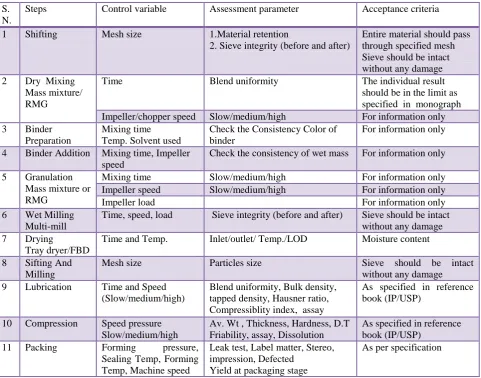
While performing the validation of tablet dosage form we have to first know all the steps, equipment, apparatus used with their process variables, assessment parameter and acceptance criteria involved in validation. The all above stated things are performed accordingly and the data are recorded. Here all possible processing steps, assessment parameter and acceptance criteria are given in tabular form to understand how the validation is performed.
Table 1: Steps involved in validation and acceptance criteria for tablet
Failure and Deviation 11
In process validation test has been performed to determine failure and deviation. There should not any case of failure. The procedure should cover all the possible areas of potential failure. The validation study gives an idea on the action to be done, recording its justification and recommendations. This decision consider: if the analytical results are not within limit, retesting is required. The operation parameters, process steps, equipment, procedure may be changed.
Suspension of the process validation exercise until further technical evaluation and/or development has been carried out, sampling regime, analytical procedure and process validation acceptance criteria can be changed.
Final Process Validation Report 15
A document in which the records, results and evaluation of a completed validation programmer are assembled and summarized. It may also contain S.
N.
Steps Control variable Assessment parameter Acceptance criteria
1 Shifting Mesh size 1.Material retention
2. Sieve integrity (before and after)
Entire material should pass through specified mesh Sieve should be intact without any damage 2 Dry Mixing
Mass mixture/ RMG
Time Blend uniformity The individual result
should be in the limit as specified in monograph Impeller/chopper speed Slow/medium/high For information only 3 Binder
Preparation
Mixing time Temp. Solvent used
Check the Consistency Color of binder
For information only
4 Binder Addition Mixing time, Impeller speed
Check the consistency of wet mass For information only
5 Granulation Mass mixture or RMG
Mixing time Slow/medium/high For information only
Impeller speed Slow/medium/high For information only
Impeller load For information only
6 Wet Milling Multi-mill
Time, speed, load Sieve integrity (before and after) Sieve should be intact without any damage 7 Drying
Tray dryer/FBD
Time and Temp. Inlet/outlet/ Temp./LOD Moisture content
8 Sifting And Milling
Mesh size Particles size Sieve should be intact
without any damage 9 Lubrication Time and Speed
(Slow/medium/high)
Blend uniformity, Bulk density, tapped density, Hausner ratio, Compressiblity index, assay
As specified in reference book (IP/USP)
10 Compression Speed pressure Slow/medium/high
Av. Wt , Thickness, Hardness, D.T Friability, assay, Dissolution
As specified in reference book (IP/USP)
11 Packing Forming pressure,
Sealing Temp, Forming Temp, Machine speed
Leak test, Label matter, Stereo, impression, Defected
Yield at packaging stage
proposal for improvement of process. At the conclusion of validation activities, a final report should be prepared. This report should summarize and reference all protocols and results. It should derive conclusions regarding the validation status of the process and necessary recommendation for routine process. The final report should be reviewed and approved by the validation team and appropriate management.
APPLICATION OF PROCESS VALIDATION
Validation is basically good business practice. It helps in following:-
1. Regulatory Requirement
Validation is regulatory requirement for the cGMPs and USFDA all over the world. The cGMP basically serve as guidelines but do not provide step-by-step directions on how to achieve them. However, the validation master plan and associated SPOs exactly responsibilities: who, when, where, and how much is sufficient to demonstrate. Improve employee awareness of processes.
2. Quality Assurance
Validation provides confidence in the quality of product of products manufactured as the over quality of a particular process cannot be established due to the limited sample size. Validation leads to less troubleshooting with routine production. As a result it reduces the number of customer complaints and drug recalls.
3. Cost Cutting Tool
Validation is a tool for cutting the cost; it is comprised of preventive, appraisal, internal failure external failure. The preventive cost includes quality planning, vendor approval, training, documentation and
preventive maintenance, calibration and sanitation cost. The Appraisal cost include inspection of raw material in-process material, finished product and stability testing, the internal failure cost include re-inspection, retesting, rework, and rejection and external failure cost include recall, complaints and return due to quality issue.Validation leads to the optimization of processes and results in minimization of those expenses. Reduction in rejections and reworks. Reduction in utility cost. Avoidance of capital expenditures.
4. Reproducibility
The product obtained from process validation shows reproducibility in quality, purity, strength and also shows consistency in results.
5. Easier scale-up from development work.
6. Easier maintenance of equipment.
7. Improve employee awareness of processes.
8. More rapid automation.
CONCLUSION
Validation is not only for a regulatory requirement of cGMP or audits across the world, but it also improve whole process by which an industry save time, wastage of investment. The process validation not only improves process but it also assured that the process will be performed in prescribed pattern and which is been controlled to attain and manage the quality of final product. Process validation is systematic approach in identifying, measuring, evaluation; documenting and revalidating the critical steps in pharmaceutical dosages form (tablet), with control assure consistency in the quality of final product. With the help of this review one can conduct the process validation and one can know basic about the process validation of in an industry.
REFERENCES
1. Aulton M E, Pharmaceutics, The Science of Dosage Form
Design, International edition, second edition, Churchill Livingston (Elsevier), 2006.
2. Nash R A, Wachter A H, Pharmaceutical Process Validation,
Third Edition, vol 129, Marcel Dekker, Inc., New York, 2003;159-180.
3. Michael L, Pharmaceutical Process Scale-Up, Marcel Dekker,
Inc., New York, 2002, 313.
4. Quality Assurance of Pharmaceuticals: A Compendium of
Guidelines And Related Materials Vol 2, 2nd
updated edition 105.
5. U.S. Food and Drug Administration. Guideline on General
Principles of Process Validation; U.S.FDA: Rockville, M D, May, 1987.
6. Chirarutsami W, Process Validation of Sterile Liquid
Products, 2006.
7. M D Shoaib, Pharmaceutical Process Validation: An
Overview, Journal of Advanced Pharmacy Education and Research, 2012, 2 (4) 189-191.
8. Kaur H, Singh G, Seth N, Pharmaceutical Process Validation: A Review, Journal of Drug Delivery and Therapeutics. 2013; 3(4):189-194
9. Sharma P P, Validation In Pharmaceutical Industry, 2nd
Edition, Vandana Publication, 2013
10. www.nsf-dba.com
11. www.ich.org
12. www.pharmatech.com
13. Potdar M, cGMP for pharmaceuticals, Pharma Med Press
reprint, 2012.
14. Parajuli RR, Shrestha S, Lamichane S, Pokhrel P, A review on pharmaceutical process validation of solid dosage form [tablets], Journal of Drug Delivery and Therapeutics. 2015; 5(6): 1-7
15. Satyabrata J, Arjun G, Ravipati A K, Industrial Process
Validation of Solid Dosage Forms – An Overview Int. J.
Pharma Sci Rev And Res, 2010,4(2), 145-148.
16. Bhattacharjee D, Maity S, Manna A, Industrial Application of
Process Validation in the Development and Scale-Up of Pharmaceutical Tablet Dosage Form of a Low Dose Containing Drug and a High Dose Containing Drug, J P S T, 2011, 3(3), 570-573.
17. Agalloco J, Frederick J. Carleton, Validation of
18. Gupta G D, Garg R, Aggrwal S. Guidelines on General Principles of Validation: Solid Liquid and Sterile Dosage Forms, 2008; 6(1):28-33.
19. Guidance for Industry: Process Validation: General Principles
and Practices. U.S. Department of Health and Human Services, Food and Drug Administration, Centre for Drug Evaluation and Research (CDER), Centre for Biologics Evaluation and Research (CBER), Centre for Veterinary Medicine (CVM), 2011.
20. Oechslein C, Lazar M S – Process Validation from view
report of the FDA, Maas & Peither AG – GMP Publishing, LOGFILE, 3, 2012.
21. Quality Management System – Process Validation Guidance
GHTF/SG3/N99-10, 2nd Edition, 2004.
22. Patel R C, Bhuva C K, Singh R P, Dadhich A, Sharma A,
Pharmaceutical Process Validation, Pharmatutor – ART – 1053.
23. Guidance on Process Validation: Rev 1-
EMA/CHMP/CVMP/QWP/7027/2012. 8. Health Canada / Health Products and Food Branch Inspectorate Validation Guidelines for Pharmaceutical Dosage Forms (GUI – 0029) / 2009.
24. Guidelines for Process Validation of Pharmaceutical Dosage
Form – Saudi Food & Drug Authority; Version 2; 1992.
25. Guide to Inspections of Oral Solid Dosage Forms pre/post
Approval Issue for Development and Validation; issue (1/94); January, 2010.
26. Note for Guidance on Process Validation – The Europe
Agency From Evaluation of Medicinal Products;
CPMP/QWP/848/96; EMEA/CVMP/598/99;
27. Validation Master Plan Installation and Operational
Qualification – Pharmaceutical Inspection Convention; Pharmaceutical Inspection Co-Operation Scheme; PI 006 – 2; July, 2004.
28. Kathiresan K, Moorthi C, Prathyusha Y, Gade B. R, Reddy B.
K, Manavalan R, An overview of pharmaceutical validation; Research Journal of Pharmaceutical, Biological and Chemical Sciences, RJPBCS, 2010, 1(4), 1026.
29. FDA’s guidance for industry, Quality Systems Approach to
Pharmaceutical Current Good Manufacturing Practice Regulations, 4. Health Canada / Health Products and Food Branch Inspectorate Validation Guidelines for Pharmaceutical Dosage Forms (GUI – 0029) /December, 2009.
30. Recommendations on Validation Master Plan, Installation and
Operational Qualification, Non-Sterile Process Validation, Cleaning Validation, PIC/S September, Review Article I J P R N K, 2007.
31. ASTM E2476-09 Standard Guide for Risk Assessment and
Risk Control as it Impacts the Design, Development, and Operation of PAT Processes for Pharmaceutical Manufacture.
32. ASTM E2281-03 Standard Practice for Process and
Measurement Capability Indices, 11,
33. ASTM E2500-07 Standard Guide for Specification, Design,
and Verification of Pharmaceutical and Biopharmaceutical Manufacturing Systems and Equipment.
34. ASTM E2709-10 Standard Practice for Demonstrating
Capability to Comply with a Lot Acceptance Procedure.
35. ASTM E2474-06 Standard Practice for Pharmaceutical
Process Design Utilizing Process Analytical Technology.
How to cite this article:
Rajpal G, Arya RKK, Kunwar N, Basic concept of process validation in solid dosage form (tablet): a