IJSRSET1184149 | Received : 04 May 2017 | Accepted : 20 May 2017 | May-June 2017 [(3) 3 : 703-708]
© 2017 IJSRSET | Volume 3 | Issue 3 | Print ISSN: 2395-1990 | Online ISSN : 2394-4099 Themed Section : Engineering and Technology
703
Application of Cloud Compouting Technology in Libraries
Rajneesh Kumar
Assistant Librarian, Central Library, IET, Bhaddal, Ropar, Punjab, India
ABSTRACT
Technology is growing very fast in these days Cloud computing is one of these fast growing
techniques of Information Communication Technology because of its potential benefits such as
reduced cost, accessible anywhere anytime as well as its elasticity and flexibility.For many
organizations, cloud computing can simplify processes and we can save time and money by using
cloud computing.The paper presents an overview of cloud computing and its possible applications that
can be clubbed with library services on the web based environment. This study may be helpful in
identifying and generating cloud based services for libraries.
Keywords: Cloud Computing,Models of Cloud Computing,Cloud,Libraries and Cloud computing.
I.
INTRODUCTION
Nowadays, cloud computing is emerged as one of the most popular virtual technology for libraries to deliver the services in an effective manner. Cloud computing contains features of different technologies including utility computing, grid computing, unified computing, web 2.0, service oriented architecture and so on. Cloud computing technology is offering great advantages for libraries to connect their services not only promptly but also in new formats with the flexibilities such as pay as you use model, access any where any time and so on. Nowadays libraries are using cloud computing technology for enhancing the services by adding more values, attracting the users and cost effectiveness. In the cloud computing environment, clouds are vast resource pools with on demand resource allocation and a collection of networked features. The new concept of cloud and libraries has generated a new model called cloud libraries. Though the usages of cloud computing may vary with the libraries nature, services and information needs but most common usages of cloud computing with in libraries can be development of digital libraries, corporate cataloging, acquisition, storages and sharing the resources on virtual environment on the web. The need of cloud
computing may occur due to the information explosion, problems in accessing the information, save the time of the users and staff, resource sharing problems, problems in library resources management, complex demand of users and attraction of users towards cutting edge technologies.
Meaning of cloud computing
these resources as a single entity which can be changed to meet the current needs of the user. The basis of cloud computing is to create a set of virtual servers on the available vast resource pool and give it to the clients. Any web enabled device can be used to access the resources through the virtual servers. Based on the computing needs of the client, the infrastructure allotted to the client can be scaled up or down. From a business point of view, cloud computing is a method to address the Scalability and availability concerns for large scale applications which involves lesser Overhead. Since the resource allocated to the client can be varied based on the needs of the client and can be done without any fuss, the overhead is very low.
Ojectives of the study
To explain the concept and various models of cloud computing.
To discover the library services that are clubbing with cloud computing technology.
To investigate present situation of Indian libraries in order to adopt cloud computing into their library services.
Review of Litrature
Large number of studies have been conducted on cloud computing and libraries related issues such as Khan provided the concept of cloud computing and also highlighted that how libraries can be benefited using cloud computing technology by providing some live examples.
sasikala argued the concept of cloud computing from the perspectives of diverse technologists, services and models available, cloud standards, cloud in government, enterprises and higher education, along with opportunities, challenges and implications on the basis past, present and future situation.
Pandya investigated the implication issues of cloud computing in libraries on the basis of SOWAT analysis and pointed out the strengths, weaknesses, opportunities, and threats a ssociated with cloud computing and libraries.
Srivastava presented the vision of cloud computing with various commercially cloud services available on the Infrastructure as-a-Service (IaaS) and found that cloud computing is changing the way towards hardware and software for ondemand capacity fulfillment and development of web applications to make business decisions.
Goldner expressed the view with regard to cloud computing, how cloud computing is differed from the other computing and its advantages to libraries in three basic areas: Technology, data and community.
Wang examined the trends of cloud computing on the basis of extant information systems literature, industry reports and practical experience reflections and also pointed out the significance of cloud computing and its implications for practitioner and academics.
Murley provided an overview of cloud computing and list of resources and services may attach with cloud computing technology particularly in law libraries and also stated that cloud computing is not new for law libraries.
Goya defined the benefits and comparisons of cloud computing services on the parameters of pricing, maximum limit, data security, data backup. This paper also includes the advantages and disadvantages of cloud computing.
Jordan expressed that cloud computing technology are clubbing with libraries services and web scale services are developing on the web in order to present the library services when and where required the users by example of Online Computer Library Center (OCLC) services.
Use of cloud Computing in Library
1.Most library computer systems are built on pre-Web technology.
2. Systems distributed across the Net using pre-Web technology are harder and more costly to integrate.
3. Libraries store and maintain a lot of of constant knowledge lots of and thousands of times.
4. With library data scatter across distributed systems the library‟s Web presence is weakened.
5. With libraries running independent systems collaboration between libraries is made difficult and expensive.
6. Information seekers work in common Web environments and distributed systems make it difficult to get the library into their workflow.
7.Many systems are only used to 10% of their
capacity. Combining systems into a cloud
environment reduces the carbon footprints, making libraries greener These improvements can be grouped into three basic areas: technology, data and community. Each offers some general and some unique opportunities for libraries.
Cloud Computing Models
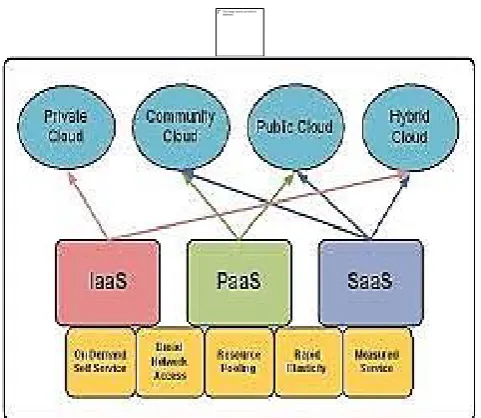
Two models are working for the cloud computing. a)Deployment Models b) Service Models.
Cloud Deployment Models:
1. Public Cloud Model: The public cloud model allows systems and services to be easily accessible to general public. The whole cloud computing infrastructure is fully controlled by the third party providers. E.g. Google, Amazon, Microsoft offers cloud services via Internet.
2. Private Cloud Model: The private cloud allows systems and services to be accessible within an organization. The private cloud is operated only within a single organization. But it may be managed
internally or by third party. This cloud offers more security as it is implemented within the internal firewall.
3. Hybrid Cloud Model: This cloud is a mixture of public and private model. On critical activities are performed using public cloud while the critical activities are performed using private cloud. The organization uses the public cloud services along with its own cloud to perform resource intensive applications.
4. Community Cloud Model: This cloud allows system and services to be accessible by group of organizations. Third party or member organizations provider can hold the responsibility of managing the cloud. It
shares the infrastructure between several
organizations.
Cloud Service Models:
1. Software as s service (SaaS): In this model, users can avail the facilities to access and use any software available with cloud vendors. However, it is not necessary for the users to buy the software, install and run, maintenance the applications on their own servers. The cloud users need not to manage the cloud infrastructure and platform on which the application is running. This service model provides online email applications, free services, limitless storage, and remote access from any computer or device with an Internet connection.
2 latformation as a Service (PaaS): Here, a layer of
software, or development environment is
encapsulated & offered as a service, upon which other higher levels of service can be built. The customer has the freedom to build his own applications, which run
on the provider‟s infrastructure. To meet
manageability and scalability requirements of the applications, PaaS providers offer a predefined combination of OS and application servers, such as LAMP platform (Linux, Apache, MySql and PHP), restricted J2EE, Ruby etc. Google‟s App Engine, Force.com, etc are some of the popular PaaS examples.
operating systems, software and applications. All of above resources are made available to end user via server virtualization.
Figure 1. Cloud computing service model
Use of Cloud Computing in Library and Information Science
Libraries are shifting their services with the attachment of cloud and networking with the facilities to access these services anytime, anywhere. Cloud computing offers many interesting possibilities for libraries that may help to reduce technology cost and increase capacity reliability and performance for some type of automation activities. Clouding computing has large potential for libraries. Libraries may put more content into the cloud computing. The following possible fields were identified where cloud computing services and applications may be applied:
1. Library Automation: Polaris provides variant cloud based services such as acquisitions, cataloguing, process system, digital content sand provision for inclusion of cutting edge technologies used in libraries for library automation purpose. Also supports various standers such as MARC 21, XML, Z39.50, UNICODE etc. which directly related to library and information science area.
2. Digital Library and Repository: Today every library needs a digital library to make their resources, information and services at an efficient level to ensure via the network. Therefore, every library is having a digital library that developed by using any digital
library software. Dspace and Fedora are used for building digital libraries and repositories. Dura cloud provides complete solutions for developing digital libraries and repositories with standard interface and open source codes for the both software.
3. Searching Library Data: Many libraries already have online catalogues and share bibliographic data with OCLC. OCLC is one of the best examples for making use of cloud computing for sharing libraries data. It is offering various services pertain to circulation, cataloguing, acquisition and other library related services on cloud platform through the web share management system.
4. Website Hosting: This is one of the earliest adoptions of cloud computing as many organizations including libraries preferred to host their websites on third party service providers rather than hosing and maintaining their own service. Google sites serve as an example of a service for hosting websites outside of the library‟s servers and allowing for multiple editors to access the site from varied locations.
5. File Storage: To access many files on the internet cloud computing present number of services such as Flicker, Drop box, Jungle Disk, Google Doc, Sky Drive etc. These services virtually share the files on the web and provide access to anytime, anywhere without any special software and hardware. Therefor libraries can get advantages of such cloud based services for various purposes. LOCKSS (Lots of copies keeps stuff safe), CLOCKSS (Controlled LOCKSS) and portico tools are extensively used for digital preservation purpose by libraries.
6. Searching Scholarly Content: Currently,
institution and R&D labs by scholars, researchers and scientists as well as over 50,000 researchers. Now Knimbus proposed a free offer to get registered to empower the libraries for dynamic searching and also for single point search interface, maximum the usage of all e-resources, customized search across selected sources reduces noise and highlights relevant content and tools to support the complete research lifecycle.
7. Community Power: Cloud computing technology offers great opportunities for libraries to build networks among the library and information science professionals and interested information seekers by using social networking tools. Twitter and Facebook are most famous social networking services which are play a key role in building community power. This cooperative effort of libraries will create time saving, efficiencies and wider recognition, cooperative intelligence for better decision making and provides the platform for innovation and sharing the intellectual conversation ideas and knowledge.
Advantages of cloud computing in libraries
• Cost reduction- Ability to increase or decrease the consumption of hardware or software resources immediately and in some cases automatically.
• Scalability- “Pay as you go” allowing a more efficient control of expenditures. • Lower investment, reduced risk- Immediate access to the improvements in the resource proposed (hardware and software) and debugging.
• Support included- Enjoyment of the most advanced security procedures, availability and performance of providers with experience and knowledge in this type of service.
• Greater security and accessibility- Access to resources from any geographical point and the ability to test and evaluate resources at no cost.
• Portability- since the service is available over the web, the service can be availed through browser from any part of the world.
• Adjustable storage- In the traditional system, if the server is less than what we have. The server should be replaced with the new one. In this computing, the
storage capacity can be adjusted according to the needs of the library, since the storage is controlled by the service provider.
• Cloud OPAC- Most of the libraries in the world are having the catalogue over the web. These catalogues are available with their libraries local server made it available over the web. If the catalogue of the libraries made it available through cloud, it will be more benefit to the users to find out the availability of materials.
II.
CONCLUSION
Cloud computing is the third generation platform. Libraries are moving towards cloud computing technology in present time and taking advantages of cloud based services especially in digital libraries, social networking and information communication. Therefore it is time for libraries think seriously for libraries services with cloud based technologies and provide reliable and rapid services to their users. Another role of LIS professionals in this virtual era is to make cloud based services as a reliable medium to disseminate library services to their users with ease of use and save the time of users.
III.
REFERENCES
[1]. Josyula Venkata, Orr Malcolm, Page Grege, Cloud Computing: Automating the Virtualized Data Center, Dorling Kindersley (India) Pvt. Ltd. New Delhi.2012.pp.1-17
[2]. http://www.oclc.org/content/dam/oclc/events/2 011/files/IFLA-winds-of-change-paper.pdf [3]. Bhattacharjee, N., & Das Purkayastha, S. (2013).
Cloud computing and its applications in libraries. e-Library Science Research Journal, 1(7).
[4]. Kumar, D. A., & Mandal, S. (2013). Development of cloud computing in integrated library management and retrieval system.
International Journal of Library and
Information Science, 5(10), 394-400
[5]. Cloud Computing Architecture in digital library available at:http://en.wikipedia.org/wiki/ cloud computing.
[7]. G. Matt. (2010). Winds of change: Libraries and cloud computing. OCLC Online Computer
Library Center. [Online]. pp. 5.
Available:http://www.oclc.org/content/dam/ocl
c/events/2011/files/IFLA-windsof-changepaper.pdf
[8]. Sasikala, P. (2011).Cloud computing: Present status and future implications. International Journal Cloud Computing, 1(1), 23-36. 10. Goyal, S. (2012). A comparative study of cloud computing service providers. International Journal of Advanced Research in Computer Science and Software Engineering, 2(2), 1-5. 11. [9]. Jordon, J. (2011).Climbing out of the box and into the cloud building web-scale for Libraries. Journal of Library Administration, 51(1), 3-17. 12.
[10]. Wang, W.Y.C., Rasid, A. & Chung, H.M. (2011). Toward the trend of cloud computing. Journal of Electronic Commerce Research, 12(4), 238-241
[11]. Farber, R. Cloud Computing: Pie in the Sky? ScientificComputing.com, November/December 2009 8. Davies, K. Amylin, Amazon, and the Cloud. BioIT World, November/December 2009, pp. 35, 42.
[12]. Cloud Computing - MLADEN .A.VOUK -Issues,
Research an Implementations, Information Technical Interfaces, June 2008.
[13]. Buyya, R., Yeo, C.S., Venugopal , S., Broberg, J. & Brandic, I. (2009). Cloud computing and emerging IT platforms: Vision, hype, and reality for delivering computing asthe 5th utility. Future Generation Computer Systems, 25, 599-616. 4.
[14]. Khan, S., Khan, S. & Galibeen, S. (2011). Cloud computing an emerging technology: Changing ways of libraries collaboration. International Research: Journal of Library and Information Science, 1(2). 5.
[15]. Pandya, M. (2012).Cloud computing for